Chinese Journal of Organic Chemistry >
Synthesis of A Novel Calix[3]carbazole Derivative and Its Recognition and Detection of 10-Hydroxycamptothecin
Received date: 2024-07-26
Revised date: 2024-09-23
Online published: 2024-11-08
Supported by
Basic Research Projects of Liaoning Provincial Department of Education(LJ212410163011)
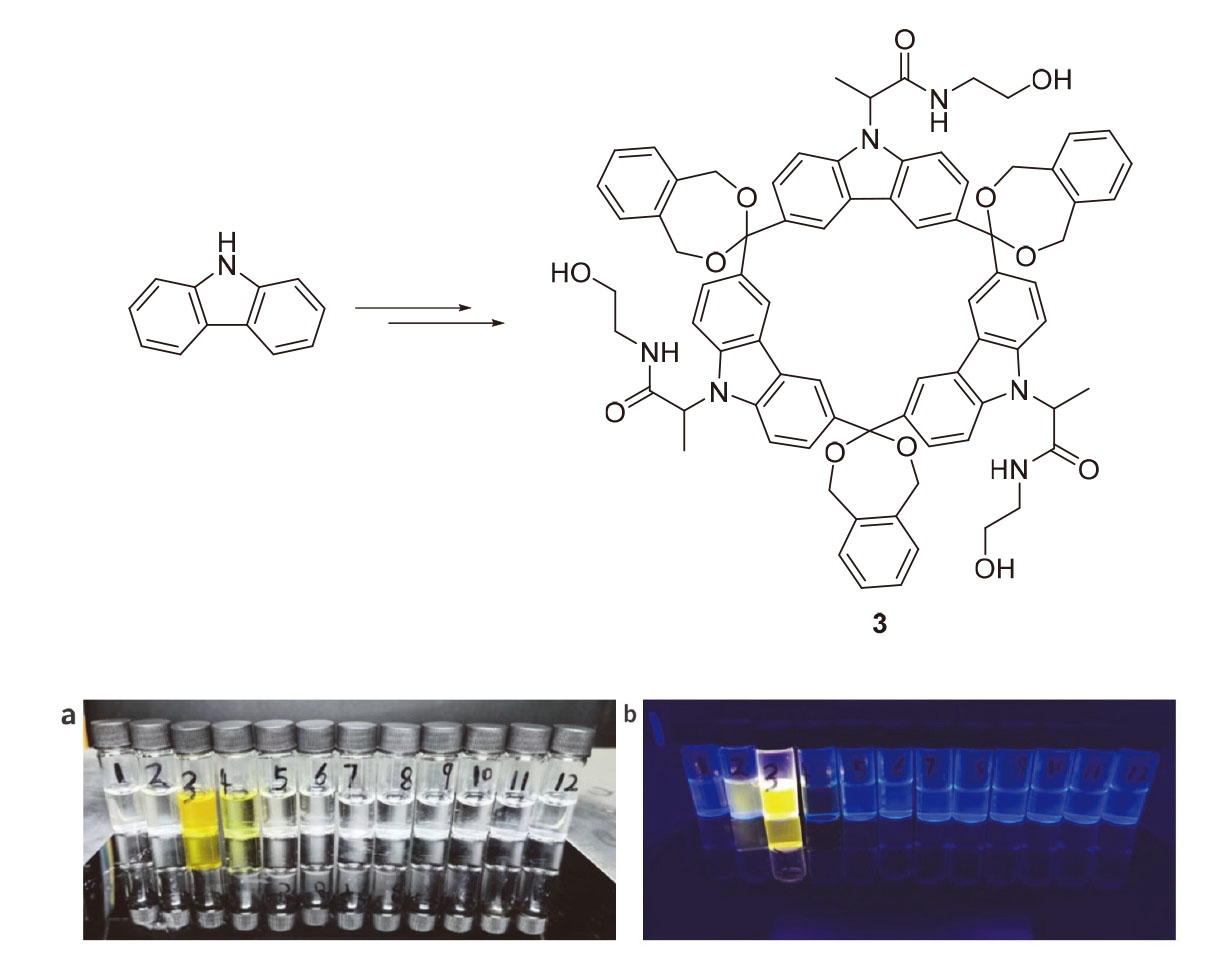
The fluorescent molecule capable of recognizing 10-hydroxycamptothecin (HCPT), a broad-spectrum anti-tumor drug, is not only able to detect it, but also able to enhance its activity due to the improvement of the delivery. Therefore, the construction of highly selective fluorescent hosts of HCPT is valuable, but remains challenging. In this work, an amphiphilic carbazole macrocyclic molecule (3) was synthesized and the host-guest interaction between 3 and HCPT was studied by fluorescence spectroscopy, NMR, scanning electron microscopy and transmission electron microscopy. The results showed that 3 could recognize HCPT with a stoichiometric ratio of 2∶1 via the mechanism of fluorescence resonance energy transfer (FRET) and a binding constant of 1.26×10¹⁴ (mol/L)-2. The detection of limit (LOD) is 11.7 nmol•L-1. In addition, the complexation enhanced the activity of HCPT to inhibit the proliferation of MCF-7 (Michigan Cancer Foundation-7) cells in vitro, and the IC50 value decreased by two orders of magnitude, indicating that 3 possessed the dual function of both fluorescence probe and molecular carrier, thus providing scientific basis for further research.
Key words: host-guest; fluorescent probe; calix[n]carbazole
Wenbo Zhang , Siming Su , Peng Yang . Synthesis of A Novel Calix[3]carbazole Derivative and Its Recognition and Detection of 10-Hydroxycamptothecin[J]. Chinese Journal of Organic Chemistry, 2025 , 45(4) : 1395 -1401 . DOI: 10.6023/cjoc202407038
| [1] | Zhang, Y.; Jiang, K.; Qing, D.; Huang, B.; Jiang, J.; Wang, S.; Yan, C. RSC Adv. 2017, 7, 12185. |
| [2] | Xu, Y.; Villalona-calero, M. A. Ann. Oncol. 2002, 13, 1841. |
| [3] | Chen, Y.; Wang, Z.; Wang, X.; Su, M.; Xu, F.; Yang, L.; Jia, L.; Zhang, Z. Int. J. Nanomed. 2022, 17, 4227. |
| [4] | Yang, P.; Jian, Y.; Zhou, X.; Li, G.; Deng, T.; Shen, H.; Yang, Z.; Tian, Z. J. Org. Chem. 2016, 81, 2974. |
| [5] | Li, G.; Song, X. Y.; Yu, H.; Hu, C.; Liu, M.; Cai, J.; Zhao, L.; Chen, Y.; Yang, P. Sens. Actuators, B 2018, 259, 177. |
| [6] | Yang, Z. Z.; Chen, Y.; Li, G.; Tian, Z.; Zhao, L.; Wu, X.; Ma, Q.; Liu, M.; Yang, P. Chem.-Eur. J. 2018, 24, 6087. |
| [7] | Zhang, F.; Du, X. S.; Zhang, D. W.; Wang, Y. F.; Lu, H. Y.; Chen, C. F. Angew. Chem., Int. Ed. 2021, 60, 15291. |
| [8] | Li, G.; Zhao, L.; Yang, P.; Yang, Z.; Tian, Z.; Chen, Y.; Shen, H.; Hu, C. Anal. Chem. 2016, 88, 10751. |
| [9] | Zhao, L.; Kang, L.; Chen, Y.; Li, G.; Wang, L.; Hu, C.; Yang, P. Spectrochim. Acta A 2018, 193, 276. |
| [10] | Chen, D. L.; Xiao, T. X.; Monflier, E.; Wang, L.Y. Commun. Chem. 2024, 7, 88. |
/
| 〈 |
|
〉 |