



糖类化合物、蛋白质和核酸为生命的三大基本物质. 糖类化合物广泛分布于天然产物和药用分子中, 它不仅是生物体内的能量来源与结构物质, 而且在许多重要的生理过程中也发挥着极为重要的作用, 包括分子间识别、细胞间信息传递、免疫应答反应以及细胞的分化和凋亡等[1-4]. 糖类化合物通常是通过糖苷键连接在一起的, 大部分糖苷化合物主要由C—O糖苷键连接而成. 近年来, N-糖苷类化合物的合成及修饰也得到了广泛关注[5-8]. 该类化合物不仅具有抗菌抗炎、免疫调节、抗肿瘤和抗病毒等重要的药理活性, 而且在调节细胞的生理功能上发挥着重要的作用. 然而, O/N-糖苷类化合物容易被胃酸和糖苷水解酶破坏, 在起治疗作用之前可能会被机体代谢, 影响其生物利用度.
C-糖苷类化合物(C-glycosides)是一类苷元和糖基通过C—C键连接而成的糖类化合物, 在生理环境中能够稳定存在, 从而可能表现出更加出色的生物利用度和药用效果. C-糖苷类化合物属于伪糖苷化合物, 因此国际纯粹与应用化学联合会(IUPAC)建议使用C-糖基化合物(C-glycosyl compounds)代替C-糖苷类化合物[9]. 由于C-糖苷类化合物这一名词已经在文献中被广泛使用, 本综述中不区分这两种说法.
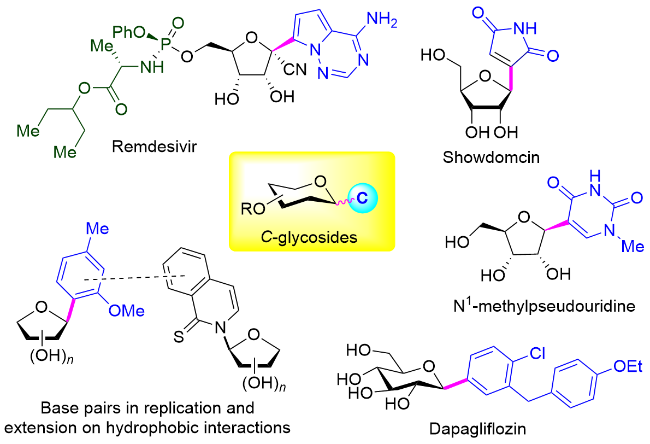
C-糖苷类化合物虽然种类较少, 但因其相较于O-糖苷或N-糖苷有更强的化学稳定性, 在生物化学、药物化学及材料科学等领域有着重要的应用(图1). 达格列净(Dapagliflozin)是一种C-芳基糖苷类化合物, 它是一种钠-葡萄糖协同转运蛋白2 (SGLT2)抑制剂, 美国食品药品监督管理局(FDA)于2014年1月批准其用于II型糖尿病的治疗[10]. 瑞德西韦(Remdesivir)是一类C-核苷类(C‑nucleosides)药物, 碱基与糖基通过C—C键连接, 该化合物对新型冠状病毒(SARS-CoV)和中东呼吸综合征冠状病毒(MERS-CoV)有强效抑制作用, 在原代人呼吸道上皮细胞培养体系中, 对SARS-CoV和MERS-CoV的半数抑制溶度EC50值为74 nmol/L, 而在延迟脑肿瘤细胞中, 对鼠肝炎病毒的EC50值为30 nmol/L[11]. 生物体内也含有C-核苷化合物来调控自身的生物功能. Karikó和Weissman等[12]发现将假尿苷或N1-甲基假尿苷引入mRNA, 能有效降低mRNA疫苗的免疫原性, 增强mRNA的稳定性, 且增强其蛋白表达能力. Karikó和Weissman在核苷碱基修饰方面的发现使得开发针对COVID-19的有效mRNA疫苗成为可能, 他们因此获得了2023年诺贝尔生理学或医学奖. 焦土霉素Showdomcin是从焦链霉素Streptomyces showdoensis分离出的一种核苷酸生物合成阻断剂[13]. 在生物化学领域, C-糖苷也可以作为分子探针来研究DNA或RNA聚合酶和反转录酶的活性和机制[14]. Kool课题组[15]报道疏水键的相互作用力也可以完成有效的碱基配对, 设计出以芳基为苷元的C-糖苷来模仿DNA碱基的结构, 这些C-糖苷可以通过疏水键的作用力完成碱基和碱基之间的配对. 他们将该类化合物设计为分子探针来研究DNA复制和转录等相关机制.
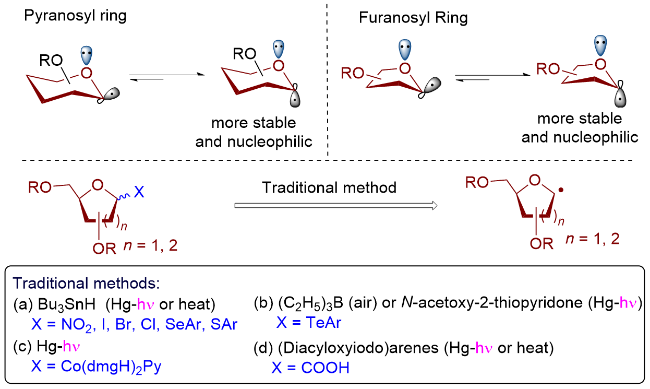
由于C-糖苷类化合物具有非常重要的药理活性和生理功能, 它们的合成引起了化学家的广泛重视. 合成C-糖苷类化合物的核心问题是如何构建C—C糖苷键, 其中最为经典的是过渡金属催化的离子型反应[16-18], 然而, 近些年来糖基自由基也常常被用作关键中间体构建C-糖苷键[19-24]. 在糖C(1)位产生的自由基通常会有两种类型: 平伏型σ自由基和直立型σ自由基, 由于邻位氧的孤对电子的存在, 无论是呋喃型五元糖环或者吡喃型六元糖环, 直立型σ自由基更加稳定并且具有较强的亲核性. 由于糖基自由基这些性质, 该中间体常常被利用于C-糖苷键的合成中. 传统方法常使用自由基引发剂、高温或者高压汞灯照射特殊的糖类底物来得到糖C(1)位自由基, 而且制备该类糖自由基前体往往需要多步制备, 在该类方法中C-糖苷化转化的效率低, 立体选择性差和底物兼容性不好(Scheme 1).
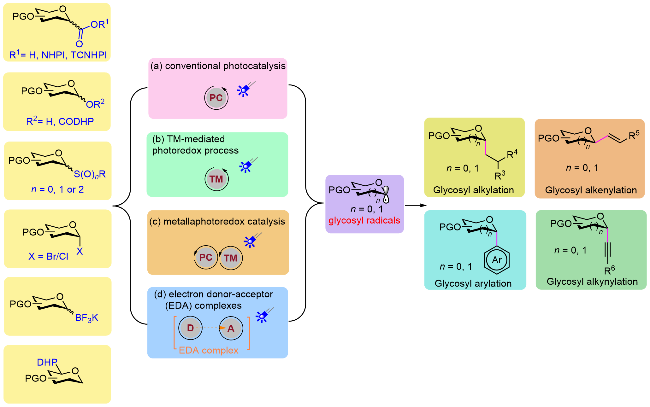
近年来, 光化学(特别是可见光氧化还原催化[25])提供了一种温和且高效的糖基化反应的方法, 该策略引起了越来越多的重视[26]. 迄今为止, 利用温和的光催化条件来构建C—O[27-29]、C—N[30-31]和C—S[32-33]糖苷键的反应不断丰富, C—C糖苷键的构建同样引起了人们浓厚的兴趣. 在光氧化还原的条件下, 预官能团化的糖基化合物被氧化或者被还原产生相应的糖基自由基, 该自由基可以被多种自由基受体捕获, 从而实现C-糖苷键构建[34]. 为了充分发挥光催化氧化还原策略在C-糖苷化反应中的作用, 研究者们设计了多种高反应活性的糖基自由基前体. 目前利用光氧化还原催化构建C-糖苷的反应模式分为传统光催化剂参与的氧化还原反应、激发态过渡金属参与的氧化还原反应、光-金属协同催化的偶联反应和光激发电子供体-受体复合物介导的反应四种. 反应中所形成的糖基自由基中间体进行了一系列后续的C-官能团化反应, 包括糖类化合物的烷基化、(杂)芳基化、烯基化以及炔基化反应等, 合成了结构多样的C-糖苷类化合物. 本文将根据光氧化还原催化构建C-糖苷的四种反应模式, 对该领域构建C-糖苷化合物的工作进行系统的总结(Scheme 2).
1 传统光催化剂参与的氧化还原反应
传统光催化剂参与的光化学反应已经发展较为成熟了, 在构建C-糖苷的诸多光化学方法中也是应用最为广泛的一种. 在该反应中仅需加入一种光催化剂作为吸光物种, 激发态的光催化在催化循环中得到电子或者给出电子, 这一过程涉及氧化或者还原淬灭循环, 取决于反应物和催化剂的性质. 整个反应的催化模式较为简单, 反应条件也很容易实现和操作.
1.1 C-糖基烷基化反应
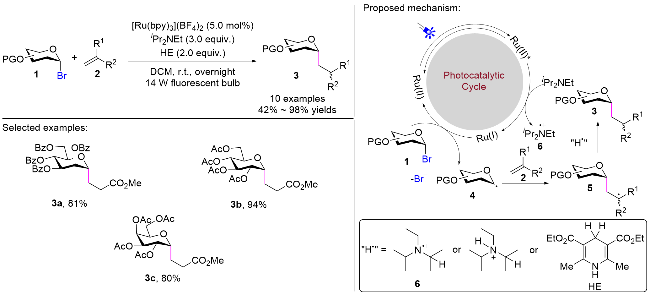
2010年, Gagné课题组[35]报道了可见光介导下的糖基溴代物与烯烃的自由基加成反应(Scheme 3). 该反应以[Ru(bpy)3](BF4)2作为光催化剂, N,N-二异丙基乙胺(DIPEA)作为还原剂, 1,4-二氢-2,6-二甲基-3,5-吡啶二羧酸二乙酯(Hantzsch Ester, HE)作为质子源, 成功实现了糖基溴代物异头碳的高α立体选择性烷基化反应. 作者提出了可能的机理: 激发态的光催化剂Ru(II)*被DIPEA还原为低价态的Ru(I), 糖基溴代物被低价态的Ru(I)还原为糖基自由基中间体4, 同时产生基态光催化剂Ru(II)进行下一个催化循环; 糖基自由基4与烯烃2发生自由基加成得到烷基自由基中间体5, 5与DIPEA阳离子自由基6或者HE发生氢原子转移即可生成目标产物.
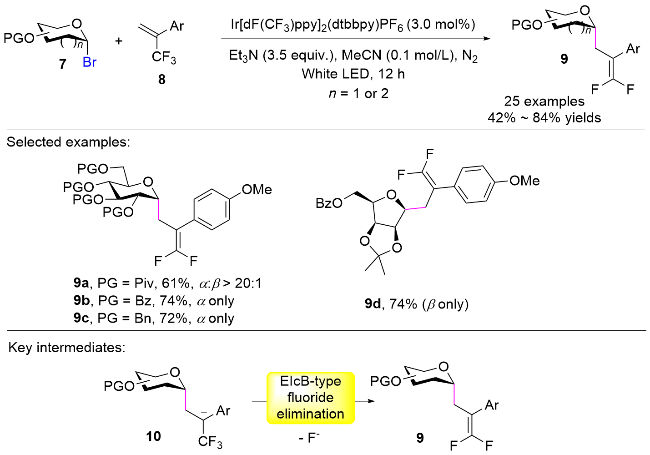
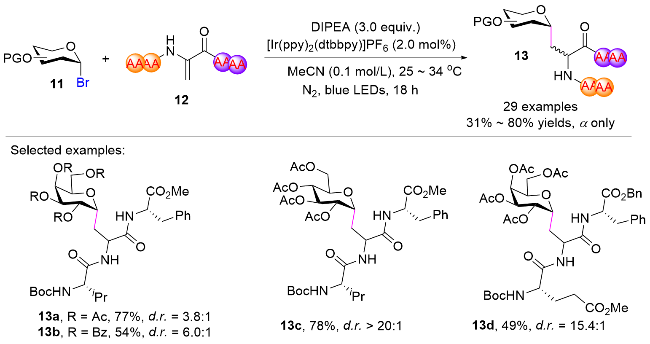
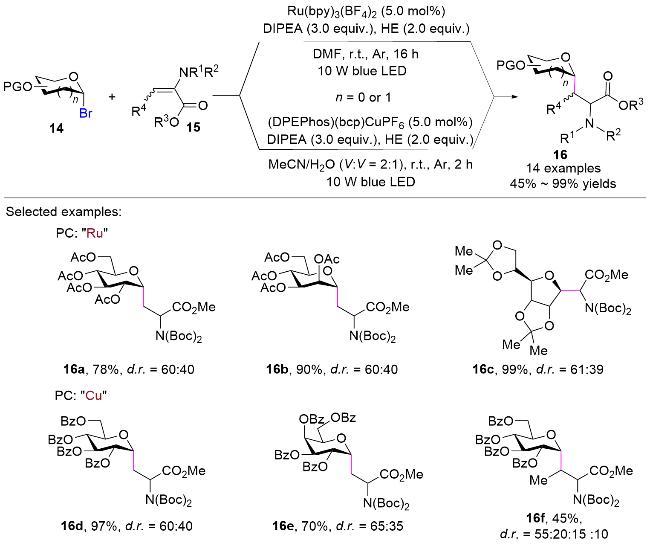
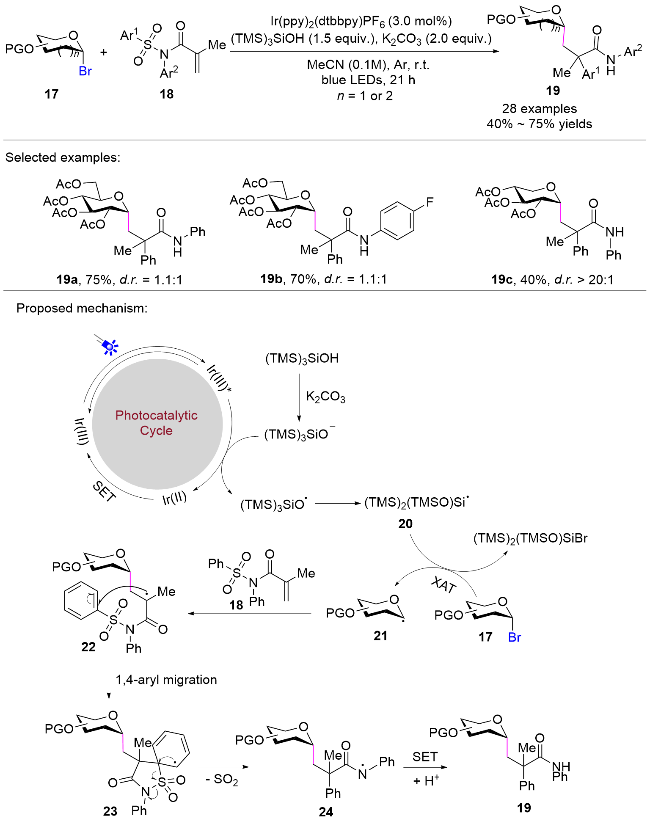
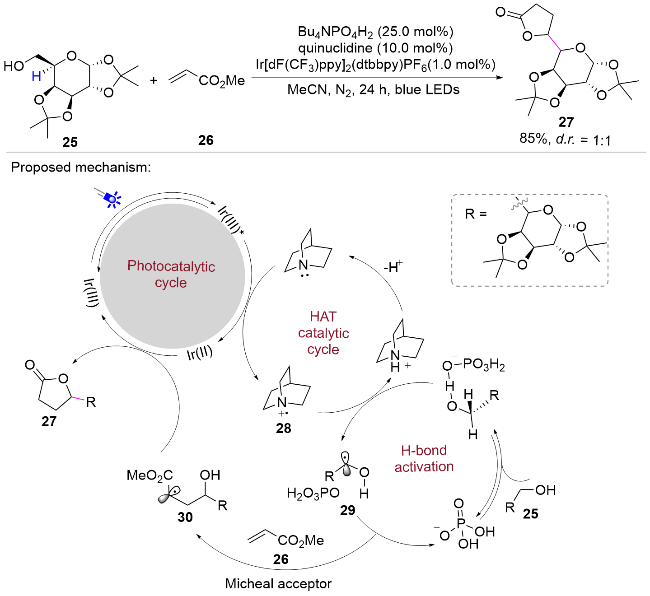
2015年, MacMillan课题组[40]报道了可见光介导下的氢原子转移机制来实现醇与丙烯酸甲酯高选择性的a-烷基化/内酯化反应(Scheme 8). 在这一新颖的催化模式中, 采用Ir[dF(CF3)ppy]2(dtbbpy)PF6作为光催化剂, 奎宁环(quinuclidine)作为还原剂和氢原子转移(HAT)试剂. 引入的磷酸四正丁基铵在反应中发挥了重要作用, 显著提高了底物醇对C—H中氢原子的选择性. 该策略已被成功应用于糖基底物. 如Scheme 8所示, 在该反应中, 奎宁环被激发态光催化剂Ir(III)*氧化生成氮正离子自由基28. 磷酸四正丁基铵激活底物25中C(6)-位裸露的羟基后, 28选择性地攫取氢原子, 形成糖基自由基中间体29. 该中间体在解离磷酸根后与烯烃26加成, 生成烷基自由基中间体30. 随后, 该中间体受到还原态光催化剂Ir(II)的还原以及再质子化和内酯化, 最终得到目标化合物27.
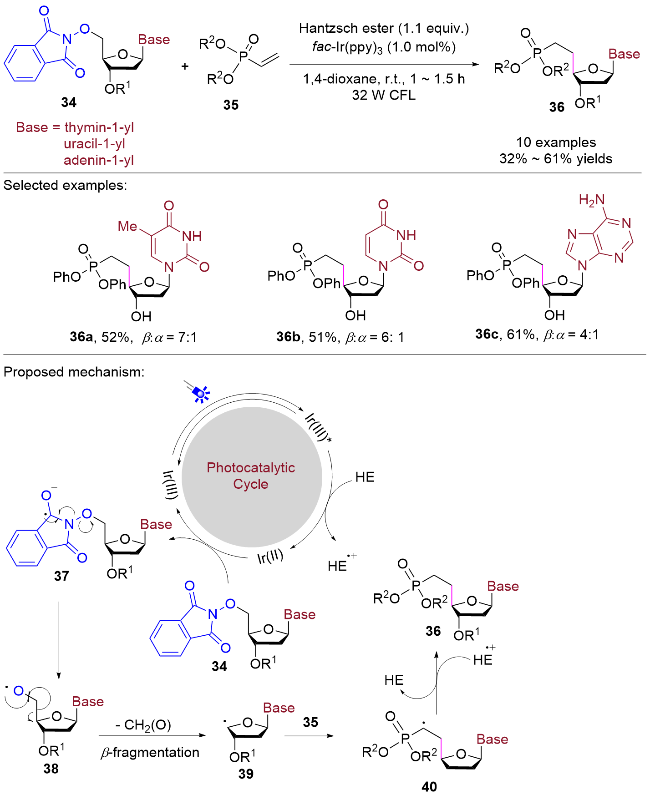
2018年, Hari课题组[42]报道了以2'-脱氧-5'-O-邻苯二甲酰亚胺核苷类化合物35为糖基自由基前体, fac-Ir(ppy)3为光催化剂, HE为还原剂, 使核糖底物去甲酰化, 实现C(4)-位烷基化反应的策略(Scheme 10). 该工作可能的机理为: 激发态光催化剂Ir(III)*被HE还原为Ir(II), 底物35再被低价态的光催化剂Ir(II)还原为阴离子自由基中间体37. 然后, 37发生均裂生成烷氧自由基中间体38, 同时脱除邻苯二甲酰亚胺盐. 随后, 38快速发生β-裂解脱去甲醛生成核糖C(4)-位烷基自由基39, 接着与烯烃受体加成产生新的烷基自由基40. 最后, 自由基40再被HE自由基阳离子还原质子化而生成目标产物36.
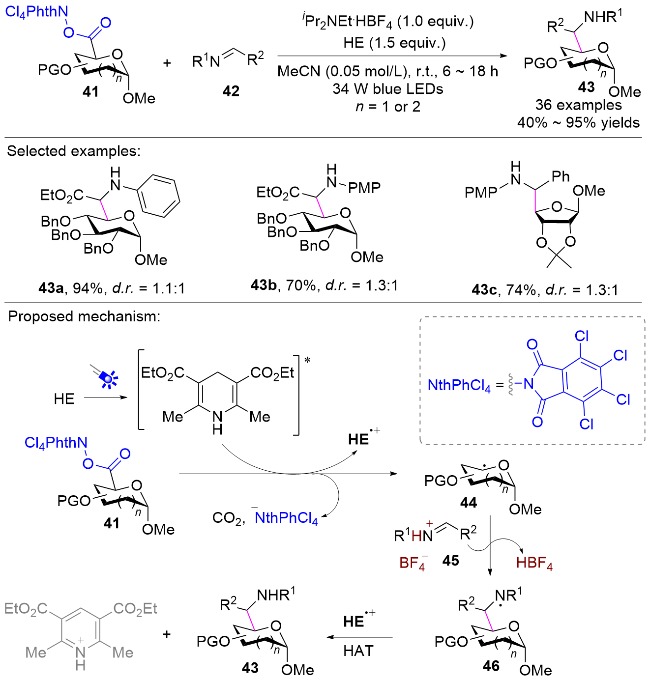
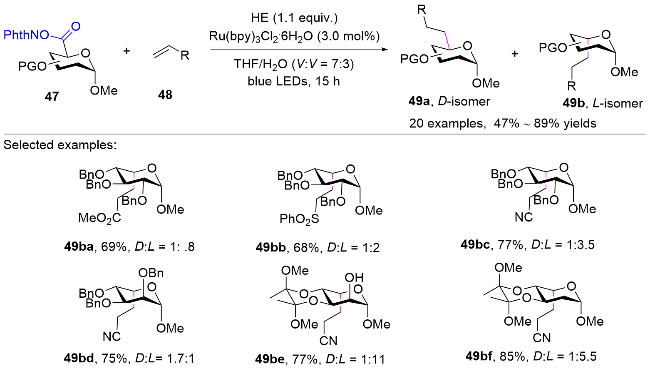
2019年, 王卫课题组[43]开发了一种糖基C(6)-位N-羟基邻苯二甲酰亚胺酯41与芳基亚胺42高效合成C-糖基氨基酸类衍生物的方法(Scheme 12). 该策略与传统的光催化氧化还原方法显著不同, 因为在该反应中, 反应物HE本身能够被光激发启动反应. 此外, 四氟硼酸的铵盐被引入作为催化剂, 以促进反应的进行. 这一反应条件表现出良好的官能团耐受性, 合成了36种C-糖基氨基酸类化合物, 产率从中等至优良. 该反应的机理如Scheme 11所示: 首先HE被光激发形成激发态的HE*, 底物41被激发态的HE*还原脱去一分子CO2和全氯代的邻苯二甲酰亚盐生成糖基自由基中间体44. 亚胺底物42被四氟硼酸活化形成亚胺盐中间体45, 该中间体作为亲电试剂被44进攻产生氮自由基中间体46, 再从自由基阳离子HE•+中攫氢实现目标化合物43的生成.
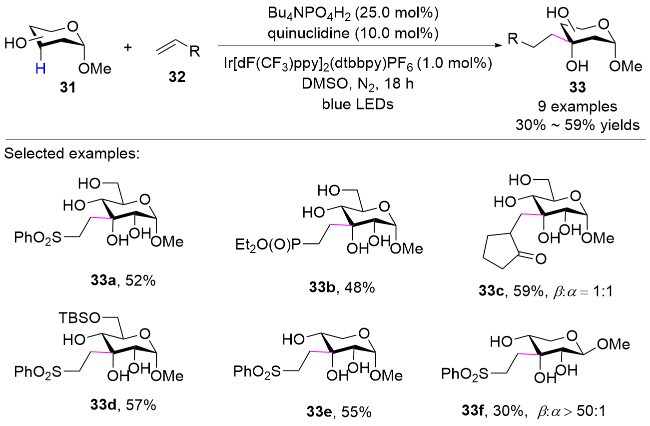
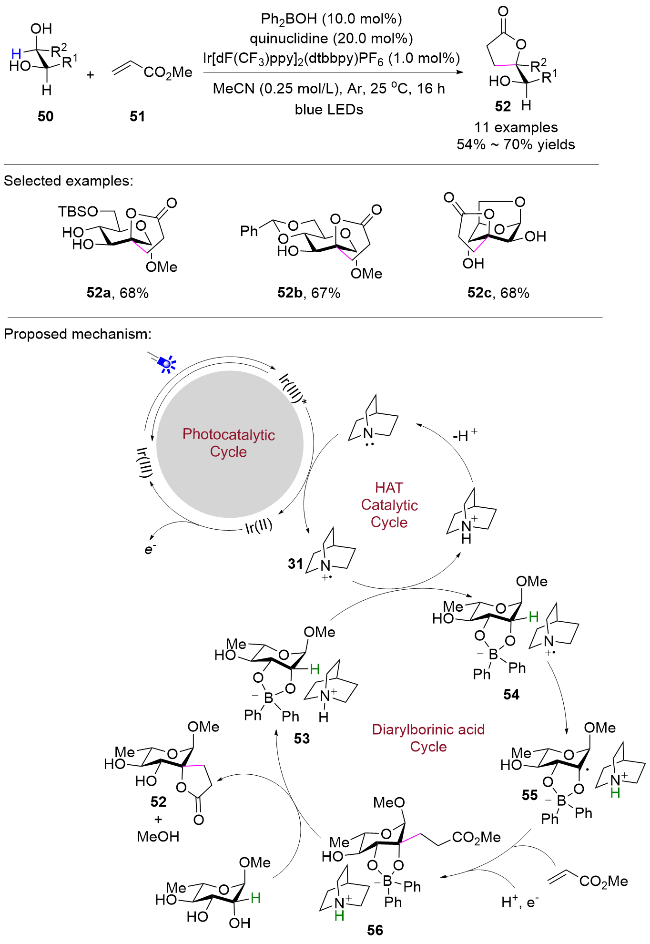
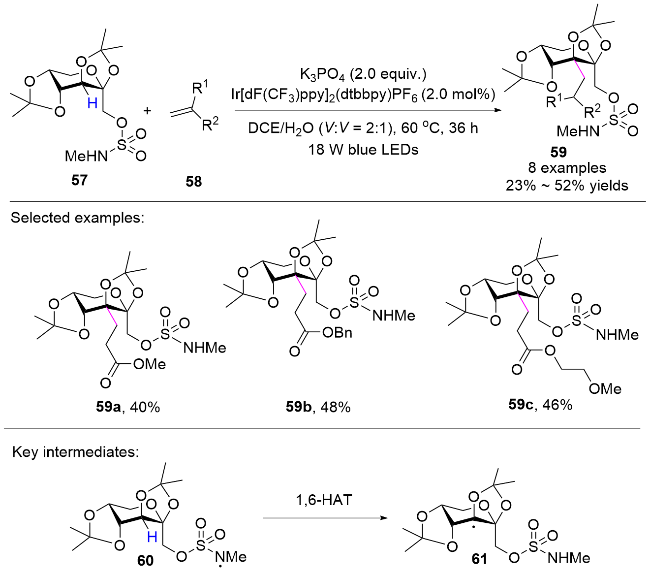
2019年, Taylor课题组[45]采用二芳基硼酸作为共催化剂, 在光氧化还原条件下, 以奎宁环作为氢原子转移(HAT)介质, 并使用Ir[dF(CF3)ppy]2(dtbbpy)PF6作为光催化剂, 实现了糖类化合物的区域选择性和立体选择性的C—H烷基化反应(Scheme 13). 该策略可能的反应途径如Scheme 13所示: 首先激发态的光催化剂Ir(III)*氧化奎宁环生成奎宁环氮正离子自由基31, 同时产生低价态Ir(II); 糖基底物50与二芳基硼酸络合形成活性离子对中间体53, 随后自由基31区域选择性地攫取54的氢原子生成烷基自由基55, 再与烯烃51加成后迅速被低价态Ir(II)还原, 然后质子化生成产物与二芳基硼酸络合的复合物56; 最后. 一分子的糖基底物50与产物复合物56进行配体交换解离出产物52, 新生成的糖底物与二芳基硼酸活化的中间体将继续下一个催化循环.
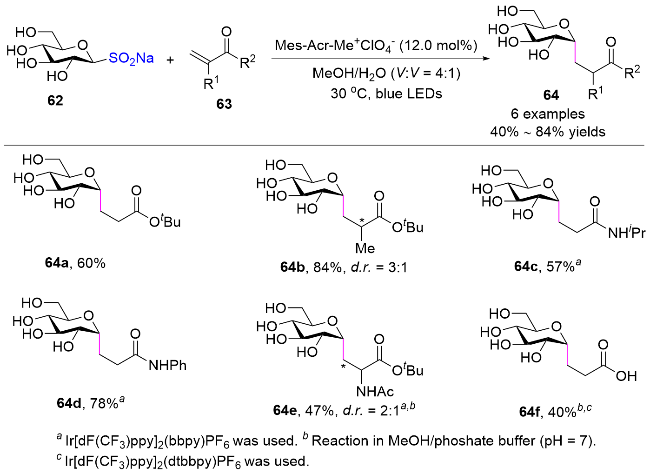
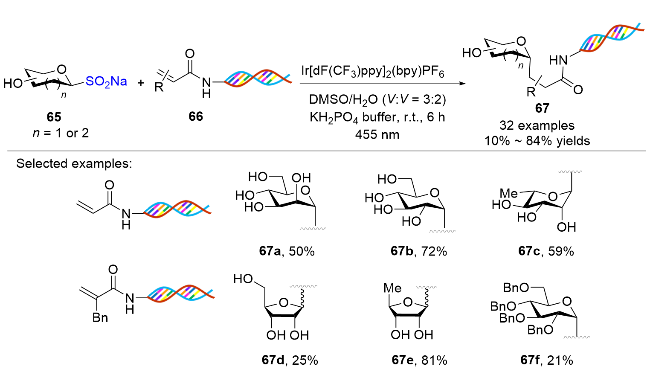
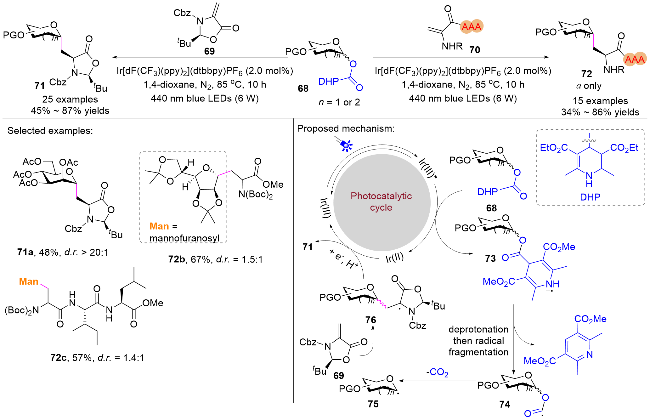
2023年, 朱峰课题组[49]报道了利用糖基活性酯DHP为糖基自由前体合成一系列C-糖基氨基酸和C-糖基多肽的方法(Scheme 17). 他们以Ir[dF(CF3)ppy]2(dtb- bpy)PF6为光催化剂, 1,4-二氧六环为反应溶剂, 在氮气氛围下440 nm蓝光引发反应, 10 h即可以温和的反应条件得到丰富多样的C-糖肽类化合物. 该反应可能的机理如Scheme 18所示: 糖基活化酯68首先被激发态的Ir(III)*氧化得到阳离子自由基中间体73; 然后73经过脱质子及C—C键均裂生成烷氧羰基自由基74; 随后进行脱羧产生糖基自由基中间体75, 再与双键受体加成后生成烷基自由基中间体76; 最后, 该中间76被低价态Ir(II)还原及质子化生成C-糖基氨基酸产物71, 同时再生Ir(III)参与下一个催化循环.
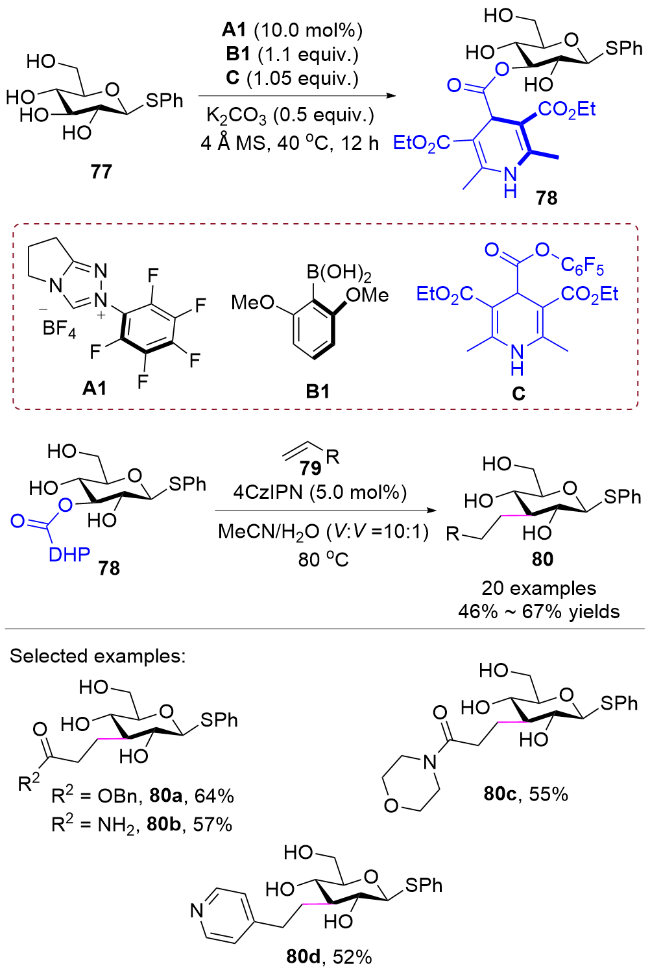
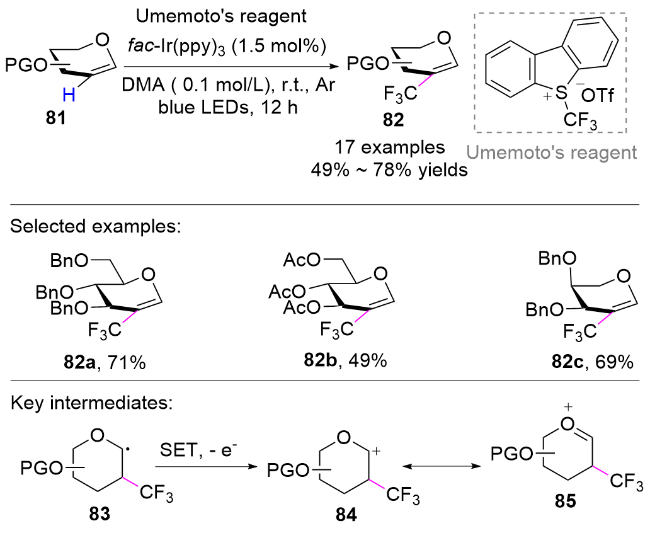
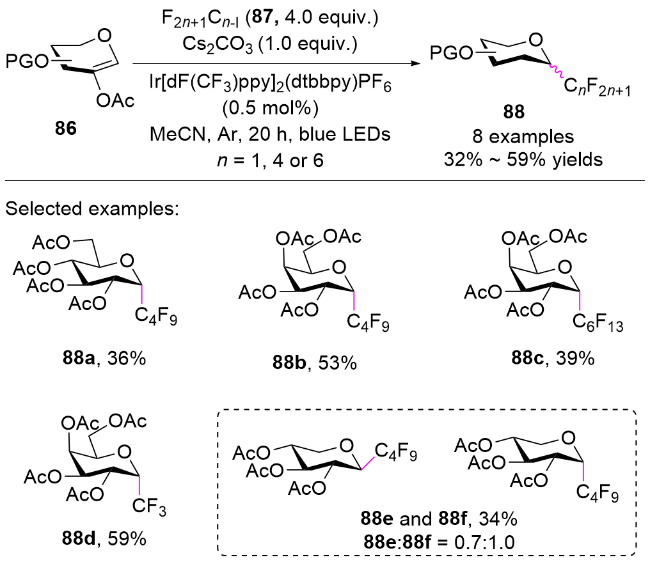
烯糖的修饰也是获得多样糖类化合物的重要方式之一. 2015年, 叶新山课题组[51]报道了在可见光下烯糖直接、温和、有效的C—H三氟甲基化反应(Scheme 19). 该反应采用fac-Ir(ppy)3作为光催化剂, Umemoto试剂作为CF3的来源, 蓝光LED或阳光作为光源, 带有吸电子和供电子保护基的烯糖均顺利地进行了这一反应过程. 该反应中设计的关键步骤是: 三氟甲基自由基对烯糖81进行加成, 然后在异头碳位置形成自由基中间体83, 接着83与光催化剂进行单电子转移(SET)过程产生碳正离子中间体84, 再发生电子共振形成氧鎓正离子中间体85, 最后脱除质子生成三氟甲基化的烯糖产物.
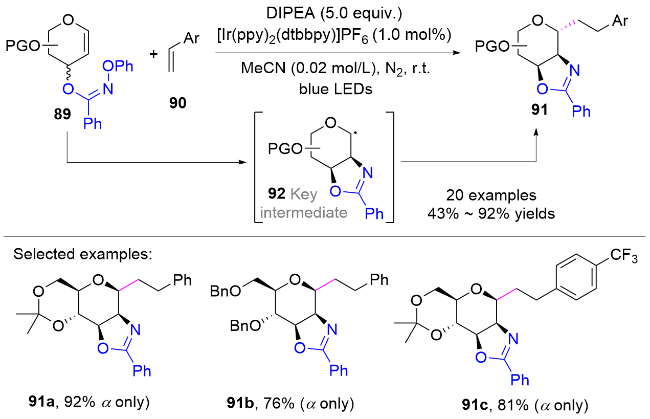
1.2 C-糖基烯基化反应
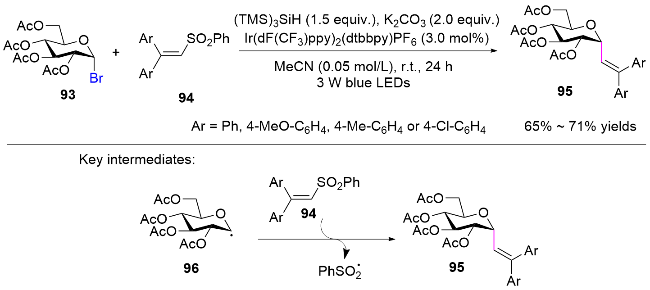
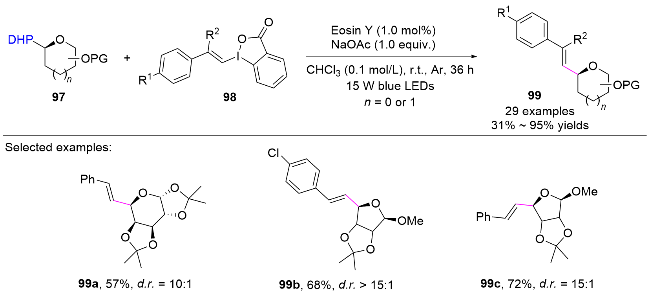
1.3 C-糖基炔基化反应
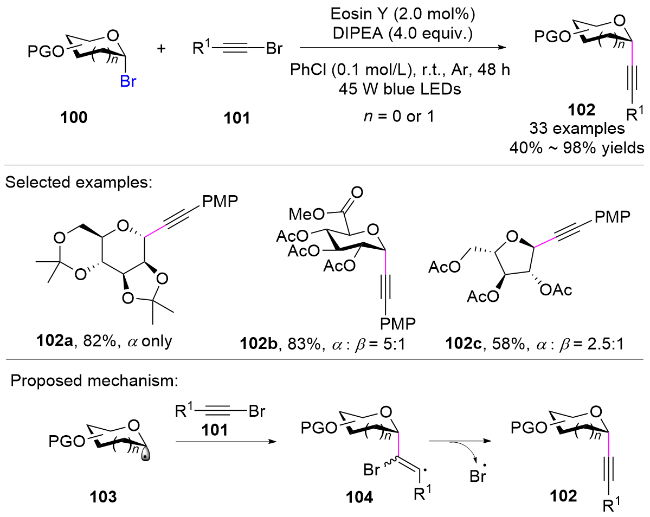
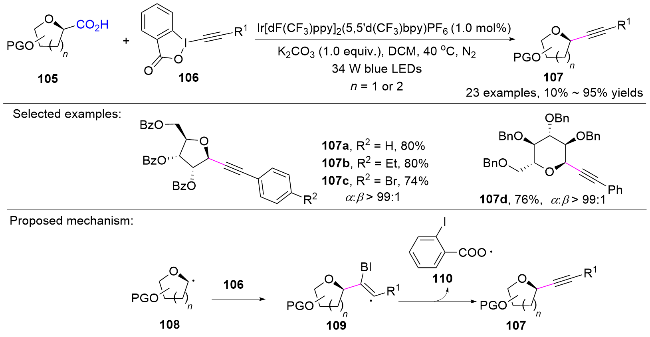
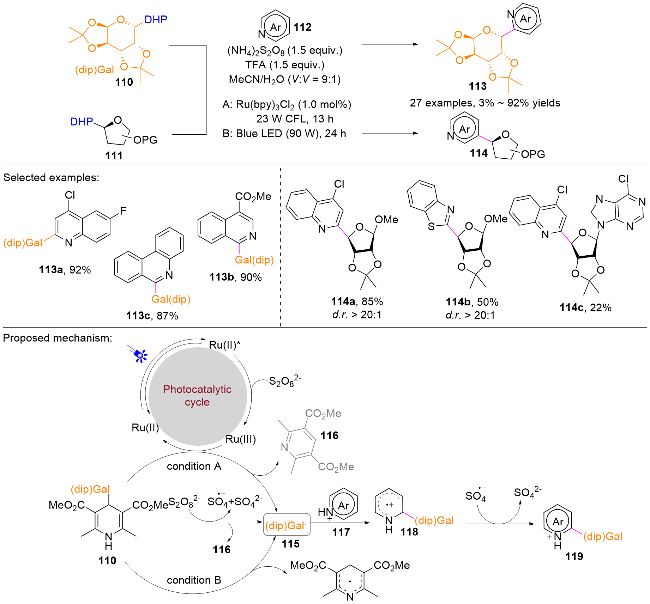
1.4 C-糖基芳基化反应
2020年, 陈弓课题组[58]报道了以N-杂芳基与糖基- 1,4-二氢吡啶(DHP)制备出杂芳基C-糖类化合物的方法(Scheme 26). 糖基-1,4-DHP在过硫酸盐的单电子转移氧化或者可见光照射下, 在有或没有光催化剂的情况下均可作为各种糖基自由基的前体去参与杂芳基化合物的C-糖苷键构建. 该反应在光催化剂Ru(II)存在下(conditions A), 用CFL灯引发产生激发态的Ru(II)*, 然后被过硫酸根($\mathrm{S}_{2} \mathrm{O}_{\mathrm{8}}^{2-}$)氧化为高价态Ru(III), 底物211再被Ru(III)氧化后形成糖基自由基115 [(dip)Gal], 同时生成低价态Ru(II)参与下一个催化循环. 自由基115与杂芳烃盐正离子117加成生成自由基阳离子118, 随后125被$\mathrm{SO}_{4}^{·-}$氧化得到C-糖基杂芳化产物的盐正离子119. 该反应在没有光催化剂时(conditions B)使用蓝光引发, 糖基-1,4-DHP自发发生C—C键均裂生成糖基自由基115, 再进行同样的反应路径.
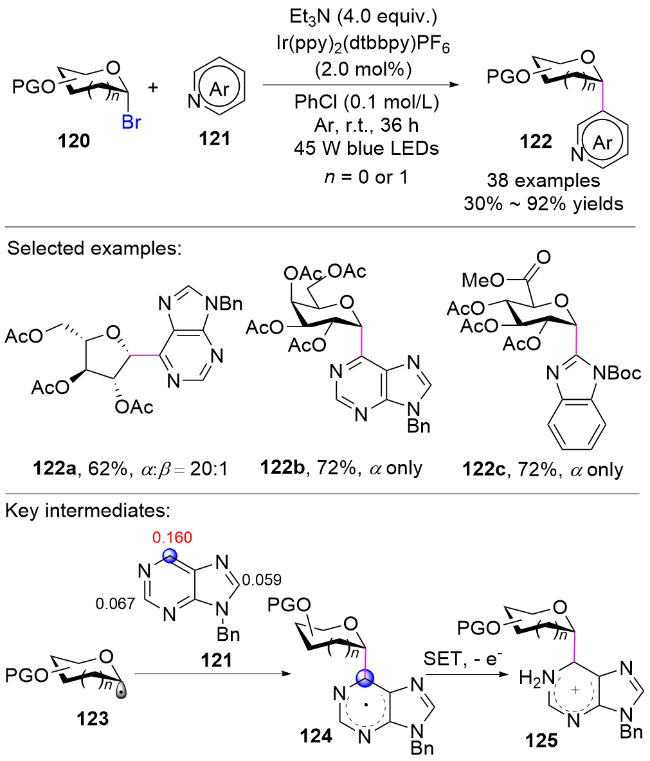
2021年, 俞寿云课题组[59]开发了一种通过光氧化还原催化实现糖基溴化物120与非官能团化杂芳烃121自由基偶联合成C-核苷类似物的方法(Scheme 27). 该方法采用Ir(dtbbpy)(ppy)2PF6作为光催化剂, 在可见光激发下, 三乙胺作为还原剂, 促使糖基溴化物生成自由基中间体123. 随后, 该自由基中间体与杂芳烃121进行加成反应, 形成芳基自由基中间体124. 接着, 通过单电子转移(SET)过程生成杂芳烃正离子中间体125, 最终通过脱氢反应高立体选择性地生成芳基化C-核苷类似物122. 当杂芳烃有多个可能的反应位点时, 福井指数(Fukui indice)可以预测杂芳烃反应的位点选择性[60].
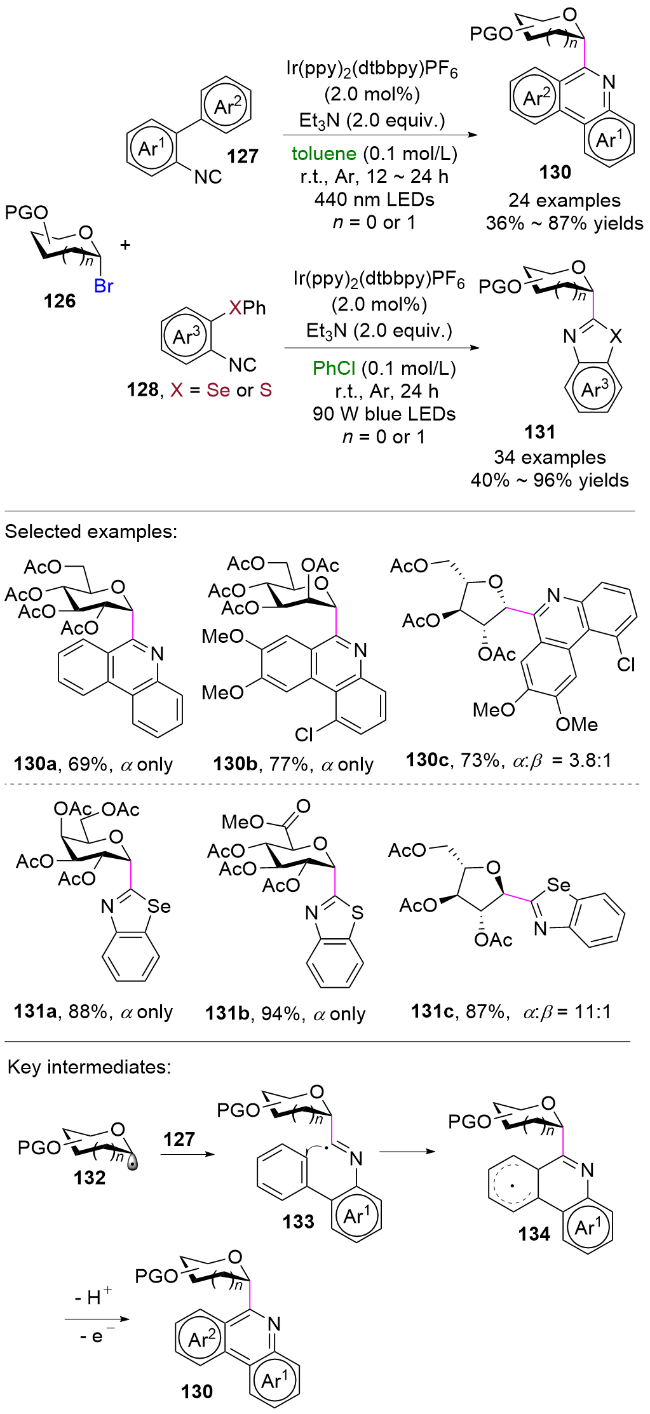
在2023年和2024年, 俞寿云课题组[61]分别报道了通过光催化实现糖基溴与联苯异氰酸酯127及2-异氰芳基硒醚(或硫醚)128构建C-杂芳基糖基化的方法, 成功合成了一系列官能团化的8,9-二甲氧基菲啶衍生物130及C-苯并硒(噻)唑糖苷类化合物131 (Scheme 28). 这两种反应均采用Ir(dtbbpy)(ppy)2PF6作为光催化剂, 三乙胺作为还原剂, 在甲苯和氯苯溶剂中室温下通过蓝光引发反应, 从而高区域选择性和高立体选择性地完成C-杂芳基糖苷化反应. 反应的关键步骤是糖基自由基132的生成, 该自由基迅速与联苯异氰酸酯127加成形成亚胺碳自由基133, 随后进行分子内环化生成中间体134, 最终经过单电子转移(SET)和去质子化反应得到目标化合物菲啶衍生物130.
2 激发态过渡金属参与的氧化还原反应
近年来, 可见光诱导的激发态过渡金属(TM)催化在各种化学转化中的发展引起了人们的广泛关注[62]. 它可以作为光催化剂吸收光子能量, 无需外加光敏剂. 此外, 它与底物的结合作用与光诱导的SET过程协同发生, 在与底物相互作用时可以降低其氧化还原过程发生的阈值, 从而实现活化具有高氧化还原电位的有机分子, 具有传统光氧化还原催化剂无法实现的独特魅力. 激发态过渡金属参与的氧化还原反应在构建多样化的糖苷键中也展现了重要的作用, 其中包括了C-糖苷的生成.
2.1 C-糖基烯基化反
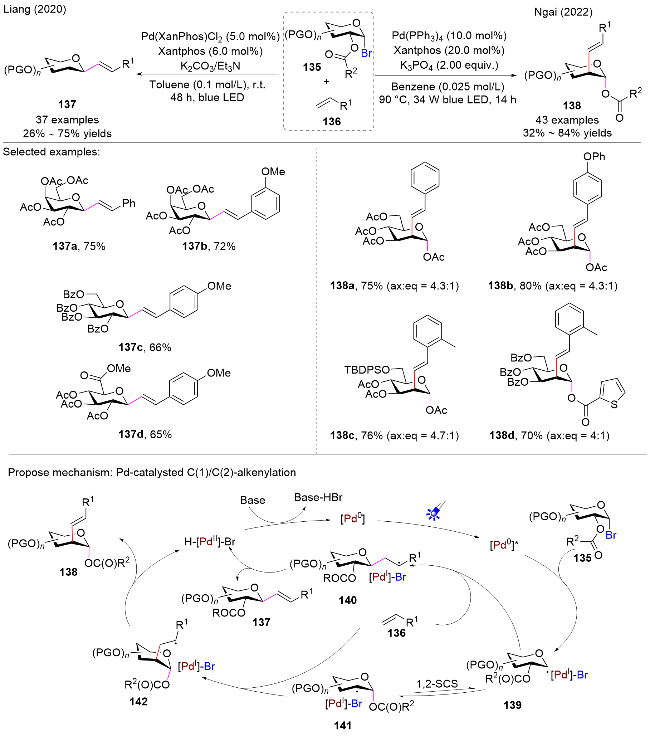
2020年, 梁永民团队[63]开发了一种可见光诱导钯催化的糖基溴化物和芳基烯烃的Heck反应构建C-糖苷的方法(Scheme 29). 在蓝光LED引发下, Pd催化的Heck型自由基反应耐受多种糖基溴化物和乙烯基(杂)芳烃, 以中等至良好的收率获得了丰富的C-糖苷乙烯基化产物, 同时具有较高的区域和立体选择性. 2022年, Ngai课题组[64]报道了激发态Pd催化的1,2-自由基迁移的Heck反应, 该反应在类似于梁永民团队所采用的条件下, 依然使用C(1)-位溴代糖与烯烃进行反应, 成功实现了C(2)-位C-糖苷的烯基化反应(Scheme 29). 这两个工作可能的反应机理如Scheme 29所示: 首先[Pd0]被光激发产生激发态的[Pd0]*, 然后激发态的[Pd0]*对糖溴135氧化加成形成C(1)-位糖基自由基139以及[PdI]-Br物种; 接着该中间体直接和烯烃底物136加成生成新的碳自由基140, 并结合[PdI]-Br物种再发生β-氢消除生成目标产物137; 如果C(1)-位糖基自由基139发生1,2-自旋中心转移(1,2-SCS)过程则会生成C(2)-位糖基自由基141, 随后与乙烯基(杂)芳烃136加成生成自由基中间体142以及结合[PdI]-Br物种; 最后再发生β-氢消除后可生成C(2)-位烯基化糖苷138, 同时生成的H-[PdII]-Br物种在碱作用下再生活性催化剂[Pd0]物种, 进行下一个催化循环.
2.2 C-糖基烷基化反应
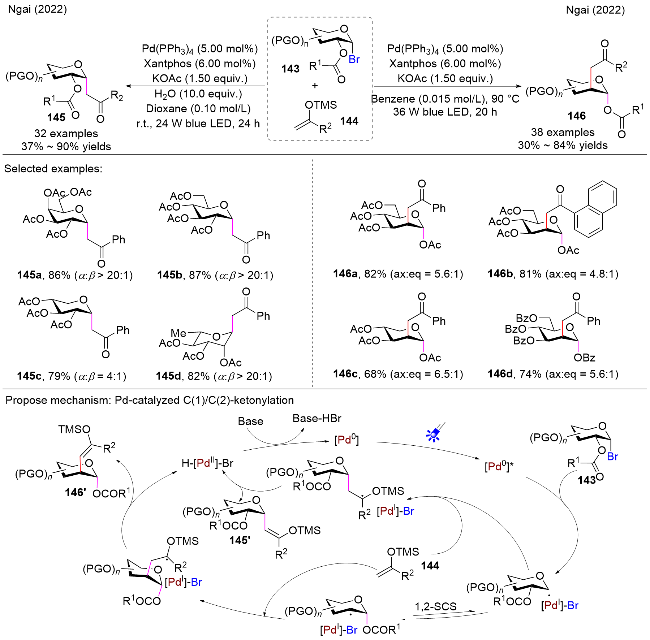
2022年, Ngai课题组[65]又利用激发态钯催化的1,2-SCS策略合成了C(2)-酮基化-2-脱氧糖类化合物154 (Scheme 30, 左半部分). 该反应继续利用易得的糖基溴代物143, 在激发态钯催化下与烯醇硅醚144发生反应, 成功制备了具有多样官能团的C(2)-位烯基化糖类衍生物. 同年, 该课题组[66]还报道了一种与C(2)-位烯基化糖苷反应略有不同的策略, 成功实现了C(1)-位酮基化糖苷的合成(Scheme 30, 右半部分). 这两个反应的主要区别在于反应溶剂的变化和反应温度的调整, 这一变化显著影响了关键的1,2-SCS过程, 从而导致不同位置的C-糖基酮基化产物的生成.
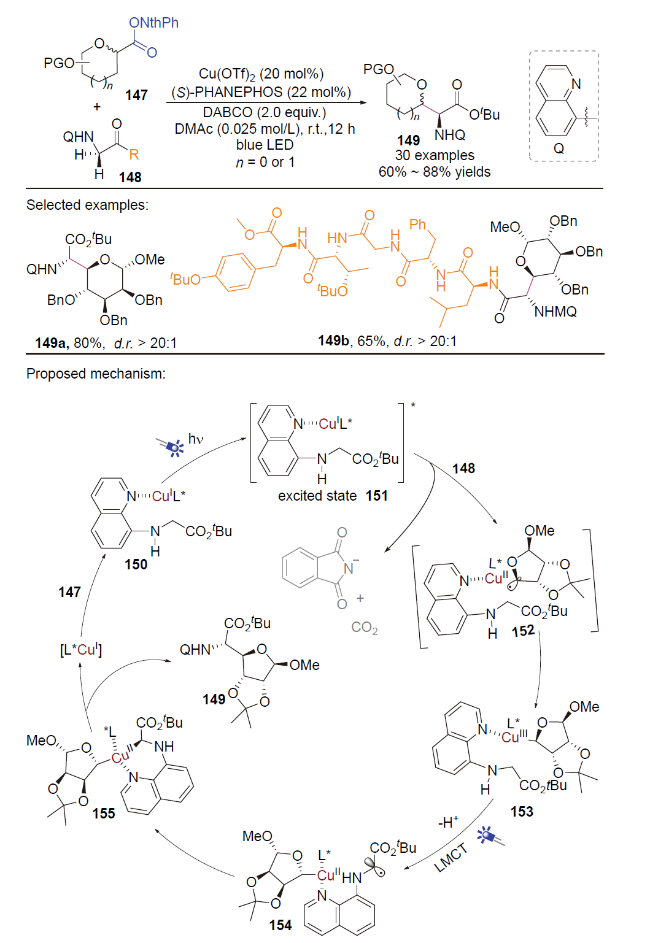
2022年, 许兆青课题组[67]报道了利用激发态的铜构建C-糖苷的方法(Scheme 31). 温和的反应条件能兼容多种糖基化底物, 一系列的单糖和二糖都能以良好的产率和优异的立体选择性转化为C-糖基氨基酸及糖肽类化合物. 基于前人的工作经验, 该工作以带有喹啉取代的胺基酸酯148与糖基氧化活性酯148为底物进行糖的氨基酸及多肽修饰. 这一策略可能的机理如Scheme 32所示: 首先底物147迅速与铜催化剂[L*CuI]快速配位原位形成复合物150, 该复合物被光激发后形成激发态的复合物151, 激发态的151很容易将活性糖基前体147还原而得到C(1)-位的糖自由基152, 同时脱去邻苯二甲酰亚胺负离子和二氧化碳; 生成的糖基自由基再与铜结合使得[CuII]变为[CuIII], 产生中间体153; 中间体153在光照下发生配体到金属的电荷转移(LMCT)和去质子化产生α-碳自由基中间体154, 随后进攻铜金属中心形成手性中间体155; 最后, 155发生立体选择性的还原消除得到C-糖基化产物149, 再生铜催化剂[L*CuI]进入下一个催化循环.
3 光-金属协同催化的偶联反应
过渡金属催化是有机化学反应中不可或缺的重要工具, 光氧化还原催化是促进单电子转移过程的强大手段. 将过渡金属与光氧化还原催化两者结合的催化模式称为金属光氧化还原催化, 通过单电子转移可以产生具有更高氧化态、高反应潜力的金属物种, 从而成为现代有机合成的一大潜在策略[68]. 在构建C-糖苷领域的反应中, 这一方法也有着令人惊讶的表现.
3.1 C-糖基芳基化反应
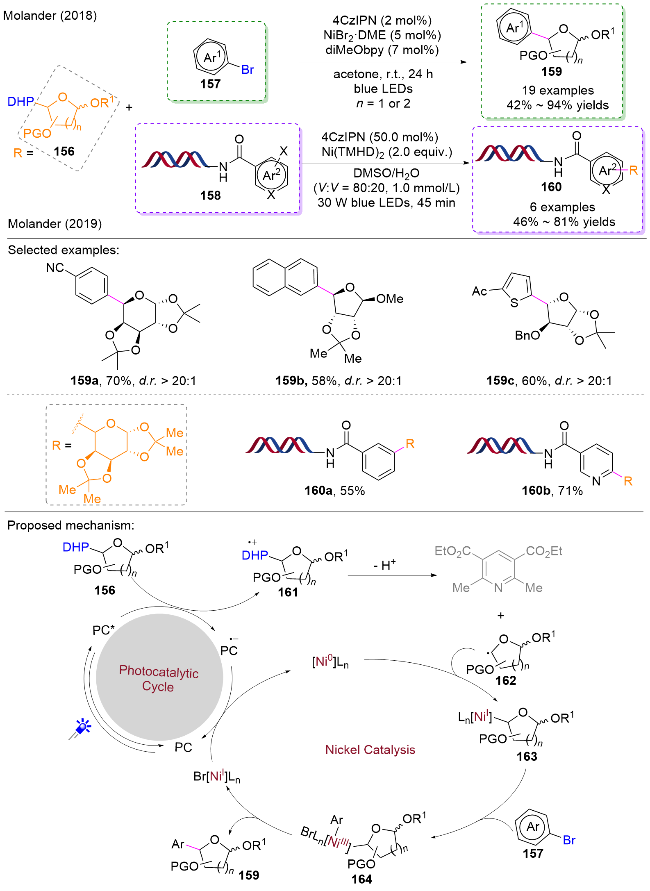
2018年, Molander课题组[69]报道了镍催化的光氧化还原反应中生成的糖基自由基与一系列(杂)芳基溴化物进行的交叉偶联, 成功合成了高度官能团化的C-芳基糖苷类化合物159 (Scheme 32, 见上部分). 在该反应中, 以4CzIPN作为光催化剂, NiBr2•DME作为金属偶联试剂, 4,4'-二甲氧基-2,2'-联吡啶(diMeObpy)作为配体, 在丙酮溶剂中通过蓝光照射反应24 h, 即可实现C-芳基糖苷的构建. 反应可能的机理如Scheme 32所示: 首先是DHP取代的糖基衍生物156被激发态的光催化剂氧化形成自由基阳离子161, 接着161迅速裂解脱去芳构化的吡啶衍生物并产生糖基自由基162; [Ni0]捕获162后形成[NiI]复合物163, 随后芳基溴物种157对复合物163氧化加成生成[NiIII]复合物164; 再后续发生还原消除即可得到产物159和[NiI]-Br, [NiI]-Br再被低价态的PC.-还原成活性[Ni0]参与下一个催化循环.
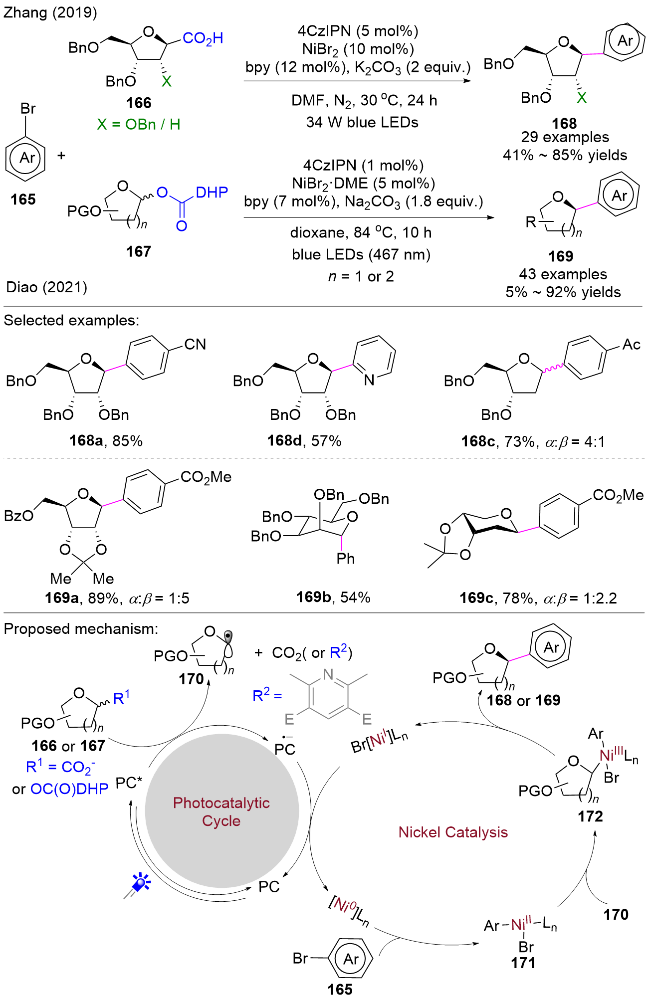
2019年, 张永强团队[71]报道了光/镍协同催化异头核糖脱酸C-芳基/杂芳化反应, 高立体选择性地合成了一些具有潜在生物药物活性的芳基/杂芳基C-核苷类化合物(Scheme 33). 该反应可能的机理如Scheme 33所示: 糖基羧酸166被激发态的光催化氧化脱羧形成糖基自由基中间体170, 同时生成低价态光催化剂PC•-; [NiI]物被PC•-还原为反应活性物种[Ni0], 然后与(杂)芳基溴165氧化加成生成[NiII]复合物171; 该复合物迅速捕获自由基170产生[NiIII]复合物172, 随后发生还原消除得到C-芳基/杂芳基糖苷产物168及[NiI]物种进入下一个氧化还原催化循环. 2021年, 刁天宁课题组[72]报道了通过DHP活化的糖基醇, 利用区域选择性C—O键均裂生成糖基自由基, 并在过渡金属Ni的协同催化下实现C-芳基糖苷的构建(Scheme 33). 该策略使糖基醇成为自由基交叉偶联反应的重要来源, 拓展了C-糖苷合成领域的新途径. 在反应中, 以4CzIPN作为光催化剂, NiBr2• DME作为偶联催化剂, 联吡啶bpy作为配体, 碳酸钠作为碱, 在二氧六环溶剂中于84 ℃下通过蓝光照射反应10 h, 成功合成了43种C-(杂)芳基糖苷类衍生物169.
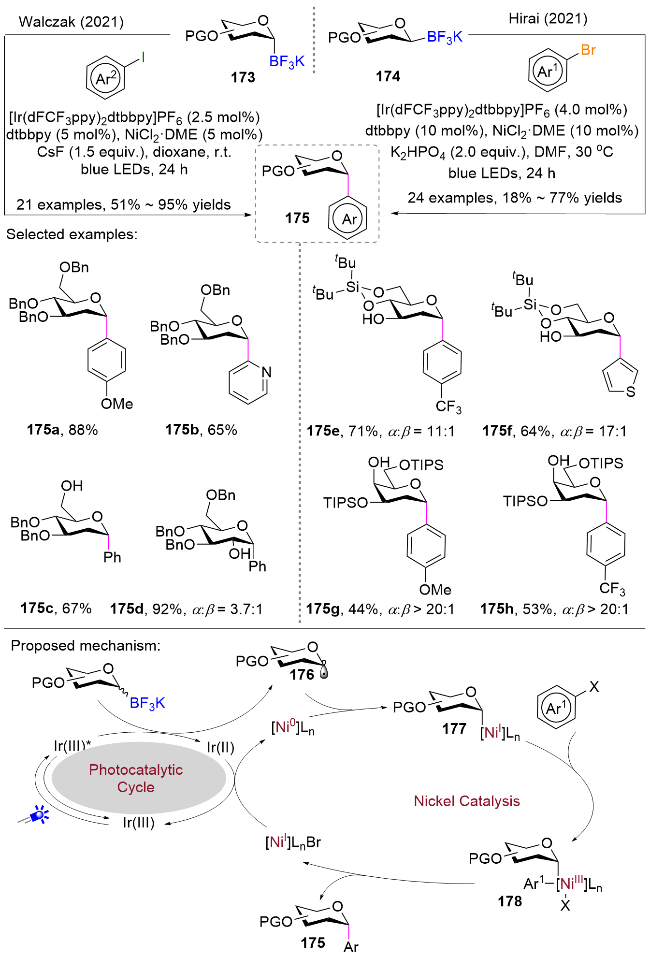
有机三氟硼酸盐因其低毒性、稳定性和良好的官能团相容性, 在Suzuki-Miyaura偶联反应中被广泛用作方便稳定的亲核试剂[73]. 在过去的十年中, 三氟硼酸盐通过光氧化还原和镍双重催化成为很有前景的碳自由基前体, 在作为糖基自由前体用于C-糖苷合成中也体现出了巨大潜力. 2021年, Hirai课题组[74]和Walczak课题组[75]分别通过单电子转移实现了糖基三氟硼酸盐在光氧化还原/Ni双催化下进行C-糖基化反应(Scheme 34). 在Walczak团队的研究中, α-糖基三氟硼酸盐作为糖基自由基前体, 成功地立体选择性合成了C-芳基糖苷, 该反应的一个显著特点是对2-脱氧糖底物表现出仅α-构型的选择性(Scheme 34, 左半部分). 在Hirai课题组的研究中, 合成了稳定的硅保护的2-脱氧-β-D-葡萄糖和β-D-半乳糖的三氟硼酸钾底物, 并将其应用于立体反转的交叉偶联反应, 成功获得了α-C-糖苷芳基化产物(Scheme 34, 右半部分). 该反应可能的机理涉及[Ni0]/ [[NiI]/[NiIII]的反应机制, 如Scheme 34所示. 激发态催化剂Ir(III)*与糖基三氟硼酸盐经历SET过程, 产生糖基自由基176以及还原态的光催化剂Ir(II); 然后, [Ni0]物种对自由基176进行单电子氧化, 产生[NiI]复合物177, 接着该中间体依次对芳基卤化物进行氧化加成和还原消除, 生成所需的a-C-糖苷175并释放[NiI]物种; 最后, 还原态光催化剂Ir(II)对[NiI]物种还原再生活性[Ni0]物种, 进入下一个催化循环.
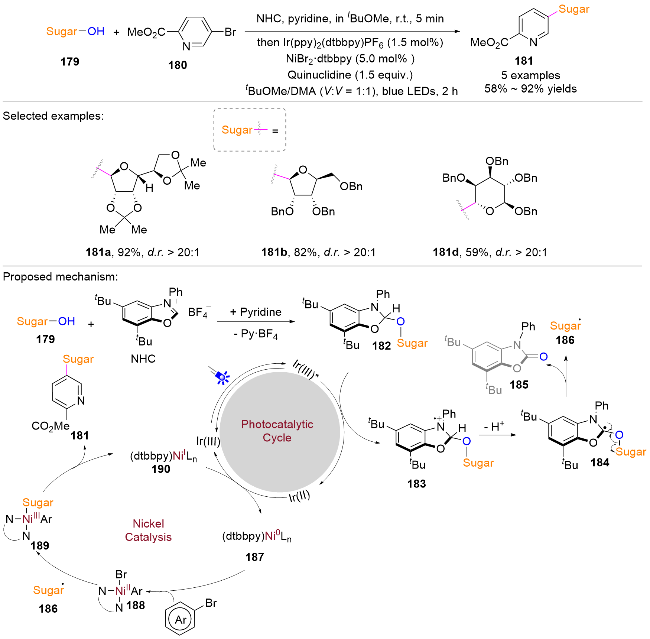
2021年, MacMillan团队[76]报道了一种新颖的NHC活化的烷基醇在光/Ni协同催化下进行的脱氧芳基化反应(Scheme 35). 作者对糖底物进行了系统探究, 成功实现了糖羟基的直接C-芳基官能团化反应. 反应可能的机理如Scheme 35所示: 首先糖基醇179与NHC反应生成活性中间体182, 接着该中间体被激发态的Ir(III)*氧化形成阳离子自由基183, 同时生成还原态的光催化剂Ir(II); 183去之质子及电子迁移生成α-碳自由基中间体184, 然后迅速发生C—O键均裂, 产生糖基自由基186和副产物185; [Ni0]复合物187对芳基溴氧化加成生成[NiII]复合物188, 该复合物被自由基186捕获后形成[NiIII]复合物189, 再经过还原消除则生成产物181及[NiI]物种; 最后, 低价态光催化剂Ir(II)还原[NiI]物种再生活性[Ni0]物种再生进入下一个催化循环.
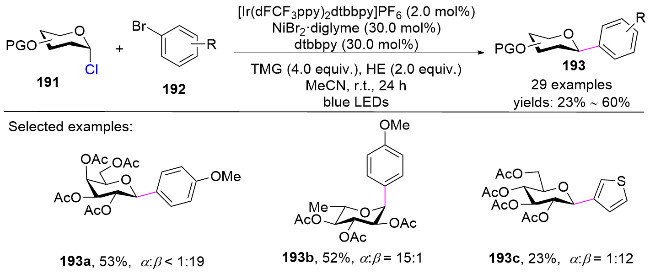
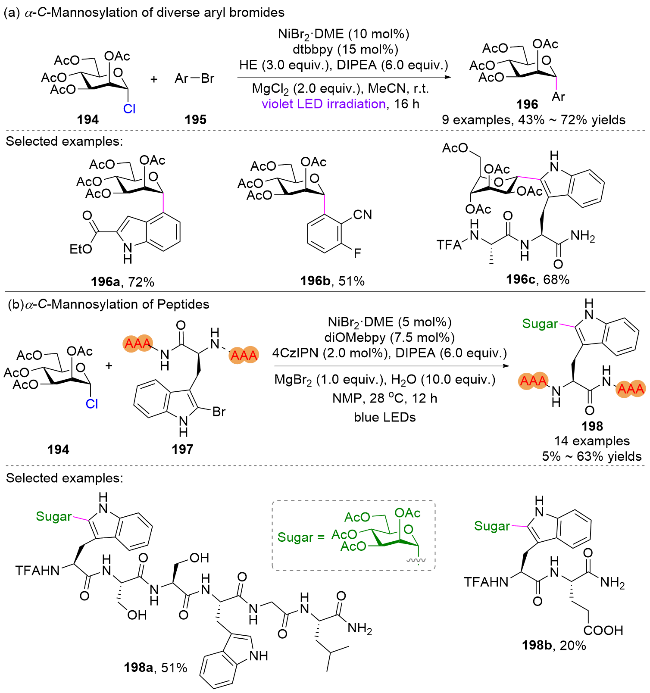
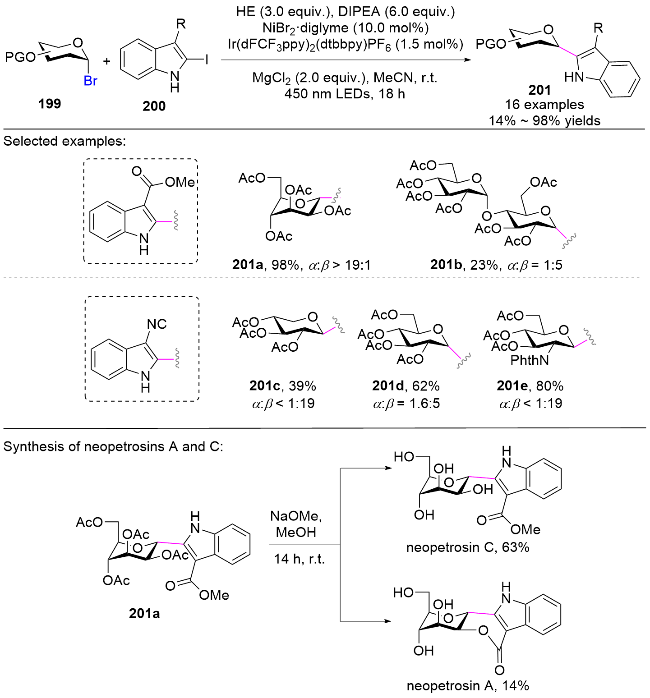
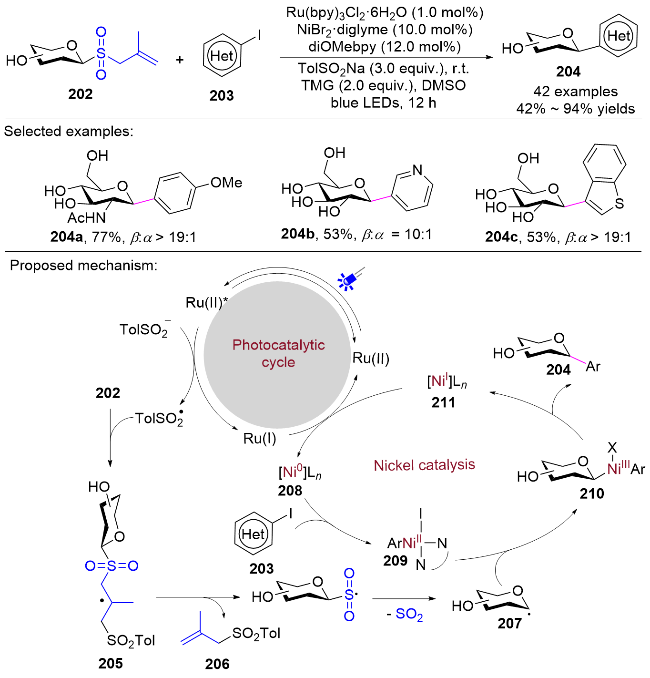
2023年, 钮大文课题组[80]报道了一种C-芳基糖苷构建的策略, 该策略以糖基烯丙基砜202为糖基自由前体, 与(杂)芳基溴化物203在光镍协同催化下高1,2-trans选择性地生成了丰富多样的无保护C-芳基糖苷204 (Scheme 39). 该研究的关键设计元素在于采用烯丙基糖基砜与苯亚磺酸盐(TolSO2Na)的组合, 可以视为糖基阴离子的合成等价物(通过糖基中间体实现), 从而避免了敏感试剂的生成和使用. 可能的机理如Scheme 39所示: 对甲苯亚磺酸负离子$\mathrm{TolSO}_{2}^{-}$被激发态的Ru(II)*氧化为自由基$\mathrm{TolSO}_{2}^{·}$, 同时生成还原态的光催化剂Ru(I); 自由基$\mathrm{TolSO}_{2}^{·}$对烯丙基糖基砜底物加成生成烷基自由基205, 然后迅速发生C—S均裂(离去副产物烯丙基206)及脱SO2这一串联反应得到糖基自由基207; [Ni0]物种208对芳基溴氧化加成后产生[NiII]物种209, 再捕获自由基207生成糖基[NiIII]复合物210, 接着发生金属消除反应得到C-芳基化糖类衍生物204及[NiI]物种211; 最后211被低价态的Ru(I)还原为活性催化[Ni0]物种进入下一个循环.
3.2 C-糖基烷基化反应
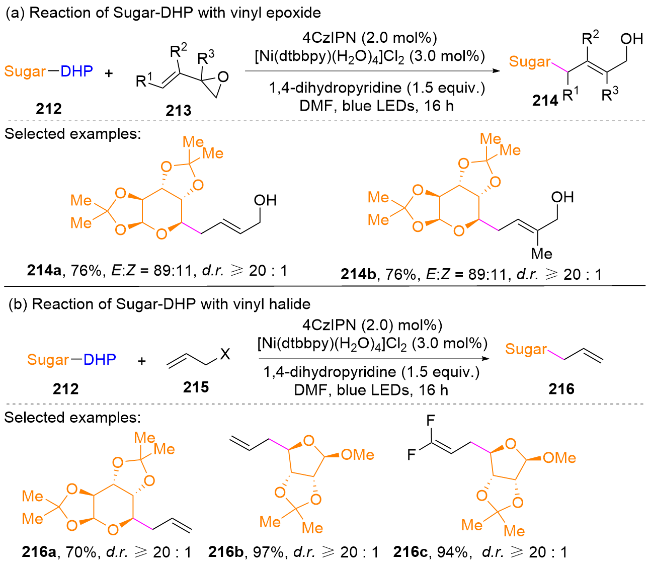
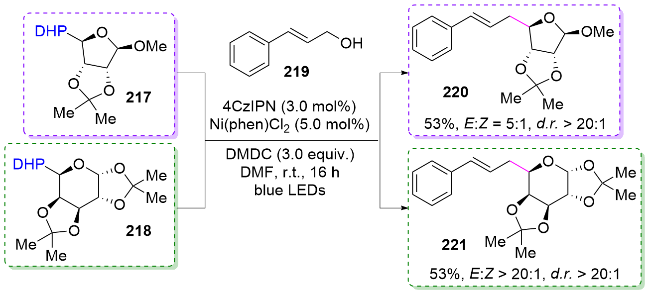
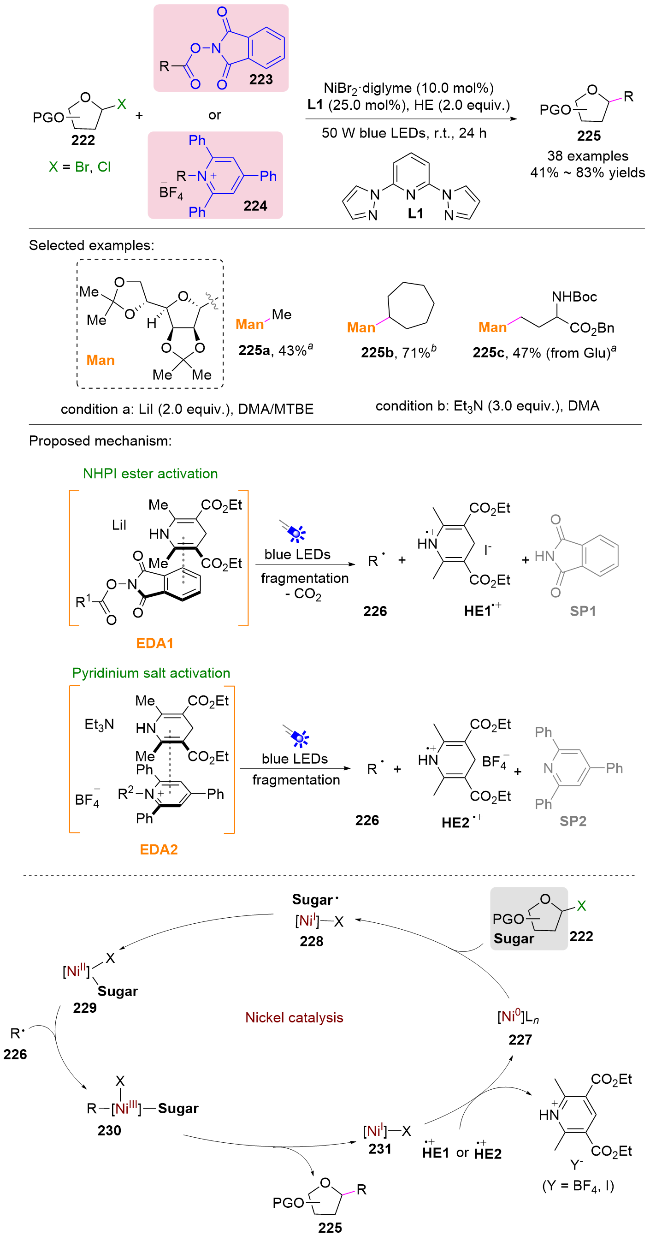
2023年, Koh团队[83]开发了一种在Hantzsch酯和LiI(或Et3N)的存在下, 蓝光LED引发的镍催化的糖基卤化物与脂肪酸或伯胺(先仅用一步转化为还原活性亲电试剂)之间的C—C偶联策略, 合成了具有高非对映选择性的C-烷基糖苷类衍生物(Scheme 42). 该反应的烷基自由基前体可以是活性酯223或者吡啶盐224, 两者分别对应着不同的反应条件(conditions a和b). 反应可能经历的过程如Scheme 42所示: 首先是烷基自由前体223和224均与HE分别形成复合物EDA1和EDA2, 蓝光引发下都产生烷基自由基226, 分别脱去副产物SP1和SP2及不同的氮正离子自由基HE1+•和HE2+•; [Ni0]物种227对核糖卤代物222单电子还原生成糖基自由基228及[NiI]物种, 接着核糖自由基对[NiI]物种加成生成[NiII]复合物229; 自由基226捕获[NiII]复合物229后生成糖基-[NiIII]复合物230, 随后发生还原消除生成目标化合物225及[NiI]物种231; 最后231被氮正离子自由基HE1+•或HE2+•还原为活性催化物种227进入下一个催化循环.
3.3 C-糖基炔基化反应
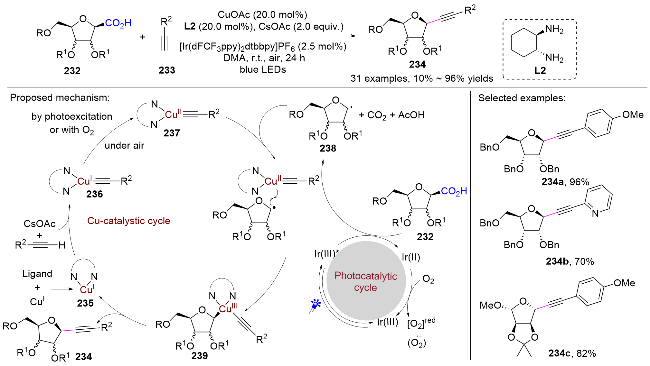
2021年, Messaoudi课题组[84]报道了一种由光/铜协同催化稳定的呋喃糖基羧酸和末端炔烃合成炔基C-核苷的策略(Scheme 43). 在低成本、低毒的铜催化下, 结合光氧化还原拓宽了合成复杂炔基C-糖苷类化合物的途径. 该工作可能的机理如Scheme 43所示: 在蓝光LED照射下, 光激发态Ir(III)*物种被糖基羧酸232还原淬灭, 得到糖基自由基238和还原态的Ir(II)物种; 在铜的催化循环中[CuI]复合物235在碱的存在下与末端炔烃反应, 生成[CuI]-乙炔物种236, 然后通过光激发或O2将其氧化为[CuII]物种237; 随后, 异头自由基238可以被[CuII]物种237捕获, 形成关键的糖基-[CuIII]复合物239; 最后, 高价瞬态[CuIII]物种239还原消除生成目标产物234并再生[CuI]催化剂235; 同时, 光催化Ir(II)被O2氧化, 再生基态光催化剂Ir(III)关闭催化循环.
3.4 C-糖基酰基化反应
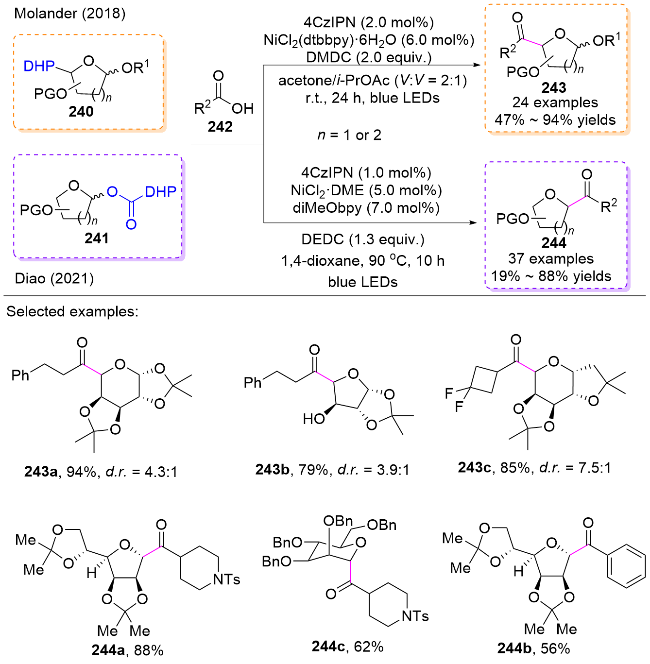
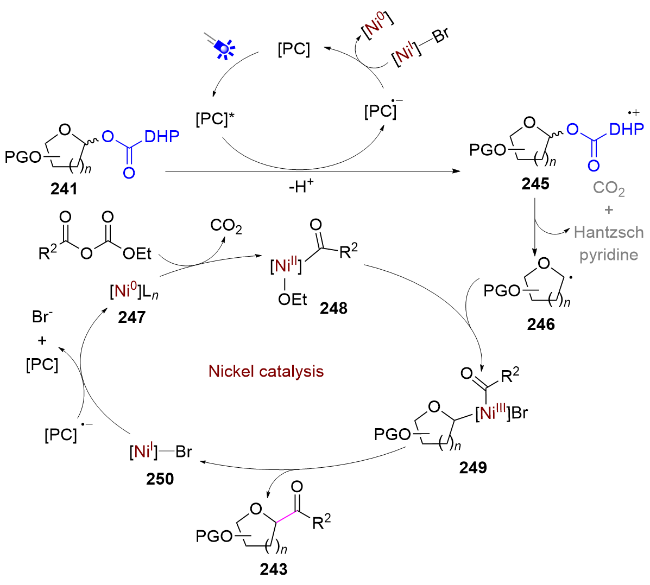
2018年, Molander课题组[85]利用DHP取代的糖基底物240, 开发了一种通过Ni/光氧化还原双催化体系合成非异头C-酰基糖苷的策略(Scheme 44, 上半部分). 该反应采用有机光催化剂4CzIPN, 结合镍催化和原位活化的二甲基二碳酸酯(DMDC), 成功实现了羧酸的偶联反应, 从而合成C(6)-酰基化糖苷类衍生物243. 该转化在温和的反应条件下进行, 展现出良好的官能团相容性, 且重点在于保留了异头碳, 为后续的进一步衍生化提供了反应位点. 2021年, 刁天宁团队[86]利用糖醇活性酯241和羧酸242为底物, 通过光/镍协同催化的交叉偶联反应, 成功制备了C(1)-酰基化糖苷类化合物244 (Scheme 44, 下半部分). 该反应的关键步骤是糖基活性酯的光氧化还原活化, 通过释放CO2生成糖基自由基来促进异头处C—O键的均裂. 详细的可能的机理如Scheme 45所示: 糖基活性酯底物241被激发态的光催化剂PC*氧化生成阳离子自由基245, 同时生成还原态的PC•-; 自由基245发生C—O均裂脱除一分子CO2和Hantzsch吡啶, 从而生成糖基自由基246; 镍循环中, [Ni0]物种247对羧酸二羰基化合物氧化加成后产生[NiII]复合物248, 接着捕获自由基246生成糖基-[NiIII]物种249; 最后, 复合物249进行还原消除释放产物243及[NiI]物种250, 250被还原态的光催化剂PC•-还原为[Ni0]物种247进入下一个催化循环.
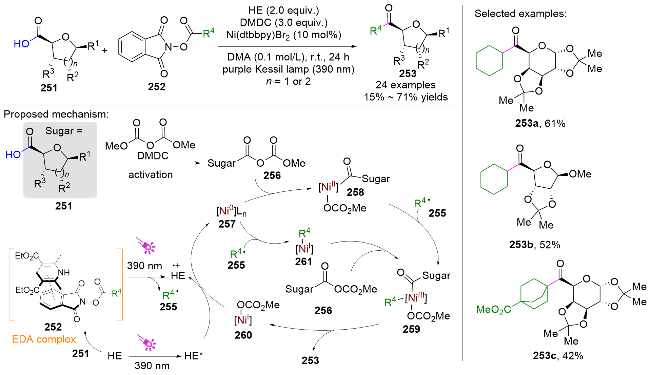
2022年, Molander团队[87]报道了通过对两种羧酸的不同活化方式在光/镍协同作用下实现非异头C-糖基酰基化的策略(Scheme 46). 糖基羧酸251与DMDC原位生成活化二羰酸酯化合物256, 然后[Ni0]物种257对其氧化加成后生成糖基-[NiII]复合物258. 底物活性酯252与HE形成的电子供体-受体(EDA)复合物在390 nm的紫外光引发下产生自由基255. 该自由基可能通过两种途径被镍复合物捕获: 第一种, [Ni0]物种257捕获255后产生[NiI]复合物261, 再对糖基二羰酸酯氧化加成生成[NiIII]物种259; 第二种, 复合物258捕获自由基255同样生成[NiIII]物种259. 最后, 复合物259进行还原消除释放产物253及[NiI]物种260, 激发态的HE*还原复合物260为[Ni0]物种257进入下一个催化循环.
3.5 C-糖基酰胺化反应
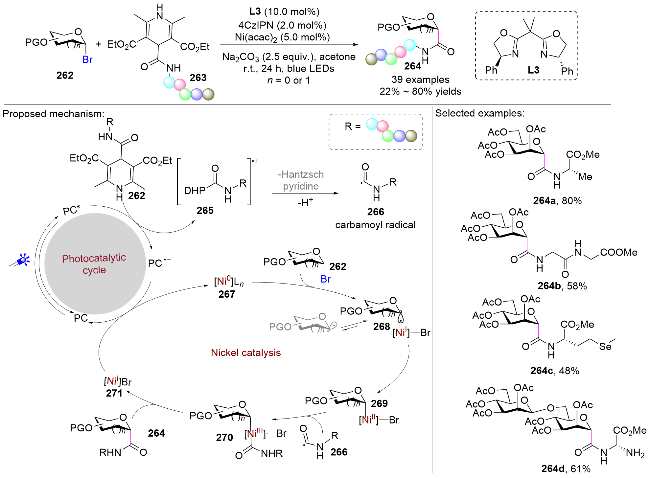
2024年, 池永贵课题组[88]报道了一种在光镍协同催化下, 通过酰胺键将糖基与氨基酸及肽连接的简便方法(Scheme 47). 该反应适用于单糖、二糖和三糖, 并且涵盖了20种天然氨基酸、肽及其衍生物, 产率范围从可接受水平到高产率不等, 同时展现出优异的立体选择性. 这一方法可能的机理如Scheme 47所示: 光催化剂4CzIPN被光激形成激发态的PC*将二氢吡啶类底物262单电子氧化形成阳离子自由基265, 再产生还原态的PC•-; 然后脱质子并芳构化脱除吡啶副产物, 产生氨基甲酰基自由基266; 同时, [Ni0]复合物267与溴糖262发生自由基氧化加成反应, 产生糖基-[NiI]复合物268和[NiII]复合物269; 随后复合物269捕获氨甲酰自由基266形成[NiIII]物种270, 再发生还原消除生成产物263, 释放[NiI]物种271. 最后, 271被还原态PC.-还原为[Ni0]物种267进入下一个催化循环.
4 光激发电子供体-受体复合物介导的反应
随着光催化领域的持续发展, 除了传统的光催化剂、激发态过渡金属以及光/金属协同双催化策略外, 研究人员还探索了其他光介导自由基生成的方法. 其中, EDA复合物作为一种强大的化学转化工具, 能够避免额外光催化剂的使用, 从而成为一种更经济、环保的反应模式[89]. 在构建C-糖苷键的反应中, EDA复合物策略也体现出了它独特的优势和实用性.
4.1 C-糖基杂芳基化反应
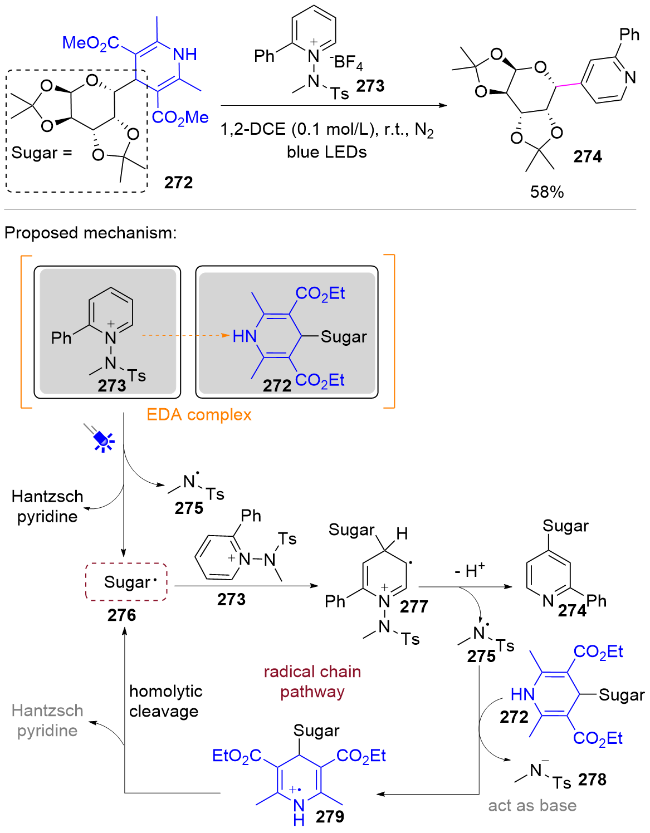
2020年, Hong团队[90]报道了一种可见光促进的吡啶官能化反应, 该反应通过电子转移复合物(EDA络合物)实现N-氨基吡啶盐与1,4-DHP之间的反应. 该策略展现出良好的官能团耐受性, 能够有效生成具有优异区域选择性的C(4)-位官能化吡啶衍生物, 其中包括糖基DHP底物272 (Scheme 48). 机理如Scheme 48所示: 在可见光照射下, 吡啶鎓盐273和糖基1,4-DHP 272形成EDA复合物, 光诱导下引发分子间电子反应; 272被273单电子氧化脱除吡啶盐, 产生酰胺自由基275及糖自由基276, 糖基自由基对吡啶盐C(4)-位加成形成阳离子自由基中间体277; 接着其去质子化并且N—N断裂生成目标化合物274, 同时再次产生酰胺自由基275; 在该过程中, 酰胺自由基通过糖基1,4-DHP底物的还原生成氮正离子自由基物种279, 进而启动自由基链式反应; 所得的酰胺负离子278在脱质子化步骤中还充当了碱, 从而最终获得所需的目标产物.
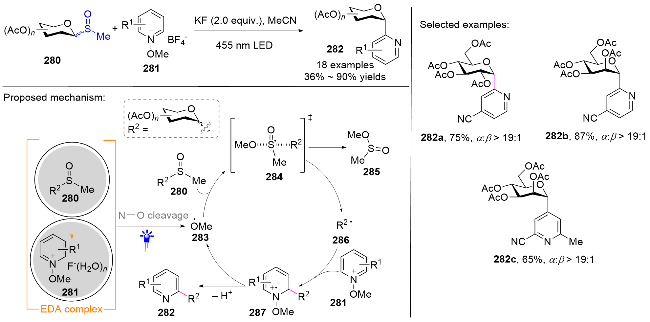
2022年, 钮大文课题组[91]利用简单易得的糖基亚砜作为自由基前体, 成功制备了糖基吡啶类衍生物(Scheme 49). 该方法对糖基亚砜的转化表现出高立体选择性, 成功合成了相应的吡啶基C-糖苷, 这进一步凸显了亚砜作为自由基前体参与化学转化的能力. 该策略可能的机理为: 糖基亚砜280和吡啶鎓盐281的水合氟阴离子之间形成的EDA络合物, 在可见光照射下, 复合物的N—O键发生均裂形成甲氧基自由基283; 然后283进攻糖基亚砜基团形成过渡态284, 随后284生成糖基自由基286及亚磺酸酯285; 糖基自由基286加成吡啶鎓盐281得到自由基阳离子287; 最后, 287进行脱质子化和芳构化得到C-糖苷产物282, 并再生甲氧基自由基283触发下一个反应循环.
4.2 C-糖基烷基化反应
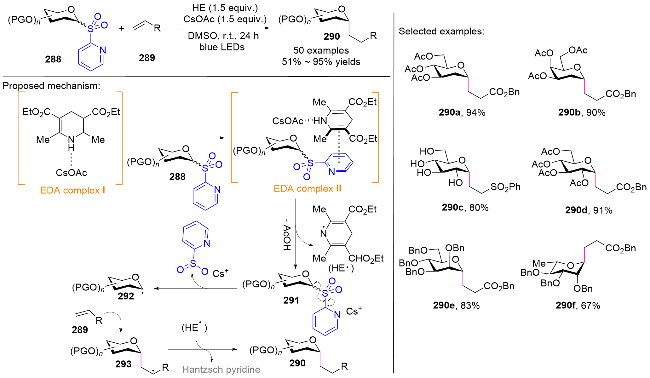
2022年, Koh团队[92]报道了新颖的可见光照射下, 杂芳基糖基砜在Hantzsch酯和弱碱的存在下与亲电试剂发生的脱硫交叉偶联反应(Scheme 50). 这种无需催化剂和过渡金属参与的方法, 有效地将各种单糖和聚糖的糖基砜供体转化为具有高立体选择性和广泛官能团耐受性的烷基C-糖苷产物, 成功克服了以往在底物范围和糖基供体不稳定性方面的局限性. HE和CsOAc的结合可能会形成具有吸光性的有色EDA复合物I, 然后糖基吡啶砜288与复合物I形成新的EDA复合物II, 在用蓝光LED照射后发生光诱导的单电子转移, 产生自由基阴离子291和HE•. 291易发生脱硫通过C—S键均裂产生糖基自由基292和亚磺酸盐副产物. 随后糖基自由基292对烯烃289位点选择性和非对映选择性加成, 生成烷基自由基293, 该烷基在HE•存在下易于氢化(由吡啶环的重排驱动)而生成目标化合物烷基C-糖苷产物290.
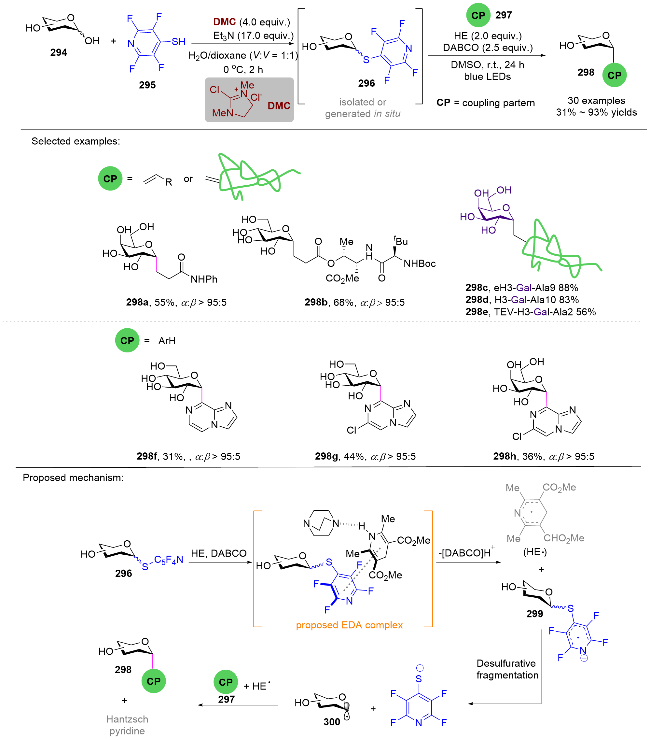
2024年, Koh课题组[93]报道了一种基于天然糖类实现位点和立体选择性糖苷键构建的方法. 该策略首先通过对单糖和低聚糖进行选择性异头官能化, 利用DMC选择性封端酸性更强的异头羟基位点, 形成一个活化的离去基团. 在碱性条件下, 该离去基团易受到2,3,5,6-四氟吡啶-4-硫醇295的亲核进攻, 从而生成糖基自由基前体296. 该研究成功构建了多种天然裸露糖类的糖苷键, 包括C-糖苷键(Scheme 51). 这一反应策略在蛋白质的后期修饰上同样兼容可行, 如Scheme 51中列出的葡萄糖修饰产物314c和314d. 反应可能的机理为: 首先, 通过原位生成糖基自由基前体296, 随后296与HE及三乙烯二胺(DABCO)形成EDA复合物. 在蓝光照射下, 该复合物引发单电子转移生成自由基阴离子299和二氢吡啶自由基HE•; 接着, 自由基299经历脱硫反应生成糖基自由基300及2,3,5,6-四氟吡啶-4-硫醇盐; 随后, 糖基自由基300与偶联片段297发生自由基加成反应, 最终被自由基HE•还原并再质子化, 从而合成目标化合物298, 同时伴随生成吡啶衍生副产物.


5 综合和展望
综上所述, 光催化这一绿色温和的反应方式在C-糖基化反应中充满活力和潜力, 在多种官能团化反应中发展迅速[94]. 特别是无保护的裸露糖类化合物实现特定位点官能团化反应, 光催化的C-糖苷化反应在此方面有了显著突破, 使得光催化领域化学的未来充满希望. 尽管光催化构建C-糖苷键这一领域已经取得了较为明显的进步, 但是依旧存在着需要继续推进的方面, 具体如下: (1)金属参与的光催化构建C-糖苷的反应中, 由于异头效应的存在, 目前所得产物多为α-构型或者α/β-混合构型, 因此迫切需要发展出精准立体控制的替代方法来实现C-糖苷的α-构型和β-构型的选择性; (2)为了使得产生糖基自由基更容易且定点产生不同位置的糖自由基, 不可避免地从更为直接的糖基活性前体1,4-二氢吡啶(DHPs)、N-羟基邻苯二甲酰亚胺(NHPI)等出发, 但通过分子间HAT过程引发的区域选择性的方法, 目前发展屈指可数. 希望后期可以设计出新颖的催化剂或者反应模式来精准调控区域选择性实现C-糖基化, 以克服不同底物导致的反应偏差难题; (3)本综述中描述的大部分化学反应都是应用于呋喃糖或者吡喃糖的单糖衍生物, 对于低聚糖、多糖、核酸聚合物和其他复杂聚糖的C-糖苷构建依旧存在巨大挑战; (4)进一步拓展光催化构建C-糖苷领域的前景, 持续开发温和且生物兼容的新型光催化方法, 以实现对广泛存在的天然复杂碳水化合物的修饰与改造, 将为推动生物医药领域的发展做出重要贡献.
(Zhao, C.)