



1 Introduction
The incorporation of trifluoromethyl group to bioactive molecules could significantly enhance their metabolic stability, lipophilicity, and solubility, leading to a wide range of applications in pharmaceuticals, agrochemicals, and materials.[1] Indeed, many popular pharmaceuticals and agrochemicals embedded with trifluoromethylated aromatic heterocyclic building blocks, including celecoxib, cinacalcet, nilotinib, beflubutamid, and norfluazon, have been successfully developed,[2] which attracted increasing interest in the production of trifluoromethylated heteroarene compounds in modern organic chemistry.[3] Impressive efforts have been devoted to the development of efficient trifluoromethylating protocols and various reagents, such as CF3I, Ruppert-Prakash reagent, CF3SO2Cl, Langlois'reagent, Togni’s reagent, Umemoto’s reagent, were explored for the accessing of trifluoromethylated heteroarenes.[4] However, traditional metal-mediated strategies usually require stoichiometric metal reagents or prefunctionalized substrates, creating obstacles for their application (Figure 1A).[5] In this context, direct photoinduced radical C—H trifluoromethylation of heteroarenes has become one of most efficient methods, as it could permit the functionalization with high reactivity, mild reaction conditions, and excellent functional group compatibility.[6]
A significant breakthrough in this methodology was first achieved by the group of MacMillan with the assistance of Ru or Ir photocatalyst.[7] Since then, many elegant methods were developed for the introduction of trifluoromethyl into heteroarenes.[8] For instance, Li and coworkers[9] realized photoinduced aromatic trifluoromethylation reaction under UV irradiation. Qing et al.[10] achieved C—H trifluoromethylation of heteroarenes with trifluoromethanesulfonic anhydride and Ru-based photocatalyst. Trifluoromethylsulfonyl-pyridinium salt (TFSP) was also demonstrated to be an efficient reagent to access trifluoromethylated heteroarenes in the presence of Ir photocatalyst by the Xiao group.[11] Although these remarkable advancements have been made, most of the developed approaches required unstable or high-cost trifluoromethyl reagents, expensive photocatalysts, excess oxidants, or harmful UV light (Figure 1B). Thus, the development of readily available reagents and efficient methods for the incorporation of CF3 into heteroarenes is still in high demand and very meaningful.

We have been interested in charge transfer complex enabled radical functionalization reactions and disclosed that phosphonium salt could combine with proper electron donor or its counter anion to form a photoactive complex, which could generate radical species after single electron transfer (SET) with blue light irradiation under photocatalyst-, transition mental-, and oxidant-free conditions.[12] Specially, we have developed that bench stable and easily available trifluoromethyl reagent [Ph2MePCF3]I could serve as intramolecular charge transfer complex (ICTC) to deliver trifluoromethyl radical, enabling efficient trifluoromethylation reactions of activated alkenes.[12a] Given the high importance of developing trifluoromethylated heterocycles, we wonder whether this simple and efficient strategy could be applied for the direct C—H trifluoromethylation of heteroarenes. If successful, achieving such a goal would offer an alternative trifluoromethylating reagent and method for the synthesis of trifluoromethylated hetero- arenes under simple and mild conditions.
2 Results and discussion
To verify the feasibility of our method, initial experiments were conducted with 1,3-dimethyl-indole 1 and [Ph2MePCF3]I salt 2. It was pleased to find that the reaction went smoothly in N,N-dimethylacetamide (DMA), giving the desired product 3 in 57% yield (Table 1, Entry 1). To improve the reaction efficiency, a series of inorganic and organic bases, including KHCO3, K2CO3, Cs2CO3, tBuOK, K3PO4, NEt3, 1,5-dizzabicyclo[5.4.0]undecen-5-ene (DBU), N,N,N',N'-tetramethyl-ethylenediamine (TME- DA), and 1,4-diazabicyclo[2.2.2]octane (DABCO), were tested, revealing that NEt3 was the best choice, providing the trifluoromethyl product in 78% yield (Table 1, Entries 2~10). Further solvent screening demonstrated that DMA was the best solvent for the reaction (Table 1, Entries 11~15). When the loading of NEt3 was decreased to 1.0 equiv., a 78% yield of isolated product was obtained (Table 1, Entry 16). Control experiment revealed the necessity of blue light (Table 1, Entry 17).
Table 1 Optimization of the reaction conditionsa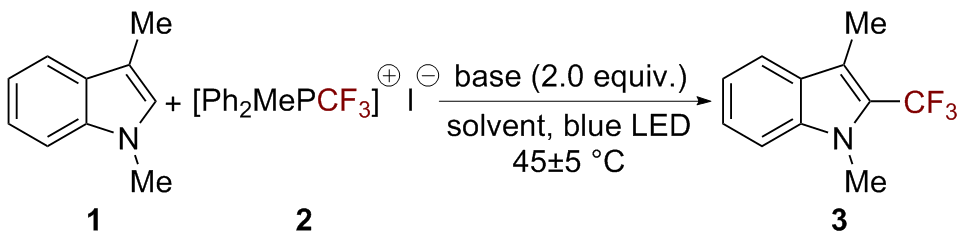 |
| Entry | Solvent | Base | Yieldb/% |
|---|---|---|---|
| 1 | DMA | — | 57 |
| 2 | DMA | KHCO3 | 50 |
| 3 | DMA | K2CO3 | 52 |
| 4 | DMA | Cs2CO3 | 53 |
| 5 | DMA | tBuOK | Trace |
| 6 | DMA | K3PO4 | Trace |
| 7 | DMA | NEt3 | 78 |
| 8 | DMA | DBU | 63 |
| 9 | DMA | TMEDA | 72 |
| 10 | DMA | DABCO | Trace |
| 11 | DMF | NEt3 | 47 |
| 12 | DMSO | NEt3 | 32 |
| 13 | DCM | NEt3 | 60 |
| 14 | MeCN | NEt3 | 46 |
| 15 | THF | NEt3 | Trace |
| 16c | DMA | NEt3 | 82 (78)d |
| 17c,e | DMA | NEt3 | NR |
a Reaction conditions: 1 (0.1 mmol, 1.0 equiv.), 2 (0.2 mmol, 2.0 equiv.), and NEt3 (0.1 mmol, 1.0 equiv.) in solvent (1.0 mL) was irradiated by blue LEDs (100 W) at (45±5) ℃ under nitrogen atmosphere for 24 h. b Determined by 19F NMR yield using 1,3,5-trifluorobenzene as an internal standard. c 1.0 equiv. of NEt3 was used. d Yield of isolated product after chromatography. e Without blue LED at 50 ℃. The reaction temperature was caused by light irradiation. |
With the optimized conditions in hand, the substrate scope was then evaluated (Table 2). It was demonstrated that indoles possessing substituents, such as Me, CH2CN, CH2CO2Et, CH2COMe, CH2CH2Br, and Ac, at the C3 position all worked well, providing the corresponding products 3~9 in 34%~83% yields. This is also true for the 3,5-disubstituted indole (10). 2-Substituted indoles also reacted smoothly to give the targeted 3-trifluoromethylated indoles in 45%~72% yields (11~15). Substrates without substituents on C2 and C3 positions, such as 1H-indole, 5-(benzyloxy)-1H-indole, and 4-chloro-1H-indole, were also applicable to deliver 2-trifluoromethyl indoles as major products in moderate yields (16~19) with the regioselectivity ratio ranging from 2∶1 to 7∶1. Moreover, this protocol could also permit late-stage trifluoromethylation of pharmaceutically important compounds including tryptophane and melatonin derivatives (20 and 21). To expand the synthetic utility of the developed ICTC strategy, a convenient protocol for the functionalization of other aromatic or heterocyclic compounds was also achieved. Azaindole, pyrrole, and substituted benzene reacted smoothly to furnish the desired products with satisfactory results (22~24). Coumarin derivative was also suitable reaction partner and reacted smoothly to afford the desired product with good reaction efficiency (25). Furthermore, the direct trifluoromethylation of Tangeritin performed smoothly to furnish the corresponding product in good yield (26).
Table 2 Substrate scopea,b |
 |
a Reaction conditions: heteroarenes (0.1 mmol), 2 (0.2 mmol, 2.0 equiv.), and NEt3 (0.1 mmol, 1.0 equiv.) in DMA (1.0 mL) were irradiated by blue LEDs (100 W) at (45±5) oC under nitrogen atmosphere for 24 h. b Yields of isolated product. The rr value was determined by GCMS. |
To understand the possible mechanism of the reaction, a series of mechanistic experiments were carried out (Figure 2). The UV-vis experiments were first conducted, which showed that the absorption of the trifluoromethyl phosphonium iodide 2 extended to the visible light region and reached over 500 nm, while its mixtures with 1,3-dime- thyl-indole or NEt3 displayed no obvious bathochromic shift compared to the salt itself. This result suggested that the salt could be excited by blue light, which was consistent with our previous study.[12a] Accordingly, the photolysis experiments of the salt also demonstrated that the phosphonium iodide salt alone was sufficiently photoactive as an ICTC to generate trifluoromethyl radical and the byproduct PPh2Me (Figure 2b). In addition, the radical inhibition study also indicated the presence of a free trifluoromethyl radical in this transformation (Figure 2c).

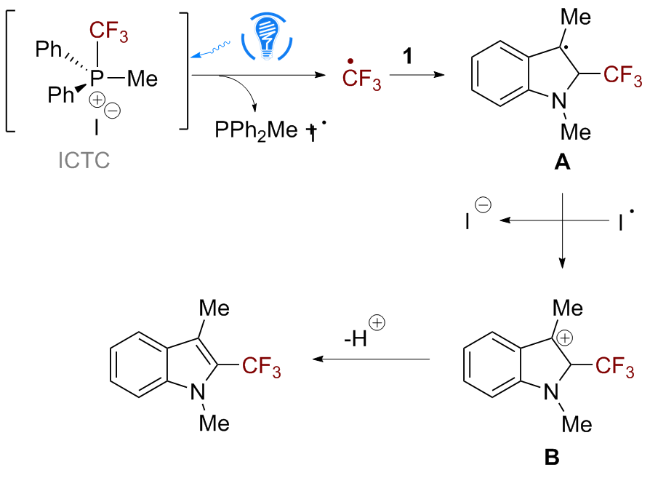
Based on these experimental results and our previous works,[12a] a possible mechanism was proposed (Figure 3). Initially, the trifluoromethyl phosphonium iodide 2 can serve as a photoactive ICTC, which is excited by blue light to undergo a SET process, delivering the trifluoromethyl radical species and iodine radical with PPh2Me as the byproduct. Then the addition of CF3 radical to the C=C double bond of indole 1 gives radical intermediate A, which would be sequentially oxidized by iodine radical species to furnish a cation intermediate B. Finally, the deprotonation of B delivers the final product.


3 Conclusions
In summary, we have developed a simple and efficient strategy for the generation of trifluoromethyl radical, providing a new method for the direct trifluoromethylation of heteroarenes with bench stable and readily available phosphonium salts. The phosphonium salt itself could serve as a photoactive ICTC to generate CF3 radical under blue light irradiation. With this technology, various heteroarenes, such as indoles, pyrrole, substituted benzene, coumarin, and chromone, achieved trifluoromethylation without using photocatalyst, transition metal, and oxidant.
4 Experimental section
4.1 General information
1H NMR, 19F NMR and 13C NMR spectra were recorded at ambient temperature on a Shimadzu Avance 400 Spectrometer, a Shimadzu Avance 500 Spectrometer, and a Shimadzu Avance 600 Spectrometer. The chemical shifts were reported in δ downfield of tetramethylsilane (TMS) and referenced to residual solvent peaks resonance as the internal standard. UV/vis absorption spectra were acquired on a UV-5 spectrophotometer (METTLER TOLEDO). The GC-MS TQ8040 was used in the detection of the reaction mixture. The SGW X-4 was used to measure the melting point of solids. HRMS (ESI) were obtained with a Thermo Scientific LTQ Orbitrap XL mass spectrometer. Chromatographic purification of the products was performed on 200~300 mesh silica gel. Solvents were freshly dried and degassed according to the purification handbook Purification of Laboratory Chemicals before using.
4.2 General procedure
In a nitrogen-filled glovebox, to a dry tube equipped with a stirring bar, heteroarene (0.1 mmol, 1.0 equiv.), NEt3 (0.1 mmol, 1.0 equiv.), 2 (0.2 mmol, 2.0 equiv.), and DMA (1.0 mL) were added, the mixture was stirred under a 100 W blue LED (450 nm) lamp with an interval of 2 cm from the lamp, and a fan was used to keep the reaction temperature at (45±5) ℃. After 24 h, the solvent was removed under vacuum and the residue was subjected to silica gel chromatography using petroleum ether and ethyl acetate as eluent to afford the desired product.
Methyl diphenyl(trifluoromethyl)phosphonium iodide (2):[12a] 1H NMR (500 MHz, CDCl3) δ: 8.20 (d, J=13.9 Hz, 4H), 8.00~7.92 (m, 2H), 7.85~7.80 (m, 4H), 3.55 (d, J=14.0 Hz, 3H); 13C NMR (101 MHz, CDCl3) δ: 37.5 (d, J=3.3 Hz), 134.5 (d, J=11.5 Hz), 131.2 (d, J=13.8 Hz), 110.5 (d, J=86.5 Hz), 7.0 (d, J=49.3 Hz); 19F NMR (565 MHz, CDCl3) δ: -62.4 (d, J=95.4 Hz).
1,3-Dimethyl-2-(trifluoromethyl)-1H-indole (3):[13] Colorless oil (16.6 mg, 78%). 1H NMR (400 MHz, CDCl3) δ: 7.63 (d, J=8.1 Hz, 1H), 7.39~7.28 (m, 2H), 7.20~7.11 (m, 1H), 3.78 (s, 3H), 2.45 (q, J=2.6 Hz, 3H); 13C NMR (151 MHz, CDCl3) δ: 137.8, 127.1, 124.7, 122.8 (q, J=269.3 Hz), 122.8 (q, J=35.0 Hz), 120.4, 120.0, 114.4 (q, J=3.0 Hz), 109.7, 30.9, 9.0; 19F NMR (471 MHz, CDCl3) δ: -55.8.
3-Methyl-2-(trifluoromethyl)-1H-indole (4):[13] Colorless oil (11.9 mg, 60%). 1H NMR (500 MHz, CDCl3): 8.14 (s, 1H), 7.63 (d, J=8.0 Hz, 1H), 7.38~7.28 (m, 2H), 7.21~7.15 (m, 1H), 2.43 (d, J=1.7 Hz, 3H); 13C NMR (126 MHz, CDCl3) δ: 135.3, 128.5, 128.2, 124.9, 123.3, 121.4 (q, J=35.7 Hz), 120.5, 120.2, 114.2 (q, J=2.8 Hz), 111.7, 8.5; 19F NMR (471 MHz, CDCl3) δ: -58.5.
2-(2-(Trifluoromethyl)-1H-indol-3-yl)acetonitrile (5):[14] Colorless oil (15.9 mg, 71%). 1H NMR (400 MHz, CDCl3): 8.72 (s, 1H), 7.77 (d, J=8.1 Hz, 1H), 7.44 (d, J=8.3 Hz, 1H), 7.42~7.36 (m, 1H), 7.28 (t, J=7.5 Hz, 1H), 3.97 (s, 2H); 13C NMR (126 MHz, CDCl3) δ: 135.2, 126.1, 125.8, 122.6 (q, J=37.1 Hz), 121.9, 120.3, 119.7, 116.9, 112.3, 105.8 (q, J=2.5 Hz), 12.9; 19F NMR (471 MHz, CDCl3) δ: -58.3.
Ethyl 2-(2-(trifluoromethyl)-1H-indol-3-yl)acetate (6):[4l] Colorless oil (22.5 mg, 83%). 1H NMR (400 MHz, CDCl3) δ: 8.66 (s, 1H), 7.67~7.61 (m, 1H), 7.31~7.20 (m, 2H), 7.20~7.13 (m, 1H), 4.16 (q, J=7.1 Hz, 2H), 3.91 (q, J=1.3 Hz, 2H), 1.23 (t, J=7.1 Hz, 3H); 13C NMR (151 MHz, CDCl3) δ: 171.1, 135.3, 127.3, 125.0, 122.9 (q, J=37.1 Hz), 121.8 (q, J=268.9 Hz), 121.0, 120.2, 112.0, 110.4 (q, J=2.9 Hz), 61.3, 30.0, 14.2; 19F NMR (471 MHz, CDCl3) δ: -58.4.
1-(2-(Trifluoromethyl)-1H-indol-3-yl)propan-2-one (7):[14] Colorless oil (13.7 mg, 57%). 1H NMR (400 MHz, CDCl3) δ: 8.86 (s, 1H), 7.55 (d, J=8.2 Hz, 1H), 7.34~7.26 (m, 2H), 7.21~7.14 (m, 1H), 3.97 (s, 2H), 2.18 (s, 3H); 13C NMR (151 MHz, CDCl3) δ: 206.2, 135.4, 127.3, 125.2, 122.8 (q, J=36.9 Hz), 121.9 (q, J=268.8 Hz), 121.2, 120.1, 112.1, 110.6 (q, J=2.9 Hz), 39.4, 29.0; 19F NMR (471 MHz, CDCl3) δ: -58.2.
3-(2-Bromoethyl)-2-(trifluoromethyl)-1H-indole (8):[14] Colorless oil (15.6 mg, 57%). 1H NMR (500 MHz, CDCl3) δ: 8.31 (s, 1H), 7.68 (t, J=7.7 Hz, 1H), 7.41 (d, J=8.2 Hz, 1H), 7.35 (t, J=7.6 Hz, 1H), 7.25~7.20 (m, 1H), 3.60~3.54 (m, 1H), 3.51~3.41 (m, 2H), 3.39~3.31 (m, 1H); 13C NMR (126 MHz, CDCl3) δ: 135.2, 127.1, 126.8, 125.3, 122.7 (q, J=37.5 Hz), 121.2, 120.1, 115.5 (q, J=2.8 Hz), 112.0, 31.4, 27.9; 19F NMR (471 MHz, CDCl3) δ: -58.2.
1-(2-(Trifluoromethyl)-1H-indol-3-yl)ethan-1-one (9):[15] Colorless oil (7.7 mg, 34%). 1H NMR (600 MHz, CDCl3) δ: 9.02 (s, 1H), 8.63 (d, J=8.0 Hz, 1H), 7.94 (d, J=3.0 Hz, 1H), 7.56 (d, J=7.5 Hz, 1H), 7.40~7.34 (m, 1H), 2.60~2.56 (m, 3H); 13C NMR (151 MHz, CDCl3) δ: 193.5, 132.3, 132.0, 126.9, 126.8, 124.7 (q, J=271.5 Hz), 122.2, 121.3 (q, J=4.4 Hz), 118.7, 113.9 (q, J=32.9 Hz), 27.7; 19F NMR (471 MHz, CDCl3) δ: -59.9.
5-Bromo-3-methyl-2-(trifluoromethyl)-1H-indole (10):[14] Colorless oil (19.1 mg, 69%). 1H NMR (500 MHz, CDCl3) δ: 8.25 (s, 1H), 7.77 (s, 1H), 7.40 (dd, J=8.7, 1.9 Hz, 1H), 7.27~7.25 (m, 1H), 2.42~2.37 (m, 3H); 13C NMR (151 MHz, CDCl3) δ: 133.8, 129.9, 127.9, 122.9, 122.7, 121.8 (q, J=268.7 Hz), 113.8, 113.2, 8.4; 19F NMR (471 MHz, CDCl3) δ: -58.8.
2-Methyl-3-(trifluoromethyl)-1H-indole (11):[13] Colorless oil (10.2 mg, 51%). 1H NMR (500 MHz, CDCl3) δ: 8.03 (s, 1H), 7.68 (d, J=7.4 Hz, 1H), 7.32~7.27 (m, 1H), 7.23~7.14 (m, 2H), 2.54 (q, J=1.9 Hz, 3H); 13C NMR (151 MHz, CDCl3) δ: 135.9 (q, J=4.3 Hz), 134.5, 124.9 (q, J=265.4 Hz), 122.6, 121.4, 119.2, 110.7, 103.5 (q, J=35.4 Hz), 12.8; 19F NMR (471 MHz, CDCl3) δ: -54.6.
2-Phenyl-3-(trifluoromethyl)-1H-indole (12):[4l] Colorless oil (18.8 mg, 72%). 1H NMR (500 MHz, CDCl3) δ: 8.24 (s, 1H), 7.82 (d, J=7.7 Hz, 1H), 7.60~7.52 (m, 2H), 7.50~7.42 (m, 3H), 7.38~7.33 (m, 1H), 7.29~7.21 (m, 2H); 13C NMR (151 MHz, CDCl3) δ: 138.7 (q, J=4.1 Hz), 135.0, 131.1, 129.5, 129.1, 128.8, 125.7 (q, J=1.4 Hz), 123.6, 121.8, 120.1 (q, J=1.9 Hz), 111.2, 103.6 (q, J=35.8 Hz); 19F NMR (471 MHz, CDCl3) δ: -52.6.
1,2-Dimethyl-3-(trifluoromethyl)-1H-indole (13):[16] Colorless oil (14.5 mg, 68%). 1H NMR (500 MHz, CDCl3) δ: 7.70 (d, J=7.9 Hz, 1H), 7.28 (d, J=8.1 Hz, 1H), 7.25~7.20 (m, 1H), 7.21~7.14 (m, 1H), 3.65 (s, 3H), 2.51 (q, J=1.4 Hz, 3H); 13C NMR (151 MHz, CDCl3) δ: 137.4 (q, J=3.7 Hz), 136.3, 126.5, 124.8, 124.5, 122.1, 121.2, 119.2, 109.3, 102.6 (q, J=35.2 Hz), 29.6, 11.1; 19F NMR (471 MHz, CDCl3) δ: -53.5.
5-Methoxy-2-methyl-3-(trifluoromethyl)-1H-indole (14):[4l] Colorless oil (12.6 mg, 55 %). 1H NMR (600 MHz, CDCl3) δ: 8.00 (s, 1H), 7.18 (d, J=8.8 Hz, 1H), 7.11 (s, 1H), 6.84 (dd, J=8.8, 2.5 Hz, 1H), 3.85 (s, 3H), 2.51 (q, J=1.7 Hz, 3H); 13C NMR (151 MHz, CDCl3) δ: 155.2, 136.3 (d, J=3.5 Hz), 129.4, 126.0, 125.4 (q, J=266.6 Hz), 112.7, 111.5, 103.3 (q, J=35.7 Hz), 101.0, 55.9, 12.9; 19F NMR (471 MHz, CDCl3) δ: -54.7.
2-(3,3-Dimethyl-2-oxoindolin-1-yl)ethyl-3-(4,5-diphen-yloxazol-2-yl)propanoate (15): Colorless oil (12.2 mg, 45%). 1H NMR (600 MHz, CDCl3) δ: 9.42 (s, 1H), 7.31~7.23 (m, 2H), 7.07 (s, 1H), 4.47 (q, J=7.1 Hz, 2H), 2.65 (q, J=2.4 Hz, 3H), 1.44 (t, J=7.2 Hz, 3H); 13C NMR (151 MHz, CDCl3) δ: 161.0, 135.5, 132.5, 126.8 (q, J=3.8 Hz), 126.1, 125.0, 123.3 (q, J=268.5 Hz), 109.9, 109.1 (q, J=38.3 Hz), 62.5, 21.6 (q, J=5.9 Hz), 14.2; 19F NMR (565 MHz, CDCl3) δ: -49.5. HRMS (ESI) calcd for C13H13- F3NO2 [M+H]+ 272.0892, found 272.0890.
2-(Trifluoromethyl)-1H-indole (16):[17] Colorless oil (10.0 mg, 54%). 1H NMR (500 MHz, CDCl3) δ: 8.42 (s, 1H), 7.69 (d, J=8.0 Hz, 1H), 7.44 (d, J=8.3 Hz, 1H), 7.39~7.28 (m, 1H), 7.26~7.15 (m, 1H), 6.94 (s, 1H); 13C NMR (126 MHz, CDCl3) δ: 136.3, 126.7, 124.9, 122.2, 121.3, 111.9, 104.4 (q, J=3.4 Hz); 19F NMR (471 MHz, CDCl3) δ: -60.4.
5-(Benzyloxy)-2-(trifluoromethyl)-1H-indole (17): White solid (15.4 mg, 53%), m.p. 98.8~99.9 ℃. 1H NMR (400 MHz, CDCl3) δ: 8.28 (s, 1H), 7.46 (d, J=7.2 Hz, 2H), 7.39 (t, J=7.4 Hz, 2H), 7.31 (dd, J=14.4, 8.1 Hz, 2H), 7.16 (d, J=2.4 Hz, 1H), 7.06 (dd, J=8.9, 2.5 Hz, 1H), 6.82 (s, 1H), 5.09 (s, 2H); 13C NMR (126 MHz, CDCl3) δ: 154.2, 137.4, 131.6, 128.7, 128.1, 127.7, 127.2, 122.4, 120.3, 116.6, 112.7, 104.5, 104.1 (q, J=3.3 Hz), 70.9; 19F NMR (471 MHz, CDCl3) δ: -60.4. HRMS (ESI) calcd for C16H13F3NO [M+H]+ 292.0943, found 292.0943.
4-Chloro-2-(trifluoromethyl)-1H-indole (18):[18] Colorless oil (13.8 mg, 63%). 1H NMR (500 MHz, CDCl3) δ: 8.54 (s, 1H), 7.34 (d, J=8.1 Hz, 1H), 7.26~7.19 (m, 2H), 7.07~7.04 (m, 1H); 13C NMR (151 MHz, CDCl3) δ: 136.8, 127.6, 126.4 (q, J=39.5 Hz), 125.9, 125.6, 121.1, 121.0 (q, J=268.0 Hz), 110.5, 103.1 (q, J=3.4 Hz); 19F NMR (471 MHz, CDCl3) δ: -60.6.
5-Chloro-2-(trifluoromethyl)-1H-indole (19):[18] Colorless oil (10.1 mg, 46%). 1H NMR (500 MHz, CDCl3) δ: 8.43 (s, 1H), 7.66 (d, J=1.9 Hz, 1H), 7.36 (d, J=8.7 Hz, 1H), 7.29 (dd, J=8.8, 2.0 Hz, 1H), 6.87 (s, 1H); 13C NMR (151 MHz, CDCl3) δ: 134.5, 127.7, 127.0, 125.5, 121.0 (q, J=267.9 Hz), 113.0, 104.0 (q, J=3.4 Hz); 19F NMR (471 MHz, CDCl3) δ: -60.6.
Methyl-2-((tert-butoxycarbonyl)amino)-3-(2-(trifluoro-methyl)-1H-indol-3-yl)propanoate (20):[19] White solid (16.6 mg, 43%), m.p. 168.2~169.7 ℃. 1H NMR (500 MHz, CDCl3) δ: 8.63 (s, 1H), 7.68 (d, J=8.1 Hz, 1H), 7.36 (d, J=8.2 Hz, 1H), 7.30 (t, J=7.6 Hz, 1H), 7.17 (t, J=7.5 Hz, 1H), 5.15 (d, J=8.5 Hz, 1H), 4.67 (q, J=6.4 Hz, 1H), 3.64 (s, 3H), 3.50~3.27 (m, 2H), 1.38 (s, 9H); 13C NMR (126 MHz, CDCl3) δ: 172.5, 171.5, 155.1, 135.5, 127.5, 125.0, 122.9 (q, J=36.9 Hz), 120.9, 120.3, 112.3, 112.0, 80.0, 54.0, 52.4, 28.3; 19F NMR (471 MHz, CDCl3) δ: -57.8.
N-(2-(5-methoxy-2-(trifluoromethyl)-1H-indol-3-yl)-ethyl)acetamide (21):[13] White solid (21.3 mg, 71%), m.p. 138.2~139.6 ℃. 1H NMR (500 MHz, CDCl3) δ: 8.91 (s, 1H), 7.30 (d, J=9.0 Hz, 1H), 7.08 (s, 1H), 6.98 (d, J=9.0 Hz, 1H), 5.66 (s, 1H), 3.84 (s, 3H), 3.56 (q, J=6.6 Hz, 2H), 3.08 (t, J=6.6 Hz, 2H), 1.93 (s, 3H); 13C NMR (126 MHz, CDCl3) δ: 170.6, 154.8, 130.7, 127.8, 122.8 (q, J=36.9 Hz), 122.1 (q, J=268.6 Hz), 116.1, 114.5 (d, J=3.0 Hz), 113.1, 100.6, 55.9, 40.1, 24.1, 23.3; 19F NMR (471 MHz, CDCl3) δ: -57.7.
6-Bromo-3-(trifluoromethyl)-1H-pyrrolo[2,3-b]pyri-dine (22): Colorless oil (16.7 mg, 63%). 1H NMR (400 MHz, CDCl3) δ: 10.73 (s, 1H), 7.91 (d, J=8.3 Hz, 1H), 7.37 (d, J=8.2 Hz, 1H), 6.91 (s, 1H); 13C NMR (126 MHz, CDCl3) δ: 148.2, 138.0, 133.1, 126.9 (q, J=40.2 Hz), 121.7, 120.6 (q, J=268.3 Hz), 118.0, 102.9 (q, J=3.8 Hz); 19F NMR (471 MHz, CDCl3) δ: -60.6. HRMS (ESI) calcd for C5H8BrF3N2 [M+H]+ 264.9582, found 292.9579.
1-Phenyl-2-(trifluoromethyl)-1H-pyrrole (23):[20] Colorless oil (15.3 mg, 76%). 1H NMR (500 MHz, CDCl3) δ: 7.47~7.41 (m, 3H), 7.40~7.34 (m, 2H), 6.87 (t, J=2.3 Hz, 1H), 6.77~6.71 (m, 1H), 6.20~6.10 (m, 1H); 13C NMR (126 MHz, CDCl3) δ: 139.3, 129.1, 128.6, 127.4, 126.7, 122.4 (q, J=38.1 Hz), 120.3 (q, J=266.1 Hz), 112.9 (q, J=3.6 Hz), 108.4; 19F NMR (471 MHz, CDCl3) δ: -55.8.
1,3,5-Trimethoxy-2-(trifluoromethyl)benzene (24):[13] Colorless oil (16.3 mg, 62%). 1H NMR (500 MHz, CDCl3) δ: 6.13 (s, 2H), 3.84 (s, 9H); 13C NMR (151 MHz, CDCl3) δ: 163.7, 160.5, 124.5 (q, J=273.2 Hz), 100.4 (q, J=29.7 Hz), 91.3, 56.3, 55.5; 19F NMR (471 MHz, CDCl3) δ: -54.1.
7-Ethoxy-4-methyl-3-(trifluoromethyl)-2H-chromen-2-one (25):[11] White solid (12.0 mg, 44%), m.p. 102.8~103.7 ℃. 1H NMR (500 MHz, CDCl3) δ: 7.69 (d, J=9.0 Hz, 1H), 6.91 (dd, J=9.0, 2.6 Hz, 1H), 6.79 (d, J=2.5 Hz, 1H), 4.12 (q, J=7.0 Hz, 2H), 2.63 (q, J=2.2 Hz, 3H), 1.47 (t, J=7.0 Hz, 3H); 13C NMR (126 MHz, CDCl3) δ: 163.9, 155.4, 155.2, 127.2, 113.9, 112.5, 101.0, 64.6, 31.7, 22.8, 15.8 (q, J=3.6 Hz), 14.6, 14.3; 19F NMR (471 MHz, CDCl3) δ: -56.2.
5,6,7,8-Tetramethoxy-2-(4-methoxyphenyl)-3-(trifluo-romethyl)-4H-chromen-4-one (26):[8h] White solid (36.6 mg, 83%), m.p. 136.2~137.9 ℃. 1H NMR (500 MHz, CDCl3) δ: 7.59 (d, J=8.7 Hz, 2H), 7.02 (d, J=8.9 Hz, 2H), 4.09 (s, 3H), 3.98 (s, 3H), 3.94 (s, 3H), 3.92 (s, 3H), 3.90 (s, 3H); 13C NMR (151 MHz, CDCl3) δ: 173.7, 165.0, 162.3, 152.2, 148.6, 146.9, 145.0, 137.8, 130.9, 124.3, 122.2 (q, J=274.8 Hz), 114.3, 113.9, 112.3 (q, J=29.2 Hz), 62.4, 62.1, 61.9, 61.8, 55.6; 19F NMR (471 MHz, CDCl3) δ: -55.9.
Supporting Information General Information, Mechanism Studies. 1H NMR, 13C NMR, and 19F NMR spectra of compounds 2~26. The Supporting Information is available free of charge via the Internet at http://sioc-journal.cn/.
(Lu, Y.)