



1 Introduction
Indoles and their derivatives are an important class of N-heterocycles, which are widely prevalent in natural bioactive molecules, pharmaceuticals, and functional materials.[1] As a result, a great deal of effort has been dedi-cated to developing methodologies for preparing indole scaffolds.[2] Among them, the most notable example is Fischer indole synthesis, which prepares indoles from arylhydrazine and carbonyl compounds (Scheme 1a).[3] Subsequently, Larock's group developed palladium-catalyzed coupling reactions of carbonyl compounds and o-haloaniline derivants to perfect indole synthesis.[4] However, most of them also face some unavoidable drawbacks, such as limited substrate scope, the necessity for strong bases and harsh reaction conditions.
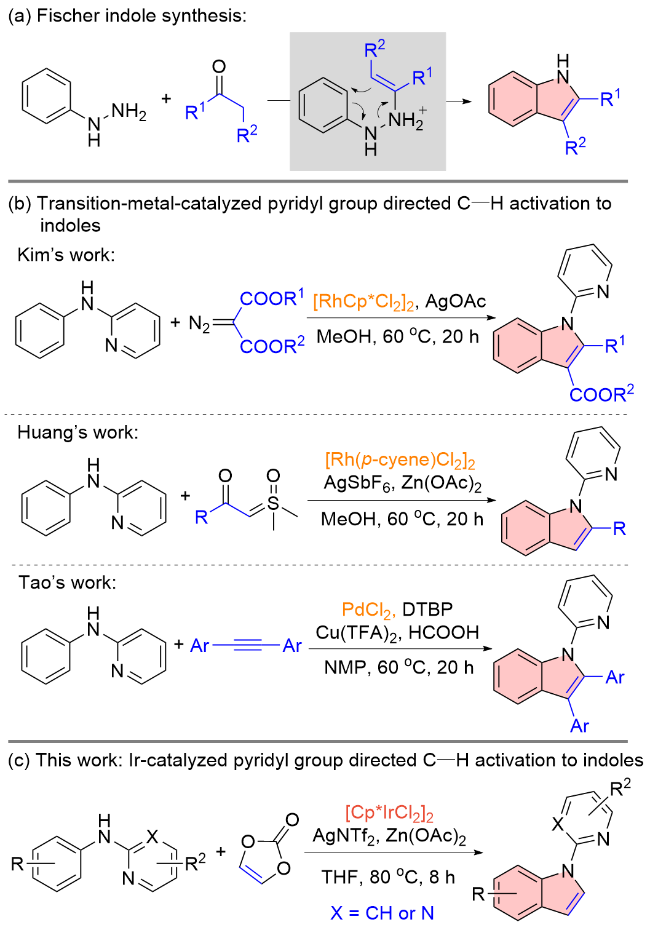
Considering the limitations of the traditional synthesis method, in recent years, many transition metal-catalysed coupling reactions utilizing a directing group were exploited to the synthesis of indoles (Scheme 1b).[5] In 2015, Kim's group[6] demonstrated a rhodium(III)-catalyzed coupling reactions of anilines with diazo compounds to synthesize highly substituted indoles. In 2019, Huang's group[7] demonstrated that sulfoxonium ylides are important building blocks in annulation reactions, and reported a Ru(II)-catalyzed intermolecular annulation of N-aryl-2-aminopyridines and sulfoxonium ylides to synthesize indole derivatives. Recently, Tao and Xia's group[8] reported a Pd-catalyzed [3+2] annulation of N-aryl-2-aminopyridines and alkynes, which provides an efficient strategy for the synthesis of highly substituted indoles. Despite these considerable progress, there is still a great demand for the development of the efficient synthesis of indole derivatives.
Recently, vinylene carbonate, as an ideal synthetic precursor of acetylene surrogate, has been widely used in annulation reactions to synthesize various polycyclic heteroaromatic scaffolds.[9] Inspired by these elegant pro-gresses and our previous research,[10] herein, we design and develop an Ir-catalyzed annulation reactions of N-aryl-2-aminopyridines to synthesize indole derivatives (Scheme 1c), which utilizing vinylene carbonate as a new C2 synthon.
2 Results and discussion
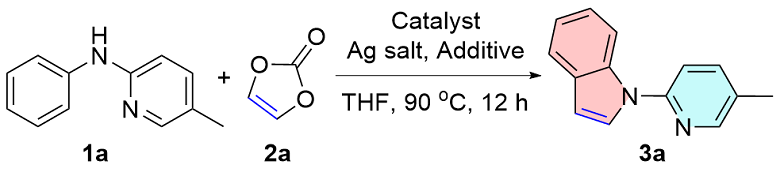
Inspired by our recent research and the reported work involving vinylene carbonate, our investigation commenced with the utilization of N-aryl-2-aminopyridines (1a) and vinylene carbonate (2a) as the model substrates using 5 mol% [Cp*RhCl2]2 in tetrahydrofuran (THF) with AgSbF6 as the sliver salt and PivOH as the additive at 90 ℃ (Table 1, Entry 1). Unfortunately, the cycloaddition product 3a was not obtained after attempts even other common catalysts, such as [Ru(p-cymene)Cl2]2, [Cp*Co(CO)I2] and Pd(OAc)2 (Table 1, Entries 2~4). Subsequently, our focus shifted to Ir-complexes, which is known for their outstanding perfor-mance in metal-catalyzed coupling reactions.[11] To our delight, the desired product 3a was first obtained in 46% yield using [Cp*IrCl2]2 as catalyst (Table 1, Entry 5). Considering the importance of additives in current reaction, other additives were investigated (Table 1, Entries 6~9), such as HOAc, NaOAc, Cu(OAc)2 and Zn(OAc)2, and the results revealed that Zn(OAc)2 was beneficial for the reaction, the yield of 3a increased to 56%. Then several solvents were investigated, among which THF gave the superior result compared with 1,2-dichloroethane (DCE), ethyl acetate (EA) and PhMe (Table 1, Entries 10~12). Subsequently, screening of sliver salt revealed that AgNTf2 was the optimal choice and 73% yield was obtained (Table 1, Entries 13~15). In order to further complete the catalytic system, screening of other parameters, such as the amount of reactants, reaction temperature and reaction time, the optimal conditions are established as follows: N-phenylpy-ridin-2-amine (1a, 0.2 mmol), vinylene carbonate (2a, 0.4 mmol), [Cp*IrCl2]2 (5 mol%), AgNTf2 (20 mol%), Zn(OAc)2 (5 mol%), in THF (2 mL) at 80 ℃ for 8 h, where the yield of 3a reached 75% (Table 1, Entry 16).
Table 1 Optimization of reaction conditionsa
|
| Entry | Catalyst | Ag salt | Additive | Solvent | Yieldb/% |
|---|---|---|---|---|---|
| 1 | [Cp*RhCl2]2 | AgSbF6 | PivOH | THF | Trace |
| 2 | [Ru(p-cymene)Cl2]2 | AgSbF6 | PivOH | THF | Trace |
| 3 | [Cp*Co(CO)I2] | AgSbF6 | PivOH | THF | Trace |
| 4 | Pd(OAc)2 | AgSbF6 | PivOH | THF | Trace |
| 5 | [Cp*IrCl2]2 | AgSbF6 | PivOH | THF | 46 |
| 6 | [Cp*IrCl2]2 | AgSbF6 | HOAc | THF | 31 |
| 7 | [Cp*IrCl2]2 | AgSbF6 | NaOAc | THF | Trace |
| 8 | [Cp*IrCl2]2 | AgSbF6 | Cu(OAc)2 | THF | Trace |
| 9 | [Cp*IrCl2]2 | AgSbF6 | Zn(OAc)2 | THF | 56 |
| 10 | [Cp*IrCl2]2 | AgSbF6 | Zn(OAc)2 | DCE | 35 |
| 11 | [Cp*IrCl2]2 | AgSbF6 | Zn(OAc)2 | EA | 18 |
| 12 | [Cp*IrCl2]2 | AgSbF6 | Zn(OAc)2 | PhMe | 51 |
| 13 | [Cp*IrCl2]2 | AgBF4 | Zn(OAc)2 | THF | Trace |
| 14 | [Cp*IrCl2]2 | AgNTf2 | Zn(OAc)2 | THF | 73 |
| 15 | [Cp*IrCl2]2 | AgOTf | Zn(OAc)2 | THF | 54 |
| 16c | [Cp*IrCl2]2 | AgNTf2 | Zn(OAc)2 | THF | 75, 71d |
a Reaction conditions: 1a (0.2 mmol), 2a (0.4 mmol), catalyst (5 mol%), Ag salt (20 mol%), additive (5 mol%), THF (2 mL) at 90 ℃ for 12 h. b Yields were determined by 1H NMR using 1,3,5-trimethoxybenzene as the internal standard. c At 80 ℃ for 8 h. d Isolated yields. |
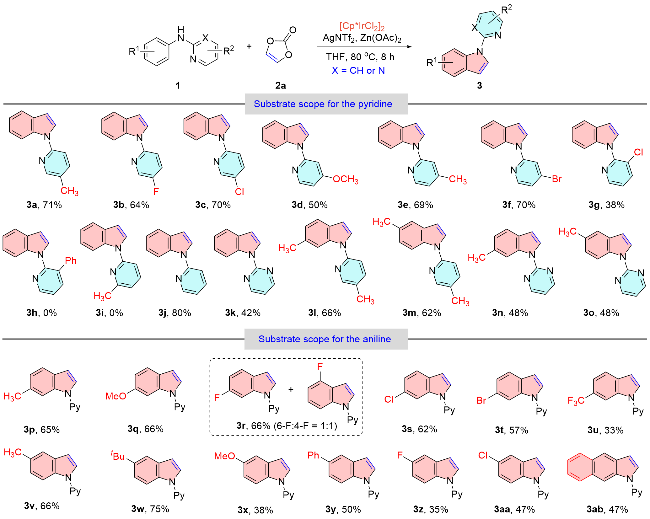
With suitable conditions established, we subsequently started to surveyed the scope and generality of various substituted pyridines for this [3+2] annulation, and the results are showned in Scheme 2. As for directing group pyridine fragments, it was found that this [3+2] annulation was not sensitive to the electronegativity of substituents, both electron-withdrawing group (F, Cl) or electron-donating group (Me) at C(3)-or C(4)-position of the pyridine rings reacted successfully, delivering the corresponding indoles (3a~3f) in 50%~71% yields. This reaction seems to be tremendously influenced by the steric hindrance effect, and the yield of C(5)-cholro-substituted pyridine 3g was decreased dramatically to 38%, even the cycloaddition product 3h was not obtained. Besides, the stability of Ir-com-plexes intermediate might be influenced by C(2)-substituted pyridine generating the desired product 3i, but 3i was not obtained. Moreover, anilines containing pyridine 3j and N-pyrimidyl 3k are also suitable for the reaction with 73% and 42% yields, respectively. Finally, polysubstituted substrates could also react with 2a to give products 3l~3o in acceptable yield. After determining the optimal guiding group 3j, various aniline fragments were also examined under the optimized conditions. Generally, this reaction has good functional group compatibility, anilines bearing electron-donating (Me, OMe, tBu, Ph) or electron-withdrawing groups (F, Cl, Br, CF3) on the benzene ring could successfully couple with vinylene carbonate to give indole derivatives in moderate to good yields (3p~3aa). Among them, anilines containing the F or Cl group at the para-position were not sensitive in this catalytic system, affording 3z and 3aa in 35% and 47% yields, respectively. It is worth noting that the large N-(naphthalene-2-yl)pyri-dine-2-amine (3ab) was also found to be effective for this [3+2] annulation, and provided the desired products in 47% yields.
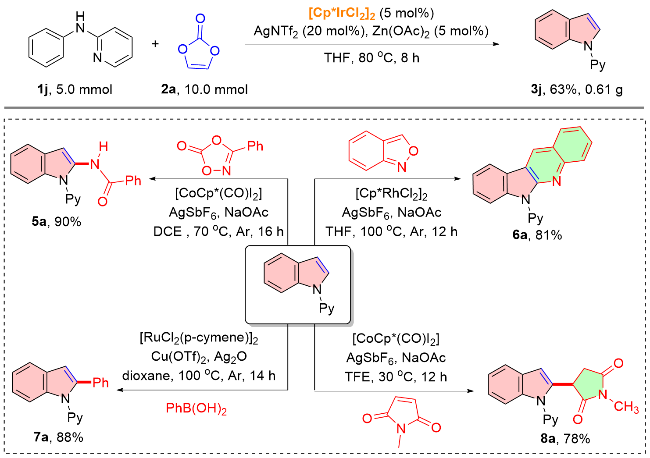
In order to explore the synthetic utility of our catalytic system, a scaled-up reaction with 5 mmol of N-phenyl-pyridin-2-amine (1j) was carried out, and indole 3j was obtained in 63% yields. Considering the importance of indole compounds,[12] some modification of the coupling product 3j was attempted. As expected, the obtained indole 3j could be further converted into various substituted indoles (5a~8a) under different catalytic systems, which clearly disclosed the synthetic utility of this method (Scheme 3).
Some mechanistic experiments were then carried out to explore the experimental mechanism (Scheme 4). Initially, the reaction was carried out by using 1j with D2O under the standard conditions for 2 h in the absence of vinylene carbonate (2a), which showed that 22% deuterium incor-poration at the ortho-position of 1j (Scheme 4a). This indicated that the C—H bond cleavage of this transformation was reversible. Then, the intermolecular competitive kinetic isotope effect (KIE) experiment of 1j and d5-1j was implemented under the standard conditions for 3 h and revealed a KIE value of 1.6 (Scheme 4b), which implying that ortho-C—H bond cleavage might not be involved in the rate-determining process. Finally, intermolecular compe-tition experiment between 1q and 1s was conducted, and the 3q and 3s were obtained in a ratio of 3.5∶1, which indicated the higher reactivity for the electron-rich substrate (Scheme 4c).
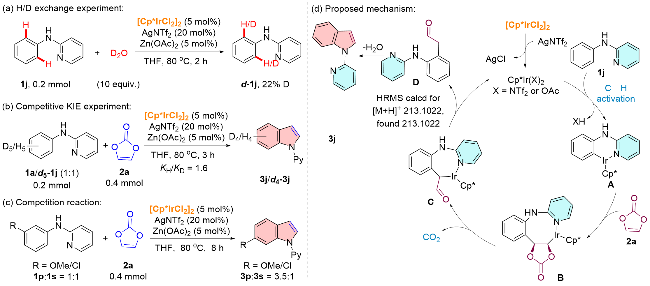


Based on these preliminary results and previous re-ports,[13] a proposed mechanism for this transformation was proposed in Scheme 4d. Firstly, substrate 1j transforms into an iridium intermediate A via C—H bond activation. Subsequently, intermediate A reacts with vinylene carbonate 2a to form eight-member intermediate B, which can translate into intermediate C by a decarboxylation. Then intermediate D is obtained from protonation of intermediate C, while releasing active Ir-complexes to complete the cata-lytic cycle. Finally, the coupling product 3j is formed via eliminating water.
3 Conclusions
In summary, an iridium-catalyzed [3+2] annulation of N-phenylpyridin-2-amine with readily available vinylene carbonate has been developed, which opens an efficient approach for the synthesis of indole derivatives. This method features broad substrate scopes and good yields.
4 Experimental section
4.1 General experimental information
All the solvents involved in the reaction were dried by standard methods. All the drugs involved in the reaction were purchased from chemical reagent suppliers such as Anergy, Bidet, etc., and were used without further purification. All products were separated by silica gel (200~300 mesh) column chromatography with petroleum ether (PE) (60~90 ℃) and ethyl acetate (EA). 1H NMR and 13C NMR spectra were recorded on a Bruker Advance 500 spectrometer at ambient temperature with CDCl3 as solvent and tetramethylsilane (TMS) as the internal standard. High resolution mass spectrometry (HRMS) data were recorded by an Agilent LC 1200/MS QTOF6520. Melting points were measured by a WRS-1B type melting point apparatus and were uncorrected.
4.2 General procedure for synthesis of indole 3
The synthesis of 1-(5-methylpyridin-2-yl)-1H-indole (3a) was taken as an example. 5-Methyl-N-phenylpyridin-2-amine (1a) (0.2 mmol), carbonate ethylene (2a) (0.4 mmol), [Cp*IrCl2]2 (5 mol%), AgNTf2 (20 mol%) and Zn(OAc)2 (5 mol%) were dissolved in THF (2 mL). The reaction mixture was stirred at 80 ℃ for 8 h. The resulting mixture was cooled to room temperature. After concentrating on the solvent, the product was purified by flash chromatography with V(petroleum ether, PE)∶V(ethyl acetate, EA)=50∶1 to give the product 3a.
1-(5-Methylpyridin-2-yl)-1H-indole (3a): 71% yield as a white solid. m.p. 107~109 ℃; Rf=0.6 [V(PE)∶V(EA)=5∶1]; 1H NMR (500 MHz, CDCl3) δ: 8.40 (d, J=2.1 Hz, 1H), 8.13 (dd, J=8.3, 1.0 Hz, 1H), 7.70 (d, J=3.5 Hz, 1H), 7.67 (d, J=7.8 Hz, 1H), 7.63 (dd, J=8.3, 2.4 Hz, 1H), 7.41 (d, J=8.3 Hz, 1H), 7.29 (ddd, J=8.4, 7.1, 1.2 Hz, 1H), 7.20 (ddd, J=7.9, 7.0, 1.0 Hz, 1H), 6.71 (dd, J=3.5, 0.8 Hz, 1H), 2.39 (s, 3H); 13C NMR (126 MHz, CDCl3) δ: 150.4, 149.0, 139.1, 135.1, 130.3, 129.8, 126.2, 123.0, 121.1, 121.1, 114.5, 112.7, 105.1, 17.9; HRMS (ESI-TOF) calcd for C14H13N2 [M+H]+ 209.1073, found 209.1080.
1-(5-Fluoropyridin-2-yl)-1H-indole (3b):[14] 64% yield as a white solid. m.p. 74~76 ℃; Rf=0.6 [V(PE)∶V(EA)=5∶1]; 1H NMR (500 MHz, CDCl3) δ: 8.43 (d, J=3.0 Hz, 1H), 8.11 (dd, J=8.4, 1.0 Hz, 1H), 7.71~7.63 (m, 2H), 7.56 (ddd, J=8.9, 7.4, 3.0 Hz, 1H), 7.47 (dd, J=8.9, 3.6 Hz, 1H), 7.30 (ddd, J=8.4, 7.1, 1.3 Hz, 1H), 7.22 (ddd, J=8.0, 7.1, 1.0 Hz, 1H), 6.72 (dd, J=3.5, 0.8 Hz, 1H); 13C NMR (126 MHz, CDCl3) δ: 158.05, 156.04, 148.83, 148.81, 136.79, 136.59, 135.18, 130.38, 126.19, 125.79, 125.63, 123.35, 121.46, 121.29, 115.61, 115.58, 112.59, 105.6; HRMS (ESI-TOF) calcd for C13H10FN2 [M+H]+ 213.0823, found 213.0827.
1-(5-Chloropyridin-2-yl)-1H-indole (3c):[14] 70% yield as a pale yellow solid foam. Rf=0.5 [V(PE)∶V(EA)=5∶1]; 1H NMR (500 MHz, CDCl3) δ: 8.51 (d, J=2.5 Hz, 1H), 8.18 (dd, J=8.4, 1.0 Hz, 1H), 7.77 (ddd, J=8.7, 2.6, 1.0 Hz, 1H), 7.70~7.62 (m, 2H), 7.44 (dt, J=8.8, 0.9 Hz, 1H), 7.32 (ddd, J=8.4, 7.0, 1.3 Hz, 1H), 7.23 (ddd, J=8.0, 7.1, 1.0 Hz, 1H), 6.73 (dd, J=3.5, 0.8 Hz, 1H); 13C NMR (126 MHz, CDCl3) δ: 150.8, 147.6, 138.25, 135.10, 130.57, 127.61, 125.86, 123.52, 121.69, 121.32, 115.09, 113.12, 106.2; HRMS (ESI-TOF) calcd for C13H10ClN2 [M+H]+ 229.0527, found 229.0528.
(4-Methoxypyridin-2-yl)-1H-indole (3d): 50% yield as a pale yellow oil. Rf=0.5 [V(PE)∶V(EA)=5∶1]; 1H NMR (500 MHz, CDCl3) δ: 8.39 (d, J=5.8 Hz, 1H), 8.16 (dd, J=8.4, 0.9 Hz, 1H), 7.72 (d, J=3.5 Hz, 1H), 7.66 (d, J=7.7 Hz, 1H), 7.32~7.28 (m, 1H), 7.21 (td, J=7.5, 0.9 Hz, 1H), 7.00 (d, J=2.2 Hz, 1H), 6.74 (dd, J=5.8, 2.3 Hz, 1H), 6.71 (d, J=3.4 Hz, 1H), 3.93 (s, 3H); 13C NMR (126 MHz, CDCl3) δ: 167.6, 154.0, 150.1, 135.2, 130.5, 126.3, 123.1, 121.3, 121.2, 112.9, 107.1, 105.4, 100.7, 55.6; HRMS (ESI-TOF) calcd for C14H13N2O [M+H]+ 247.0842, found 247.0844.
1-(4-Methylpyridin-2-yl)-1H-indole (3e):[14] 69% yield as a pale-yellow oil. Rf=0.6 [V(PE)∶V(EA)=5∶1]; 1H NMR (500 MHz, CDCl3) δ: 8.43 (d, J=5.1 Hz, 1H), 8.19 (d, J=8.4 Hz, 1H), 7.72 (d, J=3.5 Hz, 1H), 7.67 (dt, J=7.9, 1.0 Hz, 1H), 7.33~7.28 (m, 2H), 7.21 (ddd, J=8.0, 7.1, 1.0 Hz, 1H), 7.00 (dd, J=5.1, 1.3 Hz, 1H), 6.71 (dd, J=3.5, 0.8 Hz, 1H), 2.45 (s, 3H); 13C NMR (126 MHz, CDCl3) δ: 152.73, 149.92, 148.71, 135.22, 130.48, 126.20, 123.10, 121.48, 121.24, 121.15, 115.45, 113.0, 105.3, 21.4; HRMS (ESI-TOF) calcd for C14H13N2 [M+H]+ 231.0893, found 231.0898.
1-(4-Bromopyridin-2-yl)-1H-indole (3f):[14] 70% yield as yellow oil. Rf=0.6 [V(PE)∶V(EA)=5∶1]; 1H NMR (500 MHz, CDCl3) δ: 8.38 (d, J=5.3 Hz, 1H), 8.24 (dd, J=8.4, 0.9 Hz, 1H), 7.71~7.64 (m, 3H), 7.35~7.30 (m, 2H), 7.23 (ddd, J=8.0, 7.1, 1.0 Hz, 1H), 6.73 (dd, J=3.5, 0.8 Hz, 1H); 13C NMR (126 MHz, CDCl3) δ: 153.4, 149.6, 135.1, 134.3, 130.7, 125.7, 123.6, 123.2, 121.8, 121.3, 117.4, 113.3, 106.6; HRMS (ESI-TOF) calcd for C13H10BrN2 [M+H]+ 273.0022, found 273.0020.
1-(3-Chloropyridin-2-yl)-1H-indole (3g):[14] 38% yield as a colorless oil. Rf=0.4 [V(PE)∶V(EA)=5∶1]; 1H NMR (500 MHz, CDCl3) δ: 8.53 (dd, J=4.6, 1.7 Hz, 1H), 7.94 (dd, J=8.0, 1.6 Hz, 1H), 7.69 (d, J=7.6 Hz, 1H), 7.55 (dd, J=3.5, 1.4 Hz, 1H), 7.51 (dd, J=8.2, 1.1 Hz, 1H), 7.31~7.23 (m, 2H), 7.18 (tdd, J=7.1, 2.0, 1.1 Hz, 1H), 6.73 (dd, J=3.4, 1.1 Hz, 1H); 13C NMR (126 MHz, CDCl3) δ: 149.1, 147.2, 140.1, 136.0, 129.2, 127.7, 126.1, 123.1, 122.8, 121.1, 121.1, 112.2, 104.7; HRMS (ESI-TOF) calcd for C13H10ClN2 [M+H]+ 229.0527, found 229.0528.
1-(Pyridin-2-yl)-1H-indole (3j):[14] 73% yield as a pale yellow oil. Rf=0.6 [V(PE)∶V(EA)=5∶1]; 1H NMR (500 MHz, CDCl3) δ: 8.58 (ddd, J=4.9, 1.9, 0.9 Hz, 1H), 8.23 (dd, J=8.3, 1.0 Hz, 1H), 7.86~7.72 (m, 2H), 7.69 (dt, J=7.7, 1.0 Hz, 1H), 7.50 (d, J=8.2 Hz, 1H), 7.32 (ddd, J=8.3, 7.1, 1.3 Hz, 1H), 7.25~7.20 (m, 1H), 7.17 (ddd, J=7.4, 4.9, 0.9 Hz, 1H), 6.74 (dd, J=3.5, 0.8 Hz, 1H); 13C NMR (126 MHz, CDCl3) δ: 152.5, 149.0, 138.5, 135.1, 130.5, 126.1, 123.2, 121.3, 121.2, 120.1, 114.7, 113.0, 105.6; HRMS (ESI-TOF) calcd for C13H11N2 [M+H]+ 195.0917, found 195.0915.
1-(Pyrimidin-2-yl)-1H-indole (3k):[14] 42% yield as a pale yellow oil. Rf=0.5 [V(PE)∶V(EA)=5∶1]; 1H NMR (500 MHz, CDCl3) δ: 8.74 (dd, J=4.8, 1.7 Hz, 1H), 8.62 (dd, J=8.6, 1.3 Hz, 2H), 7.56 (dd, J=7.8, 1.6 Hz, 1H), 7.28 (ddd, J=8.6, 5.5, 1.8 Hz, 2H), 7.15 (ddt, J=8.5, 7.3, 1.2 Hz, 1H), 6.95 (s, 1H), 6.63 (dd, J=7.7, 4.9 Hz, 1H); 13C NMR (126 MHz, CDCl3) δ: 158.2, 157.9, 135.5, 131.4, 125.9, 123.7, 122.2, 120.9, 116.3, 116.2, 107.0; HRMS (ESI-TOF) calcd for C12H10N3 [M+H]+ 196.0869, found 196.0871.
6-Methyl-1-(5-methylpyridin-2-yl)-1H-indole (3l): 66% yield as a colorless oil. Rf=0.6 [V(PE)∶V(EA)=5∶1]; 1H NMR (500 MHz, CDCl3) δ: 8.29 (d, J=2.2 Hz, 1H), 7.84 (s, 1H), 7.51 (dd, J=5.7, 2.8 Hz, 2H), 7.44 (d, J=8.0 Hz, 1H), 7.27 (d, J=8.2 Hz, 1H), 6.97 (dd, J=8.0, 1.3 Hz, 1H), 6.55 (dd, J=3.5, 0.8 Hz, 1H), 2.41 (s, 3H), 2.27 (s, 3H); 13C NMR (126 MHz, CDCl3) δ: 150.5, 149.0, 139.1, 135.5, 132.8, 129.6, 128.1, 125.6, 122.8, 120.7, 114.5, 112.6, 104.9, 22.1, 17.9; HRMS (ESI-TOF) calcd for C15H15N2 [M+H]+ 223.1230, found 223.1233.
5-Methyl-1-(5-methylpyridin-2-yl)-1H-indole (3m):[14] 62% yield as a white solid. m.p. 108~110 ℃; Rf=0.7 [V(PE)∶V(EA)=5∶1]; 1H NMR (500 MHz, CDCl3) δ: 8.38 (d, J=2.3 Hz, 1H), 8.02 (d, J=8.5 Hz, 1H), 7.68 (d, J=3.4 Hz, 1H), 7.61 (dd, J=8.4, 2.3 Hz, 1H), 7.50 (d, J=1.3 Hz, 1H), 7.33 (d, J=8.2 Hz, 1H), 7.12 (dd, J=8.4, 1.6 Hz, 1H), 6.63 (d, J=3.4 Hz, 1H), 2.48 (s, 3H), 2.38 (s, 3H); 13C NMR (126 MHz, CDCl3) δ: 150.4, 148.9, 139.2, 133.4, 130.6, 130.4, 129.5, 126.2, 124.5, 120.9, 114.2, 112.4, 104.8, 21.4, 17.9; HRMS (ESI-TOF) calcd for C15H15N2 [M+H]+ 223.1230, found 223.1232.
6-Methyl-1-(pyrimidin-2-yl)-1H-indole (3n):[14] 48% yield as a white solid. m.p. 111~113 ℃; Rf=0.5 [V(PE)∶V(EA)=5∶1]; 1H NMR (500 MHz, CDCl3) δ: 8.70 (d, J=4.8 Hz, 2H), 8.64 (d, J=1.5 Hz, 1H), 8.21 (d, J=3.7 Hz, 1H), 7.51 (d, J=7.9 Hz, 1H), 7.09 (dd, J=8.0, 1.4 Hz, 1H), 7.03 (t, J=4.8 Hz, 1H), 6.66 (d, J=3.6 Hz, 1H), 2.56 (s, 3H); 13C NMR (126 MHz, CDCl3) δ: 158.2, 157.9, 135.8, 133.6, 129.2, 125.3, 123.7, 120.5, 116.4, 116.0, 106.9, 22.2; HRMS (ESI-TOF) calcd for C13H12N3 [M+H]+ 210.1026, found 210.1025.
5-Methyl-1-(pyrimidin-2-yl)-1H-indole (3o):[14] 48% yield as a pale yellow solid. m.p. 89~91 ℃; Rf=0.5 [V(PE)∶V(EA)=5∶1]; 1H NMR (500 MHz, CDCl3) δ: 8.71~8.63 (m, 3H), 8.23 (d, J=3.6 Hz, 1H), 7.42 (d, J=1.6 Hz, 1H), 7.17 (dd, J=8.5, 1.7 Hz, 1H), 7.01 (t, J=4.8 Hz, 1H), 6.63 (d, J=3.6 Hz, 1H), 2.48 (s, 3H); 13C NMR (126 MHz, CDCl3) δ: 158.2, 157.9, 133.7, 131.6, 131.6, 125.9, 125.1, 120.8, 116.0, 106.7, 21.5; HRMS (ESI-TOF) calcd for C13H12N3 [M+H]+ 210.1026, found 210.1024.
6-Methyl-1-(pyridin-2-yl)-1H-indole (3p):[14] 65% yield as a pale yellow oil. Rf=0.6 [V(PE)∶V(EA)=5∶1]; 1H NMR (500 MHz, CDCl3) δ: 8.58 (dd, J=4.9, 1.1 Hz, 1H), 8.02 (s, 1H), 7.85~7.80 (m, 1H), 7.65 (d, J=3.5 Hz, 1H), 7.58 (d, J=8.0 Hz, 1H), 7.47 (d, J=8.2 Hz, 1H), 7.17 (ddd, J=7.3, 4.9, 0.9 Hz, 1H), 7.05 (dd, J=8.1, 1.4 Hz, 1H), 6.67 (dd, J=3.5, 0.9 Hz, 1H), 2.52 (s, 3H); 13C NMR (126 MHz, CDCl3) δ: 152.7, 149.0, 138.5, 135.5, 133.1, 128.3, 125.5, 123.0, 120.7, 120.0, 114.8, 113.0, 105.5, 22.1; HRMS (ESI-TOF) calcd for C14H13N2 [M+H]+ 209.1073, found 209.1072.
6-Methoxy-1-(pyridin-2-yl)-1H-indole (3q):[14] 66% yield as a colorless oil. Rf=0.5 [V(PE)∶V(EA)=5∶1]; 1H NMR (500 MHz, CDCl3) δ: 8.55 (dd, J=4.9, 1.1 Hz, 1H), 8.19 (dd, J=9.1, 2.4 Hz, 1H), 7.78 (d, J=7.7 Hz, 1H),, 7.70 (d, J=3.5 Hz, 1H), 7.44 (d, J=9.2 Hz, 1H), 7.12 (d, J=2.3 Hz, 2H), 6.96 (dd, J=9.1, 2.2 Hz, 1H), 6.65 (d, J=3.4 Hz, 1H), 3.89 (s, 3H); 13C NMR (126 MHz, CDCl3) δ: 155.1, 152.6, 148.9, 138.4, 131.2, 130.3, 126.3, 119.8, 114.2, 114.0, 112.8, 105.4, 103.0, 55.8; HRMS (ESI-TOF) calcd for C14H13N2O [M+H]+ 225.1022, found 225.1022.
6-Fluoro-1-(pyridin-2-yl)-1H-indole/4-fluoro-1-(pyrid-in-2-yl)-1H-indole (3r):[14] 66% yield as a pale yellow oil. Rf=0.5 [V(PE)∶V(EA)=5∶1]; 1H NMR (500 MHz, CDCl3) δ: 8.57 (td, J=5.1, 1.9 Hz, 2H), 8.08 (dt, J=10.8, 2.3 Hz, 1H), 7.99 (d, J=8.3 Hz, 1H), 7.82 (qd, J=7.5, 1.7 Hz, 2H), 7.67 (dd, J=8.9, 3.5 Hz, 2H), 7.56 (dd, J=8.6, 5.5 Hz, 1H), 7.52~7.47 (m, 1H), 7.46~7.42 (m, 1H), 7.25~7.15 (m, 3H), 6.95 (td, J=9.0, 2.4 Hz, 1H), 6.87 (dd, J=10.0, 7.9 Hz, 1H), 6.82 (d, J=3.5 Hz, 1H), 6.69 (dd, J=3.4, 0.8 Hz, 1H); 13C NMR (126 MHz, CDCl3) δ: 161.5, 159.6, 157.2, 155.3, 152.5, 152.3, 149.1, 149.0, 138.6, 137.6, 137.5, 135.3, 135.2, 126.8, 126.1, 126.1, 126.0, 123.8, 123.7, 121.6, 121.5, 120.6, 120.3, 119.5, 119.3, 114.8, 114.1, 110.0, 109.8, 109.2, 109.2, 106.3, 106.2, 105.7, 101.3, 100.7, 100.5; HRMS (ESI-TOF) calcd for C13H10FN2 [M+H]+ 213.0823, found 213.0823.
6-Chloro-1-(pyridin-2-yl)-1H-indole (3s):[14] 62% yield as a white solid. m.p. 110~112 ℃; Rf=0.6 [V(PE)∶V(EA)=5∶1]; 1H NMR (500 MHz, CDCl3) δ: 8.59 (ddd, J=4.8, 1.9, 0.9 Hz, 1H), 8.33 (d, J=1.8 Hz, 1H), 7.84 (ddd, J=8.2, 7.4, 1.9 Hz, 1H), 7.67 (d, J=3.5 Hz, 1H), 7.56 (d, J=8.4 Hz, 1H), 7.45 (d, J=8.2 Hz, 1H), 7.22~7.16 (m, 2H), 6.69 (dd, J=3.5, 0.9 Hz, 1H); 13C NMR (126 MHz, CDCl3) δ: 152.3, 149.0, 138.7, 135.5, 129.2, 128.9, 126.5, 122.0, 121.8, 120.5, 114.4, 113.6, 105.6; HRMS (ESI-TOF) calcd for C13H10ClN2 [M+H]+ 229.0527, found 229.0527.
6-Bromo-1-(pyridin-2-yl)-1H-indole (3t):[14] 57% yield as a pale yellow solid foam. Rf=0.6 [V(PE)∶V(EA)=5∶1]; 1H NMR (500 MHz, CDCl3) δ: 8.58 (dd, J=5.0, 1.8 Hz, 1H), 8.48 (d, J=1.7 Hz, 1H), 7.83 (td, J=7.8, 1.9 Hz, 1H), 7.65 (d, J=3.5 Hz, 1H), 7.51 (d, J=8.4 Hz, 1H), 7.43 (d, J=8.2 Hz, 1H), 7.32 (dd, J=8.4, 1.7 Hz, 1H), 7.19 (dd, J=7.4, 4.8 Hz, 1H), 6.68 (d, J=3.4 Hz, 1H); 13C NMR (126 MHz, CDCl3) δ: 152.2, 149.1, 138.7, 135.9, 129.2, 126.4, 124.6, 122.2, 120.5, 116.9, 116.5, 114.5, 105.7; HRMS (ESI-TOF) calcd for C13H10BrN2 [M+H]+ 273.0022, found 273.0022.
1-(Pyridin-2-yl)-6-(trifluoromethyl)-1H-indole (3u):[14] 33% yield as a white solid. m.p. 109~111 ℃; Rf=0.6 [V(PE)∶V(EA)=5∶1]; 1H NMR (500 MHz, CDCl3) δ: 8.66~8.56 (m, 2H), 7.87 (ddd, J=8.2, 7.4, 1.9 Hz, 1H), 7.82 (d, J=3.5 Hz, 1H), 7.74 (dt, J=8.4, 0.8 Hz, 1H), 7.46 (ddd, J=13.8, 8.3, 1.3 Hz, 2H), 7.24 (ddd, J=7.4, 4.9 Hz, 1H), 6.77 (dd, J=3.5, 0.7 Hz, 1H); 13C NMR (126 MHz, CDCl3) δ: 152.1, 149.2, 138.9, 134.3, 132.8, 128.4, 126.3, 125.4, 125.2, 124.2, 121.4, 120.8, 118.1, 118.1, 118.1, 118.0, 114.7, 111.1, 111.1, 105.6; HRMS (ESI-TOF) calcd for C14H10F3N2 [M+H]+ 263.0791, found 263.0793
5-Methyl-1-(pyridin-2-yl)-1H-indole (3v):[14] 66% yield as a pale yellow oil. Rf=0.6 [V(PE)∶V(EA)=5∶1]; 1H NMR (500 MHz, CDCl3) δ: 8.56 (dd, J=4.9, 1.8 Hz, 1H), 8.10 (d, J=8.4 Hz, 1H), 7.83~7.78 (m, 1H), 7.71 (d, J=3.4 Hz, 1H), 7.51~7.45 (m, 2H), 7.17~7.12 (m, 2H), 6.65 (d, J=3.4 Hz, 1H), 2.48 (s, 3H); 13C NMR (126 MHz, CDCl3) δ: 152.6, 148.9, 138.5, 138.5, 133.4, 130.8, 130.7, 126.0, 124.7, 120.9, 119.9, 114.3, 112.7, 105.3, 21.4; HRMS (ESI-TOF) calcd for C14H12N2Na [M+H]+ 231.0893, found 231.0896.
5-(tert-Butyl)-1-(pyridin-2-yl)-1H-indole (3w): 75% yield as a pale yellow oil. Rf=0.6 [V(PE)∶V(EA)=5∶1]; 1H NMR (500 MHz, CDCl3) δ: 8.56 (dd, J=5.3, 1.7 Hz, 1H), 8.13 (d, J=8.8 Hz, 1H), 7.83~7.79 (m, 1H), 7.73 (d, J=3.5 Hz, 1H), 7.67 (d, J=1.9 Hz, 1H), 7.50 (d, J=8.2 Hz, 1H), 7.39 (dd, J=8.8, 2.0 Hz, 1H), 7.15 (ddd, J=7.3, 4.9, 0.9 Hz, 1H), 6.69 (d, J=3.4 Hz, 1H), 1.42 (s, 9H); 13C NMR (126 MHz, CDCl3) δ: 152.6, 149.0, 144.3, 138.4, 133.2, 130.4, 126.0, 121.4, 119.9, 117.1, 114.3, 112.6, 105.8, 34.7, 31.9; HRMS (ESI-TOF) calcd for C17H19N2 [M+H]+ 251.1543, found 251.1544.
5-Methoxy-1-(pyridin-2-yl)-1H-indole (3x):[14] 38% yield as a pale yellow oil. Rf=0.4 [V(PE)∶V(EA)=5∶1]; 1H NMR (500 MHz, CDCl3) δ: 8.55 (dd, J=4.9, 1.1 Hz, 1H), 8.17 (d, J=9.2 Hz, 1H), 7.82~7.77 (m, 1H), 7.70 (d, J=3.5 Hz, 1H), 7.46 (d, J=8.2 Hz, 1H), 7.13 (dd, J=12.6, 3.8 Hz, 2H), 6.95 (dd, J=9.0, 2.6 Hz, 1H), 6.64 (dd, J=3.4, 0.8 Hz, 1H), 3.88 (s, 3H); 13C NMR (126 MHz, CDCl3) δ: 155.1, 152.6, 148.9, 138.5, 131.2, 130.3, 126.4, 119.8, 114.2, 114.1, 112.8, 105.5, 103.0, 55.8; HRMS (ESI-TOF) calcd for C14H12N2ONa [M+Na]+ 247.0842, found 247.0842.
5-Phenyl-1-(pyridin-2-yl)-1H-indole (3y): 50% yield as a yellow oil. Rf=0.6 [V(PE)∶V(EA)=5∶1]; 1H NMR (500 MHz, CDCl3) δ: 8.60 (dd, J=4.9, 1.1 Hz, 1H), 8.29 (d, J=8.7 Hz, 1H), 7.89 (d, J=1.8 Hz, 1H), 7.86~7.82 (m, 1H), 7.77 (d, J=3.5 Hz, 1H), 7.69 (dd, J=8.2, 1.3 Hz, 2H), 7.56 (dd, J=8.7, 1.8 Hz, 1H), 7.53 (d, J=8.2 Hz, 1H), 7.47 (dd, J=8.5, 7.0 Hz, 2H), 7.36~7.32 (m, 1H), 7.19 (ddd, J=7.4, 4.9, 0.9 Hz, 1H), 6.78 (dd, J=3.5, 0.8 Hz, 1H); 13C NMR (126 MHz, CDCl3) δ: 152.5, 149.0, 142.2, 138.6, 134.8, 134.6, 131.0, 128.8, 127.4, 126.6, 122.9, 120.2, 119.6, 114.5, 113.4, 106.0; HRMS (ESI-TOF) calcd for C19H15N2 [M+H]+ 271.1230, found 271.1230.
5-Fluoro-1-(pyridin-2-yl)-1H-indole (3z):[14] 35% yield as a white solid. m.p. 62~64 ℃; 1H NMR (500 MHz, CDCl3) δ: 8.56 (dd, J=4.9, 1.1 Hz, 1H), 8.23 (dd, J=9.1, 4.6 Hz, 1H), 7.83 (ddd, J=8.4, 7.3, 2.0 Hz, 1H), 7.73 (d, J=3.5 Hz, 1H), 7.45 (d, J=8.7 Hz, 1H), 7.29 (dd, J=9.2, 2.6 Hz, 1H), 7.18 (ddd, J=7.4, 4.8, 0.9 Hz, 1H), 7.03 (td, J=9.1, 2.6 Hz, 1H), 6.67 (dd, J=3.4, 0.8 Hz, 1H); 13C NMR (126 MHz, CDCl3) δ: 159.6, 157.7, 152.4, 148.9, 138.7, 131.8, 131.0, 127.4, 120.3, 114.4, 114.3, 114.3, 111.4, 111.2, 106.22, 106.0, 105.6, 105.6; HRMS (ESI-TOF) calcd for C13H10FN2 [M+H]+ 213.0823, found 213.0822.
5-Chloro-1-(pyridin-2-yl)-1H-indole (3aa):[14] 47% yield as a white solid foam. Rf=0.6 [V(PE)∶V(EA)=5∶1]; 1H NMR (500 MHz, CDCl3) δ: 8.57 (dd, J=4.9, 1.1 Hz, 1H), 8.20 (d, J=8.8 Hz, 1H), 7.85~7.80 (m, 1H), 7.71 (d, J=3.5 Hz, 1H), 7.62 (d, J=2.1 Hz, 1H), 7.44 (dd, J=8.2, 0.9 Hz, 1H), 7.24 (dd, J=8.9, 2.1 Hz, 1H), 7.19 (dd, J=7.5, 4.9 Hz, 1H), 6.65 (dd, J=3.5, 0.8 Hz, 1H); 13C NMR (126 MHz, CDCl3) δ: 152.3, 149.0, 138.6, 133.6, 131.5, 127.1, 126.9, 123.4, 120.5, 120.4, 114.5, 114.4, 105.1; HRMS (ESI-TOF) calcd for C13H10ClN2 [M+H]+ 229.0527, found 229.0528.
1-(Pyridin-2-yl)-1H-benzo[f]indole (3ab): 47% yield as a white solid. m.p. 56~58 ℃; Rf=0.7 [V(PE)∶V(EA)=6∶1]; 1H NMR (500 MHz, CDCl3) δ: 8.74 (s, 1H), 8.63 (ddd, J=4.9, 2.0, 0.8 Hz, 1H), 8.14 (s, 1H), 8.01~7.94 (m, 3H), 7.85 (td, J=7.2, 1.3 Hz, 1H), 7.62~7.56 (m, 1H), 7.45~7.38 (m, 2H), 7.19~7.15 (m, 1H), 6.86 (dd, J=3.7, 0.8 Hz, 1H); 13C NMR (126 MHz, CDCl3) δ: 152.7, 149.0, 138.6, 135.2, 131.6, 131.1, 129.6, 129.5, 128.3, 128.0, 124.3, 123.6, 119.6, 118.7, 114.0, 109.4, 105.5; HRMS (ESI-TOF) calcd for C17H12N2Na [M+Na]+ 267.0893, found 267.0891.
Supporting Information Screening of reaction conditions, synthesis of substrate, characterization of products, copies of 1H NMR and 13C NMR. The Supporting Information is available free of charge via the Internet at http://sioc-journal.cn.
(Cheng, F.)