ARTICLES

Study on the Borylation of β-C Positions of Aryl Olefins Catalyzed by Copper Organophosphorus Complexes

  • Shunli Du ,
  • Yaya Wang ,
  • Jiaming Guo ,
  • Xuewei Xu ,
  • Xinhua Peng , *
Expand
  • School of Chemistry and Chemical Engineering, Nanjing University of Science and Technology, Nanjing 210094

Received date: 2025-01-13

  Revised date: 2025-02-13

  Online published: 2025-02-27

Abstract

Organoboron compounds have become important intermediates for the construction of new compounds in synthetic chemistry and pharmaceutical chemistry, and it has been found that pinacol biborate (B2pin2) as the boron source and CuII organophosphorus complex (L) as the catalyst can effectively realize the hydrogen-reduced borylation products and dehydrohydrated borylation products of aryl olefins. The reaction regioselectivity involving β-C positions of aryl olefins can be controlled by regulating the ligand and additive types. The formation mechanism of the product is conducted at LCuIBpin formed from CuII, L and B2pin2. Subsequently the substrate aryl olefins undergo addition reaction to form the active intermediate PhCH(LCuI)CH2Bpin. Followed by the metathesis of the active intermediate with water to form hydrogen reduction products, the same active intermediate can be oxidized with 2,2,6,6-tetramethylpiperidoxyl (TEMPO) to form trans dehydrogenation products.

Cite this article

Shunli Du , Yaya Wang , Jiaming Guo , Xuewei Xu , Xinhua Peng . Study on the Borylation of β-C Positions of Aryl Olefins Catalyzed by Copper Organophosphorus Complexes[J]. Chinese Journal of Organic Chemistry, 2025 , 45(7) : 2435 -2443 . DOI: 10.6023/cjoc202410022

1 Introduction

Organoboron compounds are of great significance due to their wide applications in synthetic reactions,[1] among which the borylation is an effective process to quickly construct C—B bonds which can easily convert to other organic functional groups by the introduction of boron unit.[2] Usually, alkyl borates play a pivotal role in the formation of organic boron compounds due to their stability, functional group compatibility, continuous reactivity and low toxicity.[3] Recently, the catalyzed borylation of unsaturated hydrocarbons based on some transition metal compounds such as Mn,[4] Fe,[5] Co,[6] Ni[7] and Cu[8] etc. are developed to achieve high-value functional chemicals by subsequent transformation of C—B bonds. Of the transition metals, low valence of copper compounds like cuprous chloride and cuprous oxide etc.[9] have attracted much attention in the synthesis of organic boron derivatives. Here, copper hydroxide is used as an in-situ catalyst to catalyze the borylation reaction of aryl olefins under the synergy of organic phosphine. The novel methodology is established which can selectively form 2-phenylethylboronic acid pinacol ester (2a) and E-styrylboronic acid pinacol ester (3a).

2 Results and discussion

2.1 Hydrogenative borylation of styrene

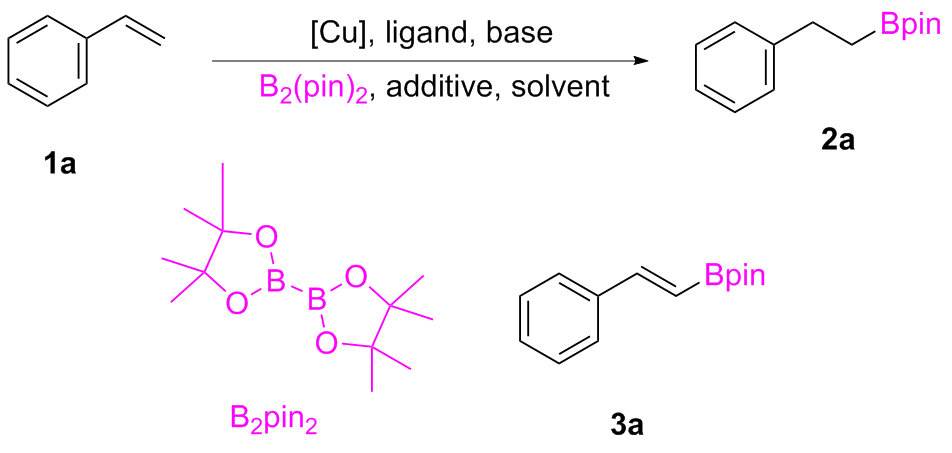
Styrene is one of the representatives of various aromatic olefins while pinacol biborate (B2pin2) is a common boron source reagent. In the experiment, styrene substrate and B2pin2 were employed to systematically present the reaction in the presence of CuCl, CuCl2 and Cu(OH)2 compounds and various organic phosphine ligands (Scheme 1) in different solvents.
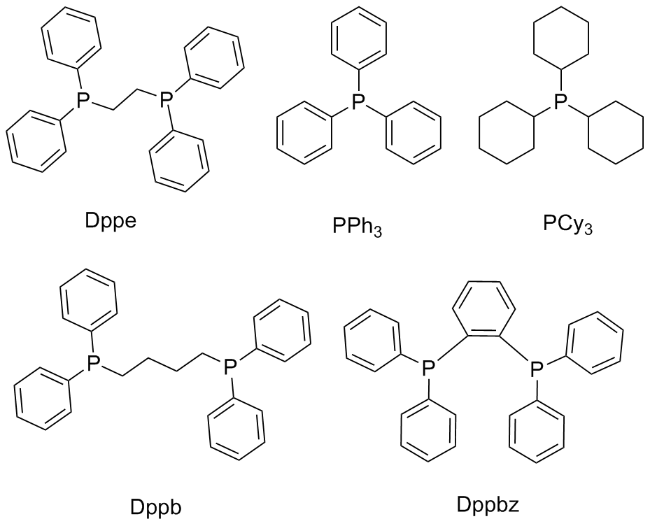
Scheme 1 Various organic phosphine ligands
In the experiments, styrene substrates (0.5 mmol) and B2pin2 (1.5 equiv.) borylation reagents were used in different solvents (2 mL), such as N,N-dimethylformamide (DMF), tetrahydrofuran (THF), H2O, 1,4-dioxane, 1,2-di- chloroethane (DCE), and mixed solvents. It reacted systematically with Cu compound catalysts such as CuCl, CuCl2, Cu(OH)2, and various organophosphine ligands such as ethylenebis(diphenylphosphine) (Dppe), triphenylphos- phine (PPh3), tricyclohexylphosphane (PCy3), 1,4-bis(di- phenylphosphino)butane (Dppb), and 1,2-bis(diphenylpho- sphino)benzene (Dppbz). The reaction temperature is 70 ℃, the reaction time is 2 h, and the products are 2a without special instructions (Table 1).
Table 1 Hydrogenative borylation of styrenea
Entry [Cu] Ligand Solvent Base Yield/%
1b CuCl Dppe DMF LiOtBu 21
2 CuCl Dppe DMF LiOtBu 39
3 CuCl2 Dppe DMF LiOtBu 70
4 CuCl2 Dppe DMF NaOC2H5 41
5 CuCl2 Dppe DMF K2CO3 68
6 CuCl2 Dppe DMF NaHCO3 59
7 CuCl2 Dppe DMF NaOH 84
8 Cu(OH)2 Dppe DMF Cu(OH)2 95 (84)c
9 Cu(OH)2 Dppe 1,4-Dioxane Cu(OH)2 74
10 Cu(OH)2 Dppe THF Cu(OH)2 81
11d Cu(OH)2 Dppe H2O/SDS Cu(OH)2 54
12e Cu(OH)2 Dppe H2O/DMF Cu(OH)2 58
13f Cu(OH)2 Dppe H2O/DMF Cu(OH)2 41
14 Cu(OH)2 Dppe DCE Cu(OH)2 5
15 Cu(OH)2 PPh3 DMF Cu(OH)2 90
16 Cu(OH)2 PCy3 DMF Cu(OH)2 34
17 Cu(OH)2 Dppb DMF Cu(OH)2 29
18 Cu(OH)2 Dppbz DMF Cu(OH)2 95
19g Cu(OH)2 Dppe DMF Cu(OH)2 61
20 Dppe DMF
21 Cu(OH)2 DMF Cu(OH)2 18
22b Cu(OH)2 Dppe DMF Cu(OH)2 15
23h Cu(OH)2 Dppe DMF Cu(OH)2 90
24i Cu(OH)2 Dppe DMF 30
25 Cu(OH)2 Dppe DMF 56
26j Cu(OH)2 Dppe DMF Cu(OH)2 95
27k Cu(OH)2 Dppe DMF Cu(OH)2 95
28 CuO Dppe DMF

a Reaction conditions: 1a (0.5 mmol), B2pin2 (1.5 equiv.), [Cu] (10 mol%), ligand (13 mol%), base (1.1 equiv.), H2O (0.5 mL), solvent (2 mL), 70 ℃, 2 h, N2. Yield by gas chromatography (GC). b H2O is not available. c Isolated yield in brackets. d Sodium dodecyl sulfate (SDS) (0.5 mmol). e H2O (1 mL), DMF (1 mL). f H2O (2 mL), DMF (0.5 mL). g MeOH replaces H2O. h r.t, 24 h. i 1 mol% [Cu] and ligand, 24 h. j Base (0.2 equiv.). k Air.

2-Phenylethylboronic acid pinacol ester (2a) and E- styrylboronic acid pinacol ester (3a) were found when styrene (1a) reacted with B2pin2 in DMF in the presence of copper organic phosphine complexes. Presence of water in reaction system provides protons that facilitate the hydrogenative borylation reaction. And the increase of amount of water improves the regio-control of the morphology of 2a. However, the use of copper chloride instead of cuprous chloride increases the yield to 70% (Table 1, Entries 1~3). Moreover, inorganic copper hydroxide can promote the yield to 95%. Especially, copper hydroxide acts not only as a catalyst but also as a base compared to LiOtBu, NaOC2H5, K2CO3, NaHCO3 and NaOH, increasing yields up to 95% (Table 1, Entries 3~8). Among the selected solvents, DMF appears to be good in high yields. The effect of different solvents on the reaction is also enormous. DMF appears to have a high yield of 95% in the selected solvents, especially when compared to 1,4-dioxane and THF yields (Table 1, Entries 8~10). Water has also been tried as a green solvent with a yield of only 41%~58% with the addition of co-solvents (Table 1, Entries 11~13). DCE has only 5% yield, probably because it is not compatible with H2O (Table 1, Entry 14). Next, the ligands are optimized for experiments. When the ligand is Dppe or Dppbz, the yield is 95%, but using Dppbz will lead to the decrease of selectivity. When the ligand is Dppb, the yield is only 29%, due to the formation of an unstable seven-membered ring with the coordination of ligand and copper metal. The yield of the ligand is 90% for PPh3, suggesting that the monodentate ligand may also have a high yield. When the ligand is PCy3, the yield is 34%, which may be unfavorable for addition because of excessive cyclohexyl hindrance (Table 1, Entries 15~18). The use of methanol as proton source results in reduced yields. In contrast, water serves as the most environmentally benign proton source, thereby negating the necessity for further screening (Table 1, Entry 19). The absence of catalysts, ligands, or proton sources all lead to diminished reaction yields or absolute failure to form the desired products (Table 1, Entries 20~22). At room temperature, a 24 h reaction yields 90%, suggesting that temperature may primarily influence the reaction rate (Table 1, Entry 23). A yield of 30% is observed when using only 1 mol% catalyst and ligand (Table 1, Entry 24). Without the addition of external base, the yield decreases to 56% (Table 1, Entry 25). However, a 95% yield can be achieved by adding 0.3 equiv. of copper hydroxide as catalyst and base (Table 1, Entry 26). The reaction also proceeds efficiently under atmospheric conditions and demonstrates good tolerance to oxygen (Table 1, Entry 27). The low reactivity when using copper oxide as catalyst confirms that the active catalyst is indeed copper hydroxide Cu(OH)₂ rather than the product of thermal decomposition of Cu(OH)₂ (Table 1, Entry 28).

2.2 Hydrogenative borylation of aromatic alkenes

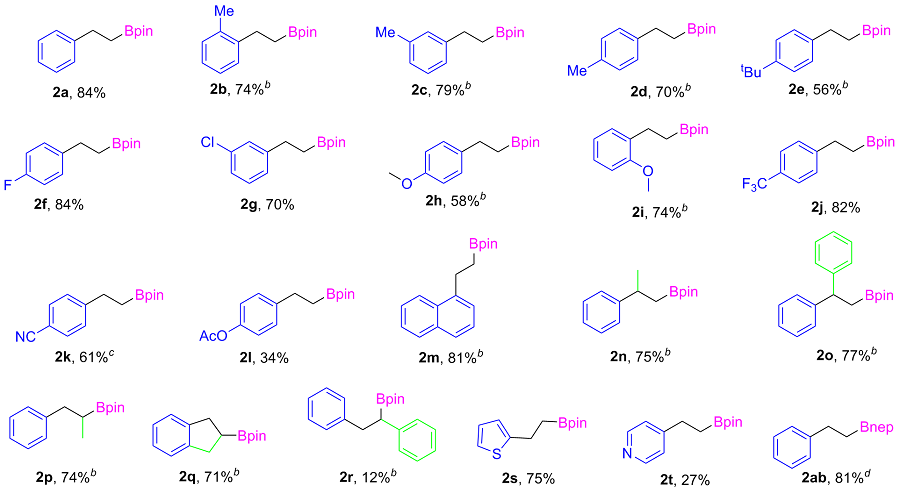
Based on the hydroboration studies of styrene, it was discovered that the use of Cu(OH)₂ as in-situ catalyst and base, Dppe as ligand, DMF as solvent, and H₂O as proton source resulted in a reaction efficiency of 95% with no detectable by-products. The applicability of the aromatic olefin hydrogenative borylation reaction was further investigated under these optimized conditions. For certain samples, the reaction time was extended to 24 h to enhance the conversion rate, given the relatively low conversion efficiency observed with a 2 h reaction period.
Substrates bearing methyl and tert-butyl substituents on the benzene ring can yield the corresponding products with greater than 70% efficiency (Table 2, 2b~2e). Halogenated substrates featuring para-fluoro and meta-chloro substituents exhibit high yields (Table 2, 2f~2g). However, products derived from para-chloro and para-bromo substrates are challenging to purify. The yield of para-methoxy sub-stitution is 58%, whereas the yield of ortho-methoxy substitution is 74%. This discrepancy suggest that para- methoxy groups are more prone to decomposition on silica compared to ortho-methoxy groups (Table 2, 2h~2i). The para-trifluoromethyl product exhibits a higher yield of 84%, whereas the lower yield of the para-nitrile product could be attributed to a limited input of raw material and increased losses during processing. Additionally, the tolerance to acetoxy-substituted substrates is poor with a yield of only 34% and the presence of numerous by-products (Table 2, 2j~2l). Naphthalene ethylene achieves a corresponding product yield of 81% (Table 2, 2m). Substrates with methyl or phenyl substitutions at the α-position, as well as those with methyl substitutions or aliphatic cyclic olefin structures at the β-position, also yield high product efficiencies without formation of by-products (Table 2, 2n~2q). Notably, trans-1,2-diphenylethylene was found to undergo the reaction, yielding a product at 12% (Table 2, 2r). As far as I know, this product has not been reported in previous studies. Furthermore, heterocyclic aromatic alkenes, such as 2-vinylthiophene and 4-vinylpyridine, are also capable of the system successfully affording the corresponding products (Table 2, 2s~2t). Additionally, the reaction can be performed using bis(neopentanediolato)- diboron (B2nep2) as the borane reagent, resulting in the corresponding hydrogenative borylation product (Table 2, Entry 2ab).
Table 2 Scope of application for hydrogenative borylation of aryl olefins

a Substrate (0.5 mmol), Cu(OH)2 (30 mol%), B2pin2 (1.5 equiv.), ligand (13 mol%), H2O (0.5 mL), DMF (2 mL),70 ℃, 2 h, N2, isolated yield. b 24 h. c Substrate (0.2 mmol), d B2nep2 replaces B2pin2.

2.3 Radical inhibition experiment with TEMPO

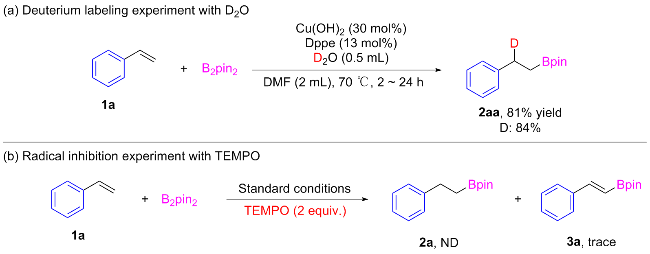
In the deuteration labeling experiment, a deuteration rate of 84% was observed at the α-position, indicating that the deuterium atoms in the reaction originated from the added proton source. Products that remain undeuterated may be influenced by trace amounts of moisture present in the solvent. Additionally, a 2,2,6,6-tetramethylpiperidoxyl (TEMPO) trapping experiment was conducted with substrate 1a, where product 2a was not detected. However, product 3a was identified (Scheme 2). While this finding is insufficient to conclusively determine whether the hydrogenative borylation reaction follows free radical mechanism, the resulting product 3a may possess greater chemical significance.[11]
Scheme 2 Control experiments for mechanistic studies

2.4 Dehydrogenative borylation of styrene

A trace amount of the product 3a can be obtained by directly adding TEMPO. It is speculated that TEMPO may facilitate the generation of 3a. Consequently, efforts were made to optimize the reaction conditions to achieve higher yields. Sequential optimization was performed to evaluate the effects of various ligands and solvents on the reaction yield (Table 3).
Table 3 Optimization of the reaction conditions for the dehydrogenative borylation of styrenea
Entry [Cu] and Base Ligand Solvent Yield/%
1 Cu(OH)2 Dppe DMF Trace
2 Cu(OH)2 Dppbz DMF Trace
3 Cu(OH)2 Dppb DMF Trace
4 Cu(OH)2 PPh3 DMF Trace
5 Cu(OH)2 PCy3 DMF 36b
6 Cu(OH)2 PCy3 1,4-Dioxane 31b
7 Cu(OH)2 PCy3 DCE 43
8c Cu(OH)2 PCy3 DCE 58 (49)d
9e Cu(OH)2 PCy3 DCE

a 1a (0.5 mmol), [Cu] and base (1.2 equiv.), ligand (13 mol%), B2pin2 (2 equiv.), TEMPO (2 equiv.), solvent (2 mL), 80 ℃, 24 h, N2, yield by GC. b Trace by-products. c TEMPO (3 equiv.). d Isolated yield. e Benzophenone replaces TEMPO.

Cu(OH)2 used as catalyst and base catalyzed styrene hydrogenative borylation dehydrogenative borylation with TEMPO as the H acceptor. The yield is notably low when utilizing ligands such as Dppe, Dppbz, Dppb, and PPh₃. Specifically, even with the ligand PCy₃, the yield only reaches 36%, and the presence of by-products is observed (Table 3, Entries 1~5). During the solvent screening process, it was found that reactions using DMF and 1,4-dioxane as solvents produced by-products, whereas no by-products were observed when using DCE as solvent (Table 3, Entries 5~7). The yield was enhanced to 58% when increasing the amount of TEMPO to 3 equiv. (Table 3, Entry 8). Benzophenone was used in place of TEMPO as an H receptor with no detected product (Table 3, Entry 9).

2.5 Dehydrogenative borylation of aromatic alkenes

Under the optimized conditions, a substrate of 0.5 mmol was employed with copper hydroxide (1.2 equiv.) serving as both catalyst and base. The ligand was PCy₃ (13 mol%), the solvent was DCE (2 mL), and TEMPO (3 equiv.) was added as an additive to study the applicability of the dehydrogenative borylation reaction of aromatic hydrocarbons. Typical substrates were tested, and the products were isolated and characterized.
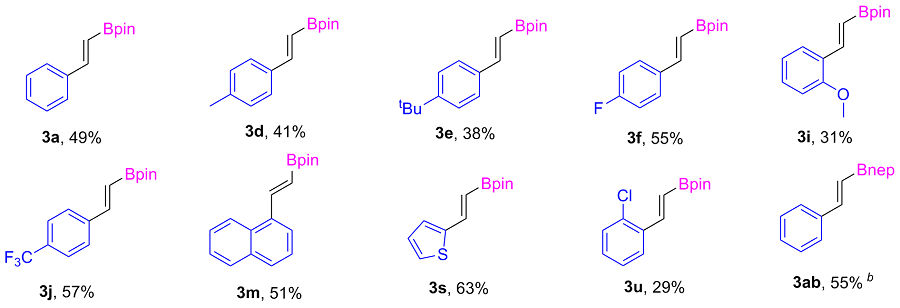
A broad range of aromatic terminal olefins were smooth- ly converted to afford highly chemoselective and stereoselective alkenyl borates (Table 4). Terminal alkenes bearing electron-rich alkyl substituents afforded products in moderate yields. Notably, methyl and tert-butyl-substituted substrates exhibited comparable yields, indicating that steric hindrance had smaller impact on the reaction outcome (3d~3e). Substrates bearing halogen substituents also demonstrated moderate reactivity. Specifically, para-fluo- rine-substituted substrates yielded 55%, whereas ortho- chlorine-substituted substrates yielded only 29% (3f, 3u). The yield of ortho-methoxy-substituted substrate was low at 31% because of decomposition on silica gel, which was clearly detected by TLC (3i). para-Trifluoromethylstyrene was employed as starting material, achieving a product yield of 57% (3j). The yields of naphthalene ethylene and 2-vinylthiophene were 51% and 63%, respectively, demon- strating that both fusion cyclic olefins and heterocyclic aryl olefins are suitable substrates for the reaction (3m, 3s). Replacing B2Pin2 with B2nep2 resulted in a 55% yield, indicating the feasibility of utilizing similar boronation reagents (3ab)
Table 4 Scope of application for dehydrogenative borylation of aryl olefins

a Substrate (0.5 mmol), [Cu] and base (1.2 equiv.), ligand (13 mol%), TEMPO (3 equiv.), B2pin2(2 equiv.), solvent (2 mL), 80 ℃, 24 h, N2, isolated yield. b B2nep2 replaces B2pin2。

2.6 Reaction mechanism

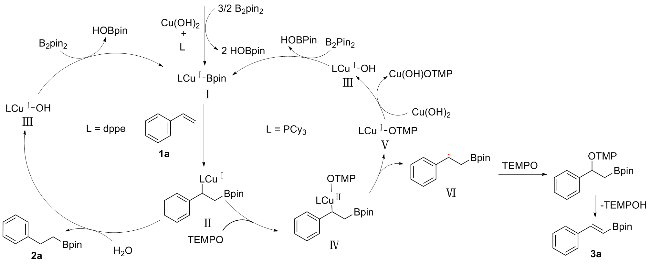
Based on the control experiments from mechanistic studies and relevant literature data, a possible mechanism is proposed for the borylation reaction of aryl olefins (Scheme 3). To date back, most reported Cu-catalyzed borylation reactions are based on CuI, while CuII is less frequently used. It remains unclear whether CuI or CuII is the active species. Drawing from other literature, we tentatively propose that the active species is CuI. Under the proposed mechanism, copper hydroxide, B2pin2, and the ligand are converted into a coordination complex CuI-Bpin (I). This complex then reacts with styrene to form an intermediate (II). Subsequently, this intermediate undergoes metathesis with H2O to generate product 2a and coordinated cuprous hydroxide (III). The coordinated cuprous hydroxide is then reconverted to CuI-Bpin (I) via interaction with B2Pin2, thus completing the catalytic cycle.
Scheme 3 Proposed reaction mechanism
In the second part of the reaction cycle, after the ligand was changed from Dppe to PCy3, the coordination complex CuI-Bpin (I) forms again. Addition occurs to generate intermediate II, which is subsequently oxidized by TEMPO to CuII. This oxidation leads to the formation of free radicals (VI) and Cu-OTMP (V). Free radicals (VI) react with TEMPO to produce product 2c. Meanwhile, Cu-OTMP (V) reacts with Cu(OH)2 and B2Pin2 to regenerate the initial coordination complex CuI-Bpin (I), thereby completing the catalytic cycle.

3 Conclusions

In conclusion, copper hydroxide catalyzing the β-bor- ylation of aryl olefins is feasible. Experimental results demonstrate that, in contrast to other hydroboration reactions, the use of copper hydroxide as both catalyst and base, Dppe as the ligand, and H₂O as the proton source enables the catalytic hydrogenative borylation of aryl olefins with B₂pin₂. Notably, this reaction remains stable under ambient air conditions. Highly isolated yields can be achieved for general substrates. Additionally, it exhibits a wide range of adaptability, including trans-1,2-stilbene substrates.
With copper hydroxide as catalyst and base, PCy3 as ligand and TEMPO as hydrogen acceptor, the system can be used for the hydrogenative borylation of aryl olefins and B2pin2 to generate the corresponding trans-alkenylboronate pinacol ester. These two reactions have advantages of high activity, low cost and good selectivity. At the same time, the optimized conditions for the reaction were obtained by changing the conditions such as solvent, temperature, catalyst dosage and additive. The combination of copper hydroxide and organic phosphine ligands provides a method for Cu-catalyzed borylation.

4 Experimental section

4.1 General experimental information

All experiments were performed in a parallel reactor with temperature calibration using a thermometer. Reagents and solvents purchase from a variety of suppliers and use them as received. 1H NMR (500 MHz) and 13C NMR (125 MHz) spectra were recorded on a Bruker Avance III 500 MHz digital NMR spectrometer in CDCl3 with TMS as the internal standard. Yield and selectivity were tested by Shimadzu GC-2014C and column chromatography determination. Thin layer chromatography (TLC) was performed on 0.20~0.25 mm HAIYANG silica gel F-254 plates. HAIYANG silica gel (size: 200~300) column chromatography was used, and PE (petrol ther)/EA (ethyl acetate) (VV=50~10∶1) was used for rapid column chromatography.

4.2 Typical procedure for hydrogenative borylation of aryl olefins

An oven-dried Schlenk tube (10 mL) containing a stirring bar was charged with Cu(OH)2 (0.015 g, 30 mol%), Dppe (0.026 g, 13 mol%) and DMF (2.0 mL). After stirring for 15 min, substrate (0.5 mmol), B2pin2 (0.190 g, 1.5 equiv.), and 0.5 mL of water were added. The reaction mixture was heatd at 70 ℃ and reacted for 2 h. Substrate expansion was protected by N2, and some reactions were carried out for 24 h. The mixture was cooled to room temperature, diluted with water, extracted with ethyl acetate, dried with anhydrous Na2SO4, and then concentrated under reduced pressure. The organic extracts in the resulting mixture were analyzed by GC with naphthalene as the internal standard. In the purification step, naphthalene was not added, and DMF was washed away with saturated saline and then purified by column chromatography.

4.3 Typical procedure for the hydrogenative borylation of aryl olefins

Cu(OH)2 (0.059 g, 1.2 equiv.), PCy3 (0.018 g, 13 mol%), B2pin2 (0.254 g, 2 equiv.), and TEMPO (0.234 g, 3 equiv.) were added to the 10 mL Schlenk tube, the rubber plug then sealed the nozzle. The gas was replaced by N2 through a double row of pipes. The substrate (0.5 mmol) was dissolved in 2 mL of DCE and then added to the Schlenk tube through a syringe. After heating at 80 ℃ and reacting for 24 h, the mixture was cooled to room temperature, diluted with ethyl acetate, washed with water, extracted with ethyl acetate, dried with anhydrous Na2SO4, and concentrated under reduced pressure. The organic extracts in the resulting mixture were analyzed by GC with naphthalene as the internal standard. In the purification step, the residual TEMPO was washed off with sodium dithionite after extraction, dried, and purified by column chromatography.
4,4,5,5-Tetramethyl-2-(2-phenylethyl)-1,3,2-dioxaboro-lane (2a):[5b] 98 mg, colorless oil, 84% yield. 1H NMR (500 MHz, CDCl3) δ: 7.20~7.11 (m, 4H), 7.09~7.03 (m, 1H), 2.67 (t, J=8.2 Hz, 2H), 1.13 (s, 12H), 1.06 (t, J=8.3 Hz, 2H); 13C NMR (126 MHz, CDCl3) δ: 144.49, 128.27, 128.09, 125.59, 83.16, 30.05, 24.90, 13.00 (low intensity).
4,4,5,5-Tetramethyl-2-[2-(2-methylphenyl)ethyl]-1,3,2-dioxaborolane (2b):[12a] 91 mg, colorless oil, 74% yield. 1H NMR (500 MHz, CDCl3) δ: 7.12~7.08 (m, 1H), 7.05~6.96 (m, 3H), 2.63 (t, J=8.2 Hz, 2H), 2.23 (s, 3H), 1.14 (s, 12H), 1.02 (t, J=8.5 Hz, 2H); 13C NMR (126 MHz, CDCl3) δ: 142.59, 135.85, 130.04, 128.16, 125.94, 125.71, 83.17, 27.27, 24.92, 19.38, 11.68 (low intensity).
4,4,5,5-Tetramethyl-2-[2-(3-methylphenyl)ethyl]-1,3,2-dioxaborolane (2c):[12a] 97 mg, colorless oil, 79% yield. 1H NMR (500 MHz, CDCl3) δ: 7.05 (t, J=7.5 Hz, 1H), 6.95 (s, 1H), 6.92 (d, J=7.7 Hz, 1H), 6.87 (d, J=7.5 Hz, 1H), 2.63 (d, J=8.1 Hz, 2H), 2.22 (s, 3H), 1.13 (s, 12H), 1.04 (d, J=8.2 Hz, 2H).13C NMR (126 MHz, CDCl3) δ: 144.45, 137.67, 128.94, 128.18, 126.30, 125.10, 83.12, 29.97, 24.90, 21.49, 13.10 (low intensity).
4,4,5,5-Tetramethyl-2-[2-(4-methylphenyl)ethyl]-1,3,2-dioxaborolane (2d):[5b] 86 mg, colorless oil, 70% yield. 1H NMR (500 MHz, CDCl3) δ: 7.13~6.83 (m, 4H), 2.63 (t, J=8.3 Hz, 2H), 2.23 (s, 3H), 1.16 (s, 12H), 1.05 (m, J=8.3 Hz, 2H); 13C NMR (126 MHz, CDCl3) δ: 141.54, 134.99, 129.01, 127.99, 83.22, 29.65, 24.96, 21.11. C[B] was not detected.
2-(4-tert-Butylphenethyl)-4,4,5,5-tetramethyl-1,3,2-dioxaborolane (2e):[12a] 80 mg, colorless oil, 56% yield. 1H NMR (500 MHz, CDCl3) δ: 7.20 (d, J=8.3 Hz, 2H), 7.07 (d, J=8.1 Hz, 2H), 2.64 (d, J=8.3 Hz, 2H), 1.22 (s, 9H), 1.14 (s, 12H), 1.06 (d, J=8.4 Hz, 2H); 13C NMR (126 MHz, CDCl3) δ: 148.34, 141.46, 127.76, 125.17, 83.16, 34.42, 31.56, 29.49, 24.93, 12.77 (low intensity).
2-[2-(4-Fluorophenyl)ethyl]-4,4,5,5-tetramethyl-1,3,2-dioxaborolane (2f):[5b] 105 mg, colorless oil, 84% yield. 1H NMR (500 MHz, CDCl3) δ: 7.07 (dd, J=8.5, 5.6 Hz, 2H), 6.84 (t, J=8.7 Hz, 2H), 2.63 (t, J=8.1 Hz, 2H), 1.12 (s, 12H), 1.03 (t, J=8.1 Hz, 2H); 13C NMR (126 MHz, CDCl3) δ: 161.20 (d, J=242.7 Hz), 140.05 (d, J=3.2 Hz), 129.41 (d, J=7.8 Hz), 114.90 (d, J=21.1 Hz), 83.21, 29.26, 24.88, 13.18 (low intensity).
2-[2-(3-Chlorophenyl)ethyl]-4,4,5,5-tetramethyl-1,3,2-dioxaborolane (2g):[5b] 93 mg, colorless oil, 70% yield. 1H NMR (500 MHz, CDCl3) δ: 7.14 (d, J=2.0 Hz, 1H), 7.09 (d, J=7.6 Hz, 1H), 7.05 (t, J=1.7 Hz, 1H), 7.01~6.99 (m, 1H), 2.64 (t, J=8.0 Hz, 2H), 1.14 (s, 12H), 1.04 (t, J=8.0 Hz, 2H); 13C NMR (126 MHz, CDCl3) δ: 146.54, 133.99, 129.54, 128.39, 126.36, 125.78, 83.31, 29.80, 24.91, 12.88 (low intensity).
2-[2-(4-Methoxyphenyl)ethyl]-4,4,5,5-tetramethyl-1,3,2-dioxaborolane (2h):[5b] 76 mg, colorless oil, 58% yield. 1H NMR (500 MHz, CDCl3) δ: 7.14 (d, J=8.6 Hz, 2H), 6.81 (d, J=8.6 Hz, 2H), 3.77 (s, 3H), 2.70 (d, J=8.1 Hz, 2H), 1.22 (s, 12H), 1.12 (d, J=8.2 Hz, 2H); 13C NMR (126 MHz, CDCl3) δ: 157.59, 136.58, 128.88, 113.61, 83.06, 55.23, 29.08, 24.84, 13.35 (low intensity).
2-[2-(2-Methoxyphenyl)ethyl]-4,4,5,5-tetramethyl-1,3,2-dioxaborolane (2i):[9d] 96 mg, colorless oil, 74% yield. 1H NMR (500 MHz, CDCl3) δ: 7.24~7.01 (m, 2H), 6.96~6.66 (m, 2H), 3.81 (s, 3H), 2.73 (d, J=8.1 Hz, 2H), 1.23 (s, 12H), 1.12 (d, J=8.3 Hz, 2H); 13C NMR (126 MHz, CDCl3) δ: 157.53, 132.93, 129.25, 126.80, 120.36, 110.18, 83.11, 55.31, 24.97, 24.51. C[B] was not detected.
4,4,5,5-Tetramethyl-2-[2-[4-(trifluoromethyl)phenyl]-ethyl]-1,3,2-dioxaborolane (2j):[12a] 123 mg, colorless oil, 82% yield. 1H NMR (500 MHz, CDCl3) δ: 7.42 (d, J=8.0 Hz, 2H), 7.24 (d, J=8.0 Hz, 2H), 2.72 (t, J=8.2 Hz, 2H), 1.13 (s, 12H), 1.07 (t, J=8.2 Hz, 2H); 13C NMR (126 MHz, CDCl3) δ: 148.66, 128.46, 125.23 (q, J=3.8 Hz), 83.38, 29.97, 24.90, 12.77 (low intensity).
4-[2-dioxaborolan-2-yl)-ethyl]benzonitrile (2k):[5b] 31 mg, colorless oil, 61% yield. 1H NMR (500 MHz, CDCl3) δ: 7.51~7.42 (m, 2H), 7.24 (d, J=8.1 Hz, 2H), 2.72 (t, J=8.0 Hz, 2H), 1.13 (s, 12H), 1.06 (t, J=8.1 Hz, 2H); 13C NMR (126 MHz, CDCl3) δ: 150.17, 132.16, 128.97, 119.34, 109.49, 83.43, 30.26, 24.89. C[B] was not detected.
4-(2-(4,4,5,5-Tetramethyl-1,3,2-dioxaborolan-2-yl)-ethyl)phenyl acetate (2l):[12b] 49 mg, colorless oil, 34% yield. 1H NMR (500 MHz, CDCl3) δ: 7.21~7.01 (m, 2H), 6.97~6.74 (m, 2H), 2.66 (t, J=8.2 Hz, 2H), 2.19 (s, 3H), 1.13 (s, 12H), 1.05 (t, J=8.2 Hz, 2H); 13C NMR (126 MHz, CDCl3) δ: 169.72, 148.62, 142.01, 128.97, 121.20, 83.20, 29.41, 24.87, 21.18, 12.91 (low intensity).
4,4,5,5-Tetramethyl-2-[2-(1-naphthalenyl)ethyl]-1,3,2-dioxaborolane (2m):[5b] 102 mg, colorless oil, 81% yield. 1H NMR (500 MHz, CDCl3) δ: 7.72~7.63 (m, 3H), 7.58~7.54 (m, 1H), 7.36~7.26 (m, 3H), 2.83 (t, J=8.1 Hz, 2H), 1.12 (s, 14H); 13C NMR (126 MHz, CDCl3) δ: 142.08, 133.76, 132.03, 127.80, 127.68, 127.54, 127.39, 125.83, 125.80, 125.02, 83.25, 30.25, 24.94. C[B] was not detected.
4,4,5,5-Tetramethyl-2-(2-phenylpropyl)-1,3,2-dioxaborolane (2n):[5b] 93 mg, colorless oil, 75% yield. 1H NMR (500 MHz, CDCl3) δ: 7.16 (d, J=2.1 Hz, 4H), 7.06 (s, 1H), 3.01~2.91 (m, 1H), 1.20 (d, J=6.9 Hz, 3H), 1.08 (s, 14H).13C NMR (126 MHz, CDCl3) δ: 149.33, 128.28, 126.74, 125.78, 83.09, 35.92, 25.02, 24.84. C[B] was not detected.
2-(2,2-Diphenylethyl)-4,4,5,5-tetramethyl-1,3,2-di-oxaborolane (2o):[5b] 117 mg, white solid, 77% yield. 1H NMR (500 MHz, CDCl3) δ: 7.31~7.09 (m, 8H), 7.09~6.97 (m, 2H), 4.20 (t, J=8.5 Hz, 1H), 1.52 (d, J=8.5 Hz, 2H), 0.96 (s, 12H); 13C NMR (126 MHz, CDCl3) δ: 146.70, 128.33, 127.78, 126.00, 83.20, 46.64, 24.69, 19.52 (low intensity).
4,4,5,5-Tetramethyl-2-(1-methyl-2-phenylethyl)-1,3,2-dioxaborolane (2p):[5b] 90 mg, colorless oil, 74% yield. 1H NMR (500 MHz, CDCl3) δ: 7.31~7.19 (m, 4H), 7.19~7.13 (m, 1H), 2.70 (ddd, J=131.8, 13.6, 7.9 Hz, 2H), 1.40 (q, J=7.6 Hz, 1H), 1.21 (s, 6H), 1.20 (s, 6H), 0.99 (d, J=7.5 Hz, 3H); 13C NMR (126 MHz, CDCl3) δ: 142.43, 129.01, 128.11, 125.66, 83.08, 39.09, 24.83, 24.81, 19.14 (low intensity), 15.31.
2-(2,3-Dihydro-1H-inden-2-yl)-4,4,5,5-tetramethyl-1,3,2-dioxaborolane (2q):[5b] 86 mg, colorless oil, 71% yield. 1H NMR (500 MHz, CDCl3) δ: 7.11 (dd, J=5.5, 3.3 Hz, 2H), 7.02 (dd, J=5.6, 3.2 Hz, 2H), 3.01~2.84 (m, 4H), 2.00~1.68 (m,1H), 1.17 (s, 12H); 13C NMR (126 MHz, CDCl3) δ: 144.48, 125.98, 124.27, 83.28, 35.23, 24.87, 21.49. (low intensity).
2-(1,2-Diphenylethyl)-4,4,5,5-tetramethyl-1,3,2-dioxa-borolane (2r):[7b] 18 mg, colorless oil, 12% yield. 1H NMR (500 MHz, CDCl3) δ: 7.39~6.56 (m, 10H), 3.32~2.74 (m, 2H), 2.61 (ddd, J=9.6, 6.8, 2.3 Hz, 1H), 1.02 (dd, J=4.6, 1.9 Hz, 12H); 13C NMR (126 MHz, CDCl3) δ: 142.62, 141.78, 128.92, 128.44, 128.37, 128.07, 125.80, 125.44, 83.43, 38.90, 24.62, 24.55. C[B] was not detected.
4,4,5,5-Tetramethyl-2-[2-(2-thienyl)ethyl]-1,3,2-dio-xaborolane (2s):[5b] 89 mg, colorless oil, 75% yield. 1H NMR (500 MHz, CDCl3) δ: 6.99 (dd, J=5.1, 1.2 Hz, 1H), 6.80 (dd, J=5.1, 3.4 Hz, 1H), 6.71 (dq, J=3.4, 1.1 Hz, 1H), 2.88 (td, J=7.8, 0.9 Hz, 2H), 1.15 (s, 14H); 13C NMR (126 MHz, CDCl3) δ: 147.84, 126.62, 123.49, 122.69, 83.30, 24.90, 24.45. C[B] was not detected.
4-[2-dioxaborolan-2-yl)-ethyl]pyridine (2t):[8a] 32 mg, light yellow oil, 27% yield. 1H NMR (500 MHz, CDCl3) δ: 8.58~8.31 (m, 2H), 7.28~6.89 (m, 2H), 2.73 (t, J=8.1 Hz, 2H), 1.20 (s, 12H), 1.13 (t, J=8.1 Hz, 2H); 13C NMR (126 MHz, CDCl3) δ: 153.52, 149.47, 123.69, 83.46, 29.40, 24.90. C[B] was not detected.
4,4,5,5-Tetramethyl-2-(2-phenylethyl-2-d)-1,3,2-dio-xaborolane (2aa):[5b] 95 mg, colorless oil, 84% yield. 1H NMR (500 MHz, CDCl3) δ: 7.28~7.10 (m, 4H), 7.10~7.03 (m, 1H), 2.66 (q, J=9.1, 8.7 Hz, 1H), 1.13 (s, 12H), 1.06 (d, J=8.3 Hz, 2H); 13C NMR (126 MHz, CDCl3) δ: 144.50 (d, J=4.0 Hz), 128.29, 128.11, 125.60, 83.18, 30.07, 29.72 (t, J=19.6 Hz), 24.92, 12.97 (low intensity).
5,5-Dimethyl-2-(2-phenylethyl)-1,3,2-dioxaborinane (2ab):[8a] 88 mg, colorless oil, 81% yield. 1H NMR (500 MHz, CDCl3) δ: 7.21~7.10 (m, 4H), 7.08~7.03 (m, 1H), 3.50 (s, 4H), 2.63 (t, J=8.2 Hz, 2H), 1.00 (t, J=8.2 Hz, 2H), 0.84 (s, 6H); 13C NMR (126 MHz, CDCl3) δ: 145.13, 128.28, 128.10, 125.44, 77.41, 77.16, 76.91, 72.11, 31.73, 30.20, 21.93, 17.05 (low intensity).
(E)-4,4,5,5-Tetramethyl-2-styryl-1,3,2-dioxaborolane (3a):[6a] 56 mg, colorless oil, 49% yield. 1H NMR (500 MHz, CDCl3) δ: 7.45~7.39 (m, 2H), 7.33 (d, J=18.5 Hz, 1H), 7.29~7.19 (m, 3H), 6.10 (d, J=18.4 Hz, 1H), 1.24 (s, 12H); 13C NMR (126 MHz, CDCl3) δ: 149.64, 137.60, 129.02, 128.69, 127.19, 83.48, 24.94. C[B] was not detected.
4,4,5,5-Tetramethyl-2-[(1E)-2-(4-methylphenyl)ethen-yl]-1,3,2-dioxaborolane (3d):[6a] 50 mg, colorless oil, 41% yield. 1H NMR (500 MHz, CDCl3) δ: 7.53~7.21 (m, 3H), 7.06 (d, J=7.8 Hz, 2H), 6.03 (d, J=18.4 Hz, 1H), 2.26 (s, 3H), 1.23 (s, 12H); 13C NMR (126 MHz, CDCl3) δ: 149.47, 138.93, 134.78, 129.28, 127.01, 83.25, 24.80, 21.32. C[B] was not detected.
(E)-2-(4-(tert-butyl)styryl)-4,4,5,5-tetramethyl-1,3,2-dioxaborolane (3e):[6a] 39 mg, white solid, 38% yield. 1H NMR (500 MHz, CDCl3) δ: 7.42~7.22 (m, 5H), 6.05 (d, J=18.4 Hz, 1H), 1.23 (s, 21H); 13C NMR (126 MHz, CDCl3) δ: 152.21, 149.50, 134.88, 126.93, 125.60, 83.36, 34.79, 31.34, 24.92. C[B] was not detected.
2-[(1E)-2-(4-fluorophenyl)ethenyl]-4,4,5,5-tetramethyl-1,3,2-dioxaborolane (3f):[6a] 68 mg, yellow oil, 55% yield. 1H NMR (500 MHz, CDCl3) δ: 7.60~7.42 (m, 2H), 7.35 (d, J=18.4 Hz, 1H), 7.02 (t, J=8.7 Hz, 2H), 6.08 (d, J=18.4 Hz, 1H), 1.31 (s, 12H); 13C NMR (126 MHz, CDCl3) δ: 163.16 (d, J=248.6 Hz), 148.18,133.74 (d, J=3.3 Hz), 128.72 (d, J=8.2 Hz), 115.57 (d, J=21.6 Hz), 83.40, 24.82 C[B] was not detected.
2-[(1E)-2-(2-methoxyphenyl)ethenyl]-4,4,5,5-tetrame-thyl-1,3,2-dioxaborolane (3i):[11c] 40 mg, colorless oil, 31% yield. 1H NMR (500 MHz, CDCl3) δ: 7.70 (d, J=18.6 Hz, 1H), 7.47 (dd, J=7.7, 1.7 Hz, 1H), 7.17 (ddd, J=8.6, 6.0, 1.7 Hz, 1H), 6.84 (t, J=7.5 Hz, 1H), 6.78 (d, J=8.4 Hz, 1H), 6.10 (d, J=18.6 Hz, 1H), 3.75 (s, 3H), 1.22 (s, 12H); 13C NMR (126 MHz, CDCl3) δ: 157.38, 144.15, 130.03, 127.10, 126.62, 120.61, 110.92, 83.25, 55.39, 24.87. C[B] was not detected.
4,4,5,5-Tetramethyl-2-[(1E)-2-[4-(trifluoromethyl)phen-yl]ethenyl]-1,3,2-dioxaborolane (3j):[11b] 84 mg, white solid, 57% yield. 1H NMR (500 MHz, CDCl3) δ: 7.53~7.47 (m, 4H), 7.32 (d, J=18.4 Hz, 1H), 6.18 (d, J=18.4 Hz, 1H), 1.24 (s, 12H); 13C NMR (126 MHz, CDCl3) δ: 147.80, 140.93, 130.6 (q, J=32.6 Hz),127.29, 125.70 (q, J=3.9 Hz), 83.74, 24.94. C[B] was not detected.
4,4,5,5-Tetramethyl-2-[(1E)-2-(1-naphthalenyl)ethenyl]-1,3,2-dioxaborolane (3m):[11c] 71 mg, colorless oil, 51% yield. 1H NMR (500 MHz, CDCl3) δ: 7.81~7.62 (m, 4H), 7.59 (dd, J=8.7, 1.7 Hz, 1H), 7.48 (d, J=18.4 Hz, 1H), 7.42~7.26 (m, 2H), 6.20 (d, J=18.3 Hz, 1H), 1.22 (s, 12H); 13C NMR (126 MHz, CDCl3) δ: 149.31, 134.76, 133.50, 133.22, 128.19, 128.04, 127.80, 127.47, 126.18, 126.07, 123.16, 83.14, 24.62. C[B] was not detected.
4,4,5,5-Tetramethyl-2-[(1E)-2-(2-thienyl)ethenyl]-1,3,2-dioxaborolane (3s):[11c] 74 mg, white solid, 63%. 1H NMR (500 MHz, CDCl3) δ: 7.39 (d, J=18.1 Hz, 1H), 7.16 (d, J=5.0 Hz, 1H), 7.00 (dd, J=3.6, 1.1 Hz, 1H), 6.90 (dd, J=5.0, 3.5 Hz, 1H), 5.84 (d, J=18.1 Hz, 1H), 1.22 (s, 12H); 13C NMR (126 MHz, CDCl3) δ: 144.04, 141.91, 127.80, 127.73, 126.40, 83.46, 24.91. C[B] was not detected.
2-[(1E)-2-(2-Chlorophenyl)ethenyl]-4,4,5,5-tetramethyl-1,3,2-dioxaborolane (3u):[11c] 38 mg, colorless oil, 29% yield. 1H NMR (500 MHz, CDCl3) δ: 7.69 (d, J=18.3 Hz, 1H), 7.53 (dd, J=7.4, 2.2 Hz, 1H), 7.24 (dd, J=7.5, 1.9 Hz, 1H), 7.18~7.02 (m, 2H), 6.08 (d, J=18.3 Hz, 1H), 1.21 (s, 12H); 13C NMR (126 MHz, CDCl3) δ: 145.00, 135.64, 133.88, 129.83, 129.73, 127.05, 126.91, 83.51, 24.87. C[B] was not detected.
(E)-5,5-Dimethyl-2-styryl-1,3,2-dioxaborinane (3ab):[12c] 59 mg, colorless oil, 55% yield. 1H NMR (500 MHz, CDCl3) δ: 7.40 (dd, J=7.4, 1.7 Hz, 2H), 7.33~7.11 (m, 4H), 6.03 (d, J=18.3 Hz, 1H), 3.61 (s, 4H), 0.91 (s, 6H); 13C NMR (126 MHz, CDCl3) δ: 147.14, 137.80, 128.53, 127.00, 72.20, 31.85, 21.88. C[B] was not detected.
Supporting Information 1H NMR and 13C NMR spectra of all products. The Supporting Information is available free of charge via the Internet at http://sioc-journal.cn.
(Lu, Y.)
[1]
(a) Miyaura N.; Suzuki A. Chem. Rev. 1995, 95, 2457.

(b) Jiang N.-Q.; Chen D.; Liu C. Org. Chem. Front. 2023, 10, 3684.

(c) Chen D.; Xu L.-X.; Yu Y.; Mo Q.-L.; Qi X.-T.; Liu C. Angew. Chem. 2023, 135, e202215168.

(d) Barth R. F.; Gupta N.; Kawabata S. Cancer Commun. 2024, 44, 893.

(e) Liu Y.; Wang H.-G. Chin. J. Org. Chem. 2024, 44, 2384 (in Chinese).

( 刘源, 王洪根, 有机化学, 2024, 44, 2384.)

DOI

[2]
(a) Brown H. C. J. Am. Chem. Soc. 1956, 78, 5694.

(b) Li Y.-F.; Gao Y.-X.; Yuan X.-P.; Yin J.-J.; Wang S.-M.; Xiong T.; Zhang Q. Chem. Catal. 2023, 3, 100645.

(c) Xu G.-L.; Han H.-P.; Cao L.-W.; Hong S.-M.; Hai L.-Y.; Cui X; Chin. J. Org. Chem. 2024, 44, 1480 (in Chinese).

( 徐光利, 韩鸿萍, 曹露微, 洪思敏, 海林悦, 崔香, 有机化学, 2024, 44, 1480.)

DOI

(d) Bai L.-T.; Jiao L. Eur. J. Org. Chem. 2024, 27, e202400043.

(e) Su W.-L.; Zhu J.-D.; Chen Y.; Zhang X.; Qiu W.-H.; Yang K.; Yu P.-Y.; Son Q.-L. Nat. Chem. 2024, 16, 1312.

(f) Li S.-H.; Li J.; Xia T.-L.; Zhao W.-X. Chin. J. Chem. 2019, 37, 462.

(g) Du R.-R.; Xu S.-M. Sci. China Chem. 2024, 68, 226.

[3]
(a) Cathleen M. C.; Ben W. G.; Christopher J. L. Chem. Commun. 2009, 21, 6704.

(b) Zhang Z.-Q.; Yang C.-T.; Liang L.-J.; Xiao B.; Lu X.; Liu J.-H.; Sun Y.-Y.; Marder T.-B.; Fu Y. Org. Lett. 2014, 16, 6342.

(c) Li J.-F.; Wei Z.-Z.; Wang Y.-Q.; Ye M.-C. Green Chem. 2017, 19, 4498.

(d) Xu N.-X.; Liang H.; Morken J. P. J. Am. Chem. Soc. 2022, 144, 11546.

(e) Zhou W.; Luo Z.-W.; Xiao H.; Yi J.; Dai J.-J. J. Org. Chem. 2023, 88, 14708.

DOI PMID

[4]
(a) Woo H.; Jun H.-P.; Jiwoong K.; Sungkyun P.; Kang H.-P. Catal. Commun. 2017, 100, 52.

(b) Huang M.; Zhou X.-Y.; Shao Y.-X., Li Y.-W., Liu Y.; Ke Z.-F. J. Catal. 2023, 428, 115197.

[5]
(a) Chen S.; Wang Z.-L.; Geng S.-S.; Zhu H.-D.; Liu Z.-L..; He Y.; Peng Q.; Feng Z. CCS Chem. 2022, 5, 1674.

(b) Liu Y.; Zhou Y.-H.; Wang H.; Qu J.-P. RSC Adv. 2015, 5, 73705.

[6]
(a) Basappa S.; Aishwarya P.; Sanjana S.-T.; Manoj V. M; Shubhankar K. B. ACS Catal. 2024, 14, 3065.

(b) Newar R.; Wahida B.; Naved A.; Neha A.; Manav C.; Ajay K.; Poorvi G.; Jaideep M.; Kuntal M. Eur. J. Inorg. Chem. 2022, 10, e202101019.

[7]
(a) Afandiyeva M.; Abhishek A. K.; Wu X.-J.; William W. B.; Kennedy C. R. Organometallics 2022, 41, 3014.

(b) Kamei T.; Nishino S.; Shimada T. Tetrahedron Lett. 2018, 59, 2896.

[8]
(a) Hong S.-B.; Liu M.-Y.; Zhang W.; Zeng Q.; Deng W. Tetrahedron Lett. 2015, 56, 2297.

(b) Liu S.-W.; Zeng X.-J.; Xu B. Tetrahedron Lett. 2016, 57, 3706.

(c) Shegavi M. L.; Abhishek A.; Shubhankar K. B. Green Chem. 2020, 22, 2799.

(d) Saini S.; Deepak S. G; Ramesh B.; Ranjit T.; Rajendra S. D.; Shubhankar K. B. Catal. Sci. Technol. 2023, 13, 147.

[9]
(a) Trevor W. B.; Edward J. M.; Tyler G. H.; Trina M. P.; Kayla M. K.; Gregory C. D.; Novruz G. A.; Jeffrey L. P.; Brian V. P. Org. Lett. 2016, 18, 6428.

(b) Namhyeon K.; Jung T. H.; Do H. R.; Jaesook Y. Org. Lett. 2017, 19, 6144.

DOI PMID

(c) Zhao Y.; Fu B.; Wang S.-M.; Li Y.-F.; Yuan X.-P.; Yin J.-J.; Xiong T.; Zhang Q. Org. Lett. 2023, 25, 2492.

DOI PMID

(d) Han H.-F.; Gao J.; Qu X.-S.; Sun Y.-M.; Xu T.; Yang H.; Chen F. Sustainable Chem. Pharm. 2024, 38, 101432.

[10]
(a) DiBenedetto T. A.; Astrid M. P.; William D. J. Organometallics 2019, 38, 3322.

DOI

[11]
(a) Doan S. H.; Nhan N. H. T.; Binh K. M.; Thanh V. N. ACS Catal. 2022, 12, 12409.

(b) Yoshii D.; Jin X.-J.; Noritaka M.; Kazuya Y. ACS Catal. 2019, 9, 3011.

(c) Lu W.-K.; Shen Z.-M. Org. Lett. 2019, 21, 142.

[12]
(a) Saini S.; Bhawar R.; Srivastava A. K.; Garg K.; Bose S. K. Org. Biomol. Chem. 2023, 21, 5274.

(b) Weber S.; Zobernig D.; Stöger B.; Veiros L. F.; Kirchner K. Angew. Chem., Int. Ed. 2021, 60, 24488.

(c) Xu H.; Yamaguchi S.; Mitsudome T.; Mizugaki T. Org. Biomol. Chem. 2023, 21, 1404.

Outlines

/