



1 Introduction
Polyfluoroarenes are essential fluorinated building blocks for agrochemicals, biologically active molecules, pharmaceuticals, and functional materials (Figure 1a).[1] Therefore, the synthesis of functionalized polyfluoroaromatic compounds from simple and readily accessible poly-fluoroarenes has received considerable attention.[2] Transition metal catalysts for cross-coupling reactions with poly-fluorinated aryl reagents (M-ArF, X-ArF, and H-ArF) are important methods to synthesize polyfluoroarenes (Figure 1b).[3] However, these methods often require the pre-syn-thesis of organometallic substrates, such as organolithium, organozinc, or Grignard reagents as nucleophiles, resulting in a limitation of substrate scope and a reduction in carbon framework complexity. Recently, polyfluoroaryl radicals and radical addition to polyfluoroarenes have been developed for the alkylation of polyfluoroarenes.[4] Representative works in this field have been reported by researchers, such as Weaver[5], Ritter,[6] Hu[7] and others.[8] Despite the progress made in the alkylation of polyfluoroarenes, general strategies for Ni-catalyzed cross-electrophile coupling of polyfluoroarenes and alkyl halides have not been explored.
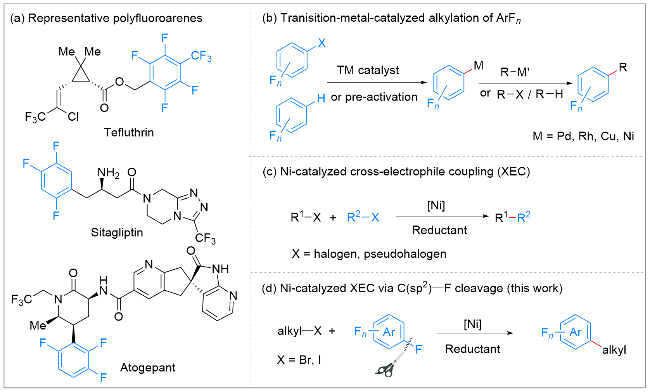
Ni-catalyzed cross-electrophile coupling (XEC) protocols have developed into a reliable alternative to cross-coupling reactions.[9] Compared to traditional cross-coupling strategies, XEC utilizes readily available electrophiles to build complex carbon scaffolds, thus avoiding the pre-synthesis of organometallic substrates (Figure 1c). The activation of C(sp2)—F bond was challenging due to the higher bond dissociation energy compared to that of the C(sp2)—X (X=Cl, Br, I) bonds.[10] Elegant works of the Ni-catalyzed XEC of C(sp2)—F bonds activation have been studied, but mainly focus on C(sp2)—F cleavage of alkenyl fluorides.[11] In 2017, the Fu group[12] reported the first Ni-catalyzed reductive defluorinative alkylation of gem-difluoroalkenes with sterically hindered secondary and tertiary alkyl halides. Inspired by this work and our continuing efforts in the field of Ni-catalyzed XEC,[13] we envisaged the feasibility nickel catalyzed alkylation of polyfluoroarenes by C(sp2)—F cleavage. Herein, we have developed a Ni-catalyzed cross-electrophile coupling of polyfluoroarenes with alkyl halides (Figure 1d).
2 Results and discussion
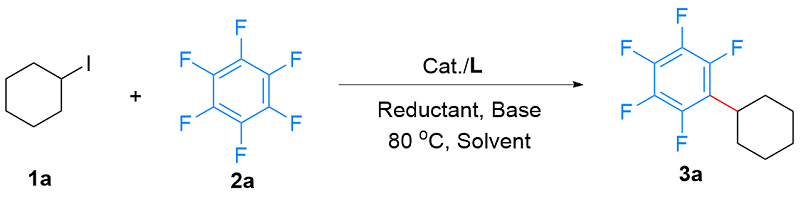
Initially, we commenced the investigation with iodocyclohexane 1a and perfluorobenzene 2a as the model substrates to evaluate the Ni-catalyzed reductive cross-coupling reaction (Table 1). Initially, using NiBr2•dme as the catalyst, bpy as the ligand and Zn powder as the reductant, the model reaction was performed in N,N-dimethylacetamide (DMA) at 80 ℃ for 12 h. The target product 1-cyclohexyl-2,3,4,5,6-pentafluorobenzene (3a) was obtained in 7% yield (Table 1, Entry 1). After testing various reductants, it was determined that B2pin2/K2CO3 was the most suitable one producing 3a with 24% yield (Entries 1~3). Several solvents including CH2Cl2, tetrahydrofuran (THF) and 1,4-dioxane were examined, and 1,4-dioxane performed best (Entries 4~6). Next, a screen with bases such as Na2CO3, Cs2CO3 and CsF did not improve the yield further (Entries 7~9). The amount of catalyst and ligand were reduced, while the yield of 3a was improved to 42% (Entry 10). The yield was slightly improved to 45% by increasing the amount of K2CO3. Replacing bpy with py (Entry 12) or phen (Entry 13) decreased the yields to 11% and 14%, respectively. Further, various nickel catalysts were explored (Entries 14 and 15) and NiCl2•dme was found to be the best choice, yielding 47%. Notably, it should be pointed out that the concentration of 2a had a great influence on the reaction system. The yield of 3a could eventually reach 75% by decreasing the amount of solvent (Entries 16 and 17).
Table 1 Optimization of the reaction conditionsa
|
| Entry | Catalyst (mol%) | L (mol%) | Reductant | Base (equiv.) | Solvent | Yieldb/% |
|---|---|---|---|---|---|---|
| 1 | NiBr2•dme (10) | bpy (15) | Zn | — | DMA | 7 |
| 2 | NiBr2•dme (10) | bpy (15) | Mn | — | DMA | 4 |
| 3 | NiBr2•dme (10) | bpy (15) | B2pin2 | K2CO3 (2) | DMA | 24 |
| 4 | NiBr2•dme (10) | bpy (15) | B2pin2 | K2CO3 (2) | THF | 18 |
| 5 | NiBr2•dme (10) | bpy (15) | B2pin2 | K2CO3 (2) | CH2Cl2 | Trace |
| 6 | NiBr2•dme (10) | bpy (15) | B2pin2 | K2CO3 (2) | 1,4-Dioxane | 36 |
| 7 | NiBr2•dme (10) | bpy (15) | B2pin2 | Na2CO3 (2) | 1,4-Dioxane | 0 |
| 8 | NiBr2•dme (10) | bpy (15) | B2pin2 | Cs2CO3 (2) | 1,4-Dioxane | 28 |
| 9 | NiBr2•dme (10) | bpy (12) | B2pin2 | CsF (2) | 1,4-Dioxane | 0 |
| 10 | NiBr2•dme (5) | bpy (6) | B2pin2 | K2CO3 (2) | 1,4-Dioxane | 42 |
| 11 | NiBr2•dme (5) | bpy (6) | B2pin2 | K2CO3 (2.5) | 1,4-Dioxane | 45 |
| 12 | NiBr2•dme (5) | py (12) | B2pin2 | K2CO3 (2.5) | 1,4-Dioxane | 11 |
| 13 | NiBr2•dme (5) | phen (6) | B2pin2 | K2CO3 (2.5) | 1,4-Dioxane | 14 |
| 14 | NiCl2•dme (5) | bpy (6) | B2pin2 | K2CO3 (2.5) | 1,4-Dioxane | 47 |
| 15 | NiCl2 (5) | bpy (6) | B2pin2 | K2CO3 (2.5) | 1,4-Dioxane | 21 |
| 16d | NiCl2•dme (5) | bpy (6) | B2pin2 | K2CO3 (2.5) | 1,4-Dioxane | 69 |
| 17e | NiCl2•dme (5) | bpy (6) | B2pin2 | K2CO3 (2.5) | 1,4-Dioxane | 75 (72c) |
a Reaction conditions: 1a (0.2 mmol, 1.0 equiv.), 2a (1.0 mmol, 5.0 equiv.), catalyst (mol%), L (equiv.), reductant (0.4 mmol, 2.0 equiv.), base, solvent (2 mL), 80 ℃, 12 h. b Yield was determined by GC using biphenyl as an internal standard. c Isolated yield based on 1a. d 1,4-Dioxane (1 ml). e 1,4-Dioxane (0.5 mL). bpy=2,2'-bipyridine, py=pyridine, phen=1,10-phenanthroline. |
With the optimized reaction conditions in hand, the polyfluoroarylation of a variety of alkyl halides 1 with 2 were evaluated (Table 2). First, bromocyclohe xane was used instead of 1a and the desired product 3a was also obtained with yield of 47%. N-protected groups such as benzoyl and Boc were well compatible in the reaction, and gave the yield of 66% (3b) and 63% (3c), respectively. Meanwhile the substrates with O-contained heterocycles also reacted with good efficiency to give the desired products (3d and 3e). In addition, secondary acyclic alkyl iodide can also be applied to this system by the formation of 3h in good yield. It was worth mentioning that 1-iodoada-mantane could run smoothly, affording the desired product 3i in 78% yield. However, primary alkyl iodide 1j was not well effective and the target product 3j was obtained with a low yield of 28%, due to the dehalogenation and boration of 1j under standard conditions.
Table 2 Substrates scopea
|

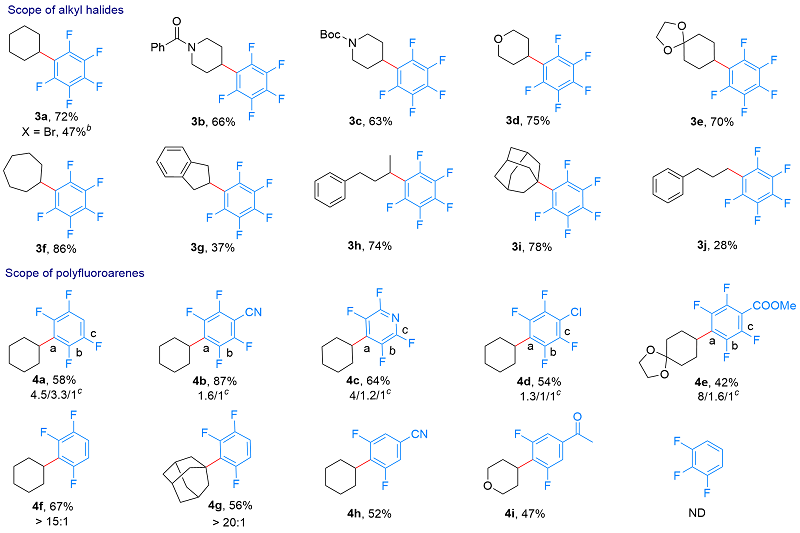 |
a Reaction conditions: alkyl halides 1 (0.2 mmol), 2 (1 mmol), B2pin2 (0.4 mmol.), K2CO3 (0.5 mmol), NiCl2•dme (5 mol%), bpy (6 mol%), 1,4-dioxane (0.5 mL), 80 ℃, 12 h. b Using bromocyclohexane. c Sites of substitution of the substrate, the ratio of the constitutional isomers is reported based on 19F NMR spectra. |
Next, the applicability of polyfluoroarenes 2 was further explored, and a variety of polyfluoroarene commpounds were prepared through this Ni-catalyzed protocol in good yields. The results showed that a variety of pentafluoride-substituted arenes could provide the corresponding alkylated products with inseparable mixtures of regioisomers (4a~4e), which might be attributed to unselective radical addition to different positions. However, several functional groups including cyano (4b), chloryl (4d) and ester (4e) could be tolerated and polyfluoroheteroarenes like pentafluoropyridine afforded the desired product 4c in 64% yield. Moreover, 1,2,3,4-tetrafluorobenzene could also be applied as a reactant and resulted in the generation of products (4f and 4g) with good site selectivity. For 1,2,3-trifluorobenzenes, para-substituents including CN, acetyl were compatible with this reductive system with good reaction efficiencies and excellent regioselectivities (4h and 4i). Using 1,2,3-trifluorobenzene as the partner was not effective to gain the desired product.
To gain more insights into the mechanism of the reaction, several control experiments were designed. (Scheme 2A). When 1,1-diphenylethylene was added under standard conditions, the corresponding product was detected by GC-MS, revealing the involvement of alkyl radical in the catalytic cycle (Scheme 1A, Eq. 1). Previously, Fu et al.[14] reported the nickel-catalyzed borylation of unactivated alkyl halides, and Radius et al.[15] reported the nickel-cata-lyzed borylation of polyfluoroarenes via C—F bond cleavage. Thus, we speculated that in suit Suzuki coupling might be involved in this reaction. However, both the reaction of cyclohexyl borate 5 with 2a (Scheme 1A, Eq. 2) and the reaction of pentafluorophenyl borate 6 with 1a under standard conditions (Scheme 1A, Eq. 3) did not detect the product 3a, which ruled out the process of in situ borylation and subsequent Suzuki coupling.
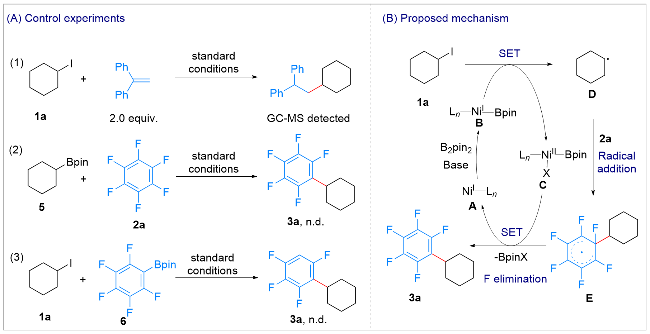


Based on the previous works [12,16] and the control experiments conducted, a plausible reaction mechanism is proposed (Scheme 1B). In this mechanism, the reaction is initiated with the formation of NiI—Ln complex (A), followed by the generation of Ln-NiI-Bpin species (B) through a borylation process. Subsequently, Then, NiI species (B) undergoes single electron transfer (SET) to iodocyclohexane 1a, leading to the generation of cyclohexyl radical (D) and NiII intermediate (C). Radical addition to hexafluorobenzene 2a gains the radical intermediate (E). Next, the intermediate (E) undergoes SET and F elimination to afford the desired product 3a with the regeneration of NiI species (A).
3 Conclusions
In conclusion, a novel Ni-catalyzed reductive alkylation of polyfluoroarenes with alkyl halides involving C—F cleavage has been established. A variety of alkyl-subs-tituted polyfluoroarenes (2F~5F) can be accessed with high efficiency under reductive conditions. Our approach demonstrates a novel Ni-catalyzed reductive cross-coupl-ing strategy in polyfluoroalkylation.
4 Experimental section
4.1 Instruments and reagents
1H NMR, 13C NMR and 19F NMR spectra were recorded on a Bruker Avance 400 spectrometer using CDCl3 as solvent and TMS as an internal standard. High-resolution mass spectra (HRMS) were obtained with a Water XEVO G2 Q-Tof (Waters Corporation). Melting points were uncorrected and were recorded on a SG WRS-2A melting point apparatus. Unless otherwise stated, all reagents and solvents were purchased from commercial suppliers and used without further purification. Commercially available reagents were purchased from Energy Chemical, Bide Pharmatech, Adamas-beta, and Sigma-Aldrich Co., Inc. According to the literature,[8b] alkyl iodides 1b, 1e, 1g and 1h were prepared from the corresponding alcohols.
4.2 General procedures for synthesis of compounds 3~4
An oven-dried 10 mL re-sealable screw-cap test tube equipped with a Teflon-coated magnetic stir bar was sequentially charged with bpy (6 mol%), NiCl2•dme (5 mol%), B2pin2 (0.4 mmol, 2.0 equiv.), and K2CO3 (0.5 mmol, 2.5 equiv.). Then 1,4-dioxane (0.5 mL), alkyl halides 1 (0.2 mmol, 1.0 equiv.), and polyfluoroarenes 2 (1.0 mmol, 5.0 eq.) were added into the tube in turn. All these procedures were conducted in the glovebox. Then removing from the glove box, the reaction mixture was stirred at 80 ℃ for 12 h. The reaction was quenched with H2O, and the aqueous layer was extracted with EtOAc. The organic layers were combined, washed with brine, dried over Na2SO4, filtered, and concentrated under reduced pressure. The product was purified by silica gel column chromatography.
1-Cyclohexyl-2,3,4,5,6-pentafluorobenzene (3a): White solid (36.1 mg, 72% yield), m.p. 44~46 ℃ (lit.[8a] 44.8~46.2 ℃); 1H NMR (400 MHz, CDCl3) δ: 3.00~2.93 (m, 1H), 1.87~1.72 (m, 7H), 1.42~1.28 (m, 3H); 19F NMR (376 MHz, CDCl3) δ: -142.89 (dd, J=22.1, 8.0 Hz, 2F), -158.53 (t, J=20.7 Hz, 1F), -162.87~-163.00 (m, 2F); 13C NMR (101 MHz, CDCl3) δ: 146.4 (m), 144.0 (m), 140.6 (m), 138.7 (m), 138.1 (m), 136.4 (m), 119.8 (m), 35.3, 31.0, 26.8, 25.7.
(4-(Perfluorophenyl)piperidin-1-yl)(phenyl)methanone(3b): Colorless solid (46.9 mg, 66% yield), m.p. 116~118 ℃ (lit.[7] 117~118 ℃); 1H NMR (400 MHz, CDCl3) δ: 7.47~7.42 (m, 5H), 4.93 (brs, 1H), 3.93 (brs, 1H), 3.29 (tt, J=12.6, 3.7 Hz, 1H), 3.12 (brs, 1H), 2.87 (brs, 1H), 2.08 (brs, 2H), 1.81 (brs, 2H); 19F NMR (376 MHz, CDCl3) δ: -142.68 (d, J=14.5 Hz, 2F), -156.69 (t, J=21.0 Hz, 1F), -162.01 (td, J=21.8, 7.6 Hz, 2F); 13C NMR (101 MHz, CDCl3) δ: 170.5, 146.3 (m), 143.8 (m), 141.1 (m), 139.1 (m), 138.7 (m), 136.4 (m), 136.0, 129.7, 128.6, 126.8, 117.2 (m), 48.2, 42.8, 33.5, 30.2 (m).
tert-Butyl 4-(perfluorophenyl)piperidine-1-carboxylate (3c):[8b] Colorless solid (44.3 mg, 63% yield), m.p. 111~1113 ℃; 1H NMR (400 MHz, CDCl3) δ: 4.29 (s, 2H), 3.18~3.11 (m, 1H), 2.81 (s, 2H), 2.02 (t, J=11.9 Hz, 2H), 1.72 (d, J=13.4 Hz, 2H), 1.50~1.54 (m, 9H); 19F NMR (377 MHz, CDCl3) δ: -142.78 (dt, J=21.9, 10.7 Hz, 2F), -157.20 (t, J=20.9 Hz, 1F), -162.31 (td, J=21.9, 7.7 Hz, 2F); 13C NMR (101 MHz, CDCl3) δ: 154.7, 146.4 (m), 143.9 (m), 141.0 (m), 138.9 (m), 136.4 (m), 117.8 (m), 79.7, 44.4, 33.5, 29.9, 28.5, 28.4.
4-(Perfluorophenyl)tetrahydro-2H-pyran (3d):[6] Colorless liquid (37.8 mg, 75% yield). 1H NMR (400 MHz, CDCl3) δ: 4.13~4.09 (m, 2H), 3.57~3.50 (m, 2H), 3.27 (tt, J=12.4, 3.8 Hz, 1H), 2.27~2.15 (m, 2H), 1.69~1.64 (m, 2H); 19F NMR (377 MHz, CDCl3) δ: -142.91~ -143.00 (m, 2F), -157.36 (t, J=20.9 Hz, 1F), -162.36~-162.51 (m, 2F); 13C NMR (101 MHz, CDCl3) δ: 146.4 (m), 144.0 (m), 140.9 (m), 138.8 (m), 138.4 (m), 136.3 (m), 117.8 (m), 68.23, 32.48, 30.6 (m).
8-(Perfluorophenyl)-1,4-dioxaspiro[4.5]decane (3e): White solid (43.1 mg, 70% yield), m.p. 109~111 ℃ (lit.[8a] 108.6~113 ℃); 1H NMR (400 MHz, CDCl3) δ: 3.97~3.93 (m, 4H), 2.99 (tt, J=12.7, 3.6 Hz, 1H), 2.18~2.06 (m, 2H), 1.87~1.81 (m, 2H), 1.77~1.70 (m, 2H), 1.64 (td, J=13.4, 4.2 Hz, 2H); 19F NMR (377 MHz, CDCl3) δ: -142.22~-142.64 (m, 2F), -157.91 (t, J=20.8 Hz, 1F), -162.67 (m, 2F); 13C NMR (101 MHz, CDCl3) δ: 146.4 (m), 144.0 (m), 140.7 (m), 138.9 (m), 138.3 (m), 136.5 (m), 11.6 (m), 107.9, 64.5 (d, J=5.6 Hz), 35.2, 34.0, 28.3.
(Perfluorophenyl)cycloheptane (3f):[8b] Colorless solid (45.4 mg, 86% yield), m.p. 41~43 ℃; 1H NMR (400 MHz, CDCl3) δ: 3.15 (tt, J=10.7, 3.4 Hz, 1H), 2.00~1.78 (m, 6H), 1.79~1.70 (m, 2H), 1.68~1.53 (m, 4H); 19F NMR (377 MHz, CDCl3) δ: -143.05 (dd, J=22.6, 7.9 Hz, 2F), -159.11 (t, J=20.8 Hz, 1F), -162.96~-163.11 (m, 2F); 13C NMR (101 MHz, CDCl3) δ: 145.8 (m), 143.3 (m), 140.3 (m), 138.8 (m), 137.8 (m), 136.3 (m), 121.8 (m), 121.6 (m), 36.8, 33.5, 27.7, 27.6.
2-(Perfluorophenyl)-2,3-dihydro-1H-indene (3g): White solid (21.1 mg, 37% yield), m.p. 100~102 ℃ (lit.[8c] 101~102 ℃); 1H NMR (400 MHz, CDCl3) δ: 7.29~7.23 (m, 4H), 4.03 (p, J=9.5 Hz, 1H), 3.36~3.26 (m, 4H); 19F NMR (377 MHz, CDCl3) δ: -141.36~-141.46 (m, 2F), -157.50 (t, J=21.0 Hz, 1F), -162.55~-162.68 (m, 2F); 13C NMR (101 MHz, CDCl3) δ: 142.0, 126.7, 124.3, 38.5, 34.0.
1,2,3,4,5-Pentafluoro-6-(4-phenylbutan-2-yl)benzene (3h):[8a] Colorless oil (44.4 mg, 74% yield). 1H NMR (400 MHz, CDCl3) δ: 7.31 (t, J=7.5 Hz, 2H), 7.23 (t, J=7.3 Hz, 1H), 7.17 (d, J=6.8 Hz, 2H), 3.30 (dq, J=13.8, 7.1 Hz, 1H), 2.65 (ddd, J=13.8, 9.7, 6.4 Hz, 1H), 2.54 (ddd, J=13.8, 9.7, 6.0 Hz, 1H), 2.17 (ddt, J=15.4, 9.3, 6.0 Hz, 1H), 2.06 (ddt, J=13.3, 9.5, 6.4 Hz, 1H), 1.42 (d, J=7.1 Hz, 3H); 19F NMR (377 MHz, CDCl3) δ: -142.69~ -142.77 (m, 2F), -157.98 (t, J=20.9 Hz, 1F), -162.73~-162.82 (m, 2F); 13C NMR (101 MHz, CDCl3) δ: 146.4 (m), 143.9 (m), 141.3, 140.7 (m), 138.8 (m), 138.2 (m), 136.3 (m), 128.4, 128.3, 126.0, 119.2 (m), 36.7, 34.3, 30.2, 19.6.
1-(Perfluorophenyl)adamantane (3i):[8b] Colorless solid (47.2 mg, 78% yield), m.p. 67~69 ℃; 1H NMR (400 MHz, CDCl3) δ: 2.26~2.25 (m, 6H), 2.12~2.09 m, 3H), 1.87~1.77 (m, 6H); 19F NMR (377 MHz, CDCl3) δ: -137.07~-138.15 (m, 2F), -158.55~-158.57 (m, 1F), -162.96~-163.09 (m, 2F); 13C NMR (101 MHz, CDCl3) δ: 147.5 (m), 145.0 (m), 139.8 (m), 138.9 (m), 137.8 (m), 136.7 (m), 122.4 (m), 41.18, 41.13, 41.07, 40.46, 36.50, 28.82.
1,2,3,4,5-Pentafluoro-6-(3-phenylpropyl)benzene (3j):[8a] Colorless oil (16.1 mg, 28% yield). 1H NMR (400 MHz, CDCl3) δ: 7.34 (t, J=7.4 Hz, 2H), 7.27~7.22 (m, 3H), 2.81~2.71 (m, 4H), 1.98 (tt, J=9.5, 6.7 Hz, 2H); 19F NMR (377 MHz, CDCl3) δ: -144.04~-144.39 (m, 2F), -158.01 (t, J=20.8 Hz, 1F), -162.79~-163.17 (m, 2F); 13C NMR (101 MHz, CDCl3) δ: 146.3 (m), 143.8 (m), 141.2, 140.8 (m), 138.7 (m), 138.3 (m), 136.2 (m), 128.4, 128.3, 126.1, 115.2 (m), 35.4, 30.7, 22.11 (d, J=1.8 Hz).
3-Cyclohexyl-1,2,4,5-tetrafluorobenzene (4a):[8a] Colorless oil (26.9 mg, 58% yield, 4.5/3.3/1). 1H NMR (400 MHz, CDCl3) δ: 7.07~6.62 (m, 1H), 3.10~2.85 (m, 1H), 1.90~1.76 (m, 7H), 1.47~1.26 (m, 3H); 19F NMR (377 MHz, CDCl3) δ: -117.35 (d, J=10.7 Hz, 0.7F), -135.42 (ddd, J=20.6, 5.0, 1.9 Hz, 0.9F), -136.79 (dd, J=21.6, 5.0 Hz, 0.7F), -140.10 (dd, J=21.8, 12.4 Hz, 2F), -140.38 (ddd, J=20.8, 12.1, 1.7 Hz, 0.2F), -143.58 (dd, J=21.7, 12.6 Hz, 2F), -145.22~ -145.94 (m, 0.2F), -156.34~-158.05 (m, 0.3F),-158.77~-161.13 (m, 0.3F), -165.80 (td, J=21.2, 10.7 Hz, 0.9F); 13C NMR (101 MHz, CDCl3) δ:147.3 (m), 146.1 (m), 144.8 (m), 143.6 (m), 125.8 (m), 119.8 (m), 108.6 (m), 103.1 (m), 100.6 (m), 36.7~35.0 (m), 32.9~30.7 (m), 26.8~26.5 (m), 25.9~25.7 (m).
4-Cyclohexyl-2,3,5,6-tetrafluorobenzonitrile (4b):[8a] Colorless oil (44.8 mg, 87% yield, 1.6/1). 1H NMR (400 MHz, CDCl3) δ: 3.16~3.03 (m, 1H), 1.97~1.78 (m, 7H), 1.47~1.28 (m, 3H); 19F NMR (377 MHz, CDCl3) δ: -130.78 (ddd, J=21.0, 11.5, 6.9 Hz, 0.6F), -132.82~-133.74 (m, 2F), -138.04~-138.37 (m, 0.7F), -139.60 (td, J=16.4, 7.2 Hz, 2F), -145.02 (td, J=20.6, 7.0 Hz, 0.6F), -155.86 (td, J=20.5, 4.0 Hz, 0.7F); 13C NMR (101 MHz, CDCl3) δ: 148.4 (m), 148.3 (m), 146.2 (m), 145.8 (m), 143.7 (m), 134.6 (m), 132.4 (m), 111.1 (m), 107.7 (m), 91.6 (m), 36.4 (m) 30.6~30.4 (m), 26.5 (m), 25.5 (m).
4-Cyclohexyl-2,3,5,6-tetrafluoropyridine (4c):[8a] Waxy oil (29.9 mg, 64% yield, 4/1.2/1). 1H NMR (400 MHz, CDCl3) δ: 3.16~2.87 (m, 1H), 1.95~1.57 (m, 7H), 1.48~1.24 (m, 3H); 19F NMR (377 MHz, CDCl3) δ: -70.55 (dt, J=23.9, 15.0 Hz, 0.6F), -84.57 (td, J=26.8, 15.5 Hz, 0.5F), -88.52~-88.67 (m, 0.6F), -92.07~-92.24 (m, 2F), -117.12 (ddd, J=19.4, 17.2, 15.2 Hz, 0.7F), -140.40 (td, J=18.8, 15.4 Hz, 0.5F), -144.21~ -144.38 (m, 2F), -149.24 (ddd, J=27.7, 19.1, 2.4 Hz, 0.5F), -161.66 (ddd, J=26.0, 18.4, 2.4 Hz, 0.5F), -167.24~-167.42 (m, 0.7F); 13C NMR (101 MHz, CDCl3) δ: 146.7 (m), 144.9 (m), 142.3 (m), 141.6 (m), 139.1 (m), 131.7 (m), 38.6, 36.4 (m), 34.7 (m), 30.6 (m), 26.4 (m), 25.5 (m).
1-Chloro-4-cyclohexyl-2,3,5,6-tetrafluorobenzene (4d): White solid (28.7 mg, 54% yield, 1.3/1/1), m.p. 38~40 ℃ (lit.[8a] 38.3~39.6 ℃); 1H NMR (400 MHz, CDCl3) δ: 3.24~2.97 (m, 1H), 1.91~1.73 (m, 7H), 1.47~1.28 (m, 3H); 19F NMR (377 MHz, CDCl3) δ: -120.19 (d, J=9.1 Hz, 0.8F), -136.75 (dd, J=22.0, 8.8 Hz, 0.6F), -137.22~137.24 (m, 0.9F), -137.30~137.37 (m, 0.9F), -140.19 (dd, J=20.7, 8.7 Hz, 0.8F), -142.04~-142.14 (m, 2F), -142.18~-142.28 (m, 2F), -157.59 (t, J=20.6 Hz, 0.8F), -157.77 (t, J=20.7 Hz, 0.8F), -162.78 (td, J=21.6, 9.2 Hz, 1F); 13C NMR (101 MHz, CDCl3) δ: 146.4 (m), 145.4 (m), 144.0 (m), 143.0 (m), 141.81, 129.0 (m), 123.8 (m), 35.6 (m), 30.8 (m), 30.2 (m), 26.7 (m), 25.6 (m).
Methyl 2,3,5,6-tetrafluoro-4-(1,4-dioxaspiro[4.5]decan-8-yl)benzoate (4e): Colorless oil (29.3 mg, 42% yield, 8/1.6/1). 1H NMR (400 MHz, CDCl3) δ: 4.01~3.97 (m, 7H), 3.14~3.03 (m, 1H), 2.26~2.11 (m, 2H), 1.93~1.60 (m, 6H); 19F NMR (377 MHz, CDCl3) δ: -116.84 (dd, J=10.4, 4.8 Hz, 0.4F), -129.70 (ddd, J=21.6, 8.6, 4.6 Hz, 0.4F), -135.62 (ddd, J=21.8, 8.4, 2.4 Hz, 0.4F), -138.60 (ddd, J=20.7, 11.7, 3.7 Hz, 0.3F), -139.99~-140.16 (m, 2F), -140.85 (ddd, J=22.2, 11.8, 4.1 Hz, 0.3F), δ:-141.55~-141.71 (m, 2F), -152.69 (d, J=4.1 Hz, 0.3F), -155.93~-160.05 (m, 0.3F), -163.66 (d, J=11.0 Hz, 0.4F); 13C NMR (101 MHz, CDCl3) δ: 171.2, 160.5 (m), 146.1 (m), 145.9 (m), 143.5 (m), 127.5 (m), 110.2 (m), 107.8 (m), 64.4 (m), 53.1 (m), 35.0 (m), 34.6 (m), 28.2 (m), 27.9 (m); HRMS (ESI) calcd for C16H17F4O4 [M+H]+ 349.1057, found 349.1052.
2-Cyclohexyl-1,3,4-trifluorobenzene (4f):[8a] Colorless oil (28.7 mg, 67% yield). 1H NMR (400 MHz, CDCl3) δ: 7.00~6.92 (m, 1H), 6.81~6.74 (m, 1H), 3.06~2.99 (m, 1H), 1.90~1.76 (m, 7H), 1.46~1.29 (m, 3H); 19F NMR (377 MHz, CDCl3) δ: -118.93 (dd, J=15.2, 3.2 Hz, 1F), -137.56 (dd, J=20.8, 3.1 Hz, 1F), -142.89~-142.98 (m, 1F); 13C NMR (101 MHz, CDCl3) δ: 157.8 (m), 155.4 (m), 150.3 (m), 1486 (m), 147.9 (m), 146.2 (m), 124.5 (m), 113.9 (m), 110.6 (m), 35.4 (m), 30.9 (m), 26.8, 25.8.
1-(2,3.6-Trifluorophenyl)adamantane (4g): Colorless solid (29.8 mg, 56% yield). m.p. 71~73 ℃; 1H NMR (400 MHz, CDCl3) δ: 7.00~6.71 (m, 2H), 2.28 (d, J=2.9 Hz, 5H), 2.13~2.04 (m, 4H), 1.87~1.77 (m, 6H); 19F NMR (377 MHz, CDCl3) δ: -111.35 (dd, J=14.0, 3.2 Hz, 1F), -132.07 (dd, J=18.2, 3.0 Hz, 1F), -142.04 (dd, J=18.2, 14.1 Hz, 1F); 13C NMR (101 MHz, CDCl3) δ: 158.5 (m), 156.0 (m), 151.3 (m), 149.4 (m), 148.7 (m), 147.0 (m), 126.7 (m), 113.9 (m), 111.4 (m), 41.1, 41.1, 41.0, 36.7, 28.9; HRMS (ESI) calcd for C16H18F3 [M+H]+ 267.1355, found 267.1369.
4-Cyclohexyl-3,5-difluorobenzonitrile (4h): Colorless solid (22.9 mg, 52% yield). m.p. 65~67 ℃; 1H NMR (400 MHz, CDCl3) δ: 7.32~7.14 (m, 2H), 3.06 (tt, J=12.0, 3.7 Hz, 1H), 1.91~1.73 (m, 7H), 1.47~1.28 (m, 3H); 19F NMR (377 MHz, CDCl3) δ: -109.41 (s, 2F); 13C NMR (101 MHz, CDCl3) δ: 162.5 (m), 160.1 (m), 128.9 (m), 116.8 (m), 115.6 (m), 110.8 (m), 35.3, 30.6, 26.7, 25.7; HRMS (ESI) calcd for C13H13F2NNa [M+Na]+244.0908, found 244.0906.
1-(3,5-Difluoro-4-(tetrahydro-2H-pyran-4-yl)phenyl)-ethan-1-one (4i): Colorless solid (22.6 mg, 47% yield). m.p. 82~84 ℃; 1H NMR (400 MHz, CDCl3) δ: 7.45~7.38 (m, 2H), 4.08~4.04 (m, 2H), 3.50 (td, J=12.1, 2.2 Hz, 2H), 3.27 (tt, J=12.4, 3.7 Hz, 1H), 2.54 (s, 3H), 2.27~2.16 (m, 2H), 1.62~1.56 (m, 2H); 19F NMR (376 MHz, CDCl3) δ: -111.56; 13C NMR (101 MHz, CDCl3) δ: 195.37, 162.67 (d, J=8.8 Hz), 160.19 (d, J=8.7 Hz), 137.02, 125.67 (m), 111.61 (m), 83.59, 68.42, 32.51, 30.46, 26.57, 25.09; HRMS (ESI) calcd for C13H14F2NaO2 [M+Na]+ 263.0854, found 263.0847.
Supporting Information NMR spectra of products 3~4 are included in the supporting information. The Supporting Information is available free of charge via the Internet at http://sioc-journal.cn.
(Cheng, F.)