



1 Introduction
Reaction intermediates play a crucial role in chemical reactions, providing essential insights into reaction mechanisms and facilitating the development of novel synthetic pathways. Halogenated compounds serve as key chemical entities and precursors in the synthesis of pharmaceuticals, biologically active compounds, and natural products.[1] The activation of carbon-halogen bonds poses a significant challenge due to their high bond strengths and redox potentials.[2a-2b] Recently developed photocatalytic halogen atom transfer (XAT) methodology offers a promising approach to activate carbon-halogen bonds in non-aromatic halogenated compounds under mild conditions, obviating the need for high-energy ultraviolet light or strong reducing agents typically required for traditional halogenated hydro-carbon activation.[3a-3c] Notably, organic amines, ubiquitous in chemical synthesis, can undergo electron loss under light irradiation to form amine alkyl radicals, which subsequently engage in halogen atom transfer (XAT) with halogen substituents to yield alkyl or aryl radicals (Scheme 1).[4a-4b,5] This innovative strategy has propelled advancements in related reactions.[6-7] Nevertheless, the real-time characterization of pivotal intermediates such as amine alkyl radicals and carbon-centered radicals resulting from halogen capture remains limited to radical quenching techniques employing agents like TEMPO.[6a,6b]
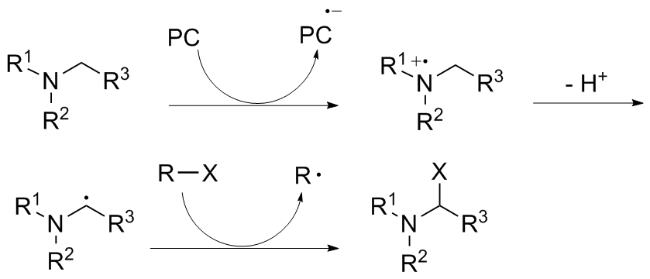
Electron paramagnetic resonance (EPR) is commonly employed for the analysis of substances with unpaired electrons in reactions and finds extensive utility in studying photocatalytic reaction intermediates.[8] This study utilizes EPR for the real-time characterization of the photocatalytic activation of halogen substituents mediated by organic amines. Specifically, we focus on monitoring the dynamic evolution of carbon radicals formed from amine alkyl radicals and halogenated hydrocarbons during halogen atom transfer (XAT). Our aim is to elucidate the mechanism of photocatalytic halogen atom transfer (XAT) mediated by organic amines and leverage this understanding to guide synthesis reactions.
2 Results and discussion
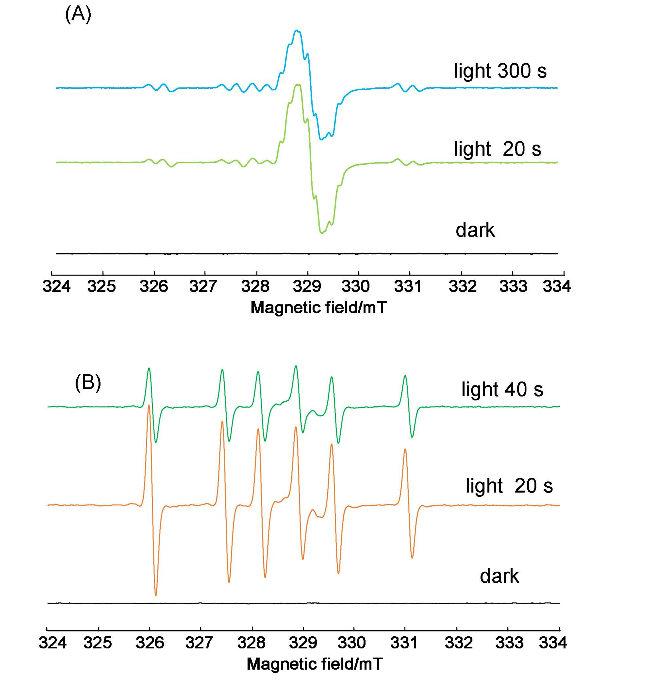
First, 4-CzIPN was utilized as a photocatalyst, with n-Bu3N serving as a halogenated hydrocarbon activator, iodocyclohexane, and 5,5-dimethyl-1-pyrroline N-oxide (DMPO) as a radical trapping agent. The reaction intermediates were characterized in situ using electron paramagnetic resonance (EPR). No signals were detected under dark conditions. Upon 20 s of in situ illumination at 455 nm, signals corresponding to amine alkyl radicals (g=2.005, AN=1.46 mT, AH=2.09 mT) were observed along with a signal of [4-CzIPN]• radical ion (g=2.0016) (Figure 1A), which remained stable with continued light exposure for 300 s. The addition of iodide did not alter the signal stability. Subsequent addition of iodocyclohexane resulted in no signals under dark conditions. Following 20 s of light exposure (455 nm), the signal of [4-CzIPN]• weakened, the amine alkyl radical signal nearly disappeared, and a set of sextet peaks (cyclohexyl radicals) signal emerged (g=2.0045, AN=1.44 mT, AH=2.14 mT), which appeared to diminish with prolonged illumination (40 s) (Figure 1B).
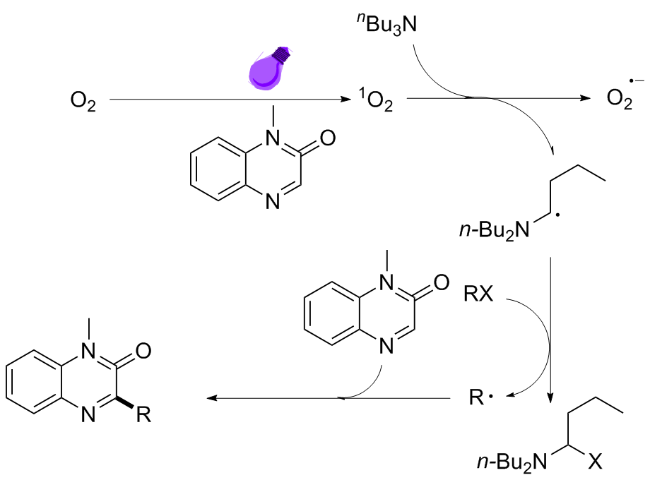
To avoid the possibility of single electron transfer (SET) between [4-CzIPN]• radical anion and iodocyclohexane, an oxygen-mediated oxidation reaction was devised to investigate intermediates in the photocatalytic XAT process. Singletoxygen, as one of the activated oxygen species, would oxidize tributylamine, forming amino alkyl radicals. Quinoxalin-2(1H)-ones, which were reported as an efficient singletoxygen initiator under visible light,[9] was employed to activate oxygen to singletoxygen. This process subsequently activates tributylamine to form an amine ion radical, which is converted into an amine alkyl radical. This free radical captures iodine from iodocyclohexane, producing a cyclohexyl radical that attacks quinoxalinone, thereby producing alkylated quinoxalinone compounds (Scheme 2).
To a mixture of 1-methylquinoxalin-2(1H)-one (0.1 mol/ L), n-Bu3N (0.2 mol/L) and iodocyclohexane in dimethyl sulfoxide (DMSO) under air, DMPO (0.1 mol/L) was (A) 4-CzIPN (1%)+nBu3N (0.2 mol/L)+DMPO (0.1 mol/L) in CH3CN; (B) 4-CzIPN (1%)+nBu3N (0.2 mol/L)+iodocyclohexane ( 0.1 mol/L)+DMPO (0.1 mol/L) in CH3CN added, then 20 µL of the mixture was transferred into a capillary. The capillary was then transferred into an EPR measurement tube. The EPR tube was then adapted to the EPR measurement capacity, and measured in-situ. The results were recorded every 20 s by the instrument automatically as soon as the mixture was irradiated with light.
In the absence of light, no radical signals were detected. Exposure to 390 nm light for 20 s generated superoxide anion radicals (g=2.0042, AN=1.30 mT, AHα=1.04 mT, AHβ=0.15 mT), amino alkyl radical (g=2.0052, AN=1.52 mT, AH=2.29 mT), and cyclohexyl radicals (g=2.0054, AN=1.45 mT, AH=2.17 mT) (Figure 2A).
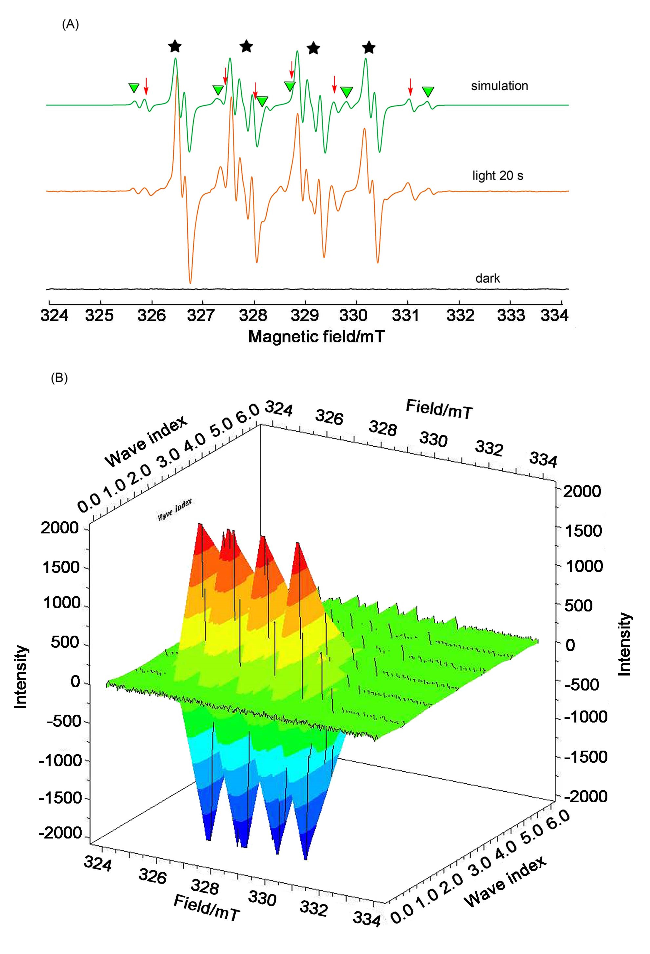
Figure 2 ESR study of singletoxygen promoted light-induced activation of iodocyclohexane via XAT(A) 1-Methylquinoxalin-2(1H)-one (0.1 mol/L)+nBu3N (0.2 mol/L)+iodocyclohexane (0.1 mol/L)+DMPO (0.1 mol/L) in DMSO. (B) Time resolved ESR study of the intermediates of 1-methylquinoxalin-2(1H)- one (0.1 mol/L)+trybutylamine (0.2 mol/L)+iodocyclohexane (0.1 mol/ L)+DMPO (0.1 mol/L) in DMSO |
Time-resolved electron paramagnetic resonance (Time- Resolved-EPR) revealed a rapid decay of the amino alkyl and superoxide anion radical signals, while cyclohexyl radical signals remained stable, indicating the consumption of the former radicals in the reaction (Figure 2B).
Having obtained an overview of the radical intermediates in the process of organic amine involved photocatalytic halogen atom transfer (XAT), the next stage was to develop new light-induced transformations.
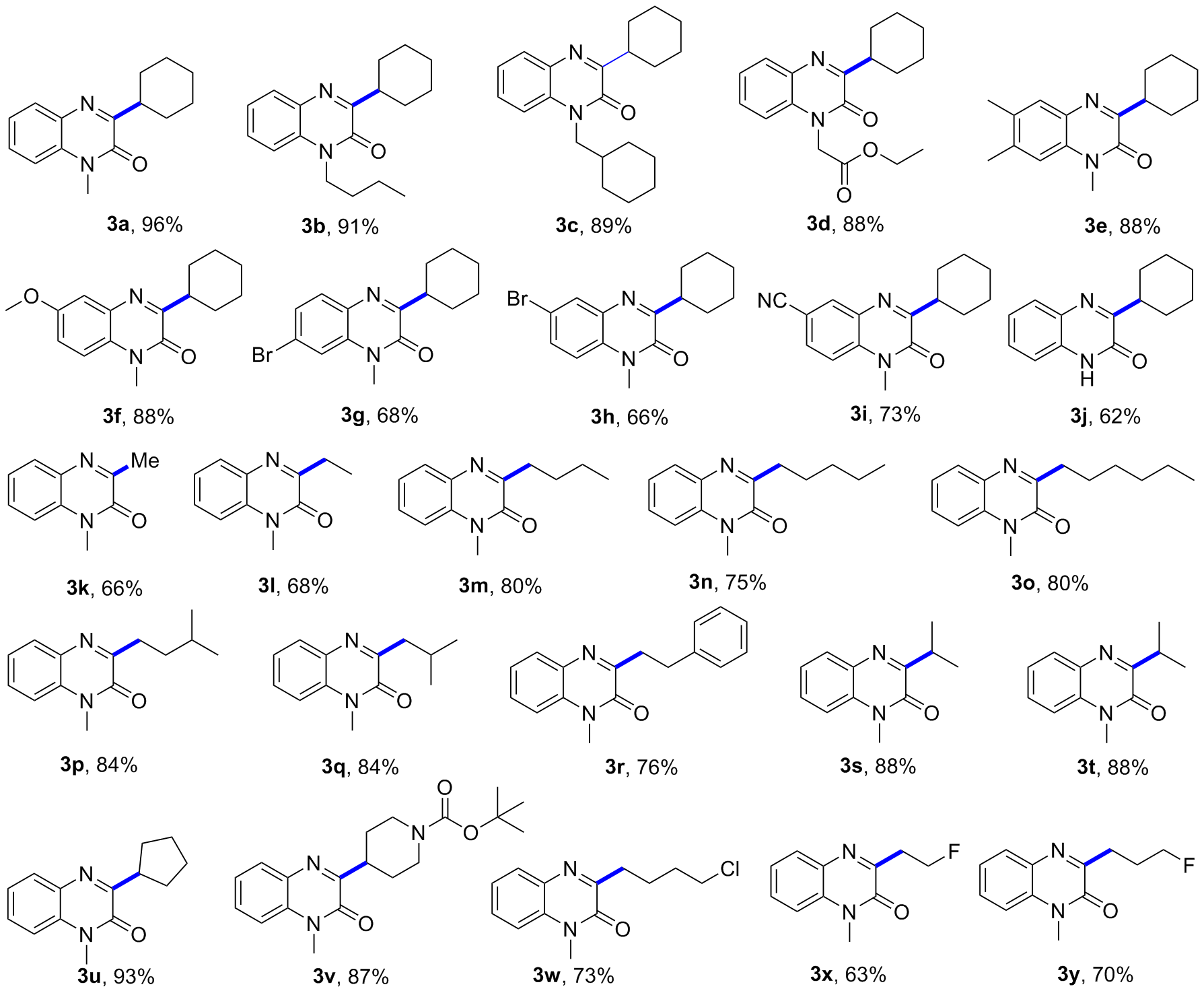
Delightly, 3-cyclohexyl-1-methylquinoxalin-2(1H)-one, the alkylation product, was isolated and confirmed by NMR with a yield of 13%, likely due to the trapping of most of the cyclohexyl radicals by DMPO. The alkylation of quinoxalinones is a significant modification of the drug skeleton.[10] In an effort to eliminate the radical scavenger DMPO from the system, the yield of 3-cyclohexyl-1-methylquinoxalin-2(1H)-one increased to 91%. Following a few works of optimization of reaction conditions, a series of alkylated quinoxalin-2(1H)-one from good to excellent yields were prepared using an XAT reaction procedure (Table 1).
Table 1 Photocatalytic alkylation of quinoxalin-2(1H)-one via XAT mechanism |



 |
3 Conclusions
In conclusion, in-situ dynamic characterization of intermediates in organic amine-mediated photocatalytic halogen atom transfer reactions via electron paramagnetic resonance (EPR) has provided insights into the dynamics of amine alkyl radicals and carbon-centered radicals of halogenated hydrocarbons post-dehalogenation. This understanding facilitated the development of quinoxalinone alkylation using tributylamine as an XAT reagent under photoinduced conditions in air. We propose that in situ EPR characterization of intermediate radicals can be broadly applied to photocatalytic organic synthesis, potentially guiding the development of new synthetic reactions.
4 Experimental sections
4.1 General information
Unless otherwise noted, materials were obtained from commercial suppliers and used without further purification. EPR spectra were recorded by using a JEOL JES X320 spectrometer (X-band, 10.0 GHz). Thin layer chromatography (TLC) employed glass 0.25 mm silica gel plates. Flash chromatography columns were packed with 200~300 mesh silica gel. 1H NMR were recorded on a Bruker AMX 500 spectrophotometer (CDCl3 as solvent). Chemical shifts for 1H NMR spectra are reported downfield from SiMe4 (δ 0.0) and relative to the signal of CDCl3 (δ 7.26, singlet). 13C NMR are reported downfield from SiMe4 (δ 0.0) and relative to the signal of CDCl3 (δ 77.0, triplet).
4.2 General experimental procedure for EPR
In a glovebox, nBu3N (47.6 µL, 0.2 mmol), iodocyclohexane (13 µL, 0.1 mmol), 4-CzIPN (1.6 mg, 2%) and DMPO (11.3µL, 0.1 mmol) was added to a 5 mL round bottomed bottle with a stir bar, CH3CN (1 mL) was added then. After the mixture was stirred for 2 min under dark, 20 µL of the mixture was transferred to a capillary, the capillary was then transferred to an EPR tube, the EPR tube was then adapted to the EPR instrument measure capacity, and measured in-situ.
The time resolved EPR measurement was recorded every 20 s by the instrument automatically as soon as the mixture was irradiated with light.
4.3 General experimental procedure for compounds
To a quartz reactor equipped with a stir bar, quinoxalin-2(1H)-ones (0.15 mmol, 1.0 equiv.), iodoalkanes (0.3 mmol, 2.0 equiv.) and nBu3N (0.3 mmol, 2.0 equiv.) were added into a 3 mL vial. Subsequently, DMSO (2 mL) was added. The reaction mixture was stirred under an air atmosphere irradiated by purple LED (λmax=390 nm) from a 3.0 cm distance for 12 h at room temperature. After reaction completion as judged by TLC, the reaction mixture was diluted with water (5 mL) and CH2Cl2 (20 mL), washed with brine (10 mL×3), dried over Na2SO4, concentrated in vacuo, then purified by silica gel column chromatography to afford the desired product.
3-Cyclohexyl-1-methylquinoxalin-2(1H)-one (3a):[10a] 96% yield, yellow solid. 1H NMR (500 MHz, CDCl3) δ: 7.84 (d, J=6.9 Hz, 1H), 7.50 (t, J=7.4 Hz, 1H), 7.32 (t, J=7.3 Hz, 1H), 7.28 (d, J=8.6 Hz, 1H), 3.70 (s, 3H), 3.37~3.31 (m, 1H), 1.97~1.94 (m, 2H), 1.89~1.85 (m, 2H), 1.79~1.74 (m, 1H), 1.61~1.53 (m, 2H), 1.51~1.43 (m, 2H), 1.34~1.29 (m, 1H); 13C NMR (125 MHz, CDCl3) δ: 164.30, 154.57, 132.92, 132.88, 129.79, 129.38, 123.39, 113.46, 40.79, 30.54, 29.06, 26.33, 26.17. HRMS (ESI+) calcd for C15H19N2O [M+H]+ 243.1492, found 243.1494.
1-Butyl-3-cyclohexylquinoxalin-2(1H)-one (3b):[10a] 91% yield, yellow solid. 1H NMR (500 MHz, CDCl3) δ: 7.84 (d, J=7.8 Hz, 1H), 7.49 (t, J=7.7 Hz, 1H), 7.29 (dd, J=13.3, 8.0 Hz, 2H), 4.24 (t, J=7.5 Hz, 2H), 3.34 (tt, J=11.6, 3.3 Hz, 1H), 1.96 (dd, J=12.4, 3.9 Hz, 2H), 1.89~1.84 (m, 2H), 1.78~1.74 (m, 2H), 1.72 (d, J=8.0 Hz, 1H), 1.59 (dd, J=12.7, 3.3 Hz, 1H), 1.55 (dd, J=12.5, 2.9 Hz, 1H), 1.51~1.44 (m, 4H), 1.36~1.30 (m, 1H), 1.00 (t, J=7.4 Hz, 3H); 13C NMR (125 MHz, CDCl3) δ: 164.27, 154.24, 133.20, 132.05, 130.02, 129.27, 123.15, 113.47, 42.12, 40.75, 30.55, 29.35, 26.36, 26.18, 20.33, 13.79. HRMS (ESI+) calcd for C18H25N2O [M+H]+ 285.1962, found 285.1964.
3-Cyclohexyl-1-(cyclohexylmethyl)quinoxalin-2(1H)-one (3c):[10a] 89% yield, yellow solid. 1H NMR (500 MHz, CDCl3) δ: 7.83 (dd, J=8.1, 1.6 Hz, 1H), 7.48 (ddd, J=8.6, 7.2, 1.6 Hz, 1H), 7.31~7.28 (m, 2H), 4.13 (d, J=7.3 Hz, 2H), 3.34 (tt, J=11.6, 3.2 Hz, 1H), 1.97~1.94 (m, 2H), 1.90~1.71 (m, 6H), 1.69~1.55 (m, 6H), 1.51~1.47 (m, 1H), 1.46~1.42 (m, 1H), 1.35~1.31 (m, 1H), 1.20~1.16 (m, 4H); 13C NMR (125 MHz, CDCl3) δ: 164.30, 154.73, 133.17, 132.47, 130.01, 129.13, 123.12, 113.95, 48.06, 40.79, 36.58, 30.98, 30.54, 26.36, 26.20, 25.82. HRMS (ESI+) calcd for C21H29N2O [M+H]+ 325.2275, found 325.2277.
Ethyl 2-(3-cyclohexyl-2-oxoquinoxalin-1(2H)-yl)acetate (3d):[10b] 88% yield, yellow solid. 1H NMR (500 MHz, CDCl3) δ: 7.85 (d, J=7.9 Hz, 1H), 7.47 (t, J=8.1 Hz, 1H), 7.32 (t, J=7.6 Hz, 1H), 7.04 (d, J=8.3 Hz, 1H), 5.01 (s, 2H), 4.25 (q, J=7.1 Hz, 2H), 3.35~3.29 (m, 1H), 1.97 (d, J=12.3 Hz, 2H), 1.87 (dt, J=13.0, 3.4 Hz, 2H), 1.79~1.74 (m, 1H), 1.60 (dd, J=12.7, 3.4 Hz, 1H), 1.55 (dd, J=12.6, 3.1 Hz, 1H), 1.50~1.46 (m, 1H), 1.45~1.41 (m, 1H), 1.36~1.32 (m, 1H), 1.28 (t, J=7.0 Hz, 3H); 13C NMR (125 MHz, CDCl3) δ: 167.27, 164.07, 154.12, 132.99, 132.02, 130.13, 129.54, 123.70, 112.90, 62.00, 43.60, 40.81, 30.49, 26.30, 26.15, 14.12. HRMS (ESI+) calcd for C18H23N2O3 [M+H]+ 315.1704, found 315.1706.
3-Cyclohexyl-1,6,7-trimethylquinoxalin-2(1H)-one (3e):[10h] 88% yield, yellow solid. 1H NMR (500 MHz, CDCl3) δ: 7.59 (s, 1H), 7.03 (s, 1H), 3.66 (s, 3H), 3.34~3.28 (m, 1H), 2.40 (s, 3H), 2.33 (s, 3H), 1.96~1.92 (m, 2H), 1.87~1.83 (m, 2H), 1.78~1.73 (m, 1H), 1.59~1.52 (m, 2H), 1.49~1.41 (m, 2H), 1.34~1.29 (m, 1H); 13C NMR (125 MHz, CDCl3) δ: 163.04, 154.63, 138.97, 132.19, 131.29, 130.83, 129.91, 114.06, 40.65, 30.59, 28.96, 26.36, 26.20, 20.45, 19.08. HRMS (ESI+) calcd for C17H23N2O [M+H]+ 271.1805, found 271.1807.
3-Cyclohexyl-6-methoxy-1-methylquinoxalin-2(1H)-one (3f):[10b] 88% yield, yellow solid. 1H NMR (500 MHz, CDCl3) δ: 7.32 (s, 1H), 7.20 (d, J=9.1 Hz, 1H), 7.13 (d, J=9.0 Hz, 1H), 3.89 (s, 3H), 3.68 (s, 3H), 3.38~3.32 (m, 1H), 1.98~1.94 (m, 2H), 1.89~1.84 (m, 2H), 1.79~1.75 (m, 1H), 1.56 (dd, J=12.1, 3.1 Hz, 2H), 1.49~1.42 (m, 2H), 1.35~1.32 (m, 1H); 13C NMR (125 MHz, CDCl3) δ: 164.92, 155.87, 154.23, 133.66, 127.10, 118.58, 114.38, 111.29, 55.79, 40.82, 30.60, 29.20, 26.33, 26.17. HRMS (ESI+) calcd for C16H21N2O2 [M+H]+ 273.1598, found 273.1600.
7-Bromo-3-cyclohexyl-1-methylquinoxalin-2(1H)-one (3g):[10h] 68% yield, yellow solid. 1H NMR (500 MHz, CDCl3) δ: 7.67 (d, J=8.4 Hz, 1H), 7.42 (d, J=7.8 Hz, 2H), 3.65 (s, 3H), 3.33~3.28 (m, 1H), 1.94 (dd, J=12.3, 3.3 Hz, 2H), 1.88~1.84 (m, 2H), 1.78~1.74 (m, 1H), 1.58~1.52 (m, 2H), 1.48~1.41 (m, 2H), 1.34~1.30 (m, 1H); 13C NMR (125 MHz, CDCl3) δ: 164.68, 154.19, 133.93, 131.75, 131.01, 126.60, 123.27, 116.50, 40.84, 30.45, 29.18, 26.26, 26.13. HRMS (ESI+) calcd for C15H18BrN2O [M+H]+ 321.0598, found 321.0600.
6-Bromo-3-cyclohexyl-1-methylquinoxalin-2(1H)-one (3h):[10b] 66% yield, yellow solid. 1H NMR (500 MHz, CDCl3) δ: 7.99 (d, J=2.3 Hz, 1H), 7.58 (dd, J=8.8, 2.3 Hz, 1H), 7.15 (d, J=8.8 Hz, 1H), 3.67 (s, 3H), 3.35~3.32 (m, 1H), 1.94~1.92 (m, 2H), 1.88~1.84 (m, 2H), 1.78~1.75 (m, 1H), 1.57~1.51 (m, 2H), 1.48~1.41 (m, 2H), 1.34~1.30 (m, 1H); 13C NMR (125 MHz, CDCl3) δ: 165.70, 154.20, 133.75, 132.22, 132.07, 132.03, 115.94, 114.89, 40.82, 30.50, 29.21, 26.25, 26.13. HRMS (ESI+) calcd for C15H18Br2N2O [M+H]+ 321.0598, found 321.0600.
3-Cyclohexyl-1-methyl-2-oxo-1,2-dihydroquinoxaline-6-carbonitrile (3i):[10e] 73% yield, yellow solid. 1H NMR (500 MHz, CDCl3) δ: 8.14 (d, J=1.9 Hz, 1H), 7.73 (dd, J=8.6, 1.9 Hz, 1H), 7.35 (d, J=8.7 Hz, 1H), 3.71 (s, 3H), 3.35~3.30 (m, 1H), 1.96~1.92 (m, 2H), 1.89~1.85 (m, 2H), 1.79~1.75 (m, 1H), 1.58~1.52 (m, 2H), 1.48~1.41 (m, 2H), 1.35~1.31 (m, 1H); 13C NMR (125 MHz, CDCl3) δ: 166.61, 154.12, 136.21, 134.09, 132.49, 132.01, 118.15, 114.59, 106.87, 40.92, 30.41, 29.35, 26.18, 26.06. HRMS (ESI+) calcd for C16H18N3O [M+H]+ 268.1445, found 268.1447.
3-Clohexylquinoxalin-2(1H)-one (3j):[10e] 62% yield, yellow solid. 1H NMR (500 MHz, DMSO-d6) δ: 12.31 (s, 1H), 7.71 (d, J=7.9 Hz, 1H), 7.46 (t, J=7.6 Hz, 1H), 7.28~7.25 (m, 2H), 3.20~3.14 (m, 1H), 1.87 (dd, J=12.4, 3.3 Hz, 2H), 1.81 (dt, J=12.7, 3.3 Hz, 2H), 1.74~1.70 (m, 1H), 1.47~1.42 (m, 2H), 1.37 (dt, J=13.0, 3.3 Hz, 2H), 1.30~1.25 (m, 1H); 13C NMR (125 MHz, DMSO-d6) δ: 165.27, 154.64, 132.12, 131.96, 129.83, 128.64, 123.50, 115.60, 30.52, 26.31, 19.86, 13.98. HRMS (ESI+) calcd for C14H17N2O+ [M+H]+ 229.1336, found 229.1338.
1,3-Dimethylquinoxalin-2(1H)-one (3k):[10b] 60% yield, yellow solid. 1H NMR (500 MHz, CDCl3) δ: 7.81 (d, J=7.3 Hz, 1H), 7.53 (t, J=8.0 Hz, 1H), 7.34 (t, J=7.8 Hz, 1H), 7.30 (d, J=8.3 Hz, 1H), 3.71 (s, 3H), 2.61 (s, 3H); 13C NMR (125 MHz, CDCl3) δ: 158.43, 155.24, 133.28, 132.69, 129.60, 129.47, 123.63, 113.62, 29.07, 21.64. HRMS (ESI+) calcd for C10H11N2O [M+H]+ 175.0866, found 175.0868.
3-Ethyl-1-methylquinoxalin-2(1H)-one (3l):[10a] 68% yield, yellow solid. 1H NMR (500 MHz, CDCl3) δ: 7.84 (d, J=7.8 Hz, 1H), 7.52 (t, J=7.5 Hz, 1H), 7.34 (t, J=7.4 Hz, 1H), 7.30 (d, J=8.3 Hz, 1H), 3.71 (s, 3H), 2.98 (q, J=7.4 Hz, 2H), 1.34 (t, J=7.4 Hz, 3H); 13C NMR (125 MHz, CDCl3) δ: 162.01, 154.88, 133.11, 132.79, 129.67, 129.48, 123.51, 113.54, 28.99, 27.55, 10.84. HRMS (ESI+) calcd for C11H13N2O+ [M+H]+ 189.1023, found 189.1025.
3-Butyl-1-methylquinoxalin-2(1H)-one (3m):[10h] 80% yield, yellow solid. 1H NMR (500 MHz, CDCl3) δ: 7.83 (d, J=7.8 Hz, 1H), 7.52 (t, J=7.7 Hz, 1H), 7.34 (t, J=7.6 Hz, 1H), 7.30 (d, J=8.4 Hz, 1H), 3.70 (s, 3H), 2.95(t, J=10.0 Hz, 2H), 1.82~1.75 (m, 2H), 1.51~1.42 (m, 2H), 0.97 (t, J=7.4 Hz, 3H); 13C NMR (125 MHz, CDCl3) δ: 161.42, 154.96, 133.13, 132.77, 129.63, 129.49, 123.52, 113.55, 34.13, 29.03, 29.00, 22.75, 13.97. HRMS (ESI+) calcd for C13H17N2O [M+H]+ 217.1336, found 217.1338.
1-Methyl-3-pentylquinoxalin-2(1H)-one (3n):[10h] 75% yield, yellow solid. 1H NMR (500 MHz, CDCl3) δ: 7.83 (d, J=7.9 Hz, 1H), 7.52 (t, J=7.7 Hz, 1H), 7.33 (t, J=7.6 Hz, 1H), 7.29 (d, J=8.3 Hz, 1H), 3.70 (s, 3H), 2.94 (d, J=7.5 Hz, 2H), 1.79 (p, J=7.6 Hz, 2H), 1.45~1.37 (m, 4H), 0.92 (t, J=7.0 Hz, 3H); 13C NMR (125 MHz, CDCl3) δ: 161.43, 154.95, 133.13, 132.77, 129.63, 129.48, 123.51, 113.54, 34.37, 31.80, 29.03, 26.57, 22.55, 14.04. HRMS (ESI+) calcd for C14H19N2O [M+H]+ 231.1492, found 231.1494.
3-Hexyl-1-methylquinoxalin-2(1H)-one (3o):[10h] 80% yield, yellow solid. 1H NMR (500 MHz, CDCl3) δ: 7.83 (d, J=8.3 Hz, 1H), 7.52 (t, J=7.4 Hz, 1H), 7.33 (t, J=7.6 Hz, 1H), 7.29 (d, J=8.4 Hz, 1H), 3.70 (s, 3H), 2.95 (t, J=7.5 Hz, 2H), 1.82~1.75 (m, 2H), 1.48~1.42 (m, 2H), 1.37~1.32 (m, 4H), 0.89 (t, J=7.1 Hz, 3H); 13C NMR (125 MHz, CDCl3) δ: 161.42, 154.94, 133.13, 132.77, 129.63, 129.48, 123.51, 113.54, 34.41, 31.69, 29.28, 29.02, 26.83, 22.58, 14.10. HRMS (ESI+) calcd for C15H21N2O [M+H]+ 244.1571, found 244.1573.
3-Isopentyl-1-methylquinoxalin-2(1H)-one (3p):[10h] 84% yield, yellow solid. 1H NMR (500 MHz, CDCl3) δ: 7.83 (d, J=7.9 Hz, 1H), 7.52 (t, J=7.6 Hz, 1H), 7.34 (t, J=7.6 Hz, 1H), 7.30 (d, J=8.4 Hz, 1H), 3.71 (s, 3H), 2.95 (t, J=7.5 Hz, 2H), 1.74~1.65 (m, 3H), 0.99 (d, J=5.9 Hz, 6H); 13C NMR (125 MHz, CDCl3) δ: 161.65, 154.93, 133.12, 132.79, 129.62, 129.47, 123.52, 113.54, 35.72, 32.44, 29.02, 28.23, 22.51. HRMS (ESI+) calcd for C14H19N2O [M+H]+ 231.1492, found 231.1494.
3-Isobutyl-1-methylquinoxalin-2(1H)-one (3q):[10h] 84% yield, a yellow oil. 1H NMR (500 MHz, CDCl3) δ: 7.84 (d, J=7.8 Hz, 1H), 7.52 (t, J=7.7 Hz, 1H), 7.34 (t, J=7.6 Hz, 1H), 7.30 (d, J=8.3 Hz, 1H), 3.70 (s, 3H), 2.83 (d, J=7.1 Hz, 2H), 2.34 (dt, J=13.5, 6.8 Hz, 1H), 1.01 (d, J=6.7 Hz, 6H); 13C NMR (125 MHz, CDCl3) δ: 160.73, 155.11, 133.12, 132.73, 129.71, 129.53, 123.50, 113.54, 42.94, 29.06, 26.87, 22.72. HRMS (ESI+) calcd for C13H17N2O [M+H]+ 217.1336, found 217.1338.
1-Methyl-3-phenethylquinoxalin-2(1H)-one (3r):[10h] 76% yield, yellow solid. 1H NMR (500 MHz, CDCl3) δ: 7.85 (d, J=7.9 Hz, 1H), 7.53 (t, J=7.7 Hz, 1H), 7.36~7.32 (m, 3H), 7.31~7.27 (m, 3H), 7.19 (t, J=7.1 Hz, 1H), 3.71 (s, 3H), 3.28 (t, J=7.5 Hz, 1H), 3.13 (t, J=7.5 Hz, 1H); 13C NMR (125 MHz, CDCl3) δ: 160.08, 154.87, 141.67, 133.16, 132.74, 129.73, 129.70, 128.63, 128.37, 125.95, 123.60, 113.59, 35.97, 32.54, 29.05. HRMS (ESI+) calcd for C17H17N2O [M+H]+ 265.1336, found 265.1338.
3-Isopropyl-1-methylquinoxalin-2(1H)-one (3s):[10h] 88% yield, yellow solid. 1H NMR (500 MHz, CDCl3) δ: 7.85 (d, J=9.4 Hz, 1H), 7.51 (t, J=7.8 Hz, 1H), 7.33 (t, J=7.7 Hz, 1H), 7.29 (d, J=8.4 Hz, 1H), 3.70 (s, 3H), 3.66~3.62 (m, 1H), 1.32 (d, J=6.8 Hz, 6H); 13C NMR (125 MHz, CDCl3) δ: 165.00, 154.52, 132.99, 132.79, 129.83, 129.43, 123.39, 113.46, 31.20, 29.03, 20.19. HRMS (ESI+) calcd for C12H15N2O [M+H]+ 203.1179, found 203.1181.
3-(sec-Butyl)-1-methylquinoxalin-2(1H)-one (3t):[10h] 88% yield, yellow solid. 1H NMR (500 MHz, CDCl3) δ: 7.84 (d, J=8.4 Hz, 1H), 7.51 (t, J=7.7 Hz, 1H), 7.33 (t, J=7.6 Hz, 1H), 3.70 (s, 3H), 3.46 (q, J=6.9 Hz, 1H), 1.93 (dt, J=14.0, 7.1 Hz, 1H), 1.61 (dt, J=13.4, 7.3 Hz, 1H), 1.28 (d, J=6.9 Hz, 3H), 0.94 (t, J=7.4 Hz, 3H); 13C NMR (125 MHz, CDCl3) δ: 164.57, 154.74, 132.91, 132.83, 129.82, 129.43, 123.39, 113.46, 37.76, 29.07, 27.54, 17.87, 12.06. HRMS (ESI+) calcd for C13H17N2O [M+H]+ 217.1336, found 217.1338.
3-Cyclopentyl-1-methylquinoxalin-2(1H)-one (3u):[10b] 93% yield, yellow solid. 1H NMR (500 MHz, CDCl3) δ: 7.82 (d, J=8.5 Hz, 1H), 7.50 (t, J=7.1 Hz, 1H), 7.32 (t, J=7.1 Hz, 1H), 7.28 (d, J=8.3 Hz, 1H), 3.75~3.72 (m, 1H), 3.70 (s, 3H), 2.09~2.03 (m, 2H), 1.96~1.89 (m, 2H), 1.85~1.79 (m, 2H), 1.75~1.69 (m, 2H); 13C NMR (125 MHz, CDCl3) δ: 163.74, 155.01, 132.97, 132.74, 129.76, 129.31, 123.38, 113.43, 42.73, 30.84, 29.03, 25.94. HRMS (ESI+) calcd for C14H17N2O [M+H]+ 229.1336, found 229.1338.
t-Butyl-4-(4-methyl-3-oxo-3,4-dihydroquinoxalin-2-yl)piperidine-1-carboxylate (3v):[10a] 87% yield, yellow solid. 1H NMR (500 MHz, CDCl3) δ: 7.83 (d, J=8.0 Hz, 1H), 7.53 (t, J=7.1 Hz, 1H), 7.34 (t, J=7.4 Hz, 1H), 7.30 (d, J=8.3 Hz, 1H), 4.25 (s, 2H), 3.71 (s, 3H), 3.47 (tt, J=11.6, 3.6 Hz, 1H), 2.92 (s, 2H), 1.94 (d, J=13.0 Hz, 2H), 1.81~1.73 (m, 2H), 1.48 (s, 9H); 13C NMR (125 MHz, CDCl3) δ: 162.19, 154.78, 154.40, 132.89, 132.74, 129.93, 129.79, 123.58, 113.55, 79.30, 38.96, 29.69, 29.42, 29.09, 28.51. HRMS (ESI+) calcd for C19H26N3O3 [M+H]+ 344.1969, found 344.1971.
3-(4-Chlorobutyl)-1-methylquinoxalin-2(1H)-one (3w):[10h] 73% yield, yellow solid. 1H NMR (500 MHz, CDCl3) δ: 7.84 (d, J=8.2 Hz, 1H), 7.54 (t, J=7.3 Hz, 1H), 7.35 (t, J=7.3 Hz, 1H), 7.31 (d, J=8.4 Hz, 1H), 3.71 (s, 3H), 3.61 (t, J=6.3 Hz, 2H), 2.98 (t, J=7.2 Hz, 2H), 1.99~1.92 (m, 4H); 13C NMR (125 MHz, CDCl3) δ: 160.35, 154.89, 133.12, 132.70, 129.74, 129.72, 123.62, 113.60, 44.83, 33.28, 32.36, 29.07, 23.92. HRMS (ESI+) calcd for C13H16ClN2O [M+H]+ 251.0946, found 251.0948.
3-(2-Fluoroethyl)-1-methylquinoxalin-2(1H)-one (3x):[10h] 63% yield, yellow solid. 1H NMR (500 MHz, CDCl3) δ: 7.86 (d, J=7.8 Hz, 1H), 7.55 (t, J=8.3 Hz, 1H), 7.35 (t, J=7.5 Hz, 1H), 7.31 (d, J=8.3 Hz, 1H), 5.02 (t, J=6.2 Hz, 1H), 4.93 (t, J=6.2 Hz, 1H), 3.71 (s, 3H), 3.40 (t, J=6.2 Hz, 1H), 3.35 (t, J=6.2 Hz, 1H); 13C NMR (125 MHz, CDCl3) δ: 156.60, 156.55, 154.76, 133.16, 132.64, 130.00, 123.72, 113.64, 81.37 (d, J=165.0 Hz), 35.05 (d, J=22.5 Hz), 29.09. 19F NMR (471 MHz, CDCl3) δ: 219.56. HRMS (ESI+) calcd for C11H12FN2O [M+H]+ 207.0929, found 207.0931.
3-(3-Fluoropropyl)-1-methylquinoxalin-2(1H)-one (3y):[10h] 70% yield, yellow solid. 1H NMR (500 MHz, CDCl3) δ: 7.83 (d, J=7.4 Hz, 1H), 7.54 (t, J=7.3 Hz, 1H), 7.35 (t, J=7.2 Hz, 1H), 7.31 (d, J=8.5 Hz, 1H), 4.65 (t, J=6.0 Hz, 1H), 4.56 (t, J=6.1 Hz, 1H), 3.71 (s, 3H), 3.08 (t, J=7.5 Hz, 2H), 2.30~2.25 (m, 1H), 2.24~2.20 (m, 1H); 13C NMR (125 MHz, CDCl3) δ: 159.75, 154.86, 133.11, 132.65, 129.76, 123.61, 113.60, 83.63 (d, J=163.7 Hz), 29.78 (d, J=5.0 Hz), 29.05, 27.19, 27.03; 19F NMR (471 MHz, CDCl3) δ: -218.58. HRMS (ESI+) calcd for C11H14FN2O [M+H]+ 221.1085, found 221.1087.
Supporting Information 1H NMR and 13C NMR spectra of compounds 3aa~3wa. The Supporting Information is available free of charge via the Internet at http://sioc-journal.cn.
(Lu, Y.)