



1 Introduction
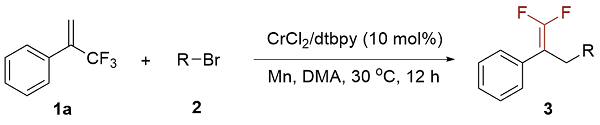
The fluorine atoms of organic compounds often profoundly influence the chemical, physical, and biological properties of molecules, making organofluorides particularly important in the development of pharmaceuticals, materials and biologically active molecules.[1] It was noted that over 20% of marketed pharmaceuticals contain fluorine atoms within their molecular structures.[2] As a consequence, the development of synthetic approaches to construct fluoride-containing compounds is of significant interest. Among the readily available organofluorides, gem- difluoroalkene motifs are found in many bioactive molecules, and usually serve as bioisomers of carbonyls in use in organic synthesis (Scheme 1, a).[3] To our knowledge, gem- difluoroalkenes serve as versatile precursors, enabling facile conversion into various fluorine-bearing functional groups, such as trifluoromethyl, difluoromethyl and monofluoroalkenyl groups.[4] The construction of gem-difluoro- alkene motifs has garnered considerable attention of chemists. Transition metal-catalyzed defluorinative cross- electrophile coupling (XEC) reactions have emerged as an attractive strategy in modern synthesis. In this field, the reductive cross-coupling reactions of trifluoromethyl alkenes with various electrophilic reagents[5-9] have been developed without the use of moisture-sensitive organometallic reagents (Scheme 1, b). Similar to gem-difluoro- alkenes, the difluoromethylene unit (CF2) has likewise received increasing attention as it serves as bioequivalent and lipophilic hydrogen-bond donor like hydroxy and thiol groups. These structural motifs have been found in the skeletons of pharmaceutical molecules, e.g., Amitiza Lubiprostone and NOS inhibitors for chronic neurodegenerative diseases (Scheme 1, a).[10] Most previously reported works need the use of activated difluoroalkylating reagents that contain electron-withdrawing substituents such as ester, amide or phosphate adjacent to bromodifluoromethyl motifs (Scheme 1, c).[11] These relatively activated difluoroalkylating reagents typically form transient radical species that couple with another precursors in the formation of target compounds. However, the reductive cross-coupling reactions of trifluoromethyl alkenes with transient radicals derived from unactivated difluoroalkylating reagents have rarely been studied. We wondered whether it’s possible to achieve the formation of polyfluoro-substituted geminal difluoroalkenes by the reductive coupling between trifluoromethyl alkenes and difluoroalkyl reagents.
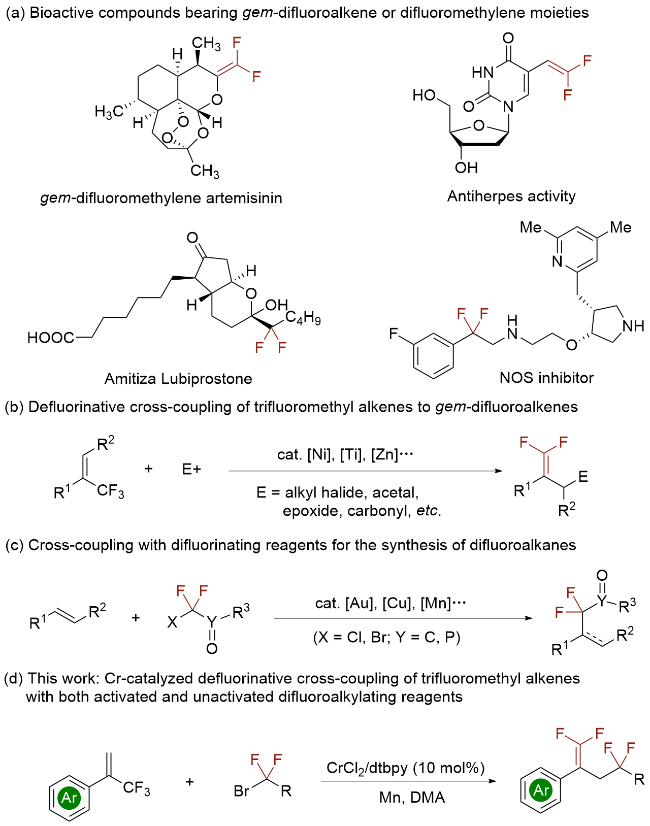
Because the earth-abundant and low-cost advantage of first-row transition metals, there has been considerable interest in the development of cost-effective synthetic methodologies by the use of these metals as catalysts.[12] Chromium di- or trichlorides are less toxic metal salts when compared with the related nickel and cobalt salts, which are widely used in synthetic chemistry.[13] Our group has previously investigated chromium-catalyzed cross-coupling reactions,[14] radical generation,[15] and C—F bond activation,[4b,16] which inspired us to continuously explore the reactivity of chromium catalysts in promoting the reductive cross-coupling of trifluoromethyl alkenes with difluoroalkyl compounds. Herein, we report the reductive cross- coupling reaction of trifluoromethyl alkenes with difluoroalkyl bromides enabled by simple CrCl2 catalyst combining with 4,4'-di-tert-butyl-2,2'-bipyridine (dtbpy) ligand (Sche- me 1, d). It provides a valuable strategy in embedding of both gem-difluoroalkene and difluoromethylene motifs into the products by one-step operation, allowing for forming tetrafluoro-substituted alkene derivatives under ambient conditions.
2 Results and discussion
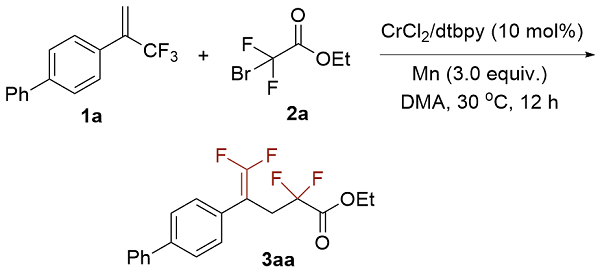
We commenced our studies by using the reaction of α- trifluoromethylstyrene 1a with ethyl bromodifluoroacetate 2a as model. In the presence of CrCl₂ as the catalyst, dtbpy as the ligand, and manganese as the reductant. We were pleased to find that the reductive cross-coupling reaction proceeded effectively, leading to the formation of difluoro- alkenylated product 3aa in 90% GC yield (Table 1, Entry 1). The controlling experiment suggested that the reaction did not occur in the absence of CrCl₂ catalyst (Entry 2). Additionally, omitting the reductant resulted in a significantly lower yield (Entry 3). In the absence of dtbpy ligand, the reaction proceeded sluggishly, giving 3aa in around 40% yield (Entry 4). The use of CrCl₃ instead of CrCl₂ led to a diminished result (Entry 5). The coupling reaction by using zinc as reductant gave inferior performance (Entry 6). The use of 2,2'-bipyridine (bpy), 4,4'-dimethyl-2,2'-bipy- ridine (dmbpy) and 4,4'-dimethoxy-2,2'-bipyridine (dmo- bpy) as ligand resulted in decreased conversions of the coupling (Entries 7~9). Conducting the reaction in tetrahydrofuran (THF), dichloromethane (DME), or MeCN led to comparatively lower yields (Entries 10~12).
Table 1 Optimization of reaction conditionsa |
| Entry | Deviation from standard conditions | Yield/% |
|---|---|---|
| 1 | None | 90 (87)b |
| 2 | Without CrCl2 | ndc |
| 3 | Without Mn | Trace |
| 4 | Without dtbpy | 40 |
| 5 | CrCl3 instead of CrCl2 | 49 |
| 6 | Zn instead of Mn | 56 |
| 7 | bpy instead of dtbpy | 36 |
| 8 | dmdpy instead of dtbpy | 37 |
| 9 | dmobpy instead of dtbpy | 58 |
| 10 | THF instead of DMA | 54 |
| 11 | DME instead of DMA | 48 |
| 12 | CH3CN instead of DMA | 18 |
a Reaction conditions: 1a (0.2 mmol), 2a (0.6 mmol), metal salt (0.02 mmol), ligand (0.02 mmol), manganese (0.6 mmol), N,N-dimethylacetamide (DMA), 30 ℃, 12 h. Yields were determined by GC analysis using n-tridecane as the internal standard. b Isolated yield in parentheses. c Not detected. |
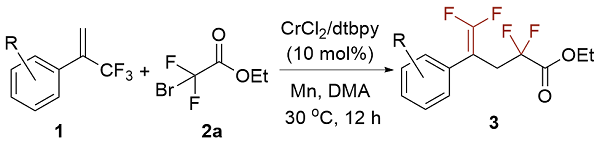
With the optimal conditions in hand, the substrate scope of the Cr-catalyzed defluorinative cross-coupling was explored (Table 2). This method was proved effective with enabling the use of a diverse range of aryl and heteroaryl- substituted α-trifluoromethyl alkenes, providing access to the desired products in 68%~92% yields. The protocol accommodates various functional groups, including phenyl (3aa), alkyl (3ba and 3da), ether (3ca, 3ha and 3pa), thioether (3ea), trifluoromethoxy (3ga), chloro (3ja and 3oa), and fluoro (3na) substituents. The reaction displays high tolerance to various functional groups, such as trifluoromethyl (3fa), cyano (3ka), keto (3la), and ester (3ma). Furthermore, it can be used in the conversions of trifluoromethyl alkenes, containing naphthalene (1q), pyridine (1r), benzodioxole (1s), and benzothiophene (1t) units, obtaining the related products (3qa~3ta) in 71%~89% yields. To demonstrate the use of this method, substrates appended to biologically relevant groups were interrogated. Pleasingly, these reactions proceeded readily to afford the products 3ua and 3va in good yields. However, the alkyl-substituted trifluoromethyl alkenes failed to undergo the defluorinative cross-coupling under present conditions.
Table 2 Scope of bromodifluoroacetate with various trifluoromethyl alkenes |
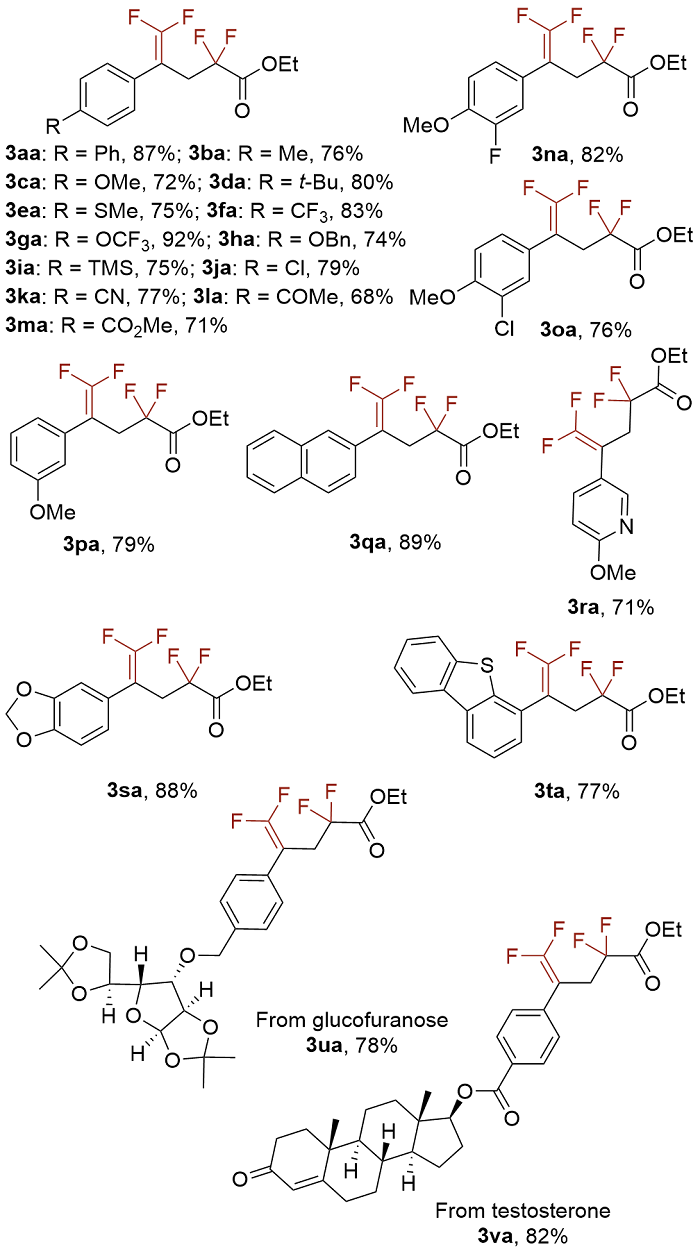 |
a Reaction conditions: 1 (0.2 mmol), 2a (0.6 mmol), CrCl2 (0.02 mmol), dtbpy (0.02 mmol), manganese (0.6 mmol), DMA, 30 ℃, 12 h. Isolated yields are given. |
Subsequently, the scope of difluoroalkyl bromides and other alkyl halides in the reaction with 1a under ambient conditions was explored (Table 3). Various fluoroacetate motifs were successfully incorporated, allowing for the formation of products 3ac~3ae in good yields. In addition to difluoroalkyl bromides, the reaction occurs effectively by using difluoroalkyl chlorides, yielding the defluorinated cross-coupling product 3ab in good yield. Remarkably, when using electron-donating methyl instead of the two electron-withdrawing fluorides in 2a, the reaction furnished the desired products 3af and 3ag. Of particular note is when the difluoroalkyl precursors were changed to unactivated aliphatic bromides in the reaction, the corresponding target products (3ah~3al) were obtained in good yields ranging from 66% to 71%. The coupling reactions were examined with a range of primary, secondary, and tertiary alkyl bromides. The related products 3am~3ap were prepared in yields ranging from 56% to 86%. When 1,5-dibromo- pentane was used as coupling partner, the bromo-substi- tuted difluoroalkene compound 3ap was obtained in 56% yield.
Table 3 Scope of trifluoromethyl alkene with various difluoroalkylating reagents and alkyl halidesa |
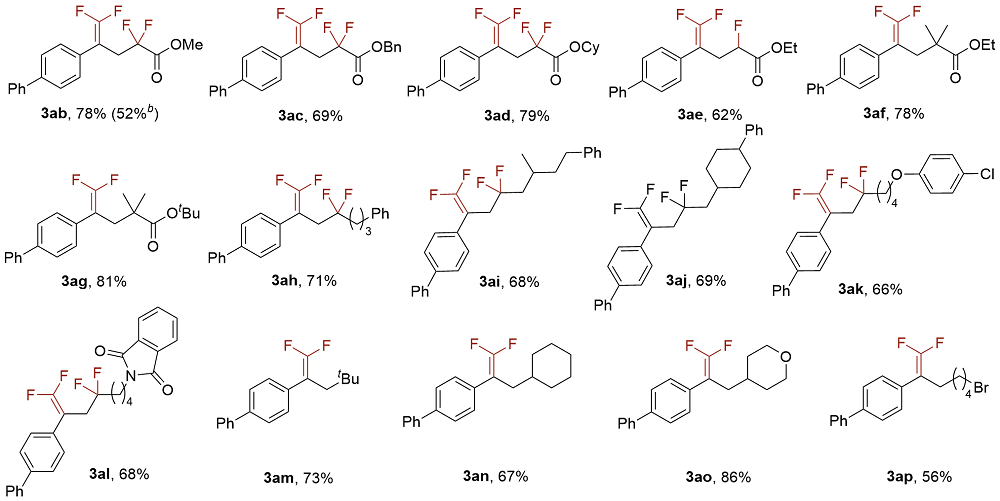 |
a Reaction conditions: 1a (0.2 mmol), 2 (0.6 mmol), CrCl2 (0.02 mmol), dtbpy (0.02 mmol), manganese (0.6 mmol), DMA, 30 ℃, 12 h. Isolated yields are given. b The yield for 3ab in the reaction by replacing bromodifluoroalkane with chlorodifluoroalkane. |
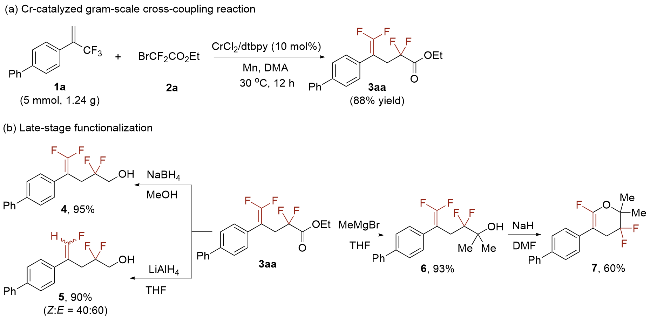
We demonstrated that the Cr-catalyzed defluorinative cross-coupling reaction could be scaled up to a gram level without affecting the conversion of 3aa. Subsequently, the late-stage functionalization of the coupling products was explored (Scheme 2). Sodium borohydride could be used to selectively reduce the ester group of 3aa. In the presence of LiAlH4, one C(sp²)—F moiety and ester group of 3aa were synchronously reduced in the formation of monofluoroalkene product 5 in 95% yield. Moreover, 3aa was treated with Grignard reagent in affording the tertiary alcohol 6, which reacted with sodium hydride by the cyclization in giving polyfluorodihydropyran compound 7.
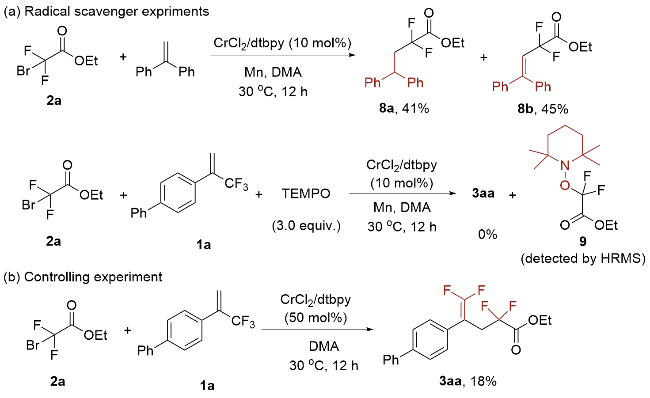
To gain insight into the mechanism of the reductive cross-coupling, the preliminary mechanistic studies were performed. As shown in Scheme 3a, the radical scavenger experiment by the reaction of 2a with 1,1-stilbene was conducted with Cr catalysis. It was noted that the reactions took place, resulting in forming ethyl 2,2-difluoro-4,4-di- phenylbutanoate (8a) and ethyl 2,2-difluoro-4,4-diphenyl- but-3-enoate (8b) in 41% and 45% yields, respectively. By the addition of 2,2,6,6-tetramethyl-piperidine-1-oxyl (TEMPO) into the standard reaction, the reductive cross- coupling between 1a and 2a was completely inhibited without the formation of the related compound 3aa. The analysis of the residue by high-resolution mass spectrum (HRMS) suggested that the TEMPO-trapped motif 9 might be formed. These indicated that radical intermediates might be formed and involved in the coupling reaction. Notably, in the absence of manganese reductant, the coupling product 3aa was still formed, indicating that Cr(II) complex played the role in the generation of difluoroalkyl radical by serving as the reductant.
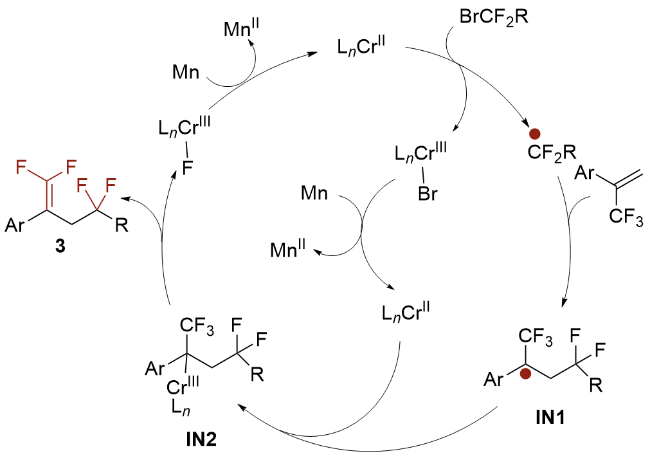
Based on these mechanistic results and previous reports,[17] the reduction of difluoroalkyl bromide with Cr(II) catalyst may be considered in the generation of difluoroalk-yl radical (Scheme 4). The radical adds to trifluoromethyl alkene in affording IN1, followed by combining with Cr(II) species and elimination of β-fluoride in the formation of gem-difluoroalkene compound.


3 Conclusion
In summary, a cost-effective chromium(II)-catalyzed defluorinative cross-electrophile coupling reaction of trifluoromethyl alkenes with difluoroalkyl and alkyl bromides has been developed. This reaction was enabled by low-cost CrCl2 as the catalyst combining with bipyridine ligand, providing a valuable strategy in the preparation of poly- fluorinated alkene derivatives under mild conditions. The role of Cr in the transformation can be assigned to the reduction of both activated and unactivated difluoroalkyl bromides to give the related difluoroalkyl radicals, which combine with the relayed aliphatic radicals through β-fluoride elimination to deliver the difluoroalkene motifs. Further studies by the use of chiral Cr(II) complexes in the development of asymmetric reductive cross-coupling are undergoing in our laboratory.
4 Experimental Section
4.1 General information
All reactions dealing with air- or moisture-sensitive compounds were carried out in a dried and sealed Schlenk tube under an atmosphere of nitrogen. Analytical thin-layer chromatography was performed on glass plates coated with 0.25 mm of 230~400 mesh silica gel containing a fluorescent indicator (Merck). Flash silica gel column chromatography was performed on silica gel 60N (spherical and neutral, 140~325 mesh) as described by Still. NMR spectra were measured on a Bruker AV-400 spectrometer. 1H NMR spectra were recorded at 400 MHz in CDCl3 with tetramethylsilane as standard, 13C NMR spectra were recorded at 100 MHz and referenced to the solvent resonance, and 19F NMR spectra were recorded at 377 MHz and referenced to the solvent resonance. Analytical gas chromatography (GC) was carried out on a Thermo Trace 1300 gas chromatograph equipped with a flame ionization detector. Mass spectra (GC-MS) were taken at a Thermo Trace 1300 gas chromatograph mass spectrometer. High resolution mass spectra (HRMS) were recorded on a Exactive Mass Spectrometer (Thermo Scientific, USA) equipped with ESI ionization source. Melting points were determined with a Hanon MP-300. All commercially available reagents were used without further purification.
4.2 General procedure for the cross-coupling of trifluoromethyl alkenes and bromodifluoroalkanes
In a dried Schlenk tube were placed trifluoromethyl substituted alkene 1 (0.2 mmol, 1.0 equiv.), difluoroalkylating reagents or alkyl halides 2 (0.6 mmol, 3.0 equiv.), CrCl2 (2.5 mg, 0.02 mmol, 10 mol%), dtbpy (5.4 mg, 0.02 mmol, 10 mol%) and Mn power (32.9 mg, 0.6 mmol, 3.0 equiv). Subsequently, freshly distilled DMA (1.5 mL) was added by a syringe under atmosphere of nitrogen. The resulting solution was stirred at 30 ℃ for 12 h. After removal of the volatiles under vacuum, the crude product was purified by column chromatography on silica gel to afford the title compound 3.
Ethyl 4-([1'-biphenyl]-4-yl)-2,2,5,5-tetrafluoropent-4-enoate (3aa): White solid, m.p. 31~33 ℃ (lit.[11c] 32~34 ℃); 1H NMR (400 MHz, CDCl3) δ: 7.63~7.58 (m, 4H), 7.49~7.43 (m, 2H), 7.41~7.34 (m, 3H), 4.05 (q, J=7.2 Hz, 2H), 3.26 (tt, J=15.0, 2.1 Hz, 2H), 1.21 (t, J=7.2 Hz, 3H); 13C NMR (100 MHz, CDCl3) δ: 163.6 (t, J=32.3 Hz), 155.5 (t, J=292.7 Hz), 140.9, 140.4, 131.2 (t, J=2.4 Hz), 129.03, 128.99, 127.7, 127.3, 127.1, 114.6 (t, J=249.1 Hz), 84.7 (t, J=20.1 Hz), 63.1, 34.1 (td, J=25.6, 1.8 Hz), 13.8 19F NMR (377 MHz, CDCl3) δ: -86.01~-86.26 (m), -104.23 (d, J=4.6 Hz).
Ethyl 2,2,5,5-tetrafluoro-4-(p-tolyl)pent-4-enoate (3ba):[11c] Colorless oil. 1H NMR (400 MHz, CDCl3) δ: 7.18 (s, 4H), 4.02 (q, J=7.1 Hz, 2H), 3.18 (tt, J=15.1, 2.1 Hz, 2H), 2.34 (s, 3H), 1.20 (t, J=7.2 Hz, 3H); 13C NMR (100 MHz, CDCl3) δ: 163.6 (t, J=32.3 Hz), 155.4 (t, J=288.7 Hz), 137.9, 129.3, 129.2, 128.5 (t, J=2.9 Hz), 114.7 (t, J=250.4 Hz), 84.8 (t, J=20.3 Hz), 63.0, 34.2 (td, J=25.0, 1.2 Hz), 21.3, 13.8; 19F NMR (377 MHz, CDCl3) δ: -87.14 (d, J=4.9 Hz), -104.29 (dd, J=3.9, 2.0 Hz).
Ethyl 2,2,5,5-tetrafluoro-4-(4-methoxyphenyl)pent-4-enoate (3ca):[11c] Colorless oil. 1H NMR (400 MHz, CDCl3) δ: 7.24~7.18 (m, 2H), 6.92~6.85 (m, 2H), 4.03 (q, J=7.1 Hz, 2H), 3.80 (s, 3H), 3.17 (tt, J=15.0, 2.1 Hz, 2H), 1.21 (t, J=7.2 Hz, 3H); 13C NMR (100 MHz, CDCl3) δ: 163.6 (t, J=32.3 Hz), 159.3, 155.3 (t, J=291.4 Hz), 129.8 (t, J=2.9 Hz), 124.3, 114.0 (t, J=3.8 Hz), 84.5 (t, J=20.5 Hz), 63.1, 55.4, 34.3 (t, J=25.5 Hz), 13.8; 19F NMR (377 MHz, CDCl3) δ: -87.60~-87.66 (m), -104.26~-104.32 (m).
Ethyl 4-(4-(tert-butyl)phenyl)-2,2,5,5-tetrafluoropent-4-enoate (3da):[11c] Colorless oil. 1H NMR (400 MHz, CDCl3) δ: 7.42~7.33 (m, 2H), 7.26~7.17 (m, 2H), 3.93 (q, J=7.2 Hz, 2H), 3.20 (tt, J=14.9, 2.1 Hz, 2H), 1.32 (s, 9H), 1.14 (t, J=7.2 Hz, 3H); 13C NMR (100 MHz, CDCl3) δ: 163.6 (t, J=32.3 Hz), 155.5 (t, J=292.1 Hz), 151.1, 129.1, 128.3 (t, J=2.9 Hz), 125.5, 114.7 (t, J=252.5 Hz), 84.7 (t, J=20.7 Hz), 63.0, 34.7, 34.2 (t, J=25.8 Hz), 31.3, 13.7; 19F NMR (377 MHz, CDCl3) δ: -86.97 (d, J=2.7 Hz), -104.27~-104.34 (m).
Ethyl 2,2,5,5-tetrafluoro-4-(4-(methylthio)phenyl)pent-4-enoate (3ea):[11c] Yellow solid, m.p. 32~35 ℃; 1H NMR (400 MHz, CDCl3) δ: 7.25~7.17 (m, 4H), 4.05 (q, J=7.1 Hz, 2H), 3.17 (tt, J=15.1, 2.1 Hz, 2H), 2.48 (s, 3H), 1.21 (t, J=7.1 Hz, 3H); 13C NMR (100 MHz, CDCl3) δ: 163.5 (t, J=32.3 Hz), 155.4 (t, J=292.3 Hz), 138.8, 129.0 (t, J=3.0 Hz), 128.8, 126.4, 114.6 (t, J=253.0 Hz), 84.6 (t, J=20.4 Hz), 63.1, 34.0 (t, J=25.6 Hz), 15.6, 13.8; 19F NMR (377 MHz, CDCl3) δ: -86.49 (t, J=2.8 Hz), -104.23 (t, J=3.0 Hz).
Ethyl 2,2,5,5-tetrafluoro-4-(4-(trifluoromethyl)phenyl)-pent-4-enoate (3fa):[11c] White solid, m.p. 34~36 ℃; 1H NMR (400 MHz, CDCl3) δ: 7.63 (d, J=8.2 Hz, 2H), 7.43 (d, J=8.2 Hz, 2H), 4.09 (q, J=7.2 Hz, 2H), 3.22 (tt, J=15.2, 2.1 Hz, 2H), 1.22 (t, J=7.2 Hz, 3H); 13C NMR (100 MHz, CDCl3) δ: 163.4 (t, J=32.1 Hz), 155.7 (t, J=293.9 Hz), 136.3, 130.2 (q, J=32.7 Hz), 129.1 (t, J=3.0 Hz), 125.6 (q, J=3.8 Hz), 122.7, 114.5 (t, J=252.9 Hz), 84.5 (t, J=19.9 Hz), 63.3, 33.9 (td, J=25.5, 2.0 Hz), 13.8; 19F NMR (377 MHz, CDCl3) δ: -62.89 (d, J=2.5 Hz), -82.85~-87.97 (m), -104.25 (d, J=4.9 Hz).
Ethyl 2,2,5,5-tetrafluoro-4-(4-(trifluoromethoxy)phenyl)-pent-4-enoate (3ga):[11c] Yellow solid, m.p. 29~31 ℃; 1H NMR (400 MHz, CDCl3) δ: 7.33 (d, J=8.7 Hz, 2H), 7.21 (d, J=8.4 Hz, 2H), 4.06 (q, J=7.2 Hz, 2H), 3.19 (tt, J=15.0, 1.8 Hz, 2H), 1.21 (t, J=7.2 Hz, 3H); 13C NMR (100 MHz, CDCl3) δ: 163.5 (t, J=32.1 Hz), 155.6 (t, J=292.9 Hz), 148.9, 131.1, 130.3 (t, J=2.9 Hz), 121.9, 119.3 (t, J=224.7 Hz), 114.5 (t, J=253.0 Hz), 84.2 (t, J=20.7 Hz), 63.2, 34.1 (t, J=25.8 Hz), 13.8; 19F NMR (377 MHz, CDCl3) δ: -57.96 (d, J=2.3 Hz), -85.83 (q, J=3.3 Hz), -104.28 (t, J=3.1 Hz).
Ethyl 4-(4-(benzyloxy)phenyl)-2,2,5,5-tetrafluoropent-4-enoate (3ha): White solid, m.p. 63~66℃(lit.[18] 63~65 ℃); 1H NMR (400 MHz, CDCl3) δ: 7.46~7.31 (m, 5H), 7.24~7.18 (m, 2H), 7.01~6.93 (m, 2H), 5.07 (s, 2H), 4.00 (q, J=7.2 Hz, 2H), 3.17 (tt, J=15.0, 2.1 Hz, 2H), 1.19 (t, J=7.2 Hz, 3H); 13C NMR (100 MHz, CDCl3) δ: 163.6 (t, J=32.0 Hz), 158.5, 155.3 (t, J=289.9 Hz), 136.9, 129.9 (t, J=3.0 Hz), 128.8, 128.2, 127.6, 124.5, 115.0, 114.7 (t, J=251.2 Hz), 84.4 (t, J=23.1 Hz), 70.1, 63.1, 34.3 (t, J=26.3 Hz), 13.8; 19F NMR (377 MHz, CDCl3) δ: -87.49 (dt, J=5.7, 2.8 Hz), -104.27 (dd, J=3.6, 2.2 Hz).
Ethyl 2,2,5,5-tetrafluoro-4-(4-(trimethylsilyl)phenyl)pent-4-enoate (3ia):[18] Yellow oil. 1H NMR (400 MHz, CDCl3) δ: 7.5~7.49 (m, 2H), 7.31~7.26 (m, 2H), 3.96 (q, J=7.2 Hz, 2H), 3.21 (tt, J=15.0, 2.1 Hz, 2H), 1.15 (t, J=7.2 Hz, 3H), 0.26 (s, 9H); 13C NMR (100 MHz, CDCl3) δ: 163.5 (t, J=32.3 Hz), 155.5 (t, J=290.7 Hz), 140.6, 133.6, 132.6 (t, J=2.1 Hz), 127.9 (t, J=2.8 Hz), 114.6 (t, J=254.6 Hz), 85.0 (t, J=19.9 Hz), 63.0, 34.1 (td, J=25.8, 1.9 Hz), 13.8, -1.1; 19F NMR (377 MHz, CDCl3) δ: -86.27~-86.54 (m), -104.27 (d, J=4.5 Hz).
Ethyl 4-(4-chlorophenyl)-2,2,5,5-tetrafluoropent-4-enoate (3ja):[11e] Yellow oil. 1H NMR (400 MHz, CDCl3) δ: 7.38~7.31 (m, 2H), 7.26~7.21 (m, 2H), 4.09 (q, J=7.2 Hz, 2H), 3.17 (tt, J=15.1, 2.1 Hz, 2H), 1.24 (t, J=7.2 Hz, 3H); 13C NMR (100 MHz, CDCl3) δ: 163.5 (t, J=32.2 Hz), 155.5 (t, J=292.8 Hz), 134.1, 130.8, 130.0 (t, J=2.9 Hz), 128.9, 114.5 (t, J=253.0 Hz), 84.3 (t, J=20.3 Hz), 63.2, 34.0 (t, J=25.1 Hz), 13.9; 19F NMR (377 MHz, CDCl3) δ: -85.79~-85.86 (m), -104.19~-104.25 (m).
Ethyl 4-(4-cyanophenyl)-2,2,5,5-tetrafluoropent-4-enoate (3ka): [11c] Yellow oil. 1H NMR (400 MHz, CDCl3) δ: 7.72~7.61 (m, 2H), 7.48~7.38 (m, 2H), 4.15 (q, J=7.1 Hz, 2H), 3.21 (tt, J=15.4, 2.1 Hz, 2H), 1.26 (t, J=7.1 Hz, 3H); 13C NMR (100 MHz, CDCl3) δ: 163.3 (t, J=32.0 Hz), 155.7 (t, J=294.8 Hz), 137.4 (t, J=3.8 Hz), 132.4, 129.3 (t, J=3.2 Hz), 118.4, 114.3 (t, J=254.6 Hz), 111.9, 84.5 (t, J=20.2 Hz), 63.3, 33.6 (td, J=25.4, 2.1 Hz), 13.9; 19F NMR (377 MHz, CDCl3) δ: -83.22~-83.75 (m), -104.24 (d, J=5.3 Hz).
Ethyl 4-(4-acetylphenyl)-2,2,5,5-tetrafluoropent-4-enoate (3la):[11e] Yellow oil. 1H NMR (400 MHz, CDCl3) δ: 8.00~7.90 (m, 2H), 7.47~7.36 (m, 2H), 4.09 (q, J=7.1 Hz, 2H), 3.23 (tt, J=15.3, 2.1 Hz, 2H), 2.60 (s, 3H), 1.23 (t, J=7.2 Hz, 3H); 13C NMR (100 MHz, CDCl3) δ: 197.4, 163.4 (t, J=32.2 Hz), 155.7 (t, J=294.1 Hz), 137.3 (t, J=3.6 Hz), 136.5, 128.8 (t, J=3.0 Hz), 128.6, 114.4 (t, J=253.2 Hz), 84.8 (t, J=18.8 Hz), 63.2, 33.7 (td, J=25.5, 2.2 Hz), 26.7, 13.8; 19F NMR (377 MHz, CDCl3) δ: -84.24~-84.60 (m), -104.25 (d, J=5.0 Hz).
Methyl 4-(5-ethoxy-1,1,4,4-tetrafluoro-5-oxopent-1-en-2-yl)benzoate (3ma):[11c] Yellow oil. 1H NMR (400 MHz, CDCl3) δ: 8.08~7.97 (m, 2H), 7.43~7.35 (m, 2H), 4.07 (q, J=7.1 Hz, 2H), 3.91 (s, 3H), 3.22 (tt, J=15.2, 2.1 Hz, 2H), 1.22 (t, J=7.1 Hz, 3H); 13C NMR (100 MHz, CDCl3) δ: 166.6, 163.4 (t, J=32.1 Hz), 155.7 (t, J=294.0 Hz), 137.1 (t, J=3.3 Hz), 130.1, 129.9, 128.6 (t, J=3.1 Hz), 114.5 (t, J=252.6 Hz), 84.8 (t, J=19.9 Hz), 63.2, 52.3, 33.8 (td, J=25.6, 2.1 Hz), 13.8; 19F NMR (377 MHz, CDCl3) δ: -84.25~-84.96 (m), -104.30 (d, J=4.9 Hz).
Ethyl 2,2,5,5-tetrafluoro-4-(3-fluoro-4-methoxyphenyl)-pent-4-enoate (3na): Yellow oil. 1H NMR (400 MHz, CDCl3) δ: 7.08~6.98 (m, 2H), 6.94 (t, J=8.8 Hz, 1H), 4.11 (q, J=7.2 Hz, 2H), 3.89 (s, 3H), 3.14 (tt, J=15.2, 2.1 Hz, 2H), 1.25 (t, J=7.2 Hz, 3H); 13C NMR (100 MHz, CDCl3) δ: 163.5 (t, J=32.2 Hz), 155.5 (t, J=292.4 Hz), 153.4, 150.9, 147.4 (d, J=10.6 Hz), 125.0, 124.7 (q, J=3.2 Hz), 116.4 (dt, J=19.7, 2.8 Hz), 114.6 (t, J=3.7 Hz), 113.3, 84.0 (t, J=19.9 Hz), 63.2, 56.3, 34.0 (td, J=25.5, 1.9 Hz), 13.8; 19F NMR (377 MHz, CDCl3) δ: -86.32~-86.52 (m), -104.27 (d, J=4.2 Hz), -134.71 (s); HRMS (ESI+) calcd for C14H14F5O3 [M+H]+ 325.0858, found 325.0855.
Ethyl 4-(3-chloro-4-methoxyphenyl)-2,2,5,5-tetrafluoro-pent-4-enoate (3oa): Yellow oil. 1H NMR (400 MHz, CDCl3) δ: 7.31 (dd, J=2.3, 0.9 Hz, 1H), 7.20~7.13 (m, 1H), 6.91 (d, J=8.6 Hz, 1H), 4.09 (q, J=7.2 Hz, 2H), 3.90 (s, 3H), 3.14 (tt, J=15.1, 2.1 Hz, 2H), 1.25 (t, J=7.2 Hz, 3H); 13C NMR (100 MHz, CDCl3) δ: 163.5 (t, J=32.3 Hz), 155.5 (t, J=292.4 Hz), 154.7, 130.3 (t, J=3.0 Hz), 128.2 (t, J=3.0 Hz), 125.3 (t, J=3.2 Hz), 122.6, 114.6 (t, J=258.3 Hz), 112.0, 83.9 (t, J=18.1 Hz), 63.2, 56.3, 34.1 (td, J=25.7, 2.2 Hz), 13.8; 19F NMR (377 MHz, CDCl3) δ: -86.23~-86.65 (m), -104.24 (d, J=4.4 Hz); HRMS (ESI+) calcd for C14H14ClF4O3 [M+H]+ 341.0562, found 341.0558.
Ethyl 2,2,5,5-tetrafluoro-4-(3-methoxyphenyl)pent-4-enoate (3pa):[11c] Colorless oil. 1H NMR (400 MHz, CDCl3) δ: 7.29~7.25 (m, 1H), 6.91~6.79 (m, 3H), 4.04 (q, J=7.1 Hz, 2H), 3.81 (s, 3H), 3.19 (tt, J=15.1, 2.1 Hz, 2H), 1.20 (t, J=7.2 Hz, 3H); 13C NMR (100 MHz, CDCl3) δ: 163.5 (t, J=32.3 Hz), 159.7, 155.5 (t, J=292.4 Hz), 133.6~133.5 (m), 129.6, 121.0 (t, J=2.9 Hz), 114.9 (t, J=217.6 Hz), 114.6 (t, J=3.0 Hz), 113.5, 84.9 (t, J=20.0 Hz), 63.1, 55.4, 34.2 (td, J=25.7, 2.4 Hz), 13.8; 19F NMR (377 MHz, CDCl3) δ: -85.88~-86.76 (m), -104.30 (d, J=5.0 Hz).
Ethyl 2,2,5,5-tetrafluoro-4-(naphthalen-2-yl)pent-4-enoate (3qa):[11c] White solid, m.p. 34~36 ℃; 1H NMR (400 MHz, CDCl3) δ: 7.87~7.80 (m, 3H), 7.77 (s, 1H), 7.53~7.47 (m, 2H), 7.42 (dt, J=8.6, 1.7 Hz, 1H), 3.92 (q, J=7.1 Hz, 2H), 3.32 (tt, J=15.0, 2.1 Hz, 2H), 1.10 (t, J=7.1 Hz, 3H); 13C NMR (100 MHz, CDCl3) δ: 163.5 (t, J=32.2 Hz), 155.7 (t, J=292.5 Hz), 133.2, 132.8, 129.6 (t, J=3.0 Hz), 128.3, 128.1, 128.0 (t, J=2.9 Hz), 127.7, 126.6 (d, J=3.1 Hz), 126.1 (t, J=2.8 Hz), 114.7 (t, J=252.8 Hz), 85.1 (t, J=20.2 Hz), 63.0, 34.2 (td, J=25.8, 2.3 Hz), 13.6; 19F NMR (377 MHz, CDCl3) δ: -86.10~-86.46 (m), -104.17 (d, J=4.8 Hz).
Ethyl 2,2,5,5-tetrafluoro-4-(6-methoxypyridin-3-yl)pent-4-enoate (3ra):[18] Colorless oil. 1H NMR (400 MHz, CDCl3) δ: 8.10 (s, 1H), 7.50 (dd, J=8.6, 2.3 Hz, 1H), 6.75 (d, J=8.6 Hz, 1H), 4.14 (q, J=7.1 Hz, 2H), 3.94 (s, 3H), 3.15 (tt, J=15.1, 2.1 Hz, 2H), 1.26 (t, J=7.2 Hz, 3H); 13C NMR (100 MHz, CDCl3) δ: 163.7, 163.4, 163.1, 155.5 (t, J=290.7 Hz), 146.8 (t, J=3.3 Hz), 138.7 (t, J=2.6 Hz), 121.2 (t, J=3.4 Hz), 114.5 (t, J=253.0 Hz), 110.8, 82.1 (t, J=21.1 Hz), 63.2, 53.6, 33.9 (td, J=25.4, 2.2 Hz), 13.8; 19F NMR (377 MHz, CDCl3) δ: -85.78~-86.38 (m), -104.17 (d, J=4.5 Hz).
Ethyl 4-(benzo[d][1,3]dioxol-5-yl)-2,2,5,5-tetrafluoro-pent-4-enoate (3sa):[11c] Colorless oil. 1H NMR (400 MHz, CDCl3) δ: 6.83~6.71 (m, 3H), 5.96 (s, 2H), 4.11 (q, J=7.2 Hz, 2H), 3.13 (tt, J=15.1, 2.1 Hz, 2H), 1.25 (t, J=7.2 Hz, 3H); 13C NMR (100 MHz, CDCl3) δ: 163.6 (t, J=32.3 Hz), 155.4 (t, J=291.7 Hz), 147.9, 147.4, 125.8 (t, J=3.3 Hz), 122.4 (t, J=2.8 Hz), 114.6 (t, J=253.4 Hz), 109.2 (t, J=3.0 Hz), 108.4, 101.4, 84.8 (t, J=20.3 Hz), 63.1, 34.4 (td, J=25.5, 2.3 Hz), 13.8; 19F NMR (377 MHz, CDCl3) δ: -86.67~-87.47 (m), -104.23 (d, J=4.7 Hz).
Ethyl 4-(dibenzo[b,d]thiophen-4-yl)-2,2,5,5-tetrafluoro-pent-4-enoate (3ta): Colorless oil. 1H NMR (400 MHz, CDCl3) δ: 8.19~8.11 (m, 2H), 7.92~7.82 (m, 1H), 7.52~7.45 (m, 3H), 7.37 (d, J=7.2 Hz, 1H), 4.00 (q, J=7.2 Hz, 2H), 3.37 (tt, J=15.2, 2.0 Hz, 2H), 1.09 (t, J=7.2 Hz, 3H); 13C NMR (100 MHz, CDCl3) δ: 163.3 (t, J=32.3 Hz), 155.6 (t, J=292.0 Hz), 139.6 (dd, J=3.1, 1.0 Hz), 139.1, 136.3, 135.7, 128.3, 127.2, 127.0 (dd, J=4.3, 1.8 Hz), 124.9, 124.7, 122.9, 121.9, 121.7, 114.6 (t, J=252.1 Hz), 83.9 (t, J=21.9 Hz), 63.1, 33.2 (td, J=25.6, 2.3 Hz), 13.7; 19F NMR (377 MHz, CDCl3) δ: -81.57 (d, J=24.3 Hz), -86.31 (dt, J=24.3, 4.2 Hz), -104.12 (d, J=4.0 Hz); HRMS (ESI+) calcd for C19H15F4O2S [M+H]+ 383.0723, found 383.0721.
Ethyl 4-(4-((((3aR,5R,6S,6aR)-5-((S)-2,2-dimethyl-1,3- dioxolan-4-yl)-2,2-dimethyltetrahydrofuro[2,3-d][1,3]dio- xol-6-yl)oxy)methyl)phenyl)-2,2,5,5-tetrafluoropent-4-enoate (3ua): Colorless oil. 1H NMR (400 MHz, CDCl3) δ: 7.35 (d, J=8.2 Hz, 2H), 7.27 (d, J=8.8 Hz, 2H), 5.89 (d, J=3.7 Hz, 1H), 4.70~4.60 (m, 2H), 4.58 (d, J=3.7 Hz, 1H), 4.38~4.32 (m, 1H), 4.15~3.98 (m, 6H), 3.19 (t, J=15.1 Hz, 2H), 1.40 (dd, J=46.7, 25.8 Hz, 12H), 1.21 (t, J=7.2 Hz, 3H); 13C NMR (100 MHz, CDCl3) δ: 163.4 (t, J=32.2 Hz), 155.3 (t, J=292.5 Hz), 137.5, 131.7, 128.5 (t, J=2.8 Hz), 127.7, 111.9, 109.1, 105.3, 84.6 (t, J=20.2 Hz), 82.6, 81.8, 81.3, 72.4, 71.9, 67.5, 63.0, 34.0 (t, J=25.2 Hz), 26.8 (d, J=3.0 Hz), 26.2, 25.4, 13.7; 19F NMR (377 MHz, CDCl3) δ: -86.37~-86.43 (m), -104.26 (dd, J=3.5, 1.8 Hz); HRMS (ESI+) calcd for C26H33F4O8 [M+H]+ 549.2106, found 549.2104.
(8R,9S,10R,13S,14S,17S)-10,13-dimethyl-3-oxo-2,3,6,7,8,9,10,11,12,13,14,15,16,17-tetradecahydro-1H-cyclopenta[a]phenanthren-17-yl 4-(5-ethoxy-1,1,4,4-tetrafluoro-5- oxopent-1-en-2-yl)benzoate (3va): Colorless oil. 1H NMR (400 MHz, CDCl3) δ: 8.03 (d, J=8.4 Hz, 2H), 7.39 (d, J=7.7 Hz, 2H), 5.74 (s, 1H), 4.85 (t, J=8.4 Hz, 1H), 4.11 (q, J=7.1 Hz, 2H), 3.23 (t, J=15.2 Hz, 2H), 2.43~2.28 (m, 5H), 2.06~2.01 (m, 1H), 1.90~1.84 (m, 2H), 1.73~1.60 (m, 5H), 1.48~1.40 (m, 2H), 1.27~1.24 (m, 7H), 1.21 (s, 3H), 0.97 (s, 3H); 13C NMR (100 MHz, CDCl3) δ: 199.6, 171.0, 166.0, 163.6 (t, J=33.0 Hz), 155.6 (t, J=279.0 Hz), 137.0, 130.2, 130.0, 129.8, 128.8, 128.6 (t, J=2.9 Hz), 126.9, 124.1, 84.8 (t, J=21.6 Hz), 83.3, 63.2, 53.9, 50.4, 43.0, 38.8, 36.9, 35.9, 35.6, 34.1 (t, J=24.9 Hz), 33.8, 33.6, 32.9, 31.6, 29.8, 27.8, 23.7, 20.7, 17.6, 13.9, 12.4; 19F NMR (377 MHz, CDCl3) δ: -81.77~-90.97 (m), -96.41~ -111.33 (m); HRMS (ESI+) calcd for C33H39F4O5 [M+ H]+ 591.2728, found 591.2725.
Methyl 4-([1'-biphenyl]-4-yl)-2,2,5,5-tetrafluoropent-4-enoate (3ab):[11c] White solid, m.p. 30~32 ℃; 1H NMR (400 MHz, CDCl3) δ: 7.64~7.57 (m, 4H), 7.48~7.42 (m, 2H), 7.40~7.34 (m, 3H), 3.59 (s, 3H), 3.25 (tt, J=15.0, 2.1 Hz, 2H); 13C NMR (100 MHz, CDCl3) δ: 164.0 (t, J=32.5 Hz), 155.6 (t, J=292.7 Hz), 140.9, 140.4, 131.0 (t, J=2.8 Hz), 129.0 (d, J=3.6 Hz), 127.7, 127.3, 127.1, 114.6 (t, J=249.9 Hz), 84.6 (t, J=20.0 Hz), 53.3; 19F NMR (377 MHz, CDCl3) δ: -85.99~-86.32 (m), -104.39 (dd, J=4.7, 1.1 Hz).
Benzyl 4-([1'-biphenyl]-4-yl)-2,2,5,5-tetrafluoropent-4-enoate (3ac):[11e] White solid, m.p. 33~35 ℃; 1H NMR (400 MHz, CDCl3) δ: 7.58 (td, J=5.9, 1.9 Hz, 4H), 7.45 (t, J=7.6 Hz, 2H), 7.39~7.31 (m, 6H), 7.28 (dd, J=6.7, 3.0 Hz, 2H), 5.00 (s, 2H), 3.25 (tt, J=15.1, 2.1 Hz, 2H); 13C NMR (100 MHz, CDCl3) δ: 163.4 (t, J=32.6 Hz), 155.5 (t, J=292.7 Hz), 140.8, 140.4, 134.1, 131.1, 129.01, 128.97, 128.8, 128.6, 127.7, 127.3, 127.1, 114.7 (t, J=253.3 Hz), 84.7 (t, J=20.1 Hz), 68.5, 34.1 (t, J=25.8 Hz); 19F NMR (377 MHz, CDCl3) δ: -85.94~-86.01 (m), -103.90~-103.96 (m).
Cyclohexyl 4-([1'-biphenyl]-4-yl)-2,2,5,5-tetrafluoro-pent-4-enoate (3ad): Colorless oil. 1H NMR (400 MHz, CDCl3) δ: 7.64~7.53 (m, 4H), 7.45 (t, J=7.5 Hz, 2H), 7.41~7.33 (m, 3H), 4.74~4.64 (m, 1H), 3.24 (tt, J=15.0, 2.1 Hz, 2H), 1.76~1.65 (m, 4H), 1.41~1.22 (m, 6H); 13C NMR (100MHz, CDCl3) δ: 163.0 (t, J=32.0 Hz), 155.5 (t, J=292.5 Hz), 140.9, 140.5, 131.3 (t, J=3.4 Hz), 129.0 (t, J=3.1 Hz), 128.96, 127.3, 127.2, 114.7 (t, J=251.2 Hz), 84.8 (t, J=20.0 Hz), 76.3, 34.1 (td, J=25.7, 2.3 Hz), 31.12, 31.09, 25.19, 25.17, 23.6, 23.4; 19F NMR (377 MHz, CDCl3) δ: -85.83~-86.35 (m), -103.81 (d, J=5.1 Hz); HRMS (ESI+) calcd for C23H23F4O2 [M+H]+ 407.1629, found 407.1627.
Ethyl 4-([1'-biphenyl]-4-yl)-2,5,5-trifluoropent-4-enoate (3ae):[11c] White solid, m.p. 28~30 ℃; 1H NMR (400 MHz, CDCl3) δ: 7.65~7.56 (m, 4H), 7.49~7.40 (m, 4H), 7.39~7.34 (m, 1H), 4.97~4.79 (m, 1H), 4.20~4.05 (m, 2H), 3.13~2.98 (m, 2H), 1.25 (t, J=7.1 Hz, 3H); 13C NMR (100 MHz, CDCl3) δ: 169.1 (d, J=23.6 Hz), 154.9 (t, J=286.0 Hz), 140.8, 140.5, 131.2 (t, J=3.6 Hz), 129.0 (t, J=3.0 Hz), 127.7, 127.4, 127.2, 87.5 (t, J=22.8 Hz), 85.7, 61.9, 31.5 (dd, J=22.8, 2.1 Hz), 14.1; 19F NMR (377 MHz, CDCl3) δ: -87.58~-88.68 (m), -191.01 (d, J=3.8 Hz).
Ethyl 4-([1'-biphenyl]-4-yl)-5,5-difluoro-2,2-dimethyl-pent-4-enoate (3af): Colorless oil. 1H NMR (400 MHz, CDCl3) δ: 7.62~7.54 (m, 4H), 7.47~7.42 (m, 2H), 7.38~7.33 (m, 3H), 3.61 (q, J=7.1 Hz, 2H), 2.73 (t, J=2.3 Hz, 2H), 1.17 (s, 6H), 1.05 (t, J=7.1 Hz, 3H); 13C NMR (100 MHz, CDCl3) δ: 176.9, 154.7 (t, J=287.8 Hz), 140.7, 140.3, 132.8 (dd, J=4.4, 2.5 Hz), 129.3 (t, J=2.7 Hz), 128.9, 127.5, 127.1, 127.0, 89.9 (dd, J=21.2, 15.0 Hz), 60.5, 42.7 (t, J=2.6 Hz), 38.4 (d, J=1.4 Hz), 25.3, 13.9; 19F NMR (377 MHz, CDCl3) δ: -89.33 (d, J=38.6 Hz), -90.68 (d, J=38.5 Hz); HRMS (ESI+) calcd for C21H23F2O2 [M+H]+ 345.1661, found 345.1658.
tert-Butyl 4-([1'-biphenyl]-4-yl)-5,5-difluoro-2,2-dimethylpent-4-enoate (3ag): Colorless oil. 1H NMR (400 MHz, CDCl3) δ: 7.59~7.53 (m, 5H), 7.46~7.41 (m, 2H), 7.38~7.34 (m, 3H), 2.71 (t, J=2.3 Hz, 2H), 1.24 (s, 9H), 1.09 (s, 6H); 13C NMR (100 MHz, CDCl3) δ: 176.3, 154.7 (t, J=289.7 Hz), 140.8, 140.4, 133.3 (dd, J=4.4, 2.5 Hz), 129.3 (t, J=2.6 Hz), 128.9, 127.5, 127.2, 90.2 (dd, J=21.0, 14.7 Hz), 80.2, 43.5 (t, J=2.7 Hz), 37.7, 27.7, 25.6; 19F NMR (377 MHz, CDCl3) δ: -90.98 (d, J=38.7 Hz), -103.44 (d, J=38.3 Hz); HRMS (ESI+) calcd for C23H27F2O2 [M+H]+ 373.1974, found 373.1969.
4-(1,1,4,4-Tetrafluoro-8-phenyloct-1-en-2-yl)-1,1'-biph-enyl (3ah): Colorless oil. 1H NMR (400 MHz, CDCl3) δ: 7.56 (d, J=7.8 Hz, 4H), 7.42~7.30 (m, 5H), 7.23~7.18 (m, 2H), 7.15~7.07(m, 3H), 2.93 (t, J=15.1 Hz, 2H), 2.51 (t, J=7.5 Hz, 2H), 1.82~1.69 (m, 2H), 1.56~1.41 (m, 4H); 13C NMR (100 MHz, CDCl3) δ: 155.3 (t, J=291.6 Hz), 142.2, 140.5 (d, J=2.7 Hz), 132.3 (t, J=3.6 Hz), 129.0, 128.8 (t, J=2.8 Hz), 128.5 (d, J=0.6 Hz), 127.6, 127.3, 127.2, 125.9, 86.4 (t, J=19.3 Hz), 36.2 (t, J=24.8 Hz), 35.8, 35.5, 35.2, 31.2, 21.9 (t, J=4.4 Hz); 19F NMR (377 MHz, CDCl3) δ: -86.91~-87.91 (m), -95.48 (d, J=5.3 Hz); HRMS (ESI+) calcd for C26H25F4 [M+H]+: 413.1887, found 413.1890.
4-(1,1,4,4-Tetrafluoro-6-methyl-8-phenyloct-1-en-2-yl)-1,1'-biphenyl (3ai): Colorless oil. 1H NMR (400 MHz, CDCl3) δ: 7.70~7.53 (m, 4H), 7.48~7.35 (m, 5H), 7.28~7.25 (m, 2H), 7.20~7.13 (m, 3H), 2.97 (t, J=15.2 Hz, 2H), 2.64~2.46 (m, 2H), 1.90~1.78 (m, 2H), 1.69~1.59 (m, 2H), 1.51~1.45 (m, 1H), 1.01 (d, J=6.4 Hz, 3H); 13C NMR (100 MHz, CDCl3) δ: 155.3 (t, J=289.5 Hz), 142.5, 140.5, 132.4 (t, J=3.7 Hz), 128.95, 128.87 (t, J=2.9 Hz), 128.5 (d, J=2.0 Hz), 127.6, 127.3, 127.2, 125.9, 86.5 (t, J=19.9 Hz), 43.0 (t, J=23.5 Hz), 39.4, 36.2 (t, J=28.2 Hz), 33.2, 29.9, 27.6 (t, J=2.8 Hz), 20.5; 19F NMR (377 MHz, CDCl3) δ: -86.90~-87.95 (m), -92.39~-94.85 (m). HRMS (ESI+) calcd for C27H26F4Na [M+Na]+ 449.1863, found 449.1865.
4-(1,1,4,4-Tetrafluoro-5-(4-phenylcyclohexyl)pent-1-en-2-yl)-1,1'-biphenyl (3aj): Colorless oil. 1H NMR (400 MHz, CDCl3) δ: 7.66~7.58 (m, 4H), 7.52~7.40 (m, 4H), 7.40~7.36 (m, 1H), 7.33~7.28 (m, 2H), 7.23~7.17 (m, 3H), 3.03 (t, J=15.2 Hz, 3H), 2.45 (tt, J=12.3, 3.1 Hz, 1H), 1.89 (d, J=11.4 Hz, 3H), 1.84~1.65 (m, 3H), 1.53~1.42 (m, 2H), 1.32~1.29 (m, 1H), 1.18~1.08 (m, 2H); 13C NMR (100 MHz, CDCl3) δ: 155.3 (t, J=290.0 Hz), 147.5, 140.6, 132.5 (t, J=3.5 Hz), 129.0, 128.9 (t, J=3.1 Hz), 128.4, 127.6, 127.3, 127.2, 126.9, 126.1, 126.0, 86.5 (t, J=19.5 Hz), 44.1, 43.4 (t, J=23.7 Hz), 36.3 (t, J=27.7 Hz), 34.2 (d, J=5.2 Hz), 32.2 (t, J=2.6 Hz), 31.0, 29.9, 28.8; 19F NMR (377 MHz, CDCl3) δ: -86.70~-88.09 (m), -93.21 (d, J=5.6 Hz); HRMS (ESI+) calcd for C29H29F4 [M+H]+ 453.2200, found 453.2198.
4-(9-(4-Chlorophenoxy)-1,1,4,4-tetrafluoronon-1-en-2-yl)-1,1'-biphenyl (3ak): Colorless oil. 1H NMR (400 MHz, CDCl3) δ: 7.65~7.59 (m, 4H), 7.47~7.35 (m, 5H), 7.23~7.20 (m, 2H), 6.80~6.75 (m, 2H), 3.87 (t, J=6.4 Hz, 2H), 3.00 (t, J=15.1 Hz, 2H), 1.86~1.78 (m, 2H), 1.74~1.67 (m, 2H), 1.53~1.49 (m, 2H), 1.44~1.37 (m, 2H); 13C NMR (100 MHz, CDCl3) δ: 157.7, 155.3 (t, J=289.9 Hz), 140.5 (d, J=7.0 Hz), 132.3 (t, J=3.6 Hz), 129.4, 129.0, 128.8 (t, J=2.9 Hz), 127.6, 127.3, 127.1, 125.5 (t, J=2.6 Hz), 115.8 (d, J=3.4 Hz), 86.4 (t, J=19.4 Hz), 68.0, 36.2 (t, J=24.8 Hz), 35.5 (t, J=27.9 Hz), 29.0, 25.9, 21.9 (t, J=4.4 Hz); 19F NMR (377 MHz, CDCl3) δ: -86.81~ -87.85 (m), -95.61 (d, J=5.4 Hz). HRMS (ESI+) calcd for C27H25ClF4NaO [M+Na]+ 499.1422, found 499.1420.
2-(8-([1'-Biphenyl]-4-yl)-6,6,9,9-tetrafluoronon-8-en-1-yl)isoindoline-1,3-dione (3al): Colorless oil. 1H NMR (400 MHz, CDCl3) δ: 7.82 (dd, J=5.4, 3.1 Hz, 2H), 7.69 (dd, J=5.4, 3.0 Hz, 2H), 7.59 (d, J=8.3 Hz, 4H), 7.45~7.39 (m, 4H), 7.36~7.31 (m, 1H), 3.63 (t, J=7.2 Hz, 2H), 2.98 (t, J=15.2 Hz, 2H), 1.84~1.72 (m, 2H), 1.67~1.59 (m, 2H), 1.52~1.44 (m, 2H), 1.35~1.27 (m, 2H); 13C NMR (100 MHz, CDCl3) δ: 168.5, 155.2 (t, J=289.9 Hz), 140.5, 134.0, 132.3 (t, J=3.7 Hz), 132.2, 128.9, 128.8 (t, J=2.9 Hz), 127.6, 127.3, 127.1, 123.3, 86.4 (t, J=16.9 Hz), 37.8, 36.2 (t, J=24.8 Hz), 35.5 (t, J=28.4 Hz), 28.4, 26.6, 21.7 (t, J=4.5 Hz); 19F NMR (377 MHz, CDCl3) δ: -86.84~-87.93 (m), -95.69 (d, J=5.5 Hz); HRMS (ESI+) calcd for C29H26F4NO2 [M+H]+ 496.1894, found 496.1899.
4-(1,1-Difluoro-4,4-dimethylpent-1-en-2-yl)-1,1'-biphenyl (3am):[19] White solid, m.p. 73~75 ℃; 1H NMR (400 MHz, CDCl3) δ: 7.65~7.57 (m, 4H), 7.48~7.34 (m, 5H), 2.39 (t, J=2.4 Hz, 2H), 0.86 (s, 9H); 13C NMR (100 MHz, CDCl3) δ: 154.6 (dd, J=290.4, 287.7 Hz), 140.7, 139.8, 134.7 (dd, J=4.7, 2.9 Hz), 129.0, 128.94, 128.92, 127.5, 127.12, 127.05, 41.2, 32.9 (t, J=2.5 Hz), 29.9; 19F NMR (377 MHz, CDCl3) δ: -89.27 (d, J=40.6 Hz), -91.92 (d, J=40.5 Hz).
4-(3-Cyclohexyl-1,1-difluoroprop-1-en-2-yl)-1,1'-biph-enyl (3an):[19] White solid, m.p. 68~70 ℃; 1H NMR (400 MHz, CDCl3) δ: 7.68~7.50 (m, 4H), 7.49~7.30 (m, 5H), 2.31 (dt, J=7.2, 2.5 Hz, 2H), 1.76~1.60 (m, 5H), 1.26 (s, 1H), 1.19~1.08 (m, 3H), 1.00~0.89 (m, 2H); 13C NMR (100 MHz, CDCl3) δ: 154.2 (dd, J=290.6, 286.2 Hz), 140.7, 140.0, 133.2 (t, J=3.9 Hz), 128.9, 128.7 (t, J=3.3 Hz), 127.5, 127.2, 127.1, 90.9 (dd, J=22.1, 12.2 Hz), 35.9, 35.3, 33.0, 26.6, 26.2; 19F NMR (377 MHz, CDCl3) δ: -90.69 (d, J=43.4 Hz), -91.24 (d, J=43.3 Hz).
4-(2-([1'-Biphenyl]-4-yl)-3,3-difluoroallyl)tetrahydro-2H-pyran (3ao):[19] White solid, m.p. 66~68 ℃; 1H NMR (400 MHz, CDCl3) δ: 7.67~7.58 (m, 4H), 7.50~7.43 (m, 2H), 7.43~7.34 (m, 3H), 3.94 (dd, J=11.3, 3.7 Hz, 2H), 3.30 (td, J=11.8, 1.6 Hz, 2H), 2.41 (dt, J=6.9, 2.5 Hz, 2H), 1.65~1.54 (m, 3H), 1.40~1.30 (m, 2H); 13C NMR (100 MHz, CDCl3) δ: 154.3 (dd, J=291.3, 286.8 Hz), 140.6, 140.2, 132.7 (t, J=3.7 Hz), 128.9, 128.7 (t, J=3.3 Hz), 127.6, 127.3, 127.1, 90.2 (dd, J=21.9, 13.0 Hz), 67.9, 34.7, 33.4 (t, J=2.8 Hz), 32.8; 19F NMR (377 MHz, CDCl3) δ: -90.12 (d, J=42.1 Hz), -90.53 (d, J=42.1 Hz).
4-(8-Bromo-1,1-difluorooct-1-en-2-yl)-1,1'-biphenyl (3ap):[20] White solid, m.p. 56~58 ℃; 1H NMR (400 MHz, CDCl3) δ: 7.63~7.58 (m, 4H), 7.48~7.43 (m, 2H), 7.42~7.34 (m, 3H), 3.39 (t, J=6.8 Hz, 2H), 2.45 (tt, J=7.3, 2.4 Hz, 2H), 1.88~1.79 (m, 2H), 1.49~1.34 (m, 6H); 13C NMR (100 MHz, CDCl3) δ: 153.8 (dd, J=288.2, 286.0 Hz), 140.7, 140.2, 132.8 (dd, J=2.6, 1.4 Hz), 128.9, 128.7 (t, J=3.4 Hz), 127.5, 127.3, 127.1, 92.1 (dd, J=19.7, 14.7 Hz), 34.0, 32.8, 28.2, 27.9, 27.7 (t, J=2.4 Hz), 27.5; 19F NMR (377 MHz, CDCl3) δ: -91.15 (d, J=41.4 Hz), -91.28 (d, J=45.1 Hz).
4-([1'-Biphenyl]-4-yl)-2,2,5,5-tetrafluoropent-4-en-1-ol (4):[11c] White solid, m.p. 38~40 ℃; 1H NMR (400 MHz, CDCl3) δ: 7.69 (d, J=8.1 Hz, 4H), 7.58~7.48 (m, 4H), 7.47~7.42 (m, 1H), 3.72 (t, J=12.7 Hz, 2H), 3.17 (tt, J=15.9, 2.2 Hz, 2H), 2.75 (s, 1H); 13C NMR (100 MHz, CDCl3) δ: 155.3 (t, J=291.8 Hz), 140.5, 140.3, 132.2 (t, J=3.4 Hz), 128.9, 128.7 (t, J=2.8 Hz), 127.6, 127.2, 127.0, 122.1 (t, J=244.4 Hz), 85.7 (t, J=19.3 Hz), 63.6 (t, J=31.1 Hz), 32.2 (t, J=26.8 Hz); 19F NMR (377 MHz, CDCl3) δ: -86.14~-87.36 (m), -106.04 (d, J=5.3 Hz).
(Z/E)-2,2,5-Trifluoro-4-(4-methoxyphenyl)pent-4-en-1-ol (5):[11d] Yellow oil. 1H NMR (400 MHz, CDCl3) δ: 7.65~7.57 (m, 4H), 7.55~7.35 (m, 5H), 7.01 (d, J=84.0 Hz, 0.75H), 5.50 (d, J=96.9 Hz, 0.5H), 3.71 (t, J=12.7 Hz, 2H), 3.28 (td, J=15.7, 3.0 Hz, 2H), 2.06 (s, 1H); 13C NMR (100 MHz, CDCl3) δ: 150.4, 147.7, 140.70 (d, J=51.5 Hz), 140.68 (d, J=15.5 Hz), 139.6, 134.6 (d, J=7.8 Hz), 129.0, 128.9, 127.6, 127.5, 127.3 (d, J=2.9 Hz), 127.2, 127.1, 126.7, 122.1 (td, J=244.6, 3.3 Hz), 119.0, 117.2 (dt, J=8.5, 4.5 Hz), 63.9 (t, J=30.9 Hz), 38.9 (t, J=24.7 Hz), 31.2 (td, J=25.9, 4.5 Hz), 29.8; 19F NMR (377 MHz, CDCl3) δ: -105.05 (d, J=73.5 Hz), -117.89~-129.39 (m). HRMS (ESI+) calcd for C17H16F3O [M+H]+ 293.1148, found 293.1150.
5-([1'-Biphenyl]-4-yl)-3,3,6,6-tetrafluoro-2-methyl-hex-5-en-2-ol (6):[11d] Colorless oil. 1H NMR (400 MHz, CDCl3) δ: 7.62~7.58 (m, 4H), 7.47~7.42 (m, 4H), 7.38~7.33 (m, 1H), 3.14 (tt, J=18.4, 2.4 Hz, 2H), 1.88 (s, 1H), 1.35 (s, 6H); 13C NMR (100 MHz, CDCl3) δ: 155.3 (t, J=291.0 Hz), 140.7, 140.3, 133.0, 128.9, 128.7 (t, J=3.1 Hz), 127.5, 127.22, 127.17, 124.1 (t, J=15.7 Hz), 85.8 (t, J=21.0 Hz), 73.3 (t, J=26.7 Hz), 30.2 (td, J=24.6, 2.2 Hz), 23.4 (t, J=2.7 Hz); 19F NMR (377 MHz, CDCl3) δ: -87.39 (dd, J=6.7, 4.0 Hz), -112.41 (dd, J=5.5, 2.2 Hz); HRMS (ESI+) calcd for C19H19F4O [M+H]+ 339.1367, found 339.1363.
5-([1'-Biphenyl]-4-yl)-3,3,6-trifluoro-2,2-dimethyl-3,4-dihydro-2H-pyran (7):[11d] Colorless oil. 1H NMR (400 MHz, CDCl3) δ: 7.64~7.56 (m, 4H), 7.48~7.41 (m, 4H), 7.39~7.32 (m, 1H), 2.97 (td, J=14.7, 5.6 Hz, 2H), 1.52 (s, 6H); 13C NMR (100 MHz, CDCl3) δ: 153.9, 151.3, 140.6, 139.2 (d, J=1.1 Hz), 133.3 (d, J=5.0 Hz), 128.9, 127.4, 127.2, 127.03, 126.95, 126.9, 119.4 (t, J=247.6 Hz), 81.6 (dt, J=19.2, 5.1 Hz), 80.2 (td, J=27.6, 1.7 Hz), 31.4 (td, J=27.3, 4.9 Hz), 20.4 (t, J=2.4 Hz); 19F NMR (377 MHz, CDCl3) δ: -90.20 (t, J=2.4 Hz), -111.19 (d, J=2.5 Hz); HRMS (ESI+) calcd for C19H18F3O [M+H]+ 319.1304, found 319.1303.
4.3 Procedure for the gram-scale cross-coupling reaction
In a dried Schlenk tube were placed 1a (1.24 g, 5 mmol), 2a (3.02 g, 15 mmol), CrCl2 (62.5 mg, 0.5 mmol, 10 mol%), dtbpy (135 mg, 0.5 mmol, 10 mol%) and Mn power (823 mg, 15 mmol). Subsequently, freshly distilled DMA (5 mL) was added by a syringe under atmosphere of nitrogen. The resulting solution was stirred at 30 ℃ for 12 h. After the completion of the reaction, the mixture solution was concentrated under vacuum and the crude products were purified by column chromatography (petroleum ether/EtOAc, V:V=20:1) to afford the desired compound 3aa (1.55 g, 88% yield) as a white solid.
Supporting Information 1H NMR, 13C NMR, and 19F NMR spectra. The Supporting Information is available free of charge via the Internet at http://sioc-journal.cn.
(Zhao, C.)