



1 Introduction
Michael reactions promoted by C(sp3)—H acids have attracted much attention as one of the most useful carbon-carbon bond-forming reactions in organic synthesis, which is also considered as an efficient and atom-eco- nomical reaction in terms of green chemistry.[1] Michael reactions of nitrogen-containing heterocycles to α,β-unsa- turated compounds have received much interest because a number of their derivatives occur in nature and possess a variety of pharmacological and biological activities.[2] However, the acid-catalyzed conjugate addition of heterocyclic compounds requires careful control of acidity to prevent side reactions including dimerisation and polyme- rization.[3] Furthermore, many of the reported procedures involve strong acidic conditions, expensive reagents, long reaction time and complex handling.[4] Therefore, the development of an efficient, cost-effective and environmentally benign solid C(sp3)—H acid catalyst for Michael addition is highly desirable.[5]
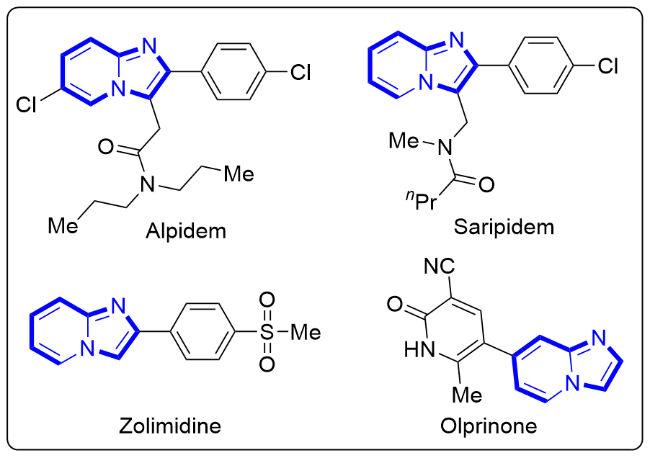
On the other hand, imidazo[1,2-a]pyridines and their derivatives are a fundamental class of heterocycles which have exhibited remarkable biological activities in medicinal chemistry and life sciences.[6] Many drugs contain the core structure of imidazo[1,2-a]pyridine, such as Alpi- dem,[7] Saripidem,[8] Zolimidine and Olprinone (Figure 1).[9] It is not surprising that a number of successful synthetic strategies have been reported for the functionalization of imidazo[1,2-a]pyridines.[10] In the past few years, Cao, Jiang, Zhu and our group have also reported many transformations to form novel imidazo[1,2-a]pyridine derivatives.[11] For example, Cao’s group developed a copper-catalyzed regioselective cross-coupling between imidazo[2-a]pyridines and methyl hetarenes through C(sp2)—H and C(sp3)—H bond functionalization.[12] The majority of these approaches depends on either stoichiometric oxidizing agents or high-temperature conditions. Therefore, the development of greener catalytic systems is in high demand to address this challenge. To the best of our know- ledge, there is no report for the alumina-promoted Michael addition of imidazo[1,2-a]pyridines with α,β-unsaturated ketones.
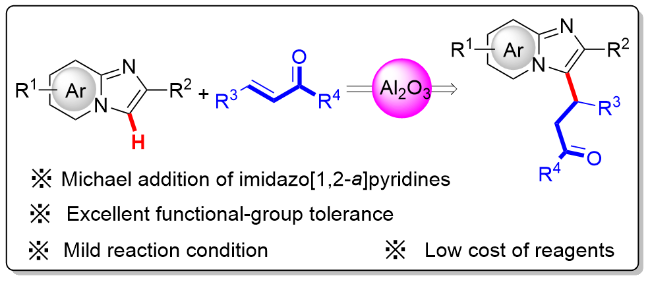
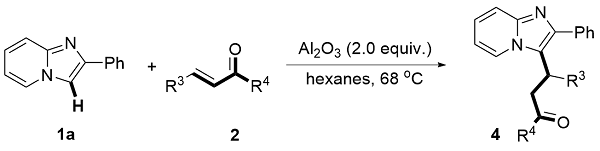
Alumina, sold ubiquitously for use in chromatography, is a mild C(sp3)—H acid catalyst for Michael reactions with cost benefit and can be easily removed from the reaction mixture by simple filtration.[13] In continuation of our interest in the construction of functionalized compounds by employing simple and readily available starting materials,[14] we reported a novel and highly efficient alumina- promoted C3-alkylation of imidazo[1,2-a]pyridines with α,β-unsaturated ketones giving the corresponding Michael adducts in moderate to excellent yields (Scheme 1).
2 Results and discussion
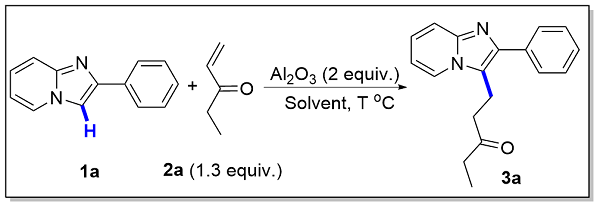
Our initial efforts focused on the optimization of reaction conditions. 2-Phenylimidazo[1,2-a]pyridine (1a) and pent-1-en-3-one (2a) were chosen as substrates to evaluate different parameters (Table 1). To our delight, using acidic alumina as C(sp3)—H acid in n-hexane afforded the desired Michael adducts 1-(2-phenylimidazo[1,2-a]pyridine- 3-yl)pentan-3-one (3a) in 85% yield. Inferior reaction performance was observed when neutral and basic alumina were used (Entries 2~3). The solvent screening showed that lipophilic solvents (Entries 4~6) were generally superior to hydrophilic solvents (Entries 7~13). It was then noticed that increasing or decreasing the reaction temperature led to reduced yields (Entries 14~16). Furthermore, the reaction efficiency was obviously affected upon reducing or increasing the loading of alumina (Entries 17~18). Not surprisingly, the reaction did not occur in the absence of alumina (Entry 19).
Table 1 Optimization of reaction conditions |
| Entry | Al2O3 | Solvent | T/oC | Yieldb/% |
|---|---|---|---|---|
| 1a | Acidic | n-Hexane | 68 | 85 |
| 2 | Neutral | n-Hexane | 68 | 17 |
| 3 | Basic | n-Hexane | 68 | 21 |
| 4 | Acidic | Heptane | 68 | 75 |
| 5 | Acidic | PhMe | 68 | 55 |
| 6 | Acidic | DCM | 68 | 60 |
| 7 | Acidic | CH3CN | 68 | 20 |
| 8 | Acidic | n-Butanol | 68 | 0 |
| 9 | Acidic | Ethanol | 68 | 0 |
| 10 | Acidic | THF | 68 | 30 |
| 11 | Acidic | Acetone | 68 | 15 |
| 12 | Acidic | DMSO | 68 | 0 |
| 13 | Acidic | dioxane | 68 | 0 |
| 14 | Acidic | n-Hexane | 48 | 65 |
| 15 | Acidic | n-Hexane | 88 | 81 |
| 16 | Acidic | n-Hexane | 108 | 78 |
| 17c | Acidic | n-Hexane | 68 | 70 |
| 18d | Acidic | n-Hexane | 68 | 56 |
| 19 | — | n-Hexane | 68 | 0 |
a Reaction conditions: 1a (0.2 mmol), 2a (1.3 equiv.), Al2O3 (acidic, 2.0 equiv.), and n-hexane (2.0 mL), stirred at 68 ℃ for 4 h. b Isolated yield. c Al2O3 loading is 3.0 equiv. d Al2O3 loading is 1.0 equiv. |
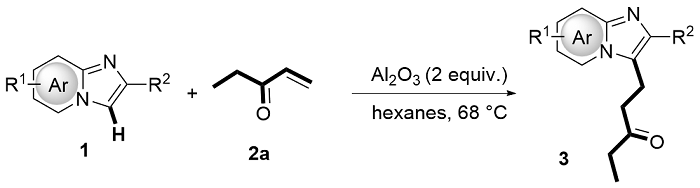
With the optimized conditions in hand, the substrate scope of the reaction was explored by testing many substituted imidazo[1,2-a]pyridines (Table 2). It was pleasure that the Michael addition reaction proceeded smoothly to provide an efficient access of 3-alkyl imidazo[1,2-a]pyri- dine derivatives. In general, the reaction of imidazo[1,2- a]pyridines bearing electron-donating groups gave slightly higher product yields than those containing electron-with- drawing moieties (3a~3i). Furthermore, substrates with various groups on the ortho-aryl ring all gave the corresponding products in moderate to good yields (3j~3p).
Table 2 Scope of imidazo[1,2-a]pyridinesa,b |
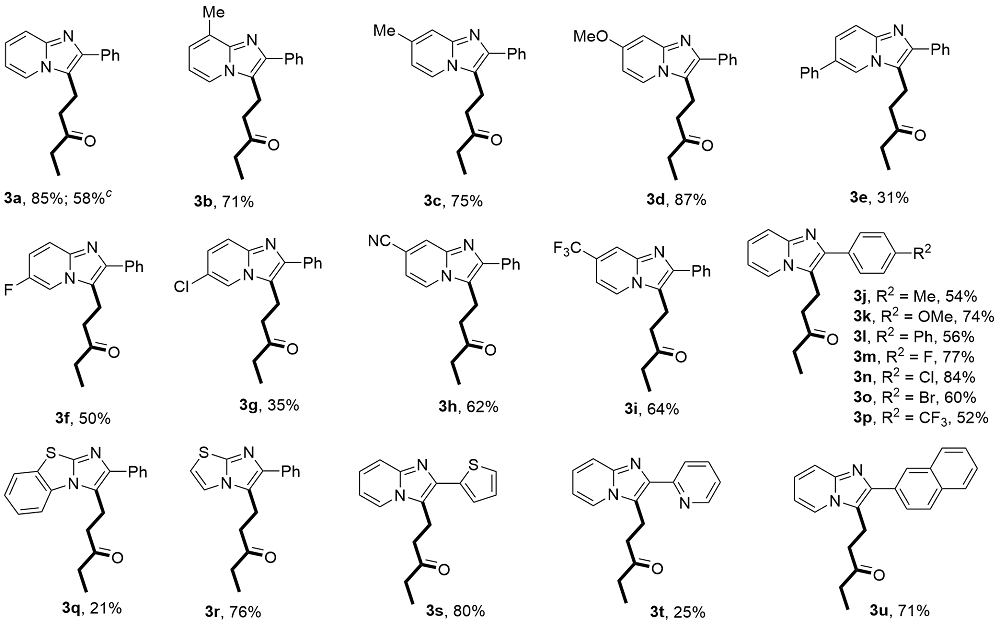 |
a Reaction conditions: a mixture of 1 (0.2 mmol), pent-1-en-3-one (2a, 1.3 equiv.), Al2O3 (acidic, 2.0 equiv.) and n-hexane (2.0 mL), stirred at 68℃. b Yields referred to isolated yields; c 2 mmol of 1a. |
Halogenated materials contain fluoro, chloro and bromo substituents were also tolerated which is very important for further functionalization (3m~3o). Much to our satisfaction, the substrates with heterocyclic ring and naphthalene were all tolerated in the reaction system (3r, 3s, 3u) albeit 2-phenylbenzo[d]imidazo[2,1-b]thiazole and 2-(pyridin-2- yl)imidazo[1,2-a]pyridine generated the desired products in only 21% and 25% yields (3q, 3t). It was worth noting that the reaction can be conducted on a gram scale, giving the desired product 3a in moderate yield.
Afterward, we proceeded to explore the scope with regard to the various α,β-unsaturated ketones, and the results are listed in Table 3. Firstly, 2-phenylimidazo[1,2-a]pyri- dine was paired with nine phenyl vinyl ketones to yield compounds 4a~4i with a range of substituents including methyl, fluoro, chloro, bromo, trifluoromethyl, nitro, cyano and phenoxy. Notably, 1-(naphthalen-2-yl)prop-2-en-1-one and 1-(thiophen-2-yl)prop-2-en-1-one also generated the desired products (3j and 3k) in moderate yields. It was noteworthy that 2-phenylimidazo[1,2-a]pyridines was reacted with chalcone resulting in the Michael adduct in 35% yield.[14]
Table 3 Scope of α,β-unsaturated ketonesa,b |
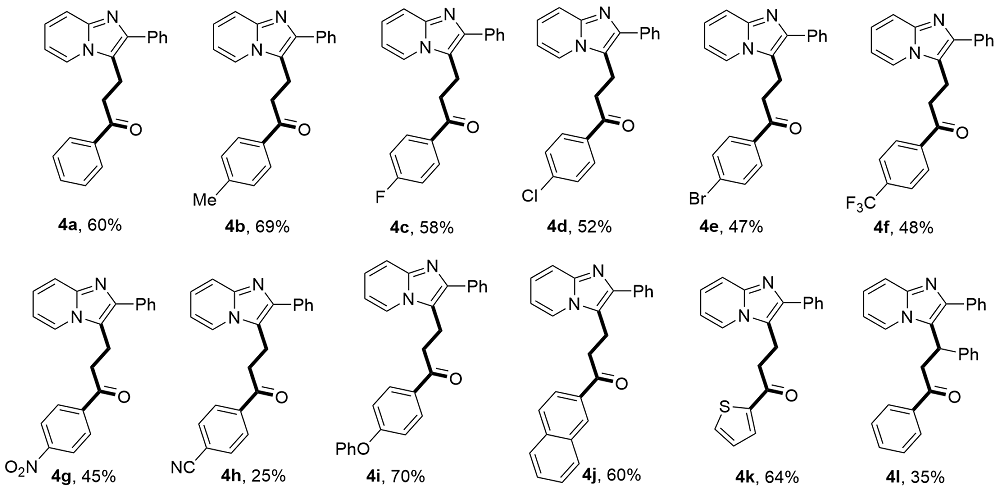 |
a Reaction conditions: a mixture of 2-phenylimidazo[1,2-a]pyridines (1a, 0.2 mmol), α,β-unsaturated ketones 2 (1.3 equiv.), Al2O3 (acidic, 2.0 equiv.) and n-hexane (2.0 mL), stirred at 68℃. b Yields referred to isolated yields. |
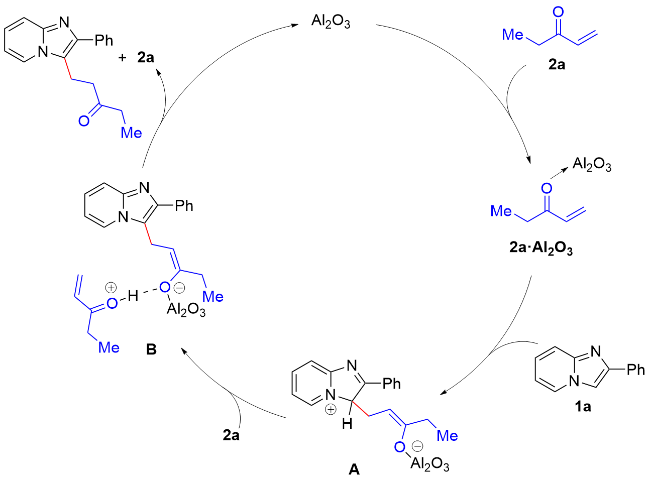
On the basis of previous literature reports,[16] a plausible mechanism for this reactions were proposed in Scheme 2. First, acidic alumina (Al2O3) coordinates with the α,β-un- saturated ketone 2a to form the adduct 2a·Al₂O₃. The lone pair of electrons from the carbonyl oxygen fills the empty orbital of Al3⁺, forming a σ-coordination bond. This coordination activates the π-bond in 2a, increasing the electrophilicity of the β-carbon and promoting its Michael addition with 1a, leading to the formation of intermediate A. Subsequently, with the assistance of an additional molecule of 2a, a hydrogen transfer occurs, ultimately yielding the product 3a.


3 Conclusions
In summary, we have developed a simple procedure for C3-alkylation of imidazo[1,2-a]pyridines that employs aci- dic alumina as C(sp3)—H acid. By this protocol, imidazo[1,2-a]pyridine derivatives undergo Michael addition reactions without any dimerisation and polymerization reaction occurring. To the best of our knowledge, alumina promoted Michael addition of imidazo[1,2-a]pyridines to electron-deficient olefins was realized for the first time. The present method has the advantages of simple experimental procedure and excellent functional-group tolerance. Moreover, the mildness of the reaction conditions and low cost of reagents should make this methodology synthetically useful.
4 Experimental section
4.1 General Information
All purchased reagents and solvents were used without further purification unless otherwise noted. 1H NMR and 13C NMR spectra were recorded on a Bruker DRX-400 or a Bruker DRX-500 spectrometer using CDCl3 as solvent. The chemical shifts are referenced to signals at δ 7.26 and 77.0, respectively. Thin-layer chromatography (TLC) was performed by using commercially prepared 100~400 mesh silica gel plates and visualization was affected at 254 nm.
4.2 General procedure for the synthesis of products 3 and 4
The mixture of 1 (0.2 mmol, 1.0 equiv.), 2 (0.26 mmol, 1.3 equiv.) and Al2O3 (acidic, 0.4 mmol, 2.0 equiv) was stirred in n-hexane (10 mL/mmol) in an oil bath at 68 oC in a sealed tube. After the reaction was completed (monitored by TLC), the resulting mixture was cooled and filtered through filter paper. The solids were rinsed with EtOAc, and the combined filtrate was concentrated in vacuo. The desired products 3 and 4 were obtained in the corresponding yields after purified by column chromatography on silica gel with a mixture of petroleum ether and ethyl acetate.
1-(2-Phenylimidazo[1,2-a]pyridin-3-yl)pentan-3-one(3a): 47.3 mg, 85% yield, yellow solid, m.p. 106.3~ 107.3 °C. 1H NMR (400 MHz, CDCl3) δ: 8.04 (d, J=6.9 Hz, 1H), 7.77 (d, J=7.0 Hz, 2H), 7.63 (d, J=9.0 Hz, 1H), 7.46 (t, J=7.6 Hz, 2H), 7.36 (t, J=7.4 Hz, 1H), 7.21~ 7.11 (m, 1H), 6.84 (t, J=6.8 Hz, 1H), 3.40 (t, J=7.6 Hz, 2H), 2.79 (t, J=7.6 Hz, 2H), 2.41 (q, J=7.3 Hz, 2H), 1.04 (t, J=7.3 Hz, 3H); 13C NMR (100 MHz, CDCl3) δ: 210.0, 144.5, 142.4, 134.7, 128.6, 128.0, 127.6, 123.8, 123.1, 119.2, 117.6, 112.2, 40.0, 36.1, 17.6, 7.7. HRMS (ESI- TOF) calcd for C18H19N2O [M+H]+ 279.1492, found 279.1498.
1-(8-Methyl-2-phenylimidazo[1,2-a]pyridin-3-yl)pen-tan-3-one (3b): 41.5 mg, 71% yield, yellow solid, m.p. 113.4~114.2 °C. 1H NMR (500 MHz, CDCl3) δ: 7.88 (d, J=6.9 Hz, 1H), 7.76 (d, J=7.7 Hz, 2H), 7.45 (t, J=7.6 Hz, 2H), 7.34 (t, J=7.6 Hz, 1H), 6.96 (d, J=6.9 Hz, 1H), 6.74 (t, J=6.8 Hz, 1H), 3.35 (t, J=7.7 Hz, 2H), 2.84-2.72 (m, 2H), 2.65 (s, 3H), 2.40 (q, J=7.3 Hz, 2H), 1.03 (t, J=7.3 Hz, 3H); 13C NMR (125 MHz, CDCl3) δ: 210.1, 145.0, 142.0, 135.0, 128.6, 128.3, 127.6, 127.5, 122.7, 120.9, 119.5, 112.3, 40.1, 36.1, 17.8, 17.2, 7.7. HRMS (ESI-TOF) calcd for C19H21N2O [M+H]+ 293.1648, found 293.1656.
1-(7-methyl-2-phenylimidazo[1,2-a]pyridin-3-yl)pentan-3-one (3c): 43.8 mg, 75% yield, white solid, m.p. 89.4~ 90.5 °C. 1H NMR (500 MHz, CDCl3) δ: 7.91 (d, J=7.0 Hz, 1H), 7.79~7.69 (m, 2H), 7.44 (t, J=7.7 Hz, 2H), 7.38 (s, 1H), 7.36~7.31 (m, 1H), 6.66 (dd, J=7.0, 1.7 Hz, 1H), 3.41~3.22 (m, 2H), 2.80~2.67 (m, 3H), 2.51~2.26 (m, 5H), 1.03 (t, J=7.3 Hz, 3H); 13C NMR (125 MHz, CDCl3) δ: 210.2, 144.9, 141.9, 134.9, 134.8, 128.6, 128.0, 127.5, 122.4, 118.6, 115.9, 114.9, 40.1, 36.1, 21.3, 17.6, 7.7. HRMS (ESI-TOF) calcd for C19H21N2O [M+H]+ 293.1648, found 293.1658.
1-(7-Methoxy-2-phenylimidazo[1,2-a]pyridin-3-yl)pen-tan-3-one (3d): 53.6 mg, 87% yield, yellow solid, m.p. 126.8~128.0 °C. 1H NMR (500 MHz, CDCl3) δ: 7.86 (d, J=7.5 Hz, 1H), 7.76-7.71 (m, 2H), 7.43 (t, J=7.7 Hz, 2H), 7.32 (td, J=7.3, 1.3 Hz, 1H), 6.89 (d, J=2.6 Hz, 1H), 6.54 (dd, J=7.5, 2.5 Hz, 1H), 3.84 (s, 3H), 3.32 (t, J=7.5 Hz, 2H), 2.75 (t, J=7.5 Hz, 2H), 2.39 (q, J=7.3 Hz, 2H), 1.02 (t, J=7.3 Hz, 3H); 13C NMR (125 MHz, CDCl3) δ: 210.2, 157.5, 145.8, 141.4, 134.8, 128.6, 128.6, 127.7, 127.4, 123.7, 118.1, 107.2, 94.6, 55.5, 40.4, 36.1, 17.5, 7.7. HRMS (ESI-TOF) calcd for C19H21N2O2 [M+ H]+ 309.1598, found 309.1603.
1-(2,6-Diphenylimidazo[1,2-a]pyridin-3-yl)pentan-3-one (3e): 21.9 mg, 31% yield, brown solid, m.p. 108.5~ 109.3 °C. 1H NMR (500 MHz, CDCl3) δ: 8.25 (s, 1H), 7.85~7.78 (m, 2H), 7.77 (d, J=9.2 Hz, 1H), 7.68~7.61 (m, 2H), 7.58~7.48 (m, 5H), 7.47~7.36 (m, 2H), 3.51~3.44 (m, 2H), 2.85 (t, J=7.6 Hz, 2H), 2.44 (q, J=7.3 Hz, 2H), 1.07 (t, J=7.3 Hz, 3H); 13C NMR (125 MHz, CDCl3) δ: 210.0, 143.6, 142.5, 137.5, 134.2, 129.2, 128.8, 128.1, 128.0, 128.0, 127.1, 125.1, 120.5, 119.8, 117.3, 40.1, 36.2, 17.6, 7.7. HRMS (ESI-TOF) calcd for C24H23- N2O [M+H]+ 355.1805, found 355.1815.
1-(6-Fluoro-2-phenylimidazo[1,2-a]pyridin-3-yl)pentan-3-one (3f): 29.6 mg, 50% yield, brown solid, m.p. 140.0~ 140.6 °C. 1H NMR (500 MHz, CDCl3) δ: 8.07~ 7.99 (m, 1H), 7.76 (d, J=7.7 Hz, 2H), 7.63 (dd, J=9.8, 5.2 Hz, 1H), 7.48 (t, J=7.6 Hz, 2H), 7.42~7.34 (m, 1H), 7.17~ 7.07 (m, 1H), 3.37 (t, J=7.5 Hz, 2H), 2.80 (t, J=7.5 Hz, 2H), 2.43 (q, J=7.2 Hz, 2H), 1.06 (t, J=7.3 Hz, 3H); 13C NMR (125 MHz, CDCl3) δ: 209.8, 153.4 (d, JC—F=236 Hz), 143.7, 142.1, 134.3, 128.7, 128.0, 127.9, 120.8 (d, JC—F=2.5 Hz), 118.0 (d, JC—F=10 Hz), 116.0 (d, JC—F=25 Hz), 110.0 (d, JC—F=41.3 Hz), 39.8, 36.1, 17.6, 7.7; 19F NMR (471 MHz, CDCl3) δ: -139.6. HRMS (ESI-TOF) calcd for C18H18FN2O [M+H]+ 297.1398, found 297.1407.
1-(6-Chloro-2-phenylimidazo[1,2-a]pyridin-3-yl)pentan-3-one (3g): 21.8 mg, 35% yield, brown solid, m.p. 131.3~132.7 °C. 1H NMR (500 MHz, CDCl3) δ: 8.12 (d, J=1.9 Hz, 1H), 7.79~7.74 (m, 2H), 7.60 (dd, J=9.6, 0.8 Hz, 1H), 7.48 (t, J=7.7 Hz, 2H), 7.43~7.35 (m, 1H), 7.17 (dd, J=9.5, 2.0 Hz, 1H), 3.43~3.34 (m, 2H), 2.81 (t, J=7.6 Hz, 2H), 2.44 (q, J=7.3 Hz, 2H), 1.07 (t, J=7.3 Hz, 3H); 13C NMR (125 MHz, CDCl3) δ: 209.7, 143.4, 142.8, 134.1, 128.8, 128.0, 128.0, 125.3, 121.2, 120.6, 120.0, 117.9, 39.8, 36.1, 17.6, 7.7. HRMS (ESI-TOF) calcd for C18H18ClN2O [M+H]+ 313.1102, found 313.1109.
3-(3-Oxopentyl)-2-phenylimidazo[1,2-a]pyridine-7-car-bonitrile (3h): 37.6 mg, 62% yield, yellow solid, m.p. 137.8~139.2 °C. 1H NMR (500 MHz, CDCl3) δ: 8.02 (d, J=7.0 Hz, 1H), 7.74~7.66 (m, 2H), 7.60 (dt, J=9.1, 1.2 Hz, 1H), 7.45~7.37 (m, 2H), 7.17 (ddd, J=9.1, 6.7, 1.2 Hz, 1H), 6.83 (td, J=6.7, 1.2 Hz, 1H), 3.40~3.31 (m, 2H), 2.75 (t, J=7.6 Hz, 2H), 2.40 (q, J=7.3 Hz, 2H), 1.03 (t, J=7.3 Hz, 3H); 13C NMR (125 MHz, CDCl3) δ: 209.8, 144.5, 141.2, 133.5, 133.2, 129.2, 128.8, 124.2, 123.2, 119.4, 117.6, 112.4, 39.8, 36.1, 17.5, 7.7. HRMS (ESI- TOF) calcd for C19H18N3O [M+H]+ 304.1444, found 304.1451.
1-(2-Phenyl-7-(trifluoromethyl)imidazo[1,2-a]pyridin-3-yl)pentan-3-one (3i): 44.3 mg, 64% yield, white solid, m.p. 122.6~123.4 °C. 1H NMR (500 MHz, CDCl3) δ: 8.23 (d, J=7.1 Hz, 1H), 7.93 (s, 1H), 7.77 (d, J=8.4 Hz, 2H), 7.47 (t, J=6.9 Hz, 2H), 7.41~7.37 (m, 1H), 7.02 (d, J=7.2 Hz, 1H), 3.42 (t, J=7.4 Hz, 2H), 2.80 (t, J=7.2 Hz, 2H), 2.40 (q, J=7.4 Hz, 2H), 1.03 (t, J=7.3 Hz, 3H); 13C NMR (125 MHz, CDCl3) δ: 209.7, 143.6 (d, JC—F=266.3 Hz), 134.0, 128.8, 128.1, 128.0, 126.8, 125.6 (q, JC—F=33.8 Hz), 124.6, 123.5 (q, JC—F=362.5 Hz), 115.4 (q, JC—F=5 Hz), 108.0 (d, JC—F=3.8 Hz), 39.9, 36.1, 17.4, 7.7; 19F NMR (471 MHz, CDCl3) δ: -63.4. HRMS (ESI-TOF) calcd for C19H18F3N2O [M+H]+ 347.1366, found 347.1374.
1-(2-(p-Tolyl)imidazo[1,2-a]pyridin-3-yl)pentan-3-one (3j): 31.5 mg, 54% yield, brown solid, m.p. 127.7~ 128.8 °C. 1H NMR (500 MHz, CDCl3) δ: 8.02 (d, J=6.5 Hz, 1H), 7.71~7.58 (m, 3H), 7.26 (d, J=7.3 Hz, 2H), 7.16 (t, J=7.9 Hz, 1H), 6.82 (t, J=6.6 Hz, 1H), 3.38 (t, J=7.6 Hz, 2H), 2.77 (t, J=7.6 Hz, 2H), 2.46~2.28 (m, 5H), 1.03 (t, J=7.3 Hz, 3H); 13C NMR (125 MHz, CDCl3) δ: 210.1, 144.4, 142.4, 137.4, 131.7, 129.4, 127.9, 123.8, 123.1, 118.9, 117.5, 112.2, 40.0, 36.1, 21.3, 17.6, 7.7. HRMS (ESI-TOF) calcd for C19H21N2O [M+H]+ 293.1648, found 293.1656.
1-(2-(4-Methoxyphenyl)imidazo[1,2-a]pyridin-3-yl)pen-tan-3-one (3k): 45.6 mg, 74% yield, brown solid, m.p. 89.2~90.3 °C. 1H NMR (500 MHz, CDCl3) δ: 7.99 (d, J=6.9 Hz, 1H), 7.71~7.64 (m, 2H), 7.59 (dt, J=9.0, 1.2 Hz, 1H), 7.13 (ddd, J=9.1, 6.7, 1.2 Hz, 1H), 7.01~6.94 (m, 2H), 6.79 (td, J=6.8, 1.2 Hz, 1H), 3.83 (s, 3H), 3.34 (t, J=7.6 Hz, 2H), 2.75 (t, J=7.6 Hz, 2H), 2.39 (q, J=7.3 Hz, 2H), 1.02 (t, J=7.3 Hz, 3H); 13C NMR (125 MHz, CDCl3) δ: 210.1, 159.2, 144.4, 142.2, 129.2, 127.2, 123.7, 123.0, 118.5, 117.3, 114.1, 112.1, 55.3, 39.9, 36.1, 17.6, 7.7. HRMS (ESI-TOF) calcd for C19H21N2O2 [M+H]+ 309.1598, found 309.1606.
1-(2-([1'-Biphenyl]-4-yl)imidazo[1,2-a]pyridin-3-yl)pentan-3-one (3l): 39.6 mg, 56% yield, yellow solid, m.p. 131.5~132.7 °C. 1H NMR (500 MHz, CDCl3) δ: 8.06 (dd, J=6.9, 1.2 Hz, 1H), 7.91~7.85 (m, 2H), 7.72 (d, J=8.4 Hz, 2H), 7.69~7.64 (m, 3H), 7.47 (t, J=7.7 Hz, 2H), 7.40~7.35 (m, 1H), 7.20 (ddd, J=9.1, 6.7, 1.3 Hz, 1H), 6.85 (td, J=6.8, 1.2 Hz, 1H), 3.45 (t, J=7.6 Hz, 2H), 2.82 (t, J=7.6 Hz, 2H), 2.44 (q, J=7.3 Hz, 2H), 1.07 (t, J=7.3 Hz, 3H); 13C NMR (125 MHz, CDCl3) δ: 210.0, 144.6, 141.9, 140.7, 140.2, 133.7, 128.8, 128.4, 127.4, 127.3, 127.0, 124.0, 123.2, 119.4, 117.6, 112.3, 40.0, 36.2, 17.7, 7.7. HRMS (ESI-TOF) calcd for C24H23N2O [M+H]+ 355.1805, found 355.1814.
1-(2-(4-Fluorophenyl)imidazo[1,2-a]pyridin-3-yl)pen-tan-3-one (3m): 45.6 mg, 77% yield, yellow solid, m.p. 104.7~105.3 °C. 1H NMR (500 MHz, CDCl3) δ: 8.01 (d, J=6.9 Hz, 1H), 7.75~7.66 (m, 2H), 7.59 (dt, J=9.1, 1.2 Hz, 1H), 7.18~7.05 (m, 3H), 6.81 (td, J=6.8, 1.2 Hz, 1H), 3.34 (t, J=7.6 Hz, 2H), 2.74 (t, J=7.6 Hz, 2H), 2.39 (q, J=7.3 Hz, 2H), 1.02 (t, J=7.3 Hz, 3H); 13C NMR (125 MHz, CDCl3) δ: 209.8, 162.4 (d, JC—F=246.3 Hz), 144.5, 141.5, 130.8 (d, JC—F=3.8 Hz), 129.7 (d, JC—F=7.5 Hz), 124.0, 123.2, 119.0, 117.5, 115.6 (d, JC—F=21.3 Hz), 112.3, 39.8, 36.1, 17.5, 7.7; 19F NMR (471 MHz, CDCl3) δ: -114.5. HRMS (ESI-TOF) calcd for C18H18FN2O [M+H]+ 297.1398, found 297.1400.
1-(2-(4-Chlorophenyl)imidazo[1,2-a]pyridin-3-yl)pen-tan-3-one (3n): 52.4 mg, 84% yield, yellow solid, m.p. 137.2-138.0 °C. 1H NMR (500 MHz, CDCl3) δ: 8.04 (dd, J=7.0, 1.2 Hz, 1H), 7.71 (d, J=8.6 Hz, 1H), 7.62 (dd, J=9.0, 1.2 Hz, 1H), 7.42 (dd, J=8.5, 1.3 Hz, 2H), 7.19 (ddd, J=9.2, 6.7, 1.3 Hz, 1H), 6.85 (td, J=6.8, 1.2 Hz, 1H), 3.37 (t, J=7.6 Hz, 2H), 2.77 (t, J=7.5 Hz, 2H), 2.42 (q, J=7.3 Hz, 2H), 1.04 (t, J=7.3 Hz, 3H); 13C NMR (125 MHz, CDCl3) δ: 209.8, 144.5, 141.1, 133.5, 133.2, 129.2, 128.8, 124.2, 123.2, 119.4, 117.6, 112.4, 39.9, 36.1, 17.5, 7.7. HRMS (ESI-TOF) calcd for C18H18ClN2O [M+H]+ 313.1102, found 313.1108.
1-(2-(4-Bromophenyl)imidazo[1,2-a]pyridin-3-yl)pen-tan-3-one (3o): 42.7 mg, 60% yield, brown solid, m.p. 143.5~144.2 °C. 1H NMR (500 MHz, CDCl3) δ: 8.06 (d, J=6.9 Hz, 1H), 7.71~7.54 (m, 5H), 7.21 (ddd, J=9.1, 6.7, 1.2 Hz, 1H), 6.87 (td, J=6.8, 1.2 Hz, 1H), 3.39 (t, J=7.6 Hz, 2H), 2.78 (t, J=7.5 Hz, 2H), 2.43 (q, J=7.3 Hz, 2H), 1.06 (t, J=7.3 Hz, 3H); 13C NMR (125 MHz, CDCl3) δ: 209.8, 144.5, 141.1, 133.6, 131.8, 129.5, 124.3, 123.2, 121.8, 119.5, 117.6, 112.5, 39.9, 36.2, 17.5, 7.7. HRMS (ESI-TOF) calcd for C18H18BrN2O [M+H]+ 357.0597, found 357.0605.
1-(2-(4-(Trifluoromethyl)phenyl)imidazo[1,2-a]pyridin-3-yl)pentan-3-one (3p): 36.0 mg, 52% yield, white solid, m.p. 156.0~156.8 °C. 1H NMR (500 MHz, CDCl3) δ: 8.09 (d, J=6.6 Hz, 1H), 7.92 (d, J=8.1 Hz, 2H), 7.73 (d, J=8.1 Hz, 2H), 7.67 (d, J=9.1 Hz, 1H), 7.24 (ddd, J=9.1, 6.7, 1.2 Hz, 1H), 6.90 (t, J=6.8 Hz, 1H), 3.43 (t, J=7.5 Hz, 2H), 2.81 (t, J=7.5 Hz, 2H), 2.44 (q, J=7.3 Hz, 2H), 1.06 (t, J=7.4 Hz, 3H); 13C NMR (125 MHz, CDCl3) δ: 209.7, 144.7, 140.7, 138.2, 129.5 (q, JC—F=32.5 Hz), 128.1, 125.6 (q, JC—F=5.0 Hz), 124.6, 123.0 (q, JC—F=388.8 Hz), 117.8, 112.7, 39.9, 36.2, 17.5, 7.7; 19F NMR (471 MHz, CDCl3) δ: -62.5. HRMS (ESI-TOF) calcd for C19H18F3N2O [M+H]+ 347.1366, found 347.1371.
1-(2-Phenylbenzo[d]imidazo[2,1-b]thiazol-3-yl)pentan-3-one (3q): 14.0 mg, 21% yield, brown solid, m.p. 87.1~87.9 °C. 1H NMR (500 MHz, CDCl3) δ: 7.77~7.60 (m, 4H), 7.47 (t, J=7.7 Hz, 3H), 7.36 (td, J=7.6, 4.6 Hz, 2H), 3.57 (t, J=7.3 Hz, 2H), 2.91 (t, J=7.2 Hz, 2H), 2.51 (q, J=7.3 Hz, 2H), 1.12 (t, J=7.3 Hz, 3H); 13C NMR (125 MHz, CDCl3) δ: 209.6, 146.8, 133.2, 130.6, 128.7, 127.7, 127.4, 127.4, 126.4, 126.4, 124.6, 124.6, 123.5, 112.7, 112.7, 41.5, 36.3, 19.2, 7.8. HRMS (ESI-TOF) calcd for C20H19SN2O [M+H]+ 335.1213, found 335.1223.
1-(6-Phenylimidazo[2,1-b]thiazol-5-yl)pentan-3-one (3r): 43.2 mg, 76% yield, brown liquid. 1H NMR (500 MHz, CDCl3) δ: 7.69 (d, J=6.8 Hz, 2H), 7.52 (d, J=4.5 Hz, 1H), 7.42 (t, J=7.7 Hz, 2H), 7.30 (t, J=7.6 Hz, 1H), 6.80 (d, J=4.6 Hz, 1H), 3.28 (t, J=7.0 Hz, 2H), 2.79 (t, J=7.1 Hz, 2H), 2.38 (q, J=7.3 Hz, 2H), 1.02 (t, J=7.3 Hz, 3H); 13C NMR (125 MHz, CDCl3) δ: 210.2, 147.9, 143.1, 134.9, 128.6, 127.1, 127.0, 121.4, 117.8, 112.1, 41.1, 36.1, 18.8, 7.7. HRMS (ESI-TOF) calcd for C16H17- SN2O [M+H]+ 285.1056, found 285.1060.
1-(2-(Thiophen-2-yl)imidazo[1,2-a]pyridin-3-yl)pentan-3-one (3s): 45.4 mg, 80% yield, brown solid, m.p. 88.7~ 89.3 °C. 1H NMR (500 MHz, CDCl3) δ: 8.07 (d, J=6.9 Hz, 1H), 7.57 (d, J=9.1 Hz, 1H), 7.43 (d, J=3.7 Hz, 1H), 7.33 (d, J=5.1 Hz, 1H), 7.20-7.07 (m, 2H), 6.81 (t, J=6.8 Hz, 1H), 3.40 (t, J=7.4 Hz, 2H), 2.81 (t, J=7.4 Hz, 2H), 2.41 (q, J=7.3 Hz, 2H), 1.02 (t, J=7.3 Hz, 3H); 13C NMR (125 MHz, CDCl3) δ: 210.1, 144.4, 137.7, 137.0, 127.8, 125.2, 124.2, 124.1, 123.3, 118.7, 117.2, 112.3, 39.7, 36.1, 17.5, 7.7. HRMS (ESI-TOF) calcd for C16H17SN2O [M+H]+ 285.1056, found 285.1062.
1-(2-(Pyridin-2-yl)imidazo[1,2-a]pyridin-3-yl)pentan-3-one (3t): 14.0 mg, 25% yield, brown liquid. 1H NMR (500 MHz, CDCl3) δ: 8.63 (ddd, J=4.8, 1.9, 1.0 Hz, 1H), 8.27 (dt, J=8.1, 1.1 Hz, 1H), 8.21 (d, J=6.9 Hz, 1H), 7.77 (td, J=7.7, 1.9 Hz, 1H), 7.62 (dt, J=9.1, 1.2 Hz, 1H), 7.25-7.14 (m, 2H), 6.86 (td, J=6.8, 1.2 Hz, 1H), 3.69 (t, J=7.3 Hz, 2H), 2.97 (t, J=7.2 Hz, 2H), 2.45 (q, J=7.3 Hz, 2H), 1.04 (t, J=7.3 Hz, 3H); 13C NMR (125 MHz, CDCl3) δ: 211.5, 154.5, 149.0, 144.2, 140.2, 136.4, 124.3, 123.7, 123.1, 121.7, 121.7, 117.6, 112.3, 40.6, 36.0, 18.4, 7.8. HRMS (ESI-TOF) calcd for C17H18N3O [M+H]+ 280.1444, found 280.1452.
1-(2-(Naphthalen-2-yl)imidazo[1,2-a]pyridin-3-yl)pen-tan-3-one (3u): 46.6 mg, 71% yield, brown solid, m.p. 79.5~79.9 °C. 1H NMR (500 MHz, CDCl3) δ: 8.24 (s, 1H), 8.06 (d, J=7.2 Hz, 1H), 7.96~7.88 (m, 3H), 7.89~ 7.83 (m, 1H), 7.68 (d, J=9.0 Hz, 1H), 7.55~7.42 (m, 2H), 7.19 (ddd, J=9.1, 6.7, 1.2 Hz, 1H), 6.84 (td, J=6.8, 1.2 Hz, 1H), 3.46 (t, J=7.5 Hz, 2H), 2.79 (t, J=7.6 Hz, 2H), 2.39 (q, J=7.3 Hz, 2H), 1.03 (t, J=7.3 Hz, 3H); 13C NMR (125 MHz, CDCl3) δ: 210.0, 144.6, 142.2, 133.5, 132.8, 132.1, 128.3, 128.3, 127.7, 126.9, 126.3, 126.1, 126.0, 124.1, 123.2, 119.7, 117.6, 112.3, 40.0, 36.1, 17.7, 7.7. HRMS (ESI-TOF) calcd for C22H21N2O [M+H]+ 329.1648, found 329.1646.
1-Phenyl-3-(2-phenylimidazo[1,2-a]pyridin-3-yl)pro-pan-1-one (4a): 39.1 mg, 60% yield, yellow solid, m.p. 167.3~168.1 °C. 1H NMR (500 MHz, CDCl3) δ: 8.09 (dd, J=6.9, 1.2 Hz, 1H), 7.92 (dd, J=8.4, 1.4 Hz, 2H), 7.82 (dd, J=8.2, 1.4 Hz, 2H), 7.68 (dd, J=9.1, 1.2 Hz, 1H), 7.61-7.54 (m, 1H), 7.46 (dt, J=15.5, 7.7 Hz, 4H), 7.38 (td, J=7.2, 1.3 Hz, 1H), 7.21 (ddd, J=9.1, 6.7, 1.3 Hz, 1H), 6.87 (td, J=6.8, 1.2 Hz, 1H), 3.62-3.55 (m, 2H), 3.40-3.34 (m, 2H); 13C NMR (125 MHz, CDCl3) δ: 198.7, 144.6, 142.5, 136.3, 134.6, 133.5, 128.7, 128.7, 128.1, 128.0, 127.7, 124.0, 123.1, 119.2, 117.7, 112.4, 36.5, 18.0. HR- MS (ESI-TOF) calcd for C22H19N2O [M+H]+ 327.1492, found 327.1497.
3-(2-Phenylimidazo[1,2-a]pyridin-3-yl)-1-(p-tolyl)pro-pan-1-one (4b): 46.9 mg, 69% yield, yellow solid, m.p. 82.1~82.9 °C. 1H NMR (500 MHz, CDCl3) δ: 8.09 (d, J=6.8 Hz, 1H), 7.85~7.78 (m, 4H), 7.67 (d, J=9.0 Hz, 1H), 7.47 (t, J=7.8 Hz, 2H), 7.37 (t, J=7.4 Hz, 1H), 7.24 (d, J=7.9 Hz, 2H), 7.23~7.16 (m, 1H), 6.86 (t, J=6.8 Hz, 1H), 3.58 (t, J=7.7 Hz, 2H), 3.33 (t, J=7.7 Hz, 2H), 2.40 (s, 3H); 13C NMR (125 MHz, CDCl3) δ: 198.3, 144.6, 144.4, 142.5, 134.6, 133.9, 129.4, 128.7, 128.2, 128.1, 127.7, 124.0, 123.2, 119.3, 117.7, 112.4, 36.3, 21.7, 18.1. HRMS (ESI-TOF) calcd for C23H21N2O [M+H]+ 341.1648, found 341.1655.
1-(4-Fluorophenyl)-3-(2-phenylimidazo[1,2-a]pyridin-3-yl)propan-1-one (4c): 39.9 mg, 58% yield, yellow solid, m.p. 171.7~172.6 °C. 1H NMR (500 MHz, CDCl3) δ: 8.09 (d, J=6.9 Hz, 1H), 7.97~7.88 (m, 2H), 7.81 (d, J=7.1 Hz, 2H), 7.68 (d, J=9.0 Hz, 1H), 7.48 (t, J=7.7 Hz, 2H), 7.38 (t, J=7.4 Hz, 1H), 7.26~7.17 (m, 1H), 7.11 (t, J=8.6 Hz, 2H), 6.88 (t, J=6.8 Hz, 1H), 3.59 (t, J=7.6 Hz, 2H), 3.33 (t, J=7.7 Hz, 2H); 13C NMR (125 MHz, CDCl3) δ: 197.0, 165.9 (d, JC—F=253.8 Hz), 144.6, 142.5, 134.5, 132.8 (d, JC—F=2.5 Hz), 130.7 (d, JC—F=8.8 Hz), 128.7, 128.2, 128.1, 127.7, 123.6 (d, JC—F=120.0 Hz), 119.1, 117.7, 115.8 (d, JC—F=22.5 Hz), 112.4, 36.4, 18.0; 19F NMR (471 MHz, CDCl3) δ: -104.4. HRMS (ESI-TOF) calcd for C22H18FN2O [M+H]+ 345.1398, found 345.1406.
1-(4-Chlorophenyl)-3-(2-phenylimidazo[1,2-a]pyridin-3-yl)propan-1-one (4d): 37.4 mg, 52% yield, yellow solid, m.p. 173.2~174.3 °C. 1H NMR (500 MHz, CDCl3) δ: 8.08 (d, J=6.9 Hz, 1H), 7.82 (dd, J=13.8, 7.9 Hz, 4H), 7.68 (d, J=9.1 Hz, 1H), 7.48 (t, J=7.6 Hz, 2H), 7.40 (dd, J=11.7, 7.8 Hz, 3H), 7.22 (t, J=7.8 Hz, 1H), 6.88 (t, J=6.9 Hz, 1H), 3.59 (t, J=7.7 Hz, 2H), 3.32 (t, J=7.6 Hz, 2H); 13C NMR (125 MHz, CDCl3) δ: 197.4, 144.6, 142.5, 140.0, 134.6, 129.4, 129.0, 128.7, 128.1, 127.8, 124.1, 124.1, 123.1, 119.0, 117.7, 112.5, 112.5, 36.5, 18.0. HRMS (ESI- TOF) calcd for C22H18ClN2O [M+H]+ 361.1102, found 361.1105.
1-(4-Bromophenyl)-3-(2-phenylimidazo[1,2-a]pyridin-3-yl)propan-1-one (4e): 38.0 mg, 47% yield, yellow solid, m.p. 177.9~178.6 °C. 1H NMR (500 MHz, CDCl3) δ: 8.09 (d, J=6.9 Hz, 1H), 7.80 (d, J=7.1 Hz, 2H), 7.75 (d, J=8.4 Hz, 2H), 7.69 (d, J=9.0 Hz, 1H), 7.58 (d, J=8.6 Hz, 2H), 7.48 (t, J=7.6 Hz, 2H), 7.38 (t, J=7.5 Hz, 1H), 7.25~7.18 (m, 1H), 6.88 (t, J=6.8 Hz, 1H), 3.59 (t, J=7.7 Hz, 2H), 3.31 (t, J=7.6 Hz, 2H); 13C NMR (125 MHz, CDCl3) δ: 197.6, 144.6, 142.5, 135.0, 134.5, 132.0, 129.5, 128.7, 128.2, 128.1, 127.8, 124.1, 123.1, 119.0, 117.7, 112.5, 36.5, 18.0. HRMS (ESI-TOF) calcd for C22H18- BrN2O [M+H]+ 405.0597, found 405.0604.
3-(2-Phenylimidazo[1,2-a]pyridin-3-yl)-1-(4-(trifluoro-methyl)phenyl)propan-1-one (4f): 37.8 mg, 48% yield, yellow solid, m.p. 173.8~174.9 °C. 1H NMR (500 MHz, CDCl3) δ: 8.09 (d, J=7.0 Hz, 1H), 7.99 (d, J=8.1 Hz, 2H), 7.86~7.76 (m, 1H), 7.70 (t, J=8.6 Hz, 3H), 7.48 (t, J=7.7 Hz, 2H), 7.42~7.35 (m, 1H), 7.23 (ddd, J=9.1, 6.7, 1.3 Hz, 1H), 6.89 (td, J=6.8, 1.2 Hz, 1H), 3.62 (t, J=7.7 Hz, 2H), 3.37 (t, J=7.6 Hz, 2H); 13C NMR (125 MHz, CDCl3) δ: 197.7, 144.6, 142.6, 138.9, 135.1, 134.6 (q, JC—F=66.3 Hz), 128.3 (q, JC—F=115.0 Hz), 125.8 (q, JC—F=3.8 Hz), 124.6, 123.6 (d, JC—F=136 Hz), 122.4, 118.8, 117.7, 112.5, 36.8, 17.9; 19F NMR (471 MHz, CDCl3) δ: -63.2. HRMS (ESI-TOF) calcd for C23H18F3- N2O [M+H]+ 395.1366, found 395.1373.
1-(4-Nitrophenyl)-3-(2-phenylimidazo[1,2-a]pyridin-3-yl)propan-1-one (4g): 33.4 mg, 45% yield, yellow solid, m.p. 189.9~190.9 °C. 1H NMR (500 MHz, CDCl3) δ: 8.28 (d, J=8.8 Hz, 2H), 8.13 (d, J=6.9 Hz, 1H), 8.03 (d, J=8.9 Hz, 2H), 7.85~7.77 (m, 2H), 7.73 (d, J=9.0 Hz, 1H), 7.49 (t, J=7.7 Hz, 2H), 7.43~7.35 (m, 1H), 7.28~7.22 (m, 1H), 6.93 (td, J=6.8, 1.2 Hz, 1H), 3.64 (t, J=7.7 Hz, 2H), 3.41 (t, J=7.6 Hz, 2H); 13C NMR (125 MHz, CDCl3) δ: 197.1, 150.5, 144.4, 142.3, 140.6, 134.1, 129.1, 128.8, 128.1, 128.0, 124.5, 123.9, 123.1, 118.6, 117.7, 112.8, 37.1, 17.8. HRMS (ESI-TOF) calcd for C22H18N3O3 [M+H]+ 372.1343, found 372.1349.
4-(3-(2-Phenylimidazo[1,2-a]pyridin-3-yl)propanoyl)-benzonitrile (4h): 17.5 mg, 25% yield, red solid, m.p. 205.8~206.5 °C. 1H NMR (500 MHz, CDCl3) δ: 8.09 (d, J=6.9 Hz, 1H), 7.97 (d, J=8.4 Hz, 2H), 7.85~7.78 (m, 2H), 7.74 (d, J=8.5 Hz, 2H), 7.69 (dt, J=9.0, 1.2 Hz, 1H), 7.48 (t, J=7.7 Hz, 2H), 7.43~7.36 (m, 1H), 7.23 (ddd, J=9.1, 6.7, 1.2 Hz, 1H), 6.90 (td, J=6.8, 1.2 Hz, 1H), 3.62 (t, J=7.6 Hz, 2H), 3.36 (t, J=7.6 Hz, 2H); 13C NMR (125 MHz, CDCl3) δ: 197.4, 144.6, 142.7, 139.1, 134.5, 132.6, 128.8, 128.4, 128.1, 127.8, 124.1, 123.0, 118.6, 117.8, 117.8, 116.7, 112.5, 36.9, 17.9. HRMS (ESI- TOF) calcd for C23H18N3O [M+H]+ 352.1444, found 352.1454.
1-(4-Phenoxyphenyl)-3-(2-phenylimidazo[1,2-a]pyridin-3-yl)propan-1-one (4i): 58.5 mg, 70% yield, brown liquid. 1H NMR (500 MHz, CDCl3) δ: 8.11 (dt, J=6.9, 1.2 Hz, 1H), 7.92-7.85 (m, 2H), 7.82 (dd, J=8.2, 1.4 Hz, 2H), 7.69 (dt, J=9.0, 1.1 Hz, 1H), 7.48 (dd, J=8.4, 7.0 Hz, 2H), 7.40 (dt, J=9.2, 7.3 Hz, 3H), 7.22 (ddd, J=8.9, 6.5, 1.2 Hz, 2H), 7.12-7.03 (m, 2H), 7.01-6.94 (m, 2H), 6.88 (td, J=6.8, 1.2 Hz, 1H), 3.59 (t, J=7.6 Hz, 2H), 3.32 (t, J=7.6 Hz, 2H); 13C NMR (125 MHz, CDCl3) δ: 197.2, 162.3, 155.3, 144.5, 142.3, 134.5, 131.0, 130.3, 130.1, 128.7, 128.1, 127.7, 124.8, 124.1, 123.2, 120.2, 119.3, 117.6, 117.4, 112.5, 36.3, 18.1. HRMS (ESI-TOF) calcd for C28H23N2O2 [M+H]+ 419.1754, found 419.1756.
1-(Naphthalen-2-yl)-3-(2-phenylimidazo[1,2-a]pyridin-3-yl)propan-1-one (4j): 45.1 mg, 60% yield, yellow solid, m.p. 153.8~154.6 °C. 1H NMR (500 MHz, CDCl3) δ: 8.40 (d, J=1.7 Hz, 1H), 8.15 (dt, J=6.9, 1.2 Hz, 1H), 8.02 (dd, J=8.7, 1.8 Hz, 1H), 7.95~7.82 (m, 6H), 7.72 (dd, J=9.1, 1.2 Hz, 1H), 7.62 (ddd, J=8.2, 6.8, 1.3 Hz, 1H), 7.56 (ddd, J=8.1, 6.9, 1.3 Hz, 1H), 7.50 (t, J=7.7 Hz, 2H), 7.43~ 7.36 (m, 1H), 7.24 (ddd, J=9.0, 6.7, 1.2 Hz, 1H), 6.91 (td, J=6.8, 1.1 Hz, 1H), 3.67 (t, J=7.6 Hz, 2H), 3.52 (t, J=7.6 Hz, 2H); 13C NMR (125 MHz, CDCl3) δ: 198.6, 144.5, 142.4, 135.7, 134.5, 133.7, 132.4, 129.9, 129.6, 128.8, 128.7, 128.6, 128.2, 127.8, 127.8, 126.9, 124.2, 123.6, 123.2, 119.3, 117.7, 112.5, 36.6, 18.2. HRMS (ESI-TOF) calcd for C26H21N2O [M+H]+ 377.1648, found 377.1656.
3-(2-Phenylimidazo[1,2-a]pyridin-3-yl)-1-(thiophen-2-yl)propan-1-one (4k): 42.5 mg, 64% yield, orange solid, m.p. 125.0~125.7 °C. 1H NMR (500 MHz, Chloroform-d) δ: 8.10 (dd, J=6.3, 1.9 Hz, 1H), 7.87~7.75 (m, 2H), 7.69~7.64 (m, 2H), 7.62~7.58 (m, 1H), 7.48 (td, J=7.6, 1.7 Hz, 2H), 7.42~7.34 (m, 1H), 7.20 (dddd, J=9.6, 6.7, 2.9, 1.4 Hz, 1H), 7.09 (dtd, J=5.1, 3.5, 1.9 Hz, 1H), 6.87 (ddt, J=8.2, 6.9, 1.5 Hz, 1H), 3.58 (t, J=7.6 Hz, 2H), 3.28 (t, J=7.6 Hz, 2H); 13C NMR (125 MHz, CDCl3) δ: 191.6, 144.6, 143.5, 142.6, 134.5, 134.2, 132.2, 128.7, 128.3, 128.1, 127.7, 124.1, 123.2, 119.0, 117.6, 112.4, 37.2, 18.3. HRMS (ESI-TOF) calcd for C20H17SN2O [M+H]+ 333.1056, found 333.1066.
(R)-1,3-Diphenyl-3-(2-phenylimidazo[2-a]pyridin-3-yl)propan-1-one (4l): 28.1 mg, 35% yield, white solid, m.p. 156.9~157.9 °C. 1H NMR (500 MHz, CDCl3) δ: 7.85 (d, J=6.9 Hz, 1H), 7.70 (d, J=9.1 Hz, 1H), 7.66 (d, J=7.8 Hz, 2H), 7.63~7.59 (m, 2H), 7.51 (t, J=7.4 Hz, 1H), 7.38~7.31 (m, 7H), 7.30~7.24 (m, 3H), 7.25~7.19 (m, 1H), 6.76 (t, J=6.8 Hz, 1H), 5.58 (t, J=7.0 Hz, 1H), 3.86~3.69 (m, 2H); 13C NMR (125 MHz, CDCl3) δ: 197.2, 144.5, 143.8, 140.5, 136.2, 134.8, 133.2, 129.5, 129.1, 128.5, 128.3, 128.0, 127.9, 127.2, 127.1, 124.5, 123.9, 121.0, 117.7, 112.4, 42.3, 35.6. HRMS (ESI-TOF) calcd for C28H23N2O [M+H]+ 403.1805, found 403.1807.
Supporting Information 1H NMR and 13C NMR spectra of compounds 3~4. The Supporting Information is available free of charge via the Internet at http://sioc-journal.cn/.
(Li, L.)