


1 Introduction
Copper oxide (CuO) is an excellent oxidant and catalyst and widely used in the gas-generating agents of automotive airbags. The addition of CuO can significantly increase the heat transfer rate, which is more conducive to the ignition and combustion reaction process. On the one hand, CuO undergoes endothermic decomposition and releases oxygen[1] during the combustion reaction, which can effectively provide sufficient oxygen and reduce the combustion temperature. On the other, CuO can effectively reduce the content of harmful gases in the products by promoting the conversion of carbon monoxide (CO) to carbon dioxide (CO2) and nitrogen oxides (NOx) to nitrogen (N2).[2] Therefore, as an important ingredient, the purity and precise content of CuO has a crucial impact on the performance of gas generators. In actual production, it is difficult to achieve absolute consistency in purity and content among samples from different batches even from the same manufacturer, and these subtle differences can sometimes lead to an undeniable impact on the final performance of gas-generating agent. Besides, chemical raw materials are prone to deterioration during transportation, storage, and use. In the initial stage of industrial production, precise detection of the purity and content of CuO raw materials will be helpful to assess the quality of raw materials and improve production efficiency. Therefore, a convenient and rapid method for the analysis of CuO is highly demanded.
Gas-generating agent is a composite material, the sufficient mixing of all agents can ensure better contact between different components and the resultant faster combustion reaction. In actual production, it is necessary to select an optimal mixing technology according to the physical and chemical properties of the gas-generating agent such as solubility, density, susceptibility, as well as the production cost. Therefore, establishing a simple, efficient, and accurate method to measure the mixing uniformity of different components is of great significance for evaluating different mixing technology.[3] Generally, traditional methods usually contain elemental analysis, scanning electron microscopy, and plasma atomic emission spectroscopy[4] to characterize the distribution and mixing effects of various components in gas generators. However, these methods suffered from different limitations such as cumbersome sample preparation, complex instrument operation, low accuracy, and inability to eliminate coexisting ion interference. It can be inferred that in a system containing CuO, the uniformity of the mixture can be conveniently measured by testing the distribution of copper element. That is to say, the smaller fluctuation of copper content, the more thoroughly mixed and evenly distributed the components in the gas-generating agents.
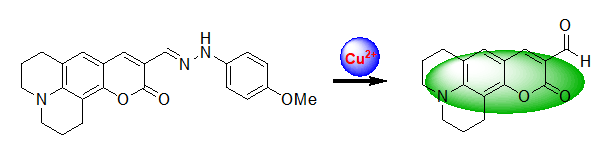
Referring to the accurate and reliable detection of Cu2+ levels, fluorescent probe is a rapidly growing area due to its appealing merits such as high sensitivity, specificity, and rapid response, enabling successful application in practical sample detection.[5] With these considerations in mind, herein, we developed a “switching-on” fluorescent probe for Cu2+ detection. In organic chemistry, hydrazone derivatives are usually used as protecting groups for carbonyl compounds, and carbonyl compounds can be readily regenerated from hydrazones by undergoing catalytic hydrolysis with Cu2+ ions.[6] This special catalytic regeneration of carbonyl compounds from hydrazone derivatives promoted by Cu2+ ions can be utilized to develop Cu2+-specific chemical probes. For this purpose, compound C2 was designed composed of a coumarin moiety and phenylhydrazone group as shown in Scheme 1. The coumarin moiety was selected to act as the fluorophore with relatively good solubility and high fluorescence quantum yield in water media[7] and the phenylhydrazone group was chosen as a putative Cu2+-dependent reactive subunit.[8] It is reasonable to deduce that the remarkably different fluorescent properties of C2 and its hydrolyzed product will be greatly helpful to report the presence of Cu2+ ions. Therefore, this special catalytic hydrolysis reaction can be exploited as an interesting platform for the design of optical probes towards Cu2+ ions. As demonstrated in Scheme 1, copper ions could undergo complexation with phenylhydrazone group in compound C2,[9] and this unique coordination effect could weaken the C=N double bond, enabling the consequent hydrolysis reaction become more easily to carry out and then trigger the conversion to aldehyde C1, resulting in the photoswitch from fluorescence “off” to “on”. As a result, under the dual action of complexation and catalytic hydrolysis, probe C2 could act as a Cu2+-specific probe via a turn-on approach. Herein, we would like to describe the synthesis and the spectroscopic evaluation of the coumarin-derivative-based catalytic fluorescent probe for Cu2+ in detail, featuring advantages such as “turn-on” fluorogenic sensing, good selectivity, high sensitivity, naked eye detection, as well as the practical application in gas-generating agents detection.

2 Results and discussion
2.1 Synthesis and structural characterization
Compound C2 was readily synthesized through the con- densation reaction between aldehyde C1 and 4-metho-xyphenylhydrazine. Here, aldehyde groups were chosen instead of ketone carbonyl groups to reduce the steric hindrance and accelerate the reaction rates. Besides, the para methoxy group increased the electron density, making the nucleophilic reactions much easier. The target compound exhibited good solubility in common organic solvents, such as CHCl3, acetone, CH3CN, N,N-dimethylformamide (DMF), dimethyl sulfoxide (DMSO), CH3CN, and tetrahydrofuran (THF). Its structure was well characterized by 1H NMR, 13C NMR, electrospray ionization-mass spectroscopy (ESI-MS) and elemental analysis (EA), and all gave satisfactory spectral data.
2.2 Sensing properties of C2 toward Cu2+ ions
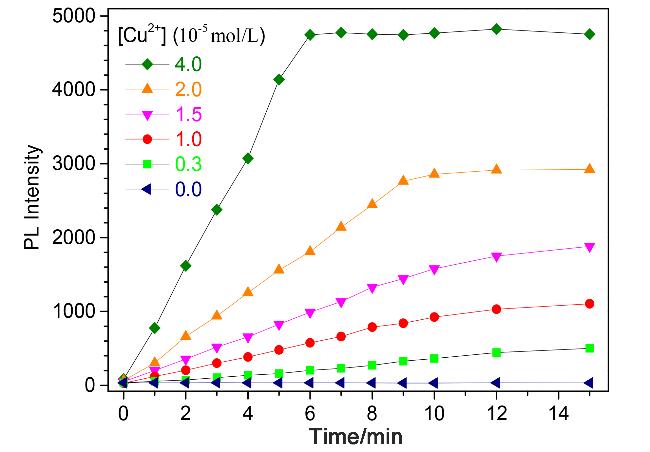
Firstly, the sensing time course was optimized with the obtained results summarized in Figure 1. Since the present sensing process relied on the catalytic hydrolysis reaction with Cu2+ ions and hydrazone moiety, thus, the reaction rate might affect the experimental results. As shown in Figure 1, when the concentration of Cu2+ ions was lower than 1.5×10⁻⁵ mol/L, there were gradual changes in the emission intensity from 0 to 10 min. After 10 min the changes on emission intensity leveled off. When the concentration of Cu2+ reached to 2.0×10⁻⁵ mol/L, a plateau of emission spectra could be achieved after 9 min. With the concentration of Cu2+ increasing to 4.0×10⁻⁵ mol/L, only 6 min was needed to achieve a plateau. That was to say, in high concentrations, the reaction almost completed within 6 min. While in low concentrations, the reaction time was longer, owing to the different catalytic capacity of different amounts of Cu2+ ions. So, in the titration experiment, we measured the emission intensity changes of C2 solutions 10 min later after all the species were added.
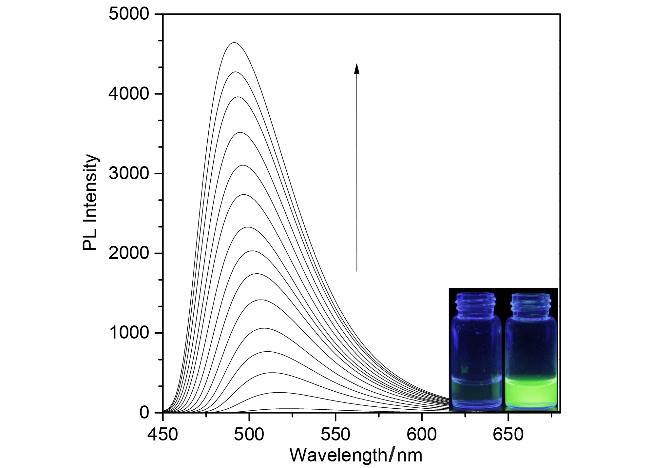
Then, Cu2+ ions were added into the diluted solution of compound C2 and its sensing behaviour in THF-HEPES (V/V=1/9) was investigated in detail. As shown in Figure 2, the emission intensity changed gradually with the increasing concentration of Cu2+ ions, while the fluorescence quantum yield increased from 0.05 to 0.67. Meanwhile, the maximum emission wavelength shifted from 520 nm to 490 nm. Actually, even at the concentration of Cu2+ as low as 2.0 μmol/L, apparent spectra changes could be observed with respect to the blank solution, indicating that fluorescent probe C2 had rather high sensitivity towards Cu2+ ions. When the concentration of Cu2+ ions increased to 35 μmol/L, the emission intensity reached the maximum with 470-fold enhancement (emission intensity at 490 nm changing from 10 to 4700). Correspondingly, the luminescence color changed from non-fluorescence to strongly green fluorescence (Figure 2, Inset), which could be easily distinguished by the naked eyes under the aid of a normal UV lamp. Thus, these results indicated that upon the addition of Cu2+ ions, the Cu2+-promoted hydrolysis process of hydrazone moiety really occurred as expected, and the aldehyde compound was regenerated step by step.
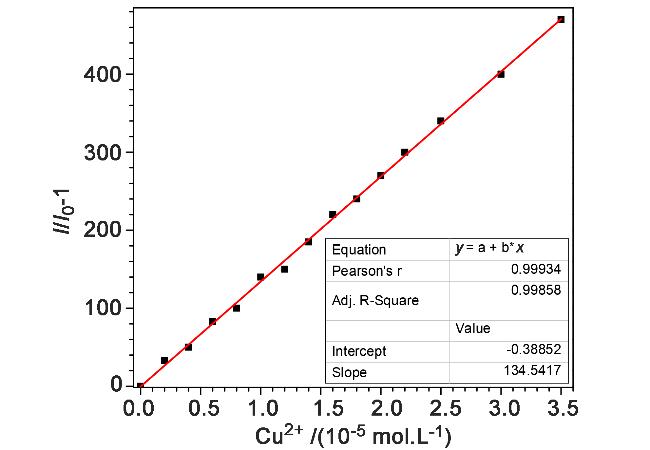
Well-behaved fluorescent probes should not only be good at qualitative analysis, but also measure the analytes quantitatively. Thus, the linearity of C2 was investigated via the fluorescence titration. As shown in Figure 3, with the amount of Cu2+ gradually increasing, the fluorescent intensity increased step by step. An excellent linear relationship was obtained between emission intensity changes and the concentration of Cu2+ ions in the range from 0 to 3.5× 10⁻⁵ mol/L. The regression equation is y=-0.38852+134.5417x, where y is emission intensity changes (I/I0-1, where I0 and I represent fluorescence intensities at 490 nm in the absence and presence of Cu2+, respectively), and x is the concentration of Cu2+ ions. According to the linear curve, R2 of probe C2 was calculated to be 0.9986, exhibiting good linearity and exact quantitative detection toward the concentration of Cu2+. The detection limit was then calculated according to the equation: detection limit=3σ/k, where σ is the standard deviation of blank measurements, k is the slope from the plot in Figure 3. To determine the S/N ratio, the emission intensity of C2 without Cu2+ ions was measured by 10 times and the standard deviation of blank measurements (σ) was determined. Accordingly, the detection limit of probe C2 was calculated to be as low as 1.5× 10⁻⁷ mol/L,[10] which was acceptable within the US Environmental Protection Agency (EPA) limit (ca. 2.0×10⁻⁵ mol/L) for the detection of Cu2+ in drinking water.[11] In short, the results of the fluorescent titration experiments confirmed our idea mentioned above: accompanying with the coordination between C2 and Cu2+ ions, the aldehyde compounds could be readily regenerated from hydrazones and gave detectable fluorescent signal in response to the presence of Cu2+ ions.
Generally, fluorescence enhancement response is more desirable for analytical purposes than fluorescence quen- ching in which variations in the environmental sample and probe distribution are problematic for quantitative measurements.[12] However, the construction of switching-on fluorescent probe for metal ions is still challenging due to the metal to ligand charge transfer (MLCT)-based heavy metal ion effect and resultant fluorescence quenching. Alternatively, chemical reaction-based probes have been developed to achieve emission enhancement by reacting with Cu2+ to generate products with weak affinity to copper ions, thus avoiding the fluorescence quenching caused by heavy metal ion effect. Therefore, the method in this work would afford us a good approach to develop novel “turning-on” fluorescent probes for metal ions by combining the conventional coordination approach and the potential reaction-based strategy.
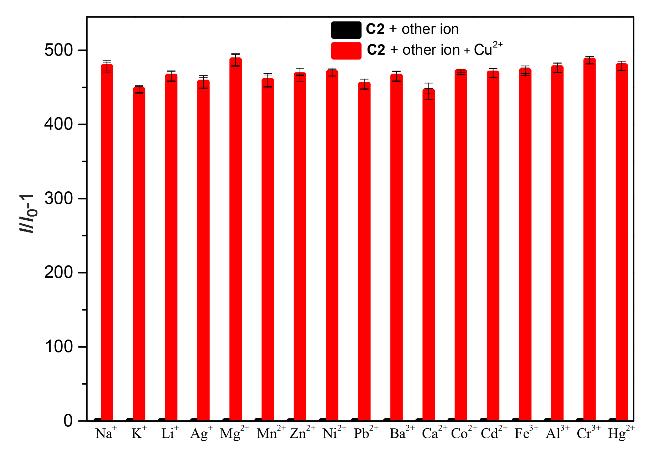
To evaluate the specific nature of C2 towards Cu2+ ions, the influence of other metal ions was investigated under the same condition. These competitive species did not induce any significant fluorescence changes of C2, and only Cu2+ elicited dramatic fluorescence spectra response. Also, the large fluorescence changes of C2 induced by Cu2+ ions could be observable by the naked eyes. When probe C2 was excited at 365 nm using UV lamp in the presence of various metal ions, only Cu2+ could cause a strong green luminescence. Moreover, the response of C2 to Cu2+ ions was investigated in the presence of other competitive ions. As shown in Figure 4, the presence of other background ions did not show any obvious disturbance to the signal response induced by Cu2+ ions. The above results indicated that probe C2 could act as a “switching-on” fluorescent probe for the detection of Cu2+ ions with good selectivity and strong anti-interference ability. It is noteworthy that the conventional fluorescent probes for Cu2+ based on the coordination approach are subject to interference from Co2+ and Zn2+ ions due to their similar coordination property. Fortunately, in the present sensing system, the special catalytic hydrolysis reaction induced by Cu2+ ions endowed probe C2 with superior selectivity. It was clear that the performance of probe C2 was among the best results of the reaction-based sensing approach for Cu2+ ions.
2.3 Investigation of sensing mechanism
In order to explore the proposed sensing mechanism, the UV-vis and emission spectra of compound C2 were measured before and after the addition of Cu2+ ions, compared with that of aldehyde C1. The UV-vis absorption maximum wavelength of C2 centered at about 425 nm. After the addition of 4 equiv. of Cu2+ ions and cultivated for 10 min, the maximum absorption wavelength of the resulting product shifted to 460 nm, which was similar to that of aldehyde C1. Furthermore, the fluorescent intensity increased dramatically upon the addition of Cu2+ ions with the maximum emission wavelength shifting from 490 nm to 520 nm, and the spectra became almost identical to that of C1. The above results indicated that after the catalytic hydrolysis reaction promoted by Cu2+ ions, the electronic property of the phenylhydrazone group changed, resulting in the different intramolecular charge transfer (ICT) efficiency and different fluorescent behaviors.
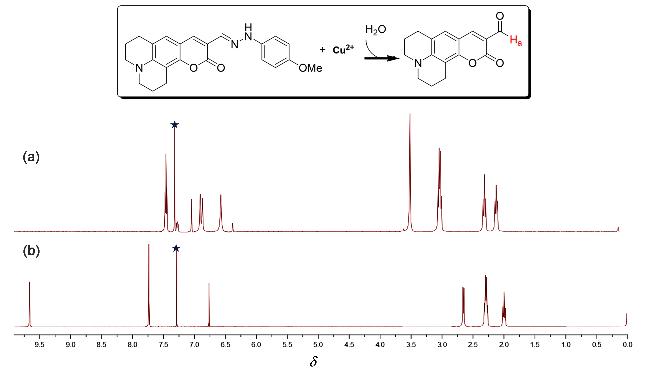
Furthermore, the reaction of compound C2 with 20 equiv. of Cu2+ ions was carried out in THF-H2O (V/ V=5/5) solution. After stirring at ambient temperature for 10 min, a new thin layer chromatography (TLC) point with strong green fluorescence was observed and its retardation factor (Rf) was very close to that of compound C1. And then the reaction products was purified and characterized by 1H NMR spectrometry as shown in Figure 5. After the reaction with excess of Cu2+, the methoxy group signal at δ 3.50 disappeared and the resonance signal corresponding to the aromatic proton decreased obviously due to the hydrolysis of the phenylhydrazone group. Meanwhile, the signal at δ 9.70 assigned to the proton Ha emerged due to the formation of aldehyde group. Correspondingly, the sensing mechanism of the present system was speculated as Scheme 1. The phenylhydrazone group was selected to afford efficient t complexation with cupric ion (Cu2+) and also serve as an appropriate hydrolytic cleavage reactive subunit. Firstly, the added cupric ion could coordinate with C2 and induced the ligand-to-metal charge transfer process, which might improve the reactivity of C=N bond in C2. Next, the followed nucleophilic attack by H2O resulted in the loss of the phenylhydrazine unit and forming the aldehyde. To the end, the synergy of both processes enabled probe C2 to detect Cu2+ ions with a switching-on fluorescent response.


2.4 Practical application in gas-generating agents
As discussed above, CuO is widely utilized in the gas- generating agents acting as both oxidant and catalyst. Herein, encouraged by its excellent sensing performance toward Cu2+ ions, the practical application of probe C2 was explored to detect the concentration of Cu2+ ions in real gas-generating agent samples. The addition of CuO sample solution (Solution A) led to marked increase (I/I0-1=122, the average of five measurements) in the emission intensity of the sensing system. According to the equation of linear regression in Figure 3, the concentration of Cu2+ could be calculated as 0.97×10⁻⁵ mol/L. Correspondingly, the final concentration of Cu2+ in Solution A could be calculated as 9.7×10⁻³ mol/L and the mass of CuO samples was accordingly calculated to be 771.1 mg, which was well consistent with the purity of 98% labeling on the product manual. Moreover, the standard addition method was utilized to determine the concentration of Cu2+ in the spiked samples. The Cu2+-spiked Solution A samples were investigated using the same method and each measurement was done in quintuplicate. The addition of Solution A samples spiked with Cu2+ led to larger increase (I/I0-1=245) in the fluorescence spectra and the total concentration of Cu2+ in this sample was calculated to be 1.95×10⁻⁵ mol/L. Eliminating the Cu2+ in Solution A, we calculated the spiked Cu2+ as 0.98×10⁻⁵ mol/L, which was in good agreement with the true values. The above results confirmed the feasibility and reliability of the proposed probe for Cu2+ detection in real commercial CuO samples. More importantly, this convenient detection approach would be helpful to assess the quality of CuO raw materials and improve production efficiency.
In addition, we tested the content of copper in the forming agent to assess the uniformity of material mixing. The contents of copper were measured according to the same method and the emission spectra were demonstrated in Figure S9. The average concentration of copper in the randomly selected eight sample was calculated to be 1.42×10⁻⁵ mol/L (I/I0-1=185) according to the calibration curve. Correspondingly, the content of CuO was determined to be 5.6 mg, which was well consistent with the formulation of 5.5% CuO. Moreover, the fluctuation of copper content was very small, indicating that copper was evenly distributed and thoroughly mixed. This approach here will provide a convenient, fast, and reliable evaluation method for the selection of mixing technology and parameter settings in actual industrial production.
3 Conclusions
In conclusion, a new fluorescent probe for Cu2+ ions was conveniently constructed with dramatic fluorescence enhancement response. Target compound C2 was designed skillfully, appending phenylhydrazone unit enabled efficient complexation with Cu2+ on the one hand and acted as a reactive subunit for catalytic hydrolysis reaction on the other. Here, Cu2+ ions acted as a complexant as well as an efficient catalyzer to promote the apparent fluorescent signal amplification. Through the fluorescent method, the detection limit of probe C2 was calculated to be as low as 150 nmol/L and there was a good linear relationship between the intensity change and the concentration of Cu2+ ions. It was worth noting that the efficient detection of C2 toward Cu2+ was also performed in the practical detection in gas-generating agents. The method in this work afforded a novel and reliable approach to evaluate the raw material specifications and the mixing technology in actual industrial production.
4 Experimental section
4.1 Materials and instrumentations
All reagents were of analytical reagent grade and used without further purification. Deionized water was used in all experiments. Inorganic salts were purchased from Shanghai Chemical Reagent Co. (Shanghai, China). Ethanol was dried over and distilled from Na under an atmosphere of dry nitrogen. N,N-Dimethylfomamide (DMF) was dried with CaH2 under an atmosphere of dry nitrogen and distilled.
1H NMR and 13C NMR spectra were measured on a Bruker500 spectrometer using tetramethylsilane (TMS, δ=0) as internal standard. Melting points were measured on a Beijing Taike XT-4 microscopy melting point apparatus, and the thermometer was uncorrected. Elemental analyses were performed on a CARLOERBA-1106 microelemental analyzer. The ESI MS (mass spectra) were measured on a Finnigan LCQ advantage mass spectrometer. Photoluminescence spectra were performed on a Hitachi F-7000 fluorescence spectrophotometer. The pH values were determined by using a DELTA 320 PH dollar.
4.2 Synthesis of compound C2
10-Oxo-2,3,5,6-tetrahydro-1H,4H,10H-11-oxa-3a-aza-benzo[de]anthracene-9-carbaldehyde (C1) was readily syn- thesized according to the literature (yellow solid, 83%).[13] 1H NMR (500 MHz, CDCl3) δ: 10.06 (s, 1H), 8.06 (s, 1H), 6.93 (s, 1H), 3.38 (t, J=10.0 Hz, 4H), 2.86 (t, J=7.5 Hz, 2H), 2.75 (t, J=10.0 Hz, 2H), 1.96~1.99 (m, 4H); 13C NMR (125 MHz, CDCl3) δ: 187.8, 162.1, 153.7, 149.3, 144.8, 128.2, 119.8, 112.6, 108.0, 106.0, 50.3, 49.9, 27.2, 20.8, 19.8; MS (ESI) m/z (rel./cal.): 269.8/270.1 [M+H]+.
Compound C1 (322 mg, 1.2 mmol) and 4-methoxy- phenylhydrazine (345 mg, 2.5 mmol) in ethanol (10 mL) were stirred at room temperature overnight. After the reaction, the solvent was removed under reduced pressure. The resultant residue was purified by silica gel column chromatography (dichloromethane/ethyl acetate/methanol, V/V/ V=35/5/1) to afford 10-oxo-2,3,5,6-tetrahydro-1H,4H,10 H-11-oxa-3a-aza-benzo[de]anthracene-2-(4-methoxyphen-yl)hydrazine (C2) as orange solid (285 mg, 61% yield). m.p. 214~216 ℃; 1H NMR (500 MHz, CDCl3) δ: 7.50 (t, J=5.0 Hz, 1H), 7.23~7.24 (m, 1H), 7.01 (s, 2H), 6.88 (d, J=15.0 Hz, 1H), 6.53 (s, 2H), 6.36 (s, 1H), 3.42 (s, 3H), 2.95 (q, J=10.0 Hz, 4H), 2.21 (t, J=10.0 Hz, 4H), 2.01 (t, J=5.0 Hz, 4H); 13C NMR (125 MHz, CDCl3) δ: 156.1, 140.1, 138.0, 133.1, 132.1, 129.9, 129.5, 124.4, 120.2, 115.1, 112.1, 45.4, 42.4, 41.9, 36.5, 28.0. MS (ESI) m/z (rel./cal.): 389.8/390.2 [M+H]+. Anal calcd for C16H16- N2O3: C 70.93, H 5.95, N 10.79; found C 70.66, H 5.97, N 10.84.
4.3 Preparation of solutions of metal ions solution
1 mmol of each inorganic salt (Cu(NO3)2, 187 mg; NaNO3, 85 mg; KNO3, 100 mg; LiCl, 42 mg; AgNO3, 170 mg; MgSO4, 120 mg; MnSO4•2H2O, 186 mg; Zn(NO3)2• 6H2O, 296 mg; Ni(NO3)2•6H2O, 290 mg; Pb(NO3)2, 332 mg; Ba(NO3)2, 262 mg; Ca(NO3)2•4H2O, 186 mg; CoCl2• 6H2O, 237 mg; CdSO4•8H2O, 354 mg; Fe(NO3)3•9H2O, 404 mg; Al(NO3)3•9H2O, 375 mg; Cr(NO3)3•9H2O, 400 mg; Hg(ClO4)2•3H2O, 399 mg) was dissolved in deionized water (10 mL) to afford 0.1 mol/L aqueous solution. The stock solutions could be diluted with water to the desired concentrations when needed.
4.4 Fluorescence titration of C2 with Cu2+ ions
A solution of C2 (10×10-6 mol/L) was prepared in THF/HEPES (V/V=1/9, 10 mmol/L, pH=7.1). The obtained solution of C2 was placed in a quartz cell (10.0 mm width) and the fluorescence spectrum was recorded. The Cu2+ ion solution was introduced in portions and fluorescence intensity changes were recorded at room temperature each time. Excitation wavelength is 410 nm.
4.5 Fluorescence titration of C2 with other ions
A solution of C2 (10×10-6 mol/L) was prepared in THF/HEPES (V/V=1/9, 10 mmol/L, pH=7.1). The obtained solution of C2 was placed in a quartz cell (10.0 mm width) and the fluorescence spectrum was recorded. Then, the Cu2+ ion solution (35 μmol/L) or other metal ion (100 μmol/L) was introduced in turn and fluorescence intensity changes were recorded at room temperature each time. In the coexistence ion interference experiment, the competitive ions (100 μmol/L) were added into the solution of C2 firstly to test the fluorescence spectrum, and then copper ions (35 μmol/L) were added continually to test the fluorescence spectrum under the same conditions.
4.6 Quantum yield calculation
Quantum yield was determined according to the equation as follows:
$\Phi_{F(\text { sample })}=\left(\frac{A_{\text {standard }}}{A_{\text {sample }}}\right)\left(\frac{F_{\text {sample }}}{F_{\text {standard }}}\right) \Phi_{F(\text { standard })}$
ΦF was the fluorescence quantum yield, A was the absorbance, F was the area under the corrected emission curve. Here, fluorescein was used as the standard; the quantum yield of fluorescein in 0.1 mol/L NaOH was 0.90.[14]
4.7 Practical application in gas-generating agents
The general pre-treatment procedure of the samples was randomly selected and weighed accurately with an analytical balance. Next, the above sample was dissolved in nitric acid and the insoluble substances were removed through filtration. Then, the obtained filtrate was transferred to a volumetric flask and diluted with deionized water to the required concentration for test. Firstly, 795 mg of the commercial CuO sample was dissolved in 10 mL of nitric acid (mass fraction: 68%). The above solution was filtered and diluted 100 times in deionized water to obtain the stock solution, namely, Solution A. 10 μL of Solution A was then added directly to 10 mL of probe C2 (10 μmol/L, THF/ HEPES, V/V=1/9) and the effect on the total volume of solution induced by the addition of Solution A was negligible. The resulting solution was shaken well. After 10 min, the fluorescence intensity was recorded at room temperature. In the standard addition method assay, the concentration of 1.0×10⁻² mol/L Cu2+ standard solution was spiked into Solution A. The Cu2+-spiked samples were investigated using the same method and each measurement was done in quintuplicate. Excitation wavelength is 410 nm.
In the uniformity testing experiment, specifically, eight samples (with the same weight of 100 mg) of gas generators from the same batch were ground and dissolved in 10 mL of nitric acid. The obtained solution was filtered and diluted 10 times in deionized water for analysis. 200 μL of above gas generator sample solution was then added directly to 10 mL of probe C2 (10 μmol/L, THF/HEPES, V/V=1/9) and the resulting solution was shaken well. After 10 min, the fluorescence intensity was recorded at room temperature.
Supporting Information The synthetic route, 1H NMR and 13C NMR spectra of compound C2, anti-interference test of C2, comparison of absorption and fluorescence spectra of C1 and C2, TLC of C2 and the product of C2 with excess Cu2+, emission profile of C2 in the presence of CuO samples and gas-generating agent samples. The Supporting Information is available free of charge via the Internet at http://sioc-journal.cn/.
(Lu, Y.)