ARTICLES

Visible-Light-Induced Diborylation to Access gem-Diborylalkanes

  • Bowen Ren a ,
  • Tongchang Fang b ,
  • Chao Liu , a, b, *
Expand
  • a State Key Laboratory for Oxo Synthesis and Selective Oxidation, Lanzhou Institute of Chemical Physics, Chinese Academy of Sciences, Lanzhou 730000
  • b State Key Laboratory of Coordination Chemistry, Institute of Green Chemistry and Engineering, School of Chemistry and Chemical Engineering, Nanjing University, Suzhou, Jiangsu 215163

Academic Papers of the 27th Annual Meeting of the China Association for Science and Technology.

Received date: 2025-04-17

  Revised date: 2025-06-09

  Online published: 2025-07-18

Abstract

A metal-free, visible-light-induced strategy has been developed for the diborylation of gem-dibromoalkanes. This reaction enables the construction of structurally diverse alkyl gem-diboronates at room temperature via visible-light-induced C—Br bond activation using B₂cat₂ as the boron source. Through a tandem in-situ dibromination/diborylation process, a one- pot transformation from aldehydes to alkyl gem-diboronates has been achieved. Additionally, sunlight irradiation has been demonstrated as a viable alternative for inducing this reaction, enabling gram-scale synthesis with practical applicability.

Cite this article

Bowen Ren , Tongchang Fang , Chao Liu . Visible-Light-Induced Diborylation to Access gem-Diborylalkanes[J]. Chinese Journal of Organic Chemistry, 2025 , 45(9) : 3343 -3350 . DOI: 10.6023/cjoc202504018

1 Introduction

Organoboron reagents play a crucial role in nowadays synthetic community. Among various organoboron reagents, the gem-diborylalkanes have become important buil- ding blocks because of the transformable ability of the geminal C—B bonds.[1] In this aspect, they have been more and more utilized for the construction of various functional molecules. Thus, developing mild and practical methods for synthesizing gem-diborylalkanes is in high demand.[2]
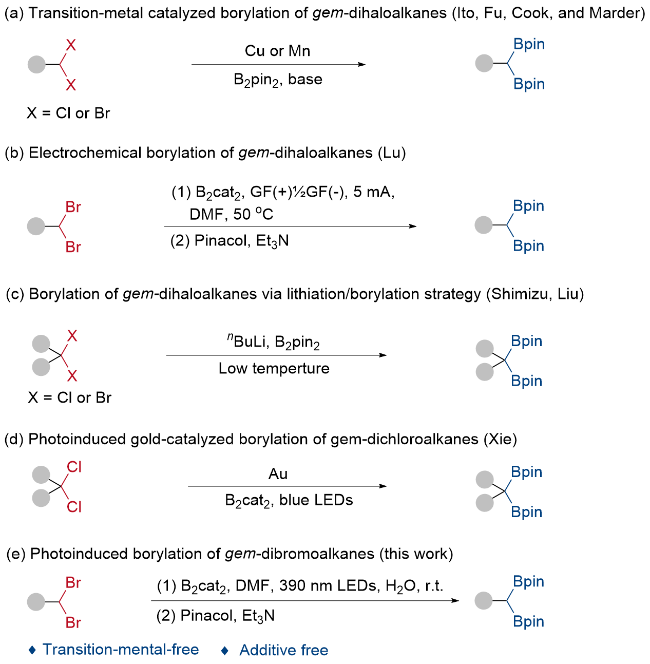
The borylation of organohalides has become a promising strategy for the synthesis of various organoboron compounds.[3] However, the gem-dihalides have been less applied in borylative transformations. Transition-metal catalysis using Cu (the Ito, Fu, Marder groups) or Mn (the Cook group) salts has been performed to achieve the gem-dibo- rylation of gem-dihaloalkanes with few examples (Scheme 1a).[4] Recently, electrochemical borylation of gem-dihalo- alkanes has been achieved by the Lu group (Scheme 1b).[5] As a practical strategy, the 1,2-metalate rearrangement of tetracoordinated boron has also been utilized to convert gem-dihaloalkane to gem-diborylalkanes. The Shimizu group[6a] reported the borylation of 1,1-dibromocyclopro-panes via lithiation/borylation strategy. Our group[6b-6d] have synthetized halogenated gem-diborylmethanes from polyhalomethanes through this strategy (Scheme 1c). Obviously, more attention is still required to realize practical and versatile borylation of gem-dihaloalkanes. To date, the significant progress on photoinduced borylation of alkyl halides has been made.[7] Comparably, photoinduced borylation has mild conditions and would be easy-handling. The Xie group[8] developed a photoinduced gold-catalyzed borylation strategy for gem-dichloroalkanes with broad substrate scopes (Scheme 1d). Recently, our group[9] have reported a rapid and practical method to prepare diverse gem-dibromoalkanes from aldehydes, which provides us a chance to further investigate the direct diborylation of gem- dihaloalkanes. Herein, we disclosed a practical visible- light-induced additive-free protocol for the borylation of gem-dibromoalkanes to access gem-diborylalkanes under mild conditions, and sunlight is also powerful enough for promoting the reaction with gram-scale synthesis (Scheme 1e).
Scheme 1 Borylation of gem-dihaloalkanes to synthesize gem-diborylalkanes

2 Results and discussion

The optimal conditions by using (3,3-dibromopropyl)- benzene (2a) were initially explored as the standard substrate. After investigating a variety of reaction parameters, it was determined that the combination of 2,2'-bis-1,3,2- benzodioxaborole (B₂cat₂) (2.5 equiv.) and N,N-dime- thylformamide (DMF) (0.4 mol/L) could enable the borylation reaction in good yield with 2.5 equiv. H₂O at ambient temperature under irradiation of 390 nm LEDs (light emitting diodes) (Table 1, Entry 1). The control experiment indicated that excessive B2cat2 was necessary for the high yield (Table 1, Entry 2). When using B2(OH)2 and B2pin2 as boron source, no product was detected (Table 1, Entries 3 and 4). And the addition of slight water would facilitate the reaction system to be homogeneous benefit for photochemistry reaction. However, an excess of water proved detrimental to the reaction system, possibly due to the hydrolysis of B2cat2 (Table 1, Entries 5 and 6). In comparison to DMF, the similar amide-based solvent N,N- dimethylacetamide (DMAc) was less efficient for the rea-ction (Table 1, Entry 7). And 460 nm LED is not powerful enough for the reaction system (Table 1, Entry 8). Trace amounts of product were detected when the reaction was conducted in a dark atmosphere (Table 1, Entry 9).
Table 1 Preliminary investigationa
Entry Variation from the standard condition Yield/%
1 None 82 (81)b
2 2.0 equiv. B2cat2 67
3 B2(OH)2 instead of B2cat2 n.d.
4 B2pin2 instead of B2cat2 n.d.
5 Without H2O 76
6 5.0 equiv. H2O 66
7 DMAc instead of DMF 59
8 460 nm LEDs instead of 390 nm LEDs 30
9 Dark 4


a Reaction conditions: 2a (0.4 mmol), B2cat2 (2.5 equiv.), H2O (2.5 equiv.), 390 nm LEDs, DMF (1.0 mL), room temperature (r.t.), 24 h; then pinacol (5.0 equiv.), Et3N (1.0 mL), r.t., 1 h. Yields were determined by GC analysis with naphthalene as the internal standard. b Isolated yield.

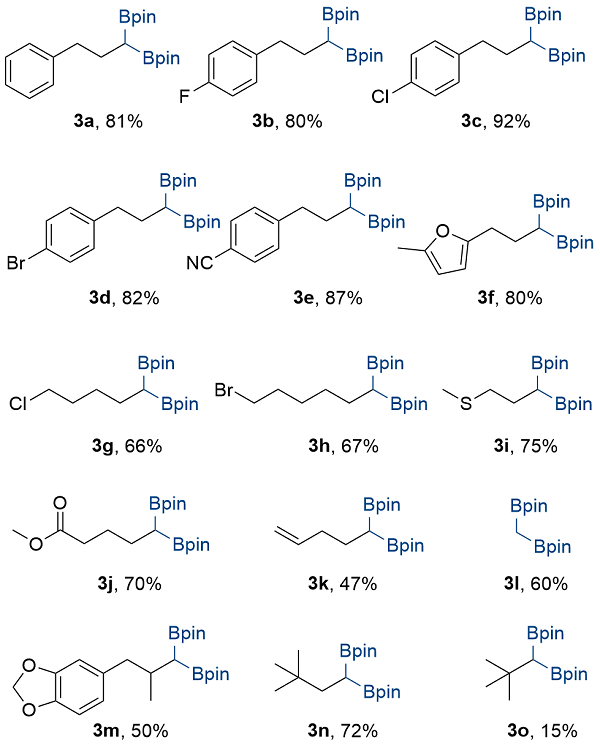
With the optimal condition in hand, the substrate scope was explored. A wide range of gem-dibromoalkanes were then evaluated (Table 2). Substrates with aromatic rings were more reactive under the given condition (3a~3f). Aryl rings with halogen substitutes, including F, Cl, Br, were well reserved during the borylation process (3b~3d). Substrate with electron-deficient cyano group also tolerated the conditions with excellent yield (3e). Electron-rich heterocyclic substrate was shown to be suitable substrate and the desired product 3f was obtained in 80% yield. The substrates with three halogens could proceed chemoselective conversions with only gem-diborylation of gem-dibromo units, preserving the halogens, including Cl, Br, which gave the molecules more diverse transformation potentiality (3g, 3h). Such results showed the gem-diborylation reaction highly relied on the reactivity of gem-dibromo units.
Table 2 Substrate scopea

a Reaction conditions: 2 (0.4 mmol), B2cat2 (2.5 equiv.), H2O (2.5 equiv.), 390 nm LEDs, DMF (1.0 mL), r.t., 24 h; then pinacol (5.0 equiv.), Et3N (1.0 mL), r.t., 1 h. Yields are based on isolated products.

Thioether group and ester group were compatible in the borylation reaction (3i, 3j). Although there are examples for borylation of unsaturation systems by B2cat2,[10] the reaction condition is suitable for the substrate containing terminal olefin (3k). Commercially available dibromomethane gave the product in 60% yield (3l). α-Secondary and β-tertiary substituted gem-dibromoalkane had moderate yields (3m, 3n). But the conversion ability of α-tertiary substituted aldehyde is deficient under the condition (3o).
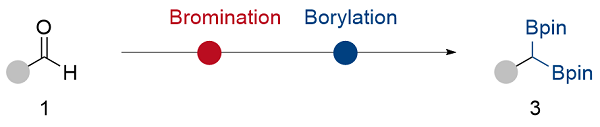
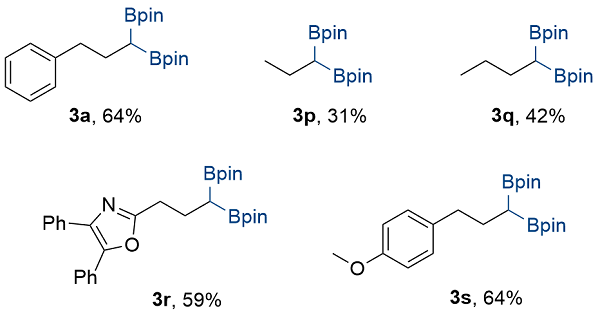
As mentioned above, we have developed an efficient protocol to the synthesis of gem-dibromoalkanes. To verify the practicality of borylation protocol, a tandem method from aldehydes to gem-diborylalkanes was developed. In 2017, our group[2c] had developed an efficient protocol to the synthesis of gem-diborylalkanes from aldehydes directly using α-oxyboronates as leaving group. Here, by the tandem protocol, the pathways from aldehydes to gem-diboryl-
alkanes were also realized with transition-metal- and additive-free condition (Table 3). Substrates bearing aryl rings and alkyl chains were converted to corresponding gem-di- borylalkanes in moderate yields (3a, 3p~3s).
Table 3 Tandem reactions from aldehydes to gem-diboryla- lkanesa

a Reaction conditions: 1 (0.4 mmol), nBu4NBr3 (1.1 equiv.), P(OPh)3 (1.1 equiv.), r.t., 1,2-dichloroethane (DCE, 1.0 mL), 0.5 h; then B2cat2 (2.5 equiv.), H2O (2.5 equiv.), 390 nm LEDs, DMF (1.0 mL), r.t., 24 h; then pinacol (5.0 equiv.), Et3N (1.0 mL), r.t., 1 h. Yields are based on isolated products.

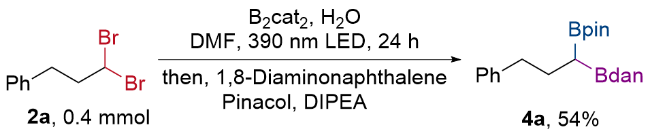
The unsymmetrical formation of gem-diborylalkanes was attractive due to the diverse transformation ability of the two boryl groups. Usually, the hydroboration of alkenes and alkynes was efficient method to the synthesis of unsymmetrical gem-diborylalkanes.[2e,11] And utilizing Bpin-Bdan to react with N-tosylhydrazones is also an alternative way.[12] Here, with the two Bcat groups, we designed to proceed diverse transesterification to prepare the unsymmetrical gem-diborylalkanes (Scheme 2). To our pleasure, this protocol was feasible, and a moderate yield of 4a was obtained.
Scheme 2 Unsymmetrical formation of gem-diborylalkanes
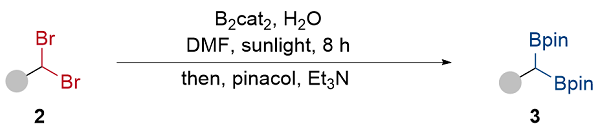
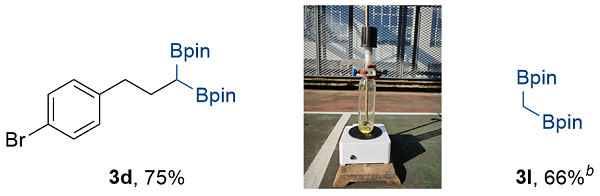
Natural solar energy is often used in photochemistry, which is secure, green, sustainable, and easily available.[13] We think it would be a good choice for gram-scale reactions (Table 4). gem-Dibromoalkane 2a was used first to test the conditions. Fortunately, the gem-diborylation reaction also proceeded efficiently under the sunshine in 72% isolated yield (3a). Besides, the bromine substituent on the aryl group was retained (3h). Then, a gram-scale reaction was carried out. Commercial-available dibromomethane was converted to the corresponding product in moderate yield (3l).
Table 4 Sunlight induced borylation reactionsa

a Reaction conditions: 2 (0.4 mmol), B2cat2 (2.5 equiv.), H2O (2.5 equiv.), sunlight, DMF (1.0 mL), r.t., 24 h; then pinacol (5.0 equiv.), Et3N (1.0 mL), r.t., 1 h. Yields are based on isolated products. b The reaction was carried out in 5.0 mmol scale, 0.89 g product was obtained.

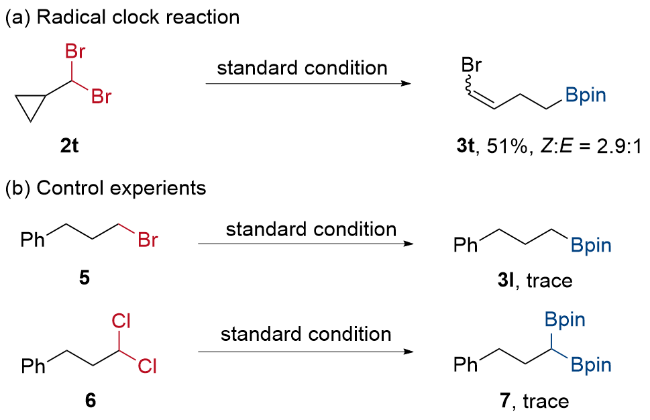
Then, a radical clock experiment was carried out (Scheme 3a). (Dibromomethyl)cyclopropane was converted to the ring-open product 3t in 51% yield, indicating an α-bromo radical was generated. Light on-off experiments were also carried out. As a result, the yield did not increase in dark condition, which showed the necessity of the light sources for the efficient conversion. To have a deeper understanding of the reaction, control experiments were conducted (Scheme 3b). Alkyl bromide 5 was not reactive at the condition. Furthermore, gem-dichloroalkane 6 could not convert to corresponding product effectively. These results suggest that two C—Br bonds are critical for the efficient borylation reaction.
Scheme 3 Mechanistic experiments
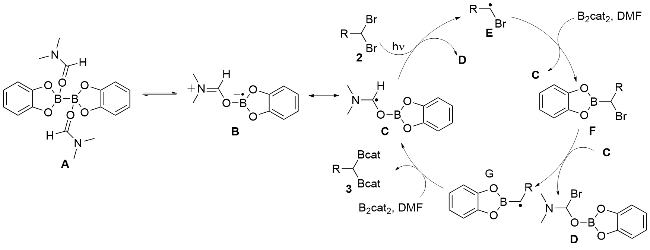
Based on the above results and previous reports,[5,7b,7d,7e,14] a plausible mechanism is depicted in Scheme 4. The reaction is initiated by the thermal homolytic fragmentation of the DMF/B2cat2 (2:1) complex A, giving the DMF-stabi- lized boryl radical B, which can be tautomerized into carbon radical C. The radical C then interacts with gem-dibromide 2 generating an α-bromo radical E under excitation by visible light. Subsequently, E would transform into α-boryl radical G via reacting with B2cat2/DMF and halogen (Br) atom transfer. The radical G would interact with B2cat2/ DMF again to give the product gem-diborylalkanes 3, and another carbon radical C would form to participate in the subsequent cycle.
Scheme 4 Proposed mechanism

3 Conclusions

In conclusion, a mild and practical borylation protocol was developed for gem-dibromoalkanes. Under metal- and additive-free conditions, the reaction gave products in good to excellent yields with broad substrate scope. To show the practicality of the reaction, tandem reactions were also developed from aldehydes to the corresponding products. Pinacol was often used for transesterification of Bcat, here, with gem-diboryl units. The unsymmetrical formation of gem-diborylalkane was realized. Moreover, sunlight was also efficient for the reaction, giving a convenient way for gram-scale reactions. Radical clock experiment supported the radical mechanism.

4 Experimental section

4.1 General information

All reactions were isolated from moisture and oxygen by a nitrogen atmosphere with a sealed tube. All glassware was oven dried at 110 ℃ for 1 h and cooled down under vacuum. Unless otherwise noted, materials were obtained from commercial suppliers and used without further purification. Thin layer chromatography (TLC) employed glass 0.25 mm silica gel plates. Flash chromatography columns were packed with 100~200 mesh silica gel or through Sepa- BeamTM Machine SPB-3006012. Gas chromatographic analysis was performed on a GC-2010 Plus gas chromatography instrument with an FID detector. GC-MS spectra were recorded on a GCMS-QP2010 SE. The high-reso- lution mass spectra (HRMS) analyses were performed on an Agilent 6530 Accurate-Mass Q-TOF LC/MS with ESI mode. NMR spectra were recorded on a 400 MHz for 1H NMR and 101 MHz for 13C NMR, using tetramethylsilane as an internal reference and CDCl3 as the solvent. Chemical shift values for protons are referenced to residual proton of TMS (δ 0.00), and chemical shifts for carbons are referenced to the carbon resonance of CDCl3 (δ 77.0). The boron-bound carbon was not detected due to quadrupolar relaxation. The violet LED lamps were purchased from GeAo Chemical (8-hole photoreactor, 40 W, 385~395 nm).

4.2 General procedure for the synthesis of gem- dibromoalkanes

Substrates 2a~2k and 2m~2t were synthesized as follows:[9] To a 100 mL flame-dried resealable reaction tube equipped with a magnetic stirring bar, nBu4NBr3 (1.1 equiv.) was dissolved in dichloromethane (DCM) (10 mL). Under nitrogen atmosphere, P(OPh)3 (1.1 equiv.) was introduced into the tube via syringe while stirring. Then the corresponding aldehyde (5 mmol, 1.0 equiv.) was added. The reaction system was stirred at room temperature for 10 min. Upon completion, the solvent was removed under reduced pressure, the resulting residue was purified by flash column chromatography on silica gel and eluted with petroleum ether (PE)/DCM to afford the product.

4.3 General procedure for the synthesis of gem- dibromoalkanes

To a 25 mL flame-dried resealable reaction tube equi- pped with a magnetic stirring bar, B2cat2 (2.5 equiv.) was dissolved in DMF (1 mL). Under nitrogen atmosphere, distilled water (2.5 equiv.) was introduced into the tube via syringe while stirring. Then the corresponding gem-dibro- moalkanes (0.4 mmol, 1.0 equiv.) were added. The reaction system was stirred under 390 nm LEDs irradiation at room temperature for 24 h. Pinacol (5.0 equiv.) and Et3N (1 mL) were added stirring for 1 h. Upon completion, the solvent was removed under reduced pressure, the resulting residue was purified by flash column chromatography on silica gel and eluted with PE/EA (petroleum ether/ethyl acetate) to afford the product.

4.4 General procedure for the synthesis of products

To a 25 mL flame-dried resealable reaction tube equi- pped with a magnetic stirring bar, B2cat2 (2.5 equiv.) was dissolved in DMF (1 mL). Under nitrogen atmosphere, distilled water (2.5 equiv.) was introduced into the tube via syringe while stirring. Then the corresponding gem-dibro- moalkanes (0.4 mmol, 1.0 equiv.) were added. The reaction system was stirred under 390 nm LEDs irradiation at room temperature for 24 h. Pinacol (5.0 equiv.) and Et3N (1 mL) were added stirring for 1 h. Upon completion, the solvent was removed under reduced pressure, the resulting residue was purified by flash column chromatography on silica gel and eluted with PE/EA to afford the product.

4.5 Tandam reactions from aldehydes

To a 25 mL flame-dried resealable reaction tube equi- pped with a magnetic stirring bar, nBu4NBr3 (1.1 equiv.) was dissolved in DCE (0.5 mL). Under nitrogen atmosphere, P(OPh)3 (1.1 equiv.) was introduced into the tube via syringe while stirring. Then the corresponding aldehyde (0.4 mmol, 1.0 equiv.) was added. The reaction system was stirred at room temperature for 30 min. Then B2cat2 (2.5 equiv.) and DMF (1 mL) were added. Distilled water (2.5 equiv.) was introduced into the tube via syringe while stirring. The reaction system was stirred under 390 nm LEDs irradiation at room temperature for 24 h. Pinacol (5 equiv.) and Et3N (1 mL) were added stirring for 1 h. Upon completion, the solvent was removed under reduced pressure, the resulting residue was purified by flash column chromatography on silica gel and eluted with PE/EA to afford the product.

4.6 Unsymmetrical formation of gem-diborylal- kanes

To a 25 mL flame-dried resealable reaction tube equi- pped with a magnetic stirring bar, B2cat2 (2.5 equiv.) was dissolved in DMF (1 mL). Under nitrogen atmosphere, distilled water (2.5 equiv.) was introduced into the tube via syringe while stirring. Then the corresponding gem-dibro- moalkanes (0.4 mmol, 1.0 equiv.) were added. The reaction system was stirred under 390 nm LEDs irradiation at room temperature for 24 h. 1,8-Diaminonaphthalene (3 equiv.) and N,N-diisopropylethylamine (DIPEA) (1 mL) were added stirring for 1 h at 30 ℃. Then pinacol (2.5 equiv.) was added stirring for 0.5 h at 30 ℃. Upon completion, the solvent was removed under reduced pressure, the resulting residue was purified by flash column chromatography on silica gel and eluted with PE/EA to afford the product.

4.7 Sunlight induced borylation reactions

To a 25 mL flame-dried resealable reaction tube equi- pped with a magnetic stirring bar, B2cat2 (2.5 equiv.) was dissolved in DMF (1 mL). Under nitrogen atmosphere, distilled water (2.5 equiv.) was introduced into the tube via syringe while stirring. Then the corresponding gem-dibro- moalkanes (0.4 mmol, 1.0 equiv.) were added. The reaction system was stirred under sunlight irradiation at room temperature for 8 h. Pinacol (5.0 equiv.) and Et3N (1 mL) were added stirring for 1 h. Upon completion, the solvent was removed under reduced pressure, the resulting residue was purified by flash column chromatography on silica gel and eluted with PE/EA to afford the product.

4.8 Gram-scale borylation reaction

To a 100 mL flame-dried resealable reaction tube equi- pped with a magnetic stirring bar, B2cat2 (2.5 equiv.) was dissolved in DMF (10 mL). Under nitrogen atmosphere, distilled water (2.5 equiv.) was introduced into the tube via syringe while stirring. Then the corresponding gem-dibro- moalkanes (5 mmol, 1.0 equiv.) were added. The reaction system was stirred under sunlight for 8 h. Pinacol (5 equiv.) and Et3N (10 mL) were added stirring for 1 h. Upon completion, water (30 mL) was added and the aqueous layer was extracted with ethyl acetate (30 mL×3). The combined organic layers were dried over sodium sulfate, filtered and concentrated, the resulting residue was purified by flash column chromatography on silica gel and eluted with PE/EA to afford the product.
4-(3,3-Dibromopropyl)benzonitrile (2e): White solid, m.p. 60~62 ℃; 1H NMR (400 MHz, CDCl3) δ: 7.61 (d, J=8.0 Hz, 2H), 7.33 (d, J=8.0 Hz, 2H), 5.62 (t, J=6.4 Hz, 1H), 3.00~2.89 (m, 2H), 2.76~2.64 (m, 2H); 13C NMR (101 MHz, CDCl3) δ: 144.7, 132.5, 129.3, 118.7, 110.6, 45.8, 44.1, 34.1.
Methyl 5,5-dibromopentanoate (2j): Colorless oil. 1H NMR (400 MHz, CDCl3) δ: 5.72 (t, J=6.4 Hz, 1H), 3.69 (s, 3H), 2.50~2.35 (m, 4H), 2.00~1.77 (m, 2H); 13C NMR (101 MHz, CDCl3) δ: 173.1, 51.7, 44.9, 44.3, 32.4, 23.4.
2,2'-(3-Phenylpropane-1,1-diyl)bis(4,4,5,5-tetramethyl-1,3,2-dioxaborolane)[2c] (3a): White solid, m.p. 70~71 ℃ [(General procedure, 0.4 mmol scale, 81% isolated yield, 120.5 mg) or (Tandem reactions from aldehydes, 0.4 mmol, 64% isolated yield, 95.2 mg) or (Sunlight induced borylation reactions, 0.4 mmol, 72% isolated yield, 107.1 mg, operated at Suzhou, China from 9:00 to 17:00 on October 18th, 2023)]. 1H NMR (400 MHz, CDCl3) δ: 7.27~7.20 (m, 2H), 7.20~7.10 (m, 3H), 2.59 (t, J=8.0 Hz, 2H), 1.85 (q, J=8.0 Hz, 2H), 1.24 (s, 12H), 1.23 (s, 12H), 0.81 (t, J=8.0 Hz, 1H); 13C NMR (101 MHz, CDCl3) δ: 142.9, 128.6, 128.1, 125.5, 83.0, 38.7, 28.0, 24.9, 24.5; 11B NMR (128 MHz, CDCl3) δ: 33.6.
2,2'-(3-(4-Fluorophenyl)propane-1,1-diyl)bis(4,4,5,5-tetramethyl-1,3,2-dioxaborolane) (3b):[5] White solid, 80% isolated yield, m.p. 76~77 ℃ (General procedure, 0.4 mmol scale, 124.8 mg). 1H NMR (400 MHz, CDCl3) δ: 7.17~7.06 (m, 2H), 6.98~6.84 (m, 2H), 2.55 (t, J=8.0 Hz, 2H), 1.87~1.76 (m, 2H), 1.24 (s, 12H), 1.23 (s, 12H), 0.78 (t, J=7.8 Hz, 1H); 13C NMR (101 MHz, CDCl3) δ: 161.1 (d, J=243.4 Hz), 138.5 (d, J=4.0 Hz), 129.8 (d,J=7.1 Hz), 114.7 (d, J=21.2 Hz), 83.0, 37.8, 28.1, 24.9, 24.5; 19F NMR (376 MHz, CDCl3) δ: -118.5; 11B NMR (128 MHz, CDCl3) δ: 33.6.
2,2'-(3-(4-Chlorophenyl)propane-1,1-diyl)bis(4,4,5,5-tetramethyl-1,3,2-dioxaborolane)[5] (3c): White solid, 92% isolated yield, m.p. 99~100 ℃ (General procedure, 0.4 mmol scale, 149.6 mg). 1H NMR (400 MHz, CDCl3) δ: 7.20 (d, J=8.4 Hz, 2H), 7.09 (d, J=8.4 Hz, 2H), 2.55 (d, J=8.0 Hz, 2H), 1.88~1.77 (m, 2H), 1.23 (s, 12H), 1.23 (s, 12H), 0.78 (t, J=7.6 Hz, 1H); 13C NMR (101 MHz, CDCl3) δ: 141.3, 131.1, 129.9, 128.1, 83.0, 37.9, 27.8, 24.9, 24.5; 11B NMR (128 MHz, CDCl3) δ: 33.9.
2,2'-(3-(4-Bromophenyl)propane-1,1-diyl)bis(4,4,5,5-tetramethyl-1,3,2-dioxaborolane) (3d):[5] White solid, m.p. 106~108 ℃ [(General procedure, 0.4 mmol scale, 82% isolated yield, 147.9 mg) or (Sunlight Induced Borylation Reactions, 0.4 mmol, 135.3 mg, 75% isolated yield, operated at Suzhou, China from 9:00 to 17:00 on October 18th, 2023)]. 1H NMR (400 MHz, CDCl3) δ: 7.35 (d, J=8.4 Hz, 2H), 7.04 (d, J=8.0 Hz, 2H), 2.53 (t, J=8.0 Hz, 2H), 1.88~1.76 (m, 2H), 1.23 (s, 12H), 1.22 (s, 12H), 0.77 (t, J=8.0 Hz, 1H); 13C NMR (101 MHz, CDCl3) δ: 141.8, 131.1, 130.3, 119.2, 83.0, 38.0, 27.8, 24.9, 24.5; 11B NMR (128 MHz, CDCl3) δ: 33.4.
4-(3,3-Bis(4,4,5,5-tetramethyl-1,3,2-dioxaborolan-2-yl)propyl)benzonitrile (3e): White solid, 87% isolated yield, m.p. 120~122 ℃ (General procedure, 0.4 mmol scale, 138.2 mg). 1H NMR (400 MHz, CDCl3) δ: 7.54 (d, J=8.2 Hz, 2H), 7.27 (d, J=8.2 Hz, 2H), 2.71~2.57 (t, J=8.0 Hz, 2H), 1.85 (q, J=7.8 Hz, 2H), 1.24 (s, 12H), 1.23 (s, 12H), 0.78 (t, J=8.0 Hz, 1H); 13C NMR (101 MHz, CDCl3) δ: 148.6, 131.9, 129.3, 119.2, 109.3, 83.1, 38.6, 27.4, 24.8, 24.4; 11B NMR (128 MHz, CDCl3) δ: 33.4. HRMS (ESI) calcd for C22H33B2NO4Na [M+Na] 420.2493, found 420.2492.
2,2'-(3-(5-Methylfuran-2-yl)propane-1,1-diyl)bis(4,4,5,5-tetramethyl-1,3,2-dioxaborolane) (3f): White solid, 80% isolated yield, m.p. 75~76 ℃ (General procedure, 0.4 mmol scale, 120.4 mg). 1H NMR (400 MHz, CDCl3) δ: 5.85~5.77 (m, 2H), 2.60~2.52 (m, 2H), 2.23 (s, 3H), 1.90~1.80 (m, 2H), 1.23 (s, 12H), 1.22 (s, 12H), 0.79 (t, J=7.6 Hz, 1H); 13C NMR (101 MHz, CDCl3) δ: 154.7, 149.8, 105.7, 105.2, 83.0, 30.3, 24.8, 24.5, 24.4, 13.5; 11B NMR (128 MHz, CDCl3) δ: 34.2. HRMS (ESI) calcd for C20H34B2O5Na [M+Na] 399.2485, found 399.2494.
2,2'-(5-Chloropentane-1,1-diyl)bis(4,4,5,5-tetramethyl-1,3,2-dioxaborolane)[15] (3g): Colorless liquid, 66% isolated yield (General procedure, 0.4 mmol scale, 94.6 mg). 1H NMR (400 MHz, CDCl3) δ: 3.52 (t, J=6.8 Hz, 2H), 1.82~1.71 (m, 2H), 1.63~1.52 (m, 2H), 1.48~1.36 (m, 2H), 1.23 (s, 12H), 1.23 (s, 12H), 0.72 (t, J=7.6 Hz, 1H); 13C NMR (101 MHz, CDCl3) δ: 82.9, 45.1, 32.6, 29.6, 24.9, 24.8, 24.5; 11B NMR (128 MHz, CDCl3) δ: 34.2.
2,2'-(6-Bromohexane-1,1-diyl)bis(4,4,5,5-tetramethyl-1,3,2-dioxaborolane)[16] (3h): Colorless liquid, 65% isolated yield (General procedure, 0.4 mmol scale, 111.76 mg). 1H NMR (400 MHz, CDCl3) δ: 3.39 (t, J=7.2 Hz, 2H), 1.90~1.79 (m, 2H), 1.60~1.49 (m, 2H), 1.46~1.36 (m, 2H), 1.35~1.27 (m, 2H), 1.23 (s, 12H), 1.22 (s, 12H), 0.71 (t, J=7.6 Hz, 1H); 13C NMR (101 MHz, CDCl3) δ: 82.8, 33.9, 32.5, 31.4, 28.0, 25.3, 24.8, 24.4; 11B NMR (128 MHz, CDCl3) δ: 34.3.
2,2'-(3-(Methylthio)propane-1,1-diyl)bis(4,4,5,5-tetra-methyl-1,3,2-dioxaborolane)[5] (3i): Colorless liquid, 75% isolated yield (General procedure, 0.4 mmol scale, 102.6 mg). 1H NMR (400 MHz, CDCl3) δ: 2.47 (t, J=7.2 Hz, 2H), 2.08 (s, 3H), 1.89~1.80 (m, 2H), 1.24 (s, 12H), 1.23 (s, 12H), 0.81 (t, J=7.6 Hz, 1H); 13C NMR (101 MHz, CDCl3) δ: 82.8, 36.5, 25.2, 24.8, 24.4, 15.2; 11B NMR (128 MHz, CDCl3) δ: 33.5.
Methyl 5,5-bis(4,4,5,5-tetramethyl-1,3,2-dioxaborolan-2-yl)pentanoate (3j): White solid, 70% isolated yield, m.p. 55~56 ℃ (General procedure, 0.4 mmol scale, 103.1 mg). 1H NMR (400 MHz, CDCl3) δ: 3.65 (s, 3H), 2.29 (t, J=6.8 Hz, 2H), 1.66~1.52 (m, 4H), 1.23 (s, 12H), 1.22 (s, 12H), 0.74 (t, J=7.6 Hz, 1H); 13C NMR (101 MHz, CDCl3) δ: 174.2, 83.0, 51.3, 34.2, 27.5, 25.3, 24.8, 24.5; 11B NMR (128 MHz, CDCl3) δ: 34.4. HRMS (ESI) calcd for C17H33B2O6 [M+H] 355.2463, found 355.2456.
2,2'-(Pent-4-ene-1,1-diyl)bis(4,4,5,5-tetramethyl-1,3,2-dioxaborolane) (3k): Colorless liquid, 47% isolated yield (General procedure, 0.4 mmol scale, 60.6 mg). 1H NMR (400 MHz, CDCl3) δ: 5.87~5.71 (m, 1H), 5.01~4.94 (m, 1H), 4.93~4.88 (m, 1H), 2.10~2.00 (m, 2H), 1.69~1.60 (m, 2H), 1.23 (s, 12H), 1.22 (s, 12H), 0.76 (t, J=8.0 Hz, 1H); 13C NMR (101 MHz, CDCl3) δ: 139.0, 114.4, 82.9, 36.5, 25.0, 24.8, 24.5; 11B NMR (128 MHz, CDCl3) δ: 34.0. HRMS (ESI) calcd for C17H32B2O4Na [M+Na] 345.2379, found 345.2389.
Bis(4,4,5,5-tetramethyl-1,3,2-dioxaborolan-2-yl)meth-ane[2c] (3l): White solid [(General procedure, 0.4 mmol scale, 60%, 64.3 mg) or (Sunlight Induced Borylation Reactions, 5 mmol, 0.89 g, 66% isolated yield, operated at Suzhou, China from 9:00 to 17:00 on October 21th, 2023)]. 1H NMR (400 MHz, CDCl3) δ: 1.24 (s, 24H), 0.36 (s, 2H); 13C NMR (101 MHz, CDCl3) δ: 82.9, 24.7; 11B NMR (128 MHz, CDCl3) δ: 33.3.
2,2'-(3-(Benzo[d][1,3]dioxol-5-yl)-2-methylpropane-1,1-diyl)bis(4,4,5,5-tetramethyl-1,3,2-dioxaborolane) (3m):[5] White solid, 50% isolated yield, m.p. 138~139 ℃ (General procedure, 0.4 mmol scale, 86 mg); 1H NMR (400 MHz, CDCl3) δ: 6.74~6.66 (m, 2H), 6.63~6.59 (m, 1H), 5.90 (s, 2H), 2.83~2.71 (m, 1H), 2.23~2.03 (m, 2H), 1.28~1.19 (m, 24H), 0.85 (d, J=6.0 Hz, 3H), 0.76 (d, J=9.2 Hz, 1H); 13C NMR (101 MHz, CDCl3) δ: 147.2, 145.3, 135.8, 122.1, 109.8, 107.7, 100.6, 83.0, 83.0, 45.6, 33.4, 25.0, 24.9, 24.5, 24.5, 21.1; 11B NMR (128 MHz, CDCl3) δ: 33.9.
2,2'-(3,3-Dimethylbutane-1,1-diyl)bis(4,4,5,5-tetrameth-yl-1,3,2-dioxaborolane)[2c] (3n): White solid, 72% isolated yield, m.p. 64~65 ℃ (General procedure, 0.4 mmol scale, 97.4 mg); 1H NMR (400 MHz, CDCl3) δ: 1.53 (d, J=6.8 Hz, 2H), 1.23 (s, 24H), 0.84 (s, 9H), 0.74 (t, J=6.4 Hz, 1H); 13C NMR (101 MHz, CDCl3) δ: 82.8, 39.2, 31.6, 29.1, 24.8, 24.6; 11B NMR (128 MHz, CDCl3) δ: 33.9.
2,2'-(2,2-Dimethylpropane-1,1-diyl)bis(4,4,5,5-tetra-methyl-1,3,2-dioxaborolane)[2c] (3o): White solid, 15% iso- lated yield (General procedure, 0.4 mmol scale, 19.4 mg); 1H NMR (400 MHz, CDCl3) δ: 1.23 (s, 12H), 1.22 (s, 12H), 1.06 (s, 9H), 0.77 (s, 1H); 13C NMR (101 MHz, CDCl3) δ: 82.6, 31.9, 31.3, 24.9, 24.5; 11B NMR (128 MHz, CDCl3) δ: 33.5.
2,2'-(Propane-1,1-diyl)bis(4,4,5,5-tetramethyl-1,3,2-dioxaborolane)[17] (3p): Colorless liquid, 31% isolated yield (Tandem reactions from aldehydes, 0.4 mmol, 36.7 mg). 1H NMR (400 MHz, CDCl3) δ: 1.63~1.50 (m, 2H), 1.23 (s, 12H), 1.23 (s, 12H),0.92 (t, J=7.2 Hz, 3H), 0.66 (t, J=7.6 Hz, 1H); 13C NMR (101 MHz, CDCl3) δ: 82.8, 24.8, 24.5, 19.0, 17.0; 11B NMR (128 MHz, CDCl3) δ: 34.0.
2,2'-(Butane-1,1-diyl)bis(4,4,5,5-tetramethyl-1,3,2-dio- xaborolane) (3q):[5] Colorless liquid, 42% isolated yield (Tandem reactions from aldehydes, 0.4 mmol, 52.1 mg). 1H NMR (400 MHz, CDCl3) δ: 1.57~1.49 (m, 2H), 1.33~1.19 (m, 26H), 0.87 (t, J=7.6 Hz, 3H), 0.73 (t, J=7.6 Hz, 1H); 13C NMR (101 MHz, CDCl3) δ: 82.8, 27.9, 25.5, 24.8, 24.5, 14.1; 11B NMR (128 MHz, CDCl3) δ: 34.1.
2-(3,3-Bis(4,4,5,5-tetramethyl-1,3,2-dioxaborolan-2-yl)propyl)-4,5-diphenyloxazole (3r): Light yellow solid, 59% isolated yield, m.p. 110 ℃ (Tandem reactions from aldehydes, 0.4 mmol, 121.6 mg); 1H NMR (400 MHz, CDCl3) δ: 7.66~7.56 (m, 4H), 7.38~7.27 (m, 6H), 2.88 (t, J=7.6 Hz, 2H), 2.13~2.05 (m, 2H), 1.24 (s, 12H), 1.24 (s, 12H), 0.89 (t, J=8.0 Hz, 1H); 13C NMR (101 MHz, CDCl3) δ: 163.9, 144.9, 134.9, 132.7, 129.2, 128.5, 128.4, 128.1, 127.9, 127.8, 126.5, 83.1, 30.2, 24.9, 24.5, 23.5; 11B NMR (128 MHz, CDCl3) δ: 33.3. HRMS (ESI) calcd for C30H40B2NO5 [M+H] 516.3093, found 516.3098.
2,2'-(3-(4-Methoxyphenyl)propane-1,1-diyl)bis(4,4,5,5-tetramethyl-1,3,2-dioxaborolane)[5] (3s): White solid, 64% isolated yield (Tandem reactions from aldehydes, 0.4 mmol, 102.9 mg). 1H NMR (400 MHz, CDCl3) δ: 7.09 (d, J=8.8 Hz, 2H), 6.79 (d, J=8.8 Hz, 2H), 3.77 (s, 3H), 2.53 (t, J=8.0 Hz, 2H), 1.87~1.76 (m, 2H), 1.23 (s, 12H), 1.23 (s, 12H), 0.79 (t, J=7.6 Hz, 1H); 13C NMR (101 MHz, CDCl3) δ: 157.5, 135.1, 129.4, 113.5, 82.9, 55.2, 37.8, 28.2, 24.9, 24.5; 11B NMR (128 MHz, CDCl3) δ: 34.4.
2-(3-Phenyl-1-(4,4,5,5-tetramethyl-1,3,2-dioxaborolan-2-yl)propyl)-2,3-dihydro-1H-naphtho[8-de][1,3,2]diaza-borinine[12] (4a): Light yellow solid, 54% isolated yield (Unsymmetrical formation of 1,1-diborylalkanes, 0.4 mmol, 89 mg). 1H NMR (400 MHz, CDCl3) δ: 7.32~7.25 (m, 2H), 7.23~7.14 (m, 3H), 7.11~7.04 (m, 2H), 6.98 (d, J=8.0 Hz, 2H), 6.26 (d, J=7.6 Hz, 2H), 5.77 (s, 2H), 2.77~2.67 (m, 1H), 2.65~2.54 (m, 1H), 2.02~1.90 (m, 1H), 1.88~1.75 (m, 1H), 1.26 (s, 6H), 1.25 (s, 6H), 0.82 (dd, J=9.6, 5.6 Hz, 1H); 13C NMR (101 MHz, CDCl3) δ: 142.5, 141.2, 136.3, 128.5, 128.3, 127.5, 125.8, 119.5, 117.3, 105.4, 83.3, 38.4, 28.5, 25.1, 24.5; 11B NMR (128 MHz, CDCl3) δ: 34.6.
Supporting Information Mechanistic studies and NMR spectra of all products. The Supporting Information is available free of charge via the Internet at http://sioc- journal.cn.
(Lu, Y.)
[1]
(a) Sun, W.; Wang, L.; Hu, Y.; Wu, X.; Xia, C.; Liu, C. Nat. Commun. 2020, 11, 3113.

(b) Sun, W.; Wang, L.; Xia, C.; Liu, C. Angew. Chem. Int. Ed. 2018, 57, 5501.

(c) Sun, W.; Xu, L.; Qin, Y.; Liu, C. Nat. Synth. 2023, 2, 413.

(d) Wu, C.; Xu, L.; Ren, B.; Lu, J.; Liu, C. Eur. J. Org. Chem. 2025, 28, e202401396.

(e) Wu, M.; Fang, T.; Xu, L.; Xu, Q.; Lu, J.; Liu, C. Org. Lett. 2025, 27, 1175.

(f) Jo, W.; Lee, J. H.; Cho, S. H. Chem. Commun. 2021, 57, 4346.

(g) Lee, Y.; Han, S.; Cho, S. H. Acc. Chem. Res. 2021, 54, 3917.

[2]
(a) Miralles, N.; Maza, R. J.; Fernández, E. Adv. Synth. Catal. 2018, 360, 1306.

(b) Nallagonda, R.; Padala, K.; Masarwa, A. Org. Biomol. Chem. 2018, 16, 1050.

DOI PMID

(c) Wang, L.; Zhang, T.; Sun, W.; He, Z.; Xia, C.; Lan, Y.; Liu, C. J. Am. Chem. Soc. 2017, 139, 5257.

DOI PMID

(d) Hwang, C.; Lee, Y.; Kim, M.; Seo, Y.; Cho, S. H. Angew. Chem. Int. Ed. 2022, 61, e202209079.

(e) Jin, S.; Li, J.; Liu, K.; Ding, W. Y.; Wang, S.; Huang, X.; Li, X.; Yu, P.; Song, Q. Nat. Commun. 2022, 13, 3524.

(f) Ning, P. F.; Wei, Y.; Chen, X. Y.; Yang, Y. F.; Gao, F. C.; Hong, K. Angew. Chem. Int. Ed. 2024, 63, e202315232.

[3]
(a) Tian, Y. M.; Guo, X. N.; Braunschweig, H.; Radius, U.; Marder, T. B. Chem. Rev. 2021, 121, 3561.

(b) Kubota, K.; Iwamoto, H.; Ito, H. Org. Biomol. Chem. 2017, 15, 285.

DOI PMID

(c) Bose, S. K.; Mao, L.; Kuehn, L.; Radius, U.; Nekvinda, J.; Santos, W. L.; Westcott, S. A.; Steel, P. G.; Marder, T. B. Chem. Rev. 2021, 121, 13238.

[4]
(a) Zhang, Z. Q.; Yang, C. T.; Liang, L. J.; Xiao, B.; Lu, X.; Liu, J. H.; Sun, Y. Y.; Marder, T. B.; Fu, Y. Org. Lett. 2014, 16, 6342.

(b) Ito, H.; Kubota, K. Org. Lett. 2012, 14, 890.

(c) Atack, T. C.; Cook, S. P. J. Am. Chem. Soc. 2016, 138, 6139.

(d) Bose, S. K.; Brand, S.; Omoregie, H. O.; Haehnel, M.; Maier, J.; Bringmann, G.; Marder, T. B. ACS Catal. 2016, 6, 8332.

[5]
Wang, B.; Zhang, X.; Cao, Y.; Zou, L.; Qi, X.; Lu, Q. Angew. Chem. Int. Ed. 2023, 62, e202218179.

[6]
(a) Shimizu, M.; Schelper, M.; Nagao, I.; Shimono, K.; Kurahashi, T.; Hiyama, T. Chem. Lett. 2006, 35, 1222.

(b) Liu, C.; Jiang, N.; Qin, Y.; Xu, L.; Fang, T. Chin. J. Org. Chem. 2023, 43, 777 (in Chinese).

(方通昌, 徐良轩, 秦玉承, 姜南权, 刘超, 有机化学, 2023, 43, 777.)

DOI

(c) Fang, T.; Wang, L.; Wu, M.; Qi, X.; Liu, C. Angew. Chem. Int. Ed. 2024, 63, e202315227.

(d) Fang, T.; Zhang, P.; Liu, C. Angew. Chem. Int. Ed. 2025, 64, e202415301.

[7]
(a) Zhang, L.; Wu, Z. Q.; Jiao, L. Angew. Chem. Int. Ed. 2020, 59, 2095.

DOI PMID

(b) Wang, C.; Zhou, L.; Yang, K.; Zhang, F.; Song, Q. Chin. J. Chem. 2021, 39, 1825.

(c) Shang, Z. H.; Pan, J.; Wang, Z.; Zhang, Z. X.; Wu, J. Eur. J. Org. Chem. 2023, 26, e202201379.

(d) Mazzarella, D.; Magagnano, G.; Schweitzer-Chaput, B.; Melchiorre, P. ACS Catal. 2019, 9, 5876.

DOI

(e) Cheng, Y.; Muck-Lichtenfeld, C.; Studer, A. Angew. Chem. Int. Ed. 2018, 57, 16832.

DOI PMID

[8]
Ji, C. L.; Chen, H.; Gao, Q.; Han, J.; Li, W.; Xie, J. Nat. Commun. 2024, 15, 3721.

[9]
Ren, B.; Xu, J.; Liu, C. Chem. Asian J. 2024, e202301087.

[10]
(a) Bonet, A.; Pubill-Ulldemolins, C.; Farre, A.; Briggs, R. Synthesis 2017, 49, 4775.

(b) Farre, A.; Soares, K.; Briggs, R. A.; Balanta, A.; Benoit, D. M.; Bonet, A. Chem.-Eur. J. 2016, 22, 17552.

[11]
(a) Feng, X.; Jeon, H.; Yun, J. Angew. Chem. Int. Ed. 2013, 52, 3989.

(b) Lee, J. C.; McDonald, R.; Hall, D. G. Nat. Chem. 2011, 3, 894.

(c) Viereck, P.; Krautwald, S.; Pabst, T. P.; Chirik, P. J. J. Am. Chem. Soc. 2020, 142, 3923.

DOI PMID

[12]
Cuenca, A. B.; Cid, J.; Garcia-Lopez, D.; Carbo, J. J.; Fernandez, E. Org. Biomol. Chem. 2015, 13, 9659.

DOI PMID

[13]
(a) Su, Y.; Zhang, L.; Jiao, N. Org. Lett. 2011, 13, 2168.

(b) Zhang, T.; Meng, Y.; Lu, J.; Yang, Y.; Li, G. Q.; Zhu, C. Adv. Synth. Catal. 2017, 360, 3063.

[14]
(a) Fawcett, A.; Pradeilles, J.; Wang, Y.; Mutsuga, T.; Myers, E. L.; Aggarwal, V. K. Science 2017, 357, 283.

(b) Wu, J.; He, L.; Noble, A.; Aggarwal, V. K. J. Am. Chem. Soc. 2018, 140, 10700.

[15]
Docherty, J. H.; Nicholson, K.; Dominey, A. P.; Thomas, S. P. ACS Catal. 2020, 10, 4686.

[16]
Hong, K.; Liu, X.; Morken, J. P. J. Am. Chem. Soc. 2014, 136, 10581.

DOI PMID

[17]
Li, L.; Gong, T.; Lu, X.; Xiao, B.; Fu, Y. Nat. Commun. 2017, 8, 345.

Outlines

/