ARTICLES

Peripheral-Group Induced Chirality of β-Isoindigo Based Aza Dipyrrometheneboron Difluoride (BODIPY) Analogs

  • Ziwei Chen ,
  • Sikang Duan ,
  • Yihui Wang ,
  • Huadan Fan ,
  • Mengjie Yang ,
  • Sisi Wang , * ,
  • Hua Lu , *
Expand
  • Key Laboratory of Organosilicon Material Technology of Zhejiang Province, Key Laboratory of Organosilicon Chemistry and Material Technology of Ministry of Education, College of Material, Chemistry and Chemical Engineering, Hangzhou Normal University, Hangzhou 311121

Received date: 2025-03-25

  Revised date: 2025-06-18

  Online published: 2025-08-18

Supported by

National Natural Science Foundation of China(22571064)

National Natural Science Foundation of China(22401067)

Interdisciplinary Research Project of Hangzhou Normal University(2024JCXK01)

Abstract

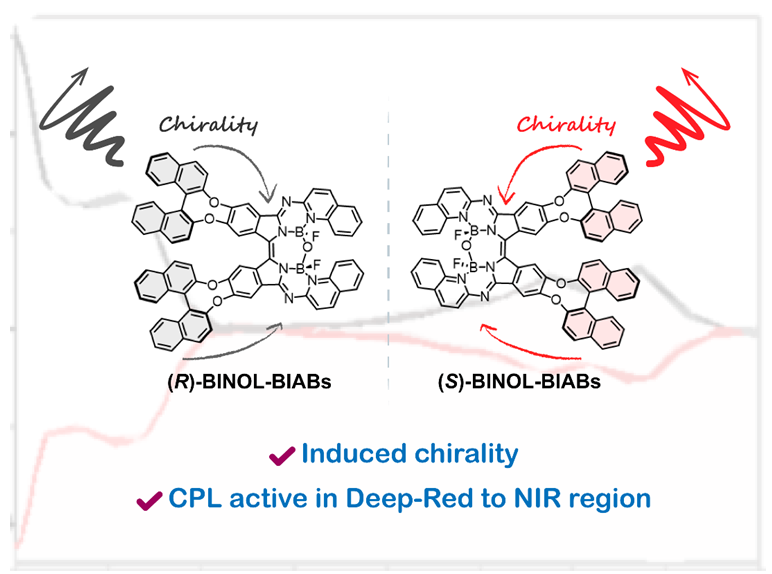
Helicene-type compounds are renowned for their unique chiral properties, however, obtaining their enantiomers usually requires laborious and costly chiral separations. Moreover, their chiroptical activity is typically limited to the ultraviolet spectral range, which restricts their broader applicability. To overcome these limitations, a novel and efficient strategy for synthesizing optically active compounds through the incorporation of an optically pure binaphthol (BINOL) group onto the periphery of β-isoindigo based aza dipyrrometheneboron difluoride (aza-BODIPY) analogues (BIABs) was presented. The resulting (R)/(S)-BINOL-BIABs demonstrate exceptional photostability, deep-red emission, strong Cotton effect (Δε) and high absorbance dissymmetry factor (gabs). Moreover, tunable circularly polarized luminescence (CPL) with high brightness in the deep-red region was achieved. This strategy offers straightforward procedures for synthesizing optically active compounds.

Cite this article

Ziwei Chen , Sikang Duan , Yihui Wang , Huadan Fan , Mengjie Yang , Sisi Wang , Hua Lu . Peripheral-Group Induced Chirality of β-Isoindigo Based Aza Dipyrrometheneboron Difluoride (BODIPY) Analogs[J]. Chinese Journal of Organic Chemistry, 2025 , 45(11) : 4163 -4170 . DOI: 10.6023/cjoc202503026

1 Introduction

Helicenes, characterized by their ortho-fused, helically chiral, and polycyclic aromatic structures, exhibit appealing chiroptical properties including high optical rotation values, exceptional absorption (gabs) and emission (glum) dissymmetry factors.[1-5] Due to their fascinating chiroptical properties, helicenes are utilized in various fields,[6] such as asymmetric catalysis,[7] optoelectronic devices[8-9] and sensor materials,[10-11] as well as conductive chiral polymer building blocks.[12-13] However, solitary non- functionalized helicenes typically exhibit short absorption and emission wavelengths, which severely restrict their applications.[1,14] The primary method to enhance these properties involves extending the helicenes backbones via π-bonding to form flexible π-extended helicenes, such as superhelicenes, double-/multiple-, and π-annulated helicenes, which offer diverse approaches to modulating their chiroptical properties.[15-20] In addition, introducing hetero- atoms, such as nitrogen or oxygen, affords another efficient strategy to tune helicene properties.[21-22] However, the synthesis of these π-extended or heteroatom-modified helicenes often entails multiple complex steps.
Isoindigo has been extensively researched and recognized for its critical function as an electron acceptor in organic electronic materials. In contrast, β-isoindigo, despite its discovery in 1941, has received comparatively limited attention.[23-27] Nevertheless, the distinctive structural features of β-isoindigo exhibit considerable potential for functional molecular design. Specifically, the β-iso- indigo core comprises two isoindole subunits, which are fundamental building blocks for crucial compounds such as phthalocyanine, benzo-dipyrrometheneboron difluoride (BODIPY), and benzoporphyrin.[28-29] The bis(isoindole) framework endows β-isoindigo with a more extended π- conjugated system, enhanced coordination lability, and inherent structural distortion, which facilitate the generation of more diverse compounds. Recently, we reported a modular synthetic strategy for the construction of a novel class of β-isoindigo-based aza-BODIPY analogues (BIABs and β-IBs).[30-33] The spatial constraints within the β-iso- indigo unit and the B-O-B confinement cavity induce a twisted conformation, fulfilling the prerequisites for helicity. However, enantiomeric resolution currently relies on chiral separation, a costly and time-intensive process. Our prior work demonstrated binaphthol (BINOL)-induced chirality in β-IBs[31]. To assess its generality, we extended this approach to BIABs, synthesizing two classes of heterocyclic complexes featuring BF2 and BPh2 coordination modes. Through systematic photophysical and chiroptical characterization, combined with time-dependent density functional theory (TD-DFT) calculations, we elucidated the origins of their chiroptical activity, informing the design of helicene-chiral molecules without requiring enantiomeric separation.


2 Results and discussion

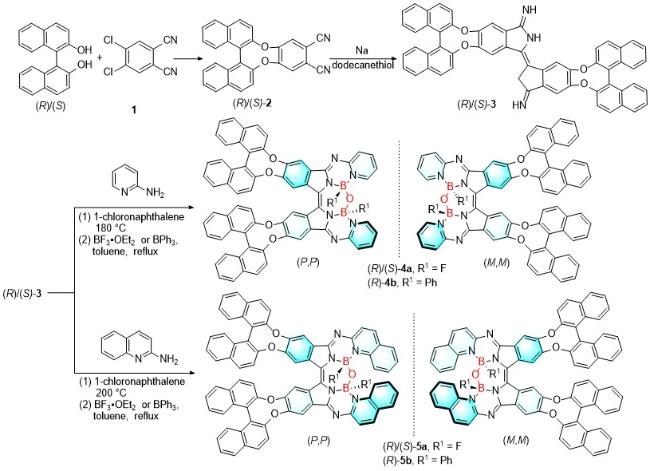
Preventing racemization at each synthetic step is essential in the synthesis of optically active compounds from enantiopure starting materials. Since optically active 1,1'- binaphthol (BINOL, R and S enantiomers) does not racemize under standard synthesis conditions and shows good optical stability, it was selected as the chiral source for our investigation. The optically active 1,1'-binaphthol was reacted with 4,5-dichloro-1,2-dicyanobenzene to get the precursor (R)/(S)-2.[34] Subsequently, this dicyano derivative was treated with sodium metal in dodecanethiol to yield the diimino-β-isoindigo (R)/(S)-3. Compound 3 was then reacted with either 2-aminopyridine or 2-amino- quinoline, accompanied by the elimination of ammonia, to afford the N,N-bidentate ligand. The (R)-binaphthol-linked BIABs (R)-4a and (R)-5b with B-O-B bridged were readily obtained by reaction of N,N-bidentate ligand with BF3• OEt2 or BPh3 under basic conditions with yield up to 37%~50% (Scheme 1). The formation of B-O-B bridge can be attribute to spontaneous hydrolysis of the adjacent B—F or B—C bonds in the confined ligand cavity with the trace of water.[35-36] The (S)-BINOL-linked analogues (S)- 4a and (S)-5a were also synthesized to facilitate the comparison of their chiral properties. High-resolution mass spectra (HRMS) and multinuclear (1H, 13C) NMR spectra provided a clear characterization of these compounds. All of the compounds were air-stable and could be stored for more than six months in natural light without degradation.
Scheme 1 Synthetic routes of β-isoindigo-based aza-BODIPY analogues (BIABs) (R)/(S)-4a, (R)-4b, (R)/(S)-5a and (R)-5b
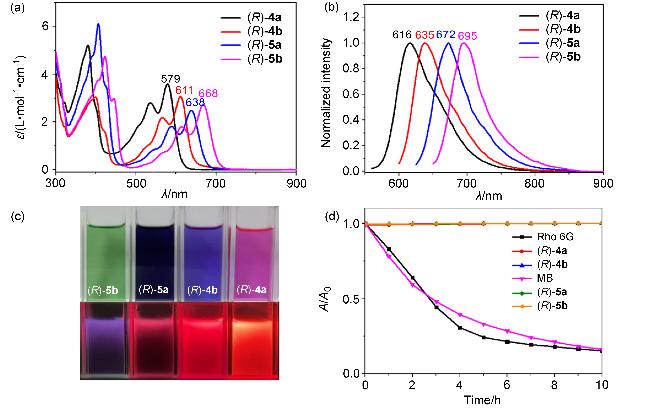
The UV-Vis absorption and emission spectra of (R)- BINOL-BIABs in dichloromethane were investigated (Figure 1). As illustrated in Figure 1a, these compounds showed strong absorption in the UV and red regions. Stepwise structural modifications induced marked bathochromic shifts: substitution of the pyridine unit in (R)-4a (579 nm) with quinoline in (R)-5a redshifted the main band to 638 nm, while replacing fluorine with phenyl in (R)-5b further shifted it to 668 nm. These bands, originating from the S₀→S₁ [highest occupied molecular orbital (HOMO)→lowest unoccupied molecular orbital (LUMO)] transition, exhibit comparable profiles with a high-energy shoulder ascribed to the 0-1 vibrational transition. Additional absorption at 400~500 nm corresponds to higher singlet excited states (S₄, S₆). Consistent redshifts were observed in the emission spectra, accompanied by a gradual decrease in the Stokes shift (Figure 1b and Table 1). The fluorescence quantum yields (ΦF) ranged from 0.22 to 0.46, and fluorescence lifetimes (τ) ranged from 3.40 to 5.50 ns, indicating tunable fluorescence brightness through minor structural changes. Notably, photostability studies (Figure 1d) demonstrated the exceptional photostability of these BIABs under continuous laser irradiation, with nearly 100% retention of absorption intensity, compared to the significant (≈80%) degradation of Rhodamine 6G (Rho 6G) and methylene blue (MB).
Figure 1 Photophysical properties of (R)-BINOL-BIABs (R)-4a/4b/5a/5b (10 μmol/L) in dichloromethane at room temperature

(a) Absorption spectra and (b) fluorescence spectra; (c) Photographs in daylight (up) and under UV light (down, λex=365 nm); (d) Photostability studies: (R)-4a, (R)-4b, and Rho 6G (525 nm, 850 mW/cm2); (R)-5a, (R)-5b, and MB (635 nm, 450 mW/cm2)

Table 1 Photophysical properties of (R)-BINOL-BIABs
Compd. λabs/nm εmaxa/104 λem/nm SSb/cm-1 ΦFc τd/ns kre/(108 s-1) knrf/(108 s-1)
(R)-4a 579 3.59 616 1037 0.46 5.5 0.84 0.98
(R)-4b 611 3.07 635 618 0.28 4.1 0.68 1.76
(R)-5a 638 2.48 672 793 0.27 5.0 0.54 1.46
(R)-5b 668 2.72 695 581 0.22 3.4 0.65 2.29

a Extinction coefficient (L•mol-1•cm-1) of the maximum absorption band; b Stokes shift; c Fluorescence quantum yield determined using the absolute method; d Fluorescence lifetime measured in time-correlated single-photon counting operation mode; e Radiative rate constant calculated using: kr=ΦPL/τ; f Non-radiative rate constant calculated using: knr=(1-ΦPL)/τ.

The calculated frontier molecular orbitals (FMOs) show that HOMO energy levels of (R)-BINOL-BIABs were calculated to be -5.08~-5.20 eV, while their LUMO energy levels were -2.73~-2.93 eV. The electrochemical properties were investigated using cyclic voltammetry (CV) and differential pulse voltammetry (DPV). It was found that BF₂ complexes 4a and 5a exhibited two reversible single-electron reduction waves with first reduction potentials of -1.38 and -1.23 V vs. Fc⁺/Fc, respectively, whereas BPh2 complexes 4b and 5b exhibit two quasi- reversible reduction waves at approximately -1.73 and -1.51 V for 4b, and -1.63 and -1.35 V for 5b. Accor-dingly, the electrochemical LUMO and HOMO energy levels were estimated to be -3.42 and -5.42 eV, -3.29 and -5.21 eV, -3.57 and -5.41 eV, -3.45 and -5.21 eV for compounds 4a, 4b, 5a, and 5b, respectively. These electrochemistry results are in good agreement with the density functional theory (DFT) calculations. The quinolinyl group significantly enhances the reduction potentials, leading to a substantial lowering of the LUMO energy levels compared to pyridinyl-based molecules. This narrowing of the HOMO-LUMO gap results in a pronounced red-shift in the absorption band.
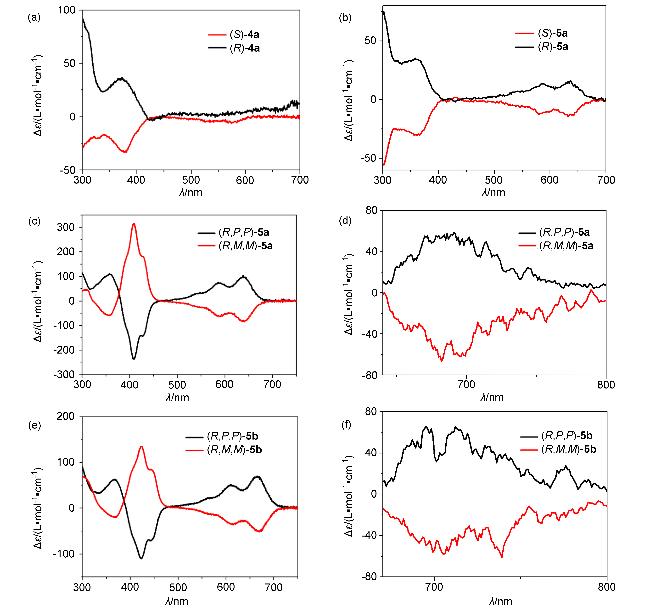
To verify the effectiveness of introducing chiral BINOL units at the molecular periphery for inducing molecular chirality, we first recorded the circular dichroism (CD) spectra of (R)-BINOL-linked (R)-4a and (R)-5a, as well as (S)-BINOL-linked (S)-4a and (S)-5a, prior to chiral resolution. As shown in Figure 2, the compounds exhibited two distinct Cotton effects around the UV region. Combined with computational analyses, we attribute the Cotton effect near 300 nm to the BINOL fragment, while the effect observed between 320~400 nm originates from the BINOL- isoindole unit. Notably, the quinoline-based compounds (R)-5a and (S)-5a exhibited clearly discernible mirror- image Cotton effects at their maximum absorption wavelengths, verifying the effectiveness of the peripheral chiral modification strategy (Figure 2b). For BPh₂-coordinated BIABs, only (R)-BINOL was employed, as phenyl substituents primarily induce a spectral redshift but negatively impact the absorption dissymmetry factor (gabs), as demonstrated by CD spectra and TD-DFT calculations.
Figure 2 Chiral optical activity of (R)/(S)-BINOL-BIABs 4a~5b (10 μmol/L in dichloromethane, measured at room temperature)

(a, b) Circular dichroism (CD) spectra of (R)/(S)-BINOL-BIABs; (c~f) CD and CPL spectra of optically resolved (R,M,M)-5a and (R,P,P)-5a, (R,M,M)-5b and (R,P,P)-5b (λex=638 nm for 5a, 688 nm for 5b)

To further elucidate the enantiomeric excess (ee), high- performance liquid chromatography (HPLC) enantioseparation of representative compounds (R)-5a, and (R)-5b was performed. The optically resolved compounds (R,M,M)-5a and (R,P,P)-5a, (R,M,M)-5b and (R,P,P)-5b displayed symmetric circular dichroism (CD) spectra with opposite strong Cotton effects at the maximum absorption region. Notably, the chiroptical responses covered the UV and the whole visible regions, which is rare in the literatures for helicene-type compounds. The absolute configurations of the enantiomers were determined by comparing the experimental data with those simulated by TD-DFT method: the Cotton effect corresponding to the main absorption band is positive for (R,P,P) and negative for (R,M,M). Quantitative analysis indicated that (R)-5a was composed of 67% (P,P)-enantiomer and 33% (M,M)-enantiomer, resulting in a 34% epimer excess. Therefore, the whole structure exhibited (P,P) signals when not separated, with positive signals at the maximum wavelength. This phenomenon can be confirmed by calculating the optimal structural energies of the pair of enantiomers of (R)-5a by TDDFT: when the modifying group in the periphery is (R)-BINAL, the (P,P) structure is energetically favored over the (M,M) structure, and thus an enantiomeric excess is shown. These results underscore the effectiveness of the peripheral chiral modification strategy.
(R,P,P)-5a showed the positive Cotton effect at 638 nm (Δε=103.2 L•mol-1•cm-1, |gabs|=0.00416), while a negative Cotton effect was observed at 410 nm (Δε=-236.9 L•mol-1•cm-1) (Table 2 and Figure 2c). Therefore, the disappearance of (R)-5a at 410 nm could attributed to the mutual cancellation between positive Cotton effect of (R)- BINOL-isoindigo and negative Cotton effect of high-ener- gy transition chirality of the parent nucleus (Figure 2b). There was no evidence of racemization, and the chirality was very stable. For instance, even after a month in CH2Cl2 at ambient temperature, the intensities in the CD spectra of (R,P,P)-5a persisted, showing that there was no chiral inversion resulting from the complex dissociation. The CPL spectra had a mirror-image connection that originated from the S1→S0 transition, with luminescence dissymmetry factors (glum) as high as 2.96×10⁻³. The CPL maxima were in line with the emission spectra maxima, allowing for regulation in the near-infrared spectrum (Figures 2d, 2f). To assess the CPL performance, one measure utilized is the CPL brightness (BCPL). The BCPL values of (R,P,P)-5a and (R,P,P)-5b were found to be 9.71 and 8.86 L•mol-1•cm-1, respectively, indicating strong BCPL values of helicenes in the red region, according on the calculation formula BCPL=ε×ΦPL×glum/2.
Table 2 Chiroptical properties of (R)-BINOL-BIABs
Compd. λabs/nm Δεa (S0-S1) Δεb S0-Sn |gabs|c/10-3 |glum|d/10-3 Bcple/(L•mol-1•cm-1) |μ|f/10-18 |m|f/10-20 cosθf |gcal,abs|g[10-3
(R)-4a 579 16.8 -77.0 0.47 0.76 6.28 8.55 0.55 -0.162 0.42
(R)-5a 638 103.2 -236.9 4.16 2.90 9.71 7.29 2.31 -0.418 5.30
(R)-5b 668 69.2 -109.7 2.54 2.96 8.86

a Δε=mdeg/(3300*l*c), unit: L•mol-1•cm-1 in the S0-S1 transition; b The S0-Sn transition. (n=7 for (R)-4a and n=6 for (R)-5a and (R)-5b); c Corresponding S0-S1 transition |gabs| of the (P,P)-configuration calculated as: gabsɛ/ɛ; d glum=2(ILIR)/(ILIR); e BCPL=ɛ×ΦPL×|glum|/2; f Calculated at the ωB97X-D/6-311G(d,p) level. |μ| unit: esu•cm, |m| unit: erg•G-1; gCalculated using: g=4 cosθ|m|/|μ|.

TD-DFT calculations at the ωB97X-D/6-311G(d,p) level were employed to investigate the chiroptical properties of (R)-4a and (R)-5a (Table 2). The dissymmetry factor (gabs) was calculated using the following equation: gabs=4cosθ|m|/|μ|, where m and μ represent the transition magnetic dipole moment (TMDM) and transition electric dipole moment (TEDM), respectively, and θ is the angle between them. This equation indicates that larger cosθ values and |m|/|μ| ratios favor larger gabs values. The results showed that, compared to pyridyl-fused (R)-4a, the quinolinyl-fused (R)-5a exhibited a slightly smaller |μ| but a significantly larger |m| (approximately 4.2 times that of (R)-4a), and a considerably larger cosθ value [-0.162 for (R)-4a and -0.418 for (R)-5a], indicating stronger elect-romagnetic transition coupling in (R)-5a. These combined factors led to a higher gabs value for (R)-5a, consistent with the experimental results. Since BIABs emit from their lowest excited singlet (S1) state, the glum factor aligns with the gabs associated with the lowest-energy transition. As a result, (R)-5a demonstrates a high glum value, attributed to its larger |m| and enhanced electric-magnetic coupling.

3 Conclusions

In summary, this study presents an efficient strategy for constructing optically active (R)/(S)-binaphthol-BIABs, featuring BF₂ and BPh₂ coordination units, achieved by incorporating chiral BINOL moieties onto the periphery of the β-isoindigo-based (BIABs) scaffold. This approach enables the direct generation of compounds exhibiting preliminary optical activity without the need for tedious resolution procedures. DFT calculations reveal that the introduction of BINOL groups induces distinct energy distributions of P/M helical isomers, thereby directly generating enantiomeric excess during the synthesis. Subsequent enantiomeric separation and purification further endow these compounds with remarkably enhanced chiroptical properties in the red region, including strong Cotton effect (103.2 L•mol-1•cm-1), high |gabs| of 4.16×10⁻³, and significant glum and CPL brightness up to 2.96×10⁻³ and 9.71 L• mol-1•cm-1, respectively. Consequently, this research not only provides new insights into the efficient and controlled chiral construction of β-isoindigo-based compounds, but also lays a solid theoretical and practical foundation for the design, synthesis, and application of high-performance chiral optoelectronic materials.

4 Experimental section

4.1 General

All reagents were obtained from commercial suppliers and used without further purification unless otherwise indicated. 1H NMR, 13C NMR spectra were recorded on a Bruker DRX400 or a Bruker DRX500 spectrometer and referenced to the residual proton signals of the solvent. 1H NMR chemical shifts were referenced to CDCl3 (δ 7.26), CD2Cl2 (δ 5.32) or DMSO-d6 (δ 2.50). 13C NMR chemical shifts were referenced to CDCl3 (δ 77.16), CD2Cl2 (δ 54.00) or DMSO-d6 (δ 39.52). High resolution mass spectra (HRMS) were recorded on a Bruker Daltonics micro TOF-Q II spectrometer, and MALDI-TOF mass spectra were recorded on an Autoflex II spectrometer of Bruker Daltonics. All the solvents employed for the spectroscopic measurements were of UV spectroscopic grade (Aldrich). Absorption spectra were measured with a JASCO V-670 spectrometer. Emission spectra were measured with a HITACHI F-4500 spectrometer. Photoluminescence quantum yields were measured on a Hamamatsu Photonics C9920- 02 Absolute PL Quantum Yield Measurement System, and absolute quantum yields were determined by using a calibrated integrating sphere system. Lifetimes were estimated with the time correlated single photon counting (TCSPC) operation mode which allows to measure fluorescence lifetimes from 100 ps to 10 μs. Cyclic voltammetry (CV) and differential pulse voltammetry (DPV) were conducted with a HOKUTO DENKO HZ-7000 voltametric analyzer. Mea- surements were carried out in a one-compartment cell under Ar gas, equipped with a platinum counter electrode, a platinum working electrode, and an Ag/Ag reference electrode. The supporting electrolyte was a 100 mmol/L dichloromethane solution of tetrabutylammonium perchlorate (TBAP). All potentials were corrected against Fc/Fc. CV was measured with a scan rate of 100 mV/s. Chiral high-performance liquid chromatography (HPLC) was im- plemented on a Daicel Chiralpak IE column and a JC-002/ YJYF-009. Circular dichroism (CD) spectra were collected on an MOS-450 circular dichroism spectrometer at 297 K. Circularly polarized luminescence (CPL) measurements were performed using a JASCO CPL-300 at 297 K.

4.2 Synthesis

4.2.1 Synthesis of bidinaphtho-substituted (E)-[15,15'- bidinaphtho[2',1':5,6;1'',2'':7,8][1,4]dioxocino[2,3-f]iso- indolylidene]-17,17'(16H,16'H)-diimine [(R)-3]

In a 50 mL round-bottom two-mouth flask, sodium metal (60 mg) was suspended in 1-dodecanethiol (5 mL) in argon atmosphere and heated to 100 ℃ for 1 h. Then (R)-2 (2.15 g, 5 mmol) was added in argon and the mixture was stirred for 1 h at the same temperature. Then the reaction temperature was raised to 180 ℃. After stirring for 1 h, the reaction was quenched by excess amount of n-hexa- ne and the precipitate was collected by filtration. The residue was purified by column chromatography [eluent: ethyl acetate (EA)/petroleum ether (PE), VV=1∶4] to afford compound (R)-3 (1.29 g, 60% yield) as brown powder. 1H NMR (500 MHz, DMSO-d6) δ: 8.61 (d, J=3.0 Hz, 2H), 8.18 (d, J=8.5 Hz, 4H), 8.11 (d, J=7.5 Hz, 4H), 7.92 (s, 2H), 7.62 (dd, J=14.0, 9.0 Hz, 4H), 7.57 (dd, J=14.5, 7.5 Hz, 8H), 7.57 (s, 4H), 7.49 (dd, J=8.0, 5.0 Hz, 4H); 13C NMR (125 MHz, DMSO-d6) δ: 150.7, 148.6 (s), 147.2, 140.1, 137.7, 131.7, 131.5, 129.5, 128.7, 127.3, 125.7, 124.9, 121.1, 118.4, 113.9; HRMS-ESI calcd for C56H32- N4O4Na [M+Na] 825.2496; found 825.2475.

4.2.2 Synthesis of (R)-BINOL-BIABs (R)-4a and (R)- 4b

In a 50 mL round-bottom two-mouth flask, (R)-3 (824 mg, 1 mmol) and 2-aminopyridine (1.88 g, 20 mmol) were suspended in 15 mL of 1-chloronaphthalene and the mixture was heated to 220 ℃ for 3 h. The color of the solution gradually changed from light yellow to brown. After the reaction was completed, the solvent was evaporated to give a residue. The residue was purified by column chromatography [eluent: dichloromethane (DCM)/PE, VV=4∶5] to afford bright orange powder.
For (R)-4a, the collected bright orange section was added into a 100 mL round-bottom flask, then 50 mL of toluene and 1.2 mL of Et3N were added at room temperature. The mixture was stirred for 10 min, followed by addition of 1.5 mL of BF3•Et2O. The temperature was raised to 120 ℃ and then the mixture was stirred for 1 h. After cooled to room temperature and evaporation of the solvent, the residue was purified by column chromatography [eluent: dichloromethane (DCM)/PE, VV=4∶5] to afford (R)-4a as a purple-red solid powder (300 mg, 50%). m.p.>250 ℃; UV/Vis (CH2Cl2) λmax [ε/(L•mol-1•cm-1)]: 579 (35900) nm; 1H NMR (500 MHz, CD2Cl2) δ: 8.63~8.65 (m, 4H), 8.38 (s, 2H), 8.07~8.04 (m, 4H), 7.99 (t, J=5.0 Hz, 4H), 7.93~7.90 (m, 4H), 7.78 (d, J=3.5 Hz, 2H), 7.60 (dd, J=8.5, 5.0 Hz, 4H), 7.55~7.50 (m, 4H), 7.47~7.41 (m, 4H), 7.37 (d, J=7.5 Hz, 2H), 7.32~7.30 (m, 2H), 7.25~7.22 (m, 2H); 13C NMR (125 MHz, CD2Cl2) δ: 152.7, 152.5, 151.1, 151.0, 150.9, 150.4, 148.1, 142.4, 142.3, 139.5, 132.9, 132.5, 132.4, 132.3, 132.3, 131.3, 131.2, 129.1, 128.9, 128.8, 127.5, 127.3, 127.3, 126.8, 126.7, 126.2, 126.1, 126.1, 121.6, 121.4, 121.0, 118.9, 118.7, 117.4, 117.4, 68.4; HRMS-ESI calcd for C66H36B2F2N6O5 1052.2901, found 1052.2990.
For (R)-4b, the collected bright orange section was treated with BPh3 afford (R)-4b as a deep blue solid powder (280 mg, 42%). m.p.>250 ℃; UV/Vis (CH2Cl2) λmax [ε/(L•mol-1•cm-1)]: 611 (30700) nm; 1H NMR (500 MHz, CD2Cl2) δ: 8.69~8.67 (m, 2H), 8.42 (s, 1H), 8.18 (s, 1H), 8.04 (d, J=7.0 Hz, 3H), 7.99 (d, J=7.0 Hz, 3H), 7.96~7.84 (m, 8H), 7.75 (d, J=8.0 Hz, 2H), 7.69 (d, J=8.5 Hz, 2H), 7.60~7.54 (m, 6H), 7.53~7.43 (m, 10H), 7.41~7.32 (m, 8H), 7.30~7.24 (m, 2H), 7.23~7.22 (m, 2H), 7.18~7.13 (m, 4H), 6.98 (dd, J=5.0, 2.0 Hz, 4H), 6.91 (dd, J=5.5, 2.5 Hz, 4H); 13C NMR (125 MHz, CD2Cl2) δ: 151.9, 150.7, 150.7, 150.0, 144.3, 142.6, 141.4, 141.3, 138.3, 138.0, 135.0, 131.8, 131.4, 129.8, 129.7, 129.5, 127.4, 126.7, 125.6, 125.5, 125.4, 121.7, 120.1, 118.5, 74.2; HRMS-ESI calcd for C78H46B2N6O5 1168.3716, found 1168.3704.

4.2.3 Synthesis of (R)-BINOL-BIABs (R)-5a and (R)- 5b

Compounds (R)-5a and (R)-5b were synthesized following procedures similar to those for (R)-4a and (R)-4b, respectively, using 2-aminoquinoline instead of 2-amino- pyridine. (R)-5a was obtained as a deep-blue solid powder (205 mg, 45%). m.p.>250 ℃; UV/Vis (CH2Cl2) λmax [ε/(L•mol-1•cm-1)]: 638 (24800) nm; 1H NMR (500 MHz, CD2Cl2) δ: 8.78 (s, 2H), 8.56 (d, J=8.9 Hz, 2H), 8.14~7.96 (m, 12H), 7.77~7.73 (m, 2H), 7.70~7.67 (m, 2H), 7.65~7.36 (m, 16H), 7.27~7.24 (m, 2H), 6.98 (d, J=7.0 Hz, 2H); 13C NMR (125 MHz, CD2Cl2) δ: 157.9, 156.2, 152.0, 150.9, 150.7, 150.4, 141.6, 139.7, 132.4, 132.2, 132.1, 132.0, 131.9, 131.3, 131.0, 130.7, 130.5, 129.9, 128.6, 128.5, 127.8, 127.1, 127.0, 126.5, 126.4, 126.2, 125.8, 125.8, 125.7, 125.4, 124.6, 123.4, 121.0, 120.7, 117.7, 68.6; HRMS-ESI calcd for C74H40B2F2N6O5 1152.3214, found 1152.3276.
(R)-5b was obtained as a green solid powder (180 mg, 37%). m.p.>250 ℃; UV/Vis (CH2Cl2) λmax [ε/(L• mol-1•cm-1)]: 668 (27200) nm; 1H NMR (500 MHz, CD2Cl2) δ: 8.93 (dd, J=13.5, 9.0 Hz, 2H), 8.23 (dd, J=17.5, 8.5 Hz, 4H), 8.11~8.04 (m, 8H), 8.00 (dd, J=15.0, 7.5 Hz, 6H), 7.94 (d, J=10.0 Hz, 2H), 7.89 (d, J=9.0 Hz, 2H), 7.85 (d, J=9.0 Hz, 2H), 7.66 (d, J=6.0 Hz, 2H), 7.56 (dt, J=14.5, 7.5 Hz, 20H), 7.50~7.40 (m, 16H), 7.36~7.33 (m, 6H), 7.29~7.23 (m, 6H), 7.20~7.17 (m, 4H), 6.93 (dt, J=18.0, 7.0 Hz, 6H), 6.83 (s, 2H); 13C NMR (125 MHz, CD2Cl2) δ: 161.5, 157.9, 156.4, 152.0, 151.0, 150.9, 149.9, 141.7, 140.8, 132.9, 132.4, 132.3, 132.2, 132.1, 131.7, 131.2, 130.9, 130.7, 128.7, 128.7, 128.1, 127.2, 127.2, 127.1, 126.7, 126.6, 126.4, 126.0, 126.0, 125.9, 125.6, 125.2, 124.0, 121.2, 121.3, 117.8, 116.9, 64.4; HRMS-ESI calcd for C86H50B2N6O5 1268.4029, found 1268.3955.
Supporting Information ¹H NMR and ¹³C NMR spectra, HRMS-ESI spectroscopy data, and calculation details. The Supporting Information is available free of charge via the Internet at http://sioc-journal.cn.
(Zhao, C.)
[1]
Shen, Y.; Chen, C.-F. Chem. Rev. 2012, 112, 1463.

DOI PMID

[2]
Gingras, M. Chem. Soc. Rev. 2013, 42, 968.

DOI PMID

[3]
Zhao, W.-L.; Li, M.; Lu, H.-Y.; Chen, C.-F. Chem. Commun. 2019, 55, 13793.

DOI

[4]
Nakai, Y.; Mori, T.; Inoue, Y. J. Phys. Chem. A 2012, 116, 7372.

DOI

[5]
Mori, T. Chem. Rev. 2021, 121, 2373.

DOI

[6]
Bouz, G.; Žádný, J.; Storch, J.; Vacek, J. Biotechnol. Adv. 2025, 79, 108513.

DOI

[7]
Fang, L.; Lin, W.-B.; Shen, Y.; Chen, C.-F. Chin. J. Org. Chem. 2018, 38, 541 (in Chinese).

DOI

(房蕾, 林伟彬, 沈赟, 陈传峰, 有机化学, 2018, 38, 541.)

DOI

[8]
Huang, T.; Yuan, L.; Lu, X.; Qu, Y.; Qu, C.; Xu, Y.; Zheng, Y.-X.; Wang, Y. Chem. Sci. 2024, 15, 15170.

DOI

[9]
Yuan, L.; Ding, Q.-J.; Tu, Z.-L.; Liao, X.-J.; Luo, X.-F.; Yan, Z.-P.; Wu, Z.-G.; Zheng, Y.-X. Chin. Chem. Lett. 2022, 33, 1459.

DOI

[10]
Zhang, L.; Song, I.; Ahn, J.; Han, M.; Linares, M.; Surin, M.; Zhang, H.-J.; Oh, J. H.; Lin, J. Nat. Commun. 2021, 12, 142.

DOI PMID

[11]
Yang, Y.; da Costa, R. C.; Fuchter, M. J.; Campbell, A. J. Nat. Photonics 2013, 7, 634.

DOI

[12]
Crassous, J.; Fuchter, M. J.; Freedman, D. E.; Kotov, N. A.; Moon, J.; Beard, M. C.; Feldmann, S. Nat. Rev. Mater. 2023, 8, 365.

DOI

[13]
Domínguez, Z.; López-Rodríguez, R.; Álvarez, E.; Abbate, S.; Longhi, G.; Pischel, U.; Ros, A. Chem.-Eur. J. 2018, 24, 12660.

DOI PMID

[14]
Cei, M.; Di Bari, L.; Zinna, F. Chirality 2023, 35, 192.

DOI

[15]
Zhang, F.; Michail, E.; Saal, F.; Krause, A.-M.; Ravat, P. Chem. Eur. J. 2019, 25, 16241.

DOI

[16]
Chen, K.; Liu, Y.-J.; Wang, Z.-L.; Hu, S.-L.; Zhao, Y.-L.; Wang, W.; Liu, G.-G.; Wang, Z.-H.; Jiang, W. J. Am. Chem. Soc. 2024, 146, 13499.

DOI PMID

[17]
Ju, Y.-Y.; Xie, L.-E.; Xing, J.-F.; Deng, Q.-S.; Chen, X.-W.; Huang, L.-X.; Nie, G.-H.; Tan, Y.-Z.; Zhang, B. Angew. Chem., Int. Ed. 2025, 64, e202414383.

[18]
Liu, B.-K.; Zhang, Y.-L.; Chen, Y.; Liu, X.-G.; Zhang, L. Chin. J. Org. Chem. 2020, 40, 2879 (in Chinese).

DOI

(刘秉康, 张艳丽, 陈瑜, 刘旭光, 张磊, 有机化学, 2020, 40, 2879.)

DOI

[19]
Liu, Y.-J.; Wang, Z.-H. Chin. J. Org. Chem. 2021, 41, 4844 (in Chinese).

DOI

(刘豫健, 王朝晖, 有机化学, 2021, 41, 4844.)

DOI

[20]
Ito, H.; Segawa, Y.; Murakami, K.; Itami, K. J. Am. Chem. Soc. 2019, 141, 3.

DOI

[21]
Xia, Y.-F.; Jiang, L.; Yang, Q.; Yu, X.; Chen, F.-K. Chin. J. Org. Chem. 2024, 44, 2841 (in Chinese).

DOI

(夏羽菲, 江丽, 杨巧, 于琇, 陈丰坤, 有机化学, 2024, 44, 2841.)

DOI

[22]
Liang, J.-C.; Gan, F.-W.; Zhang, G.-L.; Shen, C.-S.; Qiu, H.-B. Nat. Commun. 2025, 16, 3788.

DOI

[23]
Luo, L.-C.; Li, L.; Mu, Y.-B.; Li, B.-W.; Wan, X.-B. Chin. J. Org. Chem. 2022, 42, 1960 (in Chinese).

(罗力铖, 李亮, 穆有炳, 李博文, 万晓波, 有机化学, 2022, 42, 1960.)

DOI

[24]
Du, J.-P.; Qin, P.-J.; Xu, L.-C.; Feng, S.-S.; Xu, Y.-X.; Huang, J. Chin. J. Org. Chem. 2020, 40, 194 (in Chinese).

DOI

(杜俊平, 秦鹏举, 绪连彩, 封珊珊, 徐云祥, 黄江, 有机化学, 2020, 40, 194.)

DOI

[25]
Gu, H.; Ming, S.-L; Lin, K.-W.; Chen, S.; Liu, X.-M.; Lu, B.-Y.; Xu, J.-K. Electrochim. Acta 2018, 260, 772.

DOI

[26]
Lei, T.; Wang, J.-Y.; Pei, J. Acc. Chem. Res. 2014, 47, 1117.

DOI

[27]
Stalder, R.; Mei, J.; Graham, K. R.; Estrada, L. A.; Reynolds, J. R. Chem Mater. 2014, 26, 664.

DOI

[28]
Mack, J.; Kobayashi, N. Chem. Rev. 2011, 111, 281.

DOI

[29]
Zatsikha, Y. V.; Shamova, L. I.; Nemykin, V. N. J. Org. Chem. 2021, 86, 4733.

DOI PMID

[30]
Xu, Y.-Q.; Ni, Z.-G.; Xiao, Y.; Chen, Z.-W.; Wang, S.-S.; Gai, L.-Z.; Zheng, Y.-X.; Shen, Z.; Lu, H.; Guo, Z.-J. Angew. Chem., Int. Ed. 2023, 62, e202218023.

[31]
Chen, Z.-W.; Ni, Z.-G.; Chen, X.-Y.; Xu, Y.-Q.; Yu, C.-Y.; Wang, S.-S.; Wang, X.-Y.; Lu, H. Aggregate 2024, 5, e498.

[32]
Yu, C.-Y.; Xu, Y.; Bi, X.; Ni, Z.; Xiao, H.; Hu, X.; Lu, H. Tetrahedron Lett. 2023, 133, 154833.

DOI

[33]
Bi, X.; Wang, S.; Zhang, J.; Peng, Y.; Shen, Z.; Lu, H. Chin. J. Inorg. Chem. 2025, 41, 1049 (in Chinese).

(毕羡, 王思斯, 张金月, 彭雨佳, 沈珍, 卢华, 无机化学, 2025, 41, 1049.)

[34]
Wang, K.; Wang, H.-L.; Mack, J.; Li, W.-J.; Kobayashi, N.; Jiang, J.-Z. Acta Chim. Sinica 2012, 70, 1791 (in Chinese).

DOI

(王康, 王海龙, 约翰·马克, 李文军, 小林长夫, 姜建壮, 化学学报, 2012, 70, 1791.)

DOI

[35]
Tay, A. C. Y.; Frogley, B. J.; Ware, D. C.; Conradie, J.; Ghosh, A.; Brothers, P. J. Angew. Chem., Int. Ed. 2019, 58, 3057.

DOI

[36]
Wang, S.-S.; Wang, Z.-L.; Song, W.-T.; Gao, H.; Wu, F.; Zhao, Y.; Chan, K.-S.; Shen, Z. Dalton Trans. 2022, 51, 2708.

DOI

Outlines

/