ARTICLES

Synthesis of Selenylated Maleimides and Alkenes via Bromide Catalysis

  • Zhouting Zeng a ,
  • Huaixin Wei , b, * ,
  • Wei-Min He , a, * ,
  • Mingming Yu c ,
  • Zu-Li Wang d ,
  • Jinhui Cai , a, *
Expand
  • a College of Chemistry and Chemical Engineering, University of South China, Hengyang, Hunan 421000
  • b School of Chemistry and Life Science, Suzhou University of Science and Technology, Suzhou, Jiangsu 215009
  • c School of Chemistry and Chemical Engineering, Zhejiang Sci-Tech University, Hangzhou 310018
  • d College of Chemical Engineering, Nanjing Forestry University, Nanjing 210037

Received date: 2025-06-03

  Revised date: 2025-06-15

  Online published: 2025-08-18

Supported by

National Natural Science Foundation of China(22301128)

Abstract

A highly efficient and metal-free catalytic system for the synthesis of various selenylated maleimides and alkene derivatives via ammonium bromide-catalyzed direct selenylation of C(sp2)—H bond in maleimides and 1,1-diaryl alkenes using elemental selenium and boronic acids as the selenyl source is developed. Simple catalytic conditions, wide substrate scope, good functional group compatibility, scalable-up, and easy operation are presented in this strategy. The preliminary mechanism reveals that a radical pathway is possibly involved.

Cite this article

Zhouting Zeng , Huaixin Wei , Wei-Min He , Mingming Yu , Zu-Li Wang , Jinhui Cai . Synthesis of Selenylated Maleimides and Alkenes via Bromide Catalysis[J]. Chinese Journal of Organic Chemistry, 2025 , 45(10) : 3786 -3796 . DOI: 10.6023/cjoc202506004

1 Introduction

Organoselenium compounds are a category of important skeleton which are extensively emerged as the cores of many drugs, natural products, and functional molecules.[1] These organoselenium compounds show highly biological activities,[2] such as antibacterial, antioxidant, anti-prolife- rative, and antitumor etc. Therefore, the synthetic methodology for the selenylated compounds has attracted considerable attention in the last decades. Despite great progress has been made in such field,[3] developing more efficient, green, and low cost strategy for assembling organoselenium compounds is highly desirable selenium chemistry and organic synthesis.
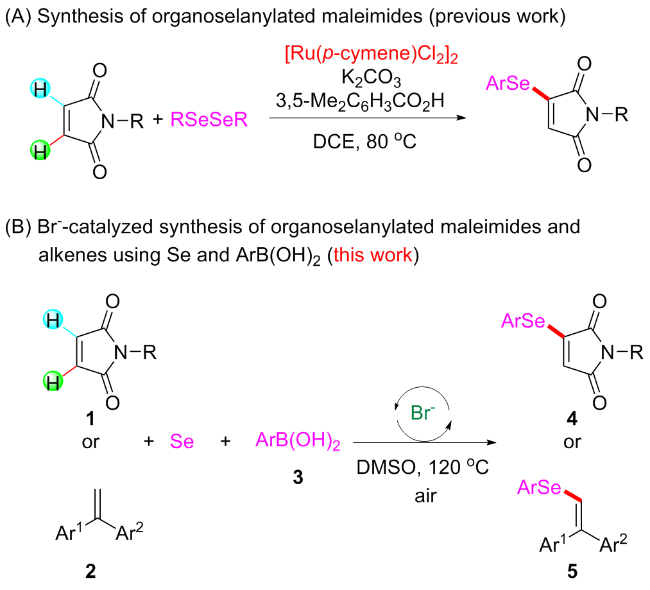
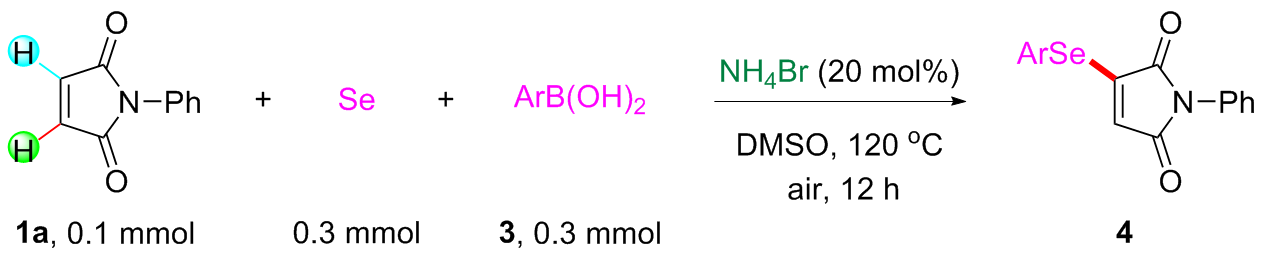
On the other hand, maleimides serve as a significant member of five-membered heterocycles in organic compounds, commonly emerging as the core skeleton of many pharmaceuticals and functional materials,[4] which can be easily converted into diversely functional molecules.[5] Hence, organic chemists have paid their successive attentions to accomplish the functionalization of maleimides. To date, many powerful methods for the functionalization of maleimides were reported, such as arylation,[6] alkenylation,[7] sulfonylation,[8] amination,[9] cyclization,[10] and aminosulfonylation[11] etc. However, to the best of know- ledge only limited methods for the direct selenylation of maleimides were disclosed. In 2017, Baidya and co-workers[12] disclosed that organoselenylated maleimides were easily accessible via Ru(II)-catalyzed direct selenylation of maleimides with diselenides (Scheme 1, A), nevertheless, the need of noble transition-metal, complex catalytic system, and toxic diselenides was necessary. Based on the existed drawbacks in the synthesis of selenylated maleimides, further seeking for metal-free and simple catalytic system to access selenyl-substituted maleimides is eagerly in demand. In recent years, Zhou, Wu, and other groups[13] have developed a versatile and powerful tool for various selenylated heterocycles via Cu-catalyzed or Ag-catalyzed cascade selenylation/cyclization strategy using Se powder and boronic acids as the selenyl source. However, these reported methods were restricted to using transition-metal salts and strong oxidants, which increased its synthetic cost and made it unfavorable to environment. Furthermore, bromide-catalyzed functionalizations were proved to be a powerful strategy for assembling all kinds of valuable molecules.[14] Based on these aspects and our previously related work about the formation of C—Se bond via bromide-catalyzed selenylation with elemental Se and boronic acids as the precursors,[15] we imagine that the efficient synthesis of selenylated maleimides 4 can be realized via bromide-catalyzed three-component reaction of maleimides 1, Se powder, and boronic acids 3 under metal-free conditions (Scheme 1, B).
Scheme 1 Strategies for the assembly of selenylated maleimides

2 Results and discussion

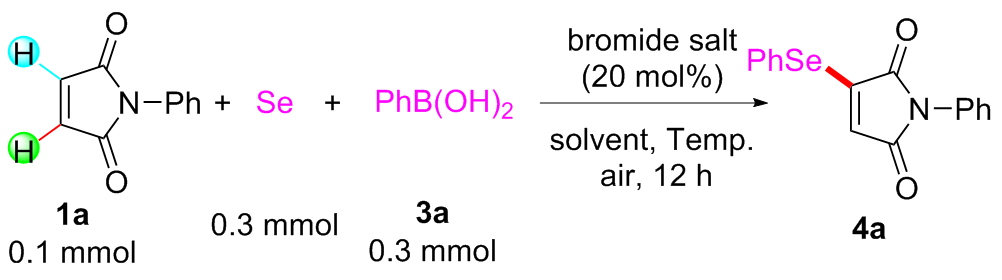
To accomplish this idea, we commenced our work by employing N-phenyl maleimide 1a as the model substrate, 20 mol% bromide salt as the catalyst, dimethyl sulfoxide (DMSO) as the solvent, Se powder and PhB(OH)2 (3a) as the selenyl source, stirring at 120 ℃ under air atmosphere for 12 h (Table 1). Firstly, a wide range of non-metallic bromide salts, KBr, NaBr, NH4Br, IBr and tetrabutyl- ammonium bromide (TBAB), were investigated (Entries 1~5). Gratifyingly, all of them smoothly furnished 1-phen- yl-3-(phenylselenyl)-1H-pyrrole-2,5-dione (4a). Among them, ammonium bromide gave the best yield (Entry 3, 91%). Subsequently, the reactivity of different solvents was examined under the present catalytic system (Entries 6~9). Solvents, including 1,4-dioxane, N,N-dimethylformamide (DMF), N-methyl-2- pyrrolidone (NMP), and PhCl, were explored, however, no desired product 4a was formed, revealing that dimethyl sulfoxide played a key role in this strategy. Performing the model reaction at 110 ℃ provided product 4a in 76% yield (Entry 10). Next, some control experiments were conducted. The model reaction under a nitrogen atmosphere was performed, furnishing compound 4a in poor yield (Entry 11). This result indicated that air was crucial to this transformation. Performing the reaction under oxygen atmosphere gave the desired product 4a in a slightly decreased yield (Entry 12). Only moderate yield was furnished by reducing the loading of the selenyl source (Entry 13). Finally, NH4I and NH4F were individually used as the catalyst in this reaction, however, the desired product 4a was not formed (Entries 14, 15). These results suggested that ammonium bromide was the best catalyst. Therefore, the optimal conditions were established as follows: 0.1 mmol of N-phenyl maleimide 1a as the substrate, 0.3 mmol of Se powder and PhB(OH)2 3a as the selenyl source, 20 mol% NH4Br as the catalyst, 1 mL of DMSO as the solvent, reacting at 120 ℃ under air atmosphere for 12 h.
Table 1 Optimization of reaction conditionsa
Entrya Bromide salt Solvent Yieldb/%
1 KBr DMSO 57
2 NaBr DMSO 45
3 NH4Br DMSO 91
4 IBr DMSO 6
5 TBAB DMSO 17
6 NH4Br 1,4-Dioxane 0
7 NH4Br DMF 0
8 NH4Br NMP 0
9 NH4Br PhCl 0
10c NH4Br DMSO 76
11d NH4Br DMSO 11
12e NH4Br DMSO 89
13f NH4Br DMSO 72
14 NH4I DMSO 0
15 NH4F DMSO 0

a Conditions: 1a (0.1 mmol), Se (0.3 mmol), PhB(OH)2 3a (0.3 mmol), bromide salt (20 mol%), solvent (1 mL), 120 ℃, 12 h, air. b Isolated yield was given. c Stirring at 110 ℃. d Under N2 atmosphere. e Under O2 atmosphere. f Using Se (0.2 mmol) and PhB(OH)2 3a (0.2 mmol).

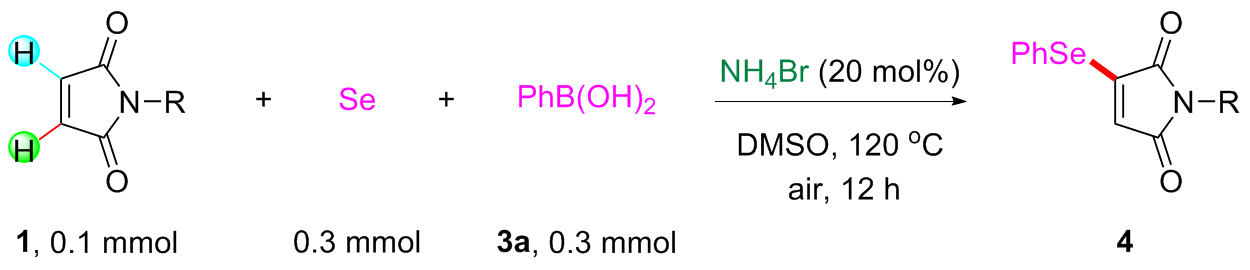
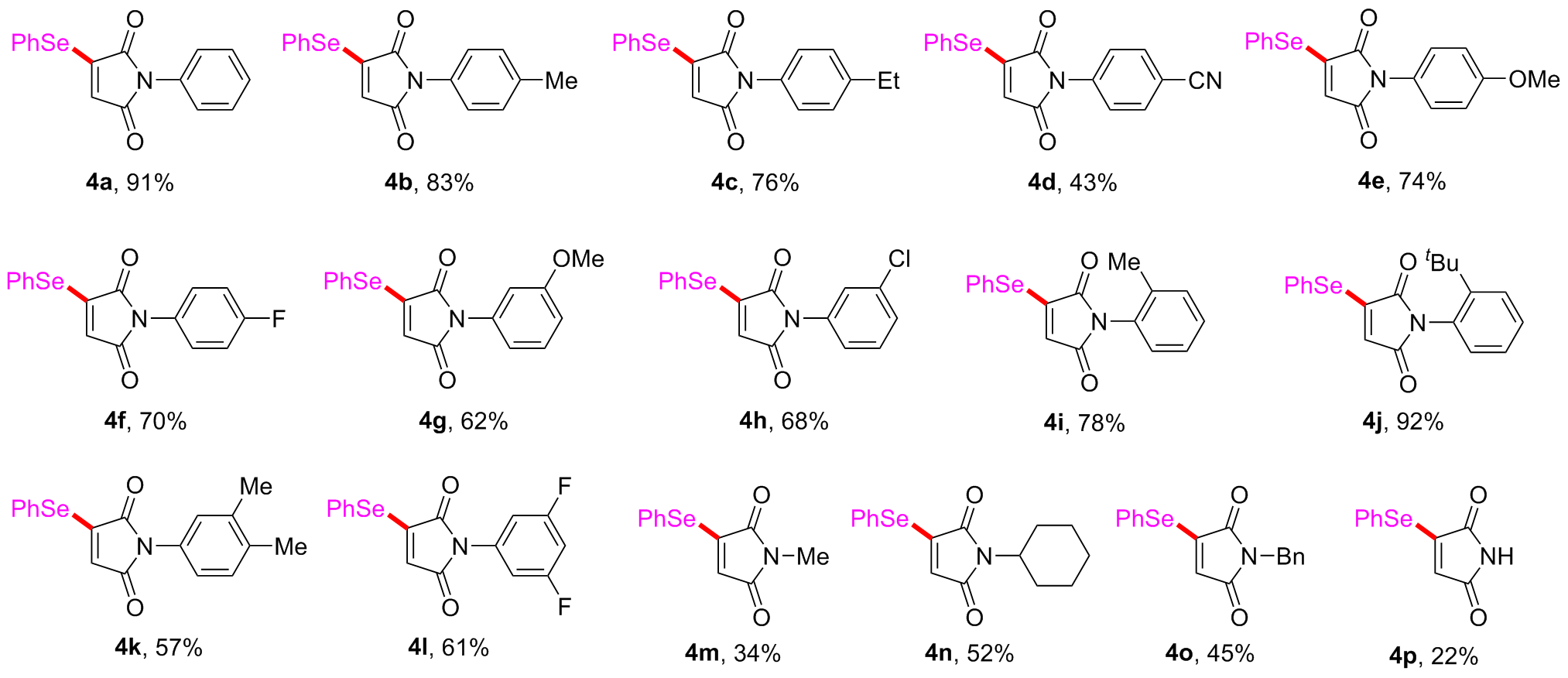
With the optimized conditions in hand, the reactivity of various maleimide derivatives 1 and boronic acids 3 were examined to showcase the tolerance of this strategy. These obtained results were shown in Tables 2 and 3. Initially, a series of N-aryl maleimides 1 were investigated under the standard conditions. Electron-donating groups, such as methyl (1b), ethyl (1c), methoxy (1e), substituting at the para-position on the arene ring of N-aryl maleimides 1, were explored, all of them successfully generated the desired products 4b~4c and 4e in 74%~83% yields. Specifically, electron-deficient substituents, like cyano (1d) and fluoro (1f), were also compatible with this method, nevertheless, sluggish yields were offered. Subsequently, N-(3- methoxyphenyl) maleimide 1g and N-(3-chlorophenyl) maleimide 1h were treated with Se powder and PhB(OH)2 (3a) in the presence of NH4Br, affording products 4g~4h in 62%~68% yields. Steric substrates, bearing methyl (1i) and tert-butyl (1j) at the ortho-position of benzene ring, were surveyed, delightfully, all of them were smoothly tolerable in this catalytic system, offering the desired maleimides 4i~4j in 78%~92% yields. Multi-substituted N-aryl maleimides 1k~1l were further employed as the starting materials, which delivered compounds 4k~4l in moderate yields. In addition, three-component reaction of N-alkyl maleimides 1, elemental Se, and phenylboronic acid 3a resulted in moderate reactivity. All of them produced the desired products 4m~4o in acceptable yields. Finally, free 1H-pyrrole-2,5-dione 1p was also examined, affording 3-(phenylselanyl)-1H-pyrrole-2,5-dione (4p) in poor yield.
Table 2 Substrate scope of maleimides 1a

a Standard conditions: maleimides 1 (0.1 mmol), Se (0.3 mmol), PhB(OH)2 (3a, 0.3 mmol), NH4Br (20 mol%), DMSO (1 mL), 120 ℃, 12 h, air. Isolated yield was given.

Table 3 Substrate scope of boronic acids 3a

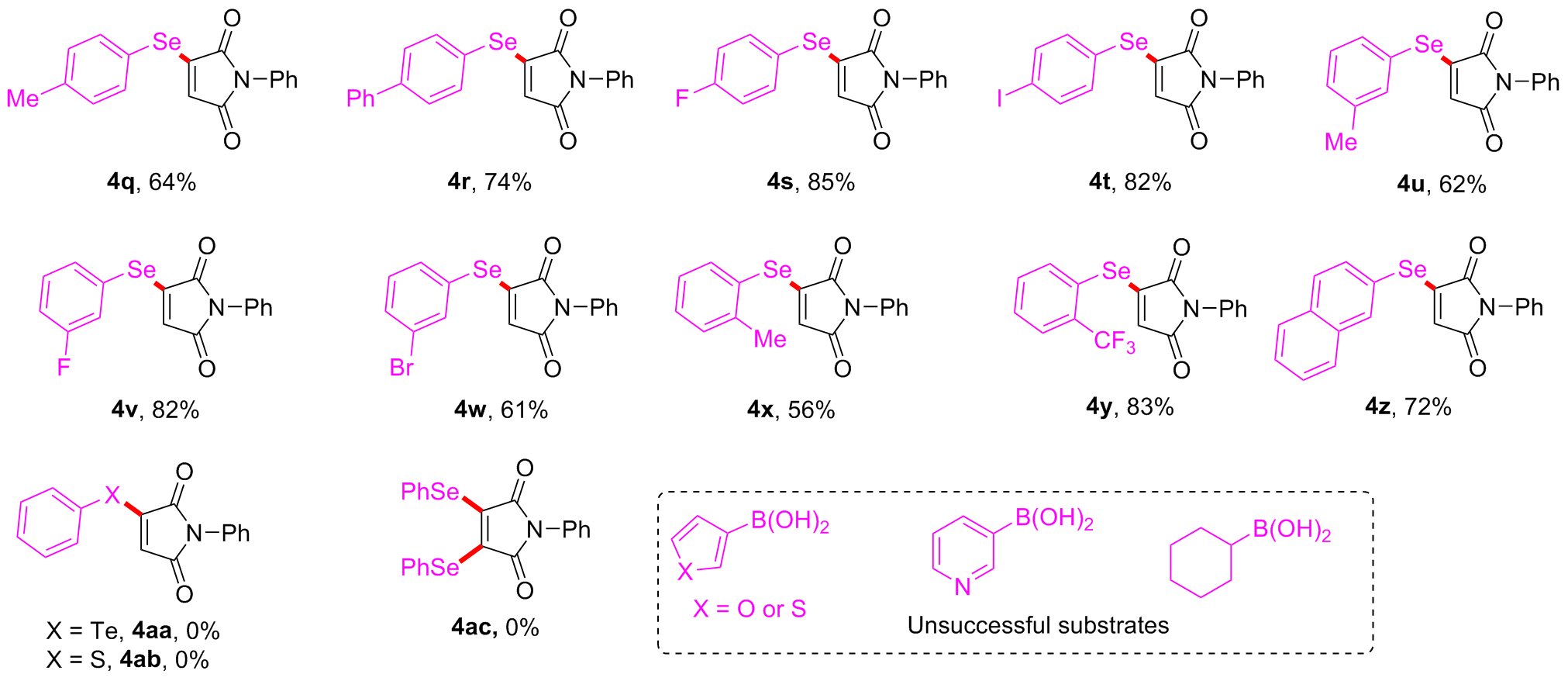
a Standard conditions: maleimides 1a (0.1 mmol), Se (0.3 mmol), ArB(OH)2 (3, 0.3 mmol), NH4Br (20 mol%), DMSO (1 mL), 120 ℃, 12 h, air. Isolated yield was given.

Next, we turned to evaluate the compatibility of different arylboronic acids 3 under the metal-free conditions. As shown in Table 3, an array of electron-rich and electron- deficient boronic acids 3 were tested. In general, the electronic property and the steric hindrance had no significant effect on the reactivity. Arylboronic acids 3, possessing methyl (3b), phenyl (3c), fluoro (3d), and iodo (3e) at the para-position, were accommodated in this reaction, all of them provided the selenylated maleimides 4q~4t in moderate to good yields. Then, three-component reactions of N-phenyl maleimide 1a, Se powder with 3-methylphenyl- boronic acid (3f), 3-fluorophenylboronic acid (3g), or 3-bromophenylboronic acid (3h) via bromide catalysis were individually conducted, which offered compounds 4u~4w in 61%~82% yields. The steric boronic acids 3 possessing methyl (3i) and trifluoromethyl (3j) at the C(2) position of benzene ring reacted with Se powder and N-phenyl maleimide 1a, delivering the selenyl-substituted maleimides 4x~4y in 56%~83% yields. The selenylation was easily realized by employing the conjugated boronic acid 3k, pleasantly, 3-(naphthalen-2-ylselanyl)-1-phenyl-1H- pyrrole-2,5-dione (4z) was assembled in 72% yield. Next, we tried to apply this strategy to synthesize valuable phenyltellanyl- or phenylthioyl-substituted maleimides. However, no desired products 4aa~4ab were observed using Te powder and S powder as the reactant. In addition, increasing the precursor of diphenyl diselenide into 0.5 mmol did not give a diphenylselenyl-substituted maleimide 4ac under the optimal conditions. Finally, heteroarylboronic acids and alkylboronic acid were further surveyed, disappointingly, all failed to generate the desired products.
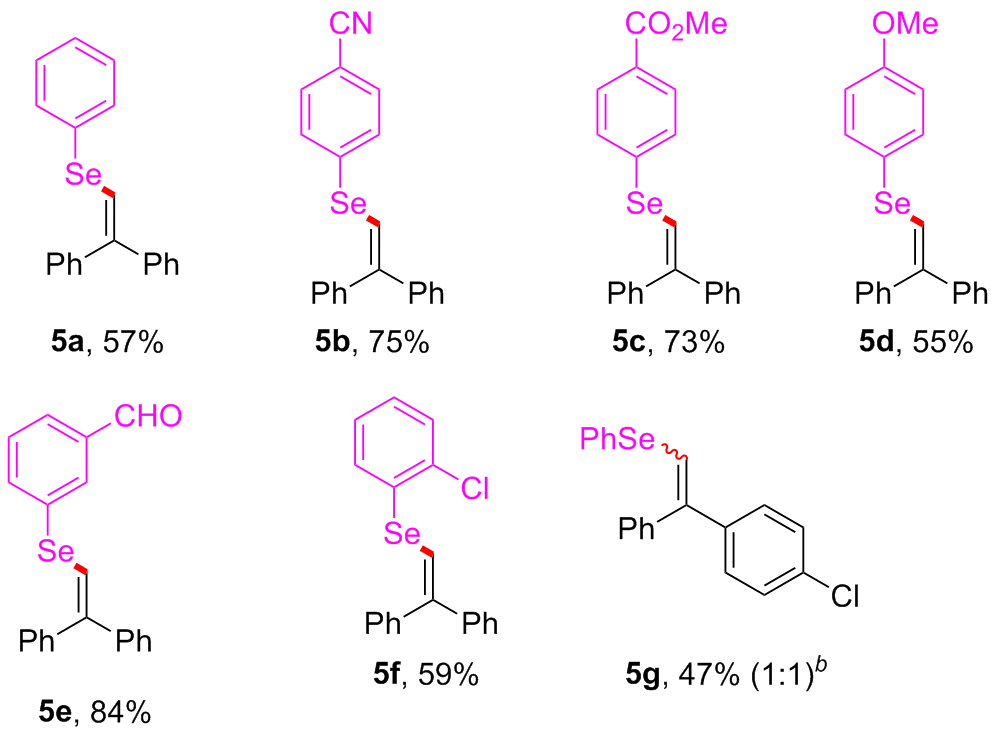
Bromide-catalyzed direct selenylation of 1,1-diarylal- kenes 2 with Se powder and boronic acids 3 were carried out to indicate the flexibility of this strategy (Table 4). Satisfyingly, arylselenylated 1,1-diphenylethylenes 5 were successfully achieved in moderate to good yields when various arylboronic acids 3 were used. Generally, electron-with- drawing groups and electron-donating group had no obvious influence on the efficiency. (4-Methoxyphenyl)boronic acid gave the desired product 5d in 55% yield. Strong electron-withdrawing groups, such as cyano, ester, and formyl, were well compatible under the present system. Remarkably, (2-chlorophenyl)(2,2-diphenylvinyl)selane (5f) was smoothly synthesized in 59% yield. Interestingly, the unsymmetrical 1-chloro-4-(1-phenylvinyl)benzene (2b) was also suitable in this method, offering a Z/E isomers of product 5g in 47% yield at a ratio of 1∶1.
Table 4 Substrate scope of boronic acids 3 and 1,1-diaryl- ethylenes 2a,b

a Standard conditions: 1,1-diarylethlene (2, 0.1 mmol), Se (0.3 mmol), ArB- (OH)2 (3, 0.3 mmol), NH4Br (20 mol%), DMSO (1 mL), 120 ℃, 12 h, air. Isolated yield was given. b The ratio of E-isomer and Z-isomer was determined by GC-MS.

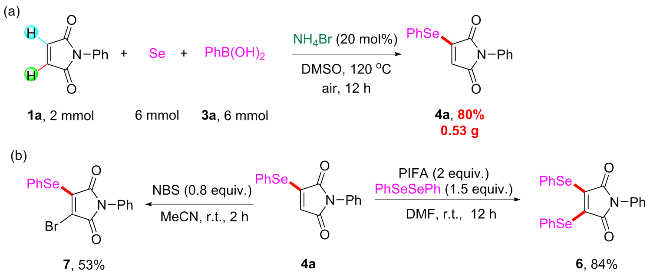
To showcase the practicability of this method, the scale- up reaction and synthetic transformations were performed (Scheme 2). A 2 mmol-scale of model reaction was carried out, which gave 0.53 g of compound 4a in 80% yield without a significant loss in reactivity (Scheme 2, a). The [bis(trifluoroacetoxy)iodo]benzene (PIFA)-promoted selen- ylation of compound 4a under ambient temperature was feasible, furnishing 1-phenyl-3,4-bis(phenylselanyl)-1H- pyrrole-2,5-dione 6 in 84% yield. Additionally, the bro-mination of compound 4a in the presence of N-bromo- succinimide successfully provided a 3-bromo-1-phenyl-4- (phenylselanyl)-1H-pyrrole-2,5-dione (7) in 53% yield (Scheme 2, b.
Scheme 2 Scale-up reaction and derivatizations of compound 4a
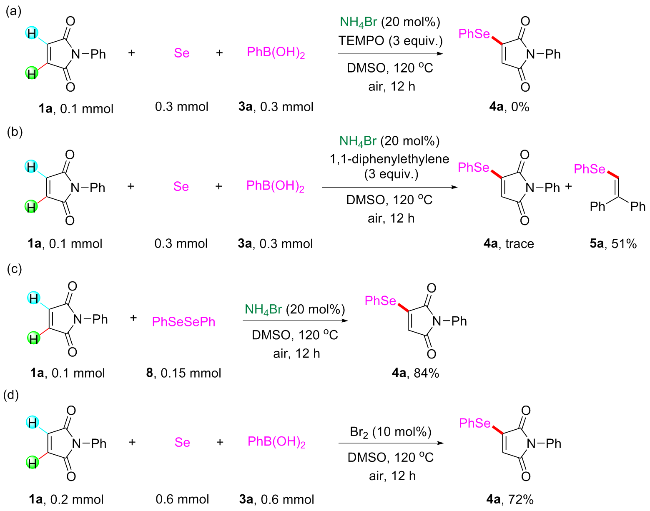
To gain more insights into this method, mechanistic experiments were conducted (Scheme 3). At the beginning, the radical capture experiments were operated with the addition of scavengers into the model reaction. No desired product 4a was observed when 3 equiv. of 2,2,6,6-tetra- methyl-1-piperinedinyloxy (TEMPO) was added (Scheme 3, a). Trace amount of product 4a was produced while 1,1-diphenylethylene was used, additionally, 2-phenyl- selenyl-1,1-diphenylethylene 5a was isolated in 51% yield and its structure was determined by 1H NMR (Scheme 3, b. These results suggested that this reaction possibly ran via a radical pathway. The N-phenyl maleimide 1a was treated with diphenyl diselenide 8 under the standard conditions, excitingly, the product 4a was obtained in 84% yield (Scheme 3, c. This meant that the in situ formation of diphenyl diselenide 8 firstly underwent between phenylboronic acid 3a and selenium powder in the presence of NH4Br. Finally, Br2-catalyzed selenylation of maleimide 1a with PhB(OH)2 (3a) and elemental Se produced compound 4a in 72% yield (Scheme 3, d. This indicated that bromide was firstly oxidized into active bromine, which was subsequently employed to catalyze this transformation.
Scheme 3 Mechanistic experiments
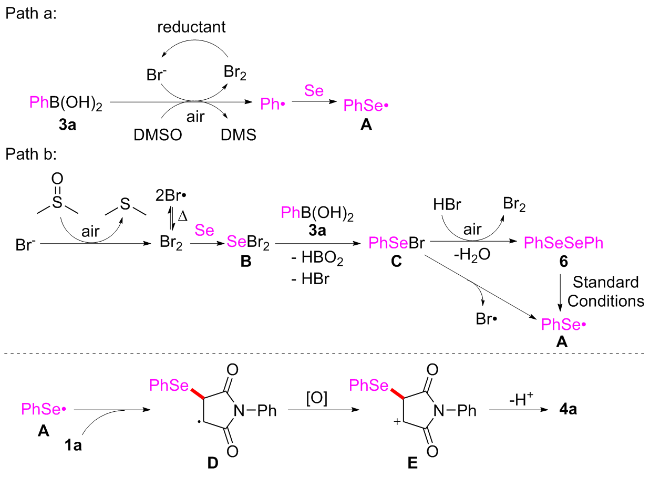
Based on these obtained results of mechanistic experiments and previously related work,[15] a plausible mechanism was proposed (Scheme 4). The phenylselenyl radical A was alternatively generated via two kinds of pathways. In path a, the phenyl radical, deriving from phenylboronic acid 3a under the synergistic work of bromide, DMSO, and air, was captured by elemental Se which formed the intermediate A. In path b, bromine was firstly generated via the oxidation of bromide in the presence of DMSO and air. Subsequently, the reaction of bromine and Se powder gave a selenium dibromide B. At the same time, a reversible process underwent between bromo radical and bromine under heating condition. The species B interacted with phenylboronic acid 3a which provided a phenylselenyl bromide C, releasing HBr and HBO2 simultaneously. On the one hand, diphenyl diselenide 6 was smoothly synthesized via the interaction of hydrogen bromide and intermdiate C under air atmosphere, along with the release of H2O. The homolysis of intermediate 6 formed a phenylselenyl radical A under the standard conditions. On the other hand, both Br• and radical A were smoothly furnished via the homolysis of species C. Then, the radical addition of radical A to N-phenyl maleimide 1a was occurred, which delivered radical D. The radical D was successfully oxidized into cation E under the oxidative conditions. Finally, the deprotonation of intermediate E generated a phenylselenylated maleimide 4a.
Scheme 4 Possible mechanism

3 Conclusions

In conclusion, a series of selenylated maleimides and alkenes were smoothly accessible via bromide-catalyzed three-component reaction of maleimides/1,1-arylethylenes, Se powder and boronic acids. This method was highlighted by its high efficiency, broad substrate scope, good functional group compatibility, scalable-up, easy operation, and simple catalytic system. The detailed mechanistic experiments indicated that this transformation possibly ran via a radical pathway. Further applications of selenyl-susbtituted maleimides is undergoing in our laboratory.

4 Experimental section

4.1 General Information

All reactions were carried out under air atmosphere of unless otherwise noted. Column chromatography was performed using silica gel (200~300 mesh). 1H NMR, 13C NMR, and 19F NMR spectra were recorded on a Bruker- ADVANCE III (500 MHz, 125 MHz, and 471 MHz, respectively) instruments using CDCl3 as solvent and TMS as an internal standard. High-resolution mass spectra (HRMS) were performed on a Bruker Compact TOF mass spectrometer in electrospray ionization mode (ESI). Structures of known compounds were further corroborated by comparing their 1H NMR, 13C NMR and MS data with those of literature. Reagents were obtained from commercial suppliers and used without further purification. Maleimide derivatives was synthesized according to previous reference.[16]

4.2 General procedure for the synthesis of selenylated maleimides 4 and alkenes 5

Under air atmosphere, a 10 mL-Schlenk tube equipped with a stirring bar were charged with substrate 1a (0.1 mmol, 17.5 mg), PhB(OH)2 (3a, 0.3 mmol, 37.0 mg), Se (0.3 mmol, 24.9 mg) and DMSO (1 mL). The obtained mixture was stirred at 120 ℃ (oil bath) for 12 h. After the reaction was completed, the mixture was diluted with H2O (5 mL) and then extracted by ethyl acetate (EA, 5 mL×3), the combined organic phase was dried by anhydrous Na2SO4 and filtered. The filtrates were concentrated under reduced pressure to give a crude residue which was purified by flash column chromatography to provide compound 4a (29.9 mg) in 91% yield as a yellow solid. Compounds 4b~4z and 5a~5g were prepared using the same procedure.
1-Phenyl-3-(phenylselanyl)-1H-pyrrole-2,5-dione (4a): Yellow solid, 29.9 mg, 91% yield. m.p. 145~147 ℃ (lit.[12] 145~146 ℃); 1H NMR (500 MHz, CDCl3) δ: 7.72~7.65 (m, 2H), 7.52~7.44 (m, 5H), 7.39~7.33 (m, 3H), 6.03 (s, 1H); 13C NMR (125 MHz, CDCl3) δ: 168.5, 167.9, 151.3, 136.1, 131.5, 130.6, 130.4, 129.2, 128.0, 126.0, 124.6, 123.8; HRMS (ESI) calcd for C16H12NO2Se [M+H] 330.0028, found 330.0030.
3-(Phenylselanyl)-1-(p-tolyl)-1H-pyrrole-2,5-dione (4b): Yellow solid, 28.5 mg, 83% yield. m.p. 159~161 ℃; 1H NMR (500 MHz, CDCl3) δ: 7.71~7.66 (m, 2H), 7.54~7.43 (m, 3H), 7.28~ 7.24 (m, 2H), 7.23~7.20 (m, 2H), 6.01 (s, 1H), 2.38 (s, 3H); 13C NMR (125 MHz, CDCl3) δ: 168.7, 168.0, 151.1, 138.0, 136.1, 130.5, 130.3, 129.9, 128.8, 126.0, 124.6, 123.9, 21.3; HRMS (ESI) calcd for C17H14NO2Se [M+H] 344.0184, found 344.0183.
(4-Ethylphenyl)-3-(phenylselanyl)-1H-pyrrole-2,5-dione (4c): Yellow solid, 27.1 mg, 76% yield. m.p. 133~134 ℃(lit.[12] 133~134 ℃); 1H NMR (500 MHz, CDCl3) δ: 7.70~7.65 (m, 2H), 7.53~7.44 (m, 3H), 7.30~7.27 (m, 2H), 7.26~7.22 (m, 2H), 6.01 (s, 1H), 2.68 (q, J=7.6 Hz, 2H), 1.25 (t, J=7.6 Hz, 3H); 13C NMR (125 MHz, CDCl3) δ: 168.7, 168.0, 151.2, 144.2, 136.1, 130.5, 130.3, 129.0, 128.7, 126.0, 124.6, 123.9, 28.7, 15.6; HRMS (ESI) calcd for C18H16NO2Se [M+H] 358.0341, found 358.0344.
(2,5-Dioxo-3-(phenylselanyl)-2,5-dihydro-1H-pyrrol-1-yl)benzonitrile (4d): Yellow solid, 15.2 mg, 43% yield. m.p. 190~192 ℃; 1H NMR (500 MHz, CDCl3) δ: 7.74 (d, J=8.5 Hz, 2H), 7.67 (d, J=7.1 Hz, 2H), 7.60 (d, J=8.5 Hz, 2H), 7.55~7.45 (m, 3H), 6.05 (s, 1H); 13C NMR (125 MHz, CDCl3) δ: 167.5, 167.2, 152.1, 136.0, 135.8, 133.1, 130.7, 130.6, 125.5, 124.7, 123.5, 118.4, 111.0; HRMS (ESI) calcd for C17H11N2O2Se [M+H] 354.9980, found 354.9981.
1-(4-Methoxyphenyl)-3-(phenylselanyl)-1H-pyrrole-2,5-dione (4e): Yellow solid, 26.6 mg, 74% yield. m.p. 152~154 ℃; 1H NMR (500 MHz, CDCl3) δ: 7.68 (d, J=6.9 Hz, 2H), 7.52~7.42 (m, 3H), 7.25~7.21 (m, 2H), 6.99~6.95 (m, 2H), 6.00 (s, 1H), 3.82 (s, 3H); 13C NMR (125 MHz, CDCl3) δ: 168.9, 168.1, 159.2, 151.1, 136.1, 130.5, 130.3, 127.6, 124.6, 124.2, 123.9, 114.6, 55.6; HRMS (ESI) calcd for C17H14NO3Se [M+H] 360.0133, found 360.0135.
1-(4-Fluorophenyl)-3-(phenylselanyl)-1H-pyrrole-2,5-dione (4f): Yellow solid, 24.2 mg, 70% yield. m.p. 166~168 ℃; 1H NMR (500 MHz, CDCl3) δ: 7.74~7.65 (m, 2H), 7.56~7.44 (m, 3H), 7.37~7.29 (m, 2H), 7.20~7.10 (m, 2H), 6.02 (s, 1H); 13C NMR (125 MHz, CDCl3) δ: 168.4, 167.8, 161.9 (d, J=246.3 Hz), 151.4, 136.1, 130.6, 130.4, 127.9 (d, J=8.9 Hz), 127.5 (d, J=3.3 Hz), 124.6, 123.8, 116.2 (d, J=22.5 Hz); 19F NMR (471 MHz, CDCl3) δ: —113.31; HRMS (ESI) calcd for C16H11FNO2Se [M+H] 347.9934, found 347.9934.
1-(3-Methoxyphenyl)-3-(phenylselanyl)-1H-pyrrole-2,5-dione (4g): Yellow solid, 22.3 mg, 62% yield. m.p. 106~108 ℃; 1H NMR (500 MHz, CDCl3) δ: 7.72~7.64 (m, 2H), 7.54~7.44 (m, 3H), 7.38~7.33 (m, 1H), 6.97~6.88 (m, 3H), 6.01 (s, 1H), 3.81 (s, 3H); 13C NMR (125 MHz, CDCl3) δ: 168.5, 167.8, 160.1, 151.3, 136.1, 132.5, 130.5, 130.4, 129.9, 124.7, 123.8, 118.3, 113.9, 111.8, 55.5; HRMS (ESI) calcd for C17H14NO3Se [M+H] 360.0133, found 360.0131.
1-(3-Chlorophenyl)-3-(phenylselanyl)-1H-pyrrole-2,5-dione (4h): Yellow solid, 24.6 mg, 68% yield. m.p. 118~120 ℃; 1H NMR (500 MHz, CDCl3) δ: 7.70~7.65 (m, 2H), 7.53~7.45 (m, 3H), 7.43~7.37 (m, 2H), 7.34~7.31 (m, 1H), 7.30~7.27 (m, 1H), 6.02 (s, 1H); 13C NMR (125 MHz, CDCl3) δ: 168.0, 167.5, 151.6, 136.1, 134.7, 132.7, 130.6, 130.4, 130.1, 128.0, 126.0, 124.6, 123.9, 123.7; HRMS (ESI) calcd for C16H11ClNO2Se [M+H] 363.9638, found 363.9636.
3-(Phenylselanyl)-1-(o-tolyl)-1H-pyrrole-2,5-dione (4i): Yellow solid, 26.8 mg, 78% yield. m.p. 78~80 ℃; 1H NMR (500 MHz, CDCl3) δ: 7.73~7.68 (m, 2H), 7.54~7.44 (m, 3H), 7.36~7.26 (m, 3H), 7.12 (d, J=7.7 Hz, 1H), 6.04 (s, 1H), 2.19 (s, 3H); 13C NMR (125 MHz, CDCl3) δ: 168.7, 167.9, 151.2, 136.7, 136.1, 131.3, 130.5, 130.34, 130.28, 129.5, 128.8, 127.0, 124.8, 123.9, 18.1; HRMS (ESI) calcd for C17H14NO2Se [M+H] 344.0184, found 344.0187.
1-(2-(tert-Butyl)phenyl)-3-(phenylselanyl)-1H-pyrrole-2,5-dione (4j): Yellow solid, 35.4 mg, 92% yield. m.p. 104~106 ℃; 1H NMR (500 MHz, CDCl3) δ: 7.74~7.68 (m, 2H), 7.58 (dd, J=8.1, 1.3 Hz, 1H), 7.54~7.45 (m, 3H), 7.41~7.37 (m, 1H), 7.28 (dd, J=7.6, 1.4 Hz, 1H), 6.93 (dd, J=7.7, 1.4 Hz, 1H), 6.08 (s, 1H), 1.32 (s, 9H); 13C NMR (125 MHz, CDCl3) δ: 169.9, 169.0, 151.7, 149.7, 136.0, 131.5, 130.5, 130.3, 129.9, 129.6, 128.7, 127.4, 125.4, 123.9, 35.6, 31.7; HRMS (ESI) calcd for C20H20NO2Se [M+H] 386.0654, found 386.0653.
1-(3,4-Dimethylphenyl)-3-(phenylselanyl)-1H-pyrrole-2,5-dione (4k): Yellow solid, 20.3 mg, 57% yield. m.p. 95~97 ℃; 1H NMR (500 MHz, CDCl3) δ: 7.71~7.66 (m, 2H), 7.53~7.44 (m, 3H), 7.21 (d, J=8.0 Hz, 1H), 7.09 (d, J=1.7 Hz, 1H), 7.04 (dd, J=8.0, 2.1 Hz, 1H), 6.01 (s, 1H), 2.28 (s, 3H), 2.28 (s, 3H); 13C NMR (125 MHz, CDCl3) δ: 168.8, 168.1, 151.1, 137.7, 136.9, 136.1, 130.5, 130.3, 130.0, 129.0, 127.3, 124.6, 123.9, 123.7, 20.0, 19.6; HRMS (ESI) calcd for C18H16NO2Se [M+H] 358.0341, found 358.0339.
1-(3,5-Difluorophenyl)-3-(phenylselanyl)-1H-pyrrole-2,5-dione (4l): Yellow solid, 22.2 mg, 61% yield. m.p. 173~174 ℃; 1H NMR (500 MHz, CDCl3) δ: 7.70~7.64 (m, 2H), 7.55~7.45 (m, 3H), 7.09~7.02 (m, 2H), 6.80 (tt, J=8.8, 2.3 Hz, 1H), 6.02 (s, 1H); 13C NMR (125 MHz, CDCl3) δ: 167.5, 167.2, 162.9 (dd, J=246.3, 13.8 Hz), 151.9, 136.1, 133.7 (dd, J=1.4, 0.8 Hz), 130.63, 130.55, 124.7, 123.6, 108.7 (dd, J=22.5, 7.5 Hz), 103.2 (dd, J=25.0, 0.8 Hz); 19F NMR (471 MHz, CDCl3) δ: —108.22; HRMS (ESI) calcd for C16H10F2NO2Se [M+H] 365.9839, found 365.9843.
1-Methyl-3-(phenylselanyl)-1H-pyrrole-2,5-dione (4m): Yellow solid, 9.1 mg, 34% yield. m.p. 104~105 ℃; 1H NMR (500 MHz, CDCl3) δ: 7.65~7.60 (m, 2H), 7.51~7.41 (m, 3H), 5.88 (s, 1H), 3.02 (s, 3H); 13C NMR (125 MHz, CDCl3) δ: 169.9, 169.2, 150.6, 136.0, 130.4, 130.2, 124.7, 124.0, 24.2; HRMS (ESI) calcd for C11H10NO2Se [M+H] 267.9871, found 267.9872.
1-Cyclohexyl-3-(phenylselanyl)-1H-pyrrole-2,5-dione (4n): Yellow solid, 17.4 mg, 52% yield. m.p. 77~78 ℃(lit.[17] 76~77 ℃); 1H NMR (500 MHz, CDCl3) δ: 7.66~7.60 (m, 2H), 7.50~7.40 (m, 3H), 5.81 (s, 1H), 3.88 (tt, J=12.4, 3.9 Hz, 1H), 2.09~1.97 (m, 2H), 1.85~1.79 (m, 2H), 1.70~1.61 (m, 3H), 1.38~1.15 (m, 3H); 13C NMR (125 MHz, CDCl3) δ: 170.0, 169.1, 150.4, 136.0, 130.4, 130.1, 124.5, 124.0, 51.2, 30.1, 26.1, 25.2; HRMS (ESI) calcd for C16H18NO2Se [M+H] 336.0497, found 336.0497.
1-Benzyl-3-(phenylselanyl)-1H-pyrrole-2,5-dione (4o): Yellow solid, 15.4 mg, 45% yield. m.p. 125~127 ℃ (lit.[17] 125~126 ℃); 1H NMR (500 MHz, CDCl3) δ: 7.64~7.60 (m, 2H), 7.50~7.40 (m, 3H), 7.38~7.27 (m, 5H), 5.88 (s, 1H), 4.67 (s, 2H); 13C NMR (125 MHz, CDCl3) δ: 169.4, 168.8, 150.7, 136.4, 136.0, 130.4, 130.2, 128.8, 128.7, 128.0, 124.7, 123.9, 41.9; HRMS (ESI) calcd for C17H14NO2Se [M+H] 344.0184, found 344.0187.
3-(Phenylselanyl)-1H-pyrrole-2,5-dione (4p): Yellow solid, 5.6 mg, 22% yield. m.p. 126~128 ℃; 1H NMR (500 MHz, CDCl3) δ: 7.76 (s, 1H), 7.67~7.61 (m, 2H), 7.51~7.41 (m, 3H), 5.87 (s, 1H); 13C NMR (125 MHz, CDCl3) δ: 169.4, 168.9, 151.7, 136.0, 130.5, 130.3, 125.7, 123.9; HRMS (ESI) calcd for C10H8NO2Se [M+H] 253.9715, found 253.9717.
1-Phenyl-3-(p-tolylselanyl)-1H-pyrrole-2,5-dione (4q): Yellow solid, 22.0 mg, 64% yield. m.p. 120~122 ℃(lit.[17] 120~121 ℃); 1H NMR (500 MHz, CDCl3) δ: 7.55 (d, J=8.0 Hz, 2H), 7.45 (dd, J=14.3, 6.6 Hz, 2H), 7.38~7.32 (m, 3H), 7.26 (d, J=8.0 Hz, 2H), 6.01 (s, 1H), 2.41 (s, 3H); 13C NMR (125 MHz, CDCl3) δ: 168.6, 167.9, 151.7, 140.8, 136.0, 131.6, 131.3, 129.2, 127.9, 126.0, 124.6, 120.2, 21.5; HRMS (ESI) calcd for C17H14NO2Se [M+H] 344.0184, found 344.0185.
3-([1'-Biphenyl]-4-ylselanyl)-1-phenyl-1H-pyrrole-2,5-dione (4r): Yellow solid, 30.0 mg, 74% yield. m.p. 146~147 ℃; 1H NMR (500 MHz, CDCl3) δ: 7.75 (d, J=8.2 Hz, 2H), 7.68 (d, J=8.2 Hz, 2H), 7.61 (d, J=7.4 Hz, 2H), 7.46~7.40 (m, 5H), 7.39~7.33 (m, 3H), 6.12 (s, 1H); 13C NMR (125 MHz, CDCl3) δ: 168.6, 167.9, 151.2, 143.5, 139.8, 136.5, 131.6, 129.3, 129.2, 128.3, 128.0, 127.3, 126.1, 124.8, 122.5; HRMS (ESI) calcd for C22H16NO2Se [M+H] 406.0341, found 406.0342.
3-((4-Fluorophenyl)selanyl)-1-phenyl-1H-pyrrole-2,5-dione (4s): Yellow solid, 29.4 mg, 85% yield. m.p. 134~135 ℃; 1H NMR (500 MHz, CDCl3) δ: 7.70~7.64 (m, 2H), 7.48~7.43 (m, 2H), 7.38~7.32 (m, 3H), 7.21~7.14 (m, 2H), 6.00 (s, 1H); 13C NMR (125 MHz, CDCl3) δ: 168.3, 167.7, 164.1 (d, J=250.0 Hz), 151.0, 138.3 (d, J=8.6 Hz), 131.5, 129.3, 128.0, 126.0, 124.8, 118.5 (d, J=3.6 Hz), 118.0 (d, J=21.3 Hz); 19F NMR (471 MHz, CDCl3) δ: —109.27; HRMS (ESI) calcd for C16H11FNO2Se [M+ H] 347.9934, found 347.9934.
3-((4-Iodophenyl)selanyl)-1-phenyl-1H-pyrrole-2,5-dione (4t): Yellow solid, 37.2 mg, 82% yield. m.p. 173~174 ℃; 1H NMR (500 MHz, CDCl3) δ: 7.85~7.76 (m, 2H), 7.50~7.44 (m, 2H), 7.43~7.39 (m, 2H), 7.38~7.32 (m, 3H), 6.05 (s, 1H); 13C NMR (125 MHz, CDCl3) δ: 168.3, 167.7, 150.3, 139.7, 137.7, 131.5, 129.3, 128.0, 126.0, 124.9, 123.5, 97.1; HRMS (ESI) calcd for C16H11INO2Se [M+H] 455.8994, found 455.8992.
1-Phenyl-3-(m-tolylselanyl)-1H-pyrrole-2,5-dione (4u): Yellow solid, 21.3 mg, 62% yield. m.p. 106~108 ℃ (lit.[13] 107~108 ℃); 1H NMR (500 MHz, CDCl3) δ: 7.53~7.43 (m, 4H), 7.38~7.28 (m, 5H), 6.04 (s, 1H), 2.40 (s, 3H); 13C NMR (125 MHz, CDCl3) δ: 168.6, 167.9, 151.4, 140.6, 136.5, 133.0, 131.6, 131.1, 130.3, 129.2, 127.9, 126.0, 124.7, 123.6, 21.4; HRMS (ESI) calcd for C17H14NO2Se [M+H] 344.0184, found 344.0182.
3-((3-Fluorophenyl)selanyl)-1-phenyl-1H-pyrrole-2,5-dione (4v): Yellow solid, 28.4 mg, 82% yield. m.p. 106~108 ℃; 1H NMR (500 MHz, CDCl3) δ: 7.52~7.41 (m, 5H), 7.39~7.32 (m, 3H), 7.25~7.19 (m, 1H), 6.08 (s, 1H); 13C NMR (125 MHz, CDCl3) δ: 168.3, 167.7, 163.1 (d, J=251.3 Hz), 150.2, 131.9, 131.82 (d, J=3.8 Hz), 131.77, 131.5, 129.3, 128.0, 126.0, 124.9, 123.0 (d, J=22.5 Hz), 117.7 (d, J=20.5 Hz); 19F NMR (471 MHz, CDCl3) δ: —109.30; HRMS (ESI) calcd for C16H11FNO2Se [M+H] 347.9934, found 347.9936.
3-((3-Bromophenyl)selanyl)-1-phenyl-1H-pyrrole-2,5-dione (4w): Yellow solid, 24.8 mg, 61% yield. m.p. 137~139 ℃; 1H NMR (500 MHz, CDCl3) δ: 7.86 (t, J=1.7 Hz, 1H), 7.68~7.60 (m, 2H), 7.48~7.44 (m, 2H), 7.39~7.33 (m, 4H), 6.08 (s, 1H); 13C NMR (125 MHz, CDCl3) δ: 168.3, 167.7, 150.2, 138.5, 134.6, 133.6, 131.8, 131.5, 129.3, 128.1, 126.0, 125.4, 125.0, 123.9; HRMS (ESI) calcd for C16H11BrNO2Se [M+H] 407.9133, found 407.9134.
1-Phenyl-3-(o-tolylselanyl)-1H-pyrrole-2,5-dione (4x): Yellow solid, 19.2 mg, 56% yield. m.p. 114~114 ℃; 1H NMR (500 MHz, CDCl3) δ: 7.69 (d, J=7.6 Hz, 1H), 7.49~7.40 (m, 4H), 7.38~7.32 (m, 3H), 7.29~7.22 (m, 1H), 5.88 (s, 1H), 2.52 (s, 3H); 13C NMR (125 MHz, CDCl3) δ: 168.6, 167.9, 150.6, 142.6, 137.5, 131.6, 131.4, 131.1, 129.2, 127.9, 127.8, 126.0, 124.8, 124.5, 22.8; HRMS (ESI) calcd for C17H14NO2Se [M+H] 344.0184, found 344.0185.
1-Phenyl-3-((2-(trifluoromethyl)phenyl)selanyl)-1H-pyrrole-2,5-dione (4y): Yellow solid, 32.9 mg, 83% yield. m.p. 100~102 ℃; 1H NMR (500 MHz, CDCl3) δ: 7.94~7.86 (m, 2H), 7.74~ 7.58 (m, 2H), 7.48~7.43 (m, 2H), 7.38~7.33 (m, 3H), 5.91 (s, 1H); 13C NMR (125 MHz, CDCl3) δ: 168.3, 167.6, 150.1, 139.9, 134.5 (q, J=30.0 Hz), 133.4, 131.4, 130.8, 129.2, 128.0, 127.9 (q, J=5.0 Hz), 126.0, 125.1, 123.2 (q, J=272.5 Hz), 122.1; 19F NMR (471 MHz, CDCl3) δ: —60.34; HRMS (ESI) calcd for C17H11F3NO2Se [M+H] 397.9902, found 397.9906.
3-(Naphthalen-2-ylselanyl)-1-phenyl-1H-pyrrole-2,5-dione (4z): Yellow solid, 27.3 mg, 72% yield. m.p. 144~145 ℃; 1H NMR (500 MHz, CDCl3) δ: 8.23 (s, 1H), 7.92 (t, J=7.8 Hz, 2H), 7.89~7.83 (m, 1H), 7.68 (dd, J=8.5, 1.5 Hz, 1H), 7.65~7.55 (m, 2H), 7.51~7.43 (m, 2H), 7.41~7.32 (m, 3H), 6.03 (s, 1H); 13C NMR (125 MHz, CDCl3) δ: 168.5, 167.9, 151.2, 136.4, 134.3, 133.7, 131.7, 131.6, 130.3, 129.2, 128.1, 128.0, 127.9, 127.4, 126.1, 124.9, 120.9; HRMS (ESI) calcd for C20H14NO2Se [M+H] 380.0184, found 380.0185.
(2,2-Diphenylvinyl)(phenyl)selane (5a): Yellow solid, 19.2 mg, 57% yield. m.p. 80~82℃ (lit.[17] 81.5~82 ℃); 1H NMR (500 MHz, CDCl3) δ: 7.67~7.61 (m, 2H), 7.51~7.45 (m, 2H), 7.45~7.26 (m, 11H), 7.20~7.17 (m, 1H); 13C NMR (125 MHz, CDCl3) δ: 143.1, 141.7, 140.4, 132.6, 131.7, 129.43, 129.41, 128.6, 128.4, 128.0, 127.5, 127.33, 127.25, 122.7; HRMS (ESI) calcd for C20H17Se [M+H] 337.0490, found 337.0492.
4-((2,2-Diphenylvinyl)selanyl)benzonitrile (5b): Yellow solid, 27.1 mg, 75% yield. m.p. 99~100 ℃; 1H NMR (500 MHz, CDCl3) δ: 7.63~7.59 (m, 2H), 7.58~7.54 (m, 2H), 7.46~7.38 (m, 3H), 7.36~7.27 (m, 7H), 7.10 (s, 1H); 13C NMR (125 MHz, CDCl3) δ: 146.5, 141.1, 140.0, 139.7, 132.6, 131.3, 129.3, 128.7, 128.6, 128.4, 128.0, 127.4, 118.8, 118.5, 110.4; HRMS (ESI) calcd for C21H16NSe [M+H] 362.0442, found 362.0440.
Methyl 4-((2,2-diphenylvinyl)selanyl)benzoate (5c): Yellow solid, 28.8 mg, 73% yield. m.p. 91~92 ℃; 1H NMR (500 MHz, CDCl3) δ: 7.95 (d, J=8.4 Hz, 2H), 7.58 (d, J=8.4 Hz, 2H), 7.45~7.36 (m, 3H), 7.34~7.24 (m, 7H), 7.14 (s, 1H), 3.91 (s, 3H); 13C NMR (125 MHz, CDCl3) δ: 166.9, 145.3, 141.5, 140.3, 138.9, 131.0, 130.3, 129.4, 128.8, 128.7, 128.5, 128.3, 127.8, 127.4, 120.0, 52.3; HRMS (ESI) calcd for C22H19O2Se [M+H] 395.0545, found 395.0542.
(2,2-Diphenylvinyl)(4-methoxyphenyl)selane (5d): Yellow solid, 20.1 mg, 55% yield. m.p. 85~86 ℃; 1H NMR (500 MHz, CDCl3) δ: 7.54~7.50 (m, 2H), 7.42 (t, J=7.6 Hz, 2H), 7.38~7.31 (m, 3H), 7.26~7.18 (m, 5H), 7.03 (s, 1H), 6.86 (d, J=8.6 Hz, 2H), 3.80 (s, 3H); 13C NMR (125 MHz, CDCl3) δ: 159.8, 142.1, 141.8, 140.5, 135.2, 129.5, 128.7, 128.4, 128.0, 127.23, 127.21, 124.4, 121.7, 115.2, 55.5; HRMS (ESI) calcd for C21H19OSe [M+H] 367.0596, found 367.0597.
3-((2,2-Diphenylvinyl)selanyl)benzaldehyde (5e): Yellow solid, 30.6 mg, 84% yield. m.p. 103~104 ℃; 1H NMR (500 MHz, CDCl3) δ: 9.99 (s, 1H), 8.06 (t, J=1.4 Hz, 1H), 7.82~7.77 (m, 2H), 7.51~7.36 (m, 5H), 7.34~7.25 (m, 6H), 7.09 (s, 1H); 13C NMR (125 MHz, CDCl3) δ: 191.7, 144.7, 141.4, 140.2, 138.0, 137.3, 133.3, 133.1, 130.0, 129.4, 128.7, 128.5, 128.3, 127.7, 127.3, 120.7; HRMS (ESI) calcd for C21H17OSe [M+H] 365.0439, found 365.0440.
(2-Chlorophenyl)(2,2-diphenylvinyl)selane (5f): Yellow solid, 21.8 mg, 59% yield. m.p. 93~94 ℃; 1H NMR (500 MHz, CDCl3) δ: 7.59 (dd, J=7.6, 1.5 Hz, 1H), 7.48~7.36 (m, 4H), 7.36~7.27 (m, 7H), 7.27~7.18 (m, 2H), 7.12 (s, 1H); 13C NMR (125 MHz, CDCl3) δ: 145.8, 141.7, 140.2, 135.2, 132.7, 131.9, 129.8, 129.5, 128.7, 128.5, 128.3, 128.1, 127.8, 127.6, 127.5, 119.6; HRMS (ESI) calcd for C20H16ClSe [M+H] 371.0100, found 371.0103.
(2-(4-Chlorophenyl)-2-phenylvinyl)(phenyl)selane (5g): Yellow solid, 17.4 mg, 47% yield. m.p. 86~87 ℃; 1H NMR (500 MHz, CDCl3) δ: 7.61~7.56 (m, 2H), 7.47~7.38 (m, 3H), 7.34~7.31 (m, 3H), 7.30~7.25 (m, 3H), 7.25~7.20 (m, 2H), 7.18~7.15 (m, 1H), 7.12 (d, J=5.6 Hz, 1H); 13C NMR (125 MHz, CDCl3) δ: 142.0, 141.8, 141.4, 140.1, 140.0, 138.8, 133.9, 133.2, 132.8, 132.7, 131.43, 131.35, 130.9, 129.5, 129.4, 128.9, 128.8, 128.6, 128.51, 128.48, 128.3, 127.7, 127.6, 127.2, 123.6, 123.4; HRMS (ESI) calcd for C20H16ClSe [M+H] 371.0100, found 371.0100.
4.3 Scale-up reaction for compound 4a

Under air atmosphere, a 50 mL round-bottom flask equipped with a stirring bar were charged with substrate (1a, 2 mmol, 348.5 mg), PhB(OH)2 (3a, 6 mmol, 734.1 mg), Se (6 mmol, 482.3 mg) and DMSO (20 mL). The obtained mixture was stirred at 120 ℃ (oil bath) for 12 h. After the reaction was completed, the mixture was diluted with H2O (15 mL) and extracted by EA (15 mL×3), the combined organic phase was dried by anhydrous Na2SO4 and filtered. The filtrates were concentrated under reduced pressure to give a crude residue which was purified by flash column chromatography to provide 1-phenyl-3-(phenylselanyl)- 1H-pyrrole-2,5-dione (4a, 0.53 g) in 80% yield as a yellow solid.

4.4 General procedure for the synthesis of compound 6

Under air atmosphere, a 10 mL Schlenk-tube equipped with a stirring bar were charged with substrate 4a (0.1 mmol, 33.1 mg), PhSeSePh (8, 0.15 mmol, 46.8 mg) and DMF (1 mL). The obtained mixture was stirred at room temperature for 12 h. After the reaction was completed, the mixture was diluted with H2O (3 mL) and extracted by EA (5 mL×3), the combined organic phase was dried by anhydrous Na2SO4 and filtered. The filtrates were concentrated under reduced pressure to give a crude residue which was purified by flash column chromatography to provide 1-phenyl-3,4-bis(phenylselanyl)-1H-pyrrole-2,5-dione (6) (40.8 mg) in 84% yield as a yellow oil. 1H NMR (500 MHz, CDCl3) δ: 7.55 (dd, J=7.2, 1.1 Hz, 4H), 7.38 (dt, J=14.3, 7.2 Hz, 4H), 7.30 (td, J=8.0, 1.8 Hz, 7H); 13C NMR (125 MHz, CDCl3) δ: 166.3, 138.7, 135.1, 131.7, 129.5, 129.10, 129.08, 127.9, 126.03, 125.98; HRMS (ESI) calcd for C22H16NO2Se2 [M+H] 485.9506, found 485.9505.

4.5 General procedure for the synthesis of compound 7

Under air atmosphere, a 10 mL Schlenk-tube equipped with a stirring bar were charged with substrate 4a (0.2 mmol, 65.8 mg), N-bromosuccinimide (NBS) (0.16 mmol, 28.6 mg) and MeCN (1 mL). The obtained mixture was stirred at room temperature for 2 h. After the reaction was completed, the mixture was concentrated under reduced pressure to give a crude residue which was purified by flash column chromatography to provide 3-bromo-1-phenyl-4- (phenylselanyl)-1H-pyrrole-2,5-dione (7) (43.1 mg) in 53% yield as a yellow solid. m.p. 145~147 ℃; 1H NMR (500 MHz, CDCl3) δ: 7.72 (d, J=7.1 Hz, 2H), 7.44 (t, J=7.5 Hz, 3H), 7.37 (dd, J=12.8, 5.4 Hz, 3H), 7.31 (d, J=7.7 Hz, 2H); 13C NMR (125 MHz, CDCl3) δ: 166.2, 163.9, 140.5, 136.9, 131.4, 130.1, 129.6, 129.3, 128.3, 126.1, 125.3, 123.2; HRMS (ESI) calcd for C16H11BrNO2Se [M+H] 407.9133, found 407.9132.
Supporting Information 1H NMR, 13C NMR, and 19F NMR spectra of compounds. The Supporting Information is available free of charge via the Internet at http://sioc-journal.cn.
(Zhao, C.)
[1]
(a) Hou, W.; Dong, H.; Zhang, X.; Wang, Y.; Su, L.; Xu, H. Drug Discovery Today 2022, 27, 2268.

(b) Chuai, H.; Zhang, S.-Q.; Bai, H.; Li, J.; Wang, Y.; Sun, J.; Wen, E.; Zhang, J.; Xin, M. Eur. J. Med. Chem. 2021, 223, 113621.

(c) Nogueira, C. W.; Zeni, G.; Rocha, J. B. Chem. Rev. 2004, 104, 6255.

[2]
(a) Mugesh, G.; du Mont, W. W.; Sies, H. Chem. Rev. 2001, 101, 2125.

PMID

(b) Kim, C.; Lee, J.; Park, M. S. Arch. Pharmacal Res. 2015, 38, 659.

(c) Savegnago, L.; Pinto, L. G.; Jesse, C. R.; Alves, D.; Rocha, J. B. T.; Nogueira, C. W.; Zeni, G. Eur. J. Pharmacol. 2007, 555, 129.

PMID

(d) Ding W.; Wang, S.; Gu, J.; Yu, L. Chin. Chem. Lett. 2023, 34, 108043.

(e) Gu, J.; Gu, J.; Yu, L. Chin. Chem. Lett. 2025, 36, 110727.

[3]
(a) Cen, K.; Liu, Y.; Yu, J.; Zeng, Z.; Hou, Q.; He, G.; Ouyang, M.; Wang, Q.; Wang, D.; Zhao, F.; Cai, J. J. Org. Chem. 2024, 89, 8632.

(b) Cai, J.; Cen, K.; Lin, H.; Zhang, H.; Zhou, N.; Wang, Q. ChemCatChem 2024,16, e202400929.

(c) Cai, J.; Cen, K.; Li, W.; Lin, H.; Zhang, H. Adv. Synth. Catal. 2025,367, e202401146.

(d) Cen, K.; Wei, J.; Liu, Y.; Tan, Z.; Wang, X.; Wang, D.; He, W.-M.; Cai, J. Eur. J. Org. Chem. 2023,26, e202300968.

(e) Xu, X.-M.; Wang, J.; Chen, X.; Zhao, Z.; Liu, Q.; Tian, M.; Sun, K. Org. Lett. 2025, 27, 802.

(f) Wang, Z.; Wang, X.; Li, Q.; Ni, S.; Zhao, D.; Yang, S.; Qiu, G.; Sun, K. Chin. Chem. Lett. 2023, 35, 109058.

(g) Zhang, Z.; Tan, P.; Wang, S.; Wang, H.; Han, L.; Yang, S.; Sun, K. Org. Lett. 2023, 25, 4208.

(h) Ma, Y.-T.; Liu, M.-C.; Zhou, Y.-B.; Wu, H.-Y. Adv. Synth. Catal. 2021, 363, 5386.

(i) Xu, Y.; Huang, D.; Wu, J.; Wu, X. Adv. Synth. Catal. 2024, 366, 3761.

(j) Hasimujiang, B.; Ruan, Z. SynOpen 2023, 7, 511.

(k) Bartz, R. H.; Hellwig, P. S.; Rosa, K. M.; Silva, M. S.; Lenardão, E. J.; Jacob, R. G.; Perin, G. Org. Biomol. Chem. 2025, 23, 2997.

(l) Pinheiro, R. do, C.; Marques, L. S.; Jung, J. T. K.; Nogueira, C. W.; Zeni, G. Chem. Rec. 2024,24, e202400044.

(m) Cai, J.; Zeng, Z.; Wang, Q.-L.; Li, W. Adv. Synth. Catal. 2025, e202500210.

(n) Shi, T.; Tian, M.; Sun, Z.; Zou, R.; Zhang, Z.; Xie, N.; Hao, E.; Xu, X.; Sun, K. Chem. Commun. 2025, 61, 4066.

(o) Wang, X.; Wang, Z.; Li, Z.; Sun, K. Chin. Chem. Lett. 2023, 34, 108045.

(p) Wang, X.; Meng, J.; Zhao, D.; Tang, S.; Sun, K. Chin. Chem. Lett. 2023, 34, 107736.

(q) Sun, K.; Wang, X.; Li, C.; Wang, H.; Li, L. Org. Chem. Front. 2020, 7, 3100.

(r) Wang, X.; Zhang, Y.; Sun, K.; Meng, J.; Zhang, B. Chin. J. Org. Chem. 2021, 41, 4588 (in Chinese).

(王薪, 张艳, 孙凯, 孟建萍, 张冰, 有机化学, 2021, 41, 4588.)

DOI

(s) Zhang, Z.; Wang, S.; Tan, P.; Gu, X.; Sun, W.; Liu, C.; Chen, J.; Li, J.; Sun, K. Org. Lett. 2022, 24, 2288.

(t) Yang, B.; Zhang, X.-Y.; Yue, H.-Q.; Li, W.-Z.; Li, M.; Lu, L.; Wu, Z.-Q.; Li, J.; Sun, K. Adv. Synth. Catal. 2022, 364, 3528.

[4]
(a) Patil, N. S.; Deshmukh, G. B.; Patil, S. V.; Bholay, A. D.; Gaikwad, N. D. Eur. J. Med. Chem. 2014, 83, 490.

(b) Budke, B.; Kalin, J. H.; Pawlowski, M.; Zelivianskaia, A. S.; Wu, M.; Kozikowski, A. P.; Connell, P. P. J. Med. Chem. 2013, 56, 254.

(c) Wu, M.-D.; Cheng, M.-J.; Wang, B.-C.; Yech, Y.-J.; Lai, J. T.; Kuo, Y.-H.; Yuan, G.-F.; Chen, I.-S. J. Nat. Prod. 2008, 71, 1258.

(d) Mabire, A. B.; Robin, M. P.; Quan, W. D.; Willcock, H.; Stavros, V. G.; O'Reilly, R. K. Chem. Commun. 2015, 51, 9733.

[5]
(a) Zhang, Z.; Han, S.; Tang, M.; Ackermann, L.; Li, J. Org. Lett. 2017, 19, 3315.

DOI PMID

(b) Marsh, B. J.; Adams, H.; Barker, M. D.; Kutama, I. U.; Jones, S. Org. Lett. 2014, 16, 3780.

(c) Yuan, W.-K.; Shi, B.-F. Angew. Chem., Int. Ed. 2021, 60, 23187.

(d) Zhan, B.-B.; Li, Y.; Xu, J.-W.; Nie, X.-L.; Fan, J.; Jin, L.; Shi, B.-F. Angew. Chem., Int. Ed. 2018, 57, 5858.

(e) Fu, L.; Huang, H.; Jiang, Y.; Liu, X.; Chen, X.; Wan, J.-P. Adv. Synth. Catal. 2024, 366, 4139.

(f) Wen, X.; Wan, J.-P.; Zhang, M.; Liu, Y. Appl. Organomet. Chem. 2024,38, e7626.

(g) Aslam, M.; Akhtar, M. S.; Lim, H. N.; Seo, J. H.; Lee, Y. R. Org. Biomol. Chem. 2025, 23, 269.

(h) Zhou, C.; Zheng, H.; Chen, Y.; Mao, G.; Deng, G.-J. J. Org. Chem. 2023, 88, 1533.

(i) Xing, Q.; Qu, H.; Chen, Y.; Xiao, F.; Deng, G.-J. Tetrahedron 2024, 158, 133986.

(i) Yang, Z.; Luo, J.; Zhang, W.; Lei, J.; Liu, C.; Li, Y. Org. Biomol. Chem. 2025, 23, 323.

DOI PMID

(j) Liu, C.; Dai, Q.; Li, Y.; Huang, C.; Guo, L.; Yang, Z. J. Org. Chem. 2023, 88, 7281.

(k) Yang, Z.; Liu, C.; Lei, J.; Zhou, Y.; Gao, X.; Li, Y. Chem. Commun. 2022, 58, 13483.

(l) Yang, Z.; Zhou, Y.; Li, H.; Lei, J.; Bing, P.; He, B.; Li, Y. Asian J. Org. Chem. 2022,11, e202100656.

[6]
(a) Jafarpor, F.; Shamsianpour, M.; Issazadeh, S.; Dorrani, M.; Hazrati, H. Tetrahedron 2017, 73, 1668.

(b) Liu, S.-L.; Ye, C.; Wang, X. Org. Biomol. Chem. 2022, 20, 4837.

[7]
Yu, H.; Mo, J.; Niu, X.; Luo, D.; Che, G. Adv. Synth. Catal. 2023, 365, 3118.

[8]
(a) Ruan, H.-L.; Deng, Y.-X.; Li, Z.-J.; Zhao, S.-Y. J. Org. Chem. 2022, 87, 15661.

(b) Ruan, H.-L.; Ma, Y.-L.; Man, K.-X.; Zhao, S.-Y. J. Org. Chem. 2022, 87, 3762.

(c) Ruan, H.-L.; Zhang, W.; Rao, X.-H.; Zhu, Z.-J.; Zhao, S.-Y. Adv. Synth. Catal. 2023, 365, 4008.

[9]
(a) An, Y.-L.; Zhang, H.-H.; Yang, Z.-H.; Lin, L.; Zhao, S.-Y. Eur. J. Org. Chem. 2016, 2016, 5405.

(b) Zhou, X.; Shi, S.; Chen, L.; Wu, G.; Ma, Y. Adv. Synth. Catal. 2022, 364, 3522.

[10]
(a) Cen, K.; Zhai, Z.; Liu, Y.; Wei, J.; Ouyang, M.; He, G.; Huang, S.; Zhao, F.; Cai, J. Org. Chem. Front. 2024, 11, 3257.

(b) Fang, F.; Zheng, H.; Li, W.; Mao, G.; Chen, S.; Deng, G.-J. Adv. Synth. Catal. 2022, 364, 2190.

(c) Chen, S.; Hu, K.; Feng, W.; Mao, G.; Li, Y.; Deng, G.-J. Adv. Synth. Catal. 2023, 365, 1846.

(d) Wang, S.; Chen, Z.; Chen, S.; Shao, W.; Chen, Y.; Deng, G.-J. Org. Lett. 2023, 25, 7142.

(e) Zhu, J.-N.; Yang, Z.-H.; Qi, M.; Zhao, S.-Y. Adv. Synth. Catal. 2019, 361, 868.

[11]
Cen, K.; Zeng, Z.; Shen, W.; Feng, Y.; Yan, P.; Wei, J.; Hou, Q.; Fu, J.; Xia, X.; Cai, J. Adv. Synth. Catal. 2023, 365, 2530.

[12]
Dana, S.; Mandal, A.; Sahoo, H.; Baidya, M. Org. Lett. 2017, 19, 1902.

[13]
(a) Zhang, X.; Huang, X.-B.; Gao, W.-X.; Zhou, Y.-B.; Liu, M.-C.; Wu, H.-Y. Adv. Synth. Catal. 2020, 362, 5639.

(b) Leng, T.; Zhou, Y.-B.; Gao, W.; Ding, J.; Huang, X.; Liu, M.; Wu, H. Adv. Synth. Catal. 2018, 360, 4336.

(c) Zhang, X.; Huang, X.-B.; Zhou, Y.-B.; Liu, M.-C.; Wu, H.-Y. Chem.-Eur. J. 2021, 27, 944.

DOI PMID

(d) An, C.; Li, C.-Y.; Huang, X.-B.; Gao, W.-X.; Zhou, Y.-B.; Liu, M.-C.; Wu, H.-Y. Org. Lett. 2019, 21, 6710.

(e) Jin, G.-Q.; Gao, W.-X.; Zhou, Y.-B.; Liu, M.-C.; Wu, H.-Y. RSC Adv. 2020, 10, 30439.

[14]
(a) Wang, Q.-L.; Huang, H.; Mao, G.; Deng, G.-J. Org. Chem. Front. 2023, 10, 890.

(b) Sun, Z.; Huang, H.; Wang, Q.; Deng, G.-J. Adv. Synth. Catal. 2022, 364, 453.

(c) Zong, Z.-M.; Wang, M.; Zhao, X.-J.; He, Y. Org. Chem. Front. 2024, 11, 3525.

(d) Jiang, Y.-Y.; Dou, G.-Y.; Xu, K.; Zeng, C.-C. Org. Chem. Front. 2018, 5, 2573.

(e) Wan, J.-L.; Huang, J.-M. Adv. Synth. Catal. 2022, 364, 2648.

(f) Wang, Q.-L.; Huang, H.; Zhu, M.; Xu, T.; Mao, G.; Deng, G.-J. Org. Lett. 2023, 25, 3800.

(g) Wang, Q.-L.; Huang, H.; Mao, G.; Deng, G.-J. Green Chem. 2022, 24, 8324.

(h) Wang, Q.-L.; Sun, Z.; Huang, H.; Mao, G.; Deng, G.-J. Green Chem. 2022, 24, 3293.

(i) Wang, Q.-L.; Huang, H.; Sun, Z.; Chen, Y.; Deng, G.-J. Green Chem. 2021, 23, 7790.

(a) Cai, J.; Zeng, Z. Adv. Synth. Catal. 2025,367, e202401477.

(b) Shen, W.; Cen, K.; Zeng, Z.; Cai, J. Synlett 2025, 36, 835.

(c) Zeng, Z.; Zhao, F.; Wei, H.; Yu, M.; Cai, J. Asian J. Org. Chem. 2025,14, e00415.

[15]
(a) Lv, K.-H.; Chen, L.; Zhao, K.-H.; Yang, J.-M.; Yan, S.-J. J. Org. Chem. 2023, 88, 2358.

(b) Shi, S.; Ma, Y.; Zhou, J.; Li, J.; Chen, L.; Wu, G. Org. Lett. 2020, 22, 1863.

[16]
Chen, Y.; Lv, M.; Zhang, Y.; Wu, Y.; Ying, L.; Tang, J.; Gong, X.; Zhou, J.; Song, Z. J. Org. Chem. 2022, 87, 16175.

DOI PMID

Outlines

/