



1 Introduction
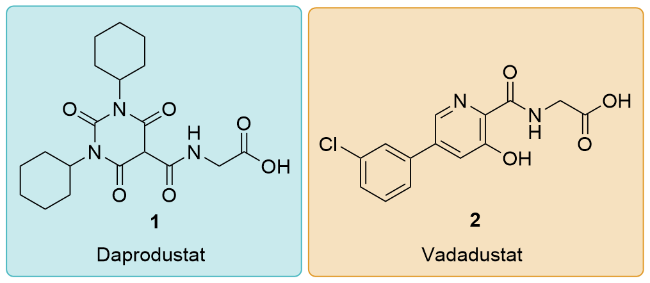
Chronic kidney disease (CKD), characterized by progressive loss of kidney function, is a growing global public health burden. Risk factors for CKD include high blood pressure, diabetes and primary kidney disease.[1] Anemia is an important and common complication of CKD.[2] Currently, the food and drug administration (FDA) has approved only two oral agents for the treatment of CKD: Daprodustat (1) and Vadadustat (2) (Figure 1).[3] Daprodustat (1), also known as GSK-1278863 and marketed as Jesduvroq, is a small molecule inhibitor of hypoxia-in- ducible factor (HIF) prolyl hydroxylase (PHD), developed by GlaxoSmithKline (GSK).[4] Pharmacokinetically, Da- produstat demonstrates superior properties compared Vadadustat, particularly through its substantially lower dosing regimen (1~24 mg/d versus 300~600 mg/d) while maintaining comparable therapeutic efficacy in CKD management.[5] Recent clinical evaluations further demonstrate Daprodustat superior safety profile, with Vadadustat showing elevated hypertension induction risks.[6] Mechanistic studies by Zhuang et al.[7] revealed Daprodustat additional therapeutic potential through significant reduction of pulmonary viral load and attenuation of monocyte/neu- trophil infiltration. The pharmaceutical industry shift toward atom-economical and operationally streamlined synthetic approaches[8] has intensified demand for developing efficient Daprodustat manufacturing processes, underscor- ing the critical need for optimized synthetic strategies.
Given its significant clinical demand and promising therapeutic applications, Daprodustat has garnered substantial research interest regarding its synthetic accessibility. To date, three representative industrial synthetic routes have been reported. The first route, described by Duffy from GSK (Scheme 1a),[9] employs malonic acid (3) as the starting material through a three-step sequence involving condensation (3→4), nucleophilic addition (4→6), and hydrolysis (6→1). Our investigation revealed that raw material 5 represents a significant cost burden, as its direct procurement would substantially increase the overall expense of the synthetic pathway. Notably, reagent 5 was unstable at room temperature and synthesized from highly toxic chemicals, such as bis(trichloromethyl) carbonate (BTC) and phosgene with a low yield.[10] Moreover, the crude product obtained from hydrolysis exhibits poorer filtration efficiency in the final step, rendering it unsuitable for large-scale production.
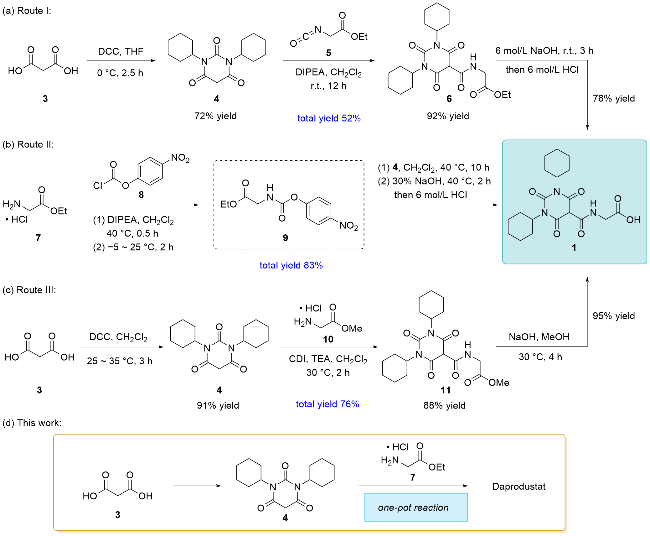
The second route enables a streamlined one-pot synthesis of Daprodustat from 4, ethyl glycinate hydrochloride (7), and 4-nitrophenyl carbonochloridate (8) with enhanced synthetic efficiency (Scheme 1b).[11] While this modification eliminates the need for expensive or hazardous precursors, new challenges emerge: the reaction produces 4-nitrophenol as a persistent byproduct, which poses environmental risks due to its carcinogenicity and high water solubility,[12] violating green chemistry principles. Additionally, the extended reaction time required for intermediate 6 synthesis reduces process practicality.
A recent third approach by Manda et al.[13] introduces methyl glycinate and CDI as substitutes for ethyl isocyanatoacetate, achieving Daprodustat in 76% overall yield through sequential coupling (4→11) and hydrolysis steps (Scheme 1c). Although this strategy circumvents toxic intermediates, it inherits the filtration challenges observed in Route I during final product isolation. Furthermore, the total yield remains suboptimal compared to industrial requirements.
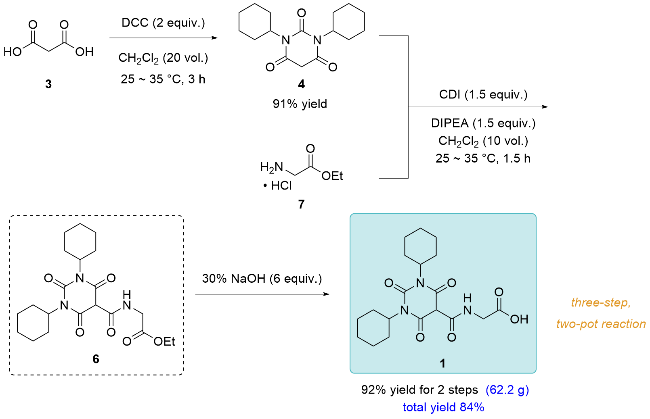
Therefore, while representing notable progress, opportunities persist for developing a more efficient and sustainable synthesis of Daprodustat (1). We herein describe a concise three-step/two-pot synthesis employing commercially available starting materials (Scheme 1d), demonstrating cost-effectiveness and scalability. Compared to Route III (Scheme 1c), the improved method achieves a significant increase in yield (from 76% to 84%). This three-step, two-pot procedure achieves significant improvements in time and energy efficiency. Moreover, the entire synthetic route utilizes CH2Cl2 as the sole solvent, facilitating solvent recovery and effectively lowering costs. Plausible mechanistic pathways for intermediate 6 formation have been rationalized. It is worth mentioning that we filed a patent application for this methodology on December 6, 2024.[14]
2 Results and discussion
The preliminary synthetic route of Daprodustat (Scheme 2) commenced with the condensation reaction of commercially available malonic acid (3) and DCC, affording intermediate 4 via dehydration condensation in 91% yield. According to literature reports,[15] intermediate 4 exhibits high reactivity toward acyl chlorides. To avoid the formation of 4-nitrophenol byproduct, isobutyl chloroformate (12) was selected as the acylating agent, successfully yielding the key intermediate 13 in 85% yield. Intermediate 13 was then subjected to alkaline hydrolysis and acidification treatment to afford the carboxylic acid derivative 14. Due to the chemical instability of 14, significant challenges arose during its purification. Therefore, the reaction progress was monitored by thin-layer chromatography (TLC) with the disappearance of intermediate 13 characteristic spot serving as the endpoint. The reaction mixture was concentrated under reduced pressure to directly obtain crude 14 as a yellow solid, which was used in subsequent condensation reactions without purification. Then, carboxylic acid 14 was activated with CDI in tetrahydrofuran (THF) and then reacted with glycine ethyl ester hydrochloride (7) at 60 ℃, yielding compound 6 in 50% yield. Finally, hydrolysis with 30% aqueous NaOH followed by acidification with 6 mol/L HCl delivered the target product in 78% yield.
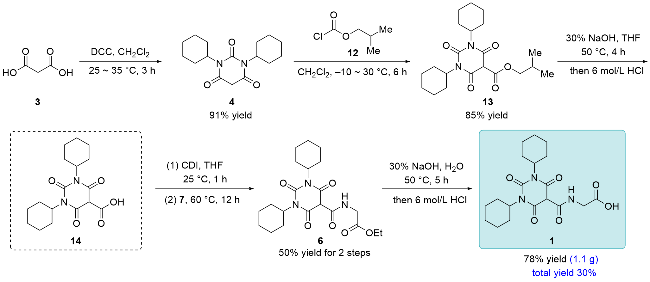
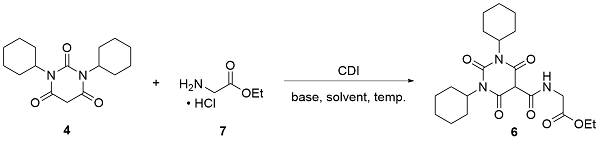
Although this route avoided the use of expensive reagent 5 and the generation of 4-nitrophenol byproduct, its five- step synthesis process and overall yield of 30% were significantly lower than the reported values. Furthermore, the thermal instability of intermediates 13 and 14 led to their decarboxylation to regenerate the starting material 4, limiting industrial applicability. Notably, when crude 14 was directly used in the synthesis of 6, no decarboxylation of 14 was observed. It was hypothesized that byproduct 4 might undergo in situ conversion to the target product 6 under the reaction conditions. This hypothesis was validated by reacting 4 directly with CDI and 7 in THF at 60 ℃, affording 6 in 23% yield (confirmed by 1H NMR and HRMS), thereby reducing the synthetic steps from five to three.
Systematic optimization studies revealed that the solubility of glycine ethyl ester hydrochloride (7) exerted a profound influence on the yield of ester 6 (Table 1). Initial attempts employing anhydrous THF at 60 ℃ for 12 h afforded 6 in merely 23% yield (Table 1, Entry 1), attributable to the limited solubility of 7 in this medium. To address this, various bases and solvent systems were screened to liberate the free amine form of 7. Introduction of triethylamine (TEA) paradoxically reduced the conversion rate to 11% (Table 1, Entry 2), likely due to competitive activation of 7 by CDI in the presence of TEA.[16] Subsequent implementation of NH3 gas sparging in CH2Cl2 successfully generated the free amine species of 7, which upon sequential addition to a solution of 4 and CDI in anhydrous THF, delivered 6 in 90% conversion rate (Table 1, Entry 3). While effective, this NH3-mediated protocol presented safety concerns and scalability limitations. Notably, employing diisopropylethylamine (DIPEA) in CH2Cl2 to generate the free amine 7 prior to coupling achieved a markedly improved conversion rate of 98% within 1 h at ambient temperature (Table 1, Entry 4). Stoichiometric evaluation of reactants (Entries 4~8) established an optimal molar ratio of 4:7:CDI=1:1.5:1.5.
Table 1 Reaction condition optimization for the preparation of ester 6a |
| Entry | 4:7:CDI (molar ratio) | Base | Solvent | Temp./℃ | Conversionb/% |
|---|---|---|---|---|---|
| 1 | 1:1.5:1.5 | — | THF | 60 | 23c |
| 2 | 1:1.5:1.5 | TEA | THF | 60 | 11 |
| 3 | 1:1.5:1.5 | NH3 d | THF | 60 | 90 |
| 4 | 1:1.5:1.5 | DIPEA | CH2Cl2 | r.t. | 98 |
| 5 | 1:1.4:1.4 | DIPEA | CH2Cl2 | r.t. | 97 |
| 6 | 1:1.3:1.3 | DIPEA | CH2Cl2 | r.t. | 96 |
| 7 | 1:1.2:1.2 | DIPEA | CH2Cl2 | r.t. | 95 |
| 8 | 1:1.1:1.1 | DIPEA | CH2Cl2 | r.t. | 94 |
a Reactions conducted with 4 (1.03 mmol), CDI (1.13~1.54 mmol), base (1.13~1.54 mmol) and 7 (1.13~1.54 mmol) in 10 vol. solvent relative to 4 for 2 h. b Conversion determined by LC-MS analysis. c Isolated yield. d NH3 gas sparging (0.5 h) of 7 suspension in THF generated free amine prior to reaction with activated 4. |
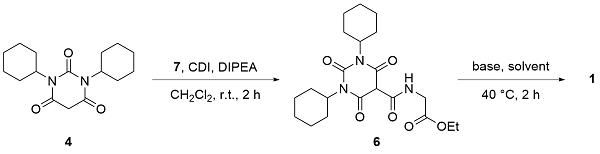
Following the optimized coupling of 4 and 7, direct hydrolysis of crude 6 was investigated via a one-pot strategy (Table 2). Treatment of crude 6 with NaOH in EtOH afforded Daprodustat (1) in 55% yield (Table 2, Entry 1). However, subsequent acidification of the reaction mixture generated a semisolid crude product with poor filtration properties, rendering this method unsuitable for industrial- scale implementation. Intriguingly, changing the solvent to CH2Cl2 not only improved the yield but also facilitated efficient filtration (Table 2, Entry 2). Comparative evaluation of bases revealed that LiOH delivered inferior yields relative to NaOH, with the latter also demonstrating superior cost efficiency (Table 2, Entry 3). Further optimization of the NaOH stoichiometry (Table 2, Entries 2, 4 and 5) identified 6 equiv. as optimal, achieving a one-pot yield of 92% (Table 2, Entry 4). As outlined in Scheme 3, the integration of this streamlined one-pot hydrolysis strategy enabled the development of a concise and operationally practical synthetic route to Daprodustat.
Table 2 Reaction condition optimization for the preparation of Daprodustat (1) by one pota |
| Entry | Base | Solvent | Yieldb/% |
|---|---|---|---|
| 1 | NaOH (7 equiv.) | EtOH | 55 |
| 2 | NaOH (7 equiv.) | CH2Cl2 | 78 |
| 3 | LiOH (7 equiv.) | CH2Cl2 | 74 |
| 4 | NaOH (6 equiv.) | CH2Cl2 | 92 |
| 5 | NaOH (5 equiv.) | CH2Cl2 | 82 |
a Reactions conducted with 4 (3.42 mmol), CDI (5.13 mmol), 7 (5.13 mmol), DIPEA (5.13 mmol) in 10 vol. CH2Cl2 relative to 4 at room temperature for 2 h, then hydrolyzed with base (13.68~23.94 mmol) in EtOH or CH2Cl2 at 40 ℃ for 2 h. b Isolated yield calculated based on 4. |
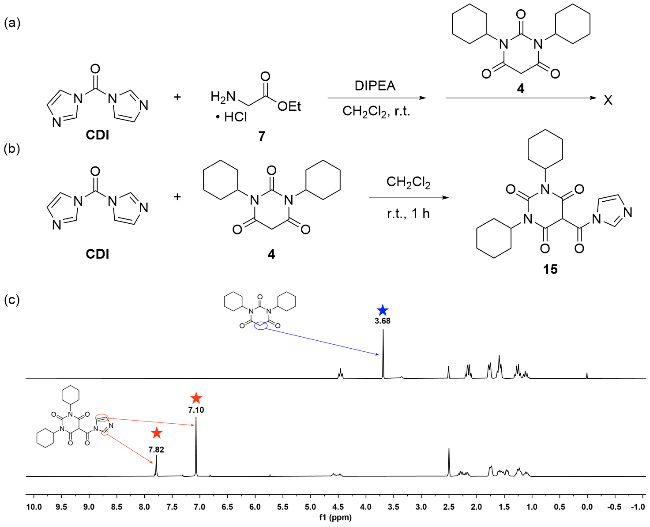
The condensation mechanism involving compounds 4, 7, and CDI diverges significantly from previously documented pathways.[17] To elucidate the reaction mechanism, a systematic series of control experiments were designed (Scheme 4). First, reversing the addition sequence, introducing the free carboxylic acid form of 7 prior to 4, failed to yield the target product under standard conditions (Scheme 4a). This observation strongly suggests that 4 undergoes initial activation via coordination with CDI, followed by nucleophilic attack by glycine ethyl ester. Subsequently, an experiment was conducted by premixing CDI and 4 at ambient temperature, with in situ monitoring via ¹H NMR spectroscopy (Scheme 4b). Notably, the diagnostic singlet for the methylene protons of 4 at δ 3.68 vanished, while two new aromatic multiplet signals emerged at δ 7.10 and 7.82 (Scheme 4c), unassignable to either starting material. These spectral features were tentatively attributed to the formation of imidazolide intermediate 15. High-resolution mass spectrometry (HRMS) analysis of the crude mixture revealed a prominent ion at m/z 409.1829 ([M+Na]⁺), consistent with the theoretical mass of 15 (calcd. [M+Na]⁺: 409.1852). However, isolation of 15 via conventional purification methods proved unsuccessful, likely due to its inherent hydrolytic instability.
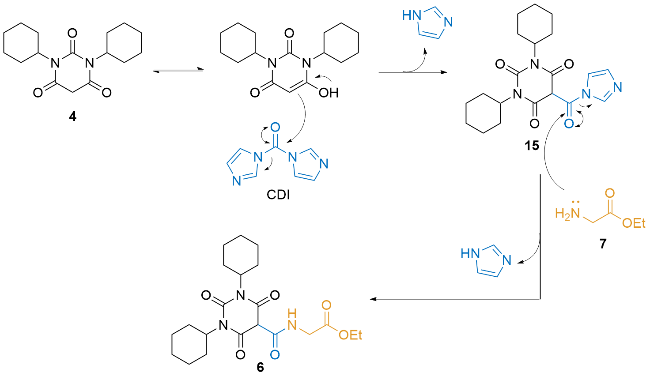
Based on the aforementioned experimental evidence, a plausible mechanistic pathway for the formation of ester 6 was delineated (Scheme 5).[18] In the proposed pathway, compound 4 initially activates via nucleophilic attack on CDI, generating the transient imidazolium species 15 alongside stoichiometric imidazole as a byproduct. Subsequently, the primary amine moiety of glycine ethyl ester (7) engages in a carbamoyl transfer reaction, wherein the lone pair of the terminal nitrogen nucleophilically displaces the imidazole-leaving group in intermediate 15, culminating in the formation of 6.[19]


3 Conclusions
In summary, an efficient and scalable synthetic route for the production of Daprodustat has been developed. This optimized protocol employs commercially available starting materials and accomplishes the target synthesis through a streamlined two-pot procedure, eliminating intermediate isolation requirements. Notably, the process demonstrates robust scalability in pilot-scale operations, achieving an overall yield of 84% with minimal process optimization. Key advantages include: (1) a simplified operational workflow that minimizes reaction duration through sequential in situ transformations, (2) enhanced atom economy via judicious reagent selection, and (3) significant cost reduction through elimination of chromatographic purifications. These features collectively establish this methodology as a commercially viable platform for industrial-scale manufacturing of Daprodustat. Critically, the reaction mechanism governing the pivotal imidazole-mediated carbamo- ylation step was elucidated and validated through comprehensive 1H NMR, 13C NMR spectra, HRMS analysis and systematic control experiments.
4 Experimental section
4.1 General experimental information
Nuclear magnetic resonance (NMR) data were collected for 1H NMR (400 MHz) and 13C NMR (100 MHz) in DMSO-d6 or CDCl3. Chemical shifts (δ) were reported using tetramethylsilane (TMS) as the internal standard. High-resolution mass spectra (HRMS) were acquired on an Agilent Q-TOF6300 instrument, and the percentage deviation between the calculated and measured values is less than 0.5%. All chemicals and solvents were of reagent grade, and used without special treatment. Melting points were measured with a Shenguang WRS-1B melting point apparatus and were uncorrected. All the reactions were monitored by thin layer chromatography (TLC) on pre- coated silica gel G plates at 254 nm under a UV lamp. The HPLC data were acquired using a Waters 2487 UV/Visible Detector and Waters 515 Binary HPLC Pump.
4.2 Experimental procedures
4.2.1 Synthesis and characterization of 1,3-dicyclohexyl- 2,4,6(1H,3H,5H)-pyrimidinetrione (4)
A solution of N,N'-dicyclohexylcarbodiimide (DCC, 79.3 g, 0.39 mol) in anhydrous CH2Cl2 (200 mL) was added dropwise to a suspension of malonic acid (3) (20.0g, 0.19 mol) in anhydrous CH2Cl2 (400 mL) at 25~35 ℃ under N2 atmosphere. The reaction mixture was then stirred at 30 ℃ for 3 h. The resulting solid was removed by suction filtration, and the filtrate was concentrated under reduced pressure to give crude product 4 as a dark brown solid. Crude product 4 was mixed with 400 mL of methanol and heated under reflux for 3 h, followed by cooling to 0~10 ℃. The resulting solid was filtered, washed with cold methanol (100 mL×2), and then dried at 45 ℃ under atmospheric pressure, yielding compound 4 (51.2 g, 91%) as a white powder. m.p. 201~202 ℃; 1H NMR (400 MHz, DMSO-d6) δ: 1.11 (t, J=13.1, 3.4 Hz, 2H), 1.26 (t, J=13.0, 3.5 Hz, 4H), 1.59 (t, J=12.3, 6.2 Hz, 6H), 1.77 (d, J=13.0 Hz, 4H), 2.15~2.33 (m, 4H), 3.69 (s, 2H), 4.46 (t, J=12.2, 3.7 Hz, 2H); 13C NMR (100 MHz, DMSO-d6) δ: 25.5, 26.4, 29.1, 41.7, 54.2, 152.0, 166.4; HRMS (ESI) calcd for C16H23N2O3 [M-H]- 291.1787, found 291.1743. HPLC Conditions: column: Agilent Inert Sustain C18 (150 mm×4.6 mm×5 µm), detection: 254 nm, flow rate: 1 mL/min, temperature: 35 ℃, injection load: 2 μL, solvent: MeOH, concentration: 0.2 mg/mL, run time: 20 min, Mobile phase A: V(water):V(phosphoric acid)=100:0.1, Mobile phase B: MeOH, gradient program: V(Mobile phase A):V(Mobile phase B)=5:95, tR=5.009 min, purity: 99.52%.
4.2.2 Synthesis and characterization of Daprodustat (1)
Flask A: A mixture of 1,3-dicyclohexyl-2,4,6(1H,3H, 5H)-pyrimidinetrione (4) (50.0 g, 0.17 mol) and CDI (41.6 g, 0.26 mol) in CH2Cl2 (300 mL) was stirred at 25~30 ℃ for 0.5 h under N2 atmosphere.
Flask B: A mixture of glycine ethyl ester hydrochloride (7) (35.8 g, 0.26 mol) and DIPEA (26.0 g, 0.26 mol) in anhydrous CH2Cl2 (200 mL) was stirred and heated at 40 ℃ for 1 h, then cooled to 25~30 ℃. After filtration, the filtrate was obtained.
The filtrate of Flask B was added dropwise to Flask A through constant pressure dropping funnel over 0.5 h. The reaction mixture was stirred at 25~30 ℃ for an additional hour until the reaction was complete [monitored by TLC, V(heptane):V(EtOAc)=1:1]. Subsequently, aq. 30% NaOH (136.8 g, 1.03 mol) was added dropwise over 0.5 h to the reaction mixture. Further, the temperature was increased to 40 ℃, and stirring was continued for 2 h until the reaction was complete [monitored by TLC, V(CH2- Cl2):V(MeOH)=30:1]. The reaction mixture was cooled to 0 ℃, and aq. 6 mol/L HCl was slowly added to adjust the pH to acidity (pH=5~6). The CH2Cl2 was evaporated under atmospheric pressure, and then glacial acetic acid (300 mL) was added. The mixture was stirred at 100 ℃ for 2 h, followed by cooling to 10 ℃. The resulting solid was filtered, washed with water (500 mL), and dried at 50 ℃ for 12 h to give crude 1 as a white solid. Then the crude 1 was added to glacial acetic acid (600 mL), stirred at 110 ℃ for 2 h, followed by cooling to 10 ℃. Then filtered again, washed with cold glacial acetic acid (50 mL×2), and dried at 50 ℃ under atmospheric pressure for 12 h to yield 1 (62.2 g, 92%) as a white solid. m.p. 235~236 ℃; 1H NMR (400 MHz, DMSO-d6) δ: 1.12 (t, J=13.1 Hz, 2H), 1.27 (q, J=13.1 Hz, 4H), 1.58 (d, J=12.9 Hz, 6H), 1.78 (d, J=12.7 Hz, 4H), 2.26 (q, J=12.5 Hz, 4H), 4.11 (d, J=5.8 Hz, 2H), 4.62 (t, J=12.4 Hz, 2H), 10.19 (d, J=6.0 Hz, 1H), 13.13 (s, 1H); HRMS (ESI) calcd for C19H28N3O6 [M+H]+ 394.1970, found 394.1975. HPLC Conditions: column: Agilent Inert Sustain C18 (150 mm×4.6 mm×5 µm), detection: 254 nm, flow rate: 1 mL/min, temperature: 35 ℃, injection load: 3 μL, solvent: MeOH, concentration: 0.2 mg/mL, run time: 35 min, Mobile phase A: V(water):V(phosphoric acid)=100:0.1, Mobile phase B: MeOH, gradient program: V(Mobile phase A):V(Mobile phase B)=20:80, tR=19.647 min, purity: 99.85%.
Supporting Information 1H NMR, 13C NMR, HRMS, and HPLC spectra of compounds 1, 4, 6 and 15, along with control experiments for mechanistic studies. The Supporting Information is available free of charge via the Internet at http://sioc-journal.cn/.
(Cheng, F.)