



1 Introduction
With the development of industrialization, excessive CO2 emission has led to a series of environmental problems such as greenhouse effect. How to convert CO2 into other value-added products[1-9] has become the focus of research, and the synthesis of cyclic carbonate by the cycloaddition of CO2 and epoxide has been favored for its atomistic economy of up to 100%. A number of homogeneous and non-homogeneous catalysts have been developed to participate in the synthesis of cyclic carbonate.
Conventional catalytic systems require the addition of co-catalysts as nucleophilic reagents to catalyze the cycloaddition reaction. For instance, catalytic systems based on Fe(II),[10] Zn,[11-12] Au,[13] Ce,[14] Cr,[15] Cu,[16-17] and Co[18] use tetrabutylammonium bromide (TBAB) as the co- catalyst, those based on Mn(III),[19] La,[20] and B[21] use tetrabutylammonium iodide (TBAI) as the co-catalyst, and the Pd-based system[22] use Pr4NBr as the co-catalyst. At the same time, some bifunctional catalysts such as Zn,[23-26] Al,[27-28] Co,[29] Nb,[30] Cr,[31] ionic liquid,[32-35] guanidine salt,[36] and polymer carrier[37] have also been developed without additional co-catalysts. However, catalytic systems capable of achieving the cycloaddition of CO₂ and epoxides under milder reaction conditions without the requirement for co-catalysts remain relatively scarce. Therefore, it is highly desirable to develop a catalytic system to synthesize cyclic carbonates without the need of co-catalyst under mild reaction conditions.
In this work, a molybdenum catalyst functionalized with quaternary ammonium salts was synthesized and their chemical structures were determined using nuclear magnetic resonance (NMR) and single crystal X-ray method. It noted that the catalyst was highly efficient for the cycloaddition of CO2 and epoxide under relatively mild conditions (80 ℃ and 0.5 MPa of CO2) without co-catalyst as nucleophile
2 Results and discussion
2a[38] was first synthesized through the coupling of benzimidazole (1a) with 2-bromopyridine (1b). Subsequently, (3-bromopropyl) triphenyl phosphine bromide (2b) and 3- bromopropyl trimethyl ammonium bromide (2c) reacted with 2a, respectively, affording 3a and 3b, which then coordinated with Mo(CO)6 to form molybdenum complexes 4a and 4bScheme 1.[39]
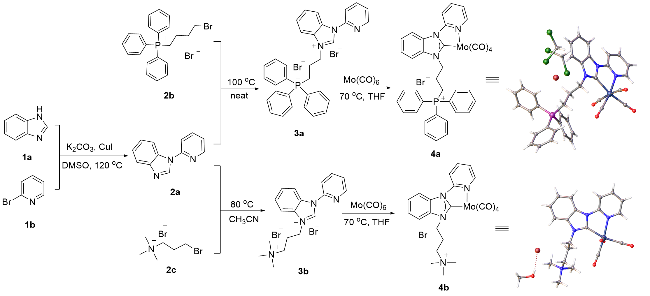
The optimization of reaction conditions revealed that the catalytic activity of 4a was superior to that of 4b (Table 1, Entries 1 and 2). Therefore, catalyst 4a was selected for further condition optimization.
Table 1 Screening of reaction conditionsa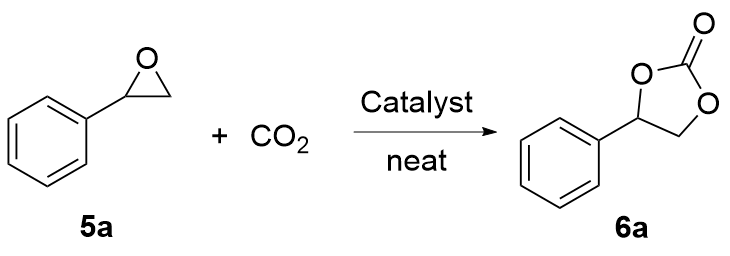 |
| Entry | Catalyst | T/℃ | p/MPa | Catalyst/ mol% | Isolated yield/% |
|---|---|---|---|---|---|
| 1 | 4a | 30 | 1.0 | 2 | 14 |
| 2 | 4b | 30 | 1.0 | 2 | 11 |
| 3 | 4a | 50 | 1.0 | 2 | 56 |
| 4 | 4a | 60 | 1.0 | 2 | 78 |
| 5 | 4a | 70 | 1.0 | 2 | 89 |
| 6 | 4a | 80 | 1.0 | 2 | 94 |
| 7 | 4a | 100 | 1.0 | 2 | 93 |
| 8 | 4a | 80 | 0.1 | 2 | 54 |
| 9 | 4a | 80 | 0.5 | 2 | 94 |
| 10 | 4a | 80 | 1.5 | 2 | 92 |
| 11 | 4a | 80 | 0.5 | 0.5 | 85 |
| 12 | 4a | 80 | 0.5 | 1.0 | 93 |
| 13 | 4a | 80 | 0.5 | 1.5 | 93 |
| 14 | 4a | 80 | 0.5 | 2.5 | 95 |
a Reaction conditions: styrene oxide (10.0 mmol), catalysts type and loading amount of catalysts, temperature, pressure of CO2, neat. Product yields were determined by column chromatography. |
The temperature was optimized as shown in Table 1 (Entries 1, 3~7), and the results showed that the yield of 6a increased with the rise of temperature. When the temperature rose to 80 ℃, the yield of 6a reached 94% (Table 1, Entry 6). With further increase in temperature, the yield remained basically unchanged (Table 1, Entry 7).
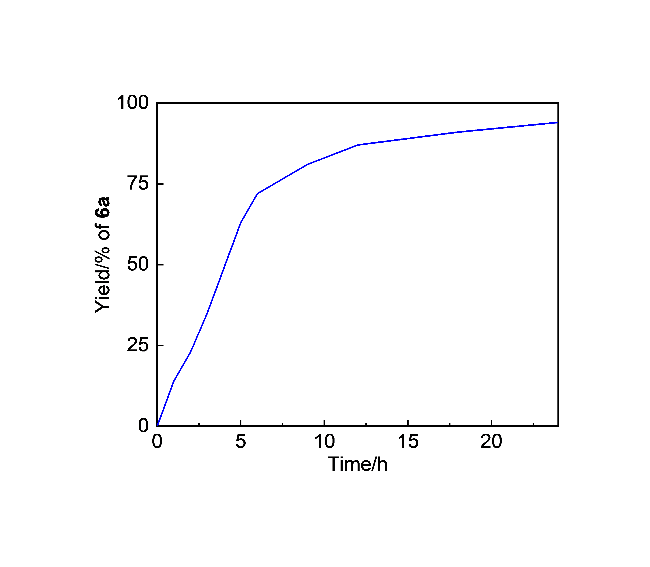
Finally, the loading amount of catalyst 4a was optimized (Table 1, Entries 6, 11~14) and it was found that when the catalyst dosage was increased to 1 mol%, the yield of 6a was 93% (Table 1, Entry 12). The loading of catalyst 4a was further increased, and the yield of 6a remained almost unchanged (Table 1, Entries 13 and 14). As illustrated in Figure 1, the yield exhibited a positive correlation with reaction time, and the cycloaddition reaction of styrene oxide was nearly completed within 24 h.
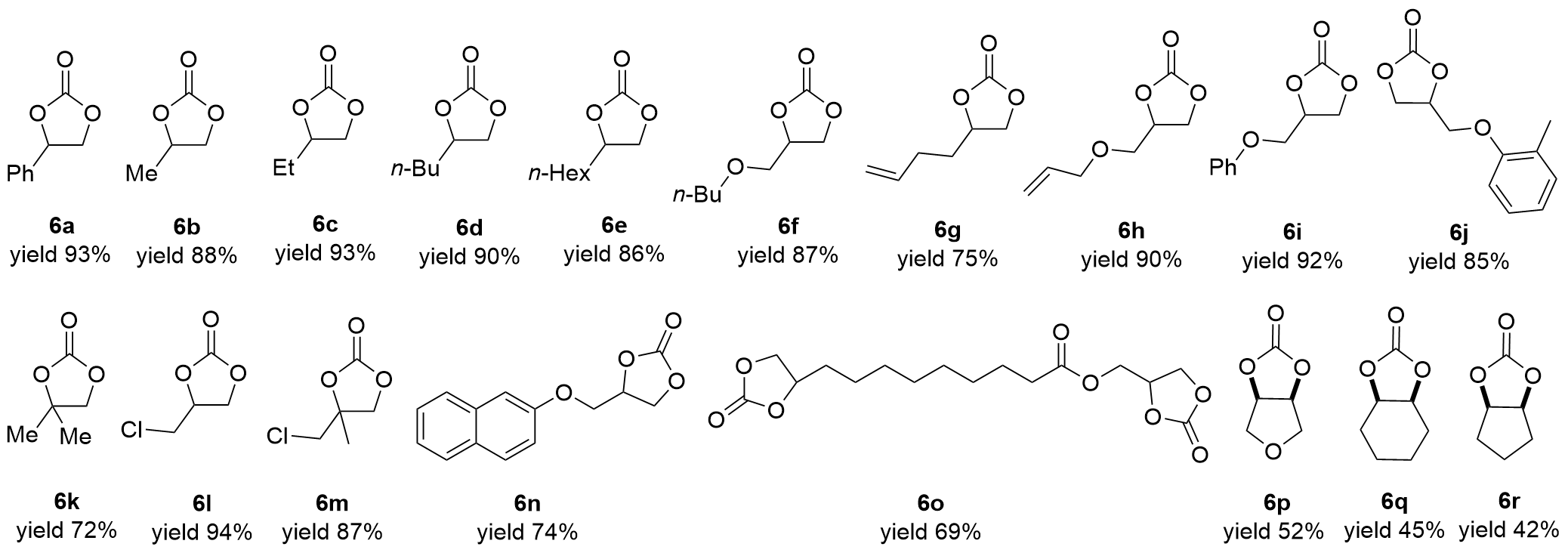
In order to investigate the substrate versatility of the catalysts, 15 terminal epoxides and 3 internal epoxides were investigated in our developed catalytic system (Table 2).
Table 2 Substrate scope of epoxidesa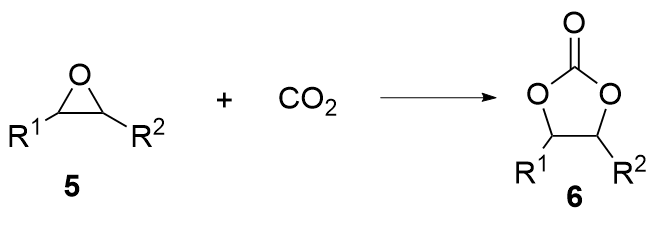 |
 |
a Reaction conditions: epoxides (10.0 mmol), catalyst 4a (1 mol%), 80 ℃, CO2 (0.5 MPa), neat. Product yields were determined by column chromatography. |
A series of epoxides, including phenyl, methyl, ethyl, n-butyl and various long-chain aliphatic chains substituted epoxides, can be smoothly coupled with CO2 to obtain a series of cyclic carbonates 6a~6m in yields of 72%~94%.
The polycyclic epoxide substrate 3-(1-naphthoxy)-1,2- epoxypropane was also examined, affording the corresponding cyclic carbonate 6n in 74% yield. Meanwhile, the disubstituted acyclic system epoxide substrate oxiran- 2-ylmethyl 9-(oxiran-2-yl)nonanoate was also tried, and the corresponding cyclic carbonate (6o) was obtained in a yield of 69%. Although the endo-epoxides are challenging substrates, under the optimized reaction conditions, the six-membered or five-membered bicyclic epoxides are also applicable to this catalytic system, and the corresponding cyclic carbonates (6p~6r) were obtained in yields of 42%~52%.
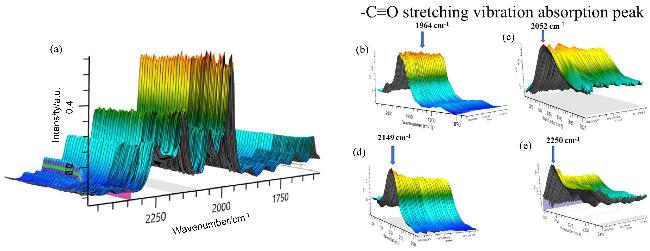
Initial mechanistic studies were performed using in situ infrared (IR) spectroscopy, as illustrated in Figure 2. In the absence of CO2, the interaction between styrene oxide and the molybdenum catalyst was monitored (Figure 2a). The IR spectrum revealed four characteristic absorption bands corresponding to C≡O ligands at 1964, 2052, 2149, and 2250 cm-1, consistent with previously reported vibrational frequencies for metal carbonyl complexes.[40-41] Notably, the peak at 1964 cm-1 (Figure 2b) remained stable, whereas the intensities of the bands at 2052 (Figure 2c), 2149 (Figure 2d), and 2250 cm-1 (Figure 2e) exhibited a pronounced decrease at the initial stage. Therefore, it can be concluded that the results are likely attributable to the dissociation of three out of the four carbonyl groups in the molybdenum-based catalyst 4a.
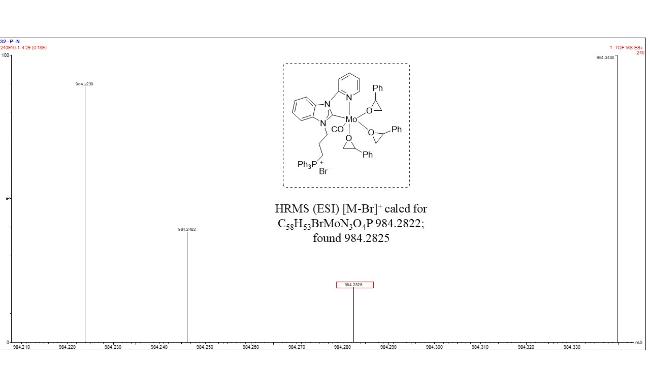
Next, the reaction intermediates were investigated using ESI-HRMS spectroscopy in positive ion mode. Upon addition of catalyst 4a to styrene oxide, a new peak was observed at m/z of 984.2825, which was assigned to the intermediate 4ab (Figure 3). The catalyst 4a undergoes three carbonyl dissociations and reacts with styrene oxide to form 4ab. The result in ESI-HRMS spectra is consistent with the in-situ infrared results (Figure 2).
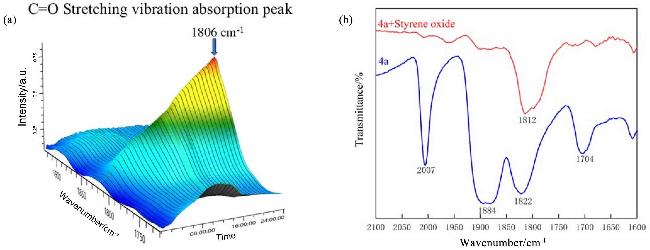
Finally, Fourier-transform infrared (FT-IR) spectroscopy was employed to characterize the Mo catalyst 4a, revealing four distinct carbonyl stretching vibrations at 2007, 1884, 1822 and 1704 cm-1 (Figure 4b).[43] Upon treatment of 4a with styrene oxide under a CO2 atmosphere for 1 h, analysis of the reaction mixture indicated that one carbonyl band remained unchanged, while the other three exhibited significant attenuation. This observation suggests the dissociation of three C≡O ligands, which is consistent with the mechanistic insights obtained from prior in situ IR studies.
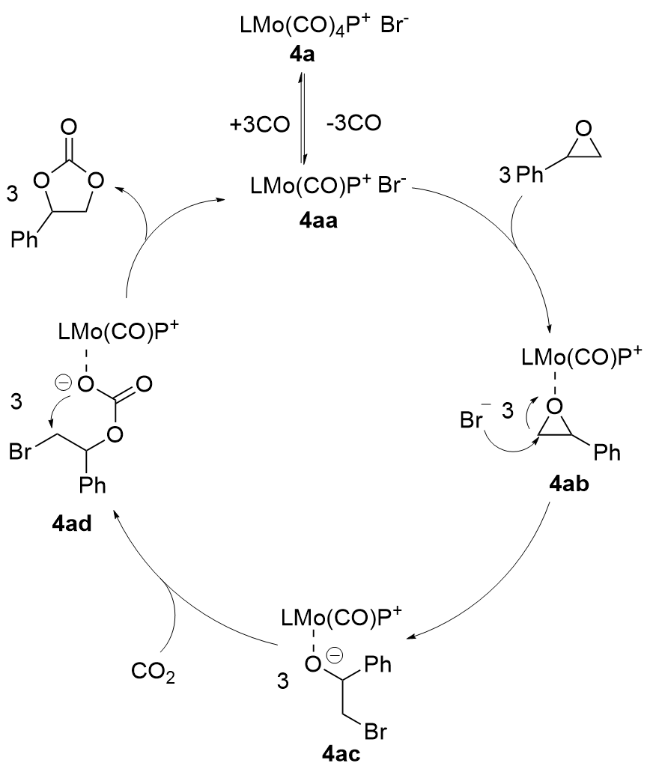
Based on the above experimental results, a reaction mechanism for the catalytic cycloaddition of epoxide with CO2 mediated by a one-component molybdenum catalyst was proposed, as illustrated in Scheme 2. First, three carbonyl groups were dissociated from the Mo catalyst to form a new Mo complex 4aa, which acted as a Lewis acid to activate the C—O bond of the epoxide through the coordination of the Mo—O bond between the molybdenum atoms and the oxygen atoms of the epoxide to form the intermediate 4ab. Then, Br- in the one-component molybdenum catalyst acts as a nucleophile to attack the carbon atoms of the epoxide to promote the ring opening of the epoxide to form the intermediate 4ac. Negatively charged oxygen atoms attack the carbon atoms of CO2 to form the intermediate 4ad. Carbon atoms of 4ad are attacked by negatively charged oxygen atoms by intramolecular nucleophilic attack to release the product and the active substance 4aa.


3 Conclusion
In this work, a one-component molybdenum catalyst was synthesized as an independent catalytic system, which can use a catalyst for the cycloaddition of epoxide with CO2 without the need of an additional co-catalyst acting as a nucleophilic reagent. This catalytic system exhibits a highly catalytic activity, and a series of cyclic carbonates were produced from the terminal epoxides in yields of 69%~94% under 80 ℃, CO2 pressure of 0.5 MPa without co-catalysts, and internal epoxides were also suitable for the system, affording yields of 42%~52%. Finally, the mechanism of the catalytic cycloaddition reaction of carbon dioxide was investigated by in situ infrared (IR), high-resolution mass spectrometry (HRMS), and Fourier transform infrared spectroscopy (FT-IR) techniques, and a possible reaction mechanism was proposed. This work will provide new ideas for the design of efficient single-com- ponent catalysts suitable for the cycloaddition reaction of carbon dioxide with epoxides.
4 Experimental section
4.1 Materials and analytical methods
All organic solvents, epoxide and metal salts were obtained from commercial suppliers without further purification. Nuclear magnetic resonance (NMR) spectra were recorded on a Bruker Avance III HD 400 spectrometer (1H NMR at 400 MHz and 13C NMR at 101 MHz) using TMS as an internal standard. High-resolution mass spectroscopy (HRMS) data were collected on a UPLC G2-XS QTOF ES+TOF mass spectrometer. React IR spectra were recorded on a METTLER TOLEDO React IR 702L
4.2 Synthetic method
4.2.1 Synthesis of ligand 2a
Dimethyl sulfoxide (DMSO, 10 mL) was added to the mixture of benzoimidazole (1a, 10 mmol), 2-bromopyri- dine (1b, 11 mmol), CuI (2 mmol) and K2CO3 (12.5 mmol). The reaction mixture was stirred at 120 ℃ for 24 h. After the reaction, saturated salt water was added and extracted with dichloromethane for 2~3 times. The vacuum concentrated extract was separated by column chromatography (particle size 200~300 mesh, eluent: V(petro- leum ether)∶V(ethyl acetate)=2∶1), thereby obtaining 1-(pyridin-2-yl)-1H-benzo[d]imidazole (2a):[38] White solid (1.9508 g, 80% yield), m.p. 202.7~203.4 ℃ (lit.[44] m.p. 203.4~203.9 ℃); 1H NMR (400 MHz, CDCl3) δ: 8.54 (s, 1H), 8.52~8.51 (m, 1H), 8.03~8.00 (m, 1H), 7.86~7.84 (m, 1H), 7.78~7.74 (m, 1H), 7.45 (d, J=12 Hz, 1H), 7.34~7.32 (m, 2H), 7.20~7.17 (m, 1H); 13C NMR (101 MHz, CDCl3) δ: 149.58, 149.16, 144.49, 141.15, 138.72, 131.92, 124.01, 123.08, 121.62, 120.38, 114.01, 112.60.
4.2.2 Synthesis of ligands 3a and 3b
A mixture of 1 mmol of the product of the first step (2a) and 1.5 mmol of (3-bromopropyl) triphenylphosphonium bromide (2b) was placed in a pressure-resistant tube and reacted for 24 h at 100 ℃ in the absence of solvent. The reaction was dissolved in dichloromethane. The vacuum concentrated extract was separated by column chromatography (particle size 200~300 mesh) using DCM/MeOH (V∶V=10∶1) as the eluent, thereby obtaining 1-(pyridin- 2-yl)-3-(3-(triphenylphosphonio)propyl)-1H-benzo[d]imi- dazol-3-iumbromide (3a): White solid (551.9 mg, 84%), m.p. 189.7~190.4 ℃; 1H NMR (400 MHz, DMSO-d6) δ: 10.81 (s, 1H), 8.81~8.79 (m, 1H), 8.55~8.53 (m, 1H), 8.34~8.30 (m, 1H), 8.25~8.23 (m, 1H), 8.15 (d, J=8 Hz, 1H), 7.92~7.88 (m, 3H), 7.83~7.72 (m, 15H), 4.92~4.89 (m, 2H), 4.00~3.92 (m, 2H), 2.40~2.34 (m, 2H); 13C NMR (101 MHz, DMSO-d6) δ: 149.4, 147.5, 142.9, 140.6, 133.7, 133.6, 131.5, 130.4, 130.2, 129.6, 127.7, 127.1, 125.1, 118.4, 117.6, 117.0, 116.1, 113.9, 46.9, 21.8, 17.9; HRMS (ESI+) calcd for C33H30BrN3P [M-Br]+ 578.1355, found 578.1360. CCDC: 2410306.
A mixture of 1 mmol of the first step product (2a) and 1.5 mmol of (3-bromopropyl) 3-bromopropyltrimethyl- ammonium bromide (2c) was placed in a 25 mL Schlenk Tube and reacted at 80 ℃ for 24 h with CH3CN as solvent. The reaction product was dissolved in dichloromethane. The vacuum concentrated extract was separated by column chromatography (particle size 200~300 mesh) using DCM/MeOH (V∶V=30∶1) as the eluent, thereby obtaining 1-(pyridin-2-yl)-3-(3-(trimethylammonio)pro- pyl)-1H-benzo[d]imidazol-3-ium bromide (3b): White solid (358.7 mg, 79%), m.p. 171.2~171.9 ℃; 1H NMR (400 MHz, DMSO-d6) δ: 10.88 (s, 1H), 8.81~8.80 (m, 1H), 8.55~8.53 (m, 1H), 8.35~8.30 (m, 2H), 8.27 (d, J=8 Hz, 1H), 7.82~7.80 (m, 2H), 7.76~7.73 (m, 1H), 4.80~4.77 (m, 2H), 3.71~3.67 (m, 2H), 3.50~3.46 (m, 2H) 3.17 (s, 9H); 13C NMR (101 MHz, DMSO-d6) δ: 149.3, 147.5, 142.7, 140.5, 131.6, 129.4, 127.7, 127.2, 125.1, 117.2, 116.1, 114.1, 62.0, 52.4, 44.4, 30.7, 25.5, 22.3; HRMS (ESI+) calcd for C18H24BrN4 [M-Br]+ 375.1179, found 375.1181. CCDC: 2405874.
4.2.3 Synthesis of 4a and 4b
A mixture of 1 mmol of the product (3a) of step 2, 1.2 mmol of molybdenum hexacarbonyl and 0.2 mmol of t- BuOK was placed in a 25 mL Schlenk Tube and reacted for 24 h at 70 ℃ with tetrahydrofuran (THF) as solvent.[39] The reaction product was dissolved in dichloromethane. The vacuum concentrated extract was separated by column chromatography (particle size 200~300 mesh) using V(DCM)∶V(MeOH)=50∶1] as the eluent, thereby obtaining Mo complexes 1 (4a). Purification by flash chromatography [V(DCM)∶V(MeOH)=50∶1], yellow solid (583.1 mg, 74%), m.p. 224.3~225.1 ℃; 1H NMR (400 MHz, DMSO-d6) δ: 8.83~8.81 (m, 1H), 8.51 (d, J=8 Hz, 1H), 8.41~8.38 (m, 1H), 8.25~8.20 (m, 1H), 7.90~7.85 (m, 4H), 7.80~7.69 (m, 12H), 7.53~7.50 (m, 2H), 7.47~7.44 (m, 1H), 4.82~4.78 (m, 2H), 3.78 (t, J=8 Hz, 2H), 2.24~2.22 (m, 2H); 13C NMR (101 MHz, DMSO-d6) δ: 206.9, 153.5, 141.3, 132.2, 131.8, 130.9, 130.8, 129.3, 129.1, 125.1, 124.7, 122.5, 114.2, 113.5, 111.8, 50.7, 26.0, 24.8; HRMS (ESI+) calcd for C37H29Mo- N3O4P [M-Br]+ 708.0950, found 708.0958. CCDC: 2405873.
A mixture of 1 mmol of the product (3b) of step 2, 1.2 mmol of molybdenum hexacarbonyl and 0.2 mmol of t-BuOK was placed in a 25 mL Schlenk Tube and reacted for 24 h at 70 ℃ with THF as solvent.[39] The reaction product was dissolved in dichloromethane. The vacuum concentrated extract was separated by column chromatography (particle size 200~300 mesh) using DCM/MeOH [V(DCM)∶V(MeOH)=30∶1] as the eluent, thereby obtaining Mo complexes 2 (4b): Yellow solid (421.2 mg, 72%), m.p. 218.9~219.6 ℃; 1H NMR (400 MHz, DMSO-d6) δ: 8.86~8.84 (m, 1H), 8.56~8.52 (m, 1H), 8.43 (d, J=8 Hz, 1H), 8.27~8.22 (m, 1H), 8.05~7.97 (m, 1H), 7.84~7.73 (m, 1H), 7.59~7.46 (m, 2H), 4.77~4.67 (m, 2H), 3.63~3.51 (m, 2H), 3.08 (s, 9H), 2.44~2.40 (m, 2H); 13C NMR (101 MHz, DMSO-d6) δ: 215.1, 207.0, 153.6, 153.3, 141.6, 135.8, 131.8, 125.2, 124.9, 122.7, 114.3, 113.5, 112.1, 63.1, 52.8, 46.2, 23.6, 22.8; HRMS (ESI+) calcd for C22H23MoN4O4 [M-Br]+ 505.0773, found 505.0781. CCDC: 2405871.
4.3 General procedure
The cycloaddition reaction of CO2 and epoxides was carried out in a 25 mL high-pressure reactor equipped with a magnetic stirrer. Firstly, epoxide (10 mmol) and cat. 4a (1 mol%) were added to the reaction vessel without solvent, and then 0.5 MPa pressure of CO2 was introduced into the reactor. The reactor was then heated to the desired temperature and maintained for the required time, with stirring at 300 r/min to initiate the reaction. After the reaction, the reactor was cooled to room temperature and the unreacted CO2 was slowly released. The cyclic carbonates were separated by silica gel flash chromatography, and the yield referred to the isolated yield.
4-Phenyl-1,3-dioxolan-2-one (6a):[45] Purification by flash chromatography [V(PE)∶V(EA)=5∶1], white solid (1.5256 g, 93%), m.p. 50.2~51.5 ℃ (lit.[46] m.p. 50.0~51.4 ℃); 1H NMR (400 MHz, CDCl3) δ: 7.46~7.41 (m, 3H), 7.37~7.35 (m, 2H), 5.67 (t, J=8 Hz, 1H), 4.80 (t, J=8.4 Hz, 1H), 4.34 (dd, J=8 Hz, 8.4 Hz, 1H); 13C NMR (101 MHz, CDCl3) δ: 155.0, 135.9, 129.8, 129.3, 126.0, 78.1, 71.3.
4-Methyl-1,3-dioxolan-2-one (6b):[47] Purification by flash chromatography [V(PE)∶V(EA)=5∶1], colorless oil (0.8979 g, 88%). 1H NMR (400 MHz, CDCl3) δ: 4.84~4.79 (m, 1H), 4.53~4.49 (m, 1H), 4.00~3.96 (m, 1H), 1.43~1.41 (m, 3H); 13C NMR (101 MHz, CDCl3) δ: 155.1, 73.6, 70.7, 19.3.
4-Ethyl-1,3-dioxolan-2-one (6c):[45] Purification by flash chromatography [V(PE)∶V(EA)=5∶1], yellow oil (1.0792 g, 93%). 1H NMR (400 MHz, CDCl3) δ: 4.82~4.59 (m, 1H), 4.48~4.44 (m, 1H), 4.01 (dd, J=7.2 Hz, 8.4 Hz, 1H), 1.76~1.64 (m, 2H), 0.95~0.92 (m, 3H); 13C NMR (101 MHz, CDCl3) δ: 155.1, 78.0, 69.0, 26.7, 8.3.
4-Butyl-1,3-dioxolan-2-one (6d):[48] Purification by flash chromatography [V(PE)∶V(EA)=5∶1], colorless oil (1.2967 g, 90%). 1H NMR (400 MHz, CDCl3) δ: 4.72~4.65 (m, 1H), 4.53~4.49 (m, 1H), 4.05 (dd, J=7.2 Hz, 8.4 Hz, 1H), 1.80~1.64 (m, 2H), 1.39~1.33 (m, 4H), 0.92~0.89(m, 3H); 13C NMR (101 MHz, CDCl3) δ: 155.2, 77.2, 69.5, 33.6, 26.5, 22.3, 13.9.
4-Hexyl-1,3-dioxolan-2-one (6e):[47] Purification by flash chromatography [V(PE)∶V(EA)=5∶1], colorless oil (1.4813 g, 86%). 1H NMR (400 MHz, CDCl3) δ: 4.70~4.67 (m, 1H), 4.53~4.49 (m, 1H), 4.07~4.03 (m, 1H), 1.80~1.63 (m, 2H), 1.46~1.28 (m, 8H), 0.87 (t, J=6.8 Hz, 3H); 13C NMR (101 MHz, CDCl3) δ: 155.2, 77.2, 69.5, 33.9, 31.6, 28.9, 24.4, 22.5, 14.1.
4-(Butoxymethyl)-1,3-dioxolan-2-one (6f):[47] Purification by flash chromatography [V(PE)∶V(EA)=5∶1], colorless oil (1.5151 g, 87%). 1H NMR (400 MHz, CDCl3) δ: 4.81~4.76 (m, 1H), 4.49~4.44 (m, 1H), 4.38~4.35 (m, 1H), 3.67~3.62 (m, 1H), 3.59~3.55 (m, 1H), 3.50~3.46 (m, 2H), 1.53~1.51 (m, 2H), 1.34~1.32 (m, 2H), 0.91~0.86 (m, 3H); 13C NMR (101 MHz, CDCl3) δ: 155.1, 75.3, 71.8, 69.6, 66.3, 31.5, 19.2, 13.8.
4-(But-3-en-1-yl)-1,3-dioxolan-2-one (6g):[49] Purification by flash chromatography [V(PE)∶V(EA)=5∶1], colorless oil (1.0654 g, 75%). 1H NMR (400 MHz, CDCl3) δ: 5.81~5.71 (m, 1H), 5.08~5.00 (m, 2H), 4.74~4.67 (m, 1H), 4.53~4.49 (m, 1H), 4.08~4.04 (m, 1H), 2.26~2.12 (m, 2H), 1.92~1.87 (m, 1H), 1.80~1.72 (m, 1H); 13C NMR (101 MHz, CDCl3) δ: 155.0, 136.2, 116.4, 76.4, 69.4, 33.0, 28.7.
4-((Allyloxy)methyl)-1,3-dioxolan-2-one (6h):[47] Purification by flash chromatography [V(PE)∶V(EA)=5∶1], colorless oil (1.4225 g, 90%). 1H NMR (400 MHz, CDCl3) δ: 5.88~5.79 (m, 1H), 5.28~5.17 (m, 2H), 4.82~4.79 (m, 1H), 4.48 (t, J=8.4 Hz, 1H), 4.38~4.34 (m, 1H), 4.03~4.01 (m, 2H), 3.67 (dd, J=3.6, 11.2 Hz, 1H), 3.60~3.56 (m, 1H); 13C NMR (101 MHz, CDCl3) δ: 155.1, 133.7, 117.8, 75.2, 72.5, 68.9, 66.3.
4-(Phenoxymethyl)-1,3-dioxolan-2-one (6i):[45] Purification by flash chromatography [V(PE)∶V(EA)=5∶1], white solid (1.5093 g, 92%), m.p. 100.6~101.3 ℃ ((lit.[46] m.p. 100.9~101.2 ℃); 1H NMR (400 MHz, CDCl3) δ: 7.33~7.28 (m, 2H), 7.03~7.00 (m, 1H), 6.92~6.89 (m, 2H), 5.05~5.00 (m, 1H), 4.63~4.59 (m, 1H), 4.53 (dd, J=6.8, 8 Hz, 1H), 4.26~4.22 (m, 1H), 4.14 (dd, J=3.6, 10.4 Hz, 1H); 13C NMR (101 MHz, CDCl3) δ: 157.9, 154.8, 129.8, 122.1, 114.7, 74.2, 67.0, 66.4.
4-((o-Tolyloxy)methyl)-1,3-dioxolan-2-one (6j):[49] Purification by flash chromatography [V(PE)∶V(EA)=5∶1], white solid (1.7686 g, 85%), m.p. 89.5~90.7 ℃ ((lit.[44] m.p. 89.3~90.2 ℃); 1H NMR (400 MHz, CDCl3) δ: 7.18~7.14 (m, 2H), 6.94~6.91 (m, 1H), 6.78 (d, J=8.4 Hz, 1H), 5.05~5.02 (m, 1H), 4.60~4.55 (m, 2H), 4.24 (dd, J=3.2, 8 Hz, 1H), 4.10 (dd, J=2.8, 10.8 Hz, 1H), 2.22(s, 3H); 13C NMR (101 MHz, CDCl3) δ: 155.8, 155.0, 131.1, 127.1, 126.9, 121.6, 110.9, 74.4, 67.1, 66.3, 16.0.
4,4-Dimethyl-1,3-dioxolan-2-one (6k):[47] Purification by flash chromatography [V(PE)∶V(EA)=5∶1], colorless oil (0.8355 g, 72%). 1H NMR (400 MHz, CDCl3) δ: 4.12 (s, 2H), 1.48 (s, 6H); 13C NMR (101 MHz, CDCl3) δ: 154.7, 81.8, 75.4, 26.0.
4-(Chloromethyl)-1,3-dioxolan-2-one (6l):[45] Purification by flash chromatography [V(PE)∶V(EA)=5∶1], yellow oil (1.2783 g, 94%). 1H NMR (400 MHz, CDCl3) δ: 5.01~4.95 (m, 1H), 4.59~4.55 (m, 1H), 4.37 (dd, J=5.6, 8.8 Hz, 1H), 3.81~3.68 (m, 2H); 13C NMR (101 MHz, CDCl3) δ: 154.4, 74.5, 67.0, 44.0.
4-(Chloromethyl)-4-methyl-1,3-dioxolan-2-one (6m):[50] Purification by flash chromatography [V(PE)∶V(EA)=5∶1], yellow oil (1.3051g, 87%). 1H NMR (400 MHz, CDCl3) δ: 4.48 (d, J=8.8 Hz, 1H), 4.15 (d, J=8.8 Hz, 1H), 3.71 (d, J=12 Hz, 1H), 3.59 (d, J=12 Hz, 1H), 1.60 (s, 3H); 13C NMR (101 MHz, CDCl3) δ: 153.9, 81.8, 72.1, 48.4, 23.1.
4-((Naphthalen-2-yloxy)methyl)-1,3-dioxolan-2-one(6n): Purification by flash chromatography [V(PE)∶V(EA)=5∶1], white solid (1.8017 g, 74%), m.p. 132.3~133.6 ℃ (m.p.[44] 133.5~134.7 ℃); 1H NMR (400 MHz, CDCl3) δ: 8.17~8.14 (m, 1H), 7.82~7.19 (m, 1H), 7.52~7.48 (m, 3H), 7.36 (t, J=8 Hz, 1H), 6.79 (d, J=4 Hz, 1H), 5.15~5.11 (m, 1H), 4.68~4.66 (m, 2H), 4.45~4.41 (m, 1H), 4.30~4.26 (m, 1H); 13C NMR (101 MHz, CDCl3) δ: 154.9, 153.6, 134.7, 127.8, 126.9, 126.0, 125.6, 125.4, 121.8, 121.7, 105.0, 74.3, 67.4, 66.5.
(2-Oxo-1,3-dioxolan-4-yl)methyl 9-(2-oxo-1,3-dioxolan- 4-yl) nonanoate (6o): Purification by flash chromatography [V(PE)∶V(EA)=20∶1], colorless oil (2.5703 g, 75%). 1H NMR (400 MHz, CDCl3) δ: 4.90~4.84 (m, 1H), 4.67~4.60 (m, 1H), 4.52~4.44 (m, 2H), 4.33~4.30 (m, 1H), 4.26~4.22 (m, 1H), 4.21~4.17 (m, 1H), 4.00 (t, J=8 Hz, 1H), 2.31 (t, J=8 Hz, 2H), 1.69~1.55 (m, 4H), 1.24 (s, 10H); 13C NMR (100 MHz, CDCl3) δ: 173.2, 155.2, 154.5,73.9, 69.5, 66.0, 62.9, 33.8, 33.8, 29.0, 28.9, 28.9, 28.9, 24.7, 24.3.
(3aR,6aS)-Tetrahydrofuro[3,4-d][1,3]dioxol-2-one(6p):[50] Purification by flash chromatography [V(PE)∶V(EA)=5∶1], white solid (0.6761 g, 52%), m.p. 70.8~71.8 ℃ ((lit.[44] m.p. 71.3~71.9 ℃); 1H NMR (400 MHz, CDCl3) δ: 5.20~5.19 (m, 2H), 4.23 (dd, J=1.2, 11.2 Hz, 2H), 3.57~3.54 (m, 2H); 13C NMR (101 MHz, CDCl3) δ: 154.5, 80.2, 73.1.
Hexahydrobenzo[d][1.3]dioxol-2-one (6q)[50]: Purification by flash chromatography [V(PE)∶V(EA)=5∶1], colorless oil (0.6393 g, 45%). 1H NMR (400 MHz, CDCl3) δ: 4.67~4.64 (m, 2H), 1.88~1.84 (m, 4H), 1.60~1.55 (m, 2H), 1.43~1.37 (m, 2H); 13C NMR (101 MHz, CDCl3) δ: 155.4, 75.8, 26.8, 19.2.
Supporting Information 1H NMR and 13C NMR spectra. The Supporting Information is available free of charge via the Internet at http://sioc-journal.cn.
(Cheng, F.)