



碱土金属(Ae)位于周期表中第二主族, 由铍(Be)、镁(Mg)、钙(Ca)、锶(Sr)、钡(Ba)和镭(Ra) 6种元素组成. 其中, 由于铍具有毒性而镭存在放射性导致人们对其研究较少. 相比之下, 其他几种碱土金属因在地壳中储量丰富、价格低廉以及环境友好等特性, 已在合成化学和小分子活化等研究领域备受关注[1]. 碱土金属价层电子排布为ns2, 次外层为8电子构型(除Be外), 因而在反应中容易失去最外层电子形成稳定的+2价化合物. 铍因其原子半径小且电负性相对较高的特性, 具有显著的共价键形成倾向. 随着原子序数增加, 同一族从上到下金属活泼性依次增加, 原子半径、电离能和电负性均表现出较好的规律性.
化学键的断裂和形成过程是化学领域中最重要的研究内容, 探究元素之间的成键本质是化学学科研究的基础. 金属-金属键是化学键中的重要分支之一, 开展金属-金属键的研究对于人们深入理解电子结构性质、轨道成键特点以及反应转化本质具有重要意义[2]. 自金属-金属键的概念被提出以来, 一系列具有里程碑意义的金属-金属键, 如Zn(I)—Zn(I)[3]和Cr(I)—Cr(I)[4]相继被报道, 使得金属-金属键的研究备受关注. 发展至今, 金属-金属键的类别已经由d区和p区金属拓展到f区金属, 极大丰富了金属键配合物的研究范畴. 相比已报道的结构多样、反应性丰富的杂核双金属配合物而言, s区碱土金属因其电正性高, 较难形成金属-金属键, 导致其发展缓慢. 近年来, 国内外众多研究组围绕碱土金属-金属键的构筑、结构及性质这一方向开展了大量的研究工作. 依据成键元素的不同, 将碱土金属-金属键主要分为同(异)核碱土金属-碱土金属键(Ae—Ae)、异核碱土金属-过渡金属键(Ae—TM)、异核碱土金属-主族金属键(Ae—MG). 本文以碱土金属-金属键的种类为出发点, 根据该领域的研究进展着重介绍含碱土金属-金属键配合物的合成、结构及其在小分子活化中的应用, 并对其发展方向进行了展望.
1 同(异)核碱土金属-碱土金属键(Ae—Ae)
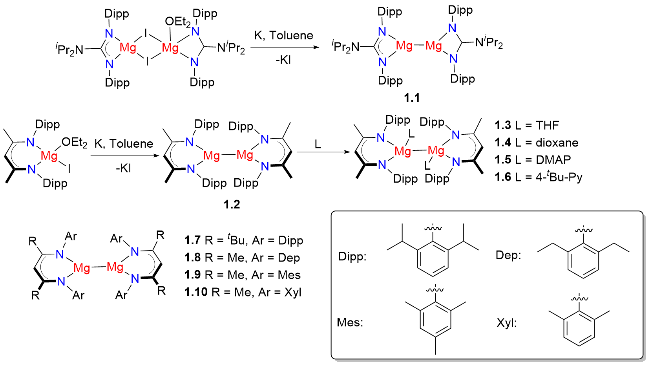
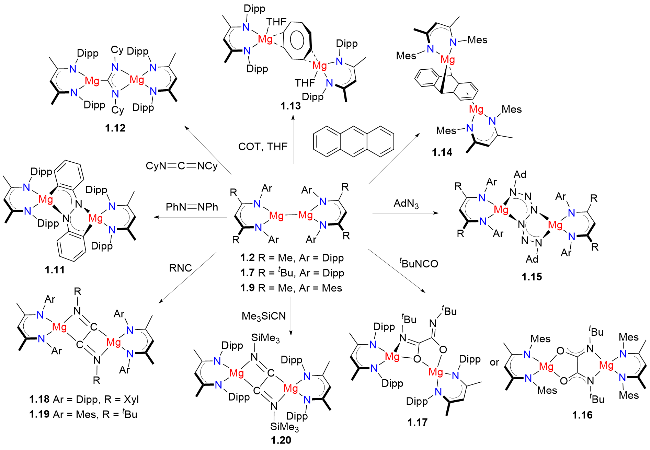
2007年, Jones和Stasch等[5]基于大位阻胍基配体和β-二亚胺配体稳定的Mg(II)碘化物, 利用碱金属钾在甲苯溶液中发生还原反应成功合成含有Mg—Mg键的Mg(I)化合物(L)Mg-Mg(L) (L={[(Dipp)N]2C(NiPr2)} (1.1)或{[(Dipp)NC(Me)]2CH} (Dipp=2,6-iPr2C6H3) (1.2) (Scheme 1). 晶体学研究表明Mg—Mg键的键长分别为0.28508(12)和0.28457(8) nm, Mg中心均呈现扭曲平面三角配位构型. 在此基础上, 2008年, 该小组[6]又合成出不同Lewis碱如四氢呋喃(THF)、1,4-二氧六环、4-二甲氨基吡啶(DMAP)以及4-叔丁基吡啶配位稳定的Mg(I)配合物1.3~1.6. 晶体学研究结果表明, 这些配合物中Mg—Mg键的键长相比不含配位分子的配合物增加了0.021~0.035 nm. 采用类似合成策略, 2010年, 该研究小组[7]通过改变β-二亚胺配体芳环N上以及骨架C上取代基, 通过Na/K还原Mg(II)碘化物, 相继合成出一系列β-二亚胺稳定的Mg(I)配合物1.7~1.10.
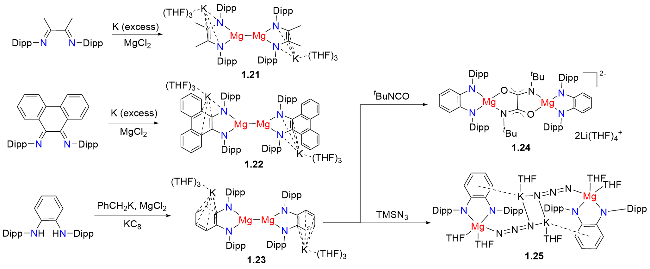
2009年, 杨晓娟、吴彪课题组[9]基于α-二亚胺配体([(Dipp)NC(Me)]2), 在THF中使用过量的K还原MgCl2, 合成了含有Mg—Mg键的中心对称的配合物1.21 (Scheme 3). 研究结果表明, 在反应过程中配体被还原为双阴离子化合物, 呈现为-2价. 由于配体空间位阻影响, 配合物中Mg—Mg键的键长为0.2937(2) nm, 略微长于Jones小组[5]所报道的Mg—Mg键配合物. 此外, 与Jones报道不同的是, 该配合物中Mg中心并未和THF配位, 可能与配合物中Mg—Mg键由s轨道和p轨道组成有关. 2019年, 为研究Mg—Mg键反应性, 该小组[10]又合成了两例新型二胺配体稳定的Mg(I)配合物1.22和1.23 (Scheme 3). 系统研究电子和空间效应对金属键反应活性的影响, 研究发现当1.23与叠氮基三甲基硅烷(TMSN3)反应, 经N—Si键断裂得到叠氮插入 Mg—Mg键配合物, 与tBuNCO作用得到C—C偶联产物.
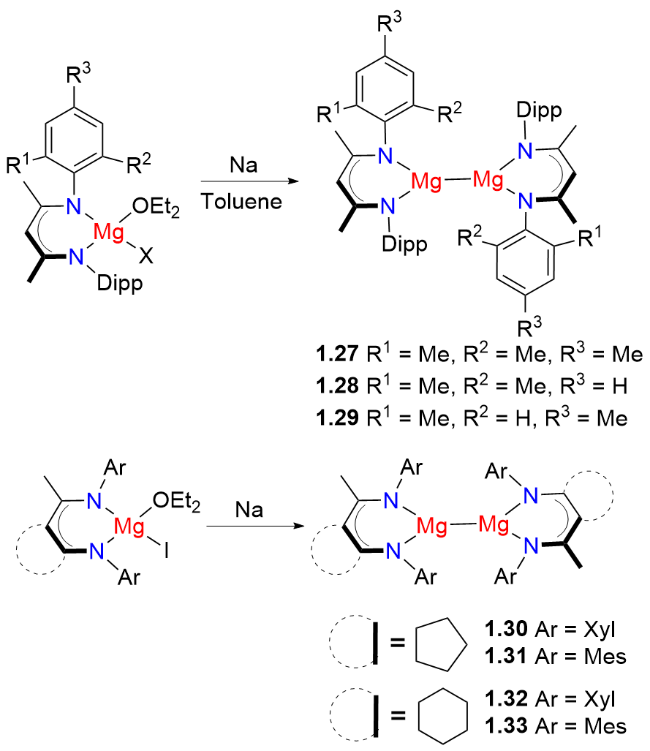
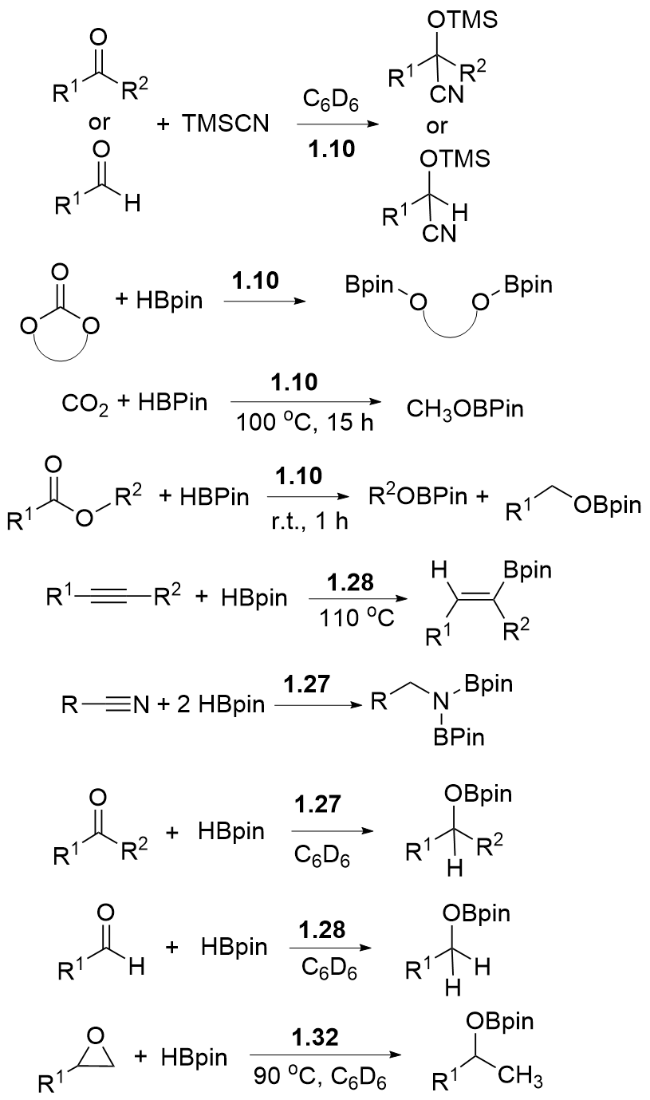
马猛涛课题组还进一步探究β-二亚胺稳定的Mg(I)配合物在催化转换中的应用. 2018年, 该课题组[14]采用[(XylNacNac)Mg]2 (1.10)作催化剂, 实现了醛酮的硅氰化反应, 为碱土金属在催化化学领域中的研究奠定基础 (Scheme 6). 随后研究发现, 该对称Mg(I)配合物能在温和条件下实现碳酸酯以及CO2的硼氢化反应[15]. 此外, 他们还将不对称Mg(I)配合物1.27和1.28用于催化炔烃、腈类化合物以及羰基化合物的硼氢化反应中, 而配合物1.32可用于催化环氧化合物与频哪醇硼烷(HBpin)的硼氢化反应, 以高选择性和高收率得到硼酸酯产物(Scheme 6).
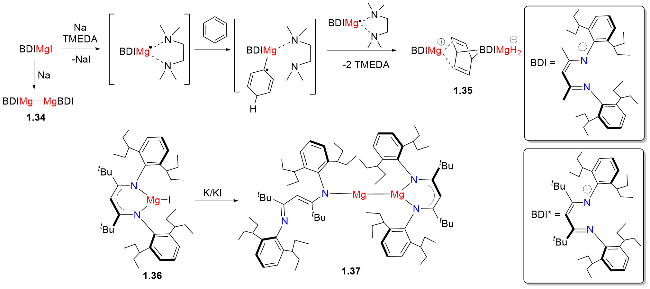
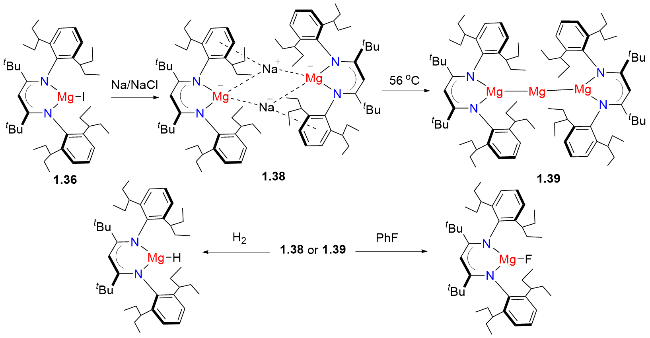
2019年, Harder课题组[16]尝试利用大位阻配体BDI [BDI=HC(C(Me)N[2,6-(3-pentyl)-phenyl])]来合成Mg(I)自由基, 但最后却得到Mg—Mg键长为0.30513(8) nm的Mg(I)二聚体1.34 (Scheme 7). 进一步研究发现, 在四甲基乙二胺(TMEDA)存在下, 在苯中用金属钠进行还原, 则生成了活化苯的化合物, 表明配体空间位阻和TMEDA能抑制Mg(I)自由基二聚. 2020年, 该小组[17]采用空间位阻更大的β-二亚胺配体BDI* [BDI*=HC(C(tBu)N[2,6-(3- pentyl)-phenyl])2]稳定的Mg(II)碘化物1.36, 在K/KI作还原剂条件下合成了Mg—Mg键配合物1.37 (Scheme 7). 配合物中Mg—Mg键长为0.2862(1) nm, 由于配体较大位阻使得该配合物中Mg中心分别呈现出配位数为2和3.
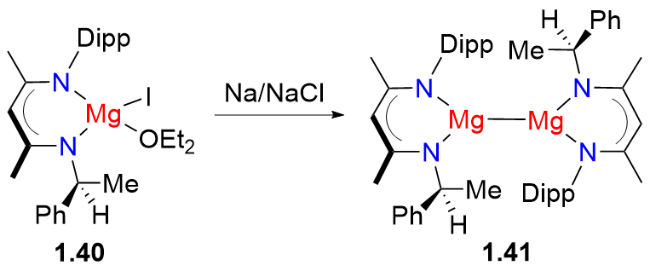
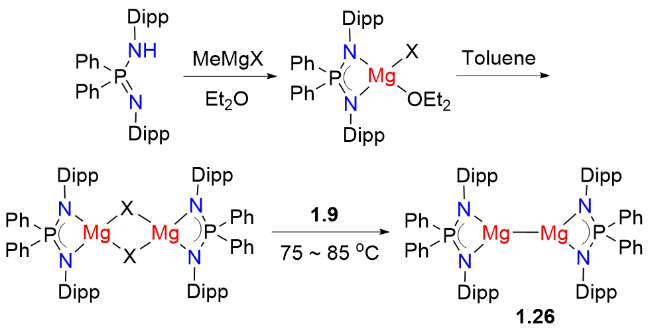
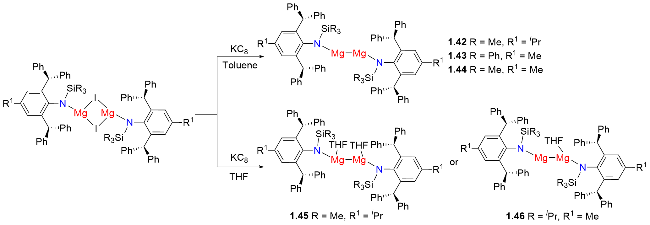
已报道的含Mg—Mg键的配合物主要由胍基型或二亚胺型多齿含氮配体来稳定得到, 通过配体改变可以实现Mg—Mg键长的变化. 目前已报道的Mg—Mg键配合物的金属键距离在0.27935(6)~0.3212(1) nm范围内. 考虑到配体非常大的空间位阻能够在动力学上对Mg(I)配合物起到立体保护作用, 2016年Jones课题组[20]基于大位阻单齿胺基配体[L=N(Ar)(SiR3), R=Me, iPr, Ph; Ar=C6H2{C(H)Ph2}2R-2,6,4, R=Me, iPr]稳定的Mg(II)碘化物, 利用石墨钾(KC8)在甲苯中发生还原, 首次合成并分离表征了二配位双核Mg(I)配合物1.42~1.44 (Scheme 10). 配合物中Mg—Mg键长在0.28223(11)~0.28504(13) nm区间内. 需要注意的是, 当其与THF作用时因空间位阻区别, 分别得到两分子THF和单分子THF加合物1.45和1.46, 配合物中Mg—Mg键长有所增加, 处于0.29049(17)~0.2930(2) nm范围内.
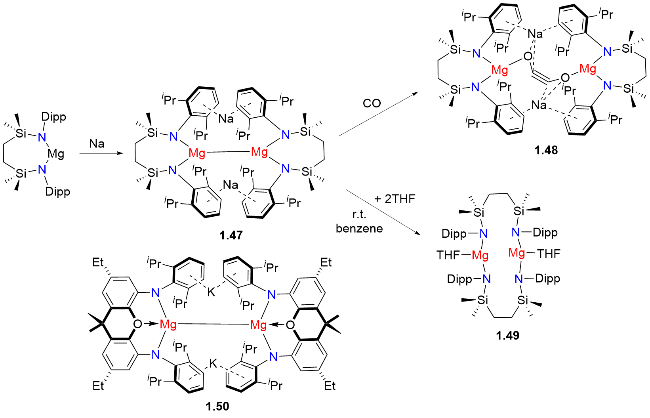
2021年, Hill课题组[21]基于双阴离子二胺配体稳定的Mg(II)配合物, 在金属钠作用下合成了新型含Mg—Mg键离子型配合物1.47, 其Mg—Mg键长为0.32077(10) nm. 尽管如此, 这一数值仍处在正常Mg(I)—Mg(I)键范围内, 并且该配合物中含有四核金属结构. 反应性能研究表明该配合物能使CO发生还原偶联反应, 通过氧桥连镁中心和钠中心. 进一步研究发现THF的加入将导致分子内氧化还原反应的发生, 得到Mg(II)配合物1.49[22]. 2023年, Jones课题组[23]利用氧杂蒽衍生的二胺配体稳定的Mg(II)配合物, 在金属钾还原作用下得到类似Hill课题组所报道的离子型Mg(I)配合物1.50, Mg—Mg键的距离为0.31369(15) nm (Scheme 11).
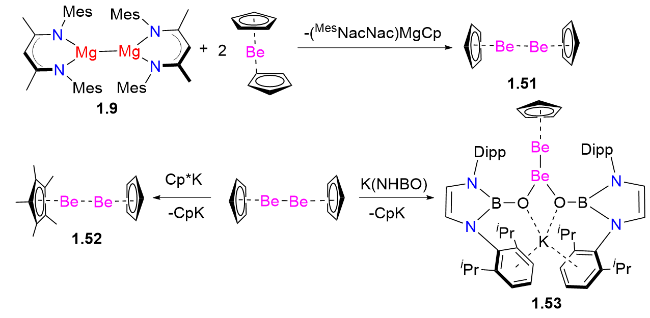
含Mg—Mg键的Mg(I)配合物近年来发展迅速, 目前已有40多种含Mg—Mg键的Mg(I)二聚体被合成出来, 并作为一种新型还原剂得到了广泛应用. 然而, 含有较重碱土金属(Ca、Sr和Ba)的同核金属-金属键的配合物目前尚未见报道. 相比于Mg—Mg键取得的快速进展而言, Be—Be键的构筑直到2023年才被研究人员所报道. Boronski等[24]利用[(MesNacNac)Mg]2还原Cp2Be, 成功合成含有Be—Be键的配合物1.51. 晶体学结构数据分析表明Be—Be键长为0.20545(18) nm, 理论计算证实Be—Be键具有高度的s轨道特征. 2024年, Boronski等[25]利用该化合物, 分别与KCp*和K(NHBO)经复分解反应, 合成了结构新颖的含Be—Be键配合物1.52和1.53, 进一步拓展了该类配合物的种类(Scheme 12).
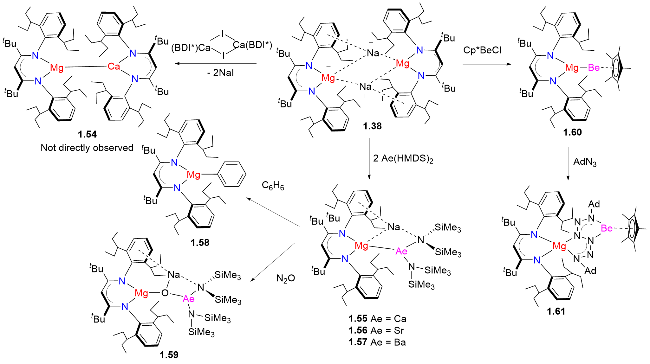
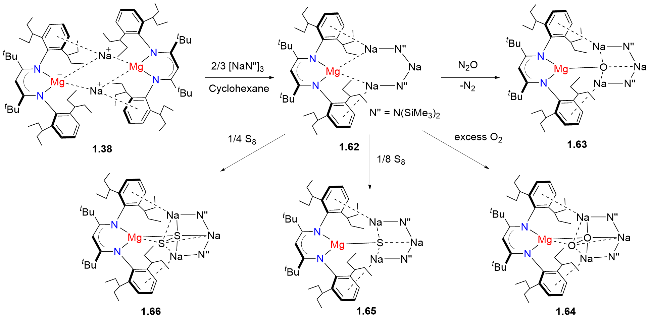
除合成同核碱土金属-碱土金属键外, 2023年, Har- der课题组[26]期望通过Mg(0)配合物1.38与大位阻β-二亚胺稳定的Ca(II)碘化物[(BDI*CaI)2], 经盐消除策略合成Mg—Ca键配合物1.54, 但由于产物稳定性差, 导致未能有效分离(Scheme 13). 2024年, 该课题组[27]改变合成策略, 利用[(BDI*)MgNa]2与二聚碱土金属胺化物[Ae(NR2)2]2反应, 成功合成了一系列含Mg—Ca/Sr/Ba键的配合物1.55~1.57. 其中, Mg—Ae键长随着碱土金属离子半径增加而增加. 反应研究表明, 这类配合物很容易通过C—H键裂解, 与苯反应生成镁配合物1.58, 并且该类配合物可与N2O发生反应, 生成氧桥联的金属配合物1.59. 随后, Harder和Buchner等[28]尝试利用该策略合成含Mg—Be键配合物, 但并未成功. 因此, 他们进一步利用[(BDI*)MgNa]2与Cp*BeCl发生盐消除反应, 首次合成了含Mg—Be键的配合物1.60, 由于金属中心位阻, 其与小分子如H2、CO等的反应活性受限, 而与CO2、CS2、异氰酸酯等缓慢反应, 与AdN3则发生还原偶联(Scheme 13).
2 异核碱土金属-过渡金属键(Ae—TM)
含金属-金属键配合物的合成引起人们极大兴趣, 对于理解化学键本质具有重要意义. 与Ae—Ae键的研究类似, Ae—TM键的研究主要集中于Mg. 1974年, Felkin等[30]在THF中用[CpFeBr(DPPE)]、BrCH2CH2Br和过量的Mg反应, 合成了含Mg—Fe键的化合物2.1. 其中, Mg—Fe键的键长为0.2593(7) nm. 1986年, Jonas等[31]利用[CpCo(η-C2H4)2]与格氏试剂RMgX (R=C3H5, Ph)反应, 通过过渡金属插入到Mg—C键之间, 合成了两例含Mg—Co键配合物[CpCo(η-C3H5)MgBr(THF)2] (2.2)和[CpCo(η-C2H4)(Ph)MgBr(TMEDA)] (2.3), 相应的Mg—Co键的键长分别为0.2480(4)和0.2565(3) nm. 1988年, Wilke等[32]将[Ni(C2H4)3]与二甲基镁试剂[Me2Mg- (TMEDA)]反应, 得到了甲基桥连的杂核双金属配合物[Ni(η-C2H4)2(μ-Me)Mg(Me)(TMEDA)] (2.4), 其中Mg—Ni键长为0.2615(1) nm, 处于两原子共价半径之和范围内. 1998年, Anderson等[33]基于铱金属氢化物Cp*(P- Me3)Ir(H)2和Ph2Mg(THF)发生烷基消除, 合成结构新颖的含Mg—Ir键配合物[Cp*Ir(PMe3)(H)(μ-MgPh)]2 (2.5) (图1). 配合物中Mg—Ir键的键长为0.2660(2)和0.2750(2) nm. 由此可知, 目前对于含镁-金属键配合物的合成策略主要有氧化还原、烷基消除、盐消除和脱氢偶联.

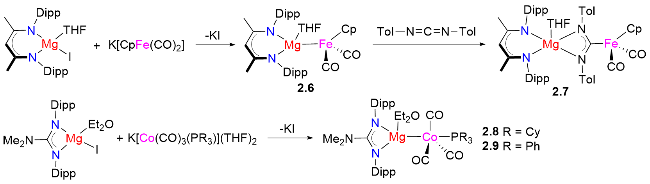
另一方面, β-二亚胺配体稳定的Mg(II)卤化物、Mg(II)氢化物、Mg(I)二聚体以及Mg(II)烷基化合物, 由于其产率高及易制备等优点, 逐渐成为用于合成含 Mg—TM键的重要前驱体. 2013年, Mountford课题组[34]利用β-二亚胺稳定的Mg(II)碘化物[(DippNacNac)Mg- I(THF)]与K[CpFe(CO)2], 经盐消除合成了一例Mg—Fe键配合物2.6, 其中Mg—Fe键长为0.26326(4) nm, 长于Felkin所报道的配合物2.1. 反应研究发现Mg—Fe键能与碳二亚胺发生插入反应生成配合物2.7. 随后, 该小组[35]采用脒基配体稳定的Mg(II)碘化物与K[Co(CO)3- (PR3)](THF)2发生盐消除, 合成了含Mg—Co键配合物2.8和2.9 (Scheme 15).
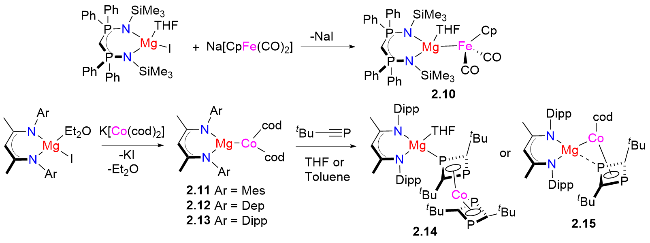
2017年, Kays课题组[36]利用亚磷酰亚胺配体稳定的Mg(II)碘化物与Na[CpFe(CO)2], 经盐消除策略合成了含Mg—Fe键配合物2.10. 2021年, Wolf课题组[37]采用类似策略将K[Co(cod)2]与不同类别β-二亚胺Mg(II)碘化物反应, 得到了一系列含Mg—Co键配合物2.11~2.13. 研究发现, 当使用四氢呋喃作为反应溶剂时, 杂核配合物与叔丁基膦炔反应生成三明治型1,3-双膦-杂环丁二烯基钴配合物2.14. 而使用甲苯时, 则生成单1,3-双膦-杂环丁二烯基钴配合物2.15 (Scheme 16). 两种不同的反应结果在于杂核金属配合物在不同溶剂中存在的形式不同.
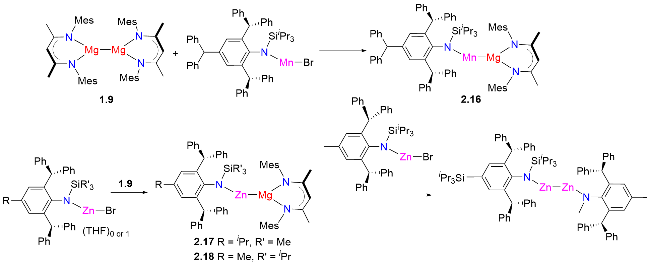
后续研究发现, 利用Mg(I)二聚体[(MesNacNac)Mg2]的还原性可以制备各种低价态的金属配合物以及相应的Mg—TM键[38]. 2014年, Jones等[39]利用大位阻胺基稳定的Mn(II)溴化物[LMnBr] (L=[NAr(SiiPr3)], Ar=2,6-[C(H)Ph2]2-4-iPrC6H2)与Mg(I)二聚体反应, 得到了含Mg—Mn键配合物[Mg(MesNacNac)MnL] (2.16). 其中, Mg—Mn键长为0.28244(13) nm. 由于两者电负性相差较小, 因此Mg—Mn键具有共价性. 该配合物可看作无机格氏试剂, 用于制备Mn(I)—Mn(I)键配合物. 2015年, 该小组[40]使用锌的溴化物[LZnBr] (L=[NAr(SiiPr3)], Ar=2,6-[C(H)Ph2]2-4-MeC6H2)进行类似反应, 合成了含Mg—Zn键配合物[Mg(MesNacNac)ZnL] (2.17和2.18). 其中, Mg—Zn键的键长为0.25775(9) nm (Scheme 17).
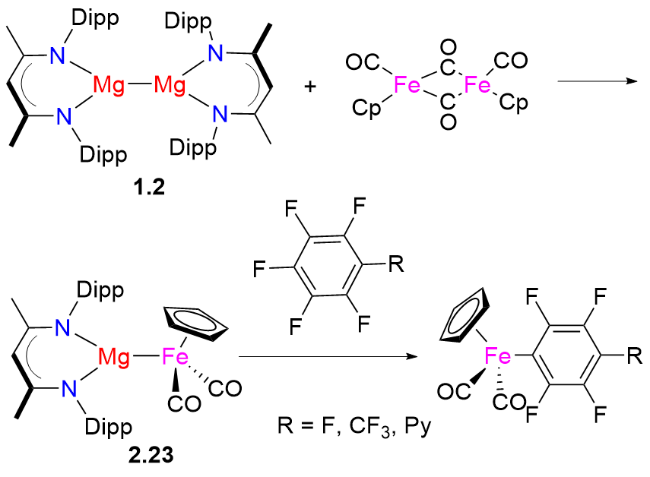
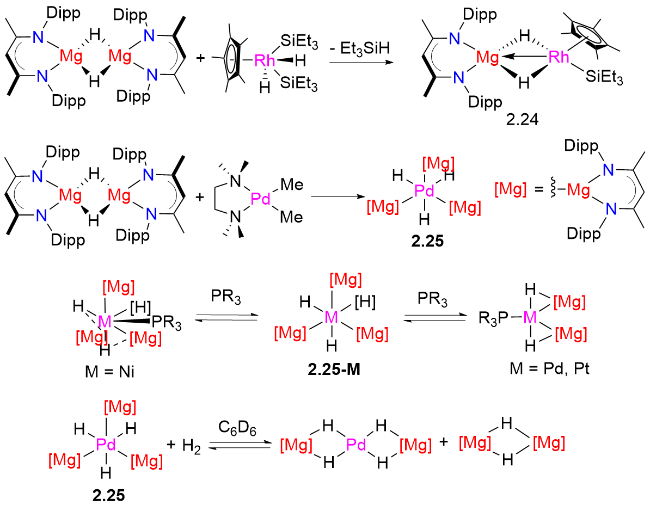
除构建Mg—Fe/Co键外, 人们对铂族金属参与的碱土金属-金属键也有研究. 2015年, Crimmin课题组[43]基于Mg(II)氢化物与(Cp*)(SiEt3)2RhH2反应, 合成了含Mg—Rh键配合物2.24, Mg—Rh键键长为0.25049(8) nm, 该策略也可用于其他镁-过渡金属键(Mg—Zr/Cu/ Ru)化合物的构筑. 2019年, Crimmin等[44]报道利用Mg(II)氢化物与TMEDA稳定的PdMe2反应, 合成了含多个Mg—Pd键平面六配位构型配合物2.25. 随后, 采用类似方法可实现含Mg—Pt/Ni键配合物的合成(Scheme 20). 这些配合物与Ph3P作用则得到相应配位产物, 值得注意的是, 产物的构型取决于过渡金属中心. Pd和Pt金属中心采取平面三角形构型, 而Ni中心则采取六方锥构型. 反应研究表明Pd配合物可以实现对氢气的可逆活化, 生成氢桥连的杂核三金属配合物.
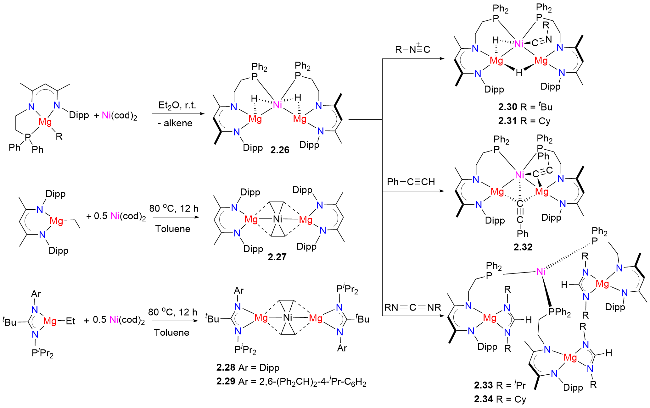
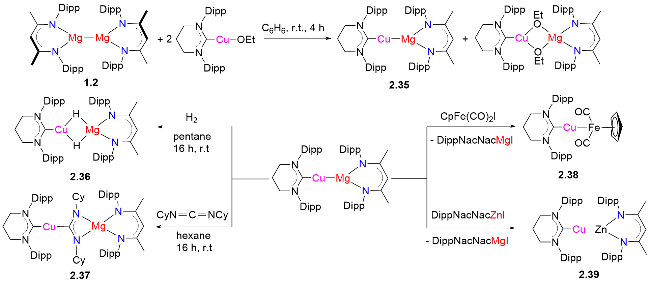
2020年, 徐信课题组[45]基于新型三齿膦基功能化的β-二亚胺配体, 合成了Mg(II)烷基化合物, 其进一步与Ni(cod)2经β-H消除生成氢桥联的Mg—Ni—Mg键配合物2.26 (Scheme 21). 理论计算表明, 在该配合物中Mg-H-Ni基团存在三中心两电子的相互作用. 反应性能研究发现该配合物可实现对不饱和有机底物如苯乙炔或碳二亚胺的活化. 2022年, 该小组[46]采用β-二亚胺稳定的Mg(II)乙基化合物LMgEt (L=((2,6-iPr2C6H3)N- CMe)2CH)与Ni(cod)2经β-H消除, 合成了含线性Mg-Ni- Mg结构单元的杂核三金属配合物2.27. X射线单晶衍射表明Ni中心采取平面六配位构型, Mg—Ni键键长为0.23715(14) nm, 是目前报道的最短Mg—Ni键. 反应性能研究表明, 该配合物能与配位性小分子DMAP、CO反应. DMAP与Mg中心配位, 从而保留原有结构, 而CO与Ni中心配位, 则发生配体交换反应. 此外, 还能实现对H2、PhNCS及TMSN3小分子的活化以及不饱和底物的催化氢化[47]. 进一步研究发现, 采用基于金属镁配体的镍-螺戊烷配合物作为催化剂, 实现了烯烃的选择性硅氢化反应[48]. 2025年, 该小组[49]基于膦基功能化脒基配体, 合成了Mg(II)乙基化合物, 将其与Ni(cod)2作用得到类似Mg-Ni-Mg结构配合物, 膦配体中心并未参与过渡金属配位. 与β-二亚胺稳定的Mg-Ni-Mg化合物类似, 在THF中得到其配位产物, 与CO作用则生成配体取代产物二羰基镍.
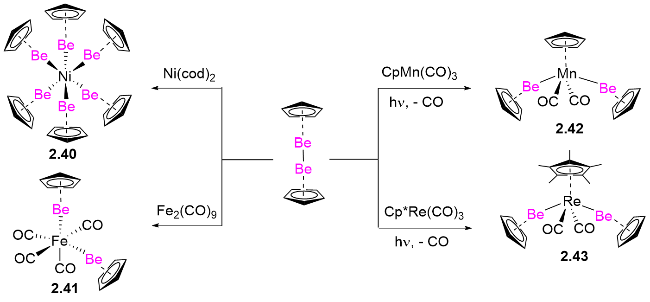
受Be及其化合物毒性影响, 关于Be与过渡金属成键的研究报道较为少见. 2023年, Boronski等[24]用二聚Be(I)化合物CpBe-BeCp与β-二亚胺Zn(II)碘化物(DippNac- Nac)ZnI反应合成了含Be—Zn键配合物. 其中, Be—Zn键长为0.2169(10) nm, 理论分析表明该化学键具有很强的共价性. 2024年, Boronski等[51]报道由零价镍通过还原加成插入到三个Be—Be键中, 形成了一种稳定的、结晶的NiX6配合物Ni(BeCp)6 (2.40) (Scheme 23). 2025年, 该小组[52]又分别合成含Be—Mn/Re键配合物, Mn—Be键长为0.2169(3)和0.2172(3) nm. Re—Be键长为0.2298(17)和0.2316(18) nm, 与其共价半径相当. 在光化学条件下, 利用CpMn(CO)3或Cp*Re(CO)3实现了CpBe-BeCp催化甲烷和苯的C—H键活化反应.
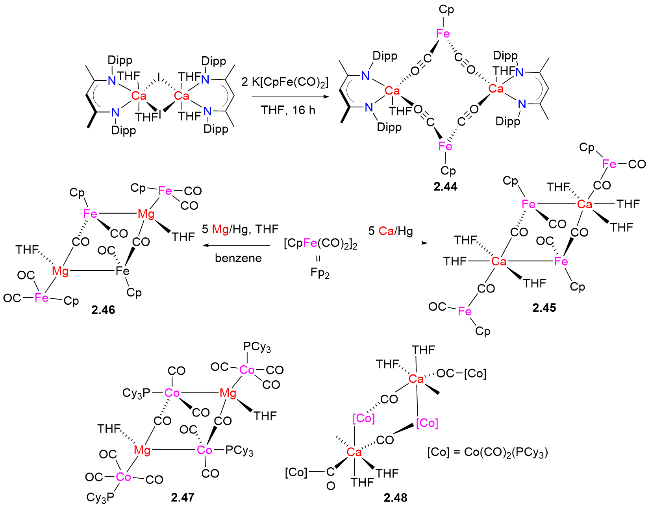
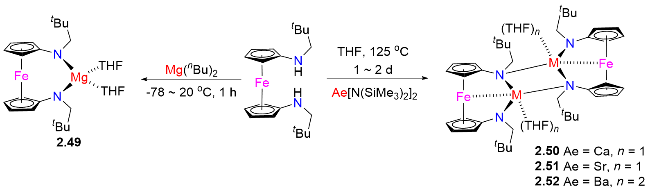
与Mg和Be参与的碱土金属-过渡金属键研究相比, 重碱土金属-过渡金属键配合物的发展迟缓. 2011年, Mountford等[53]尝试利用β-二亚胺钙卤化物经盐消除合成含Ca—Fe键配合物, 但最终得到羰基桥连的配合物2.44. 随后, 通过改进方法, 采用[CpFe(CO)2]2与Ca/Hg经还原策略得到含Ca—Fe键配合物2.45 (Scheme 24). 其中Ca—Fe键的键长为0.30185(6) nm. 为了探索Ae—TM成键极限, 该小组[54]将[Co(CO)3(PCy3)]2与Ae/Hg反应, 合成一系列包含Ae—Co键的配合物. 理论计算结果表明, Ae—Co成键相互作用从Be到Ba逐渐减弱.
3 碱土金属-主族金属键(Ae—MG)
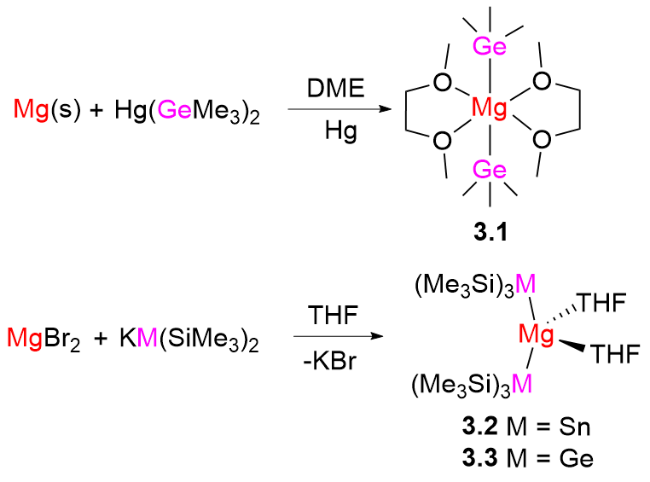
碱土金属和主族金属之间的成键研究主要集中在13族和14族的金属. 早在1984年, Rösch等[56]通过转金属化策略, 将单质Mg与[Hg(GeMe3)2]在二氯甲烷(DME)中反应, 生成配合物Mg(GeMe)2(DME)2 (3.1) (Scheme 26), 其中Mg—Ge键长为0.27219(11) nm. 2011年, Castel等[57]利用K[M(SiMe3)3] (M=Ge、Sn)与MgBr2, 在THF中经盐消除反应合成了含Mg—Ge/Sn键配合物[Mg{M(SiMe3)3}2(THF)2] (3.2~3.3). 由于Mg离子半径小, 使其仅与两分子THF配位, Mg—Ge和Mg—Sn键长分别为0.26785(5)和0.2817(3) nm. 其中Mg—Ge键长值要小于DME配位结构产物3.1, 可能是由于减少的配位数以及不同配位溶剂的空间位阻导致.
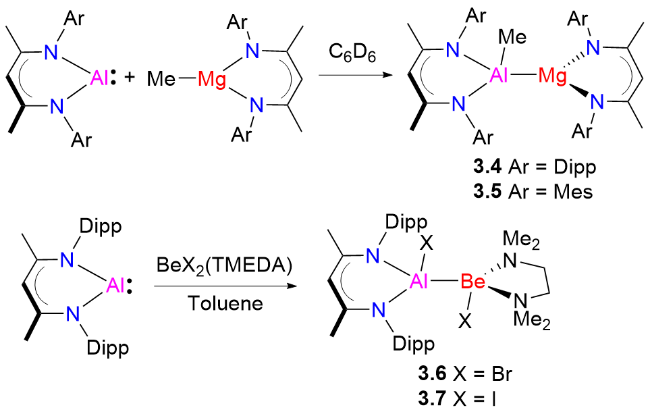
2018年, Crimmin课题组[41]采用β-二亚胺稳定的Al(I)与β-二亚胺Mg(II)烷基化合物, 通过氧化还原策略合成了含Mg—Al键配合物3.4和3.5 (Scheme 27). 其中, Al—Mg键的键长为0.27687(5) nm. Mg—Al键的成功构筑为开展Be—Al键的合成提供借鉴思路, 2019年, Jones等[58]基于类似策略将[:Al(DippNacNac)]与[BeX2- (TMEDA)]反应, 合成了含Be—Al键配合物3.6和3.7 (Scheme 27). 为比较成键特点, 随后又合成出Mg/Zn—Al键配合物. 其中, Be—Al键的键长分别为0.2474(1)和0.2432(6) nm, 明显长于对应的共价半径之和(0.228 nm), 而Mg—Al键和Zn—Al键[0.2727(2)和0.2471(1) nm]与其共价半径之和(0.265和0.244 nm)的偏差相对较小. 理论计算结果表明, 金属之间的成键均具有较高s轨道特征, 并且Be—Al键共价性最强.
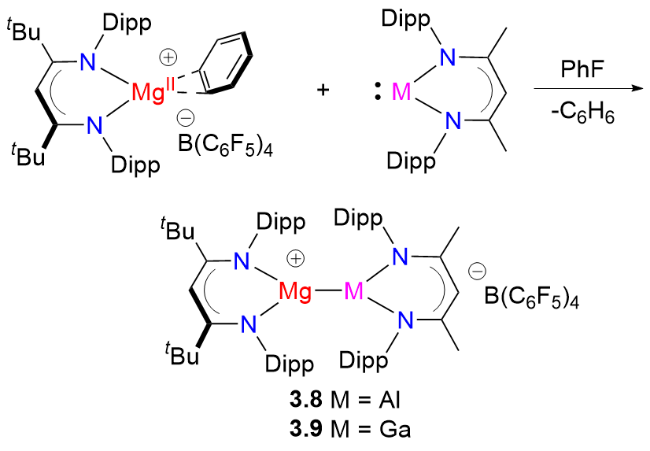
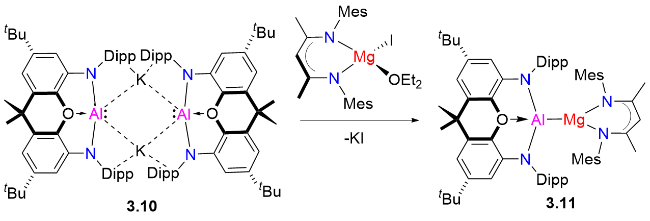
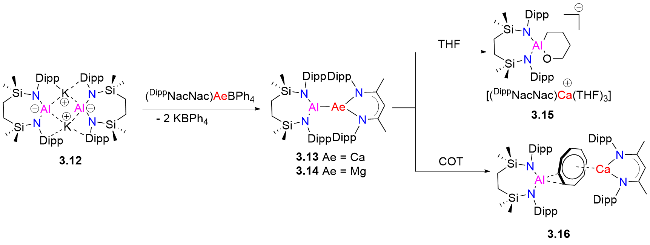
2020年, Hill和McMullin等[61]报道了重碱土金属-主族金属键配合物的合成. 该小组采用一类新型双齿含氮配体稳定的Al(III)碘化物[{SiNDipp}AlI] ({SiNDipp}={CH2SiMe2N(Dipp)}2)与金属钾作用, 得到Al(I)阴离子配合物[Al{SiNDipp}K]2 (3.12), 进一步与[(DippNac-Nac)- AeBPh4]经复分解反应, 生成Ae—Al键配合物(Ae=Ca、Mg) (Scheme 30). 其中, Al—Mg键长和Al—Ca键长分别为0.27980(6)和0.31229(5) nm. 反应研究表明, 两种配合物在苯或甲苯中时均未观察到反应性. 值得注意的是, 与重碱土金属成键的Al配合物的反应活性明显得到提升, 不仅能够与THF发生开环反应, 而且与环辛四烯(COT)经两电子还原反应, 得到反三明治结构杂核双金属产物.
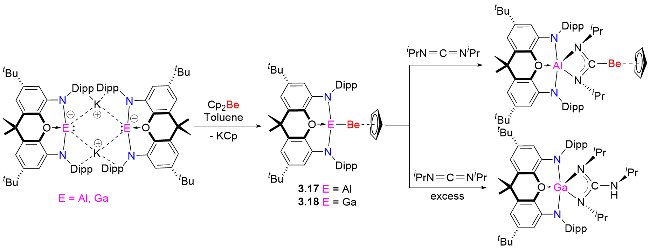
为进一步研究Be与金属之间的成键性质, 2023年, Boronski等[62]利用[K{Al(NON)}]2和[K{Ga(NON)}]2与Cp2Be发生复分解反应, 得到含Be—Al以及含Be—Ga键配合物(NON)E-BeCp [E=Al (3.17), Ga (3.18)] (Scheme 31). 其中, Be—Al键和Be—Ga键的键长分别为0.2310(4)和0.2206(2) nm. Be—Al键长短于先前报道的β-二亚胺稳定的Be—Al键配合物[0.2368(2)~0.2432(6) nm], 这是目前报道的最短的Be—Al键, 可能是因为[(NON)Al]-相比[(X)Al(DippNacNac)]-具有更强给电子能力. 研究分析表明, Be—Al键共价性明显强于 Be—Ga键及先前报道的Be—Al键. 量子化学计算结果表明, 在Be和Al之间存在一个非核吸引子(NNA). 这种不同寻常的电子结构和两种金属类似的鲍林电负性, 导致通过计算所得出的铍中心的电荷(+1.39)比铝中心的电荷(+1.88)低. 在没有NNA的Be—Ga键配合物中, Be中心的电荷(+1.49)要远高于Ga中心的电荷(+0.61). 因此, Be—Al键和Be—Ga键表现出截然不同的极性. 反应研究进一步证实, 其与碳二亚胺反应时, Be作为亲核中心进攻碳二亚胺亲电碳中心, 生成脒基类化合物.
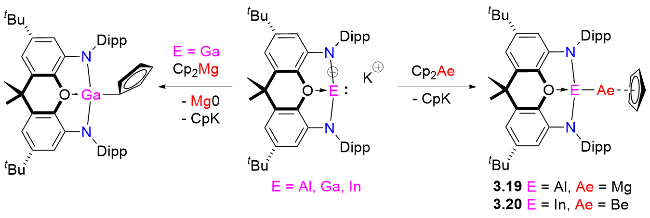
2024年, 该研究小组[63]采用类似策略, 基于一价阴离子型13族配合物[K{E(NON)}]2 (E=Al、Ga、In)和Cp2M (M=Mg、Be)的反应, 得到了含Ae—M键配合物(NON)Al-Mg(Cp) (3.19)和(NON)In-Be(Cp) (3.20), 且尝试合成(NON)Ga-Mg(Cp)和(NON)In-Mg(Cp), 并未成功 (Scheme 32). 这是首次得到结构表征的Be—In键配合物, 并且通过量子化学计算对其电子结构进行了探究. 计算分析表明, Be与三价主族元素的键合比Mg与三价主族元素的键合更具共价性. 值得注意的是, 这些计算预测, 含Be—In键配合物可作为亲核性铍的来源, 且已通过与碘甲烷的亲核取代反应生成Be-Me基团证实. 相反, Be-Ga配合物中Be中心的亲电特性与Be-In和Be-Al配合物中Be中心的亲核性形成了鲜明对比, 为铍元素参与的共价金属-金属成键能力提供新的见解.
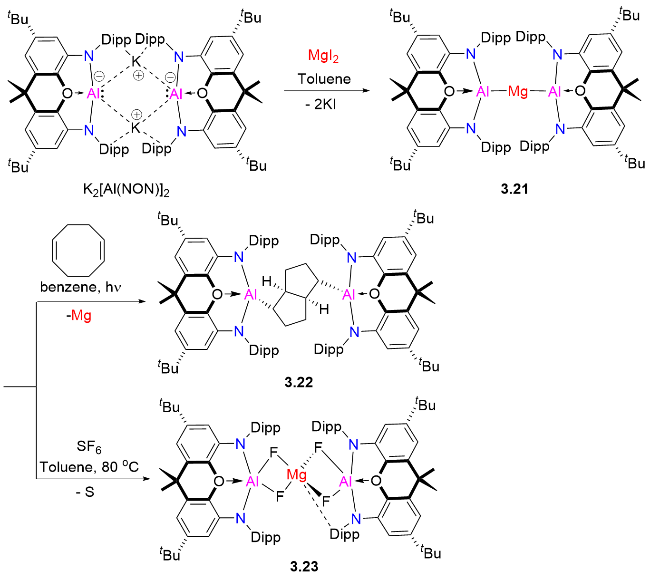
同年, Aldridge等[64]利用[K{Al(NON)}]2与MgI2发生盐消除反应, 得到均配型配合物Mg[Al(NON)]2 (3.21), 晶体学研究表明, 该配合物中三核金属Al(I)- Mg(II)-Al(I)呈非线型结构, Mg—Al键长分别为0.2695(1)和0.2689(1) nm. 反应性研究表明, 其在SF6的还原脱氟中充当四电子试剂, 而与极性底物MeI则通过Al的亲核进攻进行反应. 另一方面, 配合物在光解活化下, 经自由基机制与1,5-环辛二烯反应, 生成立体选择性的跨环加成产物3.22, 进一步证实Mg—Al键的共价性质(Scheme 33). 若在没有1,5-环辛二烯(COD)的情况下进行反应, Mg[Al(NON)]2则在己烷中经光解生成[Al(NON)]2和金属镁. 研究结果表明, 双铝基稳定的Mg配合物具有充当亲核或自由基反应性质的铝中心.
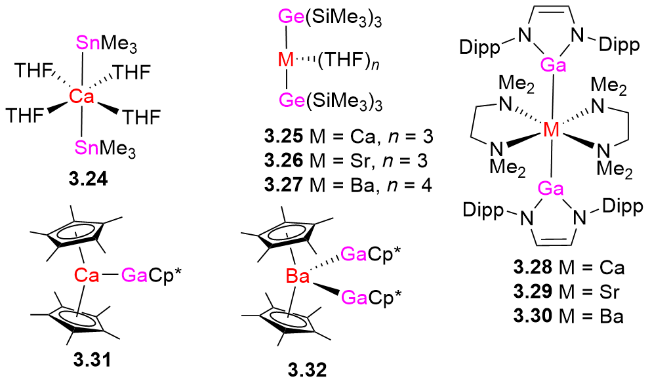
对于较重的碱土金属而言, 由于其电正性高而极难与过渡金属形成金属-金属键, 因此所报道的类别相对有限. 1994年, Westerhausen[65]基于Ca还原插入Sn2Me6中的Sn—Sn键, 得到了Ca—Sn键配合物[Ca(SnMe3)2- (THF)4] (3.24, 图2). 随后, Ruhlandt-Senge课题组[66]基于盐消除策略, 将K[Ge(SiMe3)3]与重碱土金属碘化物MI2在THF中反应, 合成了一系列Ae—Ge键配合物[M{Ge- (SiMe3)3}2(THF)n] (M=Ca, n=3; Sr, n=3; Ba, n=4) (3.25~3.27, 图2). 配合物中Ae—Ge键长随碱土金属半径增加而增加[Ca—Ge 0.3045(2) nm, Sr—Ge 0.3173(5) nm, Ba—Ge 0.3414(9) nm], 并且由于Ba具有大的离子半径, 可与多个THF配位. 2006年, Jones等[67]利用Ga杂环化合物[GaI2(ArNCR)2] (Ar=Dipp, R=H/Me)与过量Mg或Ca在Hg存在下反应, 合成含Mg/ Ca—Ga键配合物[M{Ga(DippNCR)2}2(THF)n] (M=Mg, n=3, R=H; Ca, n=4, R=H or Me). 2010年, 该小组[68]进一步利用[MI2(TMEDA)n] (M=Ca, Sr, Ba)与2 equiv.一价镓配合物[K(TMEDA)][Ga(DippNCH)2]经盐消除反应, 得到一系列重碱土金属-金属键配合物[M{Ga(Dipp- NCH)2}2(TMEDA)2] (M=Ca 3.28, Sr 3.29, Ba 3.30, 图2), 反应中TMEDA的存在对于配合物的成功合成至关重要. 2007年, Roesky等[69]采用Lewis碱配位策略, 实现了Ca—Ga键配合物的合成. 他们利用一价镓配合物Cp*Ga与[Cp*2M(THF)n] (M=Ca, Sr, Ba)反应, 得到相应Lewis碱加合物[Cp*2Ca-GaCp*]、[Cp*2Sr(THF)- GaCp*]和[Cp*2Ba(GaCp*)2].
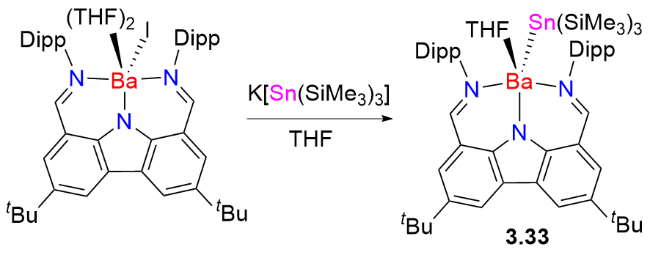
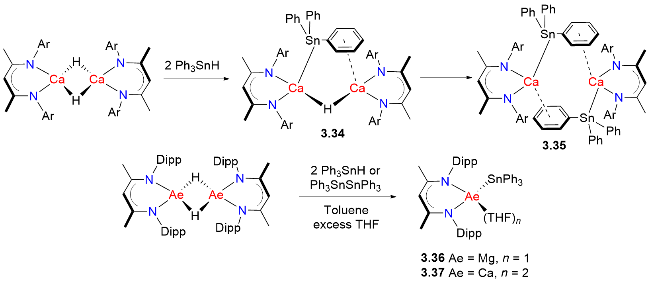
除上述合成方法外, 2019年, Hill等[71]采用β-二亚胺Ca(II)氢化物二聚体[(DippNacNac)CaH]2与Ph3SnH发生脱氢偶联反应, 合成了含Ca—Sn键二聚配合物[(DippNacNac)Ca(SnPh3)]2 (3.35), 类似的Mg(II)氢化物则不与Ph3SnH发生反应(Scheme 35). 其中, Ca—Sn键长为0.3221(5) nm. 但该配合物在溶液或固态下容易发生分解而使其应用受限. 该小组[72]进一步研究发现, 在含有THF的混合溶剂中反应, 则生成具有更高稳定性的单体配合物[(DippNacNac)Ca{SnPh3}(THF)2] (3.37)和[(DippNacNac)Mg{SnPh3}(THF)] (3.36). 此外, 还可以通过Ca(II)氢化物的亲核进攻对Ph3SnSnPh3发生异裂, 得到相应配合物. 其中, Ca—Sn和Mg—Sn键长分别为0.32951(5)和0.28340(6) nm. 由于钙离子半径大, 使得钙中心与两分子THF配位, 而Mg中心仅与一分子THF配位. 晶体学研究表明, 由于Ca中心达到五配位饱和, 导致SnPh3基团处于轴向配位, 而Mg中心则采取扭曲四面体配位构型.
2025年, 该小组[73]采取类似策略, 利用Mg(II)/Ca(II)氢化物与Ph3GeH在甲苯/THF混合溶剂中反应, 合成了含Mg/Ca—Ge键配合物[(DippNacNac)Ca{GePh3}(THF)] (Scheme 36). 晶体学分析表明Ca中心采取四配位构型, 仅与一分子THF配位, Ca—Ge键长为0.29983(3) nm. 反应研究表明Ca—Ge配合物可与碳二亚胺以及二苯甲酮作用, 生成脒基类配合物[(DippNacNac)Ca{(i-PrN)2- CGePh3}(THF)]以及烷氧基锗配合物[(DippNacNac)Ca- {OC(GePh3)Ph2}(THF)], 证实该配合物可看作[Ph3Ge]-阴离子用于亲核加成反应.

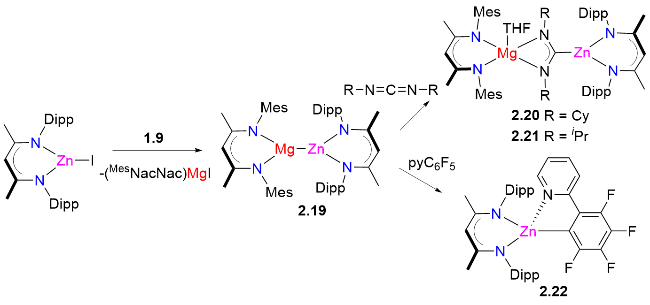
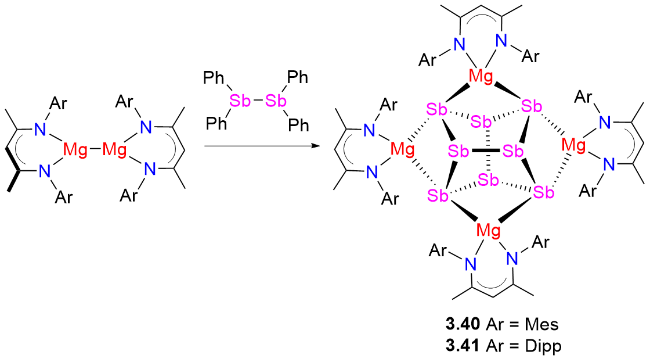
相比之下, 碱土金属与较重的第15族元素之间的化学键研究相对匮乏. 2016年, Schulz等[74]报道了利用二聚Mg(I)试剂对Sb2R4 (R=Me, Et)进行两中心/两电子还原, 得到了镁取代的Sb8多锑化物(Scheme 37). 其中, Mg(I)化合物除用作还原剂对Sb—C键进行断键外, 还用来稳定Sb8阴离子. 随后, 该小组[75]又通过Mg(I)还原Ph2Bi2合成了含Mg—Bi键配合物. 2019年, Coles等[76]报道了一种改进方法来合成多锑化物, 他们通过二胺NON配体稳定的Sb(III)氯化物与[(MesNacNac)Mg]2 (1.9, Mes=2,4,6-Me3C6H2)反应生成目标产物.


4 结论与展望
金属-金属键涉及化学键的本质和成键模式等基本理论问题, 是现代金属有机化学的研究热点和前沿领域. 自金属-金属键的概念被提出以来, 金属-金属键的研究经历了从d区金属、p区金属和f区金属向s区金属转变的发展历程. 含碱土金属-金属键配合物的研究在过去的几十年中已经取得重大进展, 尤其是含碱土金属镁-金属键配合物的研究相对成熟. 本文综述了碱土金属-金属键化学, 对已报道的含碱土金属-金属键配合物实例, 依据成键元素的不同分为同(异)核碱土金属-碱土金属键、异核碱土金 属-过渡金属键和异核碱土金属-主族金属键三类. 着重阐述了含碱土金属-金属键配合物的合成方法、结构以及反应性质. 迄今为止, 基于氧化还原、盐消除、烷烃消除、脱氢偶联以及低氧化态主族金属配位策略, 已有数十种含碱土金属的同(异)核金属配合物被合成, 并在小分子活化和催化转化中表现出巨大的潜力.
尽管研究人员在碱土金属-金属键配合物研究领域取得一定成果, 但仍存在诸多挑战和困难: (1)重碱土金属离子具有更大离子半径, 易发生Schlenk重排, 导致相应金属键配合物鲜有报道, 因此在重碱土金属-金属键的构筑中需进一步取得突破; (2)目前主要利用大空间位阻单齿或双齿含氮配体来实现碱土金属-金属键配合物的合成, 但这些有机配体往往不适用于重碱土金属键配合物的合成, 因而需通过合理设计配体或发展新的合成方法; (3)盐消除作为有效的合成策略之一, 在构建碱土金属-金属键过程中具有重要作用, 然而受限于过渡金属和主族金属试剂合成子的类别而阻碍其进一步发展, 为此新型阴离子型金属试剂亟需开发; (4)含异核碱土金属-金属键主要围绕过渡金属和主族金属, 有关碱土金属与稀土金属之间的成键仅有零星报道, 如何有效合成该类配合物具有挑战. 因此, 深入探索碱土金属-金属键配合物的合成及其反应性能具有重要意义. 通过不断持续研究, 解决当前所面临的难点问题, 将推动金属键化学领域向前发展, 丰富化学键相关理论知识.
(Zhao, C.)