



含氧有机化合物的构建是有机合成中最基础和重要的研究课题之一[1]. 大多数的氧化反应通常涉及使用过量的氧化剂如过氧化物、2,3-二氯-5,6-二氰对苯醌(DDQ)、醋酸碘苯[PhI(OAc)2]、过硫酸盐和2-碘酰苯甲酸(IBX)等, 反应结束后会生成大量的废物或副产物, 对环境不友好[1-2]. 分子氧具有廉价、清洁和可持续的优点, 能够作为氧化剂和氧源参与反应实现对有机骨架的官能化修饰, 被认为是构建含氧有机材料最理想的原料之一[3-4], 但是基态的三线态氧对大多数有机底物表现出惰性, 需要在酶催化或金属/非金属催化下通过单电子还原氧气生成单/双线态物种或金属氧化物进行氧化反应. 另一方面, 烯烃是一种容易获得且用途广泛的有机原料, 其双官能化反应已成为构建多种有机功能分子的强有力合成工具[5-6]. 在过去的几十年里, 科学家在过渡金属催化下分子氧参与烯烃的氧化双官能化反应领域已投入大量精力[7], 但该类反应仍受到反应条件苛刻及官能团兼容性差等方面的限制.
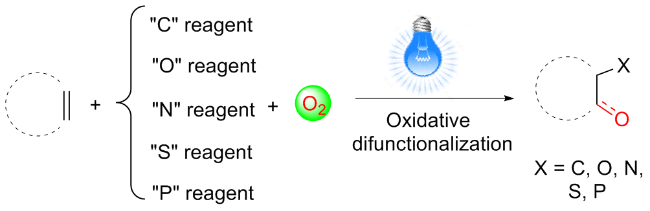
1 氧气和碳源试剂参与的烯烃氧化双官能化反应
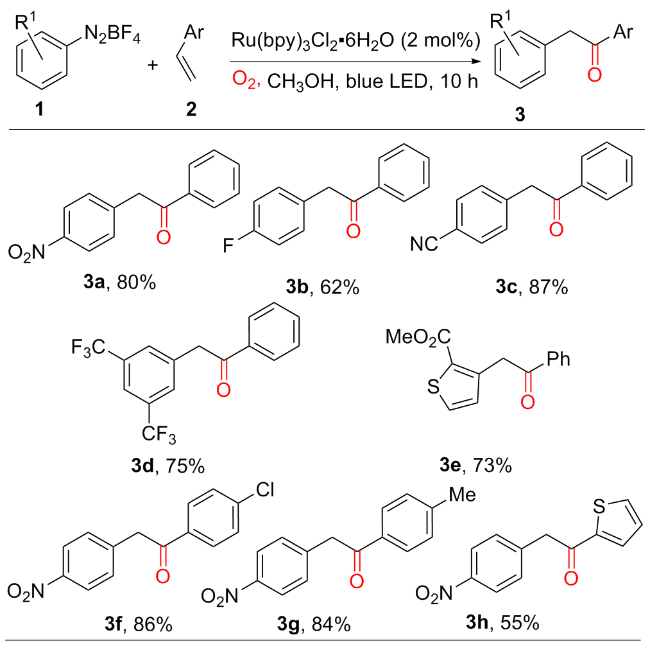
碳-碳键和碳-氧键的构建是有机合成化学中最重要的反应之一. 近年来, 化学工作者已发展了一系列可见光介导下烯烃与分子氧和碳源试剂反应构建多种含氧化合物的方法.
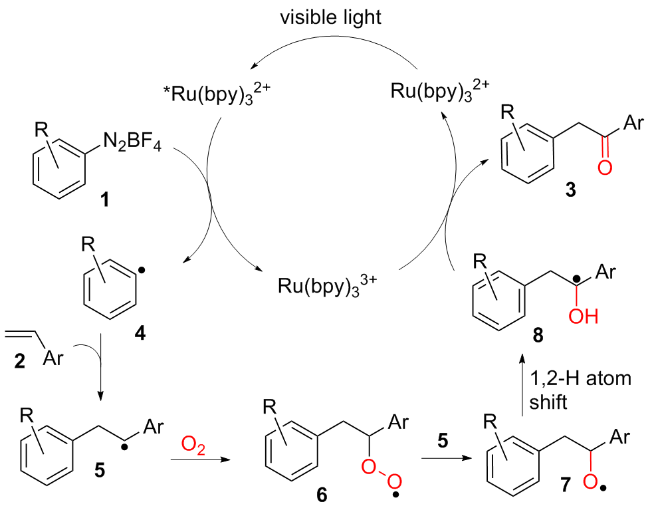
该反应机理如Scheme 3所示: 首先, 芳基重氮盐在激发态光催化剂作用下脱氮气形成芳基自由基4; 芳基自由基4选择性加成到芳基烯烃生成自由基中间体5; 自由基中间体5与O2反应分别得到过氧自由基6, 自由基6与5反应后裂解形成烷基自由基7; 最后, 中间体7经过1,2-氢迁移和单电子氧化进程得到最终产物3.
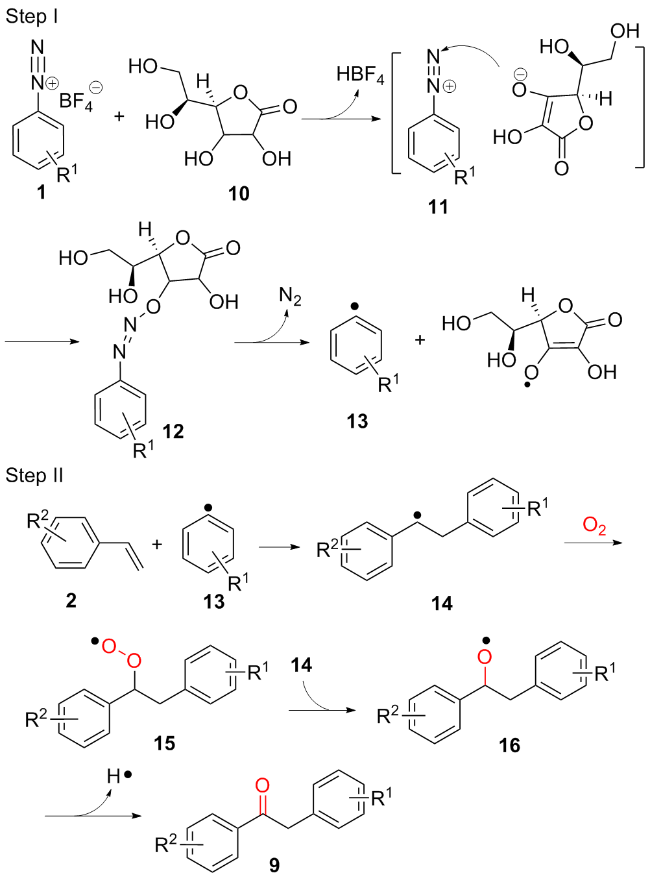
同年, Ranu课题组 [14]报道了一种分子氧参与条件下, 使用抗坏血酸促进芳基重氮氟硼酸盐和芳基烯烃氧化双官能化反应合成2-芳基苯乙酮的方法. 该方法能够在室温条件下以廉价的抗坏血酸替代昂贵的光敏剂完成光催化过程, 对多种官能团具有良好的耐受性(Scheme 4).
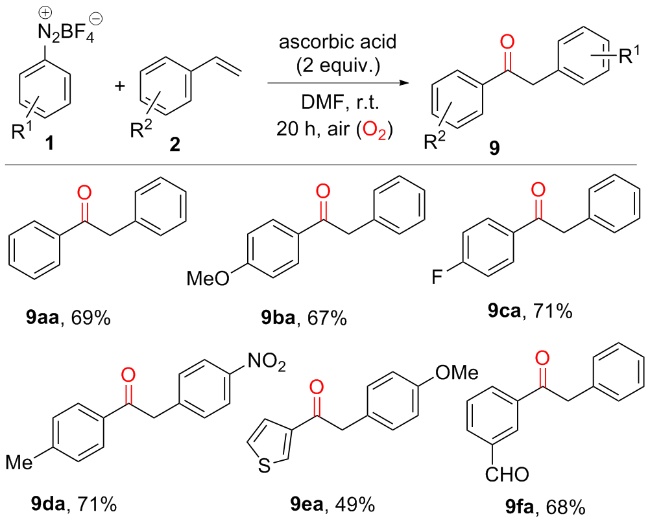
作者提出了如Scheme 5所示的可能机理. 首先, 芳基重氮盐1与抗坏血酸10发生反应, 通过抗坏血酸根离子对重氮离子进行亲核进攻生成中间体二氮杂环醚12. 随后, 二氮杂环醚12发生均裂得到芳基自由基13. 芳基烯烃2被芳基自由基13进攻形成相对稳定的苄基碳自由基14, 该自由基从空气中捕捉氧气得到过氧自由基15. 接着, 该过氧自由基与14发生反应形成烷基氧自由基16. 最终, 16脱去一个氢自由基形成产物2-苯基苯乙酮9.
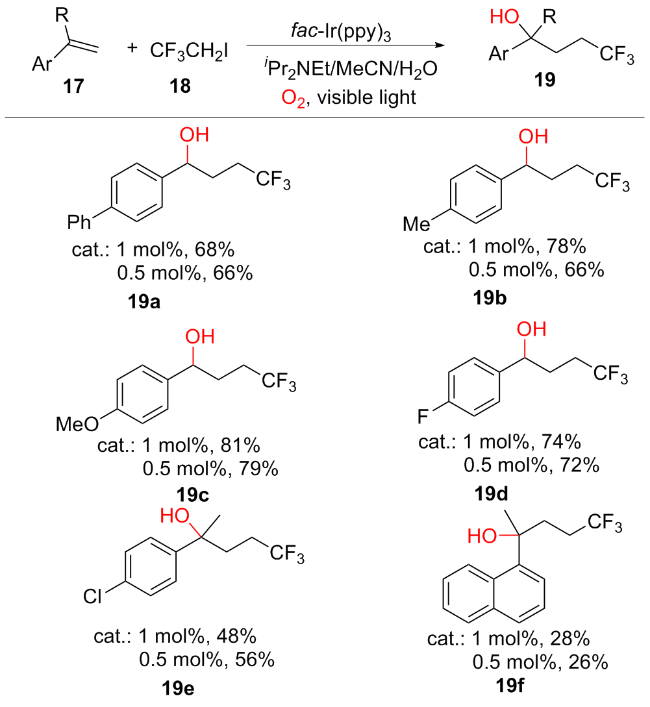
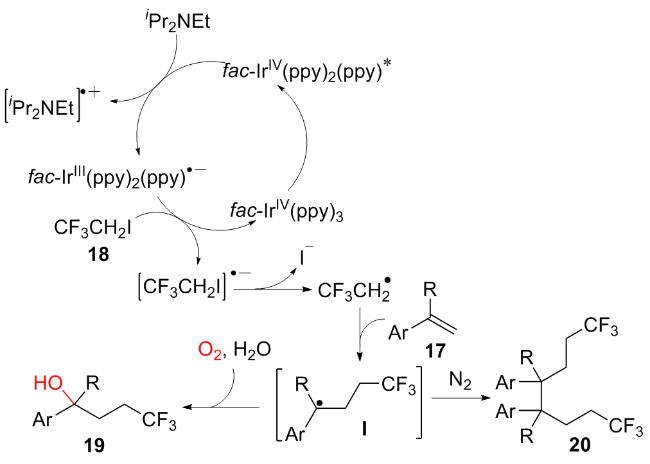
该反应机理如Scheme 7所示: fac-IrIII(ppy)3在可见光照射下被激发得到高活性的激发态物种fac- IrIV(ppy)2(ppy*); 随后激发态物种与二异丙基乙基发生单电子转移生成具有强还原能力的中间体fac-IrIV- (ppy)2(ppy•⁻), 其进一步对CF3CH2I (18)进行单电子还原生成三氟乙基自由基阴离子中间体; 随后脱除氯离子生成2,2,2-三氟乙基自由基; 三氟乙基自由基可与烯烃17发生自由基加成反应, 生成苄基自由基中间体I, 随后中间体I与分子氧在水分子存在下进一步反应生成最终羟基产物19. 若反应在氮气条件下进行, 苄基自由基中间体I发生自身偶联反应生成二聚产物20.
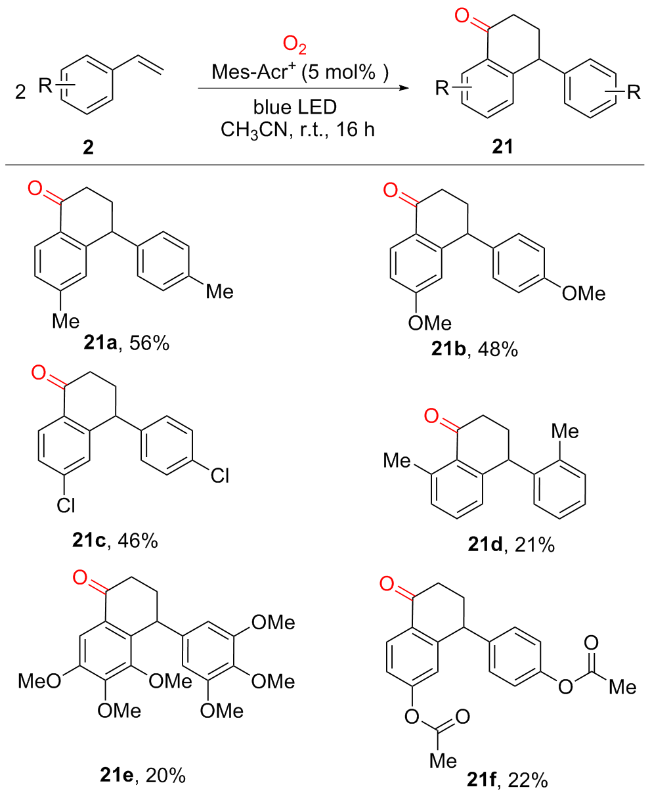
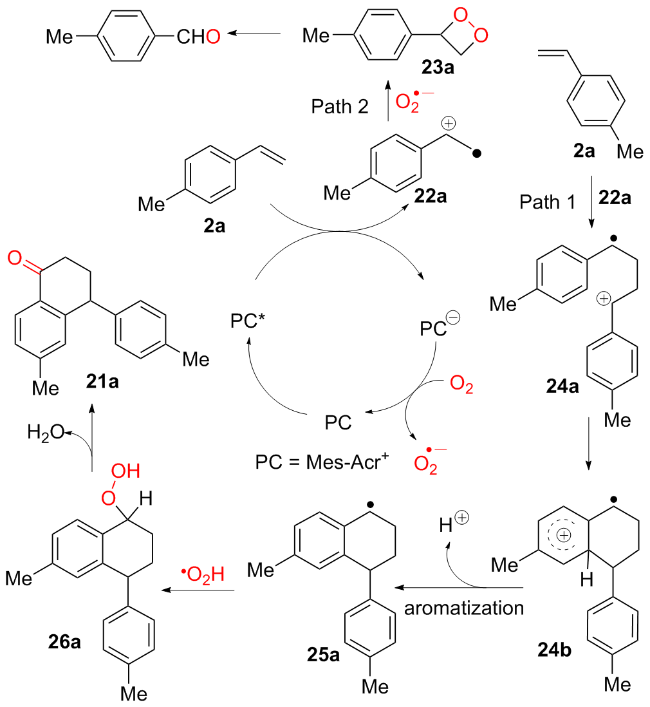
可能的机理如Scheme 9所示: 在蓝光的照射下光催化剂吸收光能从基态被激发为激发态PC*, 接下来其与2a发生单电子转移反应形成自由基阳离子中间体22a和催化剂阴离子(PC). 随后, 22a与2a进行自由基加成反应生成中间体24a(路径1), 24a进一步通过分子间亲电加成和芳构化过程转化为中间体25a. 值得注意的是, 中间体25a的存在可通过与四甲基哌啶氧化物(TEMPO)的捕获实验得以确认. 与此同时, 光催化剂的阴离子PC与氧气发生还原反应完成光氧化还原循环, 得到光催化剂的原始状态(PC)和超氧阴离子自由基($\text{O}{{_{2}^{}}^{-\ \bullet }}$). 随后, 由$\text{O}{{_{2}^{}}^{-\ \bullet }}$与质子(H+)生成氢过氧自由基 (•O2H), 其与中间体25a发生反应得到中间体26a. 最终目标产物21a通过26a的还原消除过程生成. 另一方面, 当超氧阴离子自由基$\text{O}{{_{2}^{}}^{-\ \bullet }}$与底物2a发生反应(路径2)时, 会得到二氧杂环丁烷中间体23a, 最终分解生成副产物对甲基苯甲醛.
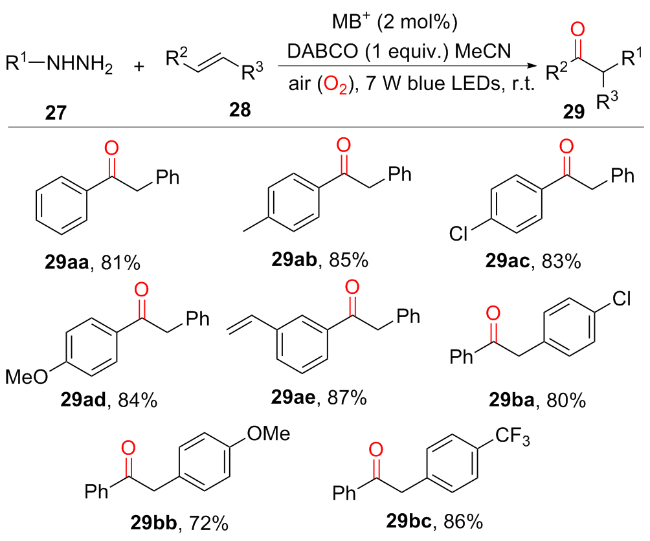
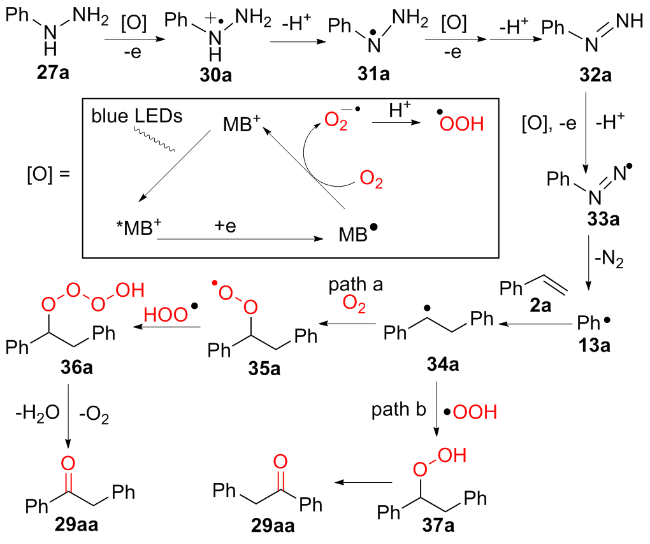
该反应的可能机理如Scheme 11所示: 首先, 在蓝色LED灯照射下甲基蓝吸收光能由基态转化为激发态; 然后苯肼27a在激发态光催化剂氧化下得到离子自由基30a和甲基蓝自由基(MB•). 离子自由基30a在脱质子化过程后, 经一系列单电子氧化脱氮气形成苯基自由基13a. 同时, 分子氧与甲基蓝自由基(MB•)氧化得到 MB+, 后者被还原为羟基过氧自由基(HOO•). 接着, 苯基自由基13a对苯乙烯2a进行自由基加成得到烷基自由基34a, 其被分子氧氧化得到过氧中间体35a. 过氧自由基中间体35a与氢过氧自由基结合得到中间体36a. 随后, 中间体36a通过Russell裂解获得目标产物29aa(路径a). 碳自由基中间体34a转化为目标产物29aa的另一可能路径是, 34a与过氧自由基结合生成中间体37a, 其分解得到最终产物(路径b).
2 氧源试剂和氧气参与的烯烃氧化双官能化反应
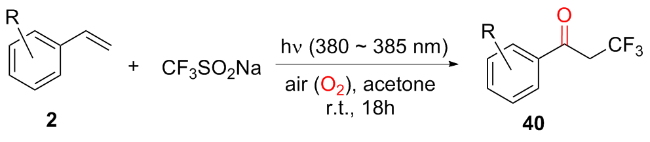
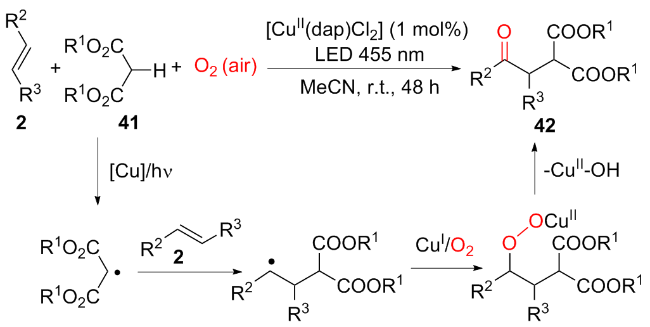
烯烃的双氧化反应是一种合成含氧分子的极其有效的策略. 多个研究团队使用可见光催化技术实现了分子氧对烯烃进行双氧化反应, 进而获得了不同类型的含氧化合物.
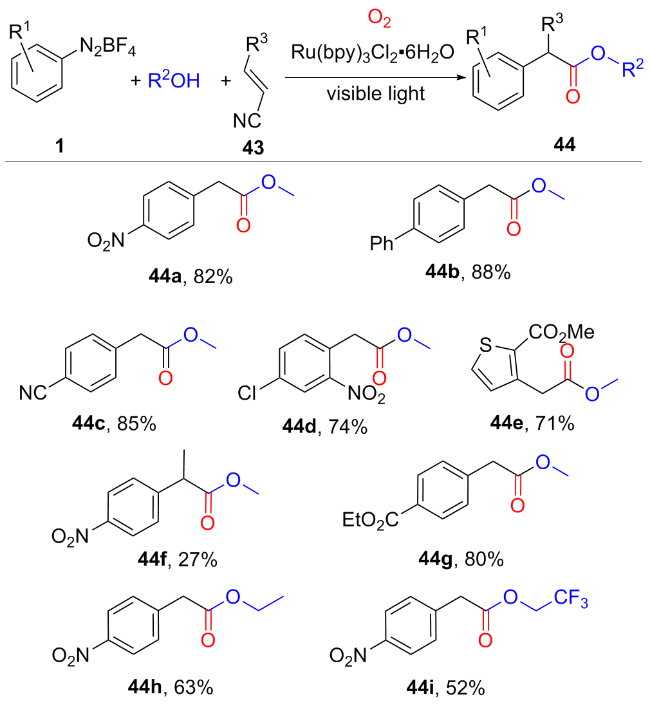
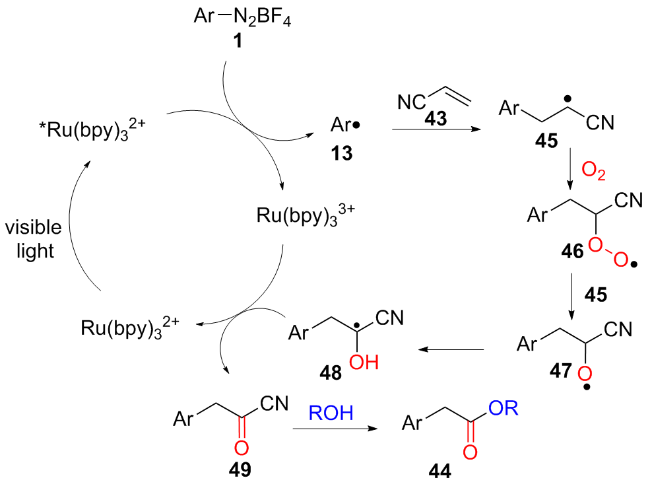
他们提出了一种可能的反应机理(Scheme 16): 首先, Ru(bpy)32+在蓝色LED光照射下吸收光能转化为激发态*Ru(bpy)32+. 接下来, 重氮盐1与激发态发生反应得到芳基自由基13. 腈基烯烃43与13进行碳碳双键加成反应生成自由基中间体45. 随后, 分子氧与45发生反应, 依次转化为过氧自由基46和烷氧自由基47. 接下来, 47经历1,2-氢原子转移后, 进一步经单电子转移(SET)过程生成碳自由基中间体48, 从而完成催化循环. 最终, 芳基乙酰氰中间体48与醇发生亲核取代反应, 得到目标产物44.
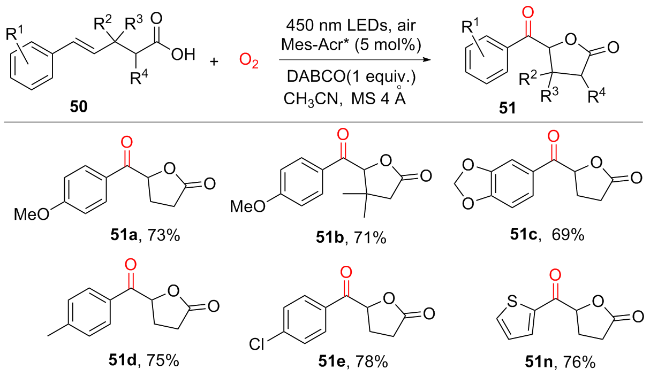
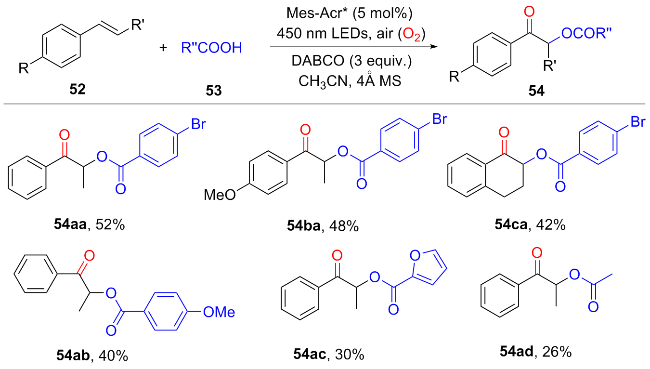
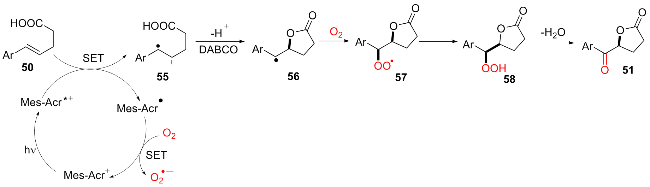
该反应的可能机理如Scheme 19所示: 在光催化下, 烯烃被单电子氧化形成自由基阳离子55, 其在碱作用下进行分子环合反应得到自由基中间体56. 随后, 分子氧与自由基中间体56反应形成过氧自由基中间体57. 接下来, 过氧自由基中间体57通过质子转移进一步转化为相应的过氧化物中间体58. 最终, 中间体58消除水分子(H2O)生成目标产物51. 另一方面, 还原态的光催化剂可以通过分子氧或过氧自由基经单电子转移(SET)过程再生.
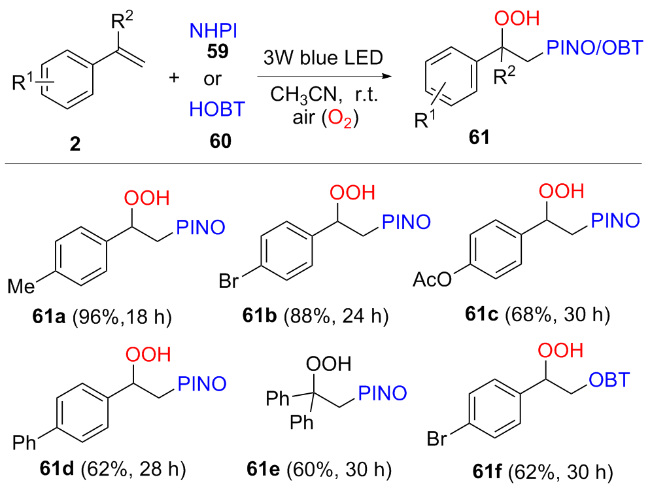
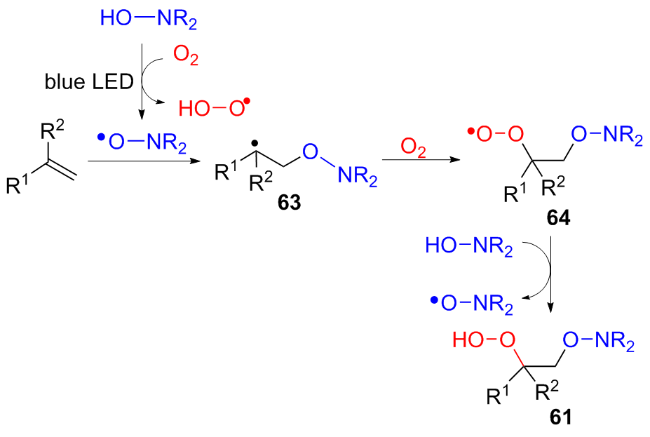
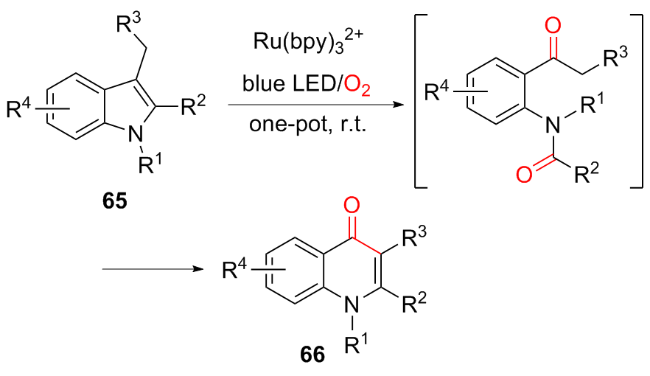
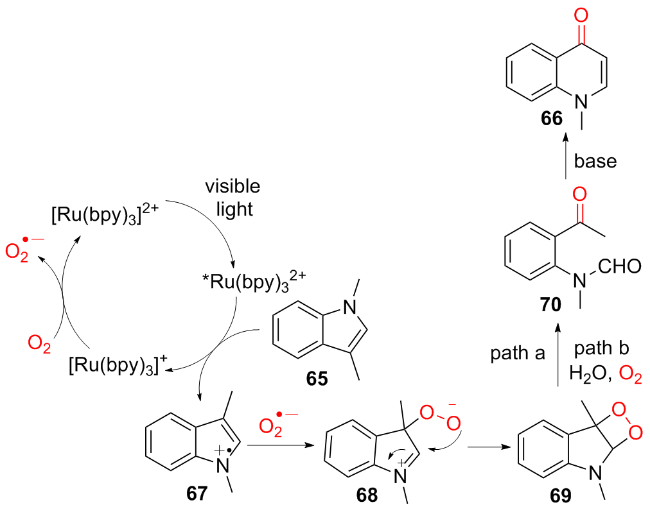
可能的机理如Scheme 23所示: 首先, 在蓝光照射下[Ru(bpy)3]2+吸收光能被激发成激发态[Ru(bpy)3]2+*. 后, 在可见光诱导下激发态光催化剂[Ru(bpy)3]2+*将吲哚65氧化为吲哚自由基阳离子67, 同时形成还原态[Ru(bpy)3]+. [Ru(bpy)3]+可进一步将分子氧还原为超氧阴离子自由基$\text{O}{{_{2}^{}}^{-\ \bullet }}$. 随后, 吲哚自由基阳离子67与$\text{O}{{_{2}^{}}^{-\ \bullet }}$发生交叉偶联反应生成超氧负离子中间体68, 接着通过分子内亲核加成反应生成二氧杂环丁烷中间体69. 接下来, 通过重排反应的路径a或涉及水分子的路径b生成中间体70. 最终, 借助KOH的辅助, 通过Camps环化反应生成4-喹啉酮66.
3 氮源试剂和氧气参与的烯烃氧化双官能化反应
含氮化合物因其在天然产物、制药工业和材料科学中的广泛应用而备受关注. 近年来, 化学工作者采用可见光催化实现了氧气与叠氮、胺和三氮唑等多种氮源试剂对烯烃的双官能化反应, 合成了一系列含氮和氧的化合物.
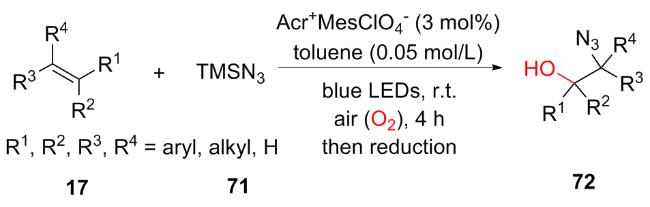
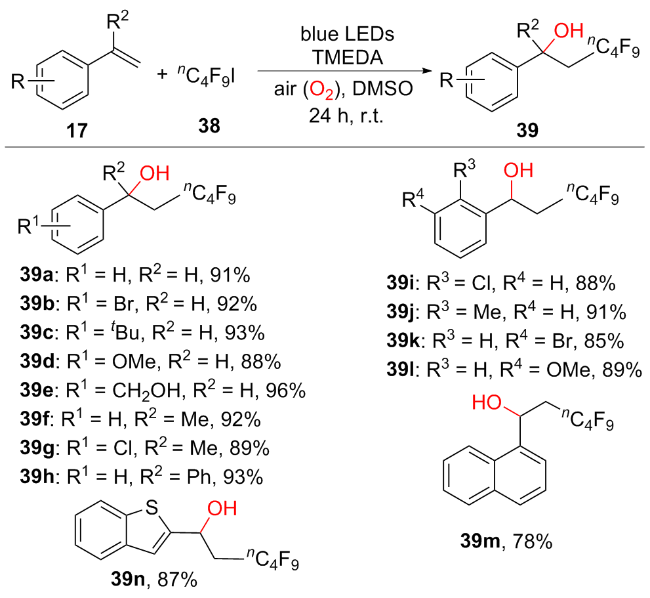
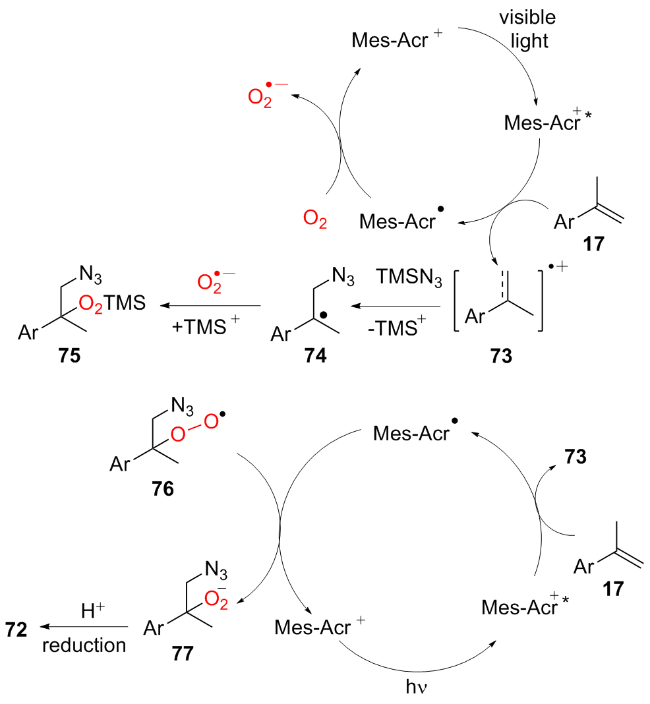
为了揭示反应的可能机理, 陆展团队开展了一系列对照实验. 基于实验研究以及先前文献报道的结果, 他们提出了该反应的合理机理(Scheme 25). 光敏剂(Mes- Acr+)吸收可见光后由基态转变为激发态, 该激发态催化剂能够氧化α-甲基芳烯17生成相应的自由基阳离子中间体73和还原态物种Mes-Acr•. Mes-Acr•可以被分子氧进一步氧化生成基态光催化剂和超氧自由基$\text{O}{{_{2}^{}}^{-\ \bullet }}$. 随后, 自由基阳离子中间体73被三甲基硅基叠氮(TMSN3)捕获生成苄基自由基中间体74. 苄基自由基中间体74随后与超氧自由基阴离子以及三甲基硅阳离子(TMS+)发生反应, 生成过氧叠氮化产物75. 值得注意的是, 还原态物种Mes-Acr•也可以直接与过氧自由基中间体76发生反应, 生成中间体77, TMS+与其进一步反应后被还原得到目标产物72.
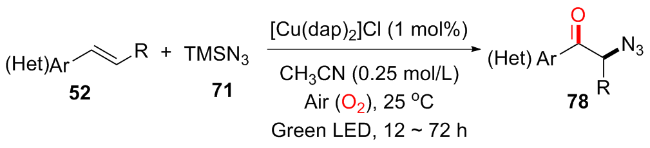
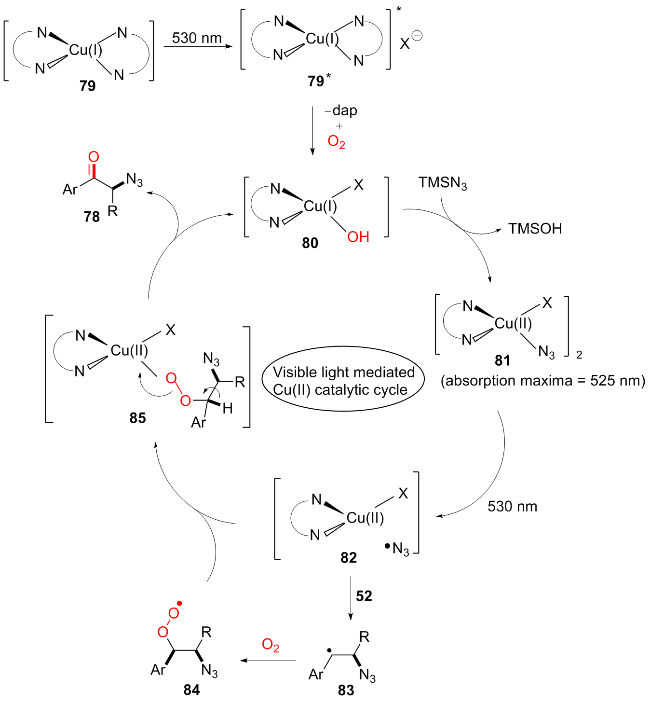
该反应的可能机理如Scheme 27所示: 在光照情况下, Cu(dap)Cl2 (79)与氧气混合后与叠氮桥联成二聚体81. 81在光照下发生均裂解离生成铜(II)物种82和叠氮自由基. 随后, 烯烃52与叠氮自由基进行加成反应形成自由基中间体83, 中间体83与氧气进一步反应生成自由基中间体84. 此时, 铜(II)物种82与84发生反应形成铜(II)物种85. 最终, 铜(II)物种85解离形成产物78和铜物种80, 完成催化循环.
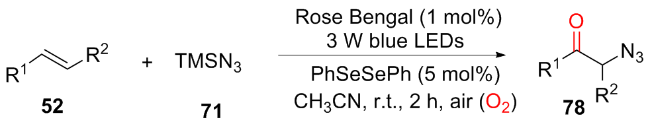
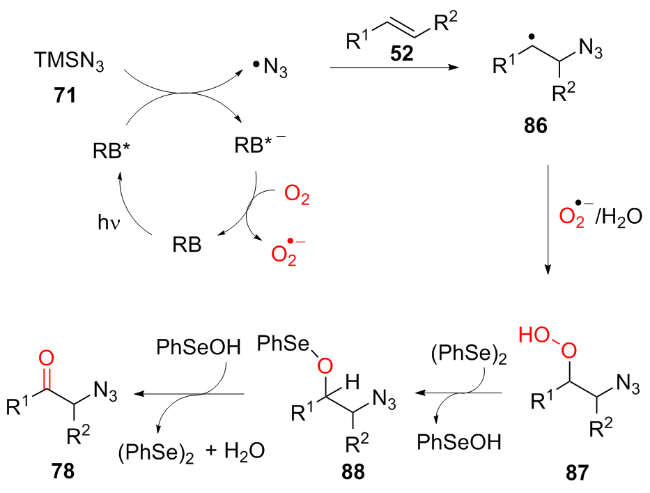
基于一系列控制实验, 魏伟课题组提出了一种可能的反应机理(Scheme 29). 首先, 在蓝光照射下RB吸收光能转化成激发态RB*. 随后, RB*与TMSN3之间发生SET过程生成自由基阴离子RB*⁻和叠氮自由基75. 接下来, 通过RB*⁻与分子氧发生氧化反应生成基态RB与超氧阴离子自由基(O2•⁻). 随后, 叠氮自由基对烯烃52进行加成获得烷基自由基86. 接下来, 86与$\text{O}{{_{2}^{}}^{-\ \bullet }}$和H2O发生反应生成烷基过氧化氢中间体87. (PhSe)2被过氧化氢中间体87氧化生成相应的活性有机硒物种88和PhSeOH. 最后, PhSeOH与活性中间体88发生反应生成目标产物78, 并再生(PhSe)2.
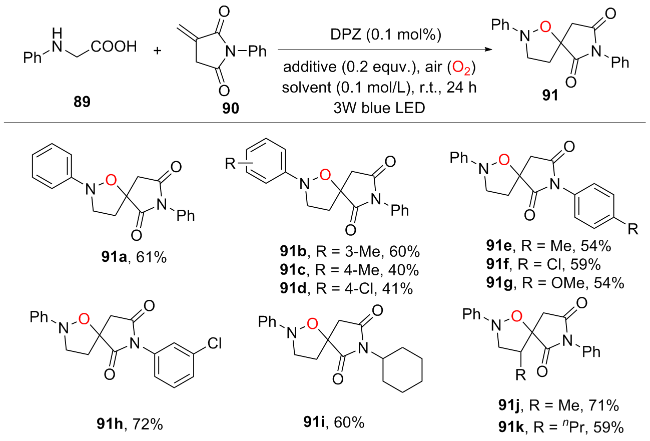
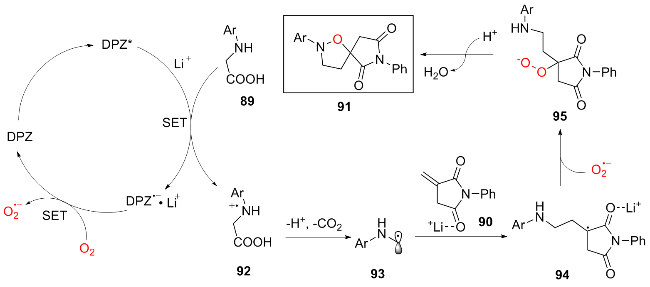
该课题组提出了一种光诱导烯烃氧化双官能团化反应的可能机理(Scheme 31). 在3W蓝色LED灯照射下, 光催化剂二腈基哌嗪衍生的生色团(DPZ)被激发至其激发态, 随后在路易斯酸LiPF6的辅助下, 被N-芳基甘氨酸还原为自由基阴离子复合物DPZ•—Li+. 空气中的氧气作为氧化剂, 使还原态的光催化剂回到基态, 同时释放出超氧自由基. 氮自由基阳离子化合物92容易发生脱羧反应生成α-氨基自由基93. 随后, 在路易斯酸性金属离子(如Li+或Mg2+)的辅助下, 93对活化烯烃进行共轭加成生成相对稳定的α-羰基自由基94, 94与超氧自由基偶联得到过氧化物95. 最后, 95通过分子内氧化芳胺化构建N—O键得到目标产物异噁唑烷91.
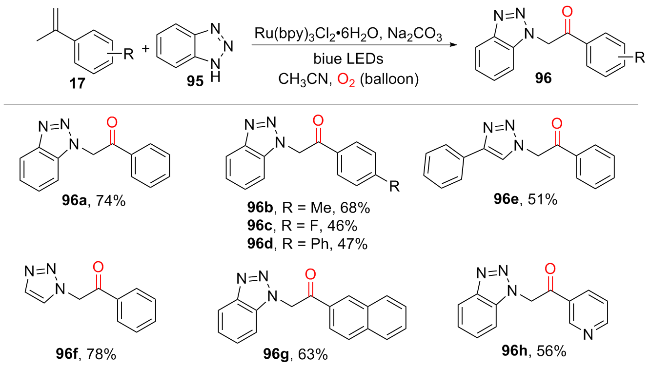
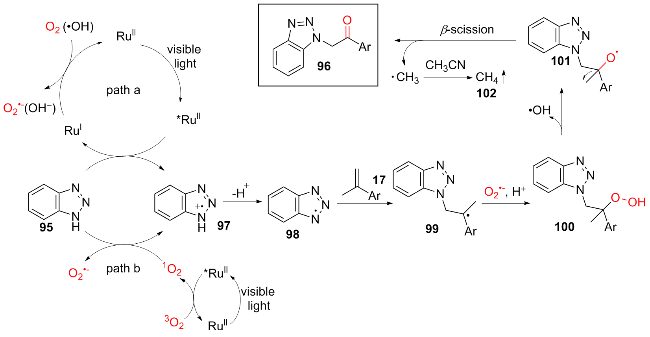
作者提出了该反应的可能机理(Scheme 33): 在可见光照射下, Ru2+吸收光能形成激发态物种RuII*, 随后RuII*与苯并三氮唑95发生SET过程, 生成氮中心自由基阳离子97和Ru+(路径a). 接着, 氮中心自由基阳离子97经历一个脱质子过程, 生成自由基98. 氮自由基98对α-甲基苯乙烯17进行加成形成自由基中间体99, 99进一步与光催化循环中产生的超氧阴离子$\text{O}{{_{2}^{}}^{-\ \bullet }}$偶合, 并质子化生成过氧化物100. 过氧化物100发生O—O键均裂生成羟基自由基和氧中心自由基101. 最后, 烷氧自由基101通过β-碳碳键断裂得到目标产物96, 同时释放出甲烷102. 在另一条路径(路径b)中, *RuII作为光敏剂与三重态氧3O2发生能量转移(ET)过程生成单线态氧1O2, 并使Ru2+再生. 氮自由基97可以通过单线态1O2的SET途径氧化生成, 同时1O2被还原为超氧阴离子$\text{O}{{_{2}^{}}^{-\ \bullet }}$.
4 硫源试剂和氧气参与的烯烃氧化官能化反应
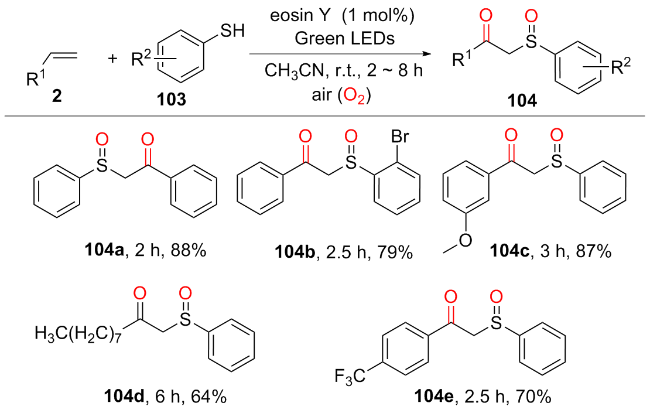
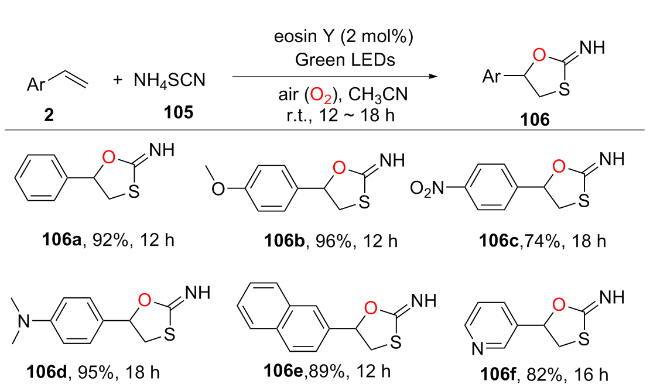
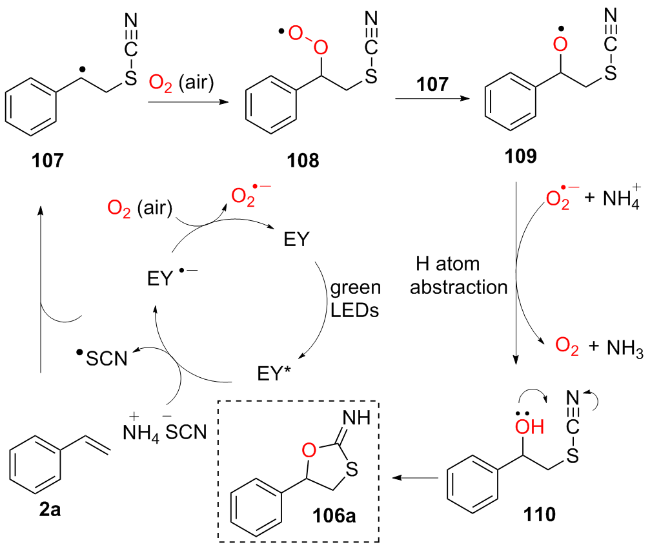
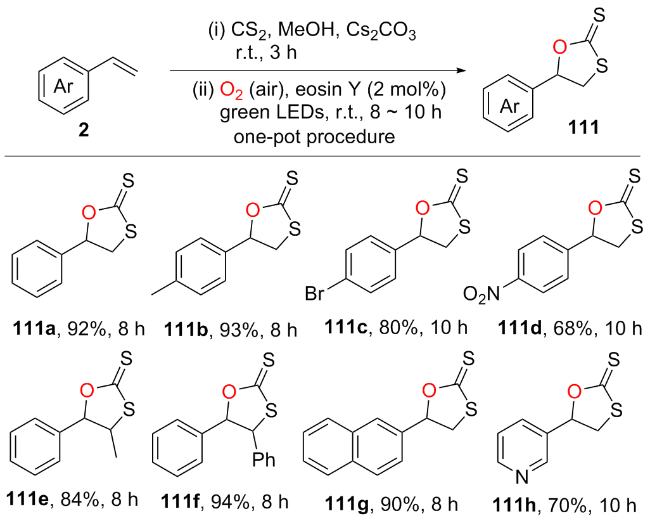
作者提出了一种如Scheme 36所示的可能反应机理. 伊红Y (EY)在吸收光后被激发至其激发态(EY*). 随后, 激发态与硫氰酸根离子(SCN)发生单电子转移(SET)生成硫氰酸根自由基(•SCN)和伊红Y自由基阴离子(EY•). 接下来, 氧气再对EY•进行氧化使其回到基态(EY). 原位生成的硫氰酸根自由基进攻苯乙烯2a得到中间体107, 107与氧气结合生成过氧自由基108. 108与107结合后发生均裂生成自由基中间体109. 109可以通过$\text{O}{{_{2}^{}}^{-\ \bullet }}$和$\text{NH}_{4}^{+}$的还原或质子转移生成β-羟基硫氰酸酯中间体110. 随后, 110迅速发生分子内环化反应生成目标产物106a.
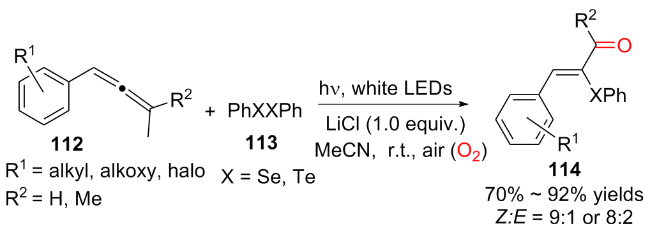
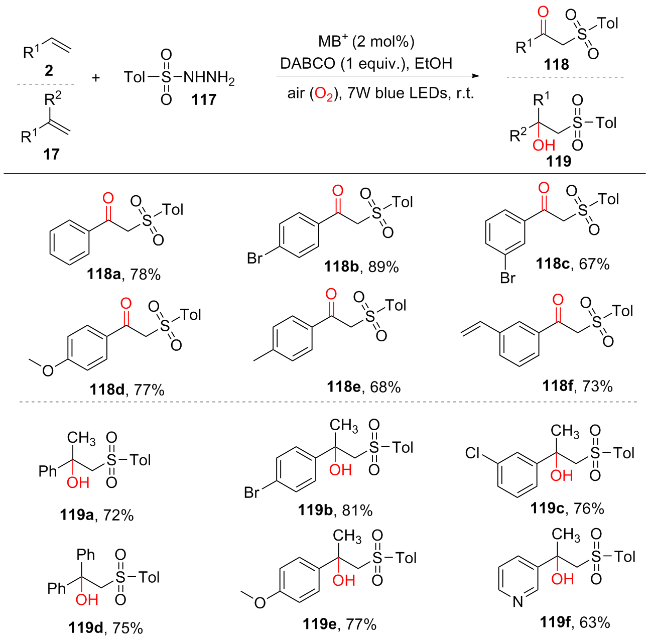
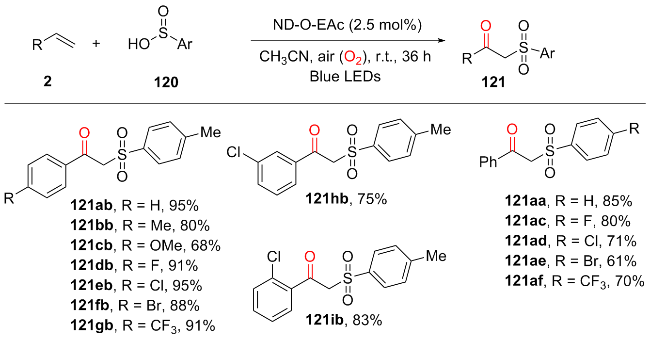
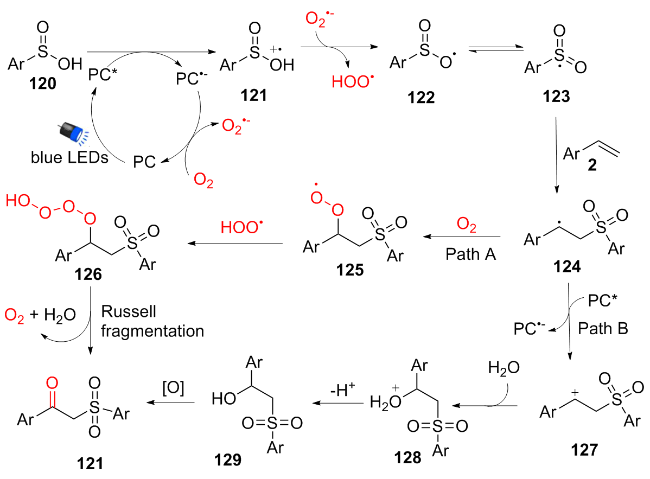
该反应的可能机理如Scheme 42所示: 首先, 光催化剂ND-O-EAc在可见光照射下被激发形成激发态物种[ND-O-EAc]*, 该物种能够被120还原猝灭, 生成自由基阳离子物种121和[ND-O-EAc]•. 随后, [ND-O- EAc]•被氧气氧化生成基态ND-O-EAc和超氧自由基物种$\text{O}{{_{2}^{}}^{-\ \bullet }}$. 自由基阳离子121被$\text{O}{{_{2}^{}}^{-\ \bullet }}$去质子化, 生成氧自由基122, 122自由基共振产生砜自由基123. 接下来, 磺酰基自由基123加成到烯烃2生成苄基自由基124. 苄基自由基124被氧气捕获生成过氧自由基125. 随后, 过氧自由基125与•OOH相互作用形成单烷基四氧化物中间体, 其通过Russell分解形成产物121aa(路径A). 此外, 苄基自由基124被激发态物种[ND-O-EAc]*氧化生成碳正离子中间体127. 最后, 水分子H2O对127亲核进攻形成中间体128, 其被氧气氧化转化为目标产物121.
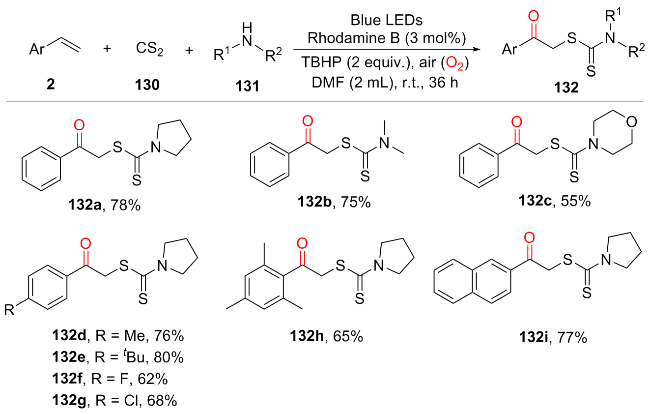
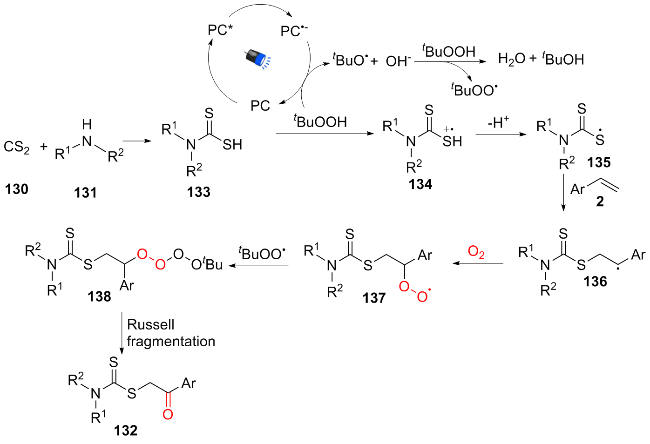
Singh等提出了该反应一种可能机理(Scheme 44). 首先, CS2 (130)与胺131发生反应生成二硫代氨基甲酸酯133. 在可见光照射下罗丹明B (PC)能够通过氧化型光诱导电子转移(PIET)过程将电子转移至143, 形成自由基阳离子中间体134. 在此过程中, 罗丹明B自由基阴离子(PC•)进一步通过单电子转移(SET)被叔丁基过氧化氢(TBHP)猝灭得到基态(PC). 同时, TBHP发生分解反应生成叔丁氧自由基(tBuO•)和氢氧根离子. 随后, 叔丁氧自由基(tBuO•)与TBHP发生反应生成叔丁基过氧自由基(tBuOO•). 自由基阳离子134发生去质子化反应生成自由基中间体135, 该中间体随后与烯烃发生加成反应生成苄基自由基中间体146. 进一步, O2与136作用生成过氧自由基中间体137, 137与叔丁基过氧自由基(tBuOO•)发生反应形成中间体138. 最后, 138经历Russell裂解反应得到目标产物132.
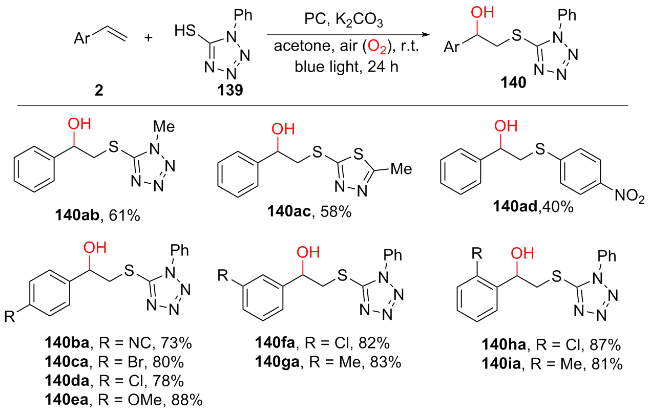
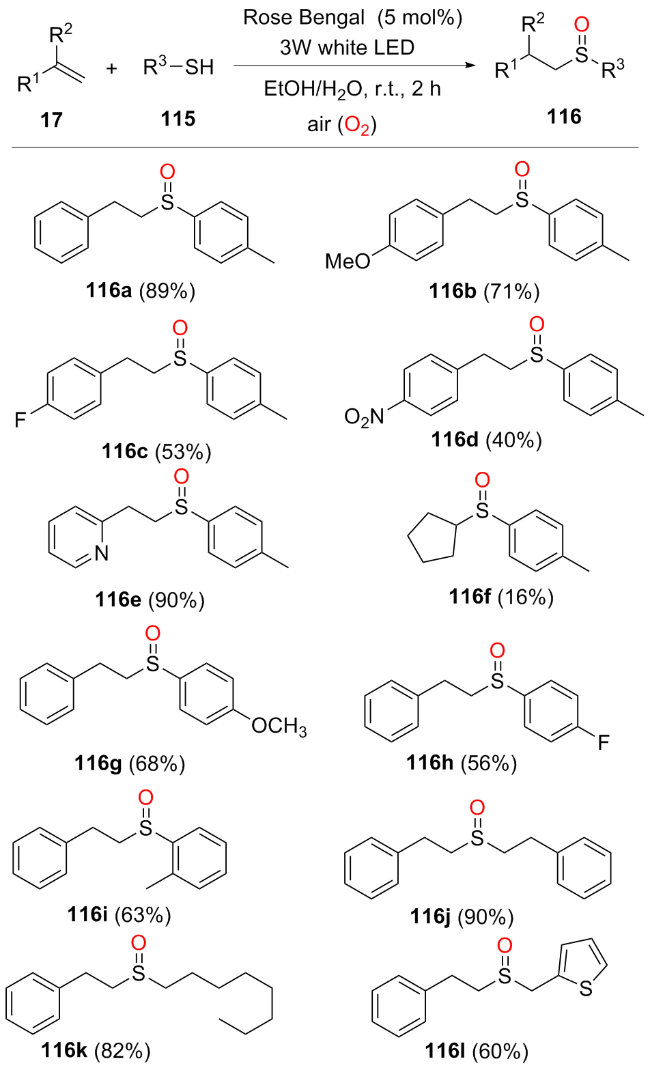
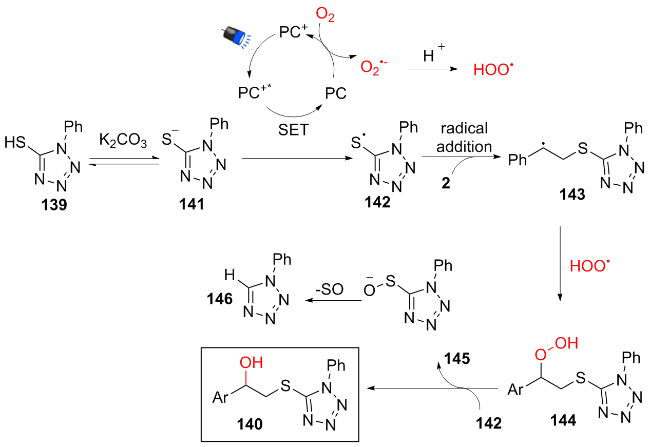
Park团队提出了一种可能的反应机理(Scheme 46). 首先, 硫醇139在碱的作用下发生去质子化反应生成硫醇负离子中间体141. 在蓝色LED灯的照射下光催化剂PC+转变为激发态PC+*, 随后通过单电子转移(SET)过程将硫醇负离子141氧化为硫自由基142. 硫自由基142以反马氏规则选择性通过自由基加成过渡态II-TS转化为苄基自由基143. 随后, 苄基自由基143与过氧自由基(•OOH)发生反应生成过氧化物中间体144. 144被硫醇负离子142还原反应得到目标产物140.

5 磷源试剂和氧气参与的烯烃氧化官能化反应
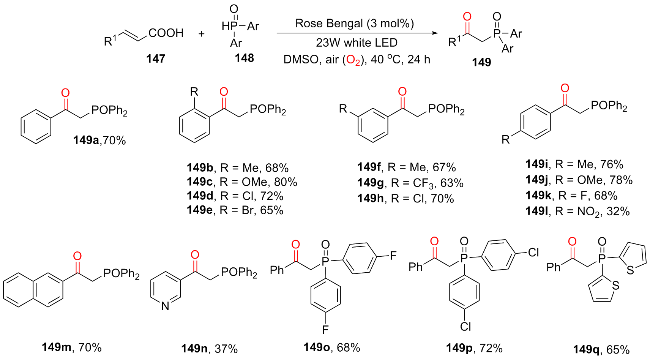
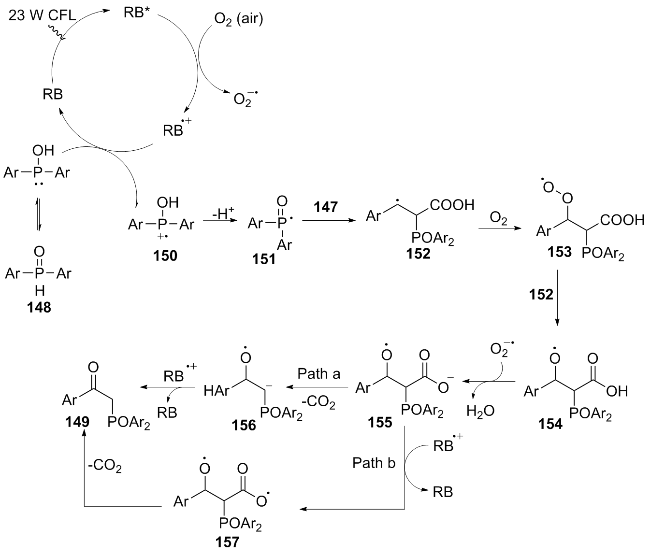
该团队提出了该反应的可能机理(Scheme 49). 在可见光照射条件下, 光催化剂罗丹明B(RB)被激发至其激发态(RB*), 随后与空气中的氧气发生单电子转移(SET)过程生成超氧阴离子自由基($\text{O}{{_{2}^{}}^{-\ \bullet }}$)和罗丹明B自由基阳离子(RB•+). 随后RB•+与二芳基氧膦148反应生成自由基阳离子中间体150和基态RB, 从而完成光氧化还原循环. 自由基阳离子中间体150发生去质子化反应生成关键的磷自由基中间体151, 随后151对肉桂酸147的α位进行自由基加成形成中间体自由基152. 接下来, 152与分子氧发生反应得到过氧自由基中间体153, 并进一步转化为烷氧自由基中间体154. 154与超氧阴离子自由基($\text{O}{{_{2}^{}}^{-\ \bullet }}$)反应生成中间体155, 随后155经历脱羧以及电子转移过程得到最终目标产物149(路径a). 此外, 中间体155还可以通过单电子转移(SET)与罗丹明B自由基阳离子(RB•+)发生作用生成中间体168, 随后中间体168发生脱羧反应得到目标产物149(路径b).

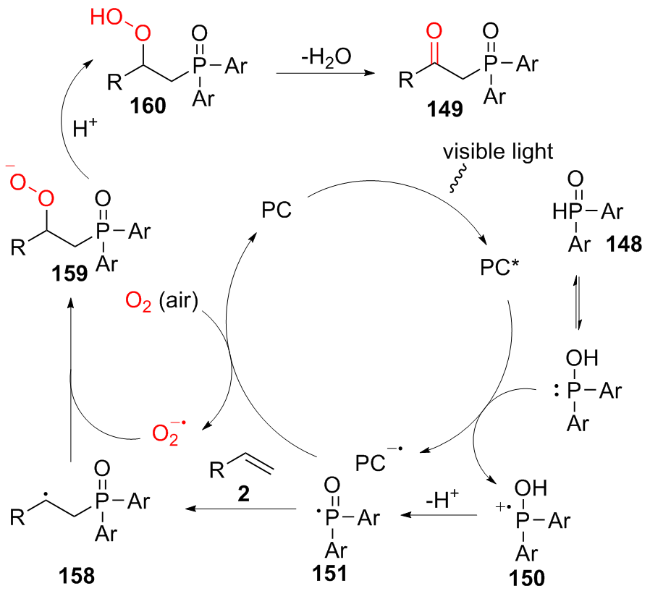
该反应的可能机理如Scheme 51所示: 光催化剂(PC)在可见光照射下被激发至激发态PC*. 随后, PC*与二芳基膦氧148发生还原猝灭反应生成自由基阳离子中间体150和还原态PC•. 接着, PC•被O2氧化生成超氧阴离子自由基$\text{O}{{_{2}^{}}^{-\ \bullet }}$, 并使光催化剂PC再生完成循环. 中间体150随后发生去质子化反应生成磷自由基151, 该自由基进攻烯烃2的碳碳双键生成碳自由基中间体158. 随后158与超氧阴离子自由基$\text{O}{{_{2}^{}}^{-\ \bullet }}$结合形成过氧阴离子中间体159, 其发生质子化反应得到过氧化物160. 最后, 160经还原脱水得到β-羰基氧膦149.
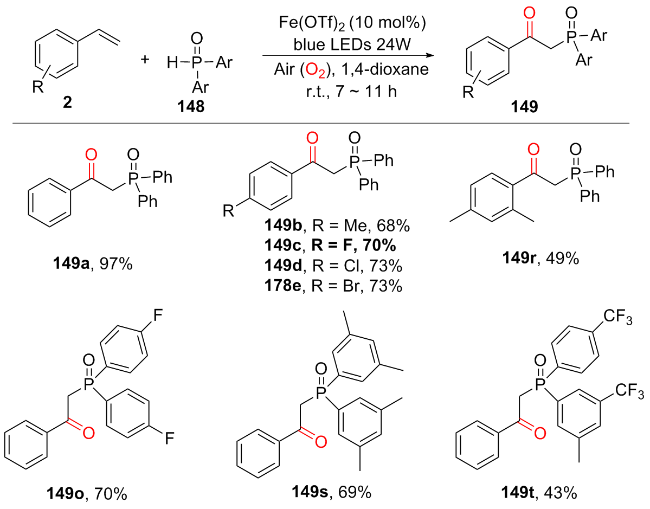
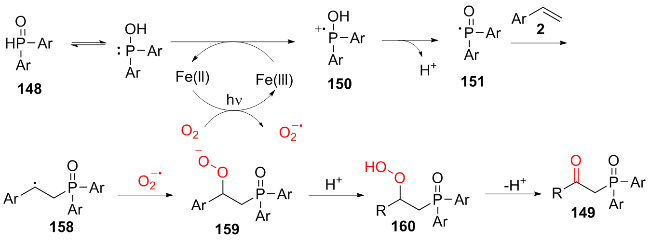
该团队提出一种Scheme 53所示的可能机理. 首先, 在可见光的照射及铁催化剂的存在下, 二芳基膦氧148被氧化为自由基阳离子中间体150. 中间体150随后发生去质子化反应生成磷自由基151, 该自由基选择性加成到烯烃2生成碳自由基中间体158. 接下来, 该自由基中间体被氧阴离子自由基$\text{O}{{_{2}^{}}^{-\ \bullet }}$捕获生成过氧阴离子中间体159, 其发生质子化反应得到过氧化物160. 最后, 160经还原脱水得到产物149.


6 总结和展望
综上所述, 近年来化学工作者已在可见光诱导烯烃与分子氧和其它试剂的氧化官能化反应构建含氧化合物领域做出了一系列出色的研究工作. 该类反应利用氧气作为氧化剂和氧源为含氧化合物的构建提供了一条温和绿色的合成路径. 通过对可见光诱导烯烃与分子氧和其它试剂的氧化官能化反应研究进展的进行总结, 我们发现其合成氧化产物种类多样, 且反应大都经历自由基反应历程. 尽管可见光诱导分子氧与烯烃氧化官能化反应已经有了很大进展, 可仍有一些挑战需要解决. 首先, 反应的底物适用范围仍需进一步扩大, 尤其是对于复杂底物和天然产物的官能化. 其次, 反应的选择性和效率仍有提升空间, 特别是在多官能团底物的反应中. 未来的研究方向可能包括以下几个方面: (1)新型光催化剂的设计, 开发具有更高光吸收效率和稳定性的光催化剂, 以提高反应的选择性和效率. (2)深入研究反应机理, 通过理论计算和实验技术进一步揭示反应中自由基中间体的寿命和活性以及反应的立体化学选择性; (3)绿色化学的应用, 探索更多以分子氧为唯一氧化剂的反应体系, 减少对环境的影响; (4)复杂分子的后期功能化, 利用可见光诱导反应实现复杂分子的后期官能化, 为药物研发和材料科学提供新的合成工具. 总之, 可见光诱导的烯烃氧化官能化反应具有广阔的应用前景. 随着研究的不断深入, 这一领域有望为有机合成化学带来更多的突破.
(Zhao, C.)