ARTICLES

Ir/f-Amphox-Catalyzed Asymmetric Hydrogenation of 1-(Pyridin-2-yl)ketones to Chiral Pyridyl Alcohols

  • Qishu Chen ,
  • Bo Yang ,
  • Qiwei Lang ,
  • Xiaobing Ding , * ,
  • Xiuxiu Li , * ,
  • Xumu Zhang , *
Expand
  • Shenzhen Key Laboratory of Small Molecule Drug Discovery and Synthesis, Shenzhen Grubbs Institute, Department of Chemistry, and Medi-X Pingshan, Southern University of Science and Technology, Shenzhen, Guangdong 518055

Academic Papers of the 27th Annual Meeting of the China Association for Science and Technology.

Received date: 2025-05-28

  Revised date: 2025-07-24

  Online published: 2025-08-27

Supported by

National Key Research and Development Program of China(2021YFA1500200)

Shenzhen Key Basic Research Project(JCYJ20241202125305008)

Abstract

Chiral pyridyl alcohols are a type of synthetically versatile building block for natural products, functional materials and bioactive molecules. Herein, a highly efficient Ir/f-amphox-catalyzed asymmetric hydrogenation of 1-(pyridin-2-yl)ketone derivatives to access chiral pyridyl alcohols was reported. The reaction proceeds smoothly under mild conditions, delivering excellent yields and enantioselectivities (up to >99% ee, turnover number (TON) up to 2000). A broad range of pyridyl alkyl and aryl ketones were successfully transformed, demonstrating the generality and synthetic utility of this methodology.

Cite this article

Qishu Chen , Bo Yang , Qiwei Lang , Xiaobing Ding , Xiuxiu Li , Xumu Zhang . Ir/f-Amphox-Catalyzed Asymmetric Hydrogenation of 1-(Pyridin-2-yl)ketones to Chiral Pyridyl Alcohols[J]. Chinese Journal of Organic Chemistry, 2025 , 45(9) : 3326 -3334 . DOI: 10.6023/cjoc202505032

1 Introduction

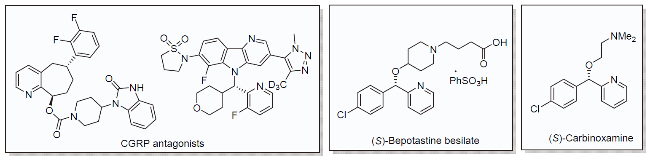
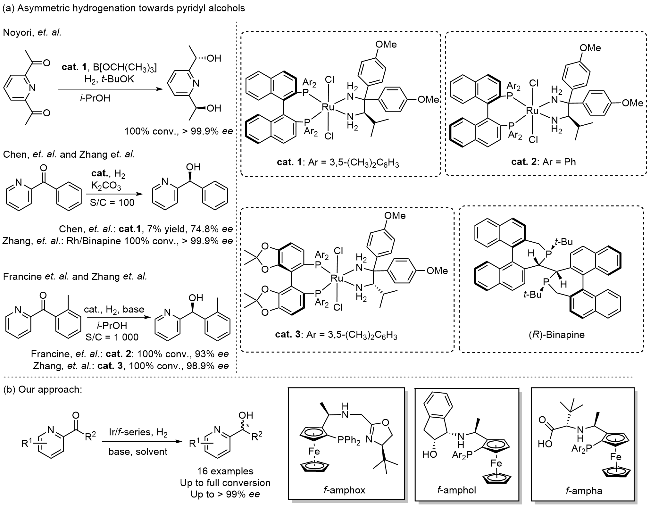
Chiral pyridyl alcohol is prevalent and synthetically important structural motifs that are widely found in natural products, pharmaceutical agents, and bioactive molecules(Scheme 1).[1] Step- and atom-efficient synthesis of chiral pyridyl alcohol has attracted significant attention due to their broad applicability as chiral intermediates.[2] Among the various methods developed for their preparation, including chiral induction,[3] enzymatic catalysis,[4] asymmetric hydrosilylation[5] and asymmetric transfer hydrogenation,[6] transition-metal-catalyzed asymmetric hydrogenation remains one of the most straightforward and atom-economical stra- tegies, enabling direct access to enantioenriched alcohols from prochiral ketones.[7] Despite notable progress, the asymmetric hydrogenation of pyridyl ketones, particularly 1-(pyridin-2-yl)ketones, remains challenging due to the strong coordination of the pyridyl nitrogen, which can lead to catalyst deactivation and diminishes reactivity or enantioselectivity. Several strategies have been developed to overcome these challenges(Scheme 2). Noyori et. al.[8] discovered that Ru/BINAP/diamine is capable of hydrogenating 1,1'- (pyridine-2,6-diyl)bis(ethan-1-one) to corresponding diol with assistance of B[OCH(CH3)3]. Subsequent efforts by Chen,[9] Francié[10] and Zhang[11,12] et. al. expanded the substrate scope and improved enantioselectivity, although in some cases, effective differentiation between pyridine and aryl groups remains a limitation.
Scheme 1 Selected bioactive molecules with pyridyl alcohol scaffold
Scheme 2 Asymmetric hydrogenation towards pyridyl alcohols and our approach
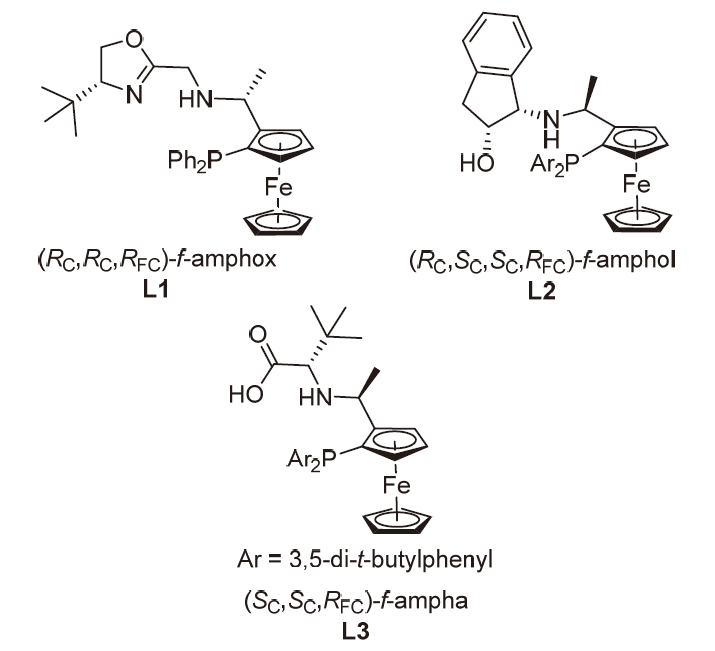
Diving in the area of asymmetric hydrogenation for decades, our group previously reported a series of tridentate ligands based on ferrocenyl scaffold including f-ampha,[15] f-amphox[16] and f-amphol.[17] These ligands were proved to be efficient in Ir-catalyzed hydrogenation of C=O bond, achieving successful reduction for challenging substrates. Therefore, we envisioned that these ligands could offer an efficient solution for the asymmetric hydrogenation of 1- (pyridin-2-yl)ketones. In particular, f-amphox, when combined with an Ir catalyst, has shown excellent activity and stereoselectivity in the reduction of challenging carbonyl compounds. Herein, we report a highly efficient Ir/f-am- phox-catalyzed asymmetric hydrogenation of 1-(pyridin-2- yl)ketones to access chiral pyridyl alcohols with high yields, excellent enantioselectivities (up to>99% ee), and turnover number (TON) up to 2000. This method features a broad substrate scope (16 examples enclosed) and demonstrates strong potential for practical synthesis.

2 Results and discussion

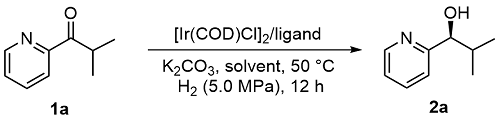
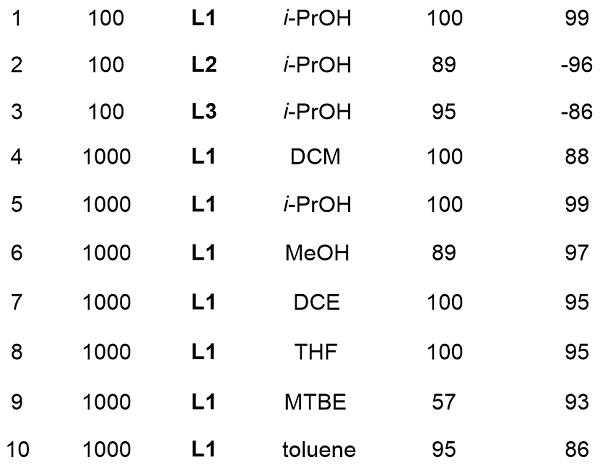
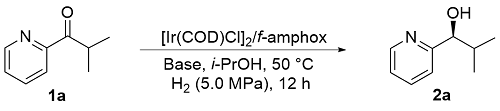
Based on the effective ferrocenyl scaffold developed by our group,[8-10] our study was initiated by evaluating three ligands (f-amphox, f-ampha, and f-amphol) at a substrate- to-catalyst (S/C) ratio of 100. Among them, f-amphox exhibited the best reaction outcome, with full conversion and 99% ee. Compared to f-amphox, f-ampha gave slightly lower enantioselectivity (96% ee) and much reduced reactivity (89% conversion). Although f-amphol gave an ideal conversion of 95%, it displayed a decreased enantioselectivity (86 % ee). Based on these results, f-amphox was identified as the optimal ligand, and the influence of solvent was further investigated under an increased S/C ratio of 1000. The transformation was proved to be most efficient in isopropanol with full conversion and 99% ee, while other solvents showed decreased reactivity or enantioselectivity. Details of optimization are displayed in Table 1.
Table 1 Effect of ligand and solventa

a Reaction condition: 1a (0.2 mmol), 1a/[Ir(COD)Cl]2/Ligand/K2CO3 (n/n/n/ n=1000/0.5/1.1/10), solvent (1 mL), H2 (5.0 MPa), 50 ℃, 12 h. Conversions were determined by GC. ee values were determined by chiral HPLC.

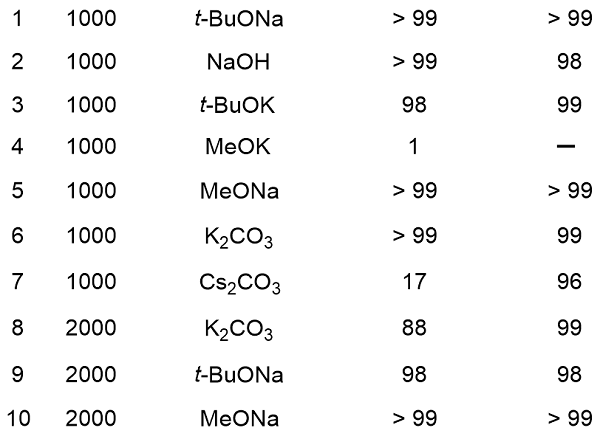
To further elevate reactivity of the catalyst, we went on to examine the effect of base in this catalytic system (Table 2). With MeONa as base, the S/C ratio was elevate to 2000 with full conversion and >99% ee. With the above-described optimization, the reaction condition was determined as 1a (0.2 mmol), 1a/[Ir(COD)Cl]2/f-amphox/MeONa (n/n/n/ n=1000/0.5/1.1/10), i-PrOH (1 mL), H2 (5.0 MPa), 50 ℃, 12 h.
Table 2 Effect of basea

a Reaction conditions: 1a (0.2 mmol), 1a/[Ir(COD)Cl]2/f-amphox/base (n/n/n/ n=1000/0.5/1.1/10), i-PrOH (1 mL), H2 (5.0 MPa), 50 ℃, 12 h. Conversions were determined by GC. ee values were determined by chiral HPLC.

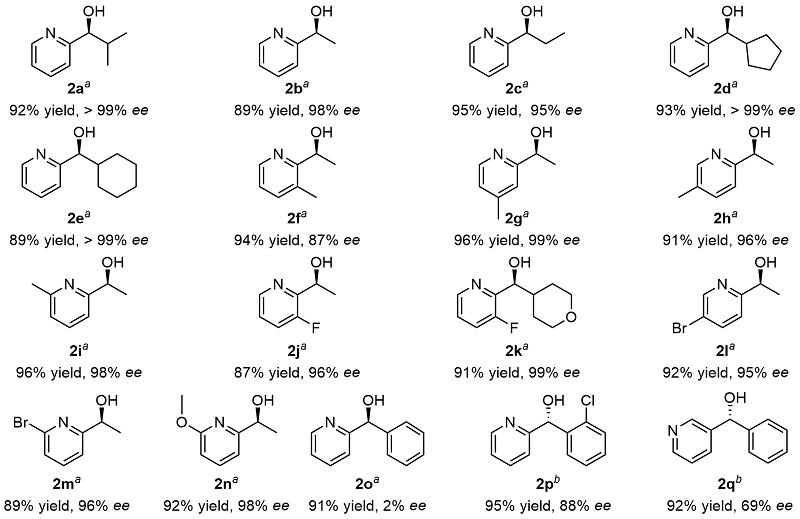
After settling the standard reaction condition, we went on to examine the synthetic versatility of the reaction under S/C ratio of 1000 (Table 3). The reaction is effective with a wide range of pyridyl alkyl ketones, including ketones bearing primary open-chain alkyl groups such as methyl and ethyl, secondary open-chain alkyl group such as isopropyl and secondary cycloalkyl groups including cyclopropyl and cyclohexyl group. Increasing the size of the alkyl group effectively elevates enantioselectivity, with primary substituents (2b and 2c) displaying up to 98% ee while secondary substituents (2a, 2d and 2e) all showing >99% ee. Substrates with substituents on the pyridine ring also reacted well to furnish corresponding products. and cyclohexyl group. Increasing the size of the alkyl reacted well to furnish corresponding products. Methyl substitution is tolerated at any position (2f~2i), and halide/methoxy substituted substrate also reacted well to give corresponding products in good selectivity (2k~2n).
Table 3 Substrate scope

Reaction conditions: a 1 (0.2 mmol), 1/[Ir(COD)Cl]2/(RC,RC,RFC)-f-amphox/MeONa (n/n/n/n=1000/0.5/1.1/10), i-PrOH (1 mL), H2 (5.0 MPa), 50 ℃, 12 h. Conversions were determined by GC. ee values were determined by chiral HPLC. b 1 (0.2 mmol), 1/[Ir(COD)Cl]2/(RC,SC,RFC)-f-amphox/MeONa (n/n/n/n=1000/0.5/1.1/10), i-PrOH (1 mL), H2 (5.0 MPa), 50 ℃, 12 h. Conversions were determined by GC. ee values were determined by chiral HPLC.

Phenyl pyridyl ketone also reacted well to yield corresponding product, despite with no enantioselectivity. However, introducing a chloride substitution at ortho position lead to effective differentiation between pyridyl group and aryl group, yielding 2p in 88% ee. Phenyl(pyridin-3-yl)methanone also reacted well under standard conditions to furnish 2q in 92% yield and 69% ee. Detailed substrate scope is listed in Table 3.

3 Conclusion

In conclusion, we herein describe the application of Ir/f-amphox as catalyst in asymmetric hydrogenation of 1-(pyridin-2-yl)ketones towards pyridinyl alcohol. Despite the potential challenge of catalyst deactivation due to pyridyl coordination, the reaction was able to be carried out at S/C ratios up to 2000. Under optimized conditions (S/C=1000), a wide range of 1-(pyridin-2-yl)ketone derivatives, including both alkyl and aryl pyridyl ketones, were successfully converted to the corresponding alcohols in high yields with excellent enantioselectivities. These results highlight the robustness and synthetic utility of this catalytic system.

4 Experimental

4.1 General information

Unless otherwise mentioned, all reactions were carried out with degassed and anhydrous solvents. Solvent was purified according to Purification of Laboratory Chemicals (Peerrin, D. D.; Armarego, W. L.; Perrins, D. R., Pergamon Press, Oxford, 1980) or bought from commercial sources. Reactions were monitored by thin layer chromatography (TLC) on plates (GF254) supplied by Yantai Chemicals (China) using UV light as the visualizing agent. Chiral HPLC analysis was performed using Daicel chiral columns on an Agilent 1260 Series HPLC instrument. If not specially mentioned, flash column chromatography was performed using E. Merck silica gel (60, particle size 0.040~0.063 mm). NMR spectra were acquired on a Bruker 400 MHz NMR spectrometer (ARX400) and a Bruker 600 MHz NMR spectrometer. High resolution mass spectra (HRMS) were recorded on a Bruker Apex IV FTMS mass spectrometer using ESI (electrospray ionization) as ionization method. Optical rotations were recorded on an AUTOPOL II digital polarimeter at 589 nm and were recorded as [α]D T (concentration in g/100 mL solvent).

4.2 General procedures and compound characterization

4.2.1 Synthesis of substrates

General Procedure A: To a previously dried three-necked round bottom flask were charged Mg (1.05 equiv.) and tetrahydrofuran (THF) under Ar atmosphere, and the flask was then placed at below 0 ℃. Corresponding alkyl/aryl bromide (1.05 equiv.) was added to the flask dropwise and was stirred until complete consumption of Mg. 2-CN pyridine (1.00 equiv.) was then added to the reaction system dropwise, and the flask was then moved to room temperature. The reaction was monitored with TLC and quenched with saturated NH4Cl upon complete consumption of 2-CN pyridine, extracted with EA (ethyl acetate)×3 and dried over anhydrous MgSO4. The crude mixture was purified by flash column chromatography with PE/EA as eluent.
General Procedure B: To a previously dried three-necked round bottom flask were charged Mg (1.05 equiv.) and THF under Ar atmosphere, and the flask was then placed at below 0 ℃. Corresponding alkyl/aryl bromide (1.05 equiv.) was added to the flask dropwise and was stirred until complete consumption of Mg. Picolinaldehyde (1.00 equiv.) was then added to the reaction system dropwise, and the flask was then moved to room temperature. The reaction was monitored with TLC and quenched with saturated NH4Cl upon complete consumption of picolinaldehyde, extracted with EA×3 and dried over MgSO4. The crude mixture was transformed into a round-bottom flask, dissolved with DCM, and Dess-Martin oxidant was then added to the flask. The reaction was monitored with TLC and quenched with saturated Na2S2O3/NaHCO3 solution, extracted with DCM×3 and dried over anhydrous MgSO4. The crude mixture was purified by flash column chromatography with PE/EA (petroleum ether/ethyl acetate) as eluent.

4.2.2 Characterization of substrates

1-(Pyridin-2-yl)propan-1-one (1a):[17] Synthesized according to General Procedure B in 51% yield. Light yellow liquid. 1H NMR (400 MHz, Chloroform-d) δ: 8.69 (ddd, J=4.8, 1.8, 0.9 Hz, 1H), 8.06 (dt, J=7.9, 1.1 Hz, 1H), 7.85 (td, J=7.7, 1.8 Hz, 1H), 7.48 (ddd, J=7.6, 4.8, 1.3 Hz, 1H), 3.26 (q, J=7.3 Hz, 2H), 1.24 (t, J=7.3 Hz, 4H); 13C NMR (101 MHz, Chloroform-d) δ: 202.6, 153.4, 148.9, 136.8, 127.0, 121.7, 31.1, 7.9.
2-Methyl-1-(pyridin-2-yl)propan-1-one (1b):[17] Synthesized according to General Procedure A in 72% yield. Colorless liquid. 1H NMR (400 MHz, Chloroform-d) δ: 8.70 (ddd, J=4.8, 1.7, 0.9 Hz, 1H), 8.06 (dt, J=7.8, 1.1 Hz, 1H), 7.85 (td, J=7.7, 1.8 Hz, 1H), 7.47 (ddd, J=7.6, 4.8, 1.3 Hz, 1H), 4.13 (hept, J=6.9 Hz, 1H), 1.24 (s, 3H), 1.22 (s, 3H); 13C NMR (101 MHz, Chloroform-d) δ: 205.7, 152.9, 148.8, 136.9, 126.8, 122.4, 53.4, 34.2, 18.6.
1-(Pyridin-2-yl)ethan-1-one (1c):[18] Synthesized according to General Procedure B in 56% yield. Colorless solid. 1H NMR (400 MHz, Chloroform-d) δ: 8.69 (ddd, J=4.8, 1.8, 0.9 Hz, 1H), 8.05 (dt, J=7.9, 1.1 Hz, 1H), 7.84 (td, J=7.7, 1.7 Hz, 1H), 7.48 (ddd, J=7.6, 4.8, 1.3 Hz, 1H), 2.74 (s, 3H); 13C NMR (101 MHz, Chloroform-d) δ: 200.1, 153.6, 149.0, 136.8, 127.1, 121.6, 25.8.
Cyclopentyl(pyridin-2-yl)methanone (1d):[17] Synthesized according to General Procedure A in 61% yield. Light yellow liquid. 1H NMR (400 MHz, Chloroform-d) δ: 8.70 (ddd, J=4.8, 1.7, 0.9 Hz, 1H), 8.07 (dt, J=7.9, 1.1 Hz, 1H), 7.84 (td, J=7.7, 1.8 Hz, 1H), 7.46 (ddd, J=7.6, 4.7, 1.3 Hz, 1H), 4.41~4.08 (m, 1H), 1.99 (dddd, J=11.5, 8.5, 5.6, 1.5 Hz, 2H), 1.88~1.64 (m, 6H); 13C NMR (101 MHz, Chloroform-d) δ: 204.3, 153.5, 148.9, 136.8, 126.7, 122.3, 53.4, 45.2, 29.7, 29.7, 26.3.
Cyclohexyl(pyridin-2-yl)methanone (1e):[17] Synthesized according to General Procedure A in 69% yield. Light yellow liquid. 1H NMR (400 MHz, Chloroform-d) δ: 8.69 (ddd, J=4.7, 1.8, 0.9 Hz, 1H), 8.03 (dt, J=7.8, 1.1 Hz, 1H), 7.83 (td, J=7.7, 1.8 Hz, 1H), 7.46 (ddd, J=7.6, 4.8, 1.3 Hz, 1H), 3.95~3.78 (m, 1H), 1.97~1.70 (m, 6H), 1.52~1.37 (m, 4H); 13C NMR (101 MHz, Chloroform-d) δ: 205.0, 153.0, 148.8, 136.9, 126.8, 122.4, 43.9, 28.85, 28.82, 26.07, 26.02, 25.7.
1-(3-Methylpyridin-2-yl)ethan-1-one (1f):[18] Synthesized according to General Procedure A in 49% yield. Light yellow liquid. 1H NMR (500 MHz, Chloroform-d) δ: 8.55~8.49 (m, 1H), 7.58 (ddd, J=7.8, 1.7, 0.8 Hz, 1H), 7.33 (dd, J=7.8, 4.6 Hz, 1H), 2.71 (s, 3H), 2.58 (s, 3H); 13C NMR (126 MHz, Chloroform-d) δ: 202.4, 151.9, 146.1, 140.0, 134.4, 126.0, 28.2, 20.4.
1-(4-Methylpyridin-2-yl)ethan-1-one (1g):[17] Synthesized according to General Procedure A in 63% yield. White solid. 1H NMR (400 MHz, Chloroform-d) δ: 8.54 (dd, J=5.0, 0.8 Hz, 1H), 7.89~7.84 (m, 1H), 7.33~7.24 (m, 1H), 2.72 (s, 3H), 2.42 (d, J=0.7 Hz, 3H). 13C NMR (101 MHz, Chloroform-d) δ: 200.4, 153.4, 148.8, 148.2, 127.9, 122.5, 25.9, 21.0.
1-(5-Methylpyridin-2-yl)ethan-1-one (1h):[20] Synthesized according to General Procedure A in 65% yield. Light yellow liquid. 1H NMR (400 MHz, Chloroform-d) δ: 8.49 (dt, J=2.3, 0.8 Hz, 1H), 7.95 (d, J=8.0 Hz, 1H), 7.62 (ddd, J=8.0, 2.2, 0.8 Hz, 1H), 2.70 (s, 3H), 2.41 (s, 3H); 13C NMR (101 MHz, Chloroform-d) δ: 199.9, 151.4, 149.4, 137.5, 137.1, 121.3, 25.7, 18.6.
1-(6-Methylpyridin-2-yl)ethan-1-one (1i):[17] Synthesized according to General Procedure A in 64% yield. White solid. 1H NMR (400 MHz, Chloroform-d) δ: 7.84 (d, J=7.7 Hz, 1H), 7.70 (t, J=7.7 Hz, 1H), 7.31 (dd, J=7.5, 1.0 Hz, 1H), 2.72 (s, 3H), 2.62 (s, 3H); 13C NMR (101 MHz, Chloroform-d) δ: 200.6, 158.0, 153.1, 136.8, 126.6, 118.6, 25.7, 24.4.
1-(3-Fluoropyridin-2-yl)ethan-1-one (1j):[18] Synthesized according to General Procedure A in 60% yield. White solid. 1H NMR (400 MHz, Chloroform-d) δ: 8.52 (dt, J=3.9, 1.6 Hz, 1H), 7.60~7.51 (m, 1H), 7.50~7.46 (m, 1H), 2.73 (d, J=1.1 Hz, 3H); 13C NMR (101 MHz, Chloroform-d) δ: 197.7, 157.1, 144.7, 142.0, 128.5, 125.6, 28.0.
(3-Fluoropyridin-2-yl)(tetrahydro-2H-pyran-4-yl)meth-anone (1k):[21] White solid. 1H NMR (400 MHz, Chloroform-d) δ: 8.52 (dt, J=3.9, 1.6 Hz, 1H), 7.60~7.51 (m, 1H), 7.48~7.45 (m, 1H), 3.95~3.78 (m, 4H), 2.15~1.80 (m, 5H); 13C NMR (101 MHz, Chloroform-d) δ: 197.9, 157.6, 151.2, 144.7, 128.7, 125.9, 69.89, 69.81,.47.5, 26.7, 26.6.[1]
1-(5-Bromopyridin-2-yl)ethan-1-one (1l):[17] Synthesized according to General Procedure A in 56% yield. White solid. 1H NMR (400 MHz, Chloroform-d) δ: 8.74 (d, J=2.1 Hz, 1H), 8.04~7.83 (m, 2H), 2.71 (s, 3H); 13C NMR (101 MHz, Chloroform-d) δ: 199.1, 151.8, 150.1, 139.5, 125.3, 122.9, 25.7.
1-(6-Bromopyridin-2-yl)ethan-1-one (1m):[20] Synthesized according to General Procedure A in 63% yield. White solid. 1H NMR (500 MHz, Chloroform-d) δ: 8.01 (dd, J=7.3, 1.3 Hz, 1H), 7.78~7.62 (m, 2H), 2.73 (s, 3H); 13C NMR (126 MHz, Chloroform-d) δ: 198.66, 154.29, 141.37, 139.17, 131.81, 120.50, 25.78.
1-(6-Methoxypyridin-2-yl)ethan-1-one (1n):[20] Synthesized according to General Procedure B in 63% yield. Light yellow solid. 1H NMR (400 MHz, Chloroform-d) δ: 7.70 (dd, J=8.1, 7.3 Hz, 1H), 7.63 (dd, J=7.3, 1.0 Hz, 1H), 6.93 (dd, J=8.1, 1.0 Hz, 1H), 4.00 (s, 3H), 2.68 (s, 3H); 13C NMR (101 MHz, Chloroform-d) δ: 199.9, 163.3, 151.0, 139.0, 115.1, 114.7, 53.4, 25.7.
Phenyl(pyridin-2-yl)methanone (1o):[17] Synthesized according to General Procedure A in 72% yield. White solid. 1H NMR (400 MHz, Chloroform-d) δ: 8.50 (ddd, J=4.8, 1.8, 0.9 Hz, 1H), 8.13~8.02 (m, 2H), 7.85~7.69 (m, 1H), 7.69~7.66 (m, 2H), 7.59~7.47 (m, 3H); 13C NMR (101 MHz, Chloroform-d) δ: 201.0, 155.8, 149.0, 137.4, 135.2, 132.2, 131.5, 129.68, 129.65, 127.1, 125.8, 125.3.
(2-Chlorophenyl)(pyridin-2-yl)methanone (1p):[22] Synthesized according to General Procedure A in 72% yield. White solid. 1H NMR (400 MHz, Chloroform-d) δ: 8.68 (ddd, J=4.7, 1.7, 0.9 Hz, 1H), 8.14 (dt, J=7.9, 1.1 Hz, 1H), 7.92~7.88 (m, 1H), 7.55~7.35 (m, 5H); 13C NMR (101 MHz, Chloroform-d) δ: 195.3, 153.8, 149.3, 138.2, 137.0, 131.9, 131.5, 129.97, 129.95, 127.0, 126.6, 123.7.

4.2.3 Asymmetric hydrogenation

General procedure C: In a glovebox under Ar atmosphere, to a 10 mL vial were added [Ir(COD)Cl]2, corresponding ligand and 1 mL of solvent. The mixture was stirred at room temperature for about 1 h until all solids were completely dissolved.
To another 5 mL vial were placed in substrate and base, and the premixed Ir-ligand complex solution were transferred to the vial. The vial was then placed in an autoclave and taken out of the glovebox. The autoclave was tightened, inner atmosphere exchanged with H2×3, and H2 was carefully introduced to the autoclave under required pressure. The autoclave was then stirred in corresponding temperature for 12 h. Upon completion of stirring, the autoclave was cooled to room temperature. H2 was then released from the autoclave, and the autoclave was opened. The reaction was filtered with a plug with EA as eluent, and the solvent was removed under reduced pressure to yield corresponding pyridyl alcohol product.

4.2.4 Characterization of products

(S)-2-Methyl-1-(pyridin-2-yl)propan-1-ol (2a):[19] White solid, 99% ee, 92% yield.$ [\alpha]_{\mathrm{D}}^{25}$-21.60 (c=0.5 g/100 mL, CH3OH). 1H NMR (400 MHz, Chloroform-d) δ: 8.57 (d, J=4.9 Hz, 1H), 7.70 (td, J=7.7, 1.8 Hz, 1H), 7.28~7.18 (m, 2H), 4.88 (q, J=6.8 Hz, 1H), 2.10~2.01 (m, 1H), 1.04 (d, J=6.8 Hz, 3H), 0.81 (d, J=6.8 Hz, 3H); 13C NMR (101 MHz, Chloroform-d) δ: 161.1, 148.5, 136.5, 122.1, 120.0, 81.5, 35.8, 18.22, 18.20. HRMS (ESI) calcd for C9H14NO [M+H] 152.1070, found 152.1072. The enantiomeric analysis was determined by chiral HPLC on Chiralpak AD-3 column. Conditions: V(hexane)/V(isopropanol) (with 0.1 mol% ethylenediamine)=99/1, flow rate=1.0 mL/min, UV detection at λ=260 nm, t=15.6 min (minor), 16.6 min (major).
(S)-1-(Pyridin-2-yl)ethan-1-ol (2b):[20] White solid, 98% ee, 89% yield. 1H NMR (400 MHz, Chloroform-d) δ: 8.53 (dt, J=4.8, 1.4 Hz, 1H), 7.68 (td, J=7.7, 1.7 Hz, 1H), 7.27 (d, J=7.8 Hz, 1H), 7.19 (ddd, J=7.5, 4.8, 1.2 Hz, 1H), 4.69 (dd, J=7.2, 4.7 Hz, 1H), 1.94~1.80 (m, 1H), 1.73 (dp, J=14.5, 7.3 Hz, 1H), 0.94 (t, J=7.4 Hz, 3H); 13C NMR (101 MHz, Chloroform-d) δ: 162.1, 148.1, 136.6, 122.2, 120.4, 73.8, 31.2, 9.4. HRMS (ESI) calcd for C7H10NO [M+H] 124.0757, found 124.0752. The enantiomeric analysis was determined by chiral HPLC on Chiralpak OD-3 column. Conditions: V(hexane)/V(isopropanol) (with 0.1 mol% eth- ylenediamine)=95/5, flow rate=1.0 mL/min, UV detection at λ=260 nm, t=7.3 min (minor), 7.8 min (major).
(S)-1-(Pyridin-2-yl)propan-1-ol (2c):[12] White solid, 95% ee, 95% yield. 1H NMR (400 MHz, Chloroform-d) δ: 8.53 (dt, J=4.8, 1.4 Hz, 1H), 7.68 (td, J=7.7, 1.7 Hz, 1H), 7.27 (d, J=7.8 Hz, 1H), 7.19 (ddd, J=7.5, 4.8, 1.2 Hz, 1H), 4.69 (dd, J=7.2, 4.7 Hz, 1H), 1.94~1.80 (m, 1H), 1.73 (dp, J=14.5, 7.3 Hz, 1H), 0.94 (t, J=7.4 Hz, 3H); 13C NMR (101 MHz, Chloroform-d) δ: 162.1, 148.1, 136.6, 122.2, 120.4, 73.8, 31.2, 9.4. HRMS (ESI) calcd for C8H12NO [M+H] 138.0913, found 138.0911. The enantiomeric analysis was determined by chiral HPLC on Chiralpak OD-3 column. Conditions: V(hexane)/V(isopropanol) (with 0.1 mol% ethylenediamine)=95/5, flow rate=1.0 mL/min, UV detection at λ=260 nm, t=7.4 min (minor), 8.0 min (major).
(S)-Cyclopentyl(pyridin-2-yl)methanol (2d):[20] White solid, >99% ee, 93% yield. 1H NMR (400 MHz, Chloroform-d) δ: 8.55 (ddd, J=4.9, 1.8, 1.0 Hz, 1H), 7.68 (td, J=7.7, 1.8 Hz, 1H), 7.26 (dt, J=8.0, 1.2 Hz, 1H), 7.20 (ddd, J=7.4, 4.9, 1.2 Hz, 1H), 4.64 (d, J=6.0 Hz, 1H), 1.67~1.48 (m, 7H), 1.31~1.24 (m, 2H); 13C NMR (101 MHz, Chloroform-d) δ: 162.0, 148.1, 136.4, 122.2, 120.9, 75.8, 47.2, 29.2, 27.2, 25.7, 25.5. HRMS (ESI) calcd for C11H6- NO [M+H] 178.1226, found 178.1223. The enantiomeric analysis was determined by chiral HPLC on Chiralpak AS-3 column. Conditions: V(hexane)/V(isopropanol) (with 0.1 mol% ethylenediamine)=95/5, flow rate=1.0 mL/min, UV detection at λ=260 nm, t=6.9 min (minor), 7.2 min (major).
(S)-Cyclohexyl(pyridin-2-yl)methanol (2e):[17] White solid, >99% ee, 89% yield. 1H NMR (400 MHz, Chloroform-d) δ: 8.54 (dt, J=4.9, 1.4 Hz, 1H), 7.67 (td, J=7.6, 1.8 Hz, 1H), 7.27~7.13 (m, 2H), 4.52 (d, J=4.7 Hz, 1H), 1.83~1.54 (m, 5H), 1.36~0.99 (m, 6H); 13C NMR (101 MHz, Chloroform-d) δ: 161.2, 148.0, 136.3, 122.1, 121.1, 77.2, 45.1, 29.7, 26.7, 26.4, 26.3, 26.1. HRMS (ESI) calcd for C12H18NO [M+H] 192.1383, found 192.1382. The enantiomeric analysis was determined by chiral HPLC on Chiralpak AS-3 column. Conditions: V(hexane)/V(isopro- panol) (with 0.1 mol% ethylenediamine)=95/5, flow rate=1.0 mL/min, UV detection at λ=260 nm, t=6.5 min (minor), 7.5 min (major).
(S)-1-(3-Methylpyridin-2-yl)ethan-1-ol (2f):[20] White solid, 87% ee, 94% yield. 1H NMR (400 MHz, Chloroform-d) δ: 8.40 (dd, J=4.9, 1.6 Hz, 1H), 7.47 (ddd, J=7.5, 1.7, 0.9 Hz, 1H), 7.15 (dd, J=7.6, 4.7 Hz, 1H), 5.01~4.96 (m, 1H), 2.32 (s, 3H), 1.41 (d, J=6.3 Hz, 3H); 13C NMR (101 MHz, Chloroform-d) δ: 160.6, 145.5, 138.3, 128.9, 122.2, 69.4, 23.6, 17.5. HRMS (ESI) calcd for C8H12NO [M+H] 138.0913, found 138.0911. The enantiomeric analysis was determined by chiral HPLC on Chiralpak OD-3 column. Conditions: V(hexane)/V(isopropanol) (with 0.1 mol% ethylenediamine)=95/5, flow rate=1.0 mL/min, UV detection at λ=260 nm, t=5.8 min (minor), 6.1 min (major).
(S)-1-(4-Methylpyridin-2-yl)ethan-1-ol (2g):[20] White solid, 99% ee, 96% yield. 1H NMR (400 MHz, Chloroform-d) δ: 8.37~8.29 (m, 1H), 7.11 (d, J=1.6 Hz, 1H), 7.02~6.83 (m, 1H), 4.83 (q, J=6.5 Hz, 1H), 2.34 (s, 3H), 1.49~1.45 (m, 3H); 13C NMR (101 MHz, Chloroform-d) δ: 163.1, 148.0, 147.7, 123.2, 120.5, 68.9, 24.2, 21.1. HRMS (ESI) calcd for C8H12NO [M+H] 138.0913, found 138.0910. The enantiomeric analysis was determined by chiral HPLC on Chiralpak OD-3 column. Conditions: V(he- xane)/V(isopropanol) (with 0.1 mol% ethylenediamine)=95/5, flow rate=1.0 mL/min, UV detection at λ=260 nm, t=6.9 min (minor), 7.4 min (major).
(S)-1-(5-Methylpyridin-2-yl)ethan-1-ol (2h):[20] White solid, 96% ee, 91% yield. 1H NMR (400 MHz, Chloroform-d) δ: 8.39~8.25 (m, 1H), 7.50 (ddd, J=7.9, 2.2, 0.8 Hz, 1H), 7.19 (d, J=8.0 Hz, 1H), 4.86 (q, J=6.5 Hz, 1H), 2.33 (s, 3H), 1.49 (d, J=6.5 Hz, 3H); 13C NMR (101 MHz, Chloroform-d) δ: 160.2, 148.3, 137.4, 131.6, 119.2, 68.7, 24.2, 18.0. HRMS (ESI) calcd for C8H12NO [M+H] 138.0913, found 138.0914. The enantiomeric analysis was determined by chiral HPLC on Chiralpak OD-3 column. Conditions: V(hexane)/V(isopropanol) (with 0.1 mol% eth- ylenediamine)=95/5, flow rate=1.0 mL/min, UV detection at λ=260 nm, t=8.2 min (minor), 8.8 min (major).
(S)-1-(6-Methylpyridin-2-yl)ethan-1-ol (2i):[17] White solid, 98% ee, 96% yield. 1H NMR (400 MHz, Chloroform-d) δ: 7.56 (t, J=7.7 Hz, 1H), 7.05 (dd, J=12.8, 7.7 Hz, 2H), 4.84 (q, J=6.5 Hz, 1H), 2.54 (s, 3H), 1.48 (d, J=6.5 Hz, 3H); 13C NMR (101 MHz, Chloroform-d) δ: 162.2, 156.8, 137.0, 121.6, 116.6, 68.5, 24.27, 24.25. HRMS (ESI) calcd for C8H12NO [M+H] 138.0913, found 138.0912. The enantiomeric analysis was determined by chiral HPLC on Chiralpak OD-3 column. Conditions: V(hexane)/ V(isopropanol) (with 0.1 mol% ethylenediamine)=95/5, flow rate=1.0 mL/min, UV detection at λ=260 nm, t=5.8 min (minor), 6.3 min (major).
(S)-1-(3-Fluoropyridin-2-yl)ethan-1-ol (2j):[19] White solid, 96% ee, 87% yield. 1H NMR (400 MHz, Chloroform- d) δ: 8.39 (dt, J=4.8, 1.5 Hz, 1H), 7.41 (ddd, J=9.6, 8.2, 1.3 Hz, 1H), 7.30~7.25 (m, 1H), 5.13 (d, J=7.6 Hz, 1H), 4.44 (d, J=6.7 Hz, 1H), 1.51 (dd, J=6.5, 1.0 Hz, 3H); 13C NMR (101 MHz, Chloroform-d) δ: 154.8, 151.0, 143.8, 123.6, 123.3, 64.4, 23.4. HRMS (ESI) calcd for C7H9FNO [M+H] 142.0663, found 142.0662. The enantiomeric analysis was determined by chiral HPLC on Chiralpak OJ-H column. Conditions: V(hexane)/V(isopropanol)(with 0.1 mol% ethylenediamine)=99/1, flow rate=1.0 mL/min, UV detection at λ=260 nm, t=11.2 min (minor), 12.2 min (major).
(S)-(3-Fluoropyridin-2-yl)(tetrahydro-2H-pyran-4-yl)-methanol (2k):[21] White solid, 99% ee, 91% yield. 1H NMR (400 MHz, Chloroform-d) δ: 8.48~8.45 (m, 2H), 7.48~7.46 (m, 1H), 4.89 (d, J=6.4 Hz, 1H), 4.09~3.98 (m, 2H), 3.39~3.35 (m, 2H), 2.49 (br, 1H), 1.88~1.76 (m, 1H), 1.74~1.69 (m, 1H), 1.56~1.48 (m, 2H), 1.38~1.25 (m, 1H); 13C NMR (101 MHz, Chloroform-d) δ: 158.6, 151.0, 144.3, 123.8, 123.4, 68.3, 66.77, 66.75, 39.8, 23.5, 23.4. HRMS (ESI) calcd for C11H15FNO2 [M+H] 212.1081, found 212.1087. The enantiomeric analysis was determined by chiral HPLC on Chiralpak OD-3 column. Conditions: V(hexane)/V(isopropanol) (with 0.1 mol% ethylenediamine)=95/5, flow rate=1.0 mL/min, UV detection at λ=260 nm, t=8.0 min (minor), 8.4 min (major).
(S)-1-(5-Bromopyridin-2-yl)ethan-1-ol (2l):[20] White solid, 95% ee, 92% yield. 1H NMR (400 MHz, Chloroform-d) δ: 8.60 (d, J=2.3 Hz, 1H), 7.82 (dd, J=8.3, 2.3 Hz, 1H), 7.24 (d, J=8.3 Hz, 1H), 5.31 (s, 1H), 4.88 (q, J=6.6 Hz, 1H), 1.50 (d, J=6.6 Hz, 3H). HRMS (ESI) calcd for C7H9BrNO [M+H] 201.9862, found 202.9867. The enantiomeric analysis was determined by chiral HPLC on Chiralpak IH-3 column. Conditions: V(hexane)/V(isopro- panol) (with 0.1 mol% ethylenediamine)=95/5, flow rate=1.0 mL/min, UV detection at λ=260 nm, t=6.7 min (minor), 7.2 min (major).
(S)-1-(6-Bromopyridin-2-yl)ethan-1-ol (2m):[20] White solid, 96% ee, 89% yield. 1H NMR (500 MHz, Chloroform-d) δ: 7.55 (t, J=7.7 Hz, 1H), 7.39 (d, J=7.7 Hz, 1H), 7.30 (d, J=7.6 Hz, 1H), 4.88 (q, J=6.6 Hz, 1H), 1.51 (d, J=6.6 Hz, 3H). 13C NMR (126 MHz, Chloroform-d) δ: 165.2, 141.1, 139.1, 126.5, 118.5, 69.1, 24.0. HRMS (ESI) calcd for C7H9BrNO [M+H] 201.9862, found 201.9865. The enantiomeric analysis was determined by chiral HPLC on Chiralpak IBN-3 column. Conditions: V(hexane)/V(iso- propanol) (with 0.1 mol% ethylenediamine)=95/5, flow rate=1.0 mL/min, UV detection at λ=260 nm, t=10.8 min (minor), 11.5 min (major).
(S)-1-(6-Methoxypyridin-2-yl)ethan-1-ol (2n):[20] White solid, 98% ee, 92% yield. 1H NMR (500 MHz, Chloroform-d) δ: 7.57 (dd, J=8.2, 7.3 Hz, 1H), 6.85~6.79 (m, 1H), 6.66~6.62 (m, 1H), 4.82~4.78 (m, 1H), 4.06 (s, 1H), 3.96 (s, 3H), 1.49 (d, J=6.5 Hz, 3H); 13C NMR (126 MHz, Chloroform-d) δ: 163.30, 160.84, 139.44, 112.05, 108.99, 68.53, 53.35, 24.11. HRMS (ESI) calcd for C8H12- NO2 [M+H] 154.0863, found 154.0860. The enantiomeric analysis was determined by chiral HPLC on Chiralpak OD-3 column. Conditions: V(hexane)/V(isopro- panol) (with 0.1 mol% ethylenediamine)=95/5, flow rate=1.0 mL/min, UV detection at λ=260 nm, t=5.6 min (minor), 5.9 min (major).
Phenyl(pyridin-2-yl)methanol (2o):[14] White solid, 2% ee, 91% yield. 1H NMR (500 MHz, Chloroform-d) δ: 8.69 (d, J=4.8 Hz, 1H), 7.68 (td, J=7.6 Hz, 1.6 Hz, 1H), 7.49~7.36 (m, 4H), 7.38~7.31 (m, 1H), 7.25~7.20 (m, 2H), 5.80 (s, 1H), 5.39 (s, 1H). 13C NMR (126 MHz, Chloroform-d) δ: 170.1, 147.8, 143.2, 137.5, 128.6, 127.8, 127.6, 122.4, 121.4. HRMS (ESI) calcd for C12H12NO [M+H] 186.0913, found 186.0911. The enantiomeric analysis was determined by chiral HPLC on Chiralpak AD-3 column. Conditions: V(hexane)/V(isopropanol) (with 0.1 mol% ethylenediamine)=85/15, flow rate=1.0 mL/min, UV detection at λ=260 nm, t=7.4 min, 9.0 min.
(R)-(2-Chlorophenyl)(pyridin-2-yl)methanol (2p):[22] White solid, 88% ee, 95% yield. 1H NMR (500 MHz, Chloroform-d) δ: 8.69 (d, J=4.8 Hz, 1H), 7.68 (td, J=7.6 Hz, 1.6 Hz, 1H), 7.60~7.49 (m, 2H), 7.35~7.28 (m, 4H), 6.38 (s, 1H), 5.67 (s, 1H); 13C NMR (126 MHz, Chloroform-d) δ: 160.8, 148.9, 141.1, 138.0, 132.8, 129.3, 128.9, 128.7, 127.3, 122.6, 121.2, 60.9. HRMS (ESI) calcd for C12H11ClNO [M+H] 220.0524, found 220.0528. The enantiomeric analysis was determined by chiral HPLC on Chiralpak AD-3 column. Conditions: V(hexane)/V(isopro- panol) (with 0.1 mol% ethylenediamine)=85/15, flow rate=1.0 mL/min, UV detection at λ=260 nm, t=7.0 min (minor), 7.8 min (major).
(S)-Phenyl(pyridin-3-yl)methanol (2q):[19] White solid, 69% ee, 92% yield. 1H NMR (600 MHz, Chloroform-d) δ: 8.23 (s, 1H), 8.06 (d, J=4.0 Hz, 1H), 7.55 (d, J=7.9 Hz, 1H), 7.18 (d, J=6.2 Hz, 4H), 7.15~7.10 (m, 1H), 7.02 (dd, J=7.4, 5.1 Hz, 1H), 5.62 (s, 1H); 13C NMR (151 MHz, CDCl3) δ: 146.61, 142.52, 139.32, 133.64, 127.53, 126.62, 125.54, 122.49, 72.41. HRMS (ESI) calcd for C12H11NO [M+H] 186.0913, found 186.0917. The enantiomeric analysis was determined by chiral HPLC on Chiralpak AS-H column. Conditions: V(hexane)/V(isopropanol)=90/10, flow rate=0.8 mL/min, UV detection at λ=254 nm, t=12.0 min (major), 14.7 min (minor).
Supporting Information HPLC spectra of products 2a~2q. The Supporting Information is available free of charge via the Internet at http://sioc-journal.cn.
(Lu, Y.)
[1]
Han, W. C.; Degnan, A. P.; Deskus, J. A.; Gavai A. V.; Gill, P.; Schmitz, W. D.; Starrett, J. E., Jr. US 20180093983, 2018.

[2]
(a) Ishizaki, M.; Hoshino, O. Chem. Lett. 1994, 23, 1337.

(b) Hawkins, J. M.; Dewan, J. C.; Sharpless, K. B. Inorg. Chem. 1986, 25, 1501.

(c) Hawkins, J. M.; Sharpless, K. B. Tetrahedron Lett. 1987, 28, 2825.

(d) Takemoto, M.; Achiwa, K. Phytochemistry 1998, 49, 1627.

PMID

[3]
Jiang, Q.; Van Plew, D.; Murtuza, S.; Zhang, X. Tetrahedron Lett. 1996, 37, 797.

[4]
(a) Bailey, D.; O'Hagan, D.; Dyer, U.; Lamont, R. B. Tetrahedron: Asymmetry 1993, 4(6), 1255.

(b) Ema, T.; Yagasaki, H.; Okita, N.; Takeda, M.; Sakai, T. Tetrahedron 2006, 62, 6143.

(c) Xu, J.; Zhou, S.; Zhao, Y.; Xia, J.; Liu, X.; Xu, J.; He, B.; Wu, B.; Zhang, J. Chem. Eng. J. 2017, 316, 919.

[5]
Lipshutz, B. H.; Lower, A.; Noson, K. Org. Lett. 2002, 4, 4045.

PMID

[6]
(a) Kwong, H.-L.; Lee, W.-S.; Lai, T.-S.; Wong, W.-T. Inorg. Chem. Comm. 1999, 2, 66.

(b) Deng, W.-P.; Hou, X.-L.; Dai, L.-X. Tetrahedron: Asymmetry 1999, 10, 4689.

(c) Okano, K.; Murata, K.; Ikariya, T. Tetrahedron Lett. 2000, 41, 9277.

(d) Wang, B.; Zhou, H.; Lu, G.; Liu, Q.; Jiang, X. Org. Lett. 2017, 19, 2094.

(e) Baratta, W.; Herdtweck, E.; Siega, K.; Toniutti, M.; Rigo, P. Organometallics 2005, 24, 1660.

(f) Chen, F.; He, D.; Chen, L.; Chang, X.; Wang, D. Z.; Xu, C.; Xing, X. ACS Catal. 2019, 9, 5562.

(g) Zuo, W.; Lough, A. J.; Li, Y. F.; Morris, R. H. Science 2013, 342, 1080.

[7]
(a) Knowles, W. S.; Sabacky, M. J. Chem. Commun. (London) 1968, 22, 1445.

(b) Hayashi, T.; Katsumura, A.; Konishi, M.; Kumada, M. Tetrahedron Lett. 1979, 20, 425.

(c) Liu, D.; Gao, W.; Wang, C.; Zhang, X. Angew. Chem. Int. Ed. 2005, 44, 1687.

(d) Noyori, R.; Ohkuma, T.; Kitamura, M.; Takaya, H.; Sayo, N.; Kumobayashi, H.; Akutagawa, S. J. Am. Chem. Soc. 1987, 109, 5856.

(e) Ohkuma, T.; Ooka, H.; Hashiguchi, S.; Ikariya, T.; Noyori, R. J. Am. Chem. Soc. 1995, 117, 2675.

(f) Cao, P.; Zhang, X. J. Org. Chem. 1999, 64, 2127.

(g) Matsumura, K.; Arai, N.; Hori, K.; Saito, T.; Sayo, N.; Ohkuma, T. J. Am. Chem. Soc. 2011, 133, 10696.

DOI PMID

(h) Chen, X.; Zhou, H.; Zhang, K.; Li, J.; Huang, H. Org. Lett. 2014, 16, 3912.

[8]
Noyori, R.; Koizumi, M.; Ishii, D.; Ohkuma, T. Pure Appl. Chem., 2001, 73, 227.

[9]
Chen, C.-Y.; Reamer, R. A.; Chilenski, J. R.; McWilliams, C. J. Org. Lett. 2003, 5, 5039.

[10]
Maerten, E.; Agbossou-Niedercorn, F.; Castanet, Y.; Mortreux, A. Tetrahedron 2008, 64, 8700.

[11]
Tao, X.; Li, W.; Ma, X.; Li, X.; Fan, W.; Xie, X.; Ayad, T.; Ratovelomanana-Vidal, V.; Zhang, Z. J. Org. Chem. 2012, 77, 612.

[12]
Yang, H.; Huo, N.; Yang, P.; Pei, H.; Lv, H.; Zhang, X. Org. Lett. 2015, 17, 4144.

[13]
(a) Kitamura, M.; Ohkuma, T.; Inoue, S.; Sayo, N.; Kumobayashi, H.; Akutagawa, S.; Ohta, T.; Takaya, H.; Noyori, R. J. Am. Chem. Soc. 1988, 110, 629.

(b) Noyori, R.; Ikeda, T.; Ohkuma, T.; Widhalm, M.; Kitamura, M.; Takaya, H.; Akutagawa, S.; Sayo, N.; Saito, T.; Taketomi, T.; Kumobayashi, H. J. Am. Chem. Soc. 1989, 111, 9134.

(c) Mashima, K.; Kusano, K.-H.; Sato, N.; Matsumura, Y.-I.; Nozaki, K.; Kumobayashi, H.; Sayo, N.; Hori, Y.; Ishizaki, T. J. Org. Chem. 1994, 59, 3064.

(d) Li, X.; Tao, X.; Ma, X.; Li, W.; Zhao, M.; Xie, X.; Ayad, T.; Ratovelomanana-Vidal, V.; Zhang, Z. Tetrahedron 2013, 69, 7152.

(e) Tao, X.; Li, W.; Li, X.; Xie, X.; Zhang, Z. Org. Lett. 2013, 15, 72.

(f) Sun, Y.; Wan, X.; Guo, M.; Wang, D.; Dong, X.; Pan, Y.; Zhang, Z. Tetrahedron: Asymmetry 2004, 15, 2185.

[14]
(a) Yu, J.; Duan, M.; Wu, W.; Qi, X.; Xue, P.; Lan, Y.; Dong, X.-Q.; Zhang, X. Chem.-Eur. J. 2017, 23, 970.

(b) Yin, C.; Dong, X.-Q.; Zhang, X. Adv. Synth. Catal. 2018, 360, 4319.

(c) Tao, L.; Yin, C.; Dong, X.-Q.; Zhang, X. Org. Biomol. Chem. 2019, 17, 785.

[15]
(a) Yu, J.; Long, J.; Yang, Y.; Wu, W.; Xue, P.; Chung, L. W.; Dong, X.-Q.; Zhang, X. Org. Lett. 2017, 19, 690.

(b) Gong, Q.; Wen, J.; Zhang, X. Chem. Sci. 2019, 10, 6350.

[16]
(a) Wu, W.; Liu, S.; Duan, M.; Tan, X.; Chen, C.; Xie, Y.; Lan, Y.; Dong, X.-Q.; Zhang, X. Org. Lett. 2016, 18, 2938.

(b) Wu, W.; Xie, Y.; Li, P.; Li, X.; Liu, Y.; Dong, X.-Q.; Zhang, X. Org. Chem. Front. 2017, 4, 555.

(c) Wu, W.; You, C.; Yin, C.; Liu, Y.; Dong, X.-Q.; Zhang, X. Org. Lett. 2017, 19, 2548.

(d) Hu, Y.; Yin, X.; Chen, Z.; Dong, X.-Q.; Zhang, X. Org. Chem. Front. 2018, 5, 2000.

(e) Qin, C.; Chen, X.; Hou, C.; Liu, H.; Liu, Y.; Huang, D.; Hu, X. Synth. Commun. 2018, 48, 672.

[17]
Lebedev, Y.; Polishchuk, I.; Maity, B.; Dinis Veloso Guerreiro, M.; Cavallo, L.; Rueping, M. J. Am. Chem. Soc. 2019, 141, 19415.

DOI PMID

[18]
Xu, L.; Sun, H.; Tan, X.; Li, D.; Chen, G.-Q.; Zhang, X. J. Org. Chem. 2025, 90, 7963.

[19]
Truppo, M. D.; Pollard, D.; Devine, P. Org. Lett. 2007, 9, 335.

[20]
Xu, L.; Chen, G.-Q.; Zhang, X. Org. Biomol. Chem. 2025, 23, 6521.

[21]
Norris, D. J.; Delucca, G. V.; Gavai, A. V.; Quesnelle, C. A.; Gill, P.; O'Malley, D.; Vaccaro, W.; Lee, F. Y.; Debenedetto, M. V.; Degnan, A. P.; Fang, H.; Hill, M. D.; Huang, H.; Schmitz, W. D.; Starrett, J. E., Jr.; Han, W.; Tokarski, J. S.; Mandal, S. K. WO 2015100282, 2015 [Chem. Abstr. 2015, 61, 100282].

[22]
Lee, C.-T.; Lipshutz, B. H. Org. Lett. 2008, 10, 4187.

Outlines

/