


1 Introduction
Arylboronates, due to their low toxicity, shelf stability, easy manipulation, mild reactivity, excellent functional group tolerance, and synthetic versatility as compared to other widely used but moisture-sensitive arylmetallic reagents (e.g., aryllithium, arylmagenisum, and arylzinc), have found widespread utilities in the fields of organic synthesis, medicinal chemistry, and materials science.[1] Among the various approaches developed thus far for the access to arylboronates,[2] the direct borylation of aryl halides with diborons,[3] first reported by Miyaura,[4] has been well-established to be one of the most efficient methods for the facile preparation of arylboronic esters. In addition to the use of haloarenes as aryl electrophiles, extension of the methodologies to the synthesis of arylboronates with the utilization of various electrophilic arylating agents as attractive alternatives to conventional aryl halides has also attracted considerable attentions of synthetic chemists. For instance, a range of aryl sources, such as aryl amines, aryl ammonium salts, aryl sulfonium salts, aryl sulfides, silyloxyarenes, aryl ethers, aryl fluorosulfates, aryl carboxylic acids, aryl amides, nitroarenes, and aroyl fluorides, have been developed for the easy entry to arylboronic esters.[5]
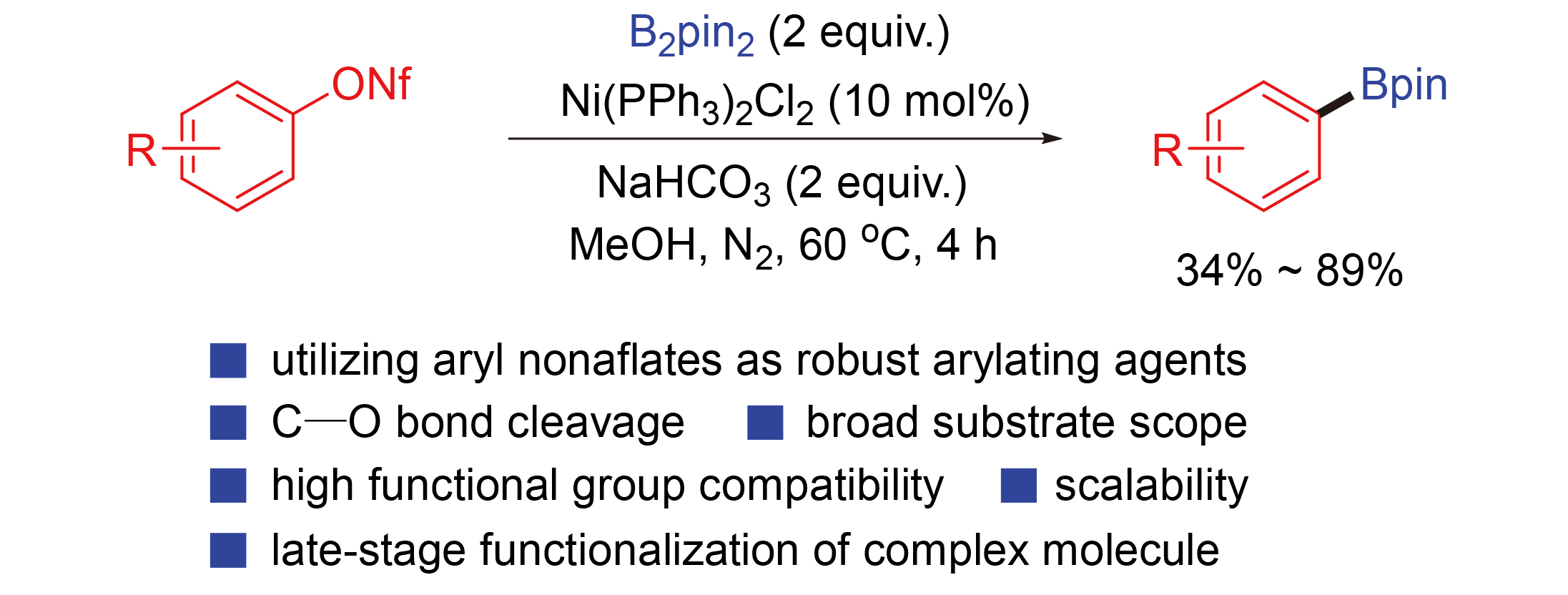
In recent decades, the employment of easily accessible, cost-effective, bench-stable, and robust aryl nonaflates[6] (RONf, Nf=SO2(CF2)3CF3) as appealing aryl electrophiles in organic transformations has garnered enormous attentions in synthetic community. Generally, aryl nonaflates could be conveniently synthesized by means of the reactions of ubiquitously present phenols with readily available and low-cost nonafluorobutanesulfonyl fluoride (CF3CF2)3-SO2F) with the aid of a base (such as Et3N).[7] However, although the applications of aryl nonaflates in a wide variety of organic reactions,[8] such as fluorination, amination, phosphorylation, carbonylation, Heck reaction, Negishi coupling, and Suzuki coupling, have been broadly explored, the development of effective methods for the facile transformations of aryl nonaflates to synthetically versatile arylboronates has not been established thus far. In continuation of the endeavors of our laboratory in applying alternative coupling electrophiles as effective surrogates to traditional organohalides in organic reactions,[9,10] herein we report an efficient nickel-catalyzed borylation of aryl nonaflates, which proceeded smoothly via C—O bond cleavage to afford a broad array of arylboronates in modest to good yields with high functional group compatibility.
2 Results and discussion
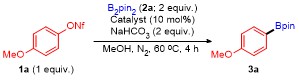
To optimize the reaction conditions, aryl nonaflate 1a (1 equiv.) was chosen as the model substrate and B2pin2 (2a; 2 equiv.) was employed as the borylating agent, and the reaction was conducted in the presence of NaHCO3 (2 equiv.) in anhydrous MeOH under nitrogen atmosphere at 60 ℃ for 4 h (Table 1). Initial screening of different transition metal catalysts (10 mol%, Entries 1~6), including CoBr2, CrCl3, CuI, Cu(OAc)2, FeCl3, and NiCl2, all almost failed to catalyze the current deoxygenative borylation (<5% NMR yield). Subsequent examination of various nickel catalysts (Table 1, Entries 7~16) revealed that the reaction could take place when nickel salt pre-complexed with phosphine ligand was utilized as catalyst (Table 1, Entries 12~16), with the highest product yield being obtained by using Ni(PPh3)2Cl2 as catalyst (95% NMR yield; 75% isolated yield;[11] Table 1, Entry 16). Notably, although the sole use of NiCl2 or Ni(cod)2 as catalyst almost could not catalyze the reaction (Table 1, Entries 6 and 11), the combinatorial use of NiCl2 or Ni(cod)2 with PPh3 could deliver the desired product 3a in 85% and 72% NMR yields, respectively, which further demonstrated the facilitating effect of phosphine ligand on the present borylation reaction (Table 1, Entries 17~18). We believe that the phosphine ligand might coordinate to the nickel center to tune the catalytic activity of nickel catalyst and stabilize the nickel catalyst. Other reaction parameters including base and solvent were also surveyed, and the results showed that NaHCO3 and MeOH[5t] were still the base and solvent of choice for the present borylation. In addition, control experiments (Table 1, Entries 19~20) indicated that both nickel catalyst and base were indispensable for the efficient occurrence of the reaction, as the absence of either of them would result in the failure of the borylation. Moreover, performing the reaction under air atmosphere instead of under nitrogen atmosphere also eroded the product yield considerably (Table 1, Entry 21).
Table 1 Optimization of reaction conditions by using various catalystsa,b |
| Entry | Catalyst | Yield/% | Entry | Catalyst | Yield/% |
|---|---|---|---|---|---|
| 1 | CoBr2 | <5 | 12 | Ni(PCy3)2Cl2 | 71 |
| 2 | CrCl3 | 0 | 13 | NiCl2•dppf | 59 |
| 3 | CuI | 0 | 14 | NiCl2•dppp | 17 |
| 4 | Cu(OAc)2 | 0 | 15 | Ni(PPh3)2Br2 | 87 |
| 5 | FeCl3 | 0 | 16 | Ni(PPh3)2Cl2 | 95 (75)c |
| 6 | NiCl2 | <5 | 17 | NiCl2 | 85d |
| 7 | NiBr2 | <5 | 18 | Ni(cod)2 | 72d |
| 8 | NiI2 | <5 | 19 | — | 0 |
| 9 | NiCl2•DME | <5 | 20 | Ni(PPh3)2Cl2 | 0e |
| 10 | Ni(acac)2 | <5 | 21 | Ni(PPh3)2Cl2 | 7f |
| 11 | Ni(cod)2 | 0 |
a The reactions were performed at 60 ℃ for 4 h under nitrogen atmosphere by using 1a (0.5 mmol), 2a (1 mmol), catalyst (10 mol%, 0.05 mmol), and NaHCO3 (1 mmol) in anhydrous CH3OH (2 mL). b Yields were determined by NMR analysis of crude reaction mixture after workup by using 1,4-dimethoxybenzene as an internal standard. c Isolated yield. d With the extra addition of 20 mol% PPh3 as ligand. e Without NaHCO3. f Under air atmosphere instead of nitrogen atmosphere. |
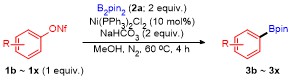
With the successful establishment of optimal conditions for the present borylation, we continued to study substrate scope of the reaction by examining a wide array of aryl nonaflates 1 as starting materials. As illustrated in Table 2, in most cases, the reactions proceeded well with structurally varied aryl nonaflates 1 to afford the corresponding arylboronates 3 in moderate to good yields. For examples, aryl nonaflates 1b~1h bearing electron-withdrawing groups, including cyano, methoxycarbonyl, acetyl, benzoyl, trifluoromethyl, trifluoromethoxy, and fluoro, were amenable to the transformations, leading to the desired products 3b~3h in 34%~86% yields. In addition, aryl nonaflates 1j~1s containing electron-donating substituents, such as methyl, methoxy, methylthio, benzyloxy, phenoxy, N,N-dimethylamino, and acetamido, were also proven to be suited for the borylation, and the expected products of arylboronic esters 3j~3s were furnished in 41%~78% yields. Analogously, the current protocol could also be applied to biphenyl- and naphthyl-substituted nonaflates 1t~1v, giving rise to the target products 3t~3v in excellent yields. Moreover, heteroaryl nonaflate 1w derived from quinoline also worked equally well under the optimized reaction conditions to generate the anticipated product 3w in moderate yield. Furthermore, the reaction could also be utilized in the late-stage functionalization of complex molecule, for the use of aryl nonaflate 1x derived from pterostilbene as substrate could also deliver the corresponding arylboronate 3x in 43% yield. However, no desired product was obtained when ortho-substituted aryl nonaflate (e.g., 2-methoxyphenyl nonaflate) was used as substrate, presumably owing to the presence of steric hindrance. In addition, the present protocol also could not be applied to the use of heteroaryl nonaflate (e.g., 3-pyridyl nonaflate) as substrate. Notably, the present deoxygenative borylations proceeded with excellent functional group compatibility, as functionalities or substituents such as CN, COOMe, Ac, Bz, CF3, OCF3, F, Me, OMe, SMe, OBn, OPh, OCH2O, NMe2, NHAc, and Ph, could be well tolerated, which could potentially be subjected to late-stage modification.
Table 2 Substrate scope of aryl nonaflatesa,b |
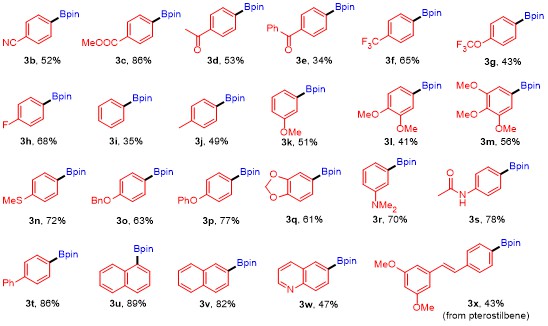 |
a The reactions were performed at 60 ℃ for 4 h under nitrogen atmosphere by using 1b~1x (0.5 mmol), 2a (1 mmol), and Ni(PPh3)2Cl2 (10 mol%, 0.05 mmol) in CH3OH (2 mL). b Isolated yield. |
When substrate 1y derived from naphthalene which possessed two ONf moieties were subjected to the borylation under standard conditions, the corresponding bis-borylated product 3y could also be obtained, albeit in a relatively low yield (Scheme 1a). When substrate 1z containing chloro atom in the para-position of aryl ring was subjected to the borylation with B2pin2 under standard conditions, the mono-borylated product 3z was obtained in 23% yield and the bis-borylated product 3z' was obtained in 32% yield (Scheme 1b), implying that the reactivities of C—Cl bond and C—ONf could not be completely differentiated under the present reaction conditions. In addition, gram-scale synthesis by employing 3 mmol aryl nonaflate 1a as substrate could also be successfully accomplished, leading to the desired product 3a in 67% yield (Scheme 1c).
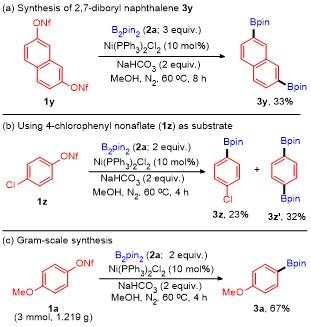


Mechanistically,[5j,5n] we believe that the reaction should initiate via the oxidative addition of nickel(0) (generated via the reduction of Ni(II) by B2pin2) into aryl nonaflate to form an arylnickel(II) species, which subsequently undergoes transmetallation with B2pin2 followed by reductive elimination to produce the desired product of arylboronate. However, the involvement of Ni(I)/Ni(III) catalytic cycle could not be ruled out at the current stage.
3 Conclusions
In summary, we have reported an efficient nickel- catalyzed borylation of aryl nonaflates with B2pin2. The reactions proceeded efficiently via C—O bond activation to produce a wide plethora of synthetically valuable arylboronates in moderate-to-good yields with broad functional group tolerance. In addition, the gram-scale synthesis and the utility of the method in the late-stage functionalization of aryl nonaflate derived from pterostilbene could be accomplished as well. We believe that the present deoxygenative borylation by using readily accessible, shelf- stable, and robust aryl nonaflates as effective arylating agents would serve as an attractive alternative and/or complement to previously reported approaches for accessing arylboronates.
4 Experimental section
4.1 General information
Unless otherwise stated, all reagents (≥98% purity) were purchased from commercial suppliers and used without further purification. All the aryl imidazolylsul- fonates were prepared according to previously reported methods.[8b,8k,12] Analytical thin layer chromatography (TLC) was performed using silica gel plate (0.2 mm thickness). After elution, the plates were visualized under UV radiation at 254 nm. Flash chromatography was performed using Merck silica gel (200~300 mesh) for column chromatography with freshly distilled solvents. Columns were typically packed as slurry and equilibrated with the appropriate solvent system prior to use. IR spectra were recorded on a FT-IR spectrophotometer using KBr optics. 1H NMR, 19F NMR, and 13C NMR spectra were recorded in CDCl3 on Jeol 400 MHz spectrometers. Tetramethylsilane (TMS) served as internal standard for 1H and 13C NMR analysis. High resolution mass spectra (HRMS) were obtained on a Waters Q-TOF Premier Spectrometer (ESI or EI Source).
4.2 Typical procedure for the synthesis of aryl nonaflates
In a 100 mL round-bottom flask, phenol (10 mmol) was dissolved in anhydrous dichloromethane (33 mL) and cooled to 0 °C. Triethylamine (2.5 g, 3.48 mL, 25 mmol) was then added, followed by the addition of nonafluorobutanesulfonyl fluoride (4.5 g, 2.70 mL, 15 mmol). The reaction mixture was warmed to room temperature and stirred for 2 h. The reaction mixture was then diluted with dichloromethane (50 mL) and washed with water (50 mL×3). The organic layer was dried over Na2SO4 and concentrated in vacuo. The residual was purified by silica gel column chromatography using petroleum ether and EtOAc as eluent to afford the pure product of aryl nonaflate. Spectral data of the products are in accord with those previously reported.[8b,8k,11]
4.3 Typical procedure for the deoxygenative borylation of aryl nonaflate with B2pin2
An oven-dried seal tube equipped with a magnetic stir bar was backfilled with nitrogen gas for three times. Then aryl nonaflate 1 (0.5 mmol, 1 equiv.), B2pin2 2 (1 mmol, 2 equiv., 253.9 mg), Ni(PPh3)2Cl2 (0.05 mmol, 10 mol%, 32.7 mg), and NaHCO3 (1 mmol, 2 equiv., 84.0 mg) were added into the tube. Then dry MeOH (2 mL) was added, and the reaction mixture was stirred at 60 ℃ for 4 h, followed by quenching with saturated NH4Cl solution (10 mL) and extracting with EtOAc (20 mL×3). The combined organic layers were washed with brine, dried over Na2SO4, and concentrated under reduced pressure to afford the crude product, which was further purified through silica gel column chromatography (using EtOAc/petroleum ether as eluents) to yield the product 3.
4.4 Typical procedure for the 3 mmol scale reaction of 1a with 2a
An oven-dried flask equipped with a magnetic stir bar was backfilled with nitrogen gas for three times. Aryl nonaflate 1a (3 mmol, 1 equiv., 1218.7 mg), B2pin2 2a (6 mmol, 2 equiv., 1523.6 mg), Ni(PPh3)2Cl2 (0.3 mmol, 10 mol%, 196.2 mg), and NaHCO3 (6 mmol, 2 equiv., 504.1 mg) were added into the tube. Then dry MeOH (10 mL) was added, and the reaction mixture was stirred at 60 ℃ for 4 h, followed by quenching with saturated NH4Cl solution (30 mL) and extracting with EtOAc (60 mL×3). The combined organic layers were washed with brine, dried over Na2SO4, and concentrated under reduced pressure to afford the crude product, which was further purified through silica gel column chromatography (using EtOAc/petroleum ether as eluents) to yield the product 3a in 67% yield (465.1 mg).
2-(4-Methoxyphenyl)-4,4,5,5-tetramethyl-1,3,2-dio-xaborolane (3a):[12] Using petroleum ether/ethyl acetate as eluent (petroleum ether/EtOAc, V/V=100/1), 88.2 mg, 75% yield. Colorless oil. 1H NMR (400 MHz, CDCl3) δ: 7.78~7.74 (m, 2H), 6.92~6.88 (m, 2H), 3.83 (s, 3H), 1.34 (s, 12H); 13C NMR (100 MHz, CDCl3) δ: 162.2, 136.6, 113.4, 83.7, 55.2, 25.0; IR (KBr) ν: 2980, 1592, 1359, 1248, 1143, 1089, 1030, 862, 652 cm-1. HRMS (ESI) calcd for C13H20BO3 [M+H]+ 235.1500, found 235.1504.
4-(4,4,5,5-Tetramethyl-1,3,2-dioxaborolan-2-yl)ben-zonitrile (3b):[12] Using petroleum ether/ethyl acetate as eluent (petroleum ether/EtOAc, V/V=50/1), 59.8 mg, 52% yield. Yellow solid. 1H NMR (400 MHz, CDCl3) δ: 7.88 (d, J=8.1 Hz, 2H), 7.63 (d, J=8.1 Hz, 2H), 1.35 (s, 12H); 13C NMR (100 MHz, CDCl3) δ: 135.2, 131.3, 119.0, 114.6, 84.6, 25.0; IR (KBr) ν: 2980, 2228, 1600, 1396, 1268, 1141, 1084, 854, 774 cm-1. HRMS (ESI) calcd for C13H17- BNO2 [M+H]+ 230.1347, found 230.1344.
Methyl 4-(4,4,5,5-tetramethyl-1,3,2-dioxaborolan-2-yl)-benzoate (3c):[12] Using petroleum ether/ethyl acetate as eluent (petroleum ether/EtOAc, V/V=50/1), 112.9 mg, 86% yield. White solid. 1H NMR (400 MHz, CDCl3) δ: 8.01 (d, J=8.3 Hz, 2H), 7.86 (d, J=8.3 Hz, 2H), 3.91 (s, 3H), 1.34 (s, 12H); 13C NMR (100 MHz, CDCl3) δ: 167.2, 134.8, 132.4, 128.7, 84.3, 52.3, 25.0; IR (KBr) ν: 2949, 2830, 1600, 1362, 1129, 1067, 774, 516 cm-1. HRMS (ESI) calcd for C14H21BO4 [M+H]+ 263.1449, found 263.1448.
1-(4-(4,4,5,5-Tetramethyl-1,3,2-dioxaborolan-2-yl)-phenyl)ethan-1-one (3d):[12] Using petroleum ether/ethyl acetate as eluent (petroleum ether/EtOAc, V/V=50/1), 65.7 mg, 53% yield. White solid. 1H NMR (400 MHz, CDCl3) δ: 7.90 (q, J=8.3 Hz, 4H), 2.61 (s, 3H), 1.35 (s, 12H); 13C NMR (100 MHz, CDCl3) δ: 198.6, 139.1, 135.0, 127.4, 84.3, 26.9, 25.0; IR (KBr) ν: 2972, 2830, 1603, 1368, 1265, 1143, 1092, 774 cm-1. HRMS (ESI) calcd for C14H20BO3 [M+H]+ 247.1500, found 247.1500.
Phenyl(4-(4,4,5,5-tetramethyl-1,3,2-dioxaborolan-2-yl)-phenyl)methanone (3e):[3l] Using petroleum ether/ethyl acetate as eluent (petroleum ether/EtOAc, V/V=50/1), 52.6 mg, 34% yield. White solid. 1H NMR (400 MHz, CDCl3) δ: 7.92 (d, J=8.1 Hz, 2H), 7.82~7.75 (m, 4H), 7.62~7.56 (m, 1H), 7.48 (t, J=7.6 Hz, 2H), 1.37 (s, 12H); 13C NMR (100 MHz, CDCl3) δ: 197.1, 139.9, 137.6, 134.7, 132.7, 130.3, 129.2, 128.4, 84.3, 25.0; IR (KBr) ν: 2972, 2827, 1603, 1365, 1291, 1189, 871, 774 cm-1. HRMS (ESI) calcd for C19H22BO3 [M+H]+ 309.1657, found 309.1667.
4,4,5,5-Tetramethyl-2-(4-(trifluoromethyl)phenyl)-1,3,2-dioxaborolane (3f):[12] Using petroleum ether/ethyl acetate as eluent (petroleum ether/EtOAc, V/V=100/1), 89.0 mg, 65% yield. Yellow solid. 1H NMR (400 MHz, CDCl3) δ: 7.91 (d, J=7.7 Hz, 2H), 7.61 (d, J=7.8 Hz, 2H), 1.36 (s, 12H); 13C NMR (100 MHz, CDCl3) δ: 135.1, 132.7 (q, J=31.8 Hz), 124.5 (q, J=3.8 Hz), 124.3 (d, J=272.5 Hz), 84.4, 25.0; 19F NMR (376 MHz, CDCl3) δ:-63.92 (s, 3F); IR (KBr) ν: 2983, 2833, 1595, 1368, 1234, 1197, 1070, 774 cm-1. HRMS (ESI) calcd for C13H17B-F3O2 [M+H]+ 273.1268, found 273.1264.
4,4,5,5-Tetramethyl-2-(4-(trifluoromethoxy)phenyl)-1,3,2-dioxaborolane (3g):[12] Using petroleum ether/ethyl acetate as eluent (petroleum ether/EtOAc, V/V=100/1), 78.1 mg, 54% yield. Colorless oil. 1H NMR (400 MHz, CDCl3) δ: 7.84 (d, J=7.5 Hz, 2H), 7.21 (d, J=7.3 Hz, 2H), 1.34 (s, 12H); 13C NMR (100 MHz, CDCl3) δ: 151.8, 136.7, 120.5 (q, J=255.8 Hz), 120.0, 84.2, 25.0; 19F NMR (376 MHz, CDCl3) δ: -57.57 (s, 3F); IR (KBr) ν: 2980, 2830, 1589, 1430, 1297, 1192, 1058, 774 cm-1. HRMS (ESI) calcd for C13H17BF3O3 [M+H]+ 289.1217, found 289.1215.
2-(4-Fluorophenyl)-4,4,5,5-tetramethyl-1,3,2-dioxabo-rolane (3h):[13] Using petroleum ether/ethyl acetate as eluent (petroleum ether/EtOAc, V/V=100/1), 75.8 mg, 68% yield. Colorless oil. 1H NMR (400 MHz, CDCl3) δ: 7.80 (dd, J=8.5, 6.3 Hz, 2H), 7.05 (t, J=8.9 Hz, 2H), 1.34 (s, 12H); 13C NMR (100 MHz, CDCl3) δ: 165.2 (d, J=250.2 Hz), 137.1 (d, J=8.2 Hz), 115.0 (d, J=20.2 Hz), 84.0, 25.0; 19F NMR (376 MHz, CDCl3) δ: -108.42 (s, 1F); IR (KBr) ν: 2943, 2830, 1600, 1365, 1263, 1183, 976, 774 cm-1. HRMS (ESI) calcd for C12H17BFO2 [M+H]+223.1300, found 223.1306.
4,4,5,5-Tetramethyl-2-phenyl-1,3,2-dioxaborolane (3i):[12] Using petroleum ether/ethyl acetate as eluent (petroleum ether/EtOAc, V/V=100/1), 35.5 mg, 35% yield. Colorless oil. 1H NMR (400 MHz, CDCl3) δ: 7.82 (d, J=6.8 Hz, 2H), 7.47 (t, J=7.4 Hz, 1H), 7.37 (t, J=7.3 Hz, 2H), 1.36 (s, 12H); 13C NMR (100 MHz, CDCl3) δ: 134.9, 131.4, 127.8, 83.9, 25.0; IR (KBr) ν: 2980, 2833, 1592, 1439, 1356, 1277, 1146, 1087, 859, 700 cm-1. HRMS (ESI) calcd for C12H19BO2 [M+H]+ 205.1394, found 205.1402.
4,4,5,5-Tetramethyl-2-(p-tolyl)-1,3,2-dioxaborolane (3j):[3l] Using petroleum ether/ethyl acetate as eluent (petroleum ether/EtOAc, V/V=100/1), 53.1 mg, 49% yield. Colorless oil. 1H NMR (400 MHz, CDCl3) δ: 7.73 (d, J=7.5 Hz, 2H), 7.20 (d, J=7.8 Hz, 2H), 2.38 (s, 3H), 1.35 (s, 12H); 13C NMR (100 MHz, CDCl3) δ: 141.5, 134.9, 128.7, 83.7, 25.0, 21.9; IR (KBr) ν: 2977, 1396, 1319, 1265, 1143, 1089, 859, 726, 652 cm-1. HRMS (ESI) calcd for C13H20BO2 [M+H]+ 219.1551, found 219.1554.
2-(3-Methoxyphenyl)-4,4,5,5-tetramethyl-1,3,2-dio-xaborolane (3k):[12] Using petroleum ether/ethyl acetate as eluent (petroleum ether/EtOAc, V/V=100/1), 59.5 mg, 51% yield. Colorless oil. 1H NMR (400 MHz, CDCl3) δ: 7.44~7.40 (m, 1H), 7.34 (d, J=2.6 Hz, 1H), 7.33~7.28 (m, 1H), 7.04~7.01 (m, 1H), 3.84 (s, 3H), 1.36 (s, 12H); 13C NMR (100 MHz, CDCl3) δ: 159.1, 129.1, 127.3, 118.7, 118.1, 83.9, 55.3, 25.0; IR (KBr) ν: 2983, 2827, 1575, 1243, 1044, 964, 854, 706 cm-1. HRMS (ESI) calcd for C13H20BO3 [M+H]+ 235.1500, found 235.1502.
2-(3,4-Dimethoxyphenyl)-4,4,5,5-tetramethyl-1,3,2-dioxaborolane (3l):[13] Using petroleum ether/ethyl acetate as eluent (petroleum ether/EtOAc, V/V=50/1), 53.6 mg, 41% yield. White solid. 1H NMR (400 MHz, CDCl3) δ: 7.41 (dd, J=8.0, 1.3 Hz, 1H), 7.27 (d, J=1.3 Hz, 1H), 6.87 (d, J=8.0 Hz, 1H), 3.91 (s, 3H), 3.88 (s, 3H), 1.32 (s, 12H); 13C NMR (100 MHz, CDCl3) δ: 151.7, 148.4, 128.6, 116.5, 110.5, 83.7, 55.9, 55.8, 24.9; IR (KBr) ν: 2983, 1516, 1411, 1351, 1256, 1138, 1027, 855, 685 cm-1. HRMS (ESI) calcd for C14H22BO4 [M+H]+ 265.1606, found 265.1599.
4,4,5,5-Tetramethyl-2-(3,4,5-trimethoxyphenyl)-1,3,2-dioxaborolane (3m):[5q] Using petroleum ether/ethyl acetate as eluent (petroleum ether/EtOAc, V/V=50/1), 81.7 mg, 56% yield. White solid. 1H NMR (400 MHz, CDCl3) δ: 7.03 (s, 2H), 3.90 (s, 6H), 3.87 (s, 3H), 1.34 (s, 12H); 13C NMR (100 MHz, CDCl3) δ: 153.0, 140.8, 111.3, 106.8, 84.0, 60.9, 56.2, 24.9; IR (KBr) ν: 2973, 1713, 1468, 1376, 1229, 1127, 1010, 851, 715 cm-1. HRMS (ESI) calcd for C15H24BO5 [M+H]+ 295.1711, found 295.1719.
4,4,5,5-Tetramethyl-2-(4-(methylthio)phenyl)-1,3,2-dioxaborolane (3n):[12] Using petroleum ether/ethyl acetate as eluent (petroleum ether/EtOAc, V/V=100/1), 90.5 mg, 72% yield. White solid. 1H NMR (400 MHz, CDCl3) δ: 7.71 (d, J=8.2 Hz, 2H), 7.23 (d, J=8.2 Hz, 2H), 2.49 (s, 3H), 1.34 (s, 12H); 13C NMR (100 MHz, CDCl3) δ: 142.7, 135.2, 125.1, 83.9, 25.0, 15.2; IR (KBr) ν: 2980, 1396, 1325, 1146, 1101, 1018, 859, 681 cm-1. HRMS (ESI) calcd for C13H20BO2S [M+H]+ 251.1272, found 251.1270.
2-(4-(Benzyloxy)phenyl)-4,4,5,5-tetramethyl-1,3,2-dioxaborolane (3o):[5q] Using petroleum ether/ethyl acetate as eluent (petroleum ether/EtOAc, V/V=50/1), 97.6 mg, 63% yield. White solid. 1H NMR (400 MHz, CDCl3) δ: 7.80 (d, J=8.0 Hz, 2H), 7.46 (d, J=7.5 Hz, 2H), 7.41 (t, J=7.2 Hz, 2H), 7.35 (d, J=7.1 Hz, 1H), 7.01 (d, J=8.1 Hz, 2H), 5.11 (s, 2H), 1.36 (s, 12H); 13C NMR (100 MHz, CDCl3) δ: 161.4, 136.9, 136.6, 128.7, 128.1, 127.6, 114.3, 83.7, 69.8, 25.0; IR (KBr) ν: 2977, 2867, 1396, 1254, 1141, 1024, 851, 737, 649 cm-1. HRMS (ESI) calcd for C19H24BO3 [M+H]+ 311.1813, found 311.1815.
4,4,5,5-Tetramethyl-2-(4-phenoxyphenyl)-1,3,2-dio-xaborolane (3p):[14] Using petroleum ether/ethyl acetate as eluent (petroleum ether/EtOAc, V/V=100/1), 114.3 mg, 77% yield. Colorless oil. 1H NMR (400 MHz, CDCl3) δ: 7.84~7.79 (m, 2H), 7.39~7.33 (m, 2H), 7.17~7.12 (m, 1H), 7.08~7.03 (m, 2H), 7.03~6.99 (m, 2H), 1.36 (s, 12H); 13C NMR (100 MHz, CDCl3) δ: 160.3, 156.6, 136.8, 129.9, 123.8, 119.6, 117.8, 83.8, 25.0; IR (KBr) ν: 2980, 1493, 1398, 1240, 1143, 1087, 858, 748, 655 cm-1. HRMS (ESI) calcd for C18H22BO3 [M+H]+297.1657, found 297.1660.
2-(Benzo[d][1,3]dioxol-5-yl)-4,4,5,5-tetramethyl-1,3,2-dioxaborolane (3q):[13] Using petroleum ether/ethyl acetate as eluent (petroleum ether/EtOAc, V/V=50/1), 75.1 mg, 61% yield. Colorless oil. 1H NMR (400 MHz, CDCl3) δ: 7.36 (dd, J=7.7, 0.9 Hz, 1H), 7.24 (d, J=1.1 Hz, 1H), 6.83 (d, J=7.7 Hz, 1H), 5.95 (s, 2H), 1.33 (s, 12H); 13C NMR (100 MHz, CDCl3) δ: 150.3, 147.3, 129.9, 114.1, 108.4, 100.9, 83.8, 25.0; IR (KBr) ν: 2983, 1436, 1336, 1237, 1143, 1035, 857, 678 cm-1. HRMS (ESI) calcd for C13H18BO4 [M+H]+ 249.1293, found 249.1297.
N,N-Dimethyl-3-(4,4,5,5-tetramethyl-1,3,2-dioxaboro-lan-2-yl)aniline (3r):[5d] Using petroleum ether/ethyl acetate as eluent (petroleum ether/EtOAc, V/V=30/1), 86.8 mg, 70% yield. 1H NMR (400 MHz, CDCl3) δ: 7.31~7.26 (m, 1H), 7.23~7.20 (m, 2H), 6.91~6.87 (m, 1H), 2.98 (s, 6H), 1.36 (s, 12H); 13C NMR (100 MHz, CDCl3) δ: 150.2, 128.6, 123.3, 118.7, 115.9, 83.7, 40.9, 25.0; IR (KBr) ν: 2980, 2796, 1427, 1386, 1325, 1140, 994, 865, 791, 701 cm-1. HRMS (ESI) calcd for C14H23BNO2 [M+H]+ 248.1816, found 248.1822.
N-(4-(4,4,5,5-Tetramethyl-1,3,2-dioxaborolan-2-yl)-phenyl)acetamide (3s):[5q] Using petroleum ether/ethyl acetate as eluent (petroleum ether/EtOAc, V/V=10/1), 102.3 mg, 78% yield. White solid. 1H NMR (400 MHz, CDCl3) δ: 7.77 (s, 1H), 7.74 (d, J=8.3 Hz, 2H), 7.52 (d, J=8.3 Hz, 2H), 2.15 (s, 3H), 1.32 (s, 12H); 13C NMR (100 MHz, CDCl3) δ: 168.8, 140.8, 135.9, 118.7, 83.8, 24.9, 24.8; IR (KBr) ν: 3307, 2977, 1674, 1597, 1533, 1491, 1398, 1141, 961, 859, 655 cm-1. HRMS (ESI) calcd for C14H21BNO3 [M+H]+ 262.1609, found 262.1607.
2-([1'-Biphenyl]-4-yl)-4,4,5,5-tetramethyl-1,3,2-dioxaborolane (3t):[12] Using petroleum ether/ethyl acetate as eluent (petroleum ether/EtOAc, V/V=100/1), 120.9 mg, 86% yield. White solid. 1H NMR (400 MHz, CDCl3) δ: 7.95 (d, J=7.4 Hz, 2H), 7.67 (d, J=7.4 Hz, 4H), 7.48 (t, J=7.2 Hz, 2H), 7.44~7.36 (m, 1H), 1.41 (s, 12H); 13C NMR (100 MHz, CDCl3) δ: 144.0, 141.1, 135.4, 128.9, 127.7, 127.3, 126.6, 83.9, 25.0; IR (KBr) ν: 2977, 1399, 1322, 1141, 1089, 962, 859, 703 cm-1. HRMS (ESI) calcd for C18H22BO2 [M+H]+ 281.1707, found 281.1714.
4,4,5,5-Tetramethyl-2-(naphthalen-1-yl)-1,3,2-dioxa-borolane (3u):[12] Using petroleum ether/ethyl acetate as eluent (petroleum ether/EtOAc, V/V=50/1), 113.7 mg, 89% yield. White solid. 1H NMR (400 MHz, CDCl3) δ: 8.88~8.73 (m, 1H), 8.19~8.06 (m, 1H), 8.03~7.92 (m, 1H), 7.91~7.81 (m, 1H), 7.56 (s, 1H), 7.51 (s, 2H), 1.45 (s, 12H); 13C NMR (100 MHz, CDCl3) δ: 137.1, 135.8, 133.3, 131.7, 128.5, 128.54, 126.47, 125.6, 125.1, 83.8, 25.0; IR (KBr) ν: 2977, 1507, 1336, 1255, 1133, 989, 844, 780 cm-1. HRMS (ESI) calcd for C16H20BO2 [M+H]+ 255.1551, found 255.1556.
4,4,5,5-Tetramethyl-2-(naphthalen-2-yl)-1,3,2-dioxa-borolane (3v):[12] Using petroleum ether/ethyl acetate as eluent (petroleum ether/EtOAc, V/V=50/1), 104.9 mg, 82% yield. Yellow oil. 1H NMR (400 MHz, CDCl3) δ: 8.44 (s, 1H), 7.93 (d, J=8.5 Hz, 1H), 7.91~7.84 (m, 3H), 7.57~7.48 (m, 2H), 1.43 (s, 12H); 13C NMR (100 MHz, CDCl3) δ: 136.4, 135.1, 132.9, 130.5, 128.8, 127.8, 127.09, 127.08, 125.9, 84.0, 25.0; IR (KBr) ν: 2975, 1479, 1383, 1298, 1130, 962, 850, 748, 688 cm-1. HRMS (ESI) calcd for C16H20BO2 [M+H]+ 255.1551, found 255.1552.
6-(4,4,5,5-Tetramethyl-1,3,2-dioxaborolan-2-yl)quino-line (3w):[12] Using petroleum ether/ethyl acetate as eluent (petroleum ether/EtOAc, V/V=30/1), 59.6 mg, 47% yield. Yellow oil. 1H NMR (400 MHz, CDCl3) δ: 8.92 (dd, J=4.3, 1.8 Hz, 1H), 8.33 (s, 1H), 8.17 (dd, J=8.3, 1.8 Hz, 1H), 8.07 (d, J=1.1 Hz, 2H), 7.38 (dd, J=8.2, 4.2 Hz, 1H), 1.37 (s, 12H); 13C NMR (100 MHz, CDCl3) δ: 151.4, 149.7, 136.9, 136.2, 134.3, 128.5, 127.7, 121.3, 84.3, 25.0; IR (KBr) ν: 2980, 2827, 1623, 1460, 1356, 1143, 964, 851, 772 cm-1. HRMS (ESI) calcd for C15H19BNO2 [M+H]+ 256.1503, found 256.1503.
(E)-2-(4-(3,5-Dimethoxystyryl)phenyl)-4,4,5,5-tetra-methyl-1,3,2-dioxaborolane (3x):[15] Using petroleum ether/ethyl acetate as eluent (petroleum ether/EtOAc, V/ V=20/1), 78.1 mg, 43% yield. Colorless oil. 1H NMR (400 MHz, CDCl3) δ: 7.82 (d, J=8.2 Hz, 2H), 7.53 (d, J=8.2 Hz, 2H), 7.11 (s, 2H), 6.69 (d, J=2.3 Hz, 2H), 6.42 (t, J=2.2 Hz, 1H), 3.83 (s, 6H), 1.37 (s, 12H); 13C NMR (100 MHz, CDCl3) δ: 161.0, 139.9, 139.2, 135.3, 129.7, 129.2, 126.0, 104.7, 100.3, 83.9, 55.5, 25.0; IR (KBr) ν: 2977, 1456, 1352, 1205, 1145, 1088, 962, 856, 654 cm-1. HRMS (ESI) calcd for C22H28BO4 [M+H]+ 367.2075, found 367.2069.
2,7-Bis(4,4,5,5-tetramethyl-1,3,2-dioxaborolan-2-yl)-naphthalene (3y): Using petroleum ether/ethyl acetate as eluent (petroleum ether/EtOAc, V/V=20/1), 61.8 mg, 33% yield. Colorless oil. 1H NMR (400 MHz, CDCl3) δ: 8.42 (s, 2H), 7.87 (d, J=8.2 Hz, 2H), 7.81 (d, J=8.2 Hz, 2H), 1.38 (s, 24H); 13C NMR (100 MHz, CDCl3) δ: 137.2, 136.7, 132.3, 131.7, 126.9, 84.0, 25.1; IR (KBr) ν: 2980, 1521, 1421, 1296, 1140, 965, 854, 686 cm-1. HRMS (ESI) calcd for C22H31B2O4 [M+H]+ 381.2403, found 381.2397.
2-(4-Chlorophenyl)-4,4,5,5-tetramethyl-1,3,2-dioxa-borolane (3z):[12] Using petroleum ether/ethyl acetate as eluent (petroleum ether/EtOAc, V/V=200/1), 27.5 mg, 23% yield. 1H NMR (400 MHz, CDCl3) δ: 7.74~7.71 (m, 2H), 7.36~7.32 (m, 2H), 1.34 (s, 12H); 13C NMR (100 MHz, CDCl3) δ: 137.7, 136.3, 128.2, 84.2, 25.0. HRMS (ESI) calcd for C12H17BClO2 [M+H]+ 239.1005, found 239.1010.
1,4-Bis(4,4,5,5-tetramethyl-1,3,2-dioxaborolan-2-yl)-benzene (3z'):[12] Using petroleum ether/ethyl acetate as eluent (petroleum ether/EtOAc, V/V=50/1), 52.8 mg, 32% yield. 1H NMR (400 MHz, CDCl3) δ: 7.80 (s, 4H), 1.35 (s, 24H); 13C NMR (100 MHz, CDCl3) δ: 134.0, 84.0, 25.0. HRMS (ESI) calcd for C18H29B2O4 [M+H]+ 331.2246, found 331.2240.
Supporting Information Optimization of reaction conditions and NMR spectra of products 3a~3z'. The Supporting Information is available free of charge via the Internet at http://sioc-journal.cn.
(Lu, Y.)