ARTICLES

Heterogeneous Copper Catalyzed Aerobic Oxidative Cross-Coupling of Tertiary Amines with Alkynes

  • Ziyun Tan a, b ,
  • Xin Yang b ,
  • Shaofeng Gong b ,
  • Huiling Yang b ,
  • Yongyan Xie b ,
  • Jingya Zhang b ,
  • Zhetai Feng a ,
  • Wenyi Li , a, * ,
  • Xinsheng Xiao , b, *
Expand
  • a College of Chemistry and Materials Science, Hengyang Normal University, Hengyang, Huanan 421000
  • b College of Chemical and Biological Engineering, Hunan University of Science and Engineering, Yongzhou, Huanan 425199
* E-mails: ;

Received date: 2025-07-22

  Revised date: 2025-08-24

  Online published: 2025-09-18

Supported by

National Natural Science Foundation of China(22002037)

Foundation of Key Laboratory of Functional Metal-Organic Com- pounds of Hunan Province(2023HSKFJJ005)

Project of Hunan Province Graduate Student Scientific Research Innovation(LXBZZ2024370)

Abstract

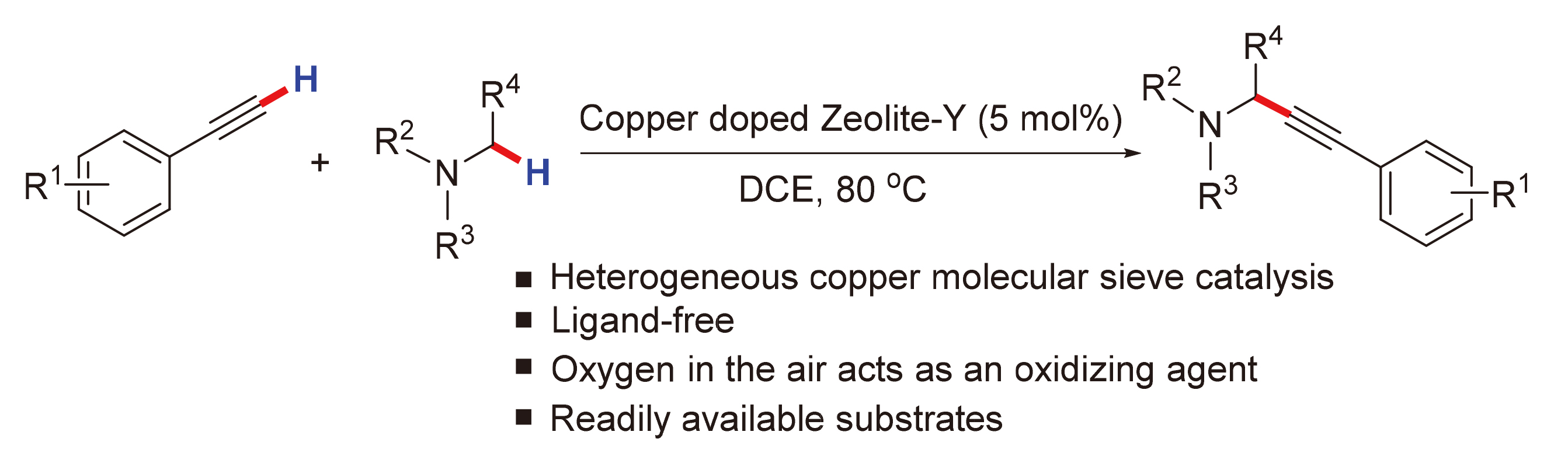
The synthesis method of propargylamines has always been the focus of research in organic synthetic methodology. A method of alkynylation of tertiary aliphatic amines with alkynes in the presence of copper doped zeolite Y as a catalyst and oxygen in the air as an oxidant has been developed. The most important feature of this reaction is that copper molecular siolite is used as catalyst, which avoids the intermolecular self-coupling of alkynes, and thus realizes the high efficiency propargylization of alkyl tertiary amines.

Cite this article

Ziyun Tan , Xin Yang , Shaofeng Gong , Huiling Yang , Yongyan Xie , Jingya Zhang , Zhetai Feng , Wenyi Li , Xinsheng Xiao . Heterogeneous Copper Catalyzed Aerobic Oxidative Cross-Coupling of Tertiary Amines with Alkynes[J]. Chinese Journal of Organic Chemistry, 2026 , 46(1) : 156 -166 . DOI: 10.6023/cjoc202504020

1 Introduction

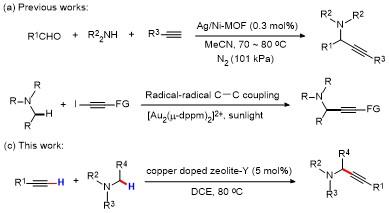
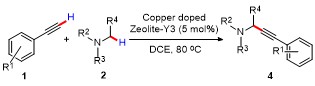
Propargylamines can be utilized as versatile and key synthetic intermediates for the preparation of several natural products,[1] bioactive compounds,[2] organic substrates. Notably, propargylamine-containing drugs, including pargyline, rasagiline, and selegiline, can be used to treat neurodegenerative diseases such as Parkinson's disease and Alzheimer's disease.[3] The development of convenient and efficient methods for the synthesis of propargylamines has attracted considerable attention. Over the past two decades, three main methods have been developed for the preparation of propargylamines. One method involves the substitution reactions of functionalized tertiary amines with alkynyl-lithium, alkynyl-magnesium,[4] or alkynyl-alumi- num[5] reagents. These reactions need leaving groups and stoichiometric nucleophiles. Another method involves the transition-metal-catalyzed three-component one-pot coupling reactions (A3-coupling reactions) of aldehydes, alkynes, and secondary amines. These reactions require prefunctionalized aldehydes to form iminium ion intermediates in situ.[6-8] The last method involves the copper- or iron- catalyzed direct oxidative alkynylations of C—H bonds in tertiary amines. These reactions proceed via iminium ion intermediates generated from the oxidative dehydrogenation reactions[9] of tertiary amines with an oxidant such as tBuOOH,[10] N-bromosuccinimide,[11] or (tBuO)2[12] in situ (Scheme 1).
Scheme 1 Synthetic method of propargylamine compounds
Among these methods, the third one is the most eco- nomical and practical. However, this reaction is only applicable to tertiary amines containing aryl groups. Aliphatic tertiary amines usually have low reactivities in such reactions because of alkyne self-coupling reaction. Heterogeneous catalysts have attracted much attention because they can be recycled and reused.[13] Copper molecular sieves have been reported as catalysts in organic synthesis.[14] The heterogeneous copper catalyst can hinder reaction self- coupling and improve reaction efficiency. Herein we report an effective copper doped Zeolite Y catalyzed oxidative cross-coupling of amine with alkyne via a direct C(sp3)—H bond alkynylation.

2 Results and discussion

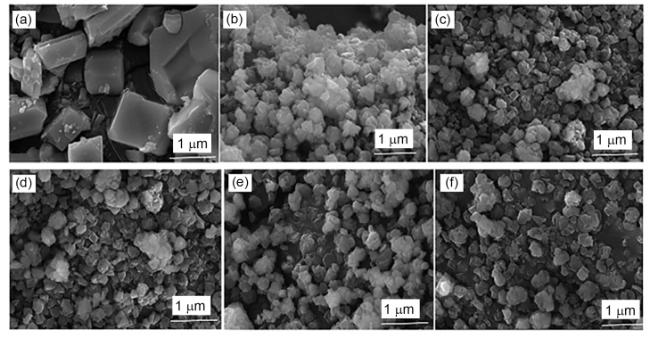
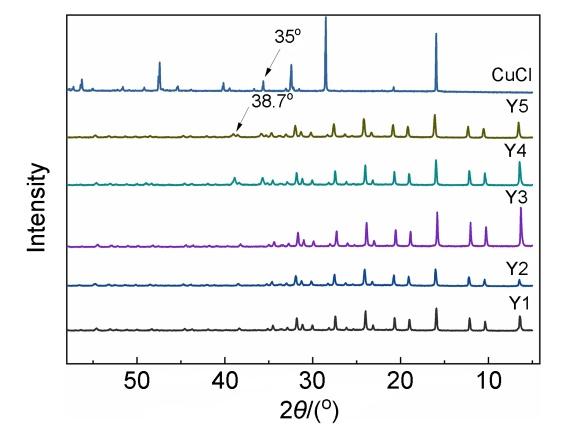
The morphologies of diverse catalysts were characterized using scanning electron microscope (SEM) imaging. As presented in Figure 1, it is evident that the morphology of cuprous chloride diverges entirely from that of the other five samples. Cuprous chloride manifests as cubic crystals. In contrast, the five samples of Y1~Y5 exhibit similar morphologies. Even after undergoing calcination, they retain the hexagonal crystal shape characteristic of the Y type molecular sieve. Five types of copper doped zeolite Y were synthesized and characterized using the X-ray powder diffraction (XRD). As shown in Figure 2, the XRD patterns of copper-doped zeolite catalysts exhibit seven characteristic peaks at 2θ values of 14.5°, 21.7°, 28.2°, 33.2°, 38.4°, 49.3°, and 55.3°, which are in good agreement with the standard diffraction pattern of zeolite Y as reported in previous studies.[15] Notably, additional diffraction peaks at 35° and 38.7° were observed in samples Y4 and Y5, which can be attributed to the presence of CuO crystalline phase.[16] In contrast, the absence of these characteristic CuO peaks in samples Y1, Y2, and Y3 suggests that copper species in these catalysts are highly dispersed within the zeolite framework.
Figure 1 SEM images of six catalysts

(a) CuCl, (b) Copper doped Zeolite Y1, (c) Copper doped Zeolite Y2, (d) Copper doped Zeolite Y3, (e) Copper doped Zeolite Y4, and (f) Copper doped Zeolite Y5

Figure 2 XRD patterns of copper doped zeolite-Y and a reference sample cuprous chloride
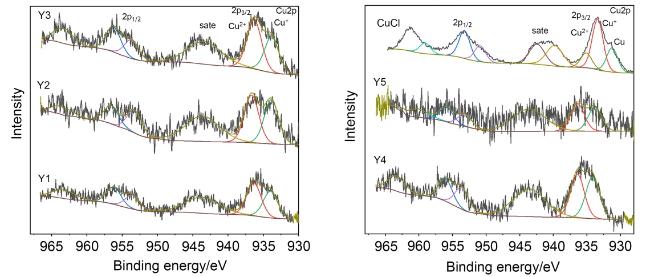
The Cu 2p spectra of samples Y1~Y5, along with a reference sample of cuprous chloride, are presented in Figure 3. According to literatures,[17-18] the binding energies for the Cu 2p3/2 and Cu 2p1/2 peaks of the reference sample were centered at 934.9 and 954.6 eV, respectively. Additionally, satellite peaks corresponding to 2p-3d orbital interactions were observed within the binding energy range of 941~944 eV. These spectral features were identified in the initial precursors, indicating the presence of Cu 2p species in the near-surface region. For samples Y3, Y4, and the reference sample, two bands were observed, ranging approximately from 931 to 938.8 eV and from 951.6 to 958.7 eV. These values are consistent with the known Cu 2p binding energies of Cu species, confirming their presence in the analyzed samples. Although the Cu 2p spectra of all copper-doped molecular sieve catalysts and the reference sample cuprous chloride all indicate the coexistence of Cu and Cu2+, Y3 is likely to maintain a more favorable Cu/ Cu2+ dynamic equilibrium during the reaction owing to the unique coordination effect of Cl. Additionally, the synergistic effect between Cl and the molecular sieve may enhance the dispersion and stability of active sites, thereby resulting in superior catalytic performance.
Figure 3 XPS patterns of copper doped zeolite-Y and a reference sample cuprous chloride
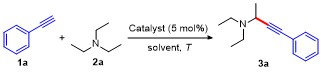
In order to verify the feasibility of the copper doped zeolite Y catalyzed aerobic oxidative cross-coupling of tertiary amines with alkynes, phenylacetylene (1a) and triethylamine (2a) were chosen as the templet substrates for investigation. No reaction was observed in the absence of metal catalyst (Table 1, Entry 1). When 5 mol% Cu(OAc)2 was employed as the catalyst, and the reaction was conducted in toluene at 100 ℃ under air atmosphere in a sealed reaction tube, the expected N,N-diethyl-4-phenylbut-3-yn- 2-amine (3a) was produced in 12% yield (Table 1, Entry 2). Encouraged by this preliminary result, a series of Cu(I) catalysts were tested (Table 1, Entries 3~5), and the outcome indicated that Cu(I) catalysts were slightly superior to Cu(OAc)2. When copper doped zeolite Y1 was used as catalyst, we surprisingly found that the target product could be obtained in 48% yield (Table 1, Entry 6).
Table 1 Optimization of reaction paramentsa

Entry Catalyst/mol% Solvent Temp./℃ Yieldb/%
1 Toluene 100 0
2 Cu(OAc)2 Toluene 100 12
3 CuI Toluene 100 17
4 CuBr Toluene 100 16
5 CuCl Toluene 100 19
6 Y1 Toluene 100 48
7 Y2 Toluene 100 33
8 Y3 Toluene 100 52
9 Y4 Toluene 100 0
10 Y5 Toluene 100 48
11 Y3 MeOH 100 23
12 Y3 CHCl3 100 39
13 Y3 DMSO 100 16
14 Y3 1,4-Dioxane 100 52
15 Y3 DCE 100 72
16 Y3 DCE 90 75
17 Y3 DCE 80 83
18 Y3 DCE 70 45
19 Y3 DCE 60 23
20c Y3 DCE 80 81

a Unless otherwise noted, all the reactions were carried out firstly using ethynylbenzene (1a, 0.20 mmol) and triethylamine (2a, 1.5 equiv.) with metal catalysts (5 mol%) in solvent (1.5 mL) at the setting temperature for 12 h under air in a sealed reaction tube, followed by flash chromatography on SiO2. b Isolated yield. c The reaction was conducted under O2 atmosphere.

When the copper-doped zeolite Y1 catalyst was replaced with other copper-doped zeolite catalysts (Table 1, Entries 7~10), copper doped zeolite Y3 was found to be the best catalyst for the present alkynylation (Table 1, Entry 8). Thus, copper doped zeolite Y3 was chosen as the catalyst for solvent screening (Table 1, Entries 11~15). It was found that changing of solvent had a significant effect on the reaction yield. Among the solvents tested, dichloroethane (DCE) appeared to be the most suitable reaction media, giving the target product in 72% yield (Table 1, Entry 15). Gratifyingly, the reaction yield could be further improved to 83% by decreasing the reaction temperature from 100 ℃ to 80 ℃ (Table 1, Entry17). However, excessively lowering the reaction temperature proved ineffective. A further decrease from 80 ℃ to 70 ℃ or 60 ℃ did not increase the yield (Table 1, Entries 18, 19). The yield of the target compound in this reaction did not change significantly when the O2 atmosphere was used instead of the air atmosphere (Table 1, Entry 20).
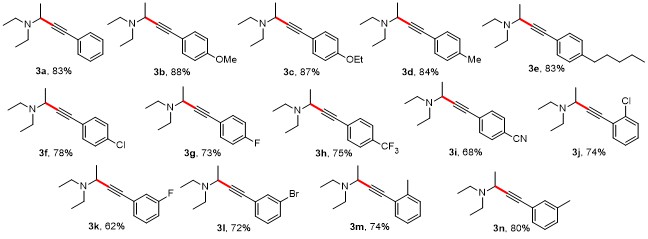
With the optimized reaction conditions in hand (Table 1, Entry 17), various alkynes were explored to investigate the generality of this copper doped zeolite Y catalyzed aerobic oxidative cross-coupling reaction, and the results are sum- marized in Table 2. The substrate scope of alkyne is quite general, phenylacetylene (1a) and various para-substituted phenylacetylenes bearing both electron-withdrawing and electron-donating groups could smoothly react with the triethylamine (2a), providing the expected propargylamines in moderate to good yields (3a~3i, 68%~88%). Ortho- and meta-substituted phenylacetylene also worked well in this reaction to furnish the corresponding propargylamines 3j~3n in 62% to 80% yields, respectively.
Table 2 Substrate scope for alkynea,b

a Unless otherwise noted, all reactions were first conducted by adding alkyne (1, 0.20 mmol), triethylamine (2a, 0.3 mmol), copper doped zeolite Y3 (5 mol %) and DCE (1.5 mL) in a sealed reaction tube, and carried out at 80 ℃ for 12 h under air atmosphere, followed by flash chromatography on SiO2. b Isolated yield.

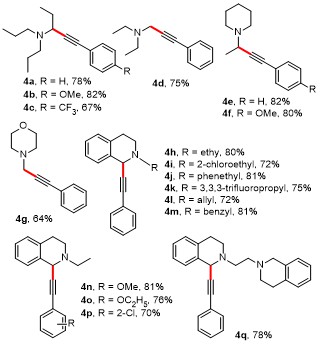
Tertiary amines with straight chain alkyl, such as propyl could smoothly reacted with the alkyne 1 furnishing the targeted alkynylamine products 4a, 4b and 4c in 78%, 82% and 67% yields, respectively (Table 3). When methyl and ethyl were present in a tertiary amine molecule, the reaction occurred preferentially with the methyl group (4d). Variation of the alkyl substitution of the tertiary amines from straight chain alkyl to 1-ethylpiperidine (4e, 4f), the same reaction could be observed. When 4-methylmorpholine was used as substrate, the target product could be obtained in a yield of 64%. The alkynylation reaction preferentially occurred on the linear alkyl α-carbon of the amine, regardless of whether the alkyl substituted piperidine or morpholine was used as the substrate (4e~4g). Next, the applicability of 2-substituted 1,2,3,4-tetrahydroisoquinoline as tertiary amine substrate was investigated. Experimental results demonstrated that the alkynylation reaction consistently occurred at the C(1) position of tetrahydroisoquinoline, regardless of the substituent (2-substituted ethyl, 2-chloro- ethyl, phenethyl, 3,3,3-trifluoropropyl, allyl, or benzyl). Various substitution patterns were compatible in the reaction, and generated the corresponding target product in moderate to high yields (4h~4m). 2-Ethyltetrahydroiso- quinoline was also able to react with p-substituted phenyl- ethynes to form the amide compounds 4n and 4o, respecti- vely, and notably, o-substituted phenylethynes were also able to react smoothly with 2-ethyltetrahydroisoquinolines to form the target amide compound 4p in a yield of 70%. Finally, when 1,2-bis(3,4-dihydroisoquinolin-2(1H)-yl)- ethane was used as the tertiary amine substrate, the C(1) monoalkynylation product was obtained in a yield of 78% (4q).
Table 3 Substrate scope for the tertiary aminesa,b

a Reaction conditions: 1 (0.2 mmol), 2 (1.5 equiv.), copper doped zeolite Y3 (5 mol%), DCE (1.5 mL) at the 80 ℃ for 12 h under air in a sealed reaction tube, followed by flash chromatography on SiO2. b Isolated yield.

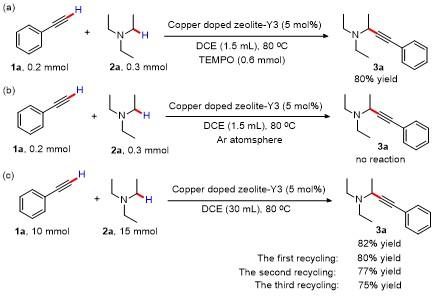
In order to shed some light on the mechanism of the present aerobic oxidative cross-coupling of tertiary amines with alkynes reaction, several controlled experiments were conducted. Firstly, the cross-coupling reaction between phenylacetylene (1a) and triethylamine (2a) was performed in the presence of 2,2,6,6-tetramethylpiperidinooxy (TEM- PO, 1.5 equiv.) under our standard conditions, and 80% yield of alkynylation product 3a could be obtained (Scheme 2, a). This finding demonstrated that free radical process was not involved in this transformation. Subsequently, using argon instead of air, the reaction was carried out under standard conditions, and no target product was obtained (Scheme 2, b). This result showed that oxygen in the air acted as an oxidizing agent in the dehydrogenation cross- coupling reaction of alkynes and tertiary amines. When the input quantity of the raw materials for this reaction was scaled up 50-fold, the yield of the target product did not exhibit any significant decline (Scheme 2, c). At the same time, the catalysts could be recycled for three times without obvious deactivation with the yield merely decreased from 82% to 75% (Scheme 2, c).
Scheme 2 Control experiments
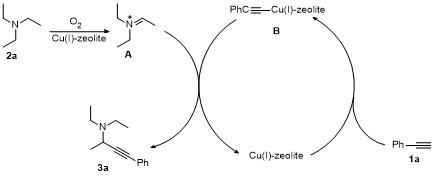
Based on the above results and previous reports, a mechanism for the copper salt-catalyzed preparation of ethynylbenzene with triethylamine to make propargylamines compound was proposed (Scheme 3). In the presence of copper doped zeolite-Y, triethylamine (2a) reacts with O2 in the air to produce the imine cation intermediate A. Mean- while, phenylethynyl (1a) undergoes an oxidation addition reaction with copper molecular sieve to generate the acetylene-copper intermediate B. Subsequently, the imine cation intermediate A reacts with the acetylene-copper intermediate B to form the target allylamine compound (3a).
Scheme 3 Possible mechanism for Cu(I)-catalyzed aerobic oxidative cross-coupling of tertiary amines with alkynes

3 Conclusions

In conclusion, a general and practical heterogeneous copper catalyzed aerobic oxidative cross-coupling method of alkyne with tertiary amines was developed. With this method, a variety of propargylamines were obtained in good to excellent yields from inexpensive and readily available reagents. Further studies on the enantioselective synthesis of propargylamines and applications of this nascent type of compounds in organic synthesis and transition-metal catalysis are currently in progress in our laboratory.

4 Experimental section

4.1 General information

All reactions were conducted in flame-dried, sealed tubes equipped with magnetic stirring. Unless otherwise specified, all experiments were performed under an air atmosphere. Reagents were procured from commercial suppliers, including TCI, Acros, and Strem, and used without further purification. Solvents were dried using 4 Å molecular sieves or sodium and subsequently distilled prior to use. Reaction products were purified by flash chromatography using silica gel (200~300 mesh) obtained from Qingdao Haiyang Chemical Co. Ltd. Infrared (IR) spectra were acquired on a Bruker TENSOR 27 FTIR spectrophotometer. Samples for IR analysis were prepared as KBr pellets containing the target compound. Nuclear magnetic resonance (NMR) spectra, including ¹H NMR and 13C NMR, were recorded on a Bruker Avance III HD 400 Fourier Transform spectrometer (400 MHz for ¹H NMR and 100 MHz for ¹³C NMR). Tetramethylsilane (TMS) was used as an internal standard, and spectra were obtained at ambient temperature unless otherwise noted. Utilizing the Hitachi S4800 scanning electron microscope manufactured by Hitachi, Ltd. in Japan and equipped with an X-ray energy dispersive spectrometer (EDX), the simultaneous analysis of the morphology and composition of solid samples becomes feasible. In the specific sample-preparation process, an appropriate quantity of conductive adhesive is first pasted onto the sample stage. Subsequently, the sample powder is evenly spread over the conductive adhesive. Finally, a gold-sputtering treatment is carried out on the sample. This procedure enhances the electrical conductivity of the sample, thereby rendering the SEM images of the sample more distinct.[19] The X-ray powder diffraction (XRD) patterns of the samples were obtained using a D8 advance diffractometer (Bruker, Germany) equipped with Cu Kα radiation (λ=0.15406 nm) at 40 kV and 40 mA. The diffraction data 2θ were collected in the range of 10°~80° with a scanning speed of 2 (°)/min.[19] The valence states and atomic ratios of the samples were determined using an ESCALAB 250Xi multifunctional X-ray photoelectron spectrometer (Thermo Fisher Scientific, USA). The instrument was calibrated to the C 1s peak, with the binding energy set at 284.6 eV.[16] X-ray photoelectron spectroscopy (XPS) was further employed to investigate the chemical states and the migration of surface copper species during the detemplation process.

4.2 Experimental procedures

4.2.1 Procedure for the preparation of catalysts

Initially, zeolite Y was dried in an oven at 120 ℃ for 2 h and then cooled to room temperature. Subsequently, 4.74 g of the dried zeolite Y was weighed and saturated with 4.8 mL of deionized water.
For water-soluble copper salts, 679.3 mg of copper acetate pentahydrate and 933.7 mg of anhydrous copper sulfate were separately dissolved in 4.8 mL of deionized water. Each solution was then uniformly mixed with 4.75 g of zeolite Y. The mixtures were maintained at room temperature for 12 h, dried in an oven at 120 ℃ for 2 h, and finally calcined in a muffle furnace at 450 ℃ for 4 h to obtain copper doped zeolites Y1 and Y2, respectively.
For water-insoluble copper salts, including 370.3 mg of cuprous chloride, 535.2 mg of cuprous oxide, or 237.5 mg of copper powder, 4.75 g of zeolite Y was placed in a mortar and ground with each salt for 10 min to ensure thorough mixing. The resulting mixtures were then calcined in a muffle furnace at 450 ℃ for 4 h to produce copper doped zeolites Y3, Y4, and Y5, respectively.

4.2.2 Typical procedure for the preparation of tertiary amine substrates 2b~2f

Substrates 2b~2e were synthesized following previously reported procedures. Briefly, to a solution of Na₂CO₃ (1.59 g, 15 mmol) in anhydrous dimethylformamide (DMF, 15 mL), 15 mmol of haloalkane and 10 mmol of 1,2,3,4- tetrahydroisoquinoline were added. The resulting mixture was stirred at room temperature under air for 12 h. After the reaction, 50 mL of water was added, and the reaction products were extracted with diethyl ether (50 mL×3). The organic layer was dried over anhydrous MgSO₄ for 6 h, filtered, and concentrated under reduced pressure. The crude product was purified by flash chromatography using a silica gel column with a mixture of ethyl acetate and petroleum ether (VV=20∶1) as the eluent.
2-Allyl-1,2,3,4-tetrahydroisoquinoline (2b):[20] Yellow oil. 1.56 g, 90% yield. 1H NMR (400 MHz, CDCl3) δ: 7.12~7.09 (m, 3H), 7.02~7.01 (m, 1H), 5.99~5.93 (m, 1H), 5.26 (dd, J=17.2, 1.6 Hz, 1H), 5.20 (d, J=10.0 Hz, 1H), 3.63 (s, 2H), 3.18 (d, J=6.4 Hz, 2H), 2.92 (t, J=6.0 Hz, 2H), 2.74 (t, J=6.0 Hz, 2H); 13C NMR (101 MHz, CDCl3) δ: 135.5, 134.9, 134.4, 128.8, 126.7, 126.2, 125.7, 118.0, 61.7, 56.2, 50.8, 29.2; MS (ESI) m/z: 173.1 (M).
2-Ethyl-1,2,3,4-tetrahydroisoquinoline (2c):[21] Yellow oil. 1.59 g, 99% yield. 1H NMR (400 MHz, CDCl3) δ: 7.14~7.08 (m, 3H), 7.05~7.01 (m, 1H), 3.62 (s, 2H), 2.93 (t, J=5.9 Hz, 2H), 2.73 (t, J=5.9 Hz, 2H), 2.59 (q, J=7.0 Hz, 2H), 1.20 (q, J=7.0 Hz, 3H); 13C NMR (100 MHz, CDCl3) δ: 134.8, 134.3, 128.6, 126.6, 126.1, 125.6, 55.8, 52.2, 50.7, 20.2, 21.4; MS (ESI) m/z: 161.1 (M).
2-Benzyl-1,2,3,4-tetrahydroisoquinoline (2d):[22] Colorless oil. 2.00 g, 90% yield. 1H NMR (400 MHz, CDCl3) δ: 7.33~7.12 (m, 5H), 7.06~6.82 (m, 4H), 3.59 (d, J=4.0 Hz, 2H), 3.56~3.50 (m, 2H), 2.79 (dd, J=5.8, 3.2 Hz, 2H), 2.65 (dt, J=8.4, 4.0 Hz, 2H); 13C NMR (100 MHz, CDCl3) δ 137.3, 137.3, 133.8,133.8, 133.3, 133.3, 128.0, 127.6, 127.2, 126.1, 125.5, 125.0, 124.5, 61.7, 61.7, 55.1, 55.0, 49.6, 49.6, 28.1, 28.1; MS (ESI) m/z: 223.1 (M).
2-Phenethyl-1,2,3,4-tetrahydroisoquinoline (2e):[23] Colorless oil. 2.25 g, 95% yield. 1H NMR (400 MHz, CDCl3) δ: 2.75~2.81 (m, 2H), 2.81 (t, J=5.8 Hz, 2H), 2.89~2.96 (m, 4H), 3.72 (s, 2H), 7.01~7.06 (m, 1H), 7.08~7.16 (m, 3H), 7.18~7.23 (m, 1H), 7.23~7.27 (m, 2H), 7.27~7.32 (m, 2H); 13C NMR (100 MHz, CDCl3) δ: 29.3, 34.2, 51.2, 56.3, 60.5, 125.8, 126.3, 126.3, 126.8, 128.6, 128.9, 129.0, 134.5, 134.9, 140.6; MS (ESI) (ESI) m/z: 237.1 (M).
In a glove box, 2-(((6-hexyl)oxy)(1-oxidaneyl)boraneyl)- 1,2,3,4-tetrahydroisoquinoline (0.2 mmol, 1.0 equiv.), tetrahydrofuran (THF, 2.0 mL) and dibromomethane (CH₂I₂, 1.2 mmol, 6.0 equiv.) were added to a flame-dried 10 mL Schlenk tube. The tube was sealed, removed from the glove box, and the reaction mixture was cooled to -95 ℃. Under a nitrogen (N₂) atmosphere, n-butyllithium (1.16 mmol, 5.8 equiv.) was slowly added over 15 min using a syringe pump. The reaction mixture was stirred at -95 ℃ for 30 min, then allowed to warm to room temperature and stirred for additional 1 h. The mixture was subsequently cooled to 0 ℃, and a premixed solution of H₂O₂ (30% in water, 0.5 mL) and sodium hydroxide (NaOH, 2.0 mmol/L, 1.0 mL) was added. The resulting mixture was stirred at room temperature for 1 h, diluted with water (H₂O, 20 mL), and extracted with dichloromethane (DCM, 30 mL×2). The combined organic phases were washed with water (30 mL) and brine (30 mL), dried over anhydrous Na₂SO₄, filtered, and concentrated under reduced pressure. The residue was purified by flash column chromatography on silica gel, yielding 2-(3,4-dihydroisoquinolin-2(1H)-yl)ethanol as Yellow oil. Next, 2-(3,4-dihydro-1H-isoquinolin-2-yl)- ethanol (50 mg, 0.282 mmol) was dissolved in dichloromethane (DCM, 5 mL), and thionyl chloride (0.041 mL, 0.564 mmol) was added. The reaction mixture was stirred at room temperature for 2 h. An additional portion of thionyl chloride (0.041 mL, 0.564 mmol) was then added, and the reaction was stirred for an additional 3 h at room temperature. Finally, the reaction mixture was concentrated to dryness to afford 2-(2-chloroethyl)-1,2,3,4-tetrahydroiso- quinoline (2f).[24] 1H NMR (400 MHz, CDCl3) δ: 7.12 (tt, J=6.4, 2.5 Hz, 1H), 7.06~6.95 (m, 1H), 3.73 (s, 1H), 2.97~2.86 (m, 2H), 2.83 (t, J=5.8 Hz, 1H); 13C NMR (100 MHz, CDCl3) δ: 134.18, 133.99, 128.74, 126.60, 126.32, 125.75, 77.38, 77.06, 76.74, 59.49, 55.91, 51.02, 41.24, 31.46, 30.21, 30.15, 29.74, 28.83; MS (ESI) m/z: 195.1 (M).

4.2.3 Typical for the preparation of compounds 3a~3n

In a sealed reaction tube, ethynylbenzene (1a, 20.4 mg, 0.20 mmol), triethylamine (2a, 30.3 mg, 0.30 mmol), copper doped zeolite Y3 (5 mol%), and 1,2-dichloroethane (DCE, 1.5 mL) were combined under an air atmosphere. The reaction mixture was stirred at 80 ℃ for 12 h. After completion, the mixture was filtered through a celite pad and washed with ethyl acetate (10 mL×3). The organic solvents were removed under reduced pressure, and the residue was purified by flash chromatography on silica gel using a mixture of petroleum ether and ethyl acetate (VV=5∶1) as the eluent to afford the desired product 3a. Products 3b~3n were synthesized following this general procedure.
N,N-Diethyl-4-phenylbut-3-yn-2-amine (3a):[25] Yellow liquid, 33.4 mg, 83% yield. 1H NMR (400 MHz, CDCl3) δ: 7.41 (dd, J=6.5, 2.9 Hz, 2H), 7.32~7.26 (m, 3H), 3.91 (q, J=7.0 Hz, 1H), 2.75 (dq, J=14.2, 7.3 Hz, 2H), 2.52 (dq, J=13.7, 7.0 Hz, 2H), 1.42 (d, J=7.0 Hz, 3H), 1.12 (t, J=7.2 Hz, 6H); 13C NMR (100 MHz, CDCl3) δ: 131.7, 128.3, 127.9, 123.6, 89.6, 84.1, 48.3, 44.7, 20.2, 13.7; MS (ESI) m/z: 201.1 (M).
N,N-Diethyl-4-(4-methoxyphenyl)but-3-yn-2-amine (3b):[9] Yellow liquid, 40.7 mg, 88% yield. 1H NMR (400 MHz, CDCl3) δ: 7.34 (d, J=8.5 Hz, 2H), 6.81 (d, J=8.5 Hz, 2H), 3.89 (q, J=7.0 Hz, 2H), 3.80 (s, 3H), 2.73 (dq, J=14.4, 7.3 Hz, 2H), 2.51 (dq, J=13.8, 7.0 Hz, 2H), 1.40 (d, J=7.0 Hz, 4H), 1.11 (t, J=7.2 Hz, 6H); 13C NMR (100 MHz, CDCl3) δ: 159.2, 133.0, 115.6, 113.8, 87.8, 83.8, 55.2, 48.3, 44.6, 20.1, 13.6; MS (ESI) m/z: 231.1 (M).
4-(4-Ethoxyphenyl)-N,N-diethylbut-3-yn-2-amine (3c):[9] Yellow liquid, 42.7 mg, 87% yield. 1H NMR (400 MHz, CDCl3) δ: 7.37~7.30 (m, 2H), 6.80 (d, J=8.1 Hz, 2H), 4.01 (d, J=7.0 Hz, 2H), 3.89 (d, J=7.0 Hz, 1H), 2.79~2.69 (m, 2H), 2.55~2.46 (m, 2H), 1.40 (dt, J=7.3, 3.6 Hz, 6H), 1.11 (t, J=7.2 Hz, 6H); 13C NMR(100 MHz, CDCl3) δ: 158.6, 133.0, 115.4, 114.3, 87.7, 83.8, 63.4, 48.3, 44.6, 20.1, 14.7, 13.6; MS (ESI) m/z: 245.1 (M).
N,N-Diethyl-4-(p-tolyl)but-3-yn-2-amine (3d):[9] Yellow liquid, 36.1 mg, 84% yield. 1H NMR (400 MHz, CDCl3) δ: 7.30 (d, J=8.0 Hz, 2H), 7.10 (d, J=8.0 Hz, 2H), 3.94 (q, J=6.9 Hz, 1H), 2.78 (dd, J=13.0, 7.1 Hz, 2H), 2.55 (dd, J=13.1, 6.9 Hz, 2H), 2.34 (s, 3H), 1.44 (d, J=7.0 Hz, 3H), 1.14 (t, J=7.2 Hz, 6H); 13C NMR (100 MHz, CDCl3) δ: 137.7, 131.5, 128.9, 120.4, 88.6, 84.1, 48.3, 44.6, 21.4, 20.1, 13.6; MS (ESI) m/z: 215.1 (M).
N,N-Diethyl-4-(4-pentylphenyl)but-3-yn-2-amine (3e): Yellow liquid, 45.0 mg, 83% yield. 1H NMR (400 MHz, CDCl3) δ: 7.32 (d, J=8.1 Hz, 2H), 7.10 (d, J=8.0 Hz, 2H), 3.94 (d, J=7.0 Hz, 1H), 2.78 (dd, J=13.0, 7.2 Hz, 2H), 2.61~2.49 (m, 4H), 1.62~1.55 (m, 2H), 1.44 (d, J=7.0 Hz, 3H), 1.33~1.28 (m, 4H), 1.14 (t, J=7.2 Hz, 6H), 0.88 (t, J=6.9 Hz, 3H); 13C NMR (100 MHz, CDCl3) δ: 133.7, 132.8, 128.5, 121.9, 99.9, 48.3, 44.6, 19.9, 13.5; IR (KBr) ν: 2923, 2860, 1601, 1525, 1462, 1288,814,750 cm-1; HRMS (ESI) calcd for C19H30N [M+H] 272.2373, found 272.2379.
4-(4-Chlorophenyl)-N,N-diethylbut-3-yn-2-amine (3f):[9] Yellow liquid, 36.7 mg, 78% yield. 1H NMR (400 MHz, CDCl3) δ: 7.38 (dd, J=8.5, 5.5 Hz, 2H), 6.98 (t, J=8.6 Hz, 2H), 3.90 (d, J=7.0 Hz, 1H), 2.74 (dd, J=13.0, 7.3 Hz, 2H), 2.51 (dd, J=13.1, 6.9 Hz, 2H), 1.41 (d, J=7.0 Hz, 3H), 1.11 (s, 6H); 13C NMR (100 MHz, CDCl3) δ: 163.4, 160.9, 133.5, 133.4, 119.5, 119.5, 115.5, 115.3, 89.0, 83.0, 48.2, 44.6, 20.0, 13.5l; 19F NMR (376 MHz, CDCl3) δ: -111.85; MS (ESI) m/z: 235.1 (M).
N,N-Diethyl-4-(4-fluorophenyl)but-3-yn-2-amine (3g): Yellow liquid, 32.0 mg, 73% yield. 1H NMR (400 MHz, CDCl3) δ: 7.39 (d, J=5.5 Hz, 2H), 7.01~6.95 (m, 2H), 3.90 (d, J=7.0 Hz, 1H), 2.74 (dd, J=13.0, 7.3 Hz, 2H), 2.51 (dd, J=13.1, 6.9 Hz, 2H), 1.41 (d, J=7.0 Hz, 3H), 1.25 (s, 3H), 1.11 (s, 6H); 13C NMR (100 MHz, CDCl3) δ: 163.4, 160.9, 133.5 (d, J=8.0 Hz), 119.5 (d, J=4.0 Hz), 115.5 (d, J=22.0 Hz), 89.0, 83.0, 48.2, 44.6, 20.0, 13.5; 19F NMR (376 MHz, CDCl3) δ: -62.75; IR (KBr) ν: 2923, 2860, 1601, 1525, 1462, 1380,814,715 cm-1; HRMS (ESI) calcd for C14H19FN [M+H] 221.1496, found 220.1503.
N,N-Diethyl-4-(4-(trifluoromethyl)phenyl)but-3-yn-2-amine (3h):[9] Yellow liquid, 40.4 mg, 75% yield. 1H NMR (400 MHz, CDCl3) δ: 7.63~7.56 (m, 2H), 7.50 (dd, J=17.2, 10.7 Hz, 2H), 3.96 (d, J=8.0 Hz, 1H), 2.77 (dd, J=5.7 Hz, 2H), 2.60~2.44 (m, 2H), 1.45 (dd, J=7.0, 1.9 Hz, 3H), 1.17~1.06 (m, 6H); 13C NMR (100MHz, CDCl3) δ: 131.9, 130.0 (q, J=32.0, 5.7 Hz,), 128.0, 127.2, 125.3, 125.1 (d, J=4.04 Hz), 122.6, 92.2, 82.9, 48.3, 44.7, 19.8, 13.6; 19F NMR (376 MHz, CDCl3) δ: -62.75; MS (ESI) m/z: 269.1 (M).
4-(3-(Diethylamino)but-1-yn-1-yl)benzonitrile (3i): Yellow liquid, 36.6 mg, 68% yield. 1H NMR (400 MHz, CDCl3) δ: 7.32 (d, J=8.1 Hz, 2H), 7.10 (d, J=8.0 Hz, 2H), 3.94 (d, J=8.0 Hz, 1H), 2.78 (dd, J=13.0, 7.2 Hz, 2H), 2.61~2.49 (m, 4H), 1.58 (dd, J=14.9, 7.4 Hz, 2H), 1.44 (d, J=7.0 Hz, 3H), 1.33~1.28 (m, 4H), 1.14 (t, J=7.2 Hz, 6H), 0.88 (t, J=6.9 Hz, 3H); 13C NMR (100 MHz, CDCl3) δ: 143.0, 131.5, 128.3, 120.4, 88.1, 84.5, 48.4, 44.7, 35.8, 31.4, 31.0, 22.5, 20.0, 14.0, 13.4; IR (KBr) ν: 2923, 2860, 1601, 1525, 1462, 1380,814,712 cm-1; HRMS (ESI) calcd for C15H19N2 [M+H] 227.1543, found 227.1551.
4-(3-Chlorophenyl)-N,N-diethylbut-3-yn-2-amine (3j): Yellow liquid, 34.8 mg, 74% yield.1H NMR (400 MHz, CDCl3) δ: 7.39 (s, 1H), 7.30~7.25 (m, 2H), 7.22 (d, J=7.6 Hz, 1H), 3.90 (d, J=7.0 Hz, 1H), 2.74 (dd, J=13.0, 7.2 Hz, 2H), 2.50 (dd, J=13.1, 6.9 Hz, 2H), 1.41 (d, J=8.0 Hz, 3H), 1.12 (t, J=7.2 Hz, 6H); 13C NMR (100 MHz, CDCl3) δ: 134.0, 131.5, 129.7, 129.4, 128.0, 125.2, 82.8, 48.3, 44.7, 20.0, 13.6; IR (KBr) ν: 2925, 2863, 1601, 1525, 1462, 1381,750 cm-1; HRMS (ESI) calcd for C14H19ClN [M+ H] 236.1201, found 236.1207.
N,N-Diethyl-4-(3-fluorophenyl)but-3-yn-2-amine (3k): Yellow liquid, 27.2 mg, 62% yield. 1H NMR (400 MHz, CDCl3) δ: 7.26~7.20 (m, 1H), 7.17 (d, J=7.6 Hz, 1H), 7.09 (dt, J=9.6, 1.9 Hz, 1H), 6.97 (td, J=8.5, 2.7 Hz, 1H), 3.89 (q, J=7.0 Hz, 1H), 2.78~2.66 (m, 2H), 2.48 (dq, J=13.8, 7.1 Hz, 2H), 1.40 (d, J=7.0 Hz, 3H), 1.10 (t, J=7.2 Hz, 6H); 13C NMR (100 MHz, CDCl3) δ: 163.6, 161.2, 129.9, 129.8, 128.5, 128.3, 127.6, 127.6, 125.5, 125.4, 125.2, 118.7 (d, J=23.0 Hz), 115.3 (d, J=21.0 Hz), 90.7, 83.1, 83.0, 77.4, 77.1, 76.8, 48.3, 44.7, 29.8, 28.9, 20.0, 15.7, 14.2, 13.7; 19F NMR (376 MHz, CDCl3) δ: -113.30. IR (KBr) ν: 2927, 2865, 1601, 1525, 1462, 1388, 819,742 cm-1; HRMS (ESI) calcd for C14H19FN [M+H] 220.1496, found 220.1504.
4-(3-Bromophenyl)-N,N-diethylbut-3-yn-2-amine (3l): Yellow liquid, 40.2 mg, 72% yield. 1H NMR (400 MHz, CDCl3) δ: 7.48 (d, J=2.3 Hz, 1H), 7.37~7.30 (m, 1H), 7.25 (d, J=7.8 Hz, 1H), 7.08 (t, J=7.9 Hz, 1H), 3.82 (q, J=7.0 Hz, 1H), 2.65 (dq, J=14.4, 7.3 Hz, 2H), 2.41 (dq, J=13.8, 7.0 Hz, 2H), 1.33 (d, J=7.1 Hz, 3H), 1.04 (t, J=7.2 Hz, 6H); 13C NMR (100 MHz, CDCl3) δ: 134.5, 131.0, 130.3, 129.7, 125.6, 122.1, 91.2, 82.7, 77.4, 76.8, 48.3, 44.8, 20.1, 13.8; IR (KBr) ν: 2925, 2863, 1606, 1525, 1462, 1288, 805, 734 cm-1; HRMS (ESI) calcd for C14H19BrN [M+ H] 280.0696, found 280.0704.
N,N-Diethyl-4-(o-tolyl)but-3-yn-2-amine (3m): Yellow liquid, 32.0 mg, 74% yield. 1H NMR (400 MHz, CDCl3) δ: 7.38 (d, J=7.5 Hz, 1H), 7.18 (d, J=4.0 Hz, 2H), 7.11 (dt, J=8.6, 4.4 Hz, 1H), 3.95 (q, J=7.0 Hz, 1H), 2.81~2.70 (m, 2H), 2.51 (dq, J=13.8, 7.1 Hz, 2H), 2.42 (s, 3H), 1.44 (d, J=7.1 Hz, 3H), 1.12 (t, J=7.2 Hz, 6H); 13C NMR (100 MHz, CDCl3) δ: 140.0, 132.0, 129.4, 127.9, 125.5, 123.4, 93.5, 83.0, 48.5, 44.9, 21.0, 20.5, 13.8; IR (KBr) ν: 2928, 2871, 1605, 1525, 1462, 1378,740 cm-1; HRMS (ESI) calcd for C15H22N [M+H] 216.1747, found 216.1753.
N,N-Diethyl-4-(m-tolyl)but-3-yn-2-amine (3n): Yellow liquid, 34.4 mg, 80% yield. 1H NMR (400 MHz, CDCl3) δ: 7.25 (d, J=11.8 Hz, 2H), 7.20 (s, 1H), 7.12 (s, 1H), 3.93 (d, J=7.0 Hz, 1H), 2.77 (dd, J=13.2, 7.0 Hz, 2H), 2.54 (dd, J=13.2, 6.8 Hz, 2H), 2.34 (s, 3H), 1.44 (d, J=7.0 Hz, 3H), 1.14 (t, J=7.2 Hz, 6H); 13C NMR (100 MHz, CDCl3) δ: 137.8, 132.2, 128.7, 128.6, 128.1, 123.2, 89.0, 84.2, 48.3, 44.6, 21.2, 20.1, 13.6; IR (KBr) ν: 2921, 2867, 1604, 1525, 1462, 1372, 805, 712 cm-1; HRMS (ESI) calcd for C15H22- N [M+H] 216.1747, found 216.1751.

4.2.4 Typical for the preparation of compounds 4a~4q

In a sealed reaction tube, ethynylbenzene (1, 20.4 mg, 0.20 mmol), triethylamine (2a, 30.3 mg, 0.30 mmol), copper-doped zeolite Y3 (5 mol%), and 1,2-dichloroethane (DCE, 1.5 mL) were combined under ambient air conditions. The reaction mixture was stirred at 80 ℃ for 12 h. Upon completion, the mixture was filtered through a celite pad and washed with ethyl acetate (10 mL×3). The organic solvents were removed under reduced pressure, and the residue was purified by flash chromatography on silica gel using the mixture of petroleum ether and ethyl acetate (VV=5∶1) as the eluent to afford the desired product 4a. Products 4b~4q were synthesized according to this general procedure.
1-Phenyl-N,N-dipropylpent-1-yn-3-amine (4a):[25] Yellow liquid, 37.9 mg, 78% yield. 1H NMR (400 MHz, CDCl3) δ: 7.46~7.37 (m, 2H), 7.32~7.26 (m, 3H), 3.53 (s, 1H), 2.56~2.47 (m, 2H), 2.43 (dd, J=8.4, 4.9 Hz, 2H), 1.70 (p, J=7.4 Hz, 2H), 1.49 (ddd, J=20.6, 11.5, 6.4 Hz, 4H), 1.04 (t, J=7.4 Hz, 3H), 0.90 (s, 6H); 13C NMR (100 MHz, CDCl3) δ: 131.7, 128.2, 127.6, 123.7, 89.1, 84.4, 56.0, 53.6, 27.4, 21.7, 12.0, 11.48; MS (ESI) m/z: 243.1 (M).
1-(4-Methoxyphenyl)-N,N-dipropylpent-1-yn-3-amine (4b): Yellow liquid, 45.1 mg, 82% yield. 1H NMR (400 MHz, CDCl3) δ: 7.36 (d, J=8.7 Hz, 2H), 6.82 (d, J=8.7 Hz, 2H), 3.80 (s, 3H), 3.51 (t, J=7.5 Hz, 1H), 2.53~2.46 (m, 2H), 2.44~2.35 (m, 2H), 1.72~1.64 (m, 2H), 1.55~1.40 (m, 4H), 1.03 (t, J=7.4 Hz, 3H), 0.90 (t, J=7.3 Hz, 6H); 13C NMR (100 MHz, CDCl3) δ: 159.1, 133.0, 115.8, 113.7, 87.4, 84.1, 56.0, 55.3, 53.5, 27.4, 21.7, 12.0, 11.5; IR (KBr) ν: 2928, 2865, 1602, 1525, 1462, 1380, 820 cm-1; HRMS (ESI) calcd for C18H30NO [M+H] 276.2322, found 276.2328.
N,N-Dipropyl-1-(4-(trifluoromethyl)phenyl)pent-1-yn-3-amine (4c): Yellow liquid, 41.7 mg, 67% yield. 1H NMR (400 MHz, CDCl3) δ: 7.52 (q, J=8.5 Hz, 4H), 3.53 (t, J=7.6 Hz, 1H), 2.51 (ddd, J=12.9, 8.7, 7.4 Hz, 2H), 2.40 (td, J=8.2, 4.2 Hz, 2H), 1.74~1.67 (m, 2H), 1.54~1.42 (m, 4H), 1.04 (t, J=7.4 Hz, 3H), 0.90 (t, J=7.4 Hz, 6H); 13C NMR (100 MHz, CDCl3) δ: 131.9, 131.4, 129.9 (q, J=33.0 Hz), 127, 125.3 (d, J=23.0 Hz), 125.1 (d, J=4.0Hz), 122.6, 92.1, 83.2, 55.9, 53.5, 27.2, 21.7, 11.9, 11.4; 19F NMR (376 MHz, CDCl3) δ: -62.72; IR (KBr) ν: 2932, 2860, 2234, 1525, 1462, 1385, 842 cm-1; HRMS (ESI) calcd for C18H25F3N [M+H] 312.1934, found 312.1939.
N,N-Diethyl-3-phenylprop-2-yn-1-amine (4d):[26] Yellow liquid, 26.1 mg, 75% yield. 1H NMR (400 MHz, CDCl3) δ: 7.44~7.41 (m, 2H), 7.32~7.28 (m, 3H), 3.66 (s, 2H), 2.65 (q, J=7.2 Hz, 4H), 1.13 (t, J=7.2 Hz, 6H); 13C NMR (100 MHz, CDCl3) δ: 131.7, 128.2, 127.9, 123.2, 85.1, 84.1, 47.3, 41.3, 12.6; MS (ESI) m/z: 187.1 (M).
1-(4-Phenylbut-3-yn-2-yl)piperidine (4e): Yellow liquid, 35.0 mg, 82% yield. 1H NMR (400 MHz, CDCl3) δ: 7.43 (dd, J=6.6, 3.1 Hz, 2H), 7.29 (dd, J=4.9, 1.9 Hz, 3H), 3.69 (q, J=7.0 Hz, 1H), 2.71 (s, 2H), 2.51 (s, 2H), 1.73~1.56 (m, 4H), 1.45 (dd, J=15.7, 6.4 Hz, 5H); 13C NMR (100 MHz, CDCl3) δ: 131.7, 128.2, 127.8, 123.3, 88.6, 85.0, 52.9, 26.0, 24.5, 19.3; IR (KBr) ν: 2929, 2862, 2250, 1525, 1462, 1382, 750, 692 cm-1; HRMS (ESI) calcd for C15H20N [M+H] 214.1590, found 214.1594.
1-(4-(4-Methoxyphenyl)but-3-yn-2-yl)piperidine (4f): Yellow liquid, 38.9 mg, 80% yield. 1H NMR (400 MHz, CDCl3) δ: 7.37 (d, J=8.5 Hz, 2H), 6.82 (d, J=8.5 Hz, 2H), 3.80 (s, 3H), 3.68 (d, J=7.0 Hz, 1H), 2.70 (s, 2H), 2.51 (s, 2H), 1.72~1.58 (m, 4H), 1.52~1.44 (m, 2H), 1.42 (d, J=7.0 Hz, 3H); 13C NMR (100 MHz, CDCl3) δ: 159.2, 133.0, 115.5, 113.8, 87.0, 84.7, 55.3, 52.9, 26.0, 24.5, 19.3; IR (KBr) ν: 2928, 2865, 2215, 1525, 1462, 1376, 836 cm-1; HRMS (ESI) calcd for C16H22NO [M+H] 244.1696, found 244.1672.
4-(3-Phenylprop-2-yn-1-yl)morpholine (4g):[27] Yellow liquid, 25.7 mg, 64% yield. 1H NMR (400 MHz, CDCl3) δ: 7.44 (dd, J=6.7, 3.0 Hz, 2H), 7.36~7.27 (m, 3H), 3.87~3.76 (m, 4H), 3.54 (s, 2H), 2.77~2.62 (m, 4H); 13C NMR (100 MHz, CDCl3) δ: 131.7, 128.3, 128.2, 122.8, 85.8, 83.7, 66.8, 52.3, 48.0; MS (ESI) m/z: 201.1 (M).
2-Methyl-1-(phenylethynyl)-1,2,3,4-tetrahydroisoquino-line (4h):[27] Yellow liquid, 41.8 mg, 80% yield. 1H NMR (400 MHz, CDCl3) δ: 7.43~7.37 (m, 2H), 7.31 (dd, J=5.8, 3.2 Hz, 1H), 7.28~7.24 (m, 3H), 7.17 (dd, J=5.7, 3.3 Hz, 2H), 7.14~7.10 (m, 1H), 4.92 (s, 1H), 3.03 (d, J=8.0 Hz, 2H), 2.88~2.78 (m, 4H), 1.23 (t, J=7.2 Hz, 3H); 13C NMR (100 MHz, CDCl3) δ: 135.4, 133.9, 131.8, 129.0, 128.2, 128.0, 127.8, 127.0, 125.9, 123.2, 87.2, 86.5, 54.1, 49.1, 45.6, 28.9, 12.6; MS (ESI) m/z: 261.1 (M).
2-(2-Chloroethyl)-1-(phenylethynyl)-1,2,3,4-tetrahydro-isoquinoline (4i): Yellow liquid, 42.5 mg, 72% yield. 1H NMR (400 MHz, CDCl3) δ: 7.42~7.37 (m, 2H), 7.32~7.26 (m, 4H), 7.19 (dd, J=5.7, 3.2 Hz, 2H), 7.14~7.11 (m, 1H), 4.93 (s, 1H), 3.72 (t, J=7.0 Hz, 2H), 3.19~3.01 (m, 4H), 2.92~2.79 (m, 2H); 13C NMR (100 MHz, CDCl3) δ: 134.9, 133.6, 131.7, 129.0, 128.2, 128.2, 127.7, 127.1, 126.0, 122.9, 86.9, 86.6, 56.8, 54.8, 46.3, 41.6, 28.9; IR (KBr) ν: 2923, 2860, 2212, 1525, 1462, 1376,750.695 cm-1; HRMS (ESI) calcd for C19H19ClN [M+H] 296.1201, found 296.1206.
2-Phenethyl-1-(phenylethynyl)-1,2,3,4-tetrahydroiso-quinoline (4j):[28] Yellow liquid, 54.6 mg, 81% yield. 1H NMR (400 MHz, CDCl3) δ: 7.42~7.35 (m, 2H), 7.34~7.30 (m, 1H), 7.25 (ddd, J=5.7, 4.9, 4.0 Hz, 7H), 7.22~7.15 (m, 3H), 7.14~7.09 (m, 1H), 5.00 (s, 1H), 3.10~2.78 (m, 8H); 13C NMR (100 MHz, CDCl3) δ: 140.4, 135.3, 133.9, 131.8, 129.1, 128.9, 128.5, 128.2, 128.1, 127.9, 127.1, 126.1, 126.0, 123.2, 87.1, 86.7, 57.3, 54.6, 46.1, 34.2, 28.9; MS (ESI) m/z: 337.1 (M).
1-(Phenylethynyl)-2-(3,3,3-trifluoropropyl)-1,2,3,4-tetra-Hydroisoquinoline (4k): Yellow liquid, 49.4 mg, 75% yield. 1H NMR (400 MHz, CDCl3) δ: 7.40 (dd, J=6.7, 3.0 Hz, 2H), 7.35~7.26 (m, 4H), 7.20 (dd, J=5.7, 3.2 Hz, 2H), 7.17~7.11 (m, 1H), 4.88 (s, 1H), 3.13~2.96 (m, 4H), 2.83 (dd, J=11.6, 5.2 Hz, 2H), 2.57~2.35 (m, 2H); 13C NMR (100 MHz, CDCl3) δ: 134.8, 133.5, 131.7, 129.0, 128.2, 127.7, 127.1, 126.0, 122.8, 86.8 (d, J=50.0 Hz), 54.7, 47.9 (d, J=4.0 Hz), 46.0, 32.6 (q, J=27.0Hz), 32.3, 28.9; 19F NMR (376 MHz, CDCl3) δ: -65.15; IR (KBr) ν: 2923, 2860, 2184, 1525, 1462, 1378, 760, 710 cm-1; HRMS (ESI) calcd for C20H19F3N [M+H] 330.1464, found 330.1468.
2-Allyl-1-(phenylethynyl)-1,2,3,4-tetrahydroisoquinoline (4l):[29] Yellow liquid, 39.3 mg, 72% yield. 1H NMR (400 MHz, CDCl3) δ: 7.41 (dd, J=6.6, 3.0 Hz, 2H), 7.34~7.24 (m, 4H), 7.16 (dd, J=8.9, 5.2 Hz, 2H), 7.12 (dd, J=5.9, 3.1 Hz, 1H), 6.02~5.91 (m, 1H), 5.36 (dd, J=17.1, 1.4 Hz, 1H), 5.24 (d, J=10.1 Hz, 1H), 4.88 (s, 1H), 3.41 (dd, J=6.5, 3.2 Hz, 2H), 3.02 (dd, J=10.3, 6.0 Hz, 2H), 2.87~2.78 (m, 2H); 13C NMR (100 MHz, CDCl3) δ: 135.3, 135.2, 133.9, 131.8, 129.0, 128.2, 128.0, 127.8, 127.0, 125.9, 123.1, 118.4, 87.2, 86.7, 58.4, 54.6, 45.5, 28.8; MS (ESI) m/z: 273.1 (M).
2-Benzyl-1-(phenylethynyl)-1,2,3,4-tetrahydroisoquino-line (4m):[30] Yellow liquid, 52.3 mg, 81% yield. 1H NMR (400 MHz, CDCl3) δ: 7.49~7.42 (m, 4H), 7.33 (t, J=7.3 Hz, 2H), 7.30~7.22 (m, 5H), 7.14 (dt, J=7.4, 2.5 Hz, 3H), 4.78 (s, 1H), 3.97~3.87 (m, 2H), 3.05 (dt, J=16.7, 5.5 Hz, 2H), 2.86~2.74 (m, 2H); 13C NMR (100 MHz, CDCl3) δ: 138.4, 135.5, 134.1, 131.8, 129.3, 129.0, 128.3, 128.2, 128.1, 127.8, 127.2, 126.9, 125.8, 123.3, 87.5, 86.9, 59.6, 54.4, 45.2, 29.1; MS (ESI) m/z: 323.1 (M).
2-Ethyl-1-((4-methoxyphenyl)ethynyl)-1,2,3,4-tetra-hydroisoqui-noline (4n): Yellow liquid, 47.2 mg, 81% yield. 1H NMR (400 MHz, CDCl3) δ: 7.31 (dd, J=10.4, 6.8 Hz, 3H), 7.20~7.13 (m, 2H), 7.11 (d, J=3.5 Hz, 1H), 6.78 (d, J=8.7 Hz, 2H), 4.90 (s, 1H), 3.75 (s, 3H), 3.02 (d, J=9.1 Hz, 2H), 2.86~2.75 (m, 4H), 1.22 (t, J=7.2 Hz, 3H); 13C NMR (100 MHz, CDCl3) δ: 159.3, 135.6, 133.9, 133.1, 129.0, 127.8, 126.9, 125.8, 115.3, 113.8, 86.2, 85.7, 55.2, 54.2, 49.1, 45.6, 28.9, 12.6; IR (KBr) ν: 2923, 2860, 2180, 1525, 1462, 1288, 814, 750 cm-1; HRMS (ESI) calcd for C20H22NO [M+H] 292.1696, found 292.1702.
1-((4-Ethoxyphenyl)ethynyl)-2-ethyl-1,2,3,4-tetrahydro-isoquin-oline (4o): Yellow liquid, 46.4 mg, 76% yield. 1H NMR (400 MHz, CDCl3) δ: 7.36~7.29 (m, 3H), 7.16 (dd, J=5.1, 3.9 Hz, 2H), 7.13~7.09 (m, 1H), 6.77 (d, J=8.9 Hz, 2H), 4.91 (s, 1H), 3.98 (q, J=7.0 Hz, 2H), 3.03 (d, J=9.6 Hz, 2H), 2.83 (ddd, J=9.8, 5.9, 2.1 Hz, 4H), 1.38 (t, J=7.0 Hz, 3H), 1.22 (t, J=7.2 Hz, 3H); 13C NMR (100 MHz, CDCl3) δ: 158.7, 135.6, 133.8, 133.1, 128.9, 127.8, 126.9, 125.8, 115.1, 114.3, 86.4, 85.5, 63.4, 54.2, 49.0, 45.6, 28.8, 14.7, 12.5; IR (KBr) ν: 3024, 2240 1600, 1525, 1462, 1380, 760, 706 cm-1; HRMS (ESI) calcd for C21H24NO [M+H] 306.1853, found 306.1858.
1-((2-Chlorophenyl)ethynyl)-2-ethyl-1,2,3,4 tetrahydro-isoquino line (4p): Yellow liquid, 41.3 mg, 70% yield. 1H NMR (400 MHz, CDCl3) δ: 7.41 (dd, J=7.5, 1.9 Hz, 1H), 7.37~7.32 (m, 2H), 7.20~7.16 (m, 3H), 7.16~7.10 (m, 2H), 5.00 (s, 1H), 3.10~3.02 (m, 2H), 2.93~2.82 (m, 4H), 1.24 (t, J=7.2 Hz, 3H); 13C NMR (100 MHz, CDCl3) δ: 135.8, 135.0, 133.9, 133.3, 129.1, 129.0, 129.0, 127.8, 127.0, 126.3, 125.9, 92.7, 83.3, 54.1, 49.1, 49.0, 45.7, 28.8, 12.5; IR (KBr) ν: 2923, 2250 1601, 1525, 1462, 1378, 770, 710 cm-1; HRMS (ESI) calcd for C19H19ClN [M+H] 296.1201, found 296.1206.
2-(2-(3,4-Dihydroisoquinolin-2(1H)-yl)ethyl)-1-(phenyl-ethynyl)-1,2,3,4-tetrahydroisoquinoline (4q): Yellow liquid, 61.2 mg, 78% yield. 1H NMR (400 MHz, CDCl3) δ: 7.42~7.37 (m, 2H), 7.31~7.28 (m, 1H), 7.25 (dd, J=6.6, 3.7 Hz, 3H), 7.18~7.14 (m, 2H), 7.13~7.06 (m, 4H), 7.01~6.97 (m, 1H), 5.01 (s, 1H), 3.74 (s, 2H), 3.16~2.98 (m, 4H), 2.93~2.78 (m, 8H); 13C NMR (100 MHz, CDCl3) δ: 135.4, 134.7, 134.3, 133.8, 131.8, 129.0, 128.7, 128.2, 128.1, 127.8, 127.0, 126.6, 126.1, 125.9, 125.6, 123.2, 87.5, 86.6, 56.5, 56.3, 55.2, 52.9, 51.4, 46.6, 29.0, 28.9; IR (KBr) ν: 3023, 2864, 1603, 1525, 1462, 1376, 760, 696 cm-1. HRMS (ESI) calcd for C28H29N [M+H] 393.2325, found 393.2372.
4.2.5 Procedure for the Cu(I)-catalyzed reactions of ethynylbenzene (1a) with triethylamine (2a)

In a sealed reaction tube, ethynylbenzene (1a, 20.4 mg, 0.20 mmol), triethylamine (2a, 30.3 mg, 0.30 mmol), copper doped zeolite Y3 (5 mol%), TEMPO (0.30 mmol, 46.8 mg) and 1,2-dichloroethane (DCE, 1.5 mL) were combined. The reaction mixture was stirred at 80 ℃ for 12 h. The progress of the reaction was monitored by thin-layer chromatography (TLC), which indicated the formation of the target product spot.

4.2.6 Procedure for the Cu(I)-catalyzed reactions of ethynylbenzene (1a) with triethylamine (2a) under Ar atmosphere conditions

In a sealed reaction tube, ethynylbenzene (1a, 20.4 mg, 0.20 mmol), triethylamine (2a, 30.3 mg, 0.30 mmol), copper doped zeolite Y3 (5 mol%), TEMPO (0.60 mmol, 93.6 mg) and 1,2-dichloroethane (DCE, 1.5 mL) were combined in Ar atmosphere conditions. The reaction mixture was stirred at 80 ℃ for 12 h. The progress of the reaction was monitored by thin-layer chromatography (TLC), and no new spot was observed. This result suggests that the reaction may not proceed via a radical mechanism.

4.2.7 Recovery procedure of copper catalysts

After the reaction was completed, the copper catalyst was immediately separated by centrifugation (8000 r/min, 3 min), washed three times with acetone and ether respectively, and vacuum-dried at room temperature for 3 h, stored in refrigerator for later use.
Supporting Information 1H NMR and 13C NMR spectra of compounds 3 and 4. The Supporting Information is available free of charge via the Internet at http://sioc- journal.cn.
(Zhao, C.)
[1]
Hendrik S. B.; Yasser F. M. Synth. Commun. 2021, 51, 3694.

DOI

[2]
(a) Ravi M.; Thaipparambil A.; Gopinathan A. RSC Adv. 2021, 11, 19433.

DOI

(b) Carneiro A.; Uriarte E.; Borges F.; Matos M. J. Future Med. Chem. 2023, 15, 211.

DOI

[3]
(a) Boulton A. A.; Davis B. A. Drug Dev. Res. 1997, 42, 150.

DOI

(b) Bar-Am O.; Amit T.; Weinreb O.; Youdim M. B.; Mandel S. P. J. Alzheimer's Disease 2010, 21, 361.

(c) Zindo F. T.; Joubert J.; Malan S. F. Med. Chem. 2015, 7, 609.

DOI

(d) Mao F.; Li J.; Wei H.; Huang L.; Li X. J. Enzyme Inhib. Med. Chem. 2015, 30, 995.

DOI

(e) Marco-Contelles J.; Unzeta M.; Bolea I.; Esteban G.; Ramsay R. R.; Romero A.; Martínez-Murillo R.; Carreiras M. C.; Ismaili L. Front. Neurosci. 2016, 10, 294.

(f) Mohan L.; Lee J. E.; Srinivasarao M.; Cutright A. J.; Raju S.; Stokes S. L.; Emerson J. P.; Kim J. H. Asian J. Org. Chem. 2023, 10, e202300375.

[4]
Murai T.; Mutoh Y.; Ohta Y.; Murakami M. J. Am. Chem. Soc. 2004, 126, 5968.

DOI

[5]
Lee S. H.; Sang J. Synthesis 2022, 54, 2233.

DOI

[6]
Krishnaveni T.; Kaveri M. V.; Kadirvelu K. New J. Chem. 2021, 45, 16271.

DOI

[7]
Sarkar F. K.; Kyndiah L.; Gajurel S.; Sarkar R.; Jana S.; Pal A. K. Sci. Rep. 2023, 13, 12908.

DOI

[8]
Hekmati M. Catal. Lett. 2019, 149, 2325.

DOI

[9]
Ma L.; Shi X.; Li X.; Dayong S. Org. Chem. Front. 2018, 5, 3515.

DOI

[10]
Yang H.; Sun Z.; Chen H.; Mao F.; Li X.; Xu X. Tetrahedron Lett. 2022, 109, 154136.

DOI

[11]
Ji Y.; Zhang X.; Wu Y.; Dang Z. L.; Han W. W.; Wang S. C.; Dong S. B.; Zhang Q. Z. Tetrahedron Lett. 2022, 110, 154175.

DOI

[12]
Muhammad A. I.; Sunwoo L. Org. Chem. Front. 2020, 7, 2737.

DOI

[13]
Shaheed N.; Nasiriani T.; Shaabani A. J. Taiwan Inst. Chem. Eng. 2024, 164, 1876.

[14]
Sampatkumar H. G.; Gundakanal S. S.; Gowda B.; Sudhanva M. S. Chem. Commun. 2025, 61, 101.

DOI

[15]
Oyinade A.; Kovo A. S.; Hill P. Adv. Powder Technol. 2016, 27, 750.

DOI

[16]
Zhang D.; Zhang H.; Yan Y. Microporous Mesoporous Mater. 2017, 243, 193.

DOI

[17]
Di W.; Zhang F.; Zhang Y. Microporous Mesoporous Mater. 2018, 255, 119.

DOI

[18]
Ye Q.; Wang L.; Yang R. T. Appl. Catal., A 2012, 427-428, 24.

DOI

[19]
Zhong C. M.S. Thesis, China University of Petroleum, Beijing, Beijing, 2020 (in Chinese).

(钟城明, 硕士论文,中国石油大学(北京),北京, 2020.)

[20]
Liu S.; Tian M.; Bu X.; Yang H. X. Chem.-Eur. J. 2021, 27, 7738.

DOI

[21]
Lator A.; Gaillard S.; Poater A.; Renoud J. L. Org. Lett. 2018, 20, 5985.

DOI

[22]
Wang J.; Wang W.; Yang X.; Liu J.; Huang H.; Chang M. Sci. China: Chem. 2023, 66, 518.

[23]
Oss G.; Vos S. D.; Luc K. N. H.; Harper J. B.; Nguyen T. V. J. Org. Chem. 2018, 83, 1000.

DOI

[24]
Xie Q.; Zhang R.; Dong G. Angew. Chem., Int. Ed. 2023, 62, e202307118.

[25]
Xie J.; Shi S.; Zhang T.; Mehrkens N.; Rudolph M.; Hashmi A. S. K. Angew. Chem., Int. Ed. 2015, 54, 56046.

[26]
Yang Q.; Jiang H. L. Small Methods 2018, 2, 1800216.

DOI

[27]
Park K.; Heo Y.; Lee S. Org. Lett. 2013, 15, 3322.

DOI

[28]
Odachowski M.; Greaney M. F.; Turner N. J. ACS Catal. 2018, 8, 10032.

DOI

[29]
Sugiishi T.; Nakamura H. J. Am. Chem. Soc. 2012, 134, 2504.

DOI PMID

[30]
Shao G.; He Y.; Xu Y.; Chen J.; Yu H.; Cao R. Eur. J. Org. Chem. 2015, 2015, 4615.

Outlines

/