


1 Introduction
Transition metal catalysis for cross-coupling reactions of carbon-carbon bonds has continued to dominate the synthetic strategies in the chemical industry.[1] These reactions form the cornerstone of modern synthetic organic chemistry, and have been used in a wide variety of academic and industrial processes.[2] The C—C bond is the most fundamental and important chemical bond in organic chemistry, forming the skeletal structure of organic molecules. The formation and transformation of C—C bonds are the core content of organic synthesis, and the development of their construction methods has promoted the progress of the entire field of organic chemistry.[3] The construction of structurally complex molecules from simple substrates is invaluable for the synthesis and discovery of compounds in organic chemistry.[4] Transition metal catalyzed reactions are widely used, and their advantages are also very obvious. Therefore, the method of using transition metal catalyzed C—C bond formation still needs further exploration. Here, A method for the construction of 1,4-dicarbonyl compounds through CuI-catalyzed C—C bond formation is presented. Notably, this method applies not only to simple ketones but also to sterically hindered complex ketones, thereby significantly expanding the substrate scope for synthesizing 1,4-dicarbonyl compounds.
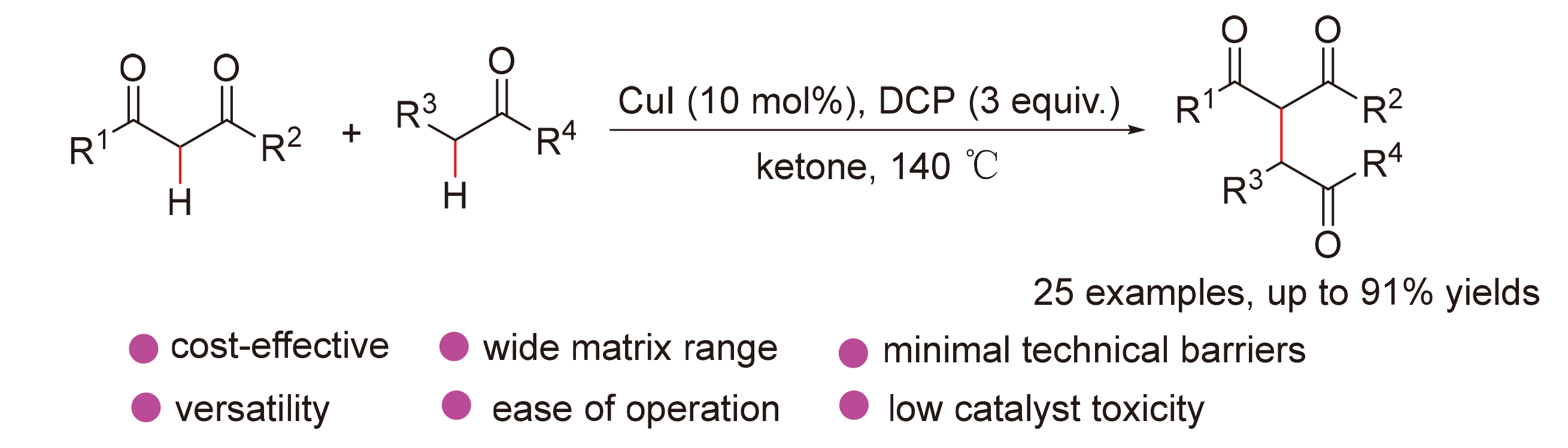
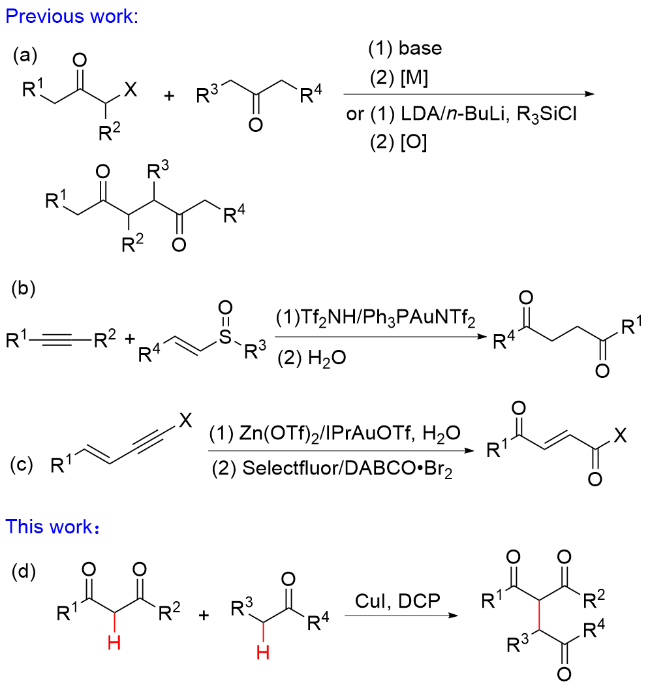
1,4-Dicarbonyl compounds play a significant role in the field of organic synthesis, and they are essential raw materials for the preparation of a wide range of heteroaromatic compounds. Such as furans,[5] thiophenes,[6] pyrroles,[7] and piperidines.[8] Zhou and Voituriez[9] developed an efficient method for synthesizing 1,4-dicarbonyl compounds from alkynes and vinyl sulfoxides. The utility of this approach was demonstrated through the preparation of five complex pyrrole-based pharmaceuticals. Separately, Chen and Enders[10] reported a radical polarity reversal catalysis stra- tegy to access 1,4-dicarbonyls. They applied this method to a concise synthesis of serotonin 5-HT1A receptor antagonists. Single carbonyl fragments or precursors without carbonyl fragments are less used in the synthesis of 1,4-dione compounds, and a coupling strategy based on two carbonyl-containing fragments is the current dominant approach for the synthesis of 1,4-dione compounds.[11] 1,4-Dicarbonyl compounds are traditionally prepared by the substitution reaction of α-halo ketones with nucleophilic enolates,[12] Stetter reaction,[13] oxidative coupling of enolates or silyl enol ethers,[14] and other approaches[15] (Scheme 1a). In recent years, many strategies for the synthesis of 1,4-dicarbonyl compounds using non-carbonyl compounds as substrates have also been reported. Kaldre et al.[16] demonstrated the synthesis of 1,4-dicarbonyl compounds with high enantioselectivity (dr>20∶1, er>99∶1) via a chiral auxiliary-assisted synthetic approach using Tf2NH (trifluoromethanesulfonimide) and chiral sulfur oxides as catalysts (Scheme 1b). Kobatakeand et al.[17] demonstrated the synthesis of 1,4-dicarbonyl compounds via a radical cyclization reaction mediated by Ti(OiPr)4 and EtNO2, followed by treatment of the final product by TiO2 and HCl. Huang et al.[18] describes the synthesis of 1,4- dicarbonyl compounds containing nitrogen heterocycles with high enantioselectivity via a multicomponent reaction catalyzed by (R)-STRIP (chiral thiourea). Liu et al.[19] developed a method that does not involve σ-migration rearrangement using 3-en-1-alkynes, which undergo hydration and oxidation reactions to produce α,β-unsaturated 1,4- dicarbonyl compounds (Scheme 1c). Dong et al.[20] described the synthesis of 1,4-dicarbonyl compounds via photoredox-catalyzed synthesis using [Ir(dFCF3ppy)2(dt- bbpy)]PF6 and Et3N as catalysts, followed by oxidation reactions to obtain the final products. It can be readily known that the simplest and most efficient synthetic route to obtain 1,4-dicarbonyl compounds may be the oxidative C—C bond coupling reaction of the C—H bonds of two readily available ketones.[10] Amaya et al.[21] employed a similar reaction pattern, developing an oxidative cross- coupling method for boron enolides with methylsilicon enol ethers. Lv et al.[22] reported the nBu4NI-catalyzed reaction of dicarbonyl compounds with acetone to construct 2-carbonyl-1,4-dione under metal-free conditions. Motivated by this, A straightforward method for the direct dehydrogenation coupling of two ketones to synthesize 1,4- dicarbonyl compounds is proposed, utilizing CuI as the catalyst (Scheme 1d). The method is highly versatile, easy to implement, compatible with a wide range of matrices, has low catalyst toxicity, and is cost-effective and readily available.
2 Results and discussion
Ethyl 3-oxo-3-phenylpropanoate 1 and acetone 2 were selected as model substrates to initiate the study for determining suitable reaction conditions (Table 1). Initially, the reaction was carried out in a solution of p-toluene sulfonic acid (TsOH•H2O, 10.0 mol%) and tert-butyl hydroperoxide (TBHP, 3.0 equiv.) in acetone (3.0 mL) at 120 ℃. To our delight, the reaction afforded the product in 18% yield after 6 h of monitoring (Table 1, Entry 1). Although the reaction yield was low, the feasibility of the method was preliminarily verified by the experimental results. Next, other catalysts, including CuI, AgNO3, and CoCl2•6H2O, were tested under identical reaction conditions (Table 1, Entries 2~4) with CuI identified as the optimal catalyst. CuI was chosen as catalyst to find other reaction conditions. Di-tert-butyl hydroperoxide (DTBP, 3.0 equiv.), diisopropylbenzene peroxide (DCP, 3.0 equiv.), benzoyl peroxide (BPO, 3.0 equiv.), tert-butyl benzoate peroxide (TBPB, 3.0 equiv.), and potassium persulfate (K2S2O8, 3.0 equiv.) were added separately. It was found that the reaction with the participation of DCP was much more effective than the other oxidants (Table 1, Entries 5~9). With CuI as the catalyst and DCP as the oxidant, the reaction solvent environment was varied by selecting a mixture of acetone and other solvents, such as methylene chloride, ethylene dichloride, toluene, and acetonitrile. After 6 h, only a small amount of the target product was observed (Table 1, Entries 10~21). This solvent system was less effective than using pure acetone as the solvent. With CuI as the catalyst, DCP as the oxidant, and pure acetone as the solvent, the effect of reaction temperature was further investigated by conducting the reaction at 140 and 80 °C for 6 h, respectively. The reaction afforded a 78% yield at 140 °C and only trace amounts of the product at 80 °C, indicating that the optimal reaction temperature was approximately 140 °C (Table 1, Entries 22~23). Additional copper catalysts, including CuBr, CuCl, Cu2O, CuCl2• 2H2O, Cu(OAc)2, CuSO4•5H2O, and Cu(NO3)2•3H2O, were evaluated under identical conditions. The yields observed after 6 h were consistently lower than those obtained with CuI as the catalyst (Table 1, Entries 24~31). Varying the catalyst loading to 20.0 and 5.0 mol% afforded no improved results (Table 1, Entries 32~33). Through the optimization of oxidant dosage, it was found that the reaction yield was the highest when 3.0 equiv. of DCP was added (Table 1, Entries 34~37). The optimum reaction conditions were determined as follows: CuI as catalyst, DCP as oxidant, in 3.0 mL ketone solvent, at 140 ℃ for 6 h.
Table 1 Screening of reaction conditionsa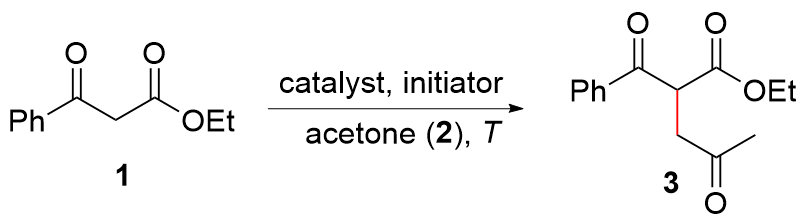 |
| Entry | Catalyst (mol%) | Initiator (equiv.) | Solvent | T/℃ | t/h | Yield b/% |
|---|---|---|---|---|---|---|
| 1 | TsOH•H2O (10) | TBHP (3) | Acetone | 120 | 6 | 18 |
| 2 | CuI (10) | TBHP (3) | Acetone | 120 | 6 | 30 |
| 3 | AgNO3 (10) | TBHP (3) | Acetone | 120 | 6 | 0 |
| 4 | CoCl2•6H2O (10) | TBHP (3) | Acetone | 120 | 6 | 0 |
| 5 | CuI (10) | DTBP (3) | Acetone | 120 | 6 | 18 |
| 6 | CuI (10) | DCP (3) | Acetone | 120 | 6 | 62 |
| 7 | CuI (10) | BPO (3) | Acetone | 120 | 6 | 43 |
| 8 | CuI (10) | TBPB (3) | Acetone | 120 | 6 | 53 |
| 9 | CuI (10) | K2S2O8 (3) | Acetone | 120 | 6 | 11 |
| 10 | CuI (10) | DCP (3) | DCM+10 equiv. acetone | 120 | 6 | 0 |
| 11 | CuI (10) | DCP (3) | DCE+10 equiv. acetone | 120 | 6 | 0 |
| 12 | CuI (10) | DCP (3) | THF+10 equiv. acetone | 120 | 6 | 0 |
| 13 | CuI (10) | DCP (3) | DMF+10 equiv. acetone | 120 | 6 | 0 |
| 14 | CuI (10) | DCP (3) | Methanol+10 equiv. acetone | 120 | 6 | Trace |
| 15 | CuI (10) | DCP (3) | V(acetone)∶V(THF)=1∶2 | 120 | 6 | 0 |
| 16 | CuI (10) | DCP (3) | V(acetone)∶V(MeNO2)=1∶2 | 120 | 6 | Trace |
| 17 | CuI (10) | DCP (3) | V(acetone)∶V(DCM)=1∶2 | 120 | 6 | 32 |
| 18 | CuI (10) | DCP (3) | V(acetone)∶V(toluene)=1∶2 | 120 | 6 | 41 |
| 19 | CuI (10) | DCP (3) | V(acetone)∶V(DMF)=1∶2 | 120 | 6 | 0 |
| 20 | CuI (10) | DCP (3) | V(acetone)∶V(methanol)=1∶2 | 120 | 6 | Trace |
| 21 | CuI (10) | DCP (3) | V(acetone)∶V(chlorobenzene)=1∶2 | 120 | 6 | 41 |
| 22 | CuI (10) | DCP (3) | Acetone | 140 | 6 | 78 |
| 23 | CuI (10) | DCP (3) | Acetone | 80 | 6 | Trace |
| 24 | CuBr (10) | DCP (3) | Acetone | 140 | 6 | 35 |
| 25 | CuCl (10) | DCP (3) | Acetone | 140 | 6 | 47 |
| 26 | Cu2O (10) | DCP (3) | Acetone | 140 | 6 | 52 |
| 27 | CuCl2•2H2O (10) | DCP (3) | Acetone | 140 | 6 | 49 |
| 28 | Cu(OAc)2 (10) | DCP (3) | Acetone | 140 | 6 | 18 |
| 29 | CuSO4•5H2O (10) | DCP (3) | Acetone | 140 | 6 | 56 |
| 30 | Cu(NO3)2•3H2O (10) | DCP (3) | Acetone | 140 | 6 | 38 |
| 31 | TBAI (10) | DCP (3) | Acetone | 140 | 6 | 45 |
| 32 | CuI (20) | DCP (3) | Acetone | 140 | 6 | 53 |
| 33 | CuI (5) | DCP (3) | Acetone | 140 | 6 | 68 |
| 34 | CuI (10) | DCP (5) | Acetone | 140 | 6 | 45 |
| 35 | CuI (10) | DCP (4) | Acetone | 140 | 6 | 55 |
| 36 | CuI (10) | DCP (2) | Acetone | 140 | 6 | 67 |
| 37 | CuI (10) | DCP (1.2) | Acetone | 140 | 6 | 36 |
a Standard reaction conditions: 1 (0.3 mmol), solvent (3.0 mL), CuI (0.03 mmol), DCP (0.9 mmol), 140 ℃, 6 h. b Yield of the isolated products. |
The generalizability of the C—C cross-coupling reaction was subsequently investigated. As shown in Table 2, avariety of 1,3-diketone compounds containing different groups were investigated, and all 1,3-diketones tested were well converted to the desired products in moderate to good yields (3a~3y). Generally, the substrates with electron- donating substituents on the aryl ring (1b, 1c) gave higher yields than those with electron-withdrawing substituents on the aryl ring (1d~1f). The methyl-substituted compounds (1b) and (1g) at different positions on the benzene ring underwent complete reaction to afford 3b (74%) and 3g (62%), respectively, indicating that the steric hindrance on the aromatic ring had little effect on the reaction. The halo-substituted 1,3-diketone substrates (1d~1f) were also tolerated in the coupling reaction, thus allowing further functionalization by cross-coupling. Subsequent investigation of heterocyclic substrates yielded compound 3h in 40% yield from ethyl 3-oxo-3-(thiophen-2-yl)propanoate under identical reaction conditions. Comparative evaluation of methoxy-containing substrates—methyl 3-oxo-3- phenylpropanoate (1i) and methyl 3-(4-fluorophenyl)-3- oxopropanoate (1j)—versus ethoxy-containing analo- gues—ethyl 3-oxo-3-phenylpropanoate (1a) and ethyl 3- (4-fluorophenyl)-3-oxopropanoate (1f)—revealed marginally higher yields for the methoxy-functionalized systems. This observation may be attributed to the stronger electron-donating effect of the methoxy group compared to the ethoxy group, which facilitates the stabilization of reaction intermediates and thus enhances the reaction yield. The 1-phenylbutane-1,3-dione (1l) without methoxy was slight- ly less electron donating and the yield decreased to 45%, and when using 1,3-diphenylpropane-1,3-dione (1m), which was replaced with phenyl at the methoxy position as substrate, the yield increased to 68%, which is in line with our previous speculation because the aryl group is also an electron donating group. Notably, 1,2-diphenylethan-1-one underwent homocoupling under standard reaction conditions, affording product 3n in enhanced yield. Building on these findings, additional ketones were subjected to coupling reactions with 1,3-diketone compounds under identical conditions, affording the desired products (3o~3y) in good yields with reaction outcomes aligning consistently with initial mechanistic hypotheses.
Table 2 Coupling reaction between 1,3-diketones and ketonesa,b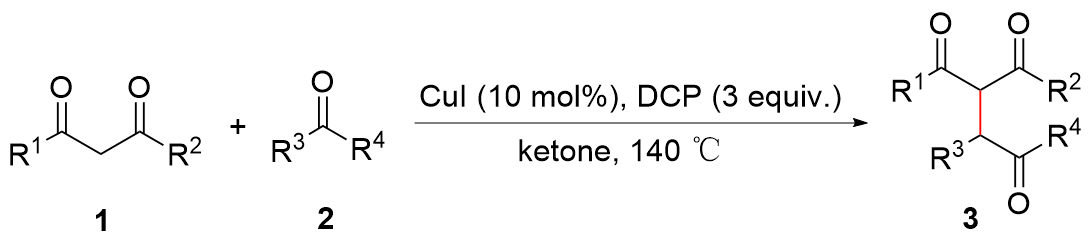 |
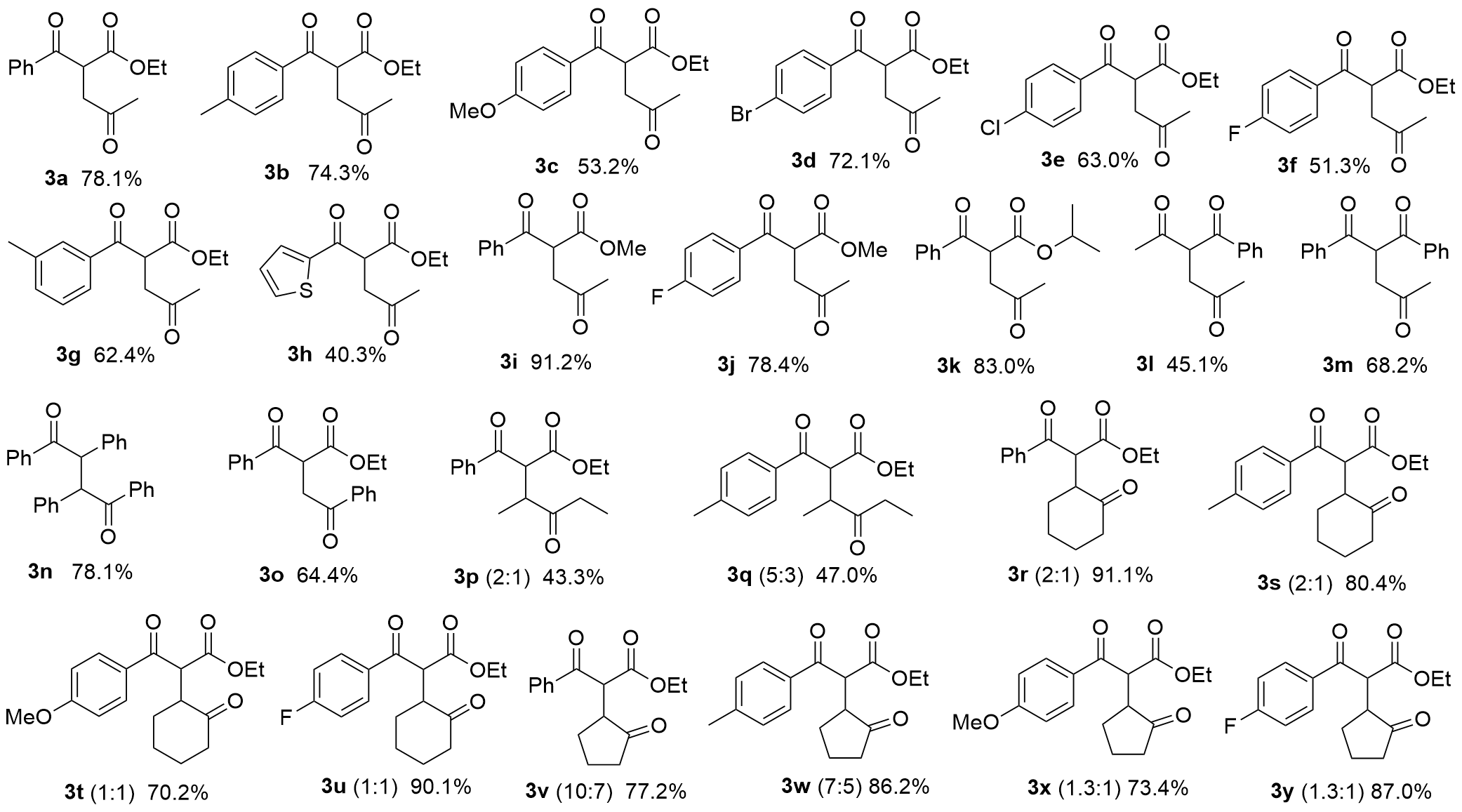 |
aStandard reaction conditions: 1 (0.3mmol), 2 (3.0mL), CuI (0.03mmol), DCP (0.9mmol), 140 ℃, 6 h. b Yield of the isolated products. |
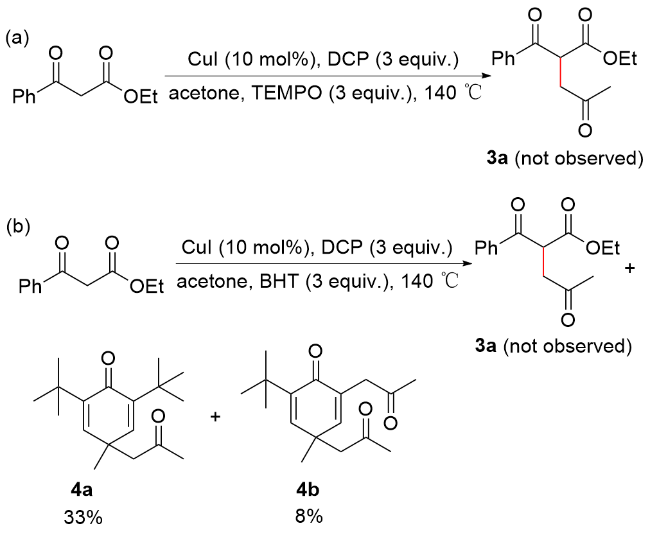
2,2,6,6-Tetramethylpiperidin-1-yloxy (TEMPO) experi- ments, and butylated hydroxytoluene (BHT) experiments were performed in order to gain insight into the reaction mechanism. In TEMPO titration experiments, 0.3, 1.2, 2, and 3 equiv. of TEMPO were sequentially introduced into reaction systems containing substrate 1a under otherwise optimal conditions (Scheme 2a). After the full reaction, the thin-layer chromatography (TLC) assay revealed that no product was observed in the reaction system with the addi- tion of 3 equiv. of TEMPO, and that the reaction was almost completely inhibited, which suggests that the reaction may involve a free radical mechanism and TEMPO prevents the reaction from proceeding by trapping key radical intermediates prevented the reaction from proceeding. In order to further investigate the free radical reaction mechanism, BHT trapping experiments were conducted using 1a as the substrate under the optimal reaction conditions. Sequentially, 0.3, 1.2, 2, and 3 equiv. of BHT were added. After the reaction reached completion, TLC analysis showed that no 3a was detected in the system with 3 equiv. of BHT. Instead, two products were observed with yields of 33% (major product) and 8% (minor product), respectively (Scheme 2b). The structures of these products were determined by NMR and MS. The major product was identified as 2,6-di-tert-butyl-4-methyl-4-(2-oxopropyl)cyclo- hexa-2,5-dien-1-one, and the minor product as 1,1'-(5- (tert-butyl)-3-methyl-6-oxocyclohexa-1,4-dien-1,3-diyl)-bis(propan-2-one).
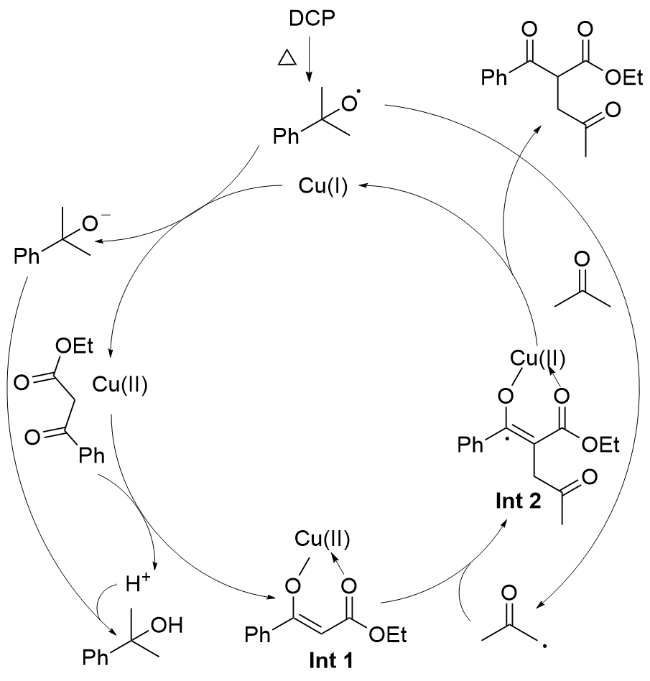
A preliminary mechanism is proposed. Under thermal conditions, homolytic cleavage of the O—O bond in dicumyl peroxide (DCP) occurs, yielding two cumyl oxy radicals (Scheme 3). These cumyl oxy radicals can abstract a hydrogen atom from a ketone substrate (e.g., carbonyl compounds containing α-hydrogens), producing phenol byproducts and α-carbonyl carbon-centered radicals. Simultaneously, Cu(I) is oxidized to Cu(II), forming a copper complex (Int 1) with the substrate. Subsequently, the α-carbonyl carbon-centered radical forms a new C—C bond with this copper complex (Int 1), yielding a new copper complex (Int 2) bearing the coupled radical species. Finally, Int 2 undergoes reduction, regenerating Cu(I) and forming the 1,4-diketone product.[23]


3 Conclusions
In conclusion, a simple catalytic protocol is established for synthesizing 1,4-dicarbonyl compounds through direct dehydrocoupling of ketones employing CuI catalysis. This method offers a compelling combination of versatility, operational simplicity, broad substrate scope, low catalyst toxicity, cost efficiency, and minimal technical barriers, making it widely applicable. It should be specifically noted that the inactive ketone of the method is not limited to acetone, other more complex ketones are also applicable, which obviously will be more favorable for the synthesis of complex 1,4-dicarbonyl compounds. Importantly, the developed strategy offers significant advantages in terms of simplified handling and post-treatment procedures, thus providing a reliable alternative for the efficient and practical synthesis of various 1,4-dicarbonyl compounds from two different ketone precursors.
4 Experimental section
4.1 General
Chemicals and solvents were all purchased from commercial sources and used without additional treatment. Reactions were monitored by TLC using silica gel F254 plates. Column chromatography was performed on 300~400 mesh silica gel under a positive pressure of air. 1H NMR, 13C NMR, DEPT NMR spectra were recorded at 25 ℃ on a Bruker Ascend 400 spectrometer using tetramethylsilane (TMS) as internal standard. High-resolution mass spectra (HRMS) were obtained using a Bruker microTOF II Focus spectrometer (ESI).
4.2 General procedure for the preparation of 3
To a solution of ethyl 3-oxo-3-phenylpropanoate (1a) (53.5 mg, 0.3 mmol) in acetone (3.0 mL) were added CuI (5.7 mg, 0.03 mmol) and DCP (243.3 mg, 0.9 mmol) in a 25 mL Schlenk tube. Under an argon atmosphere, the reaction was stirred at 140 ℃ for 6.0 h. At the end of the reaction, the reaction mixture was cooled to room temperature and quenched by the addition of a saturated solution of sodium thiosulfate (3.0 mL). The mixture was extracted with ethyl acetate (5.0 mL×3) and the combined organic phases were dried over anhydrous sodium sulfate and the solvent was evaporated under vacuum. The residue was purified by column chromatography [silica gel, V(petro- leum ether)∶V(ethyl acetate)=30∶1] to give the corresponding product ethyl 2-benzoyl-4-oxopentanoate (3a), pale yellow oil (58.1 mg, 78%). 1H NMR (400 MHz, CDCl3) δ: 8.00~8.03 (m, 2H), 7.56~7.60 (m, 1H), 7.45~7.50 (m, 2H), 4.90 (dd, J=6.3, 7.4 Hz, 1H), 4.12 (q, J=7.1 Hz, 2H), 3.18 (qd, J=18.2, 6.9 Hz, 2H), 2.22 (s, 3H), 1.15 (t, J=7.0 Hz, 3H); 13C NMR (100 MHz, CDCl3) δ: 205.39, 194.62, 169.20, 135.96, 133.61, 128.86 (2C), 128.69 (2C), 61.74, 48.82, 42.24, 29.82, 13.90; HRMS (ESI) calcd for C14H17O4 [M+H]+ 249.1127, found 249.1121.
Compounds 3b~3y, 4a and 4b are synthesized using the same method.
Ethyl 2-(4-methylbenzoyl)-4-oxopentanoate (3b): Light yellow liquid. 1H NMR (400 MHz, CDCl3) δ: 7.92 (dd, J=1.9, 6.4 Hz, 2H), 7.27 (d, J=9.2 Hz, 2H), 4.8 (t, J=7.0 Hz,1H), 4.13 (q, J=7.2 Hz, 2H), 3.10~3.22 (m, 2H), 2.42 (s, 3H), 2.23 (s, 3H), 1.16 (t, J=7.1 Hz, 3H); 13C NMR (100 MHz, CDCl3) δ: 205.44, 194.15, 169.34, 144.60, 133.41, 129.40 (2C), 129.03 (2C), 61.69, 48.73, 42.25, 29.86, 21.71, 13.93; HRMS (ESI) calcd for C15H20O4 [M+H]+ 263.1283, found 263.1287.
Ethyl 2-(4-methoxybenzoyl)-4-oxopentanoate (3c): Light yellow liquid. 1H NMR (400 MHz, CDCl3) δ: 8.02 (d, J=8.9 Hz, 2H), 6.95 (d, J=9.0 Hz, 2H), 4.86 (t, J=6.9 Hz, 1H), 4.13 (q, J=7.1 Hz, 2H), 3.87 (s, 3H), 3.16 (dd, J=3.9, 7.1 Hz, 2H), 2.22 (s, 3H), 1.67 (t, J=7.2 Hz, 3H); 13C NMR (100 MHz, CDCl3) δ: 205.56, 192.89, 169.39, 163.98, 131.31 (2C), 128.85, 113.88 (2C), 61.65, 55.53, 48.53, 42.25, 29.87, 13.94; HRMS (ESI) calcd for C15H19- O5 [M+H]+ 278.1154, found 278.1159.
Ethyl 2-(4-bromobenzoyl)-4-oxopentanoate (3d): Light yellow liquid. 1H NMR (400 MHz, CDCl3) δ: 7.88~7.91 (m, 2H), 7.61~7.65 (m, 2H), 4.83 (dd, J=5.8, 8.0 Hz, 1H), 4.13 (q, J=7.1 Hz, 2H), 3.27 (dd, J=18.3, 8.1 Hz, 1H), 3.13 (dd, J=18.3, 5.8 Hz, 1H), 2.25 (s, 3H), 1.16 (t, J=7.1 Hz, 3H); 13C NMR (100 MHz, CDCl3) δ: 205.33, 193.67, 168.85, 134.81, 132.03 (2C), 131.92, 130.38 (2C), 61.92, 48.66, 42.27, 29.78, 13.93; HRMS (ESI) calcd for C14H16BrO4 [M+H]+ 327.0232, found 327.0238.
Ethyl 2-(4-chlorobenzoyl)-4-oxopentanoate (3e): Light yellow liquid. 1H NMR (400 MHz, CDCl3) δ: 7.95~7.98 (m, 2H), 7.43~7.46 (m, 2H), 4.83 (dd, J=5.8, 8.1 Hz, 1H), 4.13 (q, J=7.1 Hz, 2H), 3.26 (dd, J=18.3, 8.0 Hz, 1H), 3.13 (dd, J=5.8, 18.3 Hz, 1H), 2.22 (s, 3H), 1.16 (t, J=7.1Hz, 3H); 13C NMR (100 MHz, CDCl3) δ: 205.34, 193.43, 168.86, 140.13, 134.42, 130.29 (2C), 129.02 (2C), 61.89, 48.70, 42.26, 29.77, 13.92; HRMS (ESI) calcd for C14H16ClO4 [M+H]+ 283.0737, found 283.0734.
Ethyl 2-(4-fluorobenzoyl)-4-oxopentanoate (3f): Light yellow liquid. 1H NMR (400 MHz, CDCl3) δ: 8.05~8.08 (m, 2H), 7.13~7.18 (m, 2H), 4.85 (dd, J=5.9, 7.9 Hz, 1H), 4.13 (q, J=7.1 Hz, 2H), 3.26 (dd, J=18.3, 7.9 Hz, 1H), 3.14 (dd, J=5.9, 18.3 Hz, 1H), 2.23 (s, 3H), 1.59 (t, J=7.2 Hz, 3H); 13C NMR (100 MHz, CDCl3) δ: 205.48, 192.98, 168.96, 167.32, 131.67, 131.57, 130.74, 115.95, 115.73, 61.84, 28.70, 42.25, 29.78, 13.90; HRMS (ESI) calcd for C14H16FO4 [M+H]+ 267.1033, found 267.1037.
Ethyl 2-(3-methylbenzoyl)-4-oxopentanoate (3g): Light yellow liquid. 1H NMR (400 MHz, CDCl3) δ: 7.81~7.83 (m, 1H), 7.35~7.42 (m, 1H), 4.89 (dd, J=6.5, 7.3 Hz, 1H), 4.13 (q, J=7.2 Hz, 1H), 3.15~3.31 (m, 2H), 2.42 (s, 3H), 2.23 (s, 3H), 1.16 (t, J=7.2 Hz, 3H); 13C NMR (100 MHz, CDCl3) δ: 205.48, 194.82, 169.31, 138.54, 135.91, 134.45, 129.34, 128.58, 126.12, 61.72, 48.83, 42.27, 29.87, 21.38, 13.93; HRMS (ESI) calcd for C15H19O4 [M+H]+ 262.1205, found 262.1209.
Ethyl 4-oxo-2-(thiophene-2-carbonyl)pentanoate (3h): Light yellow liquid. 1H NMR (400 MHz, CDCl3) δ: 7.88 (t, J=2.7 Hz, 1H), 7.69 (dd, J=1.2, 5.0 Hz), 7.15 (dd, J=3.8, 5.0 1H), 4.72 (t, J=6.9 Hz, 1H), 4.13 (q, J=7.1 Hz, 2H), 3.17 (d, J=7.0 Hz, 2H), 2.20 (s, 3H), 1.17 (t, J=7.1 Hz, 3H); 13C NMR (100 MHz, CDCl3) δ: 205.30, 186.90, 168.76, 143.02, 135.02, 133.64, 128.32, 61.87, 50.07, 42.09, 29.83, 13.93; HRMS (ESI) calcd forC12H15O4S [M+H]+ 255.3080, found 255.3083.
Methyl 2-benzoyl-4-oxopentanoate (3i): Light yellow liquid. 1H NMR (400 MHz, CDCl3) δ: 7.99~8.02 (m, 2H), 7.56 (t, J=7.0 Hz, 1H), 7.45~7.49 (m, 2H), 4.91 (dd, J=6.2, 7.1 Hz, 1H), 3.65 (s, 3H), 3.11~3.25 (m, 2H), 2.22 (s, 3H); 13C NMR (100 MHz, CDCl3) δ: 205.30, 194.52, 169.70, 135.83, 133.69, 128.87 (2C), 128.76 (2C), 52.75, 48.44, 42.35, 29.76; HRMS (ESI) calcd for C13H15O4 [M+H]+ 235.0970, found 235.0976.
Methyl 2-(4-fluorobenzoyl)-4-oxopentanoate (3j): Light yellow liquid. 1H NMR (400 MHz, CDCl3) δ: 8.03~8.07 (m, 2H), 7.12~7.16 (m, 2H), 4.86 (dd, J=5.9, 7.8 Hz, 1H), 3.66 (s, 3H), 3.10~3.28 (m, 2H), 2.21 (s, 3H); 13C NMR (100 MHz, CDCl3) δ: 205.33, 192.89, 169.45, 167.36, 164.82, 132.37, 132.34, 131.69, 131.59, 116.02, 115.80, 52.83, 48.34, 42.37, 29.72.HRMS (ESI) calcd for C13H14FO4 [M+H]+ 253.0876, found 253.0873.
Isopropyl 2-benzoyl-4-oxopentanoate (3k): Light yellow liquid. 1H NMR (400 MHz, CDCl3) δ: 7.99~8.02 (m, 2H), 7.56~7.60 (m, 1H), 7.45~7.49 (m, 2H), 4.93~4.99 (m, 1H), 4.85 (dd, J=7.6, 6.2 Hz, 1H), 3.08~3.25 (m, 2H), 2.23 (s, 3H), 1.12 (dd, J=10.7, 6.3 Hz, 6H); 13C NMR (100 MHz, CDCl3) δ: 205.49, 194.67, 168.75, 136.01, 133.56, 128.85 (2C), 128.64 (2C), 69.43, 49.21, 42.11, 29.90, 21.51, 21.39; HRMS (ESI) calcd for C15H19O4 [M+H]+ 263.1283, found 263.1288.
Benzoylhexane-2,5-dione (3l): Light brown oil. 1H NMR (400 MHz, CDCl3) δ: 7.99~8.02 (m, 2H), 7.60~7.64 (m,1H), 7.48~7.53 (m, 2H), 5.07 (t, J=6.7 Hz, 1H), 3.20 (dd, J=18.2, 7.1 Hz, 1H), 3.01 (dd, J=18.2, 6.2 Hz, 1H), 2.17 (s, 3H), 2.16 (s, 3H); 13C NMR (100 MHz, CDCl3) δ: 205.41, 202.37, 196.19, 135.94, 133.92, 129.00 (2C), 128.82 (2C), 56.82, 42.09, 29.84, 29.38; HRMS (ESI) calcd for C13H15O3 [M+H]+ 219.1021, found 219.1024.
Benzoyl-1-phenylpentane-1,4-dione (3m): Yellow oil. 1H NMR (400 MHz, CDCl3) δ: 7.94~7.97 (m, 4H), 7.94~7.97 (m, 2H), 7.55~7.59 (m, 4H), 5.88 (t, J=6.5 Hz, 1H), 3.19 (d, J=6.5 Hz, 2H), 2.28 (s, 3H); 13C NMR (100 MHz, CDCl3) δ: 205.28, 195.73 (2C), 135.41 (2C), 133.76 (2C), 128.97 (4C), 128.64 (4C), 51.53, 42.10, 30.05; HRMS (ESI) calcd for C18H17O3 [M+H]+ 281.1178, found 281.1171.
1,2,3,4-Tetraphenylbutane-1,4-dione (3n): White solid. 1H NMR (400 MHz, CDCl3) δ: 7.98~8.00 (m, 4H), 7.44~7.48 (m, 2H), 7.34~7.39 (m, 4H), 7.09~7.13 (m, 6H), 7.00~7.03 (m, 4H), 5.39 (s, 2H); 13C NMR (100 MHz, CDCl3) δ: 199.47 (2C), 136.41 (2C), 136.34 (2C), 132.91 (2C), 128.93 (4C), 128.82 (4C), 128.64 (4C), 128.46 (4C), 127.20 (2C), 58.51 (2C); HRMS (ESI) calcd for C28H23O2 [M+H]+ 391.1698, found 391.1692.
Ethyl 2-benzoyl-4-oxo-4-phenylbutanoate (3o): Light yellow liquid. 1H NMR (400 MHz, CDCl3) δ: 8.09~8.11 (m, 2H), 7.99~8.02 (m, 2H), 7.56~7.63 (m, 2H), 7.44~7.53 (m, 4H), 5.13 (dd, J=7.6, 6.1 Hz, 1H), 4.16 (q, J=7.1 Hz, 2H), 3.70~3.86 (m, 2H), 1.17 (t, J=7.1 Hz, 3H); 13C NMR (100 MHz, CDCl3) δ: 196.94, 194.86, 169.31, 136.09, 133.62, 133.55 (2C), 128.98 (2C), 128.73 (2C), 128.69 (2C), 128.25 (2C), 61.82, 48.87, 38.19, 13.96; HRMS (ESI) calcd for C19H19O4 [M+H]+ 311.1283, found 311.1288.
Ethyl 2-benzoyl-3-methyl-4-oxohexanoate (3p): Light yellow liquid. 1H NMR (400 MHz, CDCl3) δ: 8.07 (d, J=7.1 Hz, 2H minor), 8.01 (d, J=7.1 Hz, 2H major), 7.44~7.56 (stack, 3H major and minor), 4.87 (dd, J=10.6 Hz, 1H minor), 4.69 (dd, J=10.6 Hz, 1H major), 4.05~4.12 (m, 3H major), 3.55~3.60 (m, 3H minor), 2.67 (q, J=1.4 Hz, 2H major and minor), 0.97~1.19 (m, 9H major and minor); 13C NMR (100 MHz, CDCl3) δ: 213.36 (minor), 212.76 (major), 195.50 (minor), 193.99 (major), 168.86 (minor), 168.79 (major), 136.96 (minor), 135.88 (major), 133.87 (minor), 133.63 (major), 129.10 (2C minor), 128.81 (2C minor), 128.73 (2C major), 128.65 (2C, major), 61.65 (major and minor), 57.80 (major), 55.30 (minor), 45.48 (minor), 45.16 (major), 34.75 (minor), 34.53 (major), 15.13 (minor), 14.91 (major), 13.99 (major), 13.88 (minor), 7.72 (minor), 7.67 (major).
Ethyl 3-methyl-2-(4-methylbenzoyl)-4-oxohexanoate (3q): Light yellow liquid. 1H NMR (400 MHz, CDCl3) δ: 7.98 (d, J=8.3 Hz, 2H minor), 7.91 (dd, J=1.9, 6.4 Hz, 2H major), 7.30 (d, J=8.0 Hz, 2H minor), 7.24(d, J=8.0 Hz, 2H major), 4.84 (d, J=10.6 Hz, 1H minor), 4.67 (d, J=10.6 Hz, 1H major), 4.03~4.15 (m, 3H major), 3.52~3.60 (m, 3H minor), 2.64~2.69 (m, 2H major and minor), 2.42 (s, 3H minor), 2.39 (s, 3H major), 0.96~1.18 (m, 9H major and minor); 13C NMR (100 MHz, CDCl3) δ: 213.47 (minor), 212.75 (major), 194.98 (minor), 193.49 (major), 169.00 (major), 168.92 (minor), 144.94 (minor), 144.55 (major), 134.52 (minor), 133.42 (major), 129.51 (2C minor), 129.33 (2C major), 129.28 (2C minor), 128.87 (2C major), 61.57 (major and minor), 57.75 (major), 56.16 (minor), 45.47 (minor), 45.07 (major), 34.76 (minor), 34.57 (major), 21.71 (minor), 21.70 (major), 15.12 (minor), 14.89 (major), 14.01 (major), 13.89 (minor), 7.71 (minor), 7.66 (major).
Ethyl 3-oxo-2-(2-oxocyclohexyl)-3-phenylpropanoate (3r): Light yellow liquid. 1H NMR (400 MHz, CDCl3) δ: 8.05~8.09 (m, 2H major and minor), 7.54~7.66 (m, 1H major and minor), 7.42~7.54 (m, 2H major and minor), 4.75 (d, J=10.0 Hz, 1H minor), 4.63 (d, J=10.0 Hz major), 4.07~4.20 (m, 2H major and minor), 3.50~3.63 (m, 1H major and minor), 1.55~2.48 (stack, 8H major and minor),1.15~1.19 (m, 3H major and minor); 13C NMR (100 MHz, CDCl3) δ: 211.05 (minor), 210.15 (major), 195.13 (minor), 193.37 (major), 168.58 (major), 168.43 (minor), 136.82 (minor), 136.32 (major), 133.82 (minor), 133.33 (major and minor), 129.02 (2C minor), 128.76 (2C minor), 128.67 (2C major), 128.61 (2C major), 61.62 (major), 61.56 (minor), 54.80 (major), 53.67 (minor), 51.58 (minor), 51.37 (major), 42.09 (minor), 41.98 (major), 31.84 (minor), 31.67 (major), 28.17 (minor), 28.07 (major), 25.18 (major), 25.15 (minor), 14.03 (major), 13.92 (minor).
Ethyl 3-oxo-2-(2-oxocyclohexyl)-3-(p-tolyl)propanoate (3s): Light yellow liquid. 1H NMR (400 MHz, CDCl3) δ: 7.96 (dd, J=8.1, 14.4 Hz, 2H major and minor), 7.27 (dd, J=8.1, 13.8 Hz, 2H major and minor), 4.72 (d, J=11.2 Hz, 1H minor), 4.62 (d, J=10.2 Hz, 1H major), 4.09~4.16 (m, 2H major and minor), 3.53~3.61 (m, 1H major and minor), 2.36~2.49 (m, 3H major and minor), 1.53~2.17 (stack, 8H major and minor), 1.15~1.19 (m, 3H major and minor); 13C NMR (100 MHz, CDCl3) δ: 211.09 (minor), 210.05 (major), 194.61 (minor), 192.87 (major), 168.73 (major), 168.54 (minor), 144.87 (minor), 144.19 (major), 134.40 (minor), 133.83 (major), 129.46 (2C minor), 129.31 (2C major), 129.19 (2C minor), 128.82 (2C major), 61.53 (major), 61.47 (minor), 54.69 (major), 53.55 (minor), 51.58 (minor), 51.23 (major), 42.12 (minor), 42.01 (major), 31.90 (minor), 31.64 (major), 28.22 (minor), 28.08 (major), 25.23 (major), 25.17 (minor), 21.70 (minor), 21.68 (major), 14.05 (major), 13.94 (minor).
Ethyl 3-(4-methoxyphenyl)-3-oxo-2-(2-oxocyclohexyl)- propanoate (3t): Light yellow liquid. The ratio of the mixture is 1∶1. 1H NMR (400 MHz, CDCl3) δ: 8.03~8.09 (m, 2H), 6.93~6.98 (m, 2H), 4.69 (d, J=10.1 Hz, 1H), 4.60 (d, J=10.0 Hz 1H), 4.07~4.17 (m, 2H), 3.87 (s, 3H), 3.85 (s, 3H), 3.50~3.61 (m, 1H), 1.23~2.49 (m, 8H), 1.18 (t, J=7.1 Hz, 3H); 13C NMR (100 MHz, CDCl3) δ: 211.20, 211.11, 193.29, 191.63, 168.81, 168.61, 164.15, 163.73, 131.48, 131.02, 129.83, 129.28, 113.92, 113.79, 61.48, 61.40, 55.55, 55.47, 54.52, 53.38, 51.54, 51.10, 42.11, 42.01, 31.93, 31.64, 28.24, 28.12, 25.22, 25.15, 14.05, 13.94.
Methyl 3-(4-fluorophenyl)-3-oxo-2-(2-oxocyclohexyl)- propanoate (3u): Light yellow liquid. The ratio of the mixture is 1∶1. 1H NMR (400 MHz, CDCl3) δ: 8.06~8.14 (m, 2H), 7.12~7.19 (m, 2H), 4.71 (d, J=10.9 Hz, 1H), 4.60 (d, J=10.1 Hz 1H), 3.68 (s, 3H), 3.67 (s, 3H), 3.49~3.65 (m, 1H), 1.25~2.49 (m, 8H), 1.18 (t, J=7.1 Hz, 3H); 13C NMR (100 MHz, CDCl3) δ: 210.93, 210.13, 193.31, 191.72, 168.85, 168.77, 167.22, 164.97, 164.69, 133.16, 133.14, 132.72, 132.68, 131.86, 131.77, 131.44, 131.34, 116.11, 115.93, 115.90, 115.71, 54.61, 53.42, 52.78, 52.74, 51.59, 51.57, 42.06, 41.94, 31.82, 31.79, 28.13, 28.06, 25.15, 25.13.
Ethyl 3-oxo-2-(2-oxocyclopentyl)-3-phenylpropanoate (3v): Light yellow liquid. 1H NMR (400 MHz, CDCl3) δ: 7.94~7.99 (m, 2H major and minor), 7.56~7.62 (m, 1H major and minor), 7.43~7.52 (m, 2H major and minor), 4.83 (d, J=6.2 Hz, 1H major), 4.66 (d, J=6.2 Hz, 1H minor), 2.83~2.97 (m, 1H major and minor), 1.70~2.38 (m, 6H major and minor), 1.18 (t, J=7.1Hz, 3H major and minor); 13C NMR (100 MHz, CDCl3) δ: 218.01 (minor), 217.69 (major), 194.49 (major), 193.60 (minor), 169.16 (minor), 168.68 (major), 136.24 (minor), 136.01 (minor), 133.63 (major), 128.83 (2C minor), 128.71 (2C minor), 128.56(4C major), 61.71 (major), 61.58 (minor), 54.06 (minor), 53.03 (major), 48.99 (minor), 48.91 (major), 37.46 (minor), 37.24 (major), 26.91 (minor), 26.33 (major), 20.72 (minor), 20.70 (major), 13.99 (minor), 13.94 (major).
Ethyl 3-oxo-2-(2-oxocyclopentyl)-3-(p-tolyl)propanoate (3w): Light yellow liquid. 1H NMR (400 MHz, CDCl3) δ: 7.87 (t, J=9.0 Hz, 2H major and minor), 7.27 (t, J=8.0 Hz, 2H major and minor), 4.81 (d, J=6.2 Hz, 1H major), 4.62 (d, J=6.2 Hz, 1H minor), 279~2.97 (m, 1H major and minor), 2.42 (s, 3H), 2.41 (s, 3H), 1.74~2.36 (m, 5H major and minor), 1.19 (t, J=7.1 Hz, 3H major and minor); 13C NMR (100 MHz, CDCl3) δ: 218.13 (minor), 217.73 (major), 194.05 (major), 193.12 (minor), 169.26 (minor), 168.82 (major), 144.61 (major and minor), 133.78 (minor), 133.51 (major), 129.52 (2C major), 129.40 (2C minor), 128.74 (2C minor), 128.70 (2C major), 61.64 (minor), 61.50 (major), 53.97 (minor), 52.92 (major), 49.02 (minor), 48.90 (major), 37.45 (minor), 37.28 (major), 26.99 (minor), 26.29 (major), 21.70 (minor), 20.70 (major), 13.99 (major), 13.96 (minor).
Ethyl 3-(4-methoxyphenyl)-3-oxo-2-(2-oxocyclopentyl)- propanoate (3x): Light yellow liquid. 1H NMR (400 MHz, CDCl3) δ: 7.93~7.99 (m, 2H major and minor), 6.91~6.97 (m, 2H major and minor), 4.78 (d, J=6.3 Hz, 1H major), 4.59 (d, J=7.1 Hz, 2H major), 4.11~4.20 (m, 2H major and minor), 3.85~3.88 (m, 3H major and minor), 2.79~2.99 (m, 2H major and minor), 1.75~2.40 (m, 8H), 1.17~1.22 (m, 3H major and minor); 13C NMR (100 MHz, CDCl3) δ: 61.62 (minor), 61.47 (major), 55.55 (major), 55.52 (minor), 53.80 (minor), 52.73 (major), 49.09 (minor), 48.94 (major), 37.46 (minor), 37.30 (major), 27.09 (minor), 26.31 (major), 20.70 (major), 26.31 (minor), 20.70 (major), 20.68 (minor), 14.01 (major), 13.98 (minor).
Methyl 3-(4-fluorophenyl)-3-oxo-2-(2-oxocyclopentyl)-propanoate (3y): Light yellow liquid. 1H NMR (400 MHz, CDCl3) δ: 7.98~8.03 (m, 2H major and minor), 7.12~7.19 (m, 2H major and minor), 4.76 (d, J=6.0 Hz, 1H major), 4.62 (d, J=6.9 Hz, 3H minor), 3.72 (s, 3H major), 3.61 (s, 3H minor), 2.87~3.02 (m, 2H major and minor), 1.79~2.42 (m, 6H major and minor); 13C NMR (100 MHz, CDCl3) δ: 217.86, 217.46, 192.70, 191.88, 169.49, 168.94, 132.58, 132.55, 132.45, 132.42, 131.42, 131.36, 131.33, 131.27, 116.16, 116.09, 115.94, 115.87, 53.69, 52.83, 52.82, 52.61, 49.14, 49.12, 37.40, 37.09, 27.03, 26.47, 20.67, 20.65.
2,6-Di-tert-butyl-4-methyl-4-(2-oxopropyl)cyclohexa-2,5-dien-1-one (4a): Light yellow liquid. 1H NMR (400 MHz, CDCl3) δ: 6.59 (s, 2H), 2.62 (s, 2H), 2.03 (s, 3H), 1.28 (s, 3H), 1.23 (s, 18H); 13C NMR (100 MHz, CDCl3) δ: 205.69, 186.04, 146.27 (2C), 144.97 (2C), 53.87, 38.60, 34.70 (2C), 31.32, 29.40 (6C), 26.54.
1,1'-(5-(tert-Butyl)-3-methyl-6-oxocyclohexa-1,4-dien-1,3-diyl)bis(propan-2-one) (4b): Light yellow liquid. 1H NMR (400 MHz, CDCl3) δ: 6.74 (d, J=2.9 Hz, 1H), 6.69 (d, J=3.0 Hz, 1H), 3.40 (d, J=16.0 Hz, 1H), 3.39 (d, J=16.0 Hz, 1H), 2.67 (s, 2H), 2.21 (s, 3H), 2.09 (s, 3H), 1.32 (s, 3H), 1.21(s, 9H); 13C NMR (100 MHz, CDCl3) δ: 205.91, 205.51, 184.78, 150.14, 147.43, 144.75, 134.04, 52.92, 44.42, 39.35, 34.55, 31.31, 29.94, 29.10(3C), 25.85.
Supporting Information Copies of 1H NMR, 13C NMR and DEPT NMR spectra. The Supporting Information is available free of charge via the Internet at http://sioc- journal.cn.
(Cheng, F.)