


1 Introduction
Oxindoles are important nitrogen-containing heterocycles[1] encountered in in various bioactive molecules, functional materials, chiral ligands and natural products, and they are also important versatile synthetic building blocks in organic synthesis.[2] Therefore, the development of robust and modular tactics to build these skeletons has long been a key focus of synthetic chemists. Over the past decade, transition-metal-catalyzed reductive cross-coupling (RCC) reactions have been extensively investigated. This strategy avoids the use of preprepared organometallic nucleophiles, and can effectively join two different electrophiles in the presence of a terminal reductant to forge diverse C—C bonds.[3] In this research field, nickel-catalyzed reductive cross-coupling (RCC) reactions between N-(o-haloaryl)- acrylamides and alkyl electrophiles are undoubtedly the attractive approaches to new functionalized oxindoles.[4] Generally, most of these methods are initiated by the oxidative addition of Ni0 with a C—X (X=Cl, Br, I) bond and addition across a C=C bond to give a σ-alkyl NiI intermediate under a terminal reductant, followed by single electron transfer (SET) process and reductive elimination (Scheme 1, a). It should be noted that, in this respect, for the arylalkylation of tethered alkenes via RCC, the alkylation reagents are still limited to redox-active N-hydroxyphtha- limide esters (NHP),[5] alkyl halides,[6] and alkyl Katritzky salts (Scheme 1, b).[7] Therefore, developing more robust methods to access oxindoles from stable and readily available starting materials under RCC conditions is still highly challenging and desirable.

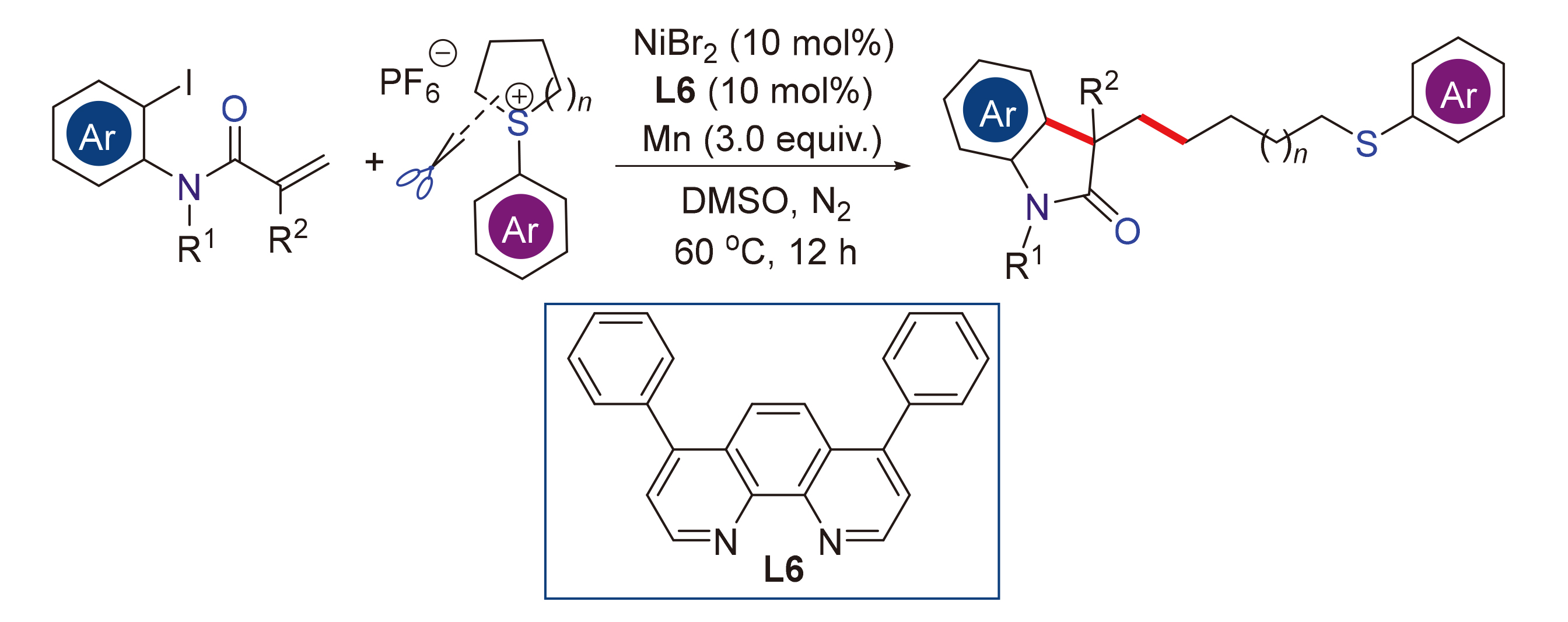
Sulfonium salts are a class of common sulfur-containing compounds with the characters of high reactivity, wide structural diversity, and easy preparation/storage.[8] In recent years, using sulfonium salts as alkyl or aryl radical precursors for the construction of C—C bonds and C-heteroatom bonds has been extensively studied.[9] However, the RCC reactions directly using sulfonium salts as electrophilic reagents are rarely reported.[10] On the other hand, the aryl/alkyl thioether scaffolds widely occur in biological molecules, natural products, and pharmaceuticals.[11] Therefore, the introduction of aryl/alkyl thioether scaffolds in the meantime of the construction of heterocyclic rings through RCC reaction might be valuable for the search for effective drugs. Based on all the above excellent studies and with our research interest in the synthesis of sulfur-containing compounds,[12] we herein report a unique example of a RCC reaction for the synthesis of sulfur- containing oxindoles, in which one aryl/alkyl thioether motif is generated through a reductive ring-opening process from a cyclosulfonium salt (Scheme 1, c).
2 Results and discussion
Initially, we investigated the model reaction between N- (2-iodophenyl)-N-methylmethacrylamide (1a) and cyclo- sulfonium salt 2a under various reaction conditions. Through detailed screening of various nickel salts, ligands, reductants, and solvents, it was found that using NiBr2 as the catalyst, 4,7-diphenyl-1,10-phenanthroline (L6) as the ligand, Mn as the reductant, and dimethyl sulfoxide (DMSO) as the solvent, the cyclization product 3a was obtained in 76% isolated yield (Table 1, Entry 1). Subsequently, various ligands including bidentate ligands (L1~L7) and tridentate ligands (L9~L13) were tested, and L6 presented the highest activity (Table 1, Entry 2). The use of other nickel salts also afforded the target product but delivered relatively lower yields (Table 1, Entry 3). Further investigation suggested that DMSO was superior than other solvents (Table 1, Entry 4). Replacing Mn with Zn resulted in a low yield of 3a (Table 1, Entry 5). Finally, the controlled experiments showed that the reaction could not occur at room temperature (Table 1, Entry 6).
Table 1 Optimization of reaction conditionsa |
| Entry | Variation from the standard reaction conditions | Yieldb/% |
|---|---|---|
| 1 | None | 76 |
| 2 | Ligands other than L6 | Trace~69 |
| 3 | Catalysts other than NiBr2 | 21~65 |
| 4 | Solvents other than DMSO | Trace~73 |
| 5 | Zn instead of Mn | 17 |
| 6 | Room temperature instead of 60 ℃ | N.R. |
a Reaction conditions: under a nitrogen atmosphere, 1a (0.4 mmol), 2a (0.2 mmol), copper salt (15 mol%), ligand (20 mol%), base (2.0 equiv.), solvent (2.0 mL) at room temperature under irradiation with a 20 W blue LED (455 nm) for 18 h. N.R.=no reaction. b Isolated yield. |
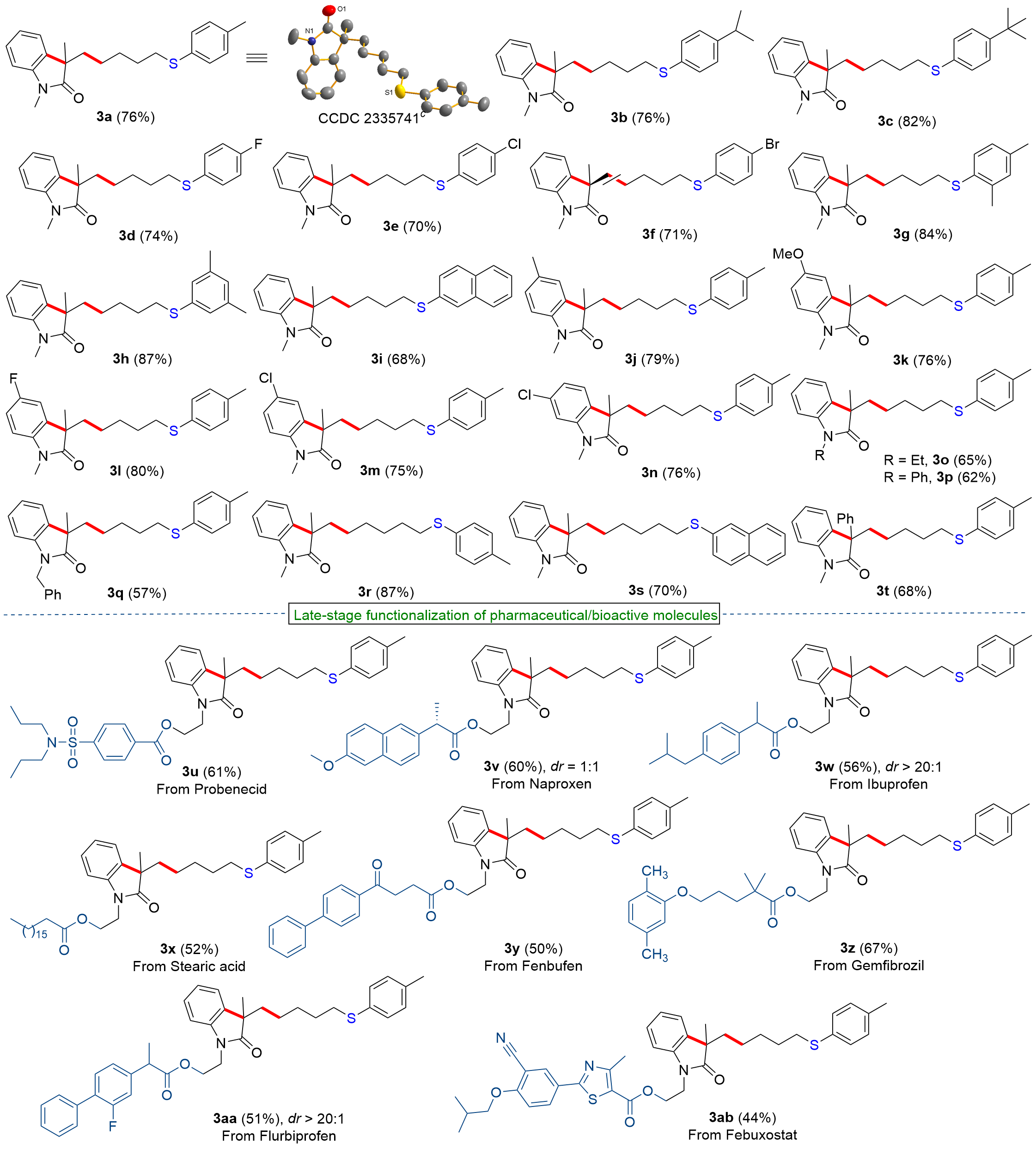
After obtaining the optimized reaction conditions, the scope and limitations of N-(2-iodophenyl)enamides 1 and cyclosulfonium salts 2 with the results were explored (Table 2). The structure of these compounds was verified by the single-crystal X-ray diffraction study of 3a. First, cyclosulfonium salts bearing diverse functional groups were accessed. A variety of electron-donating (e.g., methyl, isopropyl, tertiary butyl, biaryl) and electron-withdrawing (e.g., F, Cl, Br) groups were well tolerated (3a~3i). Next, the diversity of acrylamides was also tested. The electronic properties of the substituents on the aromatic ring did not affect the reaction efficiency, and the corresponding products were obtained in 75%~80% yields (3j~3n). Crylamides with different substituents on nitrogen atom (e.g., ethyl, phenyl, benzyl) could be participated well under the standard conditions (3o~3p).
Table 2 Scope of substratesa,b |
 |
a Reaction conditions: 1 (0.2 mmol), 2 (0.3 mmol), NiBr2 (10 mol%), L6 (10 mol%), Mn (3.0 equiv.), DMSO (2 mL), N2, 60 ℃, 12 h. b Isolated yield. c ORTEP drawing at 50% ellipsoid probability. |
Furthermore, 6-membered cyclosulfonium salts were also suitable substrates for this protocol, giving the cyclization products in good yields (3r and 3s). The practicability of this protocol was manifested by the late-stage functionalization of complex bioactive molecules. A range of N-(2-iodophenyl)enamides 1 containing complex scaffolds, such as probenecid, naproxen, ibuprofen, stearic acid, fenbufen, gemfibrozil, febuxostat, and flurbiprofen were readily transformed into the corresponding cyclization products (3u~3ab), indicating potential application in modification of bioactive molecules.
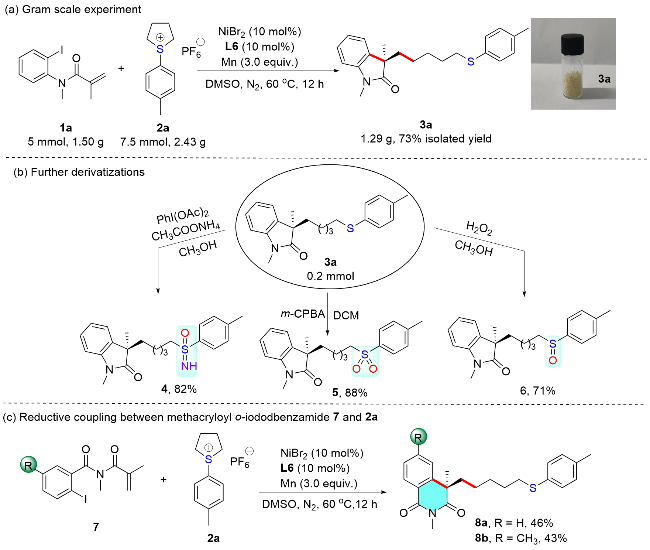
A gram scale transformation was performed between N-(2-iodophenyl)-N-methylmethacrylamide (1a) and cyclosulfonium salt 2a, and the reaction afforded 3a in 73% isolated yield (Scheme 2, a), showing the synthetic applications of this protocol. Furthermore, the sulfoximine product 4, sulfone product 5, and sulfoxide product 6 were obtained efficiently under the different oxidative conditions (Scheme 2, b). To our delight, methacryloyl o-iododbenz- amides 7 demonstrated to be suitable acceptors of alkyl radicals using the current protocol, leading to functionalized isoquinolinediones 8 in moderate yields (Scheme 2, c).
As shown in Scheme 3, some control experiments were conducted to illustrate the possible reaction mechanism. First, the reaction could proceed smoothly by replacing NiBr2 with Ni(cod)2, and 3a was obtained in 74% yield (Scheme 3, a). These preliminary results suggested that the present transformation was initiated by nickel(0) catalyst. Furthermore, the reaction was performed in the absence of Mn0, and the expected product 3a was not detected (Scheme 3, b). This result suggested that the presence of a reductant was essential and a σ-alkyl-NiI species might be formed,[3e] which could then react with cyclosulfonium salts. In addition, when the model reaction was carried out in the presence of 10.0 equiv. of D2O, we found that the deuterium incorporated Heck product 9 was obtained in 41% yield, indicating that the corresponding nickel intermediates were formed during the reaction. Finally, it was noted that 2,2, 6,6-tetramethyl-1-piperidinyloxy (TEMPO) could inhibit this reaction, probably due to the suppression of the alkyl radical generation (Scheme 3, d).

On the basis of the preliminary experimental results, a possible mechanism of the nickel-catalyzed reductive aryl- alkylation of alkenes with cyclosulfonium salts was proposed (Scheme 4). Initially, catalytically active LNi0 species was generated in situ under the reducing reaction conditions. Then, LNi0 undergo oxidative addition pathway with N-(2-iodophenyl)enamides 1 to form LNiIIAr species 10, which can be reduced by Mn0 to form LNiIAr species 11. Next, σ-alkyl-NiI species 12 is generated through exo- selective cyclization of 11. Subsequently, the cyclosulfonium salt 2 reacts with 12 via a single electron transfer (SET) process to yield a formal C(sp3)—NiIII—Ar species 14 that undergoes an in-cage radical/Ni rebound of 13. Finally, intermediate 14 undergoes reductive elimination to furnish the desired product 3, together with releasing LNiI species which is reduced by Mn to facilitate the next catalytic cycle.


3 Conclusions
In conclusion, we have initially reported a novel and efficient Ni-catalyzed intramolecular arylation/reductive cross coupling of N-(2-iodophenyl)enamides with cyclo- sulfonium salts. This developed method further expands the range of alkylation reagents which undergo arylalkylation of tethered alkenes via RCC pathway, and provides a new approach to sulfur-containing oxindoles using cyclosulfonium salts as alkylthio fragments surrogates. This strategy further expands the reaction model of sulfoniums. Further studies on the sulfonium salts involved RCC reactions are currently underway in our laboratory.
4 Experimental sections
4.1 General information
All manipulations were carried out under an atmosphere of nitrogen using standard Schlenk or glove box techniques. N,N-Dimethylacetamide (DMF) (99.8%, extra dry), dimethylacetamide (DMA) (99.8%, extra dry), N-methyl- pyrrolidone (NMP) (99.5%, extra dry), DMSO (99.7%, extra dry), CH3CN (99.9%, extra dry), C2H5OH (99.5%, extra dry), tetrahydrofuran (THF) (99.9%, extra dry) were purchased from Shanghai Titan Scientific Co., Ltd. Deuterated solvents were purchased and used as received (CDCl3 and DMSO-d6 from Maclin Co., China). NiBr2 (Meryer Co., China) was used as received. Sulfonium salts were prepared according to the reported procedure.[1,11] Unless otherwise noted, all other reagents and starting materials were purchased from commercial sources and used without further purification.
Column chromatography was performed using silica gel 300~400 mesh (purchased from Qingdao-Haiyang Co., China) as the solid support. All NMR spectra were recorded on a Bruker Avance 500 MHz spectrometer at STP unless otherwise indicated. Reference peaks for chloroform in 1H NMR and 13C NMR spectra were set at δ 7.26 and 77.16, respectively. High Resolution Mass Spectrometry (HRMS) was recorded on an UPLC-Q/TOF Xevo G2-XS (Waters, MA, USA) with an ESI source.
4.2 General experimental procedure for compounds 3
A 100 mL schlenk bottle was equipped with a magnetic stir bar, 1a (1.50 g, 5.0 mmol), 2a (2.43 g, 7.5 mmol), NiBr2 (109.3 mg, 10 mol%), L6 (116.2 mg, 10 mol%), Mn (824.1 mg, 3.0 equiv.) and 25 mL of anhydrous DMSO. The mixture was stirred under nitrogen at 60 ℃ for 12 h. The reaction was monitored by thin-layer chromatography (TLC) to identify the reaction time. Upon complete consumption of aryl iodides, the reaction mixture was diluted with water (25.0 mL) and extracted with ethyl acetate (25.0 mL×3). The combined organic layers were dried over Na2SO4, the filtrate was concentrated, purified by column chromatography (petroleum ether/ethyl acetate, V∶V=10∶1) to give product 3a in a yield of 73%. Compounds 3b~3ab were prepared according to the same procedure.
1,3-Dimethyl-3-(5-(p-tolylthio)pentyl)indolin-2-one (3a):[13] Colorless oil, 53.7 mg, 76% yield. 1H NMR (500 MHz, CDCl3) δ: 7.33 (t, J=7.7 Hz, 1H), 7.26 (d, J=8.0 Hz, 2H), 7.22 (d, J=7.2 Hz, 1H), 7.14 (d, J=7.6 Hz, 3H), 6.91 (d, J=7.7 Hz, 1H), 3.28 (s, 3H), 2.82 (t, J=7.4 Hz, 2H), 2.37 (s, 3H), 1.95 (td, J=12.8, 4.6 Hz, 1H), 1.78 (td, J=12.9, 4.3 Hz, 1H), 1.55 (p, J=7.5 Hz, 2H), 1.41 (s, 3H), 1.38~1.33 (m, 2H), 1.10~1.01 (m, 1H), 0.96~0.88 (m, 1H); 13C NMR (125 MHz, CDCl3) δ: 180.74, 143.34, 135.86, 132.99, 129.86, 129.59, 127.65, 122.46, 122.44, 107.89, 48.36, 38.32, 34.21, 28.93, 28.81, 26.09, 24.02, 23.79, 20.95; HRMS (ESI) calcd for C22H28NOS [M+H]+ 354.1886, found 354.1890.
3-(5-((4-Isopropylphenyl)thio)pentyl)-1,3-dimethylindol-in-2-one (3b):[13] Colorless oil, 58.0 mg, 76% yield. 1H NMR (500 MHz, CDCl3) δ: 7.29~7.24 (m, 1H), 7.21 (d, J=8.2 Hz, 2H), 7.16~7.10 (m, 3H), 7.09~7.03 (m, 1H), 6.84 (d, J=7.7 Hz, 1H), 3.20 (s, 3H), 2.90~2.82 (m, 1H), 2.76 (t, 2H), 1.88 (td, J=12.8, 4.8 Hz, 1H), 1.71 (td, J=12.8, 4.3 Hz, 1H), 1.54~1.44 (m, 2H), 1.34 (s, 3H), 1.28~1.25 (m, 2H), 1.22 (d, J=6.9 Hz, 6H), 1.03~0.94 (m, 1H), 0.89~0.80 (m, 1H); 13C NMR (125 MHz, CDCl3) δ: 180.75, 146.82, 143.32, 134.17, 133.40, 129.66, 127.64, 126.95, 122.46, 122.43, 107.89, 48.37, 38.32, 34.05, 33.65, 28.94, 28.82, 26.10, 24.01, 23.90, 23.79; HRMS (ESI) calcd for C24H32NOS [M+H]+ 382.2199, found 382.2203.
3-(5-((4-(tert-Butyl)phenyl)thio)pentyl)-1,3-dimethyl-indolin-2-one (3c):[13] Colorless oil, 64.9 mg, 82% yield. 1H NMR (500 MHz, CDCl3) δ: 7.31~7.23 (m, 3H), 7.20 (d, J=8.4 Hz, 2H), 7.14 (d, J=7.2 Hz, 1H), 7.05 (t, J=7.4 Hz, 1H), 6.83 (d, J=7.7 Hz, 1H), 3.20 (s, 3H), 2.76 (t, J=7.3 Hz, 2H), 1.88 (td, J=12.8, 4.7 Hz, 1H), 1.71 (td, J=12.8, 4.3 Hz, 1H), 1.54~1.45 (m, 2H), 1.33 (s, 3H), 1.29 (s, 9H), 1.25 (s, 2H), 1.05~0.92 (m, 1H), 0.89~0.80 (m, 1H); 13C NMR (125 MHz, CDCl3) δ: 180.74, 149.04, 143.34, 134.18, 133.19, 129.22, 127.64, 126.22, 125.84, 122.44, 107.88, 48.35, 38.32, 34.39, 33.88, 31.27, 29.67, 28.95, 28.82, 24.01, 23.78; HRMS (ESI) calcd for C25H34NOS [M+H]+ 396.2356, found 396.2350.
3-(5-((4-Fluorophenyl)thio)pentyl)-1,3-dimethylindol-in-2-one (3d):[13] Colorless oil, 52.9 mg, 74% yield. 1H NMR (500 MHz, CDCl3) δ: 7.31~7.26 (m, 3H), 7.17 (d, J=6.4 Hz, 1H), 7.11~7.06 (m, 1H), 7.01~6.95 (m, 2H), 6.86 (d, J=7.8 Hz, 1H), 3.23 (s, 3H), 2.79~2.72 (m, 2H), 1.90 (td, J=12.8, 4.7 Hz, 1H), 1.73 (td, J=12.8, 4.4 Hz, 1H), 1.53~1.45 (m, 2H), 1.36 (s, 3H), 1.33~1.27 (m, 2H), 1.06~0.94 (m, 1H), 0.91~0.80 (m, 1H); 13C NMR (125 MHz, CDCl3) δ: 180.74, 161.62 (d, J=245.9 Hz), 143.32, 134.12, 133.52 (d, J=8.1 Hz), 132.04, 131.96, 131.54 (d, J=3.1 Hz), 127.69, 122.50, 122.44, 116.02, 115.81, 48.38, 38.29, 34.80, 28.83, 28.73, 26.13, 24.01, 23.85; HRMS (ESI) calcd for C21H25FNOS [M+H]+ 358.1635, found 358.1631.
3-(5-((4-Chlorophenyl)thio)pentyl)-1,3-dimethylindolin-2-one (3e):[13] Light yellow oil, 52.4 mg, 70% yield. 1H NMR (500 MHz, CDCl3) δ: 7.26 (td, J=7.8, 1.3 Hz, 1H), 7.23~7.16 (m, 4H), 7.16~7.13 (m, 1H), 7.06 (td, J=7.5, 0.8 Hz, 1H), 6.83 (d, J=7.7 Hz, 1H), 3.20 (s, 3H), 2.76 (t, 2H), 1.88 (td, J=12.7, 4.7 Hz, 1H), 1.70 (td, J=12.8, 4.4 Hz, 1H), 1.53~1.44 (m, 2H), 1.34 (s, 3H), 1.30~1.23 (m, 2H), 1.04~0.94 (m, 1H), 0.89~0.80 (m, 1H); 13C NMR (125 MHz, CDCl3) δ: 180.74, 143.32, 135.39, 134.11, 131.63, 130.26, 128.94, 127.71, 122.51, 122.44, 107.96, 48.38, 38.27, 33.67, 28.77, 28.69, 26.14, 24.01, 23.85; HRMS (ESI) calcd for C21H25ClNOS [M+H]+ 374.1340, found 374.1339.
3-(5-((4-Bromophenyl)thio)pentyl)-1,3-dimethylindolin-2-one (3f):[13] Light yellow oil, 59.4 mg, 71% yield. 1H NMR (500 MHz, CDCl3) δ: 7.35 (d, J=8.4 Hz, 2H), 7.25 (t, 1H), 7.16~7.09 (m, 3H), 7.06 (t, J=7.5 Hz, 1H), 6.83 (d, J=7.7 Hz, 1H), 3.20 (s, 3H), 2.76 (t, J=7.3 Hz, 2H), 1.88 (td, J=12.8, 4.6 Hz, 1H), 1.70 (td, J=12.9, 4.2 Hz, 1H), 1.53~1.45 (m, 2H), 1.34 (s, 3H), 1.30~1.25 (m, 2H), 1.02~0.95 (m, 1H), 0.88~0.81 (m, 1H); 13C NMR (125 MHz, CDCl3) δ: 179.69, 142.32, 135.14, 133.11, 130.82, 129.44, 126.68, 121.47, 121.41, 118.41, 106.91, 47.34, 37.25, 32.50, 27.74, 27.65, 25.10, 22.97, 22.81; HRMS (ESI) calcd for C21H25BrNOS [M+H]+ 418.0835, found 418.0831.
3-(5-((2,4-Dimethylphenyl)thio)pentyl)-1,3-dimethyl-indolin-2-one (3g):[13] Colorless oil, 61.7 mg, 84% yield. 1H NMR (500 MHz, CDCl3) δ: 7.27~7.22 (m, 1H), 7.12 (dd, J=13.2, 7.6 Hz, 2H), 7.05 (t, J=7.1 Hz, 1H), 6.96 (s, 1H), 6.92 (d, J=8.0 Hz, 1H), 6.82 (d, J=7.8 Hz, 1H), 3.19 (s, 3H), 2.70 (t, 2H), 2.30 (s, 3H), 2.26 (s, 3H), 1.88 (td, J=12.7, 4.7 Hz, 1H), 1.70 (td, J=12.8, 4.4 Hz, 1H), 1.52~1.43 (m, 2H), 1.33 (s, 3H), 1.30~1.24 (m, 2H), 1.04~0.92 (m, 1H), 0.88~0.77 (m, 1H); 13C NMR (125 MHz, CDCl3) δ: 180.77, 143.33, 137.87, 135.57, 134.16, 132.29, 131.02, 128.93, 127.69, 127.07, 122.50, 122.46, 107.94, 48.40, 38.35, 33.36, 28.96, 28.80, 26.13, 24.08, 23.83, 20.87, 20.37; HRMS (ESI) calcd for C23H30NOS [M+H]+ 368.2043, found 368.2045.
3-(5-((3,5-Dimethylphenyl)thio)pentyl)-1,3-dimethyl-indolin-2-one (3h):[13] Colorless oil, 64.0 mg, 87% yield. 1H NMR (500 MHz, CDCl3) δ: 7.26 (td, J=7.6, 1.2 Hz, 1H), 7.17~7.13 (m, 1H), 7.06 (td, J=7.5, 0.8 Hz, 1H), 6.89 (s, 2H), 6.84 (d, J=7.8 Hz, 1H), 6.78 (s, 1H), 3.21 (s, 3H), 2.81~2.75 (m, 2H), 2.26 (s, 6H), 1.89 (td, J=12.8, 4.7 Hz, 1H), 1.72 (td, J=12.8, 4.4 Hz, 1H), 1.55~1.46 (m, 2H), 1.34 (s, 3H), 1.32~1.26 (m, 2H), 1.06~0.95 (m, 1H), 0.90~0.81 (m, 1H); 13C NMR (125 MHz, CDCl3) δ: 180.73, 143.35, 138.36, 136.37, 134.19, 127.66, 127.61, 126.61, 122.45, 107.89, 48.36, 38.33, 33.42, 28.87, 26.08, 24.03, 23.80, 21.19; HRMS (ESI) calcd for C23H30NOS [M+H]+ 368.2043, found 368.2038.
1,3-Dimethyl-3-(5-(naphthalen-2-ylthio)pentyl)indolin-2-one (3i):[13] Light yellow oil, 53.0 mg, 68% yield. 1H NMR (500 MHz, CDCl3) δ: 7.78 (d, J=7.8 Hz, 1H), 7.75~7.70 (m, 2H), 7.68 (d, J=8.5 Hz, 1H), 7.49~7.35 (m, 3H), 7.26 (t, J=7.5 Hz, 1H), 7.14 (t, J=6.4 Hz, 1H), 7.09~7.03 (m, 1H), 6.86~6.80 (m, 1H), 3.20 (s, 3H), 2.93 (dt, J=20.1, 7.3 Hz, 2H), 1.95~1.85 (m, 1H), 1.76~1.68 (m, 1H), 1.62~1.54 (m, 2H), 1.35 (s, 3H), 1.29~1.15 (m, 2H), 1.06~0.95 (m, 1H), 0.92~0.81 (m, 1H); 13C NMR (125 MHz, CDCl3) δ: 180.84, 143.39, 134.48, 134.19, 133.86, 131.69, 128.36, 127.79, 127.71, 127.29, 127.08, 126.58, 126.42, 125.56, 122.53, 108.02, 48.47, 38.38, 33.34, 28.97, 28.83, 26.22, 24.13, 23.92; HRMS (ESI) calcd for C25H28- NOS [M+H]+ 390.1886, found 390.1884.
1,3,5-Trimethyl-3-(5-(p-tolylthio)pentyl)indolin-2-one (3j):[13] Colorless oil, 58.1 mg, 79 % yield. 1H NMR (500 MHz, CDCl3) δ: 7.19 (d, J=8.1 Hz, 2H), 7.09~7.03 (m, 3H), 6.96 (s, 1H), 6.72 (d, J=7.8 Hz, 1H), 3.18 (s, 3H), 2.75 (t, J=7.4 Hz, 2H), 2.35 (s, 3H), 2.30 (s, 3H), 1.87 (td, J=12.8, 4.7 Hz, 1H), 1.68 (td, J=12.8, 4.3 Hz, 1H), 1.53~1.45 (m, 2H), 1.32 (s, 3H), 1.30~1.25 (m, 2H), 1.03~0.93 (m, 1H), 0.89~0.80 (m, 1H); 13C NMR (125 MHz, CDCl3) δ: 179.68, 139.97, 134.84, 133.23, 132.02, 130.93, 128.83, 128.58, 126.86, 122.30, 106.59, 47.41, 37.35, 33.22, 27.94, 27.85, 25.10, 23.03, 22.85, 20.15, 19.94; HRMS (ESI) calcd for C23H30NOS [M+H]+ 368.2043, found 368.2048.
5-Methoxy-1,3-dimethyl-3-(5-(p-tolylthio)pentyl)indol-in-2-one (3k):[13] Colorless oil, 58.3 mg, 76% yield. 1H NMR (500 MHz, CDCl3) δ: 7.18 (d, J=8.1 Hz, 3H), 7.06 (d, J=7.9 Hz, 2H), 6.77 (t, J=7.7 Hz, 2H), 6.72 (d, J=8.1 Hz, 1H), 3.80 (s, 3H), 3.17 (s, 3H), 2.75 (t, J=7.3 Hz, 2H), 2.30 (s, 3H), 1.87 (td, J=12.8, 4.6 Hz, 1H), 1.67 (td, J=12.8, 4.3 Hz, 1H), 1.53~1.43 (m, 2H), 1.32 (s, 3H), 1.29~1.24 (m, 2H), 1.02~0.93 (m, 1H), 0.87~0.80 (m, 1H); 13C NMR (125 MHz, CDCl3) δ: 180.37, 156.10, 136.93, 135.84, 135.64, 132.99, 129.85, 129.59, 111.51, 110.34, 108.07, 55.81, 48.81, 38.37, 34.21, 28.94, 28.82, 26.17, 24.04, 23.87, 20.94; HRMS (ESI) calcd for C23H30NO2S [M+H]+ 384.1992, found 384.1989.
5-Fluoro-1,3-dimethyl-3-(5-(p-tolylthio)pentyl)indolin-2-one (3l):[13] Light yellow oil, 59.4 mg, 80% yield. 1H NMR (500 MHz, CDCl3) δ: 7.19 (d, J=8.1 Hz, 2H), 7.07 (d, J=8.0 Hz, 2H), 6.95 (td, J=9.1, 2.6 Hz, 1H), 6.89 (dd, J=7.9, 2.5 Hz, 1H), 6.74 (dd, J=8.5, 4.1 Hz, 1H), 3.19 (s, 3H), 2.75 (t, 2H), 2.30 (s, 3H), 1.89 (td, J=12.8, 4.7 Hz, 1H), 1.67 (td, J=12.9, 4.4 Hz, 1H), 1.52~1.44 (m, 2H), 1.33 (s, 3H), 1.30~1.24 (m, 2H), 1.02~0.92 (m, 1H), 0.88~0.77 (m, 1H); 13C NMR (125 MHz, CDCl3) δ: 180.33, 159.42 (d, J=240.3 Hz), 139.24, 135.91 (t, J=7.6 Hz), 132.93, 129.90, 129.60, 113.78 (d, J=23.5 Hz), 110.65 (d, J=24.6 Hz), 108.29 (d, J=8.1 Hz), 48.88, 38.26, 34.21, 28.91, 28.73, 26.23, 24.01, 23.72, 20.94; HRMS (ESI) calcd for C22H27FNOS [M+H]+ 372.1792, found 372.1796.
5-Chloro-1,3-dimethyl-3-(5-(p-tolylthio)pentyl)indolin-2-one (3m):[13] Light yellow oil, 58.2 mg, 75% yield. 1H NMR (500 MHz, CDCl3) δ: 7.23 (dd, J=8.3, 2.1 Hz, 1H), 7.19 (d, J=8.2 Hz, 2H), 7.12 (d, J=2.1 Hz, 1H), 7.07 (d, J=8.0 Hz, 2H), 6.75 (d, J=8.2 Hz, 1H), 3.18 (s, 3H), 2.76 (t, J=7.3 Hz, 2H), 2.30 (s, 3H), 1.88 (td, J=12.8, 4.7 Hz, 1H), 1.67 (td, J=12.9, 4.4 Hz, 1H), 1.53~1.44 (m, 2H), 1.33 (s, 3H), 1.29~1.24 (m, 2H), 1.00~0.92 (m, 1H), 0.88~0.80 (m, 1H); 13C NMR (125 MHz, CDCl3) δ: 180.16, 141.92, 135.94, 135.91, 132.94, 129.92, 129.60, 127.91, 127.61, 123.02, 108.80, 48.67, 38.25, 34.23, 28.92, 28.73, 26.20, 24.01, 23.70, 20.94; HRMS (ESI) calcd for C22H27ClNOS [M+H]+ 388.1496, found 388.1495.
6-Chloro-1,3-dimethyl-3-(5-(p-tolylthio)pentyl)indolin-2-one (3n):[13] Light yellow oil, 59.0 mg, 76% yield. 1H NMR (500 MHz, CDCl3) δ: 7.22~7.16 (m, 3H), 7.06 (d, J=7.9 Hz, 2H), 6.98 (d, J=8.2 Hz, 1H), 6.73 (d, J=7.8 Hz, 1H), 3.20 (s, 3H), 2.75 (t, J=7.3 Hz, 2H), 2.30 (s, 3H), 2.23 (td, J=12.8, 4.5 Hz, 1H), 1.90 (td, J=12.7, 4.7 Hz, 1H), 1.47 (s, 3H), 1.32~1.25 (m, 2H), 0.89~0.81 (m, 1H), 0.79~0.72 (m, 1H); 13C NMR (125 MHz, CDCl3) δ:180.19, 145.18, 135.95, 133.00, 130.61, 129.92, 129.85, 129.68, 129.03, 123.66, 106.52, 50.37, 35.33, 34.23, 28.95, 28.74, 26.47, 24.55, 21.64, 21.08; HRMS (ESI) calcd for C22H27ClNOS [M+H]+ 388.1496, found 388.1494.
1-Ethyl-3-methyl-3-(5-(p-tolylthio)pentyl)indolin-2-one (3o):[13] Colorless oil, 47.8 mg, 65% yield. 1H NMR (500 MHz, CDCl3) δ: 7.28 (d, J=6.3 Hz, 1H), 7.23~7.15 (m, 3H), 7.11~7.05 (m, 3H), 6.88 (d, J=7.8 Hz, 1H), 3.87~3.79 (m, 1H), 3.78~3.69 (m, 1H), 2.77 (t, J=7.3 Hz, 2H), 2.33 (s, 3H), 1.91 (td, J=12.8, 4.6 Hz, 1H), 1.72 (td, J=12.9, 4.2 Hz, 1H), 1.54~1.47 (m, 2H), 1.35 (s, 3H), 1.30~1.24 (m, 5H), 1.07~0.96 (m, 1H), 0.89~0.80 (m, 1H); 13C NMR (125 MHz, CDCl3) δ: 180.38, 142.45, 135.93, 134.45, 133.02, 129.84, 129.69, 127.68, 122.71, 122.32, 108.15, 48.31, 38.45, 34.56, 34.21, 29.00, 28.90, 24.02, 23.92, 21.08, 12.86; HRMS (ESI) calcd for C23H30NOS [M+H]+ 368.2043, found 368.2048.
3-Methyl-1-phenyl-3-(5-(p-tolylthio)pentyl)indolin-2-one (3p):[13] Light yellow oil, 51.5 mg, 62% yield. 1H NMR (500 MHz, CDCl3) δ: 7.52 (t, J=7.8 Hz, 2H), 7.42~7.38 (m, 3H), 7.23~7.18 (m, 4H), 7.11 (d, J=7.3 Hz, 1H), 7.07 (t, J=8.0 Hz, 2H), 6.84 (d, J=7.8 Hz, 1H), 2.78 (t, 2H), 2.31 (s, 3H), 2.01 (td, J=12.7, 4.7 Hz, 1H), 1.80 (td, J=12.8, 4.3 Hz, 1H), 1.55~1.49 (m, 2H), 1.47 (s, 3H), 1.37~1.30 (m, 2H), 1.19~1.12 (m, 1H), 1.00~0.95 (m, 1H); 13C NMR (125 MHz, CDCl3) δ: 180.24, 143.30, 135.96, 134.73, 133.98, 133.00, 129.87, 129.71, 129.66, 128.01, 127.66, 126.64, 123.05, 122.86, 109.35, 48.54, 38.90, 34.23, 29.01, 28.90, 24.23, 24.16, 21.09; HRMS (ESI) calcd for C27H30NOS [M+H]+ 416.2043, found 416.2046.
1-Benzyl-3-methyl-3-(5-(p-tolylthio)pentyl)indolin-2-one (3q):[13] Light yellow oil, 49.0 mg, 57% yield. 1H NMR (500 MHz, CDCl3) δ: 7.33~7.27 (m, 5H), 7.23 (d, J=8.1 Hz, 2H), 7.18 (t, J=7.6 Hz, 2H), 7.11 (d, J=8.0 Hz, 2H), 7.06 (t, J=7.4 Hz, 1H), 6.76 (d, J=7.7 Hz, 1H), 4.94 (dd, 2H), 2.78 (t, J=7.4 Hz, 2H), 2.34 (s, 3H), 1.99 (td, J=12.6, 4.0 Hz, 1H), 1.80 (td, J=12.8, 4.2 Hz, 1H), 1.56~1.49 (m, 2H), 1.43 (s, 3H), 1.35~1.28 (m, 2H), 1.13~1.05 (m, 1H), 0.93~0.87 (m, 1H); 13C NMR (125 MHz, CDCl3) δ: 180.79, 142.43, 136.17, 135.88, 134.13, 132.97, 129.89, 129.59, 128.71, 127.56, 127.55, 127.30, 122.52, 122.48, 108.97, 48.37, 43.65, 38.41, 34.17, 28.95, 28.82, 24.21, 24.17, 20.97; HRMS (ESI) calcd for C28H32NOS [M+H]+ 430.2199, found 430.2195.
1,3-Dimethyl-3-(6-(p-tolylthio)hexyl)indolin-2-one (3r):[13] Colorless oil, 64.0 mg, 87% yield. 1H NMR (500 MHz, CDCl3) δ: 7.28~7.24 (m, 1H), 7.20 (d, J=8.2 Hz, 2H), 7.16~7.13 (m, 1H), 7.09~7.04 (m, 3H), 6.83 (d, J=7.7 Hz, 1H), 3.21 (s, 3H), 2.79 (t, 2H), 2.31 (s, 3H), 1.87 (td, J=12.7, 4.7 Hz, 1H), 1.71 (td, J=12.8, 4.4 Hz, 1H), 1.54~1.46 (m, 2H), 1.34 (s, 3H), 1.30~1.25 (m, 2H), 1.21~1.11 (m, 2H), 1.02~0.93 (m, 1H), 0.89~0.79 (m, 1H); 13C NMR (125 MHz, CDCl3) δ: 180.79, 143.35, 135.81, 134.26, 133.10, 129.80, 129.59, 127.62, 122.44, 107.86, 48.38, 38.41, 34.27, 29.21, 29.08, 28.41, 26.07, 24.32, 23.78, 20.95; HRMS (ESI) calcd for C23H30NOS [M+H]+ 368.2043, found 368.2048.
1,3-Dimethyl-3-(6-(naphthalen-2-ylthio)hexyl)indolin-2-one (3s):[13] Light yellow oil, 56.5 mg, 70 % yield. 1H NMR (500 MHz, CDCl3) δ: 7.76 (d, J=7.9 Hz, 1H), 7.72 (d, J=8.4 Hz, 2H), 7.67 (s, 1H), 7.45 (t, 1H), 7.40 (t, J=7.4 Hz, 1H), 7.37 (d, J=8.6 Hz, 1H), 7.24 (t, J=7.7 Hz, 1H), 7.12 (d, J=7.3 Hz, 1H), 7.04 (t, J=7.4 Hz, 1H), 6.81 (d, J=7.6 Hz, 1H), 3.19 (s, 3H), 2.93 (t, J=7.3 Hz, 2H), 1.88 (td, J=12.8, 4.1 Hz, 1H), 1.71 (td, J=12.4, 3.5 Hz, 1H), 1.62~1.53 (m, 2H), 1.33 (s, 3H), 1.32~1.29 (m, 2H), 1.23 - 1.13 (m, 2H), 1.02~0.93 (m, 1H), 0.86~0.78 (m, 1H); 13C NMR (125 MHz, CDCl3) δ: 180.79, 143.31, 134.50, 134.19, 133.79, 131.60, 128.26, 127.69, 127.61, 127.18, 126.98, 126.48, 126.28, 125.46, 122.43, 107.87, 48.40, 38.38, 33.34, 29.20, 28.90, 28.49, 26.09, 24.32, 23.80; HRMS (ESI) calcd for C26H30NOS [M+H]+ 404.2043, found 404.2040.
1-Methyl-3-phenyl-3-(5-(p-tolylthio)pentyl)indolin-2-one (3t):[13] Light yellow oil, 56.5 mg, 68% yield. 1H NMR (500 MHz, CDCl3) δ: 7.33 (t, J=7.2 Hz, 3H), 7.28 (d, J=3.5 Hz, 1H), 7.25~7.14 (m, 5H), 7.10 (d, J=7.4 Hz, 1H), 7.05 (t, J=7.2 Hz, 2H), 6.88 (d, J=7.8 Hz, 1H), 3.19 (s, 3H), 2.74 (t, J=7.3 Hz, 2H), 2.35 (td, J=12.6, 4.3 Hz, 1H), 2.28 (s, 3H), 2.15 (td, J=12.8, 4.0 Hz, 1H), 1.53~1.45 (m, 2H), 1.39~1.29 (m, 2H), 1.15~1.03 (m, 1H), 0.93~0.82 (m, 1H); 13C NMR (125 MHz, CDCl3) δ: 178.71, 144.03, 140.38, 135.99, 132.97, 132.34, 129.95, 129.72, 128.61, 128.25, 127.34, 126.95, 124.83, 122.73, 108.38, 56.74, 37.86, 34.26, 28.99, 28.94, 26.47, 24.20, 21.10; HRMS (ESI) calcd for C27H30NOS [M+H]+ 416.2043, found 416.2046.
2-(3-Methyl-2-oxo-3-(5-(p-tolylthio)pentyl)indolin-1-yl) ethyl 4-(N,N-dipropylsulfamoyl)benzoate (3u):[13] Light yellow oil, 79.4 mg, 61% yield. 1H NMR (500 MHz, CDCl3) δ: 7.99 (d, J=8.5 Hz, 2H), 7.78 (d, J=8.5 Hz, 2H), 7.18 (t, J=7.7 Hz, 1H), 7.12 (d, J=8.0 Hz, 3H), 7.05~6.99 (m, 3H), 6.89 (d, J=7.8 Hz, 1H), 4.54 (t, J=5.4 Hz, 2H), 4.10 (t, J=5.4 Hz, 2H), 3.04 (t, 4H), 2.64 (t, J=7.3 Hz, 2H), 2.25 (s, 3H), 1.84 (td, J=12.8, 4.8 Hz, 1H), 1.67 (td, J=12.8, 4.3 Hz, 1H), 1.55~1.44 (m, 4H), 1.37~1.30 (m, 2H), 1.29 (s, 3H), 1.20~1.13 (m, 2H), 0.94~0.88 (m, 1H), 0.82 (t, J=7.4 Hz, 6H), 0.77~0.71 (m, 1H); 13C NMR (125 MHz, CDCl3) δ: 180.92, 165.01, 144.43, 142.17, 135.84, 134.01, 132.84, 130.34, 129.73, 129.58, 127.63, 127.20, 126.96, 122.80, 122.73, 62.31, 50.06, 49.91, 48.26, 38.63, 38.31, 28.80, 28.70, 23.97, 23.90, 22.03, 21.91, 11.14; HRMS (ESI) calcd for C36H47N2O5S2 [M+H]+ 651.2921, found 651.2919.
2-(3-Methyl-2-oxo-3-(5-(p-tolylthio)pentyl)indolin-1-yl) ethyl (2S)-2-(6-methoxynaphthalen-2-yl)propanoate (3v):[13] Light yellow oil, 71.5 mg, 60% yield. 1H NMR (500 MHz, CDCl3) δ: 7.64 (dd, J=8.7, 3.1 Hz, 2H), 7.54 (d, J=3.5 Hz, 1H), 7.29 (dt, J=8.5, 1.8 Hz, 1H), 7.19 (dd, J=8.0, 1.3 Hz, 2H), 7.16~7.12 (m, 2H), 7.11~7.09 (m, 2H), 7.06 (d, J=8.1 Hz, 2H), 7.04~7.00 (m, 1H), 6.79 (t, J=7.7 Hz, 1H), 4.40~4.34 (m, 1H), 4.30~4.23 (m, 1H), 4.00~3.94 (m, 1H), 3.91 (d, J=1.8 Hz, 3H), 3.89~3.83 (m, 1H), 3.78~3.71 (m, 1H), 2.78~2.68 (m, 2H), 2.30 (s, 3H), 1.91~1.80 (m, 1H), 1.73~1.61 (m, 1H), 1.49 (t, J=6.8 Hz, 3H), 1.45~1.39 (m, 1H),1.28 (d, J=15.3 Hz, 3H), 1.29~1.27 (m, 1H), 1.23~1.18 (m, 1H), 1.03~0.88 (m, 1H), 0.85~0.70 (m, 1H); 13C NMR (125 MHz, CDCl3) δ: 180.77, 174.44, 157.66, 142.51, 135.20, 133.93, 133.72, 130.03, 129.74, 129.67, 129.59, 129.30, 128.88, 127.55, 127.17, 126.10, 125.99, 122.54, 122.44, 118.93, 108.24, 105.58, 61.92, 55.32, 48.14, 45.34, 38.78, 38.25, 34.14, 28.86, 28.78, 23.91, 23.78, 20.98, 18.30; HRMS (ESI) calcd for C37H42N- O4S [M+H]+ 596.2829, found 596.2839.
2-(3-Methyl-2-oxo-3-(5-(p-tolylthio)pentyl)indolin-1-yl) ethyl 2-(4-isobutylphenyl)propanoate (3w):[13] Colorless oil, 64.0 mg, 56% yield. 1H NMR (500 MHz, CDCl3) δ: 7.20 (dd, J=15.4, 7.8 Hz, 3H), 7.14 (d, J=7.1 Hz, 1H), 7.12~7.02 (m, 7H), 6.84 (d, J=7.8 Hz, 1H), 4.38~4.32 (m, 1H), 4.27~4.20 (m, 1H), 4.02~3.94 (m, 1H), 3.90~3.83 (m, 1H), 3.61~3.54 (m, 1H), 2.79~2.71 (m, 2H), 2.43 (d, J=7.1 Hz, 2H), 2.30 (s, 3H), 1.91~1.80 (m, 2H), 1.73~1.65 (m, 1H), 1.52~1.44 (m, 2H), 1.42~1.36 (m, 3H), 1.31 (d, J=8.9 Hz, 3H), 1.28~1.21 (m, 2H), 1.03~0.94 (m, 1H), 0.89 (d, J=6.6 Hz, 6H), 0.84~0.77 (m, 1H); 13C NMR (125 MHz, CDCl3) δ: 180.74, 174.52, 142.50, 140.55, 137.30, 135.84, 133.98, 132.95, 129.78, 129.59, 129.32, 127.60, 127.14, 122.55, 122.47, 108.29, 61.69, 48.17, 45.02 (d, J=3.4 Hz), 38.72, 38.26, 34.17, 30.14, 28.86, 28.79, 23.92, 23.85, 22.40, 20.97, 18.36, 18.32; HRMS (ESI) calcd for C36H46NO3S [M+H]+ 572.3193, found 572.3193.
2-(3-Methyl-2-oxo-3-(5-(p-tolylthio)pentyl)indolin-1-yl) ethyl stearate (3x):[13] Colorless oil, 67.6 mg, 52% yield. 1H NMR (500 MHz, CDCl3) δ: 7.25 (t, 1H), 7.19 (d, J=7.9 Hz, 2H), 7.15 (d, J=7.2 Hz, 1H), 7.07 (d, J=8.0 Hz, 3H), 6.91 (d, J=7.8 Hz, 1H), 4.31 (t, 2H), 4.02~3.91 (m, 2H), 2.75 (t, J=7.3 Hz, 2H), 2.31 (s, 3H), 2.20 (t, J=7.3 Hz, 2H), 1.89 (td, J=12.9, 4.0 Hz, 1H), 1.77~1.67 (m, 1H), 1.53~ 1.43 (m, 4H), 1.34 (s, 3H), 1.32~1.20 (m, 30H), 1.05~ 0.96 (m, 1H), 0.89 (t, J=6.7 Hz, 3H), 0.85~0.80 (m, 1H); 13C NMR (125 MHz, CDCl3) δ: 180.77, 173.55, 142.49, 135.83, 134.03, 132.95, 129.77, 129.58, 127.57, 122.62, 122.50, 108.17, 60.95, 48.20, 38.75, 38.31, 34.15, 34.10, 31.92, 29.70, 29.69, 29.66, 29.61, 29.44, 29.36, 29.25, 29.09, 28.89, 28.79, 24.69, 23.93, 23.90, 22.69, 20.97, 14.12; HRMS (ESI) calcd for C41H64NO3S [M+H]+ 650.4601, found 650.4606.
2-(3-Methyl-2-oxo-3-(5-(p-tolylthio)pentyl)indolin-1-yl) ethyl 4-([1'-biphenyl]-4-yl)-4-oxobutanoate (3y):[13] Co- lorless oil, 62.0 mg, 50% yield. 1H NMR (500 MHz, CDCl3) δ: 8.00 (d, J=8.3 Hz, 2H), 7.66 (d, J=8.3 Hz, 2H), 7.61 (d, J=7.3 Hz, 2H), 7.46 (t, J=7.4 Hz, 2H), 7.39 (t, J=7.3 Hz, 1H), 7.23 (d, J=8.2 Hz, 1H), 7.15 (t, J=8.2 Hz, 3H), 7.04 (t, J=7.0 Hz, 3H), 6.94 (d, J=7.8 Hz, 1H), 4.39~4.32 (m, 2H), 4.03~3.92 (m, 2H), 3.24 (t, J=6.7 Hz, 2H), 2.73 (t, J=7.3 Hz, 2H), 2.68 (t, J=6.7 Hz, 2H), 2.27 (s, 3H), 1.88 (td, J=12.7, 4.6 Hz, 1H), 1.70 (td, J=12.8, 4.3 Hz, 1H), 1.52~1.43 (m, 2H), 1.33 (s, 3H), 1.29~ 1.22 (m, 2H), 1.04~0.96 (m, 1H), 0.88~0.79 (m, 1H); 13C NMR (125 MHz, CDCl3) δ: 197.43, 180.87, 172.66, 145.90, 142.48, 139.83, 135.80, 135.15, 134.03, 132.98, 129.70, 129.60, 128.98, 128.65, 128.27, 127.69, 127.27, 127.24, 122.65, 122.57, 108.23, 61.48, 48.23, 38.79, 38.33, 34.10, 33.30, 28.90, 28.79, 28.17, 23.96, 23.91, 20.98; HRMS (ESI) calcd for C39H42NO4S [M+H]+ 620.2829, found 620.2836.
2-(3-Methyl-2-oxo-3-(5-(p-tolylthio)pentyl)indolin-1-yl) ethyl 5-(2,5-dimethylphenoxy)-2,2-dimethylpentanoate (3z):[13] Light yellow oil, 82.5 mg, 67% yield. 1H NMR (500 MHz, CDCl3) δ: 7.23 (t, 1H), 7.17 (d, J=8.0 Hz, 2H), 7.13 (d, J=7.2 Hz, 1H), 7.07~7.01 (m, 2H), 6.99 (d, J=7.4 Hz, 1H), 6.91 (d, J=7.8 Hz, 1H), 6.65 (d, J=7.4 Hz, 1H), 6.57 (s, 1H), 4.29 (t, J=5.7 Hz, 2H), 4.02~3.89 (m, 2H), 3.83~3.77 (m, 2H), 2.73 (t, J=7.3 Hz, 2H), 2.30 (d, J=3.5 Hz, 6H), 2.15 (s, 3H), 1.87 (td, J=12.8, 4.6 Hz, 1H), 1.69 (td, J=13.9, 13.3, 4.5 Hz, 1H), 1.65~1.58 (m, 4H), 1.52~1.41 (m, 2H), 1.32 (s, 3H), 1.28~1.23 (m, 2H), 1.11 (s, 6H), 1.02~0.94 (m, 1H), 0.87~0.79 (m, 1H); 13C NMR (125 MHz, CDCl3) δ: 180.68, 177.65, 156.89, 142.49, 136.41, 135.84, 134.02, 132.92, 130.29, 129.79, 129.59, 127.59, 123.52, 122.64, 122.55, 120.68, 111.94, 108.31, 67.76, 61.45, 48.18, 42.02, 38.75, 38.27, 36.91, 34.16, 28.87, 28.79, 25.05, 25.04, 24.97, 23.98, 23.92, 21.42, 20.97, 15.78; HRMS (ESI) calcd for C38H50NO4S [M+H]+ 616.3455, found 616.3458.
2-(3-Methyl-2-oxo-3-(5-(p-tolylthio)pentyl)indolin-1-yl) ethyl 2-(2-fluoro-[1'-biphenyl]-4-yl)propanoate (3aa):[13] Light yellow oil, 62.2 mg, 51% yield (dr>20∶1). 1H NMR (500 MHz, CDCl3) δ: 7.52 (d, J=4.0 Hz, 2H), 7.46~7.41 (m, 2H), 7.39~7.35 (m, 1H), 7.32 (td, J=4.0, 2.6 Hz, 1H), 7.21 (tdd, J=3.9, 1.2, 0.6 Hz, 1H), 7.18 (d, J=3.8 Hz, 2H), 7.14 (d, J=3.7 Hz, 1H), 7.08~7.01 (m, 4H), 6.98 (td, J=5.8, 0.8 Hz, 1H), 6.84 (dd, J=3.9, 1.5 Hz, 1H), 4.42~4.37 (m, 1H), 4.33~4.27 (m, 1H), 4.04~3.96 (m, 1H), 3.96~3.88 (m, 1H), 3.67~3.60 (m, 1H), 2.79~2.70 (m, 2H), 2.30 (s, 3H), 1.91~1.84 (m, 1H), 1.73~1.66 (m, 1H), 1.50~1.42 (m, 5H), 1.31 (d, J=6.6 Hz, 3H), 1.28~1.24 (m, 2H), 1.03~0.94 (m, 1H), 0.86~0.78 (m, 1H); 13C NMR (125 MHz, CDCl3) δ: 180.80, 173.75, 159.59 (d, J=246.6 Hz), 142.45, 141.33, 135.84, 135.45, 134.02, 130.78, 129.77, 129.59, 128.93, 128.91, 128.45, 127.68, 127.58, 123.53, 122.66, 122.56, 115.34, 115.14, 108.15, 62.08, 48.18, 44.91, 38.77, 38.25, 34.13, 28.88, 28.78, 23.95, 23.86, 20.97, 18.23; HRMS (ESI) calcd for C38H41FNO3S [M+ H]+ 610.2786, found 610.2784.
2-(3-Methyl-2-oxo-3-(5-(p-tolylthio)pentyl)indolin-1-yl)ethyl 5-(3-cyano-4-isobutoxyphenyl)-4-methylthiazole-2-carboxylate (3ab):[13] Light yellow oil, 60.0 mg, 52% yield. 1H NMR (500 MHz, CDCl3) δ: 8.10 (d, J=2.3 Hz, 1H), 8.02 (dd, J=8.8, 2.3 Hz, 1H), 7.23 (td, J=7.7, 1.3 Hz, 1H), 7.17~7.14 (m, 1H), 7.12 (d, J=8.1 Hz, 2H), 7.06 (td, J=7.5, 0.8 Hz, 1H), 7.03 (d, J=8.0 Hz, 2H), 6.98 (d, J=8.9 Hz, 1H), 6.93 (d, J=7.8 Hz, 1H), 4.57~4.49 (m, 2H), 4.15~4.02 (m, 2H), 3.87 (d, J=6.5 Hz, 2H), 2.69~2.66 (m, 5H), 2.28 (s, 3H), 2.22~2.16 (m, 1H), 1.89 (td, J=12.9, 4.6 Hz, 1H), 1.70 (td, J=12.9, 4.3 Hz, 1H), 1.40 (td, J=7.2, 3.0 Hz, 2H), 1.34 (s, 3H), 1.26~1.21 (m, 2H), 1.08 (d, J=6.7 Hz, 6H), 1.01~0.94 (m, 1H), 0.83 (td, J=12.7, 6.2 Hz, 1H); 13C NMR (125 MHz, CDCl3) δ: 180.79, 167.60, 162.52, 161.93, 161.64, 142.32, 135.77, 134.06, 132.97, 132.57, 132.06, 129.61, 129.56, 127.64, 125.87, 122.74, 122.65, 120.82, 115.37, 112.63, 108.20, 102.96, 75.69, 61.94, 48.23, 38.75, 38.36, 34.08, 28.83, 28.80, 28.15, 24.01, 23.91, 20.97, 19.05, 17.45; HRMS (ESI) calcd for C39H44N3O4S2 [M+H]+ 682.2768, found 682.2772.
Supporting Information 1H NMR and 13C NMR spectra of compounds 3a~3ab. The Supporting Information is available free of charge via the Internet at http://sioc-journal.cn.
(Zhao, C.)