


1 Introduction
Today, the field of organic light-emitting diodes (OLE- Ds) has been extensively investigated.[1] The key issue in the field of OLEDs is the development of fluorescent and phosphorescent materials with high efficiency.[2] Thus, numerous solutions have been proposed to break through the upper limit of luminous efficiency in traditional closed- shell materials.[2] Among them, luminescent radicals whose ground and excited states both adopt a doublet spin configuration are able to avoid quenching by the spin-forbid- den transition[3]. Moreover, the mutual interaction among the magnetic, electronic, and luminescent characteristics of organic radicals has the potential to enable the fabrication of multiply responsive molecular devices.[4] Therefore, luminescent radicals have attracted extensive attention and achieved some breakthroughs. Following the discovery by Lewis in 1944 that the triphenylmethyl radical exhibits luminescence, luminescent radicals are primarily limited to chloroarylmethyl radicals (first reported in 1900 and later developed by Juliá, Nishihara, Li, and other researchers),[5] with extremely limited examples of other types of luminescent radicals.[4b,6] Moreover, the emission wavelengths of chloroarylmethyl radicals are confined to the red and near-infrared (NIR) spectral regions, which inherently restricts the possibility of obtaining short-wavelength emissive molecules through altering substituents[3a].
To further diversify the types of luminescent radicals and expand their emission range, other types of radicals have been explored. However, blue emitting radicals remain scarcely reported. Rawson et al.[7] reported anthracene-functionalized dithiadiazolyl radicals exhibiting blue emission, whereas the luminescence originates from the anthracene moiety rather than the radical framework and the dithiadiazolyl radical portion instead acts as a fluorescent quencher. New synthetic strategies to make boron- containing dioxoborocyclic radicals producing blue-photo- luminescence have been developed by the Wang group,[4a,8] which can enable diverse luminescent radicals via parent framework and substituent alterations to expand the emission spectral range. Based on theoretical calculation, the boron-containing radicals produce blue-photo- luminescence attributed to anti-Kasha behavior.[8]
Thiophene derivatives have attracted significant attention in the development of organic materials owing to their inherent chemical stability and synthetic versatility.[9] Moreover, the thiophene unit has been widely applied in the field of luminescent materials.[10] We speculate that modification of dioxoborocyclic radicals with thiophene units could yield novel neutral blue-luminescent radicals.
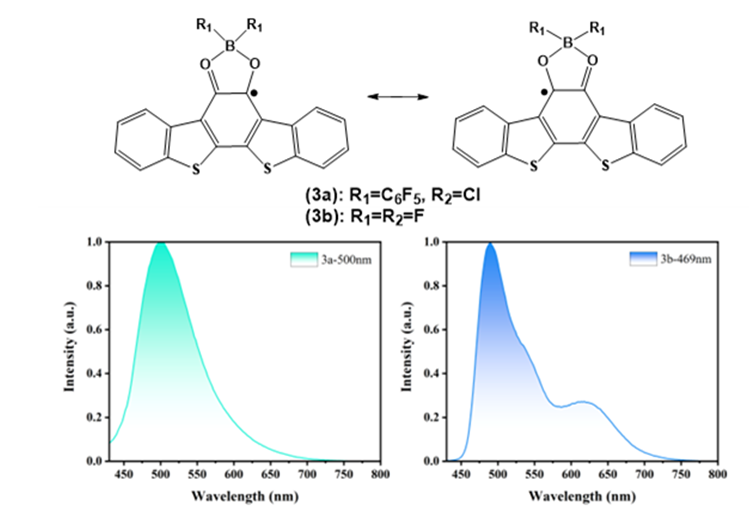
Herein, we designed and synthesized two boron-con- taining dioxoborocyclic radicals (Scheme 1, 3a and 3b) exhibiting blue-emission by the incorporation of benzo- [2,1-b:3,4-b']-bis-[1]-benzothiophene-5,6-dione and boron- containing substituents (B(R1)2). As expected, both 3a and 3b display short-wavelength emissions. By photophysical characterization and theoretical computations, we demonstrate that the blue-light emissions originate from the anti- Kasha behavior.
2 Results and discussion
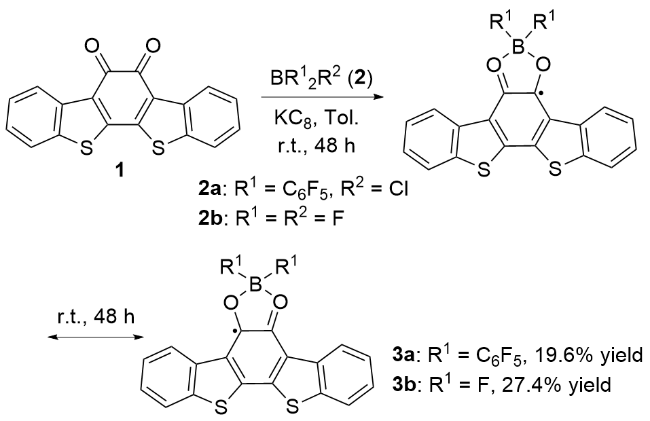
Following the procedure outlined in Scheme 1, radicals 3a and 3b were synthesized in one step from benzo- [2,1-b:3,4-b']-bis-[1]-benzothiophene-5,6-dione (1) with boron-containing compound 2 (2a: chlorobis(perfluoro- phenyl)borane, and 2b: boron trifluoride) and potassium graphite in toluene. They were isolated as crystals in moderate yields (19.6% for 3a, and 27.4% for 3b) and characterized by single-crystal X-ray diffraction, electron paramagnetic resonance (EPR) spectroscopy and UV-Vis spectroscopy, together with theoretical calculations. 3a and 3b are air-sensitive, but can be stored in solution and in the solid state under N2 atmosphere for several weeks.
Crystals 3a and 3b suitable for X-ray diffraction were obtained from the concentrated toluene solution at -35 ℃. Crystal structures of parent molecules 1 were also obtained for comparison (Figure S1 and Table S2, see Supporting Information). Radical 3a crystallizes in the monoclinic space group P21/c, whereas radical 3b crystallizes in the triclinic space group P-1 (Figures 1a, 1b). The crystal structures of 3a exhibit a one-dimen- sional chain conformation with the shortest intermolecular C—C distances of 3.384 Å between the benzothiophenedione backbones (Figure 1c), while that of 3b shows a π-dimer structure with the shortest C—C distance of 3.316 Å between the benzothiophenedione backbones (Figure 1d). The intermolecular C—C distances in 3a and 3b are shorter than the sum of van der Waals radii of two sp2-C atoms (3.40 Å), indicating intermolecular interactions. The interactions between these π-dimers of 3b are obvious with the closest dH…F=2.537 Å. Due to the smaller steric hindrance of the BF2 group, the crystal structure of 3b exhibits more pronounced intermolecular interactions. Both radicals 3a and 3b feature a planar five-membered BO2C2 ring which is coplanar with benzothiophenedione backbones. The B—O distances (3a 1.521(3), 1.530(3) Å; 3b 1.533(5), 1.508(5) Å) and O—B—O angles (the two structures of 3a 101.88(16)° and 3b 103.3(3)°) are similar to those of the reported dioxoborocyclic monoradicals[8]. The C—O bond lengths in 3a (1.313(2), 1.315(2) Å) and 3b (1.306(4), 1.318(4) Å) are longer than those in compound 1 (1.218 (3), 1.212(3) Å, Table S2, see Supporting Information), whereas the C1—C2 bond lengths in 3a (1.428(3) Å) and 3b (1.437(5) Å) are shorter than that in compound 1 (1.564(3) Å, Table S2, see Supporting Information), which can be attributed to the reduction.
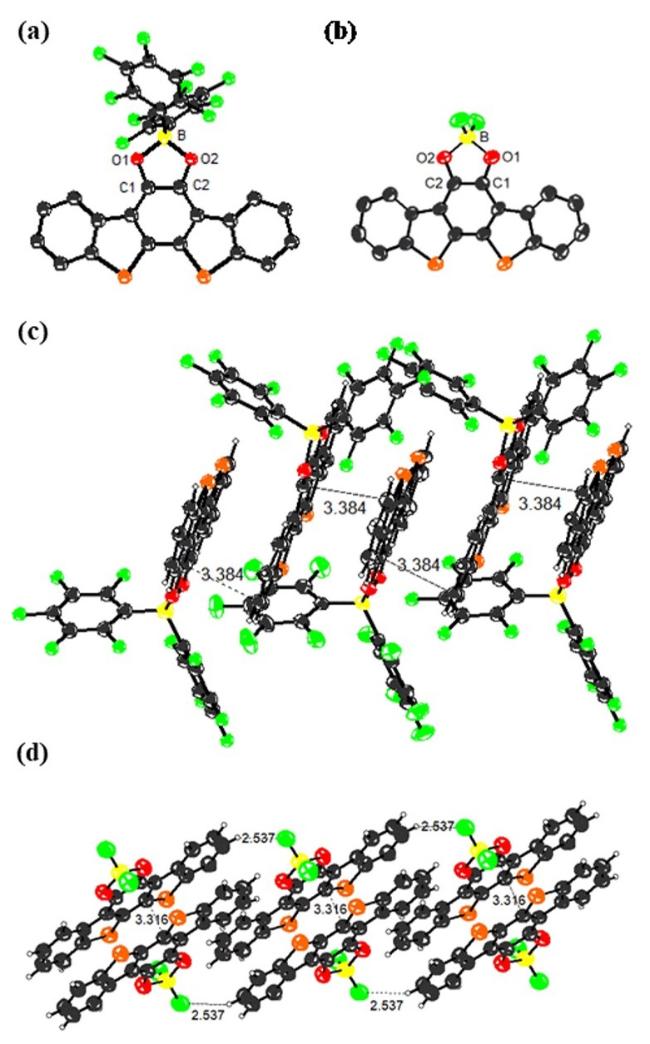
Figure 1 Thermal ellipsoid drawings (at 50% probability) with selected bond lengths of molecules and crystal packings of 3a (a, c) and 3b (b, d)Hydrogen atoms and solvent molecules are omitted for clarity. C: gray, F: green, O: red, B: yellow, S: orange. Selected bond lengths (Å): 3a: C(1)—O(1) 1.313(2), C(2)—O(2) 1.315(2), C(1)—C(2) 1.428(3), B—O(1) 1.530(3), B—O(2) 1.521(3); 3b: C(1)—O(1) 1.306(4), C(2)— O(2) 1.318(4), C(1)—C(2) 1.437(5), B—O(1) 1.533(5), B—O(2) 1.508(5). |
Both 3a and 3b are NMR silent. To fully investigate the electronic structures of 3a and 3b, EPR measurements were carried out. The solution EPR spectra of 3a and 3b at room temperature show complicated signals with the g-tensor of 2.0056 for 3a and 2.0047 for 3b (Figures 2a and 2b). The experimental EPR spectra of 3a could be successfully simulated considering the splitting from the eight 1H from the benzothiophenedione backbone and one 11B atom of the B(C6F5)2 (a11B= 2.97 G, a1H= 0.10, 0.12, 0.23, 0.50 G), suggesting the C2 symmetry of 3a in solution and a full delocalization of the unpaired electron, that is also supported by calculated spin density distribution (UB3LYP/ 6-311g(d) level, Figure 2c).
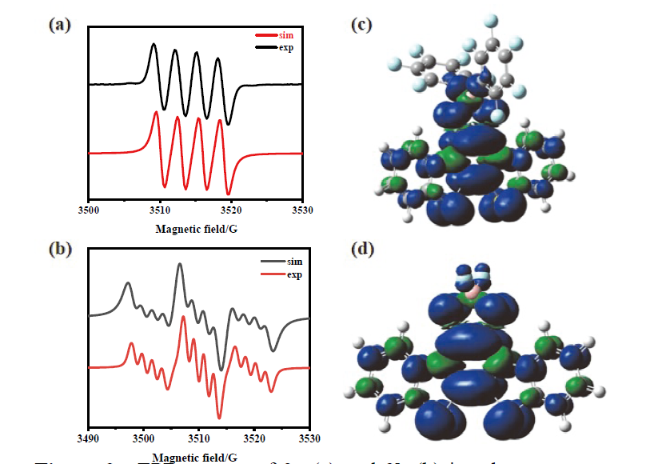
The EPR spectrum of 3b displays more complicated due to hyperfine coupling with the F atoms. The EPR spectrum of 3b arises from couplings with one set of 19F atom, one set of 11B atom and three sets of 1H atom coupling constant (a19F=7.16 G, a11B=1.64 G, a1H= 0.10, 0.77, 0.22 G), suggesting the C2 symmetry of 3b in solution and a full delocalization of the unpaired electron, that is also supported by calculated spin density distribution (UB3LYP/ 6-311g(d) level, Figure 2d). DFT-computed isotropic hyperfine coupling constants and g-values are provided in Tables S8 and S9 (see Supporting Information). These calculations confirm the experimental assignments for resolvable nuclei (¹¹B in all radicals and ¹⁹F in 3b) and reveal the significant impact of unresolved nuclei on the spectral linewidth and lineshape (1H in both radicals and ¹⁹F in 3a).
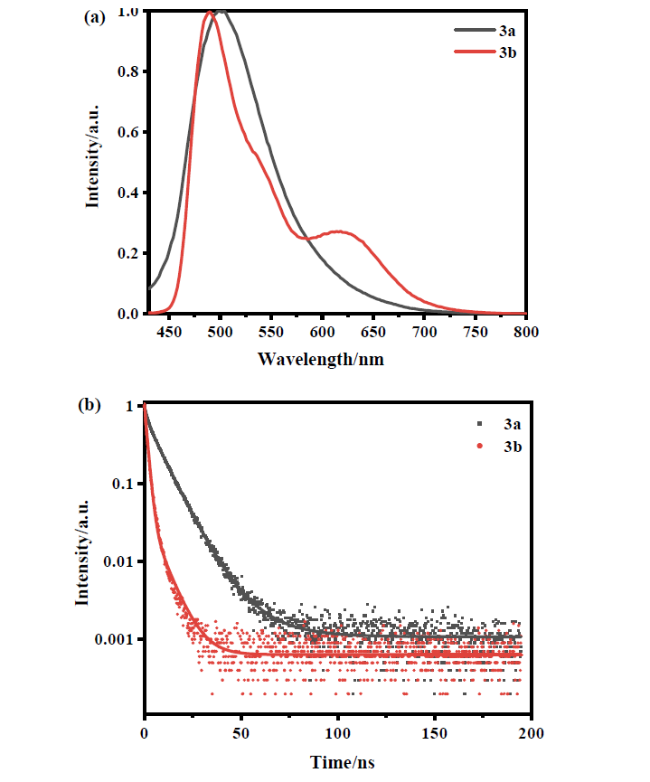
The UV-Vis absorption spectrum of 3a in dilute dichloromethane (DCM) solution displays the first absorption band at 362 nm with an additional absorption band at 628 nm. The first absorption band of 3b displays at 404 nm. The additional absorption bands of 3b (526~560 nm) are blue-shifted compared to those of 3a (628 nm), which can be attributed to the electron-acceptor of two F atoms at the B in 3b. The UV-Vis absorption spectrum of both radicals 3a and 3b in dilute DCM solution show absorption above 500 nm, featuring typical radical character.[8] Both radicals 3a and 3b exhibit blue fluorescence and absorbance above 500 nm, indicating that photon emission does not arise from the lowest excited state (D0) and these radicals deviate from Kasha’s rule (Figure 3a).[11] This observation aligns well with the reported phenomena of boron-containing dioxoborocyclic radicals, further highlighting the advantages of this system for constructing short- wavelength emissive radicals.[8] The excited-state fluorescence lifetime (τ) of 3a was determined to be 8.8 ns, and that of 3b was 2.3 ns (Figure 3b). The photoluminescence quantum yields (PLQYs) of 3a and 3b were measured as 3.39% and 0.19%, respectively.
Theoretical calculations were performed to study the electronic structure and photoluminescence mechanism of 3a and 3b. The crystal structures of 3a and 3b were taken as the starting geometry for density functional theory (DFT) optimization at the UB3LYP/6-311G(d) level. Due to the existence of an unpaired electron, the ground states of 3a and 3b are doublet. The unpaired electron is located on 166α and 94α orbitals in 3a and 3b, respectively, namely the single electron occupied molecular orbital (SOMO), with all lower-energy orbitals demonstrating paired electron configurations (Figure 4). The electron spin density of 3a and 3b is mainly distributed on the benzohio- phenedione unit, while those on remote boron atoms and fluorophenyls (or fluorine atoms) are negligible.
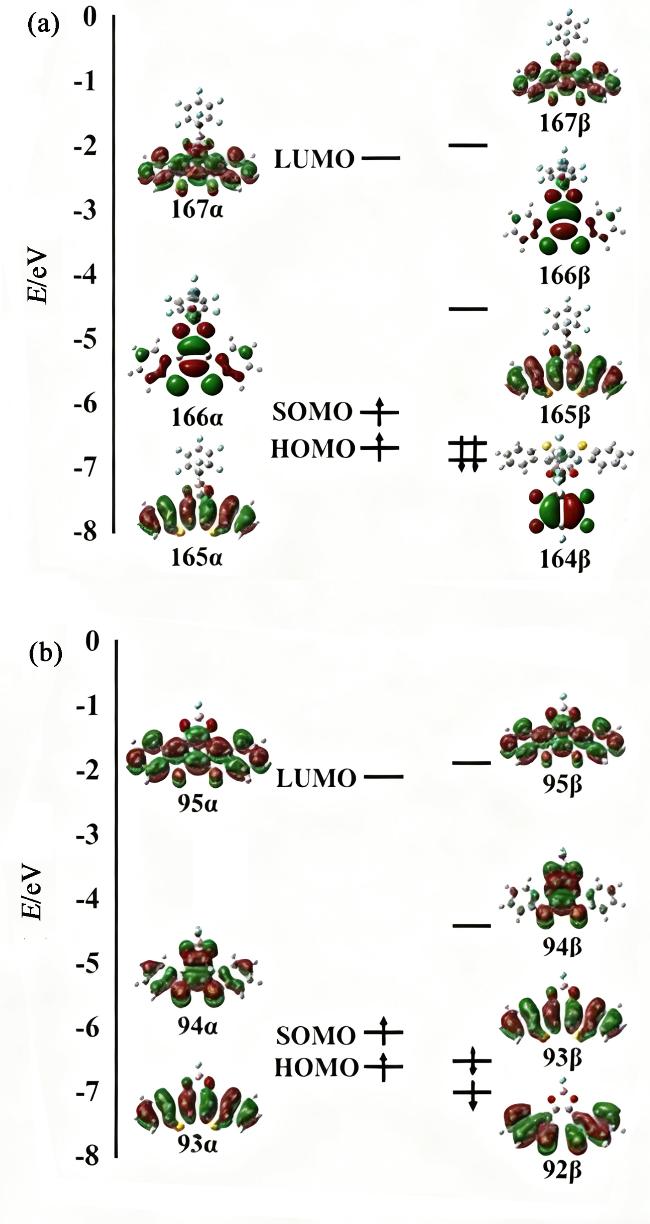


Time-dependent density functional theory (TD-DFT) calculations were carried out to elucidate the electronic excited-state properties of radicals 3a and 3b (CAM- B3LYP/6-311G(d,p) level). The lowest excited state (D1) primarily results from the beta electron (spin-down) transition from the HOMO to the SOMO, with negligible oscillator strengths (Table S5, see Supporting Information). This indicates that D1 is a "dark state" with minimal involvement in photoluminescence processes. Conversely, higher excited states possess significant oscillator streng- ths, making valence electrons prone to jump to these states upon photoexcitation. The D2 and D3 excited states nearly overlap owing to a negligible energy difference (<0.1 eV). In contrast, the substantial energy gap exceeding 1 eV between D2 and D1 considerably slows the internal conversion (IC) process.[12] Notably, TD-DFT calculations for radicals 3a and 3b exhibit good agreement between theoretical predictions (3a: D2 510 nm, D3 492 nm; 3b: D2 492 nm, D3 486 nm) and experimental fluorescence emission (3a: 501 nm, 3b: 469 nm). Hence, upon photoexcitation, higher excited states D2 and D3 can hardly relax to D1 via the IC process but directly return to the ground state through emission. These theoretical results rationalize the anti-Kasha rule behavior of emission observed in this class of radicals.
3 Conclusions
In summary, leveraging the anti-Kashaʼs rule exhibited by boron-containing dioxoborocyclic radicals, we synthesized and isolated two novel blue-light-emitting radicals by incorporating dioxoborocyclic radicals and thiophene units. They were characterized by single-crystal X-ray diffraction, UV-Vis spectroscopy, EPR spectroscopy and fluorescence spectroscopy. TD-DFT calculations demonstrate that the anti-Kasha emission of 3a and 3b can be attributed to the effective suppression of IC pathways. Consequently, these radicals exhibit anti-Kasha behavior by emitting from a high-energy excited state, which is similar to our pre- work in 2021[8]. The PLQY of 3a is 3~10 times higher than previous compounds. Critically, this work shows that changing the boron substituent markedly changes the electronic properties and emission characteristics of these radicals. Comparing the luminescent properties of 3a and 3b, stronger electron-withdrawing BF2 group causes blue- shifted absorption, stronger intermolecular interactions, and lower PLQY. This tunability via boron substituents (B(C6F5)2 vs. BF2), combined with the inherent anti-Kasha behavior of the boron-containing radical system, offers a powerful strategy for developing stable, short-wavelength luminescent radicals, addressing a major limitation of traditional chloroarylmethyl radicals. Future work can leverage this substituent effect to further optimize emission color, efficiency, and material properties.
4 Experimental section
4.1 General experimental information
Experiments were performed under a nitrogen gas atmosphere using standard Schlenk techniques and glovebox. Tetrahydrofuran (THF), toluene and DCM were dried by standard methods and distilled under nitrogen. Commercially available reagents were purchased from Energy Chemical and used as received. Benzo[2,1-b:3,4-b']bis- [1]-benzothiophene-5,6-dione (1) and chlorobis(perfluoro- phenyl)borane (2a) were prepared according to the reported methods.[13-14] For the single crystal structure analyses, the crystals were each mounted on a glass capillary in perfluorinated oil and measured in a cold N2 flow. The data were collected on Bruker D8 CMOS detectors. The structures were solved by direct methods and all refined on F2 with the SHELX- 2014/7 software package. UV-Vis spectra were recorded on Lambda 750 spectrometer. EPR spectra were obtained using Bruker EMX PLUS spectrometer at room temperature. The fluorescence experiments were performed on an Edinburgh Instruments FLS 1000 Photoluminescence spectrometer.
4.2 Synthesis of C30H8BF10O2S2 (3a)
Under anaerobic and anhydrous condition, a mixture of 1 (0.3205 g, 1 mmol), chlorobis(perfluorophenyl)borane (2a, 76.1 mg, 0.2 mmol) and KC8 (0.1485 g, 1 mmol) in toluene (50 mL) was stirred at room temperature for 48 h. The solvent of resultant dark blue mixture was filtered through celite. The filtrate was concentrated to 10 mL and stored in a -25 ℃ freezer for 2 d, forming dark blue crystals of 3a 0.1304 g, 19.6% yield. Anal. calcd for C30H8BF10O2S2: C 54.16, H 1.21; found C 55.76, H 1.16.
4.3 Synthesis of C18H8BF2O2S2 (3b)
Under anaerobic and anhydrous condition, a mixture of 1 (0.3205 g, 1 mmol), boron trichloride 2b (0.1419 g, 0.13 ml, 1 mmol) and KC8 (0.1485 g, 1 mmol) in toluene (50 mL) was stirred at room temperature for 48 h. The solvent of resultant dark red mixture was filtered through celite. The filtrate was concentrated to 10 mL and stored in a -25 ℃ freezer for 2 d, forming dark green crystals of 3b 0.1017 g, 27.4% yield. Anal. calcd for C18H8BF2O2S2: C 58.56, H 2.18; found C 57.88, H 2.99.
Supporting Information Crystal structures, EPR spectra, UV-Vis absorption spectra, photostability analysis of 3a and theoretical calculations. The Supporting Information is available free of charge via the Internet at http://sioc-journal.cn/.
(Li, L.)