



1 Introduction
Carbon nanotubes (CNTs) have garnered extensive attention in materials science owing to their unique structure and exceptional properties,[1-2] and these properties are critically dependent on their diameter and chirality.[3-4] However, conventional synthetic approaches typically produce mixtures of CNTs with varying forms,[5-7] seriously limiting their advanced applications in devices.[8] Over the past two decades, the bottom-up organic synthesis of single-walled CNTs (SWCNTs) with precisely controlled diameter and chirality has emerged as a frontier research in synthetic chemistry.[9-11] Cycloparaphenylenes (CPPs) represent the smallest repeating units of armchair- type CNTs, which could serve as ideal molecular templates for the synthesis of structurally uniform SWCNTs.[12-14] Recent research of CPPs has primarily focused on their π-extension, which not only generates novel architectures, but also confers unique properties.[15-19] A straightforward and efficient strategy for constructing π-extended carbon nanohoops involves either replacing one or more benzene rings in the CPP backbone with polycyclic aromatic hydrocarbon (PAH) units, or attaching multiple PAH units to one or more benzene rings.[20-23] However, studies on the latter approach remain relatively scarce compared to ring replacement, probably due to the persistent challenges in CPP functionalization.
In previous work, Duʼs group[24] introduced two pyrene and hexabenzocoronene (HBC) units to [10]CPP backbone, respectively, and fully investigated their chiral properties. In addition, Zysman-Colman and coworkers[25] have reported a nanohoop by incorporating four 10-phenyl-10H-pheno-xazine units into [10]CPP skeleton, which can show potential application in organic light-emitting diode (OL- ED). Despite all of the above progresses, more PAH-substituted carbon nanohoops are rarely reported due to the lack of appropriate multi-functional CPP platform. Recently, a novel donor-acceptor carbon nanohoop was reported,[26] whose key intermediate provides the opportunity to construct other multifunctional carbon nanohoops through site-specific attachment of diverse PAH units. As a prototypical PAHs, pyrene is an exceptional building block for applications due to its extended planar conjugation, distinctive photophysical properties, and superior charge transport characteristics.[27] Inspired by these, it is quite interesting to develop multi-pyrene-functionalized carbon nanohoops and explore their unique properties.
Herein, the synthesis of a multi-substituted carbon nanohoop ([12]CPP-8PBPy) is reported (Figure 1), which represents the segment of [12,12] armchair-type SWCNT. The resulting nanohoop was mainly synthesized by the Suzuki-Miyaura cross-coupling reaction. [12]CPP-8PBPy was studied by nuclear magnetic resonance (NMR) spectroscopy, high-resolution mass spectrometry (HRMS), UV/ Vis absorption and fluorescence spectroscopy. To further elucidate the electronic characteristics of this unique multi-substituted nanohoop, its charge transport behavior was evaluated through organic field-effect transistors (OFETs) measurements.
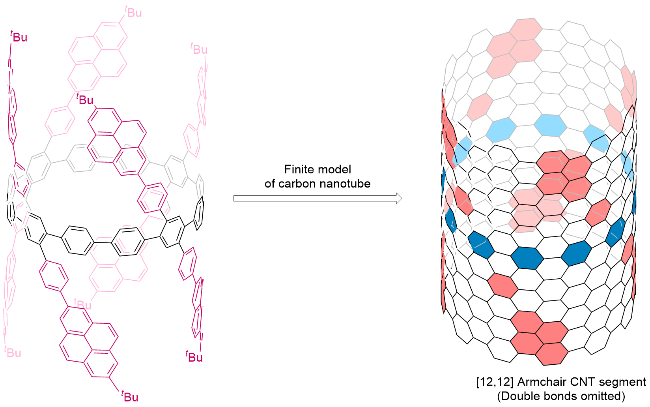
2 Results and discussion
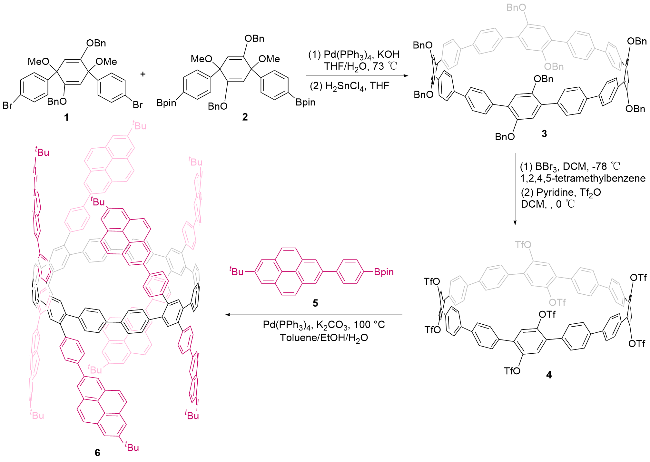
The synthestic procedure of [12]CPP-8PBPy is shown in Figure 2, and starting materials 1 and 2 were synthesized according to previously reported procedures.[19,26] The synthetic steps begin with the Suzuki-Miyaura cross-coupling of 1 with its corresponding pinacol borate 2, followed by reductive aromatization with H2SnCl4 to give nanohoop 3 in 13% yield. Then, the benzyl groups in nanohoop 3 can be easily cleaved by boron trichloride, and the subsequent reaction with triflic anhydride yields triflate-functionalized nanohoop 4 in 48% yield.[26] 7-tert-Butylpyrene-2-boronic acid pinacol ester was coupled with 1,4-dibromobenzene via Suzuki-Miyaura cross-coupling, then underwent Miyaura borylation with bis(pinacolato)-diboron to afford 5 in 61.7% yield. Finally, 4 was reacted with 5 under Suzuki-Miyaura cross-coupling to obtain the final product [12]CPP-8PBPy in a yield of 13.1%. The target molecule [12]CPP-8PBPy was fully characterized by matrix assisted laser desorption ionization time of flight mass spectrometry (MALDI-TOF MS), 1H NMR and 13C NMR.
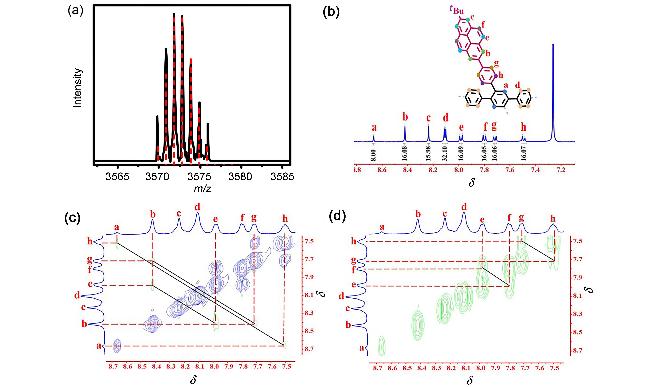
The molecular weight of [12]CPP-8PBPy was confirmed by MALDI-TOF MS. The main peak at 3571.8324 was observed, which was the exact mass for [12]CPP-8PBPy (calculated for C280H208 [M]+: 3571.8343), suggesting the successful synthesis of the target molecule (Figure 3a). As shown in Figure 3b, the 1H NMR spectrum of [12]CPP-8PBPy exhibited only eight sets of peaks in the aromatic region, indicating its highly symmetrical structure. Based on the peak shape, chemical shifts and number of integral protons, the singlet at δ=8.67 and the doublet at δ=8.11 could be assigned to protons of Ha and Hd in CPP skeleton, respectively. Rotating frame Overhauser effect spectroscopy (ROESY) is a technique used to determine the spatial proximity between protons in a molecule, describing the interactions between nuclear spins within a certain distance. According to the 1H-1H ROESY NMR spectrum (Figure 3c), Hh was correlated with Ha, suggesting that the doublet at δ=7.49 can be ascribed to the Hh. COSY is a technique in two-dimensional nuclear magnetic resonance (NMR) spectroscopy, which generally reflects the coupling relationships of hydrogens on adja-cent carbon atoms. The 1H-1H COSY NMR spectrum (Figure 3d) showed that Hg and Hh were mutually correlated, suggesting that the doublet at δ=7.72 corresponds to the Hg. Moreover, Hb was correlated with Hg and He according to the ROESY NMR spectrum, confirming that the singlet at δ=8.42 and the doublet at δ=7.98 may originate from Hb and He, respectively. The 1H-1H COSY NMR spectrum showed that Hf was correlated with He, implying that the doublet at δ=7.80 belongs to the Hf. Finally, the remaining singlet at δ=8.24 can be assigned to Hc. All the above results confirmed the successful synthesis of [12]CPP-8PBPy.
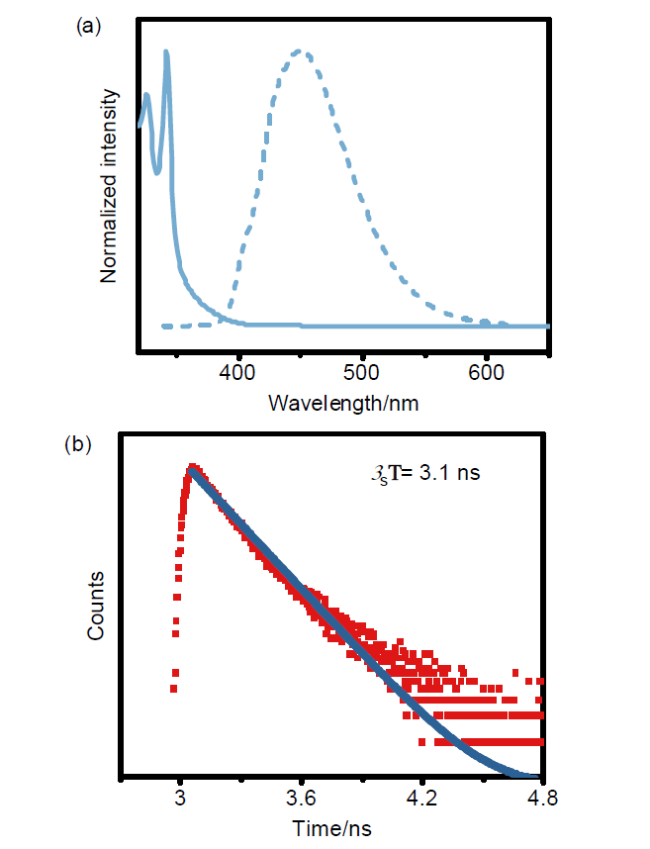
The photophysical properties of [12]CPP-8PBPy were studied in CH2Cl2 by UV/Vis absorption spectroscopy, steady-state fluorescence spectroscopy, and time-resolved fluorescence decay spectroscopy. As shown in Figure 4a, the absorption spectrum of [12]CPP-8PBPy in CH2Cl2 exhibited two absorption bands in the range of 320~410 nm, and the maximum absorption peaks were at 327 and 343 nm with the absorption coefficient (ε) of approximately 3.27×10⁴ and 5.83×10⁴ L•mol−1•cm−1, respectively. The fluorescence emission spectrum of [12]CPP-8PBPy was carried at room temperature under excitation at 343 nm. The obvious emission peak was observed at 452 nm (Figure 4a), which was comparable to that of [12]CPP.[28] Using integrating sphere method, the photoluminescence quantum yield (QY) of [12]CPP-8PBPy was determined to be ФF=32.1%. The luminescence lifetime (τs) of [12]-CPP-8PBPy was further measured by time-resolved pho-toluminescence (TRPL) technique using a nanosecond pulsed laser system in CH2Cl2 at room temperature (Figure 4b). Upon excitation at 390 nm, the luminescence lifetime (τs) of [12]CPP-8PBPy was determined to be approximately 3.1 ns at 452 nm by single-exponential decay fitting, which is longer than that of [12]CPP (τs=2.2 ns).[28] Moreover, the molecules have a longer fluorescence lifetime, which can enhance the stability of the signal,[29] improve imaging resolution,[29-30] and exhibit better environmental adaptability.[31]
Pyrene units have large π-conjugation effects and superior carrier transport characteristics, which makes pyrene- containing compounds promising for applications in electroluminescent and charge transport materials.[27,32-35] Moreover, [12]CPP-8PBPy can be regarded as a conjugated segment of CNTs. Considering the remarkable electronic properties of CNTs and similar nanohoop structures,[36-40] we further investigated the application prospect of [12]CPP-8PBPy as a charge transport layer material in optoelectronic devices. [12]CPP-8PBPy has been incorporated as an active layer in organic field-effect transistors (OFETs) possessing a bottom-gate/bottom-contact (BG/ BC) architecture (Figure 5a).
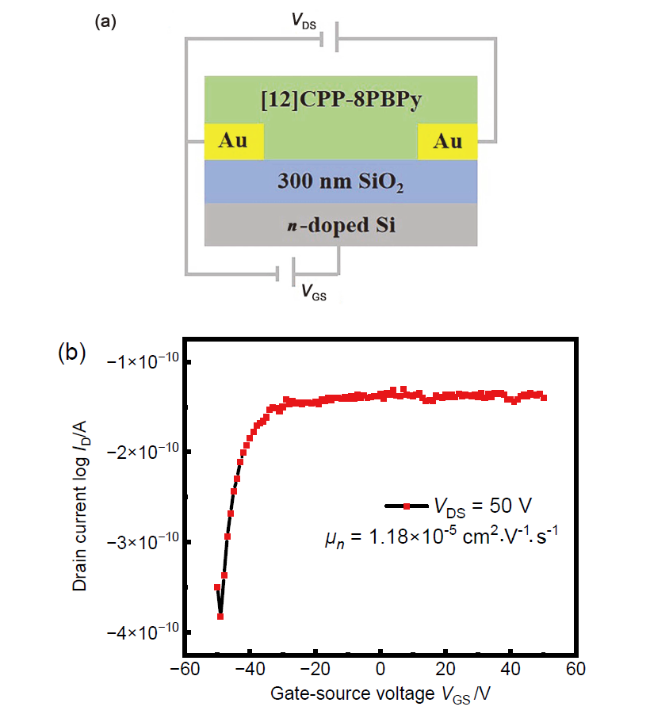


This BG/BC device was fabricated on a cleaned SiO₂ substrate, and Cr/Au (thickness: 5 nm/80 nm) was deposited on its surface by thermal evaporation as source/ drain electrodes. The active layer was spin-coated on source/ drain electrodes in the last step, which prevents any structural effect resulting from the deposition of other layers, thermally annealed at 90 ℃ for 30 min in the N2 filled glove box and then cooled naturally down 25 ℃. The transfer characteristics of [12]CPP-8PBPy are presented in Figure 5b. The mobility (μe) of [12]CPP-8PBPy was calculated to be 1.18×10⁻⁵ cm2•V-1•s-1, which is higher than that of the reported oligocarbazole rings and related CPPs,[41-42] showing that pyrene functionalization is an effective strategy for improving the electron mobility of nanohoops.
3 Conclusions
In summary, a facile synthesis strategy of the multi- substituted carbon nanohoop [12]CPP-8PBPy has been reported by Suzuki-Miyaura cross-coupling reaction, which can be considered as a segment of the armchair-type [12,12] SWCNT. The target products were characterized by HRMS, 1H NMR and 13C NMR, 2D 1H-1H COSY and ROESY NMR. Steady-state spectroscopy revealed its unique photophysical properties. [12]CPP-8PBPy also exhibited n-type OFET characteristics, with field effect mobility reaching 1.18×10⁻⁵ cm2•V-1•s-1. This simple multi-substituted strategy can provide a possible route for the construction of ultrashort armchair-type CNTs. Further challenges, including designing and synthesizing larger π-extended carbon nanohoops for producing size-defined CNTs, are the focus of ongoing work in our laboratory.
4 Experimental section
4.1 Instrumentation and materials
NMR spectra were recorded on a Bruker BioSpin (1H NMR 400 MHz, 13C NMR 100 MHz) spectrometer, and chemical shifts were reported as the δ scale relative to CDCl3 (δ 7.26) for 1H NMR and CDCl3 (δ 77.0) for 13C NMR. High resolution mass spectrometry (HRMS) ana- lyses were carried out using MALDI-TOF-MS techniques. Flash chromatography was performed on silica gel (200 to 300 mesh). Preparative thin-layer chromatography (PTLC) experiments were performed using silica gel GF 254 coated plates. UV/Vis absorption spectra were performed on a UNIC-3802 spectrophotometer. The steady state photoluminescence (PL) spectra were obtained using a HORIBA FluoroMax-4, spectrofluorometer with an excitation source of 150-watt ozone-free continuous-wave Xenon lamp. Emission lifetime measurements were carried out using a HORIBA FluoroCube-JY system with a NanoLED-390 pulsed diode light source.
All solvents for syntheses were dried by distillation under nitrogen prior to use (tetrahydrofuran was distilled after reflux with sodium under nitrogen). Other chemicals were obtained from commercial suppliers (Acros or Innochem) and used without further purification. All air-sensi- tive reactions were carried out under nitrogen or argon atmosphere. Compounds 1, 2, 3 and 4 were prepared according to reported procedures.[19,26]
4.2 General procedures for the synthesis of compound 5
To a round-bottom flask (50 mL) containing a magnetic stirring bar were added 7-tert-butylpyrene-2-boronic acid pinacol ester (500.00 mg, 1.30 mmol), 1,4-dibromoben-zene (943.64 mg, 4.00 mmol), N,N-dimethylformamide (DMF) (18 mL) and H2O (2 mL), then potassium carbonate (448.50 mg, 3.25 mmol) and Pd(PPh3)4 (28.89 mg, 0.025 mmol) were added after argon bubbling for 25 min. The mixture was reacted at 100 ℃ for 48 h. After cooling to room temperature, the solvent was removed under vacuum and the residue was extracted with CH2Cl2. The organic layer was dried by anhydrous MgSO4, filtered and concentrated under reduced pressure. Further purification by column chromatography with petroleum ether/CH2Cl2 as the eluent (V∶V=15∶1) afforded pure 2-(4-bromo- phenyl)-7-(tert-butyl)pyrene (376.16 mg, 70%) as a white solid. 1H NMR (400 MHz, Chloroform-d) δ: 8.31 (s, 2H), 8.24 (s, 2H), 8.09 (s, 4H), 7.75 (d, J=8.5 Hz, 2H), 7.67 (d, J=8.5 Hz, 2H), 1.59 (s, 9H).
To a round-bottom flask (25 mL) containing a magnetic stirring bar were added 2-(4-bromophenyl)-7-(tert-butyl)-pyrene (800.00 mg, 1.94 mmol), bis(pinacolato)diboron (1261.80 mg, 4.97 mmol), 2-dicyclohexylphosphino-2',6'-dimethoxybiphenyl (SPhos) (223.70 mg, 0.55 mmol) and 1,4-dioxane (10 mL), then potassium acetate (630.72 mg, 6.43 mmol) and Pd(OAc)2 (18.30 mg, 0.082 mmol) were added after argon bubbling for 20 min. The mixture was reacted at 90 ℃ for 48 h. After cooling to room temperature, the solvent was removed under vacuum and the residue was extracted with CH2Cl2. The organic layer was dried by anhydrous MgSO4, filtered and concentrated under reduced pressure. Further purification by recrystallization from methanol obtain pure 7-tert-butylpyrene-2-phenyl boronic acid pinacol ester 5 (790.37 mg, 61.7%) as a off-white solid. 1H NMR (400 MHz, Chloroform-d) δ: 8.39 (s, 2H), 8.23 (s, 2H), 8.09 (d, J=3.9 Hz, 4H), 8.00 (d, J=8.2 Hz, 2H), 7.91 (d, J=8.1 Hz, 2H), 1.59 (s, 9H), 1.40 (s, 12H).
4.3 General procedures for synthesis of [12]CPP-8PBPy
To a round-bottom flask (50 mL) containing a magnetic stirring bar were added compound 4 (40 mg, 0.019 mmol), 7-tert-butylpyrene-2-phenyl boronic acid pinacol ester (210 mg, 0.454 mmol), toluene (12 mL), ethanol (4 mL) and H2O (4 mL), then potassium carbonate (131.12 mg, 0.951 mmol) and Pd(PPh3)4 (4.85 mg, 0.0042 mmol) were added after argon bubbling for 25 min. The mixture was reacted at 100 ℃ for 48 h. After cooling to room temperature, the solvent was removed under vacuum and the residue was extracted with CH2Cl2. The organic layer was dried by anhydrous MgSO4, filtered and concentrated under reduced pressure. Further purification by column chro- matography with petroleum ether/CH2Cl2 as the eluent (V∶V=2∶1) afforded pure [12]CPP-8PBPy (8.89 mg, 13.1%) as a brown-black solid. 1H NMR (400 MHz, Chloroform-d) δ: 8.67 (s, 8H), 8.42 (s, 16H), 8.24 (s, 16H), 8.11 (d, J=4.7 Hz, 32H), 7.98 (d, J=8.1 Hz, 16H), 7.80 (d, J=8.1 Hz, 16H), 7.72 (d, J=7.7 Hz, 16H), 7.49 (d, J=7.7 Hz, 16H), 1.60 (s, 72H); 13C NMR (101 MHz, Chloroform-d) δ: 130.97, 128.90, 128.39, 128.06, 127.73, 127.43, 127.14, 123.40, 122.47, 31.97, 29.73. HRMS (MALDI- TOF) calcd for C280H208 3571.8343, found 3571.8324.
Supporting Information Additional experimental data include synthesis details; 1H NMR, 13C NMR, HRMS and OFETs measurement. The Supporting Information is available free of charge via the Internet at http://sioc- journal.cn/.
(Lu, Y.)