ARTICLES

Design and Synthesis of Peptide-Based Salen-Co(II) Complexes, and Studies on Their Catalytic Reactivity in Alkene Hydrohydrazination

  • Zengfeng Li ,
  • Chengxi Li ,
  • Piao Zhang ,
  • Jinmeng Tang ,
  • Chifan Zhu ,
  • Guodong Hu ,
  • Meihua Shen , * ,
  • Hua-Dong Xu , *
Expand
  • School of Pharmacy, Changzhou University, Changzhou, Jiangsu 213164

Received date: 2025-05-14

  Revised date: 2025-06-06

  Online published: 2025-11-05

Supported by

National Natural Science Foundation of China(22177015)

Natural Science Foundation of Jiangsu Province(BK20211334)

Postgraduate Research & Practice Innovation Program of Jiangsu Province(KYCX23-3022)

the Postgraduate Research & Practice Innovation Program of Jiangsu Province(KYCX23-3033)

Abstract

Nine peptide-modified Salen-Co(II) complexes based on three Salen ligand frameworks SA1~SA3 and four oligopeptides P1~P4 have been prepared. Their catalytic activities were examined through a model hydrohydrazination of cinnamic alcohol with azodicarboxylate. While peptide-modified Salen-Co(II) complexes derived from SA1 are ineffective, its parent 1SalenCo and those based on SA2 and SA3 are excellent catalyst for this reaction. These results demonstrate that peptide ligands significantly modulate the catalytic activity of SalenCo(II) complexes, particularly at lower temperatures, likely due to hydrogen-bonding interactions.

Cite this article

Zengfeng Li , Chengxi Li , Piao Zhang , Jinmeng Tang , Chifan Zhu , Guodong Hu , Meihua Shen , Hua-Dong Xu . Design and Synthesis of Peptide-Based Salen-Co(II) Complexes, and Studies on Their Catalytic Reactivity in Alkene Hydrohydrazination[J]. Chinese Journal of Organic Chemistry, 2025 , 45(12) : 4425 -4432 . DOI: 10.6023/cjoc202504005

1 Introduction

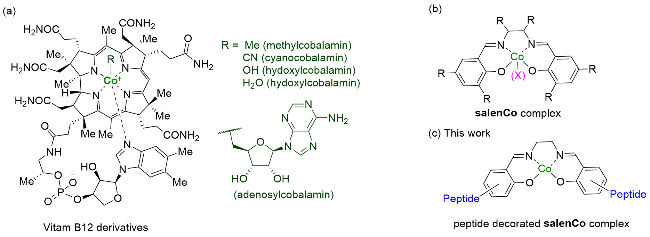
An enzyme can be considered to be made up of a number of peptide segments that together define the structural property of that enzyme and account for its high catalytic efficiency and specificity. A peptide, depending on its amino acid sequence, may also possess dynamic secondary and/or tertiary structure that could provide multiple cooperative intra- and inter-molecular interactions, which could be exploited for catalysis, just like enzymes do.[1] Since the concept of peptide-based catalysis emerged for asymmetric synthesis a half century ago,[2] enormous advances have been made in terms of reaction scope and mechanism diversity as well as catalyst design.[3] In this regard, introduction of transition metal complexes to peptide-based ligands is an efficient approach for catalyst development,[4] because it combines the richness of transition metal chemistry with the above-mentioned merits of peptidic catalysis together with its capability for facile sequence modulation. Along with this direction, palladium,[5] rhodium,[6] copper,[7] and iron[8] have been integrated with peptides to achieve asymmetric catalytic allylation, hydrogenation, oxidation, carbenoid insertion and cross-coupling reactions. However, we think the potential of this strategy is far from being fully revealed. For example, the competent cobalt,[9] an essential trace element that is employed by nature in a number of metalloenzymes as the catalytic centre in Vitamin B12 cofactors (Figure 1a),[10] is almost thoroughly ignored in this regard. We therefore launched a project aiming to fill this gap through preparation of peptide-cobalt hybrids that could be used as catalyst in organic synthesis.
Figure 1 Structures of cobalamins, Salen-Cobalt complexes and peptide modification

2 Results and discussion

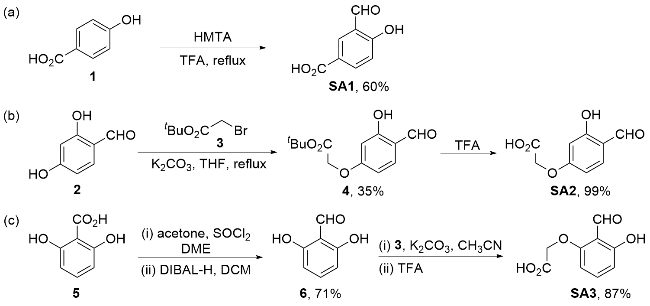
Given their ease of preparation and broad applications, Cobalt-Salen complexes were elected for this purpose (Figure 1, b).[11] Modification could occur by installation of a short peptide on the core of the Salen ligand, e.g. the phenyl moiety, to give peptide-modified Salen-Co(II) complexes (Figure 1, c). To this end, three salicylaldehydes SA1~SA3 were designed and made each bearing a free carboxyl acid group for peptide ligation (Scheme 1). 5- Carboxysalicylaldehyde SA1 was obtained readily through mono-formylation of 4-hydroxybenzoic acid 1 with hexamethylenetetramine (HMTA). Selective alkylation of commercially available 5-hydroxysalicylaldehyde (2) with tert-butyl bromoacetate (3) afforded compound 4 in 35% yield, which was converted into salicylaldehyde SA2 quantitatively via treatment with trifluoroacetic acid (TFA). 6-Hydroxysalicylic acid (5) was transformed into 6-hydro- xysalicylaldehyde (6) through a two-step process, and the same protocol was effective to afford SA3 readily.
Scheme 1 Synthesis of carboxylic acid functionalized salicylaldehydes
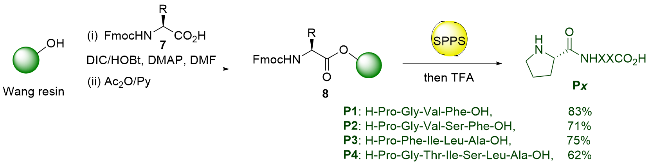
Fmoc solid-phase peptide synthesis (SPPS) was used to make oligopeptides (Scheme 2). Wang resin was loaded with a first Fmoc amino acid through condensation using the N,N'-diisopropylcarbodiimide (DIC)-1-hydroxyben- zotriazole (HOBt) combination in N,N-dimethylformamide (DMF). Subsequent end-capping acetylation was achieved with excess Ac2O/Py to give resin supported Fmoc amino acid 8 ready for elongation. Then repetitive Fmoc cleavage, coupling and washing were carried out with selected amino acids. Then at the end, cleavage from the resin with simultaneous global deprotection was accomplished by treatment with TFA. Following this protocol, short peptides P1~P4 were prepared in good yields.
Scheme 2 SPPS of short peptides
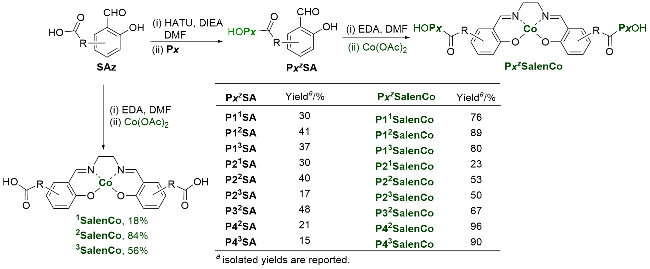
With carboxyl acid functionalized salicylaldehydes SAz and peptides Px at hand, we headed on to synthesize peptide-modified salen-Co(II) complexes. Activation of SAz with O-(7-azabenzotriazol-1-yl)-N,N,N',N'-tetramethyluro- nium hexafluorophosphate (HATU)/diisopropylethylami- ne (DIPEA) in DMF followed by addition of oligopeptide Px afforded peptide modified salicylaldehyde PxzSA, which were purified via reverse phase column chromatography. Condensation of these PxzSA with ethylenediamine (EDA, 0.5 equiv.) in DMF under nitrogen atmosphere at room temperature gave corresponding Salen ligands in 6 h. Upon completion of the reaction, as indicated by thin layer chromatography (TLC), a suspension of Co(OAc)2 in DMF was introduced. The reaction mixture was then heated to 80 °C for 12 h, affording a deep red solution. Removal of the solvent and washing with deionized water provided a brown solid. ESI-MS confirmed the successful preparation of the desired peptidic metal complexes PxzSalenCo. The UV-Vis spectra of these complexes have been recorded and analyzed to further confirm the metal centre to be Co(II) rather than Co(III).[12] The yields for peptide installation and the metal complex assembly are tabulated in Scheme 3. Meanwhile, the same protocol was also applied to prepare Co(II) complexes 1SalenCo, 2SalenCo and 3SalenCo directly from corresponding salicylaldehydes SA1~SA3.
Scheme 3 Preparation of peptidic salicylaldehydes and related Salen cobalt complexes
Recently, great advances have been made in hydrofunctionalization of alkenes and alkynes via first row transition metal catalysis.[13] In this context, the catalytic activity of our peptidic Salen cobalt complexes was evaluated with the model reaction of cobalt-catalyzed hydrohydrazination of cinnamic alcohol 9 with azodicarboxylate 10.[14] We envisioned that the hydroxyl group in olefin 9 could engage in hydrogen-bonding interactions with the peptide on the cobalt Salen complex. The reaction was carried out in MeOH under N2 at 30 ℃ with excess tetramethyldisiloxane (TMDS) as the hydride source. The results are shown in Table 1. Although 1 mol% P11SalenCo was ineffective, the same amount of complexes P12SalenCo and P13SalenCo exhibited excellent catalytic activity, resulting in clean conversion (in 3 h) of allylic alcohol 9 to 1,3-hydroxyl- alkylhydrazine 11 in 81% and 90% isolated yields, respectively (Entry 1 vs Entries 2, 3). With P2 modified Salen- Co(II) complexes, a similar trend was still observed, even lower yields were obtained (Entry 4 vs Entries 5, 6). P32SalenCo, carrying highly hydrophobic pentapeptide P3, was effective to promote the reaction as well to give 11 almost quantitatively (Entry 7). Both heptapeptide P4 modified cobalt complexes P42SalenCo and P43SalenCo could catalyze this hydrohydrazination at 30 ℃, affording 11 in excellent yields (Entries 8, 9), even though the former needed more time to achieve full conversion. At 15 ℃, the catalytic efficiency for all the peptidic cobalt complexes derived from framework SA2 decreased remarkably (Entries 10~13). When quenched at 3 h, an 80% conversion was realized with tetrapeptide P1 modified P12SalenCo as the catalyst. Similarly, with complexes P22SalenCo, P32SalenCo and P42SalenCo, 60%, 40% and 50% conversion were obtained respectively in the same reaction time, which roughly correlated proportionally with the reaction rates. The rate differences related to the decorating peptides are recognizable and should not be ignored. In order to make further comparison, non-peptide Salen-Co complexes 1SalenCo~3SalenCo were also tested with the same reaction. Surprisingly, 1SalenCo displayed much higher catalytic activity than P11SalenCo and P21SalenCo, and the reaction could proceed to completion in 3 h even at 15 ℃ (Entry 14 vs Entries 1, 4). In contrast, both 2SalenCo and 3SalenCo were able to achieve only partial conversion with the same reaction time and temperature, showing slightly decreased catalytic efficiency than their peptidic congeners (Entries 15, 16 vs Entries 10~13). These preliminary data clearly manifest that not only the electronic nature of the Salen core is strongly correlated to the catalytic activity of the metal centre, but also the identity of the peptide can impose a significant influence, a feature reminiscent of metal cofactors in metalloenzymes. Although the exact reason remains elusive at this stage, the temperature effects on these catalytic reactions may reflect the common principle that peptides have lower conformational flexibility and hydrogen bonding strength at lower temperatures.
Table 1 Peptide-modified Salen-Co(II) complexes catalyzed hydrohydrazination of cinnamic alcohola
Entry PxzSalenCo Temperature/℃ Time/h Conversionb/% Yieldc/% eed/%
1 P11SalenCo 30 3.0 ≈5 Trace
2 P12SalenCo 30 3.0 100 81 0
3 P13SalenCo 30 3.0 100 90 0
4 P21SalenCo 30 3.0 ≈5 Trace
5 P22SalenCo 30 3.0 100 73 0
6 P23SalenCo 30 3.0 100 62 0
7 P32SalenCo 30 3.0 100 95 0
8 P42SalenCo 30 3.5 100 95 0
9 P43SalenCo 30 3.0 100 80 0
10 P12SalenCo 15 3.0 80 66 (83)e
11 P22SalenCo 15 3.0 60 42 (70)e 0
12 P32SalenCo 15 3.0 40 36 (90)e
13 P42SalenCo 15 3.0 50 45 (90)e 0
14 1SalenCo 15 3.0 100 97
15 2SalenCo 15 3.0 <30 98f
16 3SalenCo 15 3.0 <50 95f

a Conditions: cinnamic alcohol 9 (0.37 mmol), di-tbutyl azodicarboxylate (10, 0.56 mmol), TMDS (0.74 mmol), PxzSalenCo (1 mol %), MeOH (2.0 mL), 30 ℃, N2. b Based on recovered 9. c Isolated yields. d Determined by HPLC on chiral stationary phase. e Yield in parentheses is the one based on conversion. f Subsequent temperature elevation to 30 ℃ resulted in full conversion and the yield is reported herein.

In addition, the ee value of the hydrazine product 11 for some reactions was measured by HPLC, but almost no enantiomeric excess could be detected. Despite being disappointed, it is not totally out of our expectation when taking into account the radical nature of the stereogenic C—N bond forming event and the fact that no asymmetric version of related cobalt catalyzed alkene hydrofunctionization has ever been documented till now.
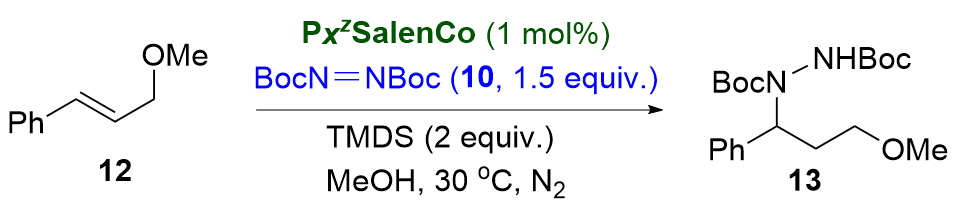
In order to evaluate the potential effect of the free hydroxyl group as an excellent hydrogen bonding donor on the catalytic reaction, parallel experiments with trans-cinnamyl methyl ether 12 in place of 9 were carried out employing our peptide-modified Salen-Co(II) complexes as catalysts (Table 2). At 30 ℃, the hydrohydrazination of cinnamyl methyl ether 12 with 10 all proceeded to completion in 3 h except those catalyzed by P11SalenCo and P21SalenCo (Entries 1, 4). With the same catalyst, the yield of 13 from the reaction of 12 was lower than the yield of 11 from the correlated reaction of 9. This divergence in yields did demonstrate an observable beneficial impact of the hydroxyl group on the metal catalyzed hydrohydrazination, which might derive from the formation of hydrogen-bonding between the substrate and the peptide on the catalyst.
Table 2 Peptide-modified Salen-Co(II) complexes catalyzed hydrohydrazination of cinnamyl methyl ethera
Entry PxzSalenCo Time/h Conversionb/% Yieldc/%
1 P11SalenCo 3.0 ≈5 Trace
2 P12SalenCo 3.0 100 63
3 P13SalenCo 3.0 100 50
4 P21SalenCo 3.0 ≈5 Trace
5 P22SalenCo 3.0 100 31
6 P23SalenCo 3.0 100 15
7 P32SalenCo 3.0 100 36
8 P42SalenCo 3.0 100 52
9 P43SalenCo 3.0 100 47

a Conditions: cinnamyl methyl ether 12 (0.34 mmol), di-tbutyl azodicarboxylate (10, 0.51 mmol), TMDS (0.67 mmol), PxzSalenCo (1 mol%), MeOH (2.0 mL), 30 ℃, N2. b Based on recovered 12. c Isolated yields.

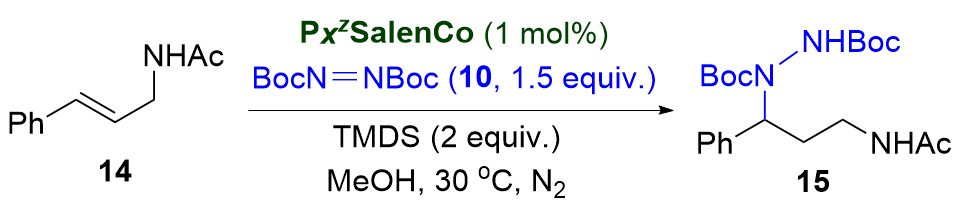
The catalytic reactivity of these peptide modified Salen- Cobalt complexes was further investigated with N-cinna- myl acetamide 14 as the substrate for this hydrohydrazination (Table 3). Under the same conditions, all complexes except those derived from scaffold SA1 demonstrated excellent activity to achieve clean reactions with full conversion of 14 and the hydrohydrazine product 15 was obtained in exceptional isolated yields. This restoration of clean reaction may be attributed to the presence of a second amide group which can readily participate in hydrogen-bonding interactions acting as either a donor or an acceptor or both.
Table 3 Peptide-modified Salen-Co(II) complexes catalyzed hydrohydrazination of N-cinnamylacetamidea
Entry PxzSalenCo Time/h Conversionb/% Yieldc/%
1 P11SalenCo 3.0 100 Messy
2 P12SalenCo 3.0 100 86
3 P13SalenCo 3.0 100 93
4 P21SalenCo 3.0 ≈5 Trace
5 P22SalenCo 3.0 100 96
6 P23SalenCo 3.0 100 95
7 P32SalenCo 3.0 100 85
8 P42SalenCo 3.0 100 95
9 P43SalenCo 3.0 100 99

a Conditions: N-cinnamylacetamide 14 (0.28 mmol), di-tbutyl azodicarboxylate 10 (0.42 mmol), TMDS (0.56 mmol), PxzSalenCo (1 mol%), MeOH (2.0 mL), 30 ℃, N2. b Based on recovered 14. c Isolated yields.

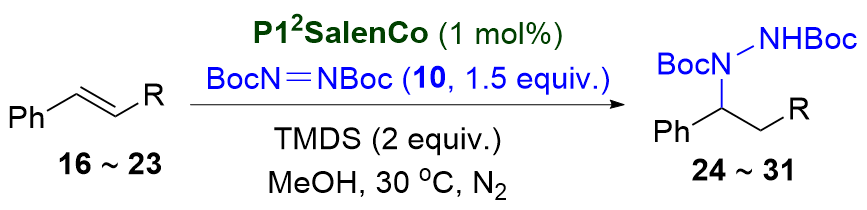
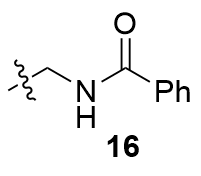
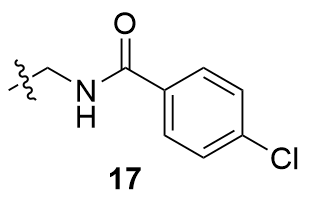
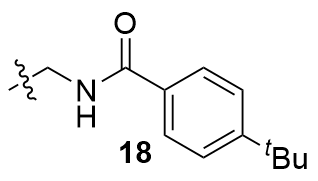
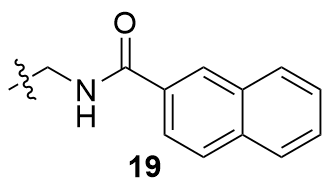
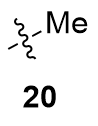
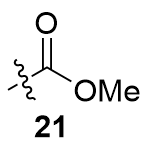
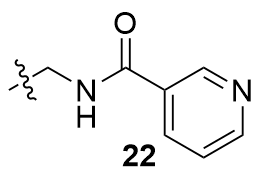
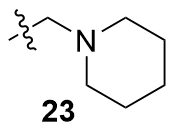
Next, peptide modified cobalt complex P12SalenCo was selected to explore the substrate scope. As shown in Table 4, secondary N-cinnamyl aromatic amides 16~19 all underwent this cobalt catalyzed hydrohydrazination reaction smoothly with 1 mol% catalyst loading, giving 24~27 in high yields (Entries 1~4). Surprisingly, under the same conditions, the reaction of (E)-propenylbenzene 20 was much slower than previous amides with a significant drop in yield (Entry 5). This phenomenon clearly demonstrates the critical role that the hydrogen bonding has played in current peptide-based SalenCo catalyzed reaction. Methyl cinna- mate 21 underwent this catalytic process readily to deliver 29 in 87% yield (Entry 6). Substrates 22 and 23, both carrying a coordinating N-heterocycle, namely pyridine and piperidine respectively, exhibited no reactivity under the standard conditions (Entries 7, 8). We reason that the catalytic activity of P12SalenCo is inhibited completely by the substrates.
Table 4 Brief exploration of the substrate scopea
Entry R Time/h Product Yieldb/%
1 3 24 94
2 3 25 93
3 3 26 83
4 3 27 84
5 24 28 36
6 3 29 87
7 3 30 c
8 3 31 c

a Conditions: amide 16~23 (0.21 mmol), di-tbutyl azodicarboxylate 10 (0.31 mmol), TMDS (0.42 mmol), P12SalenCo (1 mol%), MeOH (2.0 mL), 30 ℃, N2. b Isolated yields. c No reaction.

3 Conclusions

In summary, nine peptide modified Salen-Co(II) complexes based on three Salen ligand frameworks SA1~SA3 and four oligopeptides P1~P4 have been made successfully. These peptide-based metal complexes were submitted to catalyze the hydrohydrazination of cinnamic alcohol 9, cinnamyl methyl ether 12 and N-cinnamylacetamide 14 with azodicarboxylate 10 using TMDS as a hydrogen atom donor. Whereas Salen-Co(II) complexes derived from SA1 barely showed catalytic activity, those based on SA2 and SA3 were capable of accomplishing this transformation with only 1 mol% catalyst loading at 30 ℃ in 3 h. The catalytic activity is pretty sensitive to the reaction temperature as evidenced by the partial conversions observed in the reaction at 15 ℃. At lower temperature, the impact of peptide on the catalyst activity is also prominent. Compared to alcohols 9 and 14, ether 12 provided the hydrohydrazination product in lower yields. These findings indicate peptide modification as an effective means for Salen-Co(II) catalyst optimization and hydrogen-bonding may play a significant role. Although no chiral induction has been achieved with these catalysts, we still hold the faith in light of many enantioselective radical reactions enabled by metalloenzymes and continue to work on this project in our laboratory.

4 Experimental section

4.1 General Information and Materials

NMR spectra were recorded using Bruker AV-300/ AV-400/AV-500 spectrometers. High resolution mass spectra (HRMS) were acquired on an Agilent 6230 spectrometer and were obtained by peak matching. Analytical thin layer chromatography was performed on 0.25 mm extra hard silica gel plates with UV254 fluorescent indicator and/ or by exposure to phosphormolybdic acid/cerium(IV) sulfate/ninhydrine/2,4-dinitrophenylhydrazine followed by brief heating with a heat gun. Liquid chromatography (flash chromatography) was performed on a 60A (40~60 µm) mesh silica gel (SiO2). All reactions were carried out under nitrogen with anhydrous solvents in oven-dried glassware, unless otherwise noted. All reagents were commercially available and purified prior to use when necessary.

4.2 General procedure for synthesis of PxzSA

SAz (0.65 mmol, 1 equiv.) and 2-(7-azabenzotriazol-1-yl)- N,N,N',N'-tetramethyluronium hexafluorophosphate (HATU) (247 mg, 0.65 mmol, 1 equiv.) were dissolved in 15 mL of DMF. N,N-Diisopropylethylamine (DIEA) (180 mg, 1.3 mmol, 2 equiv.) was added and the solution was stirred at room temperature for 5 min. Then Px (0.58 mmol, 0.9 equiv., in 5 mL of DMF) was added slowly and the mixture was stirred overnight. After the reaction was completed (monitored by TLC), solvent was removed under reduced pressure. The residue was further purified by reverse column chromatography on C18 (MeOH/H2O, VV=5∶95~50∶50) to give PxzSA as a white solid.
P11SA: 113 mg, 30% yield, white powder. HRMS-ESI calcd for C29H34N4NaO8 [M+Na] 589.2269, found 589.2256.
P12SA: 158 mg, 41% yield, white powder. HRMS-ESI calculcd for C30H37N4O9 [M+H] 597.2555, found 597.2557.
P13SA: 142 mg, 37% yield, white powder. HRMS-ESI calcd for C30H36KN4O9 [M+K] 635.2114, found 635.2227.
P21SA: 128 mg, 30% yield, white powder. HRMS-ESI calcd for C32H40N5O10 [M+H] 654.2770, found 654.2687.
P22SA: 177 mg, 40% yield, white powder. HRMS-ESI calcd for C33H42N5O11 [M+H] 684.2875, found 684.2914.
P23SA: 75 mg, 17% yield, white powder. HRMS-ESI calcd for C33H42N5O11 [M+H] 684.2875, found 684.2890.
P32SA: 230 mg, 48% yield, white powder. HRMS-ESI calcd for C38H52N5O10 [M+H] 738.3709, found 738.3786.
P42SA: 114 mg, 21% yield, white powder. HRMS-ESI calcd for C38H58N7O14 [M+H] 836.4036, found 836.4035.
P43 SA: 81 mg, 15% yield, white powder. HRMS-ESI calcd for C38H58N7O14 [M+H] 836.4036, found 836.4033.

4.3 General procedure for synthesis of PxzSalenCo(II)

Anhydrous ethylenediamine (EDA) (0.1 mmol, 0.5 equiv.) was add to the solution of PxzSA (0.2 mmol, 1 equiv.) in DMF (0.03 mol/L) under nitrogen atmosphere. The color of the solution changed from colorless to yellow. The solution was stirred at room temperature for 6 h, which was monitored by TLC. Then a suspension of Co(OAc)2 (0.1 mmol, 0.5 equiv.) in DMF was added. The resulting reaction mixture was heated to 80 ℃ and stirred for 12 h. The color of the reaction solution slowly changed from yellow to red in the process described above. Solvent was removed under reduced pressure. The residue was washed with deionized water to afford PxzSalenCo(II) as a brown solid, which was confirmed by HRMS (ESI).
P11SalenCo(II): 92 mg, 76% yield, brown solid. HRMS-ESI calcd for C60H70CoN10O14 1213.4405, found 1213.4361.
P12SalenCo(II): 113 mg, 89% yield, brown solid. HRMS-ESI calcd for C62H74CoN10O16 1273.4616, found 1273.4757.
P13SalenCo(II): 101 mg, 80% yield, brown solid. HRMS-ESI calcd for C62H74CoN10O16 1273.4616, found 1273.4579.
P21SalenCo(II): 33 mg, 24% yield, brown solid. HRMS-ESI calcd for C66H80CoN12O18 1387.5046, found 1387.5133.
P22SalenCo(II): 77 mg, 53% yield, brown solid. HRMS-ESI calcd for C68H84CoN12O20 1447.5257, found 1447.5315
P23SalenCo(II): 72 mg, 50% yield, brown solid. HRMS-ESI calcd for C68H84CoN12O20 1447.5257, found 1447.5262.
P32SalenCo(II): 104 mg, 67% yield, brown solid. HRMS-ESI calcd for C78H104CoN12O18 1555.6924, found 1555.2417.
P42SalenCo(II): 168 mg, 96% yield, brown solid. HRMS-ESI calcd for C78H116CoN16O26 [M+2H]2+/2 876.8862, found 876.8942.
P43SalenCo(II): 157 mg, 90% yield, brown solid. HRMS-ESI calcd for C78H116CoN16O26 876.8326, found 876.8934.

4.4 General procedure for PxzSalenCo(II) catalyzed hydrohydrazination of 9

Under nitrogen atmosphere, to a solution of cinnamic alcohol 9 (50 mg, 0.37 mmol), di-tert-butyl azodicarboxylate (10, 128 mg, 0.56 mmol) and PxzSalenCo(II) (0.01 equiv.) in 2 mL of MeOH was added 1,1,3,3-tetramethyl- disiloxane (TMDS, 0.1 g, 0.74 mmol). The reaction solution was stirred at 15 or 30 ℃ for 3 h. Then the solvent was removed under reduced pressure. The residue was purified by column chromatography (ethyl acetate/petroleum ether, VV=1∶3) on silica gel to yield hydrazine 11 as colorless oil. The unfinished 9 was recovered from reactions at 15 ℃ (Entries 10~13 in Table 1). 11: 1H NMR (400 MHz, CDCl3) δ: 7.20~7.4 (m, 5H), 5.35 (br, 1H), 4.21~3.53 (m, 2H), 2.42~1.83 (m, 2H), 1.42 (s, 9H), 1.46 (s, 9H). The data are consistent with those reported in the literature.[14a]

4.5 General procedure for PxzSalenCo(II) catalyzed hydrohydrazination of 12

Under nitrogen atmosphere, to a solution of 12 (50 mg, 0.34 mmol), di-tert-butyl azodicarboxylate (10, 116 mg, 0.51 mmol) and PxzSalenCo(II) (0.01 equiv.) in 2 mL of MeOH was added 1,1,3,3-tetramethyldisiloxane (TMDS, 90 mg, 0.67 mmol). The reaction solution was stirred at 30 ℃ for 3 h. Then the solvent was removed under reduced pressure. The residue was purified by column chromatography (ethyl acetate/petroleum ether, VV=1∶3) on silica gel to yield hydrazine 13 as colorless oil (Entries 2, 3, 5~9 in Table 2). 1H NMR (400 MHz, CDCl3) δ: 7.25~7.48 (m, 5H), 5.45 (br, 1H), 3.52 (br, 2H), 3.31 (s, 3H), 2.09 (br, 2H), 1.46 (s, 9H), 1.43 (s, 9H); 13C NMR (100 MHz, CDCl3) δ: 127.9, 80.7, 58.7, 28.2, 27.9; HRMS-ESI calcd for C20H32N2NaO5 [M+Na] 403.2203, found 403.2210.

4.6 General procedure PxzSalenCo(II) catalyzed hydrohydrazination of 14

Under nitrogen atmosphere, to a solution of 14 (50 mg, 0.28 mmol), di-tert-butyl azodicarboxylate (10, 98 mg, 0.42 mmol) and PxzSalenCo(II) (0.01 equiv.) in 2 mL of MeOH was added 1,1,3,3-tetramethyldisiloxane (TMDS, 76 mg, 0.57 mmol). The reaction solution was stirred at 30 ℃ for 3 h. Then the solvent was removed under reduced pressure. The residue was purified by column chromatography (ethyl acetate/petroleum ether, VV=1∶3~1∶1) on silica gel to yield hydrazine 15 (Entries 2, 3, 5~9 in Table 3). 1H NMR (400 MHz, CDCl3) δ: 7.23~7.47 (m, 5H), 5.31 (br, 1H), 3.44 (br, 2H), 2.52 (br, 1H), 2.04 (br, 2H), 1.94 (s, 3H), 1.44 (s, 9H), 1.42 (s, 9H); 13C NMR (101 MHz, CDCl3) δ: 170.5, 128.2, 81.8, 77.3, 28.1, 23.1; HRMS-ESI calcd for C21H33N3NaO5 [M+Na] 430.2312, found 430.2322.

4.7 General procedure for P12SalenCo(II) catalyzed hydrohydrazination of 16~23

Under nitrogen atmosphere, to a solution of alkene 16~23 (0.21 mmol), di-tert-butyl azodicarboxylate (10, 72 mg, 0.31 mmol) and PxzSalenCo(II) (0.01 equiv.) in 2 mL of MeOH was added 1,1,3,3-tetramethyldisiloxane (TMDS, 56 mg, 0.42 mmol). The reaction solution was stirred at 30 ℃ for 3 h. Then the solvent was removed under reduced pressure. The residue was purified by column chromatography (ethyl acetate/petroleum ether, VV=1∶3~1∶1) on silica gel to yield 24~31 (in Table 4).
Di-tert-butyl 1-(3-benzamido-1-phenylpropyl)hydrazine- 1,2-dicarboxylate (24): 93 mg, 94% yield, colorless oil. 1H NMR (400 MHz, CDCl3) δ: 7.87 (m, 2H), 7.45~7.26 (m, 8H), 5.97 (br, 1H), 5.30 (br, 1H), 3.78 (d, 2H), 2.53~2.06 (m, 2H), 1.44 (s, 9H), 1.40 (s, 9H); 13C NMR (100 MHz, CDCl3) δ: 155.6, 131.0, 128.2, 127.2, 81.9, 81.3, 77.3, 28.1; HRMS-ESI calcd for C26H35N3NaO5 [M+Na] 492.2469, found 492.2474.
Di-tert-butyl 1-(3-(4-chlorobenzamido)-1-phenylpro-pyl)hydrazine-1,2-dicarboxylate (25): 100 mg, 93% yield, colorless oil. 1H NMR (400 MHz, CDCl3) δ: 7.90 (br, 2H), 7.36~7.26 (m, 7H), 5.90 (br, 1H), 5.32 (br, 1H), 3.78 (br, 2H), 2.11 (br, 2H), 1.46 (s, 9H), 1.39 (s, 9H); 13C NMR (100 MHz, CDCl3) δ: 166.3, 137.1, 128.6, 128.4, 127.9, 77.2, 28.1; HRMS-ESI calcd for C26H34ClN3NaO5 [M+Na] 526.2079, found 526.2083.
Di-tert-butyl 1-(3-(4-(tert-butyl)benzamido)-1-phenyl-propyl)hydrazine-1,2-dicarboxylate (26): 92 mg, 83% yield, colorless oil. 1H NMR (400 MHz, CDCl3) δ: 7.84 (d, J=7.7 Hz, 2H), 7.42 (d, J=6.9 Hz, 2H), 7.25~7.41 (m, 5H), 5.61 (br, 1H), 3.80 (br, 2H), 2.28 (br, 2H), 1.51 (s, 9H), 1.46 (s, 9H), 1.32 (s, 9H); 13C NMR (100 MHz, CDCl3) δ: 128.5, 127.8, 127.0, 125.2, 77.2, 34.8, 31.1, 28.1. HRMS-ESI calcd for C30H44N3O5 [M+H] 526.3275, found 526.3283.
Di-tert-butyl 1-(3-(2-naphthamido)-1-phenylpropyl)-hydrazine-1,2-dicarboxylate (27): 105 mg, 94% yield, colorless oil. 1H NMR (400 MHz, CDCl3) δ: 8.45 (s, 1H), 8.16~7.78 (m, 4H), 7.48~7.54 (m, 2H), 7.25~7.41 (m, 5H), 5.56 (br, 1H), 4.01~3.72 (br, 2H), 2.23 (br, 2H), 1.48 (s, 9H), 1.41 (s, 9H); 13C NMR (100 MHz, CDCl3) δ: 134.6, 132.7, 128.8, 127.9, 127.4, 126.34, 77.2, 28.1; HRMS-ESI calcd for C30H38N3O5 [M+H] 520.2806, found 520.2805.
Di-tert-butyl 1-(1-phenylpropyl)hydrazine-1,2-dicarboxy-late (28): 26 mg, 36% yield, white powder. m.p. 96 ℃; 1H NMR (400 MHz, CDCl3) δ: 7.24~7.45 (m, 5H), 5.93 (br, 1H), 5.20 (br, 1H), 2.07~1.81 (m, 3H), 1.45 (s, 18H), 0.96 (t, J=6.5 Hz, 3H).
Di-tert-butyl 1-(3-methoxy-3-oxo-1-phenylpropyl)hy- drazine-1,2-dicarboxylate (29):[15] 74 mg, 87% yield, white pow- der. 1H NMR (400 MHz, CDCl3) δ: 7.23~7.43 (m, 5H), 6.24 (br, 1H), 5.88~5.44 (m, 1H), 3.62 (s, 3H), 3.19~2.65 (m, 2H), 1.45 (s, 9H), 1.43 (s, 9H).
Supporting Information Experimental details, characterization of new compounds, copies of NMR spectra and HPLC traces. The Supporting Information is available free of charge via the Internet at http://sioc-journal.cn.
(Zhao, C.)
[1]
(a) Davie E. A. C.; Mennen S. M.; Xu Y.; Miller S. J. Chem. Rev. 2007, 107, 5759.

DOI

(b) Akagawa K.; Kudo K. Acc. Chem. Res. 2017, 50, 2429.

DOI

[2]
(a) Oku J.-I.; Inoue S. J. Chem. Soc., Chem. Commun. 1981, 229.

(b) Oku J.-I.; Ito N.; Inoue S. Makromol. Chem. 1979, 180, 1089.

DOI

(c) Juliá S.; Masana J.; Vega J. C. Angew. Chem., Int. Ed. 1980, 19, 929.

DOI

[3]
(a) Metrano A. J.; Chinn A. J.; Shugrue C. R.; Stone E. A.; Kim B.; Miller S. J. Chem. Rev. 2020, 120, 11479.

DOI

(b) Khettar I.; Araszczuk A. M.; Schettini R. Catalysts 2023, 13, 244.

DOI

(c) Fang S.; Liu Z.; Wang T. Angew. Chem., Int. Ed. 2023, 62, e202307258.

DOI

(d) Metrano A. J.; Miller S. J. Acc. Chem. Res. 2019, 52, 199.

DOI

[4]
(a) Degrado S. J.; Mizutani H.; Hoveyda A. H. J. Am. Chem. Soc. 2001, 123, 755.

PMID

(b) Brown M. K.; Degrado S. J.; Hoveyda A. H. Angew. Chem., Int. Ed. 2005, 44, 5306.

DOI

(c) Gilbertson S. R.; Chen G.; McLoughlin M. J. Am. Chem. Soc. 1994, 116, 4481.

DOI

[5]
(a) Gilbertson S. R.; Collibee S. E.; Agarkov A. J. Am. Chem. Soc. 2000, 122, 6522.

DOI

(b) Christensen C. A.; Meldal M. J. Comb. Chem. 2007, 9, 79.

PMID

[6]
(a) Laungani A. C.; Breit B. Chem. Commun. 2008, 844.

(b) Laungani A. C.; Slattery J. M.; Krossing I.; Breit B. Chem.- Eur. J. 2008, 14, 4488.

DOI

(c) Kokan Z.; Kirin S. I. RSC Adv. 2012, 2, 5729.

DOI

(d) Popp B. V.; Ball Z. T. J. Am. Chem. Soc. 2010, 132, 6660.

DOI

(e) Sambasivan R.; Ball Z. T. J. Am. Chem. Soc. 2010, 132, 9289.

DOI PMID

(f) Sambasivan R.; Ball Z. T. Org. Biomol. Chem. 2012, 10, 8203.

DOI PMID

(g) Sambasivan R.; Ball Z. T. Angew. Chem., Int. Ed. 2012, 51, 8568.

DOI PMID

(h) Sambasivan R.; Zheng W.; Burya S. J.; Popp B. V.; Turro C.; Clementi C.; Ball Z. T. Chem. Sci. 2014, 5, 1401.

DOI

[7]
(a) Coquière D.; Bos J.; Beld J.; Roelfes G. Angew. Chem., Int. Ed. 2009, 48, 5159.

DOI PMID

(b) Zheng L.; Marcozzi A.; Gerasimov J. Y.; Herrmann A. Angew. Chem., Int. Ed. 2014, 53, 7599.

DOI

(c) Pellegrino S.; Facchetti G.; Contini A.; Gelmi M. L.; Erba E.; Gandolfi R.; Rimoldi I. RSC Adv. 2016, 6, 71529.

DOI

(d) Kwon Y.; Chinn A. J.; Kim B.; Miller S. J. Angew. Chem., Int. Ed. 2018, 57, 6251.

DOI

(e) Chinn A. J.; Kim B.; Kwon Y.; Miller S. J. J. Am. Chem. Soc. 2017, 139, 18107.

DOI PMID

(f) Kim B.; Chinn A. J.; Fandrick D. R.; Senanayake C. H.; Singer R. A.; Miller S. J. J. Am. Chem. Soc. 2016, 138, 7939.

DOI

[8]
Cussó O.; Giuliano M. W.; Ribas X.; Miller S. J.; Costas M. Chem. Sci. 2017, 8, 3660.

DOI

[9]
(a) Hapke M.; Hilt G. Cobalt Catalysis in Organic Synthesis: Methods and Reactions, Wiley-VCH Verlag GmbH & Co. KGaA, 2019.

(b) Tohidi M. M.; Paymard B.; Vasquez-García S. R.; Fernández- Quiroz D. Tetrahedron 2023, 136, 133352.

DOI

(c) Michiyuki T.; Komeyama K. Asian J. Org. Chem. 2020, 9, 343.

DOI

[10]
(a) Randaccio L.; Geremia S.; Demitri N.; Wuerges J. Molecules 2010, 15, 3228.

DOI PMID

(b) Genchi G.; Lauria G.; Catalano A.; Carocci A.; Sinicropi M. S. Biology 2023, 12, 1335.

DOI

(c) Giedyk M.; Goliszewska K.; Gryko D. Chem. Soc. Rev. 2015, 44, 3391.

DOI

[11]
(a) Li N.; Liu X.; Zhang Y.; Liu S.; Wang X.; Chang T.; Zhu Z.; Qin S.; Hao Y. Mol. Catal. 2023, 549, 113479.

(b) Middya P.; Saha A.; Chattopadhyay S. Inorg. Chim. Acta 2023, 545, 121246.

DOI

(c) Schulz E. Chem. Rec. 2021, 21, 427.

DOI

(d) Shaw S.; White J. D. Chem. Rev. 2019, 119, 9381.

DOI

[12]
Ortiz B.; Park S.-M. Bull. Korean Chem. Soc. 2000, 21, 405.

[13]
(a) Guo J.; Cheng Z.; Chen J.; Chen X.; Lu Z. Acc. Chem. Res. 2021, 54, 2701.

DOI

(b) Chen J.; Guo J.; Lu Z. Chin. J. Chem. 2018, 36, 1075.

DOI

(c) Crossley S. W.; Obradors C.; Martinez R. M.; Shenvi R. A. Chem. Rev. 2016, 116, 8912.

DOI PMID

(d) Shen X.; Chen X.; Chen J.; Sun Y.; Cheng Z.; Lu Z. Nat. Commun. 2020, 11, 783.

DOI

[14]
(a) Waser J.; Carreira E. M. J. Am. Chem. Soc. 2004, 126, 5676.

DOI

(b) Waser J.; Gaspar B.; Nambu H.; Carreira E. M. J. Am. Chem. Soc. 2006, 128, 11693.

DOI

[15]
Waser J.; Carreira E. M. Angew. Chem., nt. Ed. 2004, 43, 4099.

Outlines

/