


1 Introduction
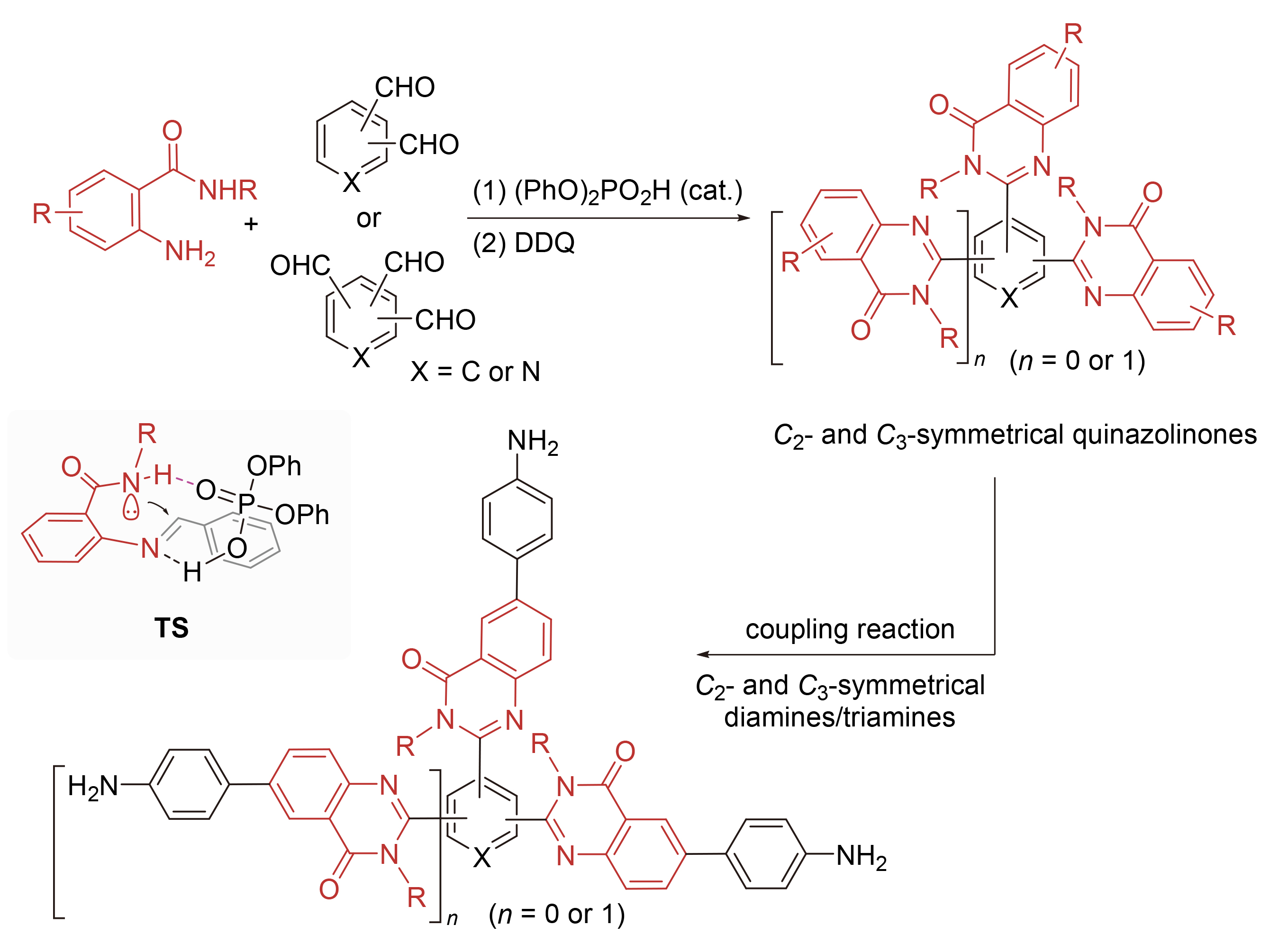
Quinazolinone, as one of the privileged hetero-cyclic scaffolds, exists widely in natural products, biologically active molecules, catalytical ligand, and marketed drugs. For example, eupolyphagin[1] is known as a potent cholescystokinin antagonist, and penipanoid C exhibits cytotoxicity against the human lung carcinoma cell (Scheme 1, a).[2] N-(Diphenylphosphaneyl)phenyl quinazolinone is a useful chiral ligand for asymmetric metal-catalysis.[3] Methaqualone (Quaalude) is being marketed as the drug for treatment of insomnia.[4] Generally, well documented qui- nazolinone-containing functional molecules are limited to those bearing only one quinazolinone unit by now. C2- and C3-symmetric quinazolinones have been rarely reported (Scheme 1, b). Theoretically, C2- and C3-symmetric aromatic quinazolinones, as the flexible and stable connectors, are highly potential for the exploration of new functional materials if they are installed with target functional groups. In fact, C2- and C3-symmetric aromatic amines[5] are widely used as the key synthons for the synthesis of polyimides,[6] covalent organic frameworks (COFs)[7] and other important organic materials.[8] However, as aromatic diamine or triamine monomers for synthesis or modification of organic materials, the direct embedment of different functional side chains into these aromatic amines remains challenging and is still in a deeply demand. Herein, as part of our ongoing research interests in the synthesis of functionalized quinazo- linones,[9] a general and practical synthetic platform was developed by a simple and convenient phosphoric acid- catalyzed double/triple Pictet-Spengler annulation/oxida- tive aromatization for the preparation of C2- and C3-symme- trical quinazolinones from 2-aminobenzamides and aldehydes, in which the products were readily converted into the diamines and triamines (Scheme 1, c).
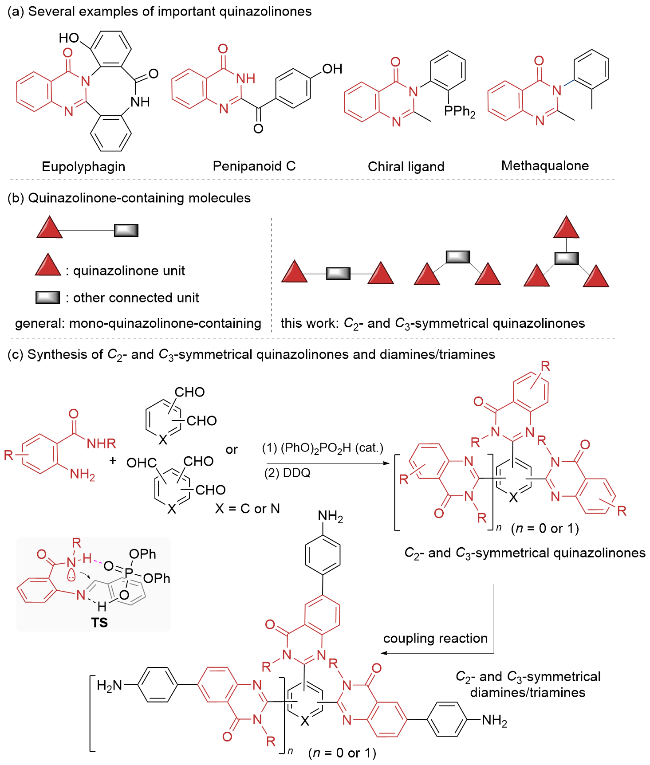
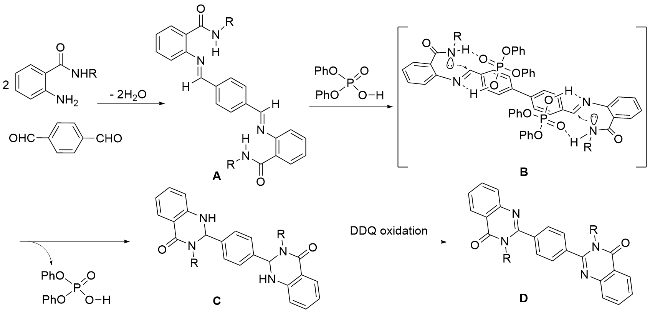
In principle, under the catalysis of the phosphoric acid, imine intermediates (TS) were first generated in situ from the anilines and aldehydes, and intermolecular hydrogen bonds were formed from both amide and imine with the acid catalyst. Then a tandem reaction sequence involving an acid catalyzed Pictet-Spengler annulation and the following 2,3- dicyano-5,6-dichlorobenzoquinone (DDQ) oxidation occurred to provide the C2- or C3-symmetric bromine substituted aromatic rings based on the quinazolinone skeletons. Importantly, these compounds can be easily transformed into various valuable symmetric aromatic diamines and triamines in gram-scale synthesis via one-step of Suzuki-coupling reaction.
2 Results and discussion
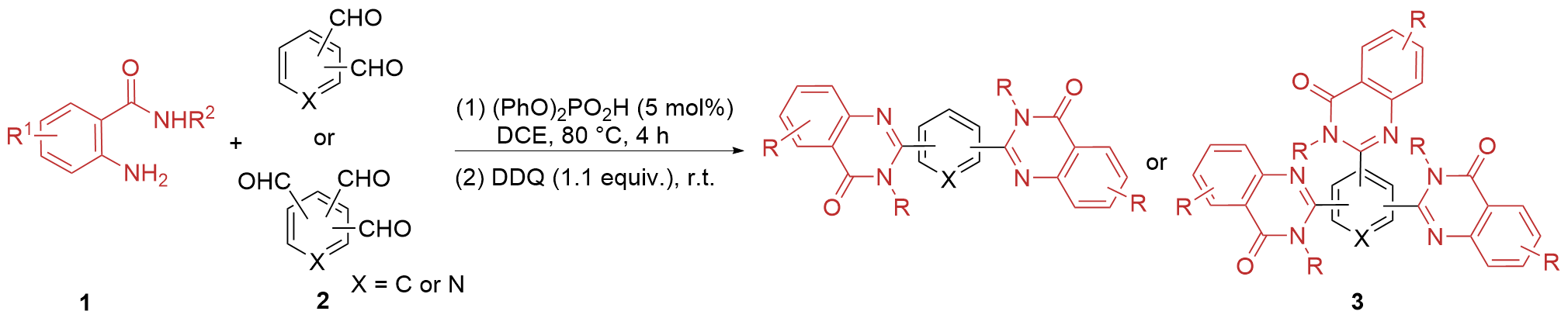
Upon the optimized reaction conditions including the diphenyl phosphate (5 mol%) catalyzed annulation at 80 ℃ in 1,2-dichloroethane (DCE) and following oxidative aromatization by 1.1 equiv. of 2,3-dichloro-5,6-dicyano-1,4- benzoquinone (DDQ) at room temperature, the substrate scopes of both 2-aminobenzamides 1 and aldehydes 2 for synthesis of a series of C2- and C3-symmetrical quinazolinones were investigated. As shown in Table 1, amides bear- ing a poly(ethylene oxide) ether chain (1a, 1b) were initially reacted with terephthalaldehyde 2a. The tri-ether and mono- ether products 3aa and 3ba were obtained exclusively in 77% and 82% yields, respectively. The chiral C2-symmetric aromatic product 3ca was obtained in 72% yield from the starting chiral aminobenzamide 1c. Biphenyl dialdehyde 2b was also amenable to this reaction with 1a, providing the corresponding product 3ab in 79% yield. meta-Substituted isophthalaldehyde 2c was utilized to react with 1a and 1d, triether- and thiophene-containing molecules 3ac and 3dc were obtained in 82% and 58% yields, respectively.
Table 1 Scopes of both 2-aminobenzamides 1 and aldehydes 2 for the synthesis of a series of C2- and C3-symmetrical quinazolinonesa |
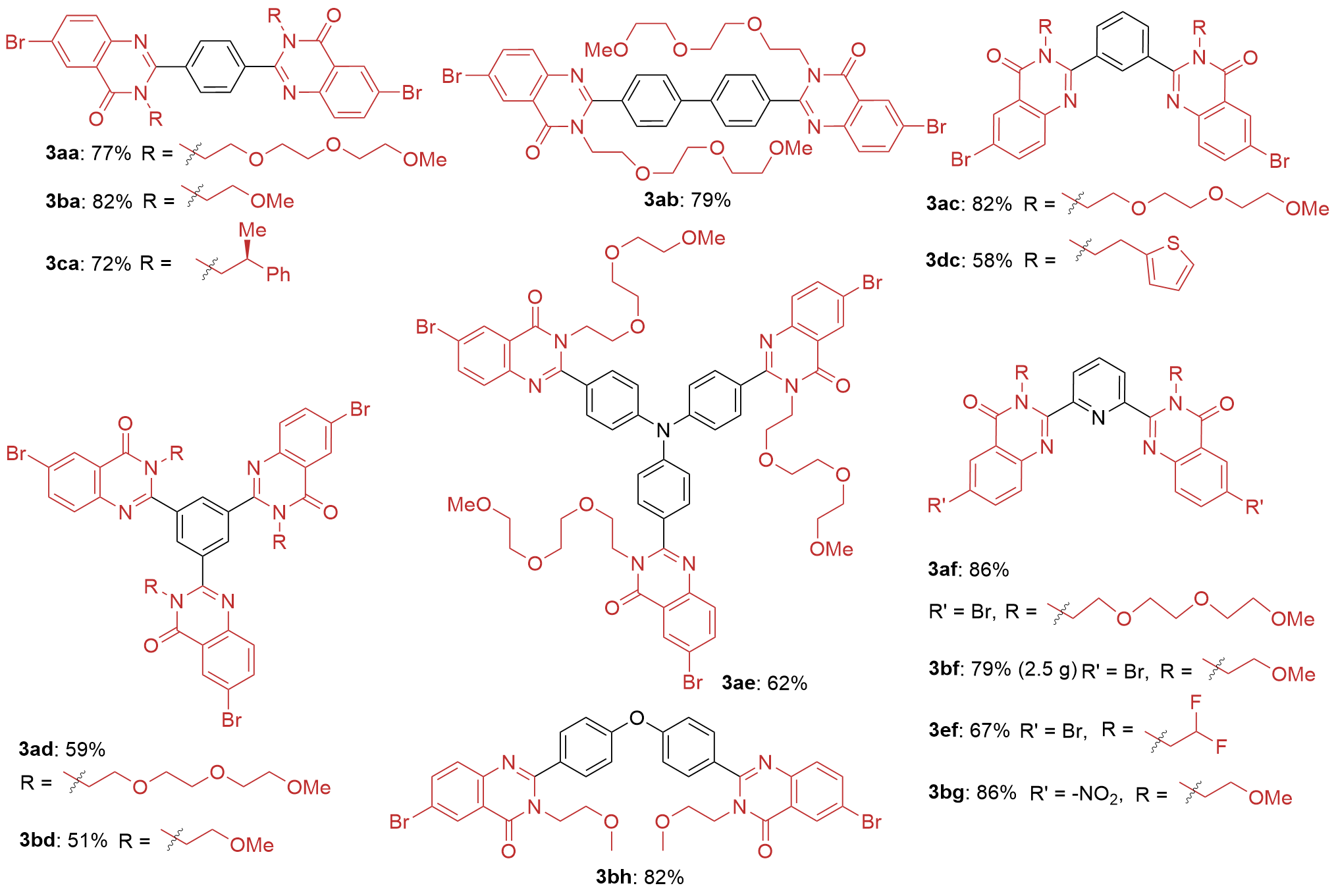 |
a Reaction conditions: 1 (1.05 mmol, 2.1 equiv.), 2 (0.5 mmol, 1.0 equiv.), and diphenyl phosphate (5 mol%) were stirred in dichloroethane (DCE, 5.0 mL, 0.1 mol/L) at 80 ℃ for 4 h, then DDQ (1.1 equiv.) was added and the reaction mixture was stirred for 10 min at room temperature. Yields of isolated products were given. |
By treatment of amides 1a, 1b with trimesaldehyde 2d and 4,4',4''-nitrilotrisbenzaldehyde 2e, C3-symmetric quina- zolinones 3ad, 3bd, and 3ae could also be constructed via the triple Pictet-Spengler annulation/oxidative aromatization in 51%~62% yields under the same reaction conditions. Delightfully, the strongly basic pyridine-2,6-dicarb- aldehydes 2f and 2g were also the applicable substrates for the diphenyl phosphate catalyzed bicyclization reactions to provide meta-quinazolinone-pyridines 3af, 3bf, 3bg and 3df in 67%~86% yields smoothly. While 4,4'-oxydibenz- aldehyde 2h was employed to react with 1b, the desired C2-symmetrical quinazolinone 3bh was isolated in 82% yield. Importantly, the reaction could be easily scaled up to gram scale without appreciable decrease in the yield of product. Accordingly, 2.5 g of 3bf was readily isolated in 79% yield by this approach, which might be practical for the exploration of new tridentate nitrogen ligands[10] for metal-catalysts and functional materials.
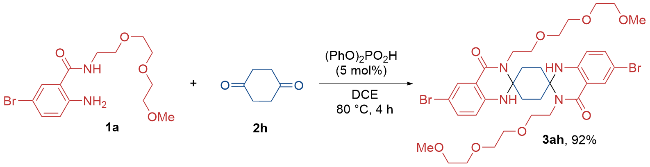
The phosphoric acid-catalyzed double Pictet-Spengler annulation is also useful for the alkyl diketone substrate. As demonstrated in Scheme 2, for example, the reaction of 1a with cyclohexane-1,4-dione 2h without subsequent DDQ oxidation afforded the desired 1,1,4,4-tetraamine product 3ah in 92% yield with an excellent diastereoselectivity. The result reasonably revealed that the reaction proceeds via double imine formation with A, followed by the phosphoric acid-catalyzed nucleophilic cycloadditions through intermediate B to afford C. Subsequent dehydrogenation with DDQ then furnished the symmetrical quinazolinone D (Scheme 3).
With a series of bromine substituted quinazolinones in hands, 3aa, 3ba and 3bd were next chosen randomly to synthesize the C2- and C3-symmetric aromatic amines and aldehyde. The results are outlined in Table 2. Under the mild Suzuki-coupling reaction by using 4-(4,4,5,5-tetra- methyl-1,3,2-dioxaborolan-2-yl)aniline (4-BPin) aniline and aldehyde 4a/4b as the coupling partners, the desired coupling products 5aaa, 5aab, 5baa and 5bda were readily obtained with good yields. For instance, by treating with 4a, the C2- and C3-symmetric aromatic diamine and triamine were successfully constructed in 76%~85% yields, even scaled up to gram reaction. The C2-symmetric aldehyde 5aab was isolated in 79% yield from the 4-BPin aldehyde. These C2- and C3-symmetric aromatic amines and aldehyde should provide new synthons for the exploitation of functional Schiff-base COF materials.
Table 2 Synthesis of C2- and C3-symmetrical aromatic amines and aldehyde |



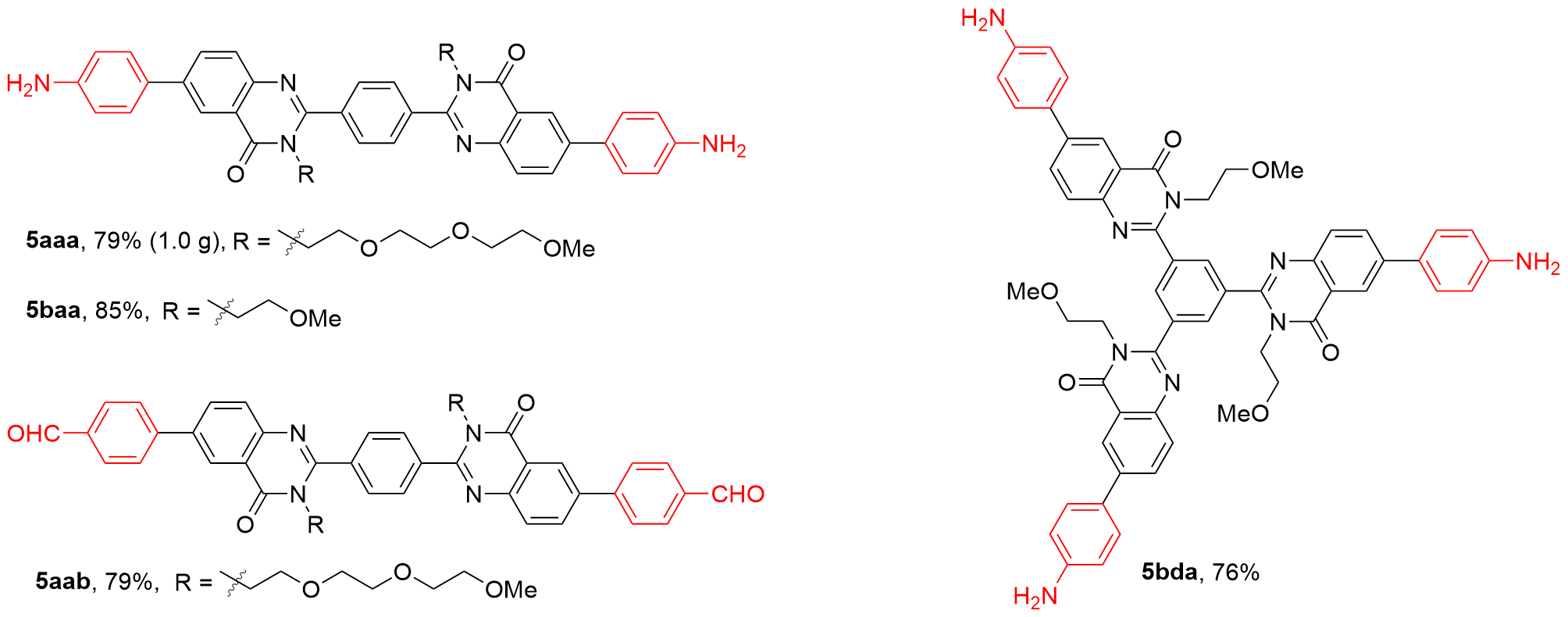 |
a Reaction conditions: 3 (0.5 mmol), 4 (1.2 mmol, 2.4 equiv.), Pd(OAc)2 (2 mol%), DPPF (3 mol%) and K2CO3 (3.0 mmol, 6.0 eq) were stirred in dimethoxymethane (DEM)/H2O (V∶V=1∶1, 5.0 mL, 0.1 mol/L) at 80 ℃ for 12 h under N2. Yields of isolated products were given. |
3 Conclusions
In summary, we have developed a new family of C2- and C3-symmetric bromine substituted aromatic rings based on quinazolinone core skeletons by a phosphoric acid-catalyzed scalable and mild annulation/oxidative aromatization from different substituted 2-aminobenzamides in high yields. The further transformations were also conducted in Suzuki- coupling conditions to provide the C2- and C3-symmetric aromatic diamines, triamine and dialdehyde, which might be potential for new COFs exploration. The application of these compounds into the functional material synthesis is ongoing in our laboratory.
4 Experimental section
4.1 General information
All reactions were set up under normal atmospheric pressure utilizing glassware that was dried in air dry oven. Reactions were monitored using thin-layer chromatography (TLC) on silica gel plates. Visualization of developed plates was performed under UV light (245 nm) or PMA stain. Silica gel flash column chromatography was performed on SYNTHWARE 40~60 µm silica gel. Unless otherwise indicated, starting catalysts and materials were obtained from Sigma Aldrich and Adamas.
All NMR spectra were run at 400 MHz (1H NMR) or 101 MHz (13C NMR) in CDCl3 or DMSO-d6 solution on a Bruker AVANCE 400 MHz instrument. 1H NMR spectra were internally referenced to TMS, and 13C NMR spectra were internally referenced to the residual solvent signal. High solution mass spectra (HRMS) were recorded on a Thermo Fisher Scientific Orbitrap Exploris 120 instrument.
4.2 General procedure for substrate synthesis
A solution of 5-bromoisatoic anhydride (1.0 equiv., 5 mmol) and amine (1.1 equiv., 5.5 mmol) in dimethyl sulfone (DMSO) (20 mL) was heated under stirring for 5 h. Upon completion, the reaction mixture was cooled to room temperature. Then water (50 mL) was added to the mixture and the mixture was extracted with ethyl acetate (20 mL×3). The organic layer was dried over anhydrous Na2SO4, concentrated in vacuo and the crude residue was purified by silica gel column chromatography (petroleum ether/ethyl acetate, V∶V=2∶1) to give 1a~1f.
2-Amino-5-bromo-N-(2-(2-(2-methoxyethoxy)ethoxy)-ethyl)benzamide (1a): White solid, 1.57 g, 87% yield. 1H NMR (400 MHz, CDCl3) δ: 7.49 (d, J=2.20 Hz, 1H), 7.26 (dd, J=8.68, 2.32 Hz, 1H), 6.78 (s, 1H), 6.56 (d, J=8.68 Hz, 1H), 5.52 (s, 2H), 3.69~3.65 (m, 8H), 3.63~3.52 (m, 4H), 3.33 (s, 3H); 13C NMR (101 MHz, CDCl3) δ: 168.3, 147.8, 134.9, 130.2, 118.9, 118.0, 107.8, 72.1, 70.7, 70.7, 70.4, 69.8, 59.1, 39.6; HRMS (ESI) calcd for C14H21BrN2O4 [M+H+] 361.0763, found 361.0767.
2-Amino-5-bromo-N-(2-methoxyethyl)benzamide (1b): White solid, 1.05 g, 77% yield. 1H NMR (400 MHz, CDCl3) δ: 7.45 (d, J=2.32 Hz, 1H), 7.24 (dd, J=8.68, 2.20 Hz, 1H), 6.72 (s, 1H), 6.55 (d, J=8.68 Hz, 1H), 5.54 (s, 2H), 3.68~3.62 (m, 4H), 3.62~3.53 (m, 4H), 3.39 (s, 3H); 13C NMR (101 MHz, CDCl3) δ: 168.2, 147.8, 134.9, 130.0, 118.9, 117.8, 107.7, 72.0, 70.2, 69.7, 59.2, 39.5; HRMS (ESI) calcd for C10H13BrN2O2 [M+H+] 273.0239, found 273.0236.
(S)-2-Amino-5-bromo-N-(2-phenylpropyl)benzamide(1c): Red solid, 1.22 g, 87% yield. 1H NMR (400 MHz, CDCl3) δ: 7.47 (t, J=7.47 Hz, 2H), 7.42~7.29 (m, 4H), 7.26 (d, J=2.31 Hz, 1H), 6.64 (d, J=8.66 Hz, 1H), 6.00 (s, 1H), 5.50 (s, 2H), 3.85 (dt, J=13.12, 6.46 Hz, 1H), 3.47 (ddd, J=13.57, 8.67, 5.13 Hz, 1H), 3.16 (dq, J=13.50, 7.01 Hz, 1H), 1.45 (d, J=7.01 Hz, 3H); 13C NMR (101 MHz, CDCl3) δ: 161.0, 155.4, 145.9, 139.3, 137.9, 135.6, 129.5, 129.2, 127.5, 127.3, 126.2, 124.6, 122.3, 121.1, 48.2, 28.1; HRMS (ESI) calcd for C16H17BrN2O [M+H+] 333.0603, found 333.0597.
2-Amino-5-bromo-N-(2-(thiophen-2-yl)ethyl)benzamide (1d): Brown solid, 1.33 g, 82% yield. 1H NMR (400 MHz, CDCl3) δ: 7.33 (d, J=2.27 Hz, 1H), 7.26 (dd, J=8.69, 2.27 Hz, 1H), 7.19 (dd, J=5.16, 1.18 Hz, 1H), 6.98 (dd, J=5.15, 3.41 Hz, 1H), 6.88 (dd, J=3.44, 1.08 Hz, 1H), 6.56 (d, J=8.67 Hz, 1H), 6.14 (s, 1H), 5.47 (s, 2H), 3.67 (q, J=6.46 Hz, 2H), 3.14 (t, J=6.65 Hz, 2H); 13C NMR (101 MHz, CDCl3) δ: 168.2, 147.7, 141.2, 135.1, 129.8, 127.3, 125.7, 124.3, 119.0, 117.8, 107.9, 41.3, 30.0; HRMS (ESI) calcd. for C13H13BrN2OS [M+H+] 327.0010, found 327.0007
2-Amino-5-bromo-N-(2,2-difluoroethyl)benzamide (1e): White solid, 1.27 g, 91% yield. 1H NMR (400 MHz, DMSO-d6) δ: 8.70 (d, J=11.75 Hz, 1H), 7.70 (d, J=2.32 Hz, 1H), 7.29 (dd, J=8.82, 2.32 Hz, 1H), 6.70 (d, J=8.82 Hz, 1H), 6.62 (s, 2H), 6.09 (tt, J=56.13, 4.09 Hz, 1H), 3.61 (tdd, J=15.51, 5.86, 4.09 Hz, 2H); 13C NMR (101 MHz, CDCl3) δ: 168.1, 149.1, 134.6, 130.3, 130.3, 118.6, 116.9, 114.9, 114.5, 112.2, 104.9, 41.5, 41.3, 41.0; 19F NMR (376 MHz, CDCl3) δ: -122.72 (s, 2F); HRMS (ESI) calcd. for C9H9BrF2N2O [M+H+] 278.9945, found 278.9949.
4.3 Synthesis of products 3
Diphenyl phosphate (5 mol%) was added into a solution of substrate 1 (1.05 or 1.55 mmol, 2.1 or 3.1 equiv.) and 2 (0.5 mmol, 1.0 equiv.) in DCE (5.0 mL, 0.1 mol/L), and the mixture was stirred at 80 ℃ for 4 h. Then the mixture was cooled to room temperature and DDQ (1.05 or 1.55 mmol, 2.1 or 3.1 equiv.) was added into the mixture. The reaction was monitored by TLC. On completion, the reaction mixture was concentrated in vacuo. Then the saturated aqueous NaHCO3 (30 mL) was added and the mixture was extracted with ethyl acetate (10 mL×3). The organic layer was dried over Na2SO4 and the filtrate was concentrated in vacuo. The crude residue was purified by silica gel column chromatography (petroleum ether/ethyl acetate, V∶V=3∶1) to give 3 as the desired products.
2,2'-(Pyridine-2,6-diyl)bis(6-(4-aminophenyl)-3-(2-methoxyethyl)quinazolin-4(3H)-one) (3aa): White solid, 314.3 mg, 77% yield. b.p. 109~110 ℃; 1H NMR (400 MHz, CDCl3) δ: 8.49 (d, J=2.2 Hz, 2H), 8.10 (dd, J=8.5, 7.2 Hz, 1H), 8.06~7.86 (m, 4H), 7.78 (d, J=8.5 Hz, 2H), 7.54 (d, J=8.6 Hz, 4H), 6.78 (d, J=8.5 Hz, 4H), 4.51 (t, J=5.6 Hz, 4H), 3.56 (t, J=5.6 Hz, 4H), 3.06 (s, 6H); 13C NMR (101 MHz, CDCl3) δ: 161.2, 156.5, 146.1, 137.8, 136.8, 129.4, 129.2, 122.3, 120.8, 71.9, 70.5, 70.5, 67.6, 59.1, 46.3; HRMS (ESI) calcd for C36H40Br2N4O8 [M+H+] 817.1121, found 817.1126.
2,2'-([1,1'-Biphenyl]-4,4'-diyl)bis(6-bromo-3-(2-(2-(2-methoxyethoxy)ethoxy)ethyl)quinazolin-4(3H)-one) (3ab): White solid, 352.6 mg, 79% yield. b.p. 184~185 ℃; 1H NMR (400 MHz, CDCl3) δ: 8.46 (d, J=2.25 Hz, 2H), 7.85 (dd, J=8.64, 2.34 Hz, 2H), 7.73 (q, J=8.34 Hz, 8H), 7.62 (d, J=8.65 Hz, 2H), 4.32 (t, J=5.53 Hz, 4H), 3.74 (t, J=5.52 Hz, 4H), 3.61~3.38 (m, 16H), 3.32 (s, 6H); 13C NMR (101 MHz, CDCl3) δ: 161.4, 156.9, 146.2, 141.9, 137.8, 134.9, 129.5, 129.4, 129.4, 127.6, 122.3, 120.7, 72.0, 70.6, 70.6, 70.6, 67.9, 59.2, 46.2; HRMS (ESI) calcd for C42H44Br2N4O8 [M+H+] 893.1584, found 893.1589.
2,2'-(1,3-Phenylene)bis(6-bromo-3-(2-(2-(2-methoxy-ethoxy)ethoxy)ethyl)quinazolin-4(3H)-one) (3ac): Yellow solid, 334.8 mg, 82% yield. b.p. 135~136 ℃; 1H NMR (400 MHz, CDCl3) δ: 8.42 (d, J=2.32 Hz, 2H), 7.82 (dd, J=8.62, 2.38 Hz, 3H), 7.77 (dd, J=7.64, 1.90 Hz, 21H), 7.63 (t, 1H), 7.58 (d, J=8.68 Hz, 2H), 4.26 (t, J=5.38 Hz, 4H), 3.70 (t, J=5.38 Hz, 4H), 3.44 (s, 8H), 3.41~3.32 (m, 8H), 3.27 (s, 6H); 13C NMR (101 MHz, CDCl3) δ: 161.2, 156.2, 146.1, 137.8, 135.8, 130.2, 129.4, 129.1, 129.0, 122.3, 120.8, 77.5, 76.8, 71.9, 70.4, 67.8, 59.0, 46.3; HRMS (ESI) calcd for C36H40Br2N4O8 [M+H+] 817.1271, found 817.1269.
2,2',2''-(Benzene-1,3,5-triyl)tris(6-bromo-3-(2-(2-(2-methoxyethoxy)ethoxy)ethyl)quinazolin-4(3H)-one) (3ad): Yellow solid, 349.8 mg, 59% yield. b.p. 65~66 ℃; 1H NMR (400 MHz, CDCl3) δ: 8.43 (d, J=2.2 Hz, 3H), 8.06 (s, 3H), 7.83 (dd, J=8.6, 2.2 Hz, 3H), 7.59 (d, J=8.7 Hz, 3H), 4.31 (t, J=5.1 Hz, 6H), 3.75 (t, J=4.9 Hz, 6H), 3.46~3.39 (m, 6H), 3.33~3.24 (m, 6H), 2.97 (s, 9H); 13C NMR (101 MHz, CDCl3) δ: 161.0, 155.4, 146.0, 137.8, 135.9, 130.6, 129.3, 129.3, 122.3, 120.9, 71.5, 70.2, 67.7, 58.6, 46.5; HRMS (ESI) calcd for C51H57Br3N6O12 [M+ H+] 1185.1642, found 1185.1639.
2,2',2''-(Nitrilotris(benzene-4,1-diyl))tris(6-bromo-3-(2-(2-(2-methoxyethoxy)ethoxy)ethyl)quinaz-olin-4(3H)-one) (3ae): Yellow solid, 419.4 mg, 62% yield. b.p. 68~69 ℃; 1H NMR (400 MHz, CDCl3) δ: 8.44 (d, J=2.3 Hz, 3H), 7.83 (dd, J=8.7, 2.3 Hz, 3H), 7.67~7.58 (m, 6H), 7.57 (s, 3H), 7.30 (d, J=8.6 Hz, 6H), 4.34 (t, J=5.7 Hz, 6H), 3.76 (t, J=5.6 Hz, 6H), 3.57~3.43 (m, 18H), 3.45~3.36 (m, 6H), 3.28 (s, 9H); 13C NMR (101 MHz, CDCl3) δ: 161.4, 156.8, 148.2, 146.2, 137.8, 130.6, 130.3, 129.4, 129.4, 124.3, 122.2, 120.6, 77.5, 76.8, 71.9, 70.6, 70.6, 67.8, 59.1, 46.1; HRMS (ESI) calcd for C63H66Br3N7O12 [M+H+] 1352.2377, found 1352.2374.
2,2'-(Pyridine-2,6-diyl)bis(6-bromo-3-(2-(2-(2-methoxyethoxy)ethoxy)ethyl)quinazolin-4(3H)-one) (3af): Yellow solid, 351.5 mg, 86% yield. b.p. 115~116 ℃; 1H NMR (400 MHz, CDCl3) δ: 8.35 (d, J=2.31 Hz, 2H), 8.04 (dd, J=8.75, 6.80 Hz, 1H), 7.99~7.93 (m, 2H), 7.76 (dd, J=8.68, 2.33 Hz, 2H), 7.54 (d, J=8.65 Hz, 2H), 4.39 (t, J=5.50 Hz, 4H), 3.54 (t, J=5.50 Hz, 4H), 3.38~3.32 (m, 8H), 3.32~3.26 (m, 8H), 3.24 (s, 6H); 13C NMR (101 MHz, CDCl3) δ: 161.14, 154.11, 152.77, 146.00, 138.80, 137.79, 129.66, 129.51, 126.52, 122.68, 121.24, 71.97, 70.47, 70.41, 70.32, 68.31, 59.14, 44.92; HRMS (ESI) calcd for C35H39Br2N5O8 [M+Na+] 840.1043, found 840.1041.
2,2',2''-(Benzene-1,3,5-triyl)tris(6-bromo-3-(2-methoxy-ethyl)quinazolin-4(3H)-one) (3bd): Yellow solid, 234.9 mg, 51% yield. b.p. 223~224 ℃; 1H NMR (400 MHz, CDCl3) δ: 8.43 (d, J=2.2 Hz, 3H), 8.06 (s, 3H), 7.83 (dd, J=8.6, 2.2 Hz, 3H), 7.59 (d, J=8.7 Hz, 3H), 4.31 (t, J=5.1 Hz, 6H), 3.75 (t, J=4.9 Hz, 6H), 3.46~3.39 (m, 6H), 3.33~3.24 (m, 6H), 2.97 (s, 9H); 13C NMR (101 MHz, CDCl3) δ: 161.0, 155.4, 146.0, 137.8, 135.9, 130.6, 129.3, 129.3, 122.3, 120.9, 71.5, 70.2, 67.7, 58.6, 46.5; HRMS (ESI) calcd for C39H33Br3N6O6 [M+H+] 921.0069, found 921.0072.
2,2'-(Pyridine-2,6-diyl)bis(6-bromo-3-(2-methoxyethyl)-quinazolin-4(3H)-one) (3bf): Yellow solid, 253.3 mg, 79% yield. b.p. 119~120 ℃; 1H NMR (400 MHz, CDCl3) δ: 8.47 (d, J=2.30 Hz, 2H), 8.11 (dd, J=8.40, 7.33 Hz, 1H), 7.96 (d, J=7.80 Hz, 2H), 7.86 (dd, J=8.68, 2.32 Hz, 2H), 7.62 (d, J=8.67 Hz, 2H), 4.47 (t, J=5.49 Hz, 4H), 3.51 (t, J=5.49 Hz, 4H), 3.04 (s, 6H); 13C NMR (101 MHz, CDCl3) δ: 161.2, 153.9, 152.9, 146.0, 138.8, 137.8, 129.7, 129.5, 126.2, 122.6, 121.3, 69.8, 58.7, 44.7; HRMS (ESI) calcd. for C27H23Br2N5O4 [M+H+] 642.0175, found 642.0178.
2,2'-(Pyridine-2,6-diyl)bis(3-(2-methoxyethyl)-6-nitro-quinazolin-4(3H)-one) (3bg): Yellow solid, 237.8 mg, 86% yield. b.p. 236~237 ℃; 1H NMR (400 MHz, DMSO-d6) δ: 8.90 (d, J=2.7 Hz, 2H), 8.62 (dd, J=9.0, 2.7 Hz, 2H), 8.37 (t, J=7.9 Hz, 1H), 8.14 (d, J=7.9 Hz, 2H), 7.97 (d, J=8.9 Hz, 2H), 4.37 (t, J=5.9 Hz, 4H), 3.49 (t, J=5.8 Hz, 4H), 2.97 (s, 6H); 13C NMR (101 MHz, DMSO-d6) δ: 160.73, 156.15, 151.59, 150.54, 145.72, 139.52, 129.42, 128.87, 126.66, 122.60, 120.69, 68.91, 57.98, 44.33; HRMS (ESI) calcd for C27H23N7O8 [M+H+] 573.5252, found 573.5253.
2,2'-(Oxybis(4,1-phenylene))bis(6-bromo-3-(2-methoxy-ethyl)quinazolin-4(3H)-one) (3bh): White solid, 192.4 mg, 82% yield. b.p. 177~178 ℃; 1H NMR (400 MHz, CDCl3) δ: 8.46 (d, J=2.3 Hz, 2H), 7.84 (dd, J=8.7, 2.3 Hz, 2H), 7.65~7.57 (m, 6H), 7.23~7.15 (m, 4H), 4.28 (t, J=5.5 Hz, 4H), 3.62 (t, J=5.5 Hz, 4H), 3.20 (s, 6H); 13C NMR (101 MHz, CDCl3) δ: 161.42, 157.96, 156.58, 146.14, 137.83, 130.92, 130.70, 129.47, 122.26, 120.71, 119.26, 69.34, 59.01, 46.02; HRMS (ESI) calcd for C34H28Br2N4O5 [M+H+] 733.4389, found 733.4390.
2,2'-(1,4-Phenylene)bis(6-bromo-3-((R)-2-phenylpropyl)-quinazolin-4(3H)-one) (3ca): Brown solid, 273.8 mg, 72% yield. b.p. 225~226 ℃; 1H NMR (400 MHz, CDCl3) δ: 8.49 (t, J=2.4 Hz, 2H), 7.86 (dt, J=8.6, 2.6 Hz, 2H), 7.57 (dd, J=8.7, 5.8 Hz, 2H), 7.24~7.07 (m, 10H), 6.86~6.75 (m, 4H), 4.51~4.40 (m, 2H), 4.09~3.96 (m, 2H), 3.32~3.20 (m, 2H), 1.29~1.15 (m, 6H); 13C NMR (101 MHz, CDCl3) δ: 161.5, 161.4, 155.6, 155.6, 145.9, 142.5, 142.5, 137.8, 136.5, 136.5, 129.5, 129.5, 129.5, 128.8, 128.8, 128.5, 127.4, 127.2, 127.1, 122.3, 122.3, 121.0, 53.4, 53.3, 37.9, 37.8, 18.1, 17.9; HRMS (ESI) calcd for C40H32Br2- N4O2 [M+H+] 761.0950, found 761.0948.
2,2'-(1,3-Phenylene)bis(6-bromo-3-(2-(thiophen-2-yl)-ethyl)quinazolin-4(3H)-one) (3dc): Brown solid, 215.8 mg, 58% yield. b.p. 165~166 ℃; 1H NMR (400 MHz, CDCl3) δ: 8.48 (d, J=2.29 Hz, 2H), 7.86 (dd, J=8.67, 2.32 Hz, 2H), 7.56 (dd, J=22.11, 8.22 Hz, 3H), 7.37 (dd, J=7.76, 1.79 Hz, 2H), 7.05 (t, J=1.77 Hz, 1H), 7.01 (dd, J=5.12, 1.18 Hz, 2H), 6.78 (dd, J=5.15, 3.42 Hz, 2H), 6.56 (dd, J=3.43, 1.11 Hz, 2H), 4.21 (t, J=7.01 Hz,4H), 3.21 (t, J=6.98 Hz, 4H); 13C NMR (101 MHz, CDCl3) δ: 161.0, 155.4, 145.9, 139.3, 137.9, 135.6, 129.5, 129.5, 129.4, 129.2, 127.5, 127.3, 126.2, 124.6, 122.3, 121.1, 48.2, 28.1; HRMS (ESI) calcd for C34H24Br2N4O2S2 [M+H+] 744.9765, found 744.9762.
2,2'-(Pyridine-2,6-diyl)bis(6-bromo-3-(3,3-difluoropropyl)quinazolin-4(3H)-one) (3ef): White solid, 228.2 mg, 67% yield. b.p. 193~194 ℃; 1H NMR (400 MHz, CDCl3) δ: 8.45 (d, J=2.30 Hz, 2H), 7.89 (dd, J=8.67, 2.28 Hz, 2H), 7.77~7.71 (m, 4H), 7.62 (d, J=8.68 Hz, 2H), 6.24 (tt, J=56.70, 4.57 Hz, 2H), 4.39 (td, J=12.49, 4.52 Hz, 4H); 13C NMR (101 MHz, CDCl3) δ: 161.3, 154.7, 145.9, 138.5, 135.3, 130.4, 129.9, 129.8, 129.5, 128.9, 121.8, 121.7, 112.1, 48.3, 40.2; 19F NMR (376 MHz, CDCl3) δ: -122.15 (s, 2F); HRMS (ESI) calcd for C25H15Br2F4N5O2 [M+H+] 653.9508, found 653.9512.
4.4 Synthesis of 3ah
Diphenyl phosphate (5 mol%) was added into a solution of the substrate 1a (1.05 mmol, 2.1 equiv.) and 1,2-dioxo- cyclohexane 2h (0.5 mmol, 1 equiv.) in DCE (5.0 mL, 0.1 mol/L), then the mixture was stirred at 80 ℃ for 4 h. The reaction was monitored by TLC. On completion, the reaction mixture was concentrated in vacuo. The crude residue was purified by silica gel column chromatography (petroleum ether/ethyl acetate, V∶V=3∶1) to give 3ah.
6,6''-Dibromo-3,3''-bis(2-(2-(2-methoxyethoxy)ethoxy)-ethyl)-1H,1''H-dispiro[quinazoline-2,1'-cyclohexane-4',2''-quinazoline]-4,4''(3H,3''H)-dione (3ah): White solid, 36.7 mg, 32% yield. b.p. 66~67 ℃; 1H NMR (400 MHz, CDCl3) δ: 7.99 (d, J=2.33 Hz, 2H), 7.37 (dd, J=8.56, 2.36 Hz, 2H), 6.72 (d, J=8.54 Hz, 2H), 5.75 (s, 2H), 3.75 (s, 18H), 3.63~3.56 (m, 4H), 3.48~3.41 (m, 4H), 3.19 (s, 6H), 2.33 (d, J=9.10 Hz, 4H), 1.97 (d, J=8.73 Hz, 4H); 13C NMR (101 MHz, CDCl3) δ: 163.2, 143.6, 136.1, 131.1, 118.6, 117.2, 110.6, 71.9, 71.7, 70.9, 70.8, 70.6, 70.1, 58.9, 42.1, 29.3; HRMS (ESI) calcd for C34H46Br2N4O8 [M+H+] 799.1740, found 799.1738.
4.5 Synthesis of compounds 5a~5d and 5f
Compounds 3 (0.5 mmol, 1.0 equiv.), 4 (1.2 mmol, 2.4 equiv.), Pd(OAc)2 (2 mol%), 1,1'-bis(diphenylphosphino)- ferrocene (DPPF) (3 mol%) and K2CO3 (3.0 mmol, 6.0 equiv.) were stirred in DEM/H2O (V∶V=1∶1, 5.0 mL, 0.1 mol/L) at 80 ℃ for 12 h under N2. Then the mixture was extracted with dichloromethane (DCM) (5 mL×3). The crude residue was purified by silica gel column chromatography (petroleum ether/ethyl acetate, V∶V=1∶1) to give the products 5.
2,2'-(Pyridine-2,6-diyl)bis(6-(4-aminophenyl)-3-(2-methoxyethyl)quinazolin-4(3H)-one) (5aaa): Yellow oil, 1.5 g, 79% yield. 1H NMR (400 MHz, DMSO-d6) δ: 8.29 (d, J=2.3 Hz, 2H), 8.08 (dd, J=8.6, 2.3 Hz, 2H), 7.81 (s, 4H), 7.70 (d, J=8.6 Hz, 2H), 7.52 (d, J=8.6 Hz, 4H), 5.38 (s, 4H), 4.18 (t, J=5.7 Hz, 4H), 3.61 (t, J=5.7 Hz, 4H), 3.44~3.28 (m, 24H), 3.14 (s, 6H); 13C NMR (101 MHz, CDCl3) δ: 162.5, 153.1, 152.9, 146.7, 145.5, 140.6, 138.7, 132.8, 129.6, 128.2, 128.0, 127.8, 126.0, 123.5, 121.5, 115.6, 70.0, 58.8, 58.7, 44.6; HRMS (ESI) calcd for C48H52- N6O8 [M+H+] 841.3925, found 841.3929.
4,4'-(1,4-Phenylenebis(3-(2-(2-(2-methoxyethoxy)-ethoxy)ethyl)-4-oxo-3,4-dihydroquinazoline-2,6-diyl))dibenzaldehyde (5aab): Yellow solid, 294.8 mg, 68% yield. b.p. 184~185 ℃; 1H NMR (400 MHz, CDCl3) δ: 10.10 (s, 2H), 8.63 (s, 2H), 8.24~7.67 (m, 16H), 4.33 (t, J=5.40 Hz, 4H), 3.76 (t, J=5.30 Hz, 4H), 3.59~3.38 (m, 16H), 3.29 (s, 6H); 13C NMR (101 MHz, CDCl3) δ: 191.9, 162.3, 156.7, 147.3, 145.6, 138.6, 137.0, 135.8, 133.5, 130.6, 129.3, 128.5, 127.9, 125.5, 121.4, 72.0, 70.6, 70.6, 67.8, 59.1, 46.3; HRMS (ESI) calcd for C50H51N4O10 [M+H+] 867.3605, found 867.3608.
2,2'-(1,4-Phenylene)bis(6-(4-aminophenyl)-3-(2-methoxyethyl)quinazolin-4(3H)-one) (5baa): Yellow solid, 282.5 mg, 85% yield. b.p. 346~348 ℃; 1H NMR (400 MHz, DMSO-d6) δ: 8.29 (s, 2H), 8.08 (d, J=8.56 Hz, 2H), 7.81 (s, 4H), 7.70 (d, J=8.48 Hz, 2H), 7.52 (d, J=8.09 Hz, 4H), 6.70 (d, J=8.06 Hz, 4H), 5.39 (s, 4H), 4.19 (t, J=6.10 Hz, 4H), 3.50 (t, J=5.89 Hz, 4H), 3.08 (s, 6H); 13C NMR (101 MHz, DMSO-d6) δ: 161.4, 154.8, 149.1, 144.9, 139.5, 136.4, 132.0, 128.5, 127.7, 127.4, 125.6, 121.2, 120.7, 114.3, 71.0, 68.6, 58.0, 44.7; HRMS (ESI) calcd for C40H37- N6O4 [M+H+] 665.2876, found 665.2874.
2,2',2''-(Benzene-1,3,5-triyl)tris(6-(4-aminophenyl)-3-(2-methoxyethyl)quinazolin-4(3H)-one) (5bda): Yellow solid, 258.95 mg, 76% yield. b.p. 192~193 ℃; 1H NMR (400 MHz, CDCl3) δ: 8.48 (s, 3H), 8.22~7.87 (m, 6H), 7.75 (d, J=8.6 Hz, 3H), 7.54 (d, J=8.1 Hz, 6H), 6.79 (d, J=8.1 Hz, 6H), 4.40 (s, 6H), 3.76 (d, J=50.0 Hz, 12H), 3.22 (s, 9H); 13C NMR (101 MHz, CDCl3) δ: 162.6, 154.3, 146.7, 145.7, 140.4, 136.3, 132.9, 130.8, 129.7, 128.3, 128.0, 123.4, 121.2, 115.6, 77.5, 76.8, 69.7, 59.0, 46.2; HRMS (ESI) calcd for C57H51N9O6 [M+H+] 958.4041, found 958.4042.
Supporting Information Details for optimization of the reaction conditions, characterization of the products, as well as all copies of NMR spectra. The Supporting Information is available free of charge via the Internet at http://sioc- journal.cn.
(Zhao, C.)