


1 Introduction
Polysubstituted furans are structurally versatile hetero- aromatic compounds present in a wide range of natural products, pharmaceuticals, and advanced materials.[1] Their biological and physicochemical properties are heavily influenced by substitution patterns, which has driven ongoing interest in the development of diverse and efficient synthetic methodologies.[2] Historically, furans have been synthesized through well-established protocols, such as the Paal-Knorr synthesis[3] and the Feist-Benary reaction.[4] Although these methods are robust and operationally straightforward, they often exhibit limited regioselectivity and poor tolerance toward functionalized or sensitive substrates. Over the past two decades, significant progress has been made in constructing furan frame-works with high substitution complexity and excellent functional group compatibility. Among these approaches, transition metal catalysis has played a crucial role in enabling the synthesis of densely functionalized furans.[5] In 2004, Larock et al.[6] first reported the gold(III)-catalyzed cyclization of carbonyl-activated 1,3-enynes with various nucleophiles to yield trisubstituted furans. Subsequent studies have greatly expanded the utility of carbonyl-activated 1,3-enynes in furan synthesis, employing transition-metal catalysts based on copper,[7] palladium,[8] rhodium,[9] silver,[10] and indium[11] (Scheme 1a). However, these strategies are still associated with certain limitations, including the need for pre-func- tionalized substrates, reliance on transition metals, harsh reaction conditions, and limited substrate scope, which collectively hinder their sustainability and scalability. Therefore, there remains a persistent need for step-econo- mical and environmentally benign synthetic approaches that operate under mild reaction conditions to access polysubstituted furans. More importantly, these methods are limited in their ability to access variants functionalized by imine-containing azaarenes, despite the widespread presence of such entities in bioactive molecules and ligands (e.g., molecules I~III, Scheme 1b).[12] In addition to the lack of effective synthetic strategies, the strong potential for interactions between transition metals and azaarenes may interfere with the intended reaction pathways, thereby compromising the feasibility of these approaches.
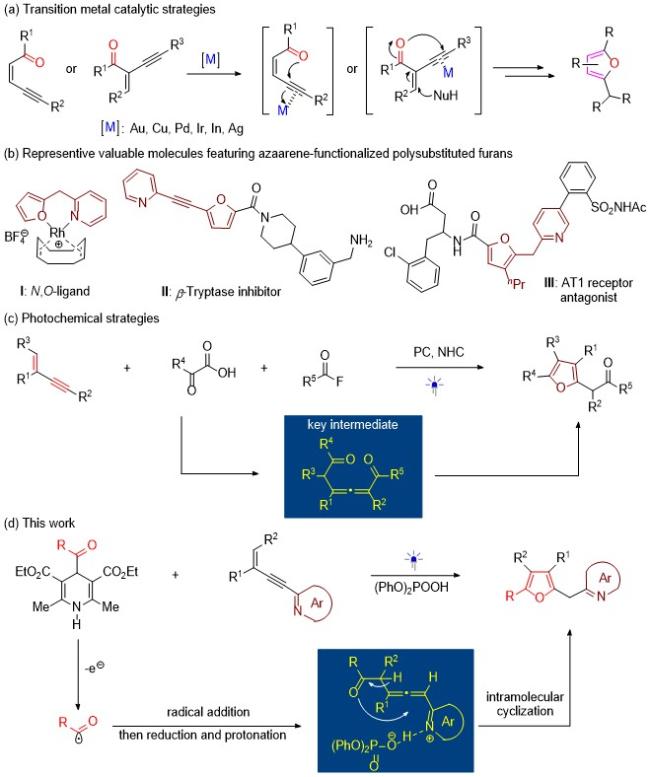
Notably, in recent years, photoredox catalysis has emerged as a promising platform for the sustainable synthesis of polysubstituted furans.[13] A prominent strategy involves visible light-induced radical cascades that proceed through the formation of allenes—either preformed or generated in situ—owing to their high reactivity and tunable substitution patterns. For instance, Zuo et al.[14] reported a synergistic NHC/organophotocatalytic 1,4-diacyla- tion/cycloisomerization of 1,3-enynes, affording tri- and tetra-substituted furans via an allene intermediate (Scheme 1c). Building on this context and our ongoing research into the photocatalytic synthesis of azaarene derivatives,[15-16] we became interested in exploring the feasibility of using 1,3-enynes bearing azaarenes on the alkynyl moiety as substrates for carbonyl radical addition. Beyond the reactivity of such radical addition processes, the subsequent ring closure of the resulting intermediates through oxygen atom addition of the carbonyl group to the allene moiety remains a significant challenge, primarily due to the comparatively weaker electron-withdrawing capacity of aza- arenes relative to previously reported ketones.
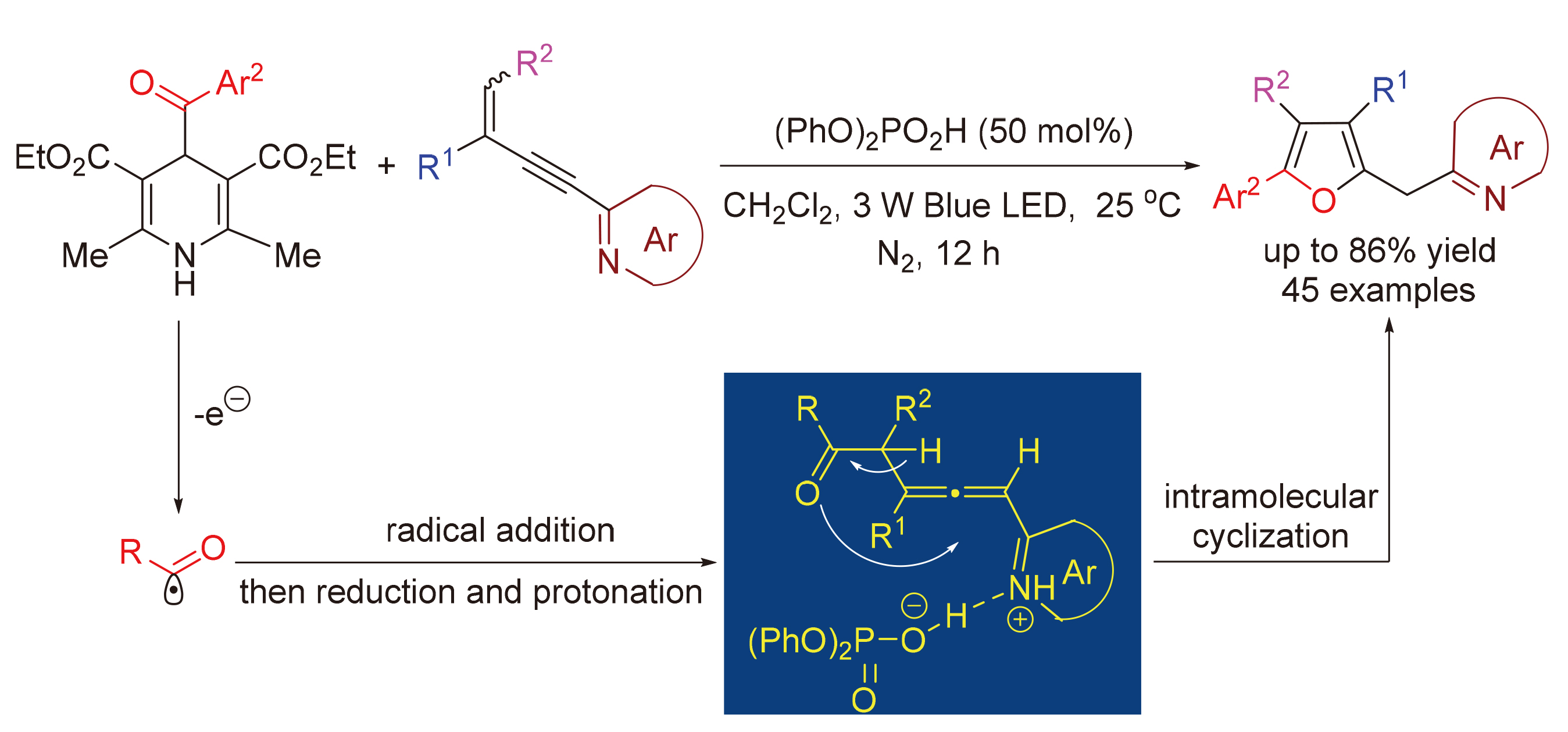
Nevertheless, we successfully addressed this significant yet unmet challenge by employing 4-acyl-substituted dihydropyridines (4-acyl-DHPs) as reaction partners (Sche- me 1d). In contrast to conventional photochemical platforms, this method eliminates the need for external photosensitizers, as DHPs can be directly activated by visible light, thereby improving synthetic efficiency.[17-19] As anticipated, the initial reactivity between the two substrates proved to be unfavorable. Through a systematic evaluation of various Brønsted-Lowry acids, commercially available diphenyl phosphate was identified as the optimal promoter, enabling the efficient synthesis of a wide range of poly- substituted furan derivatives bearing diverse azaarene functionalities in high yields.
2 Results and Discussion
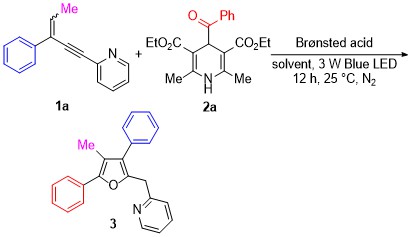
Our investigation commenced with the selection of 2-(3- phenylpent-3-en-1-yn-1-yl)pyridine (1a) and diethyl 4- benzoyl-2,6-dimethyl-1,4-dihydropyridine-3,5-dicarboxy-late (2a) as model substrates (Table 1). Initially, the reaction was carried out in dichloromethane at 25 ℃ under nitrogen atmosphere and irradiation with a 3 W blue LED. After 12 h, the reaction was complete. However, the desired product 3 was obtained in only 16% yield, accompanied by a mixture of unidentified side products (Entry 1). We hypothesized that the low chemoselectivity might result from insufficient driving force through protonation to allene intermediate after radical addition, as well as the subsequent key intramolecular cyclization. Accordingly, the use of a Brønsted-Lowry acid was proposed to enhance both steps. It was found that p-toluenesulfonic acid (TsOH) could afford product 3 in 41% yield (Entry 2), confirming the feasibility of our design and prompting further evaluation of various Brønsted-Lowry acids (Entries 3~6). Among them, diphenyl phosphate proved to be the most effective, delivering the highest yield of 62% (Entry 6). Subsequently, different solvents were examined in an attempt to further improve the yield (Entries 7~13), but no significant improvement was observed. Consequently, the loading of diphenyl phosphate was increased (Entries 14~16). The yield of product 3 reached 85% when 50 mol% diphenyl phosphate was employed (Entry 15). Further increasing the acid loading to 60 mol% did not result in a higher yield (Entry 16). The reaction was then tested under an air atmosphere, but no product 3 was formed, despite complete consumption of substrate 2a (Entry 17). Finally, the presence of a light source was demonstrated to be essential for the reaction to proceed (Entry 18).
Table 1 Reaction conditions optimizationsa |
| Entry | Brønsted-Lowry acid | Solvent | Yieldb/% |
|---|---|---|---|
| 1 | None | CH2Cl2 | 16 |
| 2 | TsOH (10 mol%) | CH2Cl2 | 41 |
| 3 | AcOH (10 mol%) | CH2Cl2 | 36 |
| 4 | H2NSO3H (10 mol%) | CH2Cl2 | 23 |
| 5 | TfOH (10 mol%) | CH2Cl2 | 0 |
| 6 | (PhO)2PO2H (10 mol%) | CH2Cl2 | 62 |
| 7 | (PhO)2PO2H (10 mol%) | DCE | 59 |
| 8c | (PhO)2PO2H (10 mol%) | THF | 60 |
| 9 | (PhO)2PO2H (10 mol%) | Toluene | 57 |
| 10 | (PhO)2PO2H (10 mol%) | CH3CN | 55 |
| 11 | (PhO)2PO2H (10 mol%) | CHCl3 | 48 |
| 12 | (PhO)2PO2H (10 mol%) | Et2O | 51 |
| 13 | (PhO)2PO2H (10 mol%) | Acetone | 59 |
| 14 | (PhO)2PO2H (30 mol%) | CH2Cl2 | 74 |
| 15 | (PhO)2PO2H (50 mol%) | CH2Cl2 | 85 |
| 16 | (PhO)2PO2H (60 mol%) | CH2Cl2 | 84 |
| 17c | (PhO)2PO2H (50 mol%) | CH2Cl2 | n.p. |
| 18d | (PhO)2PO2H (50 mol%) | CH2Cl2 | n.p. |
a Reactions were performed with 1a (0.02 mmol), 2a (0.024 mmol) in solvent (0.4 mL) at 25 ℃ and under a nitrogen atmosphere for 12 h. b The yield was determined by GC using dodecane as an internal standard. c Under air. d No light. TsOH=p-toluenesulfonic acid, TfOH=Trifluoro-methanesulfonic acid, n.p.=no product. |
With the optimized reaction conditions established, we assessed the generality of this visible light-driven tandem cyclization reaction (Table 2). A range of aryl groups at the 2-position of enyne were initially evaluated in the reaction with substrate 2a, affording the corresponding products 3~12 in yields ranging from 53% to 84%. It was observed that the electronic properties and positions of substituents on the aromatic rings had no significant impact on reaction efficiency. Notably, steric hindrance was found to moderately reduce reactivity, resulting in slightly lower yields (e.g., 5 and 11). The broad substrate scope was further demonstrated by the successful use of various simple aryls (3~10), fused aromatic rings (11), and alkyls (12). Subsequently, a diverse set of 1,3-enynes was tested accordingly. As a result, the corresponding 2,3,4,5-tetrasub- stituted furan products 13~29 was obtained in yields ranging from 51% to 85%. The compatibility of both alkyl and aryl groups as the 1-substituents on the olefin moiety (i.e., R2) enables the efficient assembly of various alkyl and aryl substituents at the 4-position of the resulting furans (13~16). Importantly, this method facilitates the incorporation of pyridines (17~24), quinolines (25), isoquinolines (26), thiazole (27), benzothiazole (28), and benzoxazoles (29) at the 2-position of the furan products. Notably, 3- and 4-pyridine-based substrates did not yield the desired products, likely due to the weaker electron- withdrawing ability of these pyridyl rings and the reduced acid-mediated activation. The same result was observed when the 2-pyridyl group was replaced with a simple phenyl substituent on the alkyne. In addition, a range of 4-acyl-DHPs bearing different aryls of the carbonyl group were next evaluated, commonly substituted aryls (30 and 31), fused aromatic rings (32), and heterocyclic aromatic rings (33~37) provided satisfactory yields, further highlighting the versatility of this methodology. Among these, the synthesis of complex furan derivatives containing four heterocyclic aromatic rings within a single molecular scaffold was successfully achieved (e.g., product 36), thereby demonstrating the applicability of this strategy in the construction of structurally intricate and valuable azaarene- functionalized furan derivatives.
Table 2 Exploration of substrate scopea |

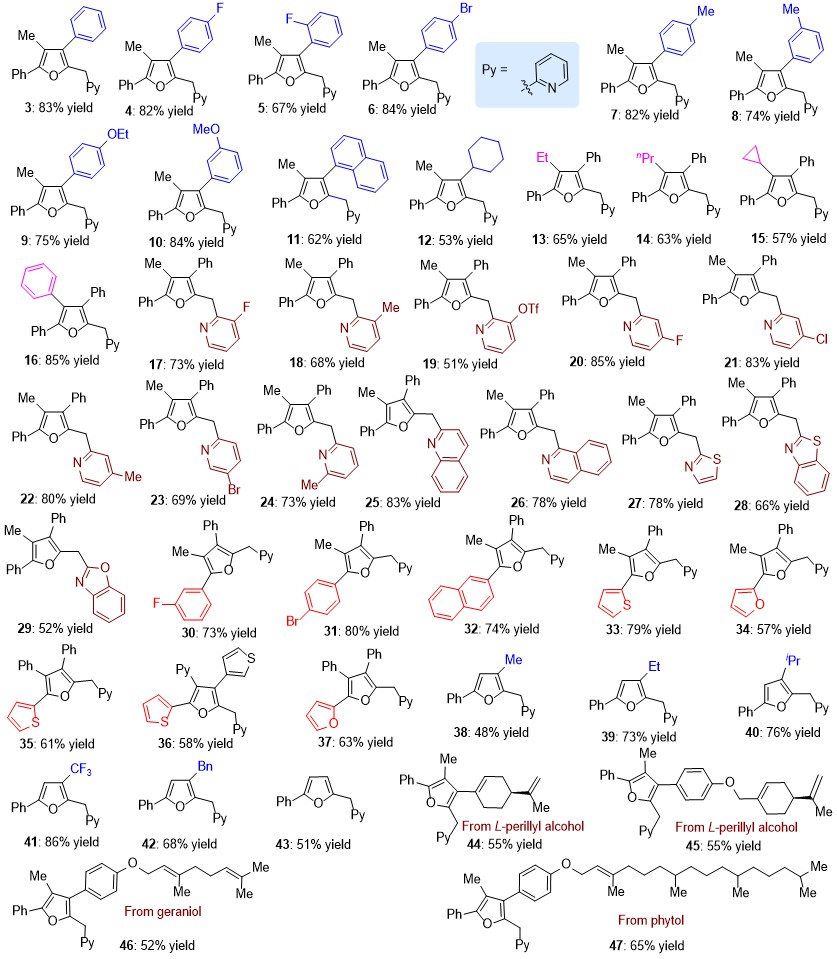 |
a Yields were those for the isolated products. |
Despite featuring simpler structural feature, trisubstituted furan products were also tested to synthesize, given their synthetic and biological importance. Accordingly, 1,3-enynes containing terminal olefin moiety were tested, leading to products 38~42 with satisfactory yields. The subsequent investigation revealed the viability of the method to access the furan derivatives featuring only two substituents (43), therefore largely enriching the variety of furan products through this photochemical approach. It is noteworthy that a diverse array of drug molecules, including L-perillyl alcohol (44, 45), geraniol (46), and phytol (47), can be efficiently incorporated into the corresponding tetrasubstituted furan derivatives via this methodology, thereby highlighting its substantial applicability in the field of drug discovery.
To elucidate the underlying reaction mechanism, control experiments and spectroscopic analyses were subsequently conducted. It was observed that the reaction between 1,3-enyne 1a and DHP 2a was completely suppressed upon the addition of 2.0 equiv. of TEMPO, with no detection of furan product 3, suggesting that the transformation proceeds via a radical-based pathway (Scheme 2a). Notably, the detection of compound 48 in the reaction system through HRMS analysis confirms the capacity of DHP 2 to generate an acyl radical under the reaction conditions. Cyclic voltammetry of 1a in the presence of (PhO)2PO2H was performed in CH₃CN to evaluate the redox properties of the enynes. A reduction potential of Ep=-1.24 V vs SCE was recorded, indicating that direct reduction of 1a by the excited state of 2a (E[2a⁺•/2a*]=-1.1 V)[20] is thermodynamically unfavorable. UV-vis absorption studies were subsequently carried out to assess the possibility of an electron donor-acceptor (EDA) complex formation among 1a, 2a, and (PhO)2PO2H. However, no new absorption bands were observed in any binary or ternary combinations, thereby ruling out an EDA-mediated mechanism and supporting the hypothesis that the 4-acyl DHPs should be directly activated under irradiation by the employed light source.
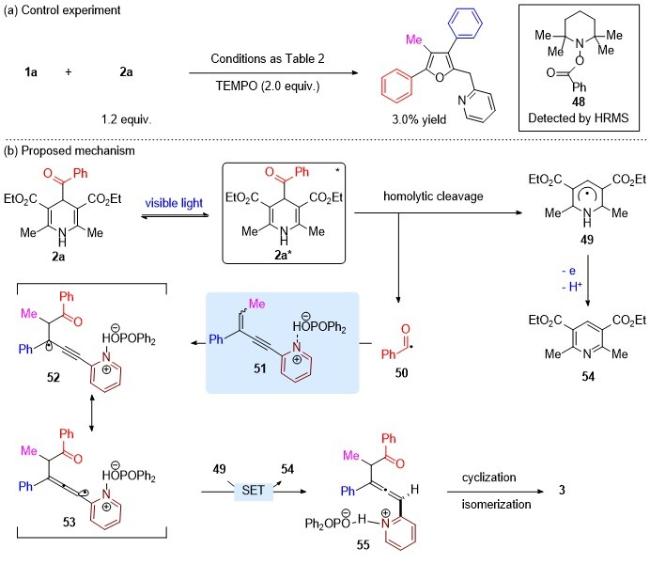


Based on these findings, a plausible mechanistic pathway is proposed, as illustrated in Scheme 2b, using the reaction between 1a and 2a as a representative example. Upon photon absorption, 2a generates its excited state (2a*), which undergoes homolytic cleavage to yield DHP radical 49 and acyl radical 50.[20] The latter subsequently undergoes radical addition to the activated 1,3-enyne 1a, which is likely facilitated by diphenyl phosphate (i.e., 51). The resulting alkyne radical 52 is then converted into allene radical 53, which undergoes single-electron transfer (SET) with 49, yielding a neutral allene species and pyridinium 54. Following intramolecular cyclization and isomerization, the final product 3 is obtained. We hypothesized that diphenyl phosphate would facilitate the reduction of allene and the subsequent cyclization, thereby enhancing both the reactivity and chemoselectivity.
3 Conclusions
In conclusion, we have established a visible-light-driven and Brønsted-Lowry acid-promoted tandem cyclization strategy for the synthesis of azaarene-containing polysubstituted furans from readily available 1,3-enynes and acyl-DHPs. In the absence of a photo-catalyst, this approach provides a straightforward, efficient, and modular route for the preparation of diverse azaarene-containing,densely functionalized furan derivatives in high yields. The Method’s broad substrate scope, synthetic efficiency, and environmental compatibility collectively render it a valuable asset in the field of polysubstituted furan synthesis.
4 Experimental section
4.1 Instruments and reagents
1H NMR, 19F NMR and 13C NMR spectra were recorded on 600 MHz NMR spectrometer (Bruker) and 400 MHz NMR spectrometer (Bruker). Chemical shifts are reported using the residual solvent signal as an internal standard: CDCl3 (1H NMR: δ 7.26, singlet; 13C NMR: δ 77.0, triplet). HRMS were recorded on a LC-MS (TOF, high-resolution mass spectrometer, Agilent). Mass samples were dissolved in CH3CN (HPLC Grade) unless otherwise stated. Melting points were determined on a melting point apparatus [OptiMelt (90-264VAC), Stanford Research System, USA].
All commercial reagents and solvents were purchased with the highest purity grade from Energy Chemical and Bidepharm. All solvents used, mainly petroleum ether (PE) and ethyl acetate (EtOAc), were distilled. Anhydrous dichloromethane (DCM) and CH3CN were freshly distilled from CaH2 and stored under N2 atmosphere. THF and toluene were freshly distilled from sodium/benzophenone before use. All synthesized compounds were stored in a -20 ℃ freezer and light-sensitive compounds were protected with aluminum foil.
4.2 General procedure for the preparation of glyoxal hydrates via the Riley oxidation
To a 100 mL round bottom flask, equipped with a magnetic stirrer and a reflux condenser, SeO2 (1.2 equiv.) was added, followed by 1,4-dioxane/water (V∶V=10∶1) and the ketone (1.0 equiv.). The reaction mixture was refluxed under argon for 5~48 h until completion, as judged by TLC analysis, and then cooled to ambient temperature. The suspension was filtered through a plug of Celite and the solvent was removed by rotary evaporator. The residue was dried under high vacuum and dissolved in a minimum amount of boiling water. The mixture was slowly cooled to 0 ℃ and then the crystallized glyoxal hydrates were filtered off and dried.
4.3 General procedure for the preparation of acyl DHPs 2a~2f
Glyoxals or glyoxal hydrates (1.0 equiv.) and ethyl acetoacetate (1.0 equiv.) were added to a 50 mL round bottom flask equipped with a magnetic stirrer. The mixture was slowly heated to 130 ℃ and kept under stirring for 5~30 min, until the condensation reaction was completed (monitored by TLC analysis). The solution was then cooled to 80 ℃. Ethyl 3-aminocrotonate (1.0 equiv.) was slowly added (exothermic reaction), then the mixture was slowly heated to 120 ℃ for 5~15 min and monitored by TLC. After completion, the reaction mixture was cooled to ambient temperature and the substrates were purified by column chromatography [SiO2, V(petroleum ether)∶ V(ethyl acetate)=4∶1~1∶1], prior to recrystallization from cyclohexane/ethyl acetate (V∶V=4∶1).[17,20]
4.4 Synthesis of substrates 1a~1n, 1ab~1ag and 1ai
Step 1: 2-Ethynylpyridine (1.1 equiv.) was dissolved in anhydrous THF (5.0 mL/mmol), and the solution was cooled to -78 ℃ under a nitrogen atmosphere. To the solution, n-BuLi (1.1 equiv., 1.6 mol/L in THF) was added dropwise. After being stirred for 1 h at -78 ℃, a solution of corresponding aldehyde (1.1 equiv.) in anhydrous THF was added dropwise. The reaction mixture was then allowed to stir at room temperature for 4 h. The reaction mixture was quenched with saturated aqueous NH4Cl. The organic layer was separated, and the water phase was extracted 3 times with ethyl acetate. The combined organic layer was dried over anhydrous Na2SO4, filtered and concentrated in vacuo to give a residue, which was purified by flash chromatography (petroleum ether/ethyl acetate) to afford secondary alcohol.[21]
Step 2: The corresponding secondary alcohol was dissolved in anhydrous dichloromethane (2.0 mL/mmol), and the solution was cooled to 0 ℃. To the solution, DMP (1.2 equiv.) was added slowly. The reaction mixture was then allowed to stir at room temperature for 4 h. After completion of the reaction as monitored by TLC, saturated Na2CO3 solution was added. The layers were separated, and the aqueous layer was extracted 3 times with dichloromethane. The organic layers were combined and dried over Na2SO4. The solvent was evaporated, and the crude product was purified by flash column chromatography (petroleum ether/ethyl acetate) to provide the corresponding ynone.[22]
Step 3: To a solution of PPh3R2CH2Br (1.2 equiv.) in anhydrous THF at 0 ℃, n-BuLi (1.6 mol/L in THF, 1.2 equiv.) was added dropwise by syringe over 5 min. After 30 min, the corresponding ynone (1.0 equiv.) was added to the orange reaction mixture. After completion of the reaction (monitored by TLC), the reaction was quenched with water and the mixture was extracted 3 times with ethyl acetate. The combined organic phase was washed with brine, dried over anhydrous Na2SO4, and filtered. The solvent was removed under vacuum and the resultant residue was purified by flash chromatography (petroleum ether/ ethyl acetate) to afford 1,3-enyne derivatives.[23]
4.5 Synthesis of substrates 1o~1aa
Step 1: Under N2 atmosphere, benzoyl chloride (1.0 equiv.), PdCl2(PPh3)2 (2.0 mol%), CuI (4.0 mol%), Et3N (1.0 equiv.), and ethynyltrimethylsilane (1.0 equiv.) dissolved in dry THF (5.0 mL/mmol) were added via standard Schlenk techniques to a flame-dried round-bottom flask equipped with a magnetic stir bar at 25 ℃. The resulting reaction mixture was stirred at room temperature for 12 h. The reaction was quenched with water. The aqueous layer was extracted 3 times with ethyl acetate. The combined organic layers were washed with brine, dried over Na2SO4, filtered, and concentrated in vacuo. The solvent was removed under vacuum and the resultant residue was purified by flash chromatography (petroleum ether/ethyl acetate) to afford 1-phenyl-3-(trimethylsilyl)prop-2-yn-1- one.[24]
Step 2: To a solution of PPh3CH2CH3Br (1.2 equiv.) in anhydrous THF at 0 ℃, n-BuLi (1.6 mol/L in THF, 1.2 equiv.) was added dropwise by syringe over 5 min. After 30 min, 1-phenyl-3-(trimethylsilyl)prop-2-yn-1-one (1.0 equiv.) was added to the orange reaction mixture. After completion of the reaction (monitored by TLC), the reaction was quenched with water and the mixture was extracted 3 times with ethyl acetate. The combined organic phase was washed with brine, dried over anhydrous Na2SO4, and filtered. The solvent was removed under vacuum and the resultant residue was purified by flash chromatography (petroleum ether/ethyl acetate) to afford trimethyl(3-phenylpent-3-en-1-yn-1-yl)silane.[25]
Step 3: Trimethyl(3-phenylpent-3-en-1-yn-1-yl)silane was dissolved in MeOH, and K2CO3 (3.0 equiv.) was added. The reaction was stirred for 2 h and after this time the reaction was quenched with a saturated NH4Cl solution and extracted 3 times with ethyl acetate. The combined organic fractions were then washed with brine and dried with Na2SO4. The solvent was removed under vacuum and the resultant residue was purified by flash chromatography (petroleum ether/ethyl acetate) to afford pent-3-en-1-yn-3- ylbenzene.[26]
Step 4: Pd(PPh3)2Cl2 (5.0 mol%) and CuI (6.0 mol%) were added to a flame-dried two-neck round-bottomed flask equipped with a magnetic stir bar and reflux condenser. After being degassed with nitrogen three times, DCE (5.0 mL/mmol) and TEA (5.0 equiv.) were added to the flask. Subsequently, pent-3-en-1-yn-3-ylbenzene (1.2 equiv.) and 2-bromoazaarene or 2-chloroazaarene (1.0 equiv.) dissolved in DCE were added dropwise via a syringe. The reaction mixture was stirred at 90 ℃ overnight. The reaction mixture was quenched with saturated aqueous NH4Cl. The organic layer was separated, and the water phase was extracted 3 times with dichloromethane. The combined organic layer was dried over anhydrous Na2SO4, filtered and concentrated in vacuo to give a residue, which was purified by flash chromatography (petroleum ether/ethyl acetate) to afford 1,3-enyne derivatives.[27]
4.6 Synthesis of substrate 1ah
CuI (2.0 mol%) and Pd(PPh3)4 (0.3 mol%) were dissolved in anhydrous, degassed diethylamine (0.5 mL/1.0 mmol alkyne) and cooled to 0 ℃. Then alkyne (1.0 equiv.) and 1 mol/L vinyl bromide in tetrahydrofuran (1.1 equiv.) were added and the mixture was stirred at room temperature until complete conversion of the starting material. Water was added, followed by extraction with ethyl acetate. The combined organic layer was dried over anhydrous Na2SO4, filtered and concentrated in vacuo to give a residue, which was purified by flash chromatography (petroleum ether/ethyl acetate) to afford 2-(but-3-en-1-yn-1- yl)pyridine 1ah.[28]
4.7 Synthesis of substrates 1aj~1al
Step 1: To a solution of corresponding alcohol (1.0 equiv.) in diethyl ether was added CBr4 (2.0 equiv.) and Ph3P (2.0 equiv.) under an N2 atmosphere at 0 ℃. The solution was stirred at the same temperature for 3 h, and petroleum ether was then added. The reaction mixture was filtered. The filtrate was concentrated under reduced pressure and the resulting crude purified by column chromatography on silica gel (petroleum ether) to yield allyl bromides.[29]
Step 2: Allyl bromide (1.5 equiv.) was added to a solution of 4-hydroxybenzaldehyde (1.0 equiv.) and anhydrous K2CO3 (3.0 equiv.) in CH3CN at room temperature. The mixture was stirred at 80 ℃. After 20 h, the mixture was diluted with ethyl acetate and water. The organic layer was washed with brine, dried over anhydrous Na2SO4, and concentrated under reduced pressure. The residue was purified by silica gel chromatography.
The following steps were same as the synthesis of substrates 1a~1n, 1ab~1ag and 1ai.
4.8 General procedures for the synthesis of polysubstituted furans 3~47
To a 10 mL Schlenk tube equipped with a magnetic stir bar were added 1,3-enynes (0.10 mmol, 1.0 equiv.), acyl DHP (0.12 mmol, 1.2 equiv.) and (PhO)2PO2H (0.05 mmol, 0.5 equiv.). Dry dichloromethane (2.0 mL) was then added, degassed three times by freeze-pump-thaw method. The reaction mixture was stirred under an N2 atmosphere at 25 ℃ (the temperature was maintained in an incubator) and irradiated by a 3 W blue LED (λ=450~455 nm) from a 2.0 cm distance for 12 h. After completion of the reaction, the solvent was removed, and the residue was purified by short column chromatography on silica gel, eluting with dichloromethane to afford products 3~47.
2-((4-Methyl-3,5-diphenylfuran-2-yl)methyl)pyridine (3): Yellow oil, 27.0 mg (0.1 mmol), 83% yield. 1H NMR (600 MHz, CDCl3) δ: 8.46 (dd, J=4.9, 1.6 Hz, 1H), 7.56 (d, J=7.8 Hz, 2H), 7.50 (td, J=6.8, 1.4 Hz, 1H), 7.36~7.27 (m, 6H), 7.26~7.22 (m, 1H), 7.19~7.14 (m, 1H), 7.08 (d, J=7.8 Hz, 1H), 7.04 (dd, J=7.4, 4.9 Hz, 1H), 4.16 (s, 2H), 2.15 (s, 3H); 13C NMR (151 MHz, CDCl3) δ: 158.9, 149.4, 148.1, 147.4, 136.7, 133.1, 131.9, 129.8, 128.6, 128.6, 127.1, 126.8, 126.8, 125.6, 122.9, 121.6, 116.7, 35.8, 11.0. HRMS (ESI) calcd for C23H20NO [M+H]+ 326.1539, found 326.1535.
2-((3-(4-Fluorophenyl)-4-methyl-5-phenylfuran-2-yl)-methyl)pyridine (4): Yellow oil, 28.1 mg (0.1 mmol), 82% yield. 1H NMR (600 MHz, CDCl3) δ: 8.47 (d, J=5.0 Hz, 1H), 7.54 (m, 3H), 7.36~7.29 (m, 2H), 7.28~7.22 (m, 2H), 7.20~7.18 (m, 1H), 7.13~6.98 (m, 4H), 4.14 (s, 2H), 2.12 (s, 3H); 13C NMR (151 MHz, CDCl3) δ: 162.2 (d, J=245.9 Hz), 158.6, 149.4, 148.1, 147.4, 136.9, 131.8, 131.4 (d, J=8.0 Hz),129.1 (d, J=3.2 Hz), 128.6, 126.9, 125.9, 125.6, 123.0, 121.7, 116.6, 115.6 (d, J=21.3 Hz), 35.7, 10.9; 19F NMR (565 MHz, CDCl3) δ: -115.3. HRMS (ESI) calcd for C23H19FNO [M+H]+ 344.1445, found 344.1443.
2-((3-(2-Fluorophenyl)-4-methyl-5-phenylfuran-2-yl)-methyl)pyridine (5): Brown oil, 23.0 mg (0.1 mmol), 67% yield. 1H NMR (600 MHz, CDCl3) δ: 8.46~8.42 (m, 1H), 7.59~7.54 (m, 2H), 7.50 (td, J=7.7, 1.9 Hz, 1H), 7.34~7.29 (m, 2H), 7.27~7.22 (m, 2H), 7.18~7.15 (m, 1H), 7.12~7.01 (m, 4H), 4.12 (s, 2H), 2.08 (d, J=1.3 Hz, 3H); 13C NMR (151 MHz, CDCl3) δ: 160.5 (d, J=246.2 Hz), 158.5, 149.3, 148.2, 136.8, 132.5 (d, J=3.3 Hz), 131.8, 129.5 (d, J=8.2 Hz), 128.6, 126.8, 125.5, 124.3 (d, J=3.4 Hz), 122.9, 121.6, 121.0, 120.7, 117.5, 115.9 (d, J=22.1 Hz), 35.9, 10.8 (d, J=2.5 Hz); 19F NMR (565 MHz, CDCl3) δ: -113.5; HRMS (ESI) calcd for C23H19FNO [M+H]+344.1445, found 344.1442.
2-((3-(4-Bromophenyl)-4-methyl-5-phenylfuran-2-yl)methyl)pyridine (6): Yellow oil, 33.8 mg (0.1 mmol), 84% yield. 1H NMR (400 MHz, CDCl3) δ: 8.59~8.48 (m, 1H), 7.67~7.50 (m, 5H), 7.40 (dd, J=8.5, 7.0 Hz, 2H), 7.28~7.23 (m, 3H), 7.18 (d, J=7.8 Hz, 1H), 7.11~7.15 (m, 1H), 4.21 (s, 2H), 2.20 (s, 3H); 13C NMR (101 MHz, CDCl3) δ: 158.6, 149.5, 148.3, 147.6, 136.8, 132.2, 131.8, 131.8, 131.5, 128.6, 126.9, 125.7, 125.7, 123.0, 121.7, 121.3, 116.3, 35.8, 10.9; HRMS (ESI) calcd for C23H19Br- NO [M+H]+ 404.0645, found 404.0640.
2-((4-Methyl-5-phenyl-3-(p-tolyl)furan-2-yl)methyl)-pyridine (7): Yellow oil, 27.8 mg (0.1 mmol), 82% yield. 1H NMR (400 MHz, CDCl3) δ: 8.58~8.51 (m, 1H), 7.67~7.56 (m, 3H), 7.40 (t, J=7.8 Hz, 2H), 7.28~7.21 (m, 5H), 7.19~7.11 (m, 2H), 4.24 (s, 2H), 2.39 (s, 3H), 2.22 (s, 3H); 13C NMR (101 MHz, CDCl3) δ: 158.9, 149.3, 148.0, 147.2, 136.8, 132.0, 130.1, 129.7, 129.4, 128.6, 126.8, 126.7, 125.6, 123.0, 121.6, 116.8, 35.7, 21.4, 11.0; HRMS (ESI) calcd for C24H22NO [M+H]+ 340.1696, found 340.1692.
2-((4-Methyl-5-phenyl-3-(m-tolyl)furan-2-yl)methyl)-pyridine (8): Yellow oil, 25.1 mg (0.1 mmol), 74% yield. 1H NMR (400 MHz, CDCl3) δ: 8.55 (d, J=5.0 Hz, 1H), 7.69~7.53 (m, 3H), 7.45~7.37 (m, 2H), 7.34~7.28 (m, 1H), 7.26~7.22 (m, 1H), 7.20~7.07 (m, 5H), 4.26 (s, 2H), 2.38 (s, 3H), 2.23 (s, 3H); 13C NMR (151 MHz, CDCl3) δ: 158.9, 149.3, 148.0, 147.3, 138.1, 136.7, 133.0, 132.0, 130.5, 128.6, 128.5, 127.9, 126.9, 126.9, 126.7, 125.6, 122.9, 121.6, 116.7, 35.8, 21.6, 11.0; HRMS (ESI) calcd for C24H22NO [M+H]+ 340.1696, found 340.1693.
2-((3-(4-Ethoxyphenyl)-4-methyl-5-phenylfuran-2-yl)methyl)pyridine (9): Yellow oil, 27.7 mg (0.1 mmol), 75% yield. 1H NMR (600 MHz, CDCl3) δ: 8.58 (d, J=4.1 Hz, 1H), 7.69~7.61 (m, 3H), 7.42 (t, J=7.8 Hz, 2H), 7.33~7.27 (m, 3H), 7.21 (d, J=7.9 Hz, 1H), 7.19~7.13 (m, 1H), 6.98 (d, J=8.6 Hz, 2H), 4.28 (s, 2H), 4.09 (q, J=7.0 Hz, 2H), 2.24 (s, 3H), 1.46 (t, J=7.0 Hz, 3H); 13C NMR (151 MHz, CDCl3) δ: 158.8, 158.2, 149.0, 148.0, 146.9, 137.1, 132.0, 130.9, 128.6, 126.7, 126.6, 125.5, 125.1, 123.1, 121.7, 116.9, 114.7, 63.6, 35.6, 15.0, 11.0; HRMS (ESI) calcd for C25H24NO2 [M+H]+ 370.1802, found 370.1800.
2-((3-(3-Methoxyphenyl)-4-methyl-5-phenylfuran-2-yl)methyl)pyridine (10): Yellow oil, 29.6 mg (0.1 mmol), 84% yield. 1H NMR (600 MHz, CDCl3) δ: 8.56 (s, 1H), 7.68~7.63 (m, 2H), 7.61 (td, J=7.7, 1.7 Hz, 1H), 7.41 (t, J=7.8 Hz, 2H), 7.34 (t, J=8.1 Hz, 1H), 7.28~7.24 (m, 1H), 7.20 (d, J=7.7 Hz, 1H), 7.14 (t, J=6.1 Hz, 1H), 6.98~6.94 (m, 2H), 6.90~6.88 (m, 1H), 4.26 (s, 2H), 3.82 (s, 3H), 2.25 (s, 3H); 13C NMR (151 MHz, CDCl3) δ: 159.7, 158.9, 148.1, 147.4, 136.8, 134.5, 131.9, 129.6, 128.6, 126.8, 126.7, 125.6, 122.2, 116.6, 115.4, 112.9, 55.4, 35.8, 11.0; HRMS (ESI) calcd for C24H22NO2 [M+H]+ 356.1645, found 356.1640.
2-((4-Methyl-3-(naphthalen-1-yl)-5-phenylfuran-2-yl)methyl)pyridine (11): Yellow oil, 23.2 mg (0.1 mmol), 62% yield. 1H NMR (400 MHz, CDCl3) δ: 8.37 (d, J=4.8 Hz, 1H), 7.85~7.75 (m, 2H), 7.71 (d, J=8.4 Hz, 1H), 7.66~7.59 (m, 2H), 7.46~7.41 (m, 2H), 7.41~7.37 (m, 1H), 7.37~7.29 (m, 3H), 7.24~7.15 (m, 2H), 7.02~6.94 (m, 2H), 4.09 (d, J=16.3 Hz, 1H), 3.99 (d, J=16.3 Hz, 1H), 1.94 (s, 3H); 13C NMR (101 MHz, CDCl3) δ: 158.5, 149.0, 148.2, 147.9, 136.7, 133.8, 132.9, 132.0, 130.7, 128.7, 128.6, 128.4, 128.2, 126.7, 126.2, 126.2, 126.0, 125.6, 125.4, 125.2, 123.0, 121.5, 118.4, 35.9, 11.0; HRMS (ESI) calcd for C27H22NO [M+H]+ 376.1696, found 376.1692.
2-((3-Cyclohexyl-4-methyl-5-phenylfuran-2-yl)methyl)-pyridine (12): yellow oil, 17.5 mg (0.1 mmol), 53% yield. 1H NMR (600 MHz, CDCl3) δ: 8.54 (d, J=4.9 Hz, 1H), 7.57 (t, J=8.2 Hz, 3H), 7.40~7.33 (m, 2H), 7.22 (t, J=7.4 Hz, 1H), 7.16~7.06 (m, 2H), 4.27 (s, 2H), 2.56~2.44 (m, 1H), 2.25 (s, 3H), 1.84~1.76 (m, 2H), 1.73 (d, J=13.5 Hz, 3H), 1.57 (m, 2H), 1.38~1.27 (m, 2H), 1.26~1.14 (m, 1H); 13C NMR (151 MHz, CDCl3) δ: 159.6, 149.2, 147.6, 146.1, 136.7, 132.1, 128.5, 128.1, 126.5, 125.9, 122.7, 121.5, 117.0, 36.4, 35.8, 32.7, 27.3, 26.3, 10.9; HRMS (ESI) calcd for C23H26NO [M+H]+ 332.2009, found 332.2005.
2-((4-Ethyl-3,5-diphenylfuran-2-yl)methyl)pyridine (13): Yellow oil, 22.0 mg (0.1 mmol), 65% yield. 1H NMR (600 MHz, CDCl3) δ: 8.48~8.42 (m, 1H), 7.58~7.54 (m, 2H), 7.50 (td, J=7.7, 1.8 Hz, 1H), 7.36~7.29 (m, 4H), 7.26 (dt, J=8.2, 1.8 Hz, 3H), 7.20~7.15 (m, 1H), 7.09~6.97 (m, 2H), 4.11 (s, 2H), 2.59 (q, J=7.5 Hz, 2H), 0.99 (t, J=7.5 Hz, 3H); 13C NMR (151 MHz, CDCl3) δ: 158.8, 149.3, 147.6, 147.5, 136.8, 133.4, 131.9, 129.9, 128.7, 128.6, 127.2, 126.9, 126.4, 125.6, 123.5, 122.9, 121.6, 35.7, 17.7, 14.7; HRMS (ESI) calcd for C24H22NO [M+ H]+ 340.1696, found340.1692.
2-((3,5-Diphenyl-4-propylfuran-2-yl)methyl)pyridine (14): Yellow oil, 22.2 mg (0.1 mmol), 63% yield. 1H NMR (400 MHz, CDCl3) δ: 8.53 (d, J=4.8 Hz, 1H), 7.66~7.61 (m, 2H), 7.58 (td, J=7.7, 1.9 Hz, 1H), 7.43~7.36 (m, 4H), 7.36~7.30 (m, 3H), 7.27~7.22 (m, 1H), 7.16~7.08 (m, 2H), 4.20 (s, 2H), 2.68~2.56 (m, 2H), 1.55~1.36 (m, 2H), 0.82 (t, J=7.3 Hz, 3H); 13C NMR (101 MHz, CDCl3) δ: 158.8, 149.3, 147.8, 147.5, 136.8, 133.5, 132.0, 129.9, 128.6, 128.6, 127.2, 126.8, 126.6, 125.7, 122.9, 122.1, 121.6, 35.7, 26.5, 23.3, 14.3; HRMS (ESI) calcd for C25H24NO [M+H]+ 354.1852, found 354.1849.
2-((4-Cyclopropyl-3,5-diphenylfuran-2-yl)methyl)pyri-dine (15): Yellow oil, 20.0 mg (0.1 mmol), 57% yield. 1H NMR (600 MHz, CDCl3) δ: 8.57~8.49 (m, 1H), 7.86~7.77 (m, 2H), 7.60 (td, J=7.7, 1.9 Hz, 1H), 7.47~7.43 (m, 2H), 7.40 (td, J=7.7, 2.2 Hz, 4H), 7.34~7.30 (m, 1H), 7.28~7.24 (m, 1H), 7.18~7.12 (m, 2H), 4.26 (s, 2H), 1.96~1.68 (m, 1H), 0.78~0.69 (m, 2H), 0.20~0.13 (m, 2H); 13C NMR (151 MHz, CDCl3) δ: 158.7, 150.2, 149.2, 146.9, 136.9, 133.4, 131.3, 129.8, 128.3, 128.3, 127.3, 126.9, 126.9, 126.1, 123.1, 122.4, 121.7, 35.7, 8.6, 6.7; HRMS (ESI) calcd for C25H22NO [M+H]+ 352.1696, found 352.1693.
2-((3,4,5-Triphenylfuran-2-yl)methyl)pyridine (16): Yellow solid, 32.9 mg (0.1 mmol), 85% yield. m.p. 96.0~97.7 ℃; 1H NMR (600 MHz, CDCl3) δ: 8.59 (d, J=4.9 Hz, 1H), 7.64 (td, J=7.7, 1.8 Hz, 1H), 7.45~7.39 (m, 2H), 7.25~7.29 (m, 4H), 7.24~7.15 (m, 9H), 7.15~7.09 (m, 2H), 4.32 (s, 2H); 13C NMR (101 MHz, CDCl3) δ: 158.7, 149.6, 149.5, 148.0, 136.8, 133.6, 132.6, 131.2, 130.6, 129.9, 128.6, 128.4, 128.3, 127.2, 126.9, 126.0, 125.9, 123.1, 121.7, 35.9; HRMS (ESI) calcd for C28H22NO [M+H]+ 388.1696, found 388.1693.
3-Fluoro-2-((4-methyl-3,5-diphenylfuran-2-yl)methyl)-pyridine (17): Yellow solid, 25.0 mg (0.1 mmol), 73% yield. m.p. 104.0~105.8 ℃; 1H NMR (600 MHz, CDCl3) δ: 8.29 (d, J=4.7 Hz, 1H), 7.55~7.50 (m, 2H), 7.35 (d, J=4.4 Hz, 4H), 7.30 (t, J=7.8 Hz, 2H), 7.27~7.23 (m, 2H), 7.17~7.13 (m, 1H), 7.09 (dt, J=8.5, 4.4 Hz, 1H), 4.20 (d, J=2.2 Hz, 2H), 2.12 (s, 3H); 13C NMR (151 MHz, CDCl3) δ: 158.0 (d, J=257.8 Hz), 148.0, 146.6 (d, J=15.2 Hz), 146.3, 145.2 (d, J=5.4 Hz), 133.2, 132.0, 130.0, 128.5, 128.5, 127.1, 126.7, 126.6, 125.6, 123.3 (d, J=3.7 Hz), 122.9 (d, J=19.0 Hz), 116.7, 29.9, 10.9; 19F NMR (565 MHz, CDCl3) δ: -124.1; HRMS (ESI) calcd for C23H19FNO [M+H]+ 344.1445, found 344.1444.
3-Methyl-2-((4-methyl-3,5-diphenylfuran-2-yl)methyl)-pyridine (18): Yellow solid, 23.0 mg (0.1 mmol), 68% yield. m.p. 99.0~100.1 ℃; 1H NMR (600 MHz, CDCl3) δ: 8.39 (dd, J=5.0, 1.7 Hz, 1H), 7.63~7.54 (m, 2H), 7.45~7.35 (m, 7H), 7.34~7.30 (m, 1H), 7.24~7.20 (m, 1H), 7.05 (dd, J=7.6, 4.8 Hz, 1H), 4.24 (s, 2H), 2.22 (s, 3H), 2.19 (s, 3H); 13C NMR (151 MHz, CDCl3) δ: 156.5, 147.7, 147.5, 146.8, 138.0, 133.3, 132.0, 131.9, 130.0, 128.5, 128.5, 127.0, 126.6, 126.2, 125.5, 121.9, 116.6, 33.9, 19.0, 11.0; HRMS (ESI) calcd for C24H22NO [M+ H]+ 340.1696, found 340.1692.
2-((4-Methyl-3,5-diphenylfuran-2-yl)methyl)pyridin-3-yl trifluoromethanesulfonate (19): Yellow oil, 24.1 mg (0.1 mmol), 51% yield. 1H NMR (600 MHz, CDCl3) δ: 8.57 (d, J=4.7 Hz, 1H), 7.61 (dd, J=13.5, 8.1 Hz, 3H), 7.41 (d, J=4.4 Hz, 4H), 7.38 (t, J=7.6 Hz, 2H), 7.31~7.35 (m, 1H), 7.29~7.22 (m, 2H), 4.33 (s, 2H), 2.21 (s, 3H); 13C NMR (151 MHz, CDCl3) δ: 151.4, 149.2, 148.3, 145.5, 145.2, 132.9, 131.9, 129.9, 129.1, 128.6, 128.5, 127.2, 127.2, 126.8, 125.6, 123.2, 116.7, 30.6, 10.9; 19F NMR (565 MHz, CDCl3) δ: -73.5; HRMS (ESI) calcd for C24H19F3NO4S [M+H]+ 474.0981, found 474.0977.
4-Fluoro-2-((4-methyl-3,5-diphenylfuran-2-yl)methyl)-pyridine (20): Yellow oil, 29.1 mg (0.1 mmol), 85% yield. 1H NMR (600 MHz, CDCl3) δ: 8.51 (dd, J=8.7, 5.6 Hz, 1H), 7.68~7.61 (m, 2H), 7.45~7.39 (m, 4H), 7.37~7.32 (m, 3H), 7.30~7.26 (m, 1H), 6.93~6.85 (m, 2H), 4.25 (s, 2H), 2.23 (s, 3H); 13C NMR (151 MHz, CDCl3) δ: 169.3 (d, J=262.2 Hz), 162.3 (d, J=6.5 Hz), 151.7 (d, J=7.1 Hz), 148.4, 146.5, 132.9, 131.8, 129.8, 128.7, 128.6, 127.3, 127.3, 126.9, 125.7, 116.7, 110.7 (d, J=17.0 Hz), 109.8 (d, J=16.5 Hz), 35.68 (d, J=3.0 Hz), 10.9; 19F NMR (565 MHz, CDCl3) δ: -102.4; HRMS (ESI) calcd for C23H19F- NO [M+H]+ 344.1445, found 344.1442.
4-Chloro-2-((4-methyl-3,5-diphenylfuran-2-yl)methyl)-pyridine (21): Yellow oil, 29.8 mg (0.1 mmol), 83% yield. 1H NMR (600 MHz, CDCl3) δ: 8.42 (d, J=5.0 Hz, 1H), 7.66~7.58 (m, 2H), 7.40 (td, J=8.5, 7.1 Hz, 4H), 7.33 (dt, J=8.5, 2.4 Hz, 3H), 7.25~7.23 (m, 1H), 7.18~7.10 (m, 1H), 4.21 (s, 2H), 2.21 (s, 3H); 13C NMR (151 MHz, CDCl3) δ: 160.5, 150.2, 148.4, 146.4, 144.8, 132.9, 131.8, 129.8, 128.7, 128.6, 127.3, 127.3, 126.9, 125.7, 123.3, 122.2, 116.7, 35.6, 10.9; HRMS (ESI) calcd for C23H19Cl- NO [M+H]+ 360.1150, found 360.1146.
4-Methyl-2-((4-methyl-3,5-diphenylfuran-2-yl)methyl)-pyridine (22): Yellow oil, 27.1 mg (0.1 mmol), 80% yield. 1H NMR (400 MHz, CDCl3) δ: 8.38 (d, J=5.0 Hz, 1H), 7.67~7.60 (m, 2H), 7.45~7.28 (m, 7H), 7.25~7.20 (m, 1H), 6.94 (d, J=7.1 Hz, 2H), 4.19 (s, 2H), 2.28 (s, 3H), 2.23 (s, 3H); 13C NMR (101 MHz, CDCl3) δ: 158.6, 149.1, 148.0, 147.9, 147.5, 133.2, 132.0, 129.8, 128.6, 127.1, 126.8, 126.7, 125.6, 123.8, 122.7, 116.7, 35.6, 21.2, 11.0; HRMS (ESI) calcd for C24H22NO [M+H]+ 340.1696, found 340.1691.
5-Bromo-2-((4-methyl-3,5-diphenylfuran-2-yl)methyl)-pyridine (23): Yellow oil, 27.8 mg (0.1 mmol), 69% yield. 1H NMR (600 MHz, CDCl3) δ: 8.52 (d, J=2.4 Hz, 1H), 7.63 (dd, J=8.4, 2.3 Hz, 1H), 7.56 (d, J=7.8 Hz, 2H), 7.37~7.31 (m, 4H), 7.27 (d, J=7.2 Hz, 2H), 7.19 (s, 2H), 7.00 (d, J=8.4 Hz, 1H), 4.11 (s, 2H), 2.15 (s, 3H); 13C NMR (151 MHz, CDCl3) δ: 157.4, 150.5, 148.3, 146.8, 139.3, 133.0, 131.8, 129.8, 128.7, 128.6, 127.3, 127.0, 126.9, 125.6, 124.3, 118.6, 116.7, 35.2, 10.9; HRMS (ESI) calcd for C23H19BrNO [M+H]+ 404.0645, found 404.0638.
2-Methyl-6-((4-methyl-3,5-diphenylfuran-2-yl)methyl)-pyridine (24): Yellow oil, 24.7 mg (0.1 mmol), 73% yield. 1H NMR (600 MHz, CDCl3) δ: 7.61~7.54 (m, 2H), 7.40 (t, J=7.7 Hz, 1H), 7.33 (td, J=7.7, 3.9 Hz, 4H), 7.29~7.22 (m, 3H), 7.17 (d, J=7.5 Hz, 1H), 6.91 (d, J=7.6 Hz, 1H), 6.86 (d, J=7.7 Hz, 1H), 4.15 (s, 2H), 2.48 (s, 3H), 2.15 (s, 3H); 13C NMR (151 MHz, CDCl3) δ: 158.1, 157.9, 148.0, 133.2, 132.0, 129.8, 128.6, 128.6, 127.1, 126.9, 126.8, 125.6, 121.2, 119.7, 116.7, 35.7, 24.5, 11.0; HRMS (ESI) calcd for C24H22NO [M+H]+ 340.1696, found 340.1692.
2-((4-Methyl-3,5-diphenylfuran-2-yl)methyl)quinoline (25): Yellow oil, 31.1 mg (0.1 mmol), 83% yield. 1H NMR (400 MHz, CDCl3) δ: 8.07 (t, J=8.5 Hz, 2H), 7.77 (dd, J=8.1, 1.5 Hz, 1H), 7.68~7.72 (m, 1H), 7.67~7.62 (m, 2H), 7.54~7.47 (m, 1H), 7.46~7.36 (m, 6H), 7.36~7.28 (m, 2H), 7.26~7.22 (m, 1H), 4.44 (s, 2H), 2.24 (s, 3H); 13C NMR (101 MHz, CDCl3) δ: 157.8, 148.0, 147.2, 141.8, 136.6, 133.2, 131.9, 130.1, 128.6, 128.5, 127.4, 127.3, 127.2, 127.2, 126.6, 126.4, 125.9, 125.5, 120.2, 116.7, 115.6, 33.8, 10.9; HRMS (ESI) calcd for C27H22NO [M+H]+ 376.1696, found 376.1693.
1-((4-Methyl-3,5-diphenylfuran-2-yl)methyl)isoquino-line (26): Yellow solid, 29.2 mg (0.1 mmol), 78% yield. m.p. 103.0~104.1 ℃; 1H NMR (600 MHz, CDCl3) δ: 8.47 (d, J=5.7 Hz, 1H), 8.04 (dd, J=8.5, 1.1 Hz, 1H), 7.78 (d, J=8.2 Hz, 1H), 7.60~7.65 (m, 1H), 7.57~7.47 (m, 4H), 7.46~7.41 (m, 4H), 7.37~7.31 (m, 3H), 7.23~7.18 (m, 1H), 4.72 (s, 2H), 2.19 (s, 3H); 13C NMR (151 MHz, CDCl3) δ: 157.9, 147.9, 147.4, 142.1, 136.5, 133.3, 131.9, 130.0, 129.9, 128.6, 128.5, 127.4, 127.3, 127.1, 127.1, 126.6, 126.4, 125.8, 125.5, 120.0, 116.7, 34.0, 11.0; HRMS (ESI) calcd for C27H22NO [M+H]+ 376.1696, found 376.1690.
2-((4-Methyl-3,5-diphenylfuran-2-yl)methyl)thiazole (27): Yellow oil; 25.8 mg (0.1 mmol), 78% yield; 1H NMR (600 MHz, CDCl3) δ: 7.72 (d, J=3.3 Hz, 1H), 7.69~7.66 (m, 2H), 7.43 (dt, J=15.2, 7.6 Hz, 4H), 7.40~7.34 (m, 3H), 7.28 (t, J=7.4 Hz, 1H), 7.24 (d, J=3.3 Hz, 1H), 4.42 (s, 2H), 2.23 (s, 3H). 13C NMR (151 MHz, CDCl3) δ: 168.0, 148.6, 145.5, 142.5, 132.7, 131.7, 129.8, 128.7, 128.6, 127.4, 127.2, 127.0, 125.7, 119.3, 116.7, 31.1, 10.9. HRMS (ESI) calcd for C21H18NOS [M+H]+ 332.1104, found 332.1098.
2-((4-Methyl-3,5-diphenylfuran-2-yl)methyl)benzo[d]-thiazole (28): Yellow oil, 25.1 mg (0.1 mmol), 66% yield. 1H NMR (600 MHz, CDCl3) δ: 8.01 (d, J=8.1 Hz, 1H), 7.82 (dd, J=8.1, 1.1 Hz, 1H), 7.72~7.68 (m, 2H), 7.48~7.43 (m, 3H), 7.43~7.39 (m, 4H), 7.38~7.33 (m, 2H), 7.28 (t, J=7.4 Hz, 1H), 4.52 (s, 2H), 2.25 (s, 3H); 13C NMR (151 MHz, CDCl3) δ: 169.1, 153.3, 148.8, 144.9, 135.8, 132.6, 131.6, 129.8, 128.8, 128.7, 127.8, 127.5, 127.1, 126.1, 125.8, 125.0, 123.0, 121.7, 116.8, 32.1, 10.9; HRMS (ESI) calcd for C25H20NOS [M+H]+ 382.1260, found 382.1255.
2-((4-Methyl-3,5-diphenylfuran-2-yl)methyl)benzo[d]-oxazole (29): Yellow oil, 19.0 mg (0.1 mmol), 52% yield. 1H NMR (600 MHz, CDCl3) δ: 7.72 (dd, J=5.9, 3.3 Hz, 1H), 7.67~7.63 (m, 2H), 7.50 (dt, J=7.5, 3.7 Hz, 1H), 7.47~7.42 (m, 4H), 7.40 (t, J=7.7 Hz, 2H), 7.35 (td, J=6.4, 2.8 Hz, 1H), 7.31 (dt, J=7.4, 3.8 Hz, 2H), 7.28~7.25 (m, 1H), 4.34 (s, 2H), 2.23 (s, 3H); 13C NMR (151 MHz, CDCl3) δ: 163.2, 151.2, 148.8, 142.8, 141.5, 132.6, 131.6, 129.8, 128.7, 128.6, 127.8, 127.5, 127.1, 125.8, 124.9, 124.4, 120.1, 116.7, 110.7, 27.3, 10.9; HRMS (ESI) calcd for C25H20NO2 [M+H]+ 366.1489, found 366.1484.
2-((5-(4-Fluorophenyl)-4-methyl-3-phenylfuran-2-yl)methyl) pyridine (30): Yellow oil, 25.0 mg (0.1 mmol), 73% yield. 1H NMR (600 MHz, CDCl3) δ: 8.59~8.50 (m, 1H), 7.64~7.56 (m, 3H), 7.42 (t, J=7.6 Hz, 2H), 7.38~7.30 (m, 3H), 7.18~7.11 (m, 2H), 7.09 (t, J=8.7 Hz, 2H), 4.23 (s, 2H), 2.20 (s, 3H); 13C NMR (151 MHz, CDCl3) δ: 161.7 (d, J=246.3 Hz), 158.8, 149.4, 147.3, 136.8, 133.0, 129.8, 128.6, 128.2 (d, J=3.2 Hz), 127.3 (d, J=7.8 Hz), 127.2, 126.8, 122.9, 121.6, 116.2, 115.6 (d, J=21.8 Hz), 35.7, 10.9; 19F NMR (565 MHz, CDCl3) δ: -115.1; HRMS (ESI) calcd for C23H19FNO [M+H]+ 344.1445, found 344.1447.
2-((5-(4-Bromophenyl)-4-methyl-3-phenylfuran-2-yl)methyl)pyridine (31): Yellow solid, 32.2 mg (0.1 mmol), 80% yield. m.p. 101.2~102.6 ℃; 1H NMR (600 MHz, CDCl3) δ: 8.55 (dd, J=4.9, 1.6 Hz, 1H), 7.57~7.62 (m, 1H), 7.50 (s, 4H), 7.42 (t, J=7.6 Hz, 2H), 7.37~7.32 (m, 3H), 7.16~7.11 (m, 2H), 4.23 (s, 2H), 2.20 (s, 3H); 13C NMR (151 MHz, CDCl3) δ: 158.6, 149.5, 147.8, 147.1, 136.7, 132.9, 131.7, 130.8, 129.8, 128.7, 128.6, 127.3, 127.0, 122.9, 121.7, 120.5, 117.4, 35.8, 11.0; HRMS (ESI) calcd for C23H19BrNO [M+H]+ 404.0645, found 404.0639.
2-((4-Methyl-5-(naphthalen-2-yl)-3-phenylfuran-2-yl)-methyl)pyridine (32): Yellow oil, 27.8 mg (0.1 mmol), 74% yield. 1H NMR (600 MHz, CDCl3) δ: 8.58 (dt, J=4.7, 1.5 Hz, 1H), 8.07 (s, 1H), 7.87 (dd, J=8.4, 3.4 Hz, 2H), 7.83 (dd, J=8.7, 1.6 Hz, 2H), 7.61 (td, J=7.7, 1.9 Hz, 1H), 7.52~7.42 (m, 4H), 7.42~7.38 (m, 2H), 7.37~7.33 (m, 1H), 7.21 (d, J=7.9 Hz, 1H), 7.16~7.12 (m, 1H), 4.30 (s, 2H), 2.33 (s, 3H); 13C NMR (151 MHz, CDCl3) δ: 158.8, 149.5, 148.2, 147.7, 136.7, 133.6, 133.1, 132.3, 129.8, 129.4, 128.6, 128.2, 128.2, 127.8, 127.2, 127.0, 126.4, 125.9, 124.0, 124.0, 122.9, 121.6, 117.2, 35.9, 11.2; HRMS (ESI) calcd for C27H22NO [M+H]+ 376.1695, found 376.1696.
2-((4-Methyl-3-phenyl-5-(thiophen-2-yl)furan-2-yl) methyl)pyridine (33): Yellow oil, 26.1 mg (0.1 mmol), 79% yield. 1H NMR (600 MHz, CDCl3) δ: 8.56~8.50 (m, 1H), 7.59 (td, J=7.7, 1.9 Hz, 1H), 7.41 (t, J=7.6 Hz, 2H), 7.37~7.30 (m, 3H), 7.27~7.22 (m, 2H), 7.17 (d, J=8.0 Hz, 1H), 7.13 (dd, J=6.4, 4.8 Hz, 1H), 7.07 (dd, J=5.1, 3.7 Hz, 1H), 4.22 (s, 2H), 2.20 (s, 3H); 13C NMR (151 MHz, CDCl3) δ: 158.7, 149.4, 147.2, 144.5, 136.7, 134.1, 132.8, 129.7, 128.7, 127.5, 127.2, 126.6, 123.8, 122.9, 122.7, 121.6, 116.3, 35.7, 10.5; HRMS (ESI) calcd for C21H18NOS [M+H]+ 332.1104, found 332.1103.
2-((3-Methyl-4-phenyl-[2,2'-bifuran]-5-yl)methyl)pyri-dine (34): Yellow oil, 18.0 mg (0.1 mmol), 57% yield. 1H NMR (600 MHz, CDCl3) δ: 8.57~8.50 (m, 1H), 7.59 (td, J=7.7, 1.9 Hz, 1H), 7.44 (dd, J=1.8, 0.8 Hz, 1H), 7.40 (td, J=7.4, 1.5 Hz, 2H), 7.36~7.29 (m, 3H), 7.15~7.09 (m, 2H), 6.50~6.43 (m, 2H), 4.23 (s, 2H), 2.21 (s, 3H); 13C NMR (151 MHz, CDCl3) δ: 158.7, 149.4, 147.6, 147.2, 141.5, 141.5, 136.7, 132.8, 129.7, 128.6, 127.2, 126.3, 122.9, 121.6, 117.0, 111.3, 105.5, 35.7, 9.8; HRMS (ESI) calcd for C21H18NO2 [M+H]+ 316.1333, found 316.1332.
2-((3,4-Diphenyl-5-(thiophen-2-yl)furan-2-yl)methyl)-pyridine (35): Yellow oil, 24.0 mg (0.1 mmol), 61% yield. 1H NMR (400 MHz, CDCl3) δ: 8.55~8.48 (m, 1H), 7.56 (td, J=7.7, 1.9 Hz, 1H), 7.25~7.20 (m, 4H), 7.20~7.16 (m, 3H), 7.15~7.12 (m, 2H), 7.12~7.08 (m, 1H), 7.08~7.02 (m, 3H), 6.96 (dd, J=3.7, 1.2 Hz, 1H), 6.82 (dd, J=5.1, 3.7 Hz, 1H), 4.23 (s, 2H); 13C NMR (101 MHz, CDCl3) δ: 158.6, 149.5, 147.8, 144.5, 136.8, 133.3, 132.8, 132.3, 130.7, 129.8, 128.6, 128.3, 127.6, 127.2, 127.0, 125.8, 124.4, 123.7, 123.1, 122.5, 121.8, 35.9; HRMS (ESI) calcd for C26H20NOS [M+H]+ 394.1260, found 394.1256.
2-((4-Phenyl-5-(thiophen-2-yl)-3-(thiophen-3-yl)furan-2-yl)methyl)pyridine (36): Yellow oil, 23.1 mg (0.1 mmol), 58% yield. 1H NMR (600 MHz, CDCl3) δ: 8.61~8.59 (m, 1H), 7.65 (td, J=7.7, 1.9 Hz, 1H), 7.39~7.35 (m, 3H), 7.33 (d, J=7.9 Hz, 1H), 7.31~7.28 (m, 2H), 7.20~7.17 (m, 1H), 7.16 (dd, J=5.0, 3.0 Hz, 1H), 7.12~7.09 (m, 2H), 7.01 (dd, J=3.7, 1.2 Hz, 1H), 6.89 (dd, J=5.0, 3.7 Hz, 1H), 6.79 (dd, J=5.0, 1.3 Hz, 1H), 4.35 (s, 2H); 13C NMR (101 MHz, CDCl3) δ: 158.5, 149.6, 147.7, 144.5, 136.9, 133.3, 133.1, 132.4, 130.7, 128.7, 128.5, 127.9, 127.2, 125.1, 124.4, 123.6, 123.1, 123.0, 122.2, 121.8, 120.8, 36.2; HRMS (ESI) calcd for C24H18NOS2 [M+H]+ 400.0824, found 400.0820.
2-((3,4-Diphenyl-[2,2'-bifuran]-5-yl)methyl)pyridine (37): Yellow oil, 23.8 mg (0.1 mmol), 63% yield. 1H NMR (400 MHz, CDCl3) δ: 8.53~8.45 (m, 1H), 7.55 (td, J=7.7, 1.9 Hz, 1H), 7.26 (d, J=1.8 Hz, 1H), 7.21~7.17 (m, 4H), 7.16~7.13 (m, 5H), 7.10~7.07 (m, 1H), 7.07~7.03 (m, 2H), 6.26 (dd, J=3.4, 1.8 Hz, 1H), 6.21 (d, J=3.4 Hz, 1H), 4.23 (s, 2H); 13C NMR (101 MHz, CDCl3) δ: 158.5, 149.5, 148.3, 146.2, 141.9, 141.1, 136.8, 132.5, 132.3, 130.4, 129.9, 128.3, 128.2, 127.3, 127.0, 125.4, 123.0, 122.9, 121.7, 111.2, 106.8, 35.9; HRMS (ESI) calcd for C26H20NO2 [M+H]+ 378.1489, found 378.1488.
2-((3-Methyl-5-phenylfuran-2-yl)methyl)pyridine (38): Yellow oil, 11.9 mg (0.1 mmol), 48% yield. 1H NMR (600 MHz, CDCl3) δ: 8.55 (d, J=4.8 Hz, 1H), 7.60 (d, J=8.0 Hz, 3H), 7.33 (t, J=7.7 Hz, 2H), 7.23~7.09 (m, 3H), 6.51 (s, 1H), 4.22 (s, 2H), 2.05 (s, 3H); 13C NMR (151 MHz, CDCl3) δ: 158.8, 152.1, 149.2, 147.7, 137.0, 131.1, 128.7, 127.0, 123.5, 122.8, 121.7, 118.4, 108.7, 35.3, 10.2; HRMS (ESI) calcd for C17H16NO [M+H]+ 250.1226, found 250.1223.
2-((3-Ethyl-5-phenylfuran-2-yl)methyl)pyridine (39): Yellow oil, 19.2 mg (0.1 mmol), 73% yield. 1H NMR (600 MHz, CDCl3) δ: 8.55 (d, J=4.9 Hz, 1H), 7.62 (dd, J=12.4, 4.9 Hz, 3H), 7.34 (t, J=7.7 Hz, 2H), 7.23~7.14 (m, 3H), 6.57 (s, 1H), 4.24 (s, 2H), 2.45 (q, J=7.6 Hz, 2H), 1.16 (t, J=7.6 Hz, 3H); 13C NMR (151 MHz, CDCl3) δ: 159.0, 152.2, 149.3, 147.0, 136.9, 131.2, 128.7, 127.0, 125.1, 123.6, 122.8, 121.6, 107.1, 35.5, 18.3, 15.1; HRMS (ESI) calcd for C18H18NO [M+H]+ 264.1383, found 264.1380.
2-((3-Isopropyl-5-phenylfuran-2-yl)methyl)pyridine (40): Brown oil, 21.1 mg (0.1 mmol), 76% yield. 1H NMR (600 MHz, CDCl3) δ: 8.52~8.57 (m, 1H), 7.64~7.55 (m, 3H), 7.34 (t, J=7.8 Hz, 2H), 7.22~7.17 (m, 1H), 7.15~7.10 (m, 2H), 6.60 (s, 1H), 4.23 (s, 2H), 2.89 (p, J=6.9 Hz, 1H), 1.18 (d, J=6.9 Hz, 6H); 13C NMR (101 MHz, CDCl3) δ: 159.2, 152.3, 149.3, 146.3, 136.8, 131.3, 130.1, 128.7, 127.0, 123.6, 122.7, 121.6, 104.9, 35.6, 24.8, 23.9; HRMS (ESI) calcd for C19H20NO [M+H]+ 278.1539, found 278.1536.
2-((5-Phenyl-3-(trifluoromethyl)furan-2-yl)methyl)pyri-dine (41): Yellow oil, 26.0 mg (0.1 mmol), 86% yield. 1H NMR (600 MHz, CDCl3) δ: 8.55~8.59 (m, 1H), 7.65~7.59 (m, 3H), 7.37 (dd, J=8.5, 7.0 Hz, 2H), 7.31~7.27 (m, 1H), 7.21~7.14 (m, 2H), 6.75 (s, 1H), 4.40 (d, J=1.4 Hz, 2H); 13C NMR (151 MHz, CDCl3) δ: 156.9, 153.8, 151.7 (q, J=3.9 Hz), 149.6, 137.0, 129.6, 128.9, 128.4, 126.0, 125.6, 124.1, 123.9, 122.8, 122.2, 122.1, 120.5, 120.4, 116.1, 115.7 (q, J=37.0 Hz), 103.4 (q, J=2.2 Hz), 36.2; 19F NMR (565 MHz, CDCl3) δ: -57.6; HRMS (ESI) calcd for C17H13F3NO [M+H]+ 304.0940, found 304.0944.
2-((3-Benzyl-5-phenylfuran-2-yl)methyl)pyridine (42): Brown oil, 22.1 mg (0.1 mmol), 68% yield. 1H NMR (600 MHz, CDCl3) δ: 8.57~8.52 (m, 1H), 7.60~7.55 (m, 3H), 7.32 (t, J=7.6 Hz, 2H), 7.29~7.23 (m, 2H), 7.21~7.17 (m, 4H), 7.14 (dd, J=7.7, 3.8 Hz, 2H), 6.47 (s, 1H), 4.27 (s, 2H), 3.80 (s, 2H); 13C NMR (151 MHz, CDCl3) δ: 158.7, 152.5, 149.4, 148.1, 140.5, 136.8, 131.0, 128.7, 128.7, 128.6, 127.1, 126.2, 123.6, 122.8, 122.2, 121.7, 107.9, 35.6, 31.3; HRMS (ESI) calcd for C23H20NO [M+H]+ 326.1539, found 326.1535.
2-((5-Phenylfuran-2-yl)methyl)pyridine (43): Yellow oil, 12.0 mg (0.1 mmol), 51% yield. 1H NMR (600 MHz, CDCl3) δ: 8.55~8.58 (m, 1H), 7.66~7.59 (m, 3H), 7.35 (t, J=7.8 Hz, 2H), 7.25 (d, J=7.3 Hz, 1H), 7.24~7.20 (m, 1H), 7.14~7.18 (m, 1H), 6.59 (d, J=3.3 Hz, 1H), 6.21 (dd, J=3.3, 0.9 Hz, 1H), 4.25 (s, 2H); 13C NMR (101 MHz, CDCl3) δ: 158.3, 153.4, 152.6, 149.4, 137.0, 131.1, 128.7, 127.2, 123.7, 123.2, 121.8, 109.4, 106.1, 37.6; HRMS (ESI) calcd for C16H14NO [M+H]+ 236.1070, found 236.1067.
(S)-2-((4-Methyl-5-phenyl-3-(4-(prop-1-en-2-yl)cyclo-hex-1-en-1-yl)furan-2-yl)methyl)pyridine (44): Yellow oil, 20.3 mg (0.1 mmol), 55% yield. 1H NMR (400 MHz, CDCl3) δ: 8.57~8.50 (m, 1H), 7.66~7.58 (m, 1H), 7.61~7.54 (m, 2H), 7.36 (t, J=7.8 Hz, 2H), 7.25~7.16 (m, 1H), 7.19~7.10 (m, 2H), 5.70~5.55 (m, 1H), 4.81~4.57 (m, 3H), 4.22 (s, 2H), 2.25~2.19 (m, 3H), 2.17 (s, 3H), 2.12~2.05 (m, 1H), 1.90~1.80 (m, 1H), 1.76 (s, 3H), 1.64~1.48 (m, 1H), 1.26 (dd, J=13.4, 7.0 Hz, 1H); 13C NMR (101 MHz, CDCl3) δ: 159.1, 149.9, 148.9, 147.6, 146.1, 137.0, 132.0, 129.9, 128.6, 128.5, 127.9, 126.6, 125.5, 123.0, 121.6, 116.9, 108.9, 40.8, 35.7, 31.1, 30.4, 28.0, 21.0, 10.9; HRMS (ESI) calcd for C26H28NO [M+ H]+ 370.2165, found 370.2163.
(S)-2-((4-Methyl-5-phenyl-3-(4-((4-(prop-1-en-2-yl)-cyclohex-1-en-1-yl)methoxy)phenyl)furan-2-yl)methyl)-pyridine (45): Yellow oil, 26.1 mg (0.1 mmol), 55% yield. 1H NMR (400 MHz, CDCl3) δ: 8.47 (d, J=4.1 Hz, 1H), 7.59~7.47 (m, 3H), 7.31 (t, J=7.8 Hz, 2H), 7.22~7.14 (m, 3H), 7.09 (d, J=7.8 Hz, 1H), 7.05 (dd, J=6.4, 4.9 Hz, 1H), 6.89 (d, J=8.7 Hz, 2H), 5.82~5.73 (m, 1H), 4.79~4.54 (m, 2H), 4.33 (s, 2H), 4.15 (s, 2H), 2.22~2.04 (m, 7H), 2.00~1.88 (m, 1H), 1.86~1.77 (m, 1H), 1.68 (s, 3H), 1.54~1.40 (m, 1H); 13C NMR (101 MHz, CDCl3) δ: 159.0, 158.3, 149.9, 149.4, 147.9, 147.2, 136.7, 133.7, 132.0, 130.8, 128.6, 126.7, 126.5, 125.5, 125.3, 125.3, 122.9, 121.6, 116.8, 114.9, 108.9, 72.5, 41.1, 35.8, 30.6, 27.5, 26.5, 20.9, 11.0; HRMS (ESI) calcd for C33H34NO2 [M+H]+ 476.2584, found 476.2583.
(E)-2-((3-(4-((3,7-Dimethylocta-2,6-dien-1-yl)oxy)-phenyl)-4-methyl-5-phenylfuran-2-yl)methyl)pyridine (46): Yellow oil, 24.8 mg (0.1 mmol), 52% yield. 1H NMR (400 MHz, CDCl3) δ: 8.51~8.44 (m, 1H), 7.64~7.52 (m, 3H), 7.32 (t, J=7.7 Hz, 2H), 7.21~7.14 (m, 3H), 7.12 (dd, J=7.8, 4.2 Hz, 2H), 6.89 (d, J=8.6 Hz, 2H), 5.44 (t, J=5.8 Hz, 1H), 5.07~4.97 (m, 1H), 4.49 (d, J=6.5 Hz, 2H), 4.24 (s, 2H), 2.14 (s, 3H), 2.11~1.96 (m, 4H), 1.67 (s, 3H), 1.61 (s, 3H), 1.54 (s, 3H); 13C NMR (101 MHz, CDCl3) δ: 158.4, 158.3, 148.1, 146.3, 141.4, 138.0, 131.9, 131.9, 130.8, 128.6, 126.9, 126.8, 125.6, 125.0, 124.0, 123.5, 122.0, 119.6, 116.9, 114.9, 110.1, 65.0, 39.7, 35.0, 26.4, 25.8, 17.8, 16.8, 11.0; HRMS (ESI) calcd for C33H36NO2 [M+H]+ 478.2741, found 478.2738.
(E)-2-((4-Methyl-5-phenyl-3-(4-((3,7,11,15-tetramethyl-hexadec-2-en-1-yl)oxy)phenyl)furan-2-yl)methyl)pyridine (47): Yellow oil, 40.2 mg (0.1 mmol), 65% yield. 1H NMR (400 MHz, CDCl3) δ: 8.52~8.44 (m, 1H), 7.62~7.51 (m, 3H), 7.32 (t, J=7.8 Hz, 2H), 7.22~7.14 (m, 3H), 7.15~7.07 (m, 2H), 6.89 (d, J=8.6 Hz, 2H), 5.48~5.39 (m, 1H), 4.49 (d, J=6.6 Hz, 2H), 4.21 (s, 2H), 2.14 (s, 3H), 2.03~1.94 (m, 2H), 1.67 (s, 3H), 1.49~1.27 (m, 5H), 1.26~1.11 (m, 8H), 1.10~0.89 (m, 6H), 0.84~0.68 (m, 12H); 13C NMR (101 MHz, CDCl3) δ: 158.6, 158.3, 148.4, 148.1, 146.6, 141.9, 137.6, 131.9, 130.8, 128.6, 126.8, 125.6, 125.1, 123.4, 121.9, 119.4, 116.9, 114.9, 65.1, 40.1, 39.5, 37.6, 37.5, 37.4, 36.8, 35.3, 32.9, 32.8, 28.1, 25.2, 24.9, 24.6, 22.9, 22.8, 19.9, 19.9, 16.7, 11.0; HRMS (ESI) calcd for C43H58NO2 [M+H]+ 620.4462, found 620.4458.
Supporting Information General information, mechanistic studies, characterization and NMR spectra. The Supporting Information is available free of charge via the Internet at http://sioc-journal.cn/.
(Cheng, F.)