ARTICLES

Electrochemical Radical Dienylation Reaction of Arylphosphine Oxides

  • Xinyu Wang a ,
  • Chenpei Huang a ,
  • Chang Guo b ,
  • Jin Song , a, *
Expand
  • a Institutes of Physical Science and Information Technology, Anhui University, Hefei 230601
  • b Hefei National Laboratory for Physical Sciences at the Microscale, University of Science and Technology of China, Hefei 230026
*E-mail:

Received date: 2025-09-04

  Revised date: 2025-10-22

  Online published: 2025-11-27

Supported by

National Natural Science Foundation of China(22471002)

Anhui Provincial Natural Science Foundation(2308085Y12)

Anhui Provincial College Student Innovation Training Program(S202510357568)

Copyright

© 2026 Shanghai Institute of Organic Chemistry, Chinese Academy of Sciences

Abstract

The development of straightforward and environmentally friendly techniques for synthesizing organophosphorus compounds with C(sp2)—P bonds would be of great value for the advancement of synthetic chemistry. An electrochemically driven dienylation strategy of arylphosphine oxides with allenylsilanes is reported for the efficient synthesis of dienyl phosphorus compounds. A wide range of dienyl organophosphorus compounds with various functional group tolerance were facilely obtained in moderate to great yield. Mechanistic studies indicate that the desired C(sp2)—P bond is constructed through the radical addition process between the phosphoryl radical and the allene carbon.

Cite this article

Xinyu Wang , Chenpei Huang , Chang Guo , Jin Song . Electrochemical Radical Dienylation Reaction of Arylphosphine Oxides[J]. Chinese Journal of Organic Chemistry, 2026 , 46(3) : 1050 -1059 . DOI: 10.6023/cjoc202509004

1 Introduction

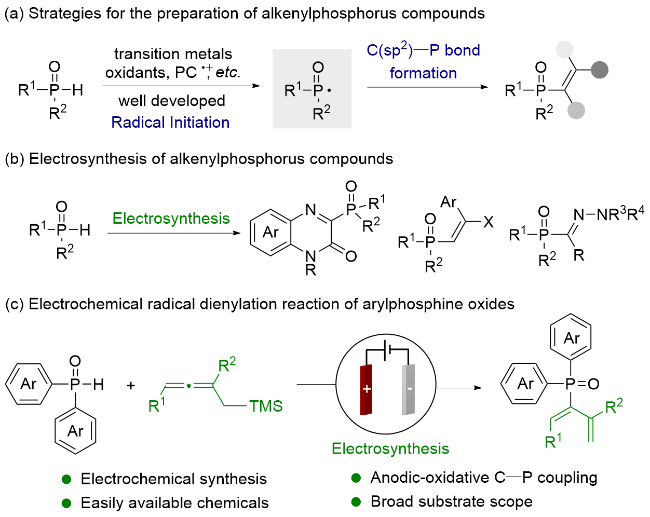
Aromatic organophosphorus compounds are prevalent in various fields, such as natural products, pharmaceuticals, materials science, and synthetic intermediates.[1] Given their significant role, the synthesis of phosphorus-con- taining compounds, particularly those involving the formation of C(sp2)—P bonds, has been a key focus in ongoing chemical research.[2] Recently, the introduction of phosphorus-centered radicals to unsaturated systems has emerged as a dependable method for synthesizing alkenyl- phosphorus compounds.[3] The use of transition metals and stoichiometric oxidants,[4] as well as the incorporation of photoredox catalysis methods,[5] has demonstrated the ability to initiate the formation of phosphorus radicals from arylphosphine oxides (Scheme 1a). Nevertheless, the effectiveness of these techniques has been constrained by the utilization of metal salts, stoichiometric chemical redox agents, and occasionally stringent reaction conditions. To address these concerns, there is an ongoing and strong demand for the development of straightforward and environmentally friendly techniques for synthesizing organophosphorus compounds with C(sp2)—P bonds.
Scheme 1 Strategies for the synthesis of alkenylphosphorus compounds
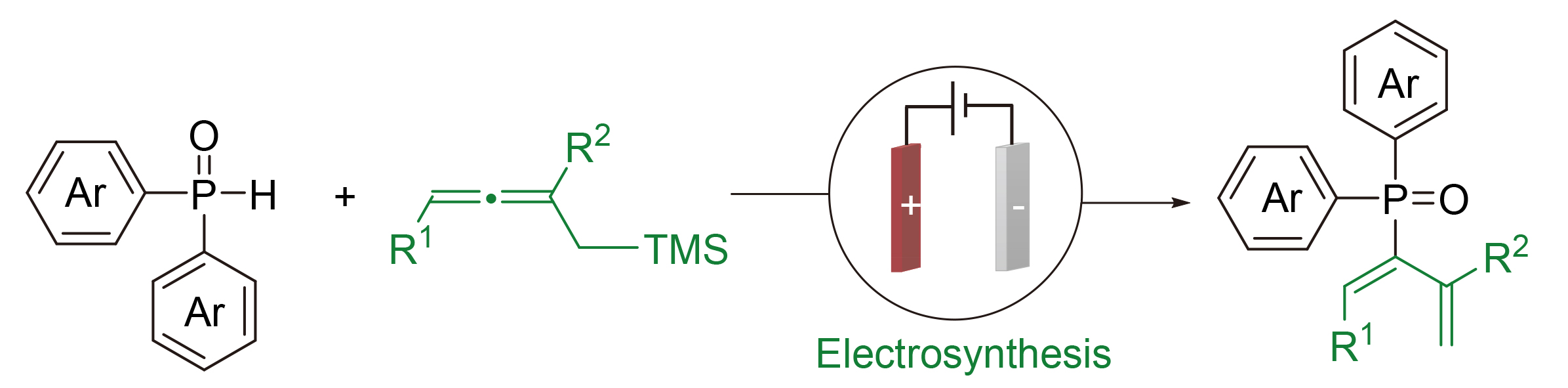
Electrochemistry has been widely recognized as an efficient and eco-friendly synthetic strategy that avoids the use of stoichiometric amounts of chemical oxidants or reductants, making it highly attractive for discovering novel chemical transformations.[6] This approach provides a unique platform for generating reactive radical intermediates, which are critical in various synthetic processes. In this scenario, electrochemical phosphorylation has emer- ged as an adjunctive strategy, which involves the directly or indirectly transferring electrons between arylphosphine oxides and electrodes to enable the C(sp2)—P bond formation.[7] Electrocatalytic phosphorus radical-initiated phosphorylation of quinoxaline-2(1H)-ones,[8] alkynes,[9] and aldehyde hydrazones,[10] has been developed for the synthesis of alkenylphosphorus compounds through radical coupling under mild reaction conditions (Scheme 1b). While electrocatalytic phosphorylation of alkenes and alkynes provides efficient access to alkenyl phosphorus compounds,[7-10] the electrochemical radical dienylation for constructing C(sp2)—P bonds remains a formidable challenge. Unlike well-defined alkenes or alkynes, allenes present multiple competing pathways for phosphoryl radical attack,[11] making regiocontrol particularly difficult. More- over, the reactive vinyl radical intermediate tends to undergo side reactions or overoxidation, leading to allylic phosphorylation byproducts instead of the desired dienylation. An electrochemical dienylation strategy of arylphos- phine oxides with allenylsilanes that overcomes these cha- llenges is reported. Our system achieves excellent regioselectivity toward 1,3-dienylphosphine oxides by leveraging the unique reactivity of allenylsilanes, where the silyl group simultaneously guides regiocontrol and facilitates a sequential oxidation/desilylation process, ensuring a clean and efficient pathway to the coveted diene system under mild electrochemical conditions (Scheme 1c).

2 Results and discussion

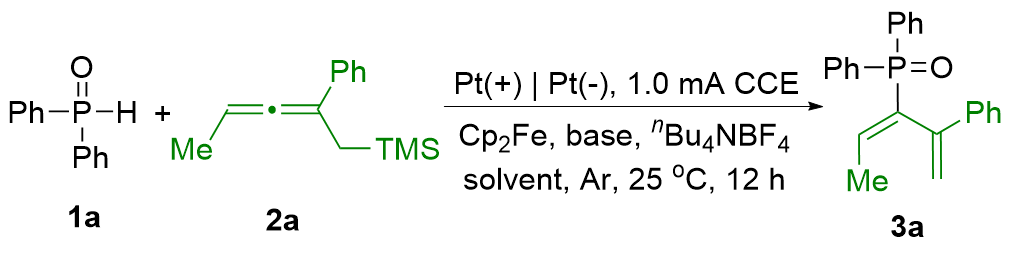
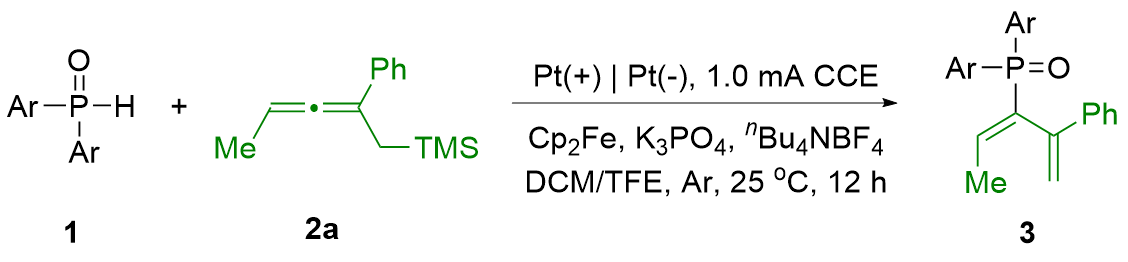
Initially, diphenylphosphine oxide (1a) and trimethyl- (2-phenylpenta-2,3-dien-1-yl)silane (2a) were chosen as the model substrates for the evaluation of electrolysis conditions in the radical dienylation reaction (Table 1). The electrolysis employed an undivided cell equipped with a Pt anode and a Pt cathode and was conducted in DCM/ MeCN (VV=1∶2) with NEt3 as a basic additive and nBu4NBF4 as the electrolyte, and the desired product 3a was obtained in 36% yield (Entry 1). A survey of mixed solvents was evaluated, and provided no improvements in the results (Entries 2~4). The influence of base on the reaction was further examined (Entries 5~9), and K3PO4 was the most efficient one in terms of current efficiency (Entry 8). In particular, when 2,2,2-trifluoroethanol (TFE) was introduced as a solvent and the proportion of mixed solvents was fine-tuned (Entries 10 and 11), the yield was further improved to 75% (Entry 11). Control experiments revealed that only a trace amount of the desired product was detected in the absence of base (Entry 12). Additionally, the target product was undetectable either in the absence of electricity (Entry 13) or in the absence of Cp2Fe (Entry 14). When this reaction was performed in air, the efficiency was significantly affected (Entry 15).
Table 1 Optimization of the reaction conditionsa
Entry Base Solvent Yield b/%
1 NEt3 V(DCM)∶V(MeCN)=1∶2 36
2 NEt3 V(DCE)∶V(MeCN)=1∶2 26
3 NEt3 V(DCM)∶V(DCE)=1∶2 24
4 NEt3 V(DCM)∶V(THF)=1∶2 21
5 iPr2NEt V(DCM)∶V(MeCN)=1∶2 22
6 KOtBu V(DCM)∶V(MeCN)=1∶2 Trace
7 DMAP V(DCM)∶V(MeCN)=1∶2 27
8 K3PO4 V(DCM)∶V(MeCN)=1∶2 43
9 NaOAc V(DCM)∶V(MeCN)=1∶2 39
10 K3PO4 V(DCM)∶V(TFE)=1∶2 47
11 K3PO4 V(DCM)∶V(TFE)=1∶2 75
12 V(DCM)∶V(TFE)=1∶2 <5
13c K3PO4 V(DCM)∶V(TFE)=1∶2 N.d.
14d K3PO4 V(DCM)∶V(TFE)=1∶2 N.d.
15e K3PO4 V(DCM)∶V(TFE)=1∶2 44

a Reaction conditions: Pt anode, Pt cathode, 1a (0.1 mmol), 2a (0.2 mmol), Cp2Fe (10 mol%), nBu4NBF4 (0.15 mmol), base (0.2 mmol), and solvent (3.0 mL) at a constant current of 1.0 mA at 25 ℃ under Ar for 12 h. b Isolated yield. c Without electricity. d Without Cp2Fe. e Under air. DCM: dichloromethane, DCE: dichloroethane, THF: tetrahydrofuran, TFE: 2,2,2-trifluoro- ethanol, N.d.: not detected.

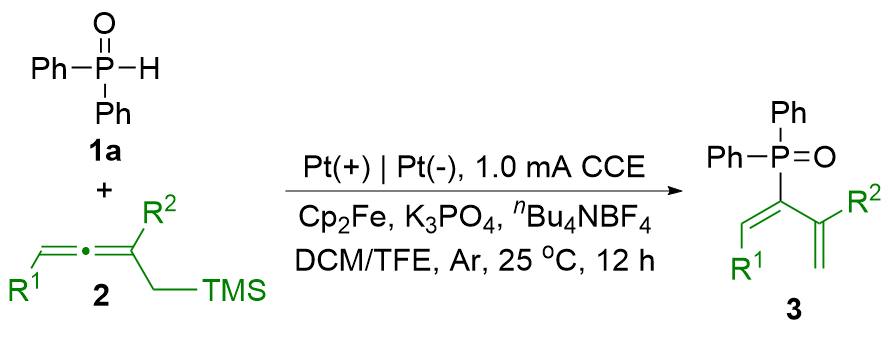
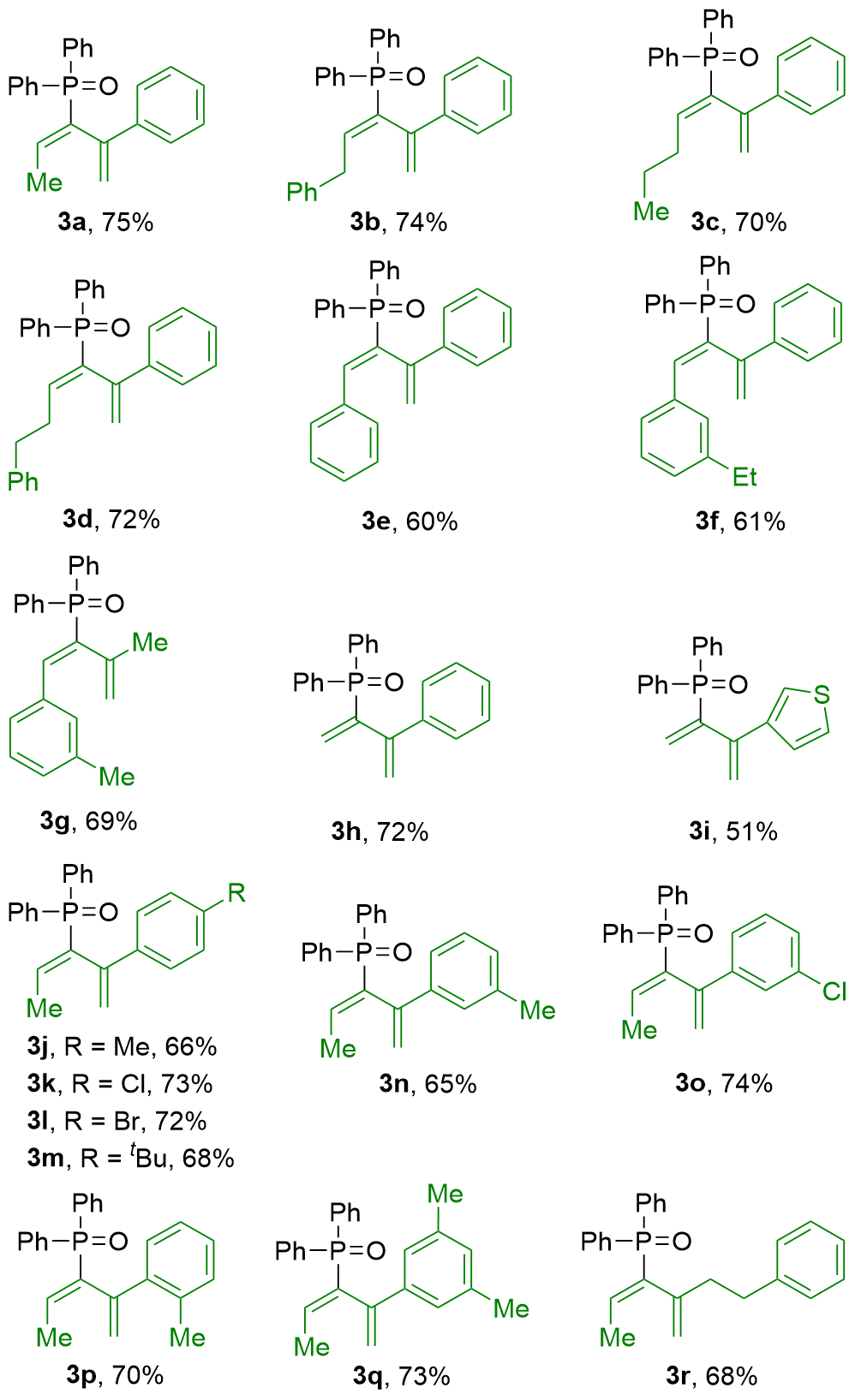
Under the optimized reaction conditions, the substrate scope of allenylsilanes was first examined. As shown in Table 2, allenylsilanes bearing different alkyl groups (R1=methyl, benzyl, propyl, and phenethyl) underwent radical dienylation reactions smoothly to produce the corresponding products in high yields (3a~3d). The alteration of R1 from an alkyl to a phenyl group was also tolerated, furnishing the expected adduct 3e in high efficiency. Allenylsilanes with a meta-substituted phenyl group participated well in the reaction, yielding the desired products 3f and 3g. Remarkably, trimethyl(2-phenylbuta-2,3-dien-1-yl)si- lane proved to be an excellent reaction counterpart, efficiently yielding compound 3h with a terminal diene structure in a 72% yield. The allenylsilane bearing a thiophene group was transformed smoothly to the corresponding diphenylphosphine oxide 3i. Moreover, a wide range of methyl substituted allenylsilanes 2 (R1=Me) with different aryl groups (R2), could be well tolerated, and good chemical yields were observed in all cases (3j~3q). The allenylsilane substrate bearing dialkyl substituents was also well tolerated, affording the corresponding product 3r in good yield.
Table 2 Scope of allenylsilanesa

a Reaction conditions: Pt anode, Pt cathode, 1a (0.1 mmol), 2 (0.2 mmol), Cp2Fe (10 mol%), nBu4NBF4 (0.15 mmol), K3PO4 (0.2 mmol), and DCM/TFE (2.0 mL/1.0 mL) at a constant current of 1.0 mA at 25 ℃ under Ar for 12 h.

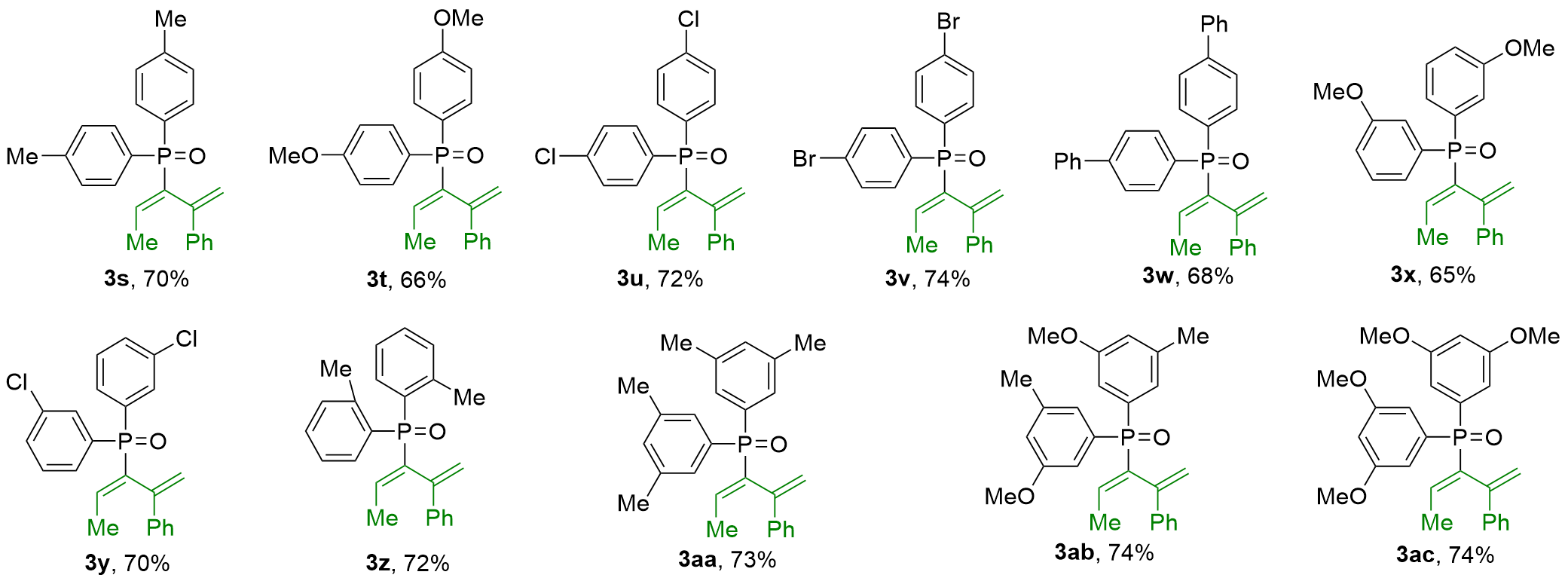
Next, the compatibility of various substituted phosphorus coupling partners with trimethyl-(2-phenylpenta-2,3- dien-1-yl)silane (2a) was investigated in the electrochemical phosphorylation approach (Table 3). A diverse array of diphenylphosphine oxides with either electron-withdraw- ing or electron-donating substituents at the para-position of the benzene ring, such as methyl, methoxyl, chloro, bromo, and phenyl groups, were all tolerated in the electrochemical reaction, and the desired products were furnished in good yields (3s~3w). The alternation of ortho- and meta-substituents was also tolerated in the dienylation reaction of allenylsilanes, leading to alkenylphosphorus compounds 3x~3z with great efficiency. It is worth noting that disubstituted substrates also proceeded smoothly to give the corresponding products 3aa, 3ab, and 3ac in great yields.
Table 3 Scope of phosphine oxidesa

a Reaction conditions: Pt anode, Pt cathode, 1 (0.1 mmol), 2a (0.2 mmol), Cp2Fe (10 mol%), nBu4NBF4 (0.15 mmol), K3PO4 (0.2 mmol), and DCM/TFE (2.0 mL/1.0 mL) at a constant current of 1.0 mA at 25 ℃ under Ar for 12 h.

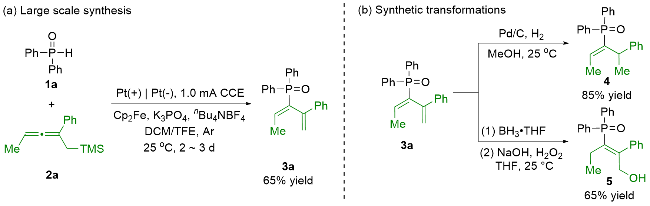
To verify the practical feasibility of this electrochemical process, the present dienylation reaction was conducted on a large scale. As shown in Scheme 2a, the reaction was carried out on a 3.0 mmol scale and afforded product 3a in 65% yield after constant electrolysis. The moderate yield on this scale is attributed to the inherent instability of the allenylsilane substrate over the extended reaction time and the formation of by-products through competing pathways. The phosphine-modified products containing contiguous double bonds, providing a gateway to structurally diverse molecules through subsequent synthetic transformations (Scheme 2b). Upon subjecting compound 3a to hydrogenation conditions with Pd/C, product 4 was obtained in 85% yield, characterized by a partially reduced double bond. The diene 3a underwent hydroboration-oxidation process and led to the formation of alcohol 5 in 65% yield.
Scheme 2 Synthetic investigation
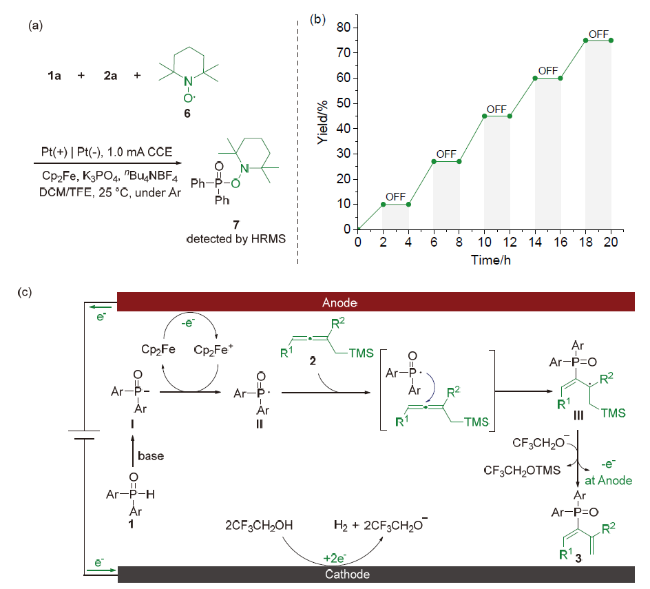
To get insight into the mechanism, some control experiments were carried out (Figure 1). To investigate whether radical intermediates were involved in the phosphorylation process, the control reaction using 2,2,6,6-tetramethyl-1- piperidinyloxy (TEMPO, 6) as the radical tracking agent was carried out under the standard conditions (Figure 1a). The formation of 3a was completely suppressed, and only the radical coupling product 7 was detected. Subsequently, the on-off switching experiment revealed that in the absence of an electrical current supply, no product was produced (Figure 1b). Based on these results, a mechanism was proposed for the phosphinoylation reaction (Figure 1c). Based on the above studies and previous reports,[11-12] a possible mechanism for the electrochemical dienylation reaction was proposed. Arylphosphine oxide 1 is deprotonated to afford anion I. The ferrocenium ion (Cp2Fe⁺), electrogenerated at the anode, serves as an effective redox shuttle that mediates the single-electron oxidation of I, thereby efficiently delivering the key phosphoryl radical II.[11b] The resulting phosphoryl radical II then adds to the allene moiety of allenylsilane 2, affording radical intermediate III, which subsequently undergoes a second single electron transfer (SET) oxidation and desilylation to furnish the final dienylation product 3.
Figure 1 Mechanistic investigations

(a) Radical trapping experiment; (b) Profile of a current switched on-off experiment; (c) Proposed mechanism.

3 Conclusions

In summary, an electrochemically driven dienylation reaction of arylphosphine oxides with allenylsilanes has been developed. A wide range of dienyl organophosphorus compounds with broad functional group tolerance were facilely obtained in moderate to great yield. Importantly, this protocol could be easily conducted on a large-scale reaction. Mechanistic studies suggest that the desired C(sp2)—P bond is constructed through the radical addition process between the phosphoryl radical and the allene carbon. Further investigations of the electrochemical radical process are ongoing in our laboratory.

4 Experimental section

4.1 Instruments and reagents

1H NMR, 13C NMR and 31P NMR spectra were recorded on Bruker Advance 400, 500, or 600 MHz spectrometers using CDCl3 as solvent and TMS as an internal standard. High-resolution mass spectra (HRMS) were obtained with a Water XEVO G2 Q-Tof (Waters Corporation). Unless otherwise stated, all reagents and solvents were purchased from commercial suppliers and used without further purification. Commercially available reagents were purchased from Energy Chemical, Bide Pharmatech, Adamas-beta, and Sigma-Aldrich Co., Inc. Substrates 1 are commercially available materials. Substrates 2 were synthesized and characterized according to literature procedures.[11a]

4.2 General procedure for the synthesis of products 3

A 30.0 mL flask was charged with 1 (0.1 mmol), 2 (0.2 mmol), Cp2Fe (10 mol%), nBu4NBF4 (0.15 mmol), K3PO4 (0.2 mmol), and DCM/TFE (2.0 mL/1.0 mL) at room temperature under argon atmosphere. The flask was equipped with Pt (10 mm×10 mm×0.2 mm) and Pt (10 mm×10 mm×0.2 mm) electrodes. The constant current (1.0 mA) electrolysis was carried out at 25 ℃ until complete consumption of the starting material, monitored by thin-layer chromatography (TLC). The solution was concentrated under reduced pressure. The residue was purified by silica gel chromatography to afford the desired product 3.
(E)-Diphenyl(2-phenylpenta-1,3-dien-3-yl)phosphine oxide (3a): Colorless oil (25.8 mg, 75% yield). 1H NMR (400 MHz, CDCl3) δ: 7.77~7.63 (m, 4H), 7.44~7.37 (m, 2H), 7.36~7.28 (m, 4H), 7.20~7.06 (m, 5H), 6.97~6.83 (m, 1H), 5.64 (d, J=2.8 Hz, 1H), 4.99 (d, J=3.2 Hz, 1H), 1.79 (dd, J=6.8, 3.2 Hz, 3H); 13C NMR (100 MHz, CDCl3) δ: 144.7 (d, J=8.3 Hz), 142.8 (d, J=9.1 Hz), 138.9, 136.6 (d, J=96.9 Hz), 132.2 (d, J=9.4 Hz), 131.7 (d, J=2.4 Hz), 131.6 (d, J=103.1 Hz), 128.2 (d, J=2.2 Hz), 128.1, 127.7, 126.2, 117.4 (d, J=6.3 Hz), 16.4 (d, J=14.7 Hz); 31P NMR (162 MHz, CDCl3) δ: 27.02; HRMS (ESI) calcd for C23H21NaOP [M+Na] 367.1222, found 367.1230.
(E)-(2,5-Diphenylpenta-1,3-dien-3-yl)diphenylphosphine oxide (3b): Colorless oil (31.1 mg, 74% yield). 1H NMR (400 MHz, CDCl3) δ: 7.89~7.74 (m, 4H), 7.62~7.50 (m, 2H), 7.51~7.43 (m, 4H), 7.42~7.36 (m, 2H), 7.35~7.30 (m, 3H), 7.28~7.25 (m, 3H), 7.24~7.20 (m, 2H), 7.15~7.07 (m, 1H), 5.85 (d, J=2.5 Hz, 1H), 5.17 (d, J=2.2 Hz, 1H), 3.64 (dd, J=7.4, 2.8 Hz, 2H); 13C NMR (100 MHz, CDCl3) δ: 147.4 (d, J=8.0 Hz), 142.8 (d, J=9.0 Hz), 138.9, 138.6, 136.1 (d, J=94.6 Hz), 132.3 (d, J=9.5 Hz), 131.8 (d, J=2.5 Hz), 131.3 (d, J=103.3 Hz), 128.7, 128.6, 128.3, 128.1, 127.9, 126.5, 126.3, 117.6 (d, J=6.3 Hz), 36.8 (d, J=13.9 Hz); 31P NMR (162 MHz, CDCl3) δ: 26.70; HRMS (ESI) calcd for C29H25NaOP [M+Na] 443.1535, found 443.1537.
(E)-Diphenyl(2-phenylhepta-1,3-dien-3-yl)phosphine oxide (3c): Colorless oil (26.1 mg, 70% yield). 1H NMR (400 MHz, CDCl3) δ: 7.72~7.64 (m, 4H), 7.46~7.39 (m, 2H), 7.36~7.29 (m, 4H), 7.19~7.13 (m, 2H), 7.12~7.06 (m, 3H), 6.89~6.80 (m, 1H), 5.62 (d, J=2.5 Hz, 1H), 4.96 (d, J=2.1 Hz, 1H), 2.18~2.12 (m, 2H), 1.49~1.40 (m, 2H), 0.86 (t, J=7.4 Hz, 3H); 13C NMR (100 MHz, Acetone-d6) δ: 149.3 (d, J=8.1 Hz), 144.2 (d, J=8.4 Hz), 140.2 (d, J=2.5 Hz), 137.6 (d, J=95.3 Hz), 133.7 (d, J=101.5 Hz), 132.9 (d, J=9.2 Hz), 132.3 (d, J=2.4 Hz), 129.1, 128.9 (d, J=9.8 Hz), 128.4, 127.2, 117.1 (d, J=5.8 Hz), 33.1 (d, J=13.5 Hz), 22.6, 14.1; 31P NMR (162 MHz, CDCl3) δ: 27.00; HRMS (ESI) calcd for C25H25NaOP [M+Na] 395.1535, found 395.1540.
(E)-(2,6-Diphenylhexa-1,3-dien-3-yl)diphenylphosphine oxide (3d): Colorless wax (31.3 mg, 72% yield). 1H NMR (400 MHz, CDCl3) δ: 7.63~7.54 (m, 4H), 7.43~7.38 (m, 2H), 7.32~7.27 (m, 4H), 7.26~7.20 (m, 3H), 7.07~7.04 (m, 7H), 6.85~6.76 (m, 1H), 5.53 (d, J=2.8 Hz, 1H), 4.68 (d, J=3.2 Hz, 1H), 2.72 (t, J=7.3 Hz, 2H), 2.52~2.46 (m, 2H); 13C NMR (100 MHz, CDCl3) δ: 148.5 (d, J=7.6 Hz), 142.6 (d, J=9.2 Hz), 140.9, 138.9 (d, J=2.4 Hz), 136.2 (d, J=95.1 Hz), 132.2 (d, J=9.6 Hz), 131.6 (d, J=2.5 Hz), 131.3 (d, J=103.1Hz), 128.7, 128.4, 128.2 (d, J=3.1 Hz), 128.1, 127.6, 126.2, 126.1, 117.2 (d, J=6.3 Hz), 34.7, 32.3 (d, J=13.8 Hz); 31P NMR (162 MHz, CDCl3) δ: 27.26; HRMS (ESI) calcd for C30H28OP [M+ H] 435.1872, found 435.1879.
(E)-(1,3-Diphenylbuta-1,3-dien-2-yl)diphenylphosphine oxide (3e): Colorless oil (24.4 mg, 60% yield). 1H NMR (500 MHz, CDCl3) δ: 7.77~7.72 (m, 5H), 7.58~7.56 (m, 2H), 7.45~7.42 (m, 2H), 7.36~7.32 (m, 4H), 7.22~7.19 (m, 5H), 7.08~7.03 (m, 3H), 5.73 (d, J=3.2 Hz, 1H), 5.13 (d, J=3.5 Hz, 1H); 13C NMR (125 MHz, CDCl3) δ: 144.1 (d, J=8.7 Hz), 143.5 (d, J=7.6 Hz), 137.6, 134.9 (d, J=17.9 Hz), 134.8 (d, J=93.1 Hz), 132.5 (d, J=9.6 Hz), 131.8 (d, J=2.3 Hz), 131.1 (d, J=103.6 Hz), 130.2, 129.4, 128.4, 128.2 (d, J=5.7 Hz), 128.1, 127.9, 126.4, 117.3 (d, J=7.0 Hz); 31P NMR (202 MHz, CDCl3) δ: 28.68; HRMS (ESI) calcd for C28H24OP [M+H] 407.1559, found 407.1554.
(E)-(1-(3-Ethylphenyl)-3-phenylbuta-1,3-dien-2-yl)diphenylphosphine oxide (3f): Colorless oil (26.5 mg, 61% yield). 1H NMR (500 MHz, Acetone-d6) δ: 7.95~7.91(m, 4H), 7.64~7.56 (m, 2H), 7.56~7.46 (m, 6H), 7.35~7.26 (m, 2H), 7.12~7.06 (m, 5H), 6.95~6.92 (m, 1H), 5.63 (d, J=2.9 Hz, 1H), 5.20 (d, J=3.1 Hz, 1H), 2.47 (q, J=7.6 Hz, 2H), 1.00 (t, J=7.6 Hz, 3H); 13C NMR (125 MHz, Acetone-d6) δ: 144.6 (d, J=7.1 Hz), 143.9, 143.2 (d, J=11.0 Hz), 140.1, 138.3 (d, J=93.7 Hz), 134.5 (d, J=17.2 Hz), 133.6 (d, J=101.7 Hz), 132.9 (d, J=9.1 Hz), 132.5 (d, J=2.7 Hz), 129.8, 129.6 (d, J=65.7 Hz), 129.3, 129.1, 128.6, 128.3, 127.5, 126.2, 118.1 (d, J=6.0 Hz), 27.1, 15.6; 31P NMR (202 MHz, CDCl3) δ: 29.43; HRMS (ESI) calcd for C30H27NaOP [M+Na] 457.1692, found 457.1702.
(E)-(3-Methyl-1-(m-tolyl)buta-1,3-dien-2-yl)diphenylphosphine oxide (3g): Colorless oil (24.7 mg, 69% yield). 1H NMR (400 MHz, CDCl3) δ: 7.85~7.79 (m, 4H), 7.56~7.53 (m, 2H), 7.52~7.40 (m, 5H), 7.34 (s, 1H), 7.28~7.15 (m, 1H), 7.12~7.10 (m, 2H), 5.13 (d, J=3.5 Hz, 1H), 4.85 (d, J=3.5 Hz, 1H), 2.32 (s, 3H), 1.65 (s, 3H); 13C NMR (100 MHz, Acetone-d6) δ: 141.7 (d, J=6.6 Hz), 141.4 (d, J=10.0 Hz), 138.8, 138.7 (d, J=92.4 Hz), 136.2 (d, J=18.3 Hz), 133.3 (d, J=101.9 Hz), 133.1 (d, J=9.2 Hz), 132.6 (d, J=2.6 Hz), 131.2, 130.7, 129.3 (d, J=11.7 Hz), 129.2, 127.3, 118.7 (d, J=6.5 Hz), 23.9 (d, J=2.7 Hz), 21.2; 31P NMR (162 MHz, CDCl3) δ: 27.13; HRMS (ESI) calcd for C24H24OP [M+H] 359.1559, found 359.1553.
Diphenyl(3-phenylbuta-1,3-dien-2-yl)phosphine oxide (3h): Colorless foam (23.8 mg, 72% yield). 1H NMR (400 MHz, CDCl3) δ: 7.78~7.71 (m, 4H), 7.55~7.39 (m, 6H), 7.25~7.20 (m, 5H), 6.03~5.81 (m, 2H), 5.67~5.36 (m, 2H); 13C NMR (100 MHz, CDCl3) δ: 145.8 (d, J=10.0 Hz), 144.1 (d, J=91.8 Hz), 140.5 (d, J=5.7 Hz), 134.1 (d, J=9.4 Hz), 132.1, 132.0, 131.9, 131.8 (d, J=103.6 Hz), 128.5 (d, J=12.0 Hz), 128.2 (d, J=16.6 Hz), 127.8, 119.7 (d, J=4.8 Hz); 31P NMR (162 MHz, CDCl3) δ: 29.44; HRMS (ESI) calcd for C22H19NaOP [M+Na] 353.1066, found 353.1074.
Diphenyl(3-(thiophen-3-yl)buta-1,3-dien-2-yl)phosphine oxide (3i): Colorless wax (17.1 mg, 51% yield). 1H NMR (400 MHz, CDCl3) δ: 7.79~7.72 (m, 4H), 7.52~7.47 (m, 2H), 7.46~7.37 (m, 4H), 7.19~7.17 (m, 1H), 7.10~7.09 (m, 1H), 7.01~6.98 (m, 1H), 6.18~5.93 (m, 2H), 5.44~5.42 (m, 2H); 13C NMR (100 MHz, CDCl3) δ: 144.3 (d, J=91.7 Hz), 142.4, 141.4 (d, J=4.8 Hz), 140.5 (d, J=10.0 Hz), 133.7 (d, J=8.6 Hz), 131.9 (d, J=9.4 Hz), 131.8 (d, J=2.8 Hz), 131.6 (d, J=104.4 Hz), 128.5 (d, J=12.0 Hz), 126.6, 125.6, 117.7 (d, J=4.9 Hz); 31P NMR (162 MHz, CDCl3) δ: 28.96; HRMS (ESI) calcd for C20H17Na- OPS [M+Na] 359.0630, found 359.0636.
(E)-Diphenyl(2-(p-tolyl)penta-1,3-dien-3-yl)phosphine
oxide (3j): Colorless oil (23.7 mg, 66% yield). 1H NMR (500 MHz, CDCl3) δ: 7.72~7.61 (m, 4H), 7.45~7.41 (m, 2H), 7.35~7.32 (m, 4H), 7.06 (d, J=8.0 Hz, 2H), 6.92 (d, J=8.2 Hz, 2H), 6.90~6.79 (m, 1H), 5.60 (d, J=3.3 Hz, 1H), 4.92 (d, J=3.1 Hz, 1H), 2.25 (s, 3H), 1.78 (dd, J=6.8, 3.0 Hz, 3H); 13C NMR (125 MHz, CDCl3) δ: 144.5 (d, J=8.5 Hz), 142.5 (d, J=9.3 Hz), 137.4, 136.5 (d, J=96.7 Hz), 135.9 (d, J=2.8 Hz), 132.2 (d, J=9.5 Hz), 131.5 (d, J=103.3 Hz), 131.5 (d, J=2.8 Hz), 128.4 (d, J=80.7 Hz), 128.1, 126.1, 116.4 (d, J=6.3 Hz), 21.1, 16.3 (d, J=14.7 Hz); 31P NMR (202 MHz, CDCl3) δ: 27.03; HRMS (ESI) calcd for C24H23NaOP [M+Na] 381.1379, found 381.1389.
(E)-(2-(4-Chlorophenyl)penta-1,3-dien-3-yl)diphenylphosphine oxide (3k): Colorless oil (27.7 mg, 73% yield). 1H NMR (500 MHz, CDCl3) δ: 7.72~7.66 (m, 4H), 7.47~7.44 (m, 2H), 7.38~7.34 (m, 4H), 7.09~7.08 (m, 4H), 6.90~6.82 (m, 1H), 5.63 (d, J=2.5 Hz, 1H), 5.00 (d, J=3.0 Hz, 1H), 1.78 (dd, J=6.8, 2.9 Hz, 3H); 13C NMR (125 MHz, CDCl3) δ: 144.8 (d, J=8.6 Hz), 141.9 (d, J=9.1 Hz), 137.5, 136.6 (d, J=96.7 Hz), 133.6, 132.2 (d, J=9.4 Hz), 131.8 (d, J=2.5 Hz), 131.5 (d, J=103.1 Hz), 128.3 (d, J=3.4 Hz), 128.2, 127.6, 117.8 (d, J=6.3 Hz), 16.4 (d, J=14.6 Hz); 31P NMR (202 MHz, CDCl3) δ: 26.98; HRMS (ESI) calcd for C23H20ClNaOP [M+Na] 401.0833, found 401.0841.
(E)-(2-(4-Bromophenyl)penta-1,3-dien-3-yl)diphenylphosphine oxide (3l): Colorless oil (30.5 mg, 72% yield). 1H NMR (500 MHz, CDCl3) δ: 7.71~7.66 (m, 4H), 7.48~7.41 (m, 2H), 7.37~7.33 (m, 4H), 7.24~7.22 (m, 2H), 7.04~7.02 (m, 2H), 6.89~6.81 (m, 1H), 5.63 (d, J=2.5 Hz, 1H), 5.00 (d, J=3.0 Hz, 1H), 1.78 (dd, J=6.8, 2.9 Hz, 3H); 13C NMR (125 MHz, CDCl3) δ: 144.9 (d, J=8.6 Hz), 141.9 (d, J=9.2 Hz), 137.9 (d, J=2.4 Hz), 136.5 (d, J=96.6 Hz), 132.2 (d, J=9.3 Hz), 131.8 (d, J=2.6 Hz), 131.4 (d, J=103.1 Hz), 131.3, 128.3 (d, J=12.0 Hz), 127.9, 121.8, 117.9 (d, J=6.2 Hz), 16.4 (d, J=14.5 Hz); 31P NMR (202 MHz, CDCl3) δ: 27.06; HRMS (ESI) calcd for C23H21BrOP [M+H] 423.0508, found 423.0522.
(E)-(2-(4-(tert-Butyl)phenyl)penta-1,3-dien-3-yl)diphenylphosphine oxide (3m): Colorless oil (27.2 mg, 68% yield). 1H NMR (500 MHz, CDCl3) δ: 7.69~7.58 (m, 4H), 7.45~7.35 (m, 2H), 7.37~7.24 (m, 4H), 7.15~7.03 (m, 4H), 6.98~6.88 (m, 1H), 5.62 (d, J=2.3 Hz, 1H), 4.96 (d, J=2.0 Hz, 1H), 1.84 (dd, J=6.8, 2.9 Hz, 3H), 1.25 (s, 9H); 13C NMR (125 MHz, CDCl3) δ: 150.7, 144.4 (d, J=8.2 Hz), 142.7 (d, J=9.3 Hz), 136.9 (d, J=96.6 Hz), 135.9 (d, J=2.4 Hz), 132.2 (d, J=9.7 Hz), 131.7 (d, J=103.2 Hz), 131.5 (d, J=2.6 Hz), 128.1 (d, J=12.0 Hz), 126.1, 125.1, 116.7 (d, J=6.4 Hz), 34.5, 31.3, 16.4 (d, J=14.6 Hz); 31P NMR (202 MHz, CDCl3) δ: 26.73; HRMS (ESI) calcd for C27H29NaOP [M+Na] 423.1848, found 423.1852.
(E)-Diphenyl(2-(m-tolyl)penta-1,3-dien-3-yl)phosphine oxide (3n): Colorless oil (23.3 mg, 65% yield). 1H NMR (500 MHz, Acetone-d6) δ: 7.78~7.72 (m, 4H), 7.52~7.49 (m, 2H), 7.45~7.41 (m, 4H), 7.30~7.16 (m, 3H), 7.12~7.05 (m, 1H), 6.75~6.68 (m,1H), 5.67 (d, J=2.4 Hz, 1H), 5.00 (d, J=2.0 Hz, 1H), 2.20 (s, 3H), 1.75 (dd, J=6.8, 2.9 Hz, 3H); 13C NMR (125 MHz, Acetone-d6) δ: 144.2 (d, J=10.7 Hz), 144.1, 139.9 (d, J=2.6 Hz), 138.6 (d, J=96.6 Hz), 138.2, 133.6 (d, J=101.9 Hz), 132.8 (d, J=9.2 Hz), 132.2 (d, J=2.5 Hz), 131.9 (d, J=9.2 Hz), 129.1, 128.9 (d, J=37.9 Hz), 127.8, 124.3, 117.2 (d, J=6.2 Hz), 21.3, 16.3 (d, J=14.8 Hz); 31P NMR (202 MHz, Acetone-d6) δ: 24.16; HRMS (ESI) calcd for C24H23NaOP [M+Na] 381.1379, found 381.1389.
(E)-(2-(3-Chlorophenyl)penta-1,3-dien-3-yl)diphenylphosphine oxide (3o): Colorless oil (28.0 mg, 74% yield). 1H NMR (400 MHz, CDCl3) δ: 7.72~7.67 (m, 4H), 7.46~7.43 (m, 2H), 7.38~7.34 (m, 4H), 7.12~7.03 (m, 4H), 6.95~6.87 (m, 1H), 5.65 (d, J=2.6 Hz, 1H), 5.06 (d, J=3.0 Hz, 1H), 1.81 (dd, J=6.8, 2.8 Hz, 3H); 13C NMR (100 MHz, CDCl3) δ: 144.9 (d, J=8.2 Hz), 141.8 (d, J=9.2 Hz), 140.8 (d, J=2.3 Hz), 136.4 (d, J=96.6 Hz), 134.1, 132.2 (d, J=9.5 Hz), 131.8 (d, J=2.5 Hz), 131.4 (d, J=103.2 Hz), 129.4, 128.2 (d, J=12.1 Hz), 127.7, 126.4, 124.4, 118.6 (d, J=6.3 Hz), 16.4 (d, J=14.4 Hz); 31P NMR (162 MHz, CDCl3) δ: 26.69; HRMS (ESI) calcd for C23H20ClNaOP [M+Na] 401.0833, found 401.0833.
(E)-Diphenyl(2-(o-tolyl)penta-1,3-dien-3-yl)phosphine oxide (3p): Colorless oil (25.1 mg, 70% yield). 1H NMR (500 MHz, CDCl3) δ: 7.65~7.61 (m, 4H), 7.47~7.40 (m, 2H), 7.35~7.31 (m, 4H), 7.06~6.89 (m, 4H), 6.64~6.56 (m, 1H), 5.38 (d, J=2.7 Hz, 1H), 5.34 (d, J=2.9 Hz, 1H), 2.10 (s, 3H), 1.88 (dd, J=6.9, 3.0 Hz, 3H); 13C NMR (125 MHz, CDCl3) δ: 143.9 (d, J=10.0 Hz), 142.6 (d, J=9.5 Hz), 139.9 (d, J=2.5 Hz), 138.6 (d, J=97.1 Hz), 135.8, 132.2 (d, J=102.4 Hz), 132.1 (d, J=9.7 Hz), 131.5 (d, J=2.6 Hz), 130.6, 129.2, 128.2 (d, J=12.0 Hz), 127.4, 125.5, 122.3 (d, J=6.8 Hz), 20.7, 16.5 (d, J=14.7 Hz); 31P NMR (202 MHz, CDCl3) δ: 27.62; HRMS (ESI) calcd for C24H23NaOP [M+Na] 381.1379, found 381.1388.
(E)-(2-(3,5-Dimethylphenyl)penta-1,3-dien-3-yl)diphenylphosphine oxide (3q): Colorless oil (27.2 mg, 73% yield). 1H NMR (400 MHz, CDCl3) δ: 7.71~7.66 (m, 4H), 7.43~7.39 (m, 2H), 7.36~7.30 (m, 4H), 7.01~6.94 (m, 1H), 6.78~6.62 (m, 3H), 5.61 (d, J=2.4 Hz, 1H), 4.96 (d, J=2.0 Hz, 1H), 2.14 (s, 6H), 1.82 (dd, J=6.8, 2.9 Hz, 3H); 13C NMR (100 MHz, CDCl3) δ: 144.5 (d, J=8.0 Hz), 143.1 (d, J=9.3 Hz), 138.9 (d, J=2.6 Hz), 137.5, 136.9 (d, J=96.2 Hz), 132.3 (d, J=9.5 Hz), 131.9 (d, J=103.3 Hz), 131.6 (d, J=2.9 Hz), 129.4, 128.1 (d, J=12.1 Hz), 124.3, 117.1 (d, J=6.4 Hz), 21.3, 16.4 (d, J=14.6 Hz); 31P NMR (162 MHz, CDCl3) δ: 26.51; HRMS (ESI) calcd for C25H25NaOP [M+Na] 395.1535, found 395.1542.
(E)-(4-Methylene-6-phenylhex-2-en-3-yl)diphenylphosphine oxide (3r): Colorless oil (25.3 mg, 68% yield). 1H NMR (400 MHz, CDCl3) δ: 7.66~7.60 (m, 4H), 7.54~7.47 (m, 2H), 7.44~7.36 (m, 4H), 7.32~7.26 (m, 2H), 7.25~7.18 (m, 1H), 7.16~7.09 (m, 2H) 6.24~6.15(m, 1H), 4.99 (d, J=2.1 Hz, 1H), 4.45 (d, J=2.2 Hz, 1H), 2.74 (t, J=7.3 Hz, 2H), 2.60~2.54 (m, 2H), 1.58~1.57 (m, 3H); 13C NMR (100 MHz, Acetone-d6) δ: 145.3 (d, J=9.1 Hz), 142.1, 141.3 (d, J=7.5 Hz), 140.1 (d, J=94.5 Hz), 133.7 (d, J=101.0 Hz), 132.8 (d, J=9.2 Hz), 132.3 (d, J=2.6 Hz), 129.5, 129.2 (d, J=10.0 Hz), 129.1, 126.9, 117.3 (d, J=6.6 Hz), 35.6, 32.2 (d, J=14.1 Hz), 24.9; 31P NMR (162 MHz, CDCl3) δ: 28.28; HRMS (ESI) calcd for C25H26OP [M+H] 373.1716, found 373.1724.
(E)-(2-Phenylpenta-1,3-dien-3-yl)di-p-tolylphosphine oxide (3s): Colorless oil (26.1 mg, 70% yield). 1H NMR (500 MHz, Acetone-d6) δ: 7.63~7.59 (m,4H), 7.35~7.30 (m, 2H), 7.24~7.22 (m, 4H), 7.20~7.15 (m, 3H), 6.64~6.56 (m, 1H), 5.64 (d, J=2.6 Hz, 1H), 4.97 (d, J=3.0 Hz, 1H), 2.33 (s, 6H), 1.69 (dd, J=6.8, 2.9 Hz, 3H); 13C NMR (125 MHz, Acetone-d6) δ: 144.4 (d, J=8.3 Hz), 143.7 (d, J=9.2 Hz), 142.6 (d, J=2.7 Hz), 140.4, 139.2 (d, J=96.1 Hz), 133.1 (d, J=9.7 Hz), 130.8 (d, J=104.2 Hz), 129.7 (d, J=12.0 Hz), 129.1, 128.5, 127.3, 117.2 (d, J=6.0 Hz), 21.6, 16.5 (d, J=14.7 Hz); 31P NMR (202 MHz, Acetone-d6) δ: 24.50; HRMS (ESI) calcd for C25H25NaOP [M+Na] 395.1535, found 395.1539.
(E)-Bis(4-methoxyphenyl)(2-phenylpenta-1,3-dien-3-yl)phosphine oxide (3t): Colorless oil (26.7 mg, 66% yield). 1H NMR (400 MHz, Acetone-d6) δ: 7.68~7.62 (m, 4H), 7.34~7.30 (m, 2H), 7.19~7.17 (m, 3H), 6.97~6.95 (m, 4H), 6.68~6.58 (m, 1H), 5.66 (d, J=2.6 Hz, 1H), 4.97 (d, J=2.1 Hz, 1H), 3.82 (s, 6H), 1.71 (dd, J=6.8, 2.9 Hz, 3H); 13C NMR (100 MHz, Acetone-d6) δ: 163.2 (d, J=2.8 Hz), 144.4 (d, J=8.6 Hz), 143.4 (d, J=9.2 Hz), 140.3 (d, J=2.3 Hz), 139.5 (d, J=97.3 Hz), 134.7 (d, J=10.6 Hz), 128.9, 128.4, 127.2, 125.1 (d, J=108.5 Hz), 117.1 (d, J=5.9 Hz), 114.6 (d, J=12.8 Hz), 55.8, 16.4 (d, J=14.6 Hz); 31P NMR (162 MHz, Acetone-d6) δ: 24.28; HRMS (ESI) calcd for C25H26O3P [M+H] 405.1614, found 405.1622.
(E)-Bis(4-chlorophenyl)(2-phenylpenta-1,3-dien-3-yl)-phosphine oxide (3u): Colorless oil (29.8 mg, 72% yield). 1H NMR (500 MHz, Acetone-d6) δ: 7.78~7.70 (m, 4H), 7.52~7.43 (m, 4H), 7.33~7.27 (m, 2H), 7.22~7.16 (m, 3H), 6.83~6.75 (m, 1H), 5.74 (d, J=2.4 Hz, 1H), 5.08 (d, J=2.1 Hz, 1H), 1.81 (dd, J=6.8, 2.9 Hz, 3H); 13C NMR (125 MHz, Acetone-d6) δ: 145.4 (d, J=9.1 Hz), 143.8 (d, J=8.7 Hz), 139.7 (d, J=2.0 Hz), 138.4 (d, J=3.1 Hz), 137.9 (d, J=98.2 Hz), 134.6 (d, J=10.1 Hz), 132.2 (d, J=102.7 Hz), 129.3 (d, J=12.1 Hz), 129.1, 128.6, 127.2, 117.9 (d, J=6.5 Hz), 16.5 (d, J=14.8 Hz); 31P NMR (202 MHz, Acetone-d6) δ: 22.48; HRMS (ESI) calcd for C23H19- Cl2NaOP [M+Na] 435.0443, found 435.0456.
(E)-Bis(4-bromophenyl)(2-phenylpenta-1,3-dien-3-yl)-phosphine oxide (3v): Colorless oil (37.2 mg, 74% yield). 1H NMR (500 MHz, Acetone-d6) δ: 7.66~7.61 (m, 4H), 7.59~7.44 (m, 4H), 7.25~7.23 (m, 2H), 7.20~7.13 (m, 3H), 6.79~6.71 (m, 1H), 5.69 (d, J=2.4 Hz, 1H), 5.04 (d, J=2.2 Hz, 1H), 1.76 (dd, J=6.8, 3.0 Hz, 3H); 13C NMR (125 MHz, Acetone-d6) δ: 145.6 (d, J=8.9 Hz), 143.8 (d, J=8.6 Hz), 139.8 (d, J=2.0 Hz), 137.9 (d, J=98.0 Hz), 134.8 (d, J=9.9 Hz), 132.7 (d, J=102.3 Hz), 132.4 (d, J=12.0 Hz), 129.1, 128.7, 127.3, 127.2 (d, J=3.6 Hz), 118.1 (d, J=6.4 Hz), 16.6 (d, J=15.2 Hz); 31P NMR (202 MHz, Acetone-d6) δ: 22.98; HRMS (ESI) calcd for C23H20Br2OP [M+H] 500.9613, found 500.9623.
(E)-Di([1,1'-biphenyl]-4-yl)(2-phenylpenta-1,3-dien-3-yl)phosphine oxide (3w): Colorless wax (33.8 mg, 68% yield). 1H NMR (500 MHz, CDCl3) δ: 7.82~7.76 (m, 4H), 7.57~7.56 (m, 4H), 7.55~7.54 (m, 4H), 7.47~7.43 (m, 4H), 7.40~7.36 (m, 2H), 7.18~7.15 (m, 2H), 7.12~7.08 (m,3H), 7.04~6.98 (m, 1H), 5.69 (d, J=2.4 Hz, 1H), 5.10 (d, J=2.1 Hz, 1H), 1.87 (dd, J=6.8, 2.9 Hz, 3H); 13C NMR (125 MHz, Acetone-d6) δ: 144.9 (d, J=2.7 Hz), 144.5 (d, J=9.0 Hz), 144.3 (d, J=8.6 Hz), 140.9, 140.2, 138.9 (d, J=96.7 Hz), 133.7, 133.6, 132.5 (d, J=103.1 Hz), 129.9, 129.1, 128.5, 128.1, 127.6 (d, J=12.0 Hz), 127.3, 117.7 (d, J=6.1 Hz), 16.5 (d, J=14.7 Hz); 31P NMR (202 MHz, Acetone-d6) δ: 23.94; HRMS (ESI) calcd for C35H29NaOP [M+Na] 519.1848, found 519.1855.
(E)-Bis(3-methoxyphenyl)(2-phenylpenta-1,3-dien-3-yl)phosphine oxide (3x): Colorless foam (26.3 mg, 65% yield). 1H NMR (500 MHz, CDCl3) δ: 7.31~7.22 (m, 6H), 7.21~7.18 (m, 2H), 7.15~7.13 (m, 3H), 6.99~6.83 (m, 3H), 5.66 (d, J=2.4 Hz, 1H), 5.04 (d, J=2.1 Hz, 1H), 3.73 (s, 6H), 1.80 (dd, J=6.8, 2.9 Hz, 3H); 13C NMR (125 MHz, Acetone-d6) δ: 160.5 (d, J=14.6 Hz), 144.6 (d, J=9.3 Hz), 144.3 (d, J=8.2 Hz), 140.2, 138.6 (d, J=96.8 Hz), 135.3 (d, J=100.7 Hz), 130.4 (d, J=13.8 Hz), 129.1, 128.6, 127.3, 125.1 (d, J=9.1 Hz), 118.2 (d, J=2.8 Hz), 118.1 (d, J=10.2 Hz), 117.5 (d, J=5.8 Hz), 55.8, 16.6 (d, J=15.0Hz); 31P NMR (202 MHz, Acetone-d6) δ: 24.29; HRMS (ESI) calcd for C25H25NaO3P [M+Na] 427.1434, found 427.1427.
(E)-Bis(3-chlorophenyl)(2-phenylpenta-1,3-dien-3-yl)- phosphine oxide (3y): Colorless oil (28.9 mg, 70% yield). 1H NMR (500 MHz, Acetone-d6) δ: 7.75~7.68 (m, 4H), 7.56~7.53 (m, 2H), 7.49~7.45 (m, 2H), 7.32~7.30 (m, 2H), 7.26~7.15 (m, 3H), 6.87~6.79 (m, 1H), 5.77 (d, J=3.5 Hz, 1H), 5.12 (d, J=3.2 Hz, 1H), 1.84 (dd, J=6.8, 3.0 Hz, 3H); 13C NMR (125 MHz, Acetone-d6) δ: 146.1 (d, J=9.2 Hz), 143.6 (d, J=8.8 Hz), 139.5, 137.4 (d, J=98.5 Hz), 135.9 (d, J=99.5 Hz), 135.1 (d, J=15.4 Hz), 132.6 (d, J=2.5 Hz), 132.3 (d, J=10.0 Hz), 131.2 (d, J=8.8 Hz), 131.1 (d, J=12.8 Hz), 129.1, 128.7, 127.2, 118.2 (d, J=6.5 Hz), 16.5 (d, J=14.9 Hz); 31P NMR (202 MHz, Acetone-d6) δ: 21.63; HRMS (ESI) calcd for C23H19Cl2- NaOP [M+Na] 435.0443, found 435.0449.
(E)-(2-Phenylpenta-1,3-dien-3-yl)di-o-tolylphosphine oxide (3z): Colorless oil (26.8 mg, 72% yield). 1H NMR (500 MHz, Acetone-d6) δ: 7.45~7.35 (m, 4H), 7.32~7.30 (m, 2H), 7.22~7.17 (m, 7H), 6.61~6.52 (m, 1H), 5.99 (d, J=2.3 Hz, 1H), 5.56 (d, J=2.8 Hz, 1H), 2.84 (s, 6H), 2.24 (dd, J=6.8, 3.0 Hz, 3H); 13C NMR (125 MHz, Acetone-d6) δ: 145.3 (d, J=8.4 Hz), 144.6 (d, J=9.3 Hz), 143.9 (d, J=7.7 Hz), 141.1, 138.3 (d, J=95.2 Hz), 133.9 (d, J=12.0 Hz), 132.8 (d, J=10.3 Hz), 132.6 (d, J=99.6 Hz), 132.5 (d, J=2.5 Hz), 128.9, 128.4, 127.5, 126.1 (d, J=12.5 Hz), 118.1 (d, J=6.3 Hz), 22.1 (d, J=3.7 Hz), 16.8 (d, J=14.7 Hz); 31P NMR (202 MHz, Acetone-d6) δ: 33.14; HRMS (ESI) calcd for C25H25NaOP [M+Na] 395.1535, found 395.1541.
(E)-Bis(3,5-dimethylphenyl)(2-phenylpenta-1,3-dien-3-yl)phosphine oxide (3aa): Colorless wax (29.2 mg, 73% yield). 1H NMR (500 MHz, CDCl3) δ: 7.37~7.30 (m, 4H), 7.26~7.22 (m, 2H), 7.21~7.18 (m, 3H), 7.09~7.08 (m, 2H), 6.99~6.89 (m, 1H), 5.71 (d, J=2.4 Hz, 1H), 5.07 (d, J=2.0 Hz, 1H), 2.30 (s, 12H), 1.87 (dd, J=6.8, 2.9 Hz, 3H); 13C NMR (125 MHz, CDCl3) δ: 144.1 (d, J=8.4 Hz), 142.9 (d, J=9.2 Hz), 139.0 (d, J=2.5 Hz), 137.8 (d, J=12.4 Hz), 136.9 (d, J=95.7 Hz), 133.3 (d, J=2.7 Hz), 131.4 (d, J=102.2 Hz), 129.9 (d, J=9.7 Hz), 128.1, 127.6, 126.3, 117.6 (d, J=6.2 Hz), 21.3, 16.4 (d, J=14.4 Hz); 31P NMR (202 MHz, CDCl3) δ: 27.65; HRMS (ESI) calcd for C27H30OP [M+H] 401.2029, found 401.2033.
(E)-Bis(3-methoxy-5-methylphenyl)(2-phenylpenta-1,3-dien-3-yl)phosphine oxide (3ab): Colorless wax (32.0 mg, 74% yield). 1H NMR (400 MHz, CDCl3) δ: 7.28~7.17 (m, 2H), 7.16~7.13 (m, 3H), 7.10~6.99 (m, 4H), 6.94~6.83 (m, 1H), 6.75~6.74 (m, 2H), 5.66 (d, J=2.5 Hz, 1H), 5.04 (d, J=2.1 Hz, 1H), 3.70 (s, 6H), 2.25 (s, 6H), 1.80 (dd, J=6.8, 2.9 Hz, 3H); 13C NMR (100 MHz, CDCl3) δ: 159.2 (d, J=15.6 Hz), 144.6 (d, J=8.4 Hz), 142.9 (d, J=9.0 Hz), 139.6 (d, J=14.0 Hz), 138.9 (d, J=2.7 Hz), 136.7 (d, J=96.5 Hz), 132.7 (d, J=102.4 Hz), 128.2, 127.7, 126.3, 125.4 (d, J=9.4 Hz), 118.7 (d, J=2.4 Hz), 117.5 (d, J=6.3 Hz), 114.1 (d, J=10.8 Hz), 55.4, 21.5, 16.5 (d, J=14.7 Hz); 31P NMR (162 MHz, CDCl3) δ: 27.80; HRMS (ESI) calcd for C27H30O3P [M+H] 433.1927, found433.1933.
(E)-Bis(3,5-dimethoxyphenyl)(2-phenylpenta-1,3-dien-3-yl)phosphine oxide (3ac): Colorless oil (34.4 mg, 74% yield). 1H NMR (400 MHz, CDCl3) δ: 7.28~7.19 (m, 2H), 7.17~7.15 (m, 3H), 6.91~6.86 (m, 1H), 6.84~6.81 (m, 4H), 6.48~6.47 (m, 2H), 5.67 (d, J=2.4 Hz, 1H), 5.08 (d, J=2.1 Hz, 1H), 3.71 (s, 12H), 1.80 (dd, J=6.8, 2.9 Hz, 3H); 13C NMR (100 MHz, CDCl3) δ: 160.6 (d, J=17.7 Hz), 145.0 (d, J=8.5 Hz), 142.9 (d, J=9.3 Hz), 138.9 (d, J=2.7 Hz), 136.5 (d, J=97.4 Hz), 133.7 (d, J=102.7 Hz), 128.2, 127.7, 126.3, 117.5 (d, J=6.4 Hz), 109.9 (d, J=10.8 Hz), 104.2 (d, J=2.1 Hz), 55.6, 16.6 (d, J=14.8 Hz); 31P NMR (162 MHz, CDCl3) δ: 28.22; HRMS (ESI) calcd for C27H30O5P [M+H] 465.1825, found 465.1835.

4.3 Procedure for the synthesis of 4 and 5

In an oven-dried 10.0 mL reaction tube equipped with a stir bar, 3a (0.1 mmol, 1 equiv.) and Pd/C (0.05 mmol, 0.5 equiv.) were added at 25 ℃. The mixture was stirred in MeOH (2.0 mL) under a hydrogen atmosphere. Subsequently, the reaction solution was monitored by TLC. The resulting solution was diluted with dichloromethane, filtered through a plug of Celite, and concentrated under reduced pressure. The residue was purified by flash column chromatography on silica gel to yield (E)-diphenyl (4- phenylpent-2-en-3-yl)phosphine oxide (4), colorless oil (29.5 mg, 85% yield). 1H NMR (400 MHz, CDCl3) δ: 7.77~7.65 (m, 4H), 7.55~7.44 (m, 4H), 7.42~7.37 (m, 2H), 7.34~7.31 (m, 2H), 7.29~7.08 (m, 3H), 6.13~6.02 (m, 1H), 4.23~4.13 (m, 1H), 1.64 (dd, J=7.0, 3.0 Hz, 3H), 1.53 (d, J=7.3 Hz, 3H); 13C NMR (100 MHz, CDCl3) δ: 143.9 (d, J=4.3 Hz), 142.6 (d, J=12.6 Hz), 139.6 (d, J=96.2 Hz), 132.7 (d, J=89.0 Hz), 131.6 (d, J=12.8 Hz), 128.5 (d, J=28.5 Hz), 128.4 (d, J=4.8 Hz), 128.1, 127.9 (d, J=35.3 Hz), 125.8, 37.7 (d, J=11.0 Hz), 19.1, 15.9 (d, J=17.6 Hz); 31P NMR (162 MHz, CDCl3) δ: 34.07; HRMS (ESI) calcd for C23H23NaOP [M+Na] 369.1379, found 369.1381.
In an oven-dried 10.0 mL reaction tube equipped with a stir bar, 3a (0.2 mmol, 1 equiv.) and BH3/THF (1 mol/L in THF, 1.0 mL, 1.0 mmol, 5 equiv.) were added at 25 ℃. The mixture was stirred in THF (2.0 mL) under an argon atmosphere. The reaction solution was monitored by TLC until complete consumption of the starting material. Subsequently, hydrogen peroxide aqueous solution (0.3 mol/L, 6 mL×3) and 10% sodium hydroxide were added. After complete consumption of the starting material, THF was removed in vacuo and the aqueous layer extracted with DCM. The combined organic extracts were washed with water and brine, dried with Na2SO4, filtered and evaporated under reduced pressure. The residue was purified by flash column chromatography on silica gel to yield (E)-(1- hydroxy-2-phenylpent-2-en-3-yl)diphenylphosphine oxide (5), colorless oil (47 mg, 65% yield). 1H NMR (400 MHz, CDCl3) δ: 7.80~7.70 (m, 4H), 7.60~7.54 (m, 2H), 7.51~7.46 (m, 4H), 7.42~7.35 (m, 2H), 7.34~7.28 (m, 3H), 4.37 (s, 2H), 2.08~1.91 (m, 2H), 0.43 (t, J=7.4 Hz, 3H); 13C NMR (100 MHz, CDCl3) δ: 160.4 (d, J=7.8 Hz), 142.1 (d, J=15.5 Hz), 133.9 (d, J=88.4 Hz), 132.8 (d, J=102.4 Hz), 132.3 (d, J=2.9 Hz), 132.1 (d, J=9.9 Hz), 131.1 (d, J=8.4 Hz), 128.8, 128.6 (d, J=1.8 Hz), 127.3 (d, J=55.8 Hz), 65.6 (d, J=8.4 Hz), 25.3 (d, J=13.3 Hz), 14.1; 31P NMR (162 MHz, CDCl3) δ: 33.96; HRMS (ESI) calcd for C23H23NaO2P [M+Na] 385.1328, found 385.1333.
Supporting Information 1H, 13C and 31P NMR spectra of products 3~5. The Supporting Information is available free of charge via the Internet at http://sioc-journal.cn/.
(Cheng, F.)
[1]
For recent reviews: (a) Tang, W.; Zhang, X. Chem. Rev. 2003, 103, 3029.

DOI

(b) Xie, J.-H.; Zhou, Q.-L. Acc. Chem. Res. 2008, 41, 581.

DOI

(c) Fernández-Pérez, H.; Etayo, P.; Panossian, A.; Vidal-Ferran, A. Chem. Rev. 2011, 111, 2119.

DOI PMID

(d) Monge, S.; David, G. Phosphorus-Based Polymers from Synthesis to Applications, The Royal Society of Chemistry, Cambridge, 2014.

[2]
(a) Alonso, F.; Beletskaya, I. P.; Yus, M. Chem. Rev. 2004, 104, 3079.

DOI

(b) Cai, B.-G.; Xuan, J.; Xiao, W.-J. Sci. Bull. 2019, 64, 337.

DOI

[3]
(a) Leca, D.; Fensterbank, L.; Lacote, E.; Malacria, M. Chem. Soc. Rev. 2005, 34, 858.

DOI

(b) Marque, S.; Tordo, P. Top. Curr. Chem. 2005, 250, 43.

(c) Mondal, M.; Bora, U. RSC Adv. 2013, 3, 18716.

DOI

(d) Gao, Y.; Tang, G.; Zhao, Y. Phosphorus Sulfur. Silicon Relat. Elem. 2017, 192, 589.

DOI

(e) Gao, Y.; Tang, G.; Zhao, Y. Chin J. Org. Chem. 2018, 38, 62 (in Chinese).

DOI

(高玉珍, 唐果, 赵玉芬, 有机化学, 2018, 38, 62.)

DOI

[4]
(a) Pan, X.-Q.; Zou, J.-P.; Zhang, G.-L.; Zhang, W. Chem. Commun. 2010, 46, 1721.

DOI

(b) Mao, L.-L.; Zhou, A.-X.; Liu, N.; Yang, S.-D. Synlett 2014, 25, 2727.

DOI

(c) Unoh, Y.; Hirano, K.; Satoh, T.; Miura, M. Angew. Chem., Int. Ed. 2013, 52, 12975.

DOI

(d) Mi, X.; Wang, C.; Huang, M.; Zhang, J.; Wu, Y.; Wu, Y. Org. Lett. 2014, 16, 3356.

DOI

(e) Zhu, X.-T.; Zhao, Q.; Liu, F.; Wang, A.-F.; Cai, P.-J.; Hao, W.-J.; Tu, S.-J.; Jiang, B. Chem. Commun. 2017, 53, 6828.

DOI

(f) Xu, P.; Wu, Z.; Zhou, N.; Zhu, C. Org. Lett. 2016, 18, 1143.

DOI

(g) Yang, S.-N.; Sun, S.-H.; Liu, C.-H.; Min, X.-T.; Wan, B.; Ji, D.-W.; Chen, Q.-A. Chin. Chem. Lett. 2023, 34, 107914.

DOI

[5]
(a) Li, J.; Zhao, J.; Loh, T.-P. Synlett 2024, 35, 840.

DOI

(b) Quint, V.; Morlet-Savary, F.; Lohier, J.-F.; Lalevée, J.; Gaumont, A.-C.; Lakhdar, S. J. Am. Chem. Soc. 2016, 138, 7436.

DOI

(c) Kim, I.; Min, M.; Kang, D.; Kim, K.; Hong, S. Org. Lett. 2017, 19, 1394.

DOI

(d) Liao, L.-L.; Gui, Y.-Y.; Zhang, X.-B.; Shen, G.; Liu, H.-D.; Zhou, W.-J.; Li, J.; Yu, D.-G. Org. Lett. 2017, 19, 3735.

DOI PMID

(e) Liu, D.; Chen, J.-Q.; Wang, X.-Z.; Xu, P.-F. Adv. Synth. Catal. 2017, 359, 2773.

DOI

(f) Xie, P.; Fan, J.; Liu, Y.; Wo, X.; Fu, W.; Loh, T.-P. Org. Lett. 2018, 20, 3341.

DOI

(g) Wang, H.; Li, Y.; Tang, Z.; Wang, S.; Zhang, H.; Cong, H.; Lei, A. ACS Catal. 2018, 8, 10599.

DOI

(h) Liu, W.-Q.; Lei, T.; Zhou, S.; Yang, X.-L.; Li, J.; Chen, B.; Sivaguru, J.; Tung, C.-H.; Wu, L.-Z. J. Am. Chem. Soc. 2019, 141, 13941.

DOI

(i) Yang, W.; Li, B.; Zhang, M.; Wang, S.; Ji, Y.; Dong, S.; Feng, J.; Yuan, S. Chin. Chem. Lett. 2020, 31, 1313.

DOI

(j) Hou, H.; Zhou, B.; Wang, J.; Zhao, D.; Sun, D.; Chen, X.; Han, Y.; Yan, C.; Shi, Y.; Zhu, S. Org. Lett. 2021, 23, 2981.

DOI

(k) Ma, W.; Zhang, S.; Xu, L.; Zhang, B.; Li, G.; Rao, B.; Zhang, M.; He, G. Chin. Chem. Lett. 2023, 34, 107958.

DOI

(l) Yang, T.-M.; Fan, X.-L.; Shi, W.; Zhao, X.; Hu, X.-H. Green Chem. 2024, 26, 11272.

DOI

[6]
(a) Yoshida, J.-I.; Kataoka, K.; Horcajada, R.; Nagaki, A. Chem. Rev. 2008, 108, 2265.

DOI

(b) Francke, R.; Little, D. Chem. Soc. Rev. 2014, 43, 2492.

DOI PMID

(c) Yan, M.; Kawamata, Y.; Baran, P. S. Chem. Rev. 2017, 117, 13230.

DOI

(d) Jiang, Y.; Xu, K.; Zeng, C. Chem. Rev. 2018, 118, 4485.

DOI

(e) Waldvogel, S. R.; Lips, S.; Selt, M.; Riehl, B.; Kampf, C. J. Chem. Rev. 2018, 118, 6706.

DOI

(f) Tang, S.; Liu, Y.; Lei, A. Chem 2018, 4, 27.

DOI

(g) Chang, X.; Zhang, Q.; Guo, C. Angew. Chem., Int. Ed. 2020, 59, 12612.

DOI

(h) Kim, Y.; Li, C.-J. Green Synth. Catal. 2020, 1, 1.

[7]
(a) Sbei, N.; Martins, G. M.; Shirinfar, B.; Ahmed, N. Chem. Rec. 2020, 20, 1530.

DOI

(b) Budnikova, Y. H.; Dolengovsky, E. L.; Tarasov, M. V.; Gryaznova, T. V. Front. Chem. 2022, 10, 1054116.

DOI

[8]
(a) Hu, C.; Hong, G.; Zhou, C.; Tang, Z.-C.; Han, J.-W.; Wang, L.-M. Asian J. Org. Chem. 2019, 8, 2092.

DOI

(b) Li, K.-J.; Jiang, Y.-Y.; Xu, K.; Zeng, C.-C.; Sun, B.-G. Green Chem. 2019, 21, 4412.

DOI

[9]
(a) Lu, L.; Fu, N.; Lin, S. Synlett 2019, 30, 1199.

DOI

(b) Zhou, X.; Wang, J.; Ma, D.; Shen, Y.; Zhao, Y.; Wu, J. Chem. Commun. 2024, 60, 7351.

DOI

[10]
(a) Xu, Z.; Li, Y.; Mo, G.; Zheng, Y.; Zeng, S.; Sun, P.-H.; Ruan, Z. Org. Lett. 2020, 22, 4016.

DOI

(b) Liu, T.; Lin, J.; Xia, F.; Xu, Z.; Xia, X.; Qian, W.; Zhong, W.; Song, D.; Ling, F. Green Synth. Catal. 2024, 5, 297.

[11]
(a) Zhang, Q.; Zhang, J.; Zhu, W.; Lu, R.; Guo, C. Nat. Commun. 2024, 15, 4477.

DOI

(b) Huang, J.; Wang, Q.; Wang, X.; Song, J.; Guo, C. ChemCatChem 2024, 16, e202401650.

[12]
(a) Wang, H.; Beiring, B.; Yu, D.-G.; Collins, K.-D.; Glorius, F. Angew. Chem., Int. Ed. 2013, 52, 12430.

DOI

(b) Shan, Q.-C.; Hu, L.-M.; Qin, W.; Hu, X.-H. Org. Lett. 2021, 23, 6041.

DOI

Outlines

/