


1 Introduction
Indoline is a unique core scaffold that is widely present in natural products, drugs, and bioactive molecules, such as indapamide, vinblastine, and (+)-hinckdentine A (Scheme 1A).[1] In recent years, the development of efficient functionalization reactions of indolines to construct structurally diverse indolines has attracted great interest.[2] On the other hand, fluorinated organic compounds have been extremely rapid development since the early 20th century and have found widespread applications in fields, such as chemistry, materials science, pesticides, and pharmaceuticals. Examples include the drugs and agrochemicals 5-fluorouracil, sunitinib, and diflubenzuron.[3] For a long time, chemists have been dedicated to introducing fluorine atoms or fluorinated groups into organic molecules, due to the unique properties of fluorine that can improve the physicochemical and biological performance of the parent molecules.[4] It can be inferred that combining these two elements may result in fluorinated indolines with potential medicinal value.
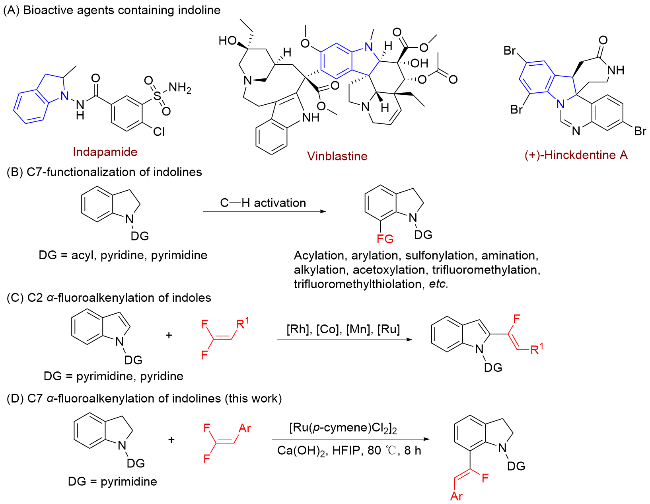
Transition-metal-catalyzed C7-functionalization of indolines (such as acylation, arylation, sulfonylation, amination, alkylation, acetoxylation, trifluoromethylation, trifluoromethylthiolation, etc.) has been developed well in the past few years.[2,5] Most of these strategies used acyl, pyridine and pyrimidine as the directing group (Scheme 1B). However, as a strongly coordinating group or ligand, pyrimidine directed C7-monofluoroalkenylation of indolines has been rarely reported. Monofluoroalkenes are a class of compounds that share similar steric and dipolar properties with amide bonds and are often used as bioisosteres in drug development. So, the development of C7-mono-fluoroalkenylation for indolines is significant for the pharmaceutical and chemical industries.[6] gem- Difluorostyrenes represent an important class of olefins owing to their biological properties and also their applications in synthetic organic chemistry.[7] Achieving the monofluoroalkenylation by using gem-difluorostyrenes as the monofluoroalkenyl source via C—H activation and C—F cleavage is a powerful strategy.
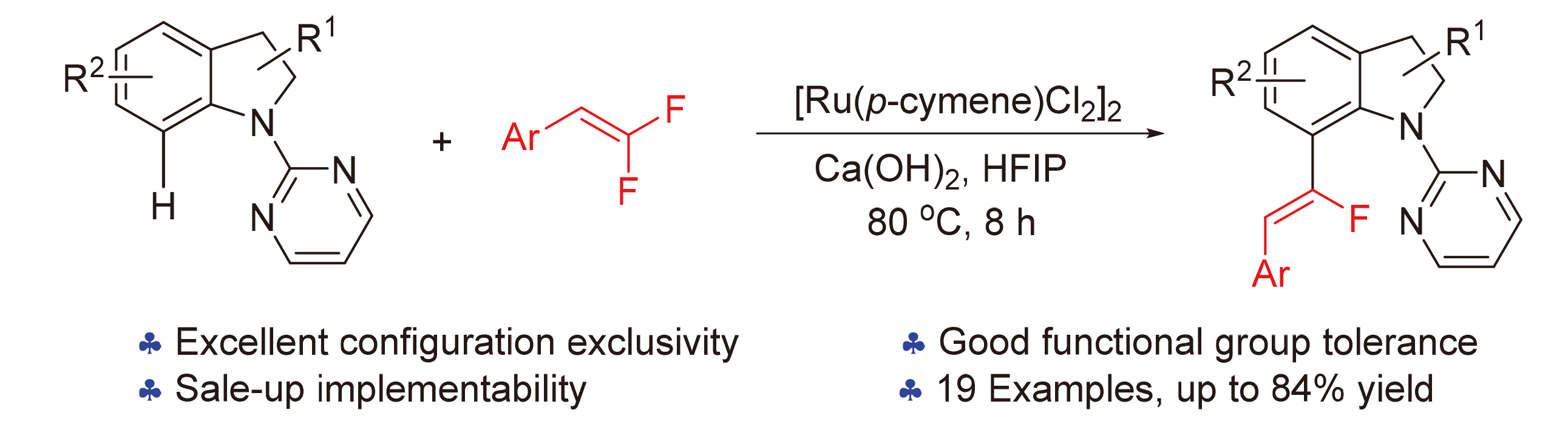
Over the past decade, Rh(III)-, Co(III)-, Mn(I)-, and Ru(II)-catalyzed C2-monofluoroalkenylations of indoles have been developed well using gem-difluorostyrenes (Scheme 1C).[6b,6c,8] These reactions exhibit excellent regioselectivity and good functional group tolerance. However, when inexpensive metals such as Mn(I) and Ru(II) are employed as catalysts, the configurational exclusivity of the products remains to be improved. Moreover, these methods are not applicable to the less reactive C7 position. In light of this, a novel Ru(II)-catalyzed C7—H monofluoroalken- ylation of indolines with gem-difluoroalkenes is disclosed, featuring high regioselectivity, excellent configurational exclusivity, and broad functional group compatibility (Scheme 1D).
2 Results and discussion
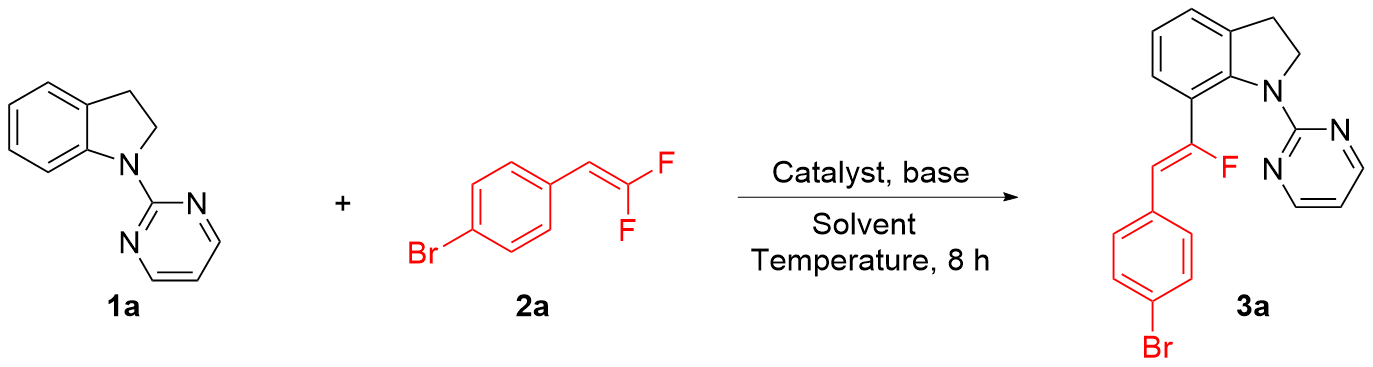
First, the reaction conditions were optimized using compounds 1a and 2a as model substrates, and the results were summarized in Table 1. When 0.15 equiv. of [Ru(p‑cymene)Cl2]2 was used as the catalyst, 2.0 equiv. of Ca(OH)2 as the base, and 1 mL of hexafluoroisopropanol (HFIP) as the solvent, the target product 3a was obtained in 79% yield after reacting at 80 ℃ for 8 h (Table 1, Entry 1). However, when using Cp*Co(CO)I2 as the catalyst, only a trace amount of the desired product was obtained.
Table 1 Optimization of reaction conditionsa |
| Entry | Catalyst | Base | Solvent | Yieldb/% |
|---|---|---|---|---|
| 1 | [Ru(p-cymene)Cl2] | Ca(OH)2 | HFIP | 79 |
| 2 | Cp*Co(CO)I2 | Ca(OH)2 | HFIP | Trace |
| 3 | Mn2(CO)10 | Ca(OH)2 | HFIP | 0 |
| 4 | Pd(OAc)2 | Ca(OH)2 | HFIP | 0 |
| 5 | IrCp*Cl2 | Ca(OH)2 | HFIP | 0 |
| 6 | — | Ca(OH)2 | HFIP | 0 |
| 7 | [Ru(p-cymene)Cl2] | K2CO3 | HFIP | 21 |
| 8 | [Ru(p-cymene)Cl2] | Cs2CO3 | HFIP | 54 |
| 9 | [Ru(p-cymene)Cl2] | NaOH | HFIP | 0 |
| 10 | [Ru(p-cymene)Cl2] | — | HFIP | 0 |
| 11 | [Ru(p-cymene)Cl2] | Ca(OH)2 | MeOH | 0 |
| 12 | [Ru(p-cymene)Cl2] | Ca(OH)2 | EtOH | 0 |
| 13 | [Ru(p-cymene)Cl2] | Ca(OH)2 | ACN | 0 |
| 14 | [Ru(p-cymene)Cl2] | Ca(OH)2 | DMSO | 0 |
| 15 | [Ru(p-cymene)Cl2] | Ca(OH)2 | HFIP/H2O (V/V=50/1) | 75 |
| 16c | [Ru(p-cymene)Cl2] | Ca(OH)2 | HFIP | 14 |
| 17d | [Ru(p-cymene)Cl2] | Ca(OH)2 | HFIP | 68 |
a Reaction conditions: 1a (0.2 mmol), 2a (0.4 mmol), catalyst (0.03 mmol), base (0.4 mmol), solvent (1.0 mL), 80 ℃, 8 h. b Isolated yields. c r.t. d 100 ℃. |
And Mn2(CO)10, Pd(OAc)2, IrCp*Cl2, or no catalyst at all were ineffective (Table 1, Entries 2~6). Subsequently, various bases were screened and it was found that Ca(OH)2 was the optimal choice. When K2CO3 or Cs2CO3 was used, the yield of 3a decreased significantly, whereas no reaction took place in the presence of NaOH or in the absence of base (Table 1, Entries 7~10). Among the tested solvents, only HFIP or HFIP/H2O proved effective, whereas common solvents such as methanol (MeOH), ethanol (EtOH), acetonitrile (ACN), and dimethyl sulfoxide (DMSO) were ineffective (Table 1, Entries 11~15). Finally, the reaction temperature was evaluated. Compared to the initial condition of 80 ℃, reducing the temperature to room temperature or increasing it to 100 ℃ did not improve the yield (Table 1, Entries 16, 17). Based on these results, Entry 1 was determined to be the optimal reaction conditions.
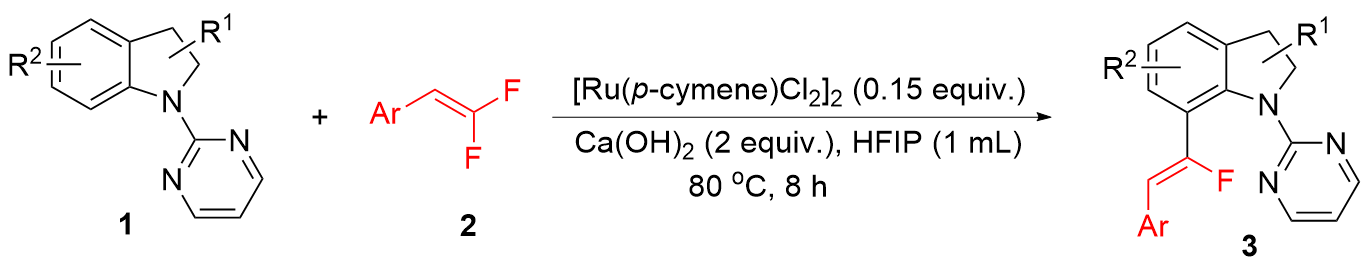
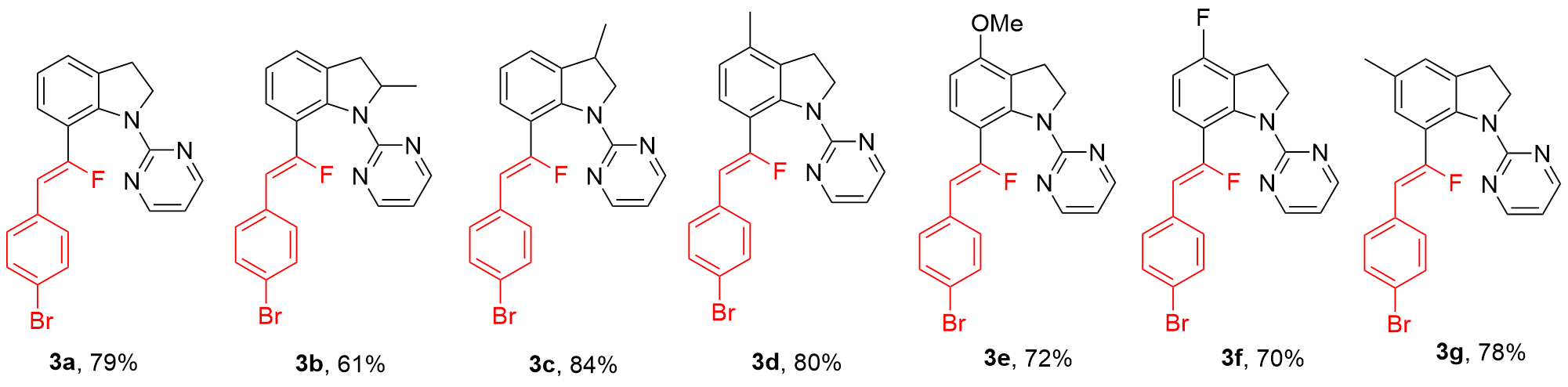
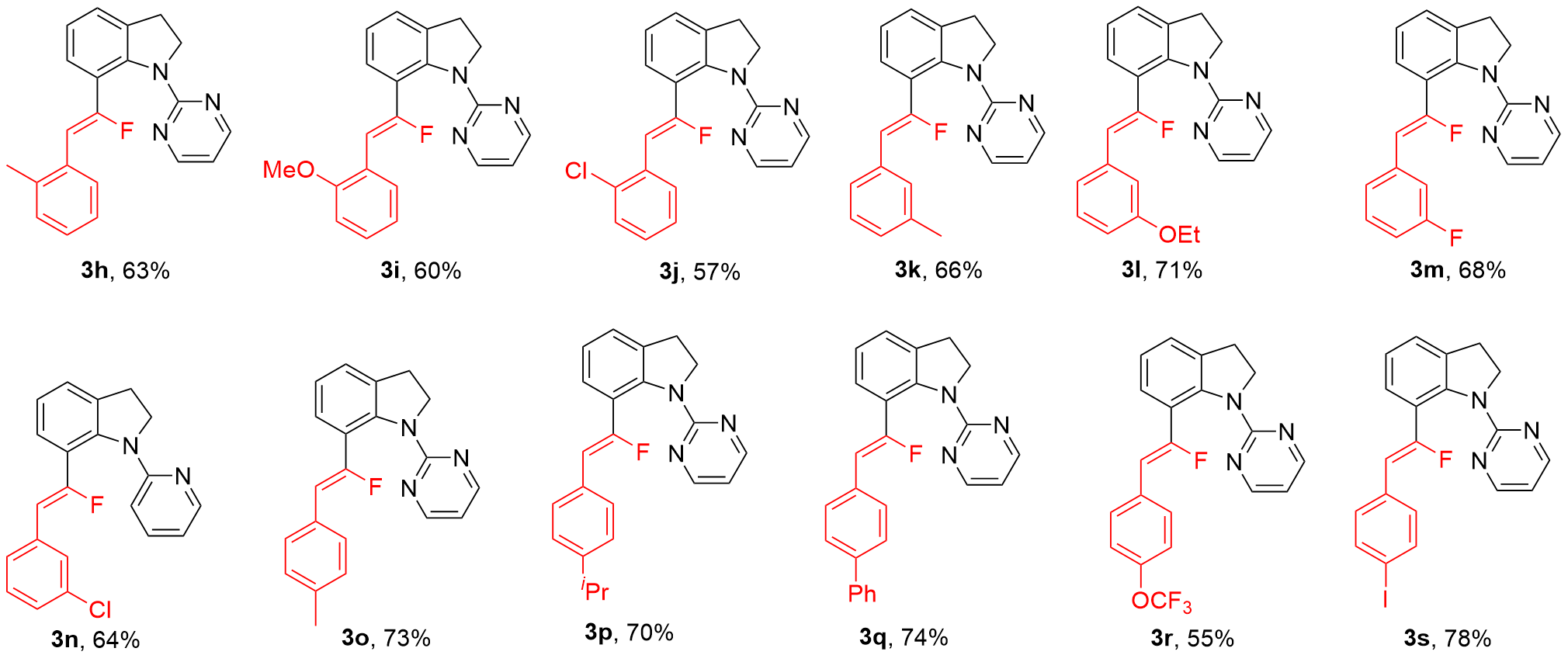
With the optimized reaction conditions in hand, the scope of indolines and gem-difluoroalkenes was explored, as shown in Table 2. Generally, this reaction exhibited the following characteristics: (1) The method showed excellent configuration exclusivity with all obtained products being of the Z configuration; (2) The reaction demonstrated good functional group tolerance. The substrates bearing electron-donating groups such as methyl, methoxy, ethoxy, isopropyl, or electron-withdrawing groups such as fluorine, chlorine, bromine, iodine, and trifluoromethoxy, the target products could be obtained in moderate to good yields; (3) The protocol displayed good site selectivity with C—H bond activation occurring exclusively at the C7 position.
Table 2 Substrate scope for this reactiona,b |
| Scope of indolines |
|---|
 |
| Scope of gem-difluoroalkenes |
 |
a Reaction conditions: 1 (0.2 mmol), 2a (0.4 mmol), [Ru(p-cymene)Cl2]2 (0.03 mmol), Ca(OH)2 (0.4 mmol), HFIP (1.0 mL), 80 ℃, 8 h. b Isolated yields. c 5 mmol 1g was used. |
For the indolines, the examined substrates afforded the target compounds 3a~3g in yields ranging from 61% to 84%. Among them, substrate 1b, bearing a methyl group at the C2 position, exhibited relatively poorer reactivity compared to those substituted at other positions. This might be attributed to the increased steric hindrance caused by the C2-methyl group, which interfered with the coordination between the catalyst and the pyridine nitrogen. In addition, In addition, the reaction could be readily scaled up.. When 5 mmol of compound 1g was used, compound 3g was obtained in 72% yield. As for the gem-difluoroal-kenes, the examined substrates provided the target compounds 3h~3s in 55%~78% yields. para-Substituted substrates showed better reactivity than meta- and ortho-substituted ones. Moreover, for substrates with the same substitution position, those bearing electron-donating groups exhibited higher reactivity than those with electron-withdrawing groups. Notably, compound 2s delivered compound 3s in 78% yield, laying the foundation for the subsequent construction of structurally diverse fluorinated alkenyl indolines via coupling reactions.
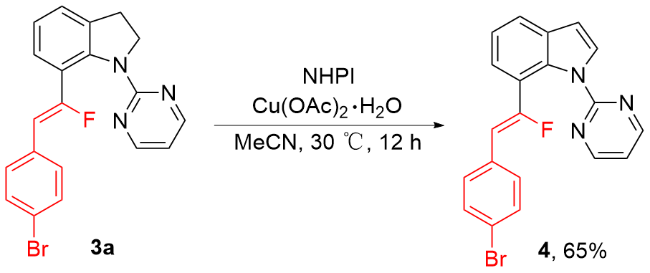
To obtain C7 fluoroalkenylated indole, the oxidation of 3a was carried out (Scheme 2). And the desired compound 4 could be obtained in 65% yield in the presence of Cu- (OAc)2•H2O and N-hydroxyphthalimide (NHPI) at 30 ℃.
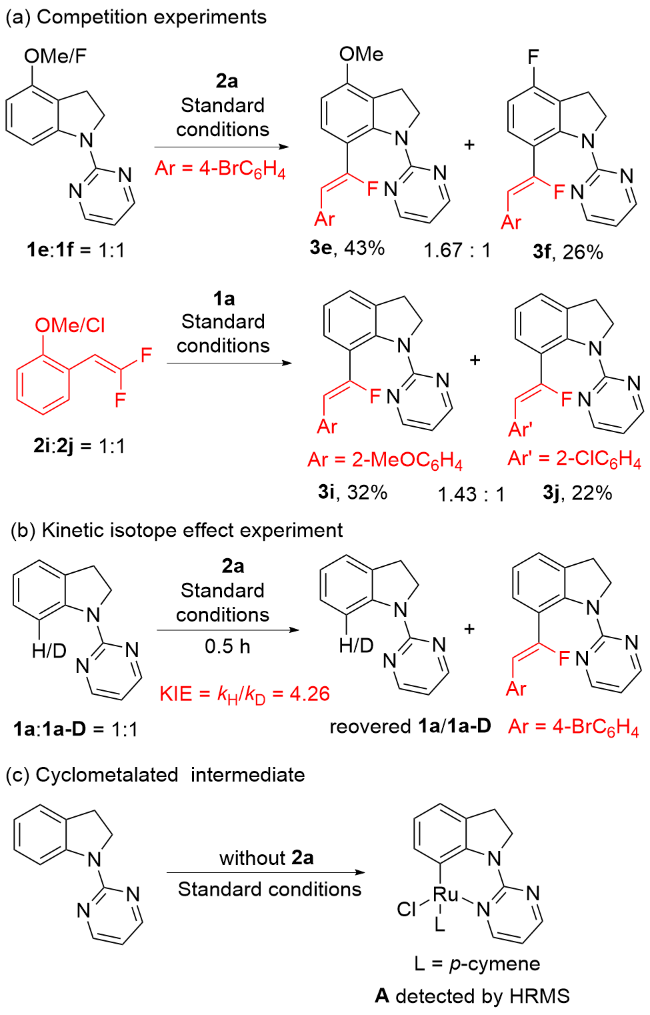
To investigate the influence of substituent electronic effects on the yield, the competitive experiments were conducted (Scheme 3a). When electronically biased substrates 1e and 1f (1∶1) were reacted with 2a under standard conditions, the products 3e and 3f were obtained in a ratio of 1.67∶1, indicating that electron-donating groups were more favorable for the reaction. Similarly, when electronically biased substrates 2i and 2j (1∶1) were reacted with 1a under standard conditions, the products 3i and 3j were formed in a ratio of 1.43∶1, further confirming the above conclusion. To explore the reaction mechanism, the kinetic isotope effect (KIE) experiment was carried out. When 1a/1a-D was reacted with 2a under standard conditions for 0.5 h, the value of KIE was 4.26 by ¹H NMR analysis, suggesting that the cleavage of the C(sp²)—H bond was likely the rate-determining step of the reaction (Scheme 3b).[9] In addition, the key six-membered ruthenium-cycle intermediate A was detected using high-resolution mass spectrometry (HRMS) analysis (Scheme 3c).
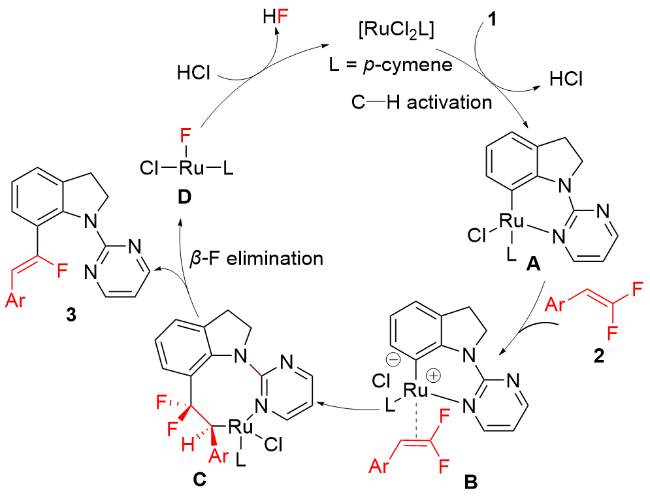
Based on the above experimental results and the relevant literature reports,[5,6,8] the possible reaction mechanism was proposed as shown in Scheme 4. Firstly, a six-membered ruthenium-cycle A is generated via cyclometallation of compound 1, together with the formation of HCl. Then, regioselective migratory insertion between intermediate A and 2 produces the key species C via the transient transition state B. The species C achieves the selective β-F elimination via a syn-coplanar transition state, thereby generating compound 3 and Ru(II) fluoride D. Finally, the active Ru(II) catalyst is regenerated through halogen anion-exchange for the next catalytic cycle.


3 Conclusions
In summary, we have developed a novel ruthenium(II)- catalyzed C7—H monofluoroalkenylation of indolines with gem-difluoroalkenes. This method exhibited good functional group tolerance, excellent configuration exclusivity and site selectivity. It may provide a valuable reference for the C7 functionalization of indolines and offer an efficient synthetic route for the development of pharmaceuticals containing fluorinated alkenyl indoline.
4 Experimental section
4.1 General information
All reagents were obtained from commercial sources and used as received without further purification unless otherwise stated. All solvents were dried over 4 Å molecular sieves. Reaction products were purified via column chromatography on silica gel (300~400 mesh). Melting points were determined using an open capillary and uncorrected. NMR spectra were recorded on a Bruker AV400 or AV600 in CDCl3 with tetramethylsilane (TMS) as an internal standard. HRMS were measured on a QSTAR Pulsar I LC/TOF MS mass spectrometer.
4.2 General procedure for the synthesis of 3
To a solution of 1 (0.2 mmol, 1 equiv.), [Ru(p-cymene)-Cl2]2 (0.03 mmol) and Ca(OH)2 (0.4 mmol, 2 equiv.) in dry HFIP (1 mL) in a 10 mL glass sealed-tube, 2 (0.4 mmol, 2 equiv.) was added. The reaction mixture was stirred at 80 ℃ in an oil bath for 8 h. The reaction mixture was diluted with 30 mL of dichloromethane (DCM), then successively washed with water and brine (15 mL each), dried over anhydrous sodium sulfate and filtered, and the solvent was evaporated under vacuum. Purification by a column chromatography on silica gel (eluents: petroleum ether/ ethyl acetate, V∶V=20∶1) afforded product 3.
(Z)-7-(2-(4-Bromophenyl)-1-fluorovinyl)-1-(pyrimidin-2-yl)indoline (3a): 62.4 mg, 79% yield. Red solid, m.p. 147~149 ℃; 1H NMR (400 MHz, CDCl3) δ: 8.30 (d, J=4.8 Hz, 2H), 7.40~7.37 (m, 3H), 7.26~7.24 (m, 3H), 7.04 (t, J=7.6 Hz, 1H), 6.64 (t, J=4.8 Hz, 1H), 6.07 (d, J=38.0 Hz, 1H), 4.46 (t, J=8.0 Hz, 2H), 3.17 (t, J=8.0 Hz, 2H); 13C NMR (100 MHz, CDCl3) δ: 160.2 (d, JCF=259.0 Hz), 159.7, 157.3 (2C), 140.8, 135.5, 133.5, 131.6 (2C), 130.1, 130.0, 127.2 (d, JCF=5.5 Hz), 125.8, 123.0, 121.9 (d, JCF=27.5 Hz), 120.5 (d, JCF=3.5 Hz), 112.7, 105.7 (d, JCF=10.2 Hz), 51.9, 28.9; 19F NMR (376 MHz, CDCl3) δ: -102.38. HRMS (ESI) calcd for C20H16N3FBr [M+H]+ 396.0512, found 396.0505.
(Z)-7-(2-(4-Bromophenyl)-1-fluorovinyl)-2-methyl-1-(pyrimidin-2-yl)indoline (3b): 49.9 mg, 61% yield. Red solid, m.p. 111~113 ℃; 1H NMR (400 MHz, CDCl3) δ: 8.30 (d, J=4.4 Hz, 2H), 7.41 (d, J=8.8 Hz, 3H), 7.28 (d, J=7.6 Hz, 3H), 7.06 (t, J=7.6 Hz, 1H), 6.64 (t, J=4.8 Hz, 1H), 6.09 (d, J=38.0 Hz, 1H), 5.02~4.95 (m, 1H), 3.51~3.45 (m, 1H), 2.64 (d, J=15.6 Hz, 1H), 1.48 (d, J=6.8 Hz, 3H); 13C NMR (100 MHz, CDCl3) δ: 159.3 (d, JCF=207.4 Hz), 157.8, 157.3 (2C), 139.3, 134.4, 133.5 (d, JCF=3.4 Hz), 131.6 (2C), 130.1, 130.0, 127.2 (d, JCF=5.5 Hz), 126.3, 123.1, 122.4 (d, JCF=27.4 Hz), 120.5 (d, JCF=3.5 Hz), 112.7, 105.4 (d, JCF=10.1 Hz), 59.3, 36.4, 21.2; 19F NMR (376 MHz, CDCl3) δ: -103.15. HRMS (ESI) calcd for C21H18N3FBr [M+H]+ 410.0668, found 410.0692.
(Z)-7-(2-(4-Bromophenyl)-1-fluorovinyl)-3-methyl-1-(pyrimidin-2-yl)indoline (3c): 68.7 mg, 84% yield. Yellow solid, m.p. 84~86 ℃; 1H NMR (400 MHz, CDCl3) δ: 8.36~8.34 (m, 2H), 7.44~7.42 (m, 3H), 7.30~7.28 (m, 3H), 7.11 (t, J=7.6 Hz, 1H), 6.69~6.66 (m, 1H), 6.12 (d, J=37.6 Hz, 1H), 4.69 (t, J=10.8 Hz, 1H), 4.05~4.00 (m, 1H), 3.52~3.45 (m, 1H), 1.39 (dd, J=6.8, 2.0 Hz, 3H); 13C NMR (100 MHz, CDCl3) δ: 160.2 (d, JCF=259.1 Hz), 159.7, 157.4 (2C), 140.6, 140.3, 133.4 (d, JCF=3.1 Hz), 131.7 (2C), 130.1, 130.0, 127.4 (d, JCF=5.6 Hz), 124.7, 123.2, 121.8 (d, JCF=27.6 Hz), 120.5 (d, JCF=3.4 Hz), 112.7, 105.7 (d, JCF=10.1 Hz), 59.7, 35.6, 19.3; 19F NMR (376 MHz, CDCl3) δ: -102.39. HRMS (ESI) calcd for C21H18N3FBr [M+H]+ 410.0668, found 410.0658.
(Z)-7-(2-(4-Bromophenyl)-1-fluorovinyl)-4-methyl-1-(pyrimidin-2-yl)indoline (3d): 65.4 mg, 80% yield. Yellow solid, m.p. 169~171 ℃; 1H NMR (400 MHz, CDCl3) δ: 8.34 (d, J=4.4 Hz, 2H), 7.42 (d, J=8.4 Hz, 2H), 7.35 (d, J=8.0 Hz, 1H), 7.28 (s, 2H), 6.91 (d, J=8.0 Hz, 1H), 6.67 (t, J=4.8 Hz, 1H), 6.07 (d, J=37.6 Hz, 1H), 4.51 (t, J=8.0 Hz, 2H), 3.11 (t, J=8.0 Hz, 2H), 2.31 (s, 3H); 13C NMR (100 MHz, CDCl3) δ: 160.4 (d, JCF=258.7 Hz), 159.6, 157.3 (2C), 140.3, 135.7, 133.9, 133.6 (d, JCF=3.3 Hz), 131.6 (2C), 130.0, 129.9, 127.3 (d, JCF=5.5 Hz), 124.3, 120.3 (d, JCF=3.2 Hz), 119.6 (d, JCF=27.2 Hz), 112.7, 105.1 (d, JCF=10.4 Hz), 51.7, 27.8, 19.0; 19F NMR (376 MHz, CDCl3) δ: -102.08. HRMS (ESI) calcd for C21H18N3FBr [M+H]+ 410.0668, found 410.0658.
(Z)-7-(2-(4-Bromophenyl)-1-fluorovinyl)-4-methyl-1-(pyrimidin-2-yl)indoline (3e): 61.2 mg, 72% yield. Yellow oil. 1H NMR (400 MHz, CDCl3) δ: 8.31 (d, J=4.4 Hz, 2H), 7.40~7.37 (m, 3H), 7.25 (d, J=8.4 Hz, 2H), 6.64~6.60 (m, 2H), 5.99 (d, J=37.6 Hz, 1H), 4.47 (t, J=8.4 Hz, 2H), 3.88 (s, 3H), 3.09 (t, J=8.4 Hz, 2H); 13C NMR (100 MHz, CDCl3) δ: 160.4 (d, JCF=258.7 Hz), 159.8, 157.3 (2C), 156.9, 142.3, 133.7, 131.6 (2C), 129.9, 129.8, 129.2 (d, JCF=5.6 Hz), 121.9, 120.2 (d, JCF=3.4 Hz), 115.5 (d, JCF=27.9 Hz), 112.8, 105.7, 104.5 (d, JCF=10.5 Hz), 55.7, 52.3, 25.9; 19F NMR (376 MHz, CDCl3) δ: -100.71. HRMS (ESI) calcd for C21H18ON3FBr [M+H]+ 426.0617, found 426.0601.
(Z)-7-(2-(4-Bromophenyl)-1-fluorovinyl)-4-fluoro-1-(pyrimidin-2-yl)indoline (3f): 57.8 mg, 70% yield. Yellow oil, m.p. 154~156 ℃; 1H NMR (400 MHz, CDCl3) δ: 8.33 (d, J=4.4 Hz, 2H), 7.40~7.35 (m, 3H), 7.25 (d, J=8.4 Hz, 2H), 6.78 (t, J=8.4 Hz, 1H), 6.69 (t, J=4.8 Hz, 1H), 6.01 (d, J=37.6 Hz, 1H), 4.51 (t, J=8.0 Hz, 2H), 3.20 (t, J=8.0 Hz, 2H); 13C NMR (100 MHz, CDCl3) δ: 160.9 (d, JCF=246.5 Hz), 159.5 (d, JCF=258.7 Hz), 159.4, 157.3 (2C), 143.4 (d, JCF=8.6 Hz), 133.3 (d, JCF=3.4 Hz), 131.7 (2C), 130.0 (d, JCF=7.9 Hz), 129.6 (d, JCF=5.4 Hz), 129.5 (d, JCF=5.4 Hz), 121.1 (d, JCF=21.8 Hz), 120.6 (d, JCF=3.5 Hz), 118.2 (d, JCF=28.1 Hz), 113.3, 110.3 (d, JCF=21.3 Hz), 105.6 (d, JCF=10.3 Hz), 52.3, 25.0; 19F NMR (376 MHz, CDCl3) δ: -101.43, -116.73. HRMS (ESI) calcd for C20H15N3F2Br [M+H]+ 414.0417, found 414.0431.
(Z)-7-(2-(4-Bromophenyl)-1-fluorovinyl)-5-methyl-1-(pyrimidin-2-yl)indoline (3g): 63.8 mg, 78% yield. Red solid, m.p. 114~116 ℃; 1H NMR (400 MHz, CDCl3) δ: 8.30 (d, J=4.4 Hz, 2H), 7.39 (d, J=7.6 Hz, 2H), 7.25 (s, 2H), 7.19 (s, 1H), 7.08 (s, 1H), 6.62 (t, J=4.4 Hz, 1H), 6.06 (d, J=38.0 Hz, 1H), 4.46 (t, J=8.0 Hz, 2H), 3.13 (t, J=8.0 Hz, 2H), 2.34 (s, 3H); 13C NMR (100 MHz, CDCl3) δ: 160.3 (d, JCF=259.1 Hz), 159.7, 157.3 (2C), 138.4, 135.7, 133.5 (d, JCF=3.1 Hz), 132.9, 131.6 (2C), 130.1, 130.0, 127.2 (d, JCF=5.3 Hz), 126.7, 121.7 (d, JCF=27.5 Hz), 120.5 (d, JCF=3.4 Hz), 112.5, 105.6 (d, JCF=10.1 Hz), 52.0, 29.0, 21.0; 19F NMR (376 MHz, CDCl3) δ: -102.56. HRMS (ESI) calcd for C21H18N3FBr [M+H]+ 410.0668, found 410.0658.
(Z)-7-(1-Fluoro-2-(o-tolyl)vinyl)-1-(pyrimidin-2-yl)-in- doline (3h): 41.7 mg, 63% yield. Red solid, m.p. 99~101 ℃; 1H NMR (400 MHz, CDCl3) δ: 8.36~8.34 (m, 2H), 7.49 (d, J=6.0 Hz, 1H), 7.43 (d, J=7.6 Hz, 1H), 7.24 (s, 1H), 7.13~7.09 (m, 3H), 7.06 (t, J=7.2 Hz, 1H), 6.66~6.63 (m, 1H), 6.26 (d, J=37.6 Hz, 1H), 4.48 (t, J=8.0 Hz, 2H), 3.16 (t, J=7.6 Hz, 2H), 2.27 (s, 3H); 13C NMR (100 MHz, CDCl3) δ: 159.9, 159.3 (d, JCF=257.4 Hz), 157.4 (2C), 140.7, 135.9, 135.5, 132.8, 130.1, 128.9 (d, JCF=10.7 Hz), 127.5 (d, JCF=5.3 Hz), 126.9, 125.9, 125.6, 123.1, 122.7 (d, JCF=27.9 Hz), 112.8, 103.9 (d, JCF=10.7 Hz), 52.0, 29.0, 20.3; 19F NMR (376 MHz, CDCl3) δ: -106.72. HRMS (ESI) calcd for C21H19N3F [M+H]+ 332.1563, found 332.1545.
(Z)-7-(1-Fluoro-2-(2-methoxyphenyl)vinyl)-1-(pyrimidin-2-yl)indoline (3i): 41.6 mg, 60% yield. Yellow solid, m.p. 199~201 ℃; 1H NMR (400 MHz, CDCl3) δ: 8.35 (d, J=4.8 Hz, 2H), 7.59 (d, J=7.6 Hz, 1H), 7.48 (d, J=8.0 Hz, 1H), 7.26~7.24 (m, 1H), 7.20 (t, J=8.0 Hz, 1H), 7.06 (t, J=7.6 Hz, 1H), 6.90~6.84 (m, 2H), 6.65 (t, J=4.4 Hz, 1H), 6.59 (d, J=39.6 Hz, 1H), 4.48 (t, J=8.0 Hz, 2H), 3.82 (s, 3H), 3.18 (t, J=8.0 Hz, 2H); 13C NMR (100 MHz, CDCl3) δ: 159.8, 159.5 (d, JCF=256.9 Hz), 157.3 (2C), 156.4, 140.6, 135.3, 129.5 (d, JCF=13.0 Hz), 127.9, 127.5 (d, JCF=5.5 Hz), 125.3, 123.3 (d, JCF=3.4 Hz), 123.0, 122.8 (d, JCF=27.8 Hz), 120.6, 112.6, 110.4, 100.3 (d, JCF=8.6 Hz), 55.6, 51.8, 29.0; 19F NMR (376 MHz, CDCl3) δ: -106.38. HRMS (ESI) calcd for C21H19ON3F [M+H]+ 348.1512, found 348.1523.
(Z)-7-(2-(2-Chlorophenyl)-1-fluorovinyl)-1-(pyrimidin-2-yl)indoline (3j): 40.0 mg, 57% yield. Yellow solid, m.p. 106~108 ℃; 1H NMR (400 MHz, CDCl3) δ: 8.36 (d, J=4.8 Hz, 2H), 7.65 (dd, J=7.6, 1.6 Hz, 1H), 7.48 (d, J=8.0 Hz, 1H), 7.38 (dd, J=8.0, 1.6 Hz, 1H), 7.29 (d, J=7.6 Hz, 1H), 7.19 (t, J=7.2 Hz, 1H), 7.14~7.10 (m, 1H), 7.08 (t, J=8.0 Hz, 1H), 6.66 (t, J=4.8 Hz, 1H), 6.57 (d, J=37.6 Hz, 1H), 4.49 (t, J=8.0 Hz, 2H), 3.18 (t, J=8.0 Hz, 2H); 13C NMR (100 MHz, CDCl3) δ: 160.7 (d, JCF=259.9 Hz), 159.7, 157.3 (2C), 140.8, 135.4, 132.8, 132.3 (d, JCF=3.5 Hz), 130.1 (d, JCF=12.4 Hz), 129.4, 127.8, 127.6 (d, JCF=5.5 Hz), 126.7, 125.8, 123.0, 122.1 (d, JCF=27.5 Hz), 112.7, 102.5 (d, JCF=9.0 Hz), 51.7, 28.9; 19F NMR (376 MHz, CDCl3) δ: -104.18. HRMS (ESI) calcd for C20H16- N3FCl [M+H]+ 352.1017, found 352.1027.
(Z)-7-(1-Fluoro-2-(m-tolyl)vinyl)-1-(pyrimidin-2-yl)-in- doline (3k): 43.7 mg, 66% yield. Red solid, m.p. 155~157 ℃; 1H NMR (400 MHz, CDCl3) δ: 8.34~8.32 (m, 2H), 7.41 (d, J=7.6 Hz, 1H), 7.25~7.16 (m, 4H), 7.05~7.01 (m, 2H), 6.65~6.62 (m, 1H), 6.13 (d, J=38.8 Hz, 1H), 4.48 (t, J=8.0 Hz, 2H), 3.18 (t, J=8.0 Hz, 2H), 2.31 (s, 3H); 13C NMR (100 MHz, CDCl3) δ: 159.7 (d, JCF=281.2 Hz), 159.5, 157.3 (2C), 140.7, 138.0, 135.4, 134.4 (d, JCF=3.0 Hz), 129.4 (d, JCF=7.2 Hz), 128.4, 127.7 (d, JCF=1.7 Hz), 127.3 (d, JCF=5.6 Hz), 125.7 (d, JCF=7.8 Hz), 125.5, 123.0, 122.3 (d, JCF=28.0 Hz), 112.6, 106.8 (d, JCF=10.1 Hz), 51.9, 29.0, 21.6; 19F NMR (376 MHz, CDCl3) δ: -104.22. HRMS (ESI) calcd for C21H19N3F [M+H]+ 332.1563, found 332.1545.
(Z)-7-(2-(3-Ethoxyphenyl)-1-fluorovinyl)-1-(pyrimidin-2-yl)indoline (3l): 51.3 mg, 71% yield. Red oil. 1H NMR (400 MHz, CDCl3) δ: 8.34 (d, J=4.8 Hz, 2H), 7.41 (d, J=7.6 Hz, 1H), 7.26 (d, J=6.0 Hz, 1H), 7.21 (t, J=7.2 Hz, 1H), 7.05 (t, J=7.6 Hz, 1H), 6.97 (d, J=6.8 Hz, 2H), 6.76 (d, J=8.4 Hz, 1H), 6.64 (t, J=4.8 Hz, 1H), 6.13 (d, J=38.0 Hz, 1H), 4.47 (t, J=8.0 Hz, 2H), 4.01~3.96 (m, 2H), 3.18 (t, J=8.0 Hz, 2H), 1.41 (t, J=7.2 Hz, 3H); 13C NMR (100 MHz, CDCl3) δ: 159.8 (d, JCF=258.2 Hz), 159.7, 159.0, 157.3 (2C), 140.7, 135.8 (d, JCF=3.2 Hz), 135.4, 129.4, 127.3 (d, JCF=5.6 Hz), 125.6, 122.9, 122.2 (d, JCF=27.4 Hz), 121.2 (d, JCF=7.1 Hz), 114.2 (d, JCF=8.3 Hz), 113.4 (d, JCF=1.3 Hz), 112.7, 106.7 (d, JCF=9.8 Hz), 63.4, 51.8, 29.0, 15.0; 19F NMR (376 MHz, CDCl3) δ: -103.29. HRMS (ESI) calcd for C22H21ON3F [M+H]+ 362.1669, found 362.1670.
(Z)-7-(1-Fluoro-2-(3-fluorophenyl)vinyl)-1-(pyrimidin-2-yl)indoline (3m): 45.5 mg, 68% yield. Red solid, m.p. 115~117 ℃; 1H NMR (400 MHz, CDCl3) δ: 8.33 (d, J=4.4 Hz, 2H), 7.41 (d, J=8.0 Hz, 1H), 7.28~7.21 (m, 2H), 7.16 (t, J=7.6 Hz, 2H), 7.05 (t, J=7.6 Hz, 1H), 6.91 (t, J=7.6 Hz, 1H), 6.66 (t, J=4.4 Hz, 1H), 6.13 (d, J=37.2 Hz, 1H), 4.48 (t, J=8.0 Hz, 2H), 3.18 (t, J=8.0 Hz, 2H); 13C NMR (100 MHz, CDCl3) δ: 164.2 (d, JCF=242.5 Hz), 160.6 (d, JCF=259.6 Hz), 159.7, 157.3 (2C), 140.8, 136.7 (d, JCF=3.2 Hz), 135.5, 129.8 (d, JCF=8.5 Hz), 127.3 (d, JCF=5.6 Hz), 125.9, 124.4 (d, JCF=2.6 Hz), 123.0, 121.8 (d, JCF=27.4 Hz), 115.1 (d, JCF=9.3 Hz), 113.8 (d, JCF=1.8 Hz), 112.8, 105.7 (d, JCF=2.5 Hz), 51.8, 28.9; 19F NMR (376 MHz, CDCl3) δ: -101.64, -113.50. HRMS (ESI) calcd for C20H16N3F2 [M+H]+ 336.1312, found 336.1299.
(Z)-7-(2-(3-Chlorophenyl)-1-fluorovinyl)-1-(pyridin-2-yl)indoline (3n): 44.9 mg, 64% yield. Red solid, m.p. 118~120 ℃; 1H NMR (400 MHz, CDCl3) δ: 8.31 (d, J=4.4 Hz, 2H), 7.38 (d, J=6.8 Hz, 2H), 7.24 (d, J=4.8 Hz, 2H), 7.20~7.13 (m, 2H), 7.04 (t, J=7.2 Hz, 1H), 6.65 (t, J=4.8 Hz, 1H), 6.07 (d, J=37.6 Hz, 1H), 4.46 (t, J=8.0 Hz, 2H), 3.17 (t, J=8.0 Hz, 2H); 13C NMR (100 MHz, CDCl3) δ: 160.6 (d, JCF=260.1 Hz), 159.7, 157.3 (2C), 140.8, 136.3 (d, JCF=3.5 Hz), 135.5, 134.3, 129.7, 128.4 (d, JCF=8.5 Hz), 127.3 (d, JCF=5.4 Hz), 126.8 (d, JCF=1.8 Hz), 126.6 (d, JCF=7.6 Hz), 125.9, 123.0, 121.8 (d, JCF=27.4 Hz), 112.8, 105.5 (d, JCF=10.0 Hz), 51.8, 28.9; 19F NMR (376 MHz, CDCl3) δ: -101.54. HRMS (ESI) calcd for C20H16N3FCl [M+H]+ 352.1017, found 352.1031.
(Z)-7-(1-Fluoro-2-(p-tolyl)vinyl)-1-(pyrimidin-2-yl)indoline (3o): 48.3 mg, 73% yield. Red solid, m.p. 165~167 ℃; 1H NMR (400 MHz, CDCl3) δ: 8.33 (d, J=4.8 Hz, 2H), 7.42 (d, J=8.0 Hz, 1H), 7.31 (d, J=8.0 Hz, 2H), 7.26 (d, J=8.4 Hz, 1H), 7.11 (d, J=8.0 Hz, 2H), 7.05 (t, J=7.6 Hz, 1H), 6.64 (t, J=4.8 Hz, 1H), 6.14 (d, J=38.8 Hz, 1H), 4.48 (t, J=8.0 Hz, 2H), 3.18 (t, J=8.0 Hz, 2H), 2.33 (s, 3H); 13C NMR (100 MHz, CDCl3) δ: 159.8, 159.1 (d, JCF=256.6 Hz), 157.3 (2C), 140.6, 136.6 (d, JCF=2.3 Hz), 135.3, 131.6 (d, JCF=3.2 Hz), 129.2 (2C), 128.5, 128.4, 127.2 (d, JCF=5.6 Hz), 125.4, 122.9, 122.3 (d, JCF=27.6 Hz), 112.6, 106.6 (d, JCF=10.4 Hz), 51.9, 29.0, 21.4; 19F NMR (376 MHz, CDCl3) δ: -105.12. HRMS (ESI) calcd for C21H19FN3 [M+H]+ 332.1563, found 332.1545.
(Z)-7-(1-Fluoro-2-(4-isopropylphenyl)vinyl)-1-(pyrimidin-2-yl)indoline (3p): 50.3 mg, 70% yield. Yellow solid, m.p. 141~143 ℃; 1H NMR (400 MHz, CDCl3) δ: 8.35 (d, J=4.8 Hz, 2H), 7.42 (d, J=8.0 Hz, 1H), 7.34 (d, J=8.0 Hz, 2H), 7.25 (d, J=7.6 Hz, 1H), 7.16 (d, J=8.4 Hz, 2H), 7.05 (t, J=7.6 Hz, 1H), 6.65 (t, J=4.8 Hz, 1H), 6.15 (d, J=38.8 Hz, 1H), 4.48 (t, J=8.4 Hz, 2H), 3.18 (t, J=8.4 Hz, 2H), 2.94~2.83 (m, 1H), 1.26 (d, J=6.8 Hz, 6H); 13C NMR (100 MHz, CDCl3) δ: 159.9, 159.2 (d, JCF=256.6 Hz), 157.3 (2C), 147.6, 140.7, 135.4, 132.1 (d, JCF=3.2 Hz), 128.6, 128.5, 127.3 (d, JCF=5.6 Hz), 126.6 (2C), 125.4, 122.9, 122.4 (d, JCF=27.7 Hz), 112.7, 106.6 (d, 3JCF=10.2 Hz), 51.9, 34.0, 29.0, 24.0 (2C); 19F NMR (376 MHz, CDCl3) δ: -105.39. HRMS (ESI) calcd for C23H23- N3F [M+H]+ 360.1876, found 360.1882.
(Z)-7-(2-([1,1'-Biphenyl]-4-yl)-1-fluorovinyl)-1-(pyrimidin-2-yl)indoline (3q): 58.2 mg, 74% yield. Yellow solid, m.p. 123~125 ℃; 1H NMR (400 MHz, CDCl3) δ: 8.34 (d, J=4.8 Hz, 2H), 7.60 (d, J=7.6 Hz, 2H), 7.54 (d, J=8.0 Hz, 2H), 7.48 (d, J=8.4 Hz, 2H), 7.44 (t, J=7.6 Hz, 3H), 7.34 (t, J=7.2 Hz, 1H), 7.26 (d, J=7.6 Hz, 1H), 7.05 (t, J=7.6 Hz, 1H), 6.64 (t, J=4.8 Hz, 1H), 6.20 (d, J=38.4 Hz, 1H), 4.48 (t, J=8.0 Hz, 2H), 3.17 (t, J=8.0 Hz, 2H); 13C NMR (100 MHz, CDCl3) δ: 159.9 (d, JCF=256.8 Hz), 159.8, 157.3 (2C), 140.8, 140.7, 139.4, 135.4, 133.6 (d, JCF=3.3 Hz), 129.0 (d, JCF=7.8 Hz), 128.9, 128.8 (2C), 127.3, 127.2 (d, JCF=5.6 Hz), 127.1 (2C), 127.0 (2C), 125.6, 123.0, 122.2 (d, JCF=27.5 Hz), 112.7, 106.3 (d, JCF=10.2 Hz), 51.8, 29.0; 19F NMR (376 MHz, CDCl3) δ: -103.40. HRMS (ESI) calcd for C26H21 N3F [M+H]+ 394.1720, found 394.1715.
(Z)-7-(1-Fluoro-2-(4-(trifluoromethoxy)phenyl)vinyl)-1-(pyrimidin-2-yl)indoline (3r): 39.5 mg, 55% yield. Yellow solid, m.p. 110~112 ℃; 1H NMR (400 MHz, CDCl3) δ: 8.33 (d, J=4.8 Hz, 2H), 7.42~7.39 (m, 3H), 7.28 (d, J=8.0 Hz, 1H), 7.13 (d, J=8.4 Hz, 2H), 7.06 (t, J=7.6 Hz, 1H), 6.66 (t, J=4.8 Hz, 1H), 6.13 (d, J=37.6 Hz, 1H), 4.48 (t, J=8.0 Hz, 2H), 3.19 (t, J=8.0 Hz, 2H); 13C NMR (100 MHz, CDCl3) δ: 160.2 (d, JCF=258.8 Hz), 159.7, 157.3 (2C), 147.8, 140.8, 135.5, 133.3 (d, JCF=3.0 Hz), 129.8 (d, JCF=8.0 Hz), 127.3, 127.2, 125.8, 123.0, 121.9 (d, JCF=27.3 Hz), 121.8 (d, JCF=255.4 Hz), 121.0 (2C), 112.8, 105.3 (d, JCF=10.2 Hz), 51.9, 29.0; 19F NMR (376 MHz, CDCl3) δ: -57.78 (3F), -103.32. HRMS (ESI) calcd for C21H16ON3F4 [M+H]+ 402.1229, found 402.1213.
(Z)-7-(1-Fluoro-2-(4-iodophenyl)vinyl)-1-(pyrimidin-2-yl)indoline (3s): 69.1 mg, 78% yield. Red solid, m.p. 145~147 ℃; 1H NMR (400 MHz, CDCl3) δ: 8.32 (d, J=4.8 Hz, 2H), 7.61 (d, J=8.4 Hz, 2H), 7.40 (d, J=8.0 Hz, 1H), 7.27 (d, J=6.4 Hz, 1H), 7.14 (d, J=8.4 Hz, 2H), 7.05 (t, J=8.0 Hz, 1H), 6.66 (t, J=4.8 Hz, 1H), 6.07 (d, J=37.6 Hz, 1H), 4.48 (t, J=8.0 Hz, 2H), 3.18 (t, J=8.0 Hz, 2H); 13C NMR (100 MHz, CDCl3) δ: 160.4 (d, JCF=259.3 Hz), 159.5, 157.3 (2C), 140.7, 137.6 (2C), 135.4, 134.0 (d, JCF=3.4 Hz), 130.3, 130.2, 127.3 (d, JCF=5.6 Hz), 125.8, 123.1, 122.0 (d, JCF=27.4 Hz), 112.7, 105.8 (d, JCF=10.0 Hz), 92.0 (d, JCF=3.4 Hz), 51.9, 29.0; 19F NMR (376 MHz, CDCl3) δ: -101.91. HRMS (ESI) calcd for C20H16- N3FI [M+H]+ 444.0373, found 444.0376.
4.3 Procedure for the synthesis of 4
To a solution of 3a (0.2 mmol) and Cu(OAc)2•H2O (0.01 mmol) in MeCN (2 mL) in a 15 mL round bottom flask, N-hydroxyphthalimide (0.04 mmol) was added. The mixture was stirred at 30 ℃ in an oil bath under air atmosphere for 12 h. After completion of the reaction (as monitored by TLC), the reaction mixture was diluted with 10 mL of DCM, then successively washed with water and brine (15 mL each), dried over anhydrous sodium sulfate, and filtered, and the solvent was evaporated under vacuum. Purification by a column chromatography on silica gel (eluents: petroleum ether/ethyl acetate, V∶V=30∶1) afforded (Z)-7-(2-(4-bromophenyl)-1-fluorovinyl)-1-(pyri- midin-2-yl)-1H-indole (4) as a colorless oil (51.1 mg, 65% yield). 1H NMR (600 MHz, CDCl3) δ: 8.57 (d, J=4.8 Hz, 2H), 7.97 (d, J=3.6 Hz, 1H), 7.73 (d, J=7.8 Hz, 1H), 7.51 (d, J=7.2 Hz, 1H), 7.44 (d, J=8.4 Hz, 2H), 7.29 (d, J=8.4 Hz, 3H), 7.07 (t, J=4.8 Hz, 1H), 6.78 (d, J=3.6 Hz, 1H), 6.19 (d, J=37.8 Hz, 1H); 13C NMR (150 MHz, CDCl3) δ: 158.6 (d, JCF=160.3 Hz), 158.1 (2C), 154.0, 133.4, 132.7, 131.8 (2C), 131.4, 130.0 (d, JCF=8.1 Hz), 129.7, 125.3 (d, JCF=5.1 Hz), 123.1, 121.9, 120.7, 120.5, 120.3, 117.5, 106.8, 106.4 (d, JCF=9.5 Hz); 19F NMR (565 MHz, CDCl3) δ: -93.32. HRMS (ESI) calcd for C20H14- N3FBr [M+H]+ 394.0355, found 394.0360.
4.4 Reaction mechanism studies
4.4.1 Competitive experiment
To a solution of 1e (0.1 mmol) and 1f (0.1 mmol), [Ru(p-cymene)Cl2]2 (0.03 mmol) and Ca(OH)2 (0.4 mmol) in dry HFIP (1 mL) in a 10 mL glass sealed-tube, 2a (0.4 mmol) was added. The reaction mixture was stirred at 80 ℃ in an oil bath for 8 hours. The reaction mixture was diluted with 30 mL of DCM, then successively washed with water and brine (15 mL each), dried over anhydrous sodium sulfate and filtered, and the solvent was evaporated under vacuum. Purification by a column chromatography on silica gel (eluents: petroleum ether/ethyl acetate, V∶V=20∶1, V∶V) afforded products 3e and 3f. The yields of 3e and 3f were determined by 1H NMR analysis (see the Supporting Information).
To a solution of 2i (0.2 mmol) and 2j (0.2 mmol), [Ru(p-cymene)Cl2]2 (0.03 mmol) and Ca(OH)2 (0.4 mmol) in dry HFIP (1 mL) in a 10 mL glass sealed-tube, 1a (0.2 mmol) was added. The reaction mixture was stirred at 80 ℃ in an oil bath for 8 h. The reaction mixture was diluted with 30 mL DCM, then successively washed with water and brine (15 mL each), dried over anhydrous sodium sulfate and filtered, and the solvent was evaporated under vacuum. Purification by a column chromatography on silica gel (eluents: petroleum ether/ethyl acetate, V∶ V=20∶1) afforded products 3i and 3j. The yields of 3i and 3j were determined by 1H NMR analysis.
4.4.2 Kinetic isotope effect experiment
Preparation of 1a-D: To a solution of 1a (2.5 mmol), [Ru(p-cymene)Cl2]2 (0.125 mmol), AgSbF6 (0.5 mmol) and AgOAc (5 mmol) in dry DCE (4 mL) in a 10 mL glass sealed-tube, CD3OD (25 mmol) was added. The reaction mixture was stirred at 100 ℃ in an oil bath for 5 h. When the reaction was finished, the reaction mixture was partitioned between DCM (20 mL×3) and H2O. The organic layer was dried over Na2SO4, filtered and the solvent removed in vacuo. The resultant residue was purified by silica gel column chromatography (eluent: petroleum ether/ EtOAc, V∶V=40∶1) and the 1H NMR analysis showed 50% deuterium incorporation at C7 position.
KIE experiment: To a solution of 1a (0.1 mmol, 0.5 equiv.) and 1a-D (50%D) (0.1 mmol, 0.5 equiv.), [Ru(p- cymene)Cl2]2 (0.03 mmol) and Ca(OH)2 (0.4 mmol, 2 equiv.) in dry HFIP (1 mL) in a 10 mL glass sealed-tube, 2a (0.4 mmol, 2 equiv.) was added. The reaction mixture was stirred at 80 ℃ in an oil bath for 0.5 h. When the reaction was finished, the reaction mixture was partitioned between DCM (10 mL×3) and H2O. The organic layer was dried over Na2SO4, filtered and the solvent removed in vacuo. The resultant residue was purified by silica gel column chromatography (eluent: petroleum ether/EtOAc, V∶V=20∶1) and KIE=kH/kD=0.81/0.19=4.26.
4.4.3 Preparation of cyclometallation intermediate A
To a solution of 1a (0.2 mmol, 1 equiv.), [Ru(p-cy- mene)Cl2]2 (0.03 mmol) in dry HFIP (1 mL) in a 10 mL glass sealed-tube, Ca(OH)2 (0.4 mmol, 2 equiv.) was added. The reaction mixture was stirred at 80 ℃ in an oil bath for 8 h. The reaction mixture was diluted with 30 mL of DCM, then successively washed with water and brine (15 mL each), dried over anhydrous sodium sulfate and filtered, and the solvent was evaporated under vacuum. Then the resultant residue was detected by high-resolution mass spectra (HRMS) analysis. HRMS (ESI) calcd for C22H24- N3Ru [M-Cl]+ 432.1014, found 432.0990.
Supporting Information The supporting information includes 1H NMR, 13C NMR, 19F NMR spectra of target compounds 3a~3s, and 4. The Supporting Information is available free of charge via the Internet at http://sioc- journal.cn.
(Lu, Y.)