


1 Introduction
Tertiary phosphine oxides (TPOs), as the important members of the organophosphorus family, exhibit extensive applications across diverse fields, spanning materials science,[1] pharmaceuticals[2] and coordination chemistry.[3] Moreover, they can also serve as essential building blocks,[4] catalysts,[5] and ligands[6] in synthetic chemistry.
As downstream products of the phosphorus industry, TPOs are most directly synthesized via the oxidation of trivalent phosphorus compounds (Scheme 1A).[7] Among established strategies, the oxidation pathways involving stoichiometric oxidant (peroxide,[8] N2O,[9] HOF,[10] Oxone,[11] high-valent metal salts,[12] etc.[13]), especially using H2O2,[14] are the most commonly used methods in either industrial or laboratory settings (Scheme 1A, path a). Although straightforward and effective, these methods often require toxic or explosive reagents, produce significant waste, and thus restrict their widespread application. Additionally, the excessive use of strongly oxidizing H2O2 also leads to poor functional group tolerance. In recent years, photo-oxidation pathways for trivalent phosphines have been developed as alternative routes to TPOs (Scheme 1A, path b).[15-16] Despite their efficiency, these approaches still suffer from limitations, including a narrow substrate scope (typically restricted to triarylphosphines), and a reliance on precious photocatalysts that often require multistep synthesis. Therefore, it remains highly desirable to exploit efficient methods with good economic viability, substrate compatibility and suitable for large-scale production for the alternative oxidation of trivalent phosphines.
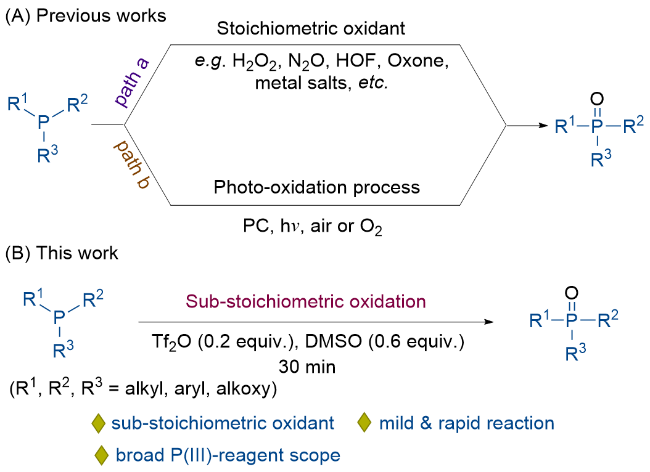
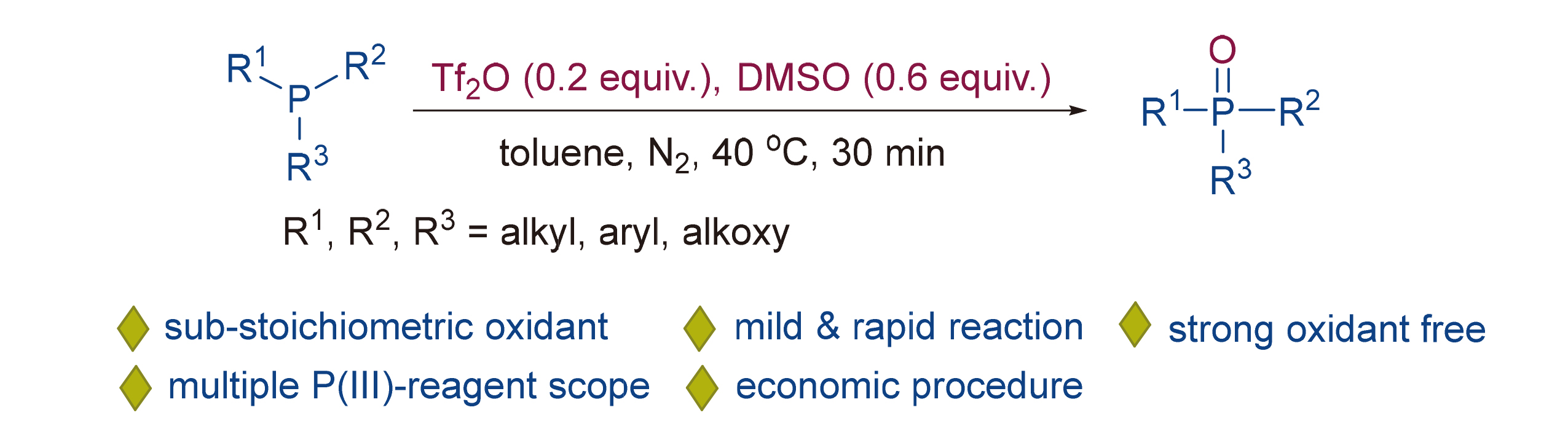
In recent years, our group has committed to exploring electrophilic phosphorylation transformations promoted by anhydride/dimethyl sulfoxide (DMSO)-based systems.[17] Building on our continued interest and further investigation within this reaction framework, herein, we disclose that the oxidation of trivalent phosphines to tertiary phosphine oxides can be efficiently achieved using catalytic amounts of Tf2O and sub-stoichiometric DMSO, completing within 30 min (Scheme 1B). This method demonstrates broad compatibility with a range of P(III) compounds, including arylphosphines, aryl alkyl phosphines, phosphinites, phosphonites, and phosphites, all of which can be smoothly converted to the corresponding P(V)-oxides in high yields. The present oxidation protocol provides an economical and practical synthetic route to diverse tertiary phosphine oxides. Moreover, the reaction can be scaled up without loss of efficiency, underscoring its potential for practical applications.
2 Results and discussion
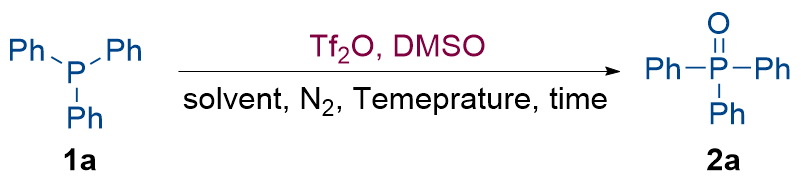
Our initial investigations focused on optimizing reaction conditions for the oxidation of model substrate triphenyl- phosphine (1a) to triphenylphosphine oxide (2a), as summarized in Table 1. Under a nitrogen atmosphere, in the presence of 0.5 equiv. of trifluoromethanesulfonic anhydride (Tf2O) and dimethyl acetamide (DMAc, 2.0 mL) at room temperature, triphenylphosphine oxide (TPPO, 2a) was observed by thin-layer chromatography (TLC), and this product was ultimately isolated in 40% yield (Entry 1). Subsequent solvent screening (Entries 2~5) led to the identification of toluene as the optimal solvent, by which the reaction yield could be effectively doubled (Entry 3). While moderate temperature elevation could improve the yield, excessive heating proved detrimental to this reaction (Entries 6 and 7). To our delight, shortening the reaction time from 12 h to 0.5 h maintained excellent yields over 90% (Entries 8 and 9), significantly enhancing synthetic efficiency. However, insufficient reaction time resulted in incomplete conversion (Entry 10). Reducing the amount of Tf2O to 0.2 equiv. caused a sharp decrease in the yield of 2a (Entry 11). Surprisingly, the addition of 1.0 equiv. of DMSO could improve the yield to 95% (Entry 12), whereas further reduction of Tf2O led to significantly diminished yields (Entry 13). Remarkably, even when DMSO was reduced to 0.6 equiv, 2a was still obtained in excellent yield (Entry 14). However, further reduction of DMSO resulted in a decreased yield (Entry 15). Using N,N-dimethylformamide (DMF) instead of DMSO led to a low yield (Entry 16). Alternative anhydrides, such as trifluoroacetic anhydride (TFAA) and Ac2O, were less effective than Tf2O (Entries 17 and 18). Most importantly, the essential role of Tf2O was confirmed by control experiments, as no reaction was observed in its absence (Entry 19).
Table 1 Reaction optimizationa |
| Entry | Tf2O/ equiv. | DMSO/ equiv. | Solvent | T/℃ | t/h | Yield/% |
|---|---|---|---|---|---|---|
| 1 | 0.5 | — | DMAc | r.t. | 12 | 40 |
| 2 | 0.5 | — | 1,4-Dioxane | r.t. | 12 | 67 |
| 3 | 0.5 | — | Toluene | r.t. | 12 | 83 |
| 4 | 0.5 | — | DCE | r.t. | 12 | 80 |
| 5 | 0.5 | — | MeCN | r.t. | 12 | 81 |
| 6 | 0.5 | — | Toluene | 40 | 12 | 90 |
| 7 | 0.5 | — | Toluene | 60 | 12 | 81 |
| 8 | 0.5 | — | Toluene | 40 | 1 | 91 |
| 9 | 0.5 | — | Toluene | 40 | 0.5 | 93 |
| 10 | 0.5 | — | Toluene | 40 | 0.25 | 83 |
| 11 | 0.2 | — | Toluene | 40 | 0.5 | 34 |
| 12 | 0.5 | 1.0 | Toluene | 40 | 0.5 | 95 |
| 13 | 0.1 | 1.0 | Toluene | 40 | 0.5 | 35 |
| 14 | 0.2 | 0.6 | Toluene | 40 | 0.5 | 98 |
| 15 | 0.2 | 0.5 | Toluene | 40 | 0.5 | 87 |
| 16b | 0.2 | 0.6 | Toluene | 40 | 0.5 | 36 |
| 17c | 0.2 | 0.6 | Toluene | 40 | 0.5 | 67 |
| 18d | 0.2 | 0.6 | Toluene | 40 | 0.5 | N.D |
| 19 | — | 0.6 | Toluene | 40 | 0.5 | N.R |
a Conditions: 1a (0.2 mmol), Tf2O, DMSO, solvent (2.0 mL), under N2, stirred at T for t h. b DMF was used instead of DMSO. c TFAA was used instead of Tf2O. d Ac2O was used instead of Tf2O. |
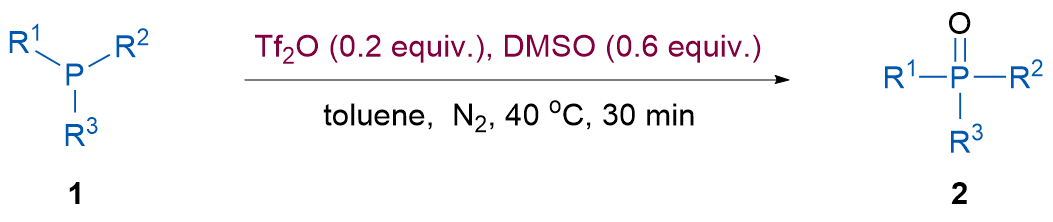
With the optimal conditions established, the substrate scope of this oxidation process was next investigated (Table 2). Pleasingly, a wide range of trivalent phosphorus compounds were compatible and efficiently converted into the corresponding tertiary phosphine oxides under this system. Firstly, various triarylphosphines were examined (Table 2, top row). Substrates bearing either electron- withdrawing group (1b, 1c) or electron-donating groups (1d, 1e) afforded the triarylphosphine oxides (2b~2e) in excellent yields. A variety of substitution patterns, including ortho- (1f), meta- (1g), multi- (1h) and mono- (1i, 1j) substituted triarylphosphines all reacted smoothly, yielding the corresponding products 2f~2j in excellent yields. Furthermore, phosphines incorporating heterocyclic moieties (1k~1m) were also well tolerated, providing 2k~2m in good yields. To evaluate steric effects on the reactivity, several P(III)-reagents with increasingly bulky substituents (1n~1r) were subjected to the reaction conditions. The results revealed a gradual decrease in yield (2n~2p) with increasing steric hindrance. For highly sterically encumbered substrates (1q and 1r), the oxidation reaction did not occur.
Table 2 Substrates scopea |
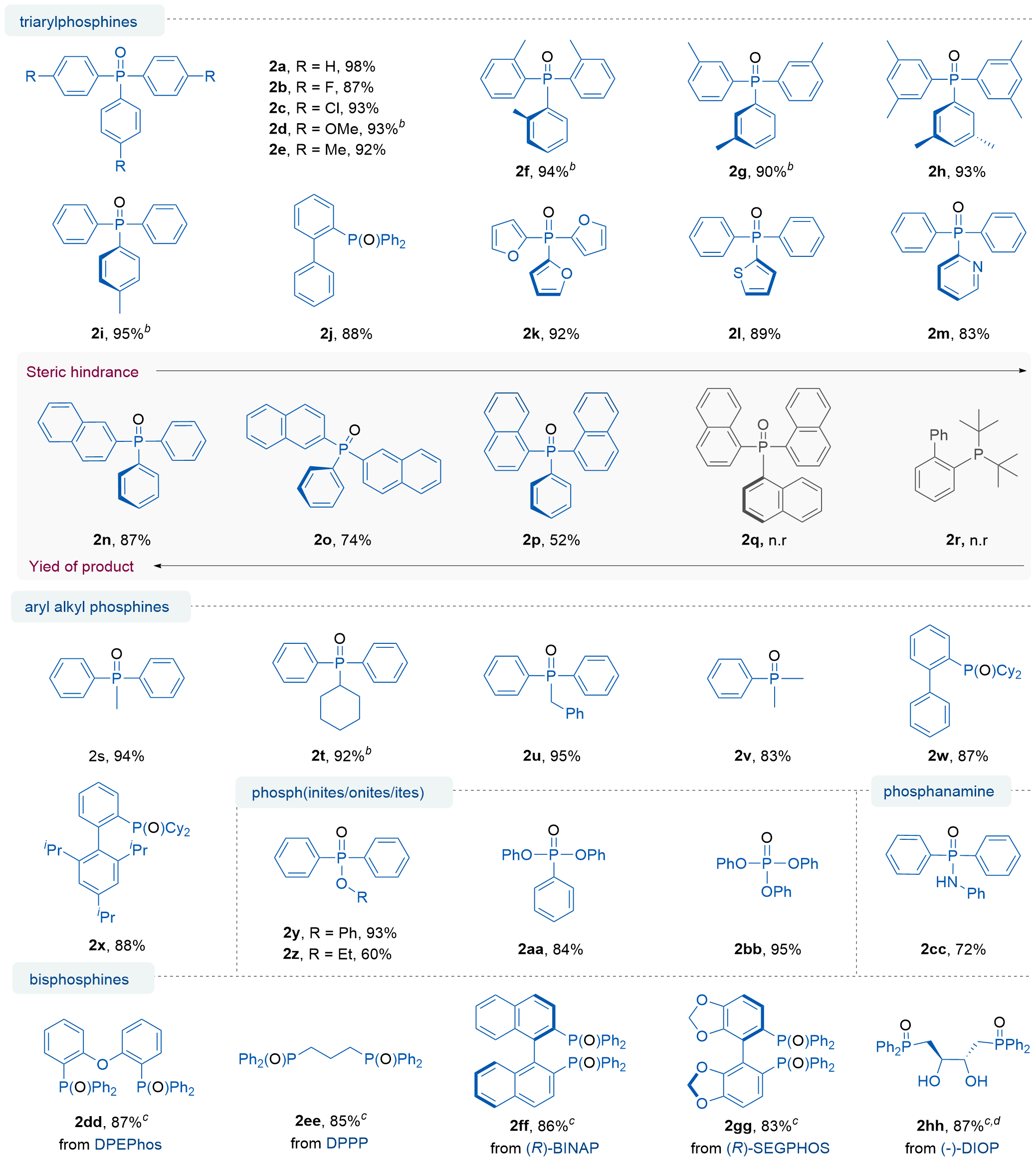 |
Conditions: a 1 (0.2 mmol, 1.0 equiv.), Tf2O (0.2 equiv.), DMSO (0.6 equiv.), toluene (2.0 mL), N2, stirred at 40 ℃ for 30 min, isolated yield; b Tf2O (0.4 equiv.), DMSO (1.2 equiv.); c Tf2O (1.6 equiv.), DMSO (2.4 equiv.); d The acetal group was hydrolyzed. |
Next, the scope of aryl alkyl phosphines was explored (Table 2, second row). Both alkyl diaryl phosphines (1s~1u) and aryl dialkyl phosphines (1v~1x) were effectively oxidized to the corresponding phosphine oxides (2s~2x). Nevertheless, this method proved incompatible with trialkylphosphines. No desired product was detected with tripropylphosphine as the substrate. Further extending the substrate scope, other classes of trivalent phosphorus reagents, including phosphinites (1y, 1z), phosphonites (1aa), phosphites (1bb), and phosphoramidite (1cc), were all compatible with the reaction, furnishing the corresponding P(V)-oxides 2y~2cc in good yields (Table 2, third row). Additionally, the reactivity of bisphosphines was also investigated (Table 2, bottom row). Several commercially available bidentate P(III)-ligands 1dd~1hh could be smoothly converted into the corresponding bidentate P(O)- ligands 2dd~2hh in good yields under the Tf2O/DMSO- based oxidation system. It should also be noted that this oxidation method is incompatible with (RO)3P, (R2N)3P, (RS)3P and trialkylphosphine. Trivalent P(III)-reagents, such as P(OEt)3, (Et2N)3P, trilauryltrithiophosphite, P(Me)3 and P(Cy)3 gave no desired products under the standard conditions, respectively.
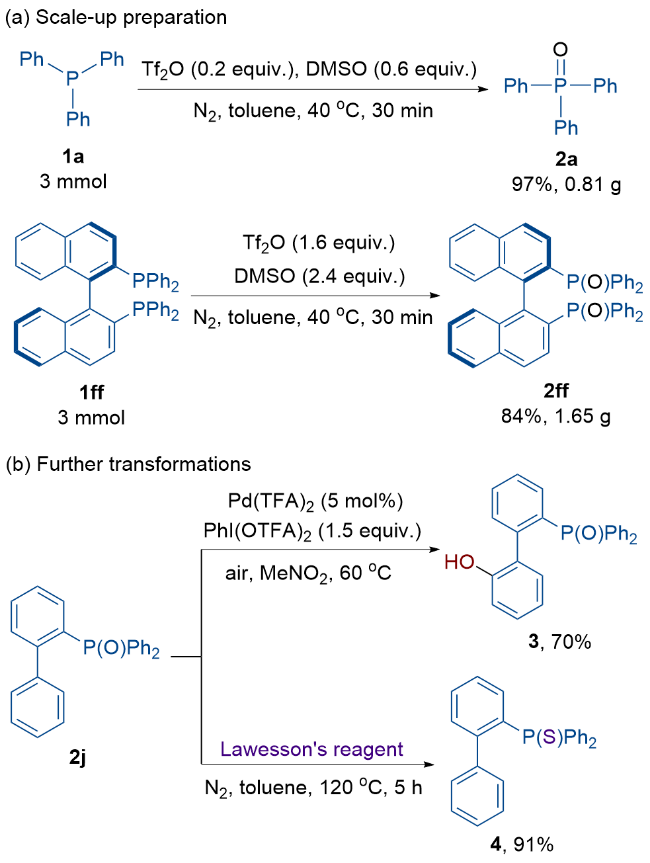
To demonstrate the synthetic utility, the scale-up preparations and further transformations were performed (Scheme 2). Subjecting a phosphine 1a and a bisphosphine 1ff on a 3.0 mmol scale afforded product 2a (0.81 g) and 2ff (1.65 g), respectively, with similar reaction efficiency (Scheme 2a). The phosphine oxide (P=O) group is known to act as an efficient directing group. Accordingly, substrate 2j could be converted to a hydroxylation product 3 in 70% yield.[18] Moreover, treating 2j with Lawesson’s reagent afforded phosphinothioate (P=S) derivative 4 in an excellent yield.
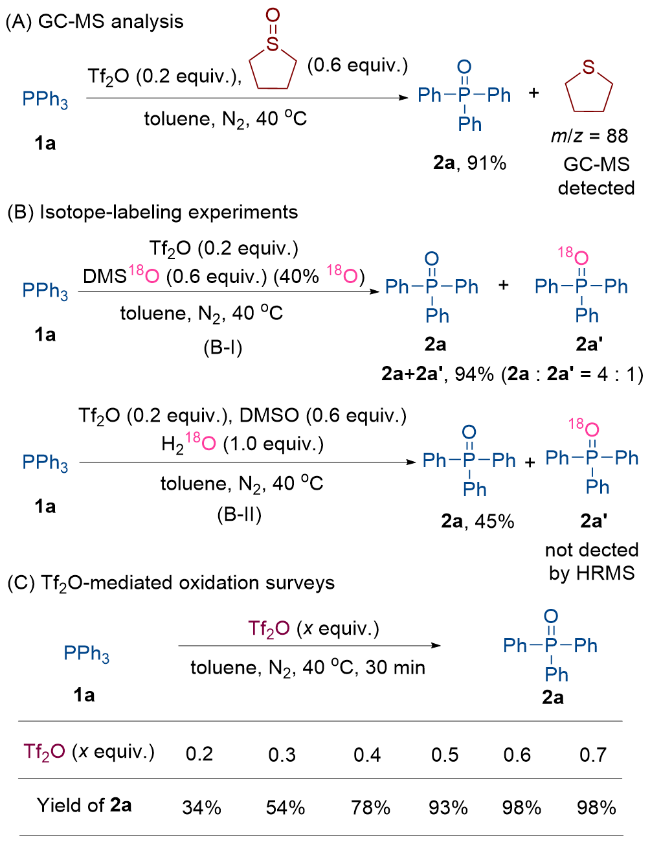
To gain insight into the reaction mechanism, a series of control experiments were conducted (Scheme 3). During the oxidation of 1a to 2a, replacement of DMSO with tetrahydrothiophene 1-oxide led to the detection of tetrahydrothiophene by GC-MS (Scheme 3A), supporting the role of the sulfoxide as an oxidant in this transformation. To further verify its oxidative function, an isotope-labeling experiment using DMS18O (40% 18O) was carried out (Scheme 3B-I). The product 2a and the corresponding 18O-labeled product 2a' were obtained as a mixture in a ratio of 4∶1, indicating that the oxygen atoms incorporated into the P(O)-product originate from both Tf2O and DMSO. Moreover, to verify whether the trace amounts of water in the reaction system are involved in the oxidation process, a template reaction was conducted by adding 1.0 equiv. of H218O (Scheme 3B-II). The isolated products were characterized by HRMS, and only the signal of 2a was observed, with almost no signal of the 18O-labeled product 2a' being detected. This result proves that the oxy- gen atoms in the product do not originate from the water. Additional evidence emerged from earlier optimization studies: the reaction using only 0.2 equiv. of Tf2O afforded 2a in 34% yield (Table 1, Entry 11), suggesting that alongside a potential Tf2O catalytic pathway, a Tf2O-mediated oxidation pathway may also be operative. To probe this pathway in more detail, the effect of Tf2O loading was examined (Scheme 3C). As shown, the yield of 2a increased gradually with increasing amounts of Tf2O, and nearly quantitative conversion was achieved with 0.6 equiv. Tf2O. These results imply that one molecule of Tf2O is capable of oxidizing 2 equiv. of the P(III)-substrate.
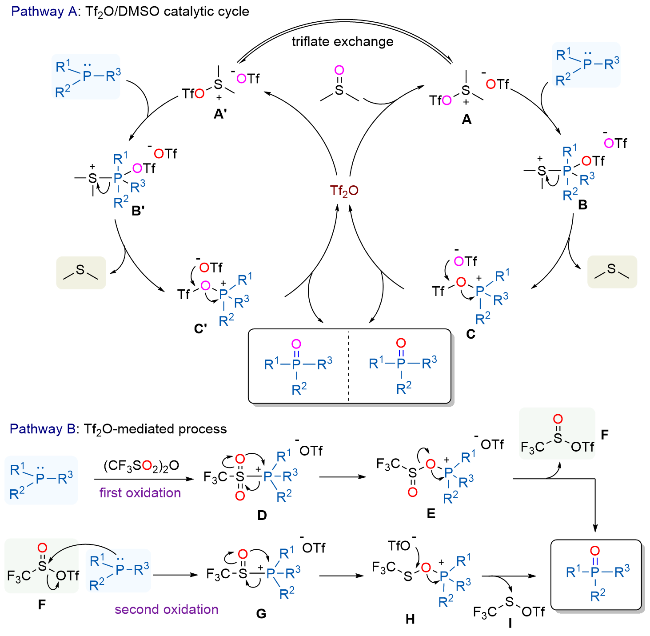
On the basis of the control experiments and literature surveys,[19-21] two plausible mechanistic pathways were proposed for this oxidation reaction, which may coexist during the reaction process (Scheme 4, Pathways A and B): one involving a Tf2O catalytic cycle (Pathway A) and the other involving a Tf2O-mediated process (Pathway B). In Pathway A, Tf2O initially reacts with DMSO to form complex A and the triflate-exchange complex A', analogous to the Albright-Goldman[19a] or Swern[19b] oxidation. Followed by the nucleophilic attack of the P(III)-reagent and the intermolecular attack by TfO- at the phosphonium, adducts B and B' are generated. These intermediates then undergo intramolecular rearrangement to form species C and C', simultaneously releasing dimethyl sulfide as the byproduct.[20c] Finally, electron transfer from C and C' results in the regeneration of Tf2O and the formation of the desired P(O)-products. In Pathway B, the P(III)-reagent first attacks Tf2O nucleophilically to form adduct D. This intermediate undergoes intramolecular rearrangement to give species E, of which the P(III)-portion abstracts an oxygen atom from the CF3SO2- moiety to achieve the first oxidation, yielding the P(O)-product and releasing a byproduct of CF3S(O)OTf (F).[20b,20e] Subsequently, following similar steps of nucleophilic attack and rearrangement, the P(III)-reagent abstracts another oxygen atom from the CF3S(O)-moiety of F to furnish the second oxidation, giving the P(O)-product and a CF3SOTf (I) byproduct.


3 Conclusions
In conclusion, a sub-stoichiometric Tf2O/DMSO-me- diated approach has been developed for the efficient oxidation of phosphine to phosphine oxides. The inexpensive and readily available reagent DMSO serves as a green oxidant in this method. By avoiding the use of stoichiometric oxidant and toxic reagents, this protocol provides an economical and practical synthetic route to a variety of tertiary phosphine oxides. Multiple P(III)-compounds are well tolerated under the Tf2O/DMSO oxidation system. Furthermore, the scalability of this method demonstrates its potential application in industrial production.
4 Experimental section
4.1 General information
1H NMR, 13C NMR, 31P NMR and 19F NMR spectra were recorded on a 500M Bruker AVANCE NEO spectrometer and a 400M JEOL ECZ400s in CDCl3 with TMS as internal standard. High resolution mass spectroscopic (HRMS) were measured using a Thermo Q Exactive Focus mass spectrometer. The starting materials were purchased from Aldrich, Acros Organics, J&K Chemicals or TCI and used without further purification. Solvents were dried and purified according to the procedure from “Purification of Laboratory Chemicals book”. Column chromatography was carried out on silica gel (particle size 200~400 mesh ASTM).
4.2 General procedure for the oxidation of trivalent phosphine to tertiary phosphine oxides
To a Schlenk tube was added 1 (0.2 mmol, 1.0 equiv.), and the tube was charged with nitrogen three times. Anhydrous toluene (2.0 mL), Tf2O (0.04 mmol, 0.2 equiv.) and DMSO (0.12 mmol, 0.6 equiv.) were added via syringe in turn. The mixture was allowed to stir at 40 ℃ for 30 min. At the completion of the reaction, the solvent was removed by rotary evaporation. The resulting residue was purified by column chromatography on silica gel to afford product 2.
Triphenylphosphine oxide (2a): White solid (54.5 mg, 98%), m.p. 152~154 ℃ (lit.[10] 152~154 ℃); 1H NMR (400 MHz, CDCl3) δ: 7.69~7.64 (m, 6H), 7.55~7.51 (m, 3H), 7.46~7.42 (m, 6H); 13C NMR (100 MHz, CDCl3) δ: 132.5 (d, JC-P=104.0 Hz), 132.0 (d, JC-P=10.0 Hz), 131.9 (d, JC-P=3.0 Hz), 128.4 (d, JC-P=12.0 Hz); 31P NMR (162 MHz, CDCl3) δ: 29.11; HRMS calcd for C18H16OP (M+H)+ 279.0933, found 279.0933.
Tris(4-fluorophenyl)phosphine oxide (2b): White solid (57.8 mg, 87%), m.p. 124~126 ℃; 1H NMR (500 MHz, CDCl3) δ: 7.68~7.63 (m, 6H), 7.20~7.16 (m, 6H); 13C NMR (125 MHz, CDCl3) δ: 165.1 (dd, J=2.5, 252.5 Hz), 134.4 (dd, J=8.8, 11.3 Hz), 128.1 (dd, J=2.5, 107.5 Hz), 116.0 (dd, J=12.5, 21.3 Hz); 31P NMR (203 MHz, CDCl3) δ: 26.84; 19F NMR (470 MHz, CDCl3) δ: -105.96; HRMS calcd for C18H13F3OP (M+H)+ 333.0651, found 333.0651.
Tris(4-chlorophenyl)phosphine oxide (2c): White solid (70.7 mg, 93%), m.p. 183~185 ℃; 1H NMR (500 MHz, CDCl3) δ: 7.61~7.56 (m, 6H), 7.48~7.45 (m, 6H); 13C NMR (125 MHz, CDCl3) δ: 139.0 (d, JC-P=2.5 Hz), 133.2 (d, JC-P=10.0 Hz), 130.2 (d, JC-P=105.0 Hz), 129.1 (d, JC-P=13.8 Hz); 31P NMR (203 MHz, CDCl3) δ: 26.91; HRMS calcd for C18H13Cl3OP (M+H)+ 380.9764, found 380.9764.
Tris(4-methoxyphenyl)phosphine oxide (2d): White solid (68.4 mg, 93%), m.p. 143~145 ℃; 1H NMR (500 MHz, CDCl3) δ: 7.59~7.54 (m, 6H), 6.97~6.93 (m, 6H), 3.82 (s, 9H); 13C NMR (125 MHz, CDCl3) δ: 162.2 (d, JC-P=2.5 Hz), 133.7 (d, JC-P=11.3 Hz), 124.3 (d, JC-P=110.0 Hz), 113.8 (d, JC-P=12.5 Hz), 55.2; 31P NMR (203 MHz, CDCl3) δ: 28.78; HRMS calcd for C21H22O4P (M+H)+ 369.1250, found 369.1251.
Tri-p-tolylphosphine oxide (2e): White solid (58.9 mg, 92%), m.p. 145~147 ℃; 1H NMR (500 MHz, CDCl3) δ: 7.52~7.48 (m, 6H), 7.19~7.17 (m, 6H), 2.36 (s, 9H); 13C NMR (125 MHz, CDCl3) δ: 142.1 (d, JC-P=2.5 Hz), 131.9 (d, JC-P=11.3 Hz), 129.3 (d, JC-P=106.3 Hz), 129.0 (d, JC-P=12.5 Hz), 21.43; 31P NMR (203 MHz, CDCl3) δ: 29.65; HRMS calcd for C21H22OP (M+H)+ 321.1403, found 321.1406.
Tri-o-tolylphosphine oxide (2f): White solid (60.2 mg, 94%), m.p. 147~149 ℃; 1H NMR (500 MHz, CDCl3) δ: 7.44~7.41 (m, 3H), 7.32~7.30 (m, 3H), 7.17~7.07 (m, 6H), 2.50 (s, 9H); 13C NMR (125 MHz, CDCl3) δ: 143.4 (d, JC-P=8.8 Hz), 132.8 (d, JC-P=12.5 Hz), 131.9 (d, JC-P=11.3 Hz), 131.8 (d, JC-P=2.5 Hz), 130.6 (d, JC-P=100.0 Hz), 125.4 (d, JC-P=12.5 Hz), 21.9 (d, JC-P=3.8 Hz); 31P NMR (203 MHz, CDCl3) δ: 37.13; HRMS calcd for C21H22OP (M+H)+ 321.1403, found 321.1405.
Tri-m-tolylphosphine oxide (2g): White solid (57.6 mg, 90%), m.p. 110~112 ℃; 1H NMR (500 MHz, CDCl3) δ: 7.58 (d, J=10.0 Hz, 3H), 7.41~7.28 (m, 9H), 2.36 (s, 9H); 13C NMR (125 MHz, CDCl3) δ: 138.3 (d, JC-P=12.5 Hz), 132.5 (d, JC-P=2.5 Hz), 132.5 (d, JC-P=103.8 Hz), 132.4 (d, JC-P=8.8 Hz), 129.1 (d, JC-P=10.0 Hz), 128.1 (d, JC-P=12.5 Hz), 21.3; 31P NMR (203 MHz, CDCl3) δ: 29.42; HRMS calcd for C21H22OP (M+H)+ 321.1403, found 321.1402.
Tris(3,5-dimethylphenyl)phosphine oxide (2h): White solid (67.3 mg, 93%), m.p. 199~201 ℃; 1H NMR (500 MHz, CDCl3) δ: 7.30~7.26 (m, 6H), 7.14 (d, J=5.0 Hz, 6H), 2.31 (s, 18H); 13C NMR (125 MHz, CDCl3) δ: 137.9 (d, JC-P=13.8 Hz), 133.4 (d, JC-P=2.5 Hz), 132.5 (d, JC-P=102.5 Hz), 129.5 (d, JC-P=10.0 Hz), 21.2; 31P NMR (203 MHz, CDCl3) δ: 29.66; HRMS calcd for C24H28OP (M+H)+ 363.1872, found 363.1873.
Diphenyl(p-tolyl)phosphine oxide (2i): White solid (55.5 mg, 95%), m.p. 132~134 ℃; 1H NMR (500 MHz, CDCl3) δ: 7.69~7.64 (m, 4H), 7.58~7.50 (m, 4H), 7.46~7.42 (m, 4H), 7.28~7.25 (m, 2H), 2.39 (s, 3H); 13C NMR (125 MHz, CDCl3) δ: 142.3 (d, JC-P=3.8 Hz), 132.7 (d, JC-P=103.8 Hz), 132.0 (d, JC-P=10.0 Hz), 131.9 (d, JC-P=10.0 Hz), 131.7 (d, JC-P=2.5 Hz), 129.1 (d, JC-P=12.5 Hz), 129.0 (d, JC-P=106.3 Hz), 128.3 (d, JC-P=12.5 Hz), 21.5; 31P NMR (203 MHz, CDCl3) δ: 29.15; HRMS calcd for C19H18OP (M+H)+ 293.1090, found 293.1094.
[1,1'-Biphenyl]-2-yldiphenylphosphine oxide (2j): White solid (62.3 mg, 88%), m.p. 155~157 ℃; 1H NMR (500 MHz, CDCl3) δ: 7.61~7.51 (m, 5H), 7.44~7.19 (m, 11H), 7.07~7.02 (m, 3H); 13C NMR (125 MHz, CDCl3) δ: 147.6 (d, JC-P=8.8 Hz), 140.2 (d, JC-P=3.8 Hz), 133.9 (d, JC-P=12.5 Hz), 133.0 (d, JC-P=103.8 Hz), 131.9 (d, JC-P=10.0 Hz), 131.6, 131.6 (d, JC-P=101.3 Hz), 131.5 (d, JC-P=8.8 Hz), 131.0 (d, JC-P=3.8 Hz), 130.0, 128.0 (d, JC-P=12.5 Hz), 127.1, 127.0, 126.5 (d, JC-P=12.5 Hz); 31P NMR (203 MHz, CDCl3) δ: 27.76; HRMS calcd for C24H20OP (M+H)+ 355.1246, found 355.1247.
Tri(furan-2-yl)phosphine oxide (2k): White solid (45.6 mg, 92%), m.p. 89~91 ℃; 1H NMR (400 MHz, CDCl3) δ: 7.74~7.72 (m, 3H), 7.21~7.16 (m, 3H), 6.57~6.54 (m, 3H); 13C NMR (100 MHz, CDCl3) δ: 148.8 (d, JC-P=8.0 Hz), 145.8 (d, JC-P=158.0 Hz), 123.4 (d, JC-P=22.0 Hz), 111.0 (d, JC-P=9.0 Hz); 31P NMR (162 MHz, CDCl3) δ: -11.61; HRMS calcd for C12H10O4P (M+H)+ 249.0311, found 249.0312.
Diphenyl(thiophen-2-yl)phosphine oxide (2l): White solid (50.6 mg, 89%), m.p. 110~112 ℃; 1H NMR (500 MHz, CDCl3) δ: 7.75~7.71 (m, 5H), 7.55~7.43 (m, 7H), 7.18~7.16 (m, 1H); 13C NMR (125 MHz, CDCl3) δ: 136.7 (d, JC-P=10.0 Hz), 133.8 (d, JC-P=5.0 Hz), 133.6 (d, JC-P=111.3 Hz), 132.7 (d, JC-P=108.8 Hz), 132.0 (d, JC-P=2.5 Hz), 131.5 (d, JC-P=11.3 Hz), 128.3 (d, JC-P=12.5 Hz), 128.0 (d, JC-P=13.8 Hz); 31P NMR (203 MHz, CDCl3) δ: 21.75; HRMS calcd for C16H14OPS (M+H)+ 285.0497, found 285.0496.
Diphenyl(pyridin-2-yl)phosphine oxide (2m): White solid (46.3 mg, 83%), m.p. 111~113 ℃; 1H NMR (500 MHz, CDCl3) δ: 8.77 (d, J=5.0 Hz, 1H), 8.30 (t, J=10.0 Hz, 1H), 7.91~7.82 (m, 5H), 7.52~7.36 (m, 7H); 13C NMR (125 MHz, CDCl3) δ: 156.8 (d, JC-P=131.2 Hz), 150.6 (d, JC-P=18.8 Hz), 136.1 (d, JC-P=8.8 Hz), 132.1 (d, JC-P=103.8 Hz), 132.0 (d, JC-P=10.0 Hz), 131.8 (d, JC-P=2.5 Hz), 128.4, 128.3 (d, JC-P=12.5 Hz), 125.2 (d, JC-P=2.5 Hz); 31P NMR (203 MHz, CDCl3) δ: 20.82; HRMS calcd for C17H15NOP (M+H)+ 280.0886, found 280.0886.
Naphthalen-2-yldiphenylphosphine oxide (2n): Colorless oil (57.1 mg, 87%). 1H NMR (500 MHz, CDCl3) δ: 8.30~8.27 (m, 1H), 7.92~7.86 (m, 3H), 7.77~7.67 (m, 4H), 7.66~7.62 (m, 1H), 7.61~7.52 (m, 4H), 7.49~7.44 (m, 4H); 13C NMR (125 MHz, CDCl3) δ: 134.6 (d, JC-P=2.5 Hz), 133.9 (d, JC-P=8.8 Hz), 132.4 (d, JC-P=103.8 Hz), 132.3 (d, JC-P=13.8 Hz), 132.1 (d, JC-P=10.0 Hz), 131.9 (d, JC-P=2.5 Hz), 129.4 (d, JC-P=103.8 Hz), 128.9, 128.5 (d, JC-P=11.3 Hz), 128.3, 128.2, 127.8, 126.9, 126.7 (d, JC-P=10.0 Hz); 31P NMR (203 MHz, CDCl3) δ: 29.38; HRMS calcd for C22H18OP (M+H)+ 329.1090, found 329.1091.
Di(naphthalen-2-yl)(phenyl)phosphine oxide (2o): Colorless oil (55.9 mg, 74%). 1H NMR (400 MHz, CDCl3) δ: 8.36~8.32 (m, 2H), 7.91~7.84 (m, 6H), 7.80~7.67 (m, 4H), 7.59~7.44 (m, 7H); 13C NMR (100 MHz, CDCl3) δ: 134.7 (d, JC-P=2.0 Hz), 134.0 (d, JC-P=9.0 Hz), 132.6 (d, JC-P=104.0 Hz), 132.4 (d, JC-P=13.0 Hz), 132.1 (d, JC-P=10.0 Hz), 132.0 (d, JC-P=3.0 Hz), 129.6 (d, JC-P=104.0 Hz), 128.9, 128.5 (t, JC-P=12.0 Hz), 128.2, 128.2, 127.8, 126.9, 126.8; 31P NMR (162 MHz, CDCl3) δ: 29.20; HRMS calcd for C26H20OP (M+H)+ 379.1246, found 379.1247.
Di(naphthalen-1-yl)(phenyl)phosphine oxide (2p): Whi- te solid (39.3 mg, 52%), m.p. 225~227 ℃; 1H NMR (400 MHz, CDCl3) δ: 8.84~8.81 (m, 2H), 7.97~7.94 (m, 2H), 7.86~7.82 (m, 2H), 7.73~7.68 (m, 2H), 7.51~7.37 (m, 7H), 7.28~7.21 (m, 4H); 13C NMR (100 MHz, CDCl3) δ: 133.8 (dd, J=3.0, 8.0 Hz), 133.3 (d, JC-P=12.0 Hz), 133.2, 133.0 (d, JC-P=3.0 Hz), 132.2 (d, JC-P=10.0 Hz), 131.8 (d, JC-P=3.0 Hz), 128.9 (d, JC-P=102.0 Hz), 128.6 (d, JC-P=1.0 Hz), 128.5, 128.4, 127.7 (d, JC-P=5.0 Hz), 127.2, 126.4, 124.1 (d, JC-P=14.0 Hz); 31P NMR (162 MHz, CDCl3) δ: 36.23; HRMS calcd for C26H20OP (M+H)+ 379.1246, found 379.1247.
Methyldiphenylphosphine oxide (2s): White solid (40.6 mg, 94%), m.p. 113~115 ℃; 1H NMR (500 MHz, CDCl3) δ: 7.75~7.71 (m, 4H), 7.53~7.44 (m, 6H), 2.02 (d, J=15.0 Hz, 3H); 13C NMR (125 MHz, CDCl3) δ: 133.9 (d, JC-P=101.3 Hz), 131.6 (d, JC-P=2.5 Hz), 130.4 (d, JC-P=8.8 Hz), 128.5 (d, JC-P=11.3 Hz), 16.4 (d, JC-P=73.8 Hz); 31P NMR (203 MHz, CDCl3) δ: 29.87; HRMS calcd for C13H14OP (M+H)+ 217.0777, found 217.0778.
Cyclohexyldiphenylphosphine oxide (2t): White solid (52.3 mg, 92%), m.p. 166~168 ℃; 1H NMR (500 MHz, CDCl3) δ: 7.81~7.76 (m, 4H), 7.50~7.43 (m, 6H), 2.28~2.20 (m, 1H), 1.82~1.68 (m, 5H), 1.59~1.49 (m, 2H), 1.31~1.20 (m, 3H); 13C NMR (125 MHz, CDCl3) δ: 132.0 (d, JC-P=93.8 Hz), 131.3 (d, JC-P=2.5 Hz), 130.9 (d, JC-P=8.8 Hz), 128.4 (d, JC-P=11.3 Hz), 37.1 (d, JC-P=72.5 Hz), 26.2 (d, JC-P=1.3 Hz), 25.6 (d, JC-P=2.5 Hz), 24.7 (d, JC-P=3.8 Hz); 31P NMR (203 MHz, CDCl3) δ: 34.28; HRMS calcd for C18H22OP (M+H)+ 285.1403, found 285.1405.
Benzyldiphenylphosphine oxide (2u): White solid (55.5 mg, 95%), m.p. 187~189 ℃; 1H NMR (500 MHz, CDCl3) δ: 7.71~7.67 (m, 4H), 7.50~7.39 (m, 6H), 7.19~7.09 (m, 5H), 3.65 (d, J=15.0 Hz, 2H); 13C NMR (125 MHz, CDCl3) δ: 132.5, 131.8, 131.7 (d, JC-P=2.5 Hz), 131.0 (d, JC-P=8.8 Hz), 130.0 (d, JC-P=5.0 Hz), 128.3 (d, JC-P=11.3 Hz), 128.2 (d, JC-P=2.5 Hz), 126.6 (d, JC-P=2.5 Hz), 37.9 (d, JC-P=66.3 Hz); 31P NMR (203 MHz, CDCl3) δ: 29.53; HRMS calcd for C19H18OP (M+H)+ 293.1090, found 293.1095.
Dimethyl(phenyl)phosphine oxide (2v): White solid (25.6 mg, 83%), m.p. 119~121 ℃; 1H NMR (500 MHz, CDCl3) δ: 7.77~7.72 (m, 2H), 7.55~7.48 (m, 3H), 1.74 (d, J=10.0 Hz, 6H); 13C NMR (125 MHz, CDCl3) δ: 134.6 (d, JC-P=97.5 Hz), 131.5 (d, JC-P=2.5 Hz), 129.4 (d, JC-P=10.0 Hz), 128.5 (d, JC-P=11.3 Hz), 17.9 (d, JC-P=71.3 Hz); 31P NMR (203 MHz, CDCl3) δ: 33.91; HRMS calcd for C8H12OP (M+H)+ 155.0620, found 155.0621.
[1,1'-Biphenyl]-2-yldicyclohexylphosphine oxide (2w): White solid (63.7 mg, 87%), m.p. 108~110 ℃; 1H NMR (500 MHz, CD3OD) δ: 7.99~7.95 (m, 1H), 7.61~7.54 (m, 2H), 7.50~7.46 (m, 3H), 7.29~7.22 (m, 3H), 1.86~1.81 (m, 8H), 1.48~1.38 (m, 6H), 1.28~1.07 (m, 8H); 13C NMR (125 MHz, CD3OD) δ: 145.7 (d, JC-P=8.8 Hz), 143.0 (d, JC-P=2.5 Hz), 134.4 (d, JC-P=6.3 Hz), 132.6 (d, JC-P=10.0 Hz), 132.5 (d, JC-P=2.5 Hz), 130.1, 129.7 (d, JC-P=82.5 Hz), 129.3, 129.3, 128.5 (d, JC-P=10.0 Hz), 39.1 (d, JC-P=65.0 Hz), 27.5 (t, JC-P=3.8 Hz), 27.3 (dd, J=6.3, 11.3 Hz), 26.8 (d, JC-P=1.3 Hz); 31P NMR (203 MHz, CD3OD) δ: 52.72; HRMS calcd for C24H32OP (M+H)+ 367.2185, found 367.2185.
Dicyclohexyl(2',4',6'-triisopropyl-[1,1'-biphenyl]-2-yl)phosphine oxide (2x): White solid (86.6 mg, 88%), m.p. 224~226 ℃; 1H NMR (500 MHz, CDCl3) δ: 7.70~7.66 (m, 1H), 7.45~7.38 (m, 2H), 7.18~7.16 (m, 1H), 6.98 (s, 2H), 2.95~2.86 (m, 1H), 2.44~2.38 (m, 2H), 1.89~1.64 (m, 12H), 1.42~1.36 (m, 4H), 1.29~1.24 (m, 12H), 1.18~1.11 (m, 6H), 0.95 (d, J=10.0 Hz, 6H); 13C NMR (125 MHz, CDCl3) δ: 147.6, 145.7, 145.1 (d, JC-P=5.0 Hz), 135.9 (d, JC-P=2.5 Hz), 133.4 (d, JC-P=10.0 Hz), 131.8 (d, JC-P=8.8 Hz), 131.4 (d, JC-P=82.5 Hz), 129.7 (d, JC-P=2.5 Hz), 125.9 (d, JC-P=10.0 Hz), 120.2, 37.6 (d, JC-P=32.5 Hz), 34.0, 30.7, 26.7 (dd, J=5.0, 12.5 Hz), 26.0 (dd, J=2.5, 21.3 Hz), 25.9 (d, JC-P=12.5 Hz), 24.0, 22.8; 31P NMR (203 MHz, CDCl3) δ: 44.24; HRMS calcd for C33H50OP (M+H)+ 493.3594, found 493.3597.
Phenyl diphenylphosphinate (2y): White solid (54.7 mg, 93%), m.p. 134~136 ℃; 1H NMR (500 MHz, CDCl3) δ: 7.91~7.87 (m, 4H), 7.53~7.42 (m, 6H), 7.24~7.19 (m, 4H), 7.07~7.04 (m, 1H); 13C NMR (125 MHz, CDCl3) δ: 150.8 (d, JC-P=7.5 Hz), 132.3 (d, JC-P=2.5 Hz), 131.7 (d, JC-P=10.0 Hz), 130.9 (d, JC-P=137.5 Hz), 129.5, 128.5 (d, JC-P=13.8 Hz), 124.5, 120.6 (d, JC-P=5.0 Hz); 31P NMR (203 MHz, CDCl3) δ: 30.37; HRMS calcd for C18H16O2P (M+H)+ 295.0882, found 295.0885.
Ethyl diphenylphosphinate (2z): colorless oil (29.5 mg, 60%). 1H NMR (500 MHz, CDCl3) δ: 7.84~7.80 (m, 4H), 7.52~7.42 (m, 6H), 4.14~4.08 (m, 2H), 1.37 (t, J=5.0 Hz, 3H); 13C NMR (125 MHz, CDCl3) δ: 132.0 (d, JC-P=3.8 Hz), 131.5 (d, JC-P=136.3 Hz), 131.5 (d, JC-P=10.0 Hz), 128.4 (d, JC-P=13.8 Hz), 61.0 (d, JC-P=5.0 Hz), 16.4 (d, JC-P=6.3 Hz); 31P NMR (203 MHz, CDCl3) δ: 31.37; HRMS calcd for C14H16O2P (M+H)+ 247.0882, found 247.0882.
Diphenyl phenylphosphonate (2aa): White solid (52.1 mg, 84%), m.p. 73~75 ℃; 1H NMR (500 MHz, CDCl3) δ: 7.98~7.94 (m, 2H), 7.60~7.56 (m, 1H), 7.50~7.46 (m, 2H), 7.29~7.24 (m, 4H), 7.19~7.11 (m, 6H); 13C NMR (125 MHz, CDCl3) δ: 150.3 (d, JC-P=7.5 Hz), 133.1 (d, JC-P=3.8 Hz), 132.2 (d, JC-P=11.3 Hz), 129.6, 128.6 (d, JC-P=15.0 Hz), 126.8 (d, JC-P=192.5 Hz), 125.1, 120.5 (d, JC-P=3.8 Hz); 31P NMR (203 MHz, CDCl3) δ: 11.72; HRMS calcd for C18H16O3P (M+H)+ 311.0832, found 311.0831.
Triphenyl phosphate (2bb): Colorless oil (61.9 mg, 95%). 1H NMR (500 MHz, CDCl3) δ: 7.36~7.33 (m, 6H), 7.25~7.19 (m, 9H); 13C NMR (125 MHz, CDCl3) δ: 150.5 (d, JC-P=7.5 Hz), 129.8, 125.6, 120.1 (d, JC-P=5.0 Hz); 31P NMR (203 MHz, CDCl3) δ: 17.69; HRMS calcd for C18H16O4P (M+H)+ 327.0781, found 327.0784.
N,P,P-Triphenylphosphinic amide (2cc): White solid (42.2 mg, 72%), m.p. 225~227 ℃; 1H NMR (400 MHz, CDCl3) δ: 7.91~7.85 (m, 4H), 7.55~7.42 (m, 6H), 7.16~7.11 (m, 2H), 6.99~6.97 (m, 2H), 6.91~6.87 (m, 1H), 5.44 (d, J=12.0 Hz, 1H); 13C NMR (100 MHz, CDCl3) δ: 140.3, 132.2 (d, JC-P=2.0 Hz), 132.0 (d, JC-P=10.0 Hz), 131.9 (d, JC-P=129.0 Hz), 129.2, 128.8 (d, JC-P=13 Hz), 121.8, 118.5 (d, JC-P=7.0 Hz); 31P NMR (162 MHz, CDCl3) δ: 18.38; HRMS calcd for C18H17NOP (M+H)+ 294.1042, found 294.1042.
(Oxybis(2,1-phenylene))bis(diphenylphosphine oxide) (2dd): White solid (99.2 mg, 87%), m.p. 287~289 ℃; 1H NMR (500 MHz, CD3OD) δ: 7.70~7.48 (m, 16H), 7.42~7.29 (m, 8H), 7.20~7.16 (m, 2H), 6.20~6.17 (m, 2H); 13C NMR (125 MHz, CD3OD) δ: 160.3 (d, JC-P=3.8 Hz), 135.8, 134.9 (d, JC-P=7.5 Hz), 133.7, 133.2 (d, JC-P=11.3 Hz), 133.0 (d, JC-P=11.3 Hz), 129.8 (dd, J=12.5, 40.0 Hz), 125.3 (d, JC-P=11.3 Hz), 124.1 (d, JC-P=102.5 Hz), 121.5; 31P NMR (203 MHz, CD3OD) δ: 29.61; HRMS calcd for C36H29O3P2 (M+H)+ 571.1587, found 571.1592.
Propane-1,3-diylbis(diphenylphosphine oxide) (2ee): White solid (75.5 mg, 85%), m.p. 145~147 ℃; 1H NMR (500 MHz, CDCl3) δ: 7.71~7.67 (m, 8H), 7.50~7.40 (m, 12H), 2.53~2.47 (m, 4H), 2.06~1.95 (m, 2H); 13C NMR (125 MHz, CDCl3) δ: 132.5 (d, JC-P=98.8 Hz), 131.7 (d, JC-P=2.5 Hz), 130.6 (d, JC-P=8.8 Hz), 128.6 (d, JC-P=11.3 Hz), 30.0 (dd, J=11.3, 71.3 Hz), 14.9 (t, JC-P=3.8 Hz); 31P NMR (203 MHz, CDCl3) δ: 32.41; HRMS calcd for C27H27O2P2 (M+H)+ 445.1481, found 445.1483.
[1,1'-Binaphthalene]-2,2'-diylbis(diphenylphosphine oxide) (2ff): White solid (112.5 mg, 86%), m.p. 295~297 ℃; 1H NMR (500 MHz, CDCl3) δ: 7.85~7.79 (m, 4H), 7.71~7.67 (m, 4H), 7.45~7.32 (m, 12H), 7.26~7.21 (m, 8H), 6.79 (d, J=4.0 Hz, 4H); 13C NMR (125 MHz, CDCl3) δ: 142.9, 134.5 (d, JC-P=105.0 Hz), 134.0 (d, JC-P=2.5 Hz), 133.3 (d, JC-P=12.5 Hz), 132.2 (dd, J=10.0, 60.0 Hz), 131.0 (dd, J=2.5, 23.8 Hz), 129.0 (d, JC-P=102.5 Hz), 128.1, 128.0, 127.9 (d, JC-P=12.5 Hz), 127.7 (d, JC-P=8.8 Hz), 127.3 (d, JC-P=13.8 Hz), 127.1 (d, JC-P=7.5 Hz), 125.8; 31P NMR (203 MHz, CDCl3) δ: 28.3; HRMS calcd for C44H33O2P2 (M+H)+ 655.1950, found 655.1951.
[4,4'-Bibenzo[d][1,3]dioxole]-5,5'-diylbis(diphenylphosphine oxide) (2gg): White solid (106.6 mg, 83%), m.p. 123~125 ℃; 1H NMR (400 MHz, CDCl3) δ: 7.66~7.60 (m, 4H), 7.55~7.50 (m, 4H), 7.42~7.27 (m, 8H), 7.23~7.18 (m, 4H), 6.73~6.67 (m, 2H), 6.59~6.56 (m, 2H), 5.63 (d, J=4.0 Hz, 2H), 5.17 (d, J=1.5 Hz, 2H); 13C NMR (100 MHz, CDCl3) δ: 149.6 (d, JC-P=3.0 Hz), 146.8 (d, JC-P=16.0 Hz), 134.7 (d, JC-P=5.0 Hz), 133.6 (d, JC-P=4.0 Hz), 132.2 (dd, J=10.0, 15.0 Hz), 131.1 (dd, J=3.0, 7.0 Hz), 129.0 (d, JC-P=13.0 Hz), 127.9 (dd, J=2.0, 13.0 Hz), 124.3 (d, JC-P=107.0 Hz), 119.4 (dd, J=4.0, 10.0 Hz), 107.5 (d, JC-P=16.0 Hz), 101.3, 29.6; 31P NMR (162 MHz, CDCl3) δ: 29.16; HRMS calcd for C38H29O6P2 (M+H)+ 643.1434, found 643.1437.
((2R,3R)-2,3-Dihydroxybutane-1,4-diyl)bis(diphenylphosphine oxide) (2hh): White solid (85.3 mg, 87%), m.p. 304~306 ℃; 1H NMR (400 MHz, CDCl3) δ: 7.74~7.66 (m, 8H), 7.52~7.38 (m, 12H), 4.47 (s, 2H), 4.14~4.08 (m, 2H), 2.73~2.57 (m, 4H) 13C NMR (100 MHz, CDCl3) δ: 132.8 (d, JC-P=74.0 Hz), 131.9 (d, JC-P=2.0 Hz), 131.8 (d, JC-P=2.0 Hz), 131.8 (d, JC-P=73.0 Hz), 130.7 (d, JC-P=9.0 Hz), 130.5 (d, JC-P=10.0 Hz), 128.7 (d, JC-P=8.0 Hz), 128.6 (d, JC-P=7.0 Hz), 69.3 (dd, J=3.0, 10.0 Hz), 32.1 (d, JC-P=71.0 Hz); 31P NMR (162 MHz, CDCl3) δ: 34.34; HRMS calcd for C28H29O4P2 (M+H)+ 491.1536, found 491.1539.
(2'-Hydroxy-[1,1'-biphenyl]-2-yl)diphenylphosphine oxide (3): White solid (77.7 mg, 70%), m.p. 231~233 ℃; 1H NMR (400 MHz, CDCl3) δ: 9.00 (s, 1H), 7.82~7.77 (m, 2H), 7.60~7.47 (m, 4H), 7.39~7.16 (m, 8H), 7.05~6.97 (m, 2H), 6.51~6.43 (m, 2H); 13C NMR (100 MHz, CDCl3) δ: 154.1, 144.3 (d, JC-P=8.0 Hz), 132.9 (d, JC-P=10.0 Hz), 132.5 (d, JC-P=2.0 Hz), 132.3 (d, JC-P=30.0 Hz), 132.2 (d, JC-P=9.0 Hz), 131.4 (d, JC-P=3.0 Hz), 131.1 (d, JC-P=3.0 Hz), 131.1 (d, JC-P=62.0 Hz), 130.9 (d, JC-P=10.0 Hz), 130.0 (d, JC-P=63.0 Hz), 129.0, 128.6 (d, JC-P=12.0 Hz), 128.0 (d, JC-P=13.0 Hz), 126.9 (d, JC-P=12.0 Hz), 121.2 (d, JC-P=64.0 Hz); 31P NMR (162 MHz, CDCl3) δ: 32.20; HRMS calcd for C24H20O2P (M+H)+ 371.1195, found 371.1196.
[1,1'-Biphenyl]-2-yldiphenylphosphine sulfide (4): Yellow solid (67.3 mg, 91%), m.p. 128~132 ℃; 1H NMR (500 MHz, CDCl3) δ: 7.78~7.73 (m, 4H), 7.53~7.43 (m, 2H), 7.38~7.25 (m, 8H), 7.18~6.97 (m, 5H); 13C NMR (125 MHz, CDCl3) δ: 146.7 (d, JC-P=8.8 Hz), 140.1 (d, JC-P=3.8 Hz), 133.7 (d, JC-P=12.5 Hz), 133.2, 132.7 (d, JC-P=10.0 Hz), 132.6, 132.2 (d, JC-P=10.0 Hz), 131.9, 131.2 (d, JC-P=2.5 Hz), 130.9 (d, JC-P=3.8 Hz), 130.1, 128.0 (d, JC-P=12.5 Hz), 127.0, 126.9 (d, JC-P=12.5 Hz); 31P NMR (203 MHz, CDCl3) δ: 42.31; HRMS calcd for C24H20PS (M+H)+ 371.1018, found 371.1018.
Supporting Information 1H NMR, 13C NMR, 31P NMR of compounds 2a~2p, 2s~2z, 2aa~2hh, 3, 4 and 19F NMR spectra of compound 2b. The Supporting Information is available free of charge via the Internet at http://sioc- journal.cn/.
(Cheng, F.)