



1 Introduction
The Minisci-type radical coupling, initially developed by Minisci et al.[1] in the 1960s, is a viable strategy for direct C—H functionalization of heteroaromatics and has been extensively studied by scientists over the past half- century.[2-4] In recent years, visible-light-induced photoredox catalysis has become an important strategy in molecular synthesis,[5-6] characterized by mild and straightforward reaction conditions.[7-10] This approach has found broad applications in the synthesis of complex pharmaceuticals[11] and natural products.[12-13] The powerful photoredox strategy could enable mild and versatile access to diverse radical precursors,[14-15] which have been ingeniously utilized for the Minisci reaction to generate various functionalized heteroaromatics.[16-17] The integration allows the direct construction of diverse C—H functionalized products under mild conditions[18-21] and has recently been extendedly exploited for multicomponent assembly.[22-23]
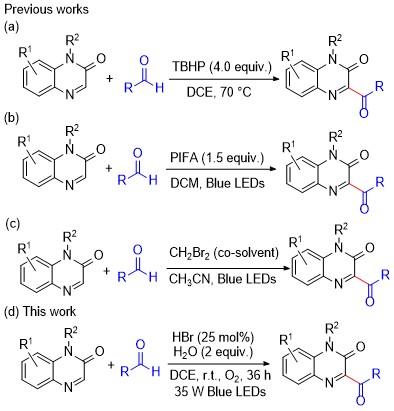
Quinazolin-2(1H)-ones, formed by the fusion of a benzene ring with a pyrimidinone ring, belong to the quinazolinone class of compounds. As a significant nitrogen-con- taining heterocyclic structural unit,[24] its unique framework possesses notable biological activities and medicinal value, enabling broad applications in drug molecules,[25] natural products,[26] and biomolecules.[27] Furthermore, quinazolin-2(1H)-ones exhibit high modifiability,[28] with extensive research focusing particularly on direct functionalization at the C(3) position, such as acylation.[29-32] In 2018, Yuan’s group[33] reported a tert-butyl hydroperoxide (TBHP)-mediated method for the C(3)-acylation of quina- zolin-2(1H)-ones at 70 ℃ (Scheme 1, a). In 2021, Ni’s group[34] achieved the same transformation using phenyliodine(III) bis(trifluoroacetate) (PIFA) as the mediator under blue LEDs conditions (Scheme 1, b). In 2024, Li et al.[35] reported a photoredox cross-dehydrogenative coupling between quinazolin- 2(1H)-ones and aldehydes using excessive dibromomethane as co-solvent, bromo source as well as oxidant (Scheme 1, c). While these methods represent significant advancements, they still suffer from certain drawbacks including the use of stoichiometric toxic oxidants and poor atom economy. Therefore, developing a milder and more environmentally friendly approach for the C(3)-acylation of quinazolin-2(1H)-ones remains essential. As our on-going program on sustainable chemistry,[36-37] Herein, we report a visible-light-induced hydrogen bromide-catalyzed aerobic method for the C(3)-acylation of quinazolin-2(1H)-ones via direct Minisci-type cross dehydrogenative couplings (Scheme 1, d).
2 Results and discussion
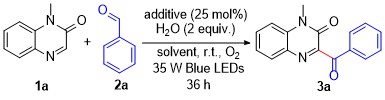
Initially, quinoxalin-2(1H)-ones (1a) and benzaldehyde (2a) were employed as model substrates to optimize the reaction systems. With screening studies on various reaction parameters, the optimized conditions for the reaction were identified as: employing a 1∶4 molar ratio of quinoxalin-2(1H)-ones (1a) to benzaldehyde (2a), 25 mol% HBr (aq., ω=48%) as an additive, H2O (2.0 equiv) and dichloroethane (DCE) as the solvent under an oxygen atmosphere at room temperature (25~30 ℃) with 35 W blue LEDs for 36 h, which afforded the desired product (3a) in 92% yield (Table 1, Entry 1). Control experiments showed that product 3a was not observed in the absence of HBr additive (Table 1, Entry 2), indicating the essential role of HBr. The screening of water content in the system indicates that adding 2.0 equiv of water yields the optimal result (Table1, Entries 3~8). Then, the effect of reaction media, as testing other solvents including dichloromethane (DCM), acetone, H2O, CHCl3, and MeCN, identified DCE as the optimal choice for this reaction (Table1, Entries 9~13). A systematic evaluation of various additives including trimethyl-chlorosilane (TMSCl), methanesulfonic acid (MsOH), trimethyl-bromo silane (TMSBr), CF3SO3H, NaBr, NaCl and LiCl, revealed that HBr exhibited significantly superior performance (Table 1, Entries 14~20). A screening study of the additive loading identified 25 mol% of HBr as the optimal amount for the reaction (Table 1, Entries 21 and 22). Last, 4.0 equiv. of benzaldehyde (2a) was established as the optimal usage, and diminished that reaction efficiency is attributed to oxidative degradation of a significant portion of benzaldehyde under the oxygen at- mosphere. Furthermore, control experiments verified that both light irradiation and an oxygen atmosphere are essential for this reaction (Table 1, Entries 23~25).
Table 1 Optimization of reaction conditionsa |
| Entry | Additive (mol%) | H2O/mol% | Solvent | Yielda/% |
|---|---|---|---|---|
| 1 | HBr (25) | 2.0 | DCE | 92 |
| 2c | — | — | DCE | 0 |
| 3d | HBr (25) | — | DCE | 65 |
| 4 | HBr (25) | — | DCE | 84 |
| 5 | HBr (25) | 1.0 | DCE | 89 |
| 6 | HBr (25) | 3.0 | DCE | 88 |
| 7 | HBr (25) | 5.0 | DCE | 62 |
| 8 | HBr (25) | 10.0 | DCE | 51 |
| 9 | HBr (25) | — | DCM | 20 |
| 10 | HBr (25) | — | Acetone | 0 |
| 11 | HBr (25) | — | H2O | 45 |
| 12 | HBr (25) | — | CHCl3 | 53 |
| 13 | HBr (25) | — | MeCN | 35 |
| 14 | TMSCl (25) | — | DCE | 51 |
| 15 | MsOH (25) | — | DCE | 30 |
| 16 | TMSBr (25) | — | DCE | 23 |
| 17 | CF3SO3H (25) | — | DCE | 33 |
| 18 | NaBr (25) | — | DCE | 23 |
| 19 | NaCl (25) | — | DCE | 15 |
| 20 | LiCl (25) | — | DCE | 10 |
| 21 | HBr (20) | — | DCE | 75 |
| 22 | HBr (30) | — | DCE | 91 |
| 23e | HBr (25) | — | DCE | 0 |
| 24f | HBr (25) | — | DCE | Trace |
| 25g | HBr (25) | ___ | DCE | Trace |
a Reaction conditions: 1a (0.2 mmol), 2a (0.8 mmol, 4.0 equiv.), additive (25 mol%) and H2O (2.0 equiv.) in solvent (2.0 mL) at room temperature (25~30 ℃) under O2 atmosphere (sealed tube) and 35 W blue LEDs irradiation for 36 h. b Isolated product. c In the absence of additive. d Add 4A molecular sieve. e In dark. f Under Ar atmosphere. g Under air atmosphere. |
With the optimized reaction conditions in hand, we next probed the substrate scope and generality of the acylating reaction between substituted quinoxalin-2(1H)-ones and aromatic aldehydes (Table 2). A variety of N-alkyl-protected a significant portion of benzaldehyde under the oxygen at- mosphere. Furthermore, control experiments verified that quinoxalin-2(1H)-ones, including N-methyl (3a), N-ethyl (3b), and N-cyclopropyl (3c), were all compatible with the reaction conditions, affording the corresponding C(3)- acylated products 3a~3d in good to excellent yields (80%~92%). The quinoxalin-2(1H)-one substituted with ester groups (3e) was also tolerated under the standard conditions, affording the corresponding products in 35% yield. Disubstituted substrates, such as difluoro-, dichloro-, and dimethyl-substituted quinoxalin-2(1H)-ones, were viable substrates in this reaction system, furnishing the corresponding products 3f~3h with yields ranging from 35% to 58%. Meanwhile, quinoxalin-2(1H)-ones bearing N-phenyl or substituted benzyl groups were also compatible, affording the target products 3i~3l in 30%~50% yields. Finally, allyl- and propargyl-substituted quinoxalin-2(1H)-ones were also viable in this methodology, affording the corresponding products 3m (31%) and 3n (30%), respectively.
Table 2 Substrate scope of quinoxalin-2(1H)-ones |

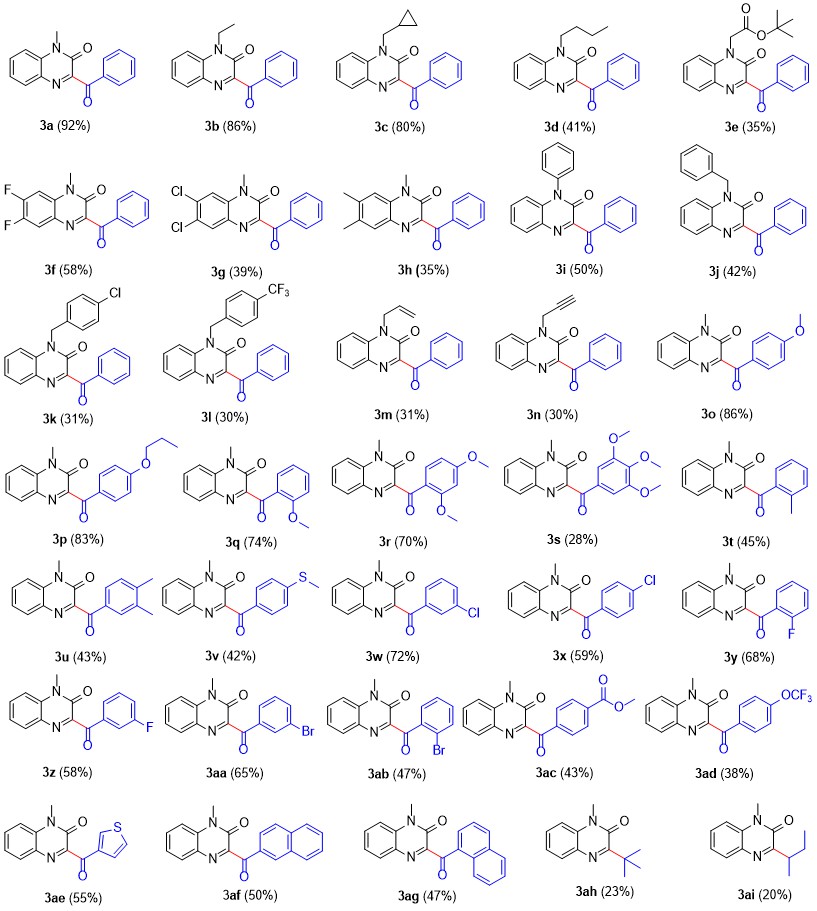 |
Next, our attention was turned to the substrate scope of aldehyde. Pleasingly, under the standard conditions, quino- xalin-2(1H)-ones reacted smoothly with a series of aryl al- dehydes bearing either electron-donating or electron-with- drawing groups, affording the corresponding acylated products in moderate to good yields. Arylaldehydes with electron-donating groups, such as alkoxy substituents at the ortho or para positions, were well tolerated, affording the desired products (3o~3r) in 70%~86% yields. However, the yield declined significantly for the trimethoxy-sub- stituted product (3s), suggesting that steric hindrance may adversely impact the acylation efficiency. Other electron- donating substituents on the benzaldehyde scaffold also provided moderate yields of the corresponding products (3t~3v). Furthermore, the reaction proceeded effectively with benzaldehydes bearing electron-withdrawing groups, such as halogens and ester moieties, providing the corresponding products (3w~3ac) in yields ranging from 43% to 68%. However, a significantly lower yield was obtained for the product derived from 4-(trifluoromethoxy)benzal- dehyde (3ad). Notably, the reaction with 4-nitrobenzal- dehyde failed to yield the desired product. Overall, the electronic properties of the substituents have significant influence on reaction performance, where benzaldehyde with electron-donating groups reacted better than that with electron-withdrawing groups. Finally, heterocyclic aromatic aldehydes and naphthaldehydes were also well tolerated, affording the corresponding products 3ae~3ag in moderate yields (47%~55%).
To investigate the feasibility of the acylation reaction with aliphatic aldehydes, several aliphatic aldehydes were examined. Interestingly, when pivalaldehyde and 2-methyl- butyraldehyde were subjected to the reaction conditions, only trace amounts of acylated products were detected. Instead, decarbonylative alkylation products 3ah and 3ai were obtained in yields of 23% and 20%, respectively. Acetaldehyde did not undergo any reaction under the same conditions, and neither acylated nor alkylated products were observed.
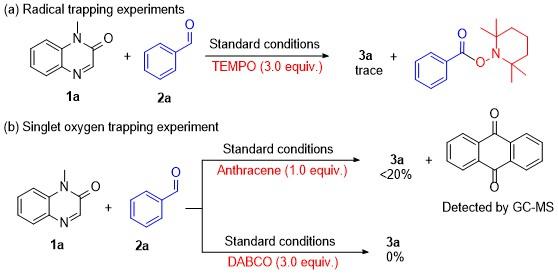
To gain deeper insight into the mechanism of this visible- light-induced acylative coupling of quinoxalin- 2(1H)-ones, a control experiment was conducted by adding the radical scavenger 2,2,6,6-tetramethylpiperidin-1-oxyl (TEMPO) to the reaction system (Scheme 2, a). Trace amounts of the target product 3a were observed, suggesting the potential involvement of a radical pathway. This hypothesis was further supported by high-resolution mass spectrometry (HRMS) analysis, in which an adduct between the benzoyl radical and TEMPO was detected. After adding a singlet oxygen scavenger (anthracene) to the reaction system, the product yield significantly decreased, and the formation of anthraquinone was detected by GC-MS analysis. Furthermore, a singlet oxygen quenching experiment was conducted by adding 1,4-diazabicyclo[2.2.2]octane (DABCO) to the reaction system, which completely inhibited the formation of 3a. These experiments elucidate the involvement of singlet oxygen (1O2) in the coupling reaction pathway (Scheme 2, b).
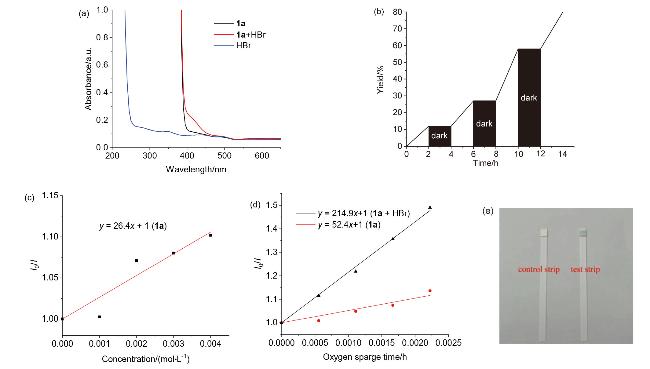
Subsequently, ultraviolet-visible (UV-Vis) absorption spectroscopy was employed to demonstrate that the absorption peak of the 1a/HBr system underwent a red shift compared to that of 1a alone, indicating the formation of an electron donor-acceptor (EDA) complex between 1a and HBr (Figure 1, a). Following this, light on/off experiments were performed, which showed that the reaction ceased HBr (Figure 1, a). Following this, light on/off experiments were performed, which showed that the reaction ceased comp-letely in the absence of light, indicating that the process is unlikely to proceed via a radical chain propagation pathway (Figure 1, b). The results of Stern-Volmer quench- ing indicated that for the 1a/HBr mixture, a decrease in the fluorescence signal was observed upon varying the O2 exposure time, demonstrating that O2 acts as a quencher for the excited state of the mixture, with a Stern-Volmer constant (Ksv) of 214.9, while others have limited effect on the fluorescence of 1a (Figures 1c, 1d). Finally, the generation of hydrogen peroxide during the reaction process was confirmed using a test strips (Figure 1, e).
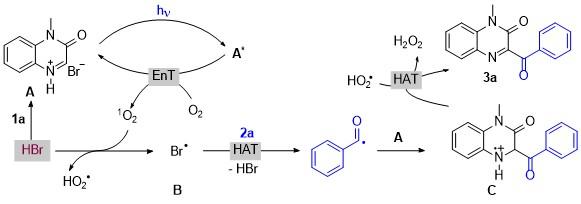
On the basis of above-mentioned results and literature reports,[38-39] a plausible mechanism is proposed (Scheme 3). The reaction begins with the formation of an electron donor-acceptor (EDA) complex/quinoxalinium bromide A from quinoxalin-2(1H)-ones (1a) and HBr. Under blue light irradiation, complex A is photoexcited to A*, which then engages in an energy transfer process with triplet oxygen (3O2), yielding singlet oxygen (1O2) while regenerating ground-state complex A. Subsequently, 1O2 undergoes a single-electron transfer (SET) with HBr, generating a hydroperoxyl radical (HO2•) and a bromine radical species B. Hydrogen atom abstraction from compound 2a by bromine radical B produces an acyl radical C. Finally, radical C couples with either 1a or complex A to form an intermediate D, which then undergoes single-electron oxidation by HO2•, affording the target product 3a and hydrogen peroxide (H2O2) as a byproduct.


3 Conclusions
In summary, we have developed a novel and efficient visible-light-induced strategy for the synthesis of C(3)- acylated quinoxalin-2(1H)-ones under mild, photocatalyst- free and metal-free conditions. This method features simple and green reaction conditions, broad substrate scope, and good functional group tolerance, providing a straight-forward and efficient approach to the structurally significant acyl quinoxalinone derivatives.
4 Experimental section
4.1 General information
The reactions via general procedure were carried out under an atmosphere of oxygen unless otherwise noted. Column chromatography was performed using silica gel (200~300 mesh) and thin layer chromatography was performed using silica gel (GF254). 1H NMR, 13C NMR and 19F NMR spectra were recorded on a Bruker-AV (400, 100 and 376 MHz, respectively) instrument internally referenced to tetramethylsilane (TMS) or chloroform signals. Mass spectra were measured on an Agilent 5977 GC-MS instrument (EI). High-resolution mass spectra (ESI) were obtained with a Thermo Scientific LTQ Orbitrap XL mass spectrometer. The structures of known compounds were further corroborated by comparing their 1H NMR, 13C NMR data and MS data with those in literature. Melting points were measured with a YUHUA X-5 melting point instrument and were uncorrected. Fluorescence quenching experiments were recorded with PTI-QM40 spectrophotometer. A commercially available blue LED (35W, HIPAR30, luminous flux is not less than 3200 lm, wavelength is 450 nm) was purchased from Shenzhen Jing Feng Times Lighting Technology Co, Ltd as the reaction light source. All irradiation reactions were carried out in glass vessel. The distance from the light source to the irradiation vessel is around 2~3 cm. Unless otherwise noted, all reagents were obtained from commercial suppliers and used without further purification.
4.2 Experimental method
A 10 mL reaction vessel was charged with quinoxalin-2(1H)-ones (0.2 mmol) and benzaldehyde (0.8 mmol, 4.0 equiv). The atmosphere was exchanged by applying vacuum and backfilling with O2 (this process was repeated for three times). Then, dichloroethane (2 mL), HBr (25 mol%) and H2O (2.0 equiv.) were added. The resulting mixture was stirred for 36 h under irradiation with a 35 W blue LED. After completion, the crude reaction mixture was directly filtered and the volatiles were removed under reduced pressure. Column chromatography was performed using silica gel (200~300 mesh) to give the C(3)-acylated quinoxalin-2(1H)-ones product 3.
3-Benzoyl-1-methylquinoxalin-2(1H)-one (3a): White solid (92%, 48.5 mg). m.p. 156~158 ℃ (lit.[33] 152~153 ℃); 1H NMR (400 MHz, CDCl3) δ: 7.99 (dd, J=8.4, 1.3 Hz, 2H), 7.92 (dd, J=8.3, 1.5 Hz, 1H), 7.71~7.60 (m, 2H), 7.52~7.45 (m, 2H), 7.44~7.38 (m, 2H), 3.75 (s, 3H); 13C NMR (100 MHz, CDCl3) δ: 191.72, 154.57, 153.25, 134.74, 134.17, 133.79, 132.10, 132.02, 130.88, 129.91, 128.61, 124.14, 113.95, 28.98.
3-Benzoyl-1-ethylquinoxalin-2(1H)-one (3b): Yellow solid (86%, 47.8 mg). m.p. 86~89 ℃ (lit.[34] 85.9~87.8 ℃); 1H NMR (400 MHz, CDCl3) δ: 7.99 (d, J=7.0 Hz, 2H), 7.93 (d, J=7.9 Hz, 1H), 7.71~7.59 (m, 2H), 7.51~7.37 (m, 4H), 4.37 (q, J=7.2 Hz, 2H), 1.42 (t, J=7.2 Hz, 3H); 13C NMR (100 MHz, CDCl3) δ: 191.72, 154.57, 153.25, 134.74, 134.17, 133.79, 132.10, 132.02, 130.88, 129.91, 128.61, 124.14, 113.95, 28.98.
3-Benzoyl-1-(cyclopropylmethyl)quinoxalin-2(1H)-one (3c): Yellow solid (80%, 48.6 mg). m.p. 59~61 ℃; 1H NMR (400 MHz, CDCl3) δ: 7.99 (d, J=8.3 Hz, 2H), 7.94 (d, J=8.1 Hz, 1H), 7.71~7.59 (m, 2H), 7.54 (d, J=8.6 Hz, 1H), 7.48 (t, J=7.0 Hz, 2H), 7.40 (t, J=7.6 Hz, 1H), 4.23 (d, J=7.1 Hz, 2H), 1.34~1.27 (m, 1H), 0.60~0.55 (m, 4H); 13C NMR (100 MHz, CDCl3) δ: 191.97, 154.87, 153.34, 134.81, 134.13, 133.26, 132.40, 131.87, 131.12, 129.87, 128.61, 123.94, 114.19, 46.18, 9.56, 4.14; HRMS (ESI) calcd for C19H17N2O2 [M+H]+ 305.1285, found 305.1292.
3-Benzoyl-1-butylquinoxalin-2(1H)-one (3d): Yellow solid (41%, 25.1 mg). m.p. 141~143 ℃ (lit.[40] 142~143 ℃); 1H NMR (400 MHz, CDCl3) δ: 8.00~7.96 (m, 2H), 7.93 (dd, J=8.0, 1.7 Hz, 1H), 7.69~7.59 (m, 2H), 7.48 (t, J=7.8 Hz, 2H), 7.40 (dd, J=14.5, 7.8 Hz, 2H), 4.33~4.26 (m, 2H), 1.84~1.75 (m, 2H), 1.54~1.45 (m, 2H), 1.00 (t, J=7.3 Hz, 3H); 13C NMR (100 MHz, CDCl3) δ: 191.89, 154.58, 152.99, 134.78, 134.12, 133.00, 132.38, 131.88, 131.09, 129.84, 128.59, 123.90, 113.92, 42.05, 29.21, 20.15, 13.65.
tert-Butyl 2-(3-benzoyl-2-oxoquinoxalin-1(2H)-yl)ace- tate (3e): Yellow solid (35%, 24.5 mg). m.p. 222~223 ℃ (lit.[41] 222~222.8 ℃); 1H NMR (400 MHz, CDCl3) δ: 8.02~7.93 (m, 3H), 7.68~7.60 (m, 2H), 7.49 (t, J=7.8 Hz, 2H), 7.42 (t, J=7.6 Hz, 1H), 7.17 (d, J=7.6 Hz, 1H), 4.99 (s, 2H), 1.47 (s, 9H); 13C NMR (100 MHz, CDCl3) δ: 191.40, 165.69, 154.52, 152.90, 134.83, 134.27, 133.18, 132.27, 132.14, 131.33, 130.06, 128.71, 124.41, 113.52, 83.52, 44.02, 27.99.
3-Benzoyl-6,7-difluoro-1-methylquinoxalin-2(1H)-one (3f): Yellow solid (58%, 34.8 mg). m.p. 185~187 ℃ (lit.[35] 185~186 ℃); 1H NMR (400 MHz, CDCl3) δ: 7.95 (d, J=7.0 Hz, 2H), 7.74 (dd, J=9.9, 8.1 Hz, 1H), 7.64 (t, J=7.5 Hz, 1H), 7.49 (t, J=7.8 Hz, 2H), 7.22 (dd, J=11.1, 7.0 Hz, 1H), 3.70 (s, 3H); 13C NMR (100 MHz, CDCl3) δ: 191.07, 154.94 (d, J=3.5 Hz), 152.82, 152.60 (dd, J=255.1, 14.2 Hz), 146.93 (dd, J=247.7, 14.3 Hz), 134.51, 134.40, 131.36 (d, J=8.7 Hz), 129.90, 128.71, 128.32 (dd, J=8.7, 3.1 Hz), 118.46 (dd, J=18.1, 2.7 Hz), 102.72 (d, J=23.3 Hz), 29.54; 19F NMR (376 MHz, CDCl3) δ: -127.09, -127.15, -140.49, -140.55.
3-Benzoyl-6,7-dichloro-1-methylquinoxalin-2(1H)-one (3g): Yellow solid (39%, 25.9 mg). m.p. 171~173 ℃ (lit.[41] 170~172 ℃); 1H NMR (400 MHz, CDCl3) δ: 8.00 (s, 1H), 7.95 (d, J=8.6 Hz, 2H), 7.65 (t, J=7.5 Hz, 1H), 7.52~7.47 (m, 3H), 3.71 (s, 3H); 13C NMR (100 MHz, CDCl3) δ: 190.91, 155.68, 152.68, 136.39, 134.50, 134.39, 133.16, 131.59, 131.07, 129.95, 128.75, 128.19, 115.53, 29.32.
3-Benzoyl-1,6,7-trimethylquinoxalin-2(1H)-one (3h): Yellow solid (35%, 20.5 mg). m.p. 161~163 ℃ (lit.[33] 161~163 ℃); 1H NMR (400 MHz, CDCl3) δ: 8.00~7.95 (m, 2H), 7.67 (s, 1H), 7.64~7.59 (m, 1H), 7.47 (t, J=7.8 Hz, 2H), 7.17 (s, 1H), 3.73 (s, 3H), 2.47 (s, 3H), 2.36 (s, 3H); 13C NMR (100 MHz, CDCl3) δ: 192.04, 153.46, 153.26, 142.48, 135.12, 134.06, 133.36, 132.03, 130.96, 130.68, 130.05, 128.63, 114.49, 28.98, 20.82, 19.20.
3-Benzoyl-1-phenylquinoxalin-2(1H)-one (3i): Yellow solid (50%, 32.6 mg). m.p. 157~159 ℃ (lit.[41] 157.6~159.1℃); 1H NMR (400 MHz, CDCl3) δ: 8.04 (d, J=7.9 Hz, 2H), 7.95 (d, J=7.9 Hz, 1H), 7.60 (d, J=7.8 Hz, 3H), 7.55 (d, J=6.7 Hz, 1H), 7.52~7.44 (m, 3H), 7.36 (dd, J=13.8, 7.6 Hz, 3H), 6.79 (d, J=8.4 Hz, 1H); 13C NMR (100 MHz, CDCl3) δ: 191.64, 155.39, 152.98, 134.92, 134.89, 134.77, 134.30, 132.08, 131.77, 130.60, 130.39, 130.09, 129.78, 128.74, 128.27, 124.42, 115.85.
3-Benzoyl-1-benzylquinoxalin-2(1H)-one (3j): Yellow solid (42%, 28.5 mg). m.p. 128~130 ℃ (lit.[33] 128~129 ℃); 1H NMR (400 MHz, CDCl3) δ: 8.05~8.00 (m, 2H), 7.93 (d, J=8.3 Hz, 1H), 7.64 (t, J=7.4 Hz, 1H), 7.57~7.48 (m, 3H), 7.37 (d, J=7.8 Hz, 2H), 7.34~7.27 (m, 5H), 5.53 (s, 2H); 13C NMR (100 MHz, CDCl3) δ: 191.67, 154.67, 153.41, 134.76, 134.25, 133.16, 132.41, 131.99, 131.06, 129.97, 128.98, 128.69, 128.34, 127.89, 127.07, 124.21, 114.76, 45.83.
3-Benzoyl-1-(4-chlorobenzyl)quinoxalin-2(1H)-one (3k): Yellow solid (31%, 21.5 mg). m.p. 208~210 ℃ (lit.[42] 208~209 ℃); 1H NMR (400 MHz, CDCl3) δ: 8.02 (d, J=7.3 Hz, 2H), 7.94 (d, J=8.1 Hz, 1H), 7.64 (t, J=7.4 Hz, 1H), 7.57 (t, J=7.9 Hz, 1H), 7.50 (t, J=7.8 Hz, 2H), 7.38 (t, J=7.4 Hz, 1H), 7.34~7.28 (m, 3H), 7.25 (d, J=6.7 Hz, 2H), 5.49 (s, 2H); 13C NMR (100 MHz, CDCl3) δ: 191.50, 154.61, 153.33, 134.73, 134.32, 133.84, 133.30, 132.98, 132.41, 132.08, 131.24, 129.99, 129.19, 128.72, 128.59, 124.38, 114.48, 45.25.
3-Benzoyl-1-(4-(trifluoromethyl)benzyl)quinoxalin-2(1H)-one (3l): Yellow solid (30%, 24.5 mg). m.p. 138~140 ℃; 1H NMR (400 MHz, CDCl3) δ: 8.02 (d, J=7.1 Hz, 2H), 7.95 (dd, J=8.0, 1.7 Hz, 1H), 7.64 (t, J=7.4 Hz, 1H), 7.57 (dd, J=12.5, 7.6 Hz, 3H), 7.50 (t, J=7.8 Hz, 2H), 7.44~7.38 (m, 3H), 7.29 (d, J=8.4 Hz, 1H), 5.57 (s, 2H); 13C NMR (100 MHz, CDCl3) δ: 191.42, 154.51, 153.27, 138.79, 134.66, 134.34, 132.88, 132.35, 132.19, 131.25, 130.17 (q, J=32.7 Hz), 129.95, 128.71, 127.39, 125.95 (q, J=3.5 Hz), 124.48, 123.80 (q, J=267.4 Hz), 114.37, 45.38; 19F NMR (376 MHz, CDCl3) δ: -62.64; HRMS (ESI) calcd for C23H16F3N2O2 [M+H]+ 409.1158, found 409.1158.
1-Allyl-3-benzoylquinoxalin-2(1H)-one (3m): Yellow solid (31%, 20.0 mg). m.p. 111~113 ℃ (lit.[34] 111~113 ℃); 1H NMR (400 MHz, CDCl3) δ: 7.99 (d, J=7.5 Hz, 2H), 7.93 (d, J=7.0 Hz, 1H), 7.63 (q, J=7.0 Hz, 2H), 7.49 (t, J=7.8 Hz, 2H), 7.42~7.37 (m, 2H), 6.01~5.89 (m, 1H), 5.29 (dd, J=23.7, 13.8 Hz, 2H), 4.95 (d, J=5.4 Hz, 2H); 13C NMR (100 MHz, CDCl3) δ: 191.67, 154.58, 152.83, 134.76, 134.19, 133.08, 132.28, 131.92, 131.01, 130.21, 129.93, 128.64, 124.13, 118.73, 114.51, 44.44.
3-Benzoyl-1-(prop-2-yn-1-yl)quinoxalin-2(1H)-one (3n): Yellow solid (31%, 20.0 mg). m.p. 121~123 ℃ (lit.[34] 121~123 ℃); 1H NMR (400 MHz, CDCl3) δ: 8.00 (d, J=7.5 Hz, 2H), 7.95 (d, J=8.1 Hz, 1H), 7.72 (t, J=7.9 Hz, 1H), 7.64 (t, J=7.4 Hz, 1H), 7.58 (d, J=8.3 Hz, 1H), 7.51~7.43 (m, 3H), 5.10 (d, J=2.7 Hz, 2H), 2.34 (t, J=2.6 Hz, 1H); 13C NMR (100 MHz, CDCl3) δ: 191.28, 154.32, 152.23, 134.64, 134.31, 132.33, 132.29, 132.15, 131.11, 130.05, 128.68, 124.55, 114.56, 73.77, 31.38.
3-(4-Methoxybenzoyl)-1-methylquinoxalin-2(1H)-one (3o): Yellow solid (86%, 50.6 mg). m.p. 204~206 ℃ (lit.[33] 204~205 ℃); 1H NMR (400 MHz, CDCl3) δ: 7.96 (d, J=8.9 Hz, 2H), 7.91 (d, J=8.1 Hz, 1H), 7.66 (t, J=7.1 Hz, 1H), 7.43~7.37 (m, 2H), 6.94 (d, J=8.9 Hz, 2H), 3.86 (s, 3H), 3.74 (s, 3H); 13C NMR (100 MHz, CDCl3) δ: 190.21, 164.43, 154.84, 153.25, 133.71, 132.38, 132.05, 131.83, 130.74, 127.78, 124.05, 113.92, 55.49, 29.59, 28.95.
1-Methyl-3-(4-propoxybenzoyl)quinoxalin-2(1H)-one (3p): Yellow solid (83%, 53.5 mg). m.p. 116~118 ℃; 1H NMR (400 MHz, CDCl3) δ: 7.98~7.88 (m, 3H), 7.69~7.62 (m, 1H), 7.43~7.36 (m, 2H), 6.94 (d, J=8.9 Hz, 2H), 3.99 (t, J=6.5 Hz, 2H), 3.74 (s, 3H), 1.86~1.79 (m, 2H), 1.04 (t, J=7.5 Hz, 3H); 13C NMR (100 MHz, CDCl3) δ: 190.20, 164.09, 154.94, 153.26, 133.73, 132.39, 132.08, 131.78, 130.75, 127.56, 124.03, 114.37, 113.89, 69.73, 28.95, 22.28, 10.34; HRMS (ESI) calcd for C19H19N2O3 [M+H]+ 323.1390, found 323.1389.
3-(2-Methoxybenzoyl)-1-methylquinoxalin-2(1H)-one (3q): Yellow solid (74%, 43.5 mg). m.p. 160~162 ℃ (lit.[33] 160~161 ℃); 1H NMR (400 MHz, CDCl3) δ: 8.07 (d, J=7.8, 1.8 Hz, 1H), 7.89 (d, J=7.8 Hz, 1H), 7.62 (t, J=7.8 Hz, 1H), 7.58~7.52 (m, 1H), 7.37 (t, J=8.5 Hz, 2H), 7.10 (t, J=7.6 Hz, 1H), 6.91 (d, J=8.4 Hz, 1H), 3.72 (s, 3H), 3.56 (s, 3H); 13C NMR (100 MHz, CDCl3) δ: 191.13, 160.00, 157.29, 153.33, 135.59, 133.50, 132.40, 131.07, 130.85, 130.61, 125.29, 123.84, 121.23, 113.72, 112.08, 56.00, 28.63.
3-(2,4-Dimethoxybenzoyl)-1-methylquinoxalin-2(1H)-one (3r): Yellow solid (70%, 45.3 mg). m.p. 162~164 ℃; 1H NMR (400 MHz, CDCl3) δ: 8.08 (d, J=8.8 Hz, 1H), 7.87 (dd, J=7.9, 1.6 Hz, 1H), 7.63~7.57 (m, 1H), 7.40~7.33 (m, 2H), 6.62 (dd, J=8.8, 2.3 Hz, 1H), 6.36 (d, J=2.3 Hz, 1H), 3.85 (s, 3H), 3.72 (s, 3H), 3.53 (s, 3H); 13C NMR (100 MHz, CDCl3) δ: 189.50, 166.08, 162.00, 157.93, 153.36, 133.37, 132.89, 132.42, 130.79, 130.39, 123.73, 118.57, 113.66, 106.45, 98.30, 55.92, 55.57, 28.58; HRMS (ESI) calcd for C18H17N2O4 [M+H]+ 325.1183, found 325.1181.
Methyl-3-(3,4,5-trimethoxybenzoyl)quinoxalin-2(1H)-one (3s): Yellow solid (28%, 19.8 mg). m.p. 88~90 ℃ (lit.[43] 88~89 ℃); 1H NMR (400 MHz, CDCl3) δ: 7.94 (dd, J=8.3, 1.5 Hz, 1H), 7.72~7.66 (m, 1H), 7.45~7.41 (m, 2H), 7.27 (d, J=6.0 Hz, 2H), 3.94 (s, 3H), 3.86 (s, 6H), 3.77 (s, 3H); 13C NMR (100 MHz, CDCl3) δ: 190.43, 154.28, 153.26, 153.11, 143.83, 133.84, 132.06, 132.00, 130.88, 129.79, 124.21, 113.99, 107.62, 60.93, 56.33, 29.05.
1-Methyl-3-(2-methylbenzoyl)quinoxalin-2(1H)-one (3t): Yellow solid (45%, 25.0 mg). m.p. 104~106 ℃ (lit.[35] 104~106 ℃); 1H NMR (400 MHz, CDCl3) δ: 7.91 (d, J=8.3 Hz, 1H), 7.68~7.64 (m, 1H), 7.60 (d, J=7.8 Hz, 1H), 7.47~7.39 (m, 3H), 7.33 (d, J=7.6 Hz, 1H), 7.23 (t, J=7.5 Hz, 1H), 3.74 (s, 3H), 2.69 (s, 3H); 13C NMR (100 MHz, CDCl3) δ: 193.99, 155.65, 153.29, 140.73, 134.17, 133.80, 132.90, 132.22, 131.97, 131.86, 130.94, 125.59, 124.14, 113.90, 28.96, 21.72.
3-(3,4-Dimethylbenzoyl)-1-methylquinoxalin-2(1H)-one (3u): Yellow solid (43%, 25.1 mg). m.p. 175~177 ℃; 1H NMR (400 MHz, CDCl3) δ: 7.93 (dd, J=8.1, 1.5 Hz, 1H), 7.75 (s, 1H), 7.70~7.65 (m, 2H), 7.41 (dd, J=7.9, 4.7 Hz, 2H), 7.23 (d, J=7.8 Hz, 1H), 3.75 (s, 3H), 2.32 (s, 3H), 2.29 (s, 3H); 13C NMR (100 MHz, CDCl3) δ: 191.75, 155.08, 153.32, 144.19, 137.15, 133.81, 132.71, 132.19, 131.84, 130.91, 130.79, 129.92, 127.84, 124.09, 113.92, 28.99, 20.22, 19.71; HRMS (ESI) calcd for C18H17N2O2 [M+H]+ 293.1285, found 293.1283.
1-Methyl-3-(4-(methylthio)benzoyl)quinoxalin-2(1H)-one (3v): Yellow solid (42%, 26.1 mg). m.p. 152~154 ℃ (lit.[33] 151~152 ℃); 1H NMR (400 MHz, CDCl3) δ: 7.94~7.86 (m, 3H), 7.71~7.64 (m, 1H), 7.41 (dd, J=8.0, 5.9 Hz, 2H), 7.26 (d, J=8.4 Hz, 2H), 3.74 (s, 3H), 2.51 (s, 3H); 13C NMR (100 MHz, CDCl3) δ: 190.62, 154.50, 153.24, 147.74, 133.77, 132.06, 131.98, 130.97, 130.85, 130.24, 124.77, 124.12, 113.93, 28.99, 14.56.
3-(3-Chlorobenzoyl)-1-methylquinoxalin-2(1H)-one (3w): Yellow solid (72%, 42.9 mg). m.p. 126~128 ℃ (lit.[35] 126~127 ℃); 1H NMR (400 MHz, CDCl3) δ: 7.97~7.91 (m, 2H), 7.87 (d, J=7.8 Hz, 1H), 7.73~7.67 (m, 1H), 7.61~7.57 (m, 1H), 7.45~7.41 (m, 3H), 3.76 (s, 3H); 13C NMR (100 MHz, CDCl3) δ: 190.40, 153.69, 153.17, 136.38, 134.91, 134.04, 133.89, 132.36, 132.06, 131.05, 129.99, 129.76, 128.06, 124.30, 114.01, 29.07.
3-(4-Chlorobenzoyl)-1-methylquinoxalin-2(1H)-one (3x): Yellow solid (59%, 34.6 mg). m.p. 181~183 ℃ (lit.[33] 181~182 ℃); 1H NMR (400 MHz, CDCl3) δ: 7.95~7.90 (m, 3H), 7.72~7.66 (m, 1H), 7.45~7.40 (m, 4H), 3.75 (s, 3H); 13C NMR (100 MHz, CDCl3) δ: 190.40, 153.84, 153.18, 140.70, 133.84, 133.17, 132.27, 132.03, 131.28, 130.96, 128.99, 124.25, 113.99, 29.03.
3-(2-Fluorobenzoyl)-1-methylquinoxalin-2(1H)-one (3y): Yellow solid (68%, 38.3 mg). m.p. 113~115 ℃ (lit.[42] 113~114 ℃); 1H NMR (400 MHz, CDCl3) δ: 8.12~8.06 (m, 1H), 7.91 (dd, J=8.3, 1.5 Hz, 1H), 7.69~7.63 (m, 1H), 7.63~7.56 (m, 1H), 7.42~7.36 (m, 2H), 7.35~7.30 (m, 1H), 7.11~7.05 (m, 1H), 3.74 (s, 3H); 13C NMR (100 MHz, CDCl3) δ: 188.93, 162.54 (d, J=254.5 Hz), 155.29, 153.21 (d, J=3.3 Hz), 135.90 (d, J=9.2 Hz), 133.85, 132.35, 131.93, 130.98, 130.91 (d, J=1.8 Hz), 124.69 (d, J=3.7 Hz), 124.19, 124.09, 116.37 (d, J=22.3 Hz), 113.92, 28.84; 19F NMR (376 MHz, CDCl3) δ: -108.90.
3-(3-Fluorobenzoyl)-1-methylquinoxalin-2(1H)-one (3z): Yellow solid (58%, 32.7 mg). m.p. 134~136 ℃ (lit.[42] 134~135 ℃); 1H NMR (400 MHz, CDCl3) δ: 7.93 (dd, J=8.4, 1.7 Hz, 1H), 7.76 (d, J=7.8 Hz, 1H), 7.73~7.67 (m, 2H), 7.49~7.41 (m, 3H), 7.36~7.30 (m, 1H), 3.76 (s, 3H); 13C NMR (100 MHz, CDCl3) δ: 190.40, 162.67 (d, J=248.3 Hz), 153.79, 153.18, 136.82 (d, J=6.6 Hz), 133.89, 132.33, 132.05, 131.04, 130.36 (d, J=7.7 Hz), 125.89 (d, J=2.9 Hz), 124.29, 121.23 (d, J=21.6 Hz), 116.37 (d, J=22.4 Hz), 114.01, 29.06; 19F NMR (376 MHz, CDCl3) δ: -111.53.
3-(3-Bromobenzoyl)-1-methylquinoxalin-2(1H)-one (3aa): Yellow solid (65%, 44.4 mg). m.p. 138~140 ℃ (lit.[33] 138~139 ℃); 1H NMR (400 MHz, CDCl3) δ: 8.11 (s, 1H), 7.92 (t, J=7.6 Hz, 2H), 7.77~7.67 (m, 2H), 7.46~7.40 (m, 2H), 7.37 (t, J=7.9 Hz, 1H), 3.76 (s, 3H); 13C NMR (100 MHz, CDCl3) δ: 192.20, 153.29, 153.19, 138.39, 134.22, 133.53, 133.31, 132.48, 132.36, 131.77, 131.44, 127.64, 124.14, 121.31, 113.94, 28.99.
3-(2-Bromobenzoyl)-1-methylquinoxalin-2(1H)-one (3ab): Yellow solid (47%, 32.1 mg). m.p. 112~114 ℃ (lit.[33] 119~120 ℃); 1H NMR (400 MHz, CDCl3) δ: 7.91 (dd, J=8.3, 1.5 Hz, 1H), 7.84 (dd, J=7.6, 1.8 Hz, 1H), 7.71~7.65 (m, 1H), 7.61 (dd, J=7.8, 1.3 Hz, 1H), 7.50~7.46 (m, 1H), 7.44~7.37 (m, 3H), 3.74 (s, 3H); 13C NMR (100 MHz, CDCl3) δ: 190.38, 153.70, 153.24, 137.02, 136.67, 133.97, 132.72, 132.45, 132.13, 131.13, 130.30, 128.59, 124.38, 122.96, 114.10, 29.15.
Methyl 4-(4-methyl-3-oxo-3,4-dihydroquinoxaline-2-carbonyl)benzoate (3ac): Yellow solid (43%, 27.7 mg). m.p. 152~154 ℃ (lit.[33] 152~153 ℃); 1H NMR (400 MHz, CDCl3) δ: 8.14 (d, J=8.6 Hz, 2H), 8.05 (d, J=8.6 Hz, 2H), 7.93 (dd, J=8.3, 1.5 Hz, 1H), 7.73~7.68 (m, 1H), 7.46~7.40 (m, 2H), 3.95 (s, 3H), 3.76 (s, 3H); 13C NMR (100 MHz, CDCl3) δ: 191.08, 166.06, 153.74, 153.21, 138.06, 134.56, 133.91, 132.39, 132.08, 131.06, 129.79, 129.75, 124.30, 114.02, 52.49, 29.06.
1-Methyl-3-(4-(trifluoromethoxy)benzoyl)quinoxalin-2 (1H)-one (3ad): Yellow solid (38%, 26.5 mg). m.p. 131~133 ℃; 1H NMR (400 MHz, CDCl3) δ: 8.06 (d, J=8.9 Hz, 2H), 7.93 (dd, J=8.3, 1.5 Hz, 1H), 7.72~7.67 (m, 1H), 7.45~7.40 (m, 2H), 7.33~7.29 (m, 2H), 3.76 (s, 3H); 13C NMR (100 MHz, CDCl3) δ: 190.05, 153.82, 153.34 (q, J=1.8 Hz), 153.21, 133.90, 133.02, 132.33, 132.06, 132.06, 131.03, 124.30, 120.35, 120.20 (q, J=259.3 Hz), 114.01, 29.06; 19F NMR (376 MHz, CDCl3) δ: -57.50; HRMS (ESI) calcd for C17H12F3N2O3 [M+H]+ 349.0795, found 349.0795.
1-Methyl-3-(thiophene-3-carbonyl)quinoxalin-2(1H)-one (3ae): Yellow solid (55%, 29.7 mg). m.p. 144~146 ℃; 1H NMR (400 MHz, CDCl3) δ: 8.17 (dd, J=2.9, 1.2 Hz, 1H), 7.94~7.91 (m, 1H), 7.71~7.65 (m, 2H), 7.43~7.36 (m, 3H), 3.75 (s, 3H); 13C NMR (100 MHz, CDCl3) δ: 184.66, 153.75, 153.02, 139.84, 136.27, 133.98, 132.22, 131.82, 130.94, 127.62, 126.53, 124.14, 113.95, 29.06; HRMS (ESI) calcd for C14H11N2O2S [M+H]+ 271.0536, found 271.0534.
3-(2-Naphthoyl)-1-methylquinoxalin-2(1H)-one (3af): Yellow solid (50%, 31.4 mg). m.p. 178~180 ℃ (lit.[33] 184~185 ℃); 1H NMR (400 MHz, CDCl3) δ: 8.40 (d, J=1.7 Hz, 1H), 8.13 (dd, J=8.6, 1.8 Hz, 1H), 7.96~7.92 (m, 2H), 7.88 (d, J=9.4 Hz, 2H), 7.72~7.67 (m, 1H), 7.63~7.58 (m, 1H), 7.54~7.49 (m, 1H), 7.45~7.40 (m, 2H), 3.77 (s, 3H); 13C NMR (100 MHz, CDCl3) δ: 191.76, 154.74, 153.37, 136.13, 133.89, 132.97, 132.31, 132.22, 132.19, 132.04, 130.99, 129.78, 129.02, 128.71, 127.83, 126.79, 124.36, 124.19, 113.99, 29.06.
3-(1-Naphthoyl)-1-methylquinoxalin-2(1H)-one (3ag): Yellow solid (47%, 29.5 mg). m.p. 176~178 ℃ (lit.[33] 176~177 ℃); 1H NMR (400 MHz, CDCl3) δ: 9.15 (d, J=8.7 Hz, 1H), 8.07 (d, J=8.2 Hz, 1H), 7.93~7.88 (m, 2H), 7.86 (dd, J=7.3, 1.3 Hz, 1H), 7.71~7.63 (m, 2H), 7.61~7.56 (m, 1H), 7.47~7.38 (m, 3H), 3.73 (s, 3H); 13C NMR (100 MHz, CDCl3) δ: 194.00, 155.66, 153.41, 134.83, 133.97, 133.81, 132.94, 132.20, 131.92, 131.41, 130.99, 130.95, 128.84, 128.48, 126.75, 126.11, 124.17, 113.93, 28.98.
3-(tert-Butyl)-1-methylquinoxalin-2(1H)-one (3ah): White solid (23%, 10.0 mg). m.p. 121~123 ℃ (lit.[35] 121~122 ℃); 1H NMR (400 MHz, CDCl3) δ: 7.83 (d, J=7.6 Hz, 1H), 7.50 (d, J=7.4 Hz, 1H), 7.34~7.26 (m, 2H), 3.68 (s, 3H), 1.49 (s, 9H); 13C NMR (100 MHz, CDCl3) δ: 165.31, 153.77, 133.33, 132.20, 130.13, 129.55, 123.21, 113.29, 39.49, 28.78, 27.90.
3-(sec-Butyl)-1-methylquinoxalin-2(1H)-one (3ai):[44] Yellow liquid (20%, 8.7 mg). 1H NMR (400 MHz, CDCl3) δ: 7.85 (dd, J=7.9, 1.6 Hz, 1H), 7.55~7.49 (m, 1H), 7.36~7.28 (m, 2H), 3.71 (s, 3H), 3.49~3.43 (m, 1H), 1.96~1.87 (m, 1H), 1.63~1.57 (m, 1H), 1.28 (d, J=6.8 Hz, 3H), 0.94 (t, J=7.4 Hz, 3H); 13C NMR (100 MHz, CDCl3) δ: 164.54, 154.71, 132.86, 132.79, 129.78, 129.41, 123.38, 113.45, 37.72, 29.06, 27.51, 17.84, 12.03.
Supporting Information Detailed mechanistic studies and NMR spectra of all products. The Supporting Information is available free of charge via the Internet at http://sioc-journal.cn.
(Zhao, C.)