ARTICLES

Trifluoromethyl Radical-Mediated C(sp3)—H Alkylation Enabled by Photoinduced Thioxanthone Catalysis

  • Dongsheng Li ,
  • Haowen Zheng ,
  • Hongping Deng , *
Expand
  • College of Sciences, Nanjing Agricultural University, Nanjing 210095

These authors contributed equally to this work.

Received date: 2025-12-28

  Revised date: 2026-02-10

  Online published: 2026-03-13

Supported by

National Natural Science Foundation of China(21901121)

Copyright

© 2026 Shanghai Institute of Organic Chemistry, Chinese Academy of Sciences

Abstract

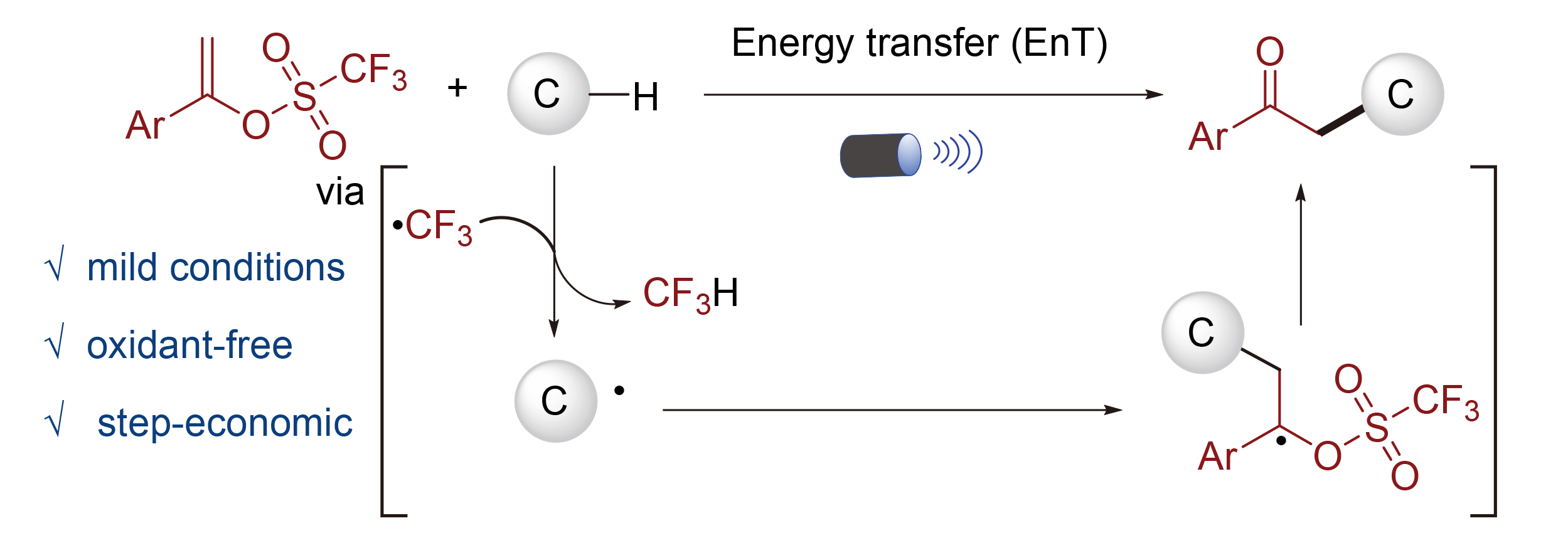
The trifluoromethyl radical is a well-established intermediate in trifluoromethylation reactions. It can also, however, act as a hydrogen atom transfer (HAT) reagent, a property that remains limited studies. A photoinduced, thioxanthone-catalyzed method for the trifluoromethyl radical-mediated C(sp3)—H alkylation was developed. This protocol offers step economy, mild reaction conditions, and operates without stoichiometric external oxidants. Utilizing readily available C(sp3)—H feedstocks, a wide range of acetophenone derivatives were synthesized efficiently. Mechanistic investigations suggest that the reaction proceeds through an energy transfer pathway, sustaining a radical chain mechanism.

Cite this article

Dongsheng Li , Haowen Zheng , Hongping Deng . Trifluoromethyl Radical-Mediated C(sp3)—H Alkylation Enabled by Photoinduced Thioxanthone Catalysis[J]. Chinese Journal of Organic Chemistry, 2026 , 46(4) : 1722 -1729 . DOI: 10.6023/cjoc202512043

1 Introduction

The incorporation of a trifluoromethyl (CF3) group into bioactive molecules is a widely employed strategy to improve key properties such as biological activity, metabolic stability, and lipophilicity.[1] Given its importance, the development of trifluoromethylation methods has attracted considerable attention over the past decades.[2]
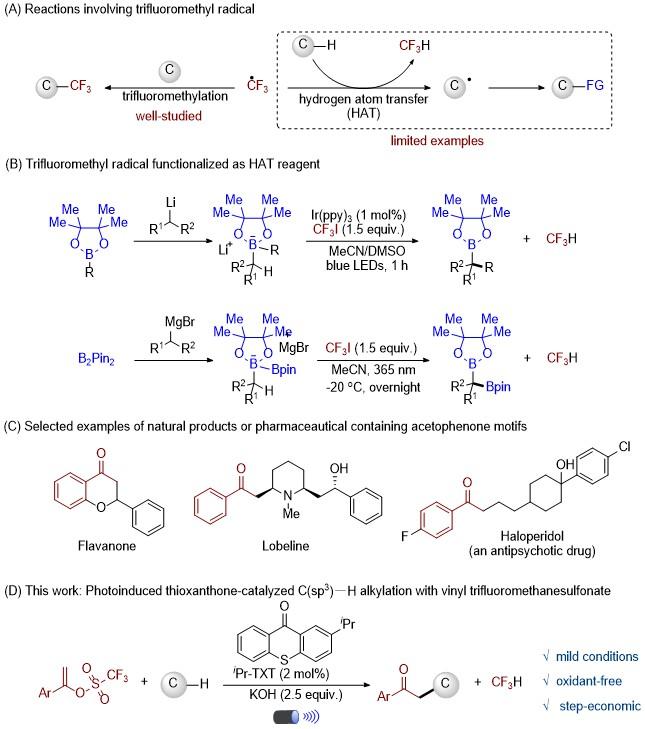
The CF3 radical, a key intermediate in many trifluoromethylation reactions, has been extensively studied.[3] Beyond this role, it can also serve as a hydrogen atom transfer (HAT) reagent to promote other radical transformations (Scheme 1, A).[4] However, compared with other HAT catalysts or reagents employed in radical-mediated C(sp3)—H functionalization,[5] the use of the CF3 radical as a HAT reagent remains relatively underexplored.
Scheme 1 Stratigies involving trifluoromethyl raidcals
In 2019, Studer and coworkers[4a] developed an elegant protocol for the boron-retaining coupling of boronates with organolithium reagents, enabled by a CF3 radical-promoted HAT process. Subsequently, using a similar strategy, the same group[4b] achieved radical boron migration in diboronates complexes to form valuable gem-diboronates with good yields (Scheme 1, B). Nevertheless, methods that employ the CF3 radical primarily as a HAT reagent remain scarce.
1-Phenylethan-1-one (acetophenone) motifs are privileged structural units, frequently found in bioactive natural products and pharmaceuticals due to their unique properties (Scheme 1, C).[6] Direct C(sp3)—H alkylation represents one of the most straightforward routes to access functionalized acetophenone derivatives. However, existing methods typically require stoichiometric external oxidants[7] or harsh reaction conditions,[8] highlighting a need for milder, oxidant-free alternatives.
Building on our ongoing interest in photoinduced C(sp3)—H functionalization,[9] herein we report an efficient, external oxidant-free method for CF3 radical- mediated C(sp3)—H alkylation with arylvinyl trifluoromethanesulfonates. This operationally simple, thioxanthone-catalyzed protocol proceeds under mild conditions, and accommodates a variety of C(sp3)—H feedstocks and arylvinyl trifluoromethanesulfonates to deliver diverse acetophenone derivatives in good yields. This strategy thus provides a practical and sustainable complement to existing methods (Scheme 1, D).

2 Results and discussion

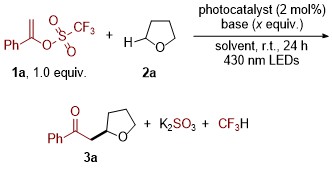
The C(sp3)—H alkylation reaction was initially investigated using 1-phenylvinyl trifluoromethanesulfonate (1a)[10] and tetrahydrofuran (THF, 2a) as model substrates under blue LED irradiation (430 nm) for 24 h. The reaction was conducted with Ir(dFCF3ppy)2(dtbbpy)PF6 (PC1) as the photocatalyst and KOH as the base in THF as the solvent. Under these conditions, the desired product, 1-phenyl- 2-(tetrahydrofuran-2-yl)ethan-1-one (3a), was obtained in 74% yield (Table 1, Entry 1). Analysis by 19F NMR spectra confirmed the formation of trifluoromethane as a byproduct,[11] while the detection of potassium sulfite byproduct indicated that sulfur dioxide released during the reaction was trapped by KOH.[10b] Further screening of photocatalysts revealed that Ir(ppy)2(dtbbpy)PF6 (PC2) was ineffective (Entry 2), whereas 2-isopropylthioxanthone (iPr-TXT, PC3) proved optimal, affording 3a in 82% yield (Entry 3). Evaluation of bases identified KOH was superior to other inorganic bases such as KOAc and K2CO3 (Entries 4~6). The optimal amount of KOH was found to be 2.5 equiv. (Entries 7, 8). The yield of 3a increased to 87% upon the addition of 50 μL of water (Entry 9). Solvent screening showed that the reaction proceeded smoothly in ethyl acetate (Entry 10), but was ineffective in acetonitrile or dichloromethane (Entries 11, 12). The transformation could be successfully scaled to the mmol-level without significant loss in efficiency (Entry 13). Control experiments established that KOH, light, and the photocatalyst were all essential for this transformation (Entries 14~16). Interest-ingly, under 365 nm irradiation, the alkylation occurred even in the absence of a photocatalyst, yielding 3a in 50% (Entry 17). This result suggests that the reaction possibly proceed via an energy-transfer pathway.
Table 1 Optimization of the conditions for C(sp3)—H alkylation
Entry Photocatalyst Base (x/equiv.) Solvent Yielda/%
1 PC1 KOH (2.5) THF 74
2 PC2 KOH (2.5) THF 0
3 PC3 KOH (2.5) THF 82
4 PC3 NaOH (2.5) THF 0
5 PC3 K2CO3 (2.5) THF 10
6 PC3 KOAc 2.5) THF 10
7 PC3 KOH (2.0) THF 78
8 PC3 KOH (3.0) THF 82
9b PC3 KOH (2.5) THF 87
10b,c PC3 KOH (2.5) EA 80
11b,c PC3 KOH (2.5) MeCN 0
12b,c PC3 KOH (2.5) DCM 0
13b,d PC3 KOH (2.5) THF 70
14b PC3 THF 0
15b,e PC3 KOH (2.5) THF 0
16b KOH (2.5) THF 0
17b,f KOH (2.5) THF 50

a General conditions: 1a (0.2 mmol), photocatalyst (0.004 mmol), KOH (0.5 mmol) in anhydrous THF (4.0 mL) was irradiated at room temperature under 430 nm LED for 24 h. The yields were isolated yields. b With 50 μL of H2O. c The reaction was performed with THF (2a, 4.0 mmol). d The reaction was performed with 1a (2.0 mmol scale). e Without light. f 365 nm light irradiation.

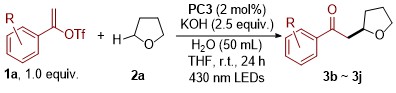
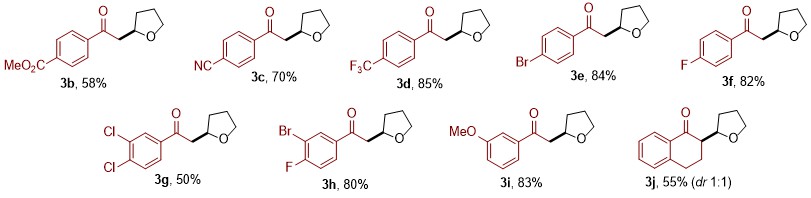
With the optimized conditions established, the scope of arylvinyl trifluoromethanesulfonates 1 was next evaluated (Table 2). The reaction proved tolerant of various electron-withdrawing substituents on the phenyl ring of 1-phen- ylvinyl trifluoromethanesulfonates. Substrates bearing ester (3b), cyano (3c), trifluoromethyl (3d), and halogen atoms (3e~3h) all reacted smoothly, providing the corresponding 1-phenylethan-1-one derivatives in good yields. 1-(3-Meth- oxyphenyl)vinyl trifluoromethanesulfonate (3i) was a feasible substrate in this C(sp3)—H alkylation reaction with 83% yield. Furthermore, the reaction was successfully extended to 3,4-dihydronaphthalen-1-yl trifluoromethanesulfonate, giving the desired product 3j in 55% yield.
Table 2 Substrate scope of arylvinyl trifluoromethanesulfonatesa

a General conditions: 1 (0.2 mmol), PC3 (0.004 mmol), KOH (0.5 mmol), H2O (50 μL) in anhydrous THF (4.0 mL), irradiated at room temperature under 430 nm LED for 24 h. The yields were isolated yields.

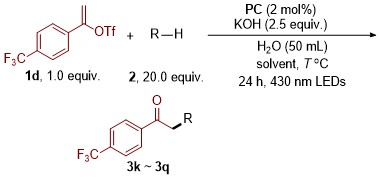
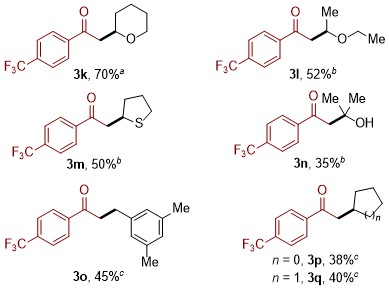
Next, the generality of C(sp3)—H feedstocks was investigated (Table 3). Under the standard conditions, tetrahydropyran, diethyl ether, and tetrahydrothiophene, performed well to provide the desired α-heteroatom site functionalized products 3k~3m in good yields. Isopropanol was also a viable substrate, furnishing product 3n in reasonable yield. However, the benzylic C—H bonds of 1,3,5-trimethyl- benzene proved unreactive under these initial parameters. Further optimization revealed that employing 5,7,12,14- pentacenetetrone (PC4) as the photocatalyst under 400 nm LED irradiation enabled the desired transformation. Under these modified conditions, the benzylic alkylation proceeded to give product 3o in 45% yield. Moreover, cycloalkanes such as cyclopentane and cyclohexane were also found to be suitable substrates when using PC4 as the photocatalyst.
Table 3 Substrate scope of C(sp3)—H feedstocks

a The reaction was performed with 1d (0.2 mmol), PC3 (0.004 mmol), KOH (0.5 mmol), H2O (50 μL) in tetrahydropyran (4.0 mL), irradiated at room temperature under 430 nm LED for 24 h; b The reaction was performed with 1d (0.2 mmol), 2 (4.0 mmol), PC3 (0.004 mmol), KOH (0.5 mmol), H2O (50 μL) in anhydrous ethyl acetate (4.0 mL), irradiated at 50 ℃ under 430 nm LED for 24 h. The yields were isolated yields. c The reaction was performed with 1d (0.2 mmol), 2 (4.0 mmol), PC4 (0.004 mmol), KOH (0.5 mmol), H2O (50 μL) in anhydrous ethyl acetate (4.0 mL), and irradiated at 50 ℃ under 400 nm LED for 24 h.

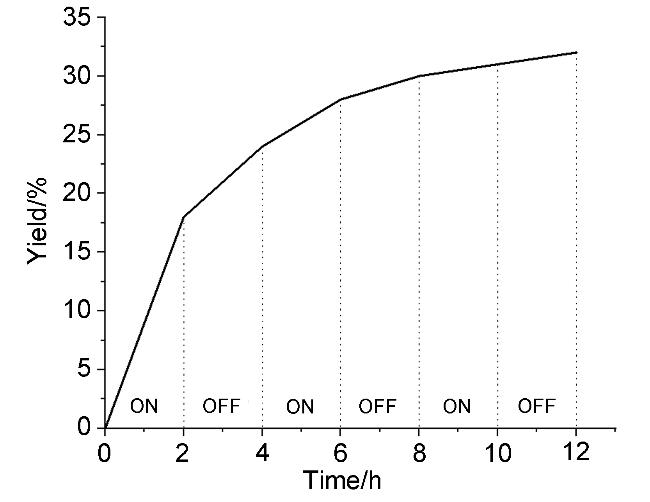
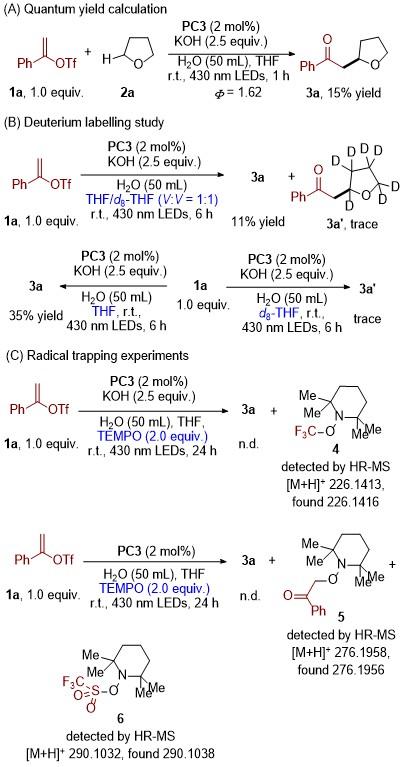
To gain insight into the reaction mechanism, several control experiments were conducted. Light on/off experiments demonstrated that after an initial irradiation period, the C(sp3)—H alkylation continued to proceed under dark conditions (Figure 1). A quantum yield of Φ=1.62 indicated that the transformation follows a chain-reaction pathway (Scheme 2, A). Kinetic isotope effects (KIEs) were evaluated through both competition and parallel reactions. The results suggested that C(sp3)—H bond cleavage is likely the rate-determining step (Scheme 2, B). When 2,2, 6,6-tetramethylpiperidinyloxyl (TEMPO) was employed as a radical scavenger, the trifluoromethyl adduct 4 was detected by HR-MS. Performing the reaction in the absence of KOH led to the trapping by TEMPO of both the acetophenone-derived alkyl radical 5 and the trifluoromethanesulfonyl radical 6 (Scheme 2, C).
Figure 1 Light on/off experiments
Scheme 2 Control experiments
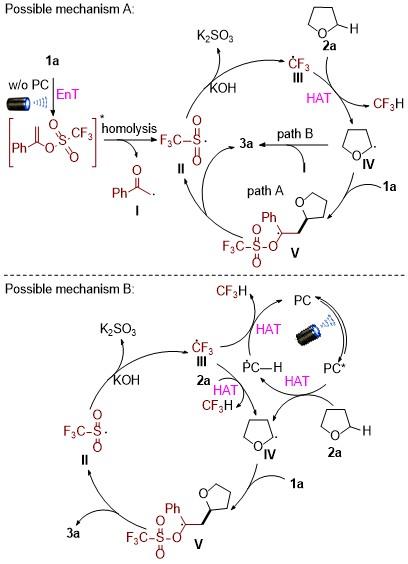
Based on the above results and previous reports,[12] two plausible mechanisms are proposed (Scheme 3). Upon light irradiation, 1-phenylvinyl trifluoromethanesulfonate (1a) reaches an excited state via a thioxanthone-catalyzed energy transfer process.[13] Homolysis of excited 1a generates the acetophenone-derived alkyl radical (I) and a trifluoromethanesulfonyl radical (II). In the presence of KOH, intermediate II releases sulfur dioxide to form a CF3 radical (III),[10b] which abstracts a hydrogen atom from the α- oxygen atom position of THF to afford alkyl radical IV.[14] Radical IV adds to 1a to form intermediate V, which then undergoes desulfonylation delivers product 3a and regenerates radical II (Scheme 3, A).[15] Alternatively, the formation of 3a via direct radical-radical coupling between intermediates I and IV cannot be excluded.
Scheme 3 Plausible mechanisms
Additionally, thioxantone PC3 may serve as a HAT photocatalyst.[9e,16] Thus, an alternative pathway for the generation of THF radical IV involves direct photoinduced HAT catalysis (Scheme 3, B).[5b]

3 Conclusions

In conclusion, we have developed an oxidant-free C(sp3)—H alkylation with arylvinyl trifluoromethanesulfonates, enabled by photoinduced energy transfer catalysis. This method provides direct access to a diverse range of acetophenone-derived products from readily available C(sp3)—H feedstocks. Mechanistic studies support a reaction pathway in which a trifluoromethyl radical acts as a HAT reagent, with the transformation proceeding via a radical chain mechanism.

4 Experimental section

4.1 General experimental information

Chemicals and anhydrous solvents were purchased from Energy Chemical and Tansoole Chemical, and used as received. The photocatalysts were purchased from Tansoole Chemical. Arylvinyl trifluoromethanesulfonates were synthesized according to literature.[9b] 1H NMR, 13C NMR, and 19F NMR spectra were recorded on a JEOL-500 M (500 MHz) spectrometer. Chemical shifts were calibrated using residual undeuterated solvent as an internal reference (CDCl3 δH 7.26, δC 77.0). The high-resolution mass spectra (HRMS) were obtained on a AB Sciex TripleTOF 5600 plus spectrometer. Melting points were determined on a digital melting point M-560 (BUCHI) apparatus and were uncorrected. The Blue LED strips (maximum emission at around 400 and 430 nm, 36 W) were purchased from Colour- LED-Luminance (Taobao). Further thin-layer chromatography (TLC) plate visualization was achieved by staining with iodine or KMnO4. The sealed-tubes with Teflon caps (15 mL) were purchased from Synthware. The reaction temperature was controlled using water baths.

4.2 General procedure for C(sp3)—H alkylation

Under nitrogen atmosphere, an oven-dried sealed-tube was equipped with a rubber septum and magnetic stir bar and charged with arylvinyl trifluoromethanesulfonate 1 (0.2 mmol), PC3 or PC4 (1.0 mg, 0.004 mmol), KOH (28.0 mg,0.5 mmol). The resulting mixture was sealed and degassed via vacuum evacuation and back-filled with nitrogen for three times. Anhydrous THF or ethyl acetate (4.0 mL) was added and then cooling the mixture to 0 ℃. A nitrogen balloon was used to bubble the reaction mixture for 10~15 min at 0 ℃. Subsequently, deionized water (0.05 mL) and C(sp3)—H feedstock 2 (4.0 mmol) were added into the reaction mixture. The tube was sealed and then placed under a 30 W 430 nm blue LEDs at 25 or 50 ℃ for 24 h. After the reaction was completed, the reaction mixture was concentrated under vacuum and then purified by flash chromatography [eluent: petroleum ether (PE)/ethyl acetate (EA), VV=10∶1] to afford the desired product.
1-Phenyl-2-(tetrahydrofuran-2-yl)ethan-1-one (3a): 33.1 mg, 87% yield, yellow oil. 1H NMR (500 MHz, CDCl3) δ: 7.96 (d, J=8.5 Hz, 2H), 7.56 (t, J=15 Hz, 1H), 7.46 (t, J=15.5 Hz, 2H), 4.43~4.38 (m, 1H), 3.89 (q, J=7 Hz, 1H), 3.75 (q, J=7.5 Hz, 1H), 3.39 (dd, J=16.5 Hz, 1H), 3.06 (dd, J=1.5 Hz, 1H), 2.23~2.17 (m, 1H), 1.96~1.90 (m, 2H), 1.60~1.53 (m, 1H); 13C NMR (125 MHz, CDCl3) δ: 198.6, 137.1, 133.3, 128.7, 128.3, 75.5, 68.0, 44.8, 31.8, 25.8; HRMS-ESI calcd for C12H15O2 [M+H] 191.1067, found 191.1062.
Methyl 4-(2-(tetrahydrofuran-2-yl)acetyl)benzoate (3b): 28.8 mg, 58% yield, colorless oil. 1H NMR (500 MHz, CDCl3) δ: 8.05 (d, J=5 Hz, 2H), 7.73 (d, J=5 Hz, 2H), 4.42~4.37 (m, 1H),3.93 (s, 3H), 3.87 (q, J=7 Hz, 1H), 3.74 (q, J=7 Hz, 1H), 3.37 (dd, J=6.5 Hz, 1H), 3.07 (dd, J=6.5 Hz,1H), 2.23~2.17 (m, 1H), 1.96~1.90 (m, 2H), 1.61~1.54 (m, 1H); 13C NMR (125 MHz, CDCl3) δ: 197.9, 166.2, 140.2, 133.8, 129.8, 128.1, 75.2, 67.9, 52.4, 44.9, 31.6, 25.6; HRMS-ESI calcd for C14H17O4 [M+H] 249.1121, found 249.1123.
4-(2-(Tetrahydrofuran-2-yl)acetyl)benzonitrile (3c): 30.1 mg, 70% yield, white solid. m.p. 55~57 ℃; 1H NMR (500 MHz, CDCl3) δ: 8.04 (d, J=8.5 Hz, 2H), 7.76 (d, J=8.5 Hz, 2H), 4.41~4.35 (m, 1H), 3.89~3.85 (m, 1H), 3.77~3.70 (m, 1H), 3.37~3.33 (m, 1H), 3.08~3.04 (m, 1H), 2.23~2.17 (m, 1H), 1.96~1.90 (m, 2H), 1.61~1.54 (m, 1H); 13C NMR (125 MHz, CDCl3) δ: 197.3, 139.9, 132.5, 128.6, 117.9, 116.3, 75.1, 67.9, 44.9, 31.6, 25.6; HRMS-ESI calcd for C13H14NO2 [M+H] 216.1019, found 216.1020.
2-(Tetrahydrofuran-2-yl)-1-(4-(trifluoromethyl)phenyl)-ethan-1-one (3d): 43.9 mg, 85% yield, colorless oil. 1H NMR (500 MHz, CDCl3) δ: 8.06 (d, J=8.0 Hz, 2H), 7.72 (d, J=8.0 Hz, 2H), 4.42~4.37 (m, 1H), 3.91~3.86 (m, 1H), 3.77~3.73 (m, 1H), 3.40~3.36 (m, 1H), 3.09~3.05 (m, 1H), 2.23~2.17 (m, 1H), 1.96~1.91 (m, 2H), 1.61~1.54 (m, 1H); 13C NMR (125 MH, CDCl3) δ: 197.6, 139.7, 134.4 (q, J=32.5 Hz, 1C), 128.6, 125.6 (q, J=3.8 Hz, 1C),123.6 (q, J=271.3 Hz, 1C), 75.2, 67.9, 44.8, 31.6, 25.6; 19F NMR (470 MHz, CDCl3) δ: -63.0; HRMS-ESI calcd for C13H14F3O2 [M+H] 259.0940, found 259.0944.
1-(4-Bromophenyl)-2-(tetrahydrofuran-2-yl)ethan-1-one (3e): 45.2 mg, 84% yield, white solid. m.p. 40~41 ℃; 1H NMR (500 MHz, CDCl3) δ: 7.82 (d, J=8.5 Hz, 2H), 7.59 (d, J=8.5 Hz, 2H), 4.40~4.35 (m, 1H), 3.88 (q, J=8.0 Hz, 1H), 3.74 (q, J=7.0 Hz, 1H), 3.35~3.31 (m, 1H), 3.04~2.99 (m, 1H), 2.22~2.15 (m, 1H), 1.95~1.89 (m, 2H), 1.59~1.52 (m, 1H); 13C NMR (125 MHz, CDCl3) δ: 197.4, 135.8, 131.9, 129.7, 128.3,75.3, 67.9, 44.6, 31.6, 25.6; HRMS-ESIcalcd for C12H14BrO2 [M+H] 269.0172, found 269.0173.
1-(4-Fluorophenyl)-2-(tetrahydrofuran-2-yl)ethan-1-one (3f): 34.2 mg, 82% yield, yellow oil. 1H NMR (500 MHz, CDCl3) δ: 8.00~7.97 (m, 2H), 7.12 (t, J=8.0 Hz, 2H), 4.41~4.35 (m, 1H), 3.88 (q, J=8.0 Hz, 1H), 3.74 (q, J=7.5 Hz, 1H), 3.37~3.32 (m, 1H), 3.04~2.99 (m, 1H), 2.22~2.16 (m, 1H), 1.95~1.89 (m, 2H), 1.59~1.52 (m, 1H); 13C NMR (125 MHz, CDCl3) δ: 196.9, 165.7 (d, J=252.5 Hz, 1C), 133.4, 130.8 (d, J=8.8 Hz, 1C), 115.6 (d, J=21.3 Hz, 1C), 75.3, 67.9, 44.5, 31.6, 25.6; 19F NMR (470 MHz, CDCl3) δ: -105.05; HRMS-ESI calcd for C12H14- FO2 [M+H]209.0968, found 209.0968.
1-(3,4-Dichlorophenyl)-2-(tetrahydrofuran-2-yl)ethan-1-one (3g): 25.9 mg, 50% yield, yellow oil. 1H NMR (500 MHz, CDCl3) δ: 8.04 (s, 1H), 7.78 (d, J=8.0 Hz, 1H), 7.54 (d, J=9.0 Hz, 1H), 4.39~4.35 (m, 1H), 3.90~3.86 (m, 1H), 3.77~3.73 (m, 1H), 3.33~3.29 (m, 1H), 3.03~2.99 (m, 1H), 2.22~2.16 (m, 1H), 1.96~1.90 (m, 2H), 1.60~1.53 (m, 1H); 13C NMR (125 MHz, CDCl3) δ: 196.3, 137.7, 136.5, 133.3, 130.7, 130.3, 127.3, 75.2, 67.9, 44.6, 31.6, 25.6; HRMS-ESI calcd for C12H12Cl2O2Na [M+Na] 259.0287, found 259.0289.
1-(3-Bromo-4-fluorophenyl)-2-(tetrahydrofuran-2-yl)-ethan-1-one (3h): 45.9 mg, 80% yield, colorless oil. 1H NMR (500 MHz, CDCl3) δ: 8.17 (d, J=5.5 Hz, 1H), 7.92~7.89 (m, 1H), 7.19 (t, J=8.5 Hz, 1H), 4.39~4.34 (m, 1H), 3.89~3.85 (m, 1H), 3.76~3.72 (m, 1H), 3.32~3.28 (m, 1H), 3.02~2.98 (m, 1H), 2.21~2.15 (m, 1H), 1.95~1.89 (m, 2H), 1.59~1.52 (m, 1H); 13C NMR (125 MHz, CDCl3) δ: 195.8, 161.9 (d, J=255.0 Hz, 1C), 134.5 (d, J=3.8 Hz, 1C), 134.1, 129.4 (d, J=8.8 Hz, 1C), 116.6 (d, J=23.8 Hz, 1C), 109.6 (d, J=21.3 Hz, 1C), 75.2, 67.9, 44.5, 31.6, 25.6; 19F NMR (470 MHz, CDCl3) δ: -99.4; HRMS-ESI calcd for C12H13BrFO2 [M+H]: 287.0077, found 287.0082.
1-(3-Methoxyphenyl)-2-(tetrahydrofuran-2-yl)ethan-1-one (3i): 36.6 mg, 83% yield, yellow oil. 1H NMR (500 MHz, CDCl3) δ: 7.53 (d, J=8.0 Hz, 2H), 7.48 (s, 1H), 7.35 (t, J=8.0 Hz, 1H), 7.10~7.08 (m, 1H), 4.41~4.36 (m, 1H), 3.90~3.86 (m, 1H), 3.83 (s, 3H), 3.74 (q, J=7.0 Hz, 1H), 3.38~3.34 (m, 1H), 3.06~3.01 (m, 1H), 2.21~2.15 (m, 1H), 1.95~1.89 (m, 2H), 1.59~1.51 (m, 1H); 13C NMR (125 MHz, CDCl3) δ: 198.3, 159.8, 138.3, 129.6, 120.9, 119.7, 112.2, 75.4, 67.8, 55.4, 44.8, 31.6, 25.6; HRMS-ESI calcd for C13H17O3 [M+H] 221.1172, found 221.1173.
2-(Tetrahydrofuran-2-yl)-3,4-dihydronaphthalen-1(2H)-one (3j): 23.8 mg, 55% yield (dr: 1∶1), yellow oil. Isomer 1: 1H NMR (500 MHz, CDCl3) δ: 8.00 (d, J=9.0 Hz, 1H), 7.47~7.44 (m, 1H), 7.30~7.27 (m, 1H), 7.23 (d, J=8.0 Hz, 1H), 4.26 (q, J=7.0 Hz, 1H), 3.87~3.83 (m, 1H), 3.76~3.72 (m, 1H), 3.11~2.95 (m, 2H), 2.58~2.53 (m, 1H), 2.39~2.34 (m, 1H), 2.24~2.17 (m, 1H), 2.15~2.07 (m, 1H), 1.95~1.89 (m, 2H), 1.80~1.73 (m, 1H); 13C NMR (125 MHz, CDCl3) δ: 198.7, 144.2, 133.3, 132.8, 128.7, 127.4, 126.5, 77.1, 67.8, 52.7, 30.3, 28.2, 25.9, 24.9; HRMS-ESI calcd for C14H17O4 [M+H] 217.1223, found 217.1220. Isomer 2: 1H NMR (500 MHz, CDCl3) δ: 8.01 (d, J=9.0 Hz, 1H), 7.48~7.44 (m, 1H), 7.30 (t, J=7.5 Hz, 1H), 7.24 (d, J=7.5 Hz, 1H), 4.54~4.50 (m, 1H), 3.88 (q, J=8.0 Hz, 1H), 3.76 (q, J=8.0 Hz, 1H), 3.08~3.01 (m, 2H), 2.96~2.92 (m, 1H), 2.33~2.27 (m, 1H), 2.10~2.04 (m, 1H), 1.98~1.85 (m, 3H), 1.65~1.61 (m, 1H); 13C NMR (125 MHz, CDCl3) δ: 198.8, 144.0, 133.3, 132.8, 128.7, 127.2, 126.6, 77.3, 68.3, 51.5, 28.7, 27.5, 26.1, 23.8; HRMS-ESI calcd for C14H17O4 [M+H] 217.1223, found 217.1220.
2-(Tetrahydro-2H-pyran-2-yl)-1-(4-(trifluoromethyl)-phenyl)ethan-1-one (3k): 38.1 mg, 70% yield, yellow oil. 1H NMR (500 MHz, CDCl3) δ: 8.06 (d, J=8.0 Hz, 2H), 7.72 (d, J=8.0 Hz, 2H), 3.97~3.92 (m, 2H), 3.48~3.43 (m, 1H), 3.32~3.27 (m, 1H), 2.93~2.89 (m, 1H), 1.89~1.72 (m, 1H), 1.59~1.49 (m, 3H),1.42~1.34 (m, 1H); 13C NMR (125 MH, CDCl3) δ: 197.7, 139.9, 134.4 (q, J=32.5 Hz, 1C), 128.6, 125.6 (q, J=3.8 Hz, 1C),123.6 (q, J=271.3 Hz, 1C), 74.2, 68.6, 45.6, 31.9, 25.7, 23.3; 19F NMR (470 MHz, CDCl3) δ: -62.9. HRMS-ESI calcd for C14H16F3O2 [M+H] 273.1097, found 273.1098.
3-Ethoxy-1-(4-(trifluoromethyl)phenyl)butan-1-one (3l): 27.1 mg, 52% yield, yellow oil. 1H NMR (500 MHz, CDCl3) δ: 8.06 (d, J=8.0 Hz, 2H), 7.73 (d, J=8.0 Hz, 2H), 4.10~4.04 (m, 1H), 3.61~3.55 (m, 1H), 3.45~3.39 (m, 1H), 3.37~3.33 (m, 1H), 2.94~2.89 (m, 1H), 1.27 (d, J=6.5 Hz, 3H), 1.12 (t, J=7.0 Hz, 3H); 13C NMR (125 MH, CDCl3) δ: 198.1, 139.9, 134.3 (q, J=32.5 Hz, 1C), 128.5, 125.6 (q, J=3.8 Hz, 1C), 123.6 (q, J=271.3 Hz, 1C), 71.8, 64.2, 46.2, 20.2, 15.4; 19F NMR (470 MHz, CDCl3) δ: -62.9; HRMS-ESI calcd for C13H16F3O2 [M+H] 261.1097, found 261.1098.
2-(Tetrahydrothiophen-2-yl)-1-(4-(trifluoromethyl)-phenyl)ethan-1-one (3m): 27.4 mg, 50% yield, yellow oil. 1H NMR (500 MHz, CDCl3) δ: 8.05 (d, J=8.0 Hz, 2H), 7.72 (d, J=8.0 Hz, 2H), 3.93~3.87 (m, 1H), 3.33 (d, J=7.0 Hz, 2H), 2.94~2.87 (m, 2H), 2.29~2.23 (m, 1H), 2.14~2.07 (m, 1H), 2.02~1.94 (m, 1H), 1.68~1.62 (m, 1H); 13C NMR (125 MH, CDCl3): δ: 197.4, 139.2, 134.4 (q, J=32.5 Hz, 1C), 128.4, 125.7 (q, J=3.8 Hz, 1C), 123.5 (q, J=271.3 Hz, 1C), 46.9, 42.9, 36.9, 32.5, 30.2; 19F NMR (470 MHz, CDCl3) δ: -62.9; HRMS-ESI calcd for C13H14F3OS [M+H] 275.0712, found 275.0710.
3-Hydroxy-3-methyl-1-(4-(trifluoromethyl)phenyl)butan-1-one (3n): 17.2 mg, 35% yield, yellow oil. 1H NMR (500 MHz, CDCl3) δ: 8.06 (d, J=7.5 Hz, 2H), 7.74 (d, J=8.0 Hz, 2H), 3.81 (s, 1H), 3.18 (s, 2H), 1.37 (s, 6H). The NMR data was consistent with literature report.[16a]
3-(3,5-Dimethylphenyl)-1-(4-(trifluoromethyl)phenyl)-propan-1-one (3o): 27.6 mg, 45% yield, yellow solid. m.p. 54~55 ℃; 1H NMR (500 MHz, CDCl3) δ: 8.06 (d, J=8.0 Hz, 2H), 7.72 (d, J=8.0 Hz, 2H), 6.88 (s, 3H), 3.31 (t, J=8.0 Hz, 2H), 3.01 (t, J=8.0 Hz, 2H), 2.31 (s, 6H); 13C NMR (125 MH, CDCl3) δ: 198.3, 140.7, 139.4, 138.1, 134.3 (q, J=32.5 Hz, 1C), 128.3, 127.9, 126.2, 125.6 (q, J=3.8 Hz, 1C),123.6 (q, J=270.0 Hz, 1C), 40.9, 29.7, 21.2; 19F NMR (470 MHz, CDCl3) δ: -62.9; HRMS-ESI calcd for C18H18F3O [M+H] 307.1304, found 307.1305.
2-Cyclopentyl-1-(4-(trifluoromethyl)phenyl)ethan-1-one (3p): 19.5 mg, 38% yield, yellow oil. 1H NMR (500 MHz, CDCl3) δ: 8.05 (d, J=8.0 Hz, 2H), 7.72 (d, J=8.0 Hz, 2H), 3.01 (d, J=7.0 Hz, 2H), 2.41~2.35 (m, 1H), 1.92~1.86 (m, 2H), 1.68~1.57 (m, 4H), 1.21~1.14 (m, 2H). The NMR data was consistent with literature report.[16b]
2-Cyclohexyl-1-(4-(trifluoromethyl)phenyl)ethan-1-one (3q): 21.6 mg, 40% yield, yellow oil. 1H NMR (500 MHz, CDCl3) δ: 8.04 (d, J=8.5 Hz, 2H), 7.72 (d, J=8.5 Hz, 2H), 2.84 (d, J=6.5 Hz, 2H), 2.01~1.93 (m, 1H), 1.77~1.66 (m, 5H), 1.30~1.28 (m, 2H), 1.19~1.12 (m, 1H), 1.06~0.98 (m, 2H). The NMR data was consistent with literature report.[16c]
Supporting Information The control experiments detail about trifluoroethane detection and potassium sulfite detection, the 1H NMR and 13C NMR spectra of all products, the 19F NMR spectra of all products bearing fluorine atom. The Supporting Information is available free of charge via the Internet at http://sioc-journal.cn.
(Zhao, C.)
[1]
(a) Böhm, H.-J.; Banner, D.; Bendels, S.; Kansy, M.; Kuhn, B.; Müller, K.; Obst-Sander, U.; Stahl, M. ChemBioChem 2004, 5, 637.

(b) Hagmann, W. K. J. Med. Chem. 2008, 51, 4359.

(c) Novás, M.; Matos, M. J. Molecules 2025, 30, 3009.

[2]
(a) Merino, E.; Nevado, C. Chem. Soc. Rev. 2014, 43, 6598.

(b) Charpentier, J.; Früh, N.; Togni, A. Chem. Rev. 2015, 115, 650.

(c) Yang, X.; Wu, T.; Phipps, R. J.; Toste, F. D. Chem. Rev. 2015, 115, 826.

(d) Alonso, C.; de Marigorta, E. M.; Rubiales, G.; Palacios, F. Chem. Rev. 2015, 115, 1847.

(e) Mandal, D.; Maji, S.; Pal, T.; Sinha, S. K.; Maiti, D. Chem. Commun. 2022, 58, 10442.

(f) Wang, M.; Xi, W.; Wu, H.; Bai, D. Chin. J. Org. Chem. 2025, 45, 516 (in Chinese).

(王曼曼, 习文慧, 吴昊, 白大昌, 有机化学, 2025, 45, 516.)

(g) Huang, G.; Xue, X.-S. Acta Chim. Sinica 2024, 82, 132 (in Chinese).

(黄广龙, 薛小松, 化学学报, 2024, 82, 132.)

(h) Li, S.; Lu, J.; Liu, J.; Jiang, L.; Yi, W. Acta Chim. Sinica 2024, 82, 110 (in Chinese).

(李珊, 路俊欣, 刘杰, 蒋绿齐, 易文斌, 化学学报, 2024, 82, 110.)

[3]
(a) Studer, A. Angew. Chem., Int. Ed. 2012, 51, 8950.

(b) Wang, X.; Zhang, Y.; Wang, J. Sci. Sin. Chim. 2012, 42, 1417.

(c) Koike, T.; Akita, M. Top. Catal. 2014, 57, 967.

(d) Xiao, H.; Zhang, Z.; Fang, Y.; Zhu, L.; Li, C. Chem. Soc. Rev. 2021, 50, 6308.

(e) Lin, D.; Coe, M.; Krishnamurti, V.; Ispizua-Rodriguez, X.; Prakash, G. K. S. Chem. Rec. 2023, 23, e202300104.

(f) Zhang, L.; Li, Y.; Huang, D.; Wu, J. Asian J. Org. Chem. 2025, 14, e00550.

[4]
(a) Wang, D.; Mück-Lichtenfeld, W.; Studer, A. J. Am. Chem. Soc. 2019, 141, 14126.

(b) Wang, D.; Mück-Lichtenfeld, W.; Studer, A. J. Am. Chem. Soc. 2020, 142, 9119.

[5]
(a) Cao, H.; Tang, X.; Tang, H.; Yuan, Y.; Wu, J. Chem. Catal. 2021, 1, 523.

(b) Capaldo, L.; Ravelli, D.; Fagnoni, M. Chem. Rev. 2022, 122, 1875.

[6]
(a) Stompor, M.; Dancewicz, K.; Gabryś B.; Anioł M. J. Agric. Food Chem. 2015, 63, 6749.

(b) Miller, D. K.; Lever, J. R.; Rodvelt, K. R.; Baskett, J. A.; Will, M. J.; Kracke, G. R. Drug Alcohol Depend. 2007, 89, 282.

(c) Kudo, S.; Ishizaki, T. Clin. Pharmacokinet. 1999, 37, 435.

[7]
(a) Ji, J.; Liu, P.; Sun, P. Chem. Commun. 2015, 51, 7546.

(b) Hua, Z.; Tang, Y.; Zhang, S.; Li, X.; Du, X.; Xu, X. Synlett 2015, 26, 2557.

(c) Ji, P.-Y.; Liu, Y.-F.; Xu, J.-W.; Luo, W.-P.; Liu, Q.; Guo, C.-C. J. Org. Chem. 2017, 82, 2965.

(d) Li, J.; Li, J.; Yuan, S.; Zhang, Q.; Li, D. Asian J. Org. Chem. 2019, 8, 1842.

(e) Mou, D.; Li, Q.; Du, Z. ChemistrySelect 2023, 8, e202203486.

(f) Das, K. M.; Pal, A.; Surya T, L.; Roy, L.; Thakur, A. Chem.-Eur. J. 2024, 30, e202303776.

[8]
Lee, J. Y.; Lim, K.-C.; Meng, X.; Kim, S. Synlett 2010, 11, 1647.

[9]
(a) Li, D.-S.; Liu, T.; Hong, Y.; Cao, C.-L.; Wu, J.; Deng, H.-P. ACS Catal. 2022, 12, 4473.

(b) Dong, M.-Y.; Han, C.-Y.; Li, D.-S.; Hong, Y.; Liu, F.; Deng, H.-P. ACS Catal. 2022, 12, 9533.

(c) Cao, C.-L.; Zhang, G.-X.; Xue, F.; Deng, H.-P. Org. Chem. Front. 2022, 9, 959.

(d) Hong, Y.; Dong, M.-Y.; Li, D.-S.; Deng, H.-P. Org. Lett. 2022, 24, 7677.

(e) Chen, P.-F.; Li, D.-S.; Ou, W.-T.; Xue, F.; Deng, H.-P. Org. Lett. 2023, 25, 6184.

(f) Zhang, G.-X.; Li, D.-S.; Chen, A.-F.; Xue, F.; Deng, H.-P. Adv. Synth. Catal. 2023, 365, 4604.

(g) Hong, Y.; Deng, H.-P. ChemPhotoChem 2024, 9, e202400282.

(h) Hong, Y.; Deng, H.-P. Chin. J. Org. Chem. 2025, 45, 1569 (in Chinese).

(洪洋, 邓红平, 有机化学, 2025, 45, 1569.)

(i) Li, D.-S.; Zhang, G.-X.; Qian, H.; Xue, F.; Deng, H.-P. Adv. Synth. Catal. 2025, 367, e202500314.

[10]
(a) Liu, S.; Jie, J.; Yu, J.; Yang, X. Adv. Synth. Catal. 2018, 360, 267.

(b) Wang, H.; Bellotti, P.; Zhang, X.; Paulisch, T. O.; Glorius, F. Chem 2021, 7, 3412.

(c) Feng, Q.; Fu, Y.; Zheng, Y.; Liao, S.; Huang, S. Org. Lett. 2022, 24, 3702.

(d) Xiang, P.; Sun, K.; Shi, A.; An, J.; Chen, X.; Qu, L.; Yu, B. Green Chem. 2025, 27, 1820.

[11]
Liu, Z.; Long, J.; Xiao, X.; Lin, J.-H.; Zheng, X.; Xiao, J.-C.; Cao, Y.-C. Chin. Chem. Lett. 2019, 30, 714.

[12]
(a) Tan, Y.; Wu, X.; Han, Y.-P.; Zhang, Y.; Zhang, H.-Y.; Zhao, J. J. Org. Chem. 2022, 87, 8551.

(b) Zhang, D.-L.; Le, Z.-G.; Li, Q.; Xie, Z.-B.; Yang, W.-W.; Zhu, Z.-Q. Chem. Commun. 2024, 60, 2958.

(c) Huang, X.-L.; Zhang, D.-L.; Li, Q.; Xie, Z.-B.; Le, Z.-G.; Zhu, Z.-Q. Org. Lett. 2024, 26, 3727.

[13]
(a) Zhou, Q.-Q.; Zou, Y.-Q.; Lu, L.-Q.; Xiao, W.-J. Angew. Chem., Int. Ed. 2019, 58, 1586.

(b) Strieth-Kalthoff, F.; Glorius, F. Chem 2020, 6, 1888.

(c) Großkopf, J.; Kratz, T.; Rigotti, T.; Bach, T. Chem. Rev. 2022, 122, 1626.

[14]
(a) Roberts, B. P. Chem. Soc. Rev. 1999, 28, 25.

(b) Garwood, J. J. A.; Chen, A. D.; Nagib, D. A. J. Am. Chem. Soc. 2024, 146, 28034.

[15]
Kawamoto, T.; Hisayuki, M.; Kamimura, A. Chem. Lett. 2024, 53, upae072.

[16]
(a) Zhu, K.; Ohtani, T.; Tripathi, C. B.; Uraguchi, D.; Ooi, T. Chem. Lett. 2019, 48, 715.

(b) Raviola, C.; Ravelli, D. Synlett 2019, 30, 803.

(c) Grover, J.; Prakash, G.; Teja, C.; Lahiri, G. K.; Maiti, D. Green Chem. 2023, 25, 3431.

Outlines

/