


1 Introduction
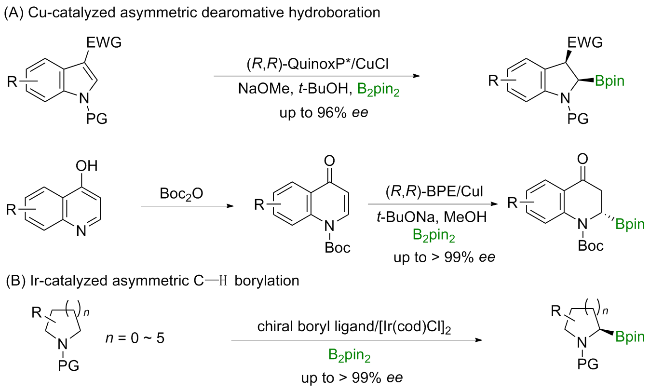
Chiral α-aminoboronic acid and their derivatives serve as broadly utilized scaffolds for therapeutically pivotal protease inhibitors,[1-2] including bortezomib, delanzomib and ixazomib, as well as dipeptidyl peptidase-4 (DPP4) inhibitors such as Talabostat and Dutogliptin. Beyond their pharmaceutical applications, these compounds have also attracted growing attention for their employment in fluorescent sensor development[3-4] and as key reagents in stereospecific synthetic transformations.[5-6] As a result, extensive research efforts have been dedicated to developing efficient synthetic protocols for chiral α-aminoboronate esters.[7-8] The majority of established strategies rely on diastereoselective synthesis involving stoichiometric quantities of chiral auxiliaries[7-8] or chiral substrates.[9] In recent years, transition-metal-catalyzed asymmetric borylation[10-17] and hydrogenation[18] have emerged as powerful approaches to access a diverse range of acyclic chiral α- aminoboronate esters. In stark contrast, the direct catalytic asymmetric borylation for the construction of cyclic chiral α-aminoboronate esters remains a significant challenge. In this regard, while dearomative borylation of indoles[19] and 4-quinoliols,[20] as well as C—H borylation of aza- cyles,[21-23] have been well established, these methods either afford fused-ring products (Scheme 1A) or rely on noble transition catalysts (Scheme 1B). In contrast, the construction of non-fused cyclic chiral α-aminoboronate esters using earth-abundant transition metal catalysts remains largely unexplored.
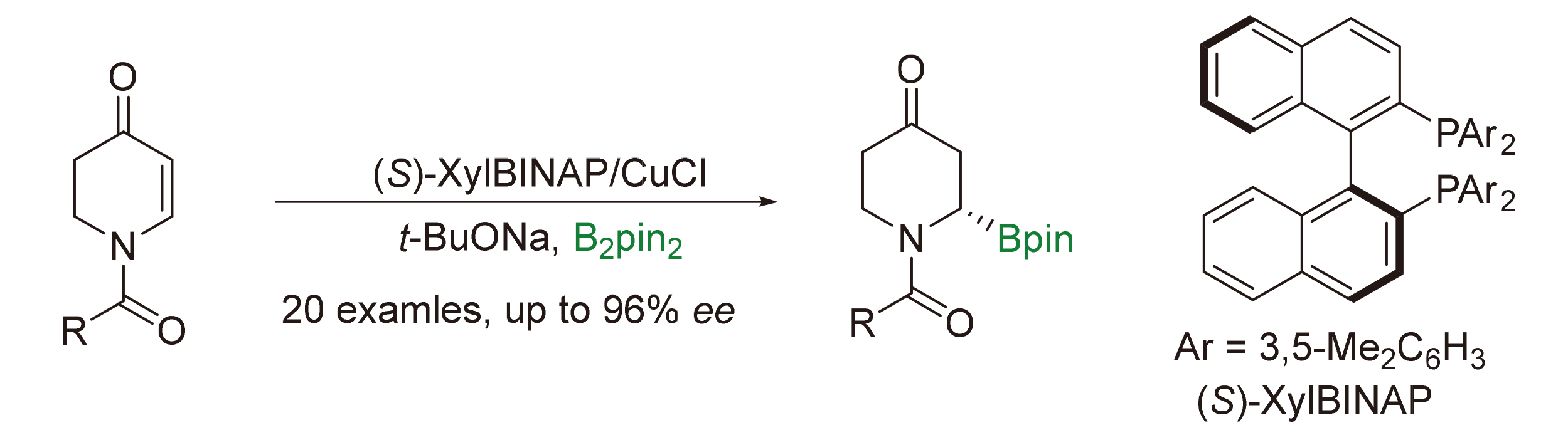
2,3-Dihydropyridin-4(1H)-ones serve as excellent Michael acceptors for conjugate addition reactions under va-rious transition metal-catalyzed conditions. In this context, organoboronic acid and their derivatives,[24-30] arylsila- nes,[31-32] organozinc reagents,[33-35] Grignard reagents,[36-37] and alkenylalanes[38] are commonly employed as nucleophiles in the asymmetric 1,4-addition to 2,3-dihydropyri- din-4(1H)-ones. This strategy enables the construction of chiral piperidin-4-ones bearing an N-adjacent stereogenic center via C—C bond formation. In contrast, the conjugate addition of these substrates to form C-heteroatom bonds remains largely unexplored. Herein, we envisioned that copper-catalyzed conjugate hydroboration of 2,3-dihydro- pyridin-4(1H)-ones would provide a straightforward approach for the synthesis of non-fused cyclic chiral α-aminoboronate esters.[39-41]
2 Results and discussion
Our studies commenced with the optimization of reaction conditions using model substrate 1-benzoyl-2,3-di- hydropyridin-4(1H)-one 1a. Preliminary examination for the reaction of 1a with 1.5 equiv. of B2pin2 in the presence of 10 mol% CuCl, 12 mol% (S)-BINAP (L1), and 15 mol% t-BuONa in toluene at room temperature for 20 h afforded desired product α-aminoboronate ester 2a in 56% isolated yield with 44% ee (Table 1, Entry 1). Employing (S)-TolBINAP (L2) improved the enantioselectivity to 75%, albeit with a reduced yield of 22% (Table 1, Entry 2). Gratifyingly, when (S)-XylBINAP (L3) was used, 2a was obtained in 73% yield with 93% ee (Table 1, Entry 3). Other ligands such as (S)-SEGPHOS (L4), (S)-DTBM- SEGPHOS (L5), and (S)-BIPHEP (L6) showed lower reactivity (Table 1, Entries 4~6) and enantioselectivity (Table 1, Entry 4). With optimal ligand L3 identified, our attention was next turned to the solvent effect on the reaction performance (Table, Entries 7~14). Benzene led to inferior reactivity and enantioselectivity (Table 1, Entry 7). Ethereal solvent such as tetrahydrofuran (THF), Et2O, methyl cyclopentyl ether (MCPE), and 1,4-dioxane gave comparable enantioselectivity but significantly lower reactivity relative to toluene (Table 1, Entries 8~11 vs Entry 3). Almost no conversion was observed in CH2Cl2 and n-hexane (Table 1, Entries 12 and 14). Acetonitrile afforded 91% ee with only 20% yield (Table 1, Entries 13). We further evaluated alternative copper sources. CuBr and CuTc (Tc=thiophenecarboxylate) provided 2a in 63% and 30% yields, respectively, with both 93% ee (Table 1, Entries 15 and 16). In contrast, CuOAc, Cu(CH3CN)4PF6, and CuCl2 afforded only trace amounts of product. Finally, varying the loading of t-BuONa revealed 20 mol% gave nearly identical results (72% yield, 92% ee) to those in entry 3.
Table 1 Optimization of reaction conditions for 1aa |
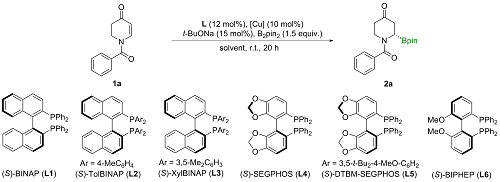
| Entry | Ligand | [Cu] | Solvent | Yieldb/% | eec/% |
|---|---|---|---|---|---|
| 1 | L1 | CuCl | Toluene | 56 | 44 |
| 2 | L2 | CuCl | Toluene | 22 | 75 |
| 3 | L3 | CuCl | Toluene | 71 | 93 |
| 4 | L4 | CuCl | Toluene | 9 | 45 |
| 5 | L5 | CuCl | Toluene | Trace | — |
| 6 | L6 | CuCl | Toluene | Trace | — |
| 7 | L3 | CuCl | Benzene | 20 | 89 |
| 8 | L3 | CuCl | THF | 45 | 91 |
| 9 | L3 | CuCl | Et2O | 19 | 93 |
| 10 | L3 | CuCl | MCPE | 42 | 92 |
| 11 | L3 | CuCl | 1,4-Dioxane | 34 | 91 |
| 12 | L3 | CuCl | CH2Cl2 | Trace | — |
| 13 | L3 | CuCl | CH3CN | 20 | 91 |
| 14 | L3 | CuCl | n-Hexane | Trace | — |
| 15 | L3 | CuBr | Toluene | 63 | 93 |
| 16 | L3 | CuTc | Toluene | 30 | 93 |
| 17 | L3 | CuOAc | Toluene | Trace | — |
| 18 | L3 | Cu(CH3CN)4PF6 | Toluene | Trace | — |
| 19 | L3 | CuCl2 | Toluene | Trace | — |
| 20d | L3 | CuCl | Toluene | 72 | 92 |
a Unless otherwise noted, all the reactions were carried out with 1a (0.20 mmol), B2pin2 (0.30 mmol), [Cu] (0.02 mmol), L (0.024 mmol), and t-BuONa (0.03 mmol) in 1 mL of solvent at room temperature for 20 h. b Yield refers to the isolated product. c The enantiomeric excess (ee) was determined by HPLC on a chiral stationary- phase IK-3 column, "—" not detected. d The reaction was carried out with 0.04 mmol of t-BuONa. |
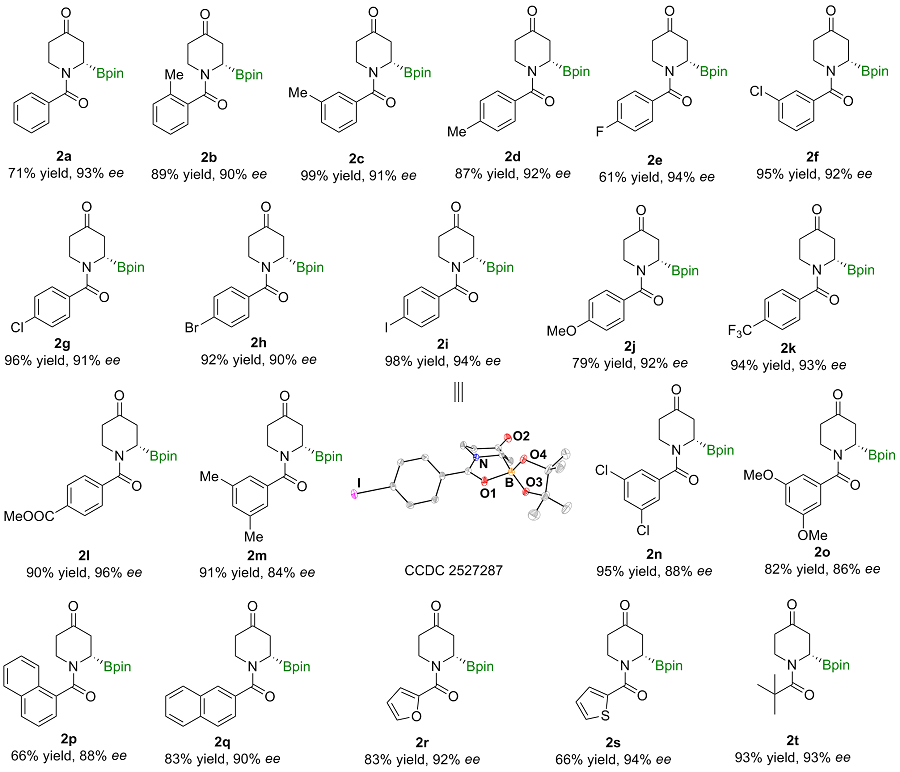
With optimal reaction conditions established (Table 1, Entry 3), we proceeded to evaluate the substrate scope, as summarized in Table 2. In addition to N-benzoyl substituent, substrates bearing a methyl group at the 2-, 3-, or 4-position were well tolerated, affording products 2b~2d in 87%~99% yields with 90%~94% ee, indicating that steric hindrance had little effect on the reaction performance. Various mono-substituted benzoyl groups with different electronic and positional patterns reacted smoo- thly, furnishing 2e~2l in 61%~96% yields and 90%~96% ee. Disubstituted benzoyl substrates 1m~1o also gave the corresponding products 2m~2o, albeit with slightly lower enantioselectivities (84%~86% ee) compared to their mono-substituted analogues. Substrates bearing 1-naphthoyl and 2-naphthoyl groups were compatible, delivering 2p and 2q in 66% and 83% yields with 88% and 90% ee, respectively. Heteroaromatic rings were also accommodated, providing 2r and 2s in 83% and 66% yields with 92% and 94% ee. Beyond aryl substituents, an N-pivaloyl-substituted substrate performed excellently, affording 2t in 93% yield and 93% ee. Unfortunately, we were not able to isolate the product when the N-Cbz protected substrate was employed, probably due to its instability upon chromatography. In addition, the β-substituted enone showed no reactivity under current reaction conditions. The absolute configuration of 2i was unambiguously assigned as S by single-crystal X-ray diffraction analysis, and the stereochemistry of the other products was tentatively assigned by analogy.
Table 2 Substrate scope for copper-catalyzed enantioselective hydroboration of 2,3-dihydropyridin-4(1H)-ones |
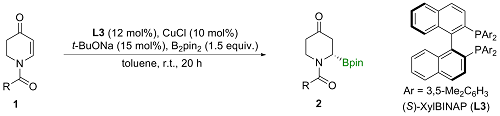
 |
To demonstrate the synthetic utility of this protocol, a gram-scale reaction of 1a (1.06 g, 5.00 mmol) was carried out with 2 mol% catalyst loading under concentrated conditions (Scheme 2). The desired product 2a was isolated in 68% yield (1.06 g) without loss of enantiopurity relative to the standard conditions. Wittig reaction of 2a with methylenetriphenylphosphine furnished 3 in 69% yield with 94% ee. Subsequent reaction of 3 with KHF2 provided difluoroborane 4 in 85% yield and 92% ee.[21]

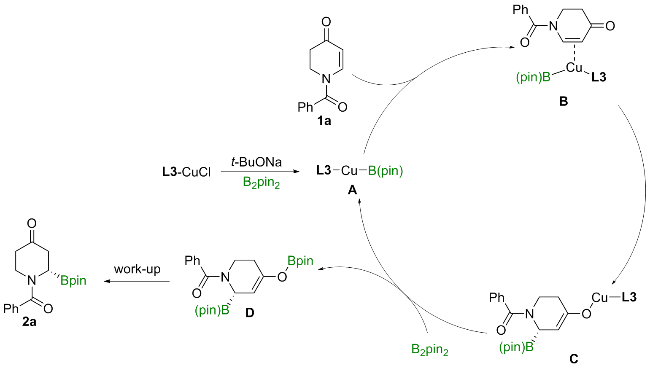
This reaction does not require protolytic cleavage to close the catalytic cycle, distinguishing it from most Cu- catalyzed hydroboration of alkenes.[42] A plausible reaction mechanism is proposed in Scheme 3. Treatment of B2pin2 with the catalyst precursor L3-CuCl in the presence of a catalytic amount of t-BuONa can generate the reactive boryl-copper species L3-Cu-Bpin (A). Coordination of A with the C—C π bond of 1a then affords the reactant complex B. Subsequent 1,4-addition of the boryl group from copper to the enone yields the O-bound enolate C. σ-Bond metathesis between C and B2pin2 produces intermediate D while regenerating A for the next catalytic turn. Finally, work-up of D delivers the product 2a.


3 Conclusions
In summary, we have developed a concise, enantioselective Cu-catalyzed hydroboration of 1-benzoyl-2,3-dihydro- pyridin-4(1H)-ones using (S)-XylBINAP as the optimal ligand to afford enantioenriched cyclic chiral α-amino- boronate esteres. The protocol offers high reactivity, excellent enantiocontrol, broad substrate scope, and synthetic utility via gram-scale synthesis and derivatization. Further utilization of obtained products is currently underway in our laboratory.
4 Experimental section
4.1 General procedures for the Cu-catalyzed enantioselective hydroboration of 1
In a nitrogen-filled glovebox, to a 25-mL flame-dried Schlenk tube charged with CuCl (2.0 mg, 0.02 mmol), NaOtBu (2.9 mg, 0.03 mmol) and (S)-XylBINAP (17.6 mg, 0.024 mmol) was added toluene (0.2 mL). The resulting mixture was allowed to stir at room temperature for 0.5 h. B2pin2 (0.30 mmol in 0.4 mL toluene) was then introduced and the reaction was allowed to stir at room temperature for 10 min followed by addition of compound 1 (0.20 mmol in 0.4 mL of toluene). The resulting mixture was continued to stir at room temperature for 20 h. After removal of the solvent, the residue was purified by column chromatography on silica gel using petroleum ether (PE)/ EtOAc as the eluent to obtain corresponding compound 2.
(S)-1-Benzoyl-2-(4,4,5,5-tetramethyl-1,3,2-dioxa-boro-lan-2-yl)piperidin-4-one (2a): Rf=0.2 (PE/EtOAc, V∶V=1∶5), white solid, m.p. 130~137 ℃; 47 mg, 71% yield, 93% ee. ${[\alpha ]}_{\text{D}}^{\text{25}}$+10.01 (c=1.0, CHCl3). 1H NMR (400 MHz, CDCl3) δ: 7.61~7.52 (m, 3H), 7.52~7.43 (m, 2H), 4.36~4.26(m, 1H), 3.71~3.59 (m, 1H), 2.99 (dd, J=13.2, 4.4 Hz, 1H), 2.76 (dd, J=15.2, 13.2 Hz, 1H), 2.55~2.33 (m, 3H), 1.19 (s, 6H), 1.18 (s, 6H); 13C NMR (100 MHz, CDCl3) δ: 207.7, 172.7, 132.8, 129.0, 128.7, 126.8, 80.6, 46.3, 42.5, 40.2, 25.3, 25.0; 11B NMR (128 MHz, CDCl3) δ: 12.6. HRMS (ESI-TOF) calcd for C18H24O4N- BNa [M+Na]+ 352.1691, found 352.1689. The enantiopurity was determined by HPLC analysis on a Daicel Chiralpak IK-3 column, n-hexane/i-PrOH (V∶V=90∶10), flow rate=1.0 mL/min, wavelength=254 nm, tR=12.35 min (major), 15.58 min (minor).
(S)-1-(2-Methylbenzoyl)-2-(4,4,5,5-tetramethyl-1,3,2-dioxaborolan-2-yl)piperidin-4-one (2b): Rf=0.2 (PE/EtOAc, V∶V=1∶5), white solid, m.p. 144~149 ℃; 61 mg, 89% yield, 90% ee. ${[\alpha ]}_{\text{D}}^{\text{25}}$+14.14 (c=1.0, CHCl3). 1H NMR (400 MHz, CDCl3) δ: 7.42~7.32 (m, 1H), 7.28~7.16 (m, 3H), 3.94~3.84 (m, 1H), 3.54~3.42 (m, 1H), 2.92 (dd, J=13.2, 4.4 Hz, 1H), 2.80~2.66 (m, 1H), 2.51~2.26 (m, 3H), 2.23 (s, 3H), 1.14 (s, 6H), 1.13 (s, 6H); 13C NMR (100 MHz, CDCl3) δ: 207.6, 173.4, 137.0, 131.7, 131.3, 127.3, 126.7, 126.1, 80.6, 45.9, 42.6, 40.3, 25.3, 25.0, 19.5; 11B NMR (128 MHz, CDCl3) δ: 13.2. HRMS (ESI-TOF) calcd for C19H26O4NBNa [M+Na]+ 366.1847, found 366.1847. The enantiopurity was determined by HPLC analysis on a Daicel Chiralpak IK-3 column, n-hexane/i-PrOH (V∶V=85∶15), flow rate=1.0 mL/min, wavelength=254 nm, tR=6.57 min (major), 7.73 min (minor).
(S)-1-(3-Methylbenzoyl)-2-(4,4,5,5-tetramethyl-1,3,2-di-oxaborolan-2-yl)piperidin-4-one (2c): Rf=0.2 (PE/EtOAc, V∶V=1∶5), white solid, m.p. 157~164 ℃; 68 mg, 99% yield, 90% ee. ${[\alpha ]}_{\text{D}}^{\text{25}}$+16.88 (c=1.0, CHCl3). 1H NMR (400 MHz, CDCl3) δ: 7.55~7.43 (m, 1H), 7.42~7.29 (m, 3H), 4.43~4.30 (m, 1H), 3.75~3.62 (m, 1H), 3.01 (dd, J=13.6, 4.4 Hz, 1H), 2.86~2.76 (m, 1H), 2.60~2.36 (m, 3H), 2.42 (s, 3H), 1.22 (s, 6H), 1.21 (s, 6H); 13C NMR (100 MHz, CDCl3) 208.1, 173.1, 139.5, 133.8, 129.6, 129.1, 126.9, 125.9, 80.8, 46.6, 42.8, 40.5, 25.6, 25.2, 21.7; 11B NMR (128 MHz, CDCl3) δ: 12.5. HRMS (ESI-TOF) calcd for C19H26O4NBNa [M+Na]+ 366.1847, found 366.1850. The enantiopurity was determined by HPLC analysis on a Daicel Chiralpak IK-3 column, n-hexane/i-PrOH (V∶V=90∶10), flow rate=1.0 mL/min, wavelength=254 nm, tR=12.47 min (major), 17.99 min (minor).
(S)-1-(4-Methylbenzoyl)-2-(4,4,5,5-tetramethyl-1,3,2-dioxaborolan-2-yl)piperidin-4-one (2d): Rf=0.2 (PE/ EtOAc, V∶V=1∶5), white solid, m.p. 169~176 ℃; 60 mg, 87% yield, 92% ee. ${[\alpha ]}_{\text{D}}^{\text{25}}$+16.87 (c=1.0, CHCl3); 1H NMR (400 MHz, CDCl3) δ: 7.51 (d, J=8.4 Hz, 2H), 7.31 (d, J=8.0 Hz, 2H), 4.43~4.33 (m, 1H), 3.86~3.52 (m, 1H), 3.01 (dd, J=13.2, 4.4 Hz, 1H), 2.79 (dd, J=15.2, 13.2 Hz, 1H), 2.61~2.33 (m, 3H), 2.43 (s, 3H), 1.22 (s, 6H), 1.21 (s, 6H); 13C NMR (100 MHz, CDCl3) δ: 207.9, 172.7, 143.7, 129.6, 128.9, 123.7, 80.5, 46.4, 42.6, 40.2, 25.4, 24.9, 21.8; 11B NMR (128 MHz, CDCl3) δ: 12.5. HRMS (ESI-TOF) calcd for C19H26O4NBNa [M+Na]+ 366.1847, found 366.1848. The enantiopurity was determined by HPLC analysis on a Daicel Chiralpak IK-3 column, n-hexane/i-PrOH (V∶V=90∶10), flow rate=1.0 mL/min, wavelength=254 nm, tR=13.57 min (major), 18.34 min (minor).
(S)-1-(4-Fluorobenzoyl)-2-(4,4,5,5-tetramethyl-1,3,2-dioxaborolan-2-yl)piperidin-4-one (2e): Rf=0.2 (PE/EtOAc, V∶V=1∶5), white solid, m.p. 170~178 ℃; 42 mg, 61% yield, 94% ee. ${[\alpha ]}_{\text{D}}^{\text{25}}$+18.80 (c=1.0, CHCl3). 1H NMR (400 MHz, CDCl3) δ: 7.69~7.56 (m, 2H), 7.23~7.14 (m, 2H), 4.35~4.25 (m, 1H), 3.74~3.62 (m, 1H), 3.00 (dd, J=13.6, 4.4 Hz, 1H), 2.76 (dd, J=15.2, 13.2 Hz, 1H), 2.55~2.36 (m, 3H), 1.19 (s, 6H), 1.18 (s, 6H); 13C NMR (100 MHz, CDCl3) δ: 207.3, 171.6, δ: 165.1 (d, J=255.6 Hz), 131.4 (d, J=9.2 Hz), 122.8 (d, J=3.6 Hz), 116.4 (d, J=22.4 Hz)., 80.6, 46.4, 42.4, 40.1, 25.3, 24.9; 19F NMR (377 MHz, CDCl3) δ: -104.3; 11B NMR (128 MHz, CDCl3) δ: 12.7. HRMS (ESI-TOF) calcd for C18H23O4NFBNa [M+Na]+ 370.1596, found 370.1606. The enantiopurity was determined by HPLC analysis on a Daicel Chiralpak IK-3 column, n-hexane/i-PrOH (V∶V=90∶10), flow rate=1.0 mL/min, wavelength=254 nm,tR=10.95 min (major), 13.64 min (minor).
(S)-1-(3-Chlorobenzoyl)-2-(4,4,5,5-tetramethyl-1,3,2-dioxaborolan-2-yl)piperidin-4-one (2f): Rf=0.2 (PE/EtOAc, V∶V=1∶5), white solid, m.p. 152~157 ℃; 69 mg, 95% yield, 92% ee. ${[\alpha ]}_{\text{D}}^{\text{25}}$ +18.91 (c=1.0, CHCl3). 1H NMR (400 MHz, CDCl3) δ: 7.63~7.52 (m, 2H), 7.46 (dd, J=5.2, 1.2 Hz, 2H), 4.37~4.21 (m, 1H), 3.74~3.62 (m, 1H), 3.02 (dd, J=13.2, 4.4 Hz, 1H), 2.79 (dd, J=15.2, 13.2 Hz, 1H), 2.63~2.38 (m, 3H), 1.21 (s, 6H), 1.20 (s, 6H); 13C NMR (100 MHz, CDCl3) δ: 207.3, 171.3, 135.4, 132.9, 130.4, 128.8, 128.6, 126.6, 80.8, 46.4, 42.4, 40.1, 25.4, 24.9; 11B NMR (128 MHz, CDCl3) δ: 13.3. HRMS (ESI-TOF) calcd for C18H23O4NClBNa [M+Na]+ 386.1301, found 386.1303. The enantiopurity was determined by HPLC analysis on a Daicel Chiralpak IK-3 column, n-hexane/i-PrOH (V∶V=90∶10), flow rate=1.0 mL/min, wavelength=254 nm, tR=11.74 min (major), 14.14 min (minor).
(S)-1-(4-Chlorobenzoyl)-2-(4,4,5,5-tetramethyl-1,3,2-dioxaborolan-2-yl)piperidin-4-one (2g): Rf=0.2 (PE/ EtOAc, V∶V=1∶5), white solid, m.p. 154~161 ℃; 70 mg, 96% yield, 91% ee. ${[\alpha ]}_{\text{D}}^{\text{25}}$+16.00 (c=1.0, CHCl3). 1H NMR (400 MHz, CDCl3) δ: 7.55~7.46 (m, 2H), 7.47~7.39 (m, 2H), 4.28~4.18 (m, 1H), 3.69~3.57 (m, 1H), 2.96 (dd, J=13.2, 4.4 Hz, 1H), 2.80~2.63 (m, 1H), 2.51~2.24 (m, 3H), 1.15 (s, 6H), 1.14 (s, 6H); 13C NMR (100 MHz, CDCl3) δ: 207.3, 171.6, 139.3, 130.1, 129.4, 125.1, 80.7, 46.3, 42.4, 40.0, 25.3, 24.9; 11B NMR (128 MHz, CDCl3) δ: 12.6. HRMS (ESI-TOF) calcd for C18H23O4NclBNa [M+Na]+ 386.1301, found 386.1302. The enantiopurity was determined by HPLC analysis on a Daicel Chiralpak IK-3 column, n-hexane/i-PrOH (V∶V=90∶10), flow rate=1.0 mL/min, wavelength=254 nm,tR=7.43 min (major), 9.27 min (minor).
(S)-1-(4-Bromobenzoyl)-2-(4,4,5,5-tetramethyl-1,3,2-dioxaborolan-2-yl)piperidin-4-one (2h): Rf=0.2 (PE/ EtOAc, V∶V=1∶5), white solid, m.p. 158~162 ℃; 75 mg, 92% yield, 90% ee. ${[\alpha ]}_{\text{D}}^{\text{25}}$ +17.87 (c=1.0, CHCl3). 1H NMR (400 MHz, CDCl3) δ: 7.65 (d, J=8.4 Hz, 2H), 7.47 (d, J=8.4 Hz, 2H), 4.32~4.22 (m, 1H), 3.68 (td, J=12.4, 4.4 Hz, 1H), 3.00 (dd, J=13.6, 4.4 Hz, 1H), 2.86~2.68 (m, 1H), 2.59~2.36 (m, 3H), 1.19 (s, 6H), 1.19 (s, 6H); 13C NMR (100 MHz, CDCl3) δ: 207.3, 171.8, 132.4, 130.2, 127.8, 125.6, 80.7, 46.3, 42.4, 40.1, 25.3, 24.9; 11B NMR (128 MHz, CDCl3) δ: 12.9. HRMS (ESI-TOF) calcd for C18H23O4NBrBNa [M+Na]+ 430.0796, found 430.0797. The enantiopurity was determined by HPLC analysis on a Daicel Chiralpak IK-3 column, n-hexane/ i-PrOH (V∶V=90∶10), flow rate=1.0 mL/min, wavelength=254 nm, tR=12.91 min (major), 15.44 min (minor).
(S)-1-(4-Iodobenzoyl)-2-(4,4,5,5-tetramethyl-1,3,2-dioxaborolan-2-yl)piperidin-4-one (2i): Rf=0.2 (PE/ EtOAc, V∶V=1∶5), white solid, m.p. 180~183 ℃; 89 mg, 98% yield, 94% ee. ${[\alpha ]}_{\text{D}}^{\text{25}}$ +17.12 (c=1.0, CHCl3). 1H NMR (400 MHz, CDCl3) δ: 7.87 (d, J=8.4 Hz, 2H), 7.32 (d, J=8.4 Hz, 2H), 4.33~4.23 (m, 1H), 3.67 (td, J=12.4, 4.8 Hz, 1H), 3.00 (dd, J=13.6, 4.4 Hz, 1H), 2.84~2.66 (m, 1H), 2.55~2.37 (m, 3H), 1.20 (s, 6H), 1.19 (s, 6H); 13C NMR (100 MHz, CDCl3) δ: 207.3, 172.0, 138.3, 130.1, 126.1, 100.1, 80.7, 46.3, 42.4, 40.1, 25.3, 24.9; 11B NMR (128 MHz, CDCl3) δ: 13.2. HRMS (ESI-TOF) calcd for C18H23O4NIBNa [M+Na]+ 478.0657, found 478.0655. The enantiopurity was determined by HPLC analysis on a Daicel Chiralpak IK-3 column, n-hexane/ i-PrOH (V∶V=90∶10), flow rate=1.0 mL/min, wavelength=254 nm, tR=16.25 min (major), 18.34 min (minor).
(S)-1-(4-Methoxybenzoyl)-2-(4,4,5,5-tetramethyl-1,3,2-dioxaborolan-2-yl)piperidin-4-one (2j): Rf=0.2 (PE/EtOAc, V∶V=1∶5), white solid, m.p. 191~211 ℃; 57 mg, 79% yield, 92% ee. ${[\alpha ]}_{\text{D}}^{\text{25}}$ +9.07 (c=1.0, CHCl3). 1H NMR (400 MHz, CDCl3) δ: 7.61~7.54 (m, 2H), 7.00~6.93 (m, 2H), 4.45~4.35 (m, 1H), 3.85 (s, 3H), 3.75~3.63 (m, 1H), 2.99 (dd, J=13.6, 4.4 Hz, 1H), 2.81~2.66 (m, 1H), 2.56~2.35 (m, 3H), 1.19 (s, 6H), 1.18 (s, 6H); 13C NMR (100 MHz, CDCl3) δ: 208.0, 172.2, 163.1, 131.1, 118.4, 114.3, 80.5, 55.7, 46.4, 42.6, 40.1, 25.3, 24.9; 11B NMR (128 MHz, CDCl3) δ: 12.0. HRMS (ESI-TOF) calcd for C19H26O5NBNa [M+Na]+ 382.1796, found 382.1800. The enantiopurity was determined by HPLC analysis on a Daicel Chiralpak IK-3 column, n-hexane/i-PrOH (V∶V=90∶10), flow rate=1.0 mL/ min, wavelength=254 nm, tR=10.20 min (major), 12.30 min (minor).
(S)-2-(4,4,5,5-Tetramethyl-1,3,2-dioxaborolan-2-yl)-1-(4-(trifluoromethyl)benzoyl)piperidin-4-one (2k): Rf=0.2 (PE/EtOAc, V∶V=1∶5), white solid, m.p. 129~134 ℃; 75 mg, 94% yield, 93% ee. ${[\alpha ]}_{\text{D}}^{\text{25}}$+11.51 (c=1.0, CHCl3). 1H NMR (400 MHz, CDCl3) δ: 7.78 (d, J=8.4 Hz, 2H), 7.72 (d, J=8.4 Hz, 2H), 4.27~4.17 (m, 1H), 3.75~3.63 (m, 1H), 3.03 (dd, J=13.6, 4.4 Hz, 1H), 2.78 (dd, J=15.2, 13.6 Hz, 1H), 2.57~2.36 (m, 3H), 1.20 (s, 6H), 1.19 (s, 6H); 13C NMR (100 MHz, CDCl3) 206.9, 171.4, 134.4 (q, J=33.2 Hz),, 130.5, 129.1, 127.3, 126.1 (q, J=3.6 Hz), 123.3 (q, J=272.6 Hz).80.9, 46.3, 42.3, 40.0, 25.3, 24.9; 11B NMR (128 MHz, CDCl3) δ: 13.6; 19F NMR (377 MHz, CDCl3) δ: -63.3. HRMS (ESI-TOF) calcd for C19H23O4NF3BNa [M+Na]+ 420.1564, found 420.1571. The enantiopurity was determined by HPLC analysis on a Daicel Chiralpak IK-3 column, n-hexane/ i-PrOH (V∶V=85∶15), flow rate=1.0 mL/min, wavelength=254 nm, tR=6.41 min (major), 7.48 min (minor).
Methyl (S)-4-(4-oxo-2-(4,4,5,5-tetramethyl-1,3,2-dioxa-borolan-2-yl)piperidine-1-carbonyl)benzoate (2l): Rf=0.2 (PE/EtOAc, V∶V=1∶5), white solid, m.p. 129~134 ℃; 70 mg, 90% yield, 96% ee. ${[\alpha ]}_{\text{D}}^{\text{25}}$+14.80 (c=1.0, CHCl3). 1H NMR (400 MHz, CDCl3) δ: 8.20~8.13 (m, 2H), 7.71~7.64 (m, 2H), 4.31~4.21 (m, 1H), 3.96 (s, 3H), 3.75~3.63 (m, 1H), 3.04 (dd, J=13.6, 4.4 Hz, 1H), 2.80 (dd, J=15.2, 13.6 Hz, 1H), 2.57~2.38 (m, 3H), 1.22 (s, 6H), 1.21 (s, 6H); 13C NMR (100 MHz, CDCl3) δ: 207.2, 171.9, 165.8, 133.9, 130.8, 130.1, 128.8, 80.8, 52.8, 46.4, 42.4, 40.1, 25.4, 24.9; 11B NMR (128 MHz, CDCl3) δ: 13.4. HRMS (ESI-TOF) calcd for C20H26O6NBNa [M+Na]+ 410.1745, found 410.1753. The enantiopurity was determined by HPLC analysis on a Daicel Chiralpak ADH column, n-hexane/i-PrOH (V∶V=90∶10), flow rate=1.0 mL/min, wavelength=254 nm, tR=6.23 min (minor), 7.00 min (major).
(S)-1-(3,5-Dimethylbenzoyl)-2-(4,4,5,5-tetramethyl-1,3,2-dioxaborolan-2-yl)piperidin-4-one (2m): Rf=0.2 (PE/EtOAc, V∶V=1∶5), white solid, m.p. 156~163 ℃; 65 mg, 91% yield, 84% ee. ${[\alpha ]}_{\text{D}}^{\text{25}}$+23.81 (c=1.0, CHCl3). 1H NMR (400 MHz, CDCl3) δ: 7.13 (d, J=4.0 Hz, 3H), 4.33~4.23 (m, 1H), 4.05 (q, J=7.2 Hz, 1H), 3.60 (td, J=12.4, 4.4 Hz, 1H), 2.93 (dd, J=13.2, 4.0 Hz, 1H), 2.71 (dd, J=15.2, 13.2 Hz, 1H), 2.45~2.34 (m, 2H), 2.30 (s, 6H), 1.15 (s, 6H), 1.14 (s, 6H); 13C NMR (100 MHz, CDCl3) δ: 207.8, 172.9, 171.2, 138.8, 134.2, 126.4, 126.1, 80.4, 60.4, 46.2, 42.4, 40.1, 25.2, 24.8, 21.2, 14.2; 11B NMR (128 MHz, CDCl3) δ: 13.2. HRMS (ESI-TOF) calcd for C20H28BNNaO4 [M+Na]+ 380.2004, found 380.2011. The enantiopurity was determined by HPLC analysis on a Daicel Chiralpak ADH column, n-hexane/ i-PrOH (V∶V=90∶10), flow rate=1.0 mL/min, wavelength=254 nm, tR=12.75 min (major), 19.93 min (minor).
(S)-1-(3,5-Dichlorobenzoyl)-2-(4,4,5,5-tetramethyl-1,3, 2-dioxaborolan-2-yl)piperidin-4-one (2n): Rf=0.2 (PE/ EtOAc, V∶V=1∶3), white solid, m.p. 167~171 ℃; 76 mg, 95% yield, 88% ee. ${[\alpha ]}_{\text{D}}^{\text{25}}$ +20.71 (c=1.0, CHCl3). 1H NMR (400 MHz, CDCl3) 7.54 (d, J=2.0 Hz, 1H), 7.44 (d, J=2.0 Hz, 2H), 4.24~4.14 (m, 1H), 3.74~3.62 (m, 1H), 2.99 (dd, J=13.2, 4.4 Hz, 1H), 2.80~2.64 (m, 1H), 2.55~2.38 (m, 3H), 1.18 (s, 6H), 1.17 (s, 6H); 13C NMR (100 MHz, CDCl3) δ: 206.7, 170.0, 136.1, 132.6, 129.8, 127.0, 126.8, 81.0, 46.3, 42.2, 39.9, 25.3, 24.8; 11B NMR (128 MHz, CDCl3) δ: 13.6. HRMS (ESI-TOF) calcd for C18H22O4NCl2BNa [M+Na]+ 420.0911, found 420.0918. The enantiopurity was determined by HPLC analysis on a Daicel Chiralpak IK-3 column, n-hexane/i-PrOH (V∶V=85∶15), flow rate=1.0 mL/min, wavelength=254 nm, tR=8.78 min (major), 11.10 min (minor).
(S)-1-(3,5-Dimethoxybenzoyl)-2-(4,4,5,5-tetramethyl-1,3,2-dioxaborolan-2-yl)piperidin-4-one (2o): Rf=0.2 (PE/ EtOAc, V∶V=1∶5), white solid. 64 mg, 82% yield, 86% ee. ${[\alpha ]}_{\text{D}}^{\text{25}}$ +19.81 (c=1.0, CHCl3). 1H NMR (400 MHz, CDCl3) δ: 6.61 (d, J=2.4 Hz, 2H), 6.55 (t, J=2.4 Hz, 1H), 4.34~4.24 (m, 1H), 3.74 (s, 6H), 3.62~3.50 (m, 1H), 2.93 (dd, J=13.6, 4.4 Hz, 1H), 2.76~2.64 (m, 1H), 2.48~2.26 (m, 3H), 1.15 (s, 6H), 1.14 (s, 6H); 13C NMR (100 MHz, CDCl3) δ: 207.7, 172.6, 161.1, 128.3, 106.5, 104.3, 80.7, 55.9, 46.4, 42.6, 40.3, 25.4, 24.9; 11B NMR (128 MHz, CDCl3) δ: 12.9. HRMS (ESI-TOF) calcd for C20H28O6NBNa [M+Na]+ 412.1902, found 412.1906. The enantiopurity was determined by HPLC analysis on a Daicel Chiralpak IK-3 column, n-hexane/i-PrOH=85∶15 (V∶V), flow rate=1.0 mL/min, wavelength=254 nm, tR=8.95 min (major), 13.31 min (minor).
(S)-1-(1-Naphthoyl)-2-(4,4,5,5-tetramethyl-1,3,2-dioxa-borolan-2-yl)piperidin-4-one (2p): Rf=0.2 (PE/EtOAc, V∶V=1∶5), white solid, m.p. 161~180 ℃; 50 mg, 66% yield, 88% ee. ${[\alpha ]}_{\text{D}}^{\text{25}}$+18.71 (c=1.0, CHCl3). 1H NMR (400 MHz, CDCl3) δ: 8.03 (d, J=8.0 Hz, 1H), 7.98~7.84 (m, 2H), 7.70~7.43 (m, 4H), 3.92~3.82 (m, 1H), 3.61~3.49 (m, 1H), 3.11 (dd, J=13.6, 4.4 Hz, 1H), 2.88 (dd, J=15.2, 13.2 Hz, 1H), 2.61~2.51 (m, 1H), 2.51~2.39 (m, 1H), 2.37~2.27 (m, 1H), 1.24 (s, 6H), 1.22 (s, 6H); 13C NMR (100 MHz, CDCl3) δ: 207.6, 173.1, 133.5, 132.3, 129.8, 128.9, 128.3, 127.3, 126.5, 124.8, 124.6, 124.4, 80.8, 46.3, 42.6, 40.3, 25.3, 25.0; 11B NMR (128 MHz, CDCl3) δ: 13.7. HRMS (ESI-TOF) calcd for C22H26O4NBNa [M+Na]+ 402.1847, found 402.1850. The enantiopurity was determined by HPLC analysis on a Daicel Chiralpak IK-3 column, n-hexane/i-PrOH (V∶V=85∶15), flow rate=1.0 mL/min, wavelength=254 nm, tR=5.95 min (major), 7.62 min (minor).
(S)-1-(2-Naphthoyl)-2-(4,4,5,5-tetramethyl-1,3,2-dioxaborolan-2-yl)piperidin-4-one (2q): Rf=0.2 (PE/EtOAc, V∶V=1∶5), white solid, m.p. 171~184 ℃; 63 mg, 83% yield, 90% ee. ${[\alpha ]}_{\text{D}}^{\text{25}}$ +16.11 (c=1.0, CHCl3). 1H NMR (400 MHz, CDCl3) δ: 8.14 (d, J=1.6 Hz, 1H), 7.98~7.86 (m, 3H), 7.67~7.55 (m, 3H), 4.48~4.38 (m, 1H), 3.80~3.68 (m, 1H), 3.07 (dd, J=13.6, 4.4 Hz, 1H), 2.88~2.72 (m, 1H), 2.62~2.36 (m, 3H), 1.23 (s, 6H), 1.22 (s, 6H); 13C NMR (100 MHz, CDCl3) δ: 207.7, 172.8, 134.9, 132.2, 130.2, 129.0, 128.9(6), 128.9(2), 128.0, 127.6, 124.1, 123.8, 80.6, 46.4, 42.6, 40.2, 25.4, 25.0; 11B NMR (128 MHz, CDCl3) δ: 12.6. HRMS (ESI-TOF) calcd for C22H26O4NBNa [M+Na]+ 402.1847, found 402.1850. The enantiopurity was determined by HPLC analysis on a Daicel Chiralpak IK-3 column, n-hexane/i-PrOH (V∶V=85∶15), flow rate=1.0 mL/min, wavelength=254 nm, tR=7.83 min (major), 10.49 min (minor).
(S)-1-(Furan-2-carbonyl)-2-(4,4,5,5-tetramethyl-1,3,2-dioxaborolan-2-yl)piperidin-4-one (2r): Rf=0.2 (PE/EtOAc, V∶V=1∶5), white solid, m.p. 131~141 ℃; 53 mg, 83% yield, 92% ee. ${[\alpha ]}_{\text{D}}^{\text{25}}$+16.11 (c=1.0, CHCl3). 1H NMR (400 MHz, CDCl3) δ: 7.63 (d, J=1.2 Hz, 1H), 7.42 (t, J=2.4 Hz, 1H), 6.58 (dd, J=3.6, 1.6 Hz, 1H), 5.02~4.92 (m, 1H), 3.82~3.70 (m, 1H), 2.97 (dd, J=13.6, 4.0 Hz, 1H), 2.74~2.62 (m, 1H), 2.61~2.38 (m, 3H), 1.15 (s, 12H); 13C NMR (100 MHz, CDCl3) δ: 208.0, 160.1, 147.5, 142.4, 123.4, 112.7, 80.3, 45.0, 42.4, 39.8, 25.2, 24.8; 11B NMR (128 MHz, CDCl3) δ: 13.1. HRMS (ESI-TOF) calcd for C16H22O5NBNa [M+Na]+ 342.1483, found 342.1485. The enantiopurity was determined by HPLC analysis on a Daicel Chiralpak IK-3 column, n-hexane/i-PrOH (V∶V=85∶15), flow rate=1.0 mL/ min, wavelength=254 nm, tR=12.74 min (major), 17.49 min (minor).
(S)-2-(4,4,5,5-Tetramethyl-1,3,2-dioxaborolan-2-yl)-1-(thiophene-2-carbonyl)piperidin-4-one (2s): Rf=0.2 (PE/ EtOAc, V∶V=1∶5), white solid, m.p. 170~188 ℃; 44 mg, 66% yield, 94% ee. ${[\alpha ]}_{\text{D}}^{\text{25}}$+18.10 (c=1.0, CHCl3). 1H NMR (400 MHz, CDCl3) δ: 7.78 (dd, J=4.0, 1.2 Hz, 1H), 7.74 (dd, J=4.8, 1.2 Hz, 1H), 7.19 (dd, J=4.8, 3.6 Hz, 1H), 4.62~4.52 (m, 1H), 3.93~3.82 (m, 1H), 3.09 (dd, J=13.6, 4.4 Hz, 1H), 2.74 (dd, J=16.4, 13.6 Hz, 1H), 2.67~2.45 (m, 3H), 1.20 (s, 12H); 13C NMR (100 MHz, CDCl3) δ: 207.9, 165.6, 135.4, 134.1, 128.2, 127.5, 80.5, 45.4, 42.3, 39.4, 25.3, 24.9; 11B NMR (128 MHz, CDCl3) δ: 12.4. HRMS (ESI-TOF) calcd for C16H22O4NSBNa [M+Na]+ 358.1255, found 358.1257. The enantiopurity was determined by HPLC analysis on a Daicel Chiralpak IK-3 column, n-hexane/i-PrOH (V∶V=90∶10), flow rate=1.0 mL/min, wavelength=254 nm, tR=14.65 min (major), 20.14 min (minor).
(S)-1-Pivaloyl-2-(4,4,5,5-tetramethyl-1,3,2-dioxaboro-lan-2-yl)piperidin-4-one (2t): Rf=0.2 (EtOAc), white solid, m.p. 207~223 ℃; 57 mg, 93% yield, 93% ee. ${[\alpha ]}_{\text{D}}^{\text{25}}$ +19.20 (c=1.0, CHCl3); 1H NMR (400 MHz, CDCl3) δ: 4.48~4.38 (m, 1H), 3.63~3.51 (m, 1H), 2.79 (dd, J=13.6, 4.0 Hz, 1H), 2.71~2.56 (m, 1H), 2.54~2.35 (m, 3H), 1.36 (s, 9H), 1.16 (s, 12H); 13C NMR (100 MHz, CDCl3) δ: 207.7, 181.2, 80.2, 46.1, 42.8, 40.1, 35.9, 27.4, 25.2, 24.8; 11B NMR (128 MHz, CDCl3) δ: 11.7. HRMS (ESI-TOF) calcd for C16H28O4NBNa [M+Na]+ 332.2004, found 332.2005. The enantiopurity was determined by HPLC analysis on a Daicel Chiralpak IK-3 column, n- hexane/i-PrOH (V∶V=90∶10), flow rate=1.0 mL/min, wavelength=230 nm, tR=7.99 min (minor), 11.99 min (major).
4.2 Wittig reaction of 2a
To a 25-mL oven-dried flask charged with methyltriphenyliphosphonium bromide (1.25 g, 3.5 mmol) and THF (5 mL) was added NaHMDS (2 mol/L in THF, 1.5 mL, 3.0 mmol) dropwise via syringe over 5 min at 0 ℃. The resulting mixture was allowed to stir at room temperature for 30 min. A separate solution of 2a (329 mg, 1.0 mmol) in THF (5 mL) was added dropwise to the above solution at 0 ℃. After complete addition, the reaction was allowed to stir at room temperature for 3 h. The reaction was then quenched with water (10 mL) at 0 ℃ and the organic layer was separated. The aqueous layer was extracted with EtOAc three times (10 mL×3). The combined organic phase was washed with brine and then dried over anhydrous Na2SO4. After removal of the solvent, the residue was then purified by column chromatography on silica gel using PE/EtOAc (V∶V=5∶1) as the eluent to afford (S)- (4-methylene-2-(4,4,5,5-tetramethyl-1,3,2-dioxaborolan-2-yl)piperidin-1-yl)(phenyl)methanone (3), Rf=0.2 (PE/ EtOAc, V∶V=3∶1), white solid, m.p. 171~181 ℃; 226 mg, 69% yield, 94% ee. ${[\alpha ]}_{\text{D}}^{\text{25}}$+20.81 (c=1.0, CHCl3). 1H NMR (400 MHz, CDCl3) δ: 7.56~7.47 (m, 3H), 7.45~7.37 (m, 2H), 4.83 (brs, 1H), 4.78~4.73 (m, 1H), 4.07~3.98 (m, 1H), 3.25~3.13 (m, 1H), 2.63~2.53 (m, 1H), 2.34 (d, J=8.8 Hz, 2H), 2.24 (dd, J=13.6, 3.6 Hz, 1H), 2.13 (td, J=12.8, 5.2 Hz, 1H), 1.18 (s, 12H); 13C NMR (100 MHz, CDCl3) δ: 171.3, 144.5, 132.1, 128.7, 128.7, 127.4, 109.8, 80.0, 47.7, 35.5, 34.4, 25.4, 25.0; 11B NMR (128 MHz, CDCl3) δ: 13.2. HRMS (ESI-TOF) calcd for C19H26O3NBNa [M+Na]+ 350.1898, found 350.1903. The enantiopurity was determined by HPLC analysis on a Daicel Chiralpak IK-3 column, n-hexane/i-PrOH (V∶V=90∶10), flow rate=1.0 mL/min, wavelength=254 nm, tR=7.92 min (major), 9.55 min (minor).
4.3 Reaction of 3 with KHF2
To a 25-mL flask charged with 3 (65 mg, 0.20 mmol), MeOH (2.0 mL) and H2O (2.0 mL) was added KHF2 (156 mg, 2.0 mmol) at room temperature. The resulting mixture was then allowed to stir at room temperature for 2 h. After removal of the solvent, the residue was diluted by H2O (10 mL) and extracted with EtOAc (10 mL×3). The combined organic phase was dried over Na2SO4. After removal of the solvent, the residue was purified by column chromatography on silica gel using PE/EtOAc (V∶V=6∶1) as the eluent to afford (S)-(2-(difluoroboraneyl)-4-methylene- piperidin-1-yl)(phenyl)methanone (4), Rf=0.2 (PE/EtOAc, V∶V=10∶1), white solid, m.p. 170~177 ℃; 42 mg, 85% yield, 92% ee. ${[\alpha ]}_{\text{D}}^{\text{25}}$ +22.94 (c=1.0, CHCl3). 1H NMR (400 MHz, CDCl3) δ: 7.73~7.59 (m, 3H), 7.58~7.50 (m, 2H), 4.93 (q, J=1.6 Hz, 1H), 4.87 (q, J=1.6 Hz, 1H), 4.26~4.17 (m, 1H), 3.44~3.32 (m, 1H), 2.86~2.74 (m, 1H), 2.57~2.48 (m, 1H), 2.43~2.19 (m, 3H); 13C NMR (100 MHz, CDCl3) δ: 171.6, 142.7, 133.3, 129.1, 128.9, 125.5, 111.0, 48.0, 34.78 (t, J=4.0 Hz), 34.1; 11B NMR (128 MHz, CDCl3) δ: 7.5; 19F NMR (377 MHz, CDCl3) δ: -146.4, -151.8. HRMS (ESI-TOF) calcd for C13H14ONF2BNa [M+Na]+ 272.1029, found 272.1033. The enantiopurity was determined by HPLC analysis on a Daicel Chiralpak ADH column, n-hexane/i-PrOH (V∶V=90∶10), flow rate=1.0 mL/min, wavelength=254 nm, tR=12.12 min (minor), 19.94 min (major).
Supporting Information Experimental details, HPLC traces, NMR data and spectra of 1a~1t, 2a~2t, 3 and 4, and crystallographic data of 2i. The Supporting Information is available free of charge via the Internet at http://sioc-journal.cn.
(Lu, Y.)