


1 Introduction
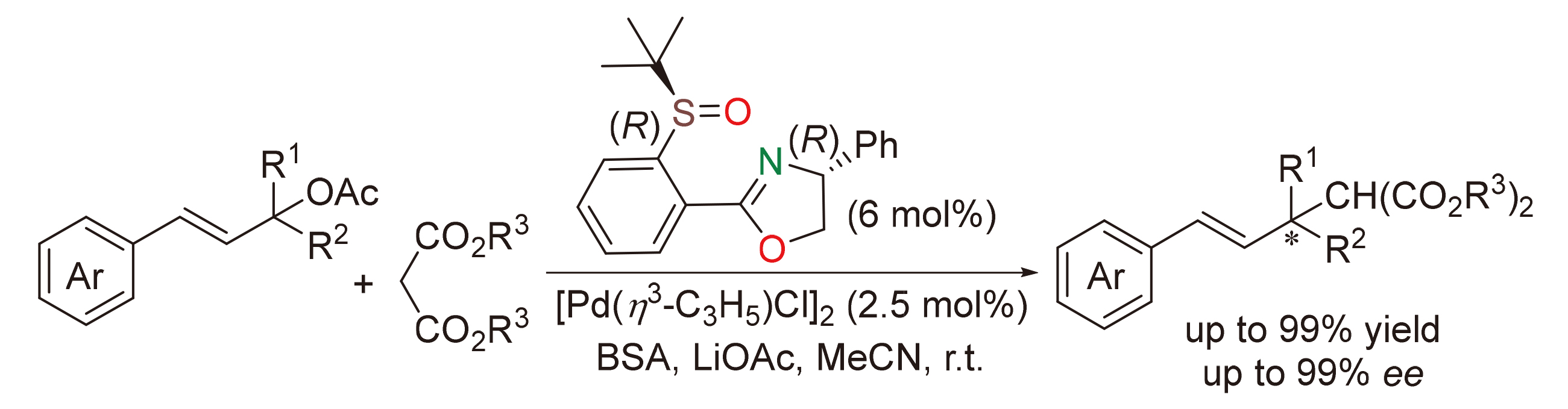
Chiral sulfoxide-oxazoline (SOX) ligands have attracted considerable attention as versatile bidentate chiral ligands that combine the electronic tunability of a sulfoxide with the rigid, stereodefined environment of an oxazoline.[1] Early work by Allen and co-workers[2] established that sulfoxide-containing oxazoline ligands can be readily synthesized and effectively applied in palladium-catalyzed asymmetric allylic substitution. Based on this concept, Hiroi and co- workers[3] demonstrated that 2-(arylsulfinylmethyl)-1,3- oxazoline derivatives can function as effective chiral ligands in Lewis acid-catalyzed asymmetric Diels-Alder reactions, further validating the SOX motif as a modular platform for asymmetric catalysis.
Subsequent development of SOX ligands has leveraged the modularity of the scaffold to tune the steric and electronic environment around the metal center. Bunya and co-workers[4] introduced heteroaryl-substituted SOX ligands that improved asymmetric induction in Pd-catalyzed allylic alkylation. Beyond allylation and Diels-Alder chemistry, SOX ligands have also proven competent in Pd- catalyzed C—H activation systems. Itami, Yamaguchi, and co-workers[5] demonstrated that ligand tuning enables efficient aromatic C—H coupling with sterically hindered arylboronic acids, while Han and co-workers[6] showed that appropriately designed chiral ligands facilitate cascade C(sp2)—H functionalization/intramolecular asymmetric allylation to access chiral indolines. Following these advances, White and co-workers[7] established that Pd(II)/ SOX complexes are highly effective for enantioselective allylic C—H functionalization and C—H oxidation, highlighting the broader relevance of SOX ligands in C—H activation chemistry.
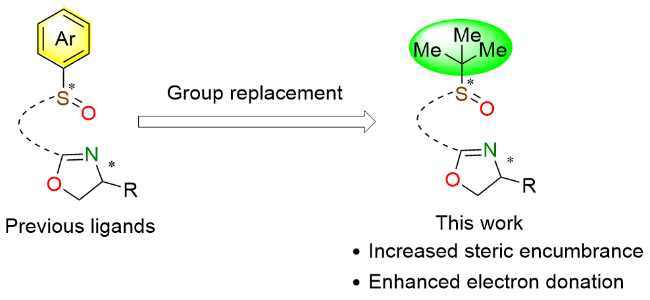
Despite this progress, most SOX ligands incorporate aryl substituents on the sulfoxide, which primarily adjust electronic properties but offer limited steric differentiation within the immediate coordination sphere. Herein, we report a complementary design strategy in which the sulfoxide aryl group is replaced with a tert-butyl substituent to afford tBu-SOX ligands (Figure 1). Introducing a bulky, aliphatic tert-butyl group at sulfur substantially alters the steric environment adjacent to the metal center and modifies the electronic character of the sulfoxide. Evaluation of these ligands in Pd-catalyzed asymmetric allylic alkylation revealed excellent reactivity and enantioselectivity, often matching or surpassing that of aryl-substituted SOX ligands. These results demonstrate that steric modulation at sulfur is a powerful yet underexplored handle for tuning SOX ligand performance and expand the design space for sulfoxide-based chiral ligands in asymmetric transition- metal catalysis.
2 Results and discussion
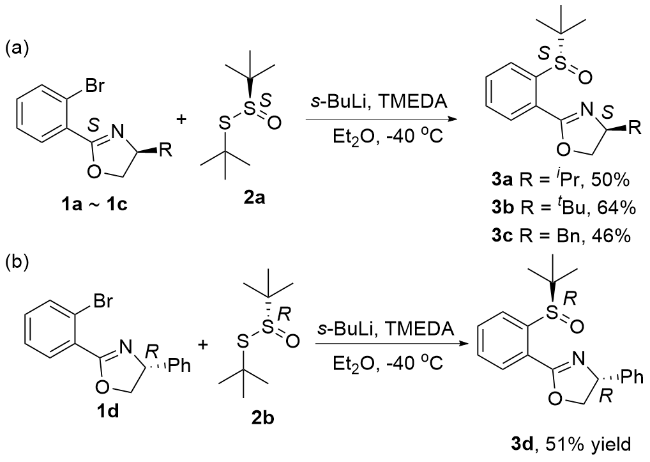
A general synthetic route to chiral SOX ligands is outlined in Scheme 1.[5,8] Brominated oxazoline precursors bearing an (S)-configuration (1a~1c) underwent lithium- halogen exchange with N,N,N′,N′-tetramethylethylene- diamine (TMEDA) in Et2O at –40 ℃, generating the corresponding aryllithium intermediates. Subsequent trapping with (S)-tert-butyl thiosulfinate 2a furnished the desired sulfoxide-oxazoline ligands (3a~3c) bearing diverse substituents (R=iPr, tBu, Bn). Notably, employing an (R)-configured, phenyl-substituted oxazoline precursor in an analogous lithiation-trapping sequence with (R)-tert- butyl thiosulfinate 2b afforded the phenyl-bearing ligand 3d in 51% isolated yield, highlighting the method flexibility to introduce distinct chiral environments through judicious choice of the oxazoline precursor.
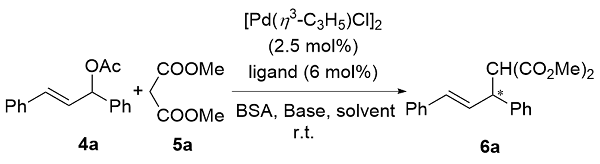
With the newly synthesized ligands in hand, we evaluated their performance in a palladium-catalyzed asymmetric allylic alkylation as a model reaction using representative substrates (Table 1). Firstly, evaluation of solvent effects using ligand 3a revealed that MeCN was uniquely effective, delivering the desired product in 99% yield and 97% ee within only 3 h (Entry 5), whereas CH2Cl2, PhCl, dioxane, and tetrahydrofuran (THF) all led to significantly diminished efficiencies under otherwise identical conditions (Entries 1~4). Screening of acetate bases further showed that LiOAc was optimal, substitution with NaOAc or KOAc resulted in both lower yields and decreased enantioselectivities (Entries 6 and 7), highlighting the importance of the counter-cation in controlling reaction rate and stereochemical outcome.
Table 1 Optimization of reaction conditionsa |
| Entry | Ligand | Base | Solvent | Time/h | Yieldb/% | eec/% |
|---|---|---|---|---|---|---|
| 1 | 3a | LiOAc | CH2Cl2 | 24 | 35 | 97 |
| 2 | 3a | LiOAc | PhCl | 24 | 10 | 96 |
| 3 | 3a | LiOAc | Dioxane | 24 | 6 | 94 |
| 4 | 3a | LiOAc | THF | 24 | 21 | 97 |
| 5 | 3a | LiOAc | MeCN | 3 | 99 | 97 |
| 6 | 3a | NaOAc | MeCN | 3 | 86 | 91 |
| 7 | 3a | KOAc | MeCN | 3 | 95 | 84 |
| 8 | 3b | LiOAc | MeCN | 3 | 99 | 97 |
| 9 | 3c | LiOAc | MeCN | 3 | 48 | 36 |
| 10 | 3d | LiOAc | MeCN | 3 | 99 | 98 |
a Reaction conditions: 4a (0.20 mmol), 5a (0.60 mmol), [Pd(η3-C3H5)Cl]2 (2.5 mol%), ligand (6 mol%), N,O-bis(trimethylsilyl)acetamide (BSA) (0.60 mmol), base (0.06 equiv.), solvent (2.0 mL), stirred at room temperature. b Yields refer to isolated products. c Enantiomeric excess (ee) was determined by chiral HPLC analysis. |
With the optimized conditions in hand, we next investigated the impact of ligand structure. Ligands 3a, 3b, and 3d, bearing i-Pr, t-Bu, and phenyl substituents, respectively, consistently afforded near-quantitative yields and excellent enantioselectivities (97%~98% ee; Entries 5, 8, and 10). In sharp contrast, ligand 3c, which contains a more flexible benzyl group, provided only 48% yield and markedly diminished stereocontrol (36% ee; Entry 9). These results indicate that increased steric bulk around the ligand framework is beneficial for maintaining a well-defined chiral environment, thereby enabling both high catalytic activity and superior enantioselectivity.
To evaluate the scope of this asymmetric allylic alkylation, a series of aryl-substituted allyl acetates 4 and malonate esters 5 were examined (Scheme 2). Under the optimized conditions, the reaction showed high reactivity toward para-halogen substituted aryl motifs, affording excellent yields, albeit with slightly reduced enantioselectivity compared with the unsubstituted arene (6a, 99% yield, 98% ee). Replacing the para-halogen with a para phenyl group (6e) further lowered the enantioselectivity (94% ee, 96% yield), while moving a Cl substituent from para to ortho (6f) led to a more pronounced decline in stereocontrol (91% ee, 96% yield).
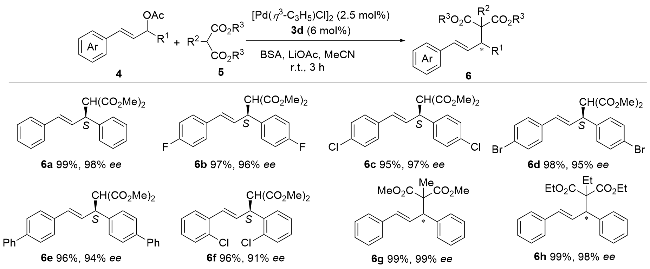
In contrast to the steric sensitivity observed on the electrophile side, the nucleophilic partner displayed excellent adaptability. Sterically bulkier 2-substituted malonates, such as 2-methyl and 2-ethyl derivatives, were converted with outstanding efficiency and near-perfect enantioselectivity (6g, 99% yield, 99% ee; 6h, 99% yield, 98% ee).
To gain mechanistic insight, we examined the interaction between the ligand and Pd(II) by directly monitoring their mixture in an NMR tube. Complete conversion to the palladium complex occurred within 20 min, indicating fast and clean coordination. Subsequently, ligand 3d and the palladium precatalyst were stirred in CH2Cl2 at room temperature for 15 min. The addition of n-hexane then precipitated complex 7 in 95% yield. Recrystallization from a CH2Cl2/ petroleum ether system afforded single crystals suitable for X-ray analysis (Scheme 3a). The resulting Pd(II) complex exhibits a distorted square-planar geometry formed by N,S-chelation from the oxazoline nitrogen and sulfoxide sulfur. Notably, both the oxazoline-bound aryl ring and the tert-butyl group on the sulfoxide project to the same face of the Pd-N-S plane, creating a well-defined and sterically congested chiral environment around the metal center.
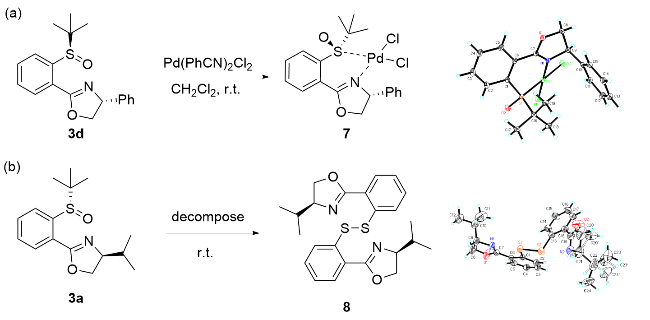


During our studies, we observed that the synthesized ligand completely decomposed after being stored at room temperature for 3 d (Scheme 3b). Therefore, long-term storage requires keeping the compound at –20 ℃ under an argon atmosphere. The major decomposition product of ligand 1a was isolated and characterized as the disulfide compound 8, whose structure was also unambiguously confirmed by single-crystal X-ray diffraction analysis. Based on literature reports of similar transformations, we speculate that the chiral ligand undergoes a series of reactions initiated either by homolytic cleavage of the C—S bond in aryl tert-butyl sulfoxide[9] or by heterolytic cleavage of the C—S bond in the corresponding radical cations formed upon oxidation.[10]
3 Conclusions
In summary, we have developed a novel class of chiral sulfoxide-oxazoline (SOX) ligands bearing a sterically demanding tert-butyl substituent on the sulfur atom. These ligands, readily synthesized via a lithiation-trapping sequence, demonstrated excellent performance in palladium- catalyzed asymmetric allylic alkylation, affording products in near-quantitative yields with up to 99% ee. X-ray crystallography of a representative Pd(II) complex revealed a well-defined, congested chiral environment created by N,S- chelation, rationalizing the high stereocontrol. This work establishes steric engineering at sulfur as a powerful and underexplored strategy for advancing sulfoxide-based chiral ligands in asymmetric catalysis.
4 Experimental section
4.1 General experimental information
All reactions were performed under argon atmosphere using oven-dried glassware. 2-(2-Bromophenyl)-4,5-dihy- drooxazoles 1a and 1b were prepared according to the literature methods.[11] 1H NMR and 13C NMR spectra were measured on a Bruker AM-400 (400 MHz) spectrometer. 1H NMR chemical shifts were referenced to internal tetramethylsilane (TMS, δ 0.0), or to the residual solvent signal (δ 5.32) when CD2Cl2 was used. 13C NMR chemical shifts were referenced to the central peak of the deuterated solvent (δ 77.0 for CDCl3 and δ 53.84 for CD2Cl2). Electrospray ionization high-resolution mass spectra (ESI-HRMS) were recorded on a Bruke P-SIMS-Gly FT-ICR mass spectrometer. Infrared spectra were recorded on a Nicolet MX-1 FT IR spectrometer as liquid film. Commercially available reagents were used as received without further purification. The absolute configuration of the compounds was assigned by comparison of its optical rotation value with the known compounds.
4.2 General procedure for the ligand synthesis
At –78 ℃, s-BuLi (6 mL, 1.0 mol/L in THF, 6.0 mmol, 1.2 equiv.) was added dropwise to a solution of 1 (5.0 mmol, 1.0 equiv) and TMEDA (0.9 mL, 6.0 mmol, 1.2 equiv) in anhydrous Et2O (30 mL). The resulting mixture was stirred for 30 min at –78 ℃, and then a solution of chiral tert-butyl tert-butanethiosulfinate 2 (1.1 g, 5.5 mmol, 1.1 equiv.) in Et2O (10 mL) was added. The resulting mixture was stirred for 2 h at –40 ℃ and quenched by saturated NH4Cl aqueous solution. The aqueous layer was extracted with EtOAc (20 mL×3). The combined organic phases were washed with brine, dried with anhydrous Na2SO4, filtered, and concentrated under reduced pressure. Purification by silica gel column chromatography (petroleum ether/EtOAc, V∶V=4∶1) afforded the pure product.
(S)-2-(2-((S)-tert-Butylsulfinyl)phenyl)-4-isopropyl-4,5-dihydrooxazole (3a): Yellow oil (732 mg, 50% yield). $[\alpha ]_{\text{D}}^{\text{25}}$–487.4 (c 0.5, CHCl3); 1H NMR (400 MHz, CDCl3) δ: 8.09 (d, J=8.0 Hz, 1H), 7.97 (d, J=7.6 Hz, 1H), 7.64 (t, J=7.6 Hz, 1H), 7.51 (t, J=7.6 Hz, 1H), 4.46~4.38 (m, 1H), 4.16~4.02 (m, 2H), 1.89~1.76 (m, 1H), 1.18 (s, 9H), 1.08 (d, J=6.8 Hz, 3H), 0.96 (d, J=6.8 Hz, 3H); 13C NMR (100 MHz, CDCl3) δ: 161.9, 142.2, 130.7, 130.3, 130.2, 127.6, 126.5, 73.2, 70.5, 58.6, 33.0, 23.4, 19.1, 18.6; IR (film) ν: 2960, 1471, 1360, 1083, 1050, 1026, 744 cm–1; HRMS (ESI) calcd for C16H24NO2S [M+H]+ 294.1528, found 294.1526.
(S)-4-(tert-Butyl)-2-(2-((S)-tert-butylsulfinyl)phenyl)-4,5-dihydrooxazole (3b): White solid (982 mg, 64% yield). $[\alpha ]_{\text{D}}^{\text{25}}$+122.5 (c 0.3, CHCl3); 1H NMR (400 MHz, CDCl3) δ: 8.02 (d, J=8.0 Hz, 1H), 7.86 (d, J=7.6 Hz, 1H), 7.57 (t, J=7.6 Hz, 1H), 7.43 (t, J=7.6 Hz, 1H), 4.31~4.23 (m, 1H), 4.09 (t, J=8.4 Hz, 1H), 4.05~3.97 (m, 1H), 1.16 (s, 9H), 0.89 (s, 9H); 13C NMR (100 MHz, CDCl3) δ: 160.6, 143.1, 130.8, 130.2, 129.6, 127.5, 126.8, 77.1, 68.5, 59.3, 33.9, 26.0, 23.9; IR (film) ν: 2957, 1656, 1362, 964 cm–1; HRMS (ESI) calcd for C17H26NO2S [M+H]+ 308.1684, found 308.1678.
(S)-4-Benzyl-2-(2-((S)-tert-butylsulfinyl)phenyl)-4,5-dihydrooxazole (3c): Yellow solid (784 mg, 46% yield). $[\alpha ]_{\text{D}}^{\text{25}}$+192.0 (c 0.1, CHCl3); 1H NMR (400 MHz, CDCl3) δ: 8.03 (d, J=8.0 Hz, 1H), 7.87 (d, J=7.6 Hz, 1H), 7.58 (t, J=7.6 Hz, 1H), 7.43 (t, J=7.6 Hz, 1H), 7.30~7.11 (m, 5H), 4.62~4.45 (m, 1H), 4.32 (t, J=8.8 Hz, 1H), 4.02 (t, J=8.4 Hz, 1H), 3.06 (dd, J=13.8, 6.2 Hz, 1H), 2.70 (dd, J=13.8, 7.6 Hz, 1H), 1.06 (s, 9H); 13C NMR (100 MHz, CDCl3) δ: 162.1, 142.2, 137.7, 130.9, 130.3, 129.9, 129.3, 128.5, 127.2, 126.6, 126.5, 71.7, 68.1, 58.8, 41.6, 23.4; IR (film) ν: 2964, 1650, 1474, 1359, 1083, 1054, 1024, 964, 741, 701 cm–1; HRMS (ESI) calcd for C20H24NO2S [M+H]+ 342.1528, found 342.1523.
(R)-2-(2-((R)-tert-Butylsulfinyl)phenyl)-4-phenyl-4,5-dihydrooxazole (3d): Light yellow solid (834 mg, 51% yield). $[\alpha ]_{\text{D}}^{\text{25}}$+220.2 (c 0.1, CHCl3); 1H NMR (400 MHz, CDCl3) δ: 8.14 (d, J=8.0 Hz, 1H), 8.05 (d, J=7.6 Hz, 1H), 7.69 (t, J=7.6 Hz, 1H), 7.55 (t, J=7.6 Hz, 1H), 7.41~7.28 (m, 5H), 5.46 (t, J=9.6 Hz, 1H), 4.90~4.77 (m, 1H), 4.20 (t, J=8.8 Hz, 1H), 1.20 (s, 9H); 13C NMR (100 MHz, CDCl3) δ: 163.2, 142.4, 141.7, 131.1, 130.4, 130.3, 128.8, 127.7, 127.3, 126.8, 126.7, 74.4, 70.3, 58.6, 23.4; IR (film) ν: 2964, 1645, 1473, 1358, 1078, 1055, 1027, 949, 701 cm–1; HRMS (ESI) calcd for C19H22NO2S [M+H]+328.1371, found 328.1365.
4.3 General procedure for the palladium-catalyzed asymmetric allylic alkylation
Under an argon atmosphere, to a Schlenck flask containing ligand 3d (6 mol%) was added CH3CN (2.0 mL) followed by [Pd(η3-C3H5)Cl]2 (1.8 mg, 5 mol% Pd). The mixture was stirred at room temperature for 30 min, and then 1,3-diaryl-2-propenyl acetate 4 (0.20 mmol) was added to the reaction system via a syringe. Dialkyl malonate 5 (0.60 mmol) was added to the mixture followed by BSA (0.15 mL, 0.60 mmol) and lithium acetate (8.0 mg, 0.12 mmol). After 3 h, the reaction was diluted with ethyl acetate (20 mL), washed with saturated NH4Cl (aq.), saturated NaHCO3 (aq.), and brine. The combined aqueous solutions were extracted with CH2Cl2. The combined organic solutions were dried over Na2SO4, filtered, concentrated in vacuo, and purified by flash chromatography.
(S,E)-Dimethyl 2-(1,3-diphenylallyl)malonate (6a):[12] Colorless oil (64 mg, 99% yield). $[\alpha ]_{\text{D}}^{\text{24}}$–18.9 (c 0.3, CHCl3); HPLC: 99% ee [Chiral AD-H column (250 mm), detected at 254 nm, n-hexane/i-propanol, V∶V=90∶10, flow rate=1.0 mL/min; retention time: 9.5 min, 13.0 min (major)]; 1H NMR (400 MHz, CDCl3) δ: 7.39~7.14 (m, 10H), 6.48 (d, J=15.6 Hz, 1H), 6.33 (dd, J=15.6, 8.6 Hz, 1H), 4.33~4.19 (m, 1H), 3.95 (d, J=10.9 Hz, 1H), 3.70 (s, 3H), 3.52 (s, 3H); EI-MS m/z (%): 324 (12.97, M+), 205 (100), 193 (96.6).
(S,E)-Dimethyl 2-(1,3-bis(4-fluorophenyl)allyl)malonate (6b):[13] Colorless oil (70 mg, 97% yield). $[\alpha ]_{\text{D}}^{\text{24}}$+15.4 (c 0.6, CHCl3); HPLC: 96% ee [Chiral AD-H column (250 mm), detected at 254 nm, n-hexane/i-propanol, V∶V=80∶20, flow rate=0.6 mL/min; retention time: 14.0 min (major), 21.3 min]; 1H NMR (400 MHz, CDCl3) δ: 7.32~7.21 (m, 4H), 6.99 (dt, J=17.2, 8.4 Hz, 4H), 6.41 (d, J=16.0 Hz, 1H), 6.22 (dd, J=15.6, 8.4 Hz, 1H), 4.29~4.18 (m, 1H), 3.88 (d, J=10.8 Hz, 1H), 3.71 (s, 3H), 3.54 (s, 3H); EI-MS m/z (%): 360 (13.0, M+), 229 (100), 133 (56.9).
(S,E)-Dimethyl 2-(1,3-bis(4-chlorophenyl)allyl)malonate (6c):[13] Colorless oil (75 mg, 95% yield). $[\alpha ]_{\text{D}}^{\text{22}}$+3.0 (c 0.6, CHCl3); HPLC: 97% ee [Chiral AD-H column (250 mm), detected at 214 nm, n-hexane/i-propanol, V∶V=85∶15, flow rate=1.0 mL/min; retention time: 14.4 min (major), 23.1 min]; 1H NMR (400 MHz, CDCl3) δ: 7.33~7.19 (m, 8H), 6.40 (d, J=15.6 Hz, 1H), 6.26 (dd, J=15.6, 8.5 Hz, 1H), 4.29~4.19 (m, 1H), 3.89 (d, J=10.7 Hz, 1H), 3.76 (s, 3H), 3.70 (s, 3H); EI-MS m/z (%): 392 (11.5, M+), 261 (100), 149 (62.4).
(S,E)-Dimethyl 2-(1,3-bis(4-bromophenyl)allyl)malonate (6d):[13-14] Colorless oil (94 mg, 98% yield). $[\alpha ]_{\text{D}}^{\text{25}}$+11.2 (c 0.2, CHCl3); HPLC: 95% ee [Chiral AD-H column (250 mm), detected at 254 nm, n-hexane/i-propanol, V∶V=85∶15, flow rate=0.8 mL/min; retention time: 19.3 min (major), 29.2 min]; 1H NMR (400 MHz, CDCl3) δ: 7.45 (d, J=8.4 Hz, 2H), 7.40 (d, J=8.4 Hz, 2H), 7.16 (dd, J=8.0 Hz, 4H), 6.38 (d, J=15.6 Hz, 1H), 6.27 (dd, J=15.6, 8.4 Hz, 1H), 4.27~4.17 (m, 1H), 3.89 (d, J=10.8 Hz, 1H), 3.70 (s, 3H), 3.55 (s, 3H); EI-MS m/z (%): 482 (12.2, M+), 191 (100), 270 (91.5).
(S,E)-Dimethyl 2-(1,3-di([1'-biphenyl]-4-yl)allyl)mal-onate (6e):[15] Colorless oil (91 mg, 96% yield). $[\alpha ]_{\text{D}}^{\text{25}}$–0.4 (c 0.4, CHCl3); HPLC: 94% ee [Chiral AD-H column (250 mm), detected at 254 nm, n-hexane/i-propanol, V∶V=80∶20, flow rate=1.0 mL/min; retention time: 14.6 min (major), 25.0 min]; 1H NMR (400 MHz, CDCl3) δ: 7.63~7.47 (m, 8H), 7.30~7.45 (m, 10H), 6.55 (d, J=15.6 Hz, 1H), 6.40 (dd, J=15.6, 8.6 Hz, 1H), 4.40~4.28 (m, 1H), 4.01 (d, J=10.8 Hz, 1H), 3.74 (s, 3H), 3.56 (s, 3H); EI-MS m/z (%): 476 (10.9, M+), 345 (100), 191 (96.3).
(S,E)-Dimethyl 2-(1,3-bis(2-chlorophenyl)allyl)malonate (6f):[16] Colorless oil (75 mg, 95% yield). $[\alpha ]_{\text{D}}^{\text{24}}$+4.3 (c 1.0, CHCl3); HPLC: 91% ee [Chiral AD-H column (250 mm), detected at 254 nm, n-hexane/i-propanol, V∶V=95∶5, flow rate=1.0 mL/min; retention time: 8.6 min (major), 10.4 min]; 1H NMR (400 MHz, CDCl3) δ: 7.47~7.42 (m, 1H), 7.42~7.36 (m, 1H), 7.36~7.28 (m, 2H), 7.28~7.22 (m, 1H), 7.22~7.11 (m, 3H), 6.90 (d, J=15.7 Hz, 1H), 6.33 (dd, J=15.7, 8.7 Hz, 1H), 4.86 (d, J=9.6 Hz, 1H), 4.16 (t, J=10.5 Hz, 1H), 3.74 (s, 3H), 3.58 (s, 3H); EI-MS m/z (%): 297 (100), 191 (96.3), 167 (45.3).
(E)-Dimethyl 2-(1,3-diphenylallyl)-2-methylmalonate (6g):[13,17] Colorless oil (70 mg, 99% yield). $[\alpha ]_{\text{D}}^{\text{27}}$–48.8 (c 0.4, CHCl3); HPLC: 99% ee [Chiral ID-3 column, detected at 214 nm, n-hexane/i-propanol, V∶V=90∶10, flow rate=0.7 mL/min; retention time: 5.57 min, 6.39 min (major)]; 1H NMR (400 MHz, CDCl3) δ: 7.34~7.06 (m, 10H), 6.68 (dd, J=15.6, 9.0 Hz, 1H), 6.39 (d, J=15.6 Hz, 1H), 4.23 (d, J=9.0 Hz, 1H), 3.70 (s, 3H), 3.62 (s, 3H), 1.48 (s, 3H); EI-MS m/z (%): 338 (3.1, M+), 193 (100), 115 (54.2), 91 (17.9).
(E)-Diethyl 2-(1,3-diphenylallyl)-2-ethylmalonate (6h):[18] Colorless oil (75 mg, 99% yield). $[\alpha ]_{\text{D}}^{\text{27}}$–65.0 (c 0.2, CHCl3); HPLC: 98% ee [Chiral ID-3 column, detected at 254 nm, n-hexane/i-propanol, V∶V=50∶50, flow rate=0.5 mL/min; retention time: 5.57 min, 6.39 min (major)]; 1H NMR (CDCl3, 400 MHz) δ: 7.31~7.11 (m, 10H); 6.82 (dd, J=16.0, J=8.4, 1H); 6.34 (d, J=16.0, 1H); 4.20~4.06 (m, 6H); 1.96~1.91 (m, 1H); 1.79~1.75 (m, 1H); 1.19 (t, J=7.1, 3H); 1.14 (t, J=7.1, 3H); 0.89 (t, J=7.1, 3H ); EI-MS m/z (%): 380 (1, M+), 194 (100), 193 (75.9), 91 (51.8).
4.4 Synthesis of palladium complex 7
Pd(PhCN)2Cl2 (20 mg) and ligand 3d (26 mg) were dissolved in 1 mL of CH2Cl2 in a flask and stirred for 15 min. Then, the product was precipitated by adding 10 mL of n-hexane, affording a dark yellow solid of dichlorido[κ²- S,N-((R,R)-2-(2-(tert-butylsulfinyl)phenyl)-4-phenyl-4,5-dihydrooxazole)]palladium(II) (7), 25 mg, 95% yield. 1H NMR (400 MHz, CD2Cl2) δ: 8.28 (d, J=8.8 Hz, 1H), 8.07 (d, J=7.8 Hz, 1H), 7.90 (dt, J=15.0, 6.8 Hz, 2H), 7.80 (d, J=6.8 Hz, 2H), 7.53~7.41 (m, 3H), 6.71 (dd, J=9.6, 3.2 Hz, 1H), 5.23 (dd, J=9.6, 3.2 Hz, 1H), 4.97 (t, J=9.6 Hz, 1H), 0.95 (s, 9H); 13C NMR (100 MHz, CD2Cl2) δ: 160.8, 137.3, 135.1, 135.1, 134.5, 132.9, 130.0, 129.7, 129.2, 129.0, 123.0, 74.5, 71.0, 67.6, 23.6.
4.5 Decomposition of product 8
Upon standing at room temperature for 3 d, complex 3a gradually decomposed to afford 1,2-bis(2-((S)-4-isopropyl- 4,5-dihydrooxazol-2-yl)phenyl)disulfane (8), which was isolated by silica gel column chromatography. White solid. $[\alpha ]_{\text{D}}^{\text{27}}$–178.8 (c 0.2, CHCl3); 1H NMR (400 MHz, CDCl3) δ: 7.83 (d, J=7.6 Hz, 2H), 7.75 (d, J=8.0 Hz, 2H), 7.32 (t, J=7.6 Hz, 2H), 7.20 (t, J=7.6 Hz, 2H), 4.43 (t, J=8.8 Hz, 2H), 4.25 (dd, J=16.2, 7.2 Hz, 2H), 4.15 (t, J=7.6 Hz, 2H), 1.88 (dq, J=13.2, 6.8 Hz, 2H), 1.10 (d, J=6.8 Hz, 6H), 1.00 (d, J=6.7 Hz, 6H); 13C NMR (100 MHz, CDCl3) δ: 162.0, 138.8, 131.1, 129.8, 126.0, 125.4, 125.2, 73.7, 70.0, 33.2, 18.9, 18.6; IR (film) ν: 2958, 1650, 1466, 1354, 1248, 1048, 1033, 960, 734 cm–1; HRMS (ESI) calcd for C19H22- NO2S [M+H]+ 441.1670, found 441.1666.
Supporting Information 1H NMR and 13C NMR spectra of all products. The Supporting Information is available free of charge via the Internet at http://sioc-journal.cn.
(Zhao, C.)