ARTICLES

Visible-Light Induced Copper-Catalyzed C—C Bond Cleavage/Coupling of Spiro Dihydroquinazolinones with Isatins: a Synthetic Method to 3-Alkyl-3-hydroxy-2-oxindoles

  • Xin Chen a ,
  • Shutao Wang a ,
  • Wen-Peng Yang a ,
  • Chuyang Wang a ,
  • Xin-Hua Duan , a, b, * ,
  • Li-Na Guo , a, *
Expand
  • a School of Chemistry, Xi'an Jiaotong University, Xi'an 710049
  • b State Key Laboratory of Natural Product Chemistry, Lanzhou University, Lanzhou 730000
*E-mail: ;

These authors contributed equally to this work.

Received date: 2026-01-03

  Revised date: 2026-02-06

  Online published: 2026-03-20

Supported by

National Natural Science Foundation of China(22571245)

Copyright

© 2026 Shanghai Institute of Organic Chemistry, Chinese Academy of Sciences

Abstract

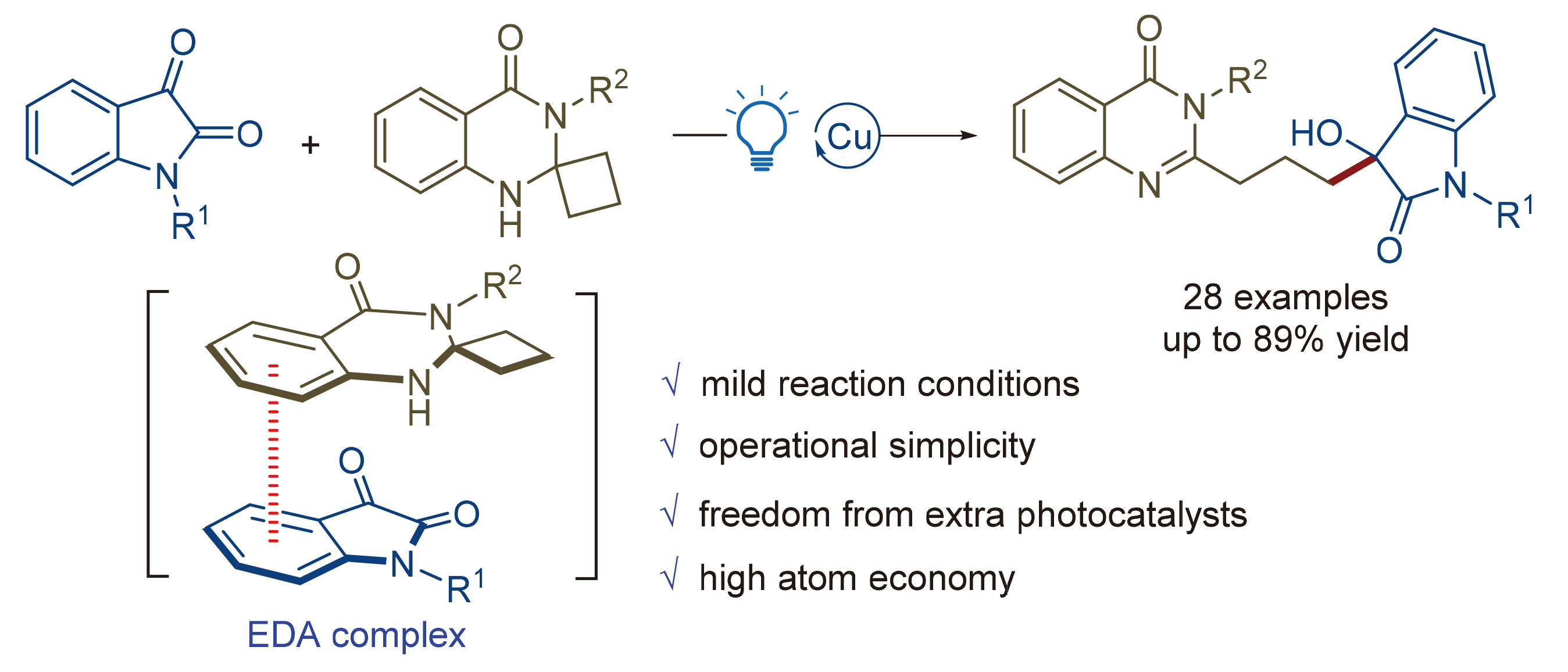
A visible-light induced copper-catalyzed C—C cleavage/coupling reaction of spiro dihydroquinazolinones with isatins was reported. Using 30 W blue LED as the light source and Cu(NO3)2 as the catalyst, a series of 3-alkyl-3-hydroxy- 2-oxindoles bearing a quinazolin-4(3H)-one motif were efficiently synthesized at room temperature. This method features mild reaction conditions, operational simplicity, free of external photosensitizers and high atom economy. Detailed mechanistic studies suggest the formation of an electron donor-acceptor (EDA) complex in the reaction.

Cite this article

Xin Chen , Shutao Wang , Wen-Peng Yang , Chuyang Wang , Xin-Hua Duan , Li-Na Guo . Visible-Light Induced Copper-Catalyzed C—C Bond Cleavage/Coupling of Spiro Dihydroquinazolinones with Isatins: a Synthetic Method to 3-Alkyl-3-hydroxy-2-oxindoles[J]. Chinese Journal of Organic Chemistry, 2026 , 46(4) : 1685 -1698 . DOI: 10.6023/cjoc202601003

1 Introduction

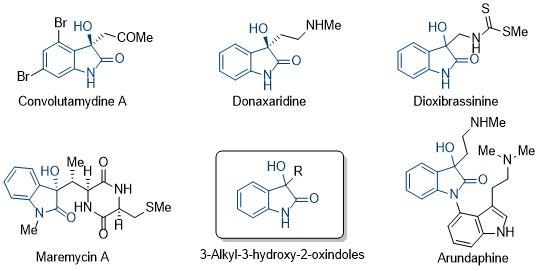
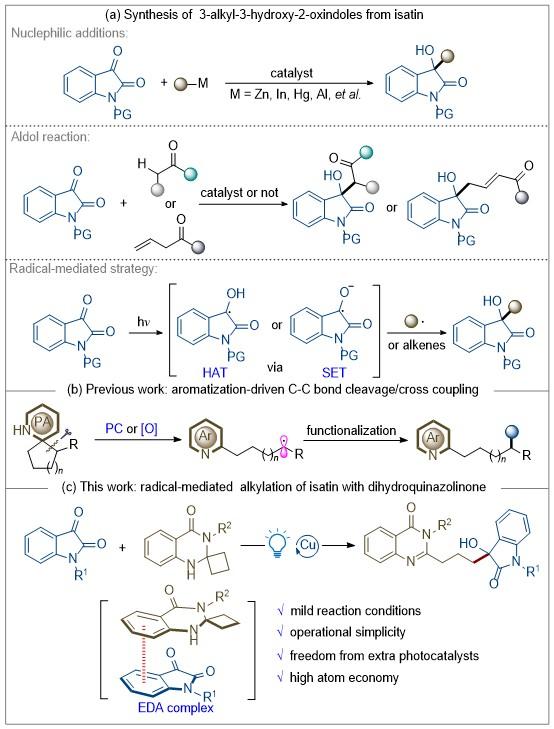
3-Alkyl-3-hydroxy-2-oxindoles represent a privileged structural motif widely found in numerous biologically active natural products and synthetic pharmaceuticals,[1] such as Convolutamydine A, Donaxaridine, Dioxibrassinine, Maremycin A, and Arundaphine (Figure 1).[2] Consequently, their synthesis has attracted considerable attention from chemists. To date, several efficient synthetic strategies have been developed to access these compounds, including oxidation of 3-alkyl-2-oxindoles[3] or 3-alkyl- indoles,[4] electrophilic addition to 3-hydroxy-2-oxin- doles,[5] and intramolecular cyclization of a-keto-amides.[6] Despite their utility, these methods are often hampered by narrow substrate scope, harsh reaction conditions, or the need for specially designed precursors, thereby limiting their broad applicability. Additionally, following green transformations of isatins into complex molecules,[7] the 3-alkylation of these commercially available and stable feedstocks has emerged as a viable route to 3-alkyl-3-hydr- oxy-2-oxindoles (Scheme 1a). In this regard, both the nucleophilic alkylation of isatins with organometallic reagents (Zn,[8] In,[9] Hg,[10] Al,[11] etc.[12]) and the aldol reactions of isatins with aldehydes,[13] ketones,[14] and enol silyl ethers,[15] as well as vinylogous aldol reactions,[16] have been well established. In recent years, visible-light-induced radical-mediated alkylation of isatins via single-electron transfer (SET) or hydrogen atom transfer (HAT) pathways has emerged as a complementary approach for accessing these scaffolds.[17] However, the introduction of a functionalized long-chain alkyl moiety remains scarce.
Figure 1 Natural products or bioactive molecules containing 3-alkyl-3-hydroxy-2-oxindoles
Scheme 1 Synthesis of 3-alkyl-3-hydroxy-2-oxindoles from isatin
In recent years, N-radical cation-mediated C—C bond cleavage/functionalization of spiro pre-aromatic intermediates (spiro PAIs), such as dihydropyrazoles,[18] dihydrotriazoles,[19] and dihydroquinazolinones[20] has gained attentions from chemists (Scheme 1b). This strategy enables the generation of alkyl radicals bearing a terminal heterocyclic aromatic ring with high atom economy, facilitating the formation of various chemical bonds. However, photocatalysts or stoichiometric amount of oxidants are usually required to generate the key N-radical cation intermediates. Given the inherent electronic properties of isatin (an electron-accepting arene)[21] and dihydroquinazolinone (an electron-donating arene),[22] we hypothesize that these two species can assemble to form an electron donor-acceptor (EDA) complex via π-π stacking. Subsequent photoexcitation of this EDA complex can facilitate the requisite single-electron transfer (SET) process, thereby obviating the need for external photocatalysts or stoichiometric oxidants. Herein, we report a visible-light-induced, copper-catalyzed alkylation of isatins with spiro dihydroquinazolinones via C—C bond cleavage, providing a new access to the 3-alkyl- 3-hydroxy-2-oxindoles (Scheme 1c). The key merits of this protocol include mild reaction conditions, operational simplicity, freedom from extra photocatalysts, and high atom economy.

2 Results and discussion

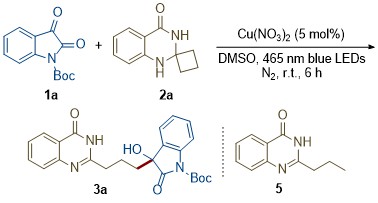
Initially, N-Boc isatin 1a and spiro dihydroquinazolinone 2a were selected as model substrates to identify the optimal reaction conditions (Table 1). Gratifyingly, the reaction proceeded successfully in the presence of 5 mol% Cu(NO3)2 in dimethyl sulfoxide (DMSO) under 30 W Blue LEDs irradiation at room temperature for 6 h, yielding the desired product 3a in 77% isolated yield (Entry 1). Solvent screening revealed that polar aprotic solvent N,N-dimethyl- acetamide (DMAc) was also suitable, with DMSO still being the optimal solvent (Entry 2). Evaluation of catalysts demonstrated that other copper salts such as Cu(OTf)2 and CuOTf were also effective, but afforded lower yields than Cu(NO3)2. Co(OAc)2 gave a moderate yield of 3a, whereas Fe(OTf)3 and Ga(OTf)3 were less effective (Entries 3~5). A survey of light sources identified 465 nm blue LEDs as the optimal choice for this transformation. 390 nm purple of LEDs were found to be less effective, while 365 nm purple and 510 nm green LEDs proved ineffective (Entries 6 and 7). Finally, control experiments established that both light irradiation and an inert atmosphere (N2) were indispensable for this transformation (Entries 8 and 9). Notably, in the absence of the copper catalyst, the ring-opening byproduct 5 was obtained in 57% yield as the sole product (Entry 10). We speculate that the copper catalyst activates the isatin carbonyl, enhancing the ketyl radical’s electrophilicity to facilitate the final radical-radical coupling.[17d,17f]
Table 1 Optimization of the reaction conditionsa
Entry Variation from standard conditions Yieldb/% of 3a
1 None 77
2 DMAc, DMF, NMP as solvent 62, <10, <10
3 Cu(OTf)2, CuOTf as catalyst 59, 58
4 Co(OAc)2 as catalyst 43
5 Fe(OTf)3, Ga(OTf)3 as catalyst <10
6 365, 390 nm Purple LEDs Trace, 43
7 510 nm Green LEDs Trace
8 Under air 13
9 In the dark n.r.
10 No Cu(NO3)2 0 (57)c

a Reaction conditions: isatin 1a (0.22 mmol, 1.1 equiv.), dihydroquinazolinone 2a (0.2 mmol, 1.0 equiv.), Cu(NO3)2 (5 mol%), and DMSO (2.0 mL) with 30 W blue LEDs (465 nm) irradiation at room temperature for 6 h under N2. b Isolated yields. c Isolated yield of 5.

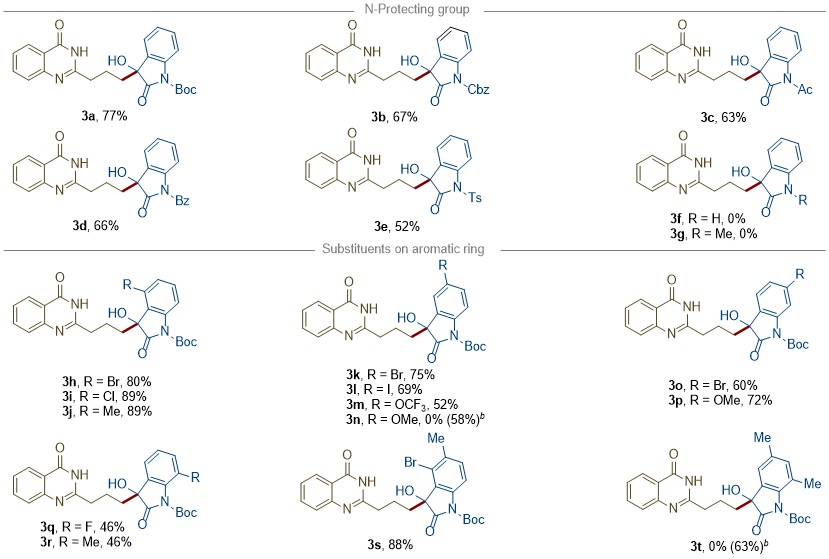
With optimized conditions in hand, the generality and limitations of isatins were first evaluated using 2a as the alkylating reagent (Table 2). The N-protecting groups on the isatin scaffold significantly impacted this reaction. Substrates bearing various electron-withdrawing groups, such as acyloxy (Boc, Cbz), acyl (Ac, Bz) and sulfonyl (Ts) groups, were compatible under the standard conditions, affording the corresponding products 3a~3e in moderate to good yields. In contrast, isatins bearing an electron-donat- ing N-methyl group or unprotected N—H failed to deliver the desired products (3f and 3g). Attempts to promote these reactions using shorter wavelength irradiation at 365 and 390 nm or by adding 4CzIPN as an external photocatalyst were unsuccessful. This inactivity can be attributed to the diminished electron-accepting ability of these substrates, which disfavors the EDA complex formation. Subsequently, substituents on the aromatic ring of isatin were investigated. Both the position and electronic effects of substituents profoundly influenced the reaction efficiency. Isatins bearing electron-withdrawing or electron-donating substituents at the 4-position afforded the desired products 3h~3j in excellent yields. At the 5-position, substrates with electron-withdrawing or weakly donating substituents also furnished the desired products 3k~3m in moderate yields. However, the analogue with a strongly electron-donating group (OMe) failed to yield any desired product (3n). Substrates with electron-withdrawing or electron-donating substituents at the 6- or 7-position gave products 3o~3r in 46%~72% yields. 4-Bromo-5-methyl isatin reacted smoo-thly with 2a to deliver product 3s in 88% yield. While the 5,7-dimethyl isatin proved unreactive (3t), likely because the electron-donating groups attenuated the electron-accep- ting ability of the isatin core, thereby suppressing formation of a productive EDA complex. Remarkably, introduction of 4CzIPN (1 mol%) as an exogenous photocatalyst enabled the corresponding products 3n and 3t to be obtained in moderate yields, suggesting that an alternative photocatalytic cycle can overcome this limitation.
Table 2 Substrate scope of isatinsa

a Reaction conditions: isatin 1 (0.22 mmol, 1.1 equiv.), dihydroquinazolinone 2a (0.2 mmol, 1.0 equiv.), Cu(NO3)2 (5 mol%), and DMSO (2.0 mL) with 30 W blue LEDs (465 nm) irradiation at room temperature for 6 h under N2. Isolated yields. b 1 mol% 4CzIPN was added as a photocatalyst.

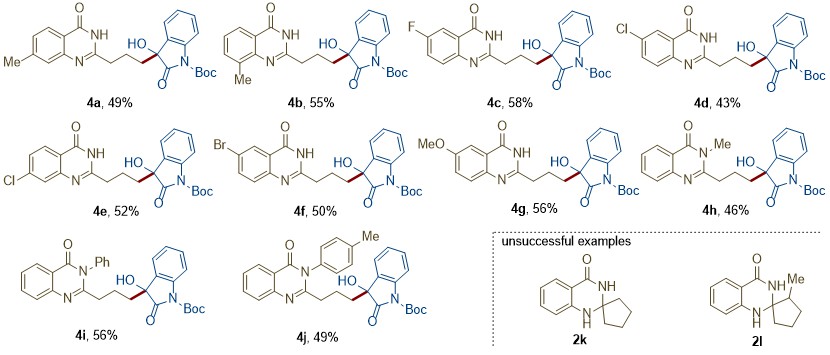
Next, the scope of spiro dihydroquinazolinones was examined with isatin 1a as the radical acceptor (Table 3). PAIs bearing electron-donating or electron-withdrawing groups on the aromatic ring all delivered the corresponding products in moderate yields (4a~4g), accompanied by approximately 10% the ring-opening byproduct 5 formed. Additionally, PAIs bearing different protecting group on the N-atom of amide, including N-Me, N-Ph and N-p-Tol, were also investigated. All of them successfully engaged in this C—C bond cleavage alkylation reaction, affording the desired products 4h~4j in moderate yields. Unfortunately, PAIs derived from cyclopentanone and 2-Me cyclopentanone (2k and 2l) both were invalid for this reaction, probably due to the less ring strain force or the rapid reverse cyclization. In these cases, the materials (2k and 2l) were almost recovered.
Table 3 Substrate scope of spiro dihydroquinazolinonesa

a Reaction conditions: isatin 1a (0.22 mmol, 1.1 equiv.), dihydroquinazolinone 2 (0.2 mmol, 1.0 equiv.), Cu(NO3)2 (5 mol%), and DMSO (2.0 mL) with 30 W blue LEDs (465 nm) irradiation at room temperature for 6 h under N2. Isolated yields.

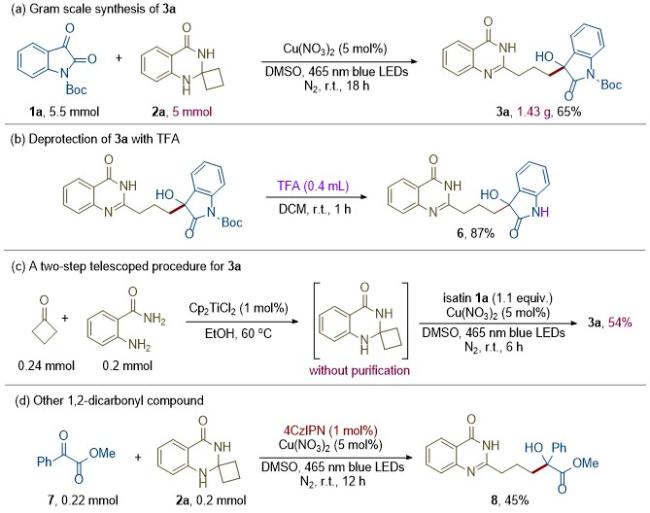
To demonstrate the practical utility of this protocol, a gram scale synthesis was performed (Scheme 2a). Impressively, when the model reaction was scaled up to 5.0 mmol (2a), the target product 3a was obtained in 65% yield (1.43 g) after extending the reaction time to 18 h. Further derivatizations of 3a were then explored (Scheme 2b). Under acidic conditions, deprotection of the N-Boc group in 3a proceeded smoothly, furnishing product 6 in 87% yield. To enhance the synthetic utility, a telescoped procedure integrating the condensation and ring-opening/coupling steps was designed (Scheme 2c). The telescoped protocol proceeded smoothly with cyclobutanone, affording the target product 3a in a moderate yield of 54%. To further expand the utility of this reaction, methyl benzoylformate 7 was used instead of isatin for this C—C bond cleavage/alkyla-tion reaction (Scheme 2d). When 1 mol% 4CzIPN was added as a photocatalyst, the anticipated product 8 was obtained in 45% yield.
Scheme 2 Application investigations
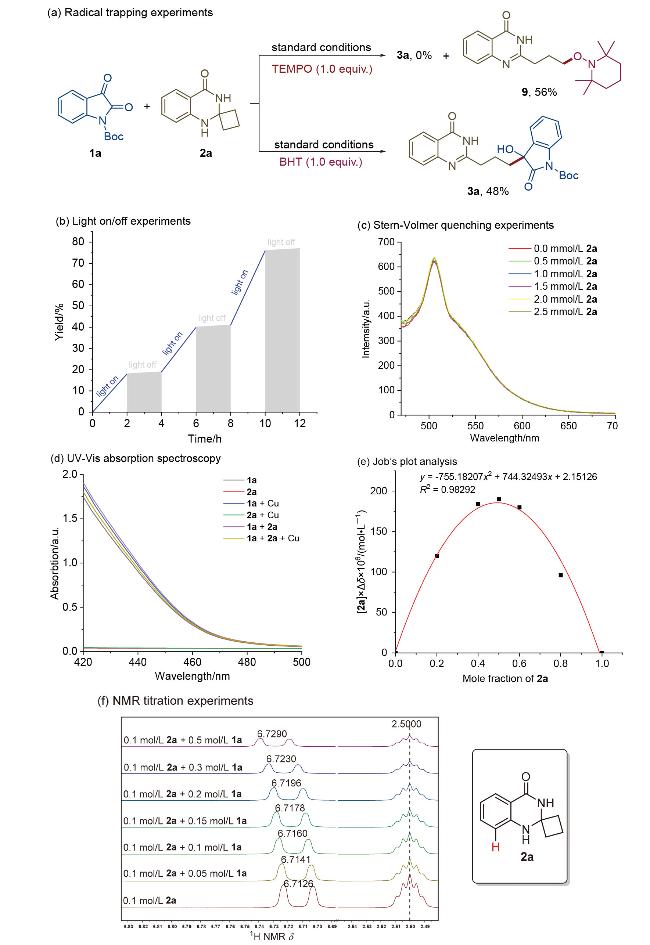
To gain insight into the mechanism of this reaction, several control experiments were carried out (Figure 2). To probe for radical intermediates, radical-trapping experiments were conducted (Figure 2a). The addition of 1.0 equiv. of (2,2,6,6-tetramethylpiperidin-1-yl)oxyl (TEM-PO) completely suppressed product formation, meanwhile the alkyl-TEMPO adduct 9 was isolated in 56% yield. Furthermore, addition of 1.0 equiv. of the radical inhibitor 2,6-di-tert-butyl-4-methylphenol (BHT) reduced the yield of 3a from 77% to 48%. These results collectively indicate that the transformation likely proceeds via a radical pathway and involves an alkyl radical intermediate generated from the ring opening of 2a. Next, light on/off experiments were carried out, indicating that continuous irradiation was essential for this transformation (Figure 2b). Stern-Volmer quenching experiments showed that 2a cannot quench the excited state of 1a, leading us to infer that the key pathway does not involve a diffusible excited state of free isatin (Figure 2c). This result therefore points to a ground-state EDA complex mechanism, wherein the adduct serves as the core unit for light absorption and charge transfer. Furthermore, UV-Vis absorption spectroscopy revealed that mixing 1a and 2a slightly enhanced absorption in the blue-light region (Figure 2d) and generated a distinct band at approximately 350 nm (see Supporting Information, Figure S4). This spectral feature, characterized by a weak absorption tail extending into blue wavelengths accounts for the complex’s visible-light-harvesting capability and photoactivity under blue LED irradiation. Job’s plot analysis confirmed a 1∶1 stoichiometry between 1a and 2a, consistent with a π-π-stacked EDA complex (Figure 2e). NMR titration experiments using the residual solvent peak of DMSO- d6 (δ 2.50) as an internal standard revealed that upon the addition of 1a, the NMR signals of key aromatic proton (H-8) in 2a exhibited continuous and concentration-depen- dent chemical shift changes (Figure 2f). This regular displacement pattern confirms the existence of close, dynamic intermolecular interactions between the two species, providing further evidence for the formation of a ground- state EDA complex.
Figure 2 Mechanism studies
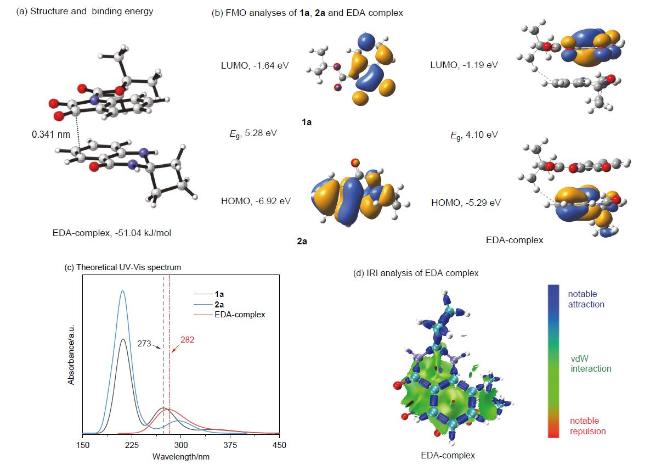
Moreover, density functional theory (DFT) calculations were conducted and provided further support for EDA complex formation (Figure 3). After full geometric optimization of the complex formed by substrates 1a and 2a, a stable EDA complex with a formation energy of -51.04 kJ/mol was obtained. Structural analysis revealed that 1a and 2a bind in a face-to-face manner (Figure 3a), indicating that the EDA complex possesses high stability and the driving force for its formation might be π-π interactions. Subsequently, frontier molecular orbitals (FMOs) analysis was performed on the EDA complex. The results demonstrated that the highest occupied molecular orbital (HOMO) is mainly localized on 2a (as donor), while the lowest unoccupied molecular orbital (LUMO) is predominantly distributed over 1a (as acceptor). This finding is consistent with the electron transfer process inferred earlier. In comparison with the unbound substrates, the HOMO-LUMO energy gap of the EDA complex is significantly reduced (Figure 3b). The theoretical UV-Vis absorption spectrum indicated that the absorption peak of the EDA complex undergoes a distinct red shift relative to that of the individual substrates, which is consistent with the experimental results (Figure 3c). Finally, the IRI analysis showed that the intermolecular interactions are primarily distributed in the planar region between 1a and 2a, with an interaction strength comparable to that of van der Waals interactions (Figure 3d). This observation further supports the possible existence of π-π interactions between the two molecules.
Figure 3 Computational study
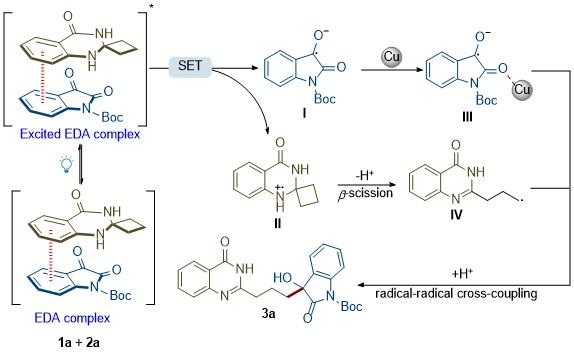
Based on relevant literature, experimental verification, and theoretical calculations, a probable EDA-mediated mechanism was proposed for this reaction (Scheme 3). Initially, isatin 1a and spiro dihydroquinazolinone 2a form an electron donor-acceptor (EDA) complex.[21-22] Upon irradiation, this complex is excited and undergoes single- electron transfer (SET), generating the ketyl radical anion I and the N-radical cation II. The copper catalyst, acting as a Lewis acid, coordinates with the carbonyl oxygen of intermediate I to form intermediate III.[17d,17f] This coordination enhances the electrophilicity of the carbonyl carbon, and stabilizes the intermediate, which is crucial for the subsequent radical cross-coupling step. The N-radical cation II then undergoes β-scission and deprotonation to produce the alkyl radical IV. Finally, radical cross-coupling between III and IV, followed by protonation, affords the final product 3a.
Scheme 3 Proposed mechanism

3 Conclusions

In conclusion, a sustainable EDA strategy for the C—C bond cleavage/coupling of spiro dihydroquinazolinones with isatins has been developed. This concise protocol requires no external photosensitizer or oxidant, and offers a mild, operationally simple, and atom-economical approach to synthesize 3-alkyl-3-hydroxy-2-oxindoles bearing a quinazolin-4(3H)-one motif in good yields with broad functional group tolerance. Gram-scale synthesis and derivatization further underscore the practical utility of this method. This work not only provides an efficient and green route to a privileged scaffold but also expands the toolkit for radical-mediated C—C bond cleavage and functionalization.

4 Experimental section

4.1 General information

1H NMR and 13C NMR spectra were recorded on a Bruker Advance and JEOL III-400 spectrometer (400 MHz for 1H and 101 MHz for 13C) in solvents as indicated. Chemical shift values are reported with the solvent resonance refereed to the standard position (CDCl3: 1H NMR δ 7.26, 13C NMR δ 77.16; DMSO-d6: 1H NMR δ 2.50, 13C NMR δ 39.52). HRMS were obtained on a WATERS I-Class VION IMS Q-Tof. Melting points were measured using open glass capillaries in an SGW® X-4A apparatus. All reactions were conducted in oven-dried Schlenk-tube under an atmosphere of nitrogen. Unless otherwise stated, all reagents were purchased from commercial sources and used without further purification. Conversion of the reactions was monitored by thin layer chromatography (TLC) using Merck TLC silica gel 60 F254. Compounds were visualized by UV light at 254 nm. Flash column chromatography was performed over silica gel (230~400 mesh).

4.2 General procedure for the synthesis of 3 and 4

To a 10 mL oven-dried Schlenk tube equipped with a magnetic stirrer, 1 (0.22 mmol, 1.1 equiv.), 2 (0.2 mmol, 1.0 equiv.), and Cu(NO3)2 (5 mol%) were added. Then, the tube was evacuated and backfilled with nitrogen for three times. Then, DMSO (2.0 mL) was added by injection syringe. Finally, the tube was sealed and placed in the photoreactor about 2 cm away from a 30 W 465 nm LEDs light irradiation with a fanner to maintain the temperature at room temperature for 6 h. The reaction mixture was quenched with brine (10 mL) and extracted with EtOAc (5 mL×3). The combined organic extracts were dried (Na2SO4) and concentrated under reduced pressure. The crude product was purified by flash column chromatography [V(PE)∶ V(EtOAc)=1∶2] on silica gel to afford compounds 3 and 4.
tert-Butyl 3-hydroxy-2-oxo-3-(3-(4-oxo-3,4-dihydro-quinazolin-2-yl)propyl)indoline-1-carboxylate (3a): White solid, 67.1 mg, 77% yield, m.p. 93.2~95.1 ℃ (dec.); 1H NMR (400 MHz, CDCl3) δ: 11.81 (s, 1H), 8.09 (dd, J=8.0, 1.2 Hz, 1H), 7.75 (d, J=8.0 Hz, 1H), 7.69~7.65 (m, 1H), 7.58 (d, J=8.4 Hz, 1H), 7.39 (d, J=7.2 Hz, 1H), 7.37~7.33 (m, 1H), 7.28~7.24 (m, 1H), 7.11~7.07 (m, 1H), 5.55 (s, 1H), 2.89~2.74 (m, 2H), 2.17~2.03 (m, 2H), 2.03~1.91 (m, 2H), 1.55 (s, 9H); 13C NMR (101 MHz, CDCl3) δ: 177.9, 163.9, 156.2, 149.0, 148.9, 139.0, 134.9, 129.8, 129.6, 126.9, 126.7, 126.3, 125.0, 124.1, 120.3, 115.3, 84.8, 76.1, 38.1, 35.0, 28.1, 20.7; HRMS (ESI) calcd for C24H26N3O5 [M+H] 436.1867, found 436.1865.
2-(3-(1-Acetyl-3-hydroxy-2-oxoindolin-3-yl)propyl)qui-nazolin-4(3H)-one (3b): White solid, 62.9 mg, 67% yield, m.p. 107.4~108.2 ℃ (dec.); 1H NMR (400 MHz, DMSO- d6) δ: 12.14 (s, 1H), 8.05 (dd, J=8.0, 1.2 Hz, 1H), 7.82 (d, J=8.0 Hz, 1H),7.76~7.72 (m, 1H), 7.55~7.50 (m, 3H), 7.46~7.36 (m, 6H), 7.35~7.23 (m, 1H), 6.34 (s, 1H), 5.45 (d, J=12.8 Hz, 1H), 5.39 (d, J=12.4 Hz, 1H), 2.53 (t, J=7.6 Hz, 2H), 2.00~1.89 (m, 2H), 1.62~1.38 (m, 2H); 13C NMR (101 MHz, DMSO-d6) δ: 176.0, 161.8, 156.9, 150.2, 148.8, 138.4, 135.4, 134.3, 130.8, 129.4, 128.6, 128.3, 127.9, 126.8, 126.0, 125.7, 125.0, 124.1, 120.9, 114.6, 75.1, 68.0, 37.6, 34.3, 20.8; HRMS (ESI) calcd for C27H23N3- NaO5 [M+Na] 492.1530, found 492.1525.
Benzyl 3-hydroxy-2-oxo-3-(3-(4-oxo-3,4-dihydroquin-azolin-2-yl)propyl)indoline-1-carboxylate (3c): White solid, 47.8 mg, 63% yield, m.p. 221.3~222.5 ℃ (dec.); 1H NMR (400 MHz, DMSO-d6) δ: 12.13 (s, 1H), 8.11 (d, J=8.4 Hz, 1H), 8.05 (dd, J=8.0, 1.2 Hz, 1H), 7.77~7.73 (m, 1H), 7.54 (d, J=8.0 Hz, 1H), 7.46~7.42 (m, 2H), 7.39 (td, J=8.0, 1.2 Hz, 1H), 7.29~7.26 (m, 1H), 6.35 (s, 1H), 2.58 (s, 3H), 2.53 (t, J=7.6 Hz, 2H), 2.01~1.90 (m, 2H), 1.64~1.41 (m, 2H); 13C NMR (101 MHz, DMSO-d6) δ: 178.7, 170.5, 161.8, 156.9, 148.8, 139.3, 134.3, 131.1, 129.3, 126.8, 126.0, 125.7, 125.3, 124.0, 120.9, 115.8, 75.3, 37.5, 34.3, 26.4, 20.6; HRMS (ESI) calcd for C21H20N3O4 [M+H] 378.1448, found 378.1448.
2-(3-(1-Benzoyl-3-hydroxy-2-oxoindolin-3-yl)propyl)-quinazolin-4(3H)-one (3d): White solid, 58.2 mg, 66% yield, m.p. 190.2~191.0 ℃ (dec.); 1H NMR (400 MHz, DMSO-d6) δ: 12.16 (s, 1H), 8.07 (d, J=7.6 Hz, 1H), 7.77~7.73 (m, 4H), 7.67~7.63 (m, 1H), 7.56 (d, J=8.4 Hz, 1H), 7.53~7.49 (m, 3H), 7.46~7.41 (m, 2H), 7.31~7.27 (m, 1H), 6.41 (s, 1H), 2.59 (t, J=7.2 Hz, 2H), 2.06~1.94 (m, 2H), 1.75~1.52 (m, 2H); 13C NMR (101 MHz, DMSO-d6) δ: 177.6, 168.9, 161.8, 156.9, 148.9, 139.2, 134.3, 134.1, 132.9, 131.5, 129.3, 129.2, 128.3, 126.8, 126.0, 125.7, 125.2, 124.3, 120.9, 114.5, 75.5, 37.2, 34.3, 20.7; HRMS (ESI) calcd for C26H22N3O4 [M+H] 440.1605, found 440.1602.
2-(3-(3-Hydroxy-2-oxo-1-tosylindolin-3-yl)propyl)quin-azolin-4(3H)-one (3e): White solid, 51.2 mg, 52% yield, m.p. 221.3~222.7 ℃ (dec.); 1H NMR (400 MHz, DMSO-d6) δ: 12.08 (s, 1H), 8.07 (d, J=7.6 Hz, 1H), 7.90 (d, J=8.0 Hz, 2H), 7.79~7.74 (m, 2H), 7.54 (d, J=8.4 Hz, 1H), 7.46 (d, J=7.6 Hz, 1H), 7.43~7.38 (m, 2H), 7.36 (d, J=8.0 Hz, 2H), 7.28~7.24 (m, 1H), 6.44 (s, 1H), 2.43 (t, J=7.8 Hz, 2H), 2.22 (s, 3H), 1.91~1.80 (m, 2H), 1.25~1.17 (m, 2H); 13C NMR (101 MHz, DMSO-d6) δ: 176.2, 161.8, 156.7, 148.8, 145.9, 137.7, 134.5, 134.3, 130.6, 130.1, 129.9, 127.4, 126.8, 126.1, 125.7, 125.3, 124.6, 120.8, 113.0, 75.4, 37.9, 34.1, 21.0, 20.6; HRMS (ESI) calcd for C26H24N3O5S [M+H] 490.1431, found 490.1421.
tert-Butyl 4-bromo-3-hydroxy-2-oxo-3-(3-(4-oxo-3,4-dihydroquinazolin-2-yl)propyl)indoline-1-carboxylate (3h): White solid, 82.3 mg, 80% yield, m.p. 259.1~259.5 ℃ (dec.); 1H NMR (400 MHz, DMSO-d6) δ: 12.16 (s, 1H), 8.05 (dd, J=8.0, 1.2 Hz, 1H), 7.79~7.72 (m, 2H), 7.54 (d, J=8.0 Hz, 1H), 7.45~7.41 (m, 1H), 7.38 (dd, J=8.0, 1.2 Hz, 1H), 7.32 (t, J=8.0 Hz, 1H), 6.35 (s, 1H), 2.59~2.47 (m, 2H), 2.42 (td, J=12.8, 4.4 Hz, 1H), 1.99 (td, J=12.8, 4.4 Hz, 1H), 1.55 (s, 9H), 1.41~1.14 (m, 2H); 13C NMR (101 MHz, DMSO-d6) δ: 175.1, 161.7, 156.6, 148.8, 148.2, 140.9, 134.2, 131.1, 128.9, 127.9, 126.8, 126.0, 125.6, 120.8, 118.7, 113.8, 84.4, 76.6, 34.2, 34.1, 27.6, 20.8; HRMS (ESI) calcd for C24H25BrN3O5 [M+H]514.0972, found 514.0977.
tert-Butyl 4-chloro-3-hydroxy-2-oxo-3-(3-(4-oxo-3,4-dihydroquinazolin-2-yl)propyl)indoline-1-carboxylate (3i): White solid, 83.9 mg, 89% yield, m.p. 150.3~151.8 ℃ (dec.); 1H NMR (400 MHz, DMSO-d6) δ: 12.14 (s, 1H), 8.05 (dd, J=8.0, 1.6 Hz, 1H), 7.77~7.72 (m, 2H), 7.54 (d, J=8.0 Hz, 1H), 7.46~7.38 (m, 2H), 7.23 (d, J=8.0 Hz, 1H), 6.37 (s, 1H), 2.59~2.45 (m, 2H), 2.35 (td, J=12.8, 4.4 Hz, 1H), 2.03 (td, J=12.8, 4.4 Hz, 1H), 1.56 (s, 9H), 1.42~1.18 (m, 2H); 13C NMR (101 MHz, DMSO-d6) δ: 175.0, 161.8, 156.6, 148.8, 148.2, 140.8, 134.2, 130.9, 130.5, 126.8, 126.4, 126.0, 125.74, 125.67, 120.8, 113.4, 84.4, 76.1, 34.4, 34.1, 27.6, 20.8; HRMS (ESI) calcd for C24H25ClN3O5 [M+H] 470.1477, found 470.1479.
tert-Butyl 3-hydroxy-4-methyl-2-oxo-3-(3-(4-oxo-3,4-dihydroquinazolin-2-yl)propyl)indoline-1-carboxylate (3j): White solid, 80.5 mg, 89% yield, m.p. 253.4~254.1 ℃ (dec.); 1H NMR (400 MHz, CDCl3) δ: 11.80 (s, 1H), 8.16 (dd, J=8.0, 1.6 Hz, 1H), 7.71~7.67 (m, 1H), 7.59~7.57 (m, 2H), 7.42~7.38 (m, 1H), 7.13 (t, J=8.0 Hz, 1H), 6.87 (d, J=7.6 Hz, 1H), 4.80 (s, 1H), 2.84~2.71 (m, 2H), 2.42 (s, 3H), 2.34~2.22 (m, 2H), 1.86~1.75 (m, 1H), 1.63~1.50 (m, 10H); 13C NMR (101 MHz, CDCl3) δ: 177.9, 164.0, 156.0, 149.1, 148.9, 139.5, 136.0, 134.9, 129.5, 127.4, 127.0, 126.6, 126.43, 126.35, 120.5, 112.7, 84.8, 77.3, 36.7, 35.1, 28.1, 21.1, 17.8; HRMS (ESI) calcd for C25H28N3O5 [M+H] 450.2023, found 450.2029.
tert-Butyl 5-bromo-3-hydroxy-2-oxo-3-(3-(4-oxo-3,4-dihydroquinazolin-2-yl)propyl)indoline-1-carboxylate (3k): White solid, 77.1 mg, 75% yield, m.p. 137.1~138.9 ℃ (dec.); 1H NMR (400 MHz, DMSO-d6) δ: 12.15 (s, 1H), 8.05 (dd, J=7.6, 0.8 Hz, 1H), 7.80~7.71 (m, 2H), 7.54 (d, J=8.0 Hz, 1H), 7.46~7.40 (m, 1H), 7.38 (d, J=7.6 Hz, 1H), 7.35~7.29 (m, 1H), 6.34 (s, 1H), 2.61~2.46 (m, 2H), 2.41 (td, J=12.8, 4.4 Hz, 1H), 1.99 (td, J=12.8, 4.4 Hz, 1H), 1.55 (s, 9H), 1.42~1.13 (m, 2H); 13C NMR (101 MHz, CDCl3) δ: 175.8, 164.1, 156.1, 148.9, 148.7, 141.2, 135.0, 130.9, 129.3, 127.5, 127.0, 126.7, 126.5, 120.4, 119.1, 114.3, 85.2, 77.6, 34.9, 34.7, 28.1, 20.6; HRMS (ESI) calcd for C24H25BrN3O5 [M+H] 514.0972, found 514.0977.
tert-Butyl 3-hydroxy-5-iodo-2-oxo-3-(3-(4-oxo-3,4-dihydroquinazolin-2-yl)propyl)indoline-1-carboxylate (3l): White solid, 77.3 mg, 69% yield, m.p. 170.3~171.9 ℃ (dec.); 1H NMR (400 MHz, DMSO-d6) δ: 12.15 (s, 1H), 8.05 (d, J=8.0 Hz, 1H), 7.77~7.70 (m, 3H), 7.59~7.53 (m, 2H), 7.46~7.41 (m, 1H), 6.36 (s, 1H), 2.54 (t, J=7.4 Hz, 2H), 2.00~1.83 (m, 2H), 1.57~1.38 (m, 11H); 13C NMR (101 MHz, DMSO-d6) δ: 175.1, 161.8, 156.8, 148.8, 148.4, 138.5, 138.0, 134.2, 133.3, 132.4, 126.8, 126.0, 125.7, 120.9, 117.0, 88.8, 84.1, 74.8, 37.2, 34.2, 27.6, 20.5; HRMS (ESI) calcd for C24H24IN3NaO5 [M+Na]584.0653, found 584.0651.
tert-Butyl 3-hydroxy-2-oxo-3-(3-(4-oxo-3,4-dihydro-quinazolin-2-yl)propyl)-5-(trifluoromethoxy)indoline-1-carboxylate (3m): White solid, 54.2 mg, 52% yield, m.p. 158.3~159.6 ℃ (dec.); 1H NMR (400 MHz, CDCl3) δ: 11.90 (s, 1H), 8.10 (dd, J=8.0, 1.2 Hz, 1H), 7.83 (d, J=8.8 Hz, 1H), 7.72~7.66 (m, 1H), 7.60 (d, J=7.9 Hz, 1H), 7.40~7.35 (m, 1H), 7.30 (d, J=2.0 Hz, 1H), 7.19~7.14 (m, 1H), 5.93 (s, 1H), 2.95~2.79 (m, 2H), 2.22~1.95 (m, 4H), 1.55 (s, 9H); 13C NMR (101 MHz, DMSO-d6) δ: 175.5, 161.8, 156.8, 148.8, 148.4, 145.1 (q, JC-F=1.8 Hz), 137.6, 134.2, 132.9, 126.8, 126.0, 125.7, 122.3, 120.9, 120.1 (q, JC-F=257.6 Hz), 117.4, 116.2, 84.2, 74.9, 37.1, 34.2, 27.6, 20.4; 19F NMR (376 MHz, DMSO-d6) δ: -56.09; HRMS (ESI) calcd for C25H24F3N3NaO6 [M+Na] 542.1509, found 542.1504.
tert-Butyl 3-hydroxy-5-methoxy-2-oxo-3-(3-(4-oxo-3,4-dihydroquinazolin-2-yl)propyl)indoline-1-carboxylate (3n): White solid, 54.1 mg, 58% yield, m.p. 173.4~174.8 ℃ (dec.); 1H NMR (400 MHz, DMSO-d6) δ: 12.13 (s, 1H), 8.05 (dd, J=8.0, 1.2 Hz, 1H), 7.78~7.71 (m, 1H), 7.66 (d, J=8.8 Hz, 1H), 7.54 (d, J=8.0 Hz, 1H), 7.46~7.41 (m, 1H), 6.97 (d, J=2.8 Hz, 1H), 6.93 (dd, J=8.8, 2.8 Hz, 1H), 6.27 (s, 1H), 3.75 (s, 3H), 2.53 (t, J=7.6 Hz, 2H), 1.97~1.85 (m, 2H), 1.57~1.31 (m, 11H); 13C NMR (101 MHz, DMSO-d6) δ: 176.1, 161.8, 156.8, 156.6, 148.8, 148.6, 134.3, 132.0, 131.9, 126.8, 126.0, 125.7, 120.8, 115.6, 114.2, 109.9, 83.6, 75.2, 55.5, 37.5, 34.3, 27.7, 20.7; HRMS (ESI) calcd for C25H28N3O6 [M+H] 466.1973, found 466.1974.
tert-Butyl 6-bromo-3-hydroxy-2-oxo-3-(3-(4-oxo-3,4-dihydroquinazolin-2-yl)propyl)indoline-1-carboxylate (3o): White solid, 61.8 mg, 60% yield, m.p.181.3~183.2 ℃ (dec.); 1H NMR (400 MHz, DMSO-d6) δ: 12.13 (s, 1H), 8.05 (dd, J=8.0, 1.2 Hz, 1H), 7.92 (d, J=1.6 Hz, 1H), 7.77~7.71 (m, 1H), 7.54 (d, J=8.0 Hz, 1H), 7.46~7.40 (m, 2H), 7.36 (d, J=8.0 Hz, 1H), 6.34 (s, 1H), 2.53 (t, J=7.6 Hz, 2H), 1.96~1.85 (m, 2H), 1.62~1.42 (m, 11H); 13C NMR (101 MHz, DMSO-d6) δ: 175.5, 161.8, 156.8, 148.8, 148.4, 140.0, 134.2, 130.0, 127.4, 126.8, 126.0, 125.9, 125.7, 121.8, 120.9, 117.5, 84.3, 74.8, 37.1, 34.3, 27.6, 20.6; HRMS (ESI) calcd for C24H25BrN3O5 [M+H]514.0972, found 514.0977.
tert-Butyl 3-hydroxy-6-methoxy-2-oxo-3-(3-(4-oxo-3,4-dihydroquinazolin-2-yl)propyl)indoline-1-carboxylate (3p): White solid, 67.1 mg, 72% yield, m.p. 171.7~172.5 ℃ (dec.); 1H NMR (400 MHz, CDCl3) δ: 11.72 (s, 1H), 8.12 (dd, J=8.0, 1.6 Hz, 1H), 7.72~7.66 (m, 1H), 7.60 (d, J=8.0 Hz, 1H), 7.41~7.35 (m, 2H), 7.28 (d, J=8.4 Hz, 1H), 6.61 (dd, J=8.4, 2.4 Hz, 1H), 5.07 (s, 1H), 3.75 (s, 3H), 2.89~2.74 (m, 2H), 2.17~2.01 (m, 2H), 2.00~1.86 (m, 2H), 1.56 (s, 9H); 13C NMR (101 MHz, CDCl3) δ: 178.1, 163.9, 161.0, 156.2, 149.1, 149.0, 140.4, 134.9, 127.1, 126.7, 126.4, 124.9, 121.3, 120.4, 110.5, 102.1, 84.8, 75.9, 55.6, 38.1, 35.2, 28.1, 20.9; HRMS (ESI) calcd for C25H28N3O6 [M+H] 466.1973, found 466.1974.
tert-Butyl 7-fluoro-3-hydroxy-2-oxo-3-(3-(4-oxo-3,4-dihydroquinazolin-2-yl)propyl)indoline-1-carboxylate (3q): White solid, 41.8 mg, 46% yield, m.p. 115.4~116.8 ℃ (dec.); 1H NMR (400 MHz, DMSO-d6) δ: 12.15 (s, 1H), 8.05 (dd, J=8.0, 1.2 Hz, 1H), 7.77~7.73 (m, 1H), 7.55 (d, J=7.6 Hz, 1H), 7.46~7.42 (m, 1H), 7.32~7.25 (m, 3H), 6.50 (s, 1H), 2.53 (t, J=7.6 Hz, 2H), 1.96~1.88 (m, 2H), 1.59~1.36 (m, 2H), 1.50 (s, 9H); 13C NMR (101 MHz, DMSO-d6) δ: 175.9, 161.8, 156.8, 148.8, 148.0 (d, JC-F=250.5 Hz), 147.0, 134.3, 134.1 (d, JC-F=0.9 Hz), 126.8, 126.3 (d, JC-F=7.1 Hz), 126.0, 125.7, 125.3 (d, JC-F=10.1 Hz), 120.8, 120.1(d, JC-F=3.0 Hz), 117.4 (d, JC-F=20.2 Hz), 84.3, 75.9, 37.6, 34.2, 27.3, 20.6; 19F NMR (376 MHz, DMSO-d6) δ: -119.74; HRMS (ESI) calcd for C24H25FN3O5 [M+H] 454.1773, found 454.1774.
tert-Butyl 3-hydroxy-7-methyl-2-oxo-3-(3-(4-oxo-3,4-dihydroquinazolin-2-yl) propyl) indoline-1-carboxylate (3r): White solid, 41.4 mg, 46% yield, m.p. 138.5~139.7 ℃ (dec.); 1H NMR (400 MHz, CDCl3) δ: 11.70 (s, 1H), 8.13 (dd, J=8.0, 1.2 Hz, 1H), 7.73~7.69 (m, 1H), 7.62 (d, J=8.0 Hz, 1H), 7.41~7.37 (m, 1H), 7.23 (d, J=7.2 Hz, 1H), 7.09 (d, J=7.2 Hz, 1H), 7.03 (t, J=7.6 Hz, 1H), 5.16 (s, 1H), 2.90 -2.74 (m, 2H), 2.19 (s, 3H), 2.14~1.88 (m, 4H), 1.54 (s, 9H); 13C NMR (101 MHz, CDCl3) δ: 178.5, 163.9, 156.0, 149.1, 149.0, 137.6, 135.0, 132.8, 130.8, 127.1, 126.8, 126.4, 125.0, 124.0, 121.7, 120.4, 85.1, 76.8, 38.1, 35.1, 27.9, 20.7, 19.7; HRMS (ESI) calcd for C25H28N3O5 [M+H] 450.2024, found 450.2029.
tert-Butyl 4-bromo-3-hydroxy-5-methyl-2-oxo-3-(3-(4-oxo-3,4-dihydroquinazolin-2-yl)propyl)indoline-1-carboxylate (3s): White solid, 92.8 mg, 88% yield, m.p. 210.3~211.2 ℃ (dec.); 1H NMR (400 MHz, DMSO-d6) δ: 12.12 (s, 1H), 8.05 (dd, J=8.0, 1.2 Hz, 1H), 7.76~7.72 (m, 1H), 7.67 (d, J=8.0 Hz, 1H), 7.53 (d, J=8.0 Hz, 1H), 7.45~7.41 (m, 1H), 7.36 (d, J=8.4 Hz, 1H), 6.28 (s, 1H), 2.57~2.43 (m, 3H), 2.30 (s, 3H), 1.98 (td, J=12.8, 4.4 Hz, 1H), 1.55 (s, 9H), 1.40~1.13 (m, 2H); 13C NMR (101 MHz, DMSO-d6) δ: 175.2, 161.8, 156.6, 148.8, 148.2, 138.6, 134.2, 134.1, 131.3, 128.1, 126.8, 126.0, 125.7, 121.3, 120.9, 113.6, 84.2, 77.1, 34.11, 34.07, 27.6, 21.9, 20.8; HRMS (ESI) calcd for C25H26BrN3NaO5 [M+Na]550.0948, found 550.0951.
tert-Butyl 3-hydroxy-5,7-dimethyl-2-oxo-3-(3-(4-oxo-3,4-dihydroquinazolin-2-yl)propyl)indoline-1-carboxylate (3t): White solid, 58.4 mg, 63% yield, m.p. 147.6~148.4 ℃ (dec.); 1H NMR (400 MHz, DMSO-d6) δ: 12.13 (s, 1H), 8.05 (dd, J=8.0, 1.2 Hz, 1H), 7.78~7.73 (m, 1H), 7.54 (d, J=8.0 Hz, 1H), 7.46~7.42 (m, 1H), 7.00 (d, J=8.4 Hz, 2H), 6.28 (s, 1H), 2.57~2.45 (m, 2H), 2.26 (s, 3H), 2.10 (s, 3H), 1.93~1.82 (m, 2H), 1.54~1.28 (m, 2H), 1.50 (s, 9H); 13C NMR (101 MHz, DMSO-d6) δ: 177.2, 161.7, 156.9, 148.9, 148.8, 135.0, 134.3, 133.8, 132.4, 131.7, 126.8, 126.0, 125.7, 122.8, 121.9, 120.8, 84.1, 75.9, 37.9, 34.3, 27.4, 21.0, 20.5, 18.6; HRMS (ESI) calcd for C26H30N3O5 [M+H]464.2180, found 464.2188.
tert-Butyl 3-hydroxy-3-(3-(7-methyl-4-oxo-3,4-dihydro-quinazolin-2-yl)propyl)-2-oxoindoline-1-carboxylate (4a): White solid, 44.2 mg, 49% yield, m.p. 161.2~162.0 ℃ (dec.); 1H NMR (400 MHz, CDCl3) δ: 11.87 (s, 1H), 7.97 (d, J=8.0 Hz, 1H), 7.77 (d, J=8.0 Hz, 1H), 7.40 (d, J=6.4 Hz, 1H), 7.35 (br s, 1H), 7.28~7.24 (m, 1H), 7.17~7.15 (m, 1H), 7.11~7.07 (m, 1H), 5.78 (s, 1H), 2.87~2.75 (m, 2H), 2.42 (s, 3H), 2.16~2.04 (m, 2H), 2.01~1.94 (m, 2H), 1.54 (s, 9H); 13C NMR (101 MHz, CDCl3) δ: 177.9, 163.9, 156.2, 149.0, 145.9, 139.1, 129.7, 128.2, 126.6, 126.1, 124.9, 124.1, 117.9, 115.3, 84.6, 76.1, 38.0, 34.9, 28.1, 22.0, 20.6; HRMS (ESI) calcd for C25H28N3O5 [M+H]450.2023, found 450.2029.
tert-Butyl 3-hydroxy-3-(3-(8-methyl-4-oxo-3,4-dihydro-quinazolin-2-yl)propyl)-2-oxoindoline-1-carboxylate (4b): White solid, 49.5 mg, 55% yield, m.p. 180.5~181.2 ℃ (dec.); 1H NMR (400 MHz, CDCl3) δ: 11.91 (s, 1H), 8.01 (d, J=7.6 Hz, 1H), 7.80 (d, J=8.4 Hz, 1H), 7.55 (d, J=7.2 Hz, 1H), 7.42 (d, J=6.8 Hz, 1H), 7.33~7.28 (m, 2H), 7.16~7.12 (m, 1H), 5.02 (s, 1H), 2.97~2.81(m, 2H), 2.56 (s, 3H), 2.21~2.02 (m, 2H), 2.01~1.92 (m, 2H), 1.59 (s, 9H); 13C NMR (101 MHz, CDCl3) δ: 177.8, 164.7, 154.4, 149.1, 147.7, 139.2, 135.8, 135.6, 129.8, 129.4, 126.1, 125.0, 124.2, 124.0, 120.2, 115.4, 84.8, 76.4, 37.7, 34.8, 28.2, 20.6, 17.9; HRMS (ESI) calcd for C25H28N3O5 [M+H]450.2023, found 450.2029.
tert-Butyl 3-(3-(6-fluoro-4-oxo-3,4-dihydroquinazolin- 2-yl)propyl)-3-hydroxy-2-oxoindoline-1-carboxylate (4c): White solid, 52.7 mg, 58% yield, m.p. 163.2~165.1 ℃ (dec.); 1H NMR (400 MHz, CDCl3) δ: 11.80 (s, 1H), 7.80 (d, J=8.0 Hz, 1H), 7.62 (dd, J=8.8, 4.8 Hz, 1H), 7.56 (dd, J=8.2, 3.0 Hz, 1H), 7.44~7.39 (m, 2H), 7.33~7.29 (m, 1H), 7.18~7.14 (m, 1H), 5.44 (s, 1H), 2.91~2.74 (m, 2H), 2.15~1.97 (m, 4H), 1.52 (s, 9H); 13C NMR (101 MHz, DMSO-d6) δ: 176.1, 161.2 (d, JC-F=3.3 Hz), 159.6 (d, JC-F=245.4 Hz), 156.3, 148.6, 145.7, 138.7, 130.6, 129.6 (d, JC-F=9.1 Hz), 129.3, 124.7, 124.1, 122.7 (d, JC-F=24.2 Hz), 122.0 (d, JC-F=8.1 Hz), 114.5, 110.3 (d, JC-F=23.2 Hz), 83.8, 74.9, 37.4, 34.2, 27.7, 20.7; 19F NMR (376 MHz, DMSO-d6) δ: -113.41; HRMS (ESI) calcd for C24H24FN3- NaO5 [M+Na] 476.1592, found 476.1591.
tert-Butyl 3-(3-(6-chloro-4-oxo-3,4-dihydroquinazolin- 2-yl)propyl)-3-hydroxy-2-oxoindoline-1-carboxylate (4d): White solid, 40.4 mg, 43% yield, m.p. 158.2~159.3 ℃ (dec.); 1H NMR (400 MHz, CDCl3) δ: 11.80 (s, 1H), 7.85 (d, J=2.0 Hz, 1H), 7.82 (d, J=8.0 Hz, 1H), 7.64 (dd, J=8.8, 2.4 Hz, 1H), 7.57 (d, J=8.8 Hz, 1H), 7.44 (dd, J=7.6, 1.6 Hz, 1H), 7.35~7.31 (m, 1H), 7.20~7.16 (m, 1H), 5.41 (s, 1H), 2.93~2.71 (m, 2H), 2.14~2.00 (m, 4H), 1.50 (s, 9H); 13C NMR (101 MHz, CDCl3) δ: 178.8, 162.7, 156.3, 149.0, 147.5, 139.1, 135.5, 132.4, 130.0, 129.3, 128.7, 125.5, 125.2, 124.4, 121.1, 115.5, 85.0, 76.3, 38.0, 35.1, 28.1, 20.8; HRMS (ESI) calcd for C24H25ClN3O5 [M+H]470.1477, found 470.1480.
tert-Butyl 3-(3-(7-chloro-4-oxo-3,4-dihydroquinazolin- 2-yl)propyl)-3-hydroxy-2-oxoindoline-1-carboxylate (4e): White solid, 48.9 mg, 52% yield, m.p. 154.3~155.8 ℃ (dec.); 1H NMR (400 MHz, DMSO-d6) δ: 12.27 (s, 1H), 8.03 (d, J=8.4 Hz, 1H), 7.73 (d, J=8.4 Hz, 1H), 7.58 (d, J=2.0 Hz, 1H), 7.46 (dd, J=8.4, 2.0 Hz, 1H), 7.41~7.36 (m, 2H), 7.24~7.20 (m, 1H), 6.26 (s, 1H), 2.53 (t, J=7.6 Hz, 2H), 1.96~1.85 (m, 2H), 1.56~1.38 (m, 11H); 13C NMR (101 MHz, DMSO-d6) δ: 176.0, 161.2, 158.6, 149.9, 148.6, 138.9, 138.7, 130.6, 129.3, 127.8, 126.3, 125.9, 124.6, 124.1, 119.7, 114.5, 83.8, 74.9, 37.4, 34.3, 27.7, 20.6; HRMS (ESI) calcd for C24H24ClN3KO5 [M+K]508.1036, found 508.1033.
tert-Butyl 3-(3-(6-bromo-4-oxo-3,4-dihydroquinazolin- 2-yl)propyl)-3-hydroxy-2-oxoindoline-1-carboxylate (4f): White solid, 51.6 mg, 50% yield, m.p. 184.3~185.3 ℃ (dec.); 1H NMR (400 MHz, CDCl3) δ: 11.71 (s, 1H), 8.02 (d, J=2.4 Hz, 1H), 7.83 (d, J=8.0 Hz, 1H), 7.79 (dd, J=8.4, 2.4 Hz, 1H), 7.50 (d, J=8.4 Hz, 1H), 7.44 (dd, J=7.6, 0.8 Hz, 1H), 7.35~7.31 (m, 1H), 7.21~7.17 (m, 1H), 5.38 (s, 1H), 2.92~2.70 (m, 2H), 2.14~1.99 (m, 4H), 1.51 (s, 9H); 13C NMR (101 MHz, CDCl3) δ: 178.9, 162.4, 156.6, 148.9, 147.7, 139.1, 138.3, 130.0, 129.3, 128.8, 128.7, 125.2, 124.4, 121.4, 120.3, 115.5, 85.0, 76.4, 38.0, 35.1, 28.1, 20.8; HRMS (ESI) calcd for C24H25BrN3O5 [M+H]514.0972, found 514.0977.
tert-Butyl 3-hydroxy-3-(3-(6-methoxy-4-oxo-3,4-di- hydro quinazolin-2-yl)propyl)-2-oxoindoline-1-carboxylate (4g): White solid, 52.2 mg, 56% yield, m.p. 177.3~178.2 ℃ (dec.); 1H NMR (400 MHz, CDCl3) δ: 11.64 (s, 1H), 7.83 (d, J=8.4 Hz, 1H), 7.55 (d, J=8.8 Hz, 1H), 7.43 (d, J=7.6 Hz, 1H), 7.34~7.31 (m, 2H), 7.28~7.25 (m, 1H), 7.19~7.15 (m, 1H), 5.68 (s, 1H), 3.83 (s, 3H), 2.93~2.73 (m, 2H), 2.18~2.03 (m, 4H), 1.51 (s, 9H); 13C NMR (101 MHz, CDCl3) δ: 178.8, 163.5, 158.0, 153.6, 149.0, 143.7, 139.1, 129.8, 129.5, 128.4, 125.2, 125.0, 124.4, 120.8, 115.4, 105.5, 84.8, 76.3, 55.8, 38.0, 34.9, 28.1, 20.9; HRMS (ESI) calcd for C25H28N3O6 [M+H] 466.1973, found 466.1974.
tert-Butyl 3-hydroxy-3-(3-(3-methyl-4-oxo-3,4-dihy-droquinazolin-2-yl)propyl)-2-oxoindoline-1-carboxylate (4h): White solid, 41.2 mg, 46% yield, m.p. 110.3~112.1 ℃ (dec.); 1H NMR (400 MHz, CDCl3) δ: 8.18 (dd, J=8.0, 1.2 Hz, 1H), 7.80 (d, J=8.0 Hz, 1H), 7.70~7.65 (m, 1H), 7.60 (d, J=8.0 Hz, 1H), 7.43~7.39 (m, 2H), 7.34~7.30 (m, 1H), 7.18~7.14 (m, 1H), 5.25 (s, 1H), 3.51 (s, 3H), 2.82 (t, J=6.8 Hz, 2H), 2.12~2.06 (m, 2H), 2.03~1.97 (m, 2H), 1.60 (s, 9H); 13C NMR (101 MHz, CDCl3) δ: 177.0, 162.4, 156.3, 149.1, 146.6, 139.1, 134.4, 129.9, 129.8, 126.8, 126.7, 126.6, 124.9, 123.9, 120.1, 115.3, 84.7, 75.8, 37.8, 34.3, 30.3, 28.2, 19.1; HRMS (ESI) calcd for C25H28N3O5 [M+H] 450.2023, found 450.2029.
tert-Butyl 3-hydroxy-2-oxo-3-(3-(4-oxo-3-phenyl-3,4-dihydroquinazolin-2-yl)propyl)indoline-1-carboxylate (4i): White solid, 57.4 mg, 56% yield, m.p. 165.4~166.2 ℃ (dec.); 1H NMR (400 MHz, CDCl3) δ: 8.23 (dd, J=8.0, 1.2 Hz, 1H), 7.82 (d, J=8.0 Hz, 1H), 7.77~7.73 (m, 1H), 7.69 (d, J=7.6 Hz, 1H), 7.54~7.44 (m, 4H), 7.36~7.31 (m, 2H), 7.19~7.15 (m, 3H), 4.93 (s, 1H), 2.47~2.37 (m, 2H), 1.99~1.86 (m, 2H), 1.81~1.73 (m, 2H), 1.61 (s, 9H); 13C NMR (101 MHz, CDCl3) δ: 176.9, 162.3, 156.2, 149.1, 146.9, 139.2, 137.0, 134.8, 130.09, 130.08, 129.8, 129.7, 129.5, 128.31, 128.29, 127.1, 127.0, 126.8, 124.8, 123.9, 120.8, 115.3, 84.6, 75.9, 37.9, 34.9, 28.2, 19.3; HRMS (ESI) calcd for C30H30N3O5 [M+H]512.2180, found 512.2185.
tert-Butyl 3-hydroxy-2-oxo-3-(3-(4-oxo-3-(p-tolyl)-3,4- dihydroquinazolin-2-yl)propyl)indoline-1-carboxylate (4j): White solid, 51.3 mg, 49% yield, m.p. 129.3~131.1 ℃ (dec.); 1H NMR (400 MHz, CDCl3) δ: 8.26 (dd, J=8.0, 1.2 Hz, 1H), 7.85 (d, J=8.0 Hz, 1H), 7.78~7.74 (m, 1H), 7.71 (dd, J=8.0, 0.8 Hz, 1H), 7.49~7.45 (m, 1H), 7.38~7.31 (m, 4H), 7.20~7.16 (m, 1H), 7.06 (d, J=8.0 Hz, 2H), 5.00 (s, 1H), 2.49~2.43 (m, 5H), 2.01~1.82 (m, 4H), 1.62 (s, 9H); 13C NMR (101 MHz, CDCl3) δ: 177.0, 162.5, 156.5, 149.2, 146.9, 139.6, 139.2, 134.8, 134.3, 130.80, 130.78, 129.9, 129.7, 127.99, 127.96, 127.2, 127.0, 126.8, 124.9, 123.9, 120.8, 115.4, 84.6, 75.9, 37.9, 34.9, 28.2, 21.4, 19.2; HRMS (ESI) calcd for C31H32N3O5 [M+H]526.2336, found 526.2329.
2-(3-(3-Hydroxy-2-oxoindolin-3-yl)propyl)quinazolin-4(3H)-one (6): White solid, 72.2 mg, 87% yield, m.p. 235.6~237.1 ℃ (dec.); 1H NMR (400 MHz, DMSO-d6) δ: 12.13 (s, 1H), 10.26 (s, 1H), 8.05 (d, J=6.8 Hz, 1H), 7.77~7.72 (m, 1H), 7.55 (d, J=8.0 Hz, 1H), 7.46~7.42 (m, 1H), 7.25 (d, J=7.2 Hz, 1H), 7.21~7.18 (m, 1H), 6.98~6.94 (m, 1H), 6.80 (d, J=7.6 Hz, 1H), 5.90 (s, 1H), 2.52 (t, J=7.6 Hz, 2H), 1.90~1.75 (m, 2H), 1.60~1.37 (m, 2H); 13C NMR (101 MHz, DMSO-d6) δ: 179.3, 161.8, 157.1, 148.9, 141.7, 134.3, 132.0, 129.0, 126.8, 126.0, 125.7, 124.0, 121.7, 120.8, 109.6, 75.5, 37.2, 34.5, 21.0. HRMS (ESI) calcd for C19H17N3NaO3 [M+Na]358.1162, found 358.1167.
Methyl 2-hydroxy-5-(4-oxo-3,4-dihydroquinazolin-2-yl)-2-phenylpentanoate (8): White solid, 31.9 mg, 45% yield, m.p. 151.3~152.9 ℃; 1H NMR (400 MHz, DMSO- d6) δ: 12.18 (s, 1H), 8.07 (d, J=7.6 Hz, 1H), 7.78~7.74 (m, 1H), 7.58 (d, J=8.0 Hz, 1H), 7.49~7.43 (m, 3H), 7.34~7.31 (m, 2H), 7.27~7.23 (m, 1H), 5.99 (s, 1H), 3.60 (s, 3H), 2.57 (t, J=7.2 Hz, 2H), 2.16~1.98 (m, 2H), 1.70~1.60 (m, 2H); 13C NMR (101 MHz, DMSO-d6) δ: 174.5, 161.8, 157.2, 148.9, 142.4, 134.3, 128.0, 127.3, 126.8, 126.0, 125.7, 125.4, 120.8, 77.8, 52.2, 38.8, 34.4, 21.3; HRMS (ESI) calcd for C20H21N2O4 [M+H] 353.1496, found 353.1500.
2-(3-((2,2,6,6-Tetramethylpiperidin-1-yl)oxy)propyl)-quinazolin-4(3H)-one (9): White solid, 39.6 mg, 57% yield, m.p. 145.9~146.7 ℃; 1H NMR (400 MHz, CDCl3) δ: 11.86 (s, 1H), 8.28 (dd, J=8.0, 1.2 Hz, 1H), 7.78~7.74 (m, 1H), 7.68 (d, J=7.6 Hz, 1H), 7.47~7.43 (m, 1H), 3.93 (t, J=6.0 Hz, 2H), 2.95 (t, J=7.6 Hz, 2H), 2.13 (p, J=6.8 Hz, 2H), 1.58~1.40 (m, 6H), 1.16 (s, 6H), 1.10 (s, 6H); 13C NMR (101 MHz, CDCl3) δ: 164.4, 156.9, 149.6, 134.8, 127.2, 126.37, 126.36, 120.7, 75.9, 59.9, 39.7, 33.4, 33.1, 26.5, 20.3, 17.2; HRMS (ESI) calcd for C20H30N3O2 [M+H]344.2333, found 344.2335.
Supporting Information Optimization conditions; detailed experimental procedures; 1H NMR and 13C NMR spectra for products 3a~3e, 3h~3t, 4a~4j, 6, 8 and 9; 19F NMR spectra for products 3m, 3q and 4c. The Supporting Information is available free of charge via the Internet at http://sioc-journal.cn/.
(Cheng, F.)
[1]
Peddibhotla, S. Curr. Bioact. Compd. 2009, 5, 20.

[2]
(a) Kamano, Y.; Zhang, H.-P.; Ichihara, Y.; Kizu, H.; Komiyama, K.; Pettit, G. R. Tetrahedron Lett. 1995, 36, 2783.

(b) Rasmussen, H. B.; MacLeod, J. K. J. Nat. Prod. 1997, 60, 1152.

(c) Monde, K.; Sasaki, K.; Shirata, A.; Takasugi, M. Phytochemistry 1991, 30, 2915.

(d) Balk-Bindseil, W.; Helmke, E.; Weyland, H.; Laatsch, H. Liebigs Ann. Chem. 1995, 1995, 1291.

(e) Tang, Y.-Q.; Sattler, I.; Thiericke, R.; Grabley, S.; Feng, X.-Z. Eur. J. Org. Chem. 2001, 2001, 261.

(f) Khuzhaev, V. U.; Zhalolov, I.; Turgunov, K. K.; Tashkhodzhaev, B.; Levkovich, M. G.; Aripova, S. F.; Shashkov, A. S. Chem. Nat. Compd. 2004, 40, 269.

(g) Koguchi, Y.; Kohno, J.; Nishio, M.; Takahashi, K.; Okuda, T.; Ohnuki, T.; Komatsubara, S. J. Antibiot. 2000, 53, 105.

(h) Kohno, J.; Koguchi, Y.; Nishio, M.; Nakao, K.; Kuroda, M.; Shimizu, R.; Ohnuki, T.; Komatsubara, S. J. Org. Chem. 2000, 65, 990.

[3]
(a) Shen, K.; Liu, X.; Wang, G.; Lin, L.; Feng, X. Angew. Chem., Int. Ed. 2011, 50, 4684.

(b) Yang, Y.; Moinodeen, F.; Chin, W.; Ma, T.; Jiang, Z.; Tan, C.-H. Org. Lett. 2012, 14, 4762.

(c) Chaudhari, M. B.; Sutar, Y.; Malpathak, S.; Hazra, A.; Gnanaprakasam, B. Org. Lett. 2017, 19, 3628.

(d) Wei, W.-T.; Zhu, W.-M.; Shao, Q.; Bao, W.-H.; Chen, W.-T.; Chen, G.-P.; Luo, Y.-J.; Liang, H. ACS Sustainable Chem. Eng. 2018, 6, 8029.

(e) Roy, P.; Anjum, S. R.; Sanwal, S. D.; Ramachary, D. B. Org. Biomol. Chem. 2023, 21, 8335.

[4]
(a) Yadav, J. S.; Reddy, B. V. S.; Reddy, C. S.; Krishn, A. D. Tetrahedron Lett. 2007, 48, 2029.

(b) Jiang, S.-Y.; Shi, J.; Wang, W.; Sun, Y.-Z.; Wu, W.; Song, J.-R.; Yang, X.; Hao, G.-F.; Pan, W.-D.; Ren, H. ACS Catal. 2023, 13, 3085.

(c) Xu, M.; He, Q.; Li, X.; Huang, Y.; Weng, Y. ACS Catal. 2025, 15, 3928.

[5]
(a) Bergonzini, G.; Melchiorre, P. Angew. Chem., Int. Ed. 2012, 51, 971.

(b) Retini, M.; Bergonzini, G.; Melchiorre, P. Chem. Commun. 2012, 48, 3336.

(c) Yamaguchi, E.; Mowat, J.; Luong, T.; Krische, M. J. Angew. Chem., Int. Ed. 2013, 52, 8428.

(d) Hou, K.-Q.; Zhou, F.; Chen, X.-P.; Ge, Y.; Chan, A. S. C.; Xiong, X.-F. J. Org. Chem. 2020, 85, 9661.

[6]
(a) Yin, L.; Kanai, M.; Shibasaki, M. Angew. Chem., Int. Ed. 2011, 50, 7620.

(b) He, J.-Q.; Chen, C.; Yu, W.-B.; Liu, R.-R.; Xu, M.; Li, Y.-J.; Gao, J.-R.; Jia, Y.-X. Tetrahedron Lett. 2014, 55, 2805.

(c) Shin, I.; Ramgren, S. D.; Krische, M. J. Tetrahedron 2015, 71, 5776.

(d) Shinde, P. S.; Shinde, V. S.; Rueping, M. Chem. Commun. 2024, 60, 3826.

(e) Tian, J.; Li, X.; Shou, T.; Li, W.; Lv, H. Chem.-Eur. J. 2024, 30, e202403622.

[7]
Liandia, A. R.; Cahyanab, A. H.; Alfarizaa, D. N.; Nurainia, R.; Saria, R. W.; Wendari, T. P. Green Synth. Catal. 2024, 5, 1.

[8]
(a) Funabashi, K.; Jachmann, M.; Kanai, M.; Shibasaki, M. Angew. Chem., Int. Ed. 2003, 42, 5489.

(b) Chouhan, M.; Sharma, R.; Nair, V. A. Appl. Organometal. Chem. 2011, 25, 470.

(c) Zhao, L.-M.; Zhang, A.-L.; Zhang, J.-H.; Gao, H.-S.; Zhou, W. J. Org. Chem. 2016, 81, 5487.

(d) Vila, C.; Del Campo, A.; Blay, G.; Pedro, J. R. Catalysts 2017, 7, 387.

(e) Wang, R.-H.; Li, Y.-L.; He, H.-J.; Xiao, Y.-C.; Chen, F.-E. Chem.-Eur. J. 2021, 27, 4302.

(f) Li, K.; Sun, X.; Zhao, S.; Li, T.; Zha, Z.; Wang, Z. Chem. Commun. 2022, 58, 2156.

[9]
Nair, V.; Ros, S.; Jayan, C. N.; Pillai, B. S. Tetrahedron 2004, 60, 1959.

[10]
(a) Cao, Z.-Y.; Zhang, Y.; Ji, C.-B.; Zhou, J. Org. Lett. 2011, 13, 6398.

(b) Cao, Z.-Y.; Jiang, J.-S.; Zhou, J. Org. Biomol. Chem. 2016, 14, 5500.

[11]
Kumar, G. S.; Ramesh, P.; Kumar, A. S.; Swetha, A.; Meshram, H. M. Tetrahedron Lett. 2013, 54, 5048.

[12]
(a) Alcaide, B.; Almendros, P.; Rodríguez-Acebes, R. J. Org. Chem. 2005, 70, 3198.

(b) Hanhan, N. V.; Tang, Y. C.; Tran, N. T.; Franz, A. K. Org. Lett. 2012, 14, 2218.

(c) Dong, G.; Bao, M.; Xie, X.; Jia, S.; Hu, W.; Xu, X. Angew. Chem., Int. Ed. 2021, 60, 1992.

[13]
Reddy, U. V. S.; Chennapuram, M.; Seki, K.; Seki, C.; Anusha, B.; Kwon, E.; Okuyama, Y.; Uwai, K.; Tokiwa, M.; Takeshita, M.; Nakano, H. Eur. J. Org. Chem. 2017, 2017, 3874.

[14]
(a) Garden, S. J.; Torres, J. C.; Ferreira, A. A.; Silva, R. B.; Pinto, A. C. Tetrahedron Lett. 1997, 38, 1501.

(b) Luppi, G.; Monari, M.; Corrêa, R. J.; Violante, F. Pinto, A. C.; Kaptein, B.; Broxterman, Q. B.; Garden, S. J.; Tomasini, C. Tetrahedron 2006, 62, 12017.

(c) Malkov, A. V.; Kabeshov, M. A.; Bella, M.; Kysilka, O.; Malyshev, D. A.; Pluhackova, K.; Kocovsky, P. Org. Lett. 2007, 9, 5473.

(d) Chen, J.-R.; Liu, X.-P.; Zhu, X.-Y.; Li, L.; Qiao, Y.-F.; Zhang, J.-M.; Xiao, W.-J. Tetrahedron 2007, 63, 10437.

(e) Chen, W.-B.; Liao, Y.-H.; Du, X.-L.; Zhang, X.-M.; Yuan, W.-C. Green Chem. 2009, 11, 1465.

(f) Tiwari, K. N.; Bora, D.; Chauhan, G.; Yadav, D.; Sharma, K.; Thakur, A.; Singh, L.; Tripathi, V. Synth. Commun. 2016, 46, 620.

(g) Cañellas, S.; Alonso, P.; Pericàs, M. À. Org. Lett. 2018, 20, 4806.

(h) Kona, K.; Kohari, Y.; Murata, M. Tetrahedron Lett. 2019, 60, 415.

(i) Zou, Y.; Li, C.-Y.; Xiang, M.; Li, W.-S.; Zhang, J.; Wan, W.-J.; Wang, L.-X. Tetrahedron Lett. 2022, 97, 153780.

(j) Faragó T.; Remete, A. M.; Szatmári, I.; Ambrus, R.; Palkó M. RSC Adv. 2023, 13, 19356.

[15]
(a) Hanhan, N. V.; Sahin, A. H.; Chang, T. W.; Fettinger, J. C.; Franz, A. K. Angew. Chem., Int. Ed. 2010, 49, 744

(b) Aikawa, K.; Mimura, S.; Numata, Y.; Mikami, K. Eur. J. Org. Chem. 2011, 2011, 62.

(c) Liu, Y.-L.; Zhou, J. Chem. Commun. 2012, 48, 1919.

(d) Liu, Y.-L.; Liao, F.-M.; Niu, Y.-F.; Zhao, X.-L.; Zhou, J. Org. Chem. Front. 2014, 1, 742.

[16]
(a) Nakamura, T.; Shirokawa, S.; Hosokawa, S.; Nakazaki, A.; Kobayashi, S. Org. Lett. 2006, 8, 677.

(b) Zhu, B.; Zhang, W.; Lee, R.; Han, Z.; Yang, W.; Tan, D.; Huang, K.-W.; Jiang, Z. Angew. Chem., Int. Ed. 2013, 52, 6666.

(c) Tang, Q.; Lin, L.; Ji, J.; Hu, H.; Liu, X.; Feng, X. Chem.-Eur. J. 2017, 23, 16447.

(d) Laina-Martín, V.; Humberías-Martín, J.; Fernández-Salas, J. A.; Alemán, J. Chem. Commun. 2018, 54, 2781.

(e) Zhang, X.; Zhou, L.; Mahmood, Q.; Zhao, M.; Wang, X.; Wang, Q. Synlett 2019, 30, 573.

(f) Xu, J.; Song, Y.; He, J.; Dong, S.; Lin, L.; Feng, X. Angew. Chem., Int. Ed. 2021, 60, 14521.

(g) Cao, S.; Li, J.; Yan, T.; Han, J.; He, Z. Org. Chem. Front. 2022, 9, 643.

(h) Venugopal, H. D. S.; Annadate, R. A.; Pansare, S. V. ACS Omega 2023, 8, 3190.

[17]
(a) Wang, C.-M.; Xia, P.-J.; Xiao, J.-A.; Li, J.; Xiang, H.-Y.; Chen, X.-Q.; Yang, H. J. Org. Chem. 2017, 82, 3895.

(b) Liu, Y.; Liu, X.; Li, J.; Zhao, X.; Qiao, B.; Jiang, Z. Chem. Sci. 2018, 9, 8094.

(c) Wang, C.-M.; Song, D.; Xia, P.-J.; Ye, Z.-P.; Xiao, J.-A.; Xiang, H.-Y.; Chen, X.-Q.; Yang, H. Org. Chem. Front. 2018, 5, 1608.

(d) Li, F.; Tian, D.; Fan, Y.; Lee, R.; Lu, G.; Yin, Y.; Qiao, B.; Zhao, X.; Xiao, Z.; Jiang, Z. Nat. Commun. 2019, 10, 1774.

(e) Maji, K.; Rai, P.; Maji, B. Asian J. Org. Chem. 2021, 10, 1708.

(f) Tan, Z.; Zhu, S.; Liu, Y.; Feng, X. Angew. Chem., Int. Ed. 2022, 61, e202203374.

[18]
Xu, Y.; Qi, X.; Zheng, P.; Berti, C. C.; Liu, P.; Dong, G. Nature 2019, 567, 373.

[19]
(a) Zhang, J.-W.; Wang, Y.-R.; Pan, J.-H.; He, Y.-H.; Yu, W.; Han, B. Angew. Chem., Int. Ed. 2020, 59, 3900.

(b) Zhang, B.; Bai, H.; Zhan, B.; Wei, K.; Nie, S.; Zhang, X. Sci. Adv. 2024, 10, eado0225.

(c) Wei, K.; Tang, Y.; Chen, X.; Zhan, B.; Zhang, X. Angew. Chem., Int. Ed. 2025, e18599.

[20]
(a) Miao, H.-J.; Zhang, J.-H.; Li, W.; Yang, W.; Xin, H.; Gao, P.; Duan, X.-H.; Guo, L.-N. Chem. Sci. 2024, 15, 8993.

(b) Zhang, J.-H.; Miao, H.-J.; Li, J.-Y.; Li, W.; Ma, P.; Duan, X.-H.; Guo, L.-N. Chem. Commun. 2024, 60, 8095.

(c) Li, W.; Miao, H.-J.; Zhang, J.-H.; Duan, X.-H.; Guo, L.-N. Chem.-Eur. J. 2024, 30, e202402602.

(d) Yang, W.-P; Miao, H.-J.; Liu, L.; Duan, X.-H.; Guo, L.-N. Org. Lett. 2024, 26, 7442.

(e) Yang, W.-P; Miao, H.-J.; Wang, G.; Yang, X.; Wang, X.; Liu, L.; Duan, X.-H.; Guo, L.-N. J. Org. Chem. 2024, 89, 18713.

(f) Yang, W.-P.; Li, J.-Y.; Liu, H.-F.; Miao, H.-J.; Duan, X.-H.; Guo, L.-N. ChemCatChem 2025, 17, e202500104.

(g) Yang, W.-P.; Liu, H.-F.; Miao, H.-J.; Niu, Y.-J.; Duan, X.-H.; Guo, L.-N. J. Org. Chem. 2025, 90, 14195.

(h) Yang, W.-P.; Miao, H.-J.; Li, J.-Y.; Duan, X.-H.; Guo, L.-N. Green Chem. 2025, 27, 14507.

(i) Gao, W.-C.; Teng, Y.; Yang, J.; Li, W.-D.; Li, W.-G.; Huang, K.-X.; Li, T. Chem. Commun. 2025, 61, 8743.

(j) Gao, W.; Teng, Y.; Huang, K.; Li, W.; Yu, Y.; Zhang, X.; Li, W.; Li, T. Org. Lett. 2025, 27, 13270.

[21]
Tavakolian, M.; Hosseini-Sarvari, M. Sustainable Chem. Pharm. 2020, 18, 100343.

[22]
Chan, C.-L.; Tsao, Y.-T.; Paculba, A. S.; Lin, P.-S.; Tsai, Z.-N.; Chiu, H.-H.; Kunitake, R.; Chiu, M.-J.; Yeh, C.-C.; Chui, C.-C.; Liao, H.-H. Org. Lett. 2025, 27, 9593.

Outlines

/