


1 Introduction
Inorganic phosphate and related anions play vital roles in many biological and environmental processes. For example, in biological systems, phosphate mainly exists in the form of adenosine phosphates [adenosine monophosphate (AMP), adenosine diphosphate (ADP) and adenosine triphosphate (ATP)],[1] which are involved in signal transduction, energy storage and expression of genetic information, and act as a prime constituent of teeth and bones of mammals.[2-4] In addition to the biological relevance, phosphates are a class of pervasive pollutants, and their accumulation in natural water bodies gives rise to water eutrophication.[5] On the other hand, hydrogen sulfate (bisulfate, $\text{HSO}_{4}^{}$) is closely associated with environmental pollution due to its status as a contaminant of concern in agricultural and industrial fields,[6]· and can also act as an important and effective catalyst for various chemical transformations.[7] Despite their importance, only a handful of selective receptors for these anions have been reported over the past few decades. Effective receptors with macrocyclic and acyclic structures have commonly been constructed employing pyrrole, indole, ammonium, guanidinium, imidazolium and triazolium, etc., as bonding motifs.[8-9] Furthermore, Qing and co-workers[10] reported that a hemicyanine-labeled 2-(2'-hydroxyphenyl)-4-methyl- oxazole can even achieve the specific recognition of pyrophosphate through competitive binding with copper ions, a process typically reflected by reversible fluorescence changes. However, the development of a receptor capable of pH-modulated selective switching behavior between ${{\text{H}}_{2}}\text{PO}_{4}^{}$ and $\text{HSO}_{4}^{}$ remains largely unexplored.
As an effective anion receptor, calixpyrrole has attracted wide attention.[11] The calix[4]pyrrole core (1) particularly shows inherent specificity for small anions, such as fluoride and chloride (Figure 1).[12] To achieve selective binding of specific anions (including phosphate and sulfate), functionalization of this system has been carried out, such as the attachment of various functional groups to the β-CH position[13] or meso-position[14]. Further, among numerous modified calix[4]pyrroles, the so-called strapped calix[4]- pyrroles, formed by linking two diagonal meso-carbon atoms via various ancillary hydrogen bond donors, exhibit enhanced affinity and selectivity toward specific anions[14b,14d]. Owing to the additional hydrogen-bond donors provided by the linkers, as well as the encapsulation of well-defined three-dimensional structures, these systems not only have higher affinities for small anions, but also can selectively recognize larger anions, such as sulfate[14a] and bicarbonate[15]. Notably, our previously reported pyridinebisthiazolamine-strapped calix[4]pyrrole 2 also exhibits binding ability toward sulfate under acidic conditions, which prompted us to explore its potential for pH-con- trolled recognition of sulfate and phosphate anions[16]. On the other hand, most reported systems bind phosphate via hydrogen bonding interactions between their H-bond donor units and the H-bond acceptor moieties of the anion.[8] However, unlike other anions, phosphate possesses one delocalized negative charge, along with two highly acidic dual hydrogen bond donor-acceptor OH moieties and two hydrogen bond acceptor oxygen moieties, making its recognition challenging. Recently, it has been found that receptors bearing both appropriately arranged hydrogen- bonding donors and acceptors exhibit strong affinities toward phosphate. In 2019, Kim and co-workers[17] reported a molecular cage containing both hydrogen bond donors and acceptors that is able to bind dihydrogen phosphate with high affinity. More recently, through 1H NMR spectroscopic and single-crystal structural analyses, we demonstrated that pyridinebisthiazolamine-strapped calix[4]pyr- role 2 in its protonated form binds hydrogen phosphate (${{\text{H}}_{2}}\text{PO}_{4}^{}$) in a cleft formed by the pyridinebisthiazole and the amine group via both hydrogen bonds from the thiazole-linked NH and the two protonated N⁺H groups on thiazole rings, as well as electrostatic interactions from the two thiazole cations (Figure 1a).[16] Nevertheless, stabilization of ${{\text{H}}_{2}}\text{PO}_{4}^{}$ by complexation with receptors bearing basic moieties has been challenging since this protic oxyanion is susceptible to proton transfer to the host molecules. Herein, we report the binding between ${{\text{H}}_{2}}\text{PO}_{4}^{}$ and pyridinebisthiazolamine-strapped calix[4]pyrrole 2, show- ing that it acts as a highly effective receptor for ${{\text{H}}_{2}}\text{PO}_{4}^{}$ despite the presence of basic nitrogen atoms. More impor-tantly, our findings—supported by ¹H NMR spectroscopy and theoretical calculations—confirm that simultaneous proton transfer events occur between receptor 2 and ${{\text{H}}_{2}}\text{PO}_{4}^{}$ (Figure 1b): The nitrogen atom on one thiazole ring is protonated to form an H-bond donor site, while deprotonation of the thiazole-linked NH generates a hydrogen bond acceptor moiety. This results in the pyridinebisthiazolamine unit and the calix[4]pyrrole moiety binding ${{\text{H}}_{2}}\text{PO}_{4}^{}$ in a cooperative manner, which is completely different from the binding mode between protonated receptor 2 and $\text{HPO}_{4}^{2}$[16]. Such synergy between the strap and calix[4]pyrrole core not only enhances binding affinity and selectivity for ${{\text{H}}_{2}}\text{PO}_{4}^{}$, but also avoids the instability caused by excessive proton transfer from ${{\text{H}}_{2}}\text{PO}_{4}^{}$ to basic receptor moieties, a common limitation of existing ${{\text{H}}_{2}}\text{PO}_{4}^{}$ receptors.
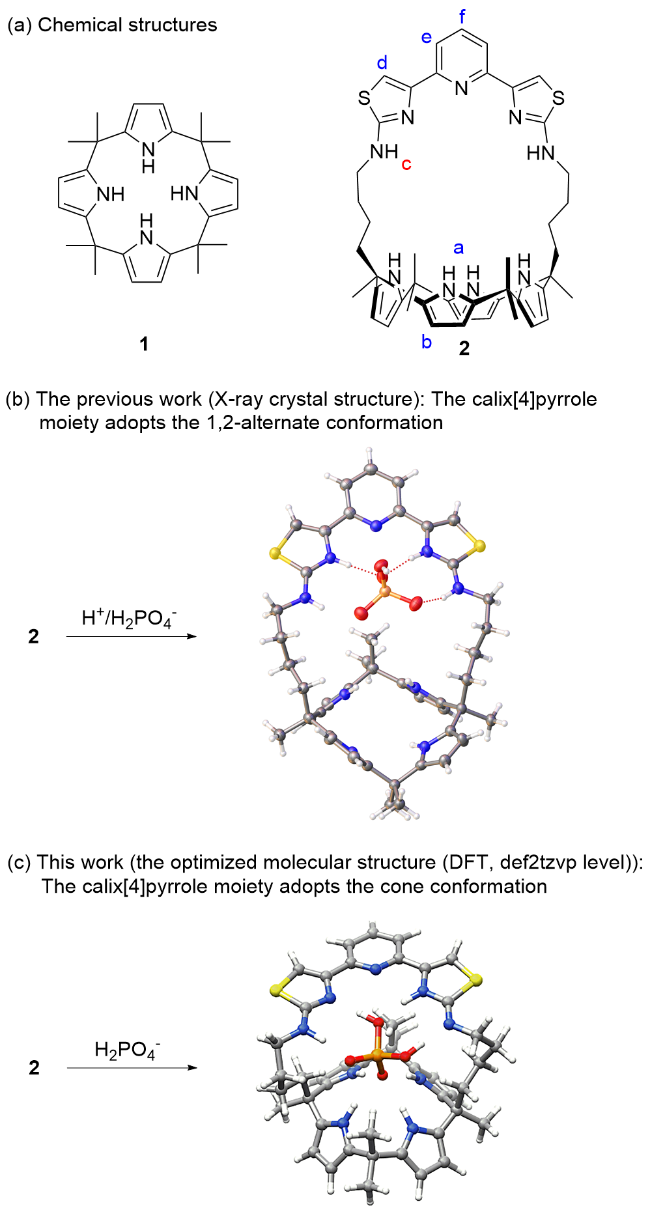
Figure 1 (a) Chemical structures of receptors 1 and 2; (b) Hydrogen phosphate binding mode in the pyridinebisthiazolamine- strapped calix[4]pyrrole 2 in its protonated form discovered previously by our group[16]; (c) Dihydrogenphosphate binding mode in the pyridinebisthiazolamine-strapped calix[4]pyrrole 2 |
As detailed below, receptor 2 further exhibits pH-con- trolled anion switching behavior in solution: It binds ${{\text{H}}_{2}}\text{PO}_{4}^{}$ under neutral conditions and switches to $\text{HSO}_{4}^{}$ binding upon adjustment to acidic conditions. This reversible specificity switching is enabled by the pH-responsive protonation/deprotonation of the thiazole nitrogen and thiazole-linked NH groups in the strap—a rare feature among calix[4]pyrrole-based receptors. This work thus represents the first example of a strapped calix[4]pyrrole-based molecular switch that enables the reversible switching of selectivity between ${{\text{H}}_{2}}\text{PO}_{4}^{}$ and $\text{HSO}_{4}^{}$ by simply modulating the pH. This design strategy opens new avenues for the development of smart materials for anion sensing and separation.
2 Results and discussion
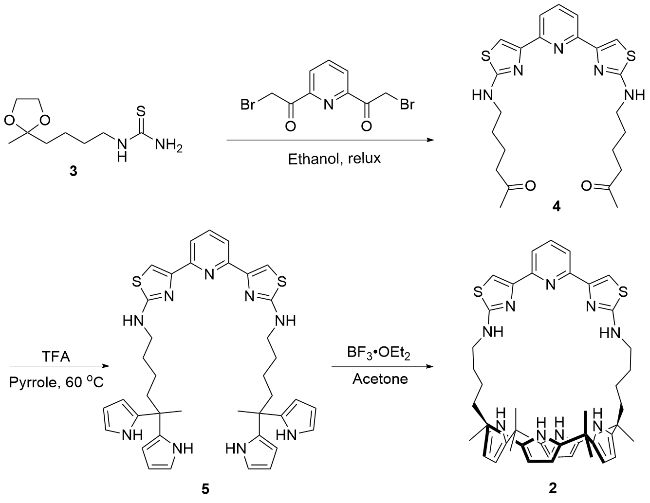
Compound 2 was prepared according to literature procedure (Scheme 1).[16] To investigate the anion binding properties of 2 in solution, UV-vis spectroscopic analyses were first performed in acetonitrile. Standard titrations, associated curve fittings[18] and Job plots revealed that the dihydrogenphosphate anion (as the tetrabutylammonium (TBA) salt) was bound to 2 with the highest relative affinity in acetonitrile (Ka=5.29×10⁶ L•mol–1) and with 1∶1 binding stoichiometry. Upon of ${{\text{H}}_{2}}\text{PO}_{4}^{}$ addition, the significant bathochromic shifts of the absorption bands of receptor 2 at 220~252 and 316~372 nm were seen, along with a disappearance of the absorption band at 252~316 nm. Such a high red shifts can be attributed to the existence of strong interaction between the pyridinebisthiazolamine unit and dihydrogenphosphate, as well as between calix[4]-pyrrole moiety and dihydrogenphosphate. In addition, HRMS study also suggested that the 1∶1 complex of 2 with dihydrogenphosphate anion was stable in the gas phase.
The binding affinities of receptor 2 for various other test anions, such as Cl–, Br–, I–, $\text{HSO}_{4}^{}$, AcO–, $\text{NO}_{3}^{}$ and $\text{ClO}_{\text{4}}^{}$ (all as TBA salts), were also determined in CH3CN through UV-vis titration experiments. Among the test anions considered, receptor 2 exhibited high affinity and selectivity for the dihydrogenphosphate anion, and the affinities for anions followed the order: ${{\text{H}}_{2}}\text{PO}_{4}^{}$ (5.29×10⁶ L•mol–1)>>AcO– (1.93×10⁵ L•mol–1)>$\text{HSO}_{4}^{}$ (5.71×10⁴ L•mol–1)>Cl– (4.20×10⁴ L•mol–1)>>Br–, I–, $\text{NO}_{3}^{}$ and $\text{ClO}_{\text{4}}^{}$ (weak or no interactions). Furthermore, the binding affinities of these anions in a water- containing organic solvent (acetonitrile with 0.5% (φ) water) were evaluated via UV-Vis spectroscopy. Strikingly, water addition imparted high selectivity to receptor 2, enabling the detection of only ${{\text{H}}_{2}}\text{PO}_{4}^{}$ and $\text{HSO}_{4}^{}$. Among these, ${{\text{H}}_{2}}\text{PO}_{4}^{}$ was bound to 2 strongly (Ka>106 L• mol–1) and with a 1∶1 binding stoichiometry. However, nonlinear curve fitting analysis revealed that $\text{HSO}_{4}^{}$ exhibits a 1∶2 binding mode with receptor 2, and the resulting binding constants were estimated to be K1=7.04×10³ L•mol–1 and K2=3.02×10⁵ L•mol–1, respectively. All other tested anions (AcO–, Cl–, Br–, I–, $\text{NO}_{3}^{}$, $\text{ClO}_{\text{4}}^{}$) showed negligible affinity.
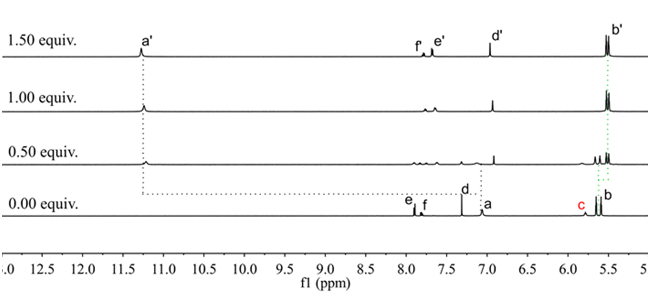
To investigate the binding mode of receptor 2 with the dihydrogenphosphate anion, 1H NMR titration experiments were carried out in CD3CN (Figure 2). Upon addition of ${{\text{H}}_{2}}\text{PO}_{4}^{}$ (added as TBA salt) to 2, a separate set of hydrogen signals appeared along with the disappearance of the corresponding 1H NMR signals of the free receptor. When the amount of dihydrogenphosphate reached 1 equiv., the signals of the free receptor completely vanished. The observations were consistent with the formation of the strong complex of 2 with dihydrogenphosphate in a 1∶1 ratio and slow exchange kinetics on the NMR time scale. The hydrogen signal for the pyrrole NH (a) dramatically shifted downfield by δ 4.16, suggesting that the pyrrole NH protons of receptor 2 participated in the dihydrogenphosphate anion binding. The signal of the pyrrolic β-CH (b) experienced an upfield shift (δ ca. 0.12) due to the conformational change of 2 to cone shaped. Interestingly, in contrast with the strong active hydrogen signal of the pyrrole NH (a) of dihydrogenphosphate complex of 2, when 1 equiv. of dihydrogenphosphate were added to 2, the peak ascribed to the thiazole-linked NH (c) of free 2 at δ 5.81 disappeared completely, and no new active hydrogen signal corresponding to the thiazole-linked NH of dihydrogenphosphate complex of 2 appears. Most likely, the proton transfer events were occurred between the thiazole-linked NH (c) and ${{\text{H}}_{2}}\text{PO}_{4}^{}$ in the ${{\text{H}}_{2}}\text{PO}_{4}^{}$ recognition process. Moreover, the signals of the exocyclic hydrogen atoms (d, e and f, respectively) on the thiazolyl and pyridinyl rings were shifted upfield, which was caused by an increase of an electron density on conjugated pyridinebisthiazole group upon anion binding to the pyridinebisthiazolamine unit.
The binding properties of receptor 2 with various other test anions in CD3CN, such as Cl–, Br–, I–, $\text{HSO}_{4}^{}$, AcO–, $\text{NO}_{3}^{}$, $\text{ClO}_{\text{4}}^{}$, were also investigated by 1H NMR spectroscopy. The significant chemical shift changes were observed by the addition of Cl–, $\text{HSO}_{4}^{}$ and AcO– to 2, respectively. Unlike the addition of ${{\text{H}}_{2}}\text{PO}_{4}^{}$ causing the disappearance of the thiazole-linked NH (c) of 2, it was found that 1 equiv. of Cl–, $\text{HSO}_{4}^{}$ or AcO–(Upon addition of AcO– to free receptor 2, the NMR signals for the pyrrole NH (a) and the thiazole-linked NH (c) are broadened) was sufficient for a new set of hydrogen signals for the pyrrole NH (a), the thiazole-linked NH (c) and the pyrrolic β-CH (b) completely appearing, leading us to conclude that the formation of a strong 1∶1 complex, a slow rate of the binding/release equilibrium and no proton transfer event occurred between receptor 2 and these anions in CD3CN. However, no obvious changes were observed in the presence of Br–, I–, $\text{NO}_{3}^{}$ and $\text{ClO}_{\text{4}}^{}$, which was ascribed to the fact that very weak or almost no hydrogen-bonding interaction existed between receptor 2 and these anions in CD3CN.
To gain further understanding of the proton transfer process, 2D NOESY NMR of receptor 2 was carried out in the presence of ${{\text{H}}_{2}}\text{PO}_{4}^{}$, $\text{HSO}_{4}^{}$ or AcO–. The result shows the correlation signal between the thiazole-linked NH (c) and H2O signal in the presence of the acidic $\text{HSO}_{4}^{}$. Though the hydrogen signal for the thiazole-linked NH (c) is broadened in the presence of basic AcO–, the correlation signal between the thiazole-linked NH (c) and H2O signal could be also observed. However, no correlation signal between the thiazole-linked NH (c) and other protons can be identified upon the addition of ${{\text{H}}_{2}}\text{PO}_{4}^{}$. The proton of the thiazole-linked NH (c) really vanish, which is consistent with the proton transfer of the thiazole-linked NH obtained from 1H NMR spectroscopy experiments. Taken together, the combination of 1D NMR and 2D NOSEY NMR leads us to conclude that the thiazole-linked NH lost the proton and the proton transfer event occurred, rather than the simple signal broadening due to the existence of mediate NMR exchange kinetics for the thiazole-linked NH.
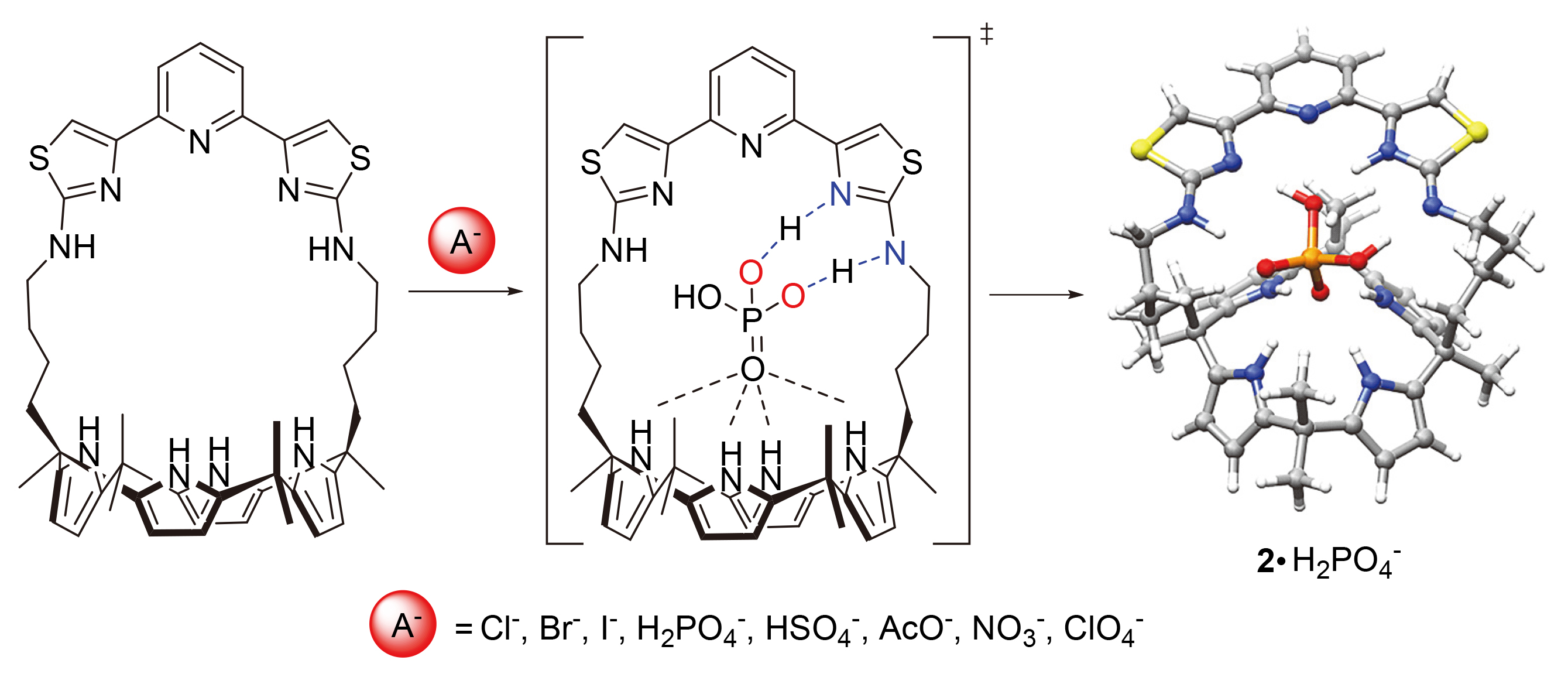
To clarify the proton transfer pathway, a computer-aided molecular modelling study was performed for the receptor 2 in the presence of dihydrogenphosphate anion. All electronic structure calculations were completed with the Gaussian 09 program.[19] The M062X density functional was used for all calculations.[20] The basis set used in the calculation is def2svp.[21] To take the solvation effect of acetonitrile into account, the SMD solvation model proposed by Truhlar et al. was adapted in single point calculations at the M062X/def2tzvp level.[22-23] The dielectric constant (ε=1.81) at 298 K was adopted to simulate the acetonitrile solvent applied in the experiment. Our working assumption is that the proton transfer events occurred between the thiazole-linked NH (c) of receptor 2 and dihydrogenphosphate in the recognition process. Figure 3 illustrates that the complexation of receptor 2 and dihydro- genphosphate proceeds via two intermediate states, namely, [2•${{\text{H}}_{2}}\text{PO}_{4}^{}$]-1 and $[2\centerdot {{\text{H}}_{2}}\text{PO}_{4}^{}]-2$, yielding the final ${{\text{H}}_{2}}\text{PO}_{4}^{}$ complexes of receptor 2. Interestingly, in the binding process, the protons of the dihydrogenphosphate and the thiazole-linked NH (c) of receptors 2 underwent transfer simultaneously, as demonstrated by the transition state TS1. The proton of dihydrogenphosphate was transferred to the nitrogen atom on the thiazole rings, meanwhile, the proton of the thiazole-linked NH (c) was transferred to the hydrogenphosphate. On the other hand, it is noted that $[2\centerdot {{\text{H}}_{2}}\text{PO}_{4}^{}]-2$ (–103.8 kJ/mol) is passed through a high energy intermediate state 2' (26.8 kJ/mol), accompanied by the release and binding of ${{\text{H}}_{2}}\text{PO}_{4}^{}$ to form the final complexes [2•${{\text{H}}_{2}}\text{PO}_{4}^{}$]. Nonetheless, in solution, sufficient energy can make this process easily occur. Additionally, the relative electronic energies of the ${{\text{H}}_{2}}\text{PO}_{4}^{}$ complexes of receptor 2, including two intermediate states [2•${{\text{H}}_{2}}\text{PO}_{4}^{}$]-1 and $[2\centerdot {{\text{H}}_{2}}\text{PO}_{4}^{}]-2$ as well as the final complexes [2•${{\text{H}}_{2}}\text{PO}_{4}^{}$], were ΔE=-125.1, -103.8, -160.7 kJ/mol, respectively. These values provided support for the conclusion that [2•${{\text{H}}_{2}}\text{PO}_{4}^{}$] is thermodynamically more stable than [2•${{\text{H}}_{2}}\text{PO}_{4}^{}$]-1 and. It is$[2\centerdot {{\text{H}}_{2}}\text{PO}_{4}^{}]-2$ therefore believed that [2•${{\text{H}}_{2}}\text{PO}_{4}^{}$]-1 and $[2\centerdot {{\text{H}}_{2}}\text{PO}_{4}^{}]-2$ serve as the intermediates for the formation of [2•${{\text{H}}_{2}}\text{PO}_{4}^{}$].
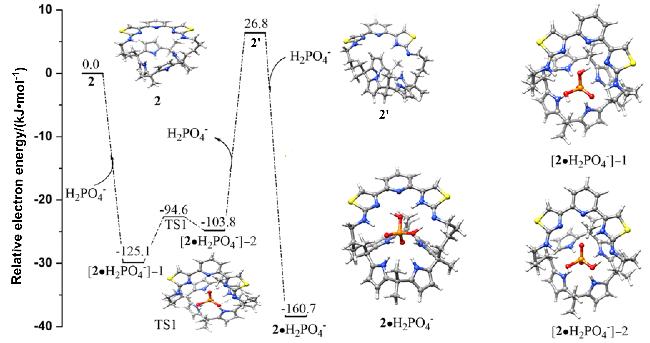
Figure 3 (Left) Computed simultaneous proton transfer transition states TS1 with M062X density functional (def2tzvp level) (The relative electronic energy barriers (ΔE) in acetonitrile solvent are given in kJ/mol); (Right) The optimized molecular structure of receptor 2 with dihydrogenphosphate as calculated in CH3CN |
The energy minimized structures of [2•${{\text{H}}_{2}}\text{PO}_{4}^{}$] indicated that the calix[4]pyrrole moiety of receptor 2 is fixed in the cone conformation by dihydrogenphosphate (Figure 3), which is consistent with the ¹H NMR observations. Interestingly, the nitrogen atom on one thiazole ring was protonated, and this protonated thiazole turn into an H-bond donor unit, while the deprotonation of the thiazole-linked NH occurred to form a hydrogen bond acceptor moiety. The calculation shows the same trend (shift and disappearance of the proton signals) as observed during the 1H NMR titration experiments of receptor 2 with dihydrogenphosphate in CD3CN. Taken in concert, the combination of 1H NMR and the density functional theory (DFT) calculation leads us to conclude that the simultaneous proton transfer events occur when 2 is exposed to dihydrogenphosphate. Most likely, dihydrogenphosphate with acidity made the thiazole group protonated, while the presence of the protonated nitrogen atom on the thiazole ring as the electron-withdrawing substituent increased the acidity of the thiazole-linked NH (c) and, as a consequence, the H+ from the thiazole-linked NH was transferred to hydrogenphosphate with basicity.
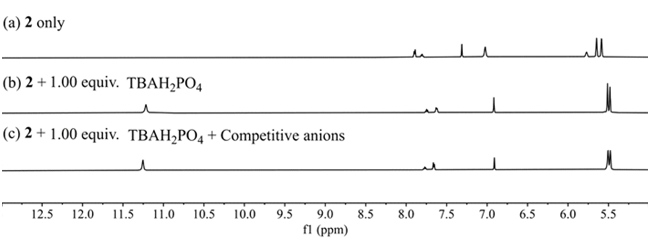
In addition, competitive binding experiments were performed by 1H NMR spectroscopy in CD3CN. Specifically, the receptor 2 was treated with ${{\text{H}}_{2}}\text{PO}_{4}^{}$ in the presence of equimolar amounts of Cl–, Br–, I–, AcO–, $\text{NO}_{3}^{}$, $\text{ClO}_{\text{4}}^{}$ and $\text{HSO}_{4}^{}$ (all as TBA salts). The spectral changes observed (Figure 4c) were entirely analogous to those during the 1H NMR titration of 2 with TBAH2PO4 alone (Figure 4b). Taken in concert, these data clearly demonstrate that receptor 2 exhibits high selectivity for ${{\text{H}}_{2}}\text{PO}_{4}^{}$ over these competing anions, which is consistent with the trend in association constants derived from UV-vis spectroscopy.
Encouraged by the previous report[16] and these initial results, we next sought to investigate whether receptor 2 could act as a pH-controlled molecular switch based on the selective recognition of ${{\text{H}}_{2}}\text{PO}_{4}^{}$ and $\text{HSO}_{4}^{}$ by 1H NMR spectroscopy. To verify this hypothesis, 1H NMR spectroscopy was employed in CD3CN at room temperature. Specifically, the ¹H NMR spectrum of the free receptor 2 showed characteristic proton resonance signals (Figure 5a). Upon addition of 1.0 equiv. of TBAH2PO4, significant spectral changes were observed, indicating the formation of the 2•${{\text{H}}_{2}}\text{PO}_{4}^{}$ complex (Figure 5b). Interestingly, the subsequent addition of 1.0 equiv. of TBAHSO4 did not alter the spectral features (Figure 5c), which remained identical to those of the 2•${{\text{H}}_{2}}\text{PO}_{4}^{}$ complex (Figure 5b), revealing that ${{\text{H}}_{2}}\text{PO}_{4}^{}$ binds preferentially over $\text{HSO}_{4}^{}$. Subsequently, the addition of 1.5 equiv. of HNO3 to this mixture resulted in a complete disappearance of the complex signals and the appearance of a new set of resonances (Figure 5d). This new spectrum was fully consistent with that obtained by directly adding 1.0 equiv. of TBAHSO4 and 1.5 equiv. of HNO3 to the receptor 2 (Figure 5g), confirming the displacement of ${{\text{H}}_{2}}\text{PO}_{4}^{}$ by $\text{HSO}_{4}^{}$ under acidic conditions; whereas as we previously reported,[16] this acidic-state binding involves protonation of the thiazole moieties in receptor 2, which then binds $\text{HSO}_{4}^{}$ (deprotonated to $\text{SO}_{4}^{2}$ under the experimental conditions) via electrostatic interactions and hydrogen bonds. This binding mode is consistent with the spectral features in Figures 5d, 5f and 5g, further validating the pH-induced switching behavior. Notably, the original complex spectral features (corresponding to the 2•${{\text{H}}_{2}}\text{PO}_{4}^{}$ complex) were fully restored upon further addition of 1.5 equiv. of TBAOH (Figure 5e), and the resulting spectrum was superimposable on the spectra shown in Figures 5b and 5c. This reversible process was further verified by the subsequent addition of another 1.5 equiv. of HNO3, which switched the spectrum back to the acidic state (Figure 5f), identical to those in Figures 5d and 5g.
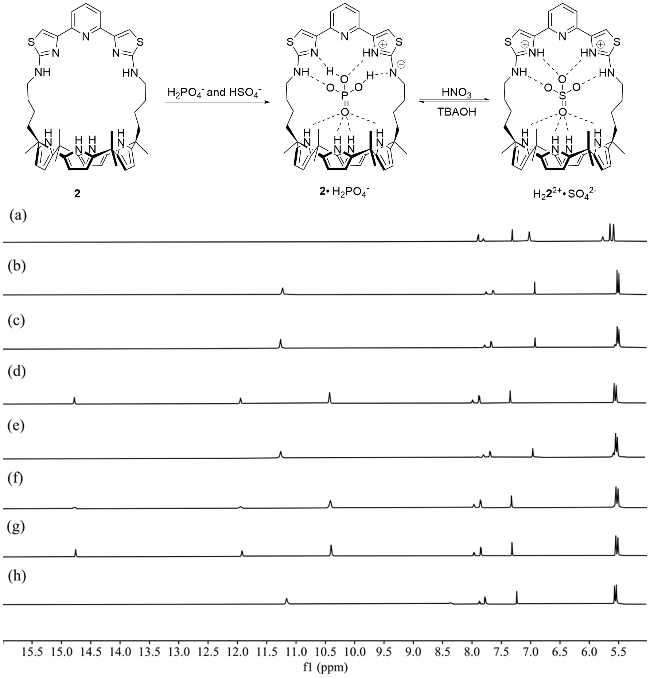


Figure 5 Partial 1H NMR spectra of receptor 2 (2.0 mmol/L in CD3CN)¹H NMR δ (a) Free receptor; (b) in the presence of 1.0 equiv. TBAH2PO4; (c) after adding 1.0 equiv. TBAHSO4 to (b); (d) after adding 1.5 equiv. HNO3 to (c); (e) after further adding 1.5 equiv. TBAOH to (d); (f) after further adding 1.5 equiv. HNO3 to (e); (g) in the presence of 1.0 equiv. TBAHSO4 and 1.5 equiv. HNO3; (h) in the presence of 1.0 equiv. TBAHSO4. |
3 Conclusions
In conclusion, the binding ability of pyridinebisthiazol- amine-strapped calix[4]pyrrole 2 towards various anions was investigated in CH3CN. 1H NMR and UV-vis titration experiments revealed that receptor 2 exhibits high affinity and selectivity for dihydrogen phosphate over other anions. DFT calculations and NMR analyses further confirmed that simultaneous proton transfer occurs between receptor 2 and ${{\text{H}}_{2}}\text{PO}_{4}^{}$: one thiazole nitrogen is protonated to form a hydrogen bond donor, while deprotonation of the thiazole-linked NH generates a hydrogen bond acceptor. This unique proton-transfer-induced binding mode not only enhances binding affinity and selectivity for ${{\text{H}}_{2}}\text{PO}_{4}^{}$ significantly, but also avoids the instability caused by excessive proton transfer from ${{\text{H}}_{2}}\text{PO}_{4}^{}$ to basic receptor moieties.
More importantly, receptor 2 displays pH-controlled anion switching behavior in solution. Under neutral conditions, it preferentially binds ${{\text{H}}_{2}}\text{PO}_{4}^{}$, whereas upon adjustment to acidic conditions, the binding preference switches to $\text{HSO}_{4}^{}$. This reversible switching is enabled by the pH-responsive protonation/deprotonation of the thiazole moieties in the strap, representing a rare example of pH-controlled dual-anion recognition based on calix[4]- pyrrole scaffolds.
4 Experimental section
4.1 General information
1H NMR spectra were recorded on a Bruker Avance III HD 600 MHz spectrometer with TMS as the internal reference and CD3CN as the deuterated solvents. High resolution mass spectra (HRMS) were obtained on a Thermo Scientific Q Exactive mass spectrometer with ESI as the ionization mode. Column chromatography was performed on silica gel of mesh size 100~200. Thin layer chromatography (TLC) was performed on silica gel plates. All solvents were dried before use according to standard procedures. Unless specifically indicated, all other chemicals and reagents used in this study were purchased from commercial sources and used as received unless otherwise noted. Compounds 2~5 were prepared as previously reported.[16]
4.2 Preparation of pyridinebisthiazolaminestrap- ped calix[4]pyrrole 2
To a solution of 3 (1.35 g, 6.18 mmol) in anhydrous ethanol (100 mL) was added α,α'-dibromo-2,6-diacetyl-pyridine (0.9 g, 2.81 mmol), and the reaction mixture was refluxed for 10 h. The reaction mixture was quenched upon addition of triethylamine. Then, the mixture was poured into water (200 mL), and the resulting mixture was extracted with dichloromethane. The organic layer was dried over anhydrous MgSO4 and the solvent was removed under reduced pressure to afford the crude reaction mixture. The crude product was purified by column chromatography over silica gel (eluent: ethyl acetate) to give 1.1 g (83% yield) of 6,6'-((pyridine-2,6-diylbis(thiazole-4,2- diyl))bis(azanediyl))bis(hexan-2-one) (4) as pale yellow solid, 124~125 ℃; 1H NMR (600 MHz, DMSO-d6) δ: 7.84 (t, J=7.7 Hz, 1H), 7.75 (d, J=7.7 Hz, 2H), 7.70 (t, J=5.4 Hz, 2H), 7.41 (s, 2H), 3.28 (q, J=6.0 Hz, 4H), 2.50~2.49 (m, 4H), 2.08 (s, 6H), 1.57~1.56 (m, 8H); 13C NMR (150 MHz, DMSO-d6) δ: 208.8, 169.2, 152.5, 150.9, 138.2, 119.2, 105.1, 44.7, 42.8, 30.1, 28.6, 21.2; HRMS (Orbitrap-ESI) calcd for C23H30N5O2S2 [M+H]+ 472.1835, found 472.1838.
To a mixture of compound 4 (1.1 g, 2.33 mmol) and pyrrole (30 mL) was added trifluoroacetic acid (345 µL, 4.66 mmol). The mixture was then stirred for 2 h at 60 ℃ before being quenched with triethylamine. Then, the mixture was poured into water (100 mL), and the resulting mixture was extracted with dichloromethane. The organic layer was collected and dried (anhydrous Na2SO4) before the solvent was removed in vacuo. The crude product was purified by column chromatography over silica gel [V(EtOAc)∶V(hexanes)=1∶1] to obtain 1.13 g (69% yield) of 4,4'-(pyridine-2,6-diyl)bis(N-(5,5-di(1H-pyrrol-2- yl)hexyl)thiazol-2-amine) (5) as off-white solid. m.p. 133~134 ℃; 1H NMR (600 MHz, DMSO-d6) δ: 10.25 (s, 4H), 7.81 (t, J=7.9 Hz, 1H), 7.73 (d, J=7.7 Hz, 2H), 7.66 (t, J=5.3 Hz, 2H), 7.39 (s, 2H), 6.57~6.56 (m, 4H), 5.85~5.84 (m, 4H), 5.72~5.71 (m, 4H), 3.22 (q, J=6.6 Hz, 4H), 2.01~1.98 (m, 4H), 1.56 (t, J=7.2 Hz, 4H), 1.52 (s, 6H), 1.19~1.16 (m, 4H); 13C NMR (150 MHz, DMSO-d6) δ: 168.6, 151.9, 150.4, 138.4, 137.7, 118.7, 116.3, 106.2, 104.5, 103.6, 44.6, 40.4, 38.5, 29.2, 24.9, 21.8; HRMS (Orbitrap-ESI) calcd for C39H46N9S2 [M+ H]+ 704.3312, found 704.3314.
To a solution of compound 5 (1.0 g, 1.42 mmol) in acetone (400 mL) was added BF3•OEt2 (456 µL, 1.42 mmol). The mixture was then stirred for 2 h at room temperature before being quenched with triethylamine (2.5 mL). Evaporation of the volatile components in vacuo afforded a reddish solid. To this crude product, dichloromethane (300 mL) and water (100 mL) were added, and the organic phase was separated and washed with water three times (150 mL). The organic layer was dried over anhydrous Na2SO4 and evaporated in vacuo to give a reddish solid. The crude product was purified by column chromatography over silica gel [V(EtOAc)∶V(hexanes)=3∶1] to obtain 0.29 g (26% yield) of pyridinebisthiazolamine- strapped calix[4]pyrrole (2) as white solid. m.p. 220~221 ℃; 1H NMR (600 MHz, DMSO-d6) δ: 9.14 (s, 4H), 7.86 (t, J=7.6 Hz, 1H), 7.66~7.62 (m, 4H), 7.11 (s, 2H), 5.59 (d, J=13.8 Hz, 8H), 3.30~3.29 (m, 4H), 1.79~1.78 (m, 4H), 1.55 (t, J=6.3 Hz, 4H), 1.49 (s, 6H), 1.46 (s, 6H), 1.35 (s, 6H), 1.15~1.14 (m, 4H); 13C NMR (150 MHz, DMSO-d6) δ: 168.9, 153.7, 151.5, 138.7, 137.8, 120.7, 105.2, 102.9, 102.2, 44.6, 42.7, 38.5, 34.9, 31.5, 29.8, 27.8, 25.3, 22.2; HRMS (Orbitrap-ESI) calcd for C45H54N9S2 [M+H]+ 784.3938, found 784.3946.
Supporting Information Experimental procedures along with copies of HRMS data, titration studies, and 2D NOSEY NMR. The Supporting Information is available free of charge via the Internet at http://sioc-journal.cn.
(Cheng, F.)