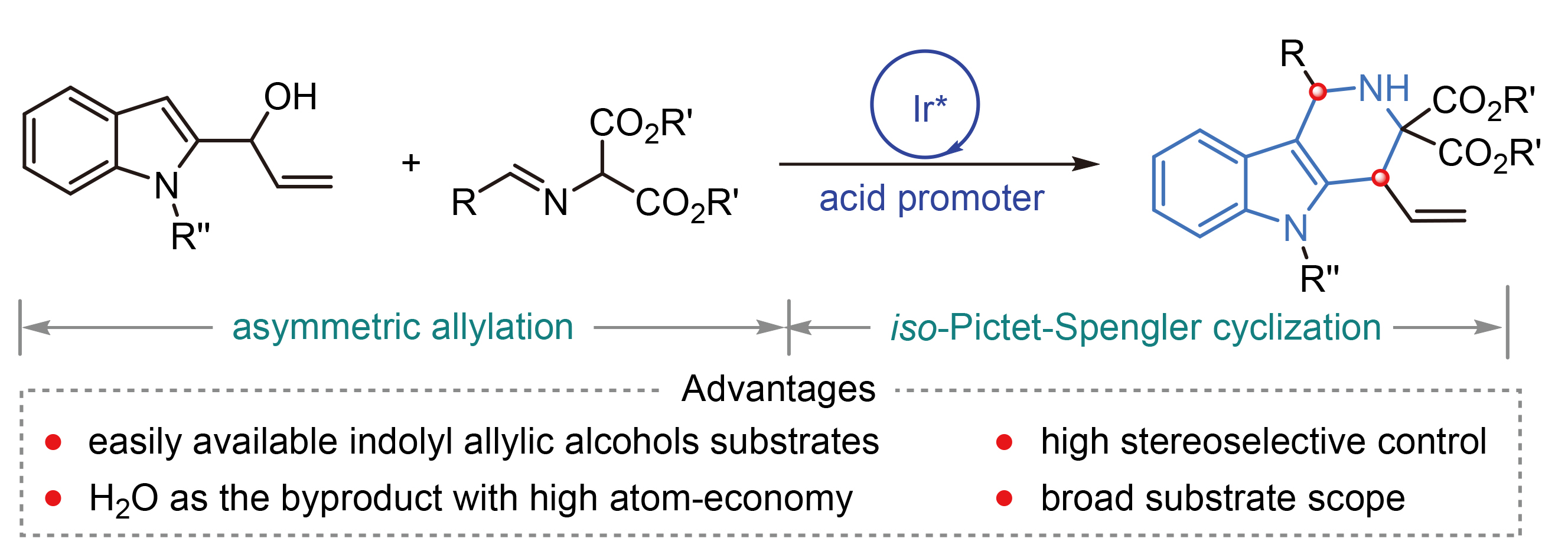
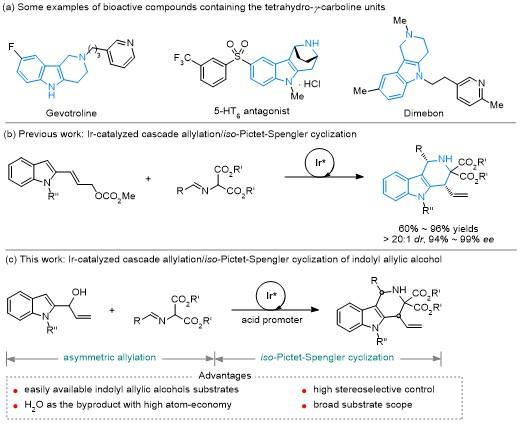
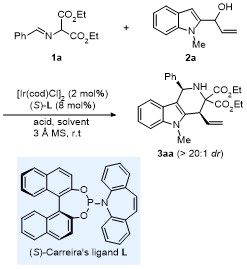
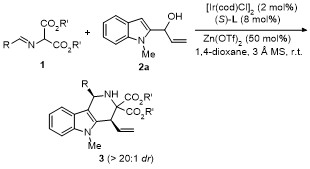
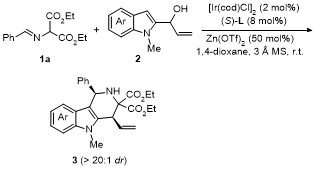
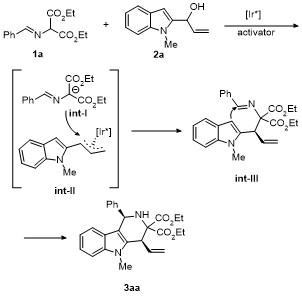
Under a nitrogen atmosphere, a flame-dried 10 mL Schlenk tube was charged with [Ir(cod)Cl]2 (2.7 mg, 0.004 mmol, 2 mol%), Carreira’s ligand (S)-L (8.2 mg, 0.016 mmol, 8 mol%). After the tube was evacuated and backfilled with nitrogen, anhydrous 1,4-dioxane (1.0 mL) was added, then stirred at room temperature for 15 min while the solution turned dark red. Then, 2-indolyl allylic alcohols 2 (0.2 mmol, 1.0 equiv.) and 3 Å MS (80.0 mg) were added, the reaction mixture immediately turned light yellow. Iminoesters 1 (0.24 mmol, 1.2 equiv.) and Zn(OTf)2 (36.4 mg, 0.1 mmol, 0.5 equiv.) were added sequentially. The reaction mixture was stirred at room temperature until iminoesters 1 were consumed (monitored by TLC deactivated by triethylamine), which was evaporated under reduced pressure. The crude residue was purified by flash chromatography [V(petroleum ether)/V(EtOAc)=20/1~10/1] to give the desired products 3. The dr value was determined by 1H NMR spectrum of the product, and the enantiomeric excess was recorded by HPLC analysis in comparison with the racemic sample.
Diethyl (1R,4R)-5-methyl-1-phenyl-4-vinyl-1,2,4,5-te- trahydro-3H-pyrido[4,3-b]indole-3,3-dicarboxylate (3aa): Yield 67%, 57.9 mg, yellow thick oil. The product was analyzed by HPLC to determine the enantiomeric excess:>99% ee (Chiralpak AD-H, i-propanol/hexane (V/V=10/90), flow rate 1.0 mL/min, λ=282 nm); tr=6.2 and 8.1 min. 1H NMR (400 MHz, Chloroform-d) δ: 7.46~7.40 (m, 2H), 7.36~7.28 (m, 3H), 7.24 (s, 1H), 7.11~7.06 (m, 1H), 6.83~6.76 (m, 1H), 6.75~6.73 (m, 1H), 6.09~6.03 (m, 1H), 5.35~5.25 (m, 2H), 5.15 (s, 1H), 4.50 (d, J=8.3 Hz, 1H), 4.27 (q, J=7.1 Hz, 2H), 4.18 (t, J=7.1 Hz, 2H), 3.70 (s, 3H), 1.30 (t, J=7.1 Hz, 3H), 1.21 (t, J=7.1 Hz, 3H); 13C NMR (100 MHz, Chloroform-d) δ: 169.3, 168.1, 142.9, 137.6, 135.9, 134.4, 128.9, 128.4, 127.8, 124.9, 121.0, 119.2, 118.9, 109.7, 108.8, 71.5, 62.2, 62.0, 55.6, 42.3, 29.1, 14.20, 14.17. HRMS (ESI) calcd for C26H29O4N2 [M+H]+ 433.2122, found 433.2099.
Diethyl (1R,4R)-5-methyl-1-(p-tolyl)-4-vinyl-1,2,4,5-te- trahydro-3H-pyrido[4,3-b]indole-3,3-dicarboxylate (3ba): Yield 60%, 53.6 mg, yellow solid, m.p. 41~43 ℃. The product was analyzed by HPLC to determine the enantio- meric excess: 98% ee (Chiralpak AD-H, i-propanol/hexane (V/V=10/90), flow rate 1.0 mL/min, λ=282 nm); tr=7.0 and 11.6 min. 1H NMR (400 MHz, Chloroform-d) δ: 7.35~7.28 (m, 2H), 7.25~7.23 (m, 1H), 7.12~7.08 (m, 3H), 6.88~6.73 (m, 2H), 6.11~6.02 (m, 1H), 5.34~5.25 (m, 2H), 5.11 (d, J=1.4 Hz, 1H), 4.49 (dd, J=8.3, 1.3 Hz, 1H), 4.26 (q, J=7.1 Hz, 2H), 4.21~4.11 (m, 2H), 3.69 (s, 3H), 2.34 (s, 3H), 1.29 (t, J=7.1 Hz, 3H), 1.20 (t, J=7.1 Hz, 3H); 13C NMR (100 MHz, Chloroform-d) δ: 169.3, 168.2, 139.9, 137.6, 137.3, 136.0, 134.4, 129.1, 128.7, 124.9, 121.0, 119.3, 119.2, 118.8, 109.8, 108.8, 71.5, 62.2, 62.0, 55.2, 42.3, 29.1, 21.3, 14.20, 14.17. HRMS (ESI) calcd for C27H31O4N2 [M+H]+ 447.2278, found 447.2258.
Diethyl (1R,4R)-5-methyl-1-(m-tolyl)-4-vinyl-1,2,4,5-te- trahydro-3H-pyrido[4,3-b]indole-3,3-dicarboxylate (3ca): Yield 62%, 55.4 mg, yellow oil. The product was analyzed by HPLC to determine the enantiomeric excess: 96% ee (Chiralpak AD-H, i-propanol/hexane (V/V=10/90), flow rate 1.0 mL/min, λ=282 nm); tr=4.8 and 5.4 min. 1H NMR (400 MHz, Chloroform-d) δ: 7.24 (d, J=3.8 Hz, 2H), 7.22~7.17 (m, 2H), 7.12~7.05 (m, 2H), 6.84~6.76 (m, 2H), 6.10~6.04 (m, 1H), 5.34~5.25 (m, 2H), 5.10 (d, J=1.5 Hz, 1H), 4.49 (dd, J=8.4, 1.3 Hz, 1H), 4.26 (q, J=7.1 Hz, 2H), 4.21~4.12 (m, 2H), 3.70 (s, 3H), 2.31 (s, 3H), 1.30 (t, J=7.1 Hz, 3H), 1.21 (t, J=7.1 Hz, 3H); 13C NMR (100 MHz, Chloroform-d) δ: 169.3, 168.2, 142.7, 137.9, 137.5, 136.0, 134.4, 129.5, 128.6, 128.2, 125.9, 121.0, 119.3, 119.2, 118.9, 109.7, 108.7, 71.5, 62.2, 62.0, 55.6, 42.3, 29.1, 21.5, 14.20, 14.17. HRMS (ESI) calcd for C27H31O4N2 [M+H]+ 447.2278, found 447.2256.
Diethyl (1S,4S)-5-methyl-1-(o-tolyl)-4-vinyl-1,2,4,5-te- trahydro-3H-pyrido[4,3-b]indole-3,3-dicarboxylate (3da): Carreira’s ligand (R)-L was used. Yield 65%, 58.1 mg, white solid, m.p. 72~74 ℃. The product was analyzed by HPLC to determine the enantiomeric excess: >99% ee (Chiralpak AD-H, i-propanol/hexane (V/V=3/97), flow rate 1.0 mL/min, λ=254 nm); tr=7.8 and 8.2 min. 1H NMR (400 MHz, Chloroform-d) δ: 7.26 (d, J=8.3 Hz, 1H), 7.17 (d, J=7.7 Hz, 3H), 7.13~7.02 (m, 2H), 6.84~6.79 (m, 1H), 6.64 (d, J=8.0 Hz, 1H), 6.12~5.95 (m, 1H), 5.41 (s, 1H), 5.35~5.25 (m, 2H), 4.49 (d, J=8.5 Hz, 1H), 4.31~4.12 (m, 4H), 3.70 (s, 3H), 2.87 (s, 1H), 2.66~2.32 (m, 3H), 1.31~1.21 (m, 6H); 13C NMR (100 MHz, Chloroform-d) δ: 169.3, 168.1, 140.1, 137.5, 135.7, 134.6, 130.2, 129.3, 127.5, 124.7, 121.0, 119.2, 119.1, 118.8, 109.6, 108.7, 71.5, 62.1, 62.0, 50.3, 42.2, 29.1, 19.2, 14.22, 14.17. HRMS (ESI) calcd for C26H29O4N2 [M+H]+ 447.2278, found 447.2259.
Diethyl (1R,4R)-1-(4-chlorophenyl)-5-methyl-4-vinyl-1,2,4,5-tetrahydro-3H-pyrido[4,3-b]indole-3,3-dicarboxyl-ate (3ea): Yield 70%, 65.4 mg, yellow oil. The product was analyzed by HPLC to determine the enantiomeric excess:>99% ee (Chiralpak AD-H, i-propanol/hexane (V/V=10/90), flow rate 1.0 mL/min, λ=282 nm); tr=8.3 and 12.5 min. 1H NMR (400 MHz, Chloroform-d) δ: 7.42~7.33 (m, 2H), 7.32~7.25 (m, 3H), 7.13~7.08 (m, 1H), 6.86~6.82 (m, 1H), 6.76~6.73 (m, 1H), 6.15~5.97 (m, 1H), 5.34~5.25 (m, 2H), 5.14 (d, J=1.3 Hz, 1H), 4.50 (dd, J=8.3, 1.3 Hz, 1H), 4.27 (q, J=7.2 Hz, 2H), 4.17 (dd, J=7.1, 4.2 Hz, 2H), 3.69 (s, 3H), 2.96 (s, 1H), 1.30 (t, J=7.1 Hz, 3H), 1.19 (t, J=7.1 Hz, 3H); 13C NMR (100 MHz, Chloroform-d) δ: 169.1, 168.0, 141.5, 137.6, 135.8, 134.5, 133.4, 130.2, 128.6, 124.7, 121.2, 119.3, 119.0, 109.2, 108.9, 71.4, 62.3, 62.1, 54.9, 42.2, 29.1, 14.19, 14.16. HRMS (ESI) calcd for C26H28O4N2Cl [M+H]+ 467.1732, found 467.1705.
Diethyl (1R,4R)-1-(3-chlorophenyl)-5-methyl-4-vinyl-1,2,4,5-tetrahydro-3H-pyrido[4,3-b]indole-3,3-dicarboxyl-ate (3fa): Yield 64%, 59.7 mg, yellow solid, m.p. 44~46 ℃. The product was analyzed by HPLC to determine the enantiomeric excess: 96% ee (Chiralpak AD-H, i-propanol/hexane (V/V=10/90), flow rate 1.0 mL/min, λ=282 nm); tr=5.6 and 6.8 min. 1H NMR (400 MHz, Chloroform-d) δ: 7.41 (d, J=2.1 Hz, 1H), 7.33~7.30 (m, 1H), 7.28~7.23 (m, 3H), 7.13~7.08 (m, 1H), 6.87~6.83 (m, 1H), 6.79~6.76 (m, 1H), 6.15~5.99 (m, 1H), 5.35~5.27 (m, 2H), 5.13 (d, J=1.4 Hz, 1H), 4.50 (dd, J=8.3, 1.3 Hz, 1H), 4.27 (qd, J=7.1, 1.4 Hz, 2H), 4.20 (d, J=3.5 Hz, 2H), 3.70 (s, 3H), 3.00 (s, 1H), 1.31 (t, J=7.1 Hz, 3H), 1.20 (t, J=7.1 Hz, 3H); 13C NMR (100 MHz, Chloroform-d) δ: 169.1, 168.0, 145.1, 137.6, 135.8, 134.5, 134.2, 129.7, 129.0, 128.1, 127.1, 124.7, 121.2, 119.4, 119.1, 119.0, 109.0, 108.9, 71.4, 62.3, 62.1, 55.3, 42.3, 29.1, 14.19, 14.16. HRMS (ESI) calcd for C26H27O4N2Cl [M+H]+ 467.1732, found 467.1712.
Diethyl (1S,4R)-1-(2-chlorophenyl)-5-methyl-4-vinyl-1,2,4,5-tetrahydro-3H-pyrido[4,3-b]indole-3,3-dicarboxyl-ate (3ga): Yield 62%, 57.9 mg, yellow oil. The product was analyzed by HPLC to determine the enantiomeric excess: 98% ee (Chiralpak AD-H, i-propanol/hexane (V/V=10/90), flow rate 1.0 mL/min, λ=282 nm); tr=6.6 and 7.2 min. 1H NMR (400 MHz, Chloroform-d) δ: 7.43 (dd, J=8.0, 1.3 Hz, 1H), 7.27 (d, J=8.4 Hz, 1H), 7.25~7.17 (m, 2H), 7.15~7.07 (m, 2H), 6.88~6.84 (m, 1H), 6.76 (d, J=7.9 Hz, 1H), 6.05 (ddd, J=17.1, 10.0, 8.4 Hz, 1H), 5.74 (s, 1H), 5.33~5.25 (m, 2H), 4.51 (d, J=8.4 Hz, 1H), 4.32~4.11 (m, 4H), 3.71 (s, 3H), 3.20 (s, 1H), 1.31 (d, J=7.1 Hz, 3H), 1.23 (d,J=7.1 Hz, 3H); 13C NMR (100 MHz, Chloroform-d) δ: 169.2, 168.1, 139.6, 137.6, 135.8, 135.1, 133.9, 131.1, 129.1, 128.9, 127.4, 121.2, 119.3, 119.3, 119.0, 108.9, 108.6, 71.5, 62.3, 62.1, 42.2, 29.1, 14.20, 14.16. HRMS (ESI) calcd for C26H28O4N2Cl [M+H]+ 467.1732, found 467.1712.
Diethyl (1R,4R)-1-(4-methoxyphenyl)-5-methyl-4-vinyl-1,2,4,5-tetrahydro-3H-pyrido[4,3-b]indole-3,3-dicarbo-xylate (3ha): Yield 64%, 59.2 mg, yellow oil. The product was analyzed by HPLC to determine the enantiomeric excess: >99% ee (Chiralpak AD-H, i-propanol/hexane (V/V=10/90), flow rate 1.0 mL/min, λ=282 nm); tr=10.6 and 13.5 min. 1H NMR (400 MHz, Chloroform-d) δ: 7.38~7.30 (m, 2H), 7.24 (s, 1H), 7.11~7.07 (m, 1H), 6.88~6.74 (m, 4H), 6.06 (ddd, J=17.1, 10.1, 8.3 Hz, 1H), 5.35~5.23 (m, 2H), 5.17~5.04 (m, 1H), 4.56~4.43 (m, 1H), 4.26 (q, J=7.1 Hz, 2H), 4.24~4.10 (m, 2H), 3.80 (s, 3H), 3.69 (s, 3H), 2.93 (s, 1H), 1.30 (t, J=7.1 Hz, 3H), 1.20 (t, J=7.1 Hz, 3H); 13C NMR (100 MHz, Chloroform-d) δ: 169.3, 159.2, 137.6, 136.0, 135.1, 134.4, 129.9, 124.9, 121.0, 119.3, 119.2, 118.9, 113.8, 110.0, 108.8, 71.5, 62.2, 62.0, 55.3, 54.9, 42.2, 29.1, 14.20, 14.16. HRMS (ESI) calcd for C27H31O5N2 [M+H]+ 463.2227, found 463.2209.
Diethyl (1R,4R)-1-(3-methoxyphenyl)-5-methyl-4-vinyl-1,2,4,5-tetrahydro-3H-pyrido[4,3-b] indole-3,3-dicar-boxylate (3ia): Yield 64%, 59.2 mg, yellow oil. The product was analyzed by HPLC to determine the enantiomeric excess: >99% ee (Chiralpak AD-H, i-propanol/hexane (V/V=10/90), flow rate 1.0 mL/min, λ=282 nm); tr=6.5 and 10.0 min. 1H NMR (400 MHz, Chloroform-d) δ: 7.25~7.17 (m, 2H), 7.11~7.07 (m, 1H), 7.05~7.01 (m, 1H), 6.98 (dd, J=2.6, 1.6 Hz, 1H), 6.88~6.79 (m, 3H), 6.07 (ddd, J=17.0, 10.1, 8.3 Hz, 1H), 5.34~5.26 (m, 2H), 5.13 (d, J=1.4 Hz, 1H), 4.50 (dd, J=8.3, 1.2 Hz, 1H), 4.26 (q, J=7.1 Hz, 2H), 4.17 (qd, J=7.1, 5.8 Hz, 2H), 3.75 (s, 3H), 3.69 (s, 3H), 1.31 (d, J=7.1 Hz, 3H), 1.20 (t, J=7.1 Hz, 3H); 13C NMR (100 MHz, Chloroform-d) δ: 169.2, 159.6, 144.6, 137.6, 136.0, 134.4, 129.4, 124.9, 121.3, 121.0, 119.3, 119.2, 118.9, 114.6, 113.1, 109.6, 108.7, 71.5, 62.2, 62.0, 55.6, 55.2, 42.3, 29.1, 14.20, 14.17. HRMS (ESI) calcd for C27H31O5N2 [M+H]+ 463.2227, found 463.2219.
Diethyl (1R,4R)-1-(4-bromophenyl)-5-methyl-4-vinyl-1,2,4,5-tetrahydro-3H-pyrido[4,3-b]indole-3,3-dicarboxyl-ate (3ja): Yield 65%, 66.5 mg, yellow solid, m.p. 165~167 ℃. The product was analyzed by HPLC to determine the enantiomeric excess:>99% ee (Chiralpak AD-H, i-propanol/hexane (V/V=10/90), flow rate 1.0 mL/min, λ=282 nm); tr=9.4 and 14.4 min. 1H NMR (400 MHz, Chloroform-d) δ: 7.49~7.40 (m, 2H), 7.33~7.28 (m, 2H), 7.24 (s, 1H), 7.11~7.10 (m, 1H), 6.85~6.82 (m, 1H), 6.75 (d, J=7.9 Hz, 1H), 6.13~5.98 (m, 1H), 5.35~5.25 (m, 2H), 5.13 (d, J=1.3 Hz, 1H), 4.50 (dd, J=8.3, 1.3 Hz, 1H), 4.27 (q, J=7.1 Hz, 2H), 4.17 (qd, J=7.1, 3.7 Hz, 2H), 3.69 (s, 3H), 1.30 (t, J=7.1 Hz, 3H), 1.19 (t, J=7.1 Hz, 3H); 13C NMR (100 MHz, Chloroform-d) δ: 169.1, 168.0, 142.1, 135.8, 137.6, 134.5, 131.6, 130.6, 124.6, 121.6, 121.2, 119.3, 119.1, 119.0, 109.1, 108.9, 71.4, 62.3, 62.1, 55.0, 42.2, 29.1, 14.21, 14.18. HRMS (ESI) calcd for C26H28O4- N2Br [M+H]+ 511.1227, found 511.1199.
Diethyl (1R,4R)-5-methyl-1-(naphthalen-2-yl)-4-vinyl-1,2,4,5-tetrahydro-3H-pyrido[4,3-b]indole-3,3-dicarboxyl-ate (3ka): Yield 60%, 57.8 mg, yellow solid, m.p. 148~150 ℃. The product was analyzed by HPLC to determine the enantiomeric excess: >99% ee (Chiralpak AD-H, i-propanol/hexane (V/V=10/90), flow rate 1.0 mL/min, λ=282 nm); tr=8.9 and 16.6 min. 1H NMR (400 MHz, Chloroform-d) δ: 7.96 (d, J=1.7 Hz, 1H), 7.88~7.82 (m, 1H), 7.82~7.77 (m, 1H), 7.73 (d, J=8.5 Hz, 1H), 7.53~7.42 (m, 3H), 7.29~7.20 (m, 1H), 7.08~7.03 (m, 1H), 6.73 (d, J=4.1 Hz, 2H), 6.14 (ddd, J=17.1, 10.0, 8.4 Hz, 1H), 5.42~5.21 (m, 3H), 4.54 (d, J=8.4 Hz, 1H), 4.30~4.13 (m, 4H), 3.71 (s, 3H), 1.29 (t, J=7.1 Hz, 3H), 1.23 (t, J=7.1 Hz, 3H); 13C NMR (100 MHz, Chloroform-d) δ: 169.3, 168.2, 140.6, 137.6, 136.0, 134.6, 133.4, 133.4, 128.4, 128.0, 127.8, 127.6, 126.9, 125.9, 125.8, 124.9, 121.1, 119.3, 119.2, 119.0, 109.5, 108.8, 71.6, 62.3, 62.1, 55.8, 42.4, 29.2, 14.3, 14.2. HRMS (ESI) calcd for C30H31O4N2 [M+H]+ 483.2278, found 483.2256.
Diethyl (1S,4R)-5-methyl-1-(thiophen-2-yl)-4-vinyl-1,2, 4,5-tetrahydro-3H-pyrido[4,3-b]indole-3,3-dicarboxylate (3la): Yield 63%, 55.2 mg, yellow oil. The product was analyzed by HPLC to determine the enantiomeric excess: 98% ee (Chiralpak AD-H, i-propanol/hexane (V/V=10/90), flow rate 1.0 mL/min, λ=282 nm); tr=7.2 and 10.4 min. 1H NMR (400 MHz, Chloroform-d) δ: 7.25~7.19 (m, 3H), 7.14~7.09 (m, 1H), 7.02 (d, J=7.9 Hz, 1H), 6.96 (dd, J=5.1, 3.4 Hz, 1H), 6.90 (ddd, J=8.0, 6.9, 1.0 Hz, 1H), 6.15~5.98 (m, 1H), 5.57 (s, 1H), 5.37~5.24 (m, 2H), 4.52~4.44 (m, 1H), 4.27 (qd, J=7.1, 1.5 Hz, 2H), 4.21~4.09 (m, 2H), 3.68 (s, 3H), 3.12 (d, J=23.4 Hz, 1H), 1.31 (t, J=7.1 Hz, 3H), 1.17 (t, J=7.1 Hz, 3H); 13C NMR (100 MHz, Chloro- form-d) δ: 169.1, 167.8, 148.1, 137.5, 135.4, 134.1, 125.8, 125.7, 125.5, 124.9, 121.2, 119.5, 119.1, 119.0, 109.6, 108.9, 71.5, 62.3, 62.1, 50.5, 42.3, 29.0, 14.2, 14.1. HRMS (ESI) calcd for C24H27O4N2S [M+H]+ 439.1646, found 439.1657.
Diisopropyl (1R,4R)-1-(4-chlorophenyl)-5-methyl-4-vinyl-1,2,4,5-tetrahydro-3H-pyrido[4,3-b]indole-3,3-di- carboxylate (3ma): Yield 70%, 70.0 mg, yellow solid, m.p. 188~190 ℃. The product was analyzed by HPLC to determine the enantiomeric excess: >99% ee (Chiralpak IE, i-propanol/hexane=2/98, V/V, flow rate 1.0 mL/min, λ=254 nm); tr=8.8 and 11.2 min. 1H NMR (400 MHz, Chloroform-d) δ: 7.38~7.33 (m, 2H), 7.30~7.23 (m, 3H), 7.10~7.09 (m, 1H), 6.84~6.81 (m, 1H), 6.74 (d, J=7.9 Hz, 1H), 6.05 (ddd, J=17.1, 10.1, 8.4 Hz, 1H), 5.38~5.24 (m, 2H), 5.17~5.06 (m, 2H), 5.04~4.93 (m, 1H), 4.56~4.34 (m, 1H), 3.70 (s, 3H), 1.32~1.24 (m, 9H), 1.09 (d, J=6.2 Hz, 3H); 13C NMR (100 MHz, Chloroform-d) δ: 168.6, 167.6, 141.6, 137.6, 135.7, 134.8, 133.4, 130.3, 128.6, 121.1, 119.2, 119.0, 109.1, 108.9, 71.2, 70.0, 69.5, 55.0, 42.1, 29.1, 21.9, 21.7, 21.6, 21.5. HRMS (ESI) calcd for C28H32O4N2Cl [M+H]+ 495.2023, found 495.2021.
Diethyl (1S,4S)-1-cyclohexyl-5-methyl-4-vinyl-1,2,4,5-tetrahydro-3H-pyrido[4,3-b] indole-3,3-dicarbo-xylate (3na): Carreira’s ligand (R)-L was used. Yield 58%, 50.8 mg, yellow oil. The product was analyzed by HPLC to determine the enantiomeric excess: 98% ee (Chiralpak AD-H, i-propanol/hexane (V/V=3/97), flow rate 1.0 mL/min, λ=254 nm); tr=4.7 and 6.4 min. 1H NMR (400 MHz, Chloroform-d) δ: 7.46 (d, J=7.9 Hz, 1H), 7.21 (s, 1H), 7.13~7.06 (m, 1H), 7.02~6.94 (m, 1H), 5.85 (ddd, J=17.1, 10.1, 8.6 Hz, 1H), 5.20~5.08 (m, 2H), 4.30 (d, J=8.6 Hz, 1H), 4.21~4.17 m, 2H), 4.13 (d, J=2.6 Hz, 1H), 3.98 (qd, J=7.1, 2.6 Hz, 2H), 3.58 (s, 3H), 2.22~2.08 (m, 1H), 1.83~1.70 (m, 2H), 1.60~1.44 (m, 5H), 1.24 (d, J=7.1 Hz, 3H), 1.15~1.07 (m, 2H), 1.02 (t, J=7.1 Hz, 3H), 0.80 (td, J=10.9, 9.7, 4.5 Hz, 1H); 13C NMR (100 MHz, Chloroform-d) δ: 169.6, 168.7, 137.7, 136.0, 134.9, 124.9, 120.8, 119.2, 118.7, 118.6, 109.0, 108.9, 71.0, 62.1, 61.7, 54.8, 42.6, 42.0, 30.4, 28.9, 27.3, 26.64, 26.58, 25.4, 14.2, 14.1. HRMS (ESI) calcd for C26H35O4N2 [M+H]+ 439.2591, found 439.2584.
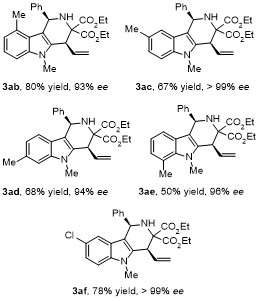
Diethyl (1R,4R)-5,9-dimethyl-1-phenyl-4-vinyl-1,2,4,5-tetrahydro-3H-pyrido[4,3-b]indole-3,3-dicarboxylate (3ab): Yield 80%, 71.4 mg, yellow thick oil. The product was analyzed by HPLC to determine the enantiomeric excess: 93% ee (Chiralpak IE, i-propanol/hexane (V/V=2/98), flow rate 1.0 mL/min, λ=254 nm); tr=9.2 and 11.0 min. 1H NMR (400 MHz, Chloroform-d) δ: 7.25 (d, J=2.8 Hz, 5H), 7.13 (d, J=8.2 Hz, 1H), 7.04~7.01 (m, 1H), 6.64 (d, J=7.1 Hz, 1H), 6.01 (ddd, J=17.7, 10.1, 8.1 Hz, 1H), 5.51 (d, J=1.4 Hz, 1H), 5.36~5.22 (m, 2H), 4.52 (d, J=8.1 Hz, 1H), 4.24 (q, J=7.0 Hz, 2H), 4.17 (dd, J=10.7, 7.1 Hz, 2H), 3.70 (s, 3H), 1.82 (s, 3H), 1.28 (t, J=7.1 Hz, 3H), 1.17 (t, J=7.1 Hz, 3H); 13C NMR (100 MHz, Chloroform-d) δ: 169.0, 167.9, 145.4, 138.1, 135.7, 135.2, 130.7, 128.6, 128.4, 127.5, 124.6, 121.5, 120.8, 119.4, 109.4, 106.5, 71.3, 62.3, 62.0, 56.1, 43.0, 29.1, 21.1, 14.19, 14.17. HRMS (ESI) calcd for C27H31O4N2 [M+H]+ 447.2278, found 447.2257.
Diethyl (1R,4R)-5,8-dimethyl-1-phenyl-4-vinyl-1,2,4,5-tetrahydro-3H-pyrido[4,3-b]indole-3,3-dicarboxylate (3ac): Yield 67%, 59.8 mg, yellow solid, m.p. 40~42 ℃. The product was analyzed by HPLC to determine the enan- tiomeric excess: >99% ee (Chiralpak AD-H, i-propanol/ hexane (V/V=10/90), flow rate 1.0 mL/min, λ=282 nm); tr=6.2 and 7.3 min. 1H NMR (400 MHz, Chloroform-d) δ: 7.46~7.40 (m, 2H), 7.36~7.28 (m, 3H), 7.13 (d, J=8.3 Hz, 1H), 6.91 (dd, J=8.4, 1.7 Hz, 1H), 6.57~6.51 (m, 1H), 6.07 (ddd, J=16.9, 10.3, 8.3 Hz, 1H), 5.34~5.24 (m, 2H), 5.16~5.07 (m, 1H), 4.48 (dd, J=8.2, 1.3 Hz, 1H), 4.26 (qd, J=7.2, 0.9 Hz, 2H), 4.16 (p, J=7.2 Hz, 2H), 3.66 (s, 3H), 2.21 (s, 3H), 1.29 (t, J=7.1 Hz, 3H), 1.20 (t, J=7.1 Hz, 3H); 13C NMR (100 MHz, Chloroform-d) δ: 169.2, 168.2, 136.01, 135.97, 134.5, 128.9, 128.4, 128.0, 127.7, 125.1, 122.6, 119.1, 118.9, 109.1, 108.5, 71.5, 62.2, 62.0, 55.6, 42.3, 29.1, 21.4, 14.14, 14.16. HRMS (ESI) calcd for C27- H31O4N2 [M+H]+ 447.2278, found 447.2259.
Diethyl (1R,4R)-5,7-dimethyl-1-phenyl-4-vinyl-1,2,4,5-tetrahydro-3H-pyrido[4,3-b]indole-3,3-dicarboxylate (3ad): Yield 68%, 60.7 mg, yellow thick oil. The product was analyzed by HPLC to determine the enantiomeric excess: 94% ee (Chiralpak AD-H, i-propanol/hexane (V/ V=10/90), flow rate 1.0 mL/min, λ=282 nm); tr=5.6 and 7.8min. 1H NMR (400 MHz, Chloroform-d) δ: 7.46~7.39 (m, 2H), 7.34~7.27 (m, 3H), 7.05 (s, 1H), 6.70~6.59 (m, 2H), 6.07 (ddd, J=17.0, 10.1, 8.2 Hz, 1H), 5.34~5.24 (m, 2H), 5.13 (d, J=1.4 Hz, 1H), 4.52~4.46 (m, 1H), 4.26 (q, J=7.1 Hz, 2H), 4.23~4.12 (m, 2H), 3.66 (s, 3H), 2.40 (s, 3H), 1.29 (t, J=7.1 Hz, 3H), 1.20 (t, J=7.1 Hz, 3H); 13C NMR (100 MHz, Chloroform-d) δ: 169.3, 168.2, 143.0, 138.0, 136.0, 133.8, 130.9, 128.9, 128.4, 127.7, 122.7, 120.5, 119.1, 118.9, 109.6, 108.9, 71.5, 62.2, 62.0, 55.6, 42.2, 29.0, 21.8, 14.20, 14.16. HRMS (ESI) calcd for C27- H31O4N2 [M+H]+ 447.2278, found 447.2257.
Diethyl (1R,4R)-5,6-dimethyl-1-phenyl-4-vinyl-1,2,4,5-tetrahydro-3H-pyrido[4,3-b]indole-3,3-dicarboxylate (3ae): Yield 50%, 44.6 mg, yellow solid, m.p. 95~97 ℃. The product was analyzed by HPLC to determine the enantio- meric excess: 96% ee (Chiralpak AD-H, i-propanol/hexane (V/V=10/90), flow rate 1.0 mL/min, λ=282 nm); tr=6.4 and 8.9 min. 1H NMR (400 MHz, Chloroform-d) δ: 7.44~7.37 (m, 2H), 7.34~7.26 (m, 3H), 6.81~6.75 (m, 1H), 6.68~6.64 (m, 1H), 6.60~6.55 (m, 1H), 6.15~6.00 (m, 1H), 5.36~5.22 (m, 2H), 5.12 (d, J=1.3 Hz, 1H), 4.54~4.44 (m, 1H), 4.26 (q, J=7.1 Hz, 2H), 4.18 (dd, J=9.7, 7.1 Hz, 2H), 3.96 (s, 3H), 2.74 (s, 3H), 1.30 (t, J=7.1 Hz, 3H), 1.22 (t, J=7.1 Hz, 3H); 13C NMR (100 MHz, Chloroform- d) δ: 169.3, 142.9, 136.0, 134.9, 128.9, 128.4, 127.8, 125.7, 124.3, 120.7, 119.3, 119.0, 117.4, 109.7, 71.6, 62.2, 62.0, 55.5, 42.3, 32.2, 20.4, 14.21, 14.16. HRMS (ESI) calcd for C27H31O4N2 [M+H]+ 447.2278, found 447.2258.
Diethyl (1R,4R)-8-chloro-5-methyl-1-phenyl-4-vinyl- 1,2,4,5-tetrahydro-3H-pyrido[4,3-b]indole-3,3-dicarboxyl-ate (3af): Yield 78%, 69.7 mg, yellow oil. The product was analyzed by HPLC to determine the enantiomeric excess: >99% ee (Chiralpak AD-H, i-propanol/hexane (V/V=10/90), flow rate 1.0 mL/min, λ=282 nm); tr=7.8 and 10.5 min. 1H NMR (400 MHz, Chloroform-d) δ: 7.41~7.38 (m, 2H), 7.35~7.31 (m, 3H), 7.14 (d, J=8.7 Hz, 1H), 7.03 (dd, J=8.7, 2.1 Hz, 1H), 6.70 (d, J=2.1 Hz, 1H), 6.07 (ddd, J=17.8, 9.7, 8.4 Hz, 1H), 5.39~5.25 (m, 2H), 5.08 (d, J=1.3 Hz, 1H), 4.52~4.41 (m, 1H), 4.26 (q, J=7.1 Hz, 2H), 4.18 (qd, J=7.1, 2.9 Hz, 2H), 3.67 (s, 3H), 1.30 (t, J=7.1 Hz, 3H), 1.20 (t, J=7.1 Hz, 3H); 13C NMR (100 MHz, Chloroform-d) δ: 169.2, 168.0, 142.3, 136.0, 135.9, 135.6, 128.7, 128.6, 128.1, 125.8, 124.6, 121.3, 119.5, 118.5, 109.8, 109.5, 71.4, 62.3, 62.1, 55.4, 42.4, 29.3, 14.22, 14.16. HRMS (ESI) calcd for C26H2O48N2Cl [M+H]+ 467.1732, found 467.1712.
Supporting Information 1H NMR and
13C NMR spectra of all products
3aa~
3af, and condition optimization data. The Supporting Information is available free of charge via the Internet at
http://sioc-journal.cn.