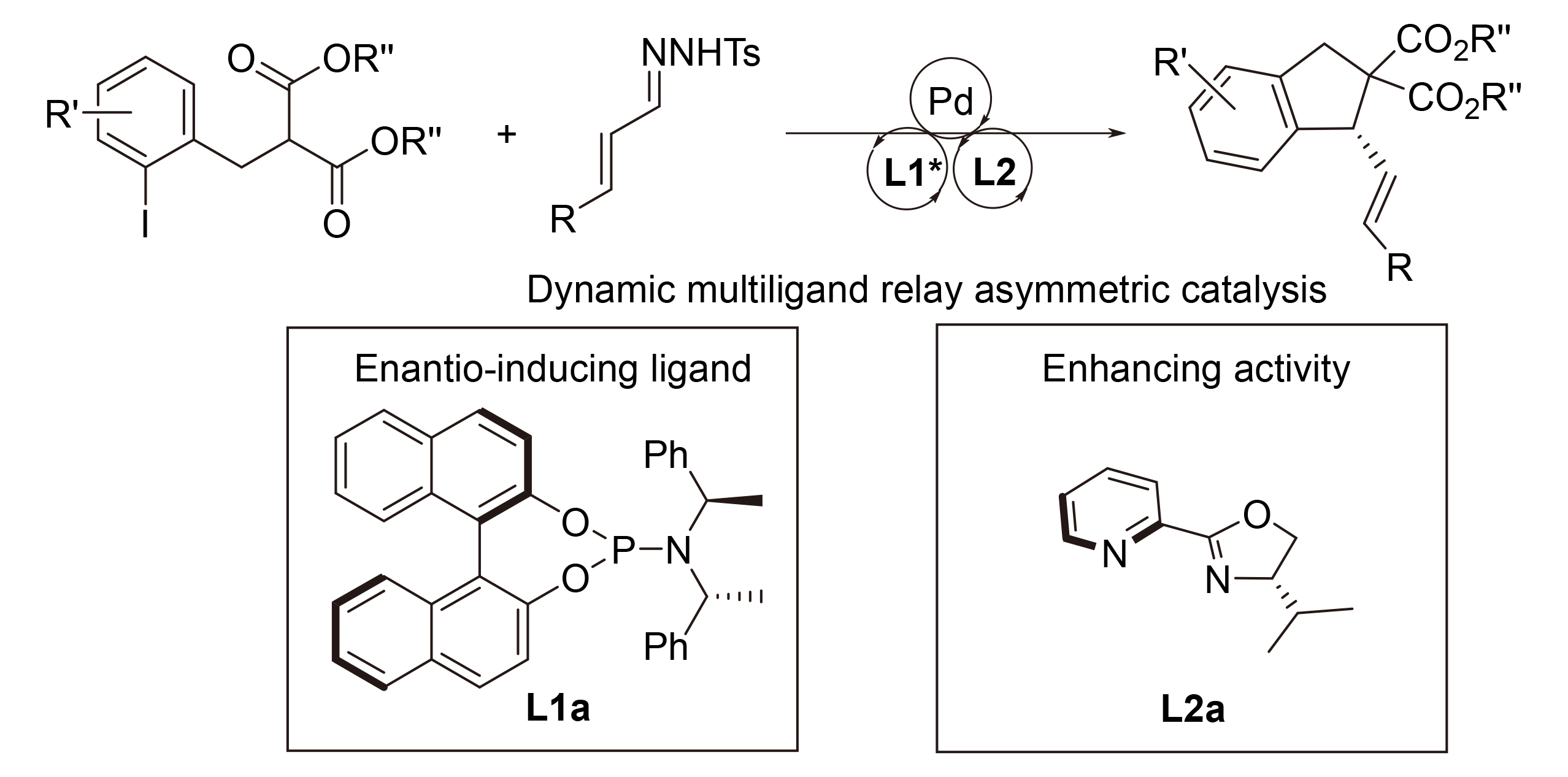
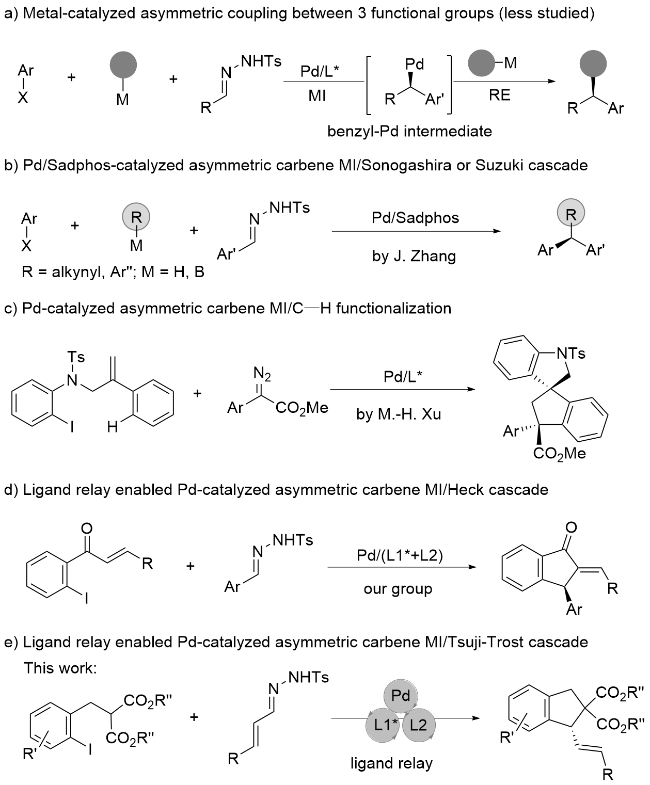
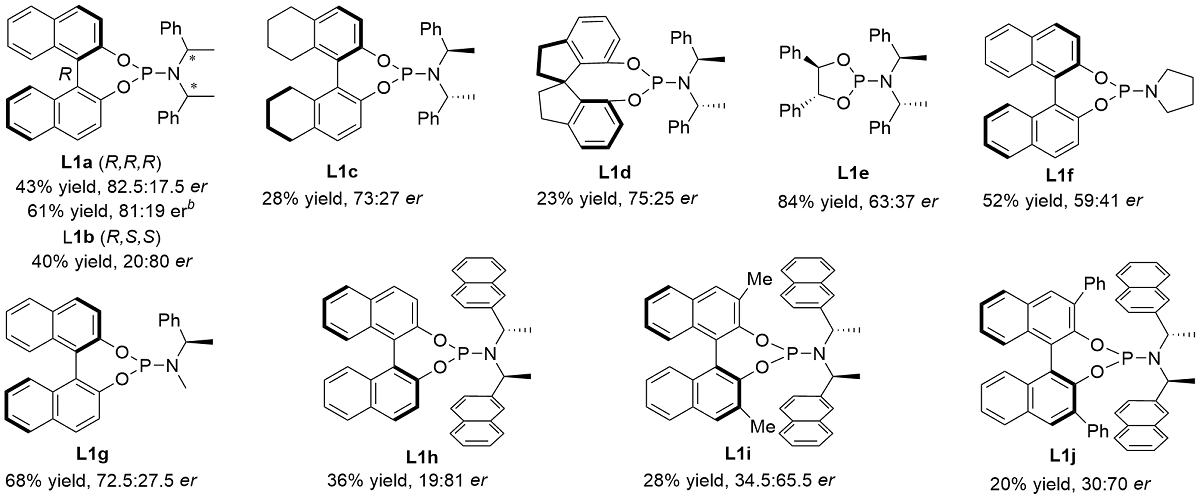
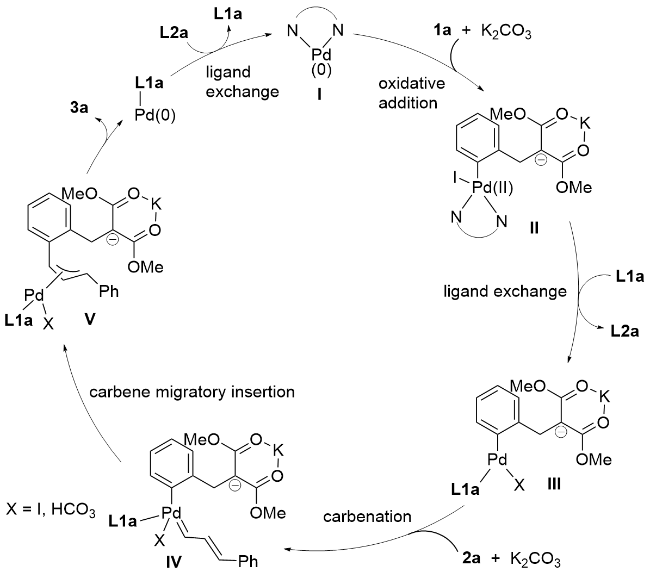
To an 8.0 mL vial equipped with a magnetic stir bar were added diester 1 (0.10 mmol, 1.0 equiv), N-Ts-hydrazone 2 (0.30 mmol, 3.0 equiv), [Pd(allyl)Cl]2 (0.0050 mmol, 5.0 mol %), L1a (0.020 mmol, 20 mol %), L2a (0.010 mmol, 10 mol %), K2CO3 (0.55 mmol, 5.5 equiv), and dry MTBE (1.5 mL) under a nitrogen atmosphere. The suspension was stirred at room temperature for 15 min, then at 65 °C for 10 h. TLC analysis showed complete consumption of substrate 1. The reaction mixture was diluted with EtOAc and filtered, and the solvent was removed under reduced pressure. The enantiomeric ratio was determined by chiral HPLC. Purification of the residue by silica gel column chromatography afforded the title product 3.
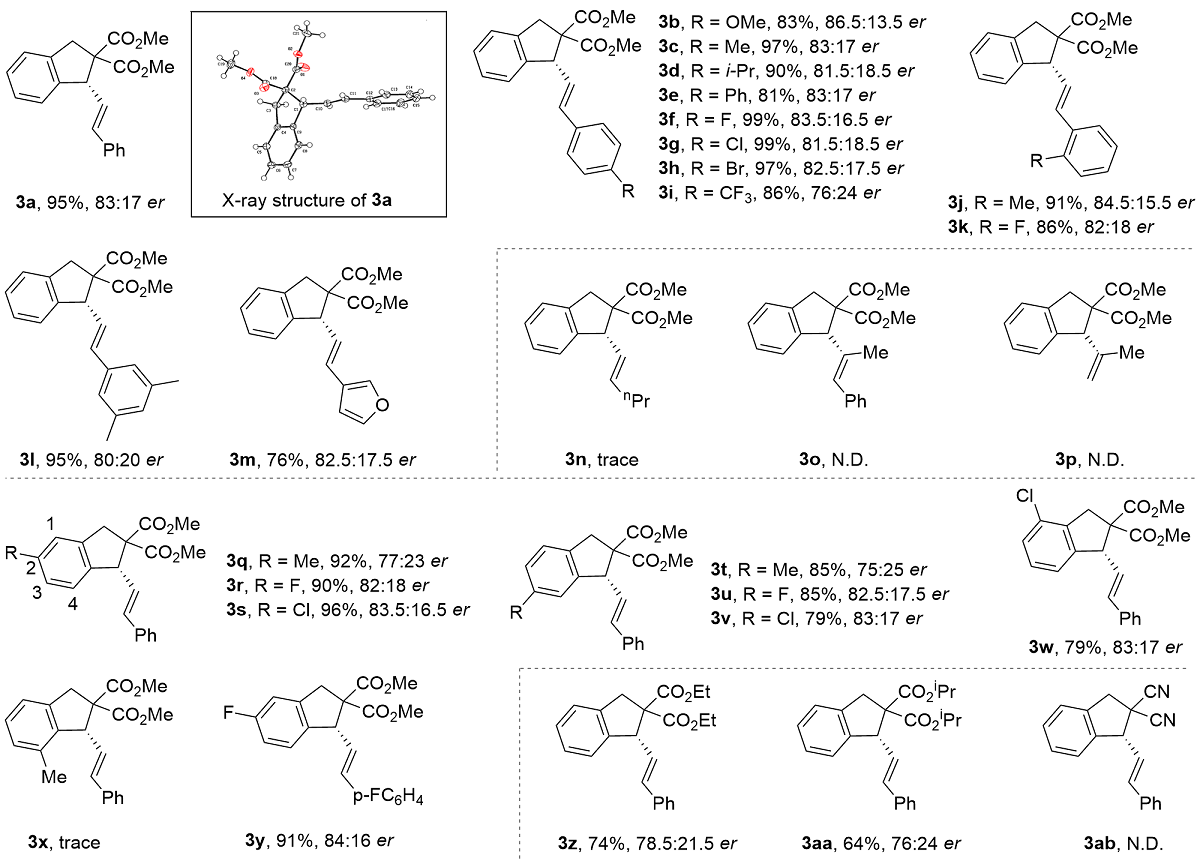
Dimethyl (E)-1-styryl-1,3-dihydro-2H-indene-2,2-dicar- boxylate (3a): Pale yellow solid (31.9 mg, 95% yield). m.p.107.5~108.6 °C. 1H NMR (500 MHz, CDCl3) δ: 7.35~7.31 (m, 2H), 7.31~7.26 (m, 2H), 7.25~7.21 (m, 3H), 7.20 (m, 2H), 6.60 (d, J=15.6 Hz, 1H), 6.09 (dd, J=9.4 Hz, J=15.7 Hz, 1H), 4.79 (d, J=9.4 Hz, 1H), 3.93 (d, J=16.7 Hz, 1H), 3.76 (s, 3H), 3.64 (s, 3H), 3.41 (d, J=16.7 Hz, 1H); 13C NMR (100 MHz, CDCl3) δ:: 172.0, 170.3, 142.7, 139.5, 137.0, 132.9, 128.7, 127.7, 127.4, 126.6, 125.0, 124.5, 65.6, 54.7, 53.1, 52.7, 39.4. HRMS (ESI) calcd for C21H20O4 [M+Na]+ 359.1259, found 359.1267. Optical rotation: [α]20 D–138.1 (c 1.0, CHCl3). HPLC (Chiralpak AD-H): n-Hexane/i-PrOH (V/V=97/3), flow rate 1.0 mL/min, T=40 °C, λ=254 nm, tR1=11.6 min (minor), tR2=15.0 min (major), 83∶17 er.
Dimethyl (E)-1-(4-methoxystyryl)-1,3-dihydro-2H-inde- ne-2,2-dicarboxylate (3b): Pale yellow oil (30.4 mg, 83% yield). 1H NMR (600 MHz, CDCl3) δ: 7.31~7.24 (m, 2H), 7.24~7.11 (m, 4H), 6.82 (d, J=8.4 Hz, 2H), 6.53 (d, J=15.6 Hz, 1H), 5.94 (dd, J=9.4, 15.6 Hz, 1H), 4.76 (d, J=9.4 Hz, 1H), 3.92 (d, J=16.6 Hz, 1H), 3.79 (s, 3H), 3.75 (s, 3H), 3.63 (s, 3H), 3.39 (d, J=16.6 Hz, 1H); 13C NMR (150 MHz, CDCl3) δ: 171.9, 170.2, 159.3, 142.8, 139.4, 132.2, 129.8, 127.6, 127.5, 127.2, 125.1, 125.0, 124.5, 114.0, 65.6, 55.3, 54.7, 53.0, 52.6, 39.3. HRMS (ESI) calcd for C22H22O5 [M+Na]+ 389.1429, found 389.1426; Optical rotation: [α]20 D–151.5 (c 1.0, CHCl3); HPLC (Chiralpak AD-H): n-Hexane/i-PrOH (V/V=97/3), flow rate 1.0 mL/min, T=40 °C, λ=254 nm, tR1=15.4 min (minor), tR2=19.6 min (major), 86.5∶13.5 er.
Dimethyl (E)-1-(4-methylstyryl)-1,3-dihydro-2H-inde- ne-2,2-dicarboxylate (3c): Pale yellow solid (33.9 mg, 97% yield). m.p. 110.0~111.6 °C; 1H NMR (600 MHz, CDCl3) δ: 7.25~7.20 (m, 4H), 7.20~7.17 (m, 2H), 7.09 (d, J=8.0 Hz, 2H), 6.56 (d, J=15.7 Hz, 2H), 6.03 (dd, J=9.4 Hz, J=15.6 Hz, 1H), 4.77 (d, J=9.4 Hz, 1H), 3.93 (d, J=16.7 Hz, 1H), 3.75 (s, 3H), 3.63 (s, 3H), 3.40 (d, J=16.6 Hz, 1H), 2.32 (s, 3H); 13C NMR (150 MHz, CDCl3) δ: 172.0, 170.3, 142.8, 139.5, 137.5, 134.2, 132.8, 129.3, 127.6, 127.3, 126.5, 126.3, 125.1, 124.5, 65.6, 54.7, 53.1, 52.7, 39.4, 21.3. HRMS (ESI) calcd for C22H22O4 [M+ Na]+ 373.1416, found 373.1416. Optical rotation: [α]20 D–139.1 (c 1.0, CHCl3). HPLC (Chiralpak AD-H): n-Hexane/ i-PrOH (V/V=97/3), flow rate 1.0 mL/min, T=40 °C, λ=254 nm, tR1=13.7 min (minor), tR2=17.2 min (major), 83∶17 er.
Dimethyl (E)-1-(4-isopropylstyryl)-1,3-dihydro-2H-in- dene-2,2-dicarboxylate (3d): Pale yellow oil (34.1 mg, 90% yield). 1H NMR (600 MHz, CDCl3) δ: 7.26~7.25 (m, 2H), 7.24~7.16 (m, 4H), 7.15~7.14 (m, 2H), 6.57 (d, J=15.7 Hz, 1H), 6.03 (dd, J=9.4, 15.6 Hz, 1H), 4.77 (d, J=9.4 Hz, 1H), 3.92 (d, J=16.6 Hz, 1H), 3.75 (s, 3H), 3.64 (s, 3H), 3.39 (d, J=16.7 Hz, 1H), 2.90~2.85 (m, 1H), 1.24 (s, 3H), 1.22 (s, 3H); 13C NMR (150 MHz, CDCl3) δ: 172.0, 170.3, 148.6, 142.8, 139.5, 134.7, 132.8, 127.6, 127.3, 126.7, 126.6, 126.4, 125.1, 124.5, 65.6, 54.8, 53.1, 52.7, 39.4, 34.0, 24.1; HRMS (ESI) calcd for C24H26O4 [M+Na]+ 401.1729, found 401.1737. Optical rotation: [α]20 D–122.1 (c 1.0, CHCl3). HPLC (Chiralpak AD-H): n-Hexane/i-PrOH (V/V=97/3), flow rate 1.0 mL/min, T=40 °C, λ=254 nm, tR1=9.6 min (minor), tR2=11.0 min (major), 81.5∶18.5 er.
Dimethyl (E)-1-(2-([1'-biphenyl]-4-yl)vinyl)-1,3-dihy- dro-2H-indene-2,2-dicarboxylate (3e): Pale yellow solid (33.4 mg, 81% yield). m.p. 136.5~137.4 °C; 1H NMR (600 MHz, CDCl3) δ: 7.60~7.58 (m, 2H), 7.54 (d, J=8.3 Hz, 2H), 7.46~7.39 (m, 4H), 7.34 (t, J=7.4 Hz, 1H), 7.26~7.19 (m, 4H), 6.65 (d, J=15.7 Hz, 1H), 6.15 (dd, J=9.4 Hz, J=15.7 Hz, 1H), 4.82 (d, J=9.4 Hz, 1H), 3.95 (d, J=16.8 Hz, 1H), 3.77 (s, 3H), 3.67 (s, 3H), 3.43 (d, J=16.7 Hz, 1H); 13C NMR (150 MHz, CDCl3) δ: 172.0, 170.3, 142.7, 140.8, 140.5, 139.5, 136.0, 132.4, 128.9, 127.7, 127.5, 127.43, 127.38, 127.3, 127.04, 126.98, 125.1, 124.5, 65.7, 54.8, 53.1, 52.8, 39.4. HRMS (ESI) calcd for C27H24O4 [M+Na]+ 435.1572, found 435.1572. Optical rotation: [α]20 D–130.8 (c 1.0, CHCl3). HPLC (Chiralpak AD-H): n-Hexane/i-PrOH (V/V=97/3), flow rate 1.0 mL/min, T=40 °C, λ=254 nm, tR1=17.6 min (minor), tR2=22.5 min (major), 83∶17 er.
Dimethyl (E)-1-(4-fluorostyryl)-1,3-dihydro-2H-indene- 2,2-dicarboxylate (3f): Pale yellow solid (35.4 mg, 99% yield). m.p. 106.1~107.6 °C; 1H NMR (600 MHz, CDCl3) δ: 7.28 (m, 2H), 7.25~7.16 (m, 4H), 6.97 (t, J=8.6 Hz, 2H), 6.55 (d, J=15.7 Hz, 1H), 6.00 (dd, J=9.4 Hz, J=15.6 Hz, 1H), 4.77 (d, J=9.4 Hz, 1H), 3.91 (d, J=16.7 Hz, 1H), 3.75 (s, 3H), 3.63 (s, 3H), 3.40 (d, J=16.7 Hz, 1H). 13C NMR (150 MHz, CDCl3) δ: 171.9, 170.3, 162.4 (d, J=245.2 Hz), 142.6, 139.3, 133.2 (d, J=3.4 Hz), 131.7, 128.1 (d, J=7.9 Hz), 127.8, 127.4, 127.2 (d, J=2.1 Hz), 125.0, 124.5, 115.6 (d, J=21.5 Hz), 65.6, 54.6, 53.1, 52.7, 39.4; 19F NMR (565 MHz, CDCl3) δ: –114.38~–114.48 (m). HRMS (ESI) calcd for C21H19FO4 [M+ Na]+ 377.1165, found 377.1168. Optical rotation: [α]20 D–144.6 (c 1.0, CHCl3). HPLC (Chiralpak AD-H): n-Hexane/ i-PrOH (V/V=96/4)), flow rate 1.0 mL/min, T=40 °C, λ=254 nm, tR1=11.5 min (minor), tR2=16.4 min (major), 83.5∶16.5 er.
Dimethyl (E)-1-(4-chlorostyryl)-1,3-dihydro-2H-indene- 2,2-dicarboxylate (3g): Pale yellow solid (37.0 mg, 99% yield). m.p. 116.8~118.2 °C; 1H NMR (600 MHz, CDCl3) δ: 7.29~7.16 (m, 8H), 6.56 (d, J=15.7 Hz, 1H), 6.08 (dd, J=9.4 Hz, J=15.7 Hz, 1H), 4.79 (d, J=9.4 Hz, 1H), 3.93 (d, J=16.7 Hz, 1H), 3.77 (s, 3H), 3.64 (s, 3H), 3.42 (d, J=16.7 Hz, 1H); 13C NMR (150 MHz, CDCl3) δ: 171.9, 170.2, 142.4, 139.5, 135.5, 133.4, 131.7, 128.8, 128.1, 127.8, 127.7, 127.4, 125.0, 124.6, 65.6, 54.6, 53.1, 52.7, 39.4. HRMS (ESI) calcd for C21H19ClO4 [M+Na]+ 393.0870, found 393.0872; Optical rotation: [α]20 D–123.2 (c 1.0, CHCl3). HPLC (Chiralpak AD-H): n-Hexane/i- PrOH (V/V=97/3)), flow rate 1.0 mL/min, T=40 °C, λ=254 nm, tR1=13.6 min (minor), tR2=22.1 min (major), 81.5∶18.5 er.
Dimethyl (E)-1-(4-bromostyryl)-1,3-dihydro-2H-indene- 2,2-dicarboxylate (3h): Pale yellow solid (40.1 mg, 97% yield). m.p. 121.3~121.8 °C; 1H NMR (600 MHz, CDCl3) δ: 7.46~7.36 (m, 2H), 7.25~7.15 (m, 6H), 6.53 (d, J=15.6 Hz, 1H), 6.09 (dd, J=9.4, J=15.7 Hz, 1H), 4.77 (d, J=9.4 Hz, 1H), 3.94~3.89 (d, J=16.7 Hz, 1H), 3.75 (s, 3H), 3.63 (s, 3H), 3.40 (d, J=16.7 Hz, 1H); 13C NMR (150 MHz, CDCl3) δ: 171.8, 170.2, 142.4, 139.5, 135.9, 131.8, 131.7, 128.3, 128.1, 127.8, 127.4, 125.0, 124.6, 121.5, 65.6, 54.6, 53.1, 52.7, 39.4. HRMS (ESI) for C21H19BrO4 [M+Na]+ 437.0364, found 437.0363; Optical rotation: [α]20 D–101.5 (c 1.0, CHCl3); HPLC (Chiralpak AD-H): n-Hexane/i-PrOH (V/V=97/3)), flow rate 1.0 mL/min, T=40 °C, λ=254 nm, tR1=14.2 min (minor), tR2=23.8 min (major), 82.5∶17.5 er.
Dimethyl (E)-1-(4-(trifluoromethyl)styryl)-1,3-dihydro- 2H-indene-2,2-dicarboxylate (3i): Pale yellow solid (34.7 mg, 86% yield). m.p. 103.3~105.0 °C; 1H NMR (600 MHz, CDCl3) δ: 7.53 (d, J=8.1 Hz, 2H), 7.42 (d, J=8.1 Hz, 2H), 7.25~7.16 (m, 4H), 6.62 (d, J=15.7 Hz, 1H), 6.20 (dd, J=9.4, J=15.7 Hz, 1H), 4.81 (d, J=9.4 Hz, 1H), 3.92 (d, J=16.7 Hz, 1H), 3.76 (s, 3H), 3.63 (s, 3H), 3.42 (d, J=16.7 Hz, 1H); 13C NMR (150 MHz, CDCl3) δ: 171.8, 170.2, 142.1, 140.5, 139.6, 131.6, 130.3, 129.6 (q, J=32.0 Hz), 127.9, 127.5, 126.7, 125.7 (q, J=3.7 Hz), 125.0, 124.6, 124.3 (q, J=270.0 Hz), 65.6, 54.6, 53.2, 52.8, 39.5; 19F NMR (565 MHz, CDCl3) δ: –62.52. HRMS (ESI) calcd for C22H19F3O4 [M+Na]+ 427.1133, found 427.1129. Optical rotation: [α]20 D–83.9 (c 1.0, CHCl3). HPLC (Chiralpak AD-H): n-Hexane/i-PrOH (V/ V=97/3)), flow rate 1.0 mL/min, T=40 °C, λ=254 nm, tR1=10.5 min (minor), tR2=16.3 min (major), 76∶24 er.
Dimethyl (E)-1-(3,5-dimethylstyryl)-1,3-dihydro-2H-in- dene-2,2-dicarboxylate (3j): Pale yellow solid (31.9 mg, 91% yield). m.p. 78.0~78.6 °C; 1H NMR (600 MHz, CDCl3) δ: 7.32 (d, J=7.1 Hz, 1H), 7.25~7.19 (m, 4H), 7.15~7.09 (m, 3H), 6.80 (d, J=15.5 Hz, 1H), 5.95 (dd, J=9.4 Hz, J=15.5 Hz, 1H), 4.80 (d, J=9.4 Hz, 1H), 3.93 (d, J=16.7 Hz, 1H), 3.76 (s, 3H), 3.66 (s, 3H), 3.41 (d, J=16.7 Hz, 1H), 2.34 (s, 3H); 13C NMR (150 MHz, CDCl3) δ: 172.0, 170.3, 142.8, 139.4, 136.3, 135.5, 131.0, 130.3, 128.8, 127.7, 127.6, 127.4, 126.2, 126.0, 125.0, 124.5, 65.6, 55.0, 53.1, 52.8, 39.4, 19.9. HRMS (ESI) calcd for C22H22O4 [M+Na]+ 373.1416, found 373.1418. Optical rotation: [α]20 D–143.2 (c 1.0, CHCl3). HPLC (Chiralpak IM): n-Hexane/i-PrOH (V/V=99/1), flow rate 0.5 mL/min, T=40 °C, λ=254 nm, tR1=18.9 min (minor), tR2=23.6 min (major), 84.5∶15.5 er.
Dimethyl (E)-1-(2-fluorostyryl)-1,3-dihydro-2H-indene- 2,2-dicarboxylate (3k): Pale yellow solid (30.4 mg, 86% yield). m.p. 76.5~78.0 °C; 1H NMR (600 MHz, CDCl3) δ: 7.40~7.31 (m, 1H), 7.25~7.20 (m, 2H), 7.20~7.13 (m, 3H), 7.08~6.95 (m, 2H), 6.75 (d, J=15.8 Hz, 1H), 6.15 (dd, J=9.5, 15.8 Hz, 1H), 4.79 (d, J=9.5 Hz, 1H), 3.92 (d, J=16.7 Hz, 1H), 3.75 (s, 3H), 3.66 (s, 3H), 3.40 (d, J=16.7 Hz, 1H); 13C NMR (150 MHz, CDCl3) δ: 171.9, 170.2, 160.3 (d, J=247.8 Hz), 142.5, 139.5, 130.1 (d, J=4.6 Hz), 129.0 (d, J=8.3 Hz), 127.8, 127.7 (d, J=3.7 Hz), 127.4, 125.5 (d, J=3.3 Hz), 125.0, 124.8 (d, J=7.8 Hz), 124.5, 124.2 (d, J=3.5 Hz), 115.8 (d, J=21.8 Hz), 65.7, 55.1, 53.1, 52.7, 39.4; 19F NMR (565 MHz, CDCl3) δ: –117.93. HRMS (ESI) calcd for C21H19FO4 [M+Na]+ 377.1165; Found 377.1168; Optical rotation: [α]20 D–129.8 (c 1.0, CHCl3); HPLC (Chiralpak IM): n-Hexane/ i-PrOH (V/V=99/1), flow rate 0.5 mL/min, T=40 °C, λ=254 nm, tR1=19.4 min (minor), tR2=24.5 min (major), 82∶18 er.
Dimethyl (E)-1-(4-methylstyryl)-1,3-dihydro-2H-inde- ne-2,2-dicarboxylate (3l): Pale yellow solid (34.6 mg, 95% yield). m.p. 81.5~83.5 °C; 1H NMR (600 MHz, CDCl3) δ: 7.25~7.15 (m, 4H), 6.95 (s, 2H), 6.86 (s, 1H), 6.53 (d, J=15.7 Hz, 1H), 6.05 (dd, J=9.4, 15.6 Hz, 1H), 4.76 (d, J=9.5 Hz, 1H), 3.93 (d, J=16.6 Hz, 1H), 3.75 (s, 3H), 3.64 (s, 3H), 3.40 (d, J=16.7 Hz, 1H), 2.28 (s, 6H); 13C NMR (150 MHz, CDCl3) δ: 172.0, 170.3, 142.9, 139.4, 138.1, 136.9, 133.0, 129.5, 127.7, 127.4, 126.9, 125.1, 124.48, 124.45, 65.6, 54.8, 53.1, 52.8, 39.4, 21.4. HRMS (ESI) calcd for C23H24O4 [M+Na]+ 387.1572, found 387.1571. Optical rotation: [α]20 D–89.4 (c 1.0, CHCl3). HPLC (Chiralpak IM): n-Hexane/i-PrOH (V/V=99/1), flow rate 0.5 mL/min, T=40 °C, λ=254 nm, tR1=16.3 min (minor), tR2=21.3 min (major), 80∶20 er.
Dimethyl (E)-1-(2-(furan-2-yl)vinyl)-1,3-dihydro-2H-in- dene-2,2-dicarboxylate (3m): Pale yellow oil (24.7 mg, 76% yield). 1H NMR (600 MHz, CDCl3) δ: 7.29 (s, 1H), 7.24~7.15 (m, 4H), 6.39~6.30 (m, 2H), 6.19 (d, J=3.2 Hz, 1H), 6.04 (dd, J=9.2, 15.7 Hz, 1H), 4.73 (d, J=9.2 Hz, 1H), 3.88 (d, J=16.6 Hz, 1H), 3.74 (s, 3H), 3.66 (s, 3H), 3.37 (d, J=16.6 Hz, 1H); 13C NMR (150 MHz, CDCl3) δ: 171.9, 170.1, 152.5, 142.4, 142.1, 139.6, 127.7, 127.3, 126.0, 125.0, 124.5, 121.4, 111.3, 108.0, 65.7, 54.4, 53.1, 52.7, 39.3. HRMS (ESI) calcd for C19H18O5 [M+ Na]+ 349.1053, found 349.1052. Optical rotation: [α]20 D–78.2 (c 1.0, CHCl3). HPLC (Chiralpak AD-H): n-Hexane/i- PrOH (V/V=96/4), flow rate 1.0 mL/min, T=40 °C, λ=254 nm, tR1=10.1 min (minor), tR2=16.0 min (major), 82.5∶17.5 er.
Dimethyl (E)-5-methyl-1-styryl-1,3-dihydro-2H-indene- 2,2-dicarboxylate (3q): Pale yellow solid (32.2 mg, 92% yield). m.p. 74.0~75.6 °C; 1H NMR (600 MHz, CDCl3) δ: 7.32 (d, J=7.3 Hz, 2H), 7.28 (t, J=7.4 Hz, 2H), 7.21 (t, J=7.2 Hz, 1H), 7.09~7.04 (m, 2H), 7.01 (d, J=7.7 Hz, 1H), 6.58 (d, J=15.7 Hz, 1H), 6.08 (dd, J=9.4, 15.7 Hz, 1H), 4.74 (d, J=9.4 Hz, 1H), 3.88 (d, J=16.7 Hz, 1H), 3.75 (s, 3H), 3.63 (s, 3H), 3.35 (d, J=16.6 Hz, 1H), 2.33 (s, 3H); 13C NMR (150 MHz, CDCl3) δ: 172.0, 170.3, 139.7, 139.6, 137.5, 137.1, 132.7, 128.6, 128.2, 127.7, 127.6, 126.5, 125.2, 124.8, 65.8, 54.4, 53.1, 52.7, 39.3, 21.5. HRMS (ESI) calcd for C22H22O4 [M+Na]+ 373.1416, found 373.1414. Optical rotation: [α]20 D–108.8 (c 1.0, CHCl3). HPLC (Chiralpak AD-H): n-Hexane/i- PrOH (V/V=97/3), flow rate 1.0 mL/min, T=40 °C, λ=254 nm, tR1=13.9 min (minor), tR2=16.0 min (major), 77∶23 er.
Dimethyl (E)-5-fluoro-1-styryl-1,3-dihydro-2H-indene- 2,2-dicarboxylate (3r): Pale yellow solid (31.8 mg, 90% yield). m.p. 81.0-82.6 °C; 1H NMR (600 MHz, CDCl3) δ: 7.35~7.31 (m, 2H), 7.30~7.27 (m, 2H), 7.23 (t, J=7.1 Hz, 1H), 7.17 (dd, J=5.1, 8.2 Hz, 1H), 6.94~6.84 (m, 2H), 6.59 (d, J=15.7 Hz, 1H), 6.06 (dd, J=9.3, 15.7 Hz, 1H), 4.75 (d, J=9.3 Hz, 1H), 3.86 (d, J=16.4 Hz, 1H), 3.76 (s, 3H), 3.64 (s, 3H), 3.35 (d, J=16.4 Hz, 1H); 13C NMR (150 MHz, CDCl3) δ: 171.8, 170.0, 162.6 (d, J=242.8 Hz), 144.9 (d, J=7.9 Hz), 136.8, 134.9 (d, J=2.4 Hz), 133.5, 128.7, 127.9, 126.6, 126.5, 125.5 (d, J=8.6 Hz), 114.8 (d, J=22.5 Hz), 112.1 (d, J=22.6 Hz), 66.1, 54.6, 53.2, 52.8, 38.7; 19F NMR (565 MHz, CDCl3) δ: –115.74. HRMS (ESI) calcd for C21H19FO4 [M+Na]+ 377.1165, found 377.1160. Optical rotation: [α]20 D–135.6 (c 1.0, CHCl3). HPLC (Chiralpak ADH): n-Hexane/i-PrOH (V/V=97/3), flow rate 1.0 mL/min, T=40 °C, λ=254 nm, tR1=10.5 min (minor), tR2=13.9 min (major), 82∶18 er.
Dimethyl (E)-5-chloro-1-styryl-1,3-dihydro-2H-indene- 2,2-dicarboxylate (3s): Pale yellow oil (35.5 mg, 96% yield). 1H NMR (600 MHz, CDCl3) δ: 7.34~7.27 (m, 4H), 7.25~7.21 (m, 2H), 7.18 (d, J=8.1 Hz, 1H), 7.10 (d, J=8.2 Hz, 1H), 6.58 (d, J=15.7 Hz, 1H), 6.05 (dd, J=9.3, 15.7 Hz, 1H), 4.74 (d, J=9.3 Hz, 1H), 3.89 (d, J=16.9 Hz, 1H), 3.76 (s, 3H), 3.64 (s, 3H), 3.37 (d, J=16.9 Hz, 1H); 13C NMR (150 MHz, CDCl3) δ: 171.6, 169.9, 141.5, 141.2, 136.8, 133.44, 133.36, 128.7, 127.9, 127.7, 126.7, 126.6, 126.2, 124.8, 65.8, 54.1, 53.2, 52.8, 39.2. HRMS (ESI) calcd for C21H19ClO4 [M+Na]+ 393.0870, found 393.0865. Optical rotation: [α]20 D–105.3 (c 1.0, CHCl3). HPLC (Chiralpak AD-H): n-Hexane/i-PrOH (V/V=97/3), flow rate 1.0 mL/min, T=40 °C, λ=254 nm, tR1=10.9 min (minor), tR2=13.9 min (major), 83.5∶16.5 er.
Dimethyl (E)-6-methyl-1-styryl-1,3-dihydro-2H-indene- 2,2-dicarboxylate (3t): Pale yellow solid (29.8 mg, 85% yield). m.p. 63.1~64.0 °C; 1H NMR (600 MHz, CDCl3) δ: 7.35~7.32 (m, 2H), 7.28 (t, J=7.4 Hz, 2H), 7.22 (t, J=7.3 Hz, 1H), 7.12 (d, J=7.6 Hz, 1H), 7.02 (d, J=7.8 Hz, 1H), 7.00 (s, 1H), 6.60 (d, J=15.7 Hz, 1H), 6.08 (dd, J=9.5, 15.6 Hz, 1H), 4.73 (d, J=9.5 Hz, 1H), 3.88 (d, J=16.4 Hz, 1H), 3.75 (s, 3H), 3.64 (s, 3H), 3.36 (d, J=16.6 Hz, 1H), 2.30 (s, 3H); 13C NMR (150 MHz, CDCl3) δ: 172.0, 170.3, 142.8, 137.07, 137.05, 136.4, 132.8, 128.7, 128.6, 127.7, 127.5, 126.6, 125.6, 124.2, 65.8, 54.7, 53.1, 52.7, 39.1, 21.4. HRMS (ESI) calcd for C22H22O4 [M+ Na]+ 373.1416, found 373.1422; Optical rotation: [α]20 D–75.3 (c 1.0, CHCl3); HPLC (Chiralpak AD-H): n-Hexane/i- PrOH (V/V=97/3), flow rate 1.0 mL/min, T=40 °C, λ=254 nm, tR1=8.4 min (major), tR2=9.1 min (minor), 25∶ 75 er.
Dimethyl (E)-6-fluoro-1-styryl-1,3-dihydro-2H-indene- 2,2-dicarboxylate (3u): Pale yellow solid (30.1 mg, 85% yield). m.p. 67.0~68.6 °C; 1H NMR (600 MHz, CDCl3) δ: 7.34~7.30 (m, 2H), 7.30~7.26 (m, 2H), 7.24~7.20 (m, 1H), 7.11 (dd, J=5.2, 8.3 Hz, 1H), 6.95~6.86 (m, 2H), 6.57 (d, J=15.7 Hz, 1H), 6.06 (dd, J=9.3, 15.7 Hz, 1H), 4.73 (d, J=9.3 Hz, 1H), 3.89 (d, J=16.9 Hz, 1H), 3.76 (s, 3H), 3.64 (s, 3H), 3.37 (d, J=16.9 Hz, 1H); 13C NMR (150 MHz, CDCl3) δ: 171.7, 170.0, 162.8 (d, J=243.1 Hz), 141.6 (d, J=8.5 Hz), 138.2 (d, J=2.4 Hz), 136.9, 133.1, 128.7, 127.8, 127.1, 126.6, 126.2 (d, J=8.9 Hz), 114.4 (d, J=22.5 Hz), 111.6 (d, J=22.5 Hz), 66.0, 53.9, 53.2, 52.8, 39.3; 19F NMR (565 MHz, CDCl3) δ: –115.44~–115.53 (m). HRMS (ESI) calcd for C21H19FO4 [M+Na]+ 377.1165, found 377.1167. Optical rotation: [α]20 D–111.8 (c 1.0, CHCl3). HPLC (Chiralpak AD-H): n-Hexane/i- PrOH (V/V=97/3), flow rate 1.0 mL/min, T=40 °C, λ=254 nm, tR1=9.0 min (minor), tR2=12.2 min (major), 82.5∶17.5 er.
Dimethyl (E)-6-chloro-1-styryl-1,3-dihydro-2H-indene- 2,2-dicarboxylate (3v): Pale yellow oil (29.2 mg, 79% yield). 1H NMR (600 MHz, CDCl3) δ: 7.35~7.32 (m, 2H), 7.31~7.27 (m, 2H), 7.25~7.21 (m, 1H), 7.20~7.17 (m, 1H), 7.16~7.13 (m, 2H), 6.60 (d, J=15.7 Hz, 1H), 6.05 (dd, J=9.4, 15.7 Hz, 1H), 4.75 (d, J=9.4 Hz, 1H), 3.86 (d, J=16.9 Hz, 1H), 3.76 (s, 3H), 3.64 (s, 3H), 3.35 (d, J=16.9 Hz, 1H); 13C NMR (150 MHz, CDCl3) δ: 171.7, 169.9, 144.7, 138.0, 136.7, 133.6, 133.1, 128.7, 128.0, 127.9, 126.6, 126.4, 125.6, 125.3, 65.8, 54.5, 53.2, 52.8, 38.9. HRMS (ESI) calcd for C21H19ClO4 [M+Na]+ 393.0870, found 393.0865. Optical rotation: [α]20 D–79.5 (c 1.0, CHCl3). HPLC (Chiralpak AD-H): n-Hexane/i-PrOH (V/V=97/3), flow rate 1.0 mL/min, T=40 °C, λ=254 nm, tR1=8.5 min (minor), tR2=9.9 min (major), 83:17 er.
Dimethyl (E)-4-chloro-1-styryl-1,3-dihydro-2H-indene- 2,2-dicarboxylate (3w): Pale yellow oil (29.2 mg, 79% yield). 1H NMR (400 MHz, CDCl3) δ: 7.34~7.25 (m, 4H), 7.24~7.18 (m, 2H), 7.14 (t, J=7.4 Hz, 1H), 7.07 (d, J=7.3 Hz, 1H), 6.59 (d, J=15.6 Hz, 1H), 6.05 (dd, J=9.4, 15.6 Hz, 1H), 4.84 (d, J=9.4 Hz, 1H), 3.95 (d, J=17.4 Hz, 1H), 3.77 (s, 3H), 3.63 (s, 3H), 3.45 (d, J=17.4 Hz, 1H); 13C NMR (125 MHz, CDCl3) δ: 171.7, 169.9, 144.7, 138.0, 136.8, 133.4, 130.6, 129.0, 128.7, 127.9, 127.8, 126.7, 126.6, 123.4, 64.8, 55.3, 53.2, 52.8, 38.8. HRMS (ESI) calcd for C21H19ClO4 [M+Na]+ 393.0870, found 393.0868. Optical rotation: [α]20 D–146.1 (c 1.0, CHCl3). HPLC (Chiralpak AD-H): n-Hexane/i-PrOH (V/V=97/3), flow rate 1.0 mL/min, T=40 °C, λ=254 nm, tR1=6.8 min (minor), tR2=9.0 min (major), 83:17 er.
Dimethyl (E)-6-fluoro-1-(4-fluorostyryl)-1,3-dihydro- 2H-indene-2,2-dicarboxylate (3y): Pale yellow oil (33.8 mg, 91% yield). 1H NMR (500 MHz, CDCl3) δ: 7.29 (dd, J=5.4, 8.7 Hz, 2H), 7.16 (dd, J=5.2, 8.2 Hz, 1H), 6.98 (t, J=8.7 Hz, 2H), 6.94~6.83 (m, 2H), 6.55 (d, J=15.7 Hz, 1H), 5.98 (dd, J=9.4, 15.7 Hz, 1H), 4.73 (d, J=9.4 Hz, 1H), 3.84 (d, J=16.5 Hz, 1H), 3.76 (s, 3H), 3.63 (s, 3H), 3.34 (d, J=16.6 Hz, 1H); 13C NMR (100 MHz, CDCl3) δ: 171.7, 170.0, 162.64 (d, J=242.8 Hz), 162.55 (d, J=245.6 Hz), 144.8 (d, J=7.8 Hz), 134.9 (d, J=2.5 Hz), 133.0 (d, J=3.4 Hz), 132.3, 128.1, 126.4 (d, J=2.1 Hz), 125.6 (d, J=8.6 Hz), 115.6 (d, J=21.5 Hz), 114.8 (d, J=22.4 Hz), 112.1 (d, J=22.6 Hz), 66.1, 54.5, 53.2, 52.8, 38.7; 19F NMR (471 MHz, CDCl3) δ: –114.12, –115.69. HRMS (ESI) calcd for C21H18F2O4 [M+Na]+ 395.1071, found 395.1068. Optical rotation: [α]20 D–152.8 (c 1.0, CHCl3). HPLC (Chiralpak AD-H): n-Hexane/i-PrOH (V/V=97/3), flow rate 1.0 mL/min, T=40 °C, λ=254 nm, tR1=12.0 min (minor), tR2=17.2 min (major), 84:16 er.
Diethyl (E)-1-styryl-1,3-dihydro-2H-indene-2,2-dicar- boxylate (3z): Pale yellow oil (26.9 mg, 74% yield). 1H NMR (600 MHz, CDCl3) δ: 7.34~7.30 (m, 2H), 7.29~7.26 (m, 2H), 7.25~7.15 (m, 5H), 6.59 (d, J=15.7 Hz, 1H), 6.11 (dd, J=9.5, 15.7 Hz, 1H), 4.78 (d, J=9.4 Hz, 1H), 4.30~4.22 (m, 1H), 4.20~4.15 (m, 1H), 4.15~4.05 (m, 2H), 3.93 (d, J=16.7 Hz, 1H), 3.39 (d, J=16.7 Hz, 1H), 1.25 (t, J=7.1 Hz, 3H), 1.14 (t, J=7.1 Hz, 3H); 13C NMR (150 MHz, CDCl3) δ: 171.5, 169.9, 142.9, 139.6, 137.0, 132.8, 128.6, 127.64, 127.63, 127.5, 127.3, 126.5, 125.0, 124.5, 65.5, 61.8, 61.6, 54.6, 39.4, 14.3, 14.2. HRMS (ESI) calcd for C23H24O4 [M+Na]+ 387.1572, found 387.1579. Optical rotation: [α]20 D–156.6 (c 1.0, CHCl3). HPLC (Chiralpak AD-H): n-Hexane/i-PrOH (V/ V=97/3), flow rate 1.0 mL/min, T=40 °C, λ=254 nm, tR1=11.5 min (minor), tR2=13.4 min (major), 78.5∶21.5 er.
Diisopropyl (E)-1-styryl-1,3-dihydro-2H-indene-2,2-di- carboxylate (3aa): Pale yellow solid (25.2 mg, 64% yield). m.p. 88.3~89.6 °C; 1H NMR (600 MHz, CDCl3) δ: 7.35~7.30 (m, 2H), 7.30~7.26 (m, 2H), 7.24~7.22 (m, 1H), 7.22~7.16 (m, 4H), 6.60 (d, J=15.7 Hz, 1H), 6.11 (dd, J=9.6, 15.7 Hz, 1H), 5.05 (p, J=6.3 Hz, 1H), 4.97 (p, J=6.3 Hz, 1H), 4.76 (d, J=9.5 Hz, 1H), 3.94 (d, J=16.7 Hz, 1H), 3.35 (d, J=16.7 Hz, 1H), 1.24 (d, J=6.2 Hz, 6H), 1.19 (d, J=6.3 Hz, 3H), 1.07 (d, J=6.2 Hz, 3H); 13C NMR (150 MHz, CDCl3) δ: 171.0, 169.4, 143.2, 139.6, 137.0, 132.7, 128.6, 127.58, 127.56, 127.3, 126.5, 125.0, 124.4, 69.20, 69.16, 65.3, 54.6, 39.6, 21.9, 21.7, 21.6. HRMS (ESI) calcd for C25H28O4 [M+Na]+ 415.1885, found 415.1888. Optical rotation: [α]20 D–97.6 (c 1.0, CHCl3). HPLC (Chiralpak IM): n-Hexane/i-PrOH (V/V=97/3), flow rate 1.0 mL/min, T=40 °C, λ=254 nm, tR1=15.1 min (major), tR2=21.3 min (minor), 24:76 er.
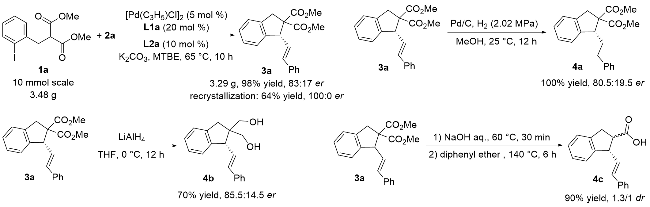
Dimethyl 1-phenethyl-1,3-dihydro-2H-indene-2,2-dicar- boxylate (4a): Pale yellow solid (33.8 mg, 100% yield). m.p. 58.0~58.9 °C; 1H NMR (400 MHz, CDCl3) δ: 7.25~7.21 (m, 3H), 7.20~7.16 (m, 3H), 7.16~7.07 (m, 3H), 3.96 (dd, J=5.5, 8.6 Hz, 1H), 3.82 (d, J=16.5 Hz, 1H), 3.73 (s, 3H), 3.67 (s, 3H), 3.33 (d, J=16.5 Hz, 1H), 2.82~2.70 (m, 1H), 2.70~2.58 (m, 1H), 1.86~1.68 (m, 2H); 13C NMR (100 MHz, CDCl3) δ: 172.2, 170.6, 144.0, 142.0, 139.2, 128.52, 128.46, 127.3, 126.9, 126.0, 124.8, 124.6, 65.6, 53.0, 52.7, 49.9, 39.3, 33.6, 33.1. HRMS (ESI) calcd for C21H22O4 [M+Na]+ 361.1414, found 361.1416. Optical rotation: [α]20 D–55.6 (c 1.0, CHCl3). HPLC (Chiralpak AD-H): n-Hexane/i-PrOH (V/V=97/3), flow rate 1.0 mL/ min, T=40 °C, λ=254 nm, tR1=10.7 min (minor), tR2=11.5 min (major), 19.5:80.5 er.
(E)-(1-Styryl-2,3-dihydro-1H-indene-2,2-diyl)dimetha-nol (4b): Pale yellow solid (19.7 mg, 70% yield). m.p. 127.5~128.5 °C; 1H NMR (400 MHz, CDCl3) δ: 7.39~7.34 (m, 2H), 7.34~7.28 (m, 2H), 7.26~7.22 (m, 2H), 7.22~7.13 (m, 3H), 6.54 (d, J=15.7 Hz, 1H), 6.28 (dd, J=9.4, 15.7 Hz, 1H), 3.95 (d, J=11.0 Hz, 1H), 3.88 (d, J=9.4 Hz, 1H), 3.86~3.73 (m, 3H), 3.00 (d, J=16.2 Hz, 1H), 2.83 (d, J=16.2 Hz, 1H); 13C NMR (100 MHz, CDCl3) δ: 144.3, 141.3, 137.0, 132.3, 129.0, 128.8, 127.7, 127.4, 126.9, 126.5, 125.5, 125.3, 69.8, 67.3, 53.7, 53.3, 37.5. HRMS (ESI) calcd for C19H20O2 [M+Na]+ 303.1361, found 303.1360. Optical rotation: [α]20 D–99.1 (c 1.0, CHCl3). HPLC (Chiralpak AD-H): n-Hexane/i-PrOH (V/V=97/3), flow rate 1.0 mL/min, T=40 °C, λ=254 nm, tR1=18.3 min (major), tR2=23.6 min (minor), 85.5∶14.5 er.
(E)-1-Styryl-2,3-dihydro-1H-indene-2-carboxylic acid (4c): Pale yellow solid (23.7 mg, 90% yield). m.p. 131.0~131.8 °C; 1H NMR (500 MHz, CDCl3) δ: 7.41 (d, J=7.5 Hz, 1H), 7.35~7.28 (m, 2H), 7.28~7.15 (m, 6H), 6.63 (d, J=15.8 Hz, 0.57H), 6.49 (d, J=15.7 Hz, 0.45H), 6.28~6.17 (m, 1H), 4.27 (q, J=8.4 Hz, 1H), 3.66~3.56 (m, 0.47H), 3.48~3.39 (m, 0.47H), 3.35~3.24 (m, 1H), 3.23~3.16 (m, 0.66H),3.13~3.05 (m, 0.47H); 13C NMR (125 MHz, CDCl3) δ: 180.4, 178.7, 143.8, 143.5, 141.5, 141.0, 137.2, 137.1, 132.6, 132.0, 130.5, 128.7, 128.6, 128.0, 127.64, 127.61, 127.55, 127.52, 127.11, 127.08, 126.6, 126.5, 125.1, 124.8, 124.7, 124.6, 52.5, 51.5, 51.4, 49.4, 35.7, 33.7. Attempts to determine the er value of compound 4c by chiral HPLC were unsuccessful.
Supporting Information The optimization details, experimental procedures for the preparation of substrates and products and spectra of reported compounds are available free of charge via the Internet at
http://sioc-journal.cn/.