ARTICLES

Electrochemically Driven Radical Alkylation of Alkenes with 1,3-Dicarbonyl Compounds

  • Yong Liu a ,
  • Juan Li a ,
  • Lingfan Wang a ,
  • Baotong Huang a ,
  • Lingzi Peng , b, * ,
  • Jin Song , a, * ,
  • Chang Guo , b, *
Expand
  • a Institutes of Physical Science and Information Technology, Anhui University, Hefei 230601
  • b Hefei National Laboratory for Physical Sciences at the Microscale, University of Science and Technology of China, Hefei 230026
*E-mail: ;

Received date: 2026-01-12

  Revised date: 2026-03-31

  Online published: 2026-04-17

Supported by

National Natural Science Foundation of China(22471002)

Anhui Provincial Natural Science Foundation(2308085Y12)

Copyright

© 2026 Shanghai Institute of Organic Chemistry, Chinese Academy of Sciences

Abstract

Developing sustainable and efficient methods for the transformation of 1,3-dicarbonyl compounds and alkene functionalization represents a pivotal endeavor for advancing the frontiers of synthetic organic chemistry. Herein, an electrochemically driven functionalization reaction of 1,3-dicarbonyl compounds and alkenes is reported, which enables the efficient construction of α-alkylated 1,3-dicarbonyl compounds. This protocol avoids additional chemical oxidants/reductants, proceeds under mild and environmentally benign conditions, and exhibits excellent functional group tolerance, furnishing a diverse array of target products in moderate to good yields. Mechanistic studies indicate that electrochemically generated 1,3-dicarbonyl radicals add to alkenes, followed by single-electron transfer (SET) oxidation and nucleophilic alcohol quenching, thereby realizing efficient alkene functionalization.

Cite this article

Yong Liu , Juan Li , Lingfan Wang , Baotong Huang , Lingzi Peng , Jin Song , Chang Guo . Electrochemically Driven Radical Alkylation of Alkenes with 1,3-Dicarbonyl Compounds[J]. Chinese Journal of Organic Chemistry, 2026 , 46(4) : 1659 -1667 . DOI: 10.6023/cjoc202601014

1 Introduction

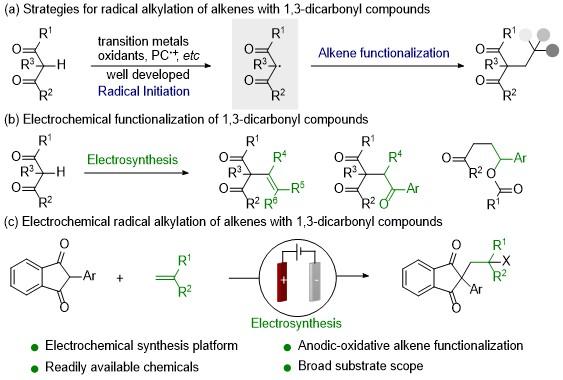
1,3-Dicarbonyl compounds are widely distributed in diverse fields, including natural product synthesis, pharmaceutical chemistry, materials science, and synthetic intermediates preparation.[1] Owing to their pivotal roles, the synthesis of 1,3-dicarbonyl-containing compounds has long been a focus in contemporary organic synthesis.[2] In recent years, the addition of α-radicals derived from 1,3-dicarbonyl compounds to unsaturated carbon-carbon double bond systems has emerged as a reliable strategy for constructing α-alkylated 1,3-dicarbonyl compounds.[3] Both the utilization of transition metals in combination with stoichiometric oxidants[4] and the incorporation of photoredox catalytic protocols[5] have been demonstrated to facilitate the formation of active radicals from 1,3- dicarbonyl compounds (Scheme 1a). Nevertheless, the efficacy of these methodologies has been hampered by the requirement for metal salts, stoichiometric redox reagents, and in certain instances, rigorous reaction conditions. To address these limitations, there is a persistent and pressing need to develop concise, eco-friendly synthetic strategies for the radical transformation of 1,3-dicarbonyl compounds.
Scheme 1 Strategies for the synthesis of α-functionalized 1,3-dicarbonyl compounds
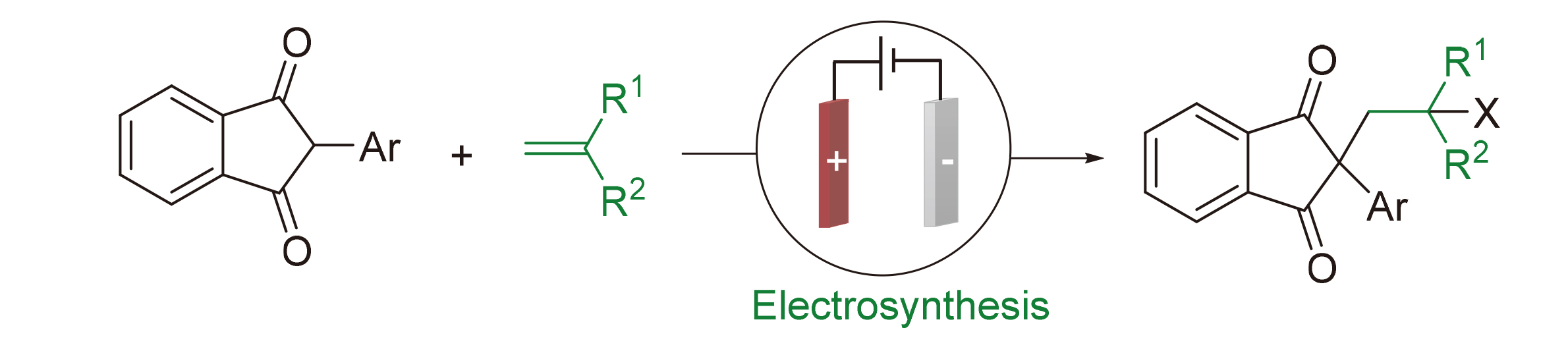
Electrochemistry offers an efficient, environmentally benign strategy that is highly attractive for discovering novel chemical transformations, as it eliminates the requirement for stoichiometric oxidants or reductants.[6] It provides a unique platform for accessing reactive radical intermediates, which are critical in synthetic chemistry. In this regard, the electrochemically promoted generation of radical intermediates from 1,3-dicarbonyl compounds has emerged as a practical approach for efficiently constructing 1,3-dicarbonyl-containing scaffolds, enabled by direct or indirect electron transfer at the electrode.[7] Alkenes are versatile building blocks for chemoselective, regioselective, and stereoselective C—C/C—X bond formation, and their electrochemical transformation offers a powerful tool for the precise modification of complex molecules.[8] To date, electrochemical alkenylation,[9] enolization,[10] and carbonyl rearrangement[11] of 1,3-dicarbonyl compounds have been developed, facilitating the efficient synthesis of dicarbonyl-containing scaffolds via radical coupling with alkenes under mild reaction conditions (Scheme 1b). However, the synthesis of α-quaternary alkylated 1,3-di- carbonyl compounds via electrochemically driven radical alkylation of alkenes remains a substantial challenge. Herein, we report the electrochemical radical coupling of 1,3-dicarbonyl compounds with alkenes. Under mild reaction conditions, the electrochemically generated 1,3-dicar- bonyl radicals undergo radical addition to alkenes, followed by single-electron transfer (SET) oxidation to carbocations and nucleophilic quenching by alcohols, thereby enabling efficient synthesis of α-quaternary alkylated 1,3- dicarbonyl compounds (Scheme 1c).

2 Results and discussion

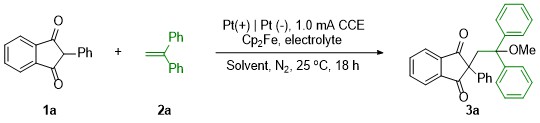
Initially, 2-phenyl-1H-indene-1,3(2H)-dione (1a) and ethene-1,1-diyldibenzene (2a) were selected as model substrates, with ferrocene (Cp2Fe) as the redox mediator. Condition optimization for the electrochemically driven radical alkylation of alkenes with 1,3-dicarbonyl compounds was performed in an undivided electrolytic cell equipped with a platinum anode and a platinum cathode, under a constant current of 1.0 mA (Table 1). A preliminary attempt was conducted using 20 mol% Cp2Fe as the mediator, nBu4NBF4 as the electrolyte, and a mixed solvent system (MeOH/TFE=4 mL/10 μL), affording the target product 3a in 30% yield (Entry 1). Subsequent screening of electrolytes revealed that the yield was significantly improved when nBu4NPF6 was employed (Entries 2~4). Next, the effect of the ferrocene loading was investigated. Reducing the amount of ferrocene resulted in a slight decrease in yield (Entry 5), while increasing its loading to 25 mol% afforded the target product in 78% yield (Entry 6). Further solvent screening was then performed, but no improvement in yield was observed (Entries 7~10). The addition of a small amount of 2,2,2-trifluoroethanol (TFE) was crucial for achieving high efficiency, presumably acting as a polar co-solvent that stabilizes the carbocation intermediate and facilitates methanol trapping without competing as a nucleophile. Control experiments demonstrated that the target product was undetectable in the absence of either Cp2Fe (Entry 11) or electrical current (Entry 12), and its formation was significantly suppressed under an air atmosphere (Entry 13).
Table 1 Reaction condition optimizationa
Entry Cp2Fe/mol% Electrolyte Solvent Yieldb/%
1 20 nBu4NBF4 MeOH/TFE (4 mL/10 μL) 30
2 20 Et4NPF6 MeOH/TFE (4 mL/10 μL) 32
3 20 Et4NBF4 MeOH/TFE (4 mL/10 μL) 30
4 20 nBu4NPF6 MeOH/TFE (4 mL/10 μL) 63
5 10 nBu4NPF6 MeOH/TFE (4 mL/10 μL) 55
6 25 nBu4NPF6 MeOH/TFE (4 mL/10 μL) 78
7 25 nBu4NPF6 MeOH (4 mL) 43
8 25 nBu4NPF6 DCE/MeOH (2 mL/2 mL) 26
9 25 nBu4NPF6 Toluene/MeOH (2 mL/2 mL) Trace
10 25 nBu4NPF6 DCM/MeOH (2 mL/2 mL) 40
11 0 nBu4NPF6 MeOH/TFE (4 mL/10 μL) n.d.
12c 25 nBu4NPF6 MeOH/TFE (4 mL/10 μL) n.d.
13d 25 nBu4NPF6 MeOH/TFE (4 mL/10 μL) 10

a Reaction conditions: Pt anode, Pt cathode, 1a (0.1 mmol), 2a (0.3 mmol), Cp2Fe, electrolyte (0.3 mmol), and solvent at a constant current of 1.0 mA at 25 ℃ under N2 for 18 h. MeOH, methanol; DCE, dichloroethane; DCM, dichloromethane; TFE, 2,2,2-trifluoroethanol; n.d., not detected. b Isolated yield. c Without electricity. d Under Air.

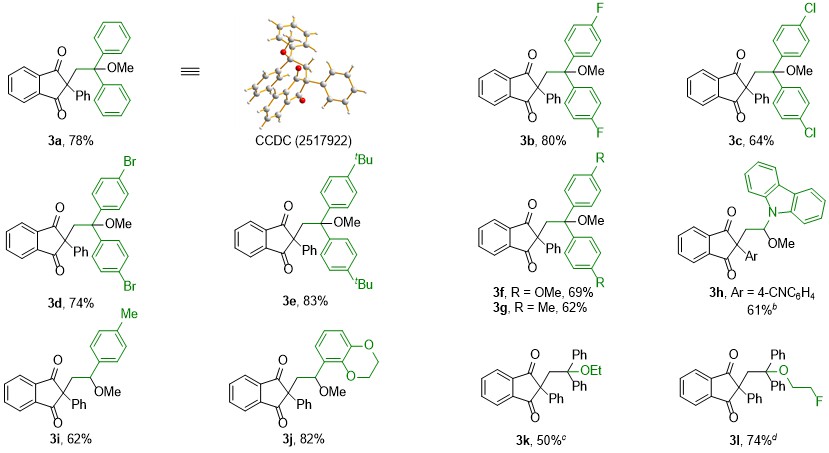
With the optimal reaction conditions established, a broad array of diversely functionalized diarylethylenes were verified to be competent substrates, affording the corresponding products in satisfactory yields (Table 2). Specifically, diarylethylenes bearing electron-withdrawing substituents (e.g., fluoro, chloro, bromo groups) underwent the radical alkylation reaction smoothly, delivering the corresponding α-alkylated 1,3-dicarbonyl products in good yields (3b~3d). In addition, diarylethylenes decorated with electron-donating groups, including tert-butyl, methoxy, and methyl substituents, were also well tolerated under the standard conditions, thus enabling the efficient access to the desired products (3e~3g). Notably, monosubstituted alkenes were further identified as viable reaction partners, which successfully underwent the transformation to generate the corresponding alkylated derivatives (3h~3j). However, simple unactivated alkenes such as styrene and 1-phenylpropene failed to deliver the desired product under the standard conditions. Further studies showed that the developed electrochemical alkene functionalization protocol is applicable to various alcohol nucleophiles, affording corresponding products with moderate to good yields (3k and 3l). The use of alternative nucleophiles, such as triethylamine trihydrofluoride, benzylamine, and aniline, failed to deliver the corresponding products under the standard conditions.
Table 2 Scope of alkenesa

a Reaction conditions: Pt anode, Pt cathode, 1a (0.1 mmol), 2 (0.3 mmol), Cp2Fe (25 mol%), nBu4NPF6 (0.3 mmol), and MeOH/TFE (4.0 mL/10 μL) at a constant current of 1.0 mA at 25 ℃ under N2. b With 4-(1,3-dioxo-2,3-dihydro-1H-inden-2-yl)benzonitrile (1b). c With ethanol/TFE (4.0 mL/10 μL). d With 2-fluoroethanol/ TFE (4.0 mL/10 μL).

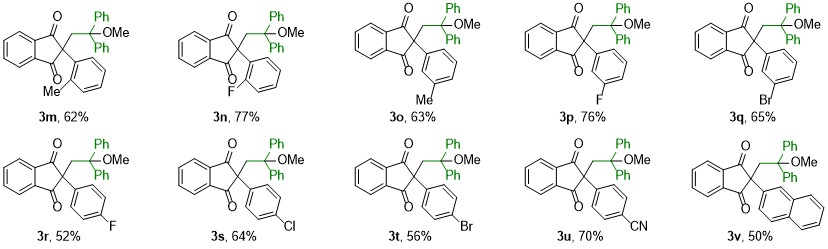
Additionally, the generality of the reaction with respect to substituents on the 1,3-dicarbonyl coupling partners was also investigated (Table 3). While substrates with ortho- position substituents (e.g., methyl, fluorine) reacted smoothly to afford products 3m and 3n, those bearing meta-position substituents were also viable, yielding products 3o~3q with up to 76% yield. Moreover, 1,3-dicarbonyl compounds bearing para-position substituents, including fluoro, chloro, bromo, and cyano groups, were all compatible with the electrochemical radical coupling with alkene 2a, affording the corresponding alkylated products (3r~3u). Furthermore, a naphthalene-containing substrate also proved compatible, smoothly delivering the desired product 3v. The substrate scope of acyclic 1,3-dicarbonyl compounds was also investigated. Under the standard conditions, chalcone proved to be a viable coupling partner, affording the desired alkylation product in 39% yield. In contrast, acetylacetone and malonate failed to deliver any detectable products, indicating the limited applicability of this method to simple acyclic 1,3-dicarbonyl substrates.
Table 3 Scope of 1,3-dicarbonyl compoundsa

a Reaction conditions: Pt anode, Pt cathode, 1 (0.1 mmol), 2a (0.3 mmol), Cp2Fe (25 mol%), nBu4NPF6 (0.3 mmol), and MeOH/TFE (4.0 mL/10 μL) at a constant current of 1.0 mA at 25 ℃ under N2.

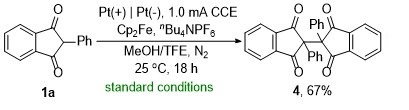
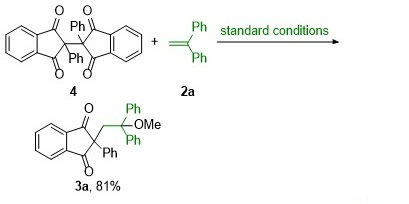
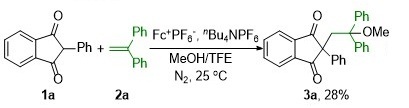
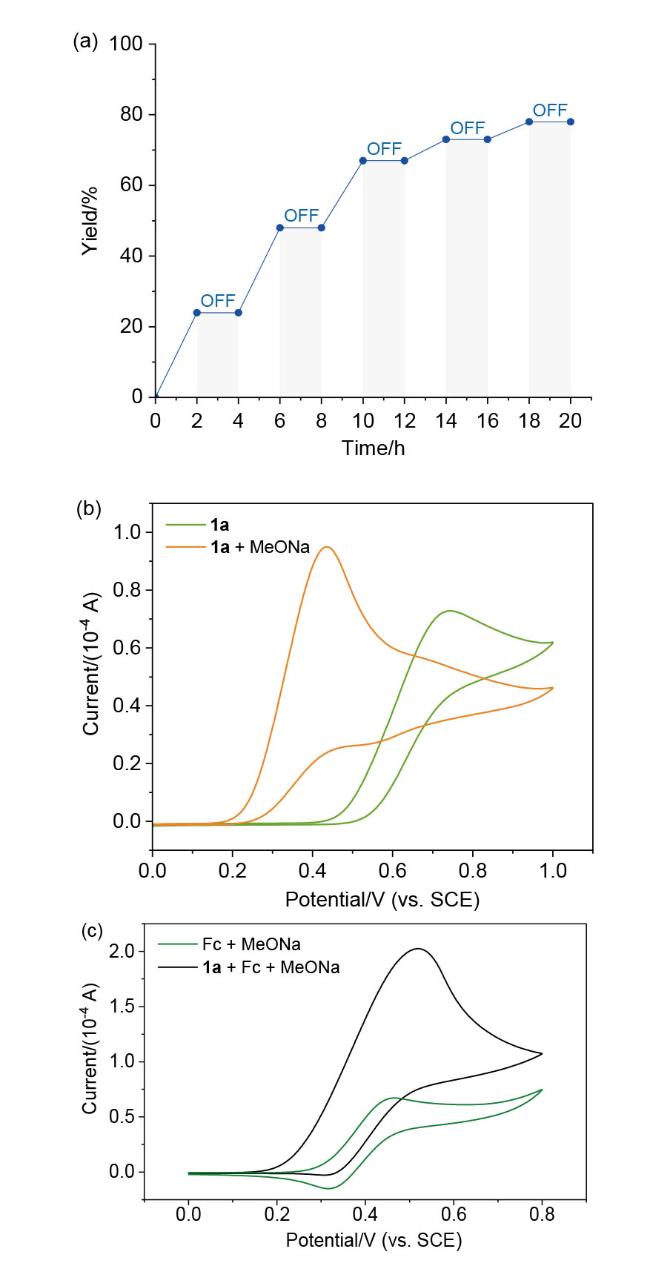
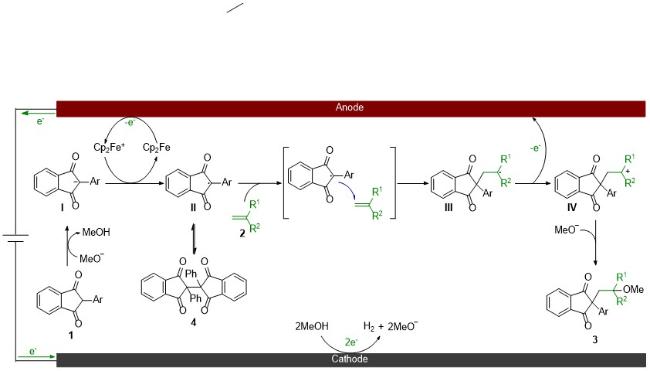
To elucidate the mechanism, a series of control experiments were performed. Under standard reaction conditions in the absence of alkene 2a, substrate 1a afforded the dimeric product 4,[12] via radical-radical dimer coupling of the electrogenerated radical intermediate (Eq. 1). The dimer product 4 and diphenylethylene 2a were next employed to the standard conditions, which successfully afforded the alkylated product 3a (Eq. 2). This outcome indicates that the dimer undergoes reversible homolysis under the electrochemical conditions, regenerating the initial radical intermediate that subsequently adds to the alkene to deliver 3a. Stoichiometric amount of $\mathrm{Fc}^{+} \mathrm{PF}_{6}^{-}$ was employed as the oxidant instead of electrical current, affording the corresponding product with 28% yield (Eq. 3). This result further corroborates the proposed Cp2Fe-mediated SET oxidation mechanism. Furthermore, an on-off current control experiment revealed that no product was formed in the absence of current supply (Figure 1a). Cyclic voltammetry study of 1,3-dicarbonyl compound 1a and alkene 2a was performed (Figure 1b). The onset oxidation potential of 1a was observed at approximately +0.50 V (vs. saturated calomel electrode, SCE; green line), and the [1a+MeONa] mixture was observed at a lower value of +0.25 V (orange line). Notably, the [1a+MeONa] mixture exhibits a lower oxidation potential compared with the 1a. For alkene 2a, the oxidation potential was observed at + 1.70 V (vs. SCE), which is notably higher than that of 1a. Cyclic voltammetry study of the Cp2Fe and 1a was also conducted, demonstrating the electron exchange between ferrocenium ion and 1a (Figure 1c). These findings collectively support a radical-based mechanism for the electrochemical coupling of 1,3-dicarbonyl compounds with alkenes. Building on the aforementioned studies and prior reports,[13] a plausible reaction mechanism for the electrochemical radical alkylation of alkenes with 1,3-dicarbonyl compounds is herein proposed (Scheme 2). Initially, the 1,3-dicarbonyl compound 1 undergoes deprotonation to generate the anionic intermediate I. Subsequently, the ferrocenium ion generated at the anode acts as a redox mediator, engaging in a single-electron transfer (SET) oxidation process with intermediate I to form the pivotal radical intermediate II.[12] Next, radical species II adds to alkene 2 to generate the carbon-centered radical intermediate III, which is then subjected to anodic oxidation to produce the carbocation intermediate IV. Finally, intermediate IV is trapped by the alkoxide anion derived from the alcoholic solvent, thus furnishing the α-alkylated product 3.
Figure 1 Mechanistic investigations. (a) Profile of a current switched on-off experiment; (b) Cyclic voltammetry study; (c) CV data of the catalytic current for the system containing ferrocene (Cp2Fe) and 1a
Scheme 2 Proposed mechanism

3 Conclusion

In summary, an electrochemically driven radical alkylation of alkenes with 1,3-dicarbonyl compounds has been successfully developed. This method provides access to a diverse array of α-alkylated 1,3-dicarbonyl products in moderate to good yields under mild electrochemical conditions, with broad functional group tolerance. Mechanistic studies support a pathway involving addition of a dicarbonyl-derived radical intermediate to the alkene. Further investigations into the electrochemical radical mechanism and its synthetic applications are currently ongoing.

4 Experimental section

4.1 Instruments and reagents

1H NMR, 13C NMR and 19F NMR spectra were recorded on Bruker Advance 400 MHz spectrometers using CDCl3 as solvent and TMS as an internal standard. High-resolu- tion mass spectra (HRMS) were obtained with a Waters XEVO G2 Q-TOF (Waters Corporation). Cyclic voltammograms were recorded on a CHI 760E instrument. Unless otherwise stated, all reagents and solvents were purchased from commercial suppliers and used without further purification. Commercially available reagents were purchased from Energy Chemical, Bide Pharmatech, Adamas-beta, and Sigma-Aldrich Co., Inc. Substrates 1 and 2 were synthesized and characterized according to literature procedures.[12a,13]

4.2 General procedure for the synthesis of products 3

A 10 mL flask was charged with 1 (0.1 mmol), 2 (0.3 mmol), Cp2Fe (4.5 mg, 0.025 mmol), nBu4NPF6 (116 mg, 0.3 mmol), and MeOH/TFE (4.0 mL/10 μL) at 25 ℃ under nitrogen atmosphere. The flask was equipped with Pt (10 mm×10 mm×0.2 mm) and Pt (10 mm×10 mm×0.2 mm) electrodes. The constant current (1.0 mA) electrolysis was carried out at 25 ℃ until complete consumption of the starting material (monitored by TLC). The solution was concentrated under reduced pressure. The residue was purified by silica gel chromatography to afford the desired product 3.
2-(2-Methoxy-2,2-diphenylethyl)-2-phenyl-1H-indene-1,3(2H)-dione (3a): White solid (33.7 mg, 78% yield), m.p. 168~170 ℃; 1H NMR (400 MHz, CDCl3) δ: 7.78~7.72 (m, 4H), 7.51~7.48 (m, 2H), 7.33~7.22 (m, 3H), 7.15~7.05 (m, 10H), 3.58 (s, 2H), 2.88 (s, 3H); 13C NMR (100 MHz, CDCl3) δ: 199.7, 144.3, 142.3, 138.6, 135.0, 128.8, 127.8, 127.7, 127.6, 127.4, 127.1, 123.2, 81.8, 58.9, 51.2, 44.5; HRMS (ESI) calcd for C30H24NaO3 [M+Na]+ 455.1618, found 455.1635.
2-(2,2-Bis(4-fluorophenyl)-2-methoxyethyl)-2-phenyl-1H-indene-1,3(2H)-dione (3b): Colorless oil (37.5 mg, 80% yield). 1H NMR (400 MHz, CDCl3) δ: 7.80~7.74 (m, 4H), 7.50~7.47 (m, 2H), 7.33~7.22 (m, 3H), 7.04~6.99 (m, 4H), 6.82~6.76 (m, 4H), 3.51 (s, 2H), 2.88 (s, 3H); 13C NMR (100 MHz, CDCl3) δ: 199.6, 161.9 (d, J=246.8 Hz), 142.2, 139.9 (d, J=3.3 Hz), 138.3, 135.2, 129.4 (d, J=8.1 Hz), 128.9, 127.8, 127.3, 123.2, 114.7 (d, J=21.3 Hz), 81.1, 58.8, 51.1, 44.3; 19F NMR (376 MHz, CDCl3) δ: -115.2; HRMS (ESI) calcd for C30H22F2NaO3 [M+Na]+ 491.1429, found 491.1446.
2-(2,2-Bis(4-chlorophenyl)-2-methoxyethyl)-2-phenyl-1H-indene-1,3(2H)-dione (3c): Colorless oil (32.0 mg, 64% yield). 1H NMR (400 MHz, CDCl3) δ: 7.79~7.74 (m, 4H), 7.50~7.46 (m, 2H), 7.33~7.23 (m, 3H), 7.08~7.05 (m, 4H), 7.00~6.95 (m, 4H), 3.49 (s, 2H), 2.90 (s, 3H); 13C NMR (100 MHz, CDCl3) δ: 199.6, 142.4, 142.1, 138.2, 135.3, 133.3, 129.0, 128.9, 128.0, 127.8, 127.3, 123.2, 81.1, 58.7, 51.1, 43.7; HRMS (ESI) calcd for C30H22Cl2- NaO3 [M+Na]+ 523.0838, found 523.0828.
2-(2,2-Bis(4-bromophenyl)-2-methoxyethyl)-2-phenyl-1H-indene-1,3(2H)-dione (3d): Colorless oil (43.7 mg, 74% yield). 1H NMR (400 MHz, CDCl3) δ: 7.79~7.74 (m, 4H), 7.50~7.46 (m, 2H), 7.33~7.30 (m, 3H), 7.23~7.20 (m, 4H), 6.92~6.90 (m, 4H), 3.48 (s, 2H), 2.90 (s, 3H); 13C NMR (100 MHz, CDCl3) δ: 199.6, 142.8, 142.1, 138.2, 135.3, 131.0, 129.4, 128.9, 127.8, 127.3, 123.2, 121.6, 81.2, 58.7, 51.1, 43.5; HRMS (ESI) calcd for C30H23Br2O3 [M+H]+ 589.0008, found 589.0020.
2-(2,2-Bis(4-(tert-butyl)phenyl)-2-methoxyethyl)-2-phenyl-1H-indene-1,3(2H)-dione (3e): Colorless oil (44.7 mg, 83% yield). 1H NMR (400 MHz, CDCl3) δ: 7.72~7.67 (m, 4H), 7.50~7.47 (m, 2H), 7.32~7.27 (m, 2H), 7.25~7.21 (m, 1H), 7.09~7.06 (m, 4H), 6.99~6.95 (m, 4H), 3.55 (s, 2H), 2.90 (s, 3H), 1.27 (s, 18H); 13C NMR (100 MHz, CDCl3) δ: 199.7, 149.7, 142.4, 141.1, 138.9, 134.8, 128.7, 127.5, 127.4, 127.4, 124.6, 123.1, 81.5, 59.1, 50.9, 44.5, 34.5, 31.5; HRMS (ESI) calcd for C38H40NaO3 [M+Na]+ 567.2870, found 567.2855.
2-(2-Methoxy-2,2-bis(4-methoxyphenyl)ethyl)-2-phenyl-1H-indene-1,3(2H)-dione (3f): Colorless oil (33.7 mg, 69% yield). 1H NMR (400 MHz, CDCl3) δ: 7.79~7.71 (m, 4H), 7.50~7.48 (m, 2H), 7.32~7.23 (m, 3H), 6.97~6.93 (m, 4H), 6.64~6.60 (m, 4H), 3.75 (s, 6H), 3.52 (s, 2H), 2.85 (s, 3H); 13C NMR (100 MHz, CDCl3) δ: 199.8, 158.5, 142.4, 138.7, 136.6, 134.9, 128.9, 128.8, 127.6, 127.4, 123.1, 113.0, 81.3, 59.0, 55.3, 50.8, 45.0; HRMS (ESI) calcd for C32H28NaO5 [M+Na]+ 515.1829, found 515.1827.
2-(2-Methoxy-2,2-di-p-tolylethyl)-2-phenyl-1H-indene-1,3(2H)-dione (3g): Colorless oil (28.5 mg, 62% yield). 1H NMR (400 MHz, CDCl3) δ: 7.76~7.71 (m, 4H), 7.51~7.48 (m, 2H), 7.32~7.27 (m, 2H), 7.25~7.21 (m, 1H), 6.93~6.88 (m, 8H), 3.54 (s, 2H), 2.86 (s, 3H), 2.27 (s, 6H); 13C NMR (100 MHz, CDCl3) δ: 199.8, 142.4, 141.4, 138.7, 136.6, 134.8, 128.8, 128.4, 127.6, 127.6, 127.4, 123.1, 81.6, 59.0, 51.0, 44.9, 21.1; HRMS (ESI) calcd for C32H28NaO3 [M+Na]+ 483.1931, found 483.1935.
4-(2-(2-(9H-Carbazol-9-yl)-2-methoxyethyl)-1,3-dioxo-2,3-dihydro-1H-inden-2-yl)benzonitrile (3h): Colorless oil (28.9 mg, 61% yield). 1H NMR (400 MHz, CDCl3) δ: 8.12~7.97 (m, 4H), 7.92~7.87 (m, 2H), 7.82~7.80 (m, 1H), 7.56~7.45 (m, 5H), 7.43~7.34 (m, 2H), 7.32~7.17 (m, 2H), 5.80 (dd, J=9.4, 5.3 Hz, 1H), 3.60 (dd, J=14.4, 9.4 Hz, 1H), 2.73 (dd, J=14.5, 5.4 Hz, 1H), 2.70 (s, 3H); 13C NMR (100 MHz, CDCl3) δ: 200.2, 198.9, 141.9, 141.6, 141.3, 140.1, 137.9, 136.4, 135.9, 132.6, 127.7, 126.2, 126.0, 124.2, 124.1, 123.6, 123.4, 120.4, 120.3, 120.3, 119.8, 118.4, 112.6, 111.9, 108.4, 83.9, 59.6, 55.6, 39.4; HRMS (ESI) calcd for C31H22N2NaO3 [M+Na]+ 493.1523, found 493.1522.
2-(2-Methoxy-2-(p-tolyl)ethyl)-2-phenyl-1H-indene-1,3(2H)-dione (3i): Colorless oil (23.0 mg, 62% yield). 1H NMR (400 MHz, CDCl3) δ: 8.21~8.14 (m, 2H), 7.99~7.88 (m, 2H), 7.53~7.46 (m, 2H), 7.40~7.18 (m, 7H), 4.21 (dd, J=11.3, 3.8 Hz, 1H), 3.07 (dd, J=14.2, 11.3 Hz, 1H), 2.63 (dd, J=14.2, 3.9 Hz, 1H), 2.59 (s, 3H), 2.42 (s, 3H); 13C NMR (100 MHz, CDCl3) δ: 202.1, 200.2, 142.6, 141.6, 137.7, 137.6, 135.8, 134.9, 129.3, 128.9, 127.6, 126.9, 126.7, 123.7, 123.1, 80.7, 60.6, 55.9, 45.5, 21.2; HRMS (ESI) calcd for C25H22NaO3 [M+Na]+ 393.1461, found 393.1457.
2-(2-(2,3-Dihydrobenzo[b][1,4]dioxin-5-yl)-2-methoxy-ethyl)-2-phenyl-1H-indene-1,3(2H)-dione (3j): Colorless oil (34.0 mg, 82% yield). 1H NMR (400 MHz, CDCl3) δ: 8.11~8.03 (m, 2H), 7.93~7.78 (m, 2H), 7.48~7.36 (m, 2H), 7.32~7.19 (m, 3H), 6.86~6.71 (m, 3H), 4.22 (s, 4H), 4.05 (dd, J=11.2, 3.9 Hz, 1H), 2.95 (dd, J=14.3, 11.3 Hz, 1H), 2.53~2.50 (m, 4H); 13C NMR (100 MHz, CDCl3) δ: 202.1, 200.1, 143.6, 143.3, 142.6, 141.6, 137.6, 135.8, 134.9, 134.1, 128.9, 127.6, 127.0, 123.7, 123.1, 119.8, 117.3, 115.6, 80.4, 64.4, 64.4, 60.6, 55.9, 45.4; HRMS (ESI) calcd for C26H22NaO5 [M+Na]+ 437.1359, found 437.1361.
2-(2-Ethoxy-2,2-diphenylethyl)-2-phenyl-1H-indene-1,3(2H)-dione (3k): Colorless oil (22.3 mg, 50% yield). 1H NMR (400 MHz, CDCl3) δ: 7.80~7.73 (m, 4H), 7.50~7.46 (m, 2H), 7.30~7.26 (m, 2H), 7.24~7.20 (m, 1H), 7.18~7.10 (m, 10H), 3.58 (s, 2H), 2.97 (q, J=6.9 Hz, 2H), 0.84 (t, J=6.9 Hz, 3H); 13C NMR (100 MHz, CDCl3) δ: 199.8, 144.4, 142.4, 138.5, 134.9, 128.8, 128.0, 127.8, 127.6, 127.4, 127.1, 123.3, 81.9, 59.4, 59.1, 47.0, 14.4; HRMS (ESI) calcd for C31H26NaO3 [M+Na]+ 469.1774, found 469.1780.
2-(2-(2-Fluoroethoxy)-2,2-diphenylethyl)-2-phenyl-1H-indene-1,3(2H)-dione (3l): Colorless oil (34.4 mg, 74% yield). 1H NMR (400 MHz, CDCl3) δ: 7.79~7.73 (m, 4H), 7.50~7.46 (m, 2H), 7.32~7.27 (m, 2H), 7.26~7.23 (m, 1H), 7.17~7.12 (m, 10H), 4.40~4.38 (m, 1H), 4.29~4.26 (m, 1H), 3.58 (s, 2H), 3.33~3.31 (m, 1H), 3.26~3.24 (m, 1H); 13C NMR (100 MHz, CDCl3) δ: 199.8, 143.7, 142.3, 138.4, 135.2, 128.8, 127.9, 127.9, 127.7, 127.3, 123.3, 83.7, 81.9 (d, J=14.4 Hz), 62.7 (d, J=20.0 Hz), 59.0, 45.5; 19F NMR (376 MHz, CDCl3) δ: -224.3; HRMS (ESI) calcd for C31H26FO3 [M+H]+ 465.1860, found 465.1875.
2-(2-Methoxy-2,2-diphenylethyl)-2-(o-tolyl)-1H-indene-1,3(2H)-dione (3m): Colorless oil (27.6 mg, 62% yield). 1H NMR (400 MHz, CDCl3) δ: 7.82~7.80 (m, 1H), 7.72~7.59 (m, 4H), 7.34 (t, J=7.4 Hz, 1H), 7.20 (t, J=7.4 Hz, 1H), 7.10~7.00 (m, 11H), 3.76 (s, 2H), 2.83 (s, 3H), 1.79 (s, 3H); 13C NMR (100 MHz, CDCl3) δ: 201.4, 144.1, 143.2, 137.8, 136.9, 134.8, 132.7, 128.6, 128.0, 127.0, 126.9, 126.4, 122.4, 81.1, 60.4, 51.0, 41.1, 23.3; HRMS (ESI) calcd for C31H26NaO3 [M+Na]+ 469.1774, found 469.1780.
2-(2-Fluorophenyl)-2-(2-methoxy-2,2-diphenylethyl)-1H-indene-1,3(2H)-dione (3n): Colorless oil (34.6 mg, 77% yield). 1H NMR (400 MHz, CDCl3) δ: 7.80~7.75 (m, 1H), 7.72~7.69 (m, 2H), 7.66~7.63 (m, 2H), 7.30~7.25 (m, 2H), 7.12~7.06 (m, 6H), 7.04~7.00 (m, 4H), 6.90~6.85 (m, 1H), 3.69 (s, 2H), 2.85 (s, 3H); 13C NMR (100 MHz, CDCl3) δ: 200.1 (d, J=1.3 Hz), 160.2 (d, J=247.6 Hz), 144.0, 142.7 (d, J=2.6 Hz), 134.6, 129.8 (d, J=8.9 Hz), 128.8 (d, J=4.4 Hz), 128.0, 127.6 (d, J=13.2 Hz), 127.1, 127.0, 124.6 (d, J=3.1 Hz), 122.7, 116.0 (d, J=22.4 Hz), 81.0, 57.1 (d, J=1.4 Hz), 51.0, 39.2; 19F NMR (376 MHz, CDCl3) δ: -104.4; HRMS (ESI) calcd for C30H23FNaO3 [M+Na]+ 473.1523, found 473.1499.
2-(2-Methoxy-2,2-diphenylethyl)-2-(m-tolyl)-1H-indene-1,3(2H)-dione (3o): Colorless oil (28.1 mg, 63% yield). 1H NMR (400 MHz, CDCl3) δ: 7.77~7.72 (m, 4H), 7.31~7.27 (m, 2H), 7.21~7.04 (m, 12H), 3.56 (s, 2H), 2.87 (s, 3H), 2.31 (s, 3H); 13C NMR (100 MHz, CDCl3) δ: 199.7, 144.3, 142.4, 138.5, 138.4, 134.9, 128.7, 128.4, 127.9, 127.8, 127.7, 127.1, 124.5, 123.2, 81.8, 58.9, 51.2, 44.4, 21.8; HRMS (ESI) calcd for C31H26NaO3 [M+Na]+ 469.1774, found 469.1780.
2-(3-Fluorophenyl)-2-(2-methoxy-2,2-diphenylethyl)-1H-indene-1,3(2H)-dione (3p): Colorless oil (34.2 mg, 76% yield). 1H NMR (400 MHz, CDCl3) δ: 7.77~7.72 (m, 4H), 7.29~7.25 (m, 3H), 7.14~7.08 (m, 6H), 7.05~7.02 (m, 4H), 6.96~6.91 (m, 1H), 3.52 (s, 2H), 2.85 (s, 3H); 13C NMR (100 MHz, CDCl3) δ: 199.1, 162.9 (d, J=246.1 Hz), 144.1, 142.2, 140.9 (d, J=7.5 Hz), 135.2, 130.1 (d, J=8.2 Hz), 127.9, 127.7, 127.2, 123.3, 123.1 (d, J=2.9 Hz), 114.9 (d, J=23.5 Hz), 114.6 (d, J=21.0 Hz), 81.8, 58.5 (d, J=1.8 Hz), 51.2, 44.8; 19F NMR (376 MHz, CDCl3) δ: -111.7; HRMS (ESI) calcd for C30H23FNaO3 [M+Na]+ 473.1523, found 473.1499.
2-(3-Bromophenyl)-2-(2-methoxy-2,2-diphenylethyl)-1H-indene-1,3(2H)-dione (3q): Colorless oil (33.1 mg, 65% yield). 1H NMR (400 MHz, CDCl3) δ: 7.78~7.73 (m, 4H), 7.67 (t, J=1.9 Hz, 1H), 7.46 (ddd, J=8.1, 2.0, 1.0 Hz, 1H), 7.38 (ddd, J=7.9, 1.8, 1.0 Hz, 1H), 7.20~7.08 (m, 7H), 7.05~7.02 (m, 4H), 3.51 (s, 2H), 2.85 (s, 3H); 13C NMR (100 MHz, CDCl3) δ: 199.0, 144.0, 142.2, 140.6, 135.2, 130.9, 130.5, 130.2, 127.9, 127.6, 127.2, 126.2, 123.3, 122.9, 81.8, 58.4, 51.2, 44.9; HRMS (ESI) calcd for C30H23BrNaO3 [M+Na]+ 533.0723, found 533.0731.
2-(4-Fluorophenyl)-2-(2-methoxy-2,2-diphenylethyl)-1H-indene-1,3(2H)-dione (3r): Colorless oil (23.4 mg, 52% yield). 1H NMR (400 MHz, CDCl3) δ: 7.76~7.74 (m, 4H), 7.51~7.48 (m, 2H), 7.16~7.08 (m, 6H), 7.06~6.97 (m, 6H), 3.52 (s, 2H), 2.86 (s, 3H); 13C NMR (100 MHz, CDCl3) δ: 199.6, 162.2 (d, J=247.4 Hz), 144.1, 142.2, 135.1, 134.2 (d, J=3.5 Hz), 129.3 (d, J=7.9 Hz), 127.9, 127.7, 127.2, 123.2, 115.6 (d, J=21.4 Hz), 81.8, 58.2, 51.2, 45.1; 19F NMR (376 MHz, CDCl3) δ: -115.0; HRMS (ESI) calcd for C30H23FNaO3 [M+Na]+ 473.1523, found 473.1499.
2-(4-Chlorophenyl)-2-(2-methoxy-2,2-diphenylethyl)-1H-indene-1,3(2H)-dione (3s): Colorless oil (30.0 mg, 64% yield). 1H NMR (400 MHz, CDCl3) δ: 7.74 (s, 4H), 7.48~7.44 (m, 2H), 7.28~7.25 (m, 2H), 7.14~7.08 (m, 6H), 7.04~7.02 (m, 4H), 3.51 (s, 2H), 2.85 (s, 3H); 13C NMR (100 MHz, CDCl3) δ: 199.3, 144.1, 142.2, 137.0, 135.2, 133.8, 128.9, 128.9, 127.9, 127.7, 127.2, 123.3, 81.8, 58.3, 51.2, 45.1; HRMS (ESI) calcd for C30H23Cl- NaO3 [M+Na]+ 489.1228, found 489.1236.
2-(4-Bromophenyl)-2-(2-methoxy-2,2-diphenylethyl)-1H-indene-1,3(2H)-dione (3t): Colorless oil (28.5 mg, 56% yield). 1H NMR (400 MHz, CDCl3) δ: 7.77~7.73 (m, 4H), 7.44~7.38 (m, 4H), 7.16~7.01 (m, 10H), 3.50 (s, 2H), 2.85 (s, 3H); 13C NMR (100 MHz, CDCl3) δ: 199.2, 144.1, 142.2, 137.5, 135.2, 131.8, 129.3, 127.9, 127.6, 127.2, 123.2, 122.0, 81.8, 58.3, 51.2, 45.0; HRMS (ESI) calcd for C30H23BrNaO3 [M+Na]+ 533.0723, found 533.0731.
4-(2-(2-Methoxy-2,2-diphenylethyl)-1,3-dioxo-2,3-dihydro-1H-inden-2-yl)benzonitrile (3u): Colorless oil (31.8 mg, 70% yield). 1H NMR (400 MHz, CDCl3) δ: 7.80~7.74 (m, 4H), 7.70~7.66 (m, 2H), 7.61~7.58 (m, 2H), 7.17~7.09 (m, 6H), 7.04~7.00 (m, 4H), 3.51 (s, 2H), 2.84 (s, 3H); 13C NMR (100 MHz, CDCl3) δ: 198.6, 143.8, 143.6, 142.2, 135.4, 132.4, 128.4, 127.9, 127.6, 127.3, 123.3, 118.6, 111.6, 81.8, 58.7, 51.2, 45.2; HRMS (ESI) calcd for C31H23NNaO3 [M+Na]+ 480.1570, found 480.1568.
2-(2-Methoxy-2,2-diphenylethyl)-2-(naphthalen-2-yl)-1H-indene-1,3(2H)-dione (3v): Colorless oil (24.0 mg, 50% yield). 1H NMR (400 MHz, CDCl3) δ: 7.88 (d, J=2.0 Hz, 1H), 7.81~7.70 (m, 8H), 7.45~7.43 (m, 2H), 7.18~7.07 (m, 10H), 3.67 (s, 2H), 2.91 (s, 3H); 13C NMR (100 MHz, CDCl3) δ: 199.6, 144.3, 142.3, 135.8, 135.1, 133.2, 132.5, 128.6, 128.5, 127.9, 127.8, 127.7, 127.5, 127.2, 126.5, 126.3, 125.3, 123.2, 81.9, 59.0, 51.2, 44.7; HRMS (ESI) calcd for C34H26NaO3 [M+Na]+ 505.1774, found 505.1783.


4.3 Procedure for the synthesis of 4

In an oven-dried 10 mL flask equipped with a magnetic stir bar was charged with 1a (44 mg, 0.2 mmol), Cp2Fe (4.5 mg, 0.025 mmol), and nBu4NPF6 (116 mg, 0.3 mmol). The reaction mixture was degassed via vacuum evacuation and backfilled with nitrogen three times. Then MeOH (4 mL) and TFE (10 μL) were added to the reaction tube. The flask was equipped with a platinum plate (10.0 mm×10.0 mm×0.2 mm) as the anode and a platinum plate (10.0 mm×10.0 mm×0.2 mm) as the cathode. The electrolysis was carried out under a constant current of 1.0 mA at 25 ℃ until complete consumption of the starting material (monitored by TLC). After the reaction is completed, the resulting solution was diluted with dichloromethane, filtered through a plug of celite, and the solvent was evaporated. The residue was purified by flash column chromatography on silica gel to yield the desired product 2,2'- diphenyl-1H,1'H-[2,2'-biindene]-1,1',3,3'(2H,2'H)-tetraone (4), colorless foam (29.7 mg, 67% yield). 1H NMR (400 MHz, CDCl3) δ: 7.83~7.78 (m, 4H), 7.68~7.64 (m, 4H), 7.26~7.24 (m, 2H), 7.20~7.16 (m, 4H), 7.13~7.10 (m, 4H); 13C NMR (100 MHz, CDCl3) δ: 197.6, 141.1, 135.8, 130.6, 130.1, 128.8, 127.7, 123.9, 64.6; HRMS (ESI) calcd for C30H19O4 [M+H]+ 443.1278, found 443.1263.
Supporting Information 1H NMR, 13C NMR and 19F NMR spectra of products 3~4. The Supporting Information is available free of charge via the Internet at http://sioc-journal.cn/.
(Cheng, F.)
[1]
For recent reviews: (a) Berzina, L.; Mierina, I. Molecules 2023, 28, 6203.

(b) Hilt, G.; Weske, D. F. Chem. Soc. Rev. 2009, 38, 3082.

[2]
(a) Jiang, L.-M.; Xiang, K.; Jiao, H.-J.; Yang, J.-L.; Qu, H.-T.; Xu, X.-T.; Bao, W.; Zhu, D.-Y.; Wang, S.-H. Tetrahedron Lett. 2023, 123, 154564.

(b) Li, L.; Chen, Q.; Xiong, X.; Zhang, C.; Qian, J.; Shi, J.; An, Q.; Zhang, M. Chin. Chem. Lett. 2018, 29, 1893.

(c) Zhou, M.; Lu, H.; Wang, Z.; Kato, T.; Liu, Y.; Maruoka, K. Tetrahedron Lett. 2022, 110, 154176.

(d) Xia, Q.; Li, X.; Fu, X.; Zhou, Y.; Peng, Y.; Wang, J.; Song, G. J. Org. Chem. 2021, 86, 9914.

(e) Zeng, X.; Lu, Z.; Liu, S.; Hammond, G. B.; Xu, B. Adv. Synth. Catal. 2017, 359, 4062.

(f) Tang, S.; Wang, Z.-Y.; Liu, B.; Dong, C.-E. Chin. Chem. Lett. 2015, 26, 744.

(g) Ma, H.; He, Y.; Huang, R.-F.; Zhang, X.-H.; Pan, J.; Li, J.-Q.; He, C.; Ling, X.-G.; Wang, X.-L.; Xiong, Y. Chin. Chem. Lett. 2014, 25, 1327.

[3]
(a) Wang, C.; Li, Y.; Gong, M.; Wu, Q.; Zhang, J.; Kim, J. K.; Huang, M.; Wu, Y. Org. Lett. 2016, 18, 4151.

(b) Xiong, M.; Liang, X.; Liang, X.; Pan, Y.; Lei, A. ChemElectroChem 2019, 6, 3383.

(c) Li, X.; He, S.; Song, Q. Chem. Sci. 2020, 11, 5969

(d) Gu, M.; Cao, Y.-J.; Zhao, Q.-Q.; Chen, J.-R. Chin. J. Chem. 2026, 44, 171.

(e) Ji, J.; Barnes, D. M.; Zhang, J.; King, S. A.; Wittenberger, S. J.; Morton, H. E. J. Am. Chem. Soc. 1999, 121, 10215.

(f) Wallentin, C.-J.; Nguyen, J. D.; Finkbeiner, P.; Stephenson, C. R. J. J. Am. Chem. Soc. 2012, 134, 8875.

(g) Zhang, M.-N.; Zhao, M.-N.; Chen, M.; Ren, Z.-H.; Wang, Y.-Y.; Guan, Z.-H. Chem. Commun. 2016, 52, 6127.

[4]
(a) Snider, B. B. Chem. Rev. 1996, 96, 339.

(b) Nair, V.; Balagopal, L.; Rajan, R.; Mathew, J. Acc. Chem. Res. 2004, 37, 21

(c) Nair, V.; Mathew, J.; Prabhakaran, J. Chem. Soc. Rev. 1997, 26, 127.

[5]
(a) Narayanam, J. M. R.; Stephenson, C. R. J. Chem. Soc. Rev. 2011, 40, 102.

(b) Prier, C. K.; Rankic, D. A.; MacMillan, D. W. C. Chem. Rev. 2013, 113, 5322.

(c) Li, T.; Liang, K.; Zhang, Y.; Hu, D.; Ma, Z.; Xia, C. Org. Lett. 2020, 22, 2386

(d) Daniel, M.; Fensterbank, L.; Goddard, J.-P.; Ollivier, C. Org. Chem. Front. 2014, 1, 551.

(e) Li, L.-J.; Zhang, J.-C.; Li, W.-P.; Zhang, D.; Duanmu, K.-N.; Yu, H.; Ping, Q.; Yang, Z.-P. J. Am. Chem. Soc. 2024, 146, 9404.

(f) Nguyen, J. D.; Tucker, J. W.; Konieczynska, M. D.; Stephenson, C. R. J. J. Am. Chem. Soc. 2011, 133, 4160

(g) Ran, Y.-S.; Jiang, B.; Shen, Y.-T.; Fan, T.-G.; Jiang, W.; Zhang, C.; Li, Y.-M. Org. Lett. 2023, 25, 7412.

(h) Scott, A. G.; Agapie, T. J. Am. Chem. Soc. 2023, 145, 774

(i) Liu, J.; Tang, S.; Xu, H.; Zhang, R.; Zhao, J.; Zhang, P.; Li, P. Org. Lett. 2022, 24, 9366.

(j) Dai, X.-J.; Xu, X.-L.; Cheng, D.-P.; Li, X.-N. Chin. Chem. Lett. 2014, 25, 545.

[6]
(a) Yoshida, J.-I.; Kataoka, K.; Horcajada, R.; Nagaki, A. Chem. Rev. 2008, 108, 2265.

(b) Yan, M.; Kawamata, Y.; Baran, P. S. Chem. Rev. 2017, 117, 13230.

(c) Jiang, Y.; Xu, K.; Zeng, C. Chem. Rev. 2018, 118, 4485.

(d) Tang, S.; Liu, Y.; Lei, A. Chem 2018, 4, 27.

(e) Chang, X.; Zhang, Q.; Guo, C. Angew. Chem., Int. Ed. 2020, 59, 12612.

(f) Novaes, L. F. T.; Liu, J.; Shen, Y.; Lu, L.; Meinhardt, J. M.; Lin, S. Chem. Soc. Rev. 2021, 50, 7941.

(g) Cembellín, S.; Batanero, B. Chem. Rec. 2021, 21, 2453

(h) Tan, Z.; Zhang, H.; Xu, K.; Zeng, C. Sci. China Chem. 2024, 67, 450.

(i) Gao, C.; Liu, X.; Wang, M.; Liu, S.; Zhu, T.; Zhang, Y.; Hao, E.; Yang, Q. Chin. J. Org. Chem. 2024, 44, 673 (in Chinese).

(高淳, 刘欣, 王明慧, 刘淑贤, 朱婷婷, 张怡康, 郝二军, 杨启亮, 有机化学, 2024, 44, 673.)

(j) Liu, M.; Guo, C. Acc. Chem. Res. 2025, 58, 3427.

(k) You, X.; Huang, K.; Zhuang, S.; Liu, C.; Jin, W. Chin. J. Org. Chem. 2025, 45, 1360 (in Chinese).

(尤晓琴, 黄克金, 庄诗怡, 刘晨江, 金伟伟, 有机化学, 2025, 45, 1360.)

(l) Li, Y.; Sun, L.; Xu, K.; Zeng, C. Chin. J. Org. Chem. 2025, 45, 668 (in Chinese).

(李永梅, 孙亮博, 徐坤, 曾程初, 有机化学, 2025, 45, 668.)

(m) Yang, Q.-L.; Liu, S.-X.; Zhu, Y.; Ni, C.-Y.; Li, S.-R.; Zhang, Q.-Y.; Wang, H.-X.; Guo, H.-M. Org. Lett. 2025, 27, 9241.

(n) Yang, Q.-L.; Wang, R.; Zhao, D.; Ni, C.-Y.; Cao, M.-S.; Zhang, J.; Ma, N.; Guo, H.-M. Chin. J. Chem. 2026, 44, 1141.

[7]
(a) Wan, Q.; Zhang, Z.; Hou, Z.-W.; Wang, L. Org. Chem. Front. 2023, 10, 2830.

(b) Hou, Z.-W.; Li, L.; Wang, L. Org. Chem. Front. 2022, 9, 2815.

(c) Kirillov, A. S.; Semenov, E. A.; Bityukov, O. V.; Kuznetsova, M. A.; Demidova, V. N.; Rogozhin, A. N.; Glinushkin, A. P.; Vil’, V. A.; Terent'ev, A. O. Org. Biomol. Chem. 2023, 21, 3615.

[8]
(a) McDonald, R. I.; Liu, G.-S.; Stahl, S. S. Chem. Rev. 2011, 111, 2981.

(b) Sauer, G. S.; Lin, S. ACS Catal. 2018, 8, 5175.

(c) Yang, Q.-L.; Zhang, Z.-X.; Zhu, Y.; Qiao, Z.-L.; Liu, X.; Wang, R.; Liu, S.-X.; Hao, E.-J.; Xiong, P.; Guo, H.-M. Org. Chem. Front. 2026, 13, 550.

[9]
Hou, Z.-W.; Jiang, T.; Wu, T.-X.; Wang, L. Org. Lett. 2021, 23, 8585.

[10]
Wu, F.; Liu, S.; Lv, X.; Pan, M.; Liu, X.; Zhang, J.; Rong, L. J. Org. Chem. 2023, 88, 13749.

[11]
Wu, W.; Linghu, R.; Jian, B.; Shi, J.; Chi, Q.; Jiang, B.; Ren, H. Org. Lett. 2025, 27, 4663.

[12]
Zhang, X.; Chang, M.; Ni, T.; Xu, X.; Zong, L. Chem. Commun. 2024, 60, 10958.

[13]
(a) Liang, K.; Zhang, Q.; Guo, C. Sci. Adv. 2022, 8, eadd7134.

(b) Xiong, P.; Hemming, M.; Ivlev, S. I.; Meggers, E. J. Am. Chem. Soc. 2022, 144, 6964.

(c) Xiong, P.; Ivlev, S. I.; Meggers, E. Nat. Catal. 2023, 6, 1186.

(d) Li, N.; Ye, X.; Liu, Y.; Song, J. Nat. Catal. 2025, 8, 957.

(e) Ye, X.; Wei, B.; Li, Y.; Li, J.; Lin, S.; Cao, L.; Wu, J.; Liu, Y.; Song, J. J. Am. Chem. Soc. 2026, 148, 12264.

(f) Li, J.; Shan, Q.; Wang, W.; Liu, Y.; Song, J. Angew. Chem., Int. Ed. 2026, e5599170.

Outlines

/

〈 〉