


1 Introduction
C—X (X=O, N, S) bonds represent a class of vital chemical bonds that not only enrich the structural diversity of organic compounds but also impart unique physical and chemical properties to different organic functional molecules.[1] Compounds bearing C—X bonds are present in almost all research fields associated with organic chemistry, including medicinal chemistry,[2] chemical engineering,[3] food science,[4] materials science,[5] biology,[6] and so on. Thus, the exploitation of novel synthetic strategies for the construction of C—X bond has long been one of the central research priorities in synthetic organic chemistry.[7] Indeed, the established methodologies for C—X bond formation have substantially advanced the development of organic chemistry and its allied disciplines, with their impacts continuing to expand.
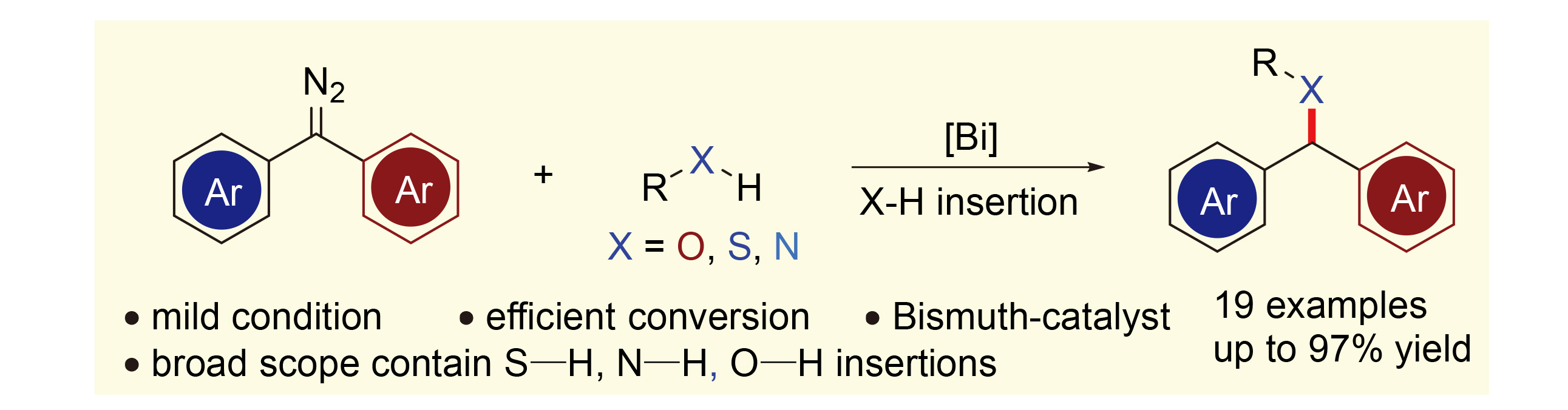
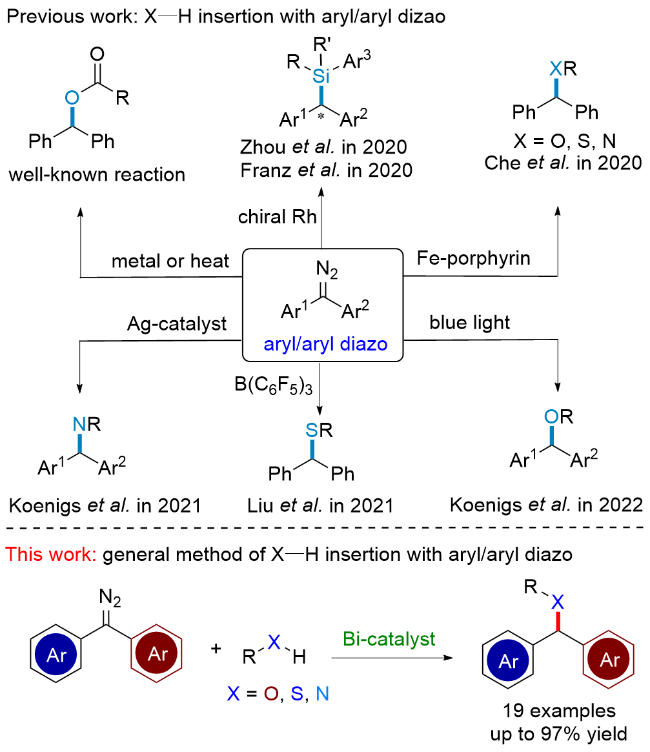
Diazo compounds serve as a versatile reagent[8] and are commonly applied in carbene transfer reactions, which have become a pivotal strategy for the synthesis of diverse molecular scaffolds.[9] Within this research field, considerable efforts have been devoted to acceptor/acceptor and acceptor/donor carbenes,[10] whereas investigations pertaining to diaryldiazomethanes, precursors of donor/donor carbenes, are still relatively scarce.[11] It is known that aryl/ aryl diazo compounds can undergo a variety of transformations under different catalytic conditions, including cyclopropanation,[12] ring expansion,[13] rearrangement,[14] coupling reaction[15] and X—H bond insertion[16]. Notably, the diarylmethane moiety, a common scaffold in pharmaceuticals and functional materials, can be directly incorporated into target molecules through these transformations.[17] Among these transformations, X—H bond insertion represents the most straightforward approach for C—X bond formation. In 2020, the Che group[18] conducted a systematic study on the X—H bond insertion of aryl/aryl diazo compounds, where a specialized iron porphyrin complex catalyst and 10 equiv. of X—H compounds were essential to afford satisfactory yields. In 2021, our group[19] developed the first B(C6F5)3-catalyzed S—H bond insertion reaction of diaryl diazo compounds. Subsequently, the N—H, O—H and Si—H bond insertion reactions of aryl/aryl diazo compounds have been successfully developed (Scheme 1).[20] Despite of abovementioned achievements, the development of X—H bond insertion reactions featuring broader generality, facile operation and the use of green, low-cost catalysts is highly desirable. As a main-group element, bismuth features low toxicity, low cost and ready availability, and has thus been widely applied in Lewis acid-catalyzed reactions.[21] However, its application in carbene transfer reactions remains very limited.[22] Building on our long-standing interest in the development of novel strategies for carbene transfer reactions,[23] herein we report a new bismuth-catalyzed X—H bond insertion reaction of diaryldiazomethanes.
2 Results and discussion
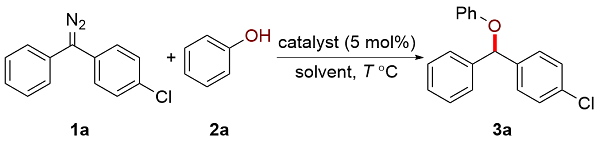
Initially, 1-chloro-4-(diazo(phenyl)methyl)benzene (1a) and phenol (2a) were selected as model substrates to optimize the reaction conditions of O—H insertion reaction. The results are summarized in Table 1. The reaction did not work at room temperature in dichloromethane (DCM) without any catalyst (Table 1, Entry 1). Subsequently, a series of commonly used catalysts for carbene transfer reactions were evaluated, including rhodium, copper, scandium and B(C6F5)3. All reactions afforded the desired product 3a, yet all yields were less than 20% (Table 1, Entries 2~5). After screening bismuth salts, Bi(OTf)3 exhibited the best catalytic activity to produce 3a in 26% yield (Table 1, Entries 6~7). With the catalyst confirmed, the effect of solvent on the reaction was next investigated to further improve the yield. No desired product 3a was detected in tetrahydrofuran or acetonitrile, whereas nonpolar solvents (toluene, cyclohexane, n-hexane) led to improved yields (Table 1, Entries 8~12). Notably, n-hexane proved to be the optimal solvent, affording product 3a in an NMR yield of up to 78% (Table 1, Entry 12). Other temperature cannot improve the results (Table 1, Entries 13~14). Employing 2 equiv. of 1a failed to drive the conversion of 2a (Table 1, Entry 15).
Table 1 Optimization of the reaction conditionsa |
| Entry | Catalyst | Solvent | Temp.b/℃ | Yield c/% |
|---|---|---|---|---|
| 1 | — | DCM | 30 | NR |
| 2 | B(C6F5)3 | DCM | 30 | 20 |
| 3 | Rh2(OAc)4 | DCM | 30 | ND |
| 4 | Sc(OTf)3 | DCM | 30 | 14 |
| 5 | Cu(OTf)2 | DCM | 30 | 6 |
| 6 | Bi(OTf)3 | DCM | 30 | 26 |
| 7 | BiCl3 | DCM | 30 | 0 |
| 8 | Bi(OTf)3 | Toluene | 30 | 61 |
| 9 | Bi(OTf)3 | THF | 30 | 0 |
| 10 | Bi(OTf)3 | MeCN | 30 | 0 |
| 11 | Bi(OTf)3 | Cyclohexane | 30 | 40 |
| 12 | Bi(OTf)3 | n-Hexane | 30 | 78 (75) |
| 13 | Bi(OTf)3 | n-Hexane | 20 | 72 |
| 14 | Bi(OTf)3 | n-Hexane | 40 | 74 |
| 15d | Bi(OTf)3 | n-Hexane | 30 | 13 |
a Reaction condition: 1a (0.2 mmol), 2a (0.4 mmol), and catalyst (0.01 mmol) in a solvent (4 mL). b 30 ℃ is room temperature. c Yields were determined by crude 1H NMR using CH2Br2 as the internal standard, and the isolated yield in the bracket. NR is no reaction. d 1a (0.4 mmol) and 2a (0.2 mmol) in the reaction. |
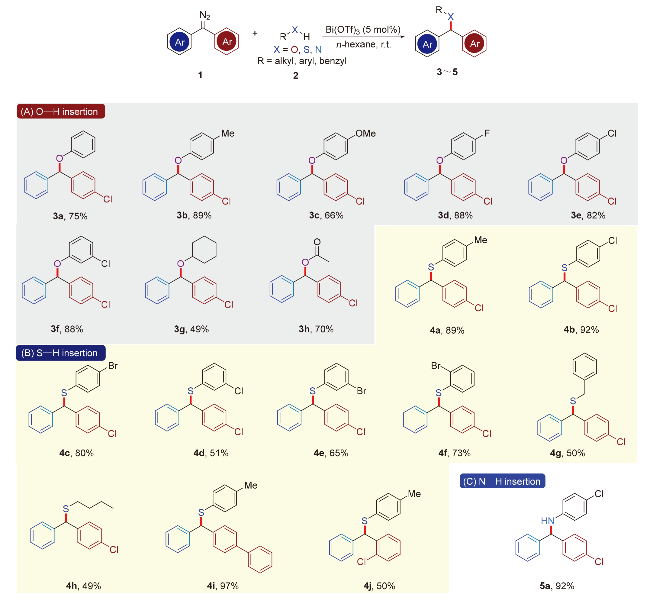
With the optimal reaction conditions established, the substrate scope of this X—H insertion reaction was further explored (Scheme 2). As depicted in Scheme 2a, the scope of phenol substrates was first evaluated. To our delight, all phenols bearing both electron-donating and electron-with- drawing substituents at diverse positions on the phenyl ring afforded O—H insertion products 3a~3f in 66%~89% yield. Under the standard conditions, diaryldiazomethanes also reacted smoothly with alcohols and carboxylic acids to furnish the respective O—H insertion products (3g and 3h) in good yields. Next, the substrate scope of thiols was investigated, with results summarized in Scheme 2b. Thiophenols substituted with various groups, including halogens and alkyls, at the ortho-, meta-, or para-positions of the phenyl group were well tolerated, delivering the target S—H insertion products 4a~4f in good to excellent yields. Aliphatic thiols also reacted with diazomethanes smoothly to afford the corresponding products 4g~4h in good yield. Notably, under the standard conditions, the reaction yields of alcohols and alkyl thiols (3g, 4g, 4h) are generally lower than those of phenols and aromatic thiols, which might be attributed to the weaker acidity of the aliphatic substrates. In addition, the scope of diaryldiazomethane substrates was investigated via their reaction with 4-methylbenzenethiol, which afforded the corresponding thioether products (4i and 4j) in good to excellent yields. Finally, the N—H insertion product 5a was obtained smoothly from the reaction of diaryldiazomethane with aniline under standard conditions.
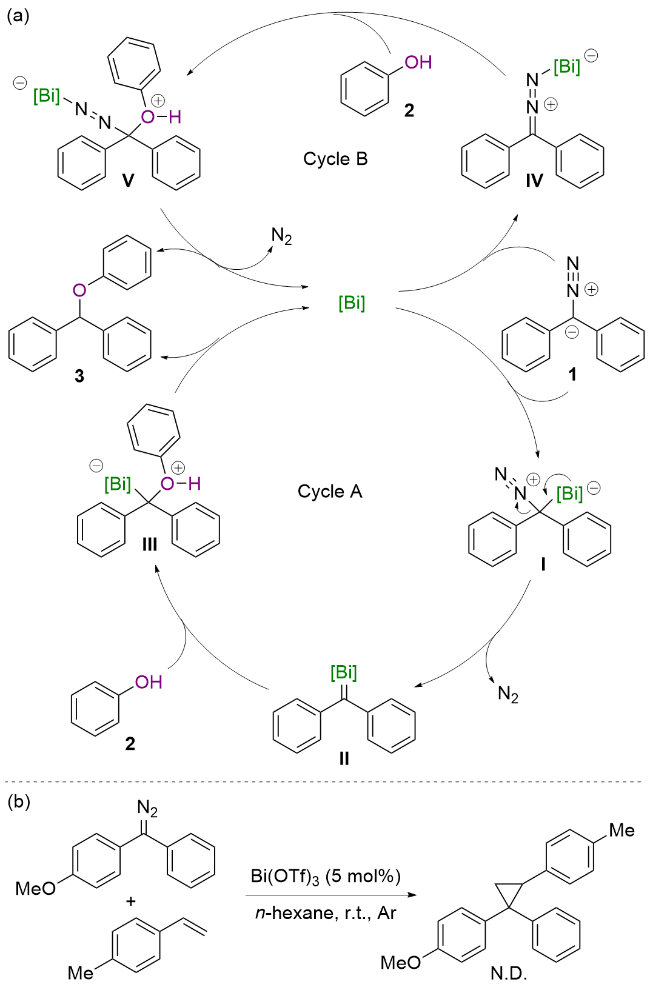
Based on the above experimental results and previous reports,[22] two plausible reaction pathway were proposed (Scheme 3a). In catalytic cycle A, the reaction is initiated by the formation of electrophilic bismuth carbene II upon dinitrogen extrusion from the diazo precursor 1. This electrophilic bismuth carbene II is attacked by phenol 2 to afford intermediate III, which can undergo direct proton transfer to yield the insertion product 3 and regenerate the bismuth catalyst. In cycle B, Bi(OTf)3 serves as a Lewis acid to coordinate with the diazo nitrogen atom of diaryl- diazomethane 1 to form intermediate IV. This specials subsequently reacts with phenol 2 to generate intermediate V. Following dinitrogen release, the target product 3 is formed. To explore the reaction mechanism, a control experiment was performed using the diazo compound and an olefin under the standard conditions (Scheme 3b). No cyclopropanation product was detected, indicating that the reaction proceeds via catalytic cycle B rather than a bismuth carbene pathway.


3 Conclusions
In conclusion, the first bismuth-catalyzed X—H bond insertion reaction of diaryldiazomethanes has been developed. This protocol tolerates a wide range of substrates including alcohols, phenols, carboxylic acids, thiols, thiophenols and anilines. Moreover, this method provides an efficient catalytic alternative to conventional transition- metal catalysts. This transformation features low toxicity, mild reaction conditions, high atom economy, rapid reaction rate, excellent yields and broad substrate generality. This bismuth-catalyzed protocol further expands the application of bismuth in carbene chemistry.
4 Experimental section
4.1 General information
All the reactions were conducted under Ar atmosphere with standard dry box or vacuum-line techniques and the glassware was dried in oven (100 ℃) or flame-dried. All the commercially available solvents and reagents were purchased and used without further purification. All new compounds were characterized by NMR spectroscopy, high-resolution mass spectroscopy (HRMS). NMR spectra were recorded on a BRUKER 500 (500 MHz) or a BRUKER 600 (600 MHz) spectrometer in CDCl3. HRMS spectra were recorded on a BRUKER maXis impact. Source type is electrospray ionization (ESI-TOF).
4.2 General procedure
Bi(OTf)3 (6.6 mg, 0.01 mmol, 5.0 mol%) and phenol or thiophenol or aniline (0.4 mmol, 2.0 equiv.) were added to a dry glass tube under an argon atmosphere, followed by 3.0 mL of anhydrous n-hexane as solvent. Diaryldiazoalkane (0.2 mmol, 1.0 equiv) dissolved in 1.0 mL of n-hexane was then added dropwise over 5 min at room temperature. Upon completion of the addition, the mixture was stirred for an additional 30 min until full consumption of the diazo starting material, as confirmed by TLC. The mixture was purified via silica gel column chromatography with petroleum ether (PE) as the eluent, and the solvent was removed under reduced pressure to afford the target product.
1-Chloro-4-(phenoxy(phenyl)methyl)benzene (3a): Colorless liquid, 75% yield (44.3 mg). 1H NMR (500 MHz, CDCl3) δ: 7.33~7.29 (m, 2H), 7.29~7.20 (m, 7H), 7.16~7.12 (m, 2H), 6.88~6.82 (m, 3H), 6.10 (s, 1H); 13C NMR (125 MHz, CDCl3) δ: 157.8, 140.8, 139.7, 133.5, 129.4, 128.8, 128.7, 128.2, 127.9, 126.8, 121.2, 116.1, 81.0; HRMS (ESI-TOF) calcd for C19H15ClNaO [M+Na]+ 317.0704, found 317.0696.
1-Chloro-4-(phenoxy(phenyl)methyl)benzene (3b): Co- lorless liquid, 89% yield (82.9 mg). 1H NMR (500 MHz, CDCl3) δ: 7.37 (d, J=7.3 Hz, 2H), 7.34~7.24 (m, 7H), 7.00 (d, J=8.2 Hz, 2H), 6.81 (d, J=8.5 Hz, 2H), 6.12 (s, 1H), 2.23 (s, 3H); 13C NMR (125 MHz, CDCl3) δ: 155.7, 141.0, 140.0, 133.4, 130.5, 129.8, 128.7, 128.7, 128.2, 127.9, 126.8, 116.0, 81.2, 20.4; HRMS (ESI-TOF) calcd for C20H17ClNaO [M+Na]+ 331.0860, found 331.0852.
1-Chloro-4-((4-methoxyphenoxy)(phenyl)methyl)ben-zene (3c): Colorless liquid, 66% yield (42.9 mg). 1H NMR (500 MHz, CDCl3) δ: 7.40~7.26 (m, 9H), 6.85 (d, J=9.1 Hz, 2H), 6.75 (d, J=9.1 Hz, 2H), 6.06 (s, 1H); 13C NMR (125 MHz, CDCl3) δ: 154.1, 151.9, 141.0, 140.1, 133.4, 128.7, 128.6, 128.3, 127.9, 126.8, 117.3, 114.5, 82.0, 55.6; HRMS (ESI-TOF) calcd for C20H17ClNaO2 [M+Na]+ 347.0809, found 347.0806.
1-Chloro-4-((4-fluorophenoxy)(phenyl)methyl)benzene (3d): Colorless liquid, 88% yield (63.9 mg). 1H NMR (500 MHz, CDCl3) δ: 7.41~7.26 (m, 9H), 6.93~6.82 (m, 4H), 6.09 (s, 1H); 13C NMR (125 MHz, CDCl3) δ: 157.4 (d, J=237.7 Hz), 153.9 (d, J=2.5 Hz), 140.6, 139.6, 133.6, 128.8, 128.7, 128.2, 128.0, 126.8, 117.3 (d, J=7.8 Hz), 115.8 (d, J=22.8 Hz), 81.9; HRMS (ESI-TOF) calcd for C19H14ClFNaO [M+Na]+ 335.0609, found 335.0599.
1-Chloro-4-((4-chlorophenoxy)(phenyl)methyl)benzene (3e): Colorless liquid, 82% yield (53.7 mg). 1H NMR (500 MHz, CDCl3) δ: 7.37~7.27 (m, 9H), 7.18~7.12 (m, 2H), 6.88~6.82 (m, 2H),6.12 (s, 1H); 13C NMR (125 MHz, CDCl3) δ: 156.4, 140.3, 139.4, 133.7, 129.3, 128.84, 128.77, 128.2, 128.1, 126.7, 126.2, 117.4, 81.5; HRMS (ESI-TOF) calcd for C19H14Cl2NaO [M+Na]+ 351.0314, found 351.0306.
1-Chloro-3-((4-chlorophenyl)(phenyl)methoxy)benzene (3f): Colorless liquid, 88% yield (58.0 mg). 1H NMR (500 MHz, CDCl3) δ: 7.37~7.28 (m, 9H), 7.16~7.10 (m, 1H), 6.96~6.94 (m, 1H), 6.92~6.18 (m, 1H), 6.83~6.78 (m, 1H), 6.15 (s, 1H); 13C NMR (125 MHz, CDCl3) δ: 158.5, 140.2, 139.3, 134.8, 133.7, 130.2, 128.9, 128.8, 128.16, 128.15, 126.7, 121.5, 116.7, 114.3, 81.3; HRMS (ESI-TOF) calcd for C19H14Cl2NaO [M+Na]+ 351.0314, found 351.0322.
1-Chloro-3-((4-chlorophenyl)(phenyl)methoxy)benzene (3g): Colorless liquid, 49% yield (29.5 mg). 1H NMR (500 MHz, CDCl3) δ: 7.32~7.30, (m, 4H), 7.29~7.24 (m, 5H), 5.50 (s, 1H), 3.37~3.30 (m, 1H), 1.93~1.85 (m, 2H), 1.76~1.68 (m, 2H), 1.45~1.37 (m, 2H), 1.28~1.16 (m, 4H); 13C NMR (125 MHz, CDCl3) δ: 142.6, 141.8, 132.9, 128.42, 128.39, 128.4, 127.4, 127.0, 79.3, 75.2, 32.37, 32.25, 25.8, 24.0; HRMS (ESI-TOF) calcd for C19H21ClNaO [M+Na]+ 323.1173, found 323.1163.
(4-Chlorophenyl)(phenyl)methyl acetate (3h):[24] Colorless liquid, 70% yield (36.6 mg); 1H NMR (600 MHz, CDCl3) δ: 7.36~7.24 (m, 9H), 6.84 (s, 1H), 2.15 (s, 3H); 1H NMR spectrum is consistent with literature reports.
((4-Chlorophenyl)(phenyl)methyl)(p-toly)sulfane (4a):[25] Colorless liquid, 89% yield (58.1 mg); 1H NMR (500 MHz, CDCl3) δ: 7.38~7.34 (m, 2H), 7.34~7.30 (m, 3H), 7.29~7.26 (m, 2H), 7.24~7.20 (m, 2H), 7.13 (d, J=8.2 Hz, 2H), 6.99 (d, J=8.0 Hz, 2H), 5.42 (s, 1H), 2.26 (s, 3H); 1H NMR spectrum is consistent with literature reports.
(4-Chlorophenyl)((4-chlorophenyl)(phenyl)methyl)sul-fane (4b):[26] Colorless liquid, 92% yield (63.3 mg); 1H NMR (500 MHz, CDCl3) δ: 7.37~7.21 (m, 9H), 7.14 (s, 4H), 5.44 (s, 1H); 1H NMR spectrum is consistent with literature reports.
(4-Bromophenyl)((4-chlorophenyl)(phenyl)methyl)sul-fane (4c):[25] Colorless liquid, 65% yield (50.7 mg); 1H NMR (500 MHz, CDCl3) δ: 7.38~7.23 (m, 11H), 7.11~7.04 (m, 2H), 5.46 (s, 1H); 1H NMR spectrum is consistent with literature reports.
(3-Chlorophenyl)((4-chlorophenyl)(phenyl)methyl)sul-fane (4d): Colorless liquid, 51% yield (35.4 mg); 1H NMR (500 MHz, CDCl3) δ: 7.40~7.17 (m, 10H), 7.15~7.03 (m, 3H), 5.51 (s, 1H); 13C NMR (125 MHz, CDCl3) δ: 139.9, 139.0, 137.7, 134.4, 133.3, 130.0, 129.8, 129.7, 128.78, 128.75, 128.3, 128.3, 127.7, 126.9, 56.5; HRMS (ESI-TOF) calcd for C19H14Cl2NaS [M+Na]+ 367.0085, found 367.0076.
(3-Bromophenyl)((4-chlorophenyl)(phenyl)methyl)sul-fane (4e): Colorless liquid, 65% yield (50.8 mg); 1H NMR (500 MHz, CDCl3) δ: 7.39~7.22 (m, 11H), 7.13~7.08 (m, 1H), 7.01~7.04 (m, 1H), 5.50 (s, 1H); 13C NMR (125 MHz, CDCl3) δ: 139.9, 139.0, 137.9, 133.3, 132.9, 130.1, 129.8, 129.7, 128.8, 128.8, 128.7, 128.3, 127.7, 122.5, 56.6; HRMS (ESI-TOF) calcd for C19H14BrClNaS [M+Na]+ 410.9580, found 410.9574.
(3-Bromophenyl)((4-chlorophenyl)(phenyl)methyl)sul-fane (4f): Colorless liquid, 73% yield (52.8 mg). 1H NMR (500 MHz, CDCl3) δ: 7.56~7.48 (m, 1H), 7.45~7.18 (m, 10H), 7.09~7.01 (m, 2H), 5.63 (s, 1H); 13C NMR (125 MHz, CDCl3) δ: 139.6, 138.7, 136.8, 133.2, 133.0, 130.6, 129.8, 128.8, 128.7, 128.4, 127.7, 127.6, 127.5, 124.5, 55.3; HRMS (ESI-TOF) calcd for C19H14BrClNaS [M+Na]+ 410.9580, found 410.9576.
Benzyl((4-chlorophenyl)(phenyl)methyl)sulfane (4g):[25] Colorless liquid, 50% yield (33.1 mg). 1H NMR (500 MHz, CDCl3) δ: 7.33~7.27 (m, 9H), 7.27~7.22 (m, 3H), 7.21~7.18 (m, 2H), 4.89 (s, 1H), 3.55 (s, 1H); 1H NMR spectrum is consistent with literature reports.
Butyl((4-chlorophenyl)(phenyl)methyl)sulfane (4h): Colorless liquid, 49% yield (28.9 mg). 1H NMR (500 MHz, CDCl3) δ: 7.40~7.34 (m, 4H), 7.33~7.26 (m, 4H), 7.25~7.21 (m, 1H), 5.10 (s, 1H), 2.37 (t, J=7.4 Hz, 2H), 1.56~1.48 (m, 2H), 1.39~1.31 (m, 2H), 0.86 (t, J=7.4 Hz, 3H); 13C NMR (125 MHz, CDCl3) δ: 141.1, 140.2, 132.8, 129.6, 128.6, 128.6, 128.2, 127.3, 53.4, 32.0, 31.1, 22.0, 13.6; HRMS (ESI-TOF) calcd for C17H19ClNaS [M+Na]+ 313.0788, found 313.0778.
([1'-Biphenyl]-4-yl(phenyl)methyl)(p-tolyl)sulfane (4i): Colorless liquid, 97% yield (62.6 mg). 1H NMR (500 MHz, CDCl3) δ: 7.59~7.54 (m, 2H), 7.53~7.49 (m, 2H), 7.49~7.39 (m, 6H), 7.29~7.34 (m, 3H), 7.25~7.21 (m, 1H), 7.19~7.14 (m, 2H), 6.99 (d, J=7.9 Hz, 2H), 5.51 (s, 1H), 2.26 (s, 3H); 13C NMR (125 MHz, CDCl3) δ: 141.1, 140.7, 140.3, 140.0, 136.9, 132.2, 131.4, 129.5, 128.8, 128.7, 128.5, 128.4, 127.3, 127.21, 127.18, 127.0, 77.25, 57.79, 21.05; HRMS (ESI-TOF) calcd for C26H22NaS [M+Na]+ 389.1334, found 389.1332.
((2-Chlorophenyl)(phenyl)methyl)(p-tolyl)sulfane (4j): Colorless liquid, 50% yield (36.5 mg). 1H NMR (500 MHz, CDCl3) δ: 7.72~7.74 (m, 1H), 7.46~7.37 (m, 2H), 7.35~7.10 (m, 8H), 6.99 (d, J=7.8 Hz, 2H), 6.01 (s, 1H), 2.25 (s, 3H); 13C NMR (125 MHz, CDCl3) δ: 139.8, 138.6, 136.8, 133.7, 132.0, 130.8, 130.1, 129.58, 129.57, 128.6, 128.5, 128.4, 127.3, 127.1, 53.6, 21.0; HRMS (ESI-TOF) calcd for C20H17ClNaS [M+Na]+ 347.0632, found 347.0623.
4-Chloro-N-((4-chlorophenyl)(phenyl)methyl)aniline (5a):[27] Colorless liquid, 92% yield (60.7 mg). 1H NMR (500 MHz, CDCl3) δ: 7.35~7.22 (m, 9H), 7.07~7.01 (m, 2H), 6.45~6.40 (m, 2H), 5.41 (s, 1H), 4.20 (br, 1H); 1H NMR spectrum is consistent with literature reports.
Supporting Information The 1H NMR and 13C NMR spectra of compounds 3a~3h, 4a~4j and 5a, and 19F NMR spectra of 3d. The Supporting Information is available free of charge via the Internet at http://sioc-journal.cn/.
(Cheng, F.)