


1 Introduction
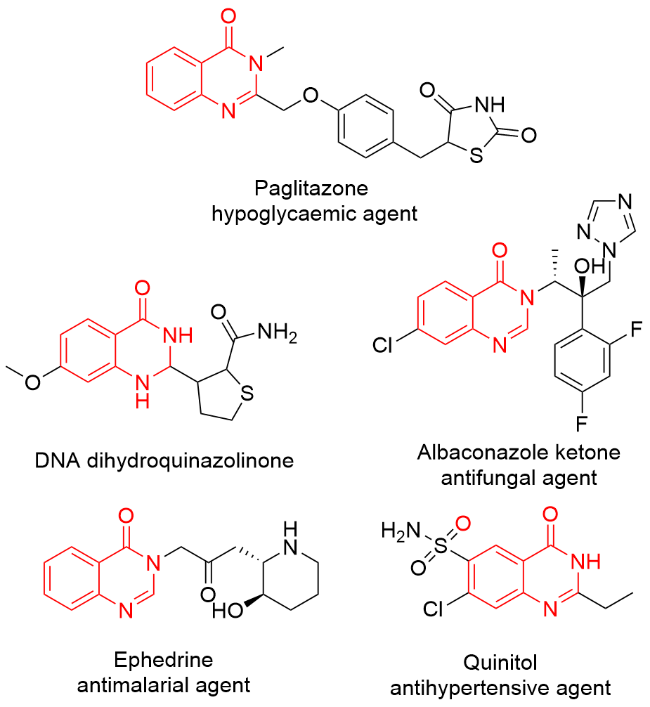
4-Quinazolinone is a key structural motif in medicinal compounds because of its broad spectrum of biological applications,[1] such as the hypoglycaemic agent paglitazone,[2] deoxyribonucleic acid (DNA) dihydroquinazolinone,[3] antifungal agent albaconazole ketone,[4] antimalarial agent ephedrine[5] and antihypertensive agent quinitol[6]. (Figure 1). Given the importance of 4-quinazolinone,[7-9] various synthetic strategies have been developed, such as the reaction of aminobenzamide with alde-hydes,[10] coupling of o-halobenzamide with alcohols and the transformation of indirubic anhydride,[11-12] amides and aldehydes[13-15] (Figure 2). Amongst these, the reaction between o-aminobenzamide and benzyl alcohol (or benzaldehyde) has garnered widespread attention owing to the accessibility of starting materials and the green nature of the procedure.
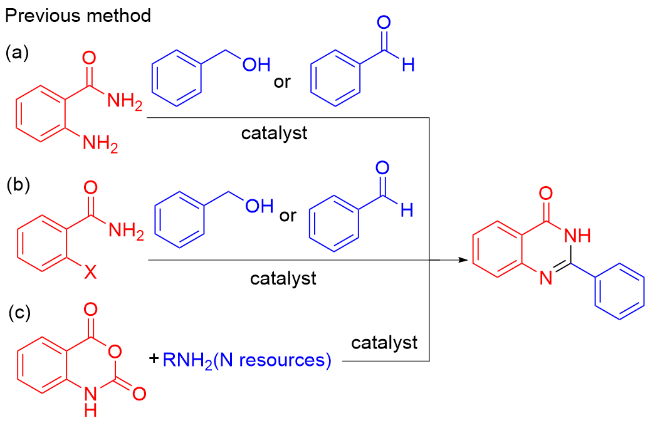
For the reaction of benzaldehyde with o-aminobenz- amide, reported catalysts including the photocatalyst Cu,[16] novel functionalized nanomagnetic composite materials (HPA) based on heteropolyacids,[17] Fe3O4 magnetic nanoparticles (MNPs) loaded with 1,4-diazabicyclo[2.2.2]- octane tribromide [1,4-diazabicyclo[2.2.2]octane (DABCO) tribromide],[18] chiral phosphoric acids[19] and iodine as an electrochemical catalyst,[20] a new catalyst [TEMPOLQ8][HSO4] can even be used to catalyze the reaction between benzaldehyde and an oxidizing agent to produce o-aminobenzamide,[21] such as using catalytic amounts of iodine (which acts as both a Lewis acid and an oxidizing agent).[22] Alternatively, molecular milling can be employed to combine benzaldehyde with amides to form quinazolinone compounds.[23] Inspite these catalysts can promote the oxidation step, they suffer from difficult synthesis and instability, which resulting in unwanted oxidation to benzoic acid. Compared with the aforementioned reaction, the reaction of benzyl alcohol with o-amino- benzamide was realized by catalyst such as Pd and Rh complexes,[24] antarctic pseudofilamentous yeast lipase,[25] visible-light photocatalysts fluorescein[26] or manganaelectro-catalyst[27]. Although these methods improve the conversion of alcohols and o-aminobenzamide, they continue to suffer from certain limitations, such as the use of expensive metal catalysts and prolonged reaction times. Therefore, developing green, efficient and environmental- friendly strategies for finishing this reaction is still desirable.
Over the years, emergence of functional ionic liquids (ILs), which comprise organic cations and inorganic or organic anions, are low-melting salts that are structurally tunable through the independent modification of their ionic components,[28-31] has created new opportunities for constructing catalytic systems.[32-35] The synergistic effects of electrostatic and hydrogen bonding interactions in ILs endow them with unique catalytic properties,[36] especially application in numerous transformations.[37-39] For examples, Our group[40] employed 1-propylsulfonic-3-methyl- imidazolium trifluoromethanesulfonate ([SO3H-PMIm]- [OTf]) as the catalyst for the reaction of alcohols and diarylmethane; Wang et al.[41] used [SO3H-BMIm][OTf] (1-butyl-3-methylimidazolium trifluoromethanesulfonate) to promote the ether transformations through hydrogen- bonding. Gao’s group[42] found that [Bmim][OAc](3-butyl- 1-methylimidazolium acetate) activates carbon dioxide and hydrosilanes to form methoxysilane intermediates and activates 2-aminothiophenol via hydrogen bonding to synthesize benzothiazoles. Above all, that searching for suitable ILs paves a new way for efficiently accomplishing the reaction between alcohol and o-aminobenzamide under mild conditions.[43-45] Therefore, selecting and seeking suitable ILs offers a promising strategy to promote the reaction between alcohols and o-aminobenzamide under mild conditions.
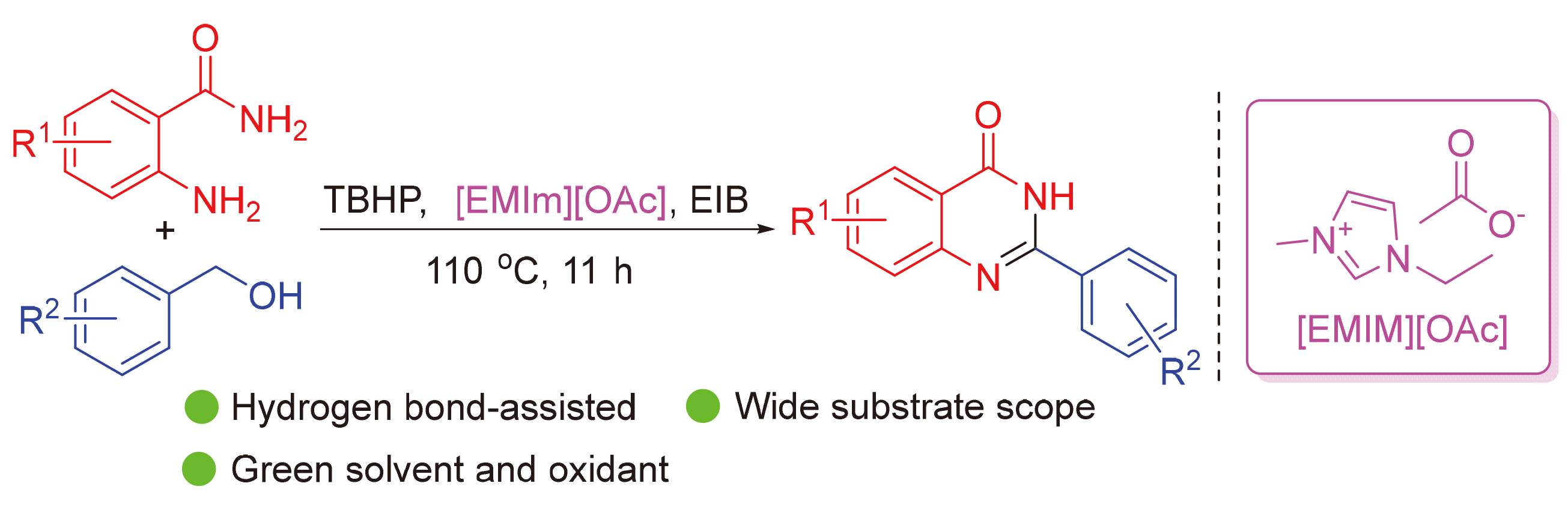
Building upon our previous research on IL-mediated selective oxidation of alcohols,[46] 1-ethyl-3-methylimida- zolium acetate ([EMIm][OAc]) was identified as a multifunctional catalyst for the tandem oxidative synthesis of 2-phenylquinazolin-4(3H)-ones from alcohols and o-aminobenzamide. Density functional theory (DFT) calculations and control experiments confirmed that the hydrogen bond-assisted tert-butyl hydroperoxide (TBHP) oxidative route proceeds via a tandem sequence: benzyl alcohol is first oxidised to benzaldehyde in the presence of [EMIm][OAc] and TBHP. The [EMIm][OAc] activates the NH2 group of 2-aminobenzamide via strong hydrogen bonding, thereby enhancing the nucleophilicity of the nitrogen atom and facilitating the formation of 2-(benzyl- ideneamino)benzamide. Further hydrogen bonding between [EMIm][OAc] and the amide NH2 group in this intermediate facilitates intramolecular cyclisation to form tetrahydro-4(1H)-quinazolinone, which undergoes dehydrogenation under TBHP oxidation to yield the final quinazolinone product. This method is scalable to gram quantities and offers a green and efficient approach for synthesising quinazolinones.
2 Results and discussion
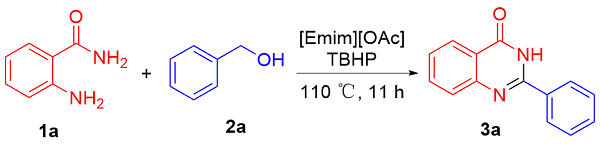
The reaction between 2-aminobenzamide (1a) and benzyl alcohol (2a) was used as the model reaction to optimise the reaction conditions. Initially, some ILs were screened, such as [SO3HPMIm][OTf], [EMIm][ClO4], [HOEMIm][OTf], [HOOCEMIm][OTf], [SO3HBMIm]- [HSO4], [EMIM][AlCl4], [EMIm][NTf2], [HOOCMMIm][Cl], [EMIm][Cl], [EMIm][NO3], [EMIM][OAc], [TMG][OAc] and [HOEtMIm][OAc] (the structures of IL are shown in Figure 3). Amongst them, [HOEtMIm][OAc] and acetate-based ILs exhibited superior results (Table 1, Entries 1~4), and [EMIm][OAc] was selected because of its relatively low cost. The oxidants (Table 1, Entries 5~9), including MnO2, benzoyl peroxide (BPO), TBHP, di-tert-butyl peroxide (DTBP) and tert-butyl peroxybenzoate (TBPB), were examined, TBHP and BPO exhibited good activity. However, TBHP was selected as the optimal oxidant owing to the instability.[47] We then examined the solvent (Table 1, Entries 10~13), the ratio of substrates 1a and 2a (Table 1, Entries 15~18), reaction temperature Table 1, Entries 18~22) and reaction time (Table 1, Entries 23~25), the optimal reaction conditions were accordingly established: 1a (0.2 mmol), 2a (0.6mmol), [EMIm][OAc] (0.2 mmol), TBHP (1.2 mmol), 110 ℃, 11 h and ethyl isobutyrate (EIB, 1 mL). Moreover, 3a could be synthesized in gram level: 10 mmol 1a and 30 mmol 2a were performed under the optimal conditions, 3a was obtained in 71% yield (1.4342 g), providing both theoretical and methodological support for the practical implementation of reactions.
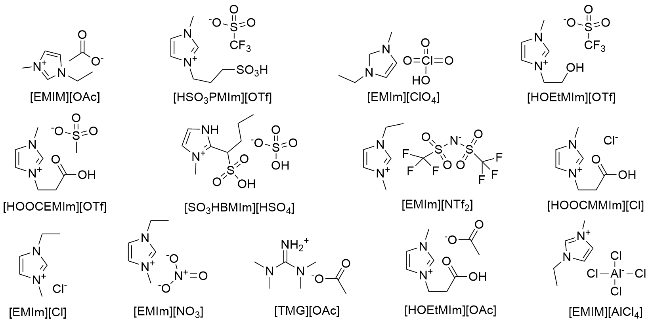
Table 1 Optimization of the reaction conditionsa |
| Entry | IL | Oxidant | T/℃ | Solvent | Yieldb/% |
|---|---|---|---|---|---|
| 1 | [HSO3PMIm][OTf] | TBHP | 110 | EIB | Trace |
| 2 | [EMIm][ClO4] | TBHP | 110 | EIB | Trace |
| 3 | [EMIm][NO3] | TBHP | 110 | EIB | Trace |
| 4 | [EMIM][OAc] | TBHP | 110 | EIB | 91 |
| 5 | [EMIM][OAc] | MnO₂ | 110 | EIB | 15 |
| 6 | [EMIM][OAc] | BPO | 110 | EIB | 65 |
| 7 | [EMIM][OAc] | DTBP | 110 | EIB | 30 |
| 8 | [EMIM][OAc] | TBPB | 110 | EIB | 15 |
| 9 | [EMIM][OAc] | BPO | 110 | EIB | 68 |
| 10 | [EMIM][OAc] | TBHP | 110 | MB | 89 |
| 11 | [EMIM][OAc] | TBHP | 110 | 1,4-dioxane | 0 |
| 12 | [EMIM][OAc] | TBHP | 110 | H2O | 0 |
| 13 | [EMIM][OAc] | TBHP | 110 | TFE | 82 |
| 14c | [EMIM][OAc] | TBHP | 110 | EIB | 17 |
| 15d | [EMIM][OAc] | TBHP | 110 | EIB | 18 |
| 16e | [EMIM][OAc] | TBHP | 110 | EIB | 20 |
| 17f | [EMIM][OAc] | TBHP | 110 | EIB | 34 |
| 18g | [EMIM][OAc] | TBHP | 110 | EIB | 51 |
| 19h | [EMIM][OAc] | TBHP | 90 | EIB | 82 |
| 20 | [EMIM][OAc] | TBHP | 100 | EIB | 13 |
| 21 | [EMIM][OAc] | TBHP | 120 | EIB | 48 |
| 22 | [EMIM][OAc] | TBHP | 130 | EIB | 57 |
| 23i | [EMIM][OAc] | TBHP | 110 | EIB | 77 |
| 24j | [EMIM][OAc] | TBHP | 110 | EIB | 88 |
| 25k | [EMIM][OAc] | TBHP | 110 | EIB | 92 |
a Reaction conditions: 1a (0.2 mmol), 2a (0.6 mmol), [EMIm][OAc] (0.2 mmol), TBHP (1.2 mmol), 110 ℃, 11 h, 1 mL EIB. b The reaction mixture was purified by HPLC to isolate the product 3a [V(CH3OH)∶V(H2O)=70∶30], flow rate: 1 mL/min, column oven temperature: 30 ℃. c n(1a)∶n(2a)=1∶1. d n(1a)∶n(2a)=1∶1.5. e n(1a)∶n(2a)=1∶2. f n(1a)∶n(2a)=1∶2.5. g 3.0 equiv. of oxidant. h 4.5 equiv. of oxidant. i 9 h. j 10 h. k12 h. |
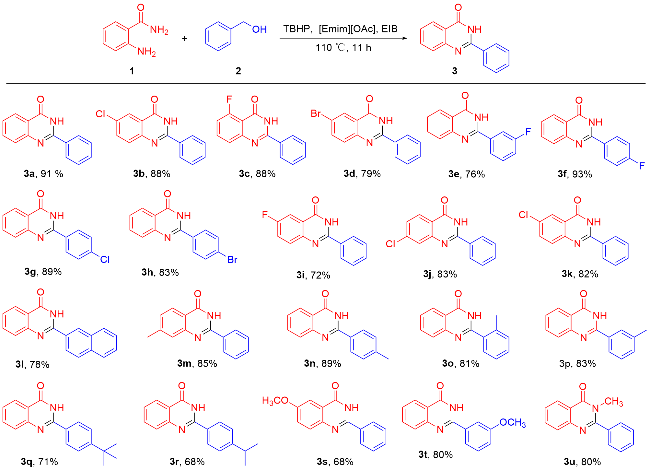
With the optimal reaction conditions established, the substrate scope of the reaction was explored (Scheme 1, 3a~3u). Both mono-substituted benzyl alcohols and 2-aminobenzamides were compatible with the reaction conditions (3a~3v). Substrates bearing halogen substituents (F, Cl and Br) afforded the desired quinazolinone products in good to excellent yields (3b~3k). The reaction of anthracene alcohol with o-aminobenzamide gave a decent yield. Moreover, substrates with alkyl substituents exhibited high reactivity (3m~3r). However, steric hindrance considerably affected reactivity, with reactivity decreasing in the following sequence of methyl-substituted benzyl alcohols: para>meta>ortho (3n, 3o and 3p). N-methyl-substituted o-aminobenzamide could react smoothly with benzyl alcohol to afford compound 3u. Substrates containing ether groups were well tolerated (3s and 3t). In contrast, alkyl alcohols and other functionalized amine compounds may not participate in the conversion process owing to their inherently lower reactivity.
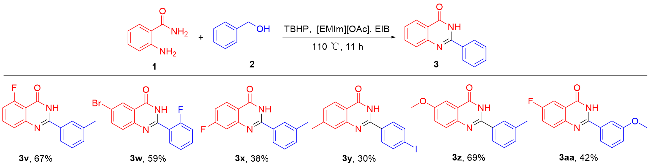
Furthermore, mono-substituted acetanilides were found to undergo successful cyclisation with mono-substituted benzyl alcohols (Scheme 2, 3v~3aa). Halogenated amines reacted effectively with halogenated benzyl alcohols (3w). Moreover, halogen-substituted 2-aminobenzamides reacted with methyl-substituted benzyl alcohols (3v, 3x), considering that steric hindrance may be responsible for the reduced nucleophilicity of N, resulting in a low yield of 3v, 3x. And vice versa methyl-substituted 2-aminobenzamides with halogenated benzyl alcohols (3y), the presence of methyl groups weakens hydrogen bonds through electron-withdrawing effects, resulting in a lower yield of 3y. Further, m-methoxybenzyl alcohol coupled with 2-amino- 5-methoxybenzamide and 2-amino-5-fluorobenzamide to form products 3z and 3aa in good yields, respectively.
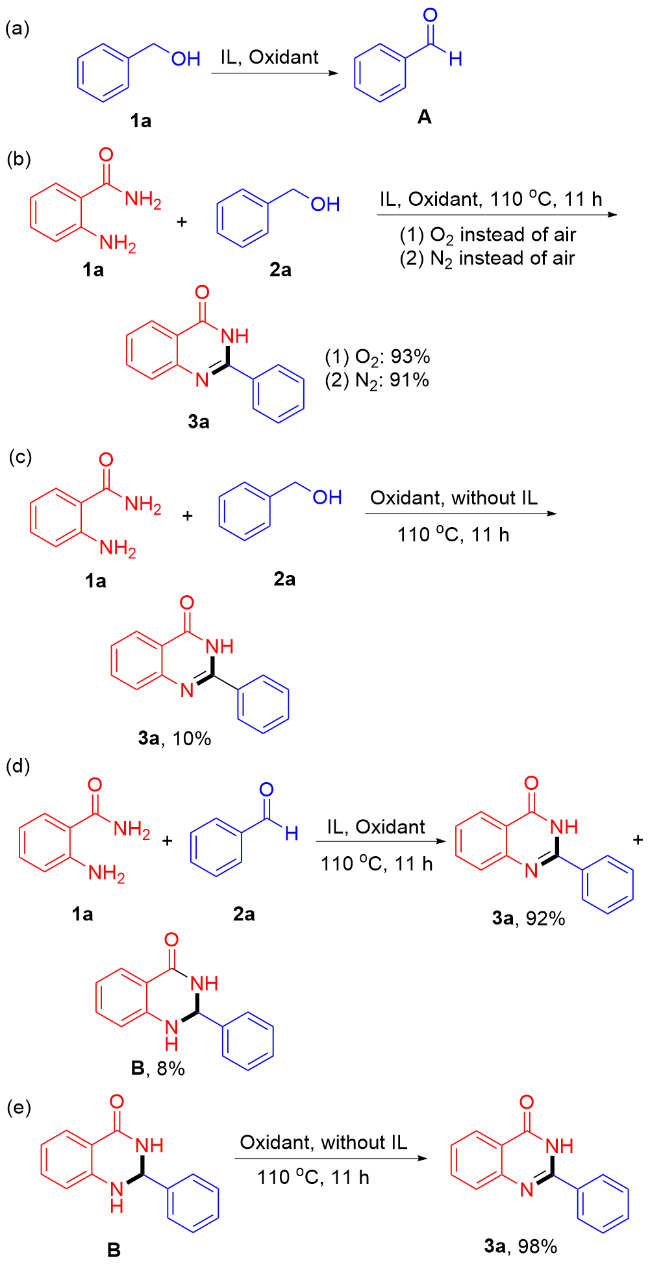
To elucidate the reaction mechanism, several control experiments were conducted (Scheme 3). Benzyl alcohol was successfully oxidised to benzaldehyde in the presence of TBHP and [EMIm][OAc], thus confirming benzaldehyde as a key intermediate (Scheme 3a). The reaction between 1a and 2a proceeded under N2 and O2 atmospheres, validating the role of TBHP as the principal oxidising agent (Scheme 3b). Only 10% yield of product 3a was obtained in the absence of IL (Scheme 3c), highlighting the critical synergistic role of TBHP and [EMIm][OAc]. Furthermore, the reaction between benzaldehyde and 2a yielded the desired product in 92% yield along with isolation of the intermediate dihydroquinazolinone (Scheme 3d). The latter was subsequently converted to 3a in the presence of TBHP, verifying it as another key intermediate (Scheme 3e).
To gain deeper mechanistic insight, the interaction between IL and the reactants was investigated. Aniline was used as a model compound to facilitate the observation of chemical shift of the NH2 group in 1a. As shown in Figure 4a, the NH2 proton signal in pure aniline occurs at δ 5.74 but moves downfield to δ 5.80 in the [EMIm][OAc]-aniline mixture, again indicative of hydrogen bonding with the [OAc]– oxygen. Accordingly, the phenyl carbon bonded to nitrogen shifts from δ 146.65 in pure aniline to δ 148.25 in the mixture (Figure 4b), offering additional evidence for the hydrogen bond. Supporting DFT calculations (Figures 4c) gave a hydrogen-bond distance of 1.82 nm between the NH2 hydrogen of 1a and the oxygen of [OAc]–, confirming a strong interaction. This was accompanied by a change in the natural bond orbital (NBO) charge on nitrogen from –0.760 to –0.767, reflecting increased nucleophilicity of the NH2 nitrogen (Figure 4c). Similarly, for the NH2 group in the amide moiety of the intermediate 3-phenyl-4(3H)-quinazolinone, the calculated hydrogen-bond length with the ionic-liquid anion was 1.74 nm, along with an NBO charge change from –0.795 to –0.798, which further indicates enhanced nucleophilicity of the CONH2 nitrogen (Figure 4d). Due to the stronger electron-withdrawing effect of the carbonyl group on the amide group, the acetate anion in [EMIm][OAc] first activates the amide group of o-aminobenzamide through strong hydrogen bonding. The nitrogen atom of CONH2 group in 2-aminobenzamide (1a) exhibits enhanced nucleophilicity due to hydrogen bonding with the acetate ion in the IL, thereby facilitating the reaction.
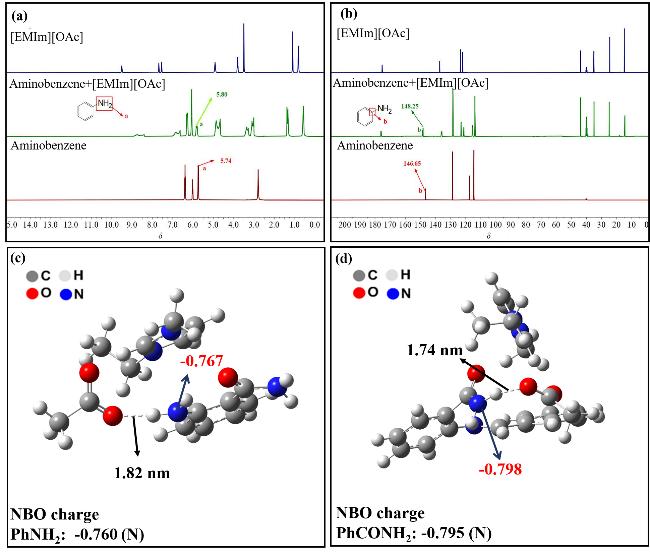
Figure 4 Mechanistic investigation. (a) Variations of hydrogen shifts of amino groups on aniline before and after addition of ILs; (b) Variations of carbon shifts of amino groups on aniline before and after addition of ILs; (c) NBO potential for hydrogen bonding between NH2 of substrate 1a and [EMIm][OAc]; (d) NBO potential for hydrogen bonding between CONH2 of substrate 1a and [EMIm][OAc] |
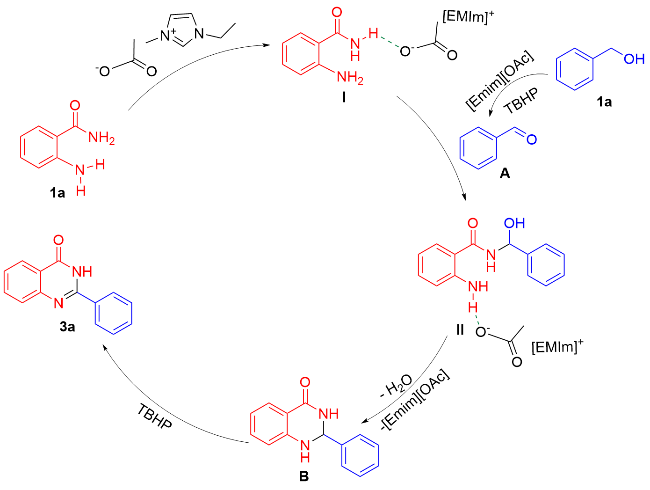
Based on the above results, a plausible reaction pathway is proposed as follows. Initially, benzyl alcohol is selectively oxidized to benzaldehyde in the presence of [EMIm][OAc] and an oxidant.[46] The resulting benzaldehyde then undergoes condensation with activated 2-amino- benzamide to afford intermediate 2-amino-N-benzyl- benzamide (I). Subsequently, the amino group in this intermediate undergoes intramolecular cyclization with II, which is stabilized through hydrogen bonding with [EMIm][OAc], giving tetrahydroquinazolinone B. Finally, this intermediate undergoes oxidative dehydrogenation with excess TBHP, furnishing the desired quinazolinone product 3a (Scheme 4).


3 Conclusions
A green and transition metal-free catalytic system was developed for synthesizing 2-phenylquinazolin-4(3H)-ones via cyclocondensation of benzyl alcohols with 2-amino- benzamides in the presence of [EMIm][OAc] and TBHP. Mechanistic investigations revealed that [EMIm][OAc] enhanced the oxidative capability of TBHP to enable selective oxidation of alcohols to aldehydes. Moreover, [EMIm][OAc] activated the amino groups of the substrates through hydrogen bonding and facilitates intramolecular cyclisation and TBHP-mediated dehydrogenation. Under the optimised conditions, this protocol synthesised 26 quinazolinone derivatives in yields ranging from 30% to 93%. The reaction was scalable to the gram level, achieving a 78% yield. This strategy exemplifies a sustainable and efficient approach to heterocycle construction, aligning with the principles of green chemistry using non-toxic IL catalysts, environmentally benign oxidants and acceptable solvents.
4 Experimental section
4.1 General information
All reactions were carried out under an atmosphere of air unless otherwise noted. Column chromatography was per-formed using silica gel (200~300 mesh). 1H NMR and 13C NMR spectra were recorded on BrukerAV (500 and 126 MHz, respectively) instrument using DMSO as solvent and TMS as an internal standard. The structures of known compounds were further corroborated by comparing their 1H NMR, 13C NMR data and with those of literature. Melting points were measured on an SGW X-4 melting point apparatus. All reagents were obtained from commercial suppliers and used without further purification. Unless otherwise noted, all reagents were supplied from commercial sources.
4.2 General procedure for the synthesis of all products (3a~3z, 3aa)
Add 2-aminobenzamide derivatives (0.2 mmol, 1.0 equiv.), benzyl alcohol derivatives (0.6 mmol, 3.0 equiv.), TBHP (1.2 mmol, 6.0 equiv.), [Emim][OAc] (0.2 mmol, 1.0 equiv.) and 1 mL EIB to a 10 mL glass test tube. Stir the reaction mixture at 110 ℃ for 11 h. After reaction completion, the reaction mixture was extracted with ethyl acetate (25 mL×3). The organic layer was collected, the solvent was concentrated under vacuum, and the product was purified by silica gel rapid chromatography [V(ethyl acetate)∶V(petroleum ether)=1∶3] to afford 2-(p-tolyl)- quinazolin-4(3H)-one (3a): White solid, m.p. 235.2~236.4 ℃ (lit.[48] 241.5~243.8 ℃); 1H NMR (500 MHz, DMSO-d6) δ: 12.56 (s, 1H), 8.19 (dd, J=13.5, 7.7 Hz, 3H), 7.85 (t, J=7.7 Hz, 1H), 7.76 (d, J=8.2 Hz, 1H), 7.57 (tt, J=14.7, 7.2 Hz, 4H); 13C NMR (126 MHz, DMSO) δ: 162.25, 152.32, 148.70, 134.57, 132.72, 131.37, 128.58, 127.75, 127.47, 126.55, 125.84, 120.97.
3b~3z and 3aa were synthesized using the same method as 3a.
6-Chloro-2-phenylquinazolin-4(3H)-one (3b): White solid, m.p. 290.6~293.3 ℃ (lit.[48] >300 ℃); 1H NMR (500 MHz, DMSO-d6) δ: 12.72 (s, 1H), 8.18 (d, J=6.9 Hz, 2H), 8.09 (d, J=2.5 Hz, 1H), 7.87 (dd, J=8.7, 2.5 Hz, 1H), 7.77 (d, J=8.7 Hz, 1H), 7.62~7.54 (m, 3H); 13C NMR (126 MHz, DMSO) δ: 161.33, 152.83, 147.49, 134.73, 132.45, 131.63, 130.78, 129.77, 128.67, 127.87, 124.90, 122.25.
5-Fluoro-2-phenylquinazolin-4(3H)-one (3c): White solid, m.p. 293.7~295.6 ℃ (lit.[49] 308~310 ℃); 1H NMR (500 MHz, DMSO-d6) δ: 12.58 (s, 1H), 8.18 (d, J=6.8 Hz, 2H), 7.84~7.78 (m, 1H), 7.64~7.53 (m, 5H), 7.30~7.23 (m, 1H); 13C NMR (126 MHz, DMSO) δ: 162.05, 160.03, 159.96, 153.74, 151.38, 135.66, 135.58, 132.69, 132.14, 129.41, 129.09, 128.34, 127.48, 124.07, 113.43, 113.27.
6-Bromo-2-phenylquinazolin-4(3H)-one (3d): White solid, m.p. 328.8~332.1 ℃ (lit.[48] >300 ℃); 1H NMR (500 MHz, DMSO-d6) δ: 12.74 (s, 1H), 8.23 (d, J=2.5 Hz, 1H), 8.18 (d, J=7.6 Hz, 2H), 7.99 (dd, J=8.7, 2.5 Hz, 1H), 7.70 (d, J=8.6 Hz, 1H), 7.61 (t, J=7.2 Hz, 1H), 7.56 (t, J=7.5 Hz, 2H); 13C NMR (126 MHz, DMSO-d6) δ: 161.65, 153.40, 148.22, 137.91, 132.92, 132.11, 130.38, 129.13, 128.47, 128.33, 123.09, 119.42.
2-(3-Fluorophenyl)quinazolin-4(3H)-one (3e): White solid, m.p. 274.1~276.5 ℃ (lit.[50] 276~278 ℃); 1H NMR (500 MHz, DMSO-d6) δ: 12.60 (s, 1H), 8.13 (d, J=7.9 Hz, 1H), 8.03 (d, J=7.8 Hz, 1H), 7.98 (d, J=10.4 Hz, 1H), 7.85~7.79 (m, 1H), 7.73 (d, J=8.1 Hz, 1H), 7.61~7.54 (m, 1H), 7.52 (t, J=7.5 Hz, 1H), 7.42 (td, J=8.5, 2.6 Hz, 1H); 13C NMR (126 MHz, DMSO) δ: 163.08, 162.17, 161.14, 151.04, 148.48, 135.06, 135.00, 134.72, 130.81, 130.74, 127.64, 126.94, 125.91, 123.97, 123.95, 121.14, 118.38, 118.21, 114.66, 114.47.
2-(4-Fluorophenyl)quinazolin-4(3H)-one (3f): White solid, m.p. 305.7~308.4 ℃ (lit.[51] 288~289 ℃); 1H NMR (500 MHz, DMSO-d6) δ: 12.60 (s, 1H), 8.26 (dd, J=8.8, 5.5 Hz, 2H), 8.16 (d, J=7.8 Hz, 1H), 7.92~7.81 (m, 1H), 7.74 (d, J=8.0 Hz, 1H), 7.53 (t, J=7.3 Hz, 1H), 7.41 (t, J=8.8 Hz, 2H); 13C NMR (126 MHz, DMSO-d6) δ: 165.06, 163.07, 151.41, 148.65, 134.67, 130.44, 129.24, 127.47, 126.65, 125.89, 120.89, 115.76.
2-(4-Chlorophenyl)quinazolin-4(3H)-one (3g): White solid, m.p. 297.8~299.6 ℃ (lit.[48] m.p. >300 ℃); 1H NMR (500 MHz, DMSO-d6) δ: 12.63 (s, 1H), 8.19 (dd, J=24.0, 8.2 Hz, 3H), 7.85 (t, J=7.6 Hz, 1H), 7.75 (d, J=8.1 Hz, 1H), 7.63 (d, J=8.5 Hz, 2H), 7.54 (t, J=7.5 Hz, 1H); 13C NMR (126 MHz, DMSO-d6) δ: 162.21, 151.36, 148.59, 136.32, 134.70, 131.56, 129.65, 128.72, 127.55, 126.81, 125.90, 121.01.
2-(4-Bromophenyl)quinazolin-4(3H)-one (3h): White solid, m.p. 291.3~294.2 ℃ (lit.[52] 293.1~295.5 ℃); 1H NMR (500 MHz, DMSO-d6) δ: 12.64 (s, 1H), 8.15 (dd, J=13.6, 8.3 Hz, 3H), 7.89~7.80 (m, 1H), 7.76 (t, J=9.3 Hz, 3H), 7.54 (t, J=7.3 Hz, 1H); 13C NMR (126 MHz, DMSO-d6) δ: 162.64, 151.91, 149.03, 135.16, 132.37, 132.10, 130.27, 128.01, 127.27, 126.35, 125.72, 121.49.
6-Fluoro-2-phenylquinazolin-4(3H)-one (3i): White solid, m.p. 274.2~276.6 ℃ (lit.[48] >300 ℃); 1H NMR (500 MHz, DMSO-d6) δ: 12.68 (s, 1H), 8.16 (d, J=7.6 Hz, 2H), 7.82 (dt, J=8.8, 4.3 Hz, 2H), 7.72 (td, J=8.7, 3.0 Hz, 1H), 7.56 (dt, J=14.7, 7.1 Hz, 3H); 13C NMR (126 MHz, DMSO-d6) δ: 161.41, 159.46, 152.31, 146.08, 133.00, 131.89, 130.81, 129.08, 128.21, 123.63, 122.67, 111.07.
7-Chloro-2-phenylquinazolin-4(3H)-one (3j): White solid, m.p. 276.6~279.2 ℃ (lit.[53] 276~288 ℃); 1H NMR (500 MHz, DMSO-d6) δ: 12.70 (s, 1H), 8.16 (dd, J=17.3, 7.9 Hz, 3H), 7.79 (d, J=1.8 Hz, 1H), 7.64~7.54 (m, 4H); 13C NMR (126 MHz, DMSO-d6) δ: 161.23, 152.96, 147.73, 137.43, 132.47, 131.64, 129.87, 128.66, 128.01, 127.87, 122.61, 118.95.
6-Chloro-2-phenylquinazolin-4(3H)-one (3k): White solid, m.p. 290.4~293.1 ℃ (lit.[54] 276~278 ℃); 1H NMR (500 MHz, DMSO-d6) δ: 12.72 (s, 1H), 8.18 (d, J=6.9 Hz, 2H), 8.09 (d, J=2.5 Hz, 1H), 7.87 (dd, J=8.7, 2.5 Hz, 1H), 7.77 (d, J=8.7 Hz, 1H), 7.62~7.54 (m, 3H); 13C NMR (126 MHz, DMSO-d6) δ: 161.33, 152.83, 147.49, 134.73, 132.45, 131.63, 130.78, 129.77, 128.67, 127.87, 124.90, 122.25.
2-(Naphthalen-2-yl)quinazolin-4(3H)-one (3l): White solid, m.p. 281.4~282.2 ℃ (lit.[53] 276~278 ℃); 1H NMR (500 MHz, DMSO-d6) δ: 12.62 (s, 1H), 8.32 (d, J=8.5 Hz, 2H), 8.18 (d, J=7.9 Hz, 1H), 7.86 (t, J=9.6 Hz, 3H), 7.78 (t, J=6.4 Hz, 3H), 7.59~7.48 (m, 3H), 7.44 (t, J=7.3 Hz, 1H); 13C NMR (126 MHz, DMSO-d6) δ: 162.72, 152.37, 149.24, 143.29, 139.41, 135.10, 132.00, 129.54, 128.84, 128.65, 127.99, 127.32, 127.22, 127.06, 126.34, 121.47.
7-Methyl-2-phenylquinazolin-4(3H)-one (3m): White solid, m.p. 237.0~238.5 ℃ (lit.[53] 239~240 ℃); 1H NMR (500 MHz, DMSO-d6) δ: 12.48 (s, 1H), 8.20~8.15 (m, 2H), 8.05 (d, J=8.1 Hz, 1H), 7.61~7.54 (m, 4H), 7.38~7.33 (m, 1H), 2.48 (s, 3H); 13C NMR (126 MHz, DMSO-d6) δ: 161.95, 150.42, 146.50, 135.01, 134.32, 132.33, 130.74, 128.02, 127.13, 125.47, 122.89, 120.27, 16.57.
2-(p-Tolyl)quinazolin-4(3H)-one (3n): White solid, m.p. 240.3~242.4 ℃ (lit.[48] 240.6~243.6 ℃); 1H NMR (500 MHz, DMSO-d6) δ: 12.48 (s, 1H), 8.14 (d, J=7.9 Hz, 1H), 8.09 (d, J=8.0 Hz, 2H), 7.84~7.79 (m, 1H), 7.72 (d, J=8.0 Hz, 1H), 7.52~7.47 (m, 1H), 7.34 (d, J=8.0 Hz, 2H), 2.37 (s, 3H); 13C NMR (126 MHz, DMSO-d6) δ: 162.73, 152.65, 149.28, 141.89, 135.01, 130.33, 129.64, 128.13, 127.87, 126.83, 126.30, 121.35, 21.45.
2-(o-Tolyl)quinazolin-4(3H)-one (3o): White solid, m.p. 212.5~213.8 ℃ (lit.[55] 214~215 ℃); 1H NMR (500 MHz, DMSO-d6) δ: 12.47 (s, 1H), 8.17 (d, J=7.5 Hz, 1H), 7.84 (t, J=7.6 Hz, 1H), 7.70 (d, J=8.1 Hz, 1H), 7.61~7.47 (m, 2H), 7.44 (t, J=7.2 Hz, 1H), 7.39~7.27 (m, 2H), 2.39 (s, 3H); 13C NMR (126 MHz, DMSO-d6) δ: 162.24, 154.83, 149.19, 136.57, 134.93, 134.68, 130.99, 130.36, 129.60, 127.83, 127.10, 126.25, 126.16, 121.44, 20.04.
2-(m-Tolyl)quinazolin-4(3H)-one (3p): White solid, m.p. 240.0~242.3 ℃ (lit.[52] 237.3~239.5 ℃); 1H NMR (500 MHz, DMSO-d6) δ: 12.51 (s, 1H), 8.16 (d, J=7.6 Hz, 1H), 8.04 (s, 1H), 7.98 (d, J=6.9 Hz, 1H), 7.85 (t, J=7.1 Hz, 1H), 7.76 (d, J=7.9 Hz, 1H), 7.53 (t, J=7.1 Hz, 1H), 7.49~7.36 (m, 2H), 2.42 (s, 3H); 13C NMR (126 MHz, DMSO-d6) δ: 162.74, 152.88, 149.16, 138.37, 135.04, 133.10, 132.46, 128.96, 128.75, 127.87, 126.98, 126.31, 125.34, 121.42, 21.45.
2-(4-(tert-Butyl)phenyl)quinazolin-4(3H)-one (3q): White solid, m.p. 243.1~245.5 ℃ (lit.[56] 224~227 ℃); 1H NMR (500 MHz, DMSO-d6) δ: 12.51 (s, 1H), 8.15 (t, J=8.3 Hz, 3H), 7.88~7.80 (m, 1H), 7.74 (d, J=8.1 Hz, 1H), 7.59~7.48 (m, 3H), 1.33 (s, 9H); 13C NMR (126 MHz, DMSO-d6) δ: 162.76, 154.77, 152.65, 149.30, 135.05, 130.40, 128.03, 127.92, 126.89, 126.32, 125.91, 121.38, 35.15, 31.37.
2-(4-Isopropylphenyl)quinazolin-4(3H)-one (3r): White solid, m.p. 234.2~235.8 ℃ (lit.[50] 220~222 ℃); 1H NMR (500 MHz, DMSO-d6) δ: 12.50 (s, 1H), 8.22~8.09 (m, 3H), 7.84 (t, J=7.7 Hz, 1H), 7.74 (d, J=8.2 Hz, 1H), 7.52 (t, J=7.6 Hz, 1H), 7.43 (d, J=7.9 Hz, 2H), 2.98 (s, 1H), 1.25 (d, J=7.0 Hz, 6H); 13C NMR (126 MHz, DMSO-d6) δ: 162.30, 152.25, 152.15, 148.86, 134.62, 130.33, 127.86, 127.47, 126.61, 126.45, 125.87, 120.93, 33.41, 23.64.
6-Methoxy-2-phenylquinazolin-4(3H)-one (3s): White solid, m.p. 309.1~310.8 ℃ (lit.[48] >300 ℃); 1H NMR (500 MHz, DMSO-d6) δ: 12.52 (s, 1H), 8.16 (d, J=7.3 Hz, 2H), 7.70 (d, J=8.9 Hz, 1H), 7.54 (d, J=7.4 Hz, 4H), 7.44 (dd, J=9.0, 3.0 Hz, 1H), 3.89 (s, 3H); 13C NMR (126 MHz, DMSO-d6) δ: 162.08, 157.77, 150.10, 143.23, 132.81, 131.08, 129.26, 128.62, 127.52, 124.17, 121.81, 105.84, 55.67.
2-(3-Methoxyphenyl)quinazolin-4(3H)-one (3t): White solid, m.p. 203.2~205.0 ℃ (lit.[51] 202~204 ℃); 1H NMR (500 MHz, DMSO-d6) δ: 12.61 (s, 1H), 8.18 (d, J=6.2 Hz, 1H), 7.90~7.72 (m, 4H), 7.46~7.55 (m, 2H), 7.16 (d, J=10.7 Hz, 1H), 3.88 (s, 3H); 13C NMR (126 MHz, DMSO-d6) δ: 162.77, 159.80, 152.53, 149.08, 135.06, 134.49, 130.20, 127.96, 127.08, 126.33, 121.48, 120.59, 118.06, 112.97, 55.84.
3-Methyl-2-phenylquinazolin-4(3H)-one (3u): White solid, m.p. 127.9~129.8 ℃ (lit.[48] 125~127 ℃); 1H NMR (500 MHz, DMSO-d6) δ: 8.14 (d, J=7.8 Hz, 1H), 7.79 (t, J=7.6 Hz, 1H), 7.67~7.59 (m, 3H), 7.58~7.47 (m, 4H), 3.32 (s, 3H); 13C NMR (126 MHz, DMSO-d6) δ: 162.11, 156.60, 147.52, 135.86, 134.81, 130.26, 128.87, 128.73, 127.64, 127.34, 126.55, 120.61, 34.36.
5-Fluoro-2-(m-tolyl)quinazolin-4(3H)-one (3v): White solid, m.p. 248.6~251.0 ℃; 1H NMR (500 MHz, DMSO- d6) δ: 12.50 (s, 1H), 8.02 (s, 1H), 7.97 (d, J=7.0 Hz, 1H), 7.83~7.77 (m, 1H), 7.56 (d, J=8.3 Hz, 1H), 7.43 (d, J=7.3 Hz, 2H), 7.26 (dd, J=11.0, 8.0 Hz, 1H), 2.41 (s, 3H); 13C NMR (126 MHz, DMSO-d6) δ: 162.05, 159.96, 153.83, 151.37, 138.41, 135.63, 135.55, 132.75, 132.61, 128.98, 128.84, 125.46, 123.99, 113.36, 113.20, 110.89, 21.42.
6-Bromo-2-(2-fluorophenyl)quinazolin-4(3H)-one (3w): White solid, m.p. 220.1~222.9 ℃; 1H NMR (500 MHz, DMSO-d6) δ: 12.79 (s, 1H), 8.25 (d, J=2.4 Hz, 1H), 8.00 (dd, J=8.7, 2.4 Hz, 1H), 7.79 (t, J=7.5 Hz, 1H), 7.70 (s, 1H), 7.68~7.60 (m, 1H), 7.44~7.39 (m, 1H), 7.37 (d, J=7.6 Hz, 1H); 13C NMR (126 MHz, DMSO-d6) δ: 160.55, 160.45, 158.56, 150.56, 147.69, 137.45, 133.13, 133.06, 131.10, 131.09, 129.90, 128.03, 124.68, 124.65, 122.75, 122.10, 122.00, 119.49, 116.33, 116.16.
7-Fluoro-2-(m-tolyl)quinazolin-4(3H)-one (3x): White solid, m.p. 242.9~244.3 ℃; 1H NMR (500 MHz, DMSO- d6) δ: 12.57 (s, 1H), 8.22~8.16 (m, 1H), 8.01 (s, 1H), 7.95 (d, J=5.4 Hz, 1H), 7.50 (d, J=10.2 Hz, 1H), 7.44~7.32 (m, 3H), 2.40 (s, 3H); 13C NMR (126 MHz, DMSO) δ: 167.30, 165.31, 161.97, 154.24, 151.47, 151.36, 138.41, 132.77, 132.75, 129.46, 129.37, 128.99, 128.88, 125.49, 118.48, 115.60, 115.42, 113.00, 112.83, 20.29.
2-(4-Iodophenyl)-7-methylquinazolin-4(3H)-one (3y): Yellow solid, m.p. 140.1~141.9 ℃; 1H NMR (500 MHz, DMSO-d6) δ: 12.51 (s, 1H), 8.03 (d, J=8.1 Hz, 1H), 7.98~7.90 (m, 4H), 7.55 (s, 1H), 7.36 (dd, J=8.1, 1.7 Hz, 1H), 2.47 (s, 3H); 13C NMR (126 MHz, DMSO-d6) δ: 161.89, 151.58, 148.56, 145.03, 137.32, 132.11, 129.43, 128.07, 127.03, 125.59, 118.49, 98.99, 21.23.
6-Methoxy-2-(m-tolyl)quinazolin-4(3H)-one (3z): Yellow solid, m.p. 212.3~213.7 ℃; 1H NMR (500 MHz, DMSO-d6) δ: 12.46 (s, 1H), 8.01 (s, 1H), 7.95 (d, J=7.6 Hz, 1H), 7.70 (d, J=8.8 Hz, 1H), 7.55 (d, J=3.0 Hz, 1H), 7.49~7.40 (m, 2H), 7.38 (d, J=7.5 Hz, 1H), 3.90 (s, 3H), 2.41 (s, 3H); 13C NMR (126 MHz, DMSO-d6) δ: 162.32, 158.17, 151.39, 145.61, 138.35, 133.19, 132.14, 129.66, 128.96, 128.51, 125.08, 124.60, 122.24, 106.29, 57.17, 22.45.
6-Fluoro-2-(3-methoxyphenyl)quinazolin-4(3H)-one (3aa): Yellow solid, m.p. 274.2~276.6 ℃; 1H NMR (500 MHz, DMSO-d6) δ: 12.73 (s, 1H), 8.10~7.61 (m, 5H), 7.46 (t, J=7.9 Hz, 1H), 7.15 (d, J=8.0 Hz, 1H), 3.87 (s, 3H); 13C NMR (126 MHz, DMSO-d6) δ: 161.25, 160.51, 158.86, 158.55, 151.13, 145.04, 133.37, 129.86, 129.28, 122.69, 122.50, 121.78, 119.62, 117.13, 112.03, 110.14, 109.95, 54.90.
4.3 Synthesis of intermediate B
Add 2-aminobenzamide (0.2 mmol, 1.0 equiv.), benzaldehyde (0.6 mmol, 3.0 equiv.), TBHP (1.2 mmol, 6.0 equiv.), and 2 mL of EIB to a 10 mL glass test tube. Stir the reaction mixture at 110 ℃ for 11 h. After the reaction, the mixture was extracted with ethyl acetate (25 mL×3). The organic layer was collected, the solvent was removed under vacuum, and the product was purified by silica gel rapid chromatography [V(ethyl acetate)∶V(petroleum ether)=1∶6] to afford 2-phenyl-2,3-dihydroquinazolin- 4(1H)-one (B): white solid, m.p. 212.3~215.5 ℃ (lit.[57] 217~218 ℃); 1H NMR (500 MHz, DMSO-d6) δ: 8.34 (s, 1H), 7.64 (d, J=7.8 Hz, 1H), 7.52 (d, J=7.1 Hz, 2H), 7.38 (dd, J=16.0, 7.4 Hz, 3H), 7.15 (s, 1H), 6.78 (d, J=8.1 Hz, 1H), 6.69 (t, J=7.5 Hz, 1H), 5.78 (t, J=1.9 Hz, 1H); 13C NMR (126 MHz, DMSO-d6) δ: 163.68, 147.93, 141.65, 133.38, 128.51, 128.38, 127.41, 126.92, 117.18, 114.99, 114.45, 66.62.
Supporting Information 1H NMR, 13C NMR data of of all products (3a~3z, 3aa) and intermediate B. The Supporting Information is available free of charge via the Internet at http://sioc-journal.cn/.
(Cheng, F.)