


1 Introduction
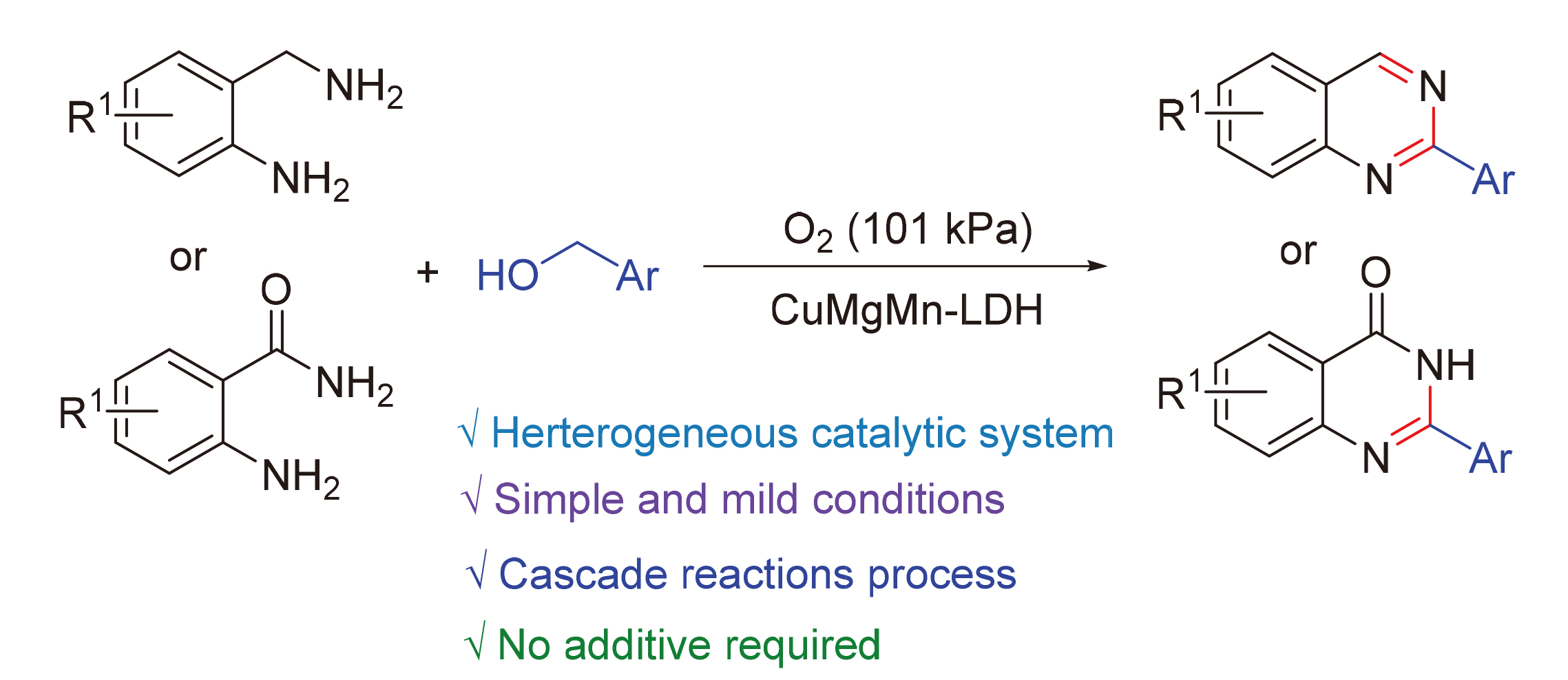
Quinazoline and its derivatives are common key heterocyclic scaffolds in drug molecules, pesticide active ingredients, and natural products, and efficient methods for constructing this framework have long been of significant interest.[1] Traditionally, quinazolines are synthesized via oxidative condensation of o-phenylenediamine or 2-amino- benzamide with aldehydes/ketones.[2] This route often relies on pre-prepared carbonyl substrates and, in many systems, still requires external oxidants or other additives to complete the dehydrogenative aromatization step, suggesting room for further optimization in terms of raw material economy and system simplification.
The cascade reaction using alcohols as carbonyl equivalents offers a more convenient route to quinazoline synthesis. This strategy typically follows an “alcohol oxidation to aldehyde, condensation of aldehyde with diamine to form tetrahydroquinazoline intermediate, followed by dehydrogenation and aromatization” cascade pathway. Significant progress has been made in methods based on alcohol and 2-aminobenzylamine (or 2-aminobenzamide), including both dehydrogenative coupling without acceptors[3] and aerobic oxidative coupling. As an economical synthetic method, various catalytic systems for oxidative coupling have been explored. Some homogeneous catalytic systems reported use precious metals or ligand systems, often in combination with basic additives to promote alcohol oxidation or facilitate the overall reaction.[4]
In contrast, heterogeneous catalysis offers natural advantages in catalyst recovery and reusability, making it suitable for such cascade transformations (Scheme 1).[5] For example, a Pd complex catalyst with KOH provided the corresponding product in 54% yield at 130 ℃ for 24 h.[5c] In contrast, a Cu-based metal-organic framework (MOF) system afforded quinazolinone in 95% yield in the presence of Cs2CO3 at 120 ℃ for 12 h.[5a] Building upon these studies, the development of a catalytic approach under oxygen conditions, with simplified reaction components and catalyst reusability, remains of practical significance.
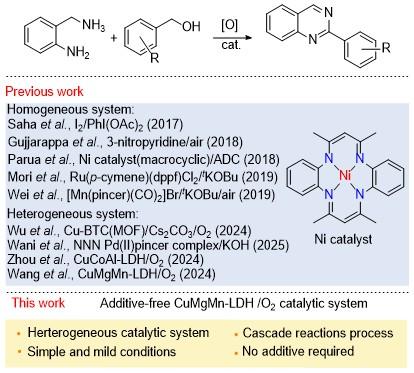
Layered double metal hydroxides (LDHs), due to their tunable metal sites and excellent solid stability, have been widely used as heterogeneous catalytic platforms.[6] In our previous work, the CuCoAl-LDH system was shown to catalyze the cascade reaction of alcohols and 2-amino- benzylamine to synthesize quinazolines.[5b] However, it was not effective in facilitating the reaction between 2-amino- benzamide and alcohols to form quinazolinones. In the present study, we reported an CuMgMn-LDH-based catalytic system for the efficient synthesis of quinazolines and quinazolinones via cascade reactions from 2-aminobenzyl- amine/2-aminobenzamide with alcohols without additives. This system uses molecular oxygen as the sole oxidant and achieves effective conversion without any external additives, demonstrating good applicability for various benzyl alcohols as well as some extended aromatic and heteroaromatic alcohols (Scheme 1).
2 Results and discussion
2.1 Optimization of the reaction conditions
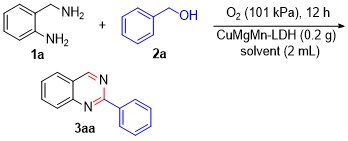
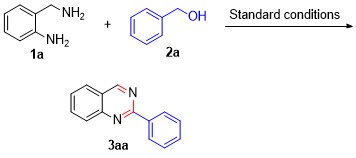
Using the oxidative coupling cyclization of 2-amino- benzylamine (1a) and benzyl alcohol (2a) to quinazoline (3aa) as a model reaction, the reaction conditions were systematically optimized (Table 1).
Table 1 Optimization of the reaction conditions |
| Entry | Solvent | T/℃ | Yield/% |
|---|---|---|---|
| 1 | Toluene | 80 | 56 |
| 2 | Acetonitrile | 80 | 58 |
| 3 | DCE | 80 | 2 |
| 4 | Trifluorotoluene | 80 | 42 |
| 5 | Water | 80 | 0 |
| 6 | Mesitylene | 80 | 41 |
| 7 | THF | 80 | 22 |
| 8 | n-Heptane | 80 | 71 |
| 9 | n-Heptane | 50 | 49 |
| 10 | n-Heptane | 60 | 60 |
| 11 | n-Heptane | 70 | 78 |
a Reaction conditions: 1a (1 mmol), 2a (1 mmol), CuMgMn-LDH (0.2 g), solvent (2 mL), O2 (101 kPa), 12 h. |
First, the solvent effect was investigated. Moderate yields were obtained with toluene and acetonitrile, giving 56% and 58% yields, respectively (Entries 1 and 2). In aromatic solvents, trifluorotoluene and mesitylene also afforded the target product but with lower yields (42% and 41%, Entries 4 and 6). In contrast, dichloroethane (DCE) and water significantly inhibited the reaction, providing only 2% yield or nearly no product (Entries 3 and 5), while tetrahydrofuran (THF) also gave a low yield (22%, Entry 7). Among the solvents screened, n-heptane proved to be the most effective, achieving 71% yield of 3a (Entry 8). Therefore, n-heptane was selected as the solvent for further optimization. The temperature was further optimized in the n-hep- tane system. When the temperature was reduced from 80 ℃ to 50 ℃ or 60 ℃, the yield decreased to 49% and 60%, respectively (Entries 9 and 10). However, at 70 ℃, the yield increased to 78% (Entry 11), indicating that 70 ℃ is the optimal reaction temperature. Subsequently, the reaction time was investigated under the conditions of n-heptane and 70 ℃ (Figure 1a). As the reaction time was extended from 2 h to 14 h, the yield of 3a gradually increased from 32% to 84%. When the reaction time was further extended to 16 or 18 h, the yield remained almost constant, suggesting that the reaction reached a plateau around 14 h. Therefore, 14 h was selected as the standard reaction time. Finally, the effect of catalyst amount was examined (Figure 1b). When the amount of CuMgMn-LDH increased from 0.05 g to 0.20 g, the yield increased from 47% to 84%. Increasing the catalyst amount further to 0.25 g did not result in significant improvement (84%), indicating that 0.20 g of catalyst was sufficient to achieve efficient conversion in this system. Several catalytic systems have recently been developed for oxidative coupling cyclization, including a Cu-based MOF system (95% yield) in the presence of Cs2CO3,[5a] CuCoAl- LDH (84% yield) without added base,[5b] a Pd complex catalyst (54% yield) with KOH.[5c] In this study, CuMgMn- LDH catalyzed the synthesis of quinazoline and quinazolinone in 84% and 89% yields, respectively, at 70 ℃ without the need for added base or additives, providing a mild and efficient heterogeneous protocol.
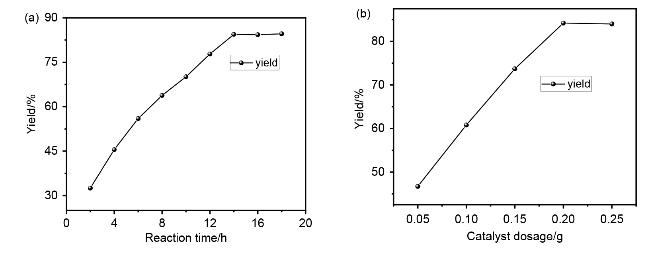
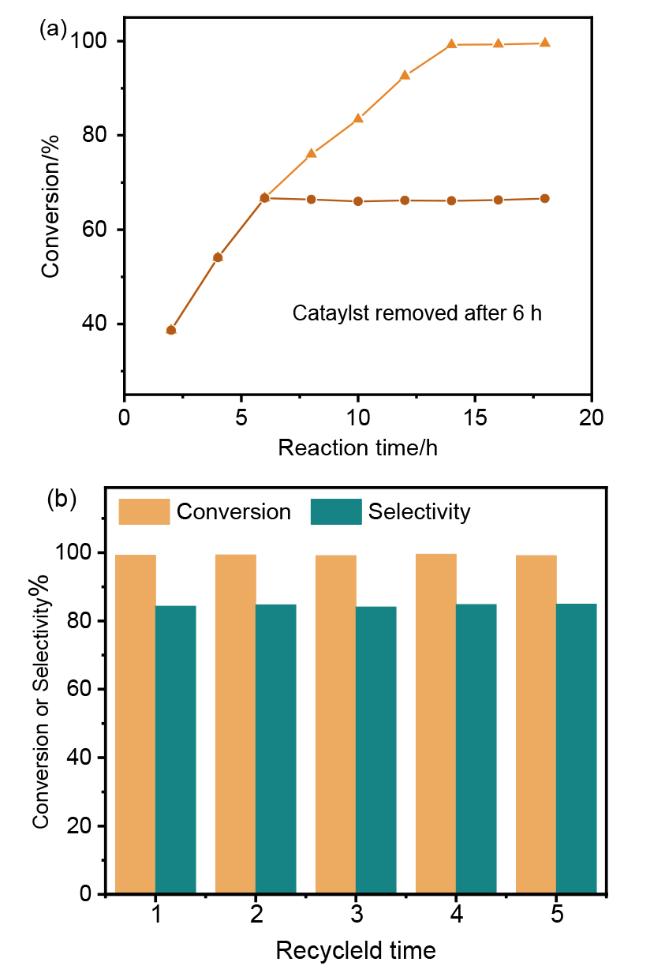
Figure 1 Optimization of reaction time and catalyst loading(a) Reaction conditions: 1a (1 mmol), 2a (1 mmol), CuMgMn-LDH (0.2 g), n-heptane (2 mL), O2 (101 kPa), 70 ℃; (b) Reaction conditions: 1a (1 mmol), 2a (1 mmol), CuMgMn-LDH (catalyst), n-heptane (2 mL), O2 (101 kPa), 70 ℃, 14 h |
2.2 Scope of substrates
Under the optimized conditions, the substrate scope was further investigated (Table 2). Using o-aminobenzylamine (1a) as the coupling substrate, a series of benzyl alcohol derivatives were evaluated. Unsubstituted benzyl alcohol was smoothly converted to quinazoline 3aa with an isolated yield of 84%. Methyl-substituted benzyl alcohols reacted at different positions, with para- and meta-methyl substitutions giving the target products 3ab (77%) and 3ac (71%), respectively. However, ortho-methyl substitution led to a significant decrease in yield, down to 48% (3ad), indicating that steric hindrance at the ortho position adversely affects reaction efficiency. Halogen-substituted benzyl alcohols demonstrated good compatibility, with para-substituted F, Cl, and Br yielding the corresponding products 3ag (86%), 3ah (83%), and 3ae (79%), respectively. In contrast, ortho- chlorine substitution led to a lower yield of 51% (3ai), consistent with the trend of steric effects. Electron-donating groups were also tolerated, as demonstrated by the conversion of 4-methoxybenzyl alcohol to 3af with a 74% yield. Nitrogen-substituted substrates gave moderate yields, such as 3aj (71%). Furthermore, the reaction system was applicable to extended aromatic and heteroaromatic alcohols, with 1-naphthylmethanol and thiophenemethanol yielding 3ak (61%) and 3al (81%), respectively.
Table 2 Scope of substratesa,b |
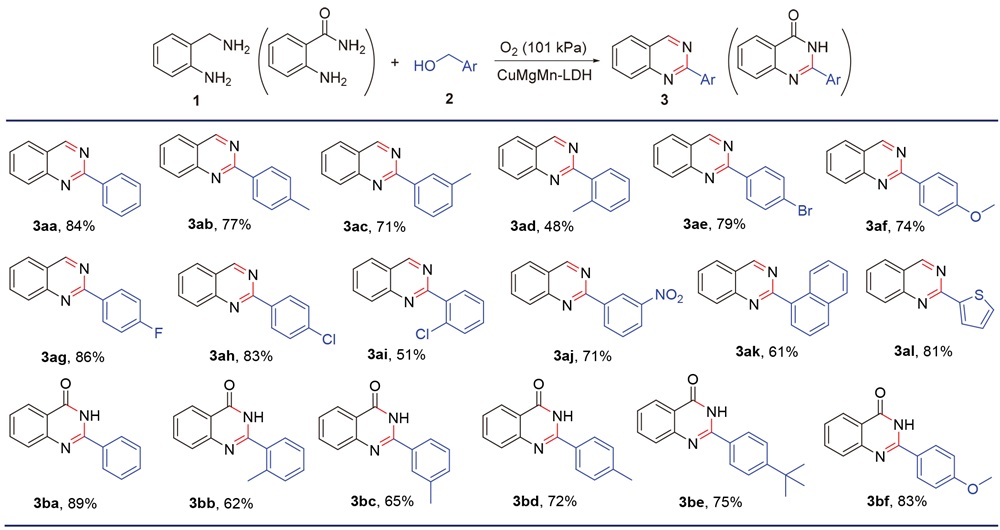 |
a Reaction conditions (3aa~3al): 1a (1 mmol), 2 (1 mmol), CuMgMn-LDH (0.2 g), 70 ℃, n-heptane (2 mL), 14~24 h, O2 (101 kPa). b Reaction conditions (3ba~3bf): 1b (1 mmol), 2 (1 mmol), CuMgMn-LDH (0.2 g), 90 ℃, n-heptane (2 mL), 48 h, O2 (101 kPa). |
Building upon the previous results, 2-aminobenzamide (1b), containing an amide functional group, was introduced into the same oxidative coupling cyclization system, enabling the construction of quinazoline-ketone frameworks (3ba~3bf). Unsubstituted benzyl alcohol gave a high yield of 89% (3ba). Methyl-substituted benzyl alcohols generally exhibited moderate to good yields (3bb~3bd, 62%~72%) with ortho-substitution showing relatively lower efficiency. para-Substituted t-butyl and methoxy groups led to the target products with yields of 75% (3be) and 83% (3bf), respectively, indicating that the system is compatible with various substituents of differing electronic properties.
2.3 Discussion of the reaction mechanism
To investigate the possible mechanism of the CuMgMn- LDH-catalyzed oxidative coupling cyclization of 1a and 2a, a series of control experiments were conducted, and the results are summarized in Table 3. Under standard conditions, CuMgMn-LDH catalyzed nearly complete conversion of the substrate (Conv.>99%) with 84% selectivity towards the target product (Entry 1). In the absence of the catalyst, the reaction hardly proceeded (Entry 2), indicating the essential role of the catalyst in driving the reaction. When O2 was replaced with air, the reaction still occurred, but both conversion and selectivity were reduced (Conv. 66%, Sel. 77%, Entry 3). In a nitrogen atmosphere, only a low conversion was observed (Conv. 18%, Sel. 50%, Entry 4), highlighting the critical role of molecular oxygen in the reaction. Some conversion was still detected under the inert atmosphere, likely due to trace oxygen adsorbed on the catalyst surface or residual oxygen in the system. Further investigation was conducted by varying the metal composition of the LDH to examine the contribution of different metal sites to the reaction. Under the same conditions, Mg2Al-LDH showed almost no catalytic activity (Entry 6). In contrast, Cu-containing CuMgAl-LDH facilitated the reaction to some extent (Conv. 64%, Sel. 58%, Entry 5), and Mn-containing Ni2Mn-LDH also exhibited moderate activity (Conv. 75%, Sel. 58%, Entry 7). Notably, the overall performance of these control catalysts was lower than that of CuMgMn-LDH (Entry 1), suggesting that both Cu and Mn sites may contribute to the reaction, and that a synergistic effect may exist in CuMgMn-LDH, enhancing both reaction activity and selectivity. The addition of the radical scavenger butylated hydroxytoluene (BHT) significantly inhibited the reaction (Entry 8), with almost no substrate conversion, suggesting that the oxidation of benzyl alcohol may involve radical-mediated intermediates. Addition of 1 equiv. of p-benzoquinone as a superoxide (• ) scavenger.[7] caused the benzyl alcohol conversion to drop to <5% (Table 3, Entry 9), indicating that the oxidation process is likely associated with a radical pathway involving reactive oxygen species • .
Table 3 Catalytic results under varied reaction conditionsa |
| Entry | Catalyst | Additives | Conv./% | Sel./% |
|---|---|---|---|---|
| 1 | CuMgMn-LDH | — | >99 | 84 |
| 2 | — | — | Trace | — |
| 3b | CuMgMn-LDH | — | 66 | 77 |
| 4c | CuMgMn-LDH | — | 18 | 50 |
| 5 | CuMgAl-LDH | — | 64 | 58 |
| 6 | Mg2Al-LDH | — | Trace | — |
| 7 | Ni2Mn-LDH | — | 75 | 58 |
| 8 | CuMgMn-LDH | BHTd | Trace | — |
| 9 | CuMgMn-LDH | p-Benzoquinoned | 3 | — |
a Reaction conditions: 1a (1 mmol), 2 (1 mmol), CuMgMn-LDH (0.2 g), 70 ℃, n-heptane (2 mL), 14 h, O2 (101 kPa). b Air. c N2. d 2.0 equiv. |
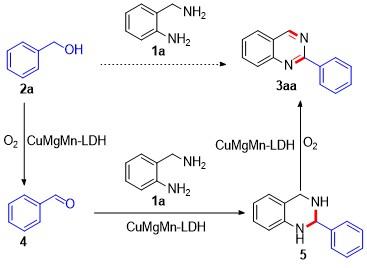
The aerobic oxidative coupling cyclization of 2-amino- benzylamine with alcohols is generally believed to proceed via a cascade pathway.[8] In this mechanism, alcohol is first oxidized to an aldehyde, which then undergoes condensation with the diamine to form a tetrahydroquinazoline intermediate, followed by further dehydrogenation and aromatization to yield the quinazoline product. In the present study, GC-MS analysis detected benzaldehyde and 2-phen- yl-1,2,3,4-tetrahydroquinazoline in the reaction mixture, supporting the hypothesis that these compounds may serve as key intermediates in the cascade process. Based on the experimental results obtained and supported by relevant literature reports,[8b,9] a possible reaction mechanism for the coupling cyclization of 1a and 2a is proposed (Scheme 2). First, under an oxygen atmosphere, 2a is oxidized to 4. Subsequently, 4 reacts with 1a via a dehydration and hydroaldol condensation to form the coupling intermediate (5). Finally, the intermediate 5 undergoes dehydrogenation to achieve aromatization, resulting in the formation of the quinazoline product (3aa). The synergistic effect between Cu and Mn of the CuMgMn-LDH catalyst significantly enhances both the reaction conversion and selectivity.
2.4 Recyclability of the catalytic system
Thermal filtration experiments demonstrated that no further conversion occurred during the reaction process (Figure 2a), confirming that the catalytic system operates heterogeneously and that the active sites do not leach out. Since the transformation proceeds via a cascade reaction pathway, catalyst recovery tests were conducted under optimized conditions. The results showed that CuMgMn- LDH can be reused five times with only a slight decrease in selectivity (Figure 2b), indicating that the catalyst exhibits good recyclability and stability. Control experiments showed that substrate 1a was stable under the standard conditions without significant self-oxidation (Eq. 1).

2.5 Scale-up experiments
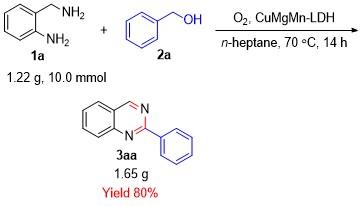
To assess the practicality of the method, a scale-up experiment was also performed, using 1.22 g (10 mmol) of 1a as the reactant for gram-scale synthesis. Under optimized conditions, the yield of 3aa was 80%, demonstrating the high practical potential of this method for the aerobic oxidative coupling of 2-aminobenzylamine and alcohols (Scheme 3).


3 Conclusions
In summary, an efficient CuMgMn-LDH-based catalytic system was developed for the synthesis of quinazolines and quinazolinones via a cascade reaction, using molecular oxygen as the sole oxidant and without the need for any additives. The system demonstrates excellent adaptability to a wide range of alcohol substrates, exhibiting outstanding catalytic performance. The synergistic effect between Cu and Mn sites plays a crucial role in enhancing catalytic efficiency. It exhibits remarkable stability, and when the reaction was scaled up by a factor of 10, the yield remained largely unchanged.
4 Experimental section
4.1 Instruments and reagents
All chemicals were purchased from Energy and used as received, unless otherwise stated. Reagents and solvents were not further purified. Column chromatography was performed on silica gel (300~400 mesh) using a gradient of ethyl acetate and petroleum ether as mobile phase. 1H NMR and 13C NMR spectra were recorded on a Bruker AV 400. Melting points were measured on a Stanford Research Systems MPA100 automated melting point apparatus.
4.2 Preparation of catalysts
The CuMgMn-LDH catalyst was synthesized via coprecipitation using the same procedure as described in our previous report.[10] To prepare the CuMgMn-LDH, 0.05 mol (14.78 g) of Cu(NO3)2•6H2O, 0.05 mol (12.82 g) of Mg(NO3)2•6H2O, and 0.05 mol (9.90 g) of MnCl2•4H2O were dissolved in 200 mL of deionized water to form solution A. Solution B was prepared by dissolving 0.3 mol (12.0 g) of NaOH in 100 mL of deionized water. Solutions A and B were then added dropwise to 100 mL of deionized water containing 0.1 mol (10.60 g) of Na2CO3 at 60 ℃ under atmospheric pressure, while maintaining a pH of (9.5±0.1). The resulting suspension was stirred continuously for 4 h and aged at 60 ℃ for 24 h. The precipitate was then washed with deionized water until neutral and dried at 80 ℃ for 12 h to yield the CuMgMn-LDH sample. The characterization of the CuMgMn-LDH catalyst followed the procedure described in our previous study.[10]
4.3 Synthesis of quinazolines via cascade reaction over CuMgMn-LDH
The oxidation reaction was carried out in a rotating reaction tube under a molecular oxygen atmosphere. A mixture of o-amino-benzylamine (1 mmol), benzyl alcohol (1 mmol), CuMgMn-LDH (0.2 g) and n-heptane (2 mL) was placed in the reaction tube and magnetically stirred at 70 ℃ under 101 kPa of oxygen for 14 h. The reaction progress was monitored by qualitative analysis using GC-MS (Shimadzu GCMS-2010), and the conversion and selectivity of the products were quantified by GC (Shimadzu GC- 2010AF). Upon completion of the reaction, the mixture was cooled, and the catalyst was recovered by filtration. The recovered catalyst was washed with solvent and dried at 80 ℃ for 12 h before being reused under similar reaction conditions. The product is distilled under vacuum to remove solvents. Purification was performed by a column chromatography on silica gel [eluents: V(petroleum ether)∶V(ethyl acetate)=5∶1] to afford the desired compounds.
2-Phenylquinazoline (3aa):[3b] White solid (14 h, yield 84%). m.p. 102.1~104.6 ℃ (lit.[3b] 97~98 ℃); 1H NMR (400 MHz, CDCl3) δ: 9.44 (s, 1H), 8.70~8.55 (m, 2H), 8.07 (d, J=8.5 Hz, 1H), 7.88 (t, J=7.7 Hz, 2H), 7.63~7.45 (m, 4H); 13C NMR (101 MHz, CDCl3) δ: 161.2, 160.5, 150.8, 138.1, 134.2, 130.7, 128.7, 128.6, 127.3, 127.2, 123.6, 77.1.
2-(p-Tolyl)quinazoline (3ab):[3b] Yellow solid (16 h, yield 77%). m.p. 111.8~113.2 ℃ (lit.[3b] 107~109 ℃); 1H NMR (400 MHz, CDCl3) δ: 9.45 (s, 1H), 8.51 (d, J=8.1 Hz, 2H), 8.07 (d, J=8.4 Hz, 1H), 7.94~7.85 (m, 2H), 7.59 (t, J=7.5 Hz, 1H), 7.35 (d, J=8.0 Hz, 2H), 2.45 (s, 3H); 13C NMR (101 MHz, CDCl3) δ: 161.2, 160.5, 150.8, 140.9, 135.3, 134.1, 129.5, 128.6, 127.2, 127.1, 123.5, 77.1, 21.6.
2-(m-Tolyl)quinazoline (3ac):[3b] Yellow solid (18 h, yield 71%). m.p. 100.3~102.4 ℃ (lit.[3b] 101~102 ℃); 1H NMR (400 MHz, CDCl3) δ: 9.47 (s, 1H), 8.42 (d, J=11.3 Hz, 2H), 8.09 (d, J=8.4 Hz, 1H), 7.97~7.87 (m, 2H), 7.61 (t, J=7.5 Hz, 1H), 7.44 (t, J=7.6 Hz, 1H), 7.33 (d, J=7.5 Hz, 1H), 2.49 (s, 3H); 13C NMR (101 MHz, CDCl3) δ: 161.2, 160.5, 150.8, 138.3, 138.0, 134.2, 131.5, 129.1, 128.6, 127.3, 127.2, 125.8, 123.6, 77.1, 21.6.
2-(o-Tolyl)quinazoline (3ad):[3b] Yellow oil (20 h, yield 48%). 1H NMR (400 MHz, CDCl3) δ: 9.51 (s, 1H), 8.10 (d, J=8.5 Hz, 1H), 8.01~7.87 (m, 3H), 7.71~7.63 (m, 1H), 7.42~7.31 (m, 3H), 2.61 (s, 3H); 13C NMR (101 MHz, CDCl3) δ: 160.2, 150.4, 138.6, 137.4, 134.2, 131.3, 130.6, 129.3, 128.6, 127.6, 127.1, 126.0, 122.9, 77.1, 21.1.
2-(4-Bromophenyl)quinazoline (3ae):[3b] Yellow solid (18 h, yield 79%). m.p. 135.1~137.3 ℃ (lit.[3b] 120~121 ℃); 1H NMR (400 MHz, CDCl3) δ: 9.38 (s, 1H), 8.46 (d, J=8.5 Hz, 2H), 8.02 (d, J=8.7 Hz, 1H), 7.90~7.81 (m, 2H), 7.65~7.54 (m, 3H); 13C NMR (101 MHz, CDCl3) δ: 160.5, 160.0, 150.6, 136.9, 134.3, 131.8, 130.2, 128.6, 127.5, 127.2, 125.4, 123.6, 77.1.
2-(4-Methoxyphenyl)quinazoline (3af):[3b] Brown oil (18 h, yield 74%). 1H NMR (400 MHz, CDCl3) δ: 9.39 (s, 1H), 8.57 (d, J=8.8 Hz, 2H), 8.02 (d, J=8.8 Hz, 1H), 7.88~7.82 (m, 2H), 7.53 (t, J=7.4 Hz, 1H), 7.04 (d, J=8.8 Hz, 2H), 3.87 (s, 3H); 13C NMR (101 MHz, CDCl3) δ: 161.8, 160.8, 160.4, 150.8, 134.1, 130.7, 130.2, 128.4, 127.2, 126.8, 123.3, 114.0, 77.1, 55.4.
2-(4-Fluorophenyl)quinazoline (3ag):[3b] White solid (16 h, yield 86%). m.p. 139.1~141.0 ℃ (lit.[3b] 122~123 ℃); 1H NMR (400 MHz, CDCl3) δ: 9.41 (s, 1H), 8.74~8.53 (m, 2H), 8.04 (d, J=8.5 Hz, 1H), 7.88 (d, J=7.5 Hz, 2H), 7.58 (t, J=7.3 Hz, 1H), 7.19 (t, J=8.4 Hz, 2H); 13C NMR (101 MHz, CDCl3) δ: 165.9, 163.4, 160.5, 160.1, 150.7, 134.2, 130.7 (d, JC-F=8.7 Hz), 128.5, 127.2 (d, JC-F=13.8 Hz), 123.5, 115.7, 115.5, 77.1.
2-(4-Chlorophenyl)quinazoline (3ah):[3b] Yellow solid (16 h, yield 83%). m.p. 134.8~136.0 ℃ (lit.[3b] 133~135 ℃); 1H NMR (400 MHz, CDCl3) δ: 9.38 (s, 1H), 8.53 (d, J=8.5 Hz, 2H), 8.02 (d, J=8.7 Hz, 1H), 7.86 (t, J=7.2 Hz, 2H), 7.57 (t, J=7.5 Hz, 1H), 7.46 (d, J=8.5 Hz, 2H); 13C NMR (101 MHz, CDCl3) δ: 160.5, 159.9, 150.6, 136.8, 136.5, 134.3, 129.9, 128.8, 128.6, 127.5, 127.2, 123.6, 77.1.
2-(2-Chlorophenyl)quinazoline (3ai):[3b] Yellow oil (18 h, yield 51%). 1H NMR (500 MHz, CDCl3) δ: 9.56 (d, J=0.5 Hz, 1H), 8.16 (dd, J=8.5, 0.6 Hz, 1H), 8.05~7.97 (m, 2H), 7.88~7.82 (m, 1H), 7.76~7.70 (m, 1H), 7.60~7.53 (m, 1H), 7.47~7.41 (m, 2H); 13C NMR (126 MHz, CDCl3) δ: 162.0, 160.3, 150.4, 138.3, 134.5, 132.9, 131.8, 130.6, 130.4, 129.3, 128.8, 128.7, 128.1, 127.2, 126.9, 123.3, 77.0.
2-(3-Nitrophenyl)quinazoline (3aj):[5b] Yellow oil (18 h, yield 71%). 1H NMR (400 MHz, CDCl3) δ: 9.52 (s, 1H), 8.73 (s, 1H), 8.50 (d, J=7.2 Hz, 1H), 8.24 (d, J=7.6 Hz, 1H), 8.14 (d, J=8.4 Hz, 1H), 7.81~7.68 (m, 3H); 13C NMR (101 MHz, CDCl3) δ: 189.8, 160.8, 134.7, 134.3, 130.4, 129.6, 128.8, 128.7, 128.1, 127.3, 125.1, 124.6, 123.6, 77.1.
2-(Naphthalen-1-yl)quinazoline (3ak):[5b] Yellow solid (24 h, yield 61%). m.p. 124.5~127.1 ℃ (lit.[5b] 126.3~128.5 ℃); 1H NMR (400 MHz, CDCl3) δ: 9.60 (s, 1H), 8.73~8.66 (m, 1H), 8.22~8.14 (m, 2H), 8.04~7.97 (m, 3H), 7.96~7.92 (m, 1H), 7.74~7.67 (m, 1H), 7.64 (dd, J=8.0, 7.4 Hz, 1H), 7.58~7.51 (m, 2H); 13C NMR (101 MHz, CDCl3) δ: 163.5, 160.5, 150.6, 136.3, 134.3, 131.2, 130.4, 129.7, 128.7, 127.8, 127.2, 126.9, 125.9, 125.4, 124.9, 123.2, 77.1.
2-(Thiophen-2-yl)quinazoline (3al):[3b] Yellow solid (18 h, yield 81%). m.p. 101.8~103.2 ℃ (lit.[3b] 137~138 ℃); 1H NMR (400 MHz, CDCl3) δ: 9.35 (s, 1H), 8.42 (d, J=2.3 Hz, 1H), 8.02 (dd, J=19.7, 6.9 Hz, 2H), 7.87~7.80 (m, 2H), 7.53 (t, J=7.5 Hz, 1H), 7.40 (dd, J=4.9, 3.1 Hz, 1H); 13C NMR (101 MHz, CDCl3) δ: 160.6, 158.2, 150.7, 142.1, 134.2, 128.4, 127.7, 127.2, 127.0, 126.2, 123.4, 77.2.
2-Phenylquinazolin-4(3H)-one (3ba):[11c] White solid (48 h, yield 89%). m.p. 195.3~200.2 ℃ (lit.[11c] 233~235 ℃); 1H NMR (400 MHz, DMSO-d6) δ: 12.58 (s, 1H), 8.18 (t, J=7.8 Hz, 3H), 7.84 (t, J=7.6 Hz, 1H), 7.75 (d, J=8.1 Hz, 1H), 7.61~7.51 (m, 4H); 13C NMR (101 MHz, DMSO-d6) δ: 162.30, 152.32, 148.64, 134.58, 132.67, 131.38, 128.59, 127.74, 127.42, 126.57, 125.83, 120.91.
2-(o-Tolyl)quinazolin-4(3H)-one (3bb):[11c] White solid (48 h, yield 62%). m.p. 185.6~187.1 ℃ (lit.[11c] 220~222 ℃); 1H NMR (400 MHz, DMSO-d6) δ: 12.47 (s, 1H), 8.19 (dd, J=8.0, 1.5 Hz, 1H), 7.85 (d, J=8.5, 7.1, 1.6 Hz, 1H), 7.71 (dd, J=8.3, 1.1 Hz, 1H), 7.57~7.50 (m, 2H), 7.44 (dd, J=7.5, 1.5 Hz, 1H), 7.38~7.33 (m, 2H), 2.40 (s, 3H); 13C NMR (101 MHz, DMSO-d6) δ: 161.75, 154.33, 148.70, 136.07, 134.44, 134.19, 130.50, 129.86, 129.10, 127.33, 126.61, 125.75, 125.66, 120.94, 19.54.
2-(m-Tolyl)quinazolin-4(3H)-one (3bc):[11c] White solid (48 h, yield 65%). m.p. 193.4~194.8 ℃ (lit.[11c] 210~212 ℃); 1H NMR (400 MHz, DMSO-d6) δ: 12.51 (s, 1H), 8.16 (dd, J=8.0, 1.5 Hz, 1H), 8.03 (s, 1H), 7.98 (dd, J=7.0, 1.9 Hz, 1H), 7.88~7.82 (m, 1H), 7.76 (d, J=8.2 Hz, 1H), 7.56~7.51 (m, 1H), 7.46~7.40 (m, 2H), 2.42 (s, 3H); 13C NMR (101 MHz, DMSO-d6) δ: 137.91, 134.60, 132.58, 132.00, 128.50, 128.24, 126.54, 125.82, 124.85, 120.88, 20.95.
2-(p-Tolyl)quinazolin-4(3H)-one (3bd):[11c] White solid (48 h, yield 72%). m.p. 200.3~203.6 ℃ (lit.[11c] 261~264 ℃); 1H NMR (400 MHz, DMSO-d6) δ: 12.50 (s, 1H), 8.16 (dd, J=8.0, 1.5 Hz, 1H), 8.10 (d, J=8.1 Hz, 2H), 7.85~7.80 (m, 1H), 7.73 (d, J=8.1 Hz, 1H), 7.53~7.48 (m, 1H), 7.35 (d, J=7.9 Hz, 2H), 2.38 (s, 3H); 13C NMR (101 MHz, DMSO-d6) δ: 162.25, 152.16, 148.76, 141.41, 134.54, 129.14, 127.62, 127.36, 126.35, 125.79, 120.82, 20.94.
2-(4-(tert-Butyl)phenyl)quinazolin-4(3H)-one (3be):[5a] White solid (48 h, yield 75%). m.p. 216.5~217.4 ℃ (lit.[12] 207~209 ℃); 1H NMR (400 MHz, DMSO-d6) δ: 12.51 (s, 1H), 8.15 (dd, J=11.8, 8.3 Hz, 3H), 7.86~7.78 (m, 1H), 7.74 (d, J=8.1 Hz, 1H), 7.53 (dd, J=18.6, 7.9 Hz, 3H), 1.31 (s, 9H); 13C NMR (101 MHz, DMSO-d6) δ: 162.26, 154.24, 152.12, 148.79, 129.86, 127.51, 127.40, 126.39, 125.80, 125.38, 120.85, 34.61, 30.84.
2-(4-Methoxyphenyl)quinazolin-4(3H)-one (3bf):[11a] White solid (48 h, yield 83%). m.p. 204.1~206.9 ℃ (lit.[11a] 245~246 ℃); 1H NMR (400 MHz, DMSO-d6) δ: 12.44 (s, 1H), 8.21~8.18 (m, 2H), 8.14 (dd, J=7.9, 1.5 Hz, 1H), 7.85~7.80 (m, 1H), 7.71 (d, J=8.1 Hz, 1H), 7.49 (t, J=7.5 Hz, 1H), 7.09 (d, J=8.8 Hz, 2H), 3.85 (s, 3H); 13C NMR (101 MHz, DMSO-d6) δ: 162.30, 161.80, 151.82, 148.87, 134.54, 129.42, 126.12, 125.79, 124.72, 120.61, 113.95, 55.40.
Supporting Information Data on catalyst screening and copies of 1H NMR, 13C NMR spectra. The Supporting Information is available free of charge via the Internet at http://sioc-journal.cn/.
(Cheng, F.)