


1 Introduction
Ketones are privileged structural motifs distributed in natural products, functional materials, and pharmaceuticals, rendering their synthesis a subject of enduring interest.[1] A pivotal route to the construction of these scaffolds involves the conversion of aldehydes to ketones. Conventional aldehyde-to-ketone transformations rely on a two-step sequence involving the addition of stoichiometric organometallic reagents and a subsequent oxidation. However, these methods are frequently limited by poor atom- and step- economy, as well as narrow functional group compatibility. The development of facile and general methods for direct transformation of aldehydes to ketones is still highly desirable.
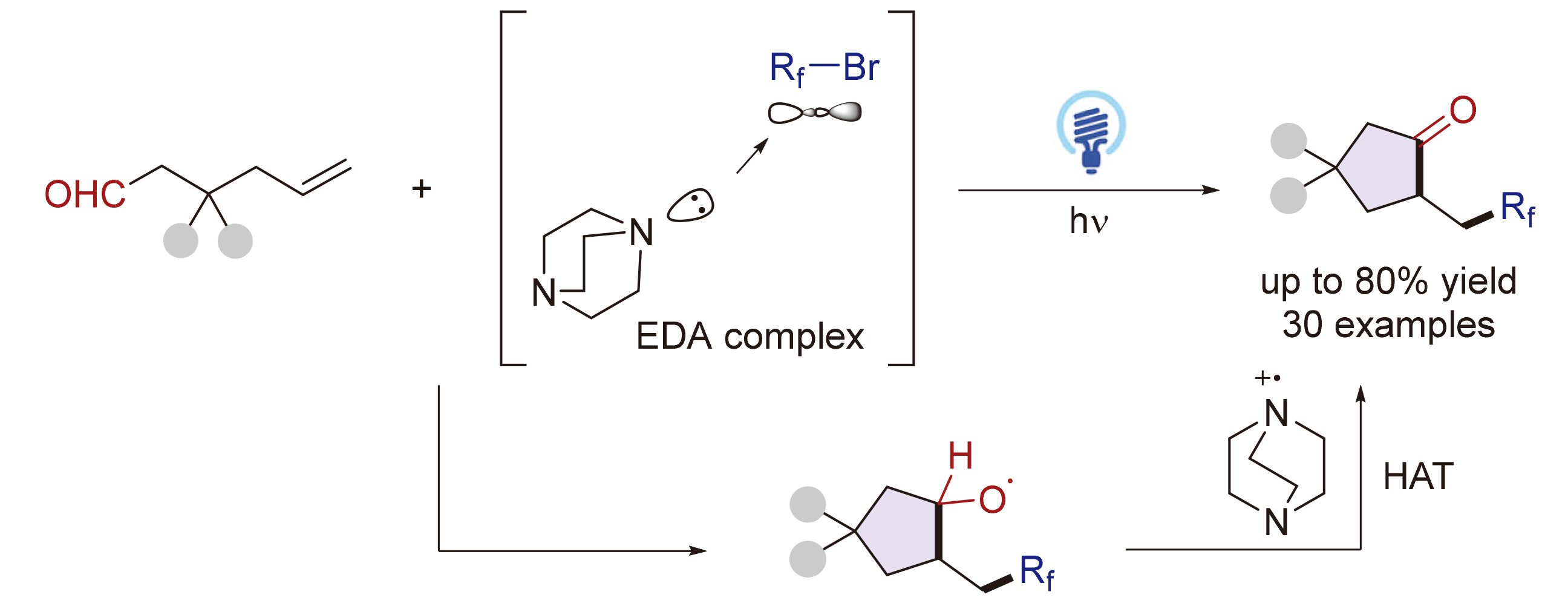
Recently, the radical addition or coupling of aldehydes, via an acyl radical intermediate, has become a promising protocol for the ketone synthesis.[2] The oxidative radical addition to aldehydes is a good alternative, however, it has to overcome the challenge of forming a thermodynamically unfavorable alkoxy radical.[3] To this end, our group has established a well-designed radical acylation methodology using readily available aldehydes as the acyl donor, in which an uncommon but irreversible 1,2-hydrogen atom transfer (1,2-HAT)/single-electron transfer (SET) sequence was used to promote the unfavorable addition (Scheme 1a).[4] The success of this strategy relies on the generation of a conjugated ketyl radical via 1,2-HAT, and is therefore ineffective for the radical acylation of alkyl aldehydes. Indeed, the 1,5-HAT of alkoxy radicals, generated from the addition of carbon radicals to alkyl aldehydes, may also occur, thereby overriding the desired ketone formation (Scheme 1b).[5] As such, novel strategy for the radical acylation with alkyl aldehydes remains to be developed.
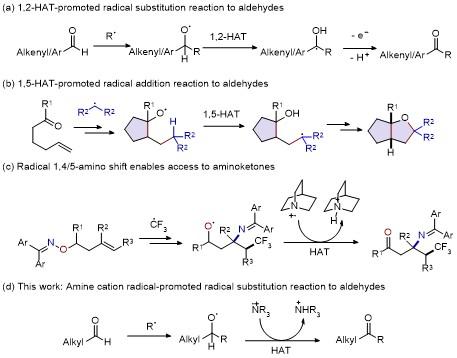
In 2021, Han and co-workers[6] reported a 1,4-amino migration strategy for the construction of amino ketones (Scheme 1, c), wherein density functional theory (DFT) calculations revealed that amine radical cations[7] efficiently abstract hydrogen atoms from the α-C—H position of alkoxyl radicals, directly converting them to ketones via a barrierless process. Given the ease with which amine radical cations can be accessed through single-electron transfer oxidation of alkylamines, we propose that amine radical cation-mediated HAT constitutes a viable strategy to facilitate the radical conversion of aldehydes to ketones (Scheme 1, d).
Our preliminary investigations revealed that radical addition to carbonyl groups suffers from high activation barrier[8] owing to the instability of alkoxyl radical intermediates. Since intramolecular radical addition to aldehydes is kinetically preferred over intermolecular pathways, alkenyl aldehydes were employed as substrates to enable sequential radical addition to the alkene followed by intramolecular cyclization to the aldehyde, furnishing the desired alkoxyl radical intermediates. Literature precedent revealed that ethyl bromodifluoroacetate forms electron donor-acceptor (EDA) complex[9] with organic amines, which undergo pho- toinduced single-electron transfer upon visible light irradiation to generate fluoroalkyl radicals and amine radical cations simultaneously. We therefore envisioned that this photochemical EDA platform could orchestrate a radical cascade process. By leveraging an amine radical cation- mediated HAT, this strategy successfully promotes the aldehyde-to-ketone transformation, thus unlocking a new avenue for the acylfluoroalkylation of unactivated alke- nes.[10]
2 Results and discussion
Using alkenyl aldehyde 1a and ethyl bromodifluoroacetate as model substrates, optimization studies were initiated. Employing N,N,N',N'-tetraethyl-ethylenediamine (TEEDA) as the base in dimethylacetamide (DMA) under blue LED irradiation (450~460 nm), the target ketone was obtained in 23% yield (Table 1, Entry 1). A subsequent survey of organic bases revealed a distinct preference for diamine motifs, N,N,N',N'-tetramethyl-ethylenediamine (TMEDA) and 1,4-diazabicyclo[2.2.2]octane (DABCO) dramatically improved the yield to >80%, whereas monoamines such as triethylamine and 1,5-diazabicyclo[4.3.0]non-5-ene (DBU) proved ineffective (Table 1, Entries 2~5). This divergence is likely attributable to the superior efficiency of diamines in forming photoactive EDA complexes with the fluorinated reagent. Further refinement of the reaction parameters indicated that the wavelength of irradiation was critical, switching to a 390 nm LED enhanced the yield to 92%, suggesting better overlap with the EDA complex absorption (Table 1, Entries 6~9). Solvent screening identified polar aprotic solvents [N,N-dimethylformamide (DMF), dimethyl sulfoxide (DMSO)] as optimal, while acetonitrile and methanol were detrimental to reactivity (Table 1, Entries 10~14). Finally, control experiments confirmed the essential roles of both the organic base and light irradiation, as the omission of either completely suppressed product formation (Table 1, Entries 15, 16).
Table 1 Optimization of reaction conditionsa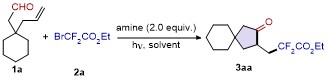 |
| Entry | Amine | λ/nm | Solvent | Yieldb/% |
|---|---|---|---|---|
| 1 | TEEDA | 450~460 | DMA | 23 |
| 2 | Et3N | 450~460 | DMA | 20 |
| 3 | TMEDA | 450~460 | DMA | 80 |
| 4 | DABCO | 450~460 | DMA | 87 |
| 5 | DBU | 450~460 | DMA | 0 |
| 6 | DABCO | 456 | DMA | 81 |
| 7 | DABCO | 440 | DMA | 84 |
| 8 | DABCO | 390 | DMA | 92 (80)c |
| 9 | DABCO | 370 | DMA | 90 |
| 10 | DABCO | 390 | DMF | 90 |
| 11 | DABCO | 390 | DMSO | 85 |
| 12 | DABCO | 390 | MeCN | 46 |
| 13 | DABCO | 390 | DCM | 88 |
| 14 | DABCO | 390 | MeOH | 10 |
| 15 | — | 390 | DMA | 0 |
| 16 | DABCO | — | DMA | 0 |
a Conditions: 1a (33.3 mg, 0.2 mmol), 2a (81.2 mg, 0.4 mmol), amine (0.4 mmol), solvent, irradiation with blue LEDs at room temperature under N2 atmosphere for 12 h. b 1H NMR yields were reported using dibenzyl ether as an internal standard. c Isolated yield. |
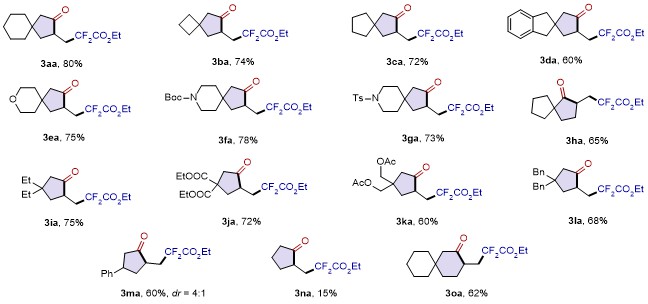
With the optimized conditions established, we proceeded to evaluate the generality of this cascade transformation. Initially, substrates capable of benefiting from the Thorpe- Ingold effect were examined. Cyclic alkenyl aldehydes incorporating cyclohexane, cyclopentane, and cyclobutane rings, as well as oxygen- and nitrogen-containing heterocycles, proved to be competent substrates, affording the corresponding bicyclic ketones in yields approximating 70% (Table 2, 3aa~3ha). Acyclic substrates bearing gem-disubstituents (alkyl, ester, benzyl) were also well-tolerated, delivering the target products in moderate to good yields (Table 2, 3ia~3la). A monosubstituted phenyl derivative underwent smooth cyclization to yield the functionalized cyclopentanone in 60% yield with a diastereomeric ratio (dr) of 4∶1 (Table 2, 3ma). Additionally, we examined the unsubstituted hexenal substrate, which afforded the cyclopentanone product in only 15% isolated yield alongside considerable amounts of uncyclized byproducts resulting from direct alkene functionalization (Table 2, 3na). This outcome suggests that steric effects play a crucial role in governing the intramolecular radical addition to the aldehyde moiety. The protocol was further successfully applied to the synthesis of six-membered rings (cyclohexanones), which were isolated in 62% yield (Table 2, 3oa). Unfortunately, this reaction is not applicable to the construction of cyclopropanones, cyclobutanones, and cycloheptanones. In the reactions of small rings, formyl migration outcompetes intermolecular hydrogen atom transfer, predominantly yielding the acyl-migrated rearrangement products.
Table 2 Substrates scope of alkenyl aldehydesa |
 |
a Conditions: 1 (0.2 mmol), 2a (81.2 mg, 0.4 mmol), DABCO (44.9 mg, 0.4 mmol), DMA (2 mL), irradiation with a 390 nm LED under N2 atmosphere at room temperature for 12 h. |
Beyond alkenyl aldehydes, the scope of fluoroalkyl radical precursors was explored. In addition to ethyl bromodifluoroacetate, various bromodifluoroacetamide derivatives, including both N-alkyl and N-aryl substituted variants, proved competent in this transformation, delivering the corresponding fluoroalkyl-substituted cyclopentanones in moderate to good yields (Table 3, 3ab~3am). The structure of product 3ad was unambiguously confirmed by single-crystal X-ray diffraction analysis (CCDC 2521617). Recognizing that perfluoroalkyl iodides also form photoactive EDA complexes with organic amines to generate perfluoroalkyl radicals and amine radical cations upon irradiation, the substrate scope was further extended to include these reagents. Gratifyingly, the reactions proceeded smoothly, affording the desired perfluoroalkylated products in moderate to good yields (Table 3, 3an~3ap).
Table 3 Substrates scope of bromodifluoroacetatesa |
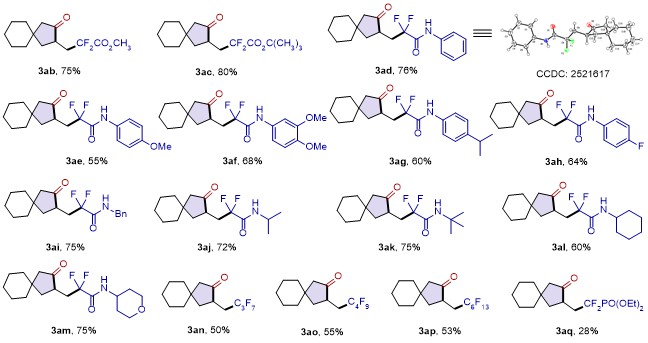 |
a Conditions: 1a (33.3 mg, 0.2 mmol), 2 (0.4 mmol), DABCO (44.9 mg, 0.4 mmol), DMA (2 mL), irradiation with a 390 nm LED under N2 atmosphere at room temperature for 12 h. |
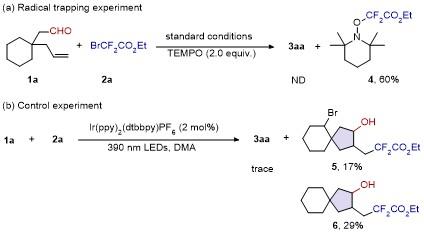
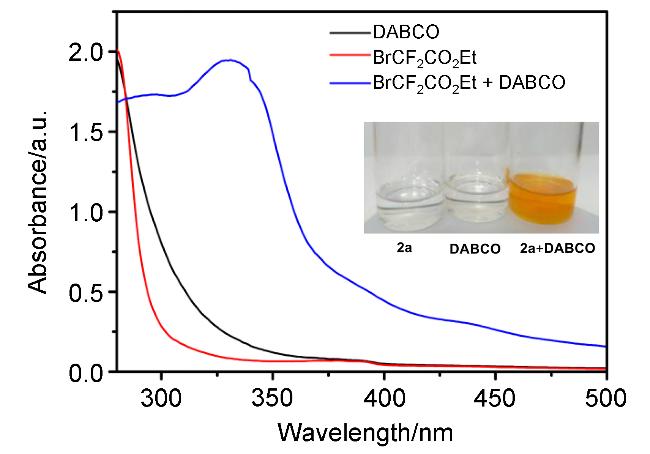
To elucidate the reaction mechanism, a series of control experiments was conducted. First, radical scavenging studies using 2,2,6,6-tetramethylpiperidinooxy (TEMPO, 2.0 equiv.) resulted in the complete inhibition of the transformation, with TEMPO-CF2COOEt adduct 4 isolated in 60% yield (Scheme 2, a).[11] This confirms the involvement of fluoroalkyl radical intermediates. To delineate the role of the amine beyond radical initiation, a control experiment was performed in the absence of the organic amine, utilizing an external photocatalyst to generate the fluoroalkyl radical (Scheme 2, b). This resulted in a complex reaction mixture devoid of the desired ketone. Instead, a byproduct 5 arising from a competing intramolecular 1,5-HAT and subsequent halogenation was isolated in 17% yield. Moreover, 29% yield of byproduct 6, resulting from direct hydrogen quenching of the alkoxy radical, was also isolated. The failure of this amine-free system to deliver the target product underscores the indispensable role of the nitrogen radical cation in mediating the selective H-abstraction step, which effectively outcompetes background radical pathways. Finally, UV-Vis absorption spectroscopy provided evidence for ground-state association between the reactants (Figure 1). Mixing DABCO with ethyl bromodifluoroacetate resulted in a distinct bathochromic shift with a new absorption band emerging in the 350~450 nm region, indicative of the formation of a photoactive EDA complex.
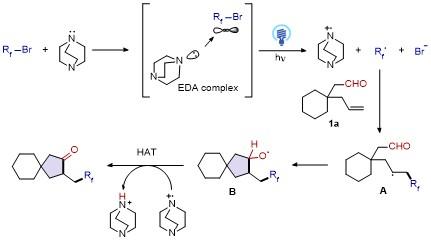
On the basis of the preceding mechanistic inquiries and concurrent literature precedents, a putative reaction mechanism was proposed (Scheme 3). Initially, the formation of a photoactive EDA complex between ethyl bromodifluoroacetate and DABCO facilitates an intermolecular single-electron transfer event upon irradiation with 390 nm LED. This process triggers the cleavage of the carbon- bromine bond, generating a difluoroalkyl radical and the corresponding amine radical cation. Subsequently, the electrophilic difluoroalkyl radical engages in regioselective addition to the alkene moiety of the enal, furnishing alkyl radical intermediate A. This species undergoes an intramolecular radical cyclization onto the carbonyl group, delivering the alkoxyl radical intermediate B. Finally, a hydrogen atom transfer process, mediated by the nitrogen radical cation, effects the abstraction of the hydrogen atom from intermediate B, culminating in the formation of the target alkylated cyclic ketone.


3 Conclusions
In conclusion, we have developed a visible-light-driven fluoroalkylative cyclization of alkenyl aldehydes mediated by amine radical cations, which are generated in situ through photoactivation of an electron donor-acceptor complex between a tertiary amine and ethyl bromodifluoro- acetate. This protocol enables efficient conversion of alkenyl aldehydes to fluorinated cyclic ketones under mild, metal-free conditions, exhibiting broad substrate scope and high functional group tolerance. The Thorpe-Ingold effect ensures selective intramolecular cyclization over competing pathways, thereby providing a versatile platform for direct aldehyde functionalization and fluorinated heterocycle synthesis.
4 Experimental section
4.1 General information
Unless otherwise noted, materials obtained from commercial suppliers were used directly without further purification. Melting points reported were measured by a melting point instrument and uncorrected. 1H NMR, 13C NMR, and 19F NMR spectra were measured on Bruker AV600 or Bruker AV400 NMR spectrometer using CDCl3 as the solvent with tetramethylsilane (TMS) as the internal standard. High- resolution mass spectrometry (HRMS) analyses were carried out using an Agilent G6230AA TOF MS instrument with an ESI source. GC-MS measurements were performed on a 7890B GC system with an Agilent 5975 MSD detector. The single-crystal X-ray diffraction data were collected on a Bruker D8 VENTURE diffractometer equipped with a PHOTON II detector at 298 K. Column chromatography was performed using silica gel (200~300 mesh). PE=petroleum ethers, EtOAc=ethyl acetate.
4.2 General procedure for the synthesis of cyclic ketones
To a Schlenk flask containing 1 (0.2 mmol, 1.0 equiv) and 2 (0.4 mmol, 2.0 equiv.) in 2 mL of DMA was added DABCO (0.4 mmol, 2.0 equiv.) under nitrogen atmosphere. The reaction tube was placed under 390 nm LED light for 12 h. Then the reaction mixture was quenched with water, extracted with EtOAc (10 mL×3), washed with brine, dried over anhydrous Na2SO4, filtered, and concentrated. The pure products were obtained by flash column chromatography.
Ethyl 2,2-difluoro-3-(3-oxospiro[4.5]decan-2-yl)propa- noate (3aa): 46 mg, 80% yield, colorless oil. Flash column chromatography conditions: PE/EtOAc (V∶V=25∶1); 1H NMR (600 MHz, CDCl3) δ: 4.33 (q, J=7.2 Hz, 2H), 2.74~2.65 (m, 1H), 2.60~2.53 (m, 1H), 2.40~2.30 (m, 2H), 1.96~1.85 (m, 2H), 1.60~1.54 (m, 2H), 1.52~1.45 (m, 4H), 1.43~1.34 (m, 8H); 13C NMR (151 MHz, CDCl3) δ: 218.0, 164.1 (t, J=32.8 Hz), 115.9 (t, J=250.6 Hz), 63.1, 49.5, 42.6, 41.5 (t, J=2.9 Hz), 39.8, 38.0, 36.0, 35.2 (t, J=23.4 Hz), 26.1, 23.5, 22.8, 14.1; 19F NMR (565 MHz, CDCl3) δ: -103.56 (d, J=253.8 Hz, 1F), -106.56 (d, J=258.2 Hz, 1F); HRMS (ESI) calcd for C15H22F2O3Na [M+Na]+ 311.1429, found 311.1428.
Ethyl 2,2-difluoro-3-(7-oxospiro[3.4]octan-6-yl)propa- noate (3ba): 38 mg, 74% yield, colorless oil. Flash column chromatography conditions: PE/EtOAc (V∶V=25∶1); 1H NMR (600 MHz, CDCl3) δ: 4.33 (q, J=7.2 Hz, 2H), 2.69 (dtd, J=23.6, 15.2, 3.2 Hz, 1H), 2.54~2.50 (m, 2H), 2.42~2.37 (m, 1H), 2.14 (d, J=19.2 Hz, 1H), 2.11~2.07 (m, 1H), 2.03~1.97 (m, 3H), 1.96~1.90 (m, 3H), 1.60 (t, J=12.4 Hz, 1H), 1.36 (t, J=7.2 Hz, 3H); 13C NMR (151 MHz, CDCl3) δ: 217.3, 164.1 (t, J=32.7 Hz), 115.9 (t, J=250.9 Hz), 63.1, 50.6, 43.0, 42.9 (t, J=2.6 Hz), 41.1, 34.5, 34.4 (t, J=23.5 Hz), 31.4, 16.1, 14.0; 19F NMR (565 MHz, CDCl3) δ: -103.55 (d, J=258.4 Hz, 1F), -106.57 (d, J=258.4 Hz, 1F); HRMS (ESI) calcd for C13H18F2O3Na [M+Na]+ 283.1116, found 283.1112.
Ethyl 2,2-difluoro-3-(3-oxospiro[4.4]nonan-2-yl)propa- noate (3ca): 39 mg, 72% yield, yellow oil. Flash column chromatography conditions: PE/EtOAc (V∶V=25∶1); 1H NMR (600 MHz, CDCl3) δ: 4.33 (q, J=7.2 Hz, 2H), 2.75~2.66 (m, 1H), 2.58~2.48 (m, 1H), 2.34~2.21 (m, 2H), 2.09 (d, J=18.6 Hz, 1H), 1.98~1.88 (m, 1H), 1.78~1.73 (m, 1H), 1.72~1.63 (m, 5H), 1.60~1.47 (m, 3H), 1.36 (t, J=7.2 Hz, 3H); 13C NMR (151 MHz, CDCl3) δ: 218.1, 164.1 (t, J=32.7 Hz), 115.9 (t, J=250.9 Hz), 63.1, 50.5, 45.4, 43.4, 42.7, 39.5, 38.5, 34.9 (t, J=23.1 Hz), 24.5, 24.2, 14.1; 19F NMR (565 MHz, CDCl3) δ: -103.59 (d, J=258.2 Hz, 1F), -106.61 (d, J=257.6 Hz, 1F); HRMS (ESI) calcd for C14H20F2O3Na [M+Na]+ 297.1273, found 297.1269.
Ethyl 2,2-difluoro-3-(3-oxo-1',3'-dihydrospiro[cyclopen-tane-1,2'-inden]-4-yl)propanoate (3da): 38 mg, 60% yield, colorless oil. Flash column chromatography conditions: PE/EtOAc (V∶V=50∶3); 1H NMR (600 MHz, CDCl3) δ: 7.21~7.15 (m, 4H), 4.32 (q, J=7.2 Hz, 2H), 3.06~2.96 (m, 3H), 2.85 (d, J=15.2 Hz, 1H), 2.79~2.70 (m, 1H), 2.67~2.61 (m, 1H), 2.49~2.45 (m, 2H), 2.20 (d, J=19.0 Hz, 1H), 2.03~1.93 (m, 1H), 1.78 (t, J=12.6 Hz, 1H), 1.35 (t, J=7.2 Hz, 3H); 13C NMR (151 MHz, CDCl3) δ: 217.2, 164.0 (t, J=32.6 Hz), 142.0, 141.6, 126.8, 126.7, 124.9, 124.5, 115.8 (t, J=250.9 Hz), 63.1, 50.7, 46.2, 45.7, 45.5, 43.4 (t, J=2.7 Hz), 42.5, 34.9 (t, J=23.5 Hz), 14.0; 19F NMR (565 MHz, CDCl3) δ: -103.47 (d, J=258.6 Hz, 1F), -106.55 (d, J=258.5 Hz, 1F); HRMS (ESI) calcd for C18H20F2O3+H [M+H]+ 323.1453, found 323.1449.
Ethyl 2,2-difluoro-3-(3-oxo-8-oxaspiro[4.5]decan-2-yl)-propanoate (3ea): 43 mg, 75% yield, yellow oil. Flash column chromatography conditions: PE/EtOAc (V∶V=20∶1); 1H NMR (600 MHz, CDCl3) δ: 4.34 (q, J=7.2 Hz, 2H), 3.85~3.77 (m, 2H), 3.60~3.52 (m, 2H), 2.76~2.67 (m, 1H), 2.61~2.55 (m, 1H), 2.50 (d, J=18.8 Hz, 1H), 2.44~2.40 (m, 1H), 2.02 (d, J=18.8 Hz, 1H), 1.98~1.88 (m, 1H), 1.73~.64 (m, 2H), 1.56~1.48 (m, 3H), 1.36 (t, J=7.2 Hz, 3H); 13C NMR (151 MHz, CDCl3) δ: 216.5, 164.0 (t, J=32.6 Hz), 115.8 (t, J=250.9 Hz), 65.2, 64.5, 63.2, 48.5, 42.4, 41.2 (t, J=2.7 Hz), 39.1, 36.2, 35.7, 34.9 (t, J=23.6 Hz), 14.0; 19F NMR (565 MHz, CDCl3) δ: -103.45 (d, J=258.7 Hz, 1F), -106.64 (d, J=258.7 Hz, 1F); HRMS (ESI) calcd for C14H20F2O4Na [M+Na]+ 313.1222, found 313.1218.
tert-Butyl 2-(3-ethoxy-2,2-difluoro-3-oxopropyl)-3-oxo-8-azaspiro[4.5]decane-8-carboxylate (3fa): 61 mg, 78% yield, yellow oil. Flash column chromatography conditions: PE/EtOAc (V∶V=3∶1); 1H NMR (600 MHz, CDCl3) δ: 4.33 (q, J=10.8 Hz, 2H), 3.71~3.61 (m, 2H), 3.23~3.12 (m, 2H), 2.78~2.65 (m, 1H), 2.64~2.54 (m, 1H), 2.45~2.35 (m, 2H), 2.04~1.85 (m, 2H), 1.63~1.50 (m, 5H), 1.46 (s, 9H), 1.36 (t, J=10.6 Hz, 3H); 13C NMR (151 MHz, CDCl3) δ: 216.4, 163.9 (t, J=32.5 Hz), 154.8, 115.7 (t, J=250.8 Hz), 79.7, 63.1, 48.1, 41.7, 41.3, 38.4, 36.5, 35.2, 34.9 (t, J=23.5 Hz), 28.5, 14.0; 19F NMR (565 MHz, CDCl3) δ: -103.2~-103.8 (m, 1F), -106.6 (d, J=259.9 Hz, 1F); HRMS (ESI) calcd for C19H29F2NO5Na [M+Na]+ 412.1906, found 412.1898.
Ethyl 2,2-difluoro-3-(3-oxo-8-tosyl-8-azaspiro[4.5]decan- 2-yl)propanoate (3ga): 64 mg, 73% yield, yellow oil. Flash column chromatography conditions: PE/EtOAc (V∶V=5∶1); 1H NMR (600 MHz, CDCl3) δ: 7.64 (d, J=8.2 Hz, 2H), 7.34 (d, J=8.0 Hz, 2H), 4.30 (q, J=7.2 Hz, 2H), 3.33~3.25 (m, 2H), 2.77~2.70 (m, 2H), 2.69~2.61 (m, 1H), 2.55~2.49 (m, 1H), 2.45 (s, 3H), 2.28~2.20 (m, 2H), 1.91~1.85 (m, 2H), 1.78~1.61 (m, 5H), 1.33 (t, J=7.2 Hz, 3H); 13C NMR (151 MHz, CDCl3) δ: 215.7, 163.8 (t, J=32.4 Hz), 143.8, 133.1, 129.8, 127.7, 115.6 (q, J=250.7 Hz), 63.2, 47.8, 43.6, 42.9, 41.5, 41.2 (t, J=2.6 Hz), 37.9, 35.8, 34.9 (t, J=23.5 Hz), 34.7, 21.6, 14.0; 19F NMR (565 MHz, CDCl3) δ: -103.48 (d, J=258.8 Hz, 1F), -106.33~-106.82 (m, 1F); HRMS (ESI) calcd for C21H27F2NO5SNa [M+Na]+ 466.1470, found 466.1476.
Ethyl 2,2-difluoro-3-(1-oxospiro[4.4]nonan-2-yl)propa- noate (3ha): 35 mg, 65% yield, colorless oil. Flash column chromatography conditions: PE/EtOAc (V∶V=20∶1); 1H NMR (600 MHz, CDCl3) δ: 4.33 (q, J=7.2 Hz, 2H), 2.75~2.66 (m, 1H), 2.56~2.51 (m, 1H), 2.32~2.24 (m, 2H), 2.09 (d, J=18.6 Hz, 1H), 1.98~1.88 (m, 1H), 1.78~1.73 (m, 1H), 1.72~1.63 (m, 6H), 1.58~1.50 (m, 2H), 1.36 (t, J=7.2 Hz, 3H); 13C NMR (151 MHz, CDCl3) δ: 218.1, 164.1 (t, J=32.8 Hz), 115.9 (t, J=250.7 Hz), 63.1, 50.5, 45.4, 43.4 (t, J=2.8 Hz), 42.7, 39.5, 38.5, 35.0 (t, J=24.5 Hz), 24.5, 24.2, 14.1; 19F NMR (565 MHz, CDCl3) δ: -103.59 (d, J=258.2 Hz, 1F), -106.61 (d, J=257.6 Hz, 1F); HRMS (ESI) calcd for C14H20F2O3Na [M+Na]+ 297.1273, found 297.1269.
Ethyl 3-(4,4-diethyl-2-oxocyclopentyl)-2,2-difluoropro-panoate (3ia): 41 mg, 75% yield, colorless oil. Flash column chromatography conditions: PE/EtOAc (V∶V=25∶2); 1H NMR (600 MHz, CDCl3) δ: 4.33 (q, J=7.2 Hz, 2H), 2.74~2.64 (m, 1H), 2.58~2.52 (m, 1H), 2.31~2.22 (m, 2H), 1.97 (d, J=18.8 Hz, 1H), 1.93~1.85 (m, 1H), 1.47~1.40 (m, 5H), 1.36 (t, J=7.2 Hz,3H), 0.87~0.84 (m, 6H); 13C NMR (151 MHz, CDCl3) δ: 218.2, 164.1 (t, J=32.5 Hz), 115.9 (t, J=250.8 Hz), 63.1, 49.1, 41.7 (t, J=2.8 Hz), 40.6, 40.1, 35.4 (t, J=23.5 Hz), 31.4, 28.5, 14.1, 8.6, 8.5; 19F NMR (377 MHz, CDCl3) δ: -103.52 (d, J=258.4 Hz, 1F), -106.56 (d, J=258.4 Hz, 1F); HRMS (ESI) calcd for C14H22F2O3Na [M+Na]+ 299.1425, found 299.1429.
Diethyl 3-(3-ethoxy-2,2-difluoro-3-oxopropyl)-4-oxo-cyclopentane-1,1-dicarboxylate (3ja): 52 mg, 72% yield, colorless oil. Flash column chromatography conditions: PE/EtOAc (V∶V=20∶1); 1H NMR (600 MHz, CDCl3) δ: 4.34 (q, J=7.2 Hz, 2H), 4.27~4.22 (m, 4H), 3.04~2.99 (m, 2H), 2.77~2.63 (m, 3H), 2.11 (t, J=12.8 Hz, 1H), 2.02~1.92 (m, 1H), 1.36 (t, J=7.2 Hz, 3H), 1.28 (t, J=7.2 Hz, 6H); 13C NMR (151 MHz, CDCl3) δ: 212.7, 170.8, 170.5, 163.8 (t, J=32.4 Hz), 115.6 (t, J=251.1 Hz), 63.2, 62.4, 62.3, 55.0, 44.0, 42.2 (t, J=2.9 Hz), 36.8, 34.7 (t, J=23.6 Hz), 14.09, 14.05, 14.0; 19F NMR (565 MHz, CDCl3) δ: -103.23 (d, J=260.4 Hz), -106.56 (d, J=260.2 Hz); HRMS (ESI) calcd for C19H21F3ONa [M+Na]+ 387.1226, found 387.1223.
(3-(3-Ethoxy-2,2-difluoro-3-oxopropyl)-4-oxocyclopen-tane-1,1-diyl)bis(methylene) diacetate (3ka): 43 mg, 60% yield, colorless oil. Flash column chromatography conditions: PE/EtOAc (V∶V=25∶1); 1H NMR (600 MHz, CDCl3) δ: 4.34 (q, J=7.2 Hz, 2H), 4.13~4.04 (m, 4H), 2.77~2.67 (m, 2H), 2.41~2.35 (m, 2H), 2.21 (d, J=19.2 Hz, 1H), 2.08 (s, 6H), 2.00~1.90 (m, 1H), 1.70~1.65 (m, 1H), 1.36 (t, J=7.2 Hz, 3H); 13C NMR (151 MHz, CDCl3) δ: 214.4, 170.60, 170.58, 163. 7 (t, J=32.4 Hz), 115.5 (t, J=251.0 Hz), 67.8, 66.4, 63.1, 43.2, 41.6, 41.5, 40.9, 35.3, 35.0 (t, J=25.1 Hz), 20.7, 13.9; 19F NMR (565 MHz, CDCl3) δ: -103.27 (d, J=259.4 Hz), -106.64 (d, J=259.7 Hz); HRMS (ESI) calcd for C16H22F2O7Na [M+ Na]+ 387.1226, found 387.1229.
Ethyl 3-(4,4-dibenzyl-2-oxocyclopentyl)-2,2-difluoro-propanoate (3la): 54 mg, 68% yield, colorless oil. Flash column chromatography conditions: PE/EtOAc (V∶V=20∶1); 1H NMR (600 MHz, CDCl3) δ: 7.32~7.24 (m, 6H), 7.15 (d, J=7.0 Hz, 2H), 7.08 (d, J=7.0 Hz, 2H), 4.29 (q, J=7.2 Hz, 2H), 2.81~2.74 (m, 4H), 2.58~2.49 (m, 1H), 2.36~2.22 (m, 3H), 2.16 (d, J=18.6 Hz, 1H), 1.74~1.64 (m, 1H), 1.61~1.56 (m, 1H), 1.32 (t, J=7.2 Hz, 3H); 13C NMR (151 MHz, CDCl3) δ: 217.3, 164.0 (t, J=32.6 Hz), 137.7, 137.3, 131.0, 130.4, 128.6, 128.4, 126.9, 126.7, 115.8 (t, J=250.6 Hz), 63.1, 47.2, 45.7, 45.5, 42.5, 41.7, 38.2, 35.4 (t, J=23.3 Hz), 14.1; 19F NMR (565 MHz, CDCl3) δ: -103.54 (d, J=258.7 Hz), -106.73 (d, J=258.8 Hz); HRMS (ESI) calcd for C24H26F2O3Na [M+ Na]+ 423.1742, found 423.1735.
Ethyl 2,2-difluoro-3-(2-oxo-4-phenylcyclopentyl)propa- noate (3ma): 42 mg, 60% yield (dr=4∶1), colorless oil. Flash column chromatography conditions: PE/EtOAc (V∶V=20∶1); Major isomer: 1H NMR (400 MHz, CDCl3) δ: 7.36~7.32 (m, 2H), 7.27~7.24 (m, 3H), 4.34 (q, J=7.2 Hz, 2H), 3.42~3.33 (m, 1H), 2.87~2.77 (m, 2H), 2.65~2.56 (m, 2H), 2.34~2.26 (dd, J=12.0 Hz, 1H), 2.10~1.96 (m, 1H), 1.75 (q, J=12.4 Hz, 1H), 1.36 (t, J=7.2 Hz, 3H); 13C NMR (151 MHz, CDCl3) δ: 216.1, 164.0 (t, J=32.7 Hz), 142.4, 128.9, 127.0, 126.8, 115.9 (t, J=250.6 Hz), 63.2, 45.2 (t, J=2.76 Hz), 44.7, 40.2, 38.5, 34.5 (t, J=23.5 Hz), 14.1; 19F NMR (565 MHz, CDCl3) δ: -103.42 (d, J=259.6 Hz, 1F), -106.45 (d, J=256.0 Hz, 1F). Minor isomer: 1H NMR (400 MHz, CDCl3) δ: 7.37~7.35 (m, 3H), 7.22~7.19 (m, 2H), 4.29 (q, J=7.2 Hz, 2H), 3.62~3.58 (m, 1H), 2.76~2.66 (m, 2H), 2.59~2.55 (m, 1H), 2.51~2.44 (m, 1H), 2.24~2.19 (m, 1H), 2.10~2.07 (m, 1H), 1.78 (q, J=12.4 Hz, 1H), 1.31 (t, J=7.2 Hz, 3H); 13C NMR (151 MHz, CDCl3) δ: 217.6, 164.0 (t, J=32.7 Hz), 143.5, 128.9, 127.0, 126.8, 115.9 (t, J=250.6 Hz), 63.2, 45.2(t, J=2.76 Hz), 44.1, 40.9, 38.2, 37.2, 35.0(t, J=23.6 Hz), 14.0; 19F NMR (565 MHz, CDCl3) δ: -103.21 (d, J=259.2 Hz, 1F), -106.34 (d, J=258.6 Hz, 1F); Both isomers: HRMS (ESI) calcd for C16H18F2O3Na [M+Na]+ 319.1116, found 319.1114.
Ethyl 2,2-difluoro-3-(2-oxocyclopentyl)propanoate (3na): 6 mg, 15% yield, colorless oil. Flash column chromatography conditions: PE/EtOAc (V∶V=20∶1); 1H NMR (600 MHz, CDCl3) δ: 4.33 (q, J=7.2 Hz, 2H), 2.76~2.67 (m, 1H), 2.47~2.42 (m, 1H), 2.40~2.29 (m, 2H), 2.13~2.05 (m, 2H), 1.96~1.88 (m, 1H), 1.85~1.77 (m, 1H), 1.61~1.54 (m, 1H), 1.36 (t, J=7.2 Hz, 3H); 13C NMR (151 MHz, CDCl3) δ: 218.3, 164.2 (t, J=33.2 Hz), 116.0 (t, J=250.5 Hz), 63.2, 43.9, 37.0, 34.6 (t, J=23.4 Hz), 30.6, 20.8, 14.1; 19F NMR (565 MHz, CDCl3) δ: -103.64 (d, J=258.6 Hz, 1F), -106.59 (d, J=258.6 Hz, 1F); HRMS (ESI) calcd for C10H14F2O3Na [M+Na]+ 243.0803, found 243.0808.
Ethyl 2,2-difluoro-3-(2-oxospiro[5.5]undecan-3-yl)pro-panoate (3oa): 37 mg, 62% yield, colorless oil. Flash column chromatography conditions: PE/EtOAc (V∶V=25∶1); 1H NMR (600 MHz, CDCl3) δ: 4.30 (q, J=7.2 Hz, 2H), 2.87~2.77 (m, 1H), 2.67~2.62 (m, 1H), 2.43~2.40 (m, 1H), 2.15~2.11 (m, 2H), 1.87~1.78 (m, 2H), 1.60~1.54 (m, 2H), 1.49~1.37 (m, 8H), 1.35 (t, J=7.2 Hz, 3H), 1.26~1.21 (m, 2H); 13C NMR (151 MHz, CDCl3) δ: 209.8, 164.3 (t, J=32.7 Hz), 116.0 (t, J=250.3 Hz), 63.0, 52.5, 44.4 (t, J=3.3 Hz), 40.6, 39.8, 35.7, 33.9 (t, J=23.4 Hz), 32.9, 29.9, 26.2, 21.8, 21.4, 14.1; 19F NMR (565 MHz, CDCl3) δ: -102.06 (d, J=256.4 Hz), -106.63 (d, J=256.4 Hz); HRMS (ESI) calcd for C16H24F2O3Na [M+ Na]+ 325.1586, found 325.1582.
Methyl 2,2-difluoro-3-(3-oxospiro[4.5]decan-2-yl)pro-panoate (3ab): 41 mg, 75% yield, colorless oil. Flash column chromatography conditions: PE/EtOAc (V∶V=20∶1); 1H NMR (600 MHz, CDCl3) δ: 3.89 (s, 3H), 2.74~2.65 (m, 1H), 2.59~2.53 (m, 1H), 2.39~2.30 (m, 2H), 1.96~1.86 (m, 2H), 1.60~1.56 (m, 2H), 1.51~1.46 (m, 4H), 1.43~1.38 (m, 5H); 13C NMR (151 MHz, CDCl3) δ: 217.9, 164.6 (t, J=32.8 Hz), 116.0 (t, J=250.8 Hz), 53.5, 49.5, 42.6, 41.4 (t, J=2.9 Hz), 39.8, 38.0, 36.1, 35.3 (t, J=23.4 Hz), 26.1, 23.5, 22.8; 19F NMR (565 MHz, CDCl3) δ: -103.29 (d, J=258.9 Hz), -106.44 (d, J=259.0 Hz); HRMS (ESI) calcd for C14H20F2O3Na [M+Na]+ 297.1273, found 297.1271.
tert-Butyl 2,2-difluoro-3-(3-oxospiro[4.5]decan-2-yl)-propanoate (3ac): 50 mg, 80% yield, colorless oil. Flash column chromatography conditions: PE/EtOAc (V∶V=50∶1); 1H NMR (600 MHz, CDCl3) δ: 2.71~2.61 (m, 1H), 2.57~2.51 (m, 1H), 2.39~2.32 (m, 2H), 1.94 (d, J=18.8 Hz, 1H), 1.90~1.81 (m, 1H), 1.61~1.55 (m, 2H), 1.53 (s, 9H), 1.48~1.37(m, 9H); 13C NMR (151 MHz, CDCl3) δ: 218.1, 163.0 (t, J=32.1 Hz), 115.8 (t, J=251.1 Hz), 84.7, 49.5, 42.6, 41.6, 39.8, 37.9, 36.0, 35.1 (t, J=23.7 Hz), 27.8, 26.1, 23.5, 22.7; 19F NMR (565 MHz, CDCl3) δ: -103.78 (d, J=254.7 Hz), -106.51 (d, J=254.7 Hz); HRMS (ESI) calcd for C17H26F2O3Na [M+Na]+ 339.1742, found 339.1740.
2,2-Difluoro-3-(3-oxospiro[4.5]decan-2-yl)-N-phenylpropanamide (3ad): 51 mg, 76% yield, white solid, m.p. 95~96 ℃; Flash column chromatography conditions: PE/ EtOAc (V∶V=20∶1); 1H NMR (600 MHz, CDCl3) δ: 8.20 (s, 1H), 7.57 (d, J=7.8 Hz, 2H), 7.36 (t, J=7.8 Hz, 2H), 7.19 (t, J=7.4 Hz, 1H), 2.80~2.71 (m, 1H), 2.66~2.60 (m, 1H), 2.38~2.31 (m, 2H), 2.12~2.02 (m, 1H), 1.95 (d, J=18.8 Hz, 1H), 1.58~1.53 (m, 2H), 1.50~1.43 (m, 5H), 1.41~1.35 (m, 4H); 13C NMR (151 MHz, CDCl3) δ: 218.2, 161.9 (t, J=28.3 Hz), 136.1, 129.3, 125.7, 120.5, 117.8 (t, J=254.1 Hz), 49.5, 42.7, 41.5 (t, J=2.7 Hz), 39.7, 38.0, 36.0, 34.8 (t, J=23.7 Hz), 26.03, 23.5, 22.7; 19F NMR (565 MHz, CDCl3) δ: -103.58 (d, J=253.1 Hz, 1F), -105.44 (d, J=253.2 Hz, 1F); HRMS (ESI) calcd for C19H23F2NO2Na [M+Na]+ 358.1589, found 358.1586.
2,2-Difluoro-N-(4-methoxyphenyl)-3-(3-oxospiro[4.5]-decan-2-yl)propenamide (3ae): 40 mg, 55% yield, colorless oil. Flash column chromatography conditions: PE/EtOAc (V∶V=5∶1); 1H NMR (600 MHz, CDCl3) δ: 8.11 (s, 1H), 7.47 (d, J=8.8 Hz, 2H), 6.88 (d, J=8.8 Hz, 2H), 3.80 (s, 3H), 2.78~2.69 (m, 1H), 2.65~2.59 (m, 1H), 2.38~2.31 (m, 2H), 2.11~2.01 (m, 1H), 1.95 (d, J=18.6 Hz, 1H), 1.58~1.53 (m, 2H), 1.50~1.43 (m, 5H), 1.42~1.36 (m, 4H); 13C NMR (151 MHz, CDCl3) δ: 218.3, 161.8 (t, J=28.0 Hz), 157.4, 129.1, 122.3, 117.9 (t, J=253.9 Hz), 114.4, 55.6, 49.5, 42.7, 41.5 (t, J=2.7 Hz), 39.7, 38.0, 36.0, 34.8 (t, J=23.6 Hz), 26.0, 23.5, 22.7; 19F NMR (565 MHz, CDCl3) δ: -103.66 (d, J=252.4 Hz), -105.45 (d, J=252.6 Hz); HRMS (ESI) calcd for C20H25F2NO3Na [M+Na]+ 388.1695, found 388.1689.
N-(3,4-Dimethoxyphenyl)-2,2-difluoro-3-(3-oxospiro-[4.5]decan-2-yl)propenamide (3af): 57 mg, 68% yield, colorless oil. Flash column chromatography conditions: PE/EtOAc (V∶V=4∶1); 1H NMR (600 MHz, CDCl3) δ: 8.19 (s, 1H), 7.32 (d, J=2.4 Hz, 1H), 7.01 (dd, J=2.5 Hz, 1H), 6.83 (d, J=8.7 Hz, 1H), 3.87 (d, J=2.6 Hz, 6H), 2.80~2.70 (m, 1H), 2.66~2.59 (m, 1H), 2.39~2.32 (m, 2H), 2.12~2.02 (m, 1H), 1.95 (d, J=19.0 Hz, 1H), 1.58~1.54 (m, 2H), 1.51~1.46 (m, 5H), 1.42~1.35 (m, 4H); 13C NMR (151 MHz, CDCl3) δ: 218.2, 161.8 (t, J=28.7 Hz), 149.2, 146.8, 129.5, 117.8 (t, J=254.2 Hz), 112.6, 111.3, 105.1, 56.1, 56.0, 49.5, 42.7, 41.5, 39.6, 37.9, 36.0, 34.8 (t, J=23.6 Hz), 26.0, 23.4, 22.7; 19F NMR (565 MHz, CDCl3) δ: -103.56 (d, J=254.3 Hz), -105.63 (d, J=254.3 Hz); HRMS (ESI) calcd for C21H27F2NO4Na [M+Na]+ 418.1800, found 418.1797.
2,2-Difluoro-N-(4-isopropylphenyl)-3-(3-oxospiro[4.5]-decan-2-yl)propenamide (3ag): 45 mg, 60% yield, yellow solid, m.p. 90~91 ℃; Flash column chromatography conditions: PE/EtOAc (V∶V=25∶4); 1H NMR (600 MHz, CDCl3) δ: 8.11 (s, 1H), 7.48 (d, J=8.4 Hz, 2H), 7.22 (d, J=8.4 Hz, 2H), 2.92~2.87 (m, 1H), 2.80~2.70 (m, 1H), 2.66~2.60 (m, 1H), 2.38~2.31 (m, 2H), 2.12~2.02 (m, 1H), 1.95 (d, J=18.8 Hz, 1H), 1.57~1.53 (m, 2H), 1.50~1.44 (m, 5H), 1.40~1.36 (m, 4H), 1.23 (d, J=6.8 Hz, 6H); 13C NMR (151 MHz, CDCl3) δ: 218.2, 161.8 (t, J=28.4 Hz), 146.5, 133.7, 127.2, 120.6, 117.9 (t, J=254.1 Hz), 49.5, 42.7, 41.5, 39.7, 38.0, 36.0, 34.8 (t, J=23.6 Hz), 33.8, 26.1, 24.1, 23.5, 22.7; 19F NMR (377 MHz, CDCl3) δ: -103.49 (d, J=252.6 Hz, 1F), -105.28 (d, J=252.6 Hz, 1F); HRMS (ESI) calcd for C22H29F2NO2Na [M+Na]+ 400.2059, found 400.2053.
2,2-Difluoro-N-(4-fluorophenyl)-3-(3-oxospiro[4.5]decan-2-yl)propenamide (3ah): 45 mg, 64% yield, colorless oil. Flash column chromatography conditions: PE/EtOAc (V∶V=10∶1); 1H NMR (400 MHz, CDCl3) δ: 8.14 (s, 1H), 7.57~7.51 (m, 2H), 7.06 (t, J=8.4 Hz, 2H), 2.81~2.59 (m, 2H), 2.40~2.30 (m, 2H), 2.15~1.94 (m, 2H), 1.58~1.36 (m, 11H); 13C NMR (151 MHz, CDCl3) δ: 218.3, 161.9 (t, J=28.9 Hz), 160.2 (d, J=245.7 Hz), 132.1(d, J=3.0 Hz), 122.35 (d, J=7.9 Hz), 117.8 (t, J=254.1 Hz), 116.1 (d, J=22.8 Hz), 49.5, 42.7, 41.5 (t, J=2.7 Hz), 39.7, 38.0, 36.1, 34.8 (t, J=23.6 Hz), 26.1, 23.5, 22.8; 19F NMR (565 MHz, CDCl3) δ: -103.43 (d, J=248.6 Hz, 1F), -105.61 (d, J=253.3 Hz, 1F), -115.93; HRMS (ESI) calcd for C19H22F3NO2Na [M+Na]+ 376.1495, found 376.1493.
N-Benzyl-2,2-difluoro-3-(3-oxospiro[4.5]decan-2-yl)-propenamide (3ai): 52 mg, 75% yield, colorless oil. Flash column chromatography conditions: PE/ EtOAc (V∶V=50∶3); 1H NMR (600 MHz, CDCl3) δ: 7.35 (t, J=7.2 Hz, 2H), 7.31 (d, J=7.2 Hz, 1H), 7.28 (t, J=6.8 Hz, 2H), 6.82 (s, 1H), 4.51~4.45 (m, 2H), 2.73~2.63 (m, 1H), 2.57~2.52 (m, 1H), 2.33 (d, J=18.8 Hz, 1H), 2.27~2.23 (m, 1H), 2.04~1.98 (m, 1H), 1.92 (d, J=18.8 Hz, 1H), 1.57~1.49 (m, 3H), 1.45~1.32 (m, 8H); 13C NMR (151 MHz, CDCl3) δ: 218.2, 164.0 (t, J=28.8 Hz), 136.9, 129.1, 128.1, 128.0, 117.9 (t, J=252.9 Hz), 49.5, 43.7, 42.6, 41.5 (t, J=2.6 Hz), 39.7, 37.9, 36.0, 34.8 (t, J=23.6 Hz), 26.1, 23.5, 22.7; 19F NMR (565 MHz, CDCl3) δ: -104.19 (d, J=253.6 Hz), -105.95 (d, J=253.5 Hz); HRMS (ESI) calcd for C20H25F2NO2Na [M+Na]+ 372.1746, found 372.1743.
2,2-Difluoro-N-isopropyl-3-(3-oxospiro[4.5]decan-2-yl)-propenamide (3aj): 43 mg, 72% yield, colorless oil. Flash column chromatography conditions: PE/ EtOAc (V∶V=10∶1); 1H NMR (600 MHz, CDCl3) δ: 6.20 (s, 1H), 4.14~4.05 (m, 1H), 2.71~2.52 (m, 2H), 2.38~2.27 (m, 2H), 2.06~1.92 (m, 2H), 1.58~1.37 (m, 11H), 1.22 (d, J=6.5 Hz, 6H); 13C NMR (151 MHz, CDCl3) δ: 218.2, 163.2 (t, J=28.3 Hz), 117.8 (t, J=252.9 Hz), 49.6, 42.6, 42.0, 41.5 (t, J=2.9 Hz), 39.7, 37.9, 36.0, 34.8 (t, J=23.7 Hz), 26.1, 23.5, 22.8, 22.5, 22.4; 19F NMR (377 MHz, CDCl3) δ: -104.54 (d, J=252.4 Hz), -106.05 (d, J=251.9 Hz); HRMS (ESI) calcd for C16H25F2NO2Na [M+Na]+ 324.1746, found 324.1740.
N-(tert-Butyl)-2,2-difluoro-3-(3-oxospiro[4.5]decan-2-yl)propenamide (3ak): 47 mg, 75% yield, colorless oil. Flash column chromatography conditions: PE/EtOAc (V∶V=10∶1); 1H NMR (600 MHz, CDCl3) δ: 6.17 (s, 1H), 2.67~2.57 (m, 1H), 2.57~2.52 (m, 1H), 2.36 (d, J=18.8, 1H), 2.32~2.28 (m, 1H), 2.03~1.93 (m, 2H), 1.59~1.54 (m, 3H), 1.51~1.41 (m, 8H), 1.40 (s, 9H); 13C NMR (151 MHz, CDCl3) δ: 218.2, 163.1 (t, J=27.4 Hz), 117.7 (t, J=253.9 Hz), 52.0, 49.6, 42.5, 41.6 (t, J=2.8 Hz), 39.7, 37.9, 36.0, 34.6 (t, J=23.8 Hz), 28.5, 26.1, 23.5, 22.8; 19F NMR (565 MHz, CDCl3) δ: -104.37 (d, J=250.5 Hz, 1F), -105.28 (d, J=250.5 Hz, 1F); HRMS (ESI) calcd for C17H27F2NO2Na [M+Na]+ 338.1902, found 338.1896.
N-Cyclohexyl-2,2-difluoro-3-(3-oxospiro[4.5]decan-2-yl)propenamide (3al): 41 mg, 60% yield, white solid, m.p. 98~99 ℃; Flash column chromatography conditions: PE/EtOAc (V∶V=5∶1); 1H NMR (600 MHz, CDCl3) δ: 6.24 (s, 1H), 3.81~3.75 (m, 1H), 2.69~2.58 (m, 1H), 2.57~2.53 (m, 1H), 2.36 (d, J=18.8 Hz, 1H), 2.32~2.27 (m, 1H), 2.04~1.92 (m, 4H), 1.75~1.72 (m, 2H), 1.66~1.62 (m, 1H), 1.58~1.54 (m, 2H), 1.50~1.35 (m, 11H), 1.26~1.18 (m, 3H); 13C NMR (151 MHz, CDCl3) δ: 218.2, 163.3 (t, J=28.0 Hz), 117.8 (t, J=252.9 Hz), 49.6, 48.6, 42.6, 41.6 (t, J=2.6 Hz), 39.7, 38.0, 36.1, 34.8 (t, J=23.6 Hz), 32.8 (d, J=3.1 Hz), 26.1, 25.4, 24.8, 23.5, 22.8; 19F NMR (565 MHz, CDCl3) δ: -104.59 (d, J=251.6 Hz, 1F), -105.98 (d, J=251.5 Hz, 1F); HRMS (ESI) calcd for C19H29F2NO2Na [M+Na]+ 364.2059, found 364.2053.
2,2-Difluoro-3-(3-oxospiro[4.5]decan-2-yl)-N-(tetrahydro-2H-pyran-4-yl)propenamide (3am): 51 mg, 75% yield, colorless oil. Flash column chromatography conditions: PE/EtOAc (V∶V=5∶2); 1H NMR (600 MHz, CDCl3) δ: 6.46 (s, 1H), 4.05~3.96 (m, 3H), 3.48 (t, J=11.8 Hz, 2H), 2.69~2.54 (m, 2H), 2.36 (d, J=18.8 Hz, 1H), 2.32~2.28 (m, 1H), 2.04~1.90 (m, 4H), 1.59~1.36 (m, 13H); 13C NMR (151 MHz, CDCl3) δ: 218.2, 163.4 (t, J=28.7 Hz), 117.7 (t, J=252.8 Hz), 66.6, 49.5, 46.2, 42.6, 41.5 (t, J=2.8 Hz), 39.7, 37.9, 36.0, 34.7 (t, J=23.6 Hz), 32.6, 26.0, 23.4, 22.7; 19F NMR (565 MHz, CDCl3) δ: -104.33 (d, J=254.3 Hz), -106.21 (d, J=259.3 Hz); HRMS (ESI) calcd for C18H27F2NO3Na [M+Na]+ 366.1851, found 366.1847.
3-(2,2,3,3,4,4,4-Heptafluorobutyl)spiro[4.5]decan-2-one (3an): 33 mg, 50% yield, colorless oil. Flash column chromatography conditions: PE/EtOAc (V∶V=50∶1); 1H NMR (400 MHz, CDCl3) δ: 2.78~2.64 (m, 1H), 2.53 (q, J=9.8 Hz, 1H), 2.37~2.26 (m, 2H), 1.92~1.74 (m, 2H), 1.53~1.27 (m, 11H); 13C NMR (151 MHz, CDCl3) δ: 217.1, 124.1~118.3 (m), 93.0~91.2 (m), 49.1, 43.2, 42.0, 39.7, 37.8, 36.1, 29.4, 26.0, 23.5, 22.7; 19F NMR (377 MHz, CDCl3) δ: -75.69~-75.69 (m, 3F), -77.51~-77.61 (m, 3F), -183.55~-183.62 (m, 1F); HRMS (ESI) calcd for C14H17F7ONa [M+Na]+ 357.1060, found 357.1062.
3-(2,2,3,3,4,4,5,5,5-Nonafluoropentyl)spiro[4.5]decan-2-one (3ao): 42 mg, 55% yield, colorless oil. Flash column chromatography conditions: PE/EtOAc (V∶V=100∶1); 1H NMR (600 MHz, CDCl3) δ: 2.75~2.65 (m, 1H), 2.62~2.56 (m, 1H), 2.35~2.31 (m, 2H), 1.89 (d, J=19.2 Hz, 1H), 1.85~1.75 (m, 1H), 1.54~1.49 (m, 2H), 1.45~1.40 (m, 4H), 1.38~1.32 (m, 5H); 13C NMR (151 MHz, CDCl3) δ: 217.5, 120.2~108.5 (m), 49.3, 42.9, 40.7, 39.8, 38.0, 36.1, 31.6 (t, J=21.7 Hz), 26.1, 23.5, 22.8; 19F NMR (565 MHz, CDCl3) δ: -81.10~-81.15 (m, 3F), -111.32~-115.37 (m, 2F), -124.51~-124.59 (m, 2F), -125.99~-126.10 (m, 2F); HRMS (ESI) calcd for C15H17F9ONa [M+Na]+ 407.1028, found 407.1030.
3-(2,2,3,3,4,4,5,5,6,6,7,7,7-Tridecafluoroheptyl)spiro[4.5]decan-2-one (3ap): 51 mg, 53% yield, colorless oil. Flash column chromatography conditions: PE/EtOAc (V∶V=50∶1); 1H NMR (600 MHz, CDCl3) δ: 2.82~2.72 (m, 1H), 2.69~2.63 (m, 1H), 2.43~2.38 (m, 2H), 1.96 (d, J=19.2 Hz, 1H), 1.93~1.82 (m, 1H), 1.62~1.56 (m, 2H), 1.52~1.37 (m, 9H); 13C NMR (151 MHz, CDCl3) δ: 217.5, 118.6~109.2 (m), 49.3, 42.9, 40.7 (d, J=2.7 Hz), 39.8, 38.0, 36.1, 31.7 (t, J=21.8 Hz), 26.1, 23.5, 22.8; 19F NMR (565 MHz, CDCl3) δ: -80.84 (t, J=10.0 Hz, 3F), -111.04~-115.08 (m, 2F), -121.82~-121.92 (m, 2F), -122.86~-122.94 (m, 2F), -123.54~-123.63 (m, 2F), -126.18~-126.22 (m, 2F); HRMS (ESI) calcd for C17H17F13ONa [M+Na]+ 507.0964, found 507.0964.
4.3 Radical-trapping experiment
To a Schlenk flask containing 1a (0.2 mmol, 1.0 equiv.), 2a (0.4 mmol, 2.0 equiv.) and TEMPO (0.4 mmol, 2.0 equiv.) in 2 mL of DMA was added DABCO (0.4 mmol, 2.0 equiv.) under nitrogen atmosphere. The reaction tube was placed under 390 nm LED for 12 h. No product 3aa was detected, and ethyl 2,2-difluoro-2-((2,2,6,6-tetrameth- ylpiperidin-1-yl)oxy)acetate (4)[11] was isolated in 60% yield (34 mg) by flash chromatography (PE/EtOAc, V∶ V=25∶1) on silica gel. 1H NMR (600 MHz, CDCl3) δ: 4.28 (q, J=7.2 Hz, 2H), 1.52~1.48 (m, 5H), 1.30 (t, J=7.3 Hz, 4H), 1.12 (s, 6H), 1.10 (s, 6H); 13C NMR (151 MHz, CDCl3) δ: 160.8 (t, J=42.7 Hz),115.6 (t, J=272.7 Hz), 63.1, 61.5, 40.4, 33.5 (t, J=4.3 Hz), 20.9, 17.0, 14.0; 19F NMR (376 MHz, CDCl3) δ: -73.47.
4.4 Control experiment
To a Schlenk flask containing 1a (0.2 mmol, 1.0 equiv.), 2a (0.4 mmol, 2.0 equiv.) and Ir(ppy)2(dtbbpy)PF6 (0.004 mmol, 2 mol%) in 2 mL of DMA under nitrogen atmosphere. The reaction tube was irradiated under 390 nm LED for 12 h. Then the reaction mixture was quenched with water, extracted with EtOAc (10 mL×3), washed with brine, dried over anhydrous Na2SO4, filtered, and concentrated. The pure products were obtained by flash column chromatography.
Ethyl 3-(6-bromo-3-hydroxyspiro[4.5]decan-2-yl)-2,2-difluoropropanoate (5): 12 mg, 17% yield, colorless oil. Flash column chromatography conditions: PE/EtOAc (V∶V=10∶3); 1H NMR (600 MHz, CDCl3) δ: 4.36~4.31 (m, 3H), 4.15 (s, 1H), 2.47~2.37 (m, 1H), 2.21~2.06 (m, 3H), 1.93~1.88 (m, 2H), 1.87~1.80 (m, 3H), 1.78~1.72 (m, 3H), 1.56~1.50 (m, 1H), 1.49~1.45 (m, 1H), 1.44~1.38 (m, 1H), 1.36~1.34 (m, 4H); 13C NMR (151 MHz, CDCl3) δ: 13C NMR (151 MHz, Chloroform-d) δ: 164.7 (t, J=32.9 Hz), 116.5 (t, J=250.4 Hz), 74.2, 68.1, 63.1, 47.7, 47.3, 37.9, 37.2, 34.4, 33.7 (t, J=22.9 Hz), 22.3, 21.8, 18.5, 14.1; 19F NMR (565 MHz, CDCl3) δ: -104.45 (d, J=259.9 Hz,1F), -105.47 (d, J=260.6 Hz, 1F); HRMS (ESI) calcd for C15H23BrF2O3Na [M+Na]+ 391.0691, found 391.0690.
Ethyl 2,2-difluoro-3-(3-hydroxyspiro[4.5]decan-2-yl)-propanoate (6): 19 mg, 29% yield, colorless oil. Flash column chromatography conditions: PE/EtOAc (V∶V=5∶2); 1H NMR (600 MHz, CDCl3) δ: 4.33 (q, J=7.2 Hz, 2H), 3.77 (q, J=8.0 Hz, 1H), 2.47~2.37 (m, 1H), 2.05~1.82 (m, 6H), 1.47~1.44 (m, 2H), 1.42~1.40 (m, 3H), 1.38~1.33 (m, 6H), 1.30 (t, J=5.7 Hz, 2H), 1.07 (m, 1H); 13C NMR (151 MHz, CDCl3) δ: 164.6 (t, J=33.0 Hz), 116.4 (t, J=250.4 Hz), 77.5, 63.0, 46.9, 43.5, 40.7 (t, J=3.1 Hz), 40.5, 40.1, 39.2, 38.1 (t, J=22.8 Hz), 26.1, 23.5, 23.2, 14.1; 19F NMR (565 MHz, CDCl3) δ: -103.16 (d, J=258.8 Hz,1F), -104.72 (d, J=258.8 Hz, 1F); HRMS (ESI) calcd for C15H24F2O3Na [M+Na]+ 313.1586, found 313.1587.
Supporting Information General information, mechanistic studies, characterization, NMR spectra and X-ray crystallographic data. The Supporting Information is available free of charge via the Internet at http://sioc- journal.cn.
(Zhao, C.)