


1 Introduction
Cycloaddition reactions, which enable the efficient construction of complex molecular scaffolds in a single step, represent a fundamental process in synthetic chemistry.[1] Among these transformations, the [2+2] cycloaddition of two alkenes under catalytic conditions offers a particularly attractive approach for the preparation of cyclobutane derivatives.[2] The photochemical processes involved in such reactions generally proceed via two pathways: direct excitation of the alkene, or excitation of the alkene through Dexter energy transfer[3] from a photosensitizer. Both mechanisms promote the alkene from its singlet ground state to a triplet excited state, which subsequently undergoes cycloaddition with another alkene to form the cyclobutane product.[4] In recent years, significant progress has been made in this field. For instance, Brown’s group[5] has developed the [2+2] cycloaddition between oxazolones and alkenes by leveraging the photochemical reactivity of oxazolones, achieving the synthesis of 2-aminocyclo-butanol derivatives. This reaction exhibits excellent compatibility with both activated and unactivated alkenes while maintaining high regioselectivity and diastereoselectivity. The participation of unactivated alkenes and the achievement of high selectivity have long been challenging issues in such reactions.[6] Therefore, investigating the differences in reactivity between activated and unactivated alkenes, as well as the origin of selectivity in this reaction, is significant for the development of [2+2] cycloaddition.[7]
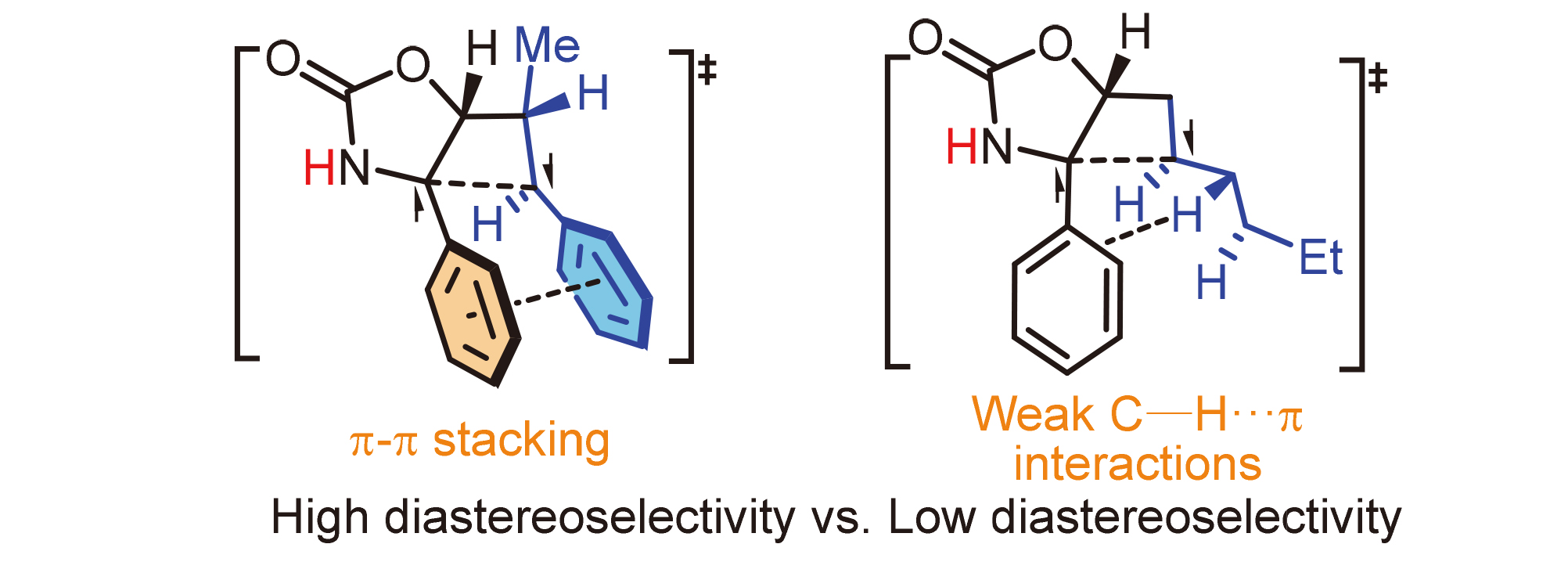
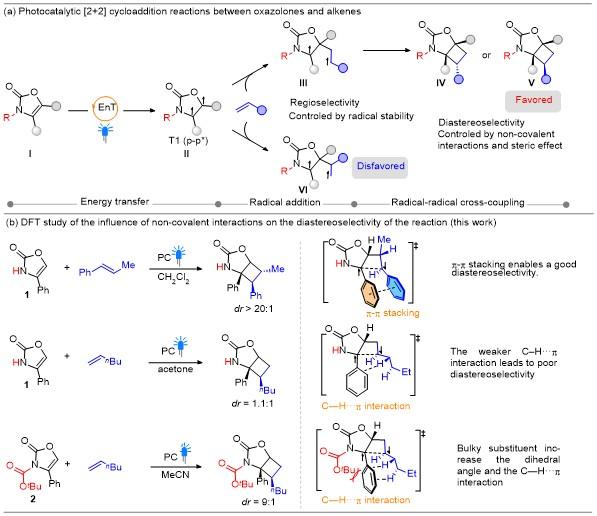
Herein, we performed density functional theory (DFT) calculations to systematically investigate this reaction system. As illustrated in Scheme 1a, the radical addition step between the triplet oxazolone and the alkene governs the regioselectivity. The difference in stability between the radical intermediates formed via the two addition pathways leads to the observed regioselectivity. Subsequently, the radical-radical coupling step serves as the diastereoselectivity-determining step, in which the disparity in non-covalent interactions between the different selectivity pathways controls the diastereoselectivity of the reaction. The diastereoselectivity of the reaction is the primary focus of our study. Experimental results reveal that (E)-methyl-styrene and 1-hexene exhibit different diastereomeric ratio (dr) values when reacting with the same oxazolone. DFT calculations indicate that in the case of 1-hexene, the difference in non-covalent interactions between the competing pathways is relatively small, leading to poor diastereoselectivity. However, increasing the steric hindrance of the oxazolone substrate enhances the C-H…π interactions between the phenyl ring and the alkyl chain, thereby enlarging the energy barrier difference between the selectivity-determining pathways and ultimately improving the diastereoselectivity (Scheme 1b). This in-depth investigation of the reaction system provides a deeper understanding of the photocatalytic [2+2] cycloaddition process and offers valuable theoretical insights and guidance for the further development of such reactions.
2 Computational details
All density functional theory (DFT) calculations were performed using the Gaussian 16 software package.[8] Geometries were optimized using the M06-2X[9] functional with the basis set of 6-311+G(d,p) in dichloromethane/ acetone/acetonitrile solvent. Vibrational frequencies were calculated for all the stationary points to confirm if each optimized structure is a local minimum on the respective potential energy surface or a transition state structure with only one imaginary frequency. Solvation energy corrections were calculated in dichloromethane/acetone/ acetonitrile solvent with the SMD continuum solvation model.[10] The temperature used for the calculation of free energies in this work is 298.15 K, and the pressure is 101 kPa. Three dimensional structures of optimized transition states were plotted using CYLview.[11] Additionally, non-covalent interaction (NCI) analyses were performed using Multi- wfn,[12] and the resulting isosurfaces were visualized with VMD software.[13]
3 Results and discussion
3.1 Computational study of the origin of the regio- selectivity in [2+2] cycloaddition
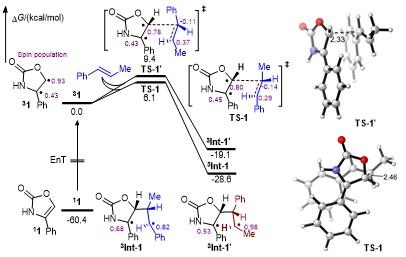
Density functional theory calculations were initially performed to investigate the origin of the regioselectivity in the [2+2] cycloaddition. For the cycloaddition between the excited state of oxazolone 1 and methylstyrene (Figure 1), the radical addition to alkene prefers to occur at the carbon adjacent to the methyl group (via TS-1) as the generated spin center at the benzyl site can be stabilized by the phenyl group. The competing radical addition at the benzyl carbon via TS-1' has a higher activation free energy by 2.2 kcal/mol. The generated biradical intermediate 3Int-1' is also less stable than 3Int-1. Therefore, the regioselectivity is controlled by the conjugative stabilization effect of the phenyl group in methylstyrene. An analogous conclusion is also observed in the case of 1-hexene. The hyperconjugative stabilization effect of the n-butyl group on radical stability determines the regioselectivity of radical addition. Therefore, the above calculations have confirmed that the stability of the radical species governs the regioselectivity of the reaction.
3.2 Computational study of the origin of the diastereoselectivity in [2+2] cycloaddition
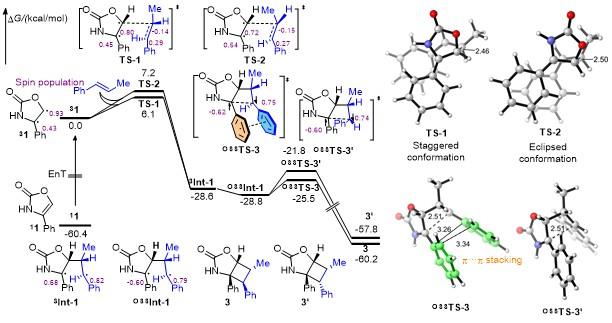
With the regioselectivity clarified, DFT calculations were subsequently performed to investigate the origin of diastereoselectivity in the [2+2] cycloaddition. For the radical addition between the excited state of oxazolone 1 and methylstyrene (Figure 2), both conformers TS-1 and TS-2 are considered. Structural analysis of these two transition states indicates that, compared to TS‑2, the two carbon centers forming the bond in the transition state adopt a staggered conformation in TS‑1, whereas they adopt an eclipsed conformation in TS‑2. This accounts for the higher energy barrier of TS‑2 (ΔΔG‡=1.1 kcal/mol). The diastereoselectivity is then determined in the subsequent radical-radical cross-coupling process. As shown in Figure 2, from the biradical intermediate 3Int-1, the [2+2] cycloaddition product 3 is generated through the open-shell singlet (OSS) transition state OSSTS-3. The activation free energy is 3.7 kcal/mol lower than the diastereomeric transition state OSSTS-3'. Structural analysis suggests that the π-π stacking interaction between the phenyl groups of oxazolone and alkene in OSSTS-3 can stabilize this radical-radical cross-coupling transition state, thereby accounting for the higher diastereoselectivity.
In the case of oxazolone 1 and 1-hexene (Figure 3a), the replacement of the phenyl group by the n-butyl group in the alkene substrate significantly diminishes this intramolecular non-covalent interactions in the radical-radical cross-coupling transition state OSSTS-5. The energy difference between OSSTS-5' and OSSTS-5 is thus decreased (ΔΔG‡=0.8 kcal/mol), which corresponds to a lower diastereoselectivity. If a N-Boc protecting group is introduced to the oxazolone, the experimental diastereoselectivity will increase (dr=9∶1). In the DFT calculation (Figure 3b), the increased energy difference between transition states OSSTS-7' and OSSTS-7 (ΔΔG‡=1.8 kcal/mol) also verifies this result. Moreover, DFT studies reveal that the bulkiness of the Boc group increases the dihedral angle of the phenyl group with the oxazolone plane in OSSTS-7. The corresponding dihedral angle in OSSTS-5 is only 0.7° while this value increases to 20.9° in OSSTS-7. As shown in the optimized structure of OSSTS-7, the rotation of the phenyl group enables the formation of multiple C—H···π interactions between the phenyl group and the n-butyl group. Whereas analogous non-covalent interactions are lacking in OSSTS-7' (Figure 3c). Therefore, the subtle difference in non-covalent interactions between the substituents of oxazolone and alkene accounts for the diastereoselectivity of the [2+2] cycloaddition.
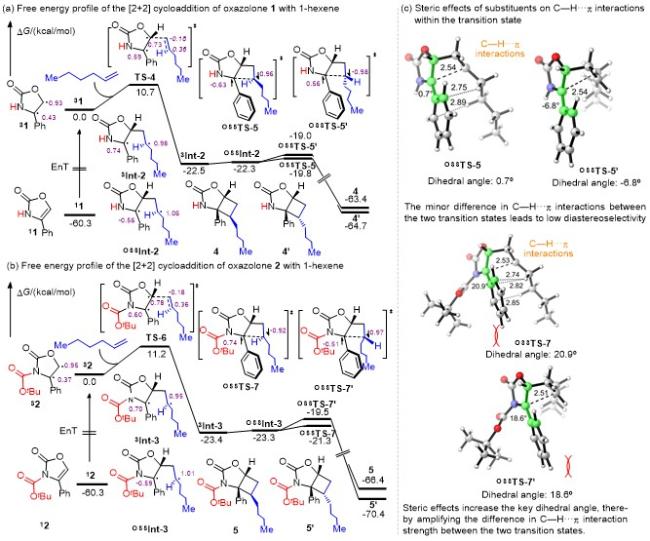
Figure 3 (a) Free energy profile of the [2+2] cycloaddition of oxazolone 1 with 1-hexene (All energies were calculated at M06-2X/6-311+G(d,p)/SMD (acetone) level of theory); (b) Free energy profile of the [2+2] cycloaddition of oxazolone 2 with 1-hexene (All energies were calculated at M06-2X/6-311+G(d,p)/SMD (acetonitrile) level of theory); (c) Three-dimensional structure of the radical-radical coupling transition state |
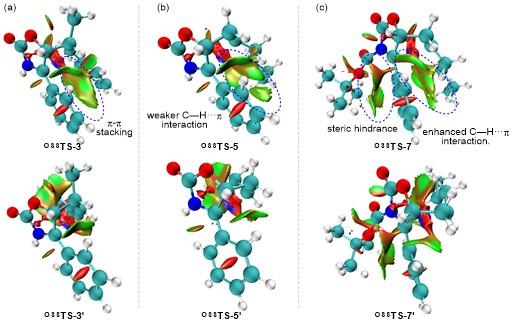
Based on the structural analysis of the radical-radical coupling transition states discussed above, we inferred that the diastereoselectivity of the reaction is governed by non-covalent interactions. Subsequently, a detailed NCI (non-covalent interaction) analysis of these transition states was performed to investigate the specific non-covalent interactions involved. As shown in Figure 4a, the NCI analysis of OSSTS-3 reveals a distinct π-π stacking interaction between the two phenyl rings in OSSTS-3. Next, NCI analysis on OSSTS-5 was conducted to explore the origin of the decreased diastereoselectivity observed in the reaction between oxazolone 1 and 1-hexene. The NCI results are consistent with our earlier inference: only weak C—H…π interactions are present in OSSTS-5, which are insufficient to create a significant energy barrier difference, thereby resulting in poor diastereoselectivity. Finally, the NCI analysis of OSSTS-7 clearly demonstrates that when the oxazolone substrate is changed from 1 to 2, the significant steric repulsion between the N-Boc protecting group and the phenyl ring alters the orientation of the phenyl ring. This reorientation enhances the C-H…π interaction between the phenyl ring and the n-butyl group, ultimately leading to increased diastereoselectivity.


4 Conclusion
Through the above theoretical calculations, we have investigated the mechanism of the cycloaddition reaction between oxazolones and alkenes. The mechanism of the photocatalytic [2+2] cycloaddition of oxazolones with alkenes was elucidated. Specifically, the oxazolone substrate first undergoes an energy transfer process mediated by the photocatalyst to generate the activated triplet state of oxazolone. Subsequently, radical addition to the alkene affords a triplet intermediate, which then undergoes the radical-radical cross-coupling to achieve the cyclization and yield the final product. The origin of selectivity in this transformation was also explored. First, the key step governing regioselectivity was investigated, and the radical addition step between the triplet substrate and the alkene was identified as the regioselectivity-determining step. Furthermore, we conclude that the stabilizing effect of the radical species modulates the regioselectivity. Moreover, the diastereoselectivity is determined by the radical-radical cross-coupling step. The modulation of diastereoselectivity is governed by weak interactions. Specifically, π-π stacking interactions induce the orientation of aromatic rings within the transition state, thereby enabling stereoselective synthesis of the products. Additionally, substituent replacement studies confirmed that substituents can adjust the orientation of aromatic rings through steric effects, thereby altering the strength of weak interactions and consequently modulating the reaction energy barriers, ultimately achieving diastereoselective synthesis.
Supporting Information Cartesian coordinates and energies. The Supporting Information is available free of charge via the Internet at http://sioc-journal.cn/.
(Lu, Y.)