ARTICLES

Photoinduced C—F Bond Cleavage α-Trifluoromethyl Alkenes for the Synthesis of gem-Difluoroalkenes

  • Bin Wang a ,
  • Bo Ye b ,
  • Lei Wang , a, * ,
  • Hong He a ,
  • Yongmin Ma , a, *
Expand
  • a Advanced Research Institute & School of Pharmaceutical Sciences, Taizhou University, Taizhou, Zhejiang 318000
  • b Linhai Branch of Taizhou Ecological Environment Bureau, Linhai, Taizhou, Zhejiang 317000

Received date: 2026-02-06

  Revised date: 2026-03-30

  Online published: 2026-05-14

Supported by

National Natural Science Foundation of China(22471187)

Copyright

© 2026 Shanghai Institute of Organic Chemistry, Chinese Academy of Sciences

Abstract

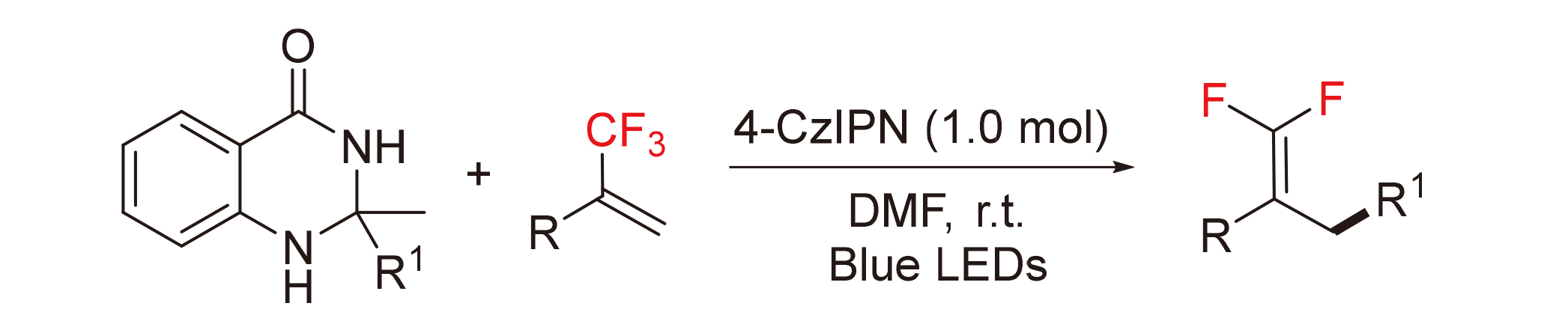
A highly efficient photoinduced radical addition/defluoroalkylation of dihydroquinazolinones and CF3-substituted alkenes was developed, affording a diverse set of gem-difluoroalkenes under mild visible-light conditions. This strategy relies on C—C bond cleavage of dihydroquinazolinones to generate alkyl radicals, followed by addition and β-fluoride elimination. This reaction exhibits broad substrate scope, excellent functional group tolerance, and operational simplicity.

Cite this article

Bin Wang , Bo Ye , Lei Wang , Hong He , Yongmin Ma . Photoinduced C—F Bond Cleavage α-Trifluoromethyl Alkenes for the Synthesis of gem-Difluoroalkenes[J]. Chinese Journal of Organic Chemistry, 2026 , 46(8) : 3219 -3226 . DOI: 10.6023/cjoc202512002

1 Introduction

Ketones are abundant, inexpensive and multifunctional intermediates widely present in commercial chemicals, pharmaceuticals, and natural products.[1] Despite their importance, direct generation of alkyl radicals from unstrained ketones via C—C bond cleavage remains challenging due to their intrinsic chemical stability. Recent advances have addressed this limitation through conversion of unconstrained ketones into protoaromatic (PA) analogs, enabling aromatization-driven C—C bond cleavage to generate alkyl radicals.[2] For examples, Dong and co-workers[3] developed a series of elegant deacylative transformations such as olefination, thiolation, and alkyl cyclization through transition-metal-catalyzed C—C cleavage. Martin[4], Zhu[5] and others[6] further established 2,3-di- hydroquinazolinones as versatile radical precursors through visible-light-induced C—C bond scission.
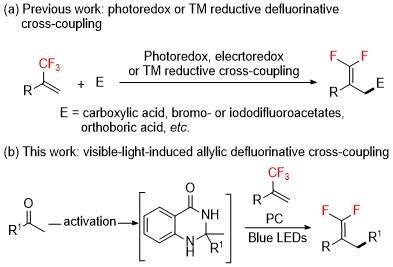
In parallel, gem-difluoroalkenes have gained prominence as fluorinated motifs in pharmaceuticals, agricultures, and advanced materials, owing to their electronic and steric resemblance to carbonyls.[7] Traditional approaches to gem-difluoroalkenes involve nucleophilic addition to α-trifluoromethyl alkenes under strongly basic or organometallic conditions, or direct difluoroalkenylation of carbonyls and diazonium salts.[8] Recently, gem-difluoro- alkenes has been accessed through β-F elimination of CF3-substituted alkenes under photocatalytic, electrocatalytic, and transition-metal catalysis,[9-14] with alkyl radicals generated from C—halogen,[12] C—C,[13] and C—B bonds (Scheme 1a).[14] Given the ubiquity of ketones and their potential as radical precursors, we envisioned a visible-light-driven defluoroalkylation strategy for coupling dihydroquinazolinones (prepared in one step from ketone and o-aminobenzamide) with α-trifluoromethylenes to construct gem-difluoroalkenes (Scheme 1b).
Scheme 1 Defluorinative cross-coupling of CF3-substituted alkenes

2 Results and discussion

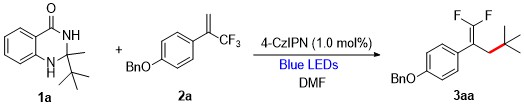
The conditions for this reaction was optimized using 2-(tert-butyl)-2-methyl-2,3-dihydroquinazolin-4(1H)-one (1a) and 1-(benzyloxy)-4-(3,3,3-trifluoroprop-1-en-2-yl)- benzene (2a) as model substrates (Table 1). After a series of conditions screening, optimal reaction conditions employed 1a (0.22 mmol, 1.1 equiv.) and 2a (0.20 mmol, 1.0 equiv.) in N,N-dimethylformamide (DMF) (2.0 mL) under 2×18W blue LEDs irradiation with 4-CzIPN (1.0 mol%) at room temperature for 0.5 h, affording gem-difluoroalkene 3aa in 96% isolated yield (Entry 1). Alternative solvents (dimethyl sulfoxide (DMSO), MeCN) and bases (K3PO4, Na2CO3, NaOAc) did not improve the yield (Entries 2~7). Conducting the reaction in air or O2 decreased efficiency (Entries 8, 9). Both light and photocatalyst were essential, as no product was observed in their absence (Entries 10, 11).
Table 1 Optimization of reaction conditionsa,b
Entry Variation from the optimal conditions Yieldb/%
1 None 96
2 DMSO as solvent 90
3 MeCN as solvent 92
4 K3PO4 (1 equiv.) was added 89
5 Na2CO3 (1 equiv.) was added 90
6 NaOAc (1 equiv.) was added 90
7 KHCO3 (1 equiv.) was added 85
8 Under air atmosphere 81
9 Under O2 atmosphere 62
10 Without photocatalyst 0
11 Without light 0

a Reaction conditions: 1a (0.22 mmol, 1.1 equiv.), 2a (0.20 mmol, 1.0 equiv.), 4-CzIPN (1.0 mol%) and DMF (2.0 mL) under argon atmosphere and stirred at room temperature for 0.5 h under 2×18 W blue LEDs irradiation. b Yields are given for isolated products.

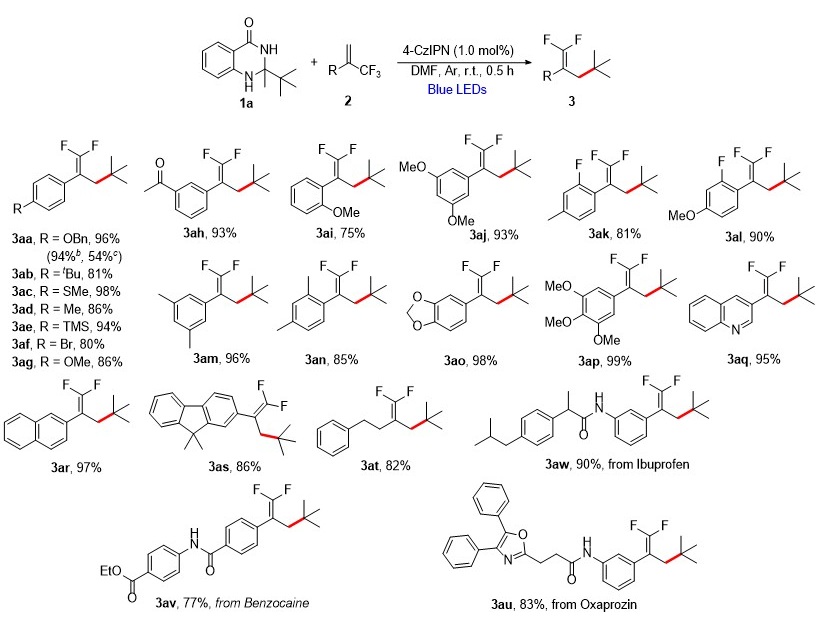
The generality of α-trifluoromethyl alkenes was evaluated under optimized conditions (Table 2). Aryl substrates bearing an electron-donating (OBn, tBu, SMe, Me, TMS, OMe) or an electron-withdrawing group (Br) at the para-position reacted smoothly to yield the corresponding products 3aa~3ag in good to excellent yields. It is noteworthy that the reactions have good compatibility with functional groups such as silyl (3ad), methylthio (3ae) and methoxy (3aa). Substituents at meta- or ortho-position (3ah, 3ai) as well as poly-substituted arenes (3aj~3ap) were well tolerated. Heteroaryl substrates, including quinolinyl and naphthyl derivatives, afforded 3aq and 3ar in 95% and 97% yields, respectively, while a fluorenyl substrate gave 3as in 86% yield. Aliphatic CF3-alkenes also participated effectively. For example, (3-(trifluoromethyl)- but-3-en-1-yl)benzene delivered 3at in 82% yield. Importantly, late-stage functionalization of CF3-alkenes derived from pharmaceuticals (oxaprozin, benzocaine, ibuprofen) afforded 3au~3aw in 77%~90% yields under the optimized reaction conditions. In addition, the reaction was scaled up to 4.4 mmol and the corresponding product 3aa was afforded in 94% yield.
Table 2 Scope of α-trifluoromethyl alkenesa,b

a Reaction conditions: 1a (0.22 mmol, 1.1 equiv.), 2 (0.20 mmol, 1.0 equiv.), 4-CzIPN (1.0 mol%), DMF (2.0 mL), under Argon atmosphere and stirred at room temperature for 0.5 h under 2×18 blue LEDs irradiation, isolated yield of product. b Isolated yield on gram scale. c Dihydroquinazolinone synthesized from pivalaldehyde as a raw material.

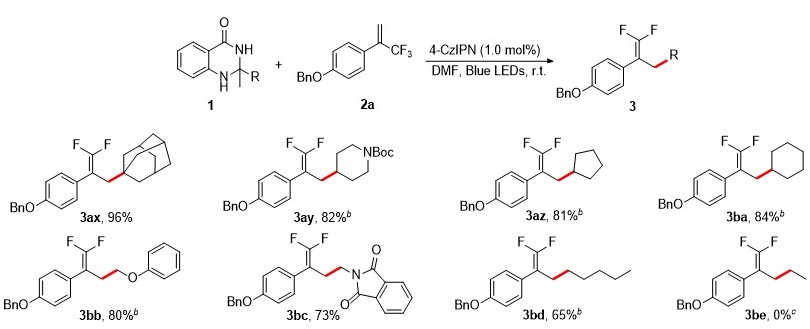
The generalizability of dihydroquinazolinone precursors derived from different ketones was then examined (Table 3). Substrates derived from primary, secondary or tertiary alkyl methyl ketones all reacted efficiently. Adamantanone-derived substrate gave 3ax in 96% yield. Secondary ketone-derived precursors required additional Na2CO3 but delivered 3ay~3ba in 81%~84% yields. Dialkyl ketone-derived precursors afforded 3bb and 3bc in 80% and 73% yields, respectively. From the heptanone-derived precursor, gem-difluoroalkene compound 3bd was obtained in 65% yield. When dihydroquinazolinone synthesized from acetophenone or acetone was used as a substrate for the reaction, the target product 3be was not obtained.
Table 3 Scope of dihydroquinazolinonesa,b

a Reaction conditions: 1 (0.22 mmol, 1.1 equiv.), 2a (0.20 mmol, 1.0 equiv.), 4-CzIPN (1.0 mol%), DMF (2.0 mL), under Argon atmosphere and stirred at room temperature for 0.5 h under 2×18 blue LEDs irradiation, isolated yield of product. b Na2CO3 (0.20 mmol, 1.0 equiv.) was added. c Dihydroquinazolinone synthesized from acetophenone or acetone as a raw material.

In order to gain insight into the reaction mechanism of this reaction, a free radical trapping experiment was conducted with 2,2,6,6-tetramethyl-1-piperidinyloxy (TEMPO, a free-radical trapping reagent). Addition of TEMPO (0.20 mmol) completely inhibited product formation, and the corresponding TEMPO adduct was detected by high performance liquid chromatography-high resolution mass spectrometry (HPLC-HRMS). This free-radical trapping experiment confirmed that the reaction process is involved a free radical during the reaction.
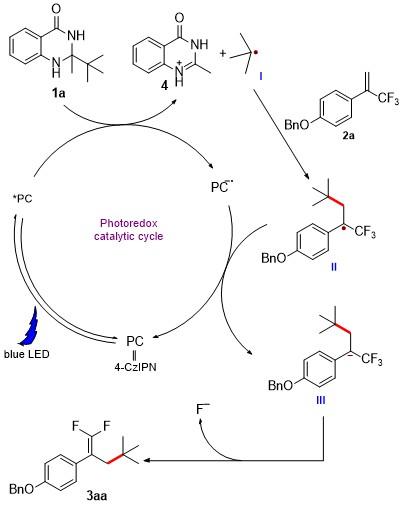
Based on these results and literature precedents,[8-16] a possible reaction mechanism is proposed in Scheme 2. Upon blue LEDs irradiation, excited 4-CzIPN oxidizes 1a to generate a tert-butyl radical I, which adds to CF3-alkene 2a to form a radical intermediate II. The obtained II is reduced by (4-CzIPN)-• to give an intermediate III, which undergoes β-F elimination to give the desired product 3aa.
Scheme 2 Plausible mechanism

3 Conclusions

In conclusion, we have realized an efficient photo-in- duced radical defluoroalkylation of dihydroquinazolinones with α-trifluoromethylenes. This protocol provides direct access to gem-difluoroalkenes from diverse ketones, operates under mild and operationally simple conditions, and can be applied to late-stage functionalization and scale-up. This method offers a valuable platform for the construction of fluorinated scaffolds relevant to drug discovery and materials development.

4 Experimental Section

4.1 General information

All 1H NMR and 13C NMR spectra were recorded on BRUKER AVANCE III 400, BRUKER AVANCE NEO 600, or BRUKER AVANCE III HD 400 NMR with 400 MHz or 600 MHz frequencies and 100 MHz or 150 MHz frequencies. 19F NMR spectra were recorded on BRUKER AVANCE III HD 400 NMR with 376 MHz or BRUKER AVANCE NEO 600 NMR with 565 MHz frequencies. Chemical shifts of 1H NMR and 13C NMR spectra were recorded with TMS (tetramethyl silane) as the internal reference standard (TMS δ=0.00 for 1H NMR, and CDCl3 δ=77.0 for 13C NMR). Data collection for HRMS was obtained from the Q-TOF instrument equipped with an ESI source. All of melting points were measured of micro melting point apparatus. The chemicals and solvents were purchased from commercial suppliers either Aldrich (USA), or Shanghai Chemical Company (P. R. China). Products were purified by flash chromatography on 200~300 mesh silica gels, SiO2.

4.2 Typical procedure for the synthesis of 3

Dihydroquinazolinone derivative (1a, 0.22 mmol), α-trifluoromethyl alkene (2a, 0.20 mmol), 4-CzIPN (1.0 mol%) were added in a 10 mL pre-dried reaction tube with stir bar. The tube was charged with argon (repeated six times). Then, the solvent (DMF, 2.0 mL) was injected. The resulting light-yellow suspension was irradiated by 2×18 W blue LEDs (λ = 452~455 nm) with stirring at room temperature for 0.5 h. After the reaction was complete, water was added and the reaction mixture was extracted with ethyl acetate (5 mL×3). The combined organic phase was dried with anhydrous Na2SO4, then an appropriate amount of silica gel was added and the mixture was concentrated in vacuo. The residue was purified with chromatography column on silica gel (eluent: petroleum ether/ethyl acetate, VV=20∶1) to provide the pure product gem-difluoroalkene 3aa (43 mg, 96% yield). Compounds 3ab~3bd were prepared through the same procedure.
1-(Benzyloxy)-4-(1,1-difluoro-4,4-dimethylpent-1-en-2-yl)benzene (3aa): White solid (43 mg, 96% yield). m.p. 81~83 ℃ (lit.[14e] 82~84 ℃); 1H NMR (400 MHz, CDCl3) δ: 7.44~7.32 (m, 5H), 7.23 (d, J=8.4 Hz, 2H), 6.94 (dd, J=8.4, 1.4 Hz, 2H), 5.04 (s, 2H), 2.30 (s, 2H), 0.80 (s, 9H); 13C NMR (100 MHz, CDCl3) δ: 157.7, 154.3 (dd, J=289.3, 287.0 Hz), 136.9, 129.5 (t, J=2.7 Hz), 128.6, 128.0, 127.5, 114.6, 90.5 (dd, J=21.4, 13.2 Hz), 70.0, 41.2, 32.7 (t, J=2.3 Hz), 29.7; 19F NMR (376 MHz, CDCl3) δ: -90.64 (d, J=43.3 Hz), -93.12 (d, J=43.3Hz).
1-(tert-Butyl)-4-(1,1-difluoro-4,4-dimethylpent-1-en-2-yl)benzene (3ab):[14e] Colorless oil (43.2 mg, 81% yield). 1H NMR (400 MHz, CDCl3) δ: 7.33 (d, J=8.4 Hz, 2H), 7.23 (dd, J=8.4, 1.6 Hz, 2H), 2.32 (t, J=2.4 Hz, 2H), 1.31 (s, 9H), 0.80 (s, 9H); 13C NMR (100 MHz, CDCl3) δ: 154.4 (dd, J=289.8, 286.9 Hz), 149.8, 132.4 (dd, J=4.4, 3.0 Hz), 128.0 (t, J=2.8 Hz), 125.1, 90.84 (dd, J=21.3, 13.0 Hz), 41.0, 34.5, 32.7 (t, J=2.5 Hz), 31.3, 29.8; 19F NMR (376 MHz, CDCl3) δ: -90.08 (d, J=42.3 Hz), -92.68 (d, J=42.2 Hz).
(4-(1,1-Difluoro-4,4-dimethylpent-1-en-2-yl)phenyl)-(methyl)sulfane (3ac):[14e] Yellow oil (50.1 mg, 98% yield). 1H NMR (400 MHz, CDCl3) δ: 7.25~7.19 (m, 4H), 2.47 (s, 3H), 2.31 (t, J=2.4 Hz, 2H), 0.80 (s, 9H); 13C NMR (100 MHz, CDCl3) δ: 154.3 (dd, J=288.5, 285.9 Hz), 137.1, 132.3 (dd, J=4.6, 2.8 Hz), 128.8 (t, J=2.9 Hz), 126.3, 90.6 (dd, J=21.8, 13.0 Hz), 41.0, 32.7 (t, J=2.4 Hz), 29.7, 15.7; 19F NMR (376 MHz, CDCl3) δ: -89.59 (d, J=41.0 Hz), -92.20 (d, J=41.2 Hz).
1-(1,1-Difluoro-4,4-dimethylpent-1-en-2-yl)-4-methyl-benzene (3ad):[14e] Colorless oil (38.7 mg, 86% yield). 1H NMR (400 MHz, CDCl3) δ: 7.19 (dd, J=8.1, 1.4 Hz, 2H), 7.13 (d, J=8.0 Hz, 2H), 2.33 (s, 3H), 2.31 (td, J=2.5, 0.6 Hz, 2H), 0.80 (s, 9H); 13C NMR (100 MHz, CDCl3) δ: 154.3 (dd, J=289.8, 286.9 Hz), 136.6, 132.6 (td, J=3.6, 1.5 Hz), 129.0, 128.3 (t, J=2.8 Hz), 90.9 (dd, J=21.2, 12.8 Hz), 41.1, 32.7 (t, J=2.5 Hz), 29.7, 21.1; 19F NMR (376 MHz, CDCl3) δ: -90.31 (d, J=42.4 Hz), -92.83 (d, J=42.3 Hz).
(4-(1,1-Difluoro-4,4-dimethylpent-1-en-2-yl)phenyl)tri-methylsilane (3ae):[14e] Colorless oil (52.9mg, 94% yield). 1H NMR (400 MHz, CDCl3) δ: 7.36 (d, J=7.6 Hz, 2H), 7.18 (d, J=7.9 Hz, 2H), 2.23 (s, 2H), 0.70 (s, 9H), 0.15 (d, J=0.7 Hz, 9H); 13C NMR (100 MHz, CDCl3) δ: 154.5 (dd, J=290.5, 286.7 Hz), 139.1, 136.0 (dd, J=4.4, 3.0 Hz), 133.2, 127.7 (t, J=2.7 Hz), 91.1 (dd, J=21.5, 12.9 Hz), 41.0, 32.7 (t, J=2.3 Hz), 29.8, -1.1; 19F NMR (376 MHz, CDCl3) δ: -89.40 (d, J=40.6 Hz), -92.15 (d, J=40.8 Hz).
1-Bromo-4-(1,1-difluoro-4,4-dimethylpent-1-en-2-yl)-benzene (3af):[14e] Colorless oil (46.2 mg, 80% yield). 1H NMR (400 MHz, CDCl3) δ: 7.45 (d, J=8.5 Hz, 2H), 7.18 (dd, J=8.3, 1.0 Hz, 2H), 2.30 (t, J=2.3 Hz, 2H), 0.79 (s, 9H); 13C NMR (100 MHz, CDCl3) δ: 154.3 (dd, J=291.8, 287.7 Hz), 134.6 (dd, J=5.0, 2.9 Hz), 131.5, 130.1 (t, J=2.9 Hz), 120.9, 90.4 (dd, J=22.1, 12.6 Hz), 41.0, 32.7 (t, J=2.4 Hz), 29.7; 19F NMR (376 MHz, CDCl3) δ: -88.83 (d, J=39.2 Hz), -91.50 (d, J=39.2 Hz).
1-(1,1-Difluoro-4,4-dimethylpent-1-en-2-yl)-4-methoxy-benzene (3ag):[14e] Colorless oil (41.2 mg, 86% yield). 1H NMR (400 MHz, CDCl3) δ: 7.25 (dd, J=8.8, 1.4 Hz, 2H), 6.89 (dd, J=6.8, 2.0 Hz, 2H), 3.82 (s, 3H), 2.32 (t, J=2.4 Hz, 2H), 0.82 (s, 9H); 13C NMR (100 MHz, CDCl3) δ: 158.4, 154.3 (dd, J=288.7, 2870 Hz), 129.5 (t, J=2.8 Hz), 127.7 (dd, J=5.1, 2.6 Hz), 113.7, 90.5 (dd, J=21.5, 13.2 Hz), 55.2, 41.2, 32.6 (t, J=2.5 Hz), 29.7; 19F NMR (376 MHz, CDCl3) δ: -90.79 (d, J=43.6 Hz), -93.33 (d, J=43.6 Hz).
1-(3-(1,1-Difluoro-4,4-dimethylpent-1-en-2-yl)phenyl)-ethan-1-one (3ah):[14e] Colorless oil (46.8 mg, 93% yield). 1H NMR (400 MHz, CDCl3) δ: 7.84 (d, J=1.1 Hz, 1H), 7.73 (d, J=7.6 Hz, 1H), 7.43 (d, J=7.7, Hz, 1H), 7.33 (t, J=7.7, Hz, 1H), 2.51(d, J=1.3 Hz, 1H), 2.28 (t, J=1.8 Hz, 2H), 0.71 (s, 9H); 13C NMR (100 MHz, CDCl3) δ: 197.6, 154.5 (dd, J=291.0, 288.6 Hz), 137.2, 136.2 (dd, J=4.7, 2.6 Hz), 133.0 (t, J=2.5 Hz), 128.5, 128.0 (t, J=2.8 Hz), 127.0, 90.6 (dd, J=22.1, 12.5 Hz), 41.1, 32.7, 29.6, 26.5; 19F NMR (376 MHz, CDCl3) δ: -88.71 (dd, J=38.9 Hz), -91.54 (dd, J=38.9 Hz).
1-(1,1-Difluoro-4,4-dimethylpent-1-en-2-yl)-2-methoxy-benzene (3ai):[14e] Colorless oil (35.9 mg, 75% yield). 1H NMR (400 MHz, CDCl3) δ: 7.24 (td, J=8.7, 1.5 Hz, 1H), 7.17 (d, J=7.5 Hz, 1H), 6.92 (t, J=7.5 Hz, 1H), 6.87 (d, J=8.3 Hz, 1H), 3.83 (s, 3H), 2.30 (s, 2H), 0.80 (s, 9H); 13C NMR (100 MHz, CDCl3) δ: 156.9, 153.9 (t, J=287.4 Hz), 130.8, 128.6, 124.6 (dd, J=5.0, 1.9 Hz), 120.3, 111.0, 87.4 (dd, J=23.0, 15.5 Hz), 55.4, 41.6, 32.6 (t, J=2.4 Hz), 29.5; 19F NMR (376 MHz, CDCl3) δ: -88.97 (d, J=39.4 Hz), -91.73 (d, J=39.5 Hz).
1-(1,1-Difluoro-4,4-dimethylpent-1-en-2-yl)-3,5-dimeth-oxybenzene (3aj):[14e] Yellow oil (50.1 mg, 93% yield). 1H NMR (400 MHz, CDCl3) δ: 6.47 (t, J=1.7 Hz, 2H), 6.36 (t, J=2.2 Hz, 1H), 3.78 (s, 6H), 2.30 (t, J=2.4 Hz, 2H), 0.82 (s, 9H); 13C NMR (100 MHz, CDCl3) δ: 160.6, 154.4 (dd, J=290.5, 287.1 Hz), 137.5 (dd, J=4.6, 2.5 Hz), 106.9 (t, J=2.8 Hz), 98.8, 91.2 (dd, J=21.89, 13.0 Hz), 55.2, 41.1, 32.7 (t, J=2.4 Hz), 29.6; 19F NMR (376 MHz, CDCl3) δ: -89.37 (d, J=40.0 Hz), -90.95 (d, J=39.0 Hz).
1-(1,1-Difluoro-4,4-dimethylpent-1-en-2-yl)-2-fluoro-4-methylbenzene (3ak):[14e] Colorless oil (39.4 mg, 81% yield). 1H NMR (400 MHz, CDCl3) δ: 7.11 (t, J=7.8 Hz, 1H), 6.91 (d, J=7.9 Hz, 1H), 6.87 (d, J=11.3 Hz, 1H), 2.33 (s, 3H), 2.29 (s, 2H), 0.81 (s, 9H); 13C NMR (100 MHz, CDCl3) δ: 159.6 (d, J=247.1 Hz), 154.1 (t, J=288.8 Hz), 139.7 (d, J=8.1 Hz), 130.3~130.2 (m), 124.7 (d, J=3.0 Hz), 120.2 (ddd, J=15.3, 5.1, 2.0 Hz), 116.4 (d, J=22.1 Hz), 85.2 (dd, J=24.7, 15.6 Hz), 41.5, 32.6 (t, J=2.5 Hz), 29.5, 21.0; 19F NMR (376 MHz, CDCl3) δ: -88.24 (dd, J=36.2 14.6 Hz), -90.09 (d, J=37.3 Hz), -114.53 (d, J=14.9 Hz).
1-(1,1-Difluoro-4,4-dimethylpent-1-en-2-yl)-2-fluoro-4-methoxybenzene (3al):[14e] Colorless oil (46.6 mg, 90% yield). 1H NMR (400 MHz, CDCl3) δ: 7.13 (t, J=8.5 Hz, 1H), 6.68 (dd, J=8.6, 2.4 Hz, 1H), 6.62 (dd, J=11.9, 2.5 Hz, 1H), 3.78 (s, 3H), 2.27 (s, 2H), 0.81 (s, 9H); 13C NMR (100 MHz, CDCl3) δ: 160.4 (d, J=247.2 Hz), 160.29 (d, J=11.0 Hz), 154.1 (t, J=288.5 Hz), 131.0~130.9 (m), 115.3 (ddd, J=15.5, 5.1, 2.1 Hz), 110.0 (d, J=3.0 Hz), 101.8 (d, J=26.4 Hz), 85.0 (dd, J=24.7, 15.6 Hz), 55.4, 41.5, 32.5 (t, J=2.3 Hz), 29.5; 19F NMR (376 MHz, CDCl3) δ: -88.68 (dd, J=37.3, 14.7 Hz), -90.42 (d, J=37.3 Hz), -111.26~-111.31 (m).
1-(1,1-Difluoro-4,4-dimethylpent-1-en-2-yl)-3,5-dimeth-ylbenzene (3am):[14e] Colorless oil (45.8 mg, 96% yield). 1H NMR (400 MHz, CDCl3) δ: 6.91 (s, 2H), 6.86 (s, 1H), 2.30~2.29 (m, 8H), 0.80 (s, 9H); 13C NMR (100 MHz, CDCl3) δ: 154.4 (dd, J=289.3, 286.9 Hz), 137.6, 135.5 (dd, J=4.4, 2.5 Hz), 128.7, 126.3 (t, J=2.6 Hz), 91.2 (dd, J=21.0, 13.0 Hz), 41.3, 32.7 (t, J=2.4 Hz), 29.7, 21.3; 19F NMR (565 MHz, CDCl3) δ: -90.17 (d, J=42.1 Hz), -92.35 (d, J=42.2Hz).
1-(1,1-Difluoro-4,4-dimethylpent-1-en-2-yl)-2,4-dimeth-ylbenzene (3an):[14e] Colorless oil (40.4 mg, 85% yield). 1H NMR (400 MHz, CDCl3) δ: 7.06 (d, J=7.8 Hz, 1H), 7.00 (s, 1H), 6.96 (d, J=7.8 Hz, 1H), 2.29 (s, 8H), 0.82 (s, 9H); 13C NMR (100 MHz, CDCl3) δ: 153.5 (dd, J=288.2, 287.7 Hz), 136.9, 136.0, 131.9 (dd, J=4.4, 1.4 Hz), 131.2, 129.4 (t, J=2.6 Hz), 126.4, 89.5 (dd, J=20.9, 16.3 Hz), 42.9, 32.7 (t, J=2.2 Hz), 29.7, 21.0, 19.8 (d, J=3.3 Hz); 19F NMR (376 MHz, CDCl3) δ: -88.37 (d, J=40.9 Hz), -91.58 (d, J=40.9 Hz).
5-(1,1-Difluoro-4,4-dimethylpent-1-en-2-yl)benzo[d][1,3]dioxole (3ao):[14e] Colorless oil (49.7 mg, 98% yield). 1H NMR (400 MHz, CDCl3) δ: 6.79 (d, J=1.0 Hz, 1H), 6.77 (s, 2H), 5.49 (s, 2H), 2.26 (t, J=2.4 Hz, 2H), 0.81 (s, 9H); 13C NMR (100 MHz, CDCl3) δ: 154.4 (dd, J=289.1, 287.0 Hz), 151.5, 147.5 146.5, 129.2 (dd, J=5.0, 2.8 Hz), 121.9 (t, J=2.9 Hz), 109.0 (t, J=2.9 Hz), 108.1, 101.0, 90.8 (dd, J=21.5, 13.1 Hz), 41.4, 32.7 (t, J=2.4 Hz), 29.7; 19F NMR (376 MHz, CDCl3) δ: -90.36 (d, J=42.3 Hz), -92.49 (d, J=43.0 Hz).
5-(1,1-Difluoro-4,4-dimethylpent-1-en-2-yl)-1,2,3-trime-thoxybenzene (3ap):[14e] Yellow oil (59.4 mg, 99% yield). 1H NMR (400 MHz, CDCl3) δ: 6.52 (d, J=1.1 Hz, 2H), 3.86 (s, 9H), 2.30 (t, J=2.4 Hz, 2H), 0.83 (s, 9H); 13C NMR (100 MHz, CDCl3) δ: 154.3 (dd, J=289.7, 287.2 Hz), 152.9, 137.1, 130.9 (dd, J=4.8, 2.9 Hz), 105.8 (t, J=2.7 Hz), 91.1 (dd, J=21.9, 12.9 Hz), 60.8, 56.1, 41.3, 32.6 (t, J=2.4 Hz), 29.6; 19F NMR (376 MHz, CDCl3) δ: -89.87 (dd, J=42.4, 2.4 Hz), -91.55 (d, J=39.9, 2.6 Hz).
3-(1,1-Difluoro-4,4-dimethylpent-1-en-2-yl)quinoline (3aq):[14e] Yellow oil (49.6 mg, 95% yield). 1H NMR (400 MHz, CDCl3) δ: 8.82 (t, J=2.1 Hz, 1H), 8.02 (d, J=8.5 Hz, 1H), 8.00 (t, J=0.9 Hz, 1H), 7.73 (d, J=8.1 Hz, 1H), 7.66~7.61 (m, 1H), 7.50~7.46 (m, 1H), 2.40 (t, J=2.4 Hz, 2H), 0.76 (s, 9H); 13C NMR (100 MHz, CDCl3) δ: 155.0 (dd, J=291.7, 289.8 Hz), 150.5 (t, J=3.2 Hz), 146.9, 134.8 (t, J=2.9 Hz). 129.5, 129.2, 128.9 (dd, J=5.0, 3.2 Hz), 127.7, 127.6, 127.0, 88.6 (dd, J=23.4, 13.1 Hz), 41.0, 32.9 (t, J=2.3 Hz), 29.8; 19F NMR (376 MHz, CDCl3) δ: -87.06~-87.30 (m), -90.60~-90.84 (m).
2-(1,1-Difluoro-4,4-dimethylpent-1-en-2-yl)naphthalene (3ar):[14e] White solid (50.4 mg, 97% yield). m.p. 55~57 ℃; 1H NMR (400 MHz, CDCl3) δ: 7.78~7.76 (m, 4H), 7.46~7.41 (m, 3H), 2.43 (td, J=2.4, 0.4 Hz, 2H), 0.81 (s, 9H); 13C NMR (100 MHz, CDCl3) δ: 154.6 (dd, J=290.5, 287.8 Hz), 133.3, 133.1 (dd, J=4.5, 2.8 Hz), 132.4, 127.9. 127.6, 127.4 (t, J=2.9 Hz), 126.5 (t, J=2.6 Hz), 126.2, 125.9, 91.2 (dd, J=21.5, 12.7 Hz), 41.3, 32.8 (t, J=2.4 Hz), 29.8; 19F NMR (376 MHz, CDCl3) δ: -89.16 (d, J=39.6 Hz), -91.97 (d, J=39.6 Hz).
2-(1,1-Difluoro-4,4-dimethylpent-1-en-2-yl)-9,9-dimethyl-9H-fluorene (3as):[14e] Colorless oil (55.9 mg, 86% yield). 1H NMR (400 MHz, CDCl3) δ: 7.70~7.65 (m, 2H), 7.42~7.40 (m, 1H), 7.37 (d, J=0.8 Hz, 1H), 7.34~7.27 (m, 3H), 2.39 (d, J=1.9 Hz, 2H), 1.48 (d, J=1.2 Hz, 6H), 0.81 (d, J=1.4 Hz, 9H); 13C NMR (100 MHz, CDCl3) δ: 154.4 (dd, J=290.2, 287.6 Hz), 153.7, 153.66, 138.8, 138.1, 134.5 (dd, J=4.3, 3.0 Hz), 127.4 (t, J=2.8 Hz), 127.2, 127.0, 122.6 (t, J=3.3 Hz), 119.9, 119.8, 91.5 (dd, J=21.2, 12.8 Hz), 46.8, 41.3, 32.7 (t, J=2.3 Hz), 29.8, 27.1; 19F NMR (376 MHz, CDCl3) δ: -89.87 (dd, J=41.1, 1.9 Hz), -92.05 (d, J=41.0, 3.2 Hz).
(3-(Difluoromethylene)-5,5-dimethylhexyl)benzene (3at): Colorless oil (39.0 mg, 82% yield). 1H NMR (400 MHz, CDCl3) δ: 7.29~7.25 (m, 2H), 7.20~7.15 (m, 3H), 2.69 (t, J=8.1 Hz, 2H), 2.32~2.28 (m, 2H), 1.86 (t, J=2.0 Hz, 2H), 0.92 (s, 9H); 13C NMR (100 MHz, CDCl3) δ: 154.7 (t, J=285.1 Hz), 141.4, 128.4, 126.0, 118.1 (dd, J=11.8, 5.8 Hz), 87.2 (t, J=16.6 Hz), 39.7 (d, J=2.2 Hz), 34.2 (t, J=2.7 Hz), 32.7 (t, J=2.5 Hz), 30.7 (d, J=2.6 Hz), 29.8; 19F NMR (376 MHz, CDCl3) δ: -91.74 (d, J=51.5 Hz), -93.97 (d, J=51.8 Hz); HRMS (ESI) calcd for C15H21F2 [M+H] 239.1606; found 239.1608.
N-(3-(1,1-Difluoro-4,4-dimethylpent-1-en-2-yl)phenyl)-3-(4,5-diphenyloxazol-2-yl)propenamide (3au): White solid (82.8 mg, 83% yield). m.p. 98~100 ℃ (lit.[14e] 97~99 ℃); 1H NMR (400 MHz, CDCl3) δ: 9.03 (s, 1H), 7.62 (dd, J=8.1, 1.6 Hz, 2H), 7.56~7.52 (m, 7H), 7.49 (d, J=8.0 Hz, 1H), 7.39~7.28 (m, 7H), 7.20 (t, J=7.9 Hz, 1H), 7.00 (d, J=7.6 Hz, 1H), 3.23 (t, J=6.9 Hz, 2H), 2.92 (t, J=6.9 Hz, 2H), 2.23 (s, 2H), 0.75 (s, 9H); 13C NMR (100 MHz, CDCl3) δ: 169.9, 162.5, 154.2 (dd, J=290.1, 287.6 Hz), 145.6, 138.2, 136.3, 134.6, 132.1, 128.7, 128.6, 128.2, 127.7, 126.4, 124.1, 119.5, 118.3, 90.8 (dd, J=22.0, 12.8 Hz), 41.0, 33.9, 32.6 (t, J=2.2 Hz), 29.6, 23.8; 19F NMR (376 MHz, CDCl3) δ: -89.48 (d, J=40.2 Hz), -91.66 (d, J=40.4 Hz).
Ethyl 4-(4-(1,1-difluoro-4,4-dimethylpent-1-en-2-yl)-benzamido)benzoate (3av): White solid (61.9 mg, 77% yield). m.p. 110~112 ℃ (lit.[14e] 111~113 ℃); 1H NMR (400 MHz, CDCl3) δ: 8.49 (s, 1H), 8.01 (dd, J=6.6, 1.6 Hz, 2H), 7.84 (d, J=7.4 Hz, 2H), 7.76 (d, J=8.4 Hz, 2H), 7.38 (d, J=8.0 Hz, 2H), 4.34 (qd, J=7.1, 1.5 Hz, 2H), 2.35 (s, 2H), 1.38 (td, J=7.0, 1.7 Hz, 3H), 0.79 (s, 9H); 13C NMR (100 MHz, CDCl3) δ: 166.2, 165.6, 154.5 (dd, J=291.8, 289.3 Hz), 142.2, 139.8, 132.9, 130.7, 128.7, 127.2, 126.1, 119.3, 90.7 (dd, J=22.3, 12.1 Hz), 60.9, 40.8, 32.7, 29.6, 14.2; 19F NMR (376 MHz, CDCl3) δ: -87.52~-87.64 (m), -90.48 (dd, J=36.1, 9.0 Hz).
N-(3-(1,1-Difluoro-4,4-dimethylpent-1-en-2-yl)phenyl)-2-(4-isobutylphenyl)-propenamide (3aw): White solid (74.6, 90% yield). m.p. 135~137 ℃ (lit.[14e] 134~136 ); 1H NMR (400 MHz, CDCl3) δ: 7.50 (s, 1H), 7.30 (d, J=7.2 Hz, 1H), 7.26 (d, J=7.8 Hz, 2H), 7.19 (t, J=7.9 Hz, 1H), 7.12 (d, J=8.0 Hz, 2H), 7.01 (d, J=7.6 Hz, 1H), 3.70 (q, J=6.8 Hz, 1H), 2.46 (d, J=7.2 Hz, 2H), 2.27 (t, J=2.2 Hz, 2H), 2.27 (sept, J=6.8 Hz, 1H), 1.56 (d, J=7.2 Hz, 3H), 0.90 (d, J=6.6 Hz, 6H), 0.77 (s, 9H); 13C NMR (100 MHz, CDCl3) δ: 172.8, 154.3 (dd, J=290.8, 287.6 Hz), 140.9, 138.0 (d, J=2.4 Hz), 136.4 (dd, J=4.6, 2.8 Hz), 129.7, 128.6, 127.3, 124.3, 119.6, 118.3, 90.9 (dd, J=21.9, 12.7 Hz), 47.6, 44.9, 41.0, 32.6 (t, J=2.2 Hz), 30.1, 29.6, 22.3, 18.5; 19F NMR (376 MHz, CDCl3) δ: -87.52 (d, J=36.3 Hz), -90.44 (d, J=36.2 Hz).
1-(2-(4-(Benzyloxy)phenyl)-3,3-difluoroallyl)adamantane (3ax):[14f] White solid (75.4 mg, 96% yield). m.p. 125~127 ℃; 1H NMR (400 MHz, CDCl3) δ: 7.42 (d, J=7.2 Hz, 2H), 7.37 (t, J=7.3 Hz, 2H), 7.32 (dd, J=7.1, 2.5 Hz, 1H), 7.23 (d, J=7.5 Hz, 2H), 6.93 (d, J=8.8 Hz, 2H), 5.02 (s, 2H), 2.16 (s, 2H), 1.86 (s, 3H), 1.62 (d, J=12.0 Hz, 3H), 1.53 (d, J=11.7 Hz, 3H), 1.38 (s, 6H); 13C NMR (100 MHz, CDCl3) δ: 157.6, 154.3 (dd, J=289.4, 286.5 Hz), 136.9, 129.4 (t, J=2.7 Hz), 128.5, 128.3 (dd, J=5.1, 2.6 Hz), 128.0, 127.5, 114.5, 89.1 (dd, J=21.9, 12.7 Hz), 70.0, 42.7, 41.9, 36.9, 34.6, 28.6; 19F NMR (376 MHz, CDCl3) δ: -89.81 (dd, J=43.2, 12.3 Hz), -92.80 (dd, J=43.0, 12.4 Hz).
tert-Butyl 4-(2-(4-(benzyloxy)phenyl)-3,3-difluoroallyl)-piperidine-1-carboxylate (3ay): Colorless oil (72.8 mg, 82% yield). 1H NMR (400 MHz, CDCl3) δ: 7.36 (d, J=7.2 Hz, 2H), 7.31 (t, J=7.3 Hz, 2H), 7.27~7.23 (m, 1H), 7.14 (d, J=8.5 Hz, 2H), 6.89 (d, J=8.7 Hz, 2H), 4.99 (s, 2H), 3.95 (s, 2H), 2.50 (t, J=12.2 Hz, 2H), 2.22 (d, J=7.0 Hz, 2H), 1.53 (d, J=12.5 Hz, 2H), 1.36 (s, 9H), 1.34~1.31 (m, 1H), 1.03 (qd, J=12.4, 3.8 Hz, 2H); 13C NMR (100 MHz, CDCl3) δ: 158.0, 154.8, 153.9 (dd, J=289.7, 286.1 Hz), 136.8, 129.3 (t, J=3.2 Hz), 128.6, 128.0, 127.5, 126.0 (t, J=3.5 Hz), 114.9, 89.9 (dd, J=22.1, 13.7 Hz), 79.3, 70.0, 43.7, 34.4, 34.2, 31.7, 28.4; 19F NMR (376 MHz, CDCl3) δ: -91.57 (d, J=45.1 Hz), -91.9 (d, J=45.1 Hz).
1-(Benzyloxy)-4-(3-cyclopentyl-1,1-difluoroprop-1-en-2-yl)benzene (3az):[14f] Brown solid (53.4 mg, 81% yield). m.p. 64~66 ℃; 1H NMR (400 MHz, CDCl3) δ: 7.43 (d, J=6.9 Hz, 2H), 7.39 (td, J=7.4, 0.7 Hz, 2H), 7.32 (t, J=7.0 Hz, 1H), 7.23 (d, J=8.2 Hz, 2H), 6.96 (d, J=8.8 Hz, 2H), 5.05 (s, 2H), 2.35 (dt, J=7.5, 2.0 Hz, 2H), 1.79 (hept, J=7.5 Hz, 1H), 1.67~1.58 (m, 4H), 1.47~1.44 (m, 2H), 1.17~1.09 (m, 2H); 13C NMR (100 MHz, CDCl3) δ: 157.9, 153.8 (dd, J=288.4, 285.4 Hz), 136.9, 129.5 (t, J=3.0 Hz), 128.6, 128.0, 127.5, 114.7, 91.7 (dd, J=21.8, 13.4 Hz), 70.0, 38.2 (t, J=4.2 Hz), 33.6, 32.1, 25.0; 19F NMR (376 MHz, CDCl3) δ: -92.94 (d, J=45.9 Hz), -93.24 (d, J=47.8 Hz).
1-(Benzyloxy)-4-(3-cyclohexyl-1,1-difluoroprop-1-en-2-yl)benzene (3ba):[14e] Yellow oil (57.4 mg, 84% yield). 1H NMR (400 MHz, CDCl3) δ: 7.43 (dd, J=7.3, 0.8 Hz, 2H), 7.38 (t, J=7.7 Hz, 2H), 7.32 (t, J=7.0 Hz, 1H), 7.22 (d, J=8.8 Hz, 2H), 6.96 (dd, J=8.5, 1.5 Hz, 2H), 5.05 (s, 2H), 2.24~2.22 (m, 2H), 1.67 (d, J=11.7 Hz, 4H), 1.59 (s, 1H), 1.28~1.22 (m, 1H), 1.12 (s, 3H), 0.92 (t, J=10.5 Hz, 2H). 13C NMR (100 MHz, CDCl3) δ: 157.8, 153.9 (dd, J=289.6, 285.5 Hz), 136.9, 129.4 (t, J=3.1 Hz), 128.6, 128.0, 127.5, 126.5 (t, J=3.6 Hz), 114.7, 90.5 (dd, J=22.1, 13.1 Hz), 70.0, 35.6, 35.3, 32.8, 26.4, 26.1; 19F NMR (376 MHz, CDCl3) δ: -92.16 (d, J=46.5 Hz), -92.58 (d, J=46.4 Hz).
1-(Benzyloxy)-4-(1,1-difluoro-4-phenoxybut-1-en-2-yl)-benzene (3bb): White solid (58.8 mg, 80% yield). m.p. 46~48 ℃; 1H NMR (400 MHz, CDCl3) δ: 7.33 (dd, J=6.8, 1.6 Hz, 2H), 7.29 (td, J=8.0, 1.4 Hz, 2H), 7.25~7.21 (m, 1H), 7.19~7.12 (m, 4H), 6.89~6.86 (m, 2H), 6.85~6.81 (m, 1H), 6.73 (dd, J=8.8, 1.0 Hz, 2H), 4.96 (s, 2H), 3.85 (t, J=6.9 Hz, 2H), 2.74 (tt, J=6.9, 2.2 Hz, 2H); 13C NMR (100 MHz, CDCl3) δ: 158.6, 158.1, 154.1 (t, J=288.9 Hz), 136.8, 129.4 (t, J=5.2 Hz), 128.6, 128.0, 127.4, 125.5 (t, J=3.7 Hz), 120.8, 114.9, 114.5, 88.66 (dd, J=20.1, 14.2 Hz), 70.0, 65.3 (t, J=2.7 Hz), 28.2; 19F NMR (376 MHz, CDCl3) δ: -90.38 (d, J=42.2 Hz), -90.88 (d, J=42.2 Hz); HRMS (ESI) calcd for C23H20F2O2Na [M+Na] 389.1324, found 389.1320.
2-(3-(4-(Benzyloxy)phenyl)-4,4-difluorobut-3-en-1-yl)-isoindoline-1,3-dione (3bc): White solid (61.3 mg, 73% yield). m.p. 92~94 ℃; 1H NMR (400 MHz, CDCl3) δ: 7.78~7.73 (m, 2H), 7.67~7.64 (m, 2H), 7.41~7.30 (m, 5H), 7.25 (dd, J=5.1, 3.1 Hz, 2H), 6.86 (dd, J=6.8, 2.0 Hz, 2H), 4.95 (s, 2H), 3.76 (t, J=6.8 Hz, 2H), 2.78 (tt, J=6.8, 2.0 Hz, 2H); 13C NMR (100 MHz, CDCl3) δ: 168.0, 157.9, 136.7, 133.7, 131.9, 129.2 (t, J=3.2 Hz), 128.5, 127.9, 127.4, 125.0, 123.0, 114.7, 89.09 (dd, J=21.4, 15.3 Hz), 69.8, 36.4, 26.5; 19F NMR (376 MHz, CDCl3) δ: -90.57 (d, J=41.5 Hz), -90.84 (d, J=41.2 Hz); HRMS (ESI) calcd for C26H22F2NO3 [M+H] 434.1562, found 434.1577.
1-(Benzyloxy)-4-(1,1-difluorooct-1-en-2-yl)benzene (3bd): White solid (43.1 mg, 65% yield). m.p. 40~42 ℃; 1H NMR (400 MHz, CDCl3) δ: 7.44~7.42 (m, 2H), 7.40~7.36 (m, 2H), 7.34~7.30 (m, 1H), 7.22 (dd, J=7.2, 1.6 Hz, 2H), 6.97~6.94 (m, 2H), 5.05 (s, 2H), 2.36~2.32 (m, 2H), 1.36~1.23 (m, 8H), 0.86 (t, J=6.9 Hz, 3H); 13C NMR (100 MHz, CDCl3) δ: 157.8, 153.4 (t, J=287.2 Hz), 136.9, 129.3 (t, J=3.3 Hz), 128.6, 128.0, 127.5, 126.3, 114.7, 91.9 (t, J=17.3 Hz), 70.0, 31.5, 28.7, 27.7 (d, J=4.1 Hz), 22.6, 14.0; 19F NMR (376 MHz, CDCl3) δ: -92.84; HRMS (ESI) calcd for C21H24F2OK [M+K] 369.1427, found 369.1437.
Supporting Information The copies of all 1H NMR, 13C NMR and 19F NMR spectra. The Supporting Information is available free of charge via the Internet at http://sioc-journal.cn.
(Zhao, C.)
[1]
March, J. In March’s Advanced Organic Chemistry: Reactions, Mechanisms, and Structure, Ed.: Smith, M. B., New York, 8th ed., 2020, p. 1335.

[2]
Bhunia, A.; Studer, A. Chem 2021, 7, 2060.

[3]
(a) Zhou, X.; Xu, Y.; Dong, G. Nat. Catal. 2021, 4, 703.

(b) Zhou, X.; Xu, Y.; Dong, G. J. Am. Chem. Soc. 2021, 143, 20042.

(c) Zhou, X.; Yu, T.; Dong, G. J. Am. Chem. Soc. 2022, 144, 9570.

(d) Zhou, X.; Pyle, D.; Zhang, Z.; Dong, G. Angew. Chem., Int. Ed. 2023, 62, e202213691.

[4]
(a) Lv, X.; Abrams, R.; Martin, R. Nat. Commun. 2022, 13, 2394.

(b) Lv, X.; Abrams, R.; Martin, R. Angew. Chem., Int. Ed. 2023, 62, e202217386.

(c) Cong, F.; Mega, R. S.; Chen, J.; Day, C. S.; Martin, R. Angew. Chem., Int. Ed. 2023, 62, e202214633.

[5]
Li, L.; Fang, L.; Wu, W.; Zhu, J. Org. Lett. 2020, 22, 5401.

[6]
(a) Lee, S. C.; Li, L. Y.; Tsai, Z. N.; Lee, Y. H.; Tsao, Y. T.; Huang, P. G.; Cheng, C. K.; Lin, H. B.; Chen, T. W.; Yang, C. H.; Chiu, C. C.; Liao, H. H. Org. Lett. 2022, 24, 85.

(b) Mondal, P. P.; Pal, A.; Prakash, A. K.; Sahoo, B. Chem. Commun. 2022, 58, 13202.

(c) Wu, H.; Chen, S.; Xiao, D.; Li, F.; Zhou, K.; Yin, X.; Liu, C.; He, X.; Shang, Y. Org. Lett. 2023, 25, 1166.

[7]
(a) Magueur, G.; Crousse, B.; Ourévitch, M.; Bonnet-Delpon, D.; Bégué J.-P. J. Fluorine Chem. 2006, 127, 637.

(b) Meanwell, N. A. J. Med. Chem. 2011, 54, 2529.

(c) Liu, S.; Zhou, J.; Yu, L.; Liu, Y.; Huang, Y.; Ouyang, Y.; Liu, G. K.; Xiu, X. H.; Shibata, N. Chem. Rev. 2025, 125, 4603.

[8]
(a) Bégué J.-P.; Bonnet-Delpon, D.; Rock, M. H. Tetrahedron Lett. 1995, 36, 5003.

(b) Hu, M.; Ni, C.; Li, L.; Han, Y.; Hu, J. J. Am. Chem. Soc. 2015, 137, 14496.

(c) Fujita, T.; Takazawa, M.; Sugiyama, K.; Suzuki, N.; Ichikawa, J. Org. Lett. 2017, 19, 588.

(d) Tian, F.; Yan, G.; Yu, J. Chem. Commun. 2019, 55, 13486.

(e) Nowak, R.; Robins, M. J. Org. Lett. 2005, 7, 721.

(f) Zhao, Y.; Huang, W.; Zhu, L.; Hu, J. Org. Lett. 2010, 12, 1444.

(g) Zheng, J.; Lin, J.-H.; Cai, J.; Xiao, J.-C. Chem.-Eur. J. 2013, 19, 15261.

(h) Zheng, J.; Cai, J.; Lin, J.-H.; Guo, Y.; Xiao, J.-C. Chem. Commun. 2013, 49, 7513.

[9]
(a) Zhang, C.; Wang, L.; Shi, H.; Lin, Z.; Wang, C. Org. Lett. 2022, 24, 3211.

(b) Qiu, J.; Wang, C.; Zhou, L.; Lou, Y.; Yang, K.; Song, Q. Org. Lett. 2022, 24, 2446.

(c) Hu, Q.; Cheng, J.; Wang, Y.; Shi, J.; Wang, B.; Hu, P.; Zhao, K.; Pan, F. Org. Lett. 2021, 23, 4457.

(d) Gao, Q.; Niu, Z.; Chen, Y.; Sun, J.; Han, W.; Wang, J.; Yu, M.; Zhou, M. Org. Lett. 2021, 23, 6153.

(e) Zhang, C.; Lin, Z.; Zhu, Y.; Wang, C. J. Am. Chem. Soc. 2021, 143, 11602.

(f) Dong, H.; Lin, Z.; Wang, C. J. Org. Chem. 2022, 87, 892.

(g) Li, L.; Xiao, T.; Chen, H.; Zhou, L. Chem.-Eur. J. 2017, 23, 2249.

(h) Wu, L.; Cheng, J.; Shen, L.; Shen, Z.; Loh, T. P. Adv. Synth. Catal. 2018, 360, 3894.

(i) Phelan, J. P.; Lang, S. B.; Sim, J.; Berritt, S.; Peat, A. J.; Billings, K.; Fan, L.; Molander, G. A. J. Am. Chem. Soc. 2019, 141, 3723.

(j) Chen, H.; Anand, D.; Zhou, L. Asian J. Org. Chem. 2019, 8, 661.

(k) He, Y.; Anand, D.; Sun, Z.; Zhou, L. Org. Lett. 2019, 21, 3769.

(l) Xia, P.; Ye, Z.; Hu, Y.; Song, D.; Xiang, H.; Chen, X.; Yang, H. Org. Lett. 2019, 21, 265.

(m) Anand, D.; Sun, Z.; Zhou, L. Org. Lett. 2020, 22, 2371.

(n) Guo, Y.; Wu, Y.; Wang, R.; Song, H.; Liu, Y.; Wang, Q. Org. Lett. 2021, 23, 2353.

(o) Aurélie, C.; Clémence., A.; Géraldine, M. Chem.-Eur. J. 2022, 28, e202103337.

[10]
(a) Wang, M.; Pu, X.; Zhao, Y.; Wang, P.; Li, Z.; Zhu, C.; Shi, Z. J. Am. Chem. Soc. 2018, 140, 9061.

(b) Wu, X.; Xie, F.; Gridnev, I.; Zhang, W. Org. Lett. 2018, 20, 1638.

(c) Lin, Z.; Lan, Y.; Wang, C. Org. Lett. 2020, 22, 3509.

(d) Zhu, C.; Liu, Z.; Tang, L.; Zhang, H.; Zhang, Y.; Walsh, P.; Feng, C. Nat. Commun. 2020, 11, 4860.

(e) Lu, X.; Jiang, R.; Li, J.; Liu, C.; Wang, Q.; Zhou, H. Org. Biomol. Chem. 2020, 18, 3674.

(f) Ding, D.; Lan, Y.; Lin, Z.; Wang, C. Org. Lett. 2019, 21, 2723.

(g) Lin, Z.; Lan, Y.; Wang, C. ACS Catal. 2019, 9, 775.

(h) Yue, W.; Day, C. S.; Martin, R. J. Am. Chem. Soc. 2021, 143, 6395.

[11]
Lu, X.; Wang, X.-X.; Gong, T.-J.; Pi, J.-J.; He, S.-J.; Fu, Y. Chem. Sci. 2019, 10, 809.

[12]
(a) Lan, Y.; Yang, F.; Wang, C. ACS Catal. 2018, 8, 9245.

(b) Lin, Z.; Lan, Y.; Wang, C. Org. Lett. 2019, 21, 8316.

(c) Wiles, R. J.; Wiles, J. P.; Molander, G. A. Chem. Commun. 2019, 55, 7599.

[13]
(a) Sun, Z.; Zhou, L. J. Org. Chem. 2022, 87, 4801.

(b) Xiao, T.; Li, L.; Zhou, L. J. Org. Chem. 2016, 81, 79086.

(c) Guo, Y.; Wang, R.; Song, H.; Liu, Y.; Wang, Q. Org. Lett. 2020, 22, 709.

[14]
(a) Lang, S. B.; Wiles, R. J.; Kelly, C. B. Angew. Chem., Int. Ed. 2017, 56, 15073.

(b) Chen, Y.; Ni, N.; Cheng, D.; Xu, X. Tetrahedron Lett. 2020, 61, 152425.

(c) Ranjan, P.; Pillitteri, S.; Coppola, G.; Oliva, M.; Van der Eycken, E. V.; Sharma, U. K. ACS Catal. 2021, 11, 10862.

(d) Yue, F.; Ma, H.; Song, H.; Liu, Y.; Dong, J.; Wang, Q. Chem. Sci. 2022, 13, 13466.

(e) Wang, B.; Wang, C. T.; Li, X. S.; Liu, X. Y.; Liang, Y. M. Org. Lett. 2022, 24, 6566.

(f) Yue, F.; Dong, J.; Liu, Y.; Wang, Q. Org. Lett. 2021, 23, 7306.

[15]
(a) Bag, S.; Dhibar, A.; Moorthy, S.; Ashokan, A.; Sahoo, B. Org. Lett. 2025, 27, 783.

(b) He, K.; Jin, N.; Chen, J.; Zheng, Y.; Pan, F. Org. Lett. 2024, 26, 9503.

(c) Bag, S.; Ojha, S.; Venugopalan, S.; Sahoo, B. J. Org. Chem. 2023, 88, 12121.

(d) Mondal, P. P.; Das, S.; Venugopalan, S.; Krishnan, M.; Sahoo, B. Org. Lett. 2023, 25, 1441.

(f) Yan, L.; Zhang, T.; Lv, Z.; Fu, M. Org. Chem. Front. 2023, 10, 6205.

[16]
(a) Guan, M.; Niu, Y.; Shui, J.; Chen, H.; Wang, L. Org. Lett. 2026, 28, 1755.

(b) Luo, X.-B.; Wu, X.-D.; Wang, L.; Li, Z.; Hou, Z.-W. Chem. Commun. 2026, 62, 4346.

(c) Wang, F.; Xie, X.; Ye, B.; Wang, L.; Zhu, B. Adv. Synth. Catal. 2026, 368, e70306.

(d) Gao, R.; Zuo, L.; Wang, F.; Li, C.-Y.; Jiang, H.; Li, P.; Wang, L. Chin. J. Org. Chem. 2022, 42, 1883 (in Chinese).

(高润烨, 左玲玲, 王芳, 李传莹, 蒋华江, 李品华, 王磊, 有机化学, 2022, 42, 1883.)

(e) Mu, X.; Guan, M.; Niu, Y.; Chen, H.; Li, C.-Y.; Wang, L. Chin. J. Org. Chem. 2025, 45, 256 (in Chinese).

(慕晓楠, 管敏慧, 牛雨龙, 陈浩, 李传莹, 王磊, 有机化学, 2025, 45, 256.)

(f) Zhou, L.; He, H.; Yang, D.-Q.; Hou, Z.-W.; Wang, L. Chin. J. Org. Chem. 2024, 44, 981 (in Chinese).

(周兰, 何红, 杨德巧, 侯中伟, 王磊, 有机化学, 2024, 44, 981.)

Outlines

/