


1 Introduction
The spirooxindole motif, in particular the spiro[pyrro- lidine-3,3']-oxindole, constitutes a ubiquitous and privileged structure featured in a wide array of natural products and bioactive molecules (Scheme 1A).[1] The unique tricyclic spirooxindole framework is considered fundamental to the plethora of biological activities.[2] As a result, quite a few synthetic spiro[pyrrolidine-3,3']-oxindole derivatives have displayed excellent and broad pharmacological activities, further highlighting their potential as promising drug scaffolds.[3] Therefore, the development of efficient and universal methods for the synthesis of structurally diverse spirooxindoles has long attracted significant interest from both medicinal and synthetic chemists.[4]
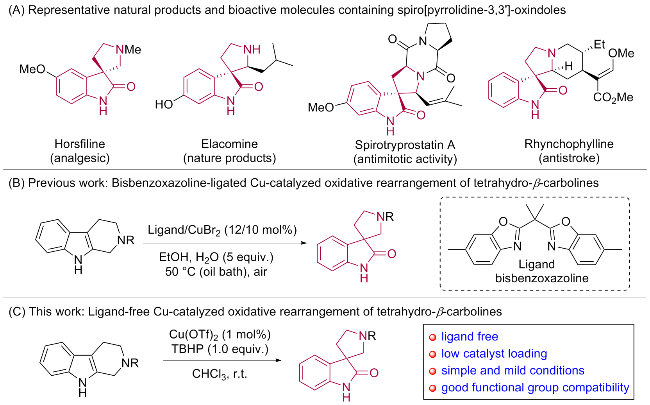
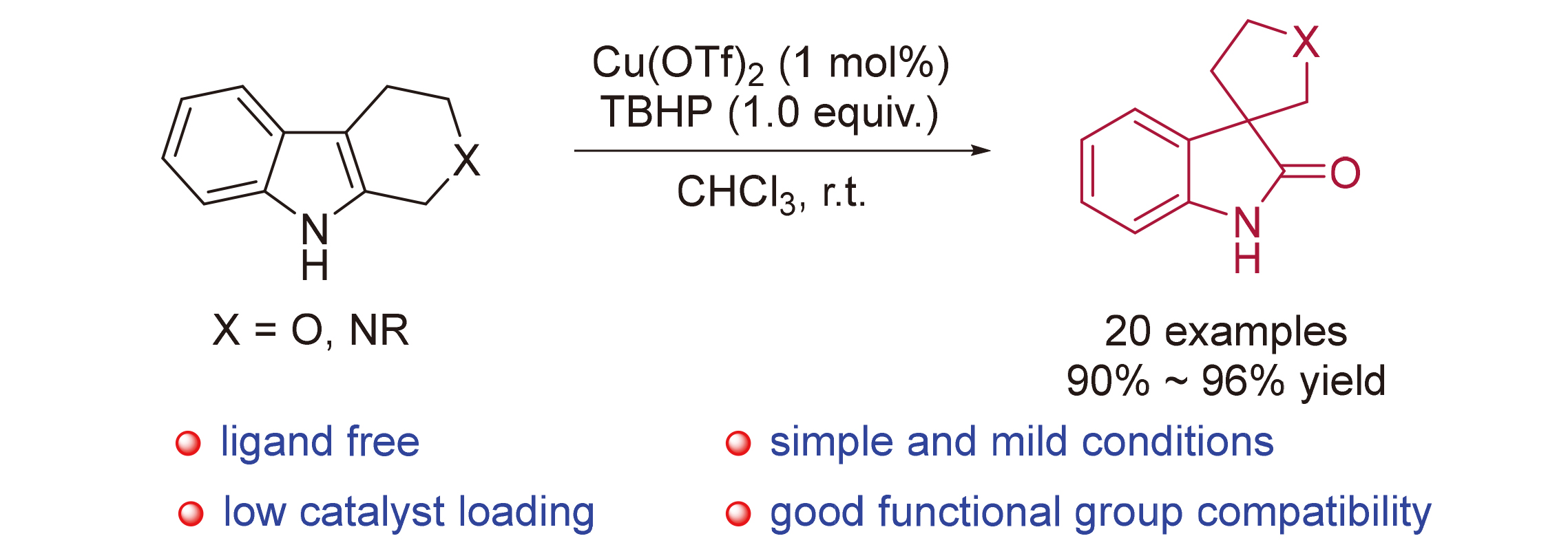
The oxidative rearrangement of tetrahydro-β-carbolines has emerged as a highly efficient method for constructing spiro[pyrrolidine-3,3']-oxindoles, enabled by its capacity to proceed directly from easily accessible substrates. Great efforts have been devoted to this field and a number of practical methods have been developed.[5-8] Among them, halogenated reagent-mediated reactions are a predominant strategy, fundamentally reliant on highly reactive halogen species introduced either as direct reagents or generated in situ.[5-7] Alternatively, the use of highly active transition metal oxidants such as Pb(OAc)4 and OsO4 is regarded as another effective strategy, yet it is typically associated with the formation of toxic by-products.[8] Beyond the aforementioned strategies, this oxidative rearrangement reaction can also be facilitated by transition-metal catalyzed oxidation system. In 2022, Ren and Pan[9] disclosed a copper-catalyzed oxidative rearrangement of tetrahydro-β-carbo- lines using atmospheric O2 as the terminal oxidant, wherein bisbenzoxazoline was employed as the ligand and found to exert a paramount influence on the reaction efficiency (Scheme 1B). However, for future practical and large-scale applications, developing a streamlined, ligand-free process using earth-abundant metal catalyst would be highly desirable.[10] Herein, we present a ligand-free copper-cataly- zed oxidative rearrangement of tetrahydro-β-carbolines under simple and mild conditions, affording a variety of spiro[pyrrolidine-3,3']-oxindoles in excellent yields (Sche- me 1C). The reaction exhibits excellent functional group tolerance and a broad substrate scope, with the ligand-free conditions significantly enhancing its synthetic utility.
2 Results and discussion
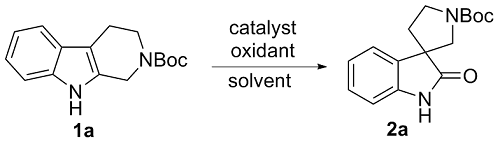
Initially, the direct oxidative rearrangement of tetrahydro-β-carboline 1a was selected as the model reaction for optimization (Table 1). A series of copper-catalyzed oxidation systems were first tested. However, no expected pro- duct was obtained when O2, H2O2, or K2S2O8 was employed as the oxidant (Entries 1~3). To our delight, when tert- butyl hydroperoxide (TBHP) was utilized as the oxidant, the reaction proceeded smoothly and furnished the desired spirooxindole 2a in 84% yield (Entry 4). In the absence of the copper catalyst, the desired product was obtained in merely 8% yield. (Entry 5). A subsequent screening of copper catalysts, such as Cu(OAc)2, CuSO4, Cu(acac)2, CuBr2, CuCl2, and CuOTf, revealed that none of them outperformed Cu(OTf)2, which was therefore chosen for further condition optimization (Entries 6~11). The solvent effect was next evaluated. Attempts to replace CH2Cl2 with CH3CN, EtOAc, acetone, or tetrahydrofuran (THF) hampered the reaction (Entries 12~15). Further investigation of the solvents indicated that CHCl3 was the best choice for the reaction, delivering the desired product 2a in 92% yield within 2 h (Entries 16~17). Moreover, TBHP loading screening showed that one equivalent oxidant is sufficient to drive the reaction (Entries 18~19). Decreasing the catalyst loading to 1 mol% still furnished the product in high yield while maintaining excellent efficiency (Entry 20). Notably, when the catalyst loading was further reduced to 0.2 mol%, the reaction proceeded smoothly and delivered the product in excellent yield (Entry 21). Therefore, the optimal set of conditions was established as: tetrahydro-β- carboline 1a (0.1 mmol)/Cu(OTf)2 (1 mol%)/ TBHP (0.1 mmol)/CHCl3 (1.0 mL)/room temperature.
Table 1 Reaction condition optimizationa |
| Entry | Catalyst | Oxidant | Solvent | Yieldb/% |
|---|---|---|---|---|
| 1 | Cu(OTf)2 | O2 | CH2Cl2 | <5 |
| 2 | Cu(OTf)2 | H2O2 | CH2Cl2 | <5 |
| 3 | Cu(OTf)2 | K2S2O8 | CH2Cl2 | <5 |
| 4 | Cu(OTf)2 | TBHP | CH2Cl2 | 84 |
| 5 | — | TBHP | CH2Cl2 | 8 |
| 6 | Cu(OAc)2 | TBHP | CH2Cl2 | 35 |
| 7 | CuSO4 | TBHP | CH2Cl2 | 40 |
| 8 | Cu(acac)2 | TBHP | CH2Cl2 | 36 |
| 9 | CuBr2 | TBHP | CH2Cl2 | 61 |
| 10 | CuCl2 | TBHP | CH2Cl2 | 55 |
| 11 | CuOTf | TBHP | CH2Cl2 | 80 |
| 12 | Cu(OTf)2 | TBHP | CH3CN | 20 |
| 13 | Cu(OTf)2 | TBHP | EtOAc | <10 |
| 14 | Cu(OTf)2 | TBHP | Acetone | 15 |
| 15 | Cu(OTf)2 | TBHP | THF | <10 |
| 16 | Cu(OTf)2 | TBHP | DCE | 72 |
| 17 | Cu(OTf)2 | TBHP | CHCl3 | 92 |
| 18c | Cu(OTf)2 | TBHP | CHCl3 | 92 |
| 19d | Cu(OTf)2 | TBHP | CHCl3 | 44 |
| 20c,e | Cu(OTf)2 | TBHP | CHCl3 | 92 |
| 21c,f | Cu(OTf)2 | TBHP | CHCl3 | 90 |
a Reaction conditions, unless otherwise specified: a solution of 1a (0.1 mmol), catalyst (10 mol%), oxidant (1.2 equiv.) in solvent (1.0 mL) at r.t. b Isolated yield. c TBHP (1.0 equiv.) was used as oxidant. d TBHP (0.5 equiv.) was used as oxidant. e 1 mol% Cu(OTf)2 was used as catalyst. f The reaction was performed on a 0.5 mmol scale using 0.2 mol% Cu(OTf)2 as catalyst. |
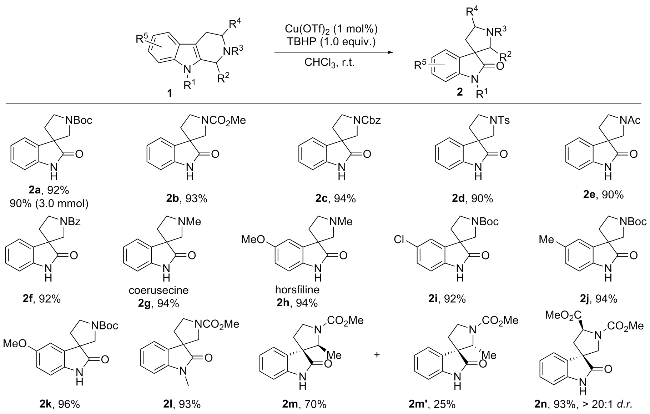
With the optimized condition in hand, the scope of the copper-catalyzed oxidative rearrangement of tetrahydro-β- carbolines was next investigated. As shown in Scheme 2, both electron-donating and -withdrawing N-protecting groups on the piperidine ring were well tolerated in the oxidative rearrangement, demonstrating its broad functional group tolerance and furnishing products 2a~2h in excellent yields (90%~96%). In addition, when the reaction was performed on a 3 mmol scale, the desired product 2a was isolated in 90% yield, representing only a modest reduction. Next, our investigations were extended to indole substrates bearing substituents of differing electronic properties at various positions on the benzene ring. Structurally and electronically tetrahydro-β-carbolines proved to be highly efficient and afforded the corresponding products in 92%~96% yields (2i~2k). Moreover, substrate bearing electron- donating alkyl group on the indole nitrogen was also compatible with the reaction conditions, delivering the product 2l in 93% yield. C1- or C3-Substituted tetrahydro-β-car- bolines also proved to be a suitable substrate, generating products in excellent yields. Under the simple and mild conditions, a highly efficient one-step reaction facilitated straightforward access to the bioactive natural products coerulescine 2g and horsfiline 2h in excellent yields. Moreover, functional groups like halogens and alkoxy moiety were readily accommodated, leaving potential func- tionalities for further transformations.
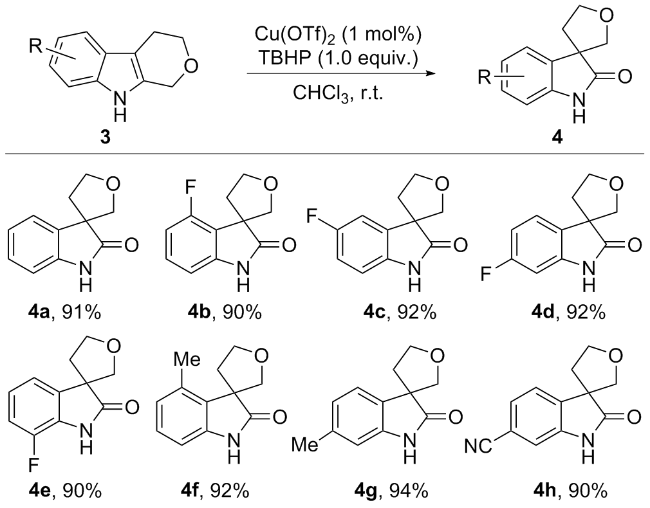
Oxa-spirooxindoles constitute an important structural scaffold found in numerous bioactive molecules, yet only a few synthetic methods have been reported.[6a,6d,11] The aforementioned excellent results prompted us to extend the developed method to the preparation of oxa-spirooxindoles. To our delight, a wide variety of 1,3,4,9-tetrahydropyrano- [3,4-b]indoles 3, bearing electronically diverse substituents on the benzene ring, underwent the oxidative rearrangement smoothly without further condition optimization, giving the corresponding products 4a~4h in 90%~94% yields (Scheme 3).
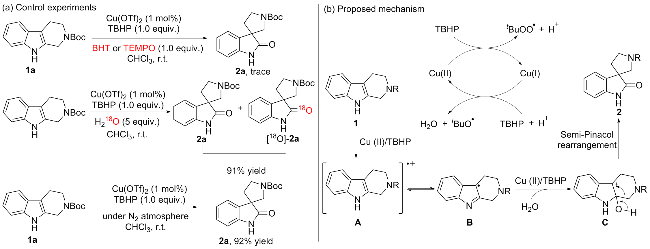
To probe the mechanism of the process, a couple of control experiments were conducted (Scheme 4a). The reaction was almost completely inhibited when stoichiometric 2,2,6,6-tetramethylpiperidine 1-oxyl (TEMPO) or 2,6-di-tert-butyl-4-methylphenol (BHT) was used as radical trapping reagent, indicating that the process proceeds via a radical mechanism. Moreover, when the reaction was carried out in the presence of H218O, 18O-labelled product 2a was detected, implying that H2O served as the oxygen source for the transformation. The reaction proceeded smoothly even under a nitrogen atmosphere, demonstrating that oxygen exerted no significant impact on the transformation. Based on the results of the control experiments and previous reports,[9,12] a plausible mechanism was proposed (Scheme 4b). First of all, TBHP reacts with copper(II) to produce copper(I), tert-butylperoxy (t-BuOO•), and tert- butoxyl radical (t-BuO•). Then these radicals oxidize the tetrahydro-β-carbolines 1 to form radical cation intermediate A. Next, a radical transfer process results in the formation of the C3-radical intermediates B. The nucleophilic attack of H2O on the C2 position and C3 radical is further oxidized to generate the hemiaminal intermediate C, which undergoes a semi-Pinacol rearrangement to furnish the spirooxindole 2.


3 Conclusions
In summary, a practical and efficient ligand-free copper- catalyzed oxidative rearrangement of indoles has been developed. Under the simple and mild conditions, this method accommodates both tetrahydro-β-carbolines and 1,3,4,9- tetrahydropyrano[3,4-b]indoles, delivering a variety of spiro[pyrrolidine-3,3'-oxindoles] and oxa-spirooxindoles in excellent yields (90%~96%). The reaction also features broad substrate scope, excellent functional group tolerance, and enhanced synthetic utility due to its ligand-free conditions.
4 Experimental section
4.1 General information
1H NMR, 13C NMR, and 19F NMR spectra were recorded on a Bruker AM-400 AVANCE III (500M) spectrometer at 500, 126, and 471 MHz, respectively. The solvent peak was used as a reference value, for 1H NMR: CDCl3 δ 7.26, (CD3)2CO δ 2.05, CD3CN δ 1.94, DMSO-d6 δ 2.50; for 13C NMR: CDCl3 δ 77.23, (CD3)2CO δ 206.23/29.82, CD3CN δ 1.32/118.26, DMSO-d6 δ 39.52. High-resolution mass spectral (HRMS) data were recorded on a Bruker APEX IV Fourier transform ion cyclotron resonance mass spectrometer using electrospray ionization (ESI) mode, and carried out on an Orbitrap analyzer. Analytical TLC was performed on precoated silica gel GF254 plates. Column chromatography was carried out on silica gel (200~300 mesh). Reagents and solvents were used as received from commercial sources without further purification.
4.2 General procedure for ligand-free copper-cata- lyzed oxidative rearrangement of indoles
To a solution of 1 (0.1 mmol) in CHCl3 (1.0 mL) were added TBHP (0.1 mmol) and Cu(OTf)2 (0.001 mmol). The mixture was stirred at room temperature and monitored by TLC until complete transformation. The solvent was removed and the residue was purified by flash chromatography using dichloromethane/methanol as eluent to afford the desired product 2.
tert-Butyl 2-oxospiro[indoline-3,3'-pyrrolidine]-1'-car- boxylate (2a): DCM/MeOH (V∶V=10∶1) as eluent to afford 2a (26.5 mg, 92% yield). 1H NMR (500 MHz, CDCl3) δ: 9.71 (s, 1H), 7.18 (t, J=7.6 Hz, 1H), 7.12 (d, J=7.3 Hz, 1H), 6.98 (t, J=7.5 Hz, 1H), 6.93 (d, J=7.7 Hz, 1H), 3.85~3.76 (m, 1H), 3.75~3.66 (m, 2H), 3.58~3.50 (m, 1H), 2.40~2.32 (m, 1H), 2.09~1.93 (m, 1H), 1.43 (s, 9H); 13C NMR (126 MHz, CDCl3) δ: 180.5, 154.5, 140.6, 132.9, 128.4, 122.8, 122.6, 110.3, 79.9, 54.2, 45.4, 35.8, 28.5; HRMS (EI) calcd for C16H21N2O3 [M+H]+ 289.1547, found 289.1555.
Methyl 2-oxospiro[indoline-3,3'-pyrrolidine]-1'-carboxy- late (2b): DCM/MeOH (V∶V=10∶1) as eluent to afford 2b (22.8 mg, 93% yield). 1H NMR (500 MHz, CD3CN) δ: 8.55 (s, 1H), 7.26~7.17 (m, 2H), 7.02 (td, J=7.6, 0.7 Hz, 1H), 6.92 (d, J=7.7 Hz, 1H), 3.79~3.72 (m, 1H), 3.70~3.59 (m, 5H), 3.57~3.49 (m, 1H), 2.34~2.25 (m, 1H), 2.17~2.04 (m, 1H); 13C NMR (126 MHz, CD3CN) δ: 179.65, 155.68, 141.71, 132.63, 128.93, 123.35, 122.89, 110.18, 54.68, 54.16, 52.53, 52.47, 46.07, 45.57, 36.51, 35.64; HRMS (EI) calcd for C13H15N2O3 [M+H]+ 247.1077, found 247.1089.
Benzyl 2-oxospiro[indoline-3,3'-pyrrolidine]-1'-carboxy- late (2c): DCM/MeOH (V∶V=10∶1) as eluent to afford 2c (30.2 mg, 94% yield). 1H NMR (500 MHz, CDCl3) δ: 9.61 (d, J=22.9 Hz, 1H), 7.37 (dt, J=40.9, 15.1 Hz, 5H), 7.23 (t, J=7.6 Hz, 1H), 7.15 (t, J=9.7 Hz, 1H), 7.03 (t, J=7.2 Hz, 1H), 6.96 (d, J=7.7 Hz, 1H), 5.22 (s, 1H), 5.18 (s, 1H), 4.01~3.90 (m, 1H), 3.84 (dd, J=19.5, 11.0 Hz, 2H), 3.69 (dd, J=28.8, 11.0 Hz, 1H), 2.44 (dt, J=12.7, 8.0 Hz, 1H), 2.15~1.93 (m, 1H); 13C NMR (126 MHz, CDCl3) δ: 180.5, 180.3, 154.9, 140.5, 136.9, 136.6, 132.6, 132.3, 128.6, 128.5, 128.1, 128.0, 127.8, 123.0, 122.7, 110.4, 67.2, 54.3, 54.1, 53.4, 52.5, 45.8, 45.4, 36.3, 35.5; HRMS (EI) calcd for C19H19N2O3 [M+H]+ 323.1390, found 323.1397.
1'-Tosylspiro[indoline-3,3'-pyrrolidin]-2-one (2d): DCM/MeOH (V∶V=10∶1) as eluent to afford 2d (30.7 mg, 90% yield). 1H NMR (500 MHz, CDCl3) δ: 9.11 (t, J=21.8 Hz, 1H), 7.76 (d, J=8.1 Hz, 2H), 7.35 (d, J=8.0 Hz, 2H), 7.23~7.14 (m, 1H), 7.01~6.83 (m, 3H), 3.75~3.65 (m, 1H), 3.60~3.51 (m, 2H), 3.47 (d, J=9.8 Hz, 1H), 2.33~2.24 (m, 1H), 2.02 (dt, J=12.6, 6.3 Hz, 1H); 13C NMR (126 MHz, CDCl3) δ: 179.47, 143.89, 140.03, 133.55, 132.72, 129.87, 128.58, 127.74, 123.06, 122.98, 110.18, 56.00, 52.98, 47.36, 36.31, 21.55; HRMS (EI) calcd for C18H19N2O3S [M+H]+ 343.1111, found 343.1122.
1'-Acetylspiro[indoline-3,3'-pyrrolidin]-2-one (2e): DCM/MeOH (V∶V=5∶1) as eluent to afford 2e (20.7 mg, 90% yield). 1H NMR (500 MHz, CD3CN) δ: 8.55 (s, 1H), 7.38~7.14 (m, 2H), 7.10~7.00 (m, 1H), 6.97~6.88 (m, 1H), 3.94~3.85 (m, 1H), 3.83~3.78 (m, 1H), 3.78~3.69 (m, 1H), 3.66~3.61 (m, 1H), 3.57 (d, J=12.0 Hz, 1H), 2.40~2.23 (m, 2H), 2.19~2.07 (m, 1H), 2.01 (d, J=49.2 Hz, 3H); 13C NMR (126 MHz, CD3CN) δ: 179.83, 179.37, 169.57, 141.70, 141.63, 132.88, 132.74, 128.99, 128.92, 123.42, 123.34, 122.95, 122.88, 110.22, 110.18, 55.44, 53.87, 53.63, 52.06, 46.81, 45.30, 36.72, 35.32, 22.27, 22.10; HRMS (EI) calcd for C13H15N2O2 [M+H]+ 231.1128, found 231.1134.
1'-Benzoylspiro[indoline-3,3'-pyrrolidin]-2-one (2f): DCM/MeOH (V∶V=5∶1) as eluent to afford 2f (26.8 mg, 92% yield). 1H NMR (500 MHz, CD3CN) δ: 8.57 (d, J=26.4 Hz, 1H), 7.62~7.55 (m, 1H), 7.52~7.34 (m, 4H), 7.35~7.11 (m, 2H), 7.09~6.98 (m, 1H), 6.91 (dd, J=33.7, 7.7 Hz, 1H), 4.03~3.92 (m, 1H), 3.90~3.82 (m, 1H), 3.83~3.51 (m, 2H), 2.45~2.25 (m, 1H), 2.20~2.12 (m, 1H); 13C NMR (126 MHz, CD3CN) δ: 179.38, 178.22, 169.33, 141.21, 141.04, 137.14, 136.92, 132.23, 131.91, 129.93, 128.42, 128.37, 128.32, 127.12, 122.91, 122.60, 122.35, 109.67, 57.03, 53.93, 52.96, 51.48, 48.30, 45.12, 36.50, 34.48; HRMS (EI) calcd for C18H17N2O2 [M+H]+ 293.1285, found 293.1299.
1'-Methylspiro[indoline-3,3'-pyrrolidin]-2-one (2g): DCM/MeOH (V∶V=5∶1) as eluent to afford 2g (19.0 mg, 94% yield). 1H NMR (500 MHz, DMSO-d6) δ: 10.35 (s, 1H), 7.31 (d, J=7.3 Hz, 1H), 7.15 (td, J=7.7, 1.1 Hz, 1H), 6.95 (td, J=7.6, 0.7 Hz, 1H), 6.81 (d, J=7.7 Hz, 1H), 3.02 (td, J=8.1, 4.3 Hz, 1H), 2.75 (d, J=9.1 Hz, 1H), 2.62 (d, J=9.1 Hz, 1H), 2.57~2.51 (m, 1H), 2.35 (s, 3H), 2.18 (ddd, J=12.3, 7.9, 4.2 Hz, 1H), 1.91 (dt, J=12.6, 7.6 Hz, 1H); 13C NMR (126 MHz, DMSO-d6) δ: 181.3, 141.6, 136.9, 128.0, 123.4, 122.3, 109.6, 66.4, 56.6, 53.4, 53.3, 41.9, 37.8. HRMS (EI) calcd for C12H15N2O [M+H]+ 203.1179, found 203.1178.
5-Methoxy-1'-methylspiro[indoline-3,3'-pyrrolidin]-2-one (2h): DCM/MeOH (V∶V=5∶1) as eluent to afford 2h (21.8 mg, 94% yield).1H NMR (500 MHz, CDCl3) δ: 8.49 (s, 1H), 7.19 (s, 1H), 6.80 (d, J=8.4 Hz, 1H), 6.74 (dd, J=8.4, 2.5 Hz, 1H), 3.79 (s, 3H), 3.31~3.12 (m, 2H), 2.98 (d, J=10.1 Hz, 2H), 2.60 (s, 3H), 2.41 (ddd, J=12.9, 7.3, 3.8 Hz, 1H), 2.25 (d, J=18.1 Hz, 1H); 13C NMR (126 MHz, CDCl3) δ: 182.3, 156.5, 133.3, 113.4, 110.3, 110.2, 56.5, 55.9, 53.9, 41.5, 37.9; HRMS (EI) calcd for C13H17N2O2 [M+H]+ 233.1285, found 233.1294.
tert-Butyl 5-chloro-2-oxospiro[indoline-3,3'-pyrrolidi- ne]-1'-carboxylate (2i): DCM/MeOH (V∶V=10∶1) as eluent to afford 2i (29.6 mg, 92% yield). 1H NMR (500 MHz, CDCl3) δ: 9.80 (s, 1H), 7.19 (dd, J=8.2, 1.5 Hz, 1H), 7.13 (s, 1H), 6.89 (d, J=8.3 Hz, 1H), 3.83 (s, 1H), 3.71 (d, J=11.0 Hz, 2H), 3.57 (s, 1H), 2.39 (dt, J=12.5, 8.3 Hz, 1H), 2.15~1.89 (m, 1H), 1.47 (s, 9H); 13C NMR (126 MHz, CDCl3) δ: 180.0, 154.5, 139.1, 134.6, 128.4, 128.2, 123.2, 111.3, 80.2, 54.2, 53.7, 45.2, 36.2, 35.4, 28.5; HRMS (EI) calcd for C16H20ClN2O3 [M+H]+ 323.1157, found 323.1170.
tert-Butyl 5-methyl-2-oxospiro[indoline-3,3'-pyrrolidi- ne]-1'-carbo-xylate (2j): DCM/MeOH (V∶V=10∶1) as eluent to afford 2j (28.3 mg, 94% yield). 1H NMR (400 MHz, CDCl3) δ: 9.26 (s, 1H), 7.06~6.93 (m, 2H), 6.89~6.80 (m, 1H), 3.91~3.47 (m, 4H), 2.45~2.36 (m, 1H), 2.31 (s, 3H), 2.09~2.01 (m, 1H), 1.48 (s, 9H); 13C NMR (101 MHz, CDCl3) δ: 180.4, 154.5, 137.8, 135.9, 132.5, 129.9, 129.5, 128.7, 123.5, 109.9, 79.9, 54.3, 45.4, 28.5, 21.2; HRMS (EI) calcd for C17H23N2O3 [M+H]+ 303.1703, found 303.1715.
tert-Butyl 5-methoxy-2-oxospiro[indoline-3,3'-pyrroli- dine]-1'-car-boxylate (2k): DCM/MeOH (V∶V=10∶1) as eluent to afford 2k (30.5 mg, 96% yield). 1H NMR (500 MHz, CDCl3) δ: 9.38 (s, 1H), 6.90~6.83 (m, 1H), 6.80~6.72 (m, 2H), 3.85~3.77 (m, 1H), 3.75 (s, 3H), 3.74~3.70 (m, 2H), 3.59~3.55 (m, 1H), 2.43~2.37 (m, 1H), 2.07~2.03 (m, 1H), 1.47 (s, 9H); 13C NMR (101 MHz, CDCl3) δ: 180.3, 156.1, 154.5, 134.3, 133.7, 112.6, 110.6, 110.1, 79.9, 55.8, 54.2, 45.3, 35.9, 28.5; HRMS (EI) calcd for C17H23N2O4 [M+H]+ 319.1652, found 319.1660.
Methyl 1-methyl-2-oxospiro[indoline-3,3'-pyrrolidine]- 1'-carboxylate (2l): DCM/MeOH (V∶V=10∶1) as eluent to afford 2l (30.5 mg, 96% yield). 1H NMR (500 MHz, CDCl3) δ: 7.29 (t, J=7.6 Hz, 1H), 7.16 (d, J=6.8 Hz, 1H), 7.05 (t, J=7.5 Hz, 1H), 6.86 (d, J=7.7 Hz, 1H), 3.90~3.53 (m, 7H), 3.21 (s, 3H), 2.43~2.35 (m, 1H), 2.12~1.94 (m, 1H); 13C NMR (126 MHz, CDCl3) δ: 177.5, 177.2, 155.4, 142.9, 132.4, 132.0, 129.0, 128.6, 127.7, 123.1, 122.4, 108.4, 54.4, 54.0, 52.9, 52.6, 51.9, 45.8, 45.3, 36.3, 35.5, 26.5; HRMS (EI) calcd for C14H17N2O3 [M+H]+ 261.1234, found 261.1248.
Methyl (2'S,3R)-2'-methyl-2-oxospiro[indoline-3,3'-pyrrolidine]-1'-carboxylate (2m): DCM/MeOH (V∶V=10∶1) as eluent to afford 2m (18.2 mg, 70% yield). 1H NMR (500 MHz, CDCl3) δ: 9.55 (s, 1H), 7.19 (dd, J=11.2, 4.0 Hz, 1H), 7.08 (d, J=7.2 Hz, 1H), 7.00 (t, J=7.5 Hz, 1H), 6.93 (d, J=7.7 Hz, 1H), 4.12~3.75 (m, 3H), 3.73 (s, 3H), 2.50~2.32 (m, 1H), 2.08 (s, 1H), 1.30 (d, J=5.1 Hz, 3H); 13C NMR (126 MHz, CDCl3) δ: 179.6, 178.95, 155.5, 140.7, 140.4, 132.9, 131.8, 128.5, 122.8, 122.6, 110.1, 61.4, 60.8, 56.6, 52.5, 45.2, 34.2, 33.3, 16.5, 15.3; HRMS (EI) calcd for C14H17N2O3 [M+H]+ 261.1234, found261.1236.
Methyl(2'R,3R)-2'-methyl-2-oxospiro[indoline-3,3'-pyrrolidine]-1'-carboxylate (2m'): DCM/MeOH (V∶V=10∶1) as eluent to afford 2m' (6.5 mg, 25% yield). 1H NMR (500 MHz, CDCl3) δ: 9.31 (s, 1H), 7.27~7.19 (m, 2H), 7.03 (t, J=7.6 Hz, 1H), 6.96 (d, J=7.7 Hz, 1H), 4.16 (s, 1H), 3.96 (s, 1H), 3.75~3.71 (m, 4H), 2.34~2.27 (m, 1H), 2.19~2.09 (m, 1H), 1.15 (s, 3H); 13C NMR (126 MHz, CDCl3) δ: 180.7, 155.9, 141.1, 129.4, 128.6, 125.0, 122.3, 110.3, 59.1, 56.9, 52.5, 45.4, 33.8, 17.6; HRMS (EI) calcd for C14H17N2O3 [M+H]+ 261.1234, found 261.1235.
Methyl 2',2'-dimethyl-2-oxospiro[indoline-3,3'-pyrro- lidine]-1'-car-boxylate (2n): DCM/MeOH (V∶V=10∶1) as eluent to afford 2n (25.5 mg, 93% yield). 1H NMR (500 MHz, CDCl3) δ: 9.55~9.30 (m, 1H), 7.27~7.19 (m, 2H), 7.02 (t, J=7.5 Hz, 1H), 6.92 (d, J=7.8 Hz, 1H), 4.95~4.75 (m, 1H), 4.10~3.93 (m, 1H), 3.77 (s, 3H), 3.75~3.71 (m, 1H), 3.68 (d, J=7.0 Hz, 3H), 2.72~2.63 (m, 1H), 2.34~2.27 (m, 1H); 13C NMR (126 MHz, CDCl3) δ: 180.2, 154.7, 141.7, 129.1, 128.6, 125.4, 122.0, 110.1, 65.0, 60.5, 52.0, 44.8, 30.9, 23.9, 22.3; HRMS (EI) calcd for C15H19N2O3 [M+H]+ 275.1390, found 275.1388.
4,5-Dihydro-2H-spiro[furan-3,3'-indolin]-2'-one (4a): DCM/MeOH (V∶V=10∶1) as eluent to afford 4a (17.1 mg, 91% yield). 1H NMR (500 MHz, CDCl3) δ: 9.53 (s, 1H), 7.28 (d, J=7.4 Hz, 1H), 7.22 (t, J=7.6 Hz, 1H), 7.05 (t, J=7.5 Hz, 1H), 6.97 (d, J=7.7 Hz, 1H), 4.23 (t, J=7.1 Hz, 2H), 4.09 (d, J=8.6 Hz, 1H), 3.96 (d, J=8.5 Hz, 1H), 2.56 (dt, J=12.9, 7.2 Hz, 1H), 2.25~2.12 (m, 1H); 13C NMR (101 MHz, CDCl3) δ: 180.4, 154.5, 137.8, 135.9, 132.5, 129.9, 129.5, 128.7, 123.5, 109.9, 79.9, 54.3, 45.4, 28.5, 21.2; HRMS (EI) calcd for C11H12NO2 [M+H]+ 190.0863, found 190.0874.
4'-Fluoro-4,5-dihydro-2H-spiro[furan-3,3'-indolin]-2'-one (4b): DCM/MeOH (V∶V=10∶1) as eluent to afford 4b (18.6 mg, 90% yield). 1H NMR (500 MHz, acetone-d6) δ: 9.57 (s, 1H), 7.34~7.18 (m, 1H), 6.84~6.69 (m, 2H), 4.16~4.06 (m, 2H), 4.05~3.97 (m, 2H), 2.40~2.28 (m, 2H); 13C NMR (126 MHz, acetone-d6) δ: 179.9, 158.5 (d, J=245.4 Hz), 144.1 (d, J=9.6 Hz), 130.1 (d, J=8.8 Hz), 118.6 (d, J=19.4 Hz), 109.1 (d, J=21.0 Hz), 105.9 (d, J=3.1 Hz), 75.3, 69.0 (d, J=1.8 Hz), 53.6 (d, J=2.7 Hz), 37.2; 19F NMR (471 MHz, acetone) δ: -120.69; HRMS (EI) calcd for C11H11FNO2 [M+H]+ 208.0768, found 208.0783.
5'-Fluoro-4,5-dihydro-2H-spiro[furan-3,3'-indolin]-2'-one (4c): DCM/MeOH (V∶V=10∶1) as eluent to afford 4c (19.0 mg, 92% yield). 1H NMR (500 MHz, CDCl3) δ: 9.62 (s, 1H), 7.02 (dd, J=7.9, 2.3 Hz, 1H), 6.97~6.86 (m, 2H), 4.20 (ddd, J=10.0, 6.2, 2.5 Hz, 2H), 4.05 (d, J=8.6 Hz, 1H), 3.95 (d, J=8.6 Hz, 1H), 2.56 (ddd, J=12.7, 7.8, 6.8 Hz, 1H), 2.23~2.11 (m, 1H); 13C NMR (101 MHz, CDCl3) δ: 180.4, 154.5, 137.8, 135.9, 132.5, 129.9, 129.5, 128.7, 123.5, 109.9, 79.9, 54.3, 45.4, 28.5, 21.2; 19F NMR (471 MHz, CDCl3) δ: -119.8; HRMS (EI) calcd for C11H11FNO2 [M+H]+ 208.0768, found 208.0778.
6'-Fluoro-4,5-dihydro-2H-spiro[furan-3,3'-indolin]-2'-one (4d): DCM/MeOH (V∶V=10∶1) as eluent to afford 4d (19.0 mg, 92% yield). 1H NMR (500 MHz, CDCl3) δ: 9.30 (s, 1H), 7.21 (dd, J=8.2, 5.3 Hz, 1H), 6.73 (td, J=10.6, 2.2 Hz, 2H), 4.24~4.19 (m, 2H), 4.05 (d, J=8.6 Hz, 1H), 3.93 (d, J=8.6 Hz, 1H), 2.54 (dt, J=12.7, 7.3 Hz, 1H), 2.22~2.12 (m, 1H); 13C NMR (126 MHz, CDCl3) δ: 181.7, 163.8, 161.8, 141.6, 141.5, 129.5, 129.5, 124.0, 123.9, 109.4, 109.2, 98.9, 98.6, 77.3, 77.1, 77.0, 76.8, 69.0, 54.4, 38.7; 19F NMR (471 MHz, CDCl3) δ: -112.29; HRMS (EI) calcd for C11H11FNO2 [M+H]+ 208.0768, found 208.0778.
7'-Fluoro-4,5-dihydro-2H-spiro[furan-3,3'-indolin]-2'-one (4e): DCM/MeOH (V∶V=10∶1) as eluent to afford 4e (18.5 mg, 90% yield). 1H NMR (500 MHz, CDCl3) δ: 8.92 (s, 1H), 7.08 (dd, J=5.0, 3.5 Hz, 1H), 7.03~6.98 (m, 2H), 4.22 (pd, J=8.5, 6.5 Hz, 2H), 4.07 (d, J=8.6 Hz, 1H), 3.97 (d, J=8.6 Hz, 1H), 2.58 (ddd, J=12.6, 8.1, 6.4 Hz, 1H), 2.22~2.13 (m, 1H); 13C NMR (126 MHz, CDCl3) δ: 178.0, 148.0, 146.0, 137.0, 137.0, 127.5, 127.4, 123.8, 123.7, 118.6, 118.6, 115.3, 115.2, 77.3, 77.1, 76.8, 69.0, 55.2, 55.2, 38.8; 19F NMR (471 MHz, CDCl3) δ: -133.6; HRMS (EI) calcd for C11H11FNO2 [M+H]+ 208.0768, found 208.0778.
4'-Methyl-4,5-dihydro-2H-spiro[furan-3,3'-indolin]-2'-one (4f): DCM/MeOH (V∶V=10∶1) as eluent to afford 4f (18.6 mg, 92% yield). 1H NMR (500 MHz, CDCl3) δ: 7.91 (s, 1H), 7.12 (t, J=7.7 Hz, 1H), 6.85 (d, J=7.8 Hz, 1H), 6.73 (d, J=7.7 Hz, 1H), 4.35~4.29 (m, 2H), 4.21~4.17 (m, 1H), 4.12~4.03 (m, 2H), 2.43~2.35 (m, 5H); 13C NMR (101 MHz, CDCl3) δ: 182.0, 140.6, 134.6, 130.9, 128.1, 125.5, 107.5, 75.8, 69.9, 54.3, 54.9, 37.6, 18.0; HRMS (EI) calcd for C12H14NO2 [M+H]+ 204.1019, found 204.1028.
6'-Methyl-4,5-dihydro-2H-spiro[furan-3,3'-indolin]-2'-one (4g): DCM/MeOH (V∶V=10∶1) as eluent to afford 4g (19.0 mg, 94% yield). 1H NMR (500 MHz, CDCl3) δ: 9.38 (s, 1H), 7.16 (d, J=7.6 Hz, 1H), 6.87 (d, J=7.6 Hz, 1H), 6.81 (s, 1H), 4.22 (t, J=7.1 Hz, 2H), 4.07 (d, J=8.5 Hz, 1H), 3.93 (d, J=8.5 Hz, 1H), 2.54 (dt, J=12.7, 7.3 Hz, 1H), 2.34 (s, 3H), 2.21~2.12 (m, 1H); 13C NMR (101 MHz, CDCl3) δ: 180.4, 154.5, 137.8, 135.9, 132.5, 129.9, 129.5, 128.7, 123.5, 109.9, 79.9, 54.3, 45.4, 28.5, 21.2; HRMS (EI) calcd for C12H14NO2 [M+H]+ 204.1019, found 204.1033.
2'-Oxo-4,5-dihydro-2H-spiro[furan-3,3'-indoline]-6'-carbonitrile (4h): DCM/MeOH (V∶V=10∶1) as eluent to afford 4h (19.2 mg, 90% yield). 1H NMR (500 MHz, acetone-d6) δ: 9.77 (s, 1H), 7.53~7.47 (m, 1H), 7.46~7.41 (m, 1H), 7.28~7.24 (m, 1H), 4.26~4.16 (m, 1H), 4.14~4.04 (m, 1H), 3.92 (s, 2H), 2.51~2.42 (m, 1H), 2.26~2.15 (m, 1H); 13C NMR (126 MHz, acetone-d6) δ: 178.5, 160.7, 142.4, 139.9, 126.6, 123.8, 118.5, 111.8, 76.7, 68.6, 54.5, 38.4; HRMS (EI) calcd for C12H11N2O2 [M+H]+ 215.0815, found 215.0825.
Supporting Information Copies of the 1H NMR and 13C NMR spectra for compounds 2a~2n, 2m', and 4a~4h, together with the 19F NMR spectra for 4b~4e. The Supporting Information is available free of charge via the Internet at http://sioc-journal.cn/.
(Cheng, F.)