


1 Introduction
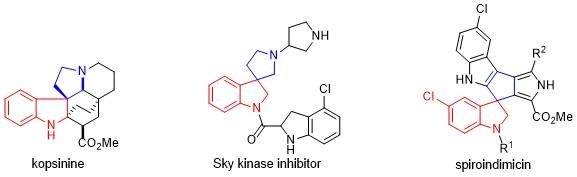
Spirocyclic compounds are of great significance in medicinal chemistry due to their unique three-dimensional structures and distinctive biological and pharmaceutical activities.[1] Among them, spiroindolines are inherently high-value motifs of significant biological importance, found in numerous natural products and biologically active substances, such as kopsinine,[2] Sky kinase inhibitors,[3] and spiroindimicin[4] (Figure 1).
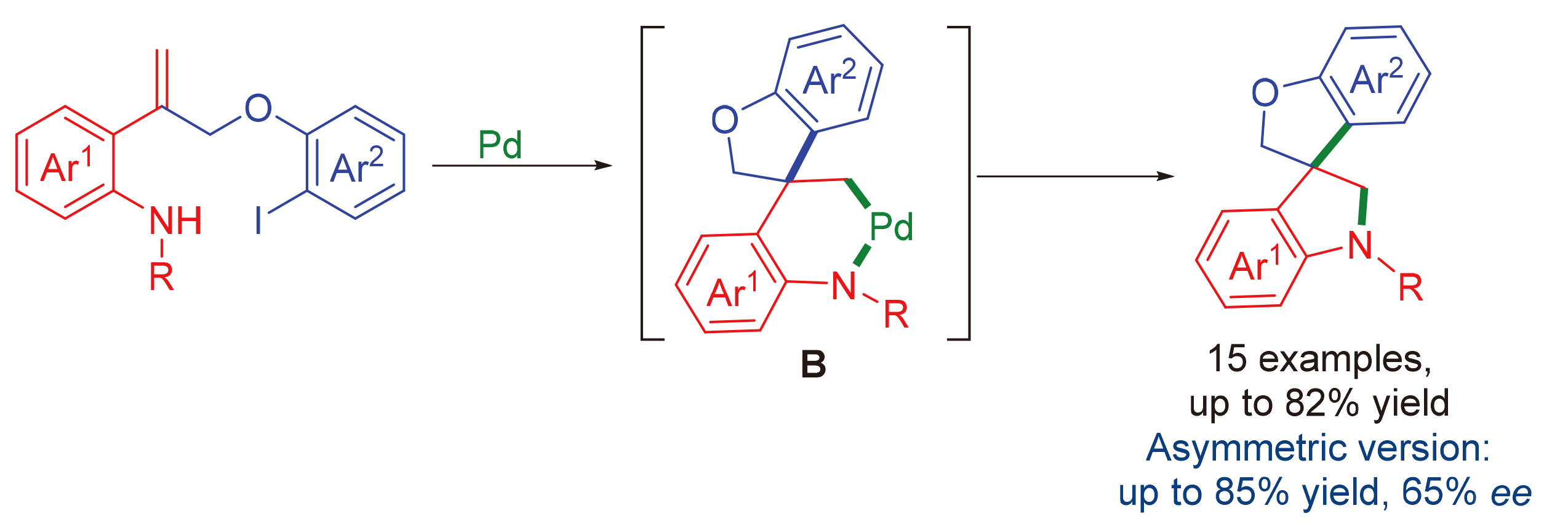
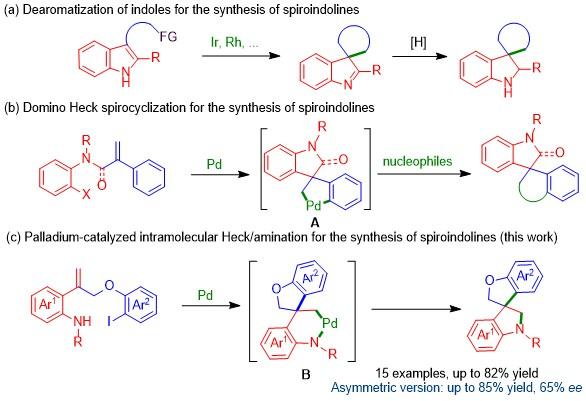
In the past decades, the synthesis of spiroindolines has attracted extensive attention. One of the most straightforward strategies is the dearomatization of indoles. In 2010, the You group[5] realized an Ir-catalyzed intramolecular C-3 allylic alkylation of indoles, affording highly enantioenriched spiroindolenine derivatives. In a subsequent reduction step, the spiroindolenine could be reduced to the corresponding spiroindoline. After this seminal work, various synthetic strategies employing Ir,[6] Rh,[7] Au,[8] Cu,[9] Pd,[10] and Ag[11] have been successively reported for the construction of spiroindolines (Scheme 1a).[12] However, most of these methods still require an additional reduction step, which compromises step economy and limits their practical utility. Palladium-catalyzed Heck reactions play an important role in the construction of heterocyclic com- pounds.[13] The intramolecular Heck reaction of an aryl halide with a tethered terminal alkene is one of the alternative methods for the synthesis of spiroindolines.[14] The reaction proceeds through a spiropalladacycle intermediate A, which is subsequently trapped by nucleophiles such as benzynes,[15] α-diazocarbonyl compounds,[16] CH2Br2,[17] arynes,[18] and diaziridinone[19] to construct the spiroindoline framework (Scheme 1b). In contrast to these reported Heck spirocyclizations that rely on external nucleophiles to trap the spiropalladacycle intermediate, our method utilizes the intrinsic N—H moiety as the internal nucleophile, bypassing the need for an additional trapping reagent. However, to the best of our knowledge, the synthesis of spiroindolines via the intramolecular Heck reaction of alkenes has not been realized. Herein, we report a palladium-catalyzed intramolecular Heck/amination of unactivated alkenes that proceeds through an N,P-containing spiropalladacycle intermediate B for the synthesis of spiroindolines. The reaction employs the intramolecular N—H moiety as the nucleophile without the need for external nucleophiles, proceeding via direct intramolecular N—H insertion to afford spiroindolines. This method affords a series of spiroindolines in good to moderate yields, and preliminary asymmetric attempts have also been conducted (Scheme 1c).
2 Results and discussion
We initiated our studies on the palladium-catalyzed Heck/amination reaction using ortho-iodophenol-derived isopropenyl diphenylamine ether 1a as a model substrate (Table 1). Initially, various ligands were screened in the presence of Pd(dba)2 as the palladium source, Cs2CO3 as the base, and toluene as the solvent at 110 ℃ for 13 h. Under these conditions, PPh3 delivered the desired product in 48% yield (Table 1, Entry 1). Among the ligands examined, the bulky ligands S-Phos and DavePhos afforded 47% and 34% yields, respectively (Table 1, Entries 2, 3). PCy3 gave a yield of 16% (Table 1, Entry 4). The electron-rich (4-MeO- C6H4)3P and (4-MeC6H4)3P gave moderate yields (Table 1, Entries 5, 6). The electron-withdrawing ligand (4-CF3- C6H4)3P proved superior, affording the product in 71% yield (Table 1, Entry 8). Subsequently, the palladium source was examined using (4-CF3C6H4)3P as the optimal ligand. When various palladium catalysts were evaluated, Pd(dba)2 remained the most effective, whereas Pd(PPh3)4, PdCl2, and Pd(PPh3)2Cl2 led to significantly lower yields (Table 1, Entries 9~11). Further optimization of the base showed that Cs2CO3 and K2CO3 gave comparable results (Table 1, Entry 12), while CsOAc resulted in a lower yield (Table 1, Entry 13). When the organic base Et3N was employed, no desired product was observed (Table 1, Entry 14). Finally, lowering the reaction temperature to 90 ℃ resulted in a decreased yield of 55% (Table 1, Entry 15), confirming that 110 ℃ was optimal. Control experiments were also conducted (Table 1, Entries 16, 17). Omitting either the palladium source (Pd(dba)2) or the phosphine ligand (4-CF3- C6H4)3P resulted in no reaction, indicating that both components are essential for the transformation.
Table 1 Optimization of reaction conditionsa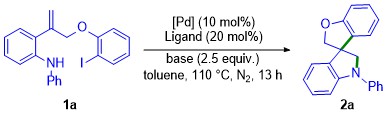 |
| Entry | Ligand | [Pd] | Base | T/℃ | Yieldb/% | |
|---|---|---|---|---|---|---|
| 1 | PPh3 | Pd(dba)2 | Cs2CO3 | 110 | 48 | |
| 2 | S-Phos | Pd(dba)2 | Cs2CO3 | 110 | 47 | |
| 3 | DavePhos | Pd(dba)2 | Cs2CO3 | 110 | 34 | |
| 4 | PCy3 | Pd(dba)2 | Cs2CO3 | 110 | 16 | |
| 5 | (4-MeC6H4)3P | Pd(dba)2 | Cs2CO3 | 110 | 57 | |
| 6 | (4-MeOC6H4)3P | Pd(dba)2 | Cs2CO3 | 110 | 40 | |
| 7 | (4-ClC6H4)3P | Pd(dba)2 | Cs2CO3 | 110 | 58 | |
| 8 | (4-CF3C6H4)3P | Pd(dba)2 | Cs2CO3 | 110 | 71 | |
| 9 | (4-CF3C6H4)3P | Pd(PPh3)4 | Cs2CO3 | 110 | 23 | |
| 10 | (4-CF3C6H4)3P | PdCl2 | Cs2CO3 | 110 | 22 | |
| 11 | (4-CF3C6H4)3P | Pd(PPh3)2Cl2 | Cs2CO3 | 110 | 17 | |
| 12 | (4-CF3C6H4)3P | Pd(dba)2 | K2CO3 | 110 | 70 | |
| 13 | (4-CF3C6H4)3P | Pd(dba)2 | CsOAc | 110 | 49 | |
| 14 | (4-CF3C6H4)3P | Pd(dba)2 | Et3N | 110 | NR | |
| 15 | (4-CF3C6H4)3P | Pd(dba)2 | Cs2CO3 | 90 | 55 | |
| 16 | — | Pd(dba)2 | Cs2CO3 | 110 | NR | |
| 17 | (4-CF3C6H4)3P | — | Cs2CO3 | 110 | NR |
a Reaction conditions: 1 (0.1 mmol), ligand (20 mol%), [Pd] (10 mol%), base (2.5 equiv.), toluene (2.0 mL), N2. b Isolated yields. |
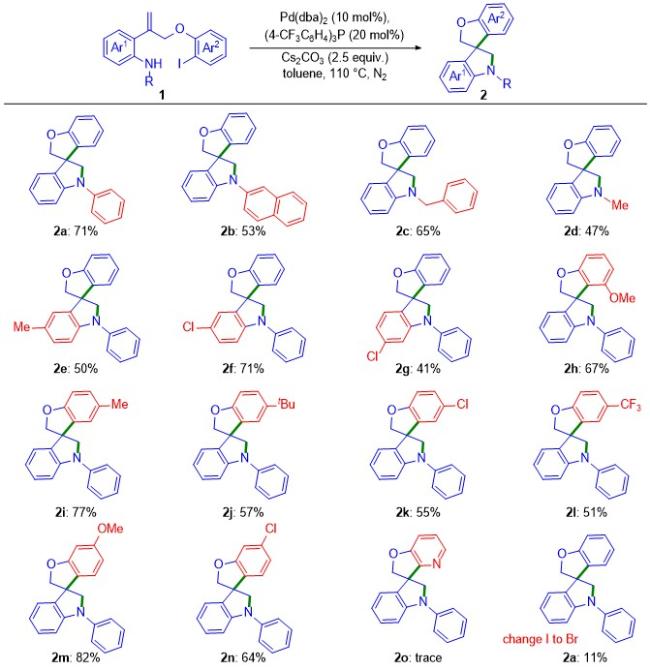
With the optimized reaction conditions in hand (Table 1, Entry 8), the substrate scope suitable for this strategy was explored (Scheme 2). The reactions proceeded smoothly when the N-phenyl substituent was changed to N-naphthyl, albeit in diminished yield (53%), giving product 2b. When the N-substituent was changed to alkyl groups, such as N-benzyl and N-methyl, the reactions proceeded smoothly, affording the corresponding products 2c and 2d in moderate yields. When changing the substituent on Ar1, both the elec- tron-donating methyl group and the electron-withdrawing chloro group allowed the reaction to proceed smoothly, affording the desired products 2e~2g. However, when the electron-withdrawing chloro group was located at the meta-position of the N-substituent, the yield of 2g was lower (41%) than that at the para-position (2f, 71%). Subsequently, the applicability of various substituents on Ar2 was examined to the reaction. When the methoxy group was located at the ortho-position relative to iodine (1h), although the steric hindrance increases, the reaction still affords the corresponding target product 2h in 67% yield. When a methyl group was added at the meta-position relative to iodine (1i), the desired product 2i was obtained in 77% yield. When a bulky tert-butyl group or electron-with- drawing chloro and trifluoromethyl groups were introduced at the meta-position, the yields of products 2j~2l were all moderately decreased compared to the model substrate. Introducing electron-donating methoxy (1m) and electron-withdrawing chloro (1n) substituents at the para-posi- tion relative to iodine gave products 2m and 2n in 82% and 64% yields, respectively. However, changing Ar2 to pyridine (1o) resulted in poor conversion, primarily due to the electron-withdrawing nature of the pyridine ring and possible palladium coordination by the pyridyl nitrogen. Under the reaction conditions, replacing iodine with bromine reduced the yield of 2a to 11%, presumably because aryl bromides undergo slower oxidative addition than aryl iodides.
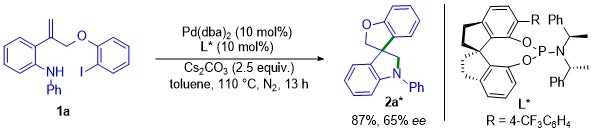
In view of the high potential of chiral spiroindolines in drug discovery and as chiral ligands, the replacement of (4-CF3C6H4)3P with chiral phosphine ligands was explored to access these spirocyclic frameworks. After screening a series of chiral phosphine ligands and solvents, the optimal result to date was obtained using the N-P ligand L*, which gave the target product 2a in 87% yield with 65% ee (Eq. 1).
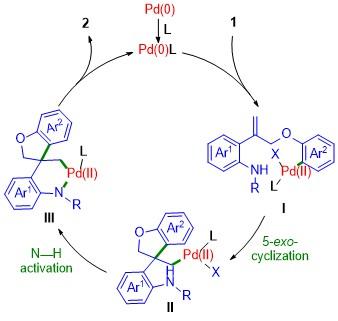
On the basis of experimental observations and known literature, a reasonable catalytic cycle is proposed as illustrated in Scheme 3.[13a] Initially, oxidative addition of 1 to the Pd(0) complex generates arylpalladium species I. Subsequently, I undergoes intramolecular 5-exo-cyclization to afford alkylpalladium intermediate II. Then, deprotonation of the N—H bond by the base generates a nitrogen anion, which subsequently attacks the palladium center to form spiropalladacycle III. Finally, reductive elimination from III produces the corresponding product 2 and regenerates the Pd(0) catalyst for the next catalytic cycle.


3 Conclusions
In summary, we have developed a palladium-catalyzed intramolecular Heck/amination for the synthesis of spiroindolines using the intrinsic N—H moiety as the nucleophile. This method offers a step-economical approach to spiroindoline frameworks without the need for external nucleophiles. Further studies on the asymmetric synthesis of spiroindolines are currently underway in our laboratory.
4 Experimental section
4.1 Instruments and reagents
1H NMR and 13C NMR spectra were recorded on a Bruker 400 MHz spectrometer internally referenced to tetramethylsilane (δ=0.0) or residue of CDCl3 (δ=7.26) signal. Melting points were measured using a XT4A microscopic apparatus. Unless otherwise stated, solvents and chemicals were bought from commercial sources and used directly unless otherwise stated. Column chromatography was performed on 300~400 mesh silica gel. Analytical thin-layer chromatography (TLC) was performed on pre- coated, glass-backed silica gel plates.
4.2 Synthesis of substrates 1 and characterization data
2-(3-(2-Iodophenoxy)prop-1-en-2-yl)-N-phenylaniline (1a): White solid, m.p. 51~52 ℃. 1H NMR (400 MHz, CDCl3) δ: 7.76 (dd, J=7.8, 1.6 Hz, 1H), 7.35~7.32 (m, 1H), 7.25~7.18 (m, 5H), 7.07~7.00 (m, 2H), 6.98~6.88 (m, 2H), 6.76~6.65 (m, 2H), 5.92 (s, 1H), 5.88 (d, J=1.6 Hz, 1H), 5.40 (d, J=1.6 Hz, 1H), 4.72 (s, 2H); 13C NMR (101 MHz, CDCl3) δ: 156.9, 143.3, 142.3, 140.6, 139.6, 129.8, 129.6, 129.4, 129.3, 128.7, 122.8, 121.1, 121.0, 118.2, 117.7, 117.9, 112.5, 86.6, 71.0. HRMS (ESI) calcd for C21H19ONI [M+H]+ 428.0506, found 428.0515.
N-(2-(3-(2-Iodophenoxy)prop-1-en-2-yl)phenyl)naphth-alen-2-amine (1b): Colorless oil. 1H NMR (400 MHz, CDCl3) δ: 7.71~7.66 (m, 3H), 7.57 (d, J=8.2 Hz, 1H), 7.40 (d, J=7.9 Hz, 1H), 7.36~7.32 (m, 2H), 7.25~7.18 (m, 3H), 7.16~7.09 (m, 2H), 6.98~6.94 (m, 1H), 6.66~6.60 (m, 2H), 6.04 (s, 1H), 5.84 (d, J=1.5 Hz, 1H), 5.38 (d, J=1.2 Hz, 1H), 4.70 (s, 2H); 13C NMR (101 MHz, CDCl3) δ: 156.9, 142.4, 141.1, 140.3, 139.6, 134.6, 130.2, 129.9, 129.4, 129.3, 129.2, 128.8, 127.7, 126.49, 126.46, 123.5,122.9, 121.5, 120.2, 118.5, 117.9, 112.5, 111.9, 86.6, 71.0. HRMS (ESI) calcd for C25H21ONI [M+H]+ 478.0662, found 478.0670.
N-Benzyl-2-(3-(2-iodophenoxy)prop-1-en-2-yl)aniline (1c): Colorless oil. 1H NMR (400 MHz, CDCl3) δ: 7.77~7.76 (m, 1H), 7.30 (d, J=4.4 Hz, 4H), 7.25~7.19 (m, 2H), 7.17~7.13 (m,1H), 7.07 (d, J=7.6 Hz, 1H), 6.78~6.76 (m, 1H), 6.73~6.68 (m, 2H), 6.62 (d, J=8.0 Hz, 1H), 5.90 (d, J=1.2 Hz, 1H), 5.41 (s, 1H), 4.69 (s, 2H), 4.65 (s, 1H), 4.33 (s, 2H); 13C NMR (101 MHz, CDCl3) δ: 157.0, 145.2, 141.8, 139.6, 139.4, 129.4, 129.1, 128.9, 128.7, 127.3, 127.2, 125.0, 122.8, 117.3, 116.9, 112.4, 110.9, 86.6, 70.8, 48.2. HRMS (ESI) [M+H]+ calcd for C22H21ONI 442.0662, found 442.0669.
2-(3-(2-Iodophenoxy)prop-1-en-2-yl)-N-methylaniline (1d): Colorless oil. 1H NMR (400 MHz, CDCl3) δ: 7.80 (dd, J=7.6, 1.6 Hz, 1H), 7.31~7.28 (m, 1H), 7.26~7.22 (m, 1H), 7.07 (dd, J=7.6, 1.6 Hz, 1H), 6.80 (dd, J=8.4, 0.8 Hz, 1H), 6.75~6.71 (m, 2H), 6.66 (dd, J=15.2, 1.2 Hz, 1H), 5.94 (d, J=1.6 Hz, 1H), 5.38 (d, J=1.2 Hz, 1H), 4.67 (s, 2H), 4.27 (s, 1H), 2.83 (s, 3H); 13C NMR (101 MHz, CDCl3) δ: 157.0, 146.4, 141.9, 139.6, 129.5, 129.1, 128.8, 124.9, 122.8, 117.2, 116.5, 112.3, 109.9, 86.5, 70.8, 30.7. HRMS (ESI) calcd for C16H17ONI [M+H]+ 366.0349, found 366.0359.
2-(3-(2-Iodophenoxy)prop-1-en-2-yl)-4-methyl-N-phenylaniline (1e): Colorless oil. 1H NMR (400 MHz, CDCl3) δ: 7.75 (dd, J=7.6, 1.6 Hz, 1H), 7.23 (d, J=1.6 Hz, 1H), 7.22~7.17 (m, 3H), 7.06~7.05 (m, 2H), 6.98~6.96 (m, 2H), 6.88~6.84 (m, 1H), 6.71~6.66 (m, 2H), 5.82 (d, J=1.6 Hz, 1H), 5.77 (s, 1H), 5.35 (d, J=1.2 Hz, 1H), 4.71 (s, 2H), 2.31 (s, 3H); 13C NMR (101 MHz, CDCl3) δ: 157.0, 144.2, 142.5, 139.6, 137.7, 131.1, 130.7, 130.5, 129.4, 129.33, 129.30, 122.8, 120.4, 119.3, 117.4, 117.2, 112.5, 86.6, 71.0, 20.7. HRMS (ESI) calcd for C22H21ONI [M+H]+ 442.0662, found 442.0671.
4-Chloro-2-(3-(2-iodophenoxy)prop-1-en-2-yl)-N-phen- ylaniline (1f): Colorless oil. 1H NMR (400 MHz, CDCl3) δ: 7.74 (d, J=1.6 Hz, 1H), 7.24 (d, J=1.2 Hz, 2H), 7.22~7.19 (m, 3H), 7.17 (dd, J=8.6, 2.5 Hz, 1H), 7.01~6.98 (m, 2H), 6.95~6.91 (m, 1H), 6.74~6.68 (m, 2H), 5.88 (d, J=1.2 Hz, 1H), 5.86 (s, 1H), 5.41 (d, J=1.2 Hz, 1H), 4.70 (s, 2H); 13C NMR (101 MHz, CDCl3) δ: 156.8, 142.8, 141.3, 139.6, 139.4, 131.0, 129.6, 129.4, 128.6, 125.6, 123.0, 121.6, 119.0, 118.7, 118.5, 112.5, 86.6, 70.9. HRMS (ESI) calcd for C21H18ONClI [M+H]+ 462.0116, found 462.0125.
5-Chloro-2-(3-(2-iodophenoxy)prop-1-en-2-yl)-N-phen- ylaniline (1g): White solid, m.p. 50~51 ℃. 1H NMR (400 MHz, CDCl3) δ: 7.71 (d, J=1.6 Hz, 1H), 7.24~7.16 (m, 4H), 7.07~7.02 (m, 3H), 6.96~6.93 (m, 1H), 6.82 (dd, J=8.4, 2.4 Hz, 1H), 6.71~6.63 (m, 2H), 5.94 (s, 1H), 5.88 (d, J=1.2 Hz, 1H), 5.38 (d, J=1.2 Hz, 1H), 4.65 (s, 2H); 13C NMR (101 MHz, CDCl3) δ: 156.8, 142.3, 141.9, 141.4, 139.7, 134.5, 130.7, 129.6, 129.5, 126.9, 123.0, 122.4, 120.3, 119.6, 118.8, 116.0, 112.5, 86.7, 71.0. HRMS (ESI) calcd for C21H18ONClI [M+H]+ 462.0116, found 462.0125.
2-(3-(2-Iodo-3-methoxyphenoxy)prop-1-en-2-yl)-N-phenylaniline (1h): White solid, m.p. 59~60 ℃. 1H NMR (400 MHz, CDCl3) δ: 7.32 (d, J=1.2 Hz, 1H), 7.26~7. 20 (m, 4H), 7.16 (t, J=8.0 Hz, 1H), 7.05~7.03 (m, 2H), 6.96~6.89 (m, 2H), 6.47 (d, J=7.6 Hz, 1H), 6.40 (d, J=8.4, 1.1 Hz, 1H), 5.94 (s, 1H), 5.91 (d, J=1.6 Hz, 1H), 5.39 (d, J=1.6 Hz, 1H), 4.74 (s, 2H), 3.87 (s, 3H); 13C NMR (101 MHz, CDCl3) δ: 159.7, 158.4, 143.3, 142.4, 140.6, 129.81, 129.79, 129.3, 128.7, 121.1, 120.9, 118.2, 117.7, 117.6, 108.0, 105.5, 104.4, 103.0, 71.2, 56.6. HRMS (ESI) calcd for C22H21O2NI [M+H]+ 458.0612, found 458.0618.
2-(3-(2-Iodo-4-methylphenoxy)prop-1-en-2-yl)-N-phen- ylaniline (1i): White solid, m.p. 56~57 ℃. 1H NMR (400 MHz, CDCl3) δ: 7.58 (d, J=1.6 Hz, 1H), 7.33 (d, J=8 Hz, 1H), 7.24~7.19 (m, 4H), 7.04~7.00 (m, 2H), 6.98~6.95 (m, 1H), 6.93~6.89 (m, 2H), 6.62 (d, J=8.4 Hz, 1H), 5.93 (s, 1H), 5.86 (d, J=1.6 Hz, 1H), 5.38 (d, J=1.2 Hz, 1H), 4.69 (s, 2H), 2.22 (s, 3H); 13C NMR (101 MHz, CDCl3) δ: 153.9, 142.3, 141.5, 139.6, 138.9, 131.4, 128.83, 128.76, 128.6, 128.3, 127.6, 120.1, 119.9, 117.2, 116.59, 116.56, 111.3, 85.4, 70.2, 18.9. HRMS (ESI) calcd for C22H21ONI [M+H]+ 442.0662, found 442.0667.
2-(3-(4-(tert-Butyl)-2-iodophenoxy)prop-1-en-2-yl)-N-phenylaniline (1j): White solid, m.p. 81~82 ℃. 1H NMR (400 MHz, CDCl3) δ: 7.75 (d, J=2.4 Hz, 1H), 7.33 (d, J=8.0 Hz, 1H), 7.24~7.20 (m, 5H), 7.03 (d, J=7.6 Hz, 2H), 6.96~6.89 (m, 2H), 6.66 (d, J=8.4 Hz, 1H), 5.93 (s, 1H), 5.87 (d, J=1.2 Hz, 1H), 5.39 (s, 1H), 4.70 (s, 2H), 1.26 (s, 9H); 13C NMR (101 MHz, CDCl3) δ: 154.8, 146.0, 143.3, 142.5, 140.6, 136.6, 129.8, 129.7, 129.3, 128.6, 126.3, 121.1, 120.9, 118.2, 117.7, 117.6, 112.0, 86.5, 71.2, 34.1, 31.4. HRMS (ESI) calcd for C25H27ONI [M+H]+ 484.1132, found 484.1140.
2-(3-(4-Chloro-2-iodophenoxy)prop-1-en-2-yl)-N-phen- ylaniline (1k): Colorless oil. 1H NMR (400 MHz, CDCl3) δ: 7.71 (d, J=1.6 Hz, 1H), 7.33 (d, J=8.0 Hz, 1H), 7.22 (t, J=7.6 Hz, 3H), 7.19~7.14 (m, 2H), 7.02 (d, J=8.0 Hz, 2H), 6.97~6.90 (m, 2H), 6.60 (d, J=8.8 Hz, 1H), 5.86 (s, 1H), 5.83 (s, 1H), 5.40 (s, 1H), 4.69 (s, 2H); 13C NMR (101 MHz, CDCl3) δ: 155.9, 143.3, 142.2, 140.5, 138.7, 129.9, 129.7, 129.4, 129.2, 128.8, 126.7, 121.23, 121.18, 118.1, 118.0, 117.9, 112.9, 86.7, 71.3. HRMS (ESI) calcd for C21H18ONClI [M+H]+ 462.0116, found 462.0125.
2-(3-(2-Iodo-4-(trifluoromethyl)phenoxy)prop-1-en-2-yl)-N-phenylaniline (1l): Colorless oil. 1H NMR (400 MHz, CDCl3) δ: 7.99 (s, 1H), 7.46 (d, J=1.6, 2.3 Hz, 1H), 7.45~7.34 (m, 1H), 7.32~7.20 (m, 4H), 7.02~6.96 (m, 3H), 6.95~6.90 (m, 2H), 6.74 (d, J=8.4 Hz, 1H), 5.84 (s, 1H), 5.83 (s, 1H), 5.42 (d, J=1.2 Hz, 1H), 4.78 (s, 2H); 19F NMR (376 MHz, CDCl3) δ: -61.64; 13C NMR (101 MHz, CDCl3) δ: 159.5, 143.4, 142.1, 140.6, 136.8 (q, C-F, 3JC-F=3.6 Hz), 130.0, 129.7, 129.5, 129.0, 127.0 (q, C-F, 3JC-F=3.9 Hz), 124.9 (q, C-F, 2JC-F=33.0 Hz), 123.4 (q, C-F, 1JC-F=272.5 Hz), 121.5, 121.3, 118.3, 118.2, 118.1, 111.7, 86.3, 71.3. HRMS (ESI) calcd for C22H18ONIF3 [M+H]+ 496.0380, found 496.0386.
2-(3-(2-Iodo-5-methoxyphenoxy)prop-1-en-2-yl)-N-phenylaniline (1m): Colorless oil. 1H NMR (400 MHz, CDCl3) δ: 7.60 (d, J=8.4 Hz, 1H), 7.33 (d, J=7.6 Hz, 1H), 7.26~7.20 (m, 4H), 7.04 (t, J=0.8 Hz, 2H), 6.96~6.92 (m, 1H), 6.92~6.89 (m, 1H), 6.35 (d, J=2.8 Hz, 1H), 6.31 (dd, J=8.8, 2.8 Hz, 1H), 5.93 (s, 1H), 5.90 (d, J=1.6 Hz, 1H), 5.41 (d, J=1.2 Hz, 1H), 4.69 (s, 2H), 3.70 (s, 3H); 13C NMR (101 MHz, CDCl3) δ: 161.3, 157.7, 143.2, 142.2, 140.6, 139.2, 129.8, 129.5, 129.3, 128.7, 121.2, 120.9, 118.3, 117.8, 117.5, 107.9, 100.4, 75.3, 71.0, 55.5. HRMS (ESI) [M+H]+ calcd for C22H21O2NI 458.0612, found 458.0618.
2-(3-(5-Chloro-2-iodophenoxy)prop-1-en-2-yl)-N-phen- ylaniline (1n): White solid, m.p. 57~58 ℃. 1H NMR (400 MHz, CDCl3) δ: 7.63 (d, J=8.0 Hz, 1H), 7.32 (d, J=7.6 Hz, 1H), 7.24 (s, 2H), 7.22~7.18 (m, 2H), 7.04 (d, J=0.8 Hz, 1H), 7.02 (d, J=0.8 Hz, 1H), 6.96~6.93 (m, 1H), 6.92~6.89 (m, 1H), 6.72~6.68 (m, 2H), 5.86 (s, 1H), 5.85 (s, 1H), 5.41 (d, J=1.6 Hz, 1H), 4.70 (s, 2H); 13C NMR (101 MHz, CDCl3) δ: 157.6, 143.2, 141.9, 140.6, 139.8, 135.2, 129.8, 129.41, 129.35, 128.8, 122.9, 121.2, 121.1, 118.3, 118.0, 117.8, 113.1, 83.8, 71.2. HRMS (ESI) [M+H]+ calcd for C21H18ONClI 462.0116, found 462.0126.
2-(3-(2-Bromophenoxy)prop-1-en-2-yl)-N-phenylaniline (1o): White solid, m.p. 60~61 ℃. 1H NMR (400 MHz, CDCl3) δ: 7.52 (dd, J=8.0, 1.6 Hz, 1H), 7.33 (d, J=8.0 Hz, 1H), 7.24~7.21 (m, 3H), 7.19~7.15 (m, 2H), 7.04~7.02 (m, 2H), 6.95 (dd, J=7.6, 1.2 Hz, 1H), 6.93~6.89 (m, 1H), 6.83~6.79 (m, 2H), 5.95 (s, 1H), 5.82 (d, J=1.6 Hz, 1H), 5.38 (d, J=1.2 Hz, 1H), 4.74 (s, 2H); 13C NMR (101 MHz, CDCl3) δ: 154.8, 143.3, 142.4, 140.6, 133.5, 129.80, 129.78, 129.3, 128.7, 128.4, 122.2, 121.1, 121.0, 118.1, 117.8, 117.7, 113.5, 112.3, 71.0. HRMS (ESI) calcd for C20H18ON2I [M+H]+ 429.0458, found 429.0468.
4.3 General procedure for the synthesis of products 2 and characterization data
Compound 1 (0.1 mmol, 1.0 equiv.), Cs2CO3 (2.5 equiv.), Pd(dba)2 (10 mol%) and ligand (20 mol%) were combined in an oven-dried Schlenk tube with a magnetic stir bar. Subsequently, toluene (2 mL) was added dropwise to the reaction mixture, and the resulting solution was stirred at 110 ℃. After the reaction was complete (monitored by TLC), the reaction mixture was cooled to room temperature and concentrated under vacuum. The residue was purified by flash column chromatography with V(petroleum ether)∶V(ethyl acetate)=100∶1 as eluent to afford the desired product 2.
1'-Phenyl-2H-spiro[benzofuran-3,3'-indoline] (2a): Yellow solid, 71% yield, V(petroleum ether)∶V(ethyl aceta- te)=20∶1, Rf=0.45. m.p. 92~93 ℃. 1H NMR (400 MHz, CDCl3) δ: 7.39~7.35 (m, 2H), 7.26~7.20 (m, 4H), 7.19~7.13 (m, 2H), 7.06~7.00 (m, 2H), 6.94~6.90 (m, 2H), 6.83~6.79 (m, 1H), 4.73 (d, J=9.2 Hz, 1H), 4.55 (d, J=8.8 Hz, 1H), 4.13 (d, J=9.2 Hz, 1H), 4.08 (d, J=9.6 Hz, 1H); 13C NMR (101 MHz, CDCl3) δ: 160.2, 146.8, 143.6, 134.9, 132.2, 129.4, 129.2, 128.5, 124.3, 124.2, 121.7, 121.5, 120.0, 118.0, 109.8, 108.5, 83.6, 65.6, 54.3. HRMS (ESI) calcd for C21H18ON [M+H]+ 300.1383, found 300.1377.
1'-(Naphthalen-2-yl)-2H-spiro[benzofuran-3,3'-indoline] (2b): Colorless oil, 53% yield, V(petroleum ether)∶V(ethyl acetate)=20∶1, Rf=0.45. 1H NMR (400 MHz, CDCl3) δ: 7.72 (d, J=9.2 Hz, 1H), 7.67 (d, J=8.4 Hz, 1H), 7.60 (d, J=8.4 Hz, 1H), 7.46 (dd, J=8.8, 2.0 Hz, 1H), 7.37~7.31 (m, 2H), 7.26~7.18 (m, 2H), 7.14- 7.09 (m, 2H), 7.06 (t, J=4 Hz, 1H), 6.97 (d, J=7.2 Hz, 1H), 6.84~6.80 (m, 2H), 6.75~6.71 (m, 1H), 4.64 (d, J=8.8 Hz, 1H), 4.47 (d, J=8.8 Hz, 1H), 4.13 (d, J=9.6 Hz, 1H), 4.07 (d, J=9.6 Hz, 1H); 13C NMR (101 MHz, CDCl3) δ: 159.2, 145.8, 140.2, 134.0, 133.4, 131.1, 128.4, 128.2, 128.0, 127.5, 126.6, 125.7, 125.6, 123.3, 123.1, 123.0, 120.5, 119.2, 118.3, 112.2, 108.8, 107.5, 82.5, 64.9, 53.4. HRMS (ESI) [M+H]+ calcd for C25H20ON 350.1539, found 350.1530.
1'-Benzyl-2H-spiro[benzofuran-3,3'-indoline] (2c): Colorless oil, 65% yield, V(petroleum ether)∶V(ethyl aceta- te)=20∶1, Rf=0.45. 1H NMR (400 MHz, CDCl3) δ: 7.27 (s, 2H), 7.24~7.16 (m, 3H), 7.09~7.02 (m, 3H), 6.89 (d, J=7.2 Hz, 1H), 6.82~6.78 (m, 2H), 6.65 (t, J=7 Hz, 1H), 6.55 (d, J=7.6 Hz, 1H), 4.56 (d, J=8.8 Hz, 1H), 4.40~4.32 (m, 2H), 4.11 (d, J=14.8 Hz, 1H), 3.45 (d, J=9.2 Hz, 1H), 3.31 (d, J=9.2 Hz, 1H); 13C NMR (101 MHz, CDCl3) δ: 160.1, 152.1, 137.8, 133.9, 132.3, 128.9, 128.7, 128.6, 128.0, 127.4, 124.2, 123.8, 121.3, 118.9, 109.7, 107.7, 83.3, 66.8, 54.5, 53.3. HRMS (ESI) calcd for C22H20ON [M+ H]+ 314.1539, found 314.1532.
1'-Methyl-2H-spiro[benzofuran-3,3'-indoline] (2d): Co- lorless oil, 47% yield, V(petroleum ether)∶V(ethyl aceta- te)=20∶1, Rf=0.40. 1H NMR (400 MHz, CDCl3) δ: 7.22~7.17 (m, 2H), 7.11 (d, J=6.8 Hz, 1H), 6.95 (d, J=7.6 Hz, 1H), 6.90 (t, J=7.4 Hz, 2H), 6.74 (t, J=7.4 Hz, 1H), 6.61 (d, J=7.6 Hz, 1H), 4.70 (d, J=8.8 Hz, 1H), 4.47 (d, J=9.2 Hz, 1H), 3.60 (d, J=9.2 Hz, 1H), 3.38 (d, J=9.2 Hz, 1H), 2.82 (s, 3H); 13C NMR (101 MHz, CDCl3) δ: 160.2, 152.9, 134.0, 132.2, 128.9, 128.7, 124.3, 123.5, 121.2, 118.8, 109.7, 107.7, 83.2, 69.2, 54.7, 35.9. HRMS (ESI) calcd for C16H16ON [M+H]+ 238.1227, found 238.1226.
5'-Methyl-1'-phenyl-2H-spiro[benzofuran-3,3'-indoline] (2e): Colorless oil, 50% yield, V(petroleum ether)∶V(ethyl acetate)=20∶1, Rf=0.45. 1H NMR (400 MHz, CDCl3) δ: 7.37 (t, J=8 Hz, 2H), 7.26~7.22 (m, 3H), 7.17~7.14 (m, 2H), 7.01~6.98 (m, 2H), 6.96~6.92 (m, 2H), 6.88 (d, J=12 Hz, 1H), 4.72 (d, J=8.8 Hz, 1H), 4.56 (d, J=9.2 Hz, 1H), 4.12 (d, J=9.6 Hz, 1H), 4.07 (d, J=9.6 Hz, 1H), 2.26 (s, 3H); 13C NMR (101 MHz, CDCl3) δ: 160.2, 144.5, 143.9, 135.2, 132.2, 129.5, 129.3, 129.1, 128.8, 124.9, 124.2, 121.5, 121.2, 117.5, 109.8, 108.4, 83.6, 65.7, 54.3, 20.7. HRMS (ESI) calcd for C22H20ON [M+H]+ 314.1539, found 314.1531.
5'-Chloro-1'-phenyl-2H-spiro[benzofuran-3,3'-indoline] (2f): Colorless oil, 71% yield, V(petroleum ether)∶V(ethyl acetate)=20∶1, Rf=0.45. 1H NMR (400 MHz, CDCl3) δ: 7.39~7.35 (m, 2H), 7.25~7.24 (m, 1H), 7.22~7.20 (d, J=7.6 Hz, 2H), 7.15~7.13 (m, 1H), 7.10 (d, J=1.2 Hz, 2H), 7.06~7.02 (m, 1H), 6.98 (t, J=1.2 Hz, 1H), 6.96~6.90 (m, 2H), 4.71 (d, J=9.2 Hz, 1H), 4.53 (d, J=9.2 Hz, 1H), 4.15 (d, J=10 Hz, 1H), 4.08 (d, J=10 Hz, 1H); 13C NMR (101 MHz, CDCl3) δ: 159.1, 144.5, 142.1, 135.8, 130.4, 128.4, 128.4, 127.3, 123.4, 123.3, 123.0, 121.1, 120.6, 117.1, 109.0, 108.2, 82.4, 64.7, 53.2. HRMS (ESI) calcd for C21H17ONCl [M+H]+ 334.0993, found 334.0986.
6'-Chloro-1'-phenyl-2H-spiro[benzofuran-3,3'-indoline] (2g): Colorless oil, 41% yield, V(petroleum ether)∶V(ethyl acetate)=20∶1, Rf=0.45. 1H NMR (400 MHz, CDCl3) δ: 7.41 (t, J=7.8 Hz, 2H), 7.26~7.23 (m, 3H), 7.14 (d, J=5.2 Hz, 2H), 7.08 (t, J=7.2 Hz, 1H), 6.97~6.91 (m, 3H), 6.77 (t, J=3.8 Hz, 1H), 4.73 (d, J=9.2 Hz, 1H), 4.52 (d, J=8.8 Hz, 1H), 4.17 (d, J=9.6 Hz, 1H), 4.10 (d, J=9.6 Hz, 1H); 13C NMR (101 MHz, CDCl3) δ: 160.2, 148.1, 142.8, 134.5, 133.5, 131.6, 129.5, 129.4, 125.0, 124.0, 122.6, 121.6, 119.6, 118.6, 110.0, 108.6, 83.5, 66.0, 53.9. HRMS (ESI) calcd for C21H17ONCl [M+H]+ 334.0993, found 334.0993.
4-Methoxy-1'-phenyl-2H-spiro[benzofuran-3,3'-indoline] (2h): Colorless oil, 67% yield, V(petroleum ether)∶V(ethyl acetate)=20∶1, Rf=0.45. 1H NMR (400 MHz, CDCl3) δ: 7.37~7.33 (m, 2H), 7.26~7.24 (m, 2H), 7.19~7.17 (m, 2H), 7.15~7.10 (m, 1H), 7.01 (dd, J=7.2, 0.8 Hz, 1H), 6.99~6.95 (m, 1H), 6.77~6.74 (m, 1H), 6.54 (dd, J=8.0, 0.4 Hz, 1H), 6.42 (d, J=8.0, 1H), 4.66 (d, J=8.8 Hz, 1H), 4.54 (d, J=9.2 Hz, 1H), 4.43 (d, J=9.6 Hz, 1H), 3.94 (d, J=9.2 Hz, 1H), 3.57 (s, 3H); 13C NMR (101 MHz, CDCl3) δ: 161.5, 157.2, 146.1, 144.1, 135.3, 130.4, 129.2, 127.9, 123.9, 121.0, 119.5, 117.6, 117.4, 108.6, 104.1, 103.1, 85.0, 62.8, 55.5, 53.7. HRMS (ESI) calcd for C22H20O2N [M+H]+ 330.1489, found 330.1500.
5-Methyl-1'-phenyl-2H-spiro[benzofuran-3,3'-indoline] (2i): Colorless oil, 77% yield, V(petroleum ether)∶V(ethyl acetate)=20∶1, Rf=0.45. 1H NMR (400 MHz, CDCl3) δ: 7.37 (t, J=7.8 Hz, 2H), 7.26~7.21 (m, 3H), 7.19~7.15 (m, 1H), 7.06 (d, J=7.2 Hz, 1H), 7.03~7.01 (m, 2H), 6.94 (s, 1H), 6.83~6.79 (m, 2H), 4.70 (d, J=9.2 Hz, 1H), 4.53 (d, J=9.2 Hz, 1H), 4.12 (d, J=9.6 Hz, 1H), 4.07 (d, J=9.6 Hz, 1H), 2.26 (s, 3H); 13C NMR (101 MHz, CDCl3) δ: 157.1, 145.8, 142.5, 133.9, 131.1, 129.9, 128.6, 128.3, 127.4, 123.5, 123.3, 120.6, 118.9, 117.0, 108.3, 107.4, 82.7, 64.5, 53.3, 19.8. HRMS (ESI) calcd for C22H20ON [M+H]+ 314.1544, found 314.1539.
5-(tert-Butyl)-1'-phenyl-2H-spiro[benzofuran-3,3'-indoline] (2j): Colorless oil, 57% yield, V(petroleum ether)∶V(ethyl acetate)=20∶1, Rf=0.45. 1H NMR (400 MHz, CDCl3) δ: 7.35 (t, J=8 Hz, 2H), 7.25~7.23 (m, 2H), 7.20 (d, J=7.2 Hz, 2H), 7.18~7.14 (m, 2H), 7.05 (d, J=7.2 Hz, 1H), 6.99 (t, J=7.4 Hz, 1H), 6.83~6.79 (m, 2H), 4.70 (d, J=8.8 Hz, 1H), 4.44 (d, J=9.2 Hz, 1H), 4.11 (d, J=10 Hz, 1H), 4.03 (d, J=9.6 Hz, 1H), 1.25 (s, 9H); 13C NMR (101 MHz, CDCl3) δ: 157.3, 146.0, 143.7, 142.6, 133.8, 130.3, 128.3, 127.4, 125.1, 123.4, 120.6, 119.8, 118.9, 117.0, 107.9, 107.3, 83.0, 64.5, 53.7, 33.5, 30.7. HRMS (ESI) calcd for C25H26ON [M+H]+ 356.2008, found 356.2009.
5-Chloro-1'-phenyl-2H-spiro[benzofuran-3,3'-indoline] (2k): Colorless oil, 55% yield, V(petroleum ether)∶V(ethyl acetate)=20∶1, Rf=0.45. 1H NMR (400 MHz, CDCl3) δ: 7.38 (t, J=7.8 Hz, 2H), 7.25 (d, J=8.4 Hz, 2H), 7.22~7.16 (m, 3H), 7.10 (d, J=2 Hz, 1H), 7.07~7.02 (m, 2H), 6.85~6.81 (m, 2H), 4.75 (d, J=9.2 Hz, 1H), 4.59 (d, J=9.2 Hz, 1H), 4.11 (d, J=9.6 Hz, 1H), 4.08 (d, J=9.6 Hz, 1H); 13C NMR (101 MHz, CDCl3) δ: 158.8, 146.9, 143.4, 134.2, 134.1, 129.4, 129.1, 128.8, 126.1, 124.3, 124.2, 122.0, 120.1, 118.2, 110.9, 108.6, 84.1, 65.5, 54.4. HRMS (ESI) calcd for C21H17ONCl [M+H]+ 334.0993, found 334.0984.
1'-Phenyl-5-(trifluoromethyl)-2H-spiro[benzofuran-3,3'-indoline] (2l): Colorless oil, 51% yield, V(petroleum ether)∶V(ethyl acetate)=20∶1, Rf=0.45. 1H NMR (400 MHz, CDCl3) δ: 7.53~7.48 (m, 1H), 7.41~7.35 (m, 3H), 7.27~7.23 (m, 2H), 7.22~7.16 (m, 2H), 7.04 (t, J=7.9 Hz, 2H), 6.96 (d, J=8.5 Hz, 1H), 6.86~6.80 (m, 1H), 4.81 (d, J=9.3 Hz, 1H), 4.63 (d, J=9.3 Hz, 1H), 4.13 (d, J=9.7 Hz, 1H), 4.09 (d, J=9.7 Hz, 1H); 13C NMR (101 MHz, CDCl3) δ: 163.0, 147.1, 143.4, 134.0, 133.2, 129.5, 129.1, 127.3 (q, 3JC-F=3.6 Hz), 124.5 (q, 1JC-F=272.0 Hz), 123.2 (q, 2JC-F=32.7 Hz), 122.2, 121.8 (q, 3JC-F=3.7 Hz), 120.3, 118.5, 110.1, 108.8, 84.7, 65.9, 54.2; 19F NMR (376 MHz, CDCl3) δ: -60.98. HRMS (ESI) calcd for C22H17ONF3 [M+H]+ 368.1257, found 368.1256.
6-Methoxy-1'-phenyl-2H-spiro[benzofuran-3,3'-indo-line] (2m): Colorless oil, 82% yield, V(petroleum ether)∶V(ethyl acetate)=20∶1, Rf=0.45. 1H NMR (400 MHz, CDCl3) δ: 7.37 (t, J=7.8 Hz, 2H), 7.26~7.23 (m, 2H), 7.21~7.14 (m, 1H), 7.06 (d, J=7.2 Hz, 1H), 7.03~7.00 (m, 2H), 6.84~6.80 (m, 1H), 6.49 (t, J=4.8 Hz, 2H), 4.74 (d, J=9.2 Hz, 1H), 4.55 (d, J=9.2 Hz, 1H), 4.10 (d, J=9.6 Hz, 1H), 4.05 (d, J=9.6 Hz, 1H), 3.81 (s, 3H); 13C NMR (101 MHz, CDCl3) δ: 161.6, 161.3, 146.8, 143.6, 135.1, 129.3, 128.4, 124.3, 124.21, 124.15, 121.6, 119.9, 118.0, 108.4, 107.3, 96.3, 84.6, 65.7, 55.6, 53.8. HRMS (ESI) calcd for C22H20O2N [M+H]+ 330.1489, found 330.1482.
6-Chloro-1'-phenyl-2H-spiro[benzofuran-3,3'-indoline] (2n): White solid, m.p. 51~52 ℃, 64% yield, V(petroleum ether)∶V(ethyl acetate)=20∶1, Rf=0.45. 1H NMR (400 MHz, CDCl3) δ: 7.40~7.36 (m, 2H), 7.25~7.22 (m, 2H), 7.20~7.15 (m, 2H), 7.05~7.01 (m, 3H), 6.91~6.89 (m, 2H), 6.84~6.80 (m, 1H), 4.75 (d, J=9.2 Hz, 1H), 4.58 (d, J=9.2 Hz, 1H), 4.09 (d, J=9.6 Hz, 1H), 4.06 (d, J=10 Hz, 1H); 13C NMR (101 MHz, CDCl3) δ: 161.0, 146.8, 143.4, 134.6, 134.3, 131.0, 129.4, 128.7, 124.7, 124.1, 121.9, 121.7, 120.0, 118.1, 110.6, 108.6, 84.3, 65.6, 53.9. HRMS (ESI) calcd for C21H17ONCl [M+H]+ 334.0993, found 334.0985.
Supporting Information 1H NMR, 19F NMR and 13C NMR spectra of products. The Supporting Information is available free of charge via the Internet at http://sioc- journal.cn.
(Lu, Y.)