


1 Introduction
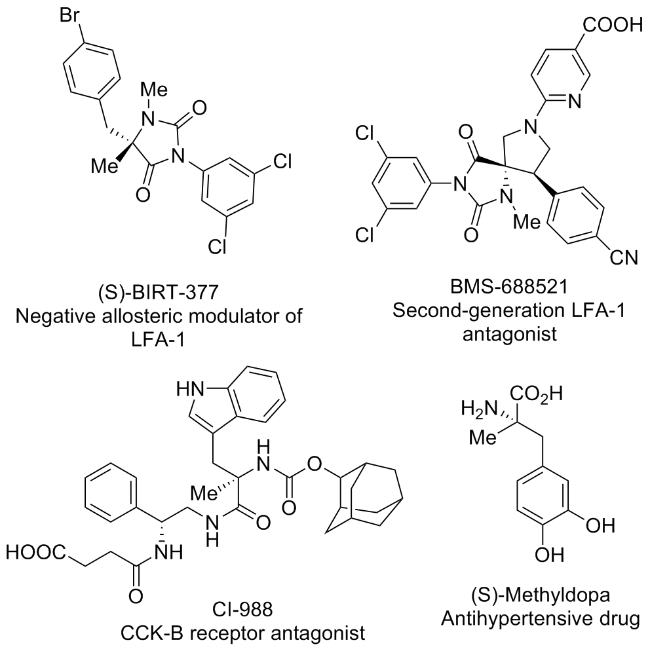
The enantioselective construction of quaternary stereogenic centers represents a formidable challenge in organic synthesis, particularly within the realm of α-amino acid derivatives that are prevalent in pharmaceuticals and natural products.[1-5] Chiral α-quaternary amino acids (α-QAAs) feature two modular non-hydrogen functionalities and are thus ideal candidates for the preparation of novel peptides with desired properties, serving as important building blocks or intermediates in synthetic chemistry.[6-7] The two substituents at the α-carbon of chiral α-QAAs are projected in well-defined spatial orientations, which is crucial for the design of molecules that interact with biological acceptors.[6-7] Over the past decades, significant efforts have been devoted to the development of efficient methodologies for the construction of all-carbon quaternary stereocenters,[4-5,8] with transition metal catalysis emerging as a particularly powerful tool.[9-10] Representative pharmaceuticals incorporating the chiral quaternary α-amino acid motif[11-13] include (S)-BIRT-377, BMS-688521, CI-988, and (S)-methyl- dopa (Figure 1). Among them, (S)-BIRT-377, with its distinctive hydantoin framework and remarkable biological activity, was selected as the target molecule for this study.
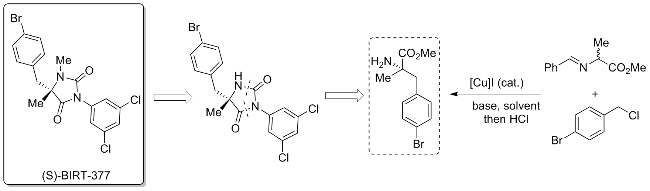
Various synthetic strategies toward BIRT-377 have been reported.[14-25] Although these methods are effective, they generally suffer from lengthy procedures and limited efficiency, underscoring the need for a more concise and efficient synthetic route to BIRT-377. A retrosynthetic analysis of (S)-BIRT-377 reveals a concise strategy for its assembly (Scheme 1). First, N-demethylation of the hydantoin ring provides the corresponding NH-hydantoin intermediate. Subsequent disconnection of the hydantoin ring and the amide bond leads to an α-methyl alanine derivative bearing the 4-bromobenzyl substituent at the quaternary center. Further disconnection suggests that this key quaternary stereocenter could be forged via an asymmetric alkylation reaction between an alanine-derived imino ester and 4-bromobenzyl chloride.
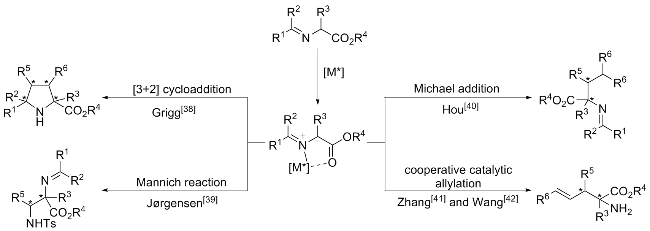
Significant progress in asymmetric alkylation[26-37] has provided a robust foundation for the development of α- imino ester-based methodologies. Upon activation by transition metals, α-imino esters generate metallated azomethine ylides as versatile synthons, and the field has achieved various types of asymmetric transformations, including annulation processes,[38] Mannich reactions,[39] Michael additions,[40] and cooperative catalytic allylation transformations (Scheme 2).[41-42] Nevertheless, straightforward functionalization of α-imino esters under mild conditions remains challenging and highly desirable. Our group has previously developed a copper-catalyzed enantioselective difluoromethylation of amino acid derivatives via difluoro- carbene.[43] Mechanistic studies revealed that the reaction proceeds through the activation of α-imino esters by a chiral copper catalyst, generating a stabilized metalated azomethine ylide that undergoes nucleophilic addition to difluoro- carbene. More recently, we have also demonstrated a copper-catalyzed switchable asymmetric defluoroalkylation and [3+2] cycloaddition of trifluoropropene.[44] Building on our experience with azomethine ylide chemistry, we envisioned that this catalytic system could be extended to the synthesis of (S)-BIRT-377. Specifically, we hypothesized that the metalated azomethine ylide derived from an alanine methyl ester imine could undergo enantioselective nucleophilic substitution with 4-bromobenzyl chloride, thereby directly constructing the quaternary stereocenter of (S)-BIRT-377. Concurrently, the group of Yin[45] has made important contributions to copper-catalyzed asymmetric alkylation of α-imino esters with diverse alkyl halides, providing a general platform for the construction of structurally diverse chiral α-amino acids. Encouraged by these advances, we undertook a systematic investigation of the proposed transformation. Herein, we report the successful realization of this strategy, culminating in an efficient enantioselective synthesis of (S)-BIRT-377.
2 Results and discussion
To verify our reaction hypothesis, we first explored the copper-catalyzed asymmetric coupling of alanine methyl ester-derived α-imino ester 1a with 4-bromobenzyl chloride 2a, using Cs2CO3 as the base in tetrahydrofuran (THF) at room temperature (Table 1). A series of representative chiral ligands widely applied in copper-catalyzed asymmetric alkylations were screened, including BOX-type ligand L1, pyridine-oxazoline-type ligand L2, and a panel of PHOX-type ligands L3~L6. Initial screening showed that the BOX ligand L1 failed to promote the reaction with no product formation (Entry 1). The pyridine-oxazoline ligand L2 delivered the target product 3 in only 29% yield with extremely low enantioselectivity (8% ee, Entry 2). Gratifyingly, the PHOX-type ligand L3 remarkably improved the reaction efficiency and stereocontrol, furnishing 3 in 72% yield with 95% ee (Entry 3). Further ligand optimization demonstrated that L4 was superior to other candidates, providing the desired product in 76% yield and 97% ee (Entry 4). Two additional PHOX analogs were subsequently evaluated: (S,Sp)-L5 afforded a comparable yield of 75% but a slightly reduced ee value of 96% (Entry 5), whereas (S)-L6 resulted in diminished yield (60%) and poor enantioselectivity (38% ee, Entry 6). Control experiments unambiguously validated the essential roles of the copper catalyst, chiral ligand, and inorganic base for this transformation. Omitting the chiral ligand, copper catalyst, or base completely suppressed product generation (Entries 7~9). We also systematically optimized the base loading and screened other bases, and no better results were obtained from these evaluations.
Table 1 Optimization of reaction conditionsa |
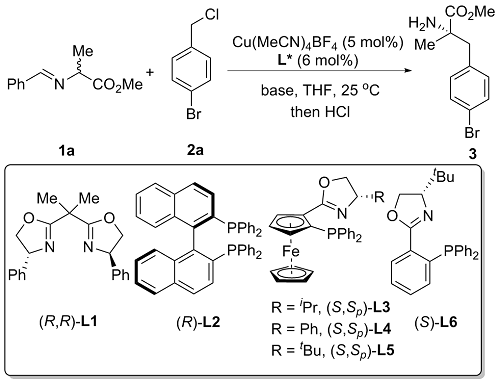
| Entry | L* | Base | Yieldb/% | eec/% |
|---|---|---|---|---|
| 1 | (R,R)-L1 | Cs2CO3 | nr | — |
| 2 | (R)-L2 | Cs2CO3 | 29 | 8 |
| 3 | (S,Sp)-L3 | Cs2CO3 | 72 | 95 |
| 4 | (S,Sp)-L4 | Cs2CO3 | 76 | 97 |
| 5 | (S,Sp)-L5 | Cs2CO3 | 75 | 96 |
| 6 | (S,Sp)-L6 | Cs2CO3 | 60 | 38 |
| 7 | — | Cs2CO3 | nr | — |
| 8d | (S,Sp)-L4 | Cs2CO3 | nr | — |
| 9 | (S,Sp)-L4 | — | nr | — |
a Reactions were performed with Cu(MeCN)4BF4 (5 mol%), L* (6 mol%), 1a (0.1 mmol, 1.0 equiv.), 2a (0.2 mmol, 2.0 equiv.), and Cs2CO3 (0.5 mmol, 5.0 equiv.) in THF (1 mL) at 25 ℃ for 24 h; hydrolysis with HCl (1 mol/L). b Isolated yields after chromatography. c Determined by chiral HPLC analysis. d Without Cu(MeCN)4BF4. nr=no reaction. |
With the optimized reaction conditions in hand, the scope of alkyl halides was next examined using α-imino ester 1 as the model nucleophile. As shown in Table 2, a wide range of electrophiles participated smoothly, affording the corresponding chiral α-amino acid derivatives in good to excellent yields and enantioselectivities. Benzylic chlorides bearing various substituents were competent substrates. 4-Bromobenzyl chloride, piperonyl chloride, and 3,4-dichlo- robenzyl chloride afforded products 3~7 in 73%~89% yield with 95%~97% ee. Notably, piperonyl chloride, the key fragment for methyldopa synthesis, reacted efficiently, setting the stage for subsequent application. Allylic chlorides were well tolerated. Allyl chloride, 1-chloro-3-methyl- 2-butene, and cinnamyl chloride provided products 8~10 in 73%~85% yields with 96%~97% ee. Propargyl chloride 11 furnished the corresponding product in 86% yield with 94% ee at 60 ℃. Simple alkyl bromides were also compatible. Butyl bromide, bromoethane, and cyclohexylmethyl bromide gave products 12, 13, and 16 in 73%~85% yields with 94%~96% ee. Notably, secondary iodides proved to be competent electrophiles: 2-iodopropane gave product 14 in 73% yield with 97% ee, and cyclopentyl iodide afforded product 15 in 87% yield with 99% ee. In contrast, secondary bromides and chlorides (e.g., cyclopentyl bromide and cyclopentyl chloride) did not react under the standard conditions. Moreover, tertiary alkyl halides including tert-butyl chloride, tert-butyl bromide, and tert-butyl iodide failed to react under the standard conditions, presumably due to steric hindrance and competing elimination pathways.
Table 2 Substrate scope of alkyl halides and α-imino estersa |

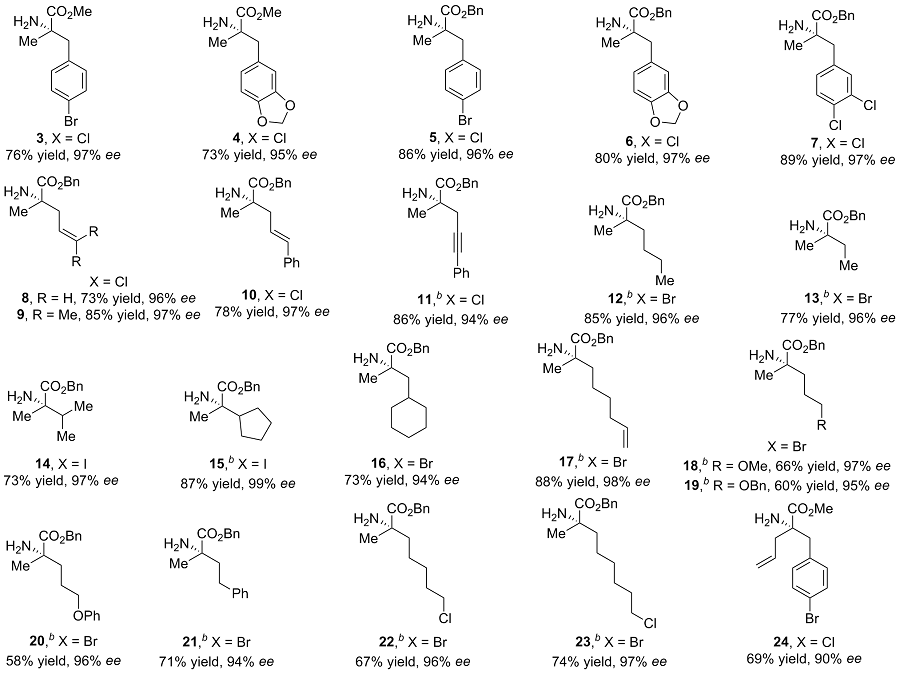 |
a Reactions were performed with Cu(MeCN)4BF4 (5 mol%), (S,Sp)-L4 (6 mol%), 1 (0.1 mmol), 2 (0.2 mmol), and Cs2CO3 (0.5 mmol, 5.0 equiv.) in THF (0.5 mL) at 25 ℃ for 24 h; hydrolysis with HCl (1 mol/L). b The reaction was performed at 60 ℃. |
In addition, alkyl bromides bearing diverse functional groups were examined and participated effectively. 6- Bromo-1-hexene, 3-bromopropyl methyl ether, 3-benzyl- oxy-1-bromopropane, and 3-phenoxy-1-bromopropane afforded products 17, 18, 19, and 20 in 58%~88% yields with 95%~98% ee. Phenethyl bromide gave product 21 in 71% yield with 94% ee. Notably, alkyl bromides bearing a terminal chloro group, such as 1-bromo-5-chloropentane and 1-bromo-6-chlorohexane, were well tolerated, providing products 22 in 67% yield with 96% ee and 23 in 74% yield with 97% ee, demonstrating the chemoselectivity of this protocol. The selectivity between different halogen atoms and between primary and secondary halides was also investigated. Competition experiments revealed that the reactivity order is iodide>bromide>> chloride, and that primary halides are significantly more reactive than secondary halides. The scope of the α-imino ester component was also briefly examined. Replacing the methyl group with an allyl group was well tolerated, affording product 24 in 69% yield with 90% ee. In contrast, the α-phenyl-substi- tuted imino ester did not react under the standard conditions, presumably due to increased steric hindrance. These results demonstrate that the copper catalyst system exhibits excellent functional-group tolerance and that both benzyl and methyl esters serve as effective nucleophile precursors.
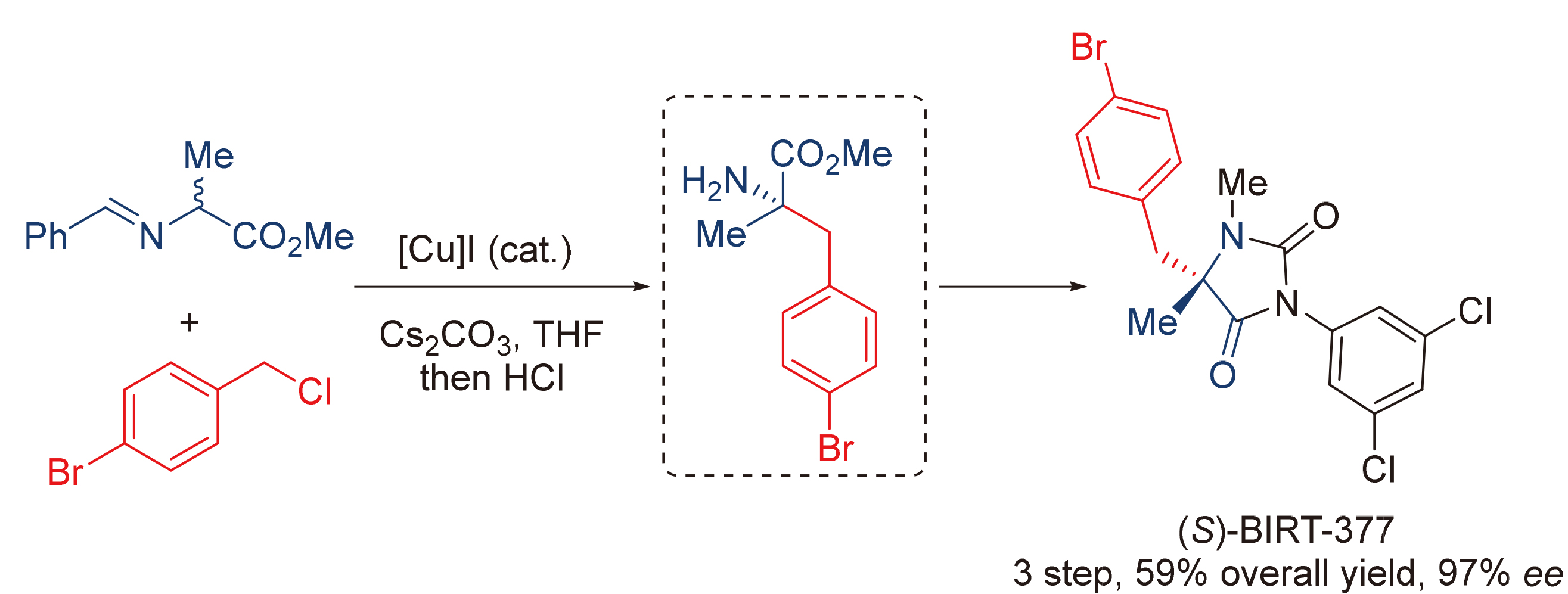
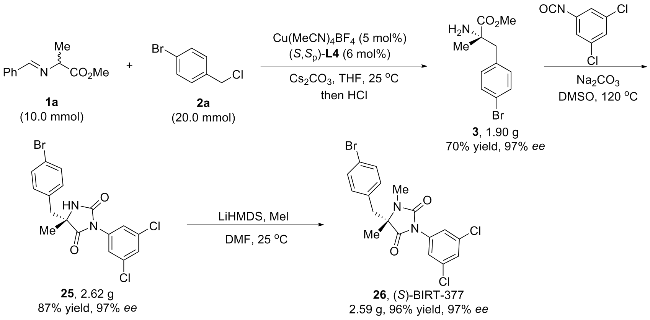
Having established the optimized conditions and demon- strated the broad substrate scope on a small scale, we next scaled up this protocol to the gram-scale synthesis of (S)- BIRT-377 (Scheme 3). Alanine methyl ester imine 1a was subjected to the asymmetric alkylation with 4-bromobenzyl chloride on a 10 mmol scale under the standard conditions. Gratifyingly, the reaction proceeded smoothly, affording chiral amino ester 3 in 70% yield (1.90 g) with 97% ee, in good consistency with the small-scale results. Subsequent treatment with 3,5-dichlorophenyl isocyanate provided urea derivative 25 in 87% yield (2.62 g) with 97% ee. Final methylation provided (S)-BIRT-377 (26) in 96% yield (2.59 g) with 97% ee. The absolute configuration was confirmed to be S by comparison of its chiral high performance liquid chromatography (HPLC) retention time with the data reported.[25] The three-step sequence delivers (S)- BIRT-377 in 59% overall yield with excellent stereocontrol, highlighting the practicality and scalability of this concise and efficient synthetic approach.
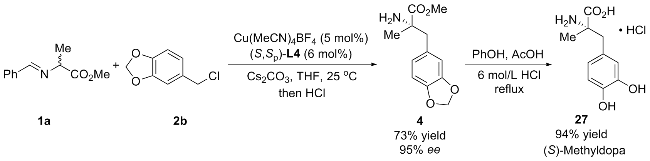
Encouraged by the successful synthesis of (S)-BIRT-377, the methodology was extended to another important pharmaceutical, (S)-methyldopa (Scheme 4). Using the chiral amino ester 4 prepared under the standard conditions (Table 2), subsequent hydrolysis under reflux conditions provided (S)-methyldopa (27) in 94% yield without erosion of enantiopurity. This two-step sequence delivers (S)-methyl- dopa in 69% overall yield with excellent enantioselectivity, further highlighting the versatility of the catalytic system.


3 Conclusions
In summary, we have developed a concise and efficient enantioselective synthesis of (S)-BIRT-377 via copper- catalyzed asymmetric alkylation of an alanine-derived imino ester with 4-bromobenzyl chloride. The key step proceeds in 70% yield with 97% ee, and the three-step sequence delivers the target molecule in 59% overall yield on a gram scale. The methodology exhibits broad substrate scope, accommodating a wide range of alkyl halides to afford diverse chiral α-amino acid derivatives in good to excellent yields and enantioselectivities. The synthetic utility was further demonstrated by the expedient synthesis of the antihypertensive drug methyldopa in two steps (69% overall yield, 95% ee). This work not only provides a practical route to (S)-BIRT-377, but also underscores the power of copper-catalyzed asymmetric alkylation of α-imino esters for constructing quaternary stereocenters.
4 Experimental section
4.1 General information
Unless otherwise noted, all reagents were purchased from commercial suppliers (Energy Chemical, Bidepharm, Le- yan, Sigma-Aldrich, TCI, Daicel, and J&K Scientific, etc.) and used without further purification. Aldimine esters 1 were prepared according to the literature procedure.[46] All reactions were carried out in oven-dried glassware under a dry nitrogen atmosphere. Thin layer chromatography (TLC) plates were visualized using UV light. Proton nuclear mag- netic resonance (1H NMR) spectra and carbon nuclear mag- netic resonance (13C NMR) spectra were recorded at 25 ℃ on Bruker Advance 400 MHz, 500 MHz or 600 MHz NMR spectrometers. High-resolution mass spectral (HRMS) analysis was performed on a Waters XEVO G2 Q-TOF instrument. The measurement of enantiomeric excesses was performed on a Waters-Alliance (2998, Photodiode Array Detector). CHIRALCEL and CHIRALPAK analytical columns were purchased from Daicel Chemical Industries, LTD.
4.2 General procedures for asymmetric alkylation
In a 10 mL Schlenk tube, Cu(CH3CN)4BF4 (1.6 mg, 0.005 mmol, 5 mol%) and (S,Sp)-L4 (3.1 mg, 0.006 mmol, 6 mol%) were stirred in THF (0.5 mL) under argon at 25 ℃ for 30 min. Cs2CO3 (163 mg, 0.5 mmol, 5.0 equiv.) and α-imino ester 1 (0.1 mmol, 1.0 equiv.) were then added, followed by the alkyl halide 2 (0.2 mmol, 2.0 equiv.). The reaction mixture was stirred at the specified temperature (25 ℃ unless otherwise noted) for 24 h. After the reaction was complete (monitored by TLC), aqueous HCl (1 mol/L) was added dropwise at 25 ℃ until the intermediate imine was fully hydrolyzed (monitored by TLC). The mixture was then neutralized with saturated aqueous K2CO3 and extracted with EtOAc. The combined organic layers were dried over Na2SO4, concentrated in vacuo, and purified by flash column chromatography to afford the desired product.
Methyl (S)-2-amino-3-(4-bromophenyl)-2-methylpropa- noate (3): Colorless oil (20.7 mg, 76% yield). ${[\alpha ]}_{\text{D}}^{\text{20}}$-21.3 (c 0.57, CH2Cl2). 1H NMR (500 MHz, CDCl3) δ: 7.40 (d, J=8.3 Hz, 2H), 7.02 (d, J=8.3 Hz, 2H), 3.69 (s, 3H), 3.06 (d, J=13.2 Hz, 1H), 2.75 (d, J=13.2 Hz, 1H), 1.37 (s, 3H); 13C NMR (125 MHz, CDCl3) δ: 177.4, 135.7, 131.8, 131.6, 121.2, 58.8, 52.3, 46.3, 26.7; HR-ESI-MS calcd for C11H15- BrNO2 [M+H]+ 272.0281, found 272.0285. The product was analyzed by HPLC to determine the enantiomeric excess: 97% ee (CHIRALPAK IE, hexane/i-PrOH, V∶V=85∶15, detector: 210 nm, T=25 ℃, flow rate: 1 mL/min), t1(minor)=7.68 min, t2(major)=8.38 min.
Methyl (S)-2-amino-3-(benzo[d][1,3]dioxol-5-yl)-2-methylpropanoate (4): Colorless oil (17.3 mg, 73% yield). ${[\alpha ]}_{\text{D}}^{\text{20}}$-27.6 (c 0.88, CH2Cl2). 1H NMR (500 MHz, CDCl3) δ: 6.74~6.70 (m, 1H), 6.65~6.62 (m, 1H), 6.62~6.56 (m, 1H), 5.92 (s, 2H), 3.70 (s, 3H), 3.04 (d, J=13.4 Hz, 1H), 2.70 (d, J=13.4 Hz, 1H), 1.37 (s, 3H); 13C NMR (125 MHz, CDCl3) δ: 177.7, 147.7, 146.7, 130.3, 123.1, 110.3, 108.3, 101.0, 59.0, 52.2, 46.7, 26.7; HR-ESI-MS calcd for C12H15- NO4Na 260.0891 [M+Na]+, found 260.0893. The product was analyzed by HPLC to determine the enantiomeric excess: 95% ee (CHIRALPAK IE, hexane/i-PrOH, V∶V=95∶5, detector: 210 nm, T=25 ℃, flow rate: 1 mL/min), t1(major)=61.01 min, t2(minor)=69.70 min.
Benzyl (S)-2-amino-3-(4-bromophenyl)-2-methylpropa- noate (5): Colorless oil (30.0 mg, 86% yield). ${[\alpha ]}_{\text{D}}^{\text{20}}$-15.4 (c 0.61, CH2Cl2). 1H NMR (500 MHz, CDCl3) δ: 7.40~7.34 (m, 3H), 7.34~7.29 (m, 4H), 6.95~6.91 (m, 2H), 5.14 (d, J=12.2 Hz, 1H), 5.10 (d, J=12.2 Hz, 1H), 3.07 (d, J=13.2 Hz, 1H), 2.75 (d, J=13.2 Hz, 1H), 1.40 (s, 3H); 13C NMR (125 MHz, CDCl3) δ: 176.8, 135.6, 135.5, 131.8, 131.5, 128.8, 128.6, 121.1, 67.1, 58.8, 46.3, 26.7; HR- ESI-MS calcd for C17H19BrNO2 348.0594 [M+H]+, found 348.0604. The product was analyzed by HPLC to determine the enantiomeric excess: 96% ee (CHIRALPAK IE, hexane/i-PrOH, V∶V=85∶15, detector: 210 nm, T=25 ℃, flow rate: 1 mL/min), t1(major)=6.95 min, t2(minor)=7.65 min.
Benzyl (S)-2-amino-3-(benzo[d][1,3]dioxol-5-yl)-2-me- thylpropanoate (6): Colorless oil (25.0 mg, 80% yield). ${[\alpha ]}_{\text{D}}^{\text{20}}$-34.7 (c 0.69, CH2Cl2). 1H NMR (500 MHz, CDCl3) δ: 7.41~7.31 (m, 5H), 6.67~6.63 (m, 1H), 6.63~6.58 (m, 1H), 6.56~6.50 (m, 1H), 5.91 (s, 2H), 5.18~5.10 (m, 2H), 3.06 (d, J=13.3 Hz, 1H), 2.71 (d, J=13.3 Hz, 1H), 1.40 (s, 3H); 13C NMR (125 MHz, CDCl3) δ: 177.0, 147.6, 146.6, 135.8, 130.2, 128.7, 128.5, 123.2, 110.38, 108.2, 101.1, 67.0, 59.0, 46.6, 26.7; HR-ESI-MS calcd for C18H20NO4 [M+H]+ 314.1387, found 314.1387. The product was analyzed by HPLC to determine the enantiomeric excess: 97% ee (CHIRALPAK IE, hexane/i-PrOH, V∶V=85∶15, detector: 210 nm, T=25 ℃, flow rate: 1 mL/min), t1(ma- jor)=13.88 min, t2(minor)=16.33 min.
Benzyl (S)-2-amino-3-(3,4-dichlorophenyl)-2-methylpro-panoate (7): Colorless oil (30.1 mg, 89% yield). ${[\alpha ]}_{\text{D}}^{\text{20}}$-24.2 (c 0.40, CH2Cl2). 1H NMR (500 MHz, CDCl3) δ: 7.44~7.36 (m, 3H), 7.34~7.30 (m, 2H), 7.28~7.21 (m, 2H), 6.89 (dd, J=8.2, 1.9 Hz, 1H), 5.14 (d, J=12.4 Hz, 1H), 5.11 (d, J=12.4 Hz, 1H), 3.06 (d, J=13.3 Hz, 1H), 2.75 (d, J=13.3 Hz, 1H), 1.40 (s, 3H); 13C NMR (125 MHz, CDCl3) δ: 176.6, 136.9, 135.5, 132.3, 132.0, 131.2, 130.3, 129.5, 128.8, 128.7, 128.6, 67.2, 58.8, 45.8, 26.7; HR-ESI-MS calcd for C17H18Cl2NO2 [M+H]+ 338.0709, found 338.0701. The product was analyzed by HPLC to determine the enantiomeric excess: 97% ee (CHIRALPAK IC, hexane/i-PrOH, V∶V=85∶15, detector: 210 nm, T=25 ℃, flow rate: 1 mL/min), t1(minor)=8.60 min, t2(major)=9.34 min.
Benzyl (S)-2-amino-2-methylpent-4-enoate (8): Colorless oil (16.0 mg, 73% yield). ${[\alpha ]}_{\text{D}}^{\text{20}}$-10.5 (c 0.72, CH2Cl2). 1H NMR (500 MHz, CDCl3) δ: 7.39~7.31 (m, 5H), 5.81~5.56 (m, 1H), 5.14 (s, 2H), 5.11~5.10 (m, 1H), 5.09~5.07 (m, 1H), 2.54 (dd, J=13.5, 6.7 Hz, 1H), 2.28 (dd, J=13.5, 8.2 Hz, 1H), 1.35 (s, 3H); 13C NMR (125 MHz, CDCl3) δ: 177.2, 136.0, 132.8, 128.7, 128.4, 128.3, 119.5, 67.0, 57.7, 45.3, 26.3; HR-ESI-MS calcd for C13H18NO2 [M+H]+ 220.1332, found 220.1347. The product was analyzed by HPLC to determine the enantiomeric excess: 96% ee (CHIRALPAK IE, hexane/i-PrOH, V∶V=98∶2, detector: 210 nm, T=25 ℃, flow rate: 1 mL/min), t1(major)=19.30 min, t2(minor)=20.60 min.
Benzyl (S)-2-amino-2,5-dimethylhex-4-enoate (9): Colorless oil (20.9 mg, 85% yield). ${[\alpha ]}_{\text{D}}^{\text{20}}$-8.1 (c 0.80, CH2Cl2). 1H NMR (500 MHz, CDCl3) δ: 7.42~7.29 (m, 5H), 5.14 (s, 2H), 5.00 (t, J=6.8 Hz, 1H), 2.44 (dd, J=14.0, 6.8 Hz, 1H), 2.30 (dd, J=14.0, 8.4 Hz, 1H), 1.67 (s, 3H), 1.59 (s, 3H), 1.34 (s, 3H); 13C NMR (125 MHz, CDCl3) δ: 177.5, 136.2, 136.1, 128.7, 128.3, 128.2, 118.4, 66.8, 58.4, 39.5, 26.3, 26.1, 18.1; HR-ESI-MS calcd for C15H22NO2 [M+H]+ 248.1645, found 248.1660. The pro- duct was analyzed by HPLC to determine the enantiomeric excess: 97% ee (CHIRALPAK IE, hexane/i-PrOH, V∶V=98∶2, detector: 210 nm, T=25 ℃, flow rate: 1 mL/min), t1(major)=16.99 min, t2(minor)=18.18 min.
Benzyl (S,E)-2-amino-2-methyl-5-phenylpent-4-enoate (10): Colorless oil (23.0 mg, 78% yield). ${[\alpha ]}_{\text{D}}^{\text{20}}$+7.4 (c 0.52, CH2Cl2). 1H NMR (500 MHz, CDCl3) δ: 7.39~7.32 (m, 5H), 7.30~7.17 (m, 5H), 6.43 (d, J=15.8 Hz, 1H), 6.01 (ddd, J=15.8, 8.4, 6.8 Hz, 1H), 5.19 (d, J=12.2 Hz, 1H), 5.14 (d, J=12.2 Hz, 1H), 2.69 (ddd, J=13.5, 6.8, 1.0 Hz, 1H), 2.42 (dd, J=13.5, 8.4 Hz, 1H), 1.40 (s, 3H); 13C NMR (125 MHz, CDCl3) δ: 177.1, 137.1, 135.9, 134.4, 128.7, 128.6, 128.5, 127.5, 126.3, 124.3, 67.0, 58.1, 44.6, 26.4; HR-ESI-MS calcd for C19H22NO2 [M+H]+ 296.1645, found 296.1648. The product was analyzed by HPLC to determine the enantiomeric excess: 97% ee (CHIRALPAK IG, hexane/i-PrOH, V∶V=85∶15, detector: 210 nm, T=25 ℃, flow rate: 1 mL/min), t1(ma- jor)=8.12 min, t2(minor)=9.28 min.
Benzyl (S)-2-amino-2-methyl-5-phenylpent-4-ynoate (11): Colorless oil (25.2 mg, 86% yield). The reaction was performed at 60 ℃. ${[\alpha ]}_{\text{D}}^{\text{20}}$-11.6 (c 0.39, CH2Cl2). 1H NMR (500 MHz, CDCl3) δ: 7.40~7.24 (m, 10H), 5.22 (d, J=12.4 Hz, 1H), 5.18 (d, J=12.4 Hz, 1H), 2.92 (d, J=16.5 Hz, 1H), 2.69 (d, J=16.5 Hz, 1H), 1.46 (s, 3H); 13C NMR (125 MHz, CDCl3) δ: 176.2, 135.9, 131.8, 128.7, 128.4, 128.3, 128.1, 128.1, 123.3, 85.2, 83.8, 67.2, 58.0, 32.1, 26.1; HR-ESI-MS calcd for C19H20NO2 [M+H]+ 294.1489, found 294.1496. The product was analyzed by HPLC to determine the enantiomeric excess: 94% ee (CHIRALPAK OJ, hexane/i-PrOH, V∶V=70∶30, detec- tor: 210 nm, T=25 ℃, flow rate: 1 mL/min), t1(minor)=7.30 min, t2(major)=9.44 min.
Benzyl (S)-2-amino-2-methylhexanoate (12): Colorless oil (20.0 mg, 85% yield). The reaction was performed at 60 ℃. ${[\alpha ]}_{\text{D}}^{\text{20}}$-20.6 (c 0.43, CH2Cl2). 1H NMR (500 MHz, CDCl3) δ: 7.39~7.30 (m, 5H), 5.16 (d, J=12.3 Hz, 1H), 5.12 (d, J=12.3 Hz, 1H), 1.77~1.67 (m, 3H), 1.61~1.53 (m, 1H), 1.33 (s, 3H), 1.31~1.25 (m, 2H), 0.84 (t, J=7.1 Hz, 3H); 13C NMR (125 MHz, CDCl3) δ: 177.7, 136.1, 128.7, 128.4, 128.2, 66.8, 58.0, 40.9, 29.8, 26.4, 23.0, 14.0; HR-ESI-MS calcd for C14H22NO2 [M+H]+ 236.1645, found 236.1640. The product was analyzed by HPLC to determine the enantiomeric excess: 96% ee (CHIRALPAK IC, hexane/i-PrOH, V∶V=99∶1, detector: 210 nm, T=25 ℃, flow rate: 1 mL/min), t1(major)=31.48 min, t2(minor)=33.35 min.
Benzyl (S)-2-amino-2-methylbutanoate (13): Colorless oil (15.9 mg, 77% yield). The reaction was performed at 60 ℃. ${[\alpha ]}_{\text{D}}^{\text{20}}$-13.1 (c 0.71, CH2Cl2). 1H NMR (500 MHz, CDCl3) δ: 7.40~7.30 (m, 5H), 5.14 (s, 2H), 1.82~1.73 (m, 1H), 1.61~1.54 (m, 1H), 1.33 (s, 3H), 0.84 (t, J=7.5 Hz, 3H); 13C NMR (125 MHz, CDCl3) δ: 177.6, 136.1, 128.7, 128.3, 128.1, 66.8, 58.3, 34.0, 26.0, 8.5; HR-ESI-MS calcd for C12H18NO2 [M+H]+ 208.1332, found 208.1330. The product was analyzed by HPLC to determine the enantiomeric excess: 96% ee (CHIRALPAK IG, hexane/i-PrOH, V∶V=98∶2, detector: 210 nm, T=25 ℃, flow rate: 1 mL/min), t1(major)=19.60 min, t2(minor)=21.06 min.
Benzyl (S)-2-amino-2,3-dimethylbutanoate (14): Colorless oil (16.1 mg, 73% yield). ${[\alpha ]}_{\text{D}}^{\text{20}}$-3.5 (c 0.65, CH2Cl2). 1H NMR (400 MHz, CDCl3) δ: 7.40~7.29 (m, 5H), 5.14 (s, 2H), 2.01 (hept, J=6.9 Hz, 1H), 1.28 (s, 3H), 0.90 (d, J=6.9 Hz, 3H), 0.83 (d, J=6.9 Hz, 3H); 13C NMR (125 MHz, CDCl3) δ: 177.8, 136.1, 128.7, 128.4, 128.3, 66.8, 60.9, 35.8, 23.6, 17.5, 16.5; HR-ESI-MS calcd for C13H20NO2 [M+H]+ 222.1489, found 222.1482. The product was analyzed by HPLC to determine the enantiomeric excess: 97% ee (CHIRALPAK IE, hexane/i-PrOH, V∶V=95∶5, detector: 210 nm, T=25 ℃, flow rate: 1 mL/min), t1(ma- jor)=9.99 min, t2(minor)=11.11 min.
Benzyl (S)-2-amino-2-cyclopentylpropanoate (15): Colorless oil (21.5 mg, 87% yield). The reaction was performed at 60 ℃. ${[\alpha ]}_{\text{D}}^{\text{20}}$-9.7 (c 0.60, CH2Cl2). 1H NMR (400 MHz, CDCl3) δ: 7.39~7.31 (m, 5H), 5.14 (s, 2H), 2.35~2.17 (m, 1H), 1.69~1.44 (m, 8H); 13C NMR (125 MHz, CDCl3) δ: 177.7, 136.1, 128.7, 128.3, 128.2, 66.8, 59.5, 48.3, 27.3, 26.5, 26.0, 25.8, 25.0; HR-ESI-MS calcd for C15H22NO2 [M+H]+ 248.1645, found 248.1660. The product was analyzed by HPLC to determine the enantiomeric excess: 99% ee (CHIRALPAK IE, hexane/i-PrOH, V∶V=95∶5, detector: 210 nm, T=25 ℃, flow rate: 1 mL/min), t1(ma- jor)=10.58 min, t2(minor)=11.57 min.
Benzyl (S)-2-amino-3-cyclohexyl-2-methylpropanoate (16): Colorless oil (20.1 mg, 73% yield). ${[\alpha ]}_{\text{D}}^{\text{20}}$-18.4 (c 0.46, CH2Cl2). 1H NMR (400 MHz, CDCl3) δ: 7.40~7.32 (m, 5H), 5.14 (d, J=12.3 Hz, 1H), 5.10 (d, J=12.3 Hz, 1H), 1.75~1.67 (m, 1H), 1.61~1.46 (m, 6H), 1.32 (s, 3H), 1.28~1.01 (m, 4H), 1.00~0.76 (m, 2H); 13C NMR (100 MHz, CDCl3) δ: 178.4, 136.0, 128.7, 128.4, 128.4, 66.9, 57.5, 48.4, 35.0, 34.0, 33.8, 27.9, 26.4, 26.4, 26.3; HR-ESI- MS calcd for C17H25NO2Na [M+Na]+ 298.1778, found 298.1774. The product was analyzed by HPLC to determine the enantiomeric excess: 94% ee (CHIRALPAK IE, hexane/i-PrOH, V∶V=95∶5, detector: 210 nm, T=25 ℃, flow rate: 1 mL/min), t1(major)=9.95 min, t2(minor)=10.83 min.
Benzyl (S)-2-amino-2-methyloct-7-enoate (17): Colorless oil (23.0 mg, 88% yield). The reaction was performed at 60 ℃. ${[\alpha ]}_{\text{D}}^{\text{20}}$-32.5 (c 0.80, CH2Cl2). 1H NMR (500 MHz, CDCl3) δ: 7.39~7.30 (m, 5H), 5.74 (ddt, J=17.1, 10.2, 6.7 Hz, 1H), 5.15 (d, J=12.3 Hz, 1H), 5.12 (d, J=12.3 Hz, 1H), 4.96 (ddd, J=17.1, 3.5, 1.6 Hz, 1H), 4.91 (ddt, J=10.2, 2.1, 1.1 Hz, 1H), 1.98 (td, J=7.0, 1.2 Hz, 2H), 1.77~1.70 (m, 1H), 1.60~1.53 (m, 1H), 1.38~1.28 (m, 6H), 1.16~1.05 (m, 1H); 13C NMR (125 MHz, CDCl3) δ: 177.7, 138.8, 136.1, 128.7, 128.4, 128.2, 114.6, 66.8, 57.9, 41.1, 33.6, 29.2, 26.5, 23.8; HR-ESI-MS calcd for C16H24NO2 [M+H]+ 262.1802, found 262.1797. The product was analyzed by HPLC to determine the enantiomeric excess: 98% ee (CHIRALPAK IC, hexane/i-PrOH, V∶V=98∶2, detector: 210 nm, T=25 ℃, flow rate: 1 mL/min), t1(ma- jor)=23.47 min, t2(minor)=26.39 min.
Benzyl (S)-2-amino-5-methoxy-2-methylpentanoate (18): Colorless oil (16.6 mg, 66% yield). The reaction was performed at 60 ℃. ${[\alpha ]}_{\text{D}}^{\text{20}}$-22.4 (c 0.78, CH2Cl2). 1H NMR (500 MHz, CDCl3) δ: 7.46~7.27 (m, 5H), 5.14 (s, 2H), 3.32 (t, J=6.3 Hz, 2H), 3.28 (s, 3H), 1.67~1.45 (m, 4H), 1.35 (s, 3H); 13C NMR (125 MHz, CDCl3) δ: 177.4, 136.0, 128.7, 128.4, 128.2, 72.7, 66.9, 58.5, 57.8, 37.6, 26.3, 24.5; HR-ESI-MS calcd for C14H22NO3 [M+H]+ 252.1594, found 252.1581. The product was analyzed by HPLC to determine the enantiomeric excess: 97% ee (CHIRALPAK IE, hexane/i-PrOH, V∶V=95∶5, detector: 210 nm, T=25 ℃, flow rate: 1 mL/min), t1(major)=24.95 min, t2(minor)=27.39 min.
Benzyl (S)-2-amino-5-(benzyloxy)-2-methylpentanoate (19): Colorless oil (19.6 mg, 60% yield). The reaction was performed at 60 ℃. ${[\alpha ]}_{\text{D}}^{\text{20}}$-29.1 (c 0.63, CH2Cl2). 1H NMR (500 MHz, CDCl3) δ: 7.38~7.26 (m, 10H), 5.13 (s, 2H), 4.46 (s, 2H), 3.43 (t, J=6.3 Hz, 2H), 1.85~1.79 (m, 1H), 1.65~1.58 (m, 2H), 1.57~1.48 (m, 1H), 1.35 (s, 3H); 13C NMR (125 MHz, CDCl3) δ: 177.4, 138.5, 135.9, 128.6, 128.3, 128.3, 128.1, 127.6, 127.5, 72.8, 70.2, 66.8, 57.6, 37.6, 26.3, 24.6; HR-ESI-MS calcd for C20H25NO3Na [M+Na]+ 350.1727, found 350.1717. The product was analyzed by HPLC to determine the enantiomeric excess: 95% ee (CHIRALPAK IC, hexane/i-PrOH, V∶V=85∶15, detec- tor: 210 nm, T=25 ℃, flow rate: 1 mL/min), t1(major)=10.40 min, t2(minor)=11.57 min.
Benzyl (S)-2-amino-2-methyl-5-phenoxypentanoate (20): Colorless oil (18.1 mg, 58% yield). The reaction was performed at 60 ℃. ${[\alpha ]}_{\text{D}}^{\text{20}}$-35.9 (c 0.54, CH2Cl2). 1H NMR (500 MHz, CDCl3) δ: 7.44~7.29 (m, 5H), 7.29~7.23 (m, 2H), 6.96~6.90 (m, 1H), 6.88~6.82 (m, 2H), 5.13 (s, 2H), 4.01~3.86 (m, 2H), 1.99~1.89 (m, 1H), 1.86~1.72 (m, 3H), 1.38 (s, 3H); 13C NMR (125 MHz, CDCl3) δ: 177.5, 159.0, 136.0, 129.5, 128.7, 128.4, 128.2, 120.7, 114.6, 67.7, 67.0, 57.8, 37.5, 26.4, 24.4; HR-ESI-MS calcd for C19H23- NO3Na [M+Na]+ 314.1751, found 314.1750. The product was analyzed by HPLC to determine the enantiomeric excess: 96% ee (CHIRALPAK IC, hexane/i-PrOH, V∶V=85∶15, detector: 210 nm, T=25 ℃, flow rate: 1 mL/min), t1(major)=9.39 min, t2(minor)=10.96 min.
Benzyl (S)-2-amino-2-methyl-4-phenylbutanoate (21): Colorless oil (20.1 mg, 71% yield). The reaction was performed at 60 ℃. ${[\alpha ]}_{\text{D}}^{\text{20}}$-21.3 (c 0.77, CH2Cl2). 1H NMR (500 MHz, CDCl3) δ: 7.40~7.31 (m, 5H), 7.27~7.21 (m, 2H), 7.19~7.13 (m, 1H), 7.09~7.05 (m, 2H), 5.17 (d, J=12.2 Hz, 1H), 5.12 (d, J=12.2 Hz, 1H), 2.61 (td, J=12.7, 5.2 Hz, 1H), 2.44 (td, J=12.7, 5.2 Hz, 1H), 2.08~1.99 (m, 1H), 1.93~1.84 (m, 1H), 1.39 (s, 3H); 13C NMR (125 MHz, CDCl3) δ: 177.4, 141.7, 136.0, 128.8, 128.5, 128.5, 128.4, 126.0, 67.0, 58.0, 43.0, 30.8, 26.6; HR-ESI-MS calcd for C18H21NO2Na [M+Na]+ 306.1464, found 306.1466. The product was analyzed by HPLC to determine the enantiomeric excess: 94% ee (CHIRALPAK IC, hexane/i-PrOH, V∶V=98∶2, detector: 210 nm, T=25 ℃, flow rate: 1 mL/min), t1(major)=23.45 min, t2(minor)=36.05 min.
Benzyl (S)-2-amino-7-chloro-2-methylheptanoate (22): Colorless oil (19.0 mg, 67% yield). The reaction was performed at 60 ℃. ${[\alpha ]}_{\text{D}}^{\text{20}}$-39.4 (c 0.85, CH2Cl2). 1H NMR (500 MHz, CDCl3) δ: 7.40~7.29 (m, 5H), 5.14 (q, J=12.3 Hz, 2H), 3.46 (t, J=6.7 Hz, 2H), 1.76~1.65 (m, 3H), 1.60~1.52 (m, 1H), 1.42~1.28 (m, 6H), 1.16~1.06 (m, 1H); 13C NMR (125 MHz, CDCl3) δ: 177.6, 136.0, 128.7, 128.5, 128.3, 66.9, 57.9, 45.0, 41.0, 32.4, 27.1, 26.5, 23.6; HR-ESI-MS calcd for C15H23ClNO2 [M+H]+ 284.1412, found 284.1426. The product was analyzed by HPLC to determine the enantiomeric excess: 96% ee (CHIRALPAK IE, hexane/i-PrOH, V∶V=95∶5, detector: 210 nm, T=25 ℃, flow rate: 1 mL/min), t1(major)=14.03 min, t2(minor)=16.78 min.
Benzyl (S)-2-amino-8-chloro-2-methyloctanoate (23): Colorless oil (22.0 mg, 74% yield). The reaction was performed at 60 ℃. ${[\alpha ]}_{\text{D}}^{\text{20}}$-31.5 (c 0.42, CH2Cl2). 1H NMR (500 MHz, CDCl3) δ: 7.41~7.29 (m, 5H), 5.15 (q, J=12.3 Hz, 2H), 3.49 (t, J=6.5 Hz, 2H), 1.83~1.56 (m, 4H), 1.41~1.31 (m, 5H), 1.30~1.23 (m, 3H), 1.16~1.05 (m, 1H); 13C NMR (125 MHz, CDCl3) δ: 177.7, 177.7, 136.1, 128.7, 128.4, 128.3, 66.8, 58.0, 45.1, 41.1, 32.6, 29.2, 26.8, 26.5, 24.1; HR-ESI-MS calcd for C16H25ClNO2 [M+H]+ 298.1568, found 298.1550. The product was analyzed by HPLC to determine the enantiomeric excess: 97% ee (CHIRALPAK IE, hexane/i-PrOH, V∶V=95∶5, detector: 210 nm, T=25 ℃, flow rate: 1 mL/min), t1(major)=13.91 min, t2(minor)=16.14 min.
Methyl (S)-2-amino-2-(4-bromobenzyl)pent-4-enoate (24): Colorless oil (20.6 mg, 69% yield). ${[\alpha ]}_{\text{D}}^{\text{20}}$-6.8 (c 0.90, CH2Cl2). 1H NMR (500 MHz, CDCl3) δ: 7.39 (d, J=8.3 Hz, 2H), 7.02 (d, J=8.2 Hz, 2H), 5.68 (ddd, J=16.7, 8.7, 6.5 Hz, 1H), 5.25~5.09 (m, 2H), 3.69 (s, 3H), 3.11 (d, J=13.2 Hz, 1H), 2.73 (d, J=13.2 Hz, 1H), 2.68 (dd, J=13.4, 6.5 Hz, 1H), 2.29 (dd, J=13.4, 8.7 Hz, 1H); 13C NMR (125 MHz, CDCl3) δ: 176.4, 135.3, 132.4, 131.7, 131.6, 121.2, 120.1, 61.9, 52.2, 45.3, 44.5; HR-ESI-MS calcd for C13H17BrNO2 [M+H]+ 298.0437, found 298.0431. The product was analyzed by HPLC to determine the enantiomeric excess: 90% ee (CHIRALPAK IC, hexane/i-PrOH, V∶V=90∶10, detector: 210 nm, T=25 ℃, flow rate: 1 mL/min), t1(minor)=7.10 min, t2(major)=7.66 min.
4.3 Synthesis of (S)-BIRT-377
In a 100 mL Schlenk tube, Cu(CH3CN)4BF4 (160 mg, 0.5 mmol, 5 mol%) and (S,Sp)-L4 (310 mg, 0.6 mmol, 6 mol%) were stirred in THF (30 mL) under argon at 25 ℃ for 1 h. Cs2CO3 (16.3 g, 50 mmol, 5.0 equiv.) and α-imino ester 1a (10 mmol, 1.0 equiv.) were then added, followed by the alkyl halide (20 mmol, 2.0 equiv.). The reaction mixture was stirred at 25 ℃ for 24 h. After the reaction was complete (monitored by TLC), aqueous HCl (1 mol/L) was added dropwise at 25 ℃ until the intermediate imine was fully hydrolyzed (monitored by TLC). The mixture was then neutralized with saturated aqueous K2CO3 and extracted with EtOAc. The combined organic layers were dried over Na2SO4, concentrated in vacuo, and purified by flash column chromatography to afford the chiral amino ester 3 (1.90 g, 70% yield, 97% ee). To a stirred solution, chiral amino ester 3 (1.90 g, 7.0 mmol, 1.0 equiv.) in dry dimethyl sulfoxide (DMSO) (30 mL) was added 3,5-di- chlorophenylisocyanate (1.32 g, 7.0 mmol, 1.0 equiv.) at 25 ℃ and the resulted mixture was stirred for 1.5 h. Na2CO3 (0.74 g, 14 mmol, 2.0 equiv.) was added and reaction mixture was heated at 120 ℃ for 15 h. The reaction mixture was cooled to 25 ℃ and diluted with EtOAc. The mixture was washed with water and brine. The combined organic layers were dried over Na2SO4, concentrated in vacuo, and purified by flash column chromatography to afford (S)-5-(4- bromobenzyl)-3-(3,5-dichlorophenyl)-5-methylimidazo- lidine-2,4-dione (25), colorless oil (2.62 g, 87% yield, 97% ee). ${[\alpha ]}_{\text{D}}^{\text{20}}$+104.3 (c 0.65, CH2Cl2). 1H NMR (500 MHz, CDCl3) δ: 7.49~7.43 (m, 2H), 7.37~7.32 (m, 1H), 7.09~7.04 (m, 2H), 7.02~6.97 (m, 2H), 6.45 (s, 1H), 3.14 (d, J=13.7 Hz, 1H), 2.91 (d, J=13.7 Hz, 1H), 1.60 (s, 3H); 13C NMR (125 MHz, CDCl3) δ: 174.3, 154.6, 135.4, 133.0, 133.0, 131.9, 131.9, 128.7, 124.7, 122.2, 62.8, 43.8, 23.6; HR-ESI-MS calcd for C17H14BrCl2N2O2 [M+H]+ 426.9610, found 426.9627. The product was analyzed by HPLC to determine the enantiomeric excess: 97% ee (CHIRALPAK AD-H, hexane/i-PrOH, V∶V=85∶15, detector: 210 nm, T=25 ℃, flow rate: 1 mL/min), t1(major)=4.29 min, t2(minor)=10.89 min.
The product 25 (2.62 g, 6.1 mmol, 1.0 equiv.) was dissolved in dry N,N-dimethylformamide (DMF) (30 mL), and lithium hexamethyldisilazide (LiHMDS) (7.3 mL, 1 mol/L in THF, 1.2 equiv.) was added dropwise at 0 ℃. Then, the mixture was then stirred for 1 h at 25 ℃. Methyl iodide (1.3 g, 9.2 mmol, 1.5 equiv.) was added and stirred for 10 h at 25 ℃. The reaction was quenched with ice-cold water and diluted with EtOAc. The organic layer was separated and washed with brine, dried over Na2SO4 and concentrated in vacuo. The crude product was purified by flash column chromatography to afford (S)-5-(4-bromobenzyl)-3-(3,5- dichlorophenyl)-1,5-dimethylimidazolidine-2,4-dione (26), white solid (2.59 g, 96% yield, 97% ee). m.p. 131~136 ℃; ${[\alpha ]}_{\text{D}}^{\text{20}}$-112.6 (c 0.79, EtOH). 1H NMR (400 MHz, CDCl3) δ: 7.47~7.39 (m, 2H), 7.31~7.28 (m, 1H), 6.99~6.91 (m, 2H), 6.87~6.83 (m, 2H), 3.09 (d, J=15.5 Hz, 1H), 3.07 (s, 3H), 2.97 (d, J=14.0 Hz, 1H), 1.62 (s, 3H); 13C NMR (125 MHz, CDCl3) δ: 173.5, 153.6, 135.2, 133.2, 133.0, 132.0, 131.3, 128.5, 124.7, 122.2, 65.8, 40.9, 25.5, 21.2; HR-ESI- MS calcd for C18H16BrCl2N2O2 [M+H]+ 440.9767, found 440.9749. The product was analyzed by HPLC to determine the enantiomeric excess: 97% ee (CHIRALPAK AD-H, hexane/i-PrOH, V∶V=95∶5, detector: 210 nm, T=25 ℃, flow rate: 1 mL/min), t1(major)=9.40 min, t2(mi- nor)=11.46 min.
4.4 Synthesis of (S)-methyldopa
In a 10 mL Schlenk tube, Cu(CH3CN)4BF4 (1.6 mg, 0.005 mmol, 5 mol%) and (S,Sp)-L4 (3.1 mg, 0.006 mmol, 6 mol%) were stirred in THF (0.5 mL) under argon at 25 ℃ for 30 min. Cs2CO3 (163 mg, 0.5 mmol, 5.0 equiv.) and α-imino ester 1a (0.1 mmol, 1.0 equiv.) were then added, followed by the alkyl halide (0.2 mmol, 2.0 equiv.). The reaction mixture was stirred at 25 ℃ for 24 h. After the reaction was complete (monitored by TLC), aqueous HCl (1 mol/L) was added dropwise at 25 ℃ until the intermediate imine was fully hydrolyzed (monitored by TLC). The mixture was then neutralized with saturated aqueous K2CO3 and extracted with EtOAc. The combined organic layers were dried over Na2SO4, concentrated in vacuo, and purified by flash column chromatography to afford the chiral amino ester 4. Chiral amino ester 4 (35.0 mg, 0.15 mmol, 1.0 equiv.), phenol (42.3 mg, 0.45 mmol, 3.0 equiv.), acetic acid (26 µL, 0.45 mmol, 3.0 equiv.) and 6 mol/L HCl (2 mL) were combined in a flask. The flask was covered with foil and the reaction was stirred at 135 ℃ under argon for 28 h. The solution was washed with EtOAc, and the aqueous phase was concentrated to afford (S)-2-amino-3-(3,4-dihy- droxyphenyl)-2-methylpropanoic acid hydrochloride (27), white solid (34.9 mg, 94% yield). m.p. 292~297 ℃; ${[\alpha ]}_{\text{D}}^{\text{20}}$-6.7 (c 0.86, H2O). 1H NMR (600 MHz, D2O) δ: 6.67~6.65 (m, 1H), 6.55~6.52 (m, 1H), 6.47~6.45 (m, 1H), 3.02 (d, J=14.5 Hz, 1H), 2.73 (d, J=14.5 Hz, 1H), 1.40 (s, 3H); 13C NMR (150 MHz, D2O) δ: 173.8, 144.1, 143.7, 125.5, 122.5, 117.5, 116.4, 60.8, 41.6, 21.6; HR-ESI-MS calcd for C10H14NO4 [M+H]+ 212.0917, found 212.0909.
Supporting Information Experimental details, HPLC traces, NMR data and spectra of all compounds. The Supporting Information is available free of charge via the Internet at http://sioc-journal.cn.
(Zhao, C.)