


1 Introduction
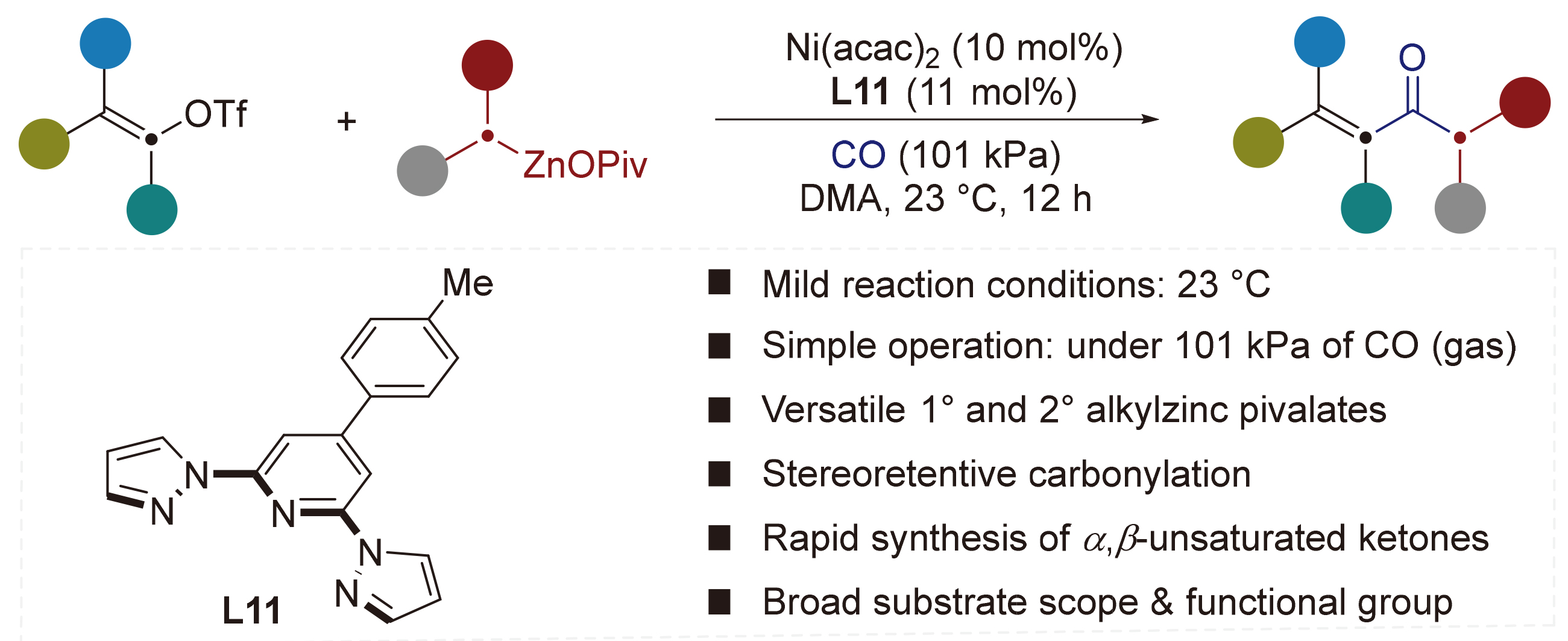
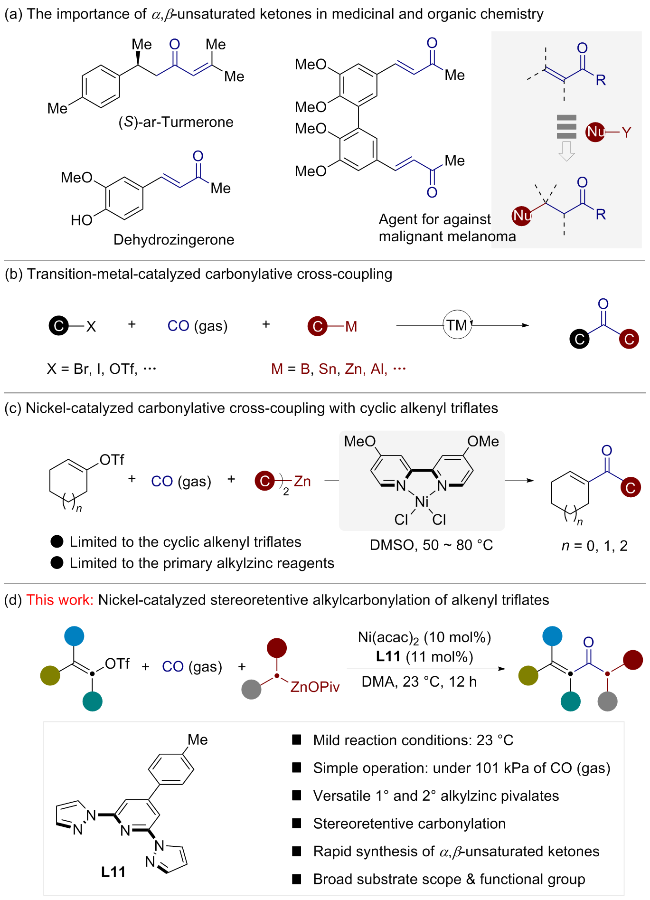
α,β-Unsaturated ketones are an important class of organic synthetic intermediates and are widely found in various natural products and pharmaceutical molecules.[1] Meanwhile, as common electrophiles, they can be employed to construct complex molecular frameworks through various transformations (Scheme 1a).[2] Traditionally, α,β-unsa- turated ketones are synthesized through the oxidation of ketones or olefins, aldol condensation reactions and acylation reactions.[3] In recent years, transition metal-catalyzed carbonylative cross-coupling reactions become one of the important methods for the synthesis of ketone com- pounds.[4] Since the prominent research of Heck in the 1970s,[5] a variety of carbonylative coupling reactions have been developed, including Stille, Suzuki, and Negishi type carbonylative transformations.[6] In addition, carbonylative couplings catalyzed by earth-abundant metals have also attracted considerable attention.[7] In particular, ligand- accelerated nickel-catalyzed carbonylative cross coupling has emerged as a rapid development by overcoming the deactivation of Ni(CO)4 species.[8] By the use of C(sp2)—X,[9] C(sp)—X,[10] and activated C(sp3)—X,[11] as the electrophilic coupling partners, diverse nickel-catalyzed ketone frameworks have been reported during the last decades. However, the unactivated C(sp3)—X[12] was only recently employed in the nickel-catalyzed carbonylative couplings (Scheme 1b). Despite these major advances made, we envisioned the synthesis of α,β-unsaturated ketone via nickel-catalyzed carbonylative cross-coupling strategy with organometallic nucleophiles and easily accessible alkenyl triflates using CO as the C1 source.[13] Thus far, sporadic examples toward direct carbonylation of tetrasubstituted alkenyl triflates with nucleophiles have been developed. Among them, the nickel-catalyzed carbonylative Negishi cross-coupling between cyclic alkenyl triflates and organozinc reagents has been reported by Chen and coworkers.[14] Thereafter, Beller et al.[15] also disclosed the carbonylative Suzuki coupling of alkenyl triflates. However, these approaches largely limited to the use of primary alkylzinc reagents and cyclic alkenyl triflates, the carbonylative cross-coupling with acyclic tetrasubstituted alkenyl triflates still remains challenges, particularly when done in a stereoretentive fashion (Scheme 1c). Very recently, we have also disclosed the ligand-modulated cobalt-catalyzed multicomponent carbonylative functionalization of alkenes using aryl- and alkylzinc pivalates as the nucleophiles. Among them, the OPiv-supported organozinc reagents showed outstanding reactivity to form the acyl-cobalt species via 1,1-insertion of CO.[16] As such, we herein report a facile nickel-catalyzed stereoretentive alkylcarbonylation of tetrasubstituted alkenyl triflates with both primary and secondary alkylzinc pivalates under 101 kPa of CO gas. Moreover, by the use of acyclic tetrasubstituted alkenyl triflates as the electrophiles, our nickel catalysis enables an efficient stereoretentive carbonylation with various alkylzinc pivalates with good functional group compatibility, thus allowing us to rapidly and reliably access α,β-unsatu- rated ketone skeletons under mild conditions (Scheme 1d).
2 Results and discussion
In our initial experiments, the nickel-catalyzed carbon- ylative cross-coupling of cyclopenenyl triflate (1a) and solid alkylzinc pivalate (2a) was investigated with 10 mol% Ni(acac)2 in N,N-dimethylacetamide (DMA) at 23 ℃ to obtain the desired product 3 under 101 kPa of CO atmosphere. As shown in Figure 1a, when bipyridine bidentate nitrogen ligands (L1~L2) were employed, the three-com- ponent carbonylation cross-coupling product was obtained in 23%~33% yields. As well as other bidentate nitrogen ligands (L3~L4) were screened, resulting in 20% and 57% yields. In contrast, the tridentate nitrogen ligands L5~L7 gave only poor yields. Notably, during the further evaluations of tridentate pincer-ligands L8~L11, the L11 ligand gave the optimal results, leading to 3 in 81% yield. In the absence of the ligand, no reaction occurred, demonstrating the necessity of the ligand in this nickel-catalyzed carbonylation. Subsequently, the solvent and catalyst were screened. The reaction hardly proceeded in nonpolar solvents, and reducing the catalyst loading had little effect on the reaction yield (Figures 1b and 1c). Through these screenings, the optimal reaction conditions were ultimately established. Ni(acac)2 and DMA were identified as the optimal catalyst and solvent, respectively.
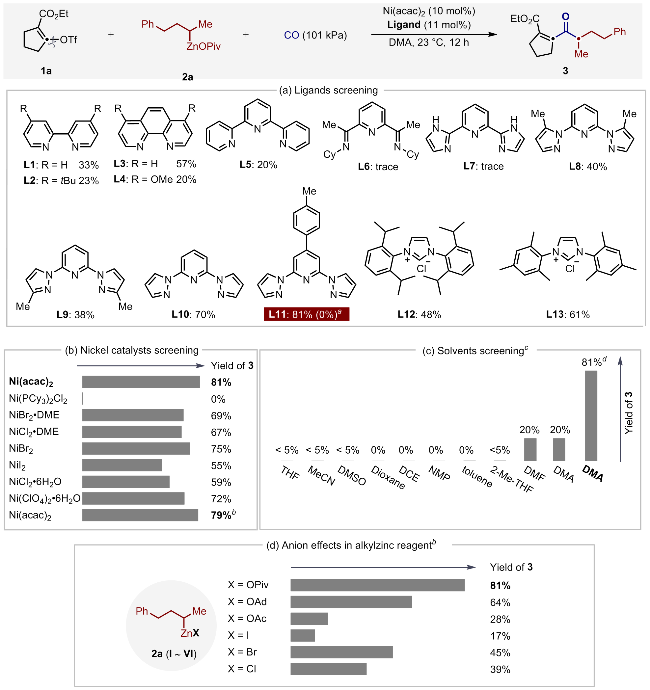
Figure 1 Optimization studies for nickel-catalyzed carbonylative Negishi cross-coupling between alkenyl triflate 1a and alkylzinc pivalate 2a under 101 kPa of COReaction conditions: 1a (0.1 mmol, 1.0 equiv.), 2a (0.15 mmol, 1.5 equiv.), Ni(acac)2 (10.0 mol%), ligand (11.0 mol%), DMA (1.0 mL), 23 ℃, 12 h. a Without ligand. b Ni(acac)2 (5.0 mol%), L11 (6 mol%). c Ni(acac)2 (10.0 mol%), L5 (11 mol%). d Ni(acac)2 (10.0 mol%), L11 (11.0 mol%). |
Notably, switching from alkylzinc pivalate (2a) to other halides-supported alkylzinc reagents, which prepared by transmetalation reaction of alkylmagnesium bromide with different ZnX2 (X=Cl, Br, I), resulted in significantly decreased yields of the product 3. Moreover, control experiments using OAc, OAd or OPiv-supported alkylzinc reagents as the nucleophiles were also conducted, the more electron-rich carboxylate anions displayed superior effects in tuning the reactivity of carbon-based organozinc reagents for carbonylative coupling reactions (Figure 1d). Therefore, the unique anion-effects stand as a treatment to extend the applications of organozinc reagents in transition-metal-catalyzed cross-coupling reactions.[17]
After obtaining the optimal reaction conditions, we proceeded to investigate the scope and limitations of this nickel-catalyzed carbonylative Negishi cross-coupling reaction (Table 1). And the generality of solid alkylznic pivalate was first investigated. A variety of secondary alkylzinc pivalates, including cyclic and acyclic, afforded the target product in moderate to good yields (Table 1, 3~7). Subsequently, the functional group compatibility of primary zinc reagents was examined and this carbonylative protocol also exhibited notable accommodating functionalities such as silyl ethers, benzyl ethers, and other ether-based protecting groups (9~11). Furthermore, α,β-unsaturated ketones skeletons were successfully constructed from alkyl chains (8), esters (12) and acetals (13) with isolated yields ranging from 42%~75%. Notably, the reaction tolerated alkylzinc reagents containing halogen atoms (14~15), affording the desired products in good yield.
Table 1 Substrate scope of alkylzinc pivalates and tetrasubstituted alkenyl triflates for nickel-catalyzed carbonylative Negishi cross- couplinga |
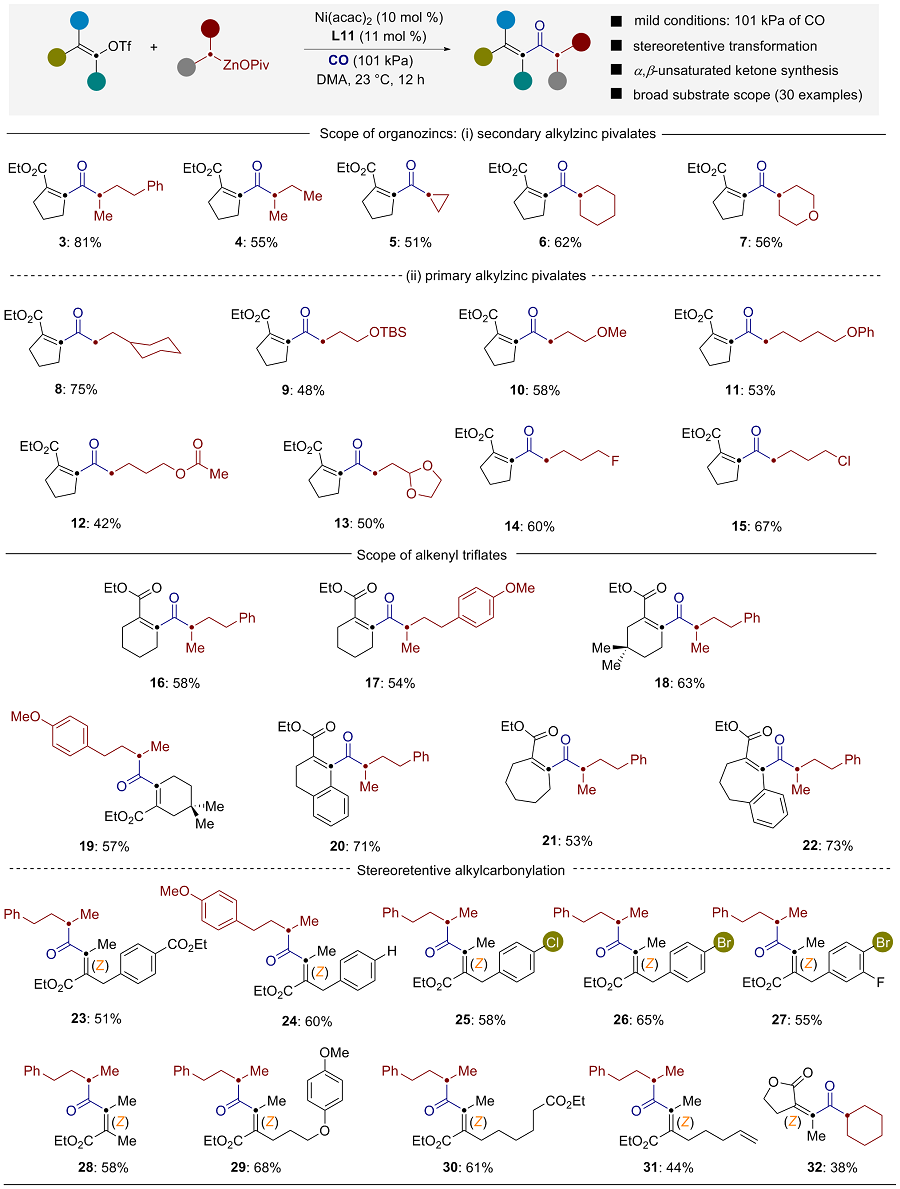 |
a Reaction conditions: 1a (0.2 mmol, 1.0 equiv.), 2a (0.3 mmol, 1.5 equiv.), Ni(acac)2 (10 mol%), L11 (11 mol%), DMA (1.0 mL), 23 ℃, 12 h. |
Our attention was next turned to exploring the range of alkenyl triflates compatible with this reaction (Table 1). When the ring size of cyclic alkenyl triflates was expanded to six or seven members, the reaction still proceeded smoothly, delivering the desired products in good yields (16~22). Increasing the steric hindrance of cyclic enol triflates, exemplified by benzo-fused six- and seven-mem- bered rings, afforded the corresponding products in 71% and 73% yields. These results demonstrate that the catalytic system tolerates sterically hindered cyclic substrates well. Furthermore, when the substrate scope was extended to linear tetrasubstituted alkenyl triflates, as shown in Table 1, the Z-configured alkenyl triflates delivered the three- component carbonylative coupling product with complete stereoretention and this class of substrates proved to be compatible with a broad range of functional groups. For instance, alkenyl triflates bearing ester groups (23, 30), alkyl chains (24, 28), various halogens (25, 26, 27) and ether moieties (29) all gave the desired carbonylative coupling products in moderate yields. The alkenyl triflates containing a terminal alkene afforded the corresponding ketone in 41% yield (31). In addition, the successful conversion of an exocyclic alkenyl triflate to the target product in 38% yield further extended the generality of enol triflates as viable substrates (32). This further broadens the scope of enol triflates in carbonylative coupling reactions. However, no desired transformation was detected when employing the substrates bearing strongly electron-withdrawing groups as the electrophiles, such as nitrile or nitro substituents.
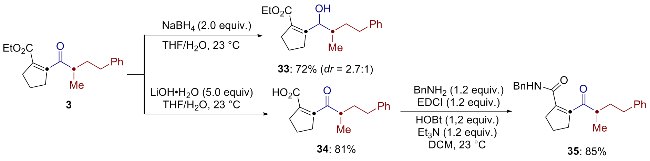
To further demonstrate the synthetic utility of the resulting α,β-unsaturated ketone products, several facile transformations with 3 were performed. As shown in Scheme 2, treatment of compound 3 with NaBH4 afforded the corresponding secondary alcohol 33 in 72% yield. In addition, hydrolysis of 3 with LiOH gave the carboxylic acid 34, which could serve as a building block for the synthesis of the amide 35 in high yield.


3 Conclusions
In conclusion, we have disclosed an efficient nickel- catalyzed carbonylative Negishi cross-coupling between tetrasubstituted alkenyl triflates and primary or secondary alkylzinc pivalates under 101 kPa of CO gas. Our protocol allows for the construction of synthetically valuable α,β- unsaturated ketone skeletons under mild reaction conditions with excellent functional group compatibility. Notably, the reaction proceeds in a stereoretentive manner when employing acyclic tetrasubstituted alkenyl triflates as the electrophiles.
4 Experimental section
4.1 General remarks
All reactions were carried out under argon atmosphere and anhydrous conditions unless otherwise indicated. Syringes used to transfer reagents and solvents were purged with argon prior to use. Nickel catalysts were obtained from commercial sources. Superdry solvents, tetrahydrofuran, MeCN, 1,4-dioxane, methyl tert-butyl ether, and dimethylacetamide were purchased from commercial sources. Dry toluene and Et2O were continuously refluxed and freshly distilled from sodium benzophenone ketyl under nitrogen. Yields refer to isolated compounds, estimated to be >95% pure as determined by 1H NMR. Reactions were monitored by thin layer chromatography (TLC). TLC were performed using aluminum plates covered with SiO2 (Merck 60, F-254) and visualized by UV detection. Purifi- cation via column chromatography was performed using Merck silica gel 60 (40~63 μm, 230~400 mesh ASTM from Merck). NMR spectra were recorded on a Bruker 400 MHz NMR spectrometer in CDCl3 (δ=7.26). High-resolution mass spectra (HRMS) were recorded on an Agilent 1290 mass spectrometer using ESI-TOF (electrospray ionization time-of- flight).
4.2 General procedure for the preparation of ketones
An oven-dried tube was charged with Ni(acac)2 (10 mol%), and L11 (11 mol%). The reaction vessel was then evacuated and backfilled with CO (three times, 101 kPa, balloon). Anhydrous dimethylacetamide (1.0 mL) was added and stirred for 10 min vigorously. Alkenyl triflates (0.2 mmol, 1.0 equiv.) was added. Then alkylzinc pivalates 3 (0.3 mmol, 1.5 equiv.) dissolved in dimethylacetamide (0.5 mL) was added dropwise over 5 min. The reaction mixture was stirred at 23 ℃ for 12 h. When the reaction was completed, the resulting residue was purified by column chromatography on silica gel (petroleum ether/EtOAc) to yield products.
4.3 Product structure characterization
Ethyl-2-(2-methyl-4-phenylbutanoyl)cyclopent-1-ene-1-carboxylate (3): Purification by column chromatography [V(petroleum ether)∶V(EtOAc)=35∶1] yielded 3 (48.6 mg, 81%) as a colorless oil. 1H NMR (400 MHz, CDCl3) δ: 7.27 (dd, J=10.1, 5.5 Hz, 2H), 7.18 (t, J=6.6 Hz, 3H), 4.23~4.02 (m, 2H), 2.93~2.79 (m, 1H), 2.74~2.66 (m, 5H), 2.66~2.50 (m, 1H), 2.18~2.02 (m, 1H), 2.01~1.90 (m, 2H), 1.75~1.62 (m, 1H), 1.23 (t, J=7.1 Hz, 3H), 1.19 (d, J=7.0 Hz, 3H); 13C NMR (100 MHz, CDCl3) δ: 208.4, 164.7, 153.2, 141.8, 134.3, 128.4, 128.3, 125.9, 60.7, 44.7, 36.9, 33.7, 33.5, 33.1, 22.4, 15.2, 14.1. HRMS (ESI) calcd for C19H25O3 [M+H]+ 301.1798, found 301.1800.
Ethyl-2-(2-methylbutanoyl)cyclopent-1-ene-1-carboxyl-ate (4): Purification by column chromatography [V(petro- leum ether)∶V(EtOAc)=35∶1] yielded 4 (24.6 mg, 55%) as a colorless oil. 1H NMR (400 MHz, CDCl3) δ: 4.17 (q, J=7.1 Hz, 2H), 3.32~2.51 (m, 5H), 2.15~1.88 (m, 2H), 1.87~1.67 (m, 1H), 1.51~1.32 (m, 1H), 1.25 (t, J=7.1 Hz, 3H), 1.11 (d, J=6.9 Hz, 3H), 0.91 (t, J=7.5 Hz, 3H); 13C NMR (100 MHz, CDCl3) δ: 210.1, 165.8, 154.9, 134.8, 61.8, 48.0, 38.1, 34.5, 26.2, 15.6, 15.2, 12.5. HRMS (ESI) calcd for C13H21O3 [M+H]+ 225.1485, found 225.1481.
Ethyl-2-(cyclopropanecarbonyl)cyclopent-1-ene-1-car- boxylate (5): Purification by column chromatography [V(petroleum ether)∶V(EtOAc)=35∶1] yielded 5 (21.6 mg, 52%) as a colorless oil. 1H NMR (400 MHz, CDCl3) δ: 4.20 (q, J=7.1 Hz, 2H), 2.81~2.69 (m, 4H), 2.15~2.09 (m, 1H), 2.07~1.91 (m, 2H), 1.28 (t, J=7.1 Hz, 3H), 1.23~1.10 (m, 2H), 0.98 (dd, J=7.8, 3.5 Hz, 2H); 13C NMR (100 MHz, CDCl3) δ: 204.5, 164.3, 152.1, 133.5, 60.1, 35.5, 21.6, 20.3, 13.4, 11.3. HRMS (ESI) calcd for C12H16O3Na [M+Na]+ 231.0992, found 231.0983.
Ethyl 2-(cyclohexanecarbonyl)cyclopent-1-ene-1-carbo-xylate (6): Purification by column chromatography [V(pe- troleum ether)∶V(EtOAc)=35∶1] yielded 6 (31.0 mg, 62%) as a colorless oil. 1H NMR (400 MHz, CDCl3) δ: 4.17 (q, J=7.1 Hz, 2H), 2.77~2.61 (m, 5H), 2.03~1.94 (m, 2H), 1.94~1.87 (m, 2H), 1.83~1.73 (m, 2H), 1.71~1.61 (m, 1H), 1.40~1.28 (m, 4H), 1.25 (t, J=7.1 Hz, 3H), 1.19 (dd, J=12.7, 9.6 Hz, 1H); 13C NMR (100 MHz, CDCl3) δ: 209.6, 165.0, 154.8, 133.4, 61.1, 50.4, 37.7, 33.6, 28.5, 26.3, 26.1, 22.8, 14.5. HRMS (ESI) calcd for C15H23O3 [M+H]+ 251.1642, found 251.1637.
Ethyl 2-(tetrahydro-2H-pyran-4-carbonyl)cyclopent-1-ene-1-carboxylate (7): Purification by column chromatography [V(petroleum ether)∶V(EtOAc)=10∶1] yielded 7 (31.6 mg, 58%) as a colorless oil. 1H NMR (400 MHz, CDCl3) δ: 4.17 (q, J=7.0 Hz, 2H), 3.99 (d, J=10.2 Hz, 2H), 3.41 (t, J=11.4 Hz, 2H), 2.90 (dd, J=13.7, 8.5 Hz, 1H), 2.70 (t, J=6.9 Hz, 4H), 2.05~1.98 (m, 2H), 1.84~1.70 (m, 4H), 1.26 (t, J=6.9 Hz, 3H); 13C NMR (100 MHz, CDCl3) δ: 207.5, 164.7, 154.1, 133.9, 67.5, 61.1, 47.1, 37.5, 28.1, 22.7, 14.4. HRMS (ESI) calcd for C14H21O4 [M+H]+ 253.1434, found 253.1431
Ethyl 2-(3-cyclohexylpropanoyl)cyclopent-1-ene-1-car- boxylate (8): Purification by column chromatography [V(petroleum ether)∶V(EtOAc)=35∶1] yielded 8 (41.7 mg, 75%) as a colorless oil. 1H NMR (400 MHz, CDCl3) δ: 4.19 (q, J=7.0 Hz, 2H), 2.71 (t, J=7.3 Hz, 4H), 2.64 (t, J=7.5 Hz, 2H), 1.99 (p, J=7.4 Hz, 2H), 1.72~1.52 (m, 4H), 1.53 (dd, J=14.4, 7.1 Hz, 2H), 1.27 (t, J=6.9 Hz, 4H), 1.25~1.08 (m, 4H), 0.90 (q, J=11.6 Hz, 2H); 13C NMR (100 MHz, CDCl3) δ: 205.9, 164.8, 153.2, 133.5, 60.8, 39.6, 37.2, 36.1, 33.5, 33.1, 30.6, 26.5, 26.2, 22.3, 14.0. HRMS (ESI) calcd for C17H27O3 [M+H]+ 279.1955, found 279.1951.
Ethyl 2-(4-((tert-butyldimethylsilyl)oxy)butanoyl)cyclo-pent-1-ene-1-carboxylate (9): Purification by column chro- matography [V(petroleum ether)∶V(EtOAc)=35∶1] yielded 9 (32.6 mg, 48%) as a colorless oil. 1H NMR (400 MHz, CDCl3) δ: 4.20 (q, J=6.9 Hz, 2H), 3.66 (t, J=6.0 Hz, 2H), 2.71 (d, J=6.4 Hz, 6H), 2.10~1.95 (m, 2H), 1.93~1.79 (m, 2H), 1.28 (t, J=6.9 Hz, 3H), 0.90 (s, 9H), 0.06 (s, 6H); 13C NMR (100 MHz, CDCl3) δ: 205.2, 164.8, 153.0, 133.84, 62.1, 60.8, 38.3, 36.0, 33.5, 26.4, 25.9, 22.3, 18.3, 14.0, -5.3. HRMS (ESI) calcd for C18H33O4Si [M+H]+ 341.2143, found 341.2145.
Ethyl 2-(4-methoxybutanoyl)cyclopent-1-ene-1-carbox-ylate (10): Purification by column chromatography [V(petroleum ether)∶V(EtOAc)=20∶1] yielded 10 (27.8 mg, 58%) as a colorless oil. 1H NMR (400 MHz, CDCl3) δ: 4.21 (q, J=7.0 Hz, 2H), 3.43 (t, J=6.1 Hz, 2H), 3.34 (s, 3H), 2.72 (d, J=6.1 Hz, 6H), 2.01 (dd, J=14.9, 7.4 Hz, 2H), 1.97~1.81 (m, 2H), 1.29 (t, J=6.9 Hz, 3H); 13C NMR (100 MHz, CDCl3) δ: 204.9, 164.8, 153.0, 133.8, 71.6, 60.8, 58.5, 38.5, 36.0, 33.5, 23.3, 22.3, 14.0. HRMS (ESI) calcd for C13H21O4 [M+H]+ 241.1440, found 241.1431
Ethyl 2-(4-phenoxybutanoyl)cyclopent-1-ene-1-carbox-ylate (11): Purification by column chromatography [V(pe- troleum ether)∶V(EtOAc)=20∶1] yielded 11 (35.0 mg, 53%) as a colorless oil. 1H NMR (400 MHz, CDCl3) δ: 7.30 (d, J=9.1 Hz, 2H), 6.93 (dd, J=20.4, 7.5 Hz, 3H), 4.21 (q, J=6.9 Hz, 2H), 3.98 (t, J=5.9 Hz, 2H), 2.87~2.59 (m, 6H), 2.00 (p, J=7.3 Hz, 2H), 1.90~1.79 (m, 2H), 1.71 (dt, J=18.0, 8.9 Hz, 2H), 1.54 (dd, J=15.4, 7.5 Hz, 2H), 1.28 (t, J=6.9 Hz, 3H); 13C NMR (100 MHz, CDCl3) δ: 205.2, 164.8, 159.0, 153.2, 133.8, 129.4, 120.5, 114.4, 67.5, 60.8, 41.8, 36.1, 33.5, 29.1, 25.7, 23.0, 22.3, 14.1. HRMS (ESI) calcd for C20H27O4 [M+H]+ 331.1904, found 331.1901.
Ethyl 2-(5-acetoxypentanoyl)cyclopent-1-ene-1-carbox-ylate (12): Purification by column chromatography [V(petroleum ether)∶V(EtOAc)=10∶1] yielded 12 (35.0 mg, 53%) as a colorless oil. 1H NMR (400 MHz, CDCl3) δ: 4.19 (q, J=7.1 Hz, 2H), 4.08 (t, J=6.1 Hz, 2H), 2.69 (dt, J=14.1, 7.3 Hz, 6H), 2.05 (s, 3H), 2.04~1.93 (m, 2H), 1.82~1.55 (m, 5H), 1.27 (t, J=7.1 Hz, 4H); 13C NMR (101 MHz, CDCl3) δ: 204.78, 171.14, 164.82, 153.06, 134.02, 64.11, 60.84, 41.24, 36.01, 33.56, 27.99, 22.31, 20.97, 19.66, 14.09. HRMS (ESI) calcd for C15H23O5 [M+H]+ 283.1540, found 283.1546.
Ethyl 2-(4-(1,3-dioxolan-2-yl)butanoyl)cyclopent-1-ene-1-carboxylate (13): Purification by column chromatography [V(petroleum ether)∶V(EtOAc) 5∶1] yielded 13 (26.8 mg, 50%) as a colorless oil. 1H NMR (400 MHz, CDCl3) δ: 4.96 (s, 1H), 4.20 (q, J=7.0 Hz, 2H), 3.96 (s, 2H), 3.86 (s, 2H), 2.95~2.50 (m, 6H), 2.18~1.69 (m, 4H), 1.28 (t, J=7.0 Hz, 3H); 13C NMR (100 MHz, CDCl3) δ: 204.6, 165.0, 153.1, 134.2, 103.5, 65.2, 61.1, 36.3, 36.1, 33.8, 27.5, 22.5, 14.3. HRMS (ESI) calcd for C14H21O5 [M+H]+ 269.1384, found 269.1377.
Ethyl 2-(5-fluoropentanoyl)cyclopent-1-ene-1-carboxyl-ate (14): Purification by column chromatography [V(pe- troleum ether)∶V(EtOAc)=35∶1] yielded 14 (29.1 mg, 60%) as a colorless oil. 1H NMR (400 MHz, CDCl3) δ: 4.53 (s, 1H), 4.42 (d, J=5.7 Hz, 1H), 4.20 (q, J=7.1 Hz, 2H), 2.84~2.62 (m, 6H), 2.23~2.17 (m, 2H), 1.90~1.64 (m, 5H), 1.28 (t, J=7.0 Hz, 3H); 13C NMR (100 MHz, CDCl3) δ: 204.8, 164.8, 153.0, 133.9, 84.6, 83.0, 60.8, 41.2, 36.0, 33.5, 29.8, 29.6, 22.3, 19.1, 19.1, 14.0; 19F NMR (376 MHz, CDCl3) δ: -219.21. HRMS (ESI) calcd for C14H21O4 [M+H]+ 243.1391, found 243.1395.
Ethyl 2-(5-chloropentanoyl)cyclopent-1-ene-1-carboxy-late (15): Purification by column chromatography [V(pe- troleum ether)∶V(EtOAc)=35∶1] yielded 15 (34.6 mg, 67%) as a colorless oil. 1H NMR (400 MHz, CDCl3) δ: 4.20 (q, J=7.0 Hz, 2H), 3.57 (t, J=5.3 Hz, 2H), 3.05~2.59 (m, 6H), 2.10~1.92 (m, 2H), 1.82~1.69 (m, 4H), 1.28 (t, J=7.0 Hz, 3H); 13C NMR (100 MHz, CDCl3) δ: 204.6, 164.8, 153.0, 60.8, 44.7, 36.0, 33.5, 31.8, 22.3, 20.5, 14.1. HRMS (ESI) calcd for C13H20O3Cl [M+H]+ 259.1095, found 259.1101
Ethyl 2-(2-methyl-4-phenylbutanoyl)cyclohex-1-ene-1-carboxylate (16): Purification by column chromatography [V(petroleum ether)∶V(EtOAc)=35∶1] yielded 16 (36.4 mg, 58%) as a colorless oil. 1H NMR (400 MHz, CDCl3) δ: 7.29 (d, J=7.7 Hz, 1H), 7.22~7.15 (m, 3H), 4.12 (qd, J=7.1, 1.5 Hz, 2H), 2.92~2.63 (m, 2H), 2.63~2.56 (m, 1H), 2.41~2.28 (m, 2H), 2.27~2.19 (m, 2H), 2.14~2.01 (m, 1H), 1.76~1.61 (m, 5H), 1.23 (t, J=7.1 Hz, 3H), 1.20 (d, J=7.0 Hz, 3H); 13C NMR (100 MHz, CDCl3) δ: 211.2, 167.3, 149.7, 141.9, 128.5, 128.4, 128.3, 125.8, 60.8, 44.1, 33.9, 33.1, 28.6, 25.1, 21.5, 21.4, 15.4, 14.0. HRMS (ESI) calcd for C20H27O3 [M+H]+ 315.1955, found 315.1951.
Ethyl 2-(4-(4-methoxyphenyl)-2-methylbutanoyl)cyclo-hex-1-ene-1-carboxylate (17): Purification by column chromatography [V(petroleum ether)∶V(EtOAc)=20∶1] yielded 17 (37.2 mg, 54%) as a colorless oil. 1H NMR (400 MHz, CDCl3) δ: 7.10 (d, J=8.6 Hz, 2H), 6.90~6.73 (m, 2H), 4.12 (dd, J=7.1, 0.9 Hz, 2H), 3.78 (s, 3H), 2.78~2.62 (m, 2H), 2.55~2.43 (m, 1H), 2.32 (s, 2H), 2.23 (d, J=2.3 Hz, 2H), 2.11~1.98 (m, 1H), 1.79~1.53 (m, 5H), 1.23 (t, J=7.1 Hz, 3H), 1.18 (d, J=7.0 Hz, 3H); 13C NMR (100 MHz, CDCl3) δ: 211.3, 167.3, 157.8, 149.7, 133.9, 129.3, 128.4, 113.8, 60.8, 55.2, 44.0, 34.1, 32.2, 28.6, 25.1, 21.5, 21.4, 15.4, 14.1. HRMS (ESI) calcd for C21H29O4 [M+H]+ 345.2060, found 345.2070.
Ethyl 5,5-dimethyl-2-(2-methyl-4-phenylbutanoyl)cy-clohex-1-ene-1-carboxylate (18): Purification by column chromatography [V(petroleum ether)∶V(EtOAc)=35∶1] yielded 18 (43.2 mg, 63%) as a colorless oil. 1H NMR (400 MHz, CDCl3) δ: 7.27 (dd, J=10.4, 4.3 Hz, 3H), 7.22~7.14 (m, 3H), 4.11 (qd, J=7.1, 1.8 Hz, 2H), 2.80~2.65 (m, 2H), 2.65~2.56 (m, 1H), 2.32~2.22 (m, 2H), 2.18~2.04 (m, 3H), 1.75~1.61 (m, 1H), 1.39 (t, J=6.4 Hz, 2H), 1.23 (t, J=7.1 Hz, 3H), 1.20 (d, J=7.0 Hz, 3H), 0.96 (s, 3H), 0.95 (s, 3H); 13C NMR (100 MHz, CDCl3) δ: 211.1, 167.3, 148.5, 141.8, 128.4, 128.3, 127.7, 125.9, 60.9, 44.2, 38.7, 34.1, 33.9, 33.1, 28.5, 27.9, 27.9, 26.6, 15.3, 14.0. HRMS (ESI) calcd for C22H31O3 [M+H]+ 343.2268, found 343.2266.
Ethyl 2-(4-(4-methoxyphenyl)-2-methylbutanoyl)-5,5-dimethylcyclohex-1-ene-1-carboxylate (19): Purification by column chromatography [V(petroleum ether)∶V(Et- OAc)=20∶1] yielded 19 (43.2 mg, 57%) as a colorless oil. 1H NMR (400 MHz, CDCl3) δ: 7.09 (d, J=8.5 Hz, 2H), 6.82 (d, J=8.5 Hz, 2H), 4.12 (q, J=7.1 Hz, 2H), 3.78 (s, 3H), 2.70~2.63 (m, 2H), 2.58~2.50 (m, 1H), 2.34~2.22 (m, 2H), 2.13~1.98 (m, 3H), 1.70~1.53 (m, 1H),1.39 (t, J=6.4 Hz, 2H), 1.24 (t, J=7.1 Hz, 3H), 1.18 (d, J=7.0 Hz, 3H), 0.96 (s, 3H), 0.95 (s, 3H); 13C NMR (100 MHz, CDCl3) δ: 211.2, 167.3, 157.8, 148.4, 133.9, 129.3, 127.7, 113.8, 60.9, 55.2, 44.1, 38.7, 34.2, 34.1, 32.2, 28.5, 28.0, 27.9, 26.6, 15.3, 14.0. HRMS (ESI) calcd for C23H33O4[M+H]+ 373.2373, found 373.2378.
Ethyl 1-(2-methyl-4-phenylbutanoyl)-3,4-dihydronaph-thalene-2-carboxylate (20): Purification by column chromatography [V(petroleum ether)∶V(EtOAc)=35∶1] yielded 20 (51.4 mg, 71%) as a colorless oil. 1H NMR (400 MHz, CDCl3) δ: 7.29~7.19 (m, 4H), 7.19~7.05 (m, 5H), 4.18 (dd, J=7.1, 1.4 Hz, 2H), 2.83 (d, J=8.0 Hz, 2H), 2.80~2.70 (m, 2H), 2.60 (dd, J=8.2, 6.6 Hz, 3H), 2.25~2.13 (m, 1H), 1.67 (dd, J=9.3, 4.6 Hz, 1H), 1.27 (t, J=7.1 Hz, 3H), 1.20 (d, J=7.0 Hz, 3H); 13C NMR (100 MHz, CDCl3) δ: 209.3, 165.7, 148.1, 141.1, 136.1, 129.7, 129.0, 127.6, 127.5, 127.3, 126.1, 125.4, 125.3, 125.0, 60.4, 45.3, 32.7, 32.5, 27.0, 22.0, 14.6, 13.4. HRMS (ESI) calcd for C24H27O3 [M+H]+ 363.1955, found 363.1948.
Ethyl 2-(2-methyl-4-phenylbutanoyl)cyclohept-1-ene-1-carboxylate (21): Purification by column chromatography [V(petroleum ether)∶V(EtOAc)=35∶1] yielded 21 (34 mg, 54%) as a colorless oil. 1H NMR (400 MHz, CDCl3) δ: 7.29 (d, J=7.6 Hz, 3H), 7.18 (dd, J=5.1, 2.6 Hz, 2H), 4.37~3.81 (m, 2H), 2.84~2.57 (m, 3H), 2.57~2.47 (m, 2H), 2.41~2.26 (m, 2H), 2.19~2.00 (m, 1H), 1.79 (dd, J=11.7, 6.0 Hz, 2H), 1.74~1.49 (m, 4H), 1.23 (t, J=7.1 Hz, 3H), 1.19 (d, J=7.0 Hz, 3H); 13C NMR (100 MHz, CDCl3) δ: 211.1, 167.7, 154.8, 141.8, 134.2, 128.3, 128.3, 125.8, 61.1, 44.0, 33.7, 33.1, 32.1, 32.0, 28.9, 25.6, 25.4, 15.3, 14.0. HRMS (ESI) calcd for C21H29O3 [M+H]+ 329.2111, found 329.2115.
Ethyl 9-(2-methyl-4-phenylbutanoyl)-6,7-dihydro-5H-benzo[7]annulene-8-carboxylate (22): Purification by column chromatography [V(petroleum ether)∶V(EtOAc)=35∶1] yielded 22 (54.9 mg, 73%) as a colorless oil. 1H NMR (400 MHz, CDCl3) δ: 7.32~7.26 (m, 2H), 7.26~7.22 (m, 2H), 7.22~7.16 (m, 2H), 7.16~7.08 (m, 1H), 7.02~6.93 (m, 2H), 4.22 (q, J=7.1 Hz, 2H), 2.78~2.61 (m, 3H), 2.59~2.43 (m, 2H), 2.29~2.11 (m, 4H), 2.02~1.88 (m, 1H), 1.62~1.46 (m, 1H), 1.29 (t, J=7.1 Hz, 3H), 1.13 (d, J=7.0 Hz, 3H); 13C NMR (100 MHz, CDCl3) δ: 209.6, 168.1, 152.5, 142.6, 141.7, 135.7, 132.3, 130.5, 130.0, 129.1, 129.1, 128.3, 127.3, 126.6, 62.2, 46.0, 35.5, 34.8, 33.6, 32.7, 26.4, 16.1, 15.0. HRMS (ESI) calcd for C25H29O3 [M+H]+ 377.2111, found 377.2110.
Ethyl (Z)-4-(2-(ethoxycarbonyl)-3,5-dimethyl-4-oxo-7-phenylhept-2-en-1-yl)benzoate (23): Purification by column chromatography [V(petroleum ether)∶V(EtOAc)=10∶1] yielded 23 (44.5 mg, 51%) as a colorless oil. 1H NMR (400 MHz, CDCl3) δ: 7.96 (d, J=8.3 Hz, 2H), 7.29 (d, J=7.2 Hz, 2H), 7.23 (d, J=8.3 Hz, 2H), 7.19 (dd, J=12.6, 4.6 Hz, 3H), 4.37 (q, J=7.1 Hz, 2H), 4.05 (q, J=7.1 Hz, 2H), 3.75 (s, 2H), 2.99~2.67 (m, 2H), 2.65~2.57 (m, 1H), 2.32~2.08 (m, 1H), 1.96 (s, 3H), 1.74~1.59 (m, 1H), 1.39 (t, J=7.1 Hz, 3H), 1.24 (d, J=2.2 Hz, 3H), 1.12 (t, J=7.1 Hz, 3H); 13C NMR (100 MHz, CDCl3) δ: 211.0, 166.7, 166.4, 150.6, 143.8, 141.7, 129.8, 128.7, 128.6, 128.4, 128.0, 125.9, 61.2, 60.9, 44.3, 33.9, 33.9, 33.1, 27.0, 18.1, 15.2, 14.3, 13.9. HRMS (ESI) calcd for C25H29O3 [M+H]+ 437.2323, found 437.2330.
Ethyl (Z)-2-benzyl-7-(4-methoxyphenyl)-3,5-dimethyl-4-oxohept-2-enoate (24): Purification by column chromatography [V(petroleum ether)∶V(EtOAc)=20∶1] yielded 24 (47.3 mg, 60%) as a colorless oil. 1H NMR (400 MHz, CDCl3) δ: 7.27 (t, J=7.3 Hz, 3H), 7.18 (dd, J=16.2, 7.2 Hz, 3H), 7.09 (t, J=9.9 Hz, 2H), 6.81 (d, J=8.6 Hz, 2H), 4.06 (q, J=7.1 Hz, 2H), 3.78 (s, 3H), 3.70 (s, 2H), 2.77~2.63 (m, 2H), 2.55 (ddd, J=13.9, 9.5, 7.1 Hz, 1H), 2.18~2.01 (m, 1H), 1.96 (s, 3H), 1.74~1.53 (m, 2H), 1.21 (d, J=7.0 Hz, 3H), 1.13 (t, J=7.1 Hz, 3H); 13C NMR (100 MHz, CDCl3) δ: 211.2, 167.1, 157.8, 149.7, 138.4, 133.8, 129.6, 129.3, 128.5, 128.1, 126.3, 113.8, 61.1, 55.2, 44.2, 34.2, 34.0, 32.3, 18.0, 15.3, 13.9. HRMS (ESI) calcd for C25H31O4 [M+H]+ 395.2217, found 395.2219.
Ethyl (Z)-2-(4-chlorobenzyl)-3,5-dimethyl-4-oxo-7-phenylhept-2-enoate (25): Purification by column chromatography [V(petroleum ether)∶V(EtOAc)=35∶1] yielded 25 (47.3 mg, 60%) as a colorless oil. 1H NMR (400 MHz, CDCl3) δ: 7.34~7.13 (m, 4H), 7.09 (d, J=8.5 Hz, 1H), 4.06 (q, J=7.1 Hz, 1H), 3.66 (s, 1H), 2.81~2.63 (m, 1H), 2.64~2.57 (m, 1H), 2.23~2.02 (m, 1H), 1.95 (s, 1H), 1.74~1.58 (m, 1H), 1.57 (s, 1H), 1.22 (d, J=7.0 Hz, 2H), 1.13 (t, J=7.1 Hz, 2H); 13C NMR (100 MHz, CDCl3) δ: 210.9, 166.8, 150.1, 141.7, 136.9, 132.1, 129.4, 129.0, 128.6, 128.4, 128.41, 125.9, 61.2, 44.3, 33.9, 33.3, 33.2, 18.1, 15.3, 13.9. HRMS (ESI) calcd for C24H28O3Cl [M+H]+ 399.1721, found 399.1716.
Ethyl (Z)-2-(4-bromobenzyl)-3,5-dimethyl-4-oxo-7-phenylhept-2-enoate (26): Purification by column chromatography [V(petroleum ether)∶V(EtOAc)=35∶1] yielded 26 (57.5 mg, 65%) as a colorless oil. 1H NMR (400 MHz, CDCl3) δ: 7.45~7.36 (m, 1H), 7.27 (dd, J=12.7, 5.1 Hz, 1H), 7.22~7.12 (m, 2H), 7.03 (d, J=8.4 Hz, 1H), 4.05 (q, J=7.1 Hz, 2H), 3.64 (s, 2H), 2.83~2.65 (m, 2H), 2.63~2.50 (m, 1H), 2.12~2.09 (m, 1H), 1.94 (s, 3H), 1.74~1.62 (m, 1H), 1.22 (d, J=7.0 Hz, 3H), 1.13 (t, J=7.1 Hz, 3H); 13C NMR (100 MHz, CDCl3) δ: 210.9, 166.8, 150.2, 141.7, 137.5, 131.6, 129.8, 128.9, 128.4, 128.4, 125.9, 120.1, 61.2, 44.3, 33.9, 33.4, 33.2, 18.1, 15.3, 13.9. HRMS (ESI) calcd for C24H28O3Br [M+H]+ 443.1216, found 443.1209.
Ethyl (Z)-2-(4-bromo-3-fluorobenzyl)-3,5-dimethyl-4-oxo-7-phenylhept-2-enoate (27): Purification by column chromatography [V(petroleum ether)∶V(EtOAc)=25∶1] yielded 27 (50.6 mg, 55%) as a colorless oil. 1H NMR (400 MHz, CDCl3) δ: 7.28 (t, J=7.3 Hz, 2H), 7.21~7.16 (m, 5H), 7.02 (t, J=8.2 Hz, 1H), 4.05 (q, J=7.1 Hz, 2H), 3.64 (s, 2H), 2.86~2.64 (m, 2H), 2.69~2.57 (m, 1H), 2.23~2.05 (m, 1H), 1.95 (s, 3H), 1.71~1.64 (m, 1H), 1.22 (d, J=7.0 Hz, 3H), 1.14 (t, J=7.1 Hz, 3H); 13C NMR (100 MHz, CDCl3) δ: 211.0, 166.5, 161.9, 159.4, 150.9, 141.7, 131.1, 131.1, 128.4, 127.4, 127.4, 127.3, 125.9, 124.6, 124.5, 120.3, 120.2, 119.0, 118.7, 61.3, 44.2, 33.8, 33.2, 26.9, 26.9, 17.9, 17.9, 15.2, 13.9; 19F NMR (376 MHz, CDCl3) δ: -114.18. HRMS (ESI) calcd for C24H27O3FBr [M+H]+ 461.1122, found 461.1129.
Ethyl (Z)-2,3,5-trimethyl-4-oxo-7-phenylhept-2-enoate (28): Purification by column chromatography [V(petroleum ether)∶V(EtOAc)=35∶1] yielded 28 (33.4 mg, 58%) as a colorless oil. 1H NMR (400 MHz, CDCl3) δ: 7.35~7.24 (m, 3H), 7.19 (d, J=6.4 Hz, 2H), 4.12 (tt, J=7.5, 3.8 Hz, 2H), 2.77~2.68 (m, 2H), 2.64~2.56 (m, 1H), 2.21~2.00 (m, 1H), 1.89 (s, 7H), 1.81~1.56 (m, 2H), 1.24 (t, J=7.1 Hz, 3H), 1.20 (d, J=7.0 Hz, 3H); 13C NMR (100 MHz, CDCl3) δ: 211.4, 167.6, 147.6, 141.8, 128.4, 128.3, 126.8, 125.8, 61.0, 44.2, 33.8, 33.1, 17.8, 15.4, 14.3, 14.0. HRMS (ESI) calcd for C18H25O3 [M+H]+ 289.1798, found 289.1802.
Ethyl (Z)-2-(3-(4-methoxyphenoxy)propyl)-3,5-dimeth-yl-4-oxo-7-phenylhept-2-enoate (29): Purification by column chromatography [V(petroleum ether)∶V(EtOAc)=35∶1] yielded 29 (59.6 mg, 68%) as a colorless oil. 1H NMR (400 MHz, CDCl3) δ: 7.33~7.23 (m, 2H), 7.21~7.12 (m, 3H), 6.82 (d, J=4.0 Hz, 4H), 4.11 (q, J=7.1 Hz, 2H), 3.90 (t, J=6.0 Hz, 2H), 3.76 (s, 3H), 2.81~2.56 (m, 3H), 2.52 (t, J=7.4 Hz, 2H), 2.14~2.01 (m, 1H), 1.95~1.85 (m, 5H), 1.73~1.56 (m, 1H), 1.22 (t, J=7.1 Hz, 3H), 1.18 (d, J=7.0 Hz, 3H); 13C NMR (100 MHz, CDCl3) δ: 211.0, 167.5, 153.8, 152.9, 148.0, 141.8, 130.8, 128.4, 128.3, 125.9, 115.3, 114.6, 67.2, 61.0, 55.7, 43.9, 33.9, 33.1, 27.9, 25.1, 17.3, 15.4, 14.0. HRMS (ESI) calcd for C27H35O5 [M+H]+ 439.2479, found 439.2477.
Diethyl (Z)-2-(4-methyl-3-oxo-6-phenylhexan-2-ylid-ene)octanedioate (30): Purification by column chromatography [V(petroleum ether)∶V(EtOAc)=10∶1] yielded 30 (50.7 mg, 61%) as a colorless oil. 1H NMR (400 MHz, CDCl3) δ: 7.33~7.26 (m, 2H), 7.23~7.13 (m, 3H), 4.12 (qd, J=7.1, 1.4 Hz, 4H), 2.96~2.52 (m, 3H), 2.30 (dd, J=14.7, 7.1 Hz, 4H), 2.17~2.01 (m, 1H), 1.89 (s, 3H), 1.72~1.55 (m, 3H), 1.50~1.31 (m, 4H), 1.24 (dd, J=15.0, 7.3 Hz, 6H), 1.18 (d, J=6.9 Hz, 3H); 13C NMR (100 MHz, CDCl3) δ: 211.0, 173.6, 167.7, 146.7, 141.8, 132.0, 128.4, 128.3, 125.8, 61.1, 60.2, 43.9, 34.1, 33.9, 33.1, 28.9, 28.4, 27.9, 24.6, 17.2, 15.4, 14.2, 14.0. HRMS (ESI) calcd for C27H35O5 [M+H]+ 417.2636, found 417.2645.
Ethyl (Z)-3,5-dimethyl-4-oxo-2-(pent-4-en-1-yl)-7-phen-ylhept-2-enoate (31): Purification by column chromatography [V(petroleum ether)∶V(EtOAc)=35∶1] yielded 31 (30.2 mg, 44%) as a colorless oil. 1H NMR (400 MHz, CDCl3) δ: 7.28 (d, J=7.7 Hz, 2H), 7.18 (dd, J=7.0, 3.5 Hz, 3H), 5.80 (m, 1H), 5.23~4.73 (m, 2H), 4.12 (q, J=7.1 Hz, 2H), 3.07~2.50 (m, 3H), 2.46~2.22 (m, 2H), 2.09 (dd, J=13.8, 6.7 Hz, 3H), 1.89 (s, 3H), 1.70~1.63 (m, 1H), 1.53 (dt, J=15.2, 7.6 Hz, 2H), 1.24 (t, J=7.1 Hz, 3H), 1.19 (d, J=6.9 Hz, 3H); 13C NMR (100 MHz, CDCl3) δ: 211.0, 167.7, 146.8, 141.8, 138.1, 132.0, 128.4, 128.3, 125.9, 115.0, 61.0, 43.9, 33.9, 33.4, 33.1, 28.1, 27.4, 17.2, 15.4, 14.0. HRMS (ESI) calcd for C22H31O3 [M+H]+ 343.2268, found 343.2273.
(Z)-3-(1-Cyclohexyl-1-oxopropan-2-ylidene)dihydrofu-ran-2(3H)-one (32): Purification by column chromatography [V(petroleum ether)∶V(EtOAc)=35∶1] yielded 32 (16.9 mg, 38%) as a colorless oil. 1H NMR (400 MHz, CDCl3) δ: 4.44 (t, J=7.4 Hz, 2H), 2.91 (td, J=7.5, 1.9 Hz, 2H), 2.74 (tt, J=11.4, 3.4 Hz, 1H), 1.98 (t, J=1.9 Hz, 3H), 1.91~1.71 (m, 2H), 1.70~1.61 (m, 2H), 1.47~1.14 (m, 6H); 13C NMR (100 MHz, CDCl3) δ: 211.7, 169.1, 150.0, 122.2, 65.6, 50.4, 28.1, 26.0, 25.8, 25.7, 19.7. HRMS (ESI) calcd for C13H19O3 [M+H]+ 223.1329, found 223.1332.
Ethyl 2-(1-hydroxy-2-methyl-4-phenylbutyl)cyclopent-1-ene-1-carboxylate (33): Purification by column chromatography [V(petroleum ether)∶V(EtOAc)=9∶1] yielded 33 (43.5 mg, 72%, dr=2.7∶1). 1H NMR (400 MHz, CDCl3) δ: 7.27~7.25 (m, 2H), 7.19~7.16 (m, 3H), 4.56 (d, J=5.4 Hz, 0.28H), 4.50 (d, J=7.6 Hz, 0.72H), 4.18 (q, J=13.8, 2H), 2.81~2.68 (m, 1H), 2.64 (s, 2H), 2.61~2.39 (m, 3H), 2.05~2.00 (m, 1H), 1.90~1.65 (m, 3H), 1.64~1.45 (m, 1H), 1.28 (t, J=7.1 Hz, 3H), 1.01 (d, J=6.4 Hz, 0.82H), 0.93 (d, J=6.8 Hz, 2.18H); 13C NMR (100 MHz, CDCl3) δ: 167.02, 166.94, 161.94, 161.72, 142.79, 142.55, 129.04, 128.96, 128.40, 128.29, 128.27, 125.68, 125.61, 74.20, 73.74, 60.51, 37.74, 37.51, 36.89, 36.68, 35.10, 34.31, 34.19, 33.99, 33.40, 33.20, 21.69, 16.15, 14.76, 14.23. HRMS (ESI) calcd for C19H27O3 [M+H]+ 303.1955, found 303.1948.
2-(2-Methyl-4-phenylbutanoyl)cyclopent-1-ene-1-car-boxylic acid (34): Purification by column chromatography [V(petroleum ether)∶V(EtOAc)=1∶1] yielded 34 (46.4 mg, 81%) as a white solid. 1H NMR (400 MHz, CDCl3) δ: 7.34~7.24 (m, 2H), 7.22~7.11 (m, 3H), 2.94~2.85 (m, 1H), 2.85~2.68 (m, 4H), 2.67~2.55 (m, 2H), 2.08 (m, 1H), 1.91 (p, J=7.7 Hz, 2H), 1.76~1.58 (m, 1H), 1.17 (d, J=6.9 Hz, 3H); 13C NMR (100 MHz, CDCl3) δ: 209.16, 166.00, 149.68, 142.35, 141.20, 128.52, 128.44, 126.20, 44.09, 36.89, 35.48, 34.13, 33.23, 21.35, 16.13. HRMS (ESI) calcd for C17H21O3 [M+H]+ 273.1485, found 273.1480.
N-Benzyl-2-(2-methyl-4-phenylbutanoyl)cyclopent-1-ene-1-carboxamide (35): Purification by column chromatography [V(petroleum ether)∶V(EtOAc)=5∶1] yielded 35 (30.7 mg, 85%) as a colorless oil. 1H NMR (400 MHz, CDCl3) δ: 8.04 (s, 1H), 7.38~7.28 (m, 5H), 7.25~7.06 (m, 5H), 4.48 (d, J=5.8 Hz, 3H), 2.92~2.72 (m, 3H), 2.75~2.63 (m, 2H), 2.55 (t, J=7.8 Hz, 2H), 2.07~1.93 (m, 1H), 1.92~1.80 (m, 2H), 1.62~1.46 (m, 1H), 1.09 (d, J=6.9 Hz, 3H); 13C NMR (100 MHz, CDCl3) δ: 208.29, 164.76, 144.47, 143.93, 141.48, 138.25, 128.62, 128.44, 128.40, 127.78, 127.33, 126.04, 43.54, 43.47, 36.37, 36.05, 34.28, 33.25, 21.54, 16.05. HRMS (ESI) calcd for C24H28NO2 [M+H]+ 362.2115, found 362.2109.
Supporting Information 1H NMR, 13C NMR, 19F NMR spectra of compounds 3~35. The Supporting Information is available free of charge via the Internet at http://sioc-journal.cn/.
(Lu, Y.)