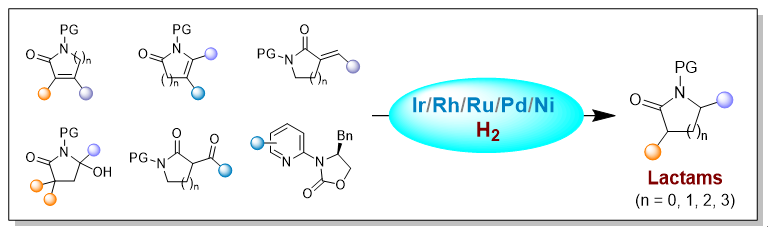
[1] (a) Nay, B.; Riache, N.; Evanno, L. Nat. Prod. Rep. 2009, 26, 1044.
(b) Royer, J., Ed. Asymmetric Synthesis of Nitrogen Heterocycles; Wiley-VCH: Weinheim, 2009.
(c) Bregman, H.; Chakka, N.; Guzman-Perez, A.; Gunaydin, H.; Gu, Y.; Huang, X.; Berry, V.; Liu, J.; Teffera, Y.; Huang, L.; Egge, B.; Mullady, E. L.; Schneider, S.; Andrews, P. S.; Mishra, A.; Newcomb, J.; Serafino, R.; Strathdee, C. A.; Turci, S. M.; Wilson, C.; DiMauro, E. F. J. Med. Chem. 2013, 56, 4320.
(d) Fisher, J. F.; Mobashery, S. Chem. Rev. 2021, 121, 3412.
(e) Tan, M.; Peters, B. B. C.; Andersson, P. G.; Zhou, T. Org. Chem. Front. 2024, 11, 2934.
(f) Shen, J.; Wang, Y.; Wu, Z.; Xu, D.; Zhang, W. Chin. J. Org. Chem. 2025, 45, 2637.
[2] (a) France, S.; Weatherwax, A.; Taggi, A. E.; Lectka, T. Acc. Chem. Res. 2004, 37, 592.
(b) Pitts, C. R.; Lectka, T. Chem. Rev. 2014, 114, 7930.
(c) Martelli, G.; Orena, M.; Rinaldi, S. Curr. Org. Chem. 2014, 18, 1373.
(d) Ye, L.-W.; Shu, C.; Gagosz, F. Org. Biomol. Chem. 2014, 12, 1833.
(e) Saura-Sanmartin, A.; Andreu-Ardil, L. Org. Biomol. Chem. 2023, 21, 3296.
[3] (a) Xie, J.-H.; Zhu, S.-F.; Zhou, Q.-L. Chem. Rev. 2011, 111, 1713.
(b) Ager, D. J.; de Vries, A. H. M.; de Vries, J. G. Chem. Soc. Rev. 2012, 41, 3340.
(c) Zhang, Z.; Butt, N. A.; Zhang, W. Chem. Rev. 2016, 116, 14769.
(d) Yuan, Q.; Zhang, W. Chin. J. Org. Chem. 2016, 36, 274.
(e) Chu, Y.; Han, Z.; Ding, K. Chin. J. Org. Chem. 2023, 43, 1934.
(f) Behera, P.; Ramakrishna, D. S.; Chandrasekhar, M. M.; Kothakapu, S. R. Chirality 2023, 35, 477.
(g) Chakrabortty, S.; de Bruin, B.; de Vries, J. G. Angew. Chem. Int. Ed. 2024, 63, e202315773.
(h) Zhang, J.; Song, Y.; Zhang, Z.; Zhang, W. Asian J. Org. Chem. 2025, 14, e202400584.
(i) Chen, Q.; Yang, B.; Lang, Q.; Ding, X.; Li, X.; Zhang, X. Chin. J. Org. Chem. 2025, 45, 3326.
[4] Adam, D. Chemistry Nobel 2001. Nature 2001.
[5] (a) Johnson, N. B.; Lennon, I. C.; Moran, P. H.; Ramsden, J. A. Acc. Chem. Res. 2007, 40, 1291.
(b) Biosca, M.; Diéguez, M.; Zanotti-Gerosa, A. Adv. Catal. 2021, 68, 341.
(c) Zhang, M.; Yin, Q. Chin. J. Org. Chem. 2024, 44, 3258.
[6] Privileged Chiral Ligands and Catalysts; Ed.:Zhou, Q.-L., Wiley-VCH: Weinheim, Germany, 2011.
[7] (a) Lückemeier, L.; Pierau, M.; Glorius, F. Chem. Soc. Rev. 2023, 52, 4996.
(b) Wang, P.; He, Z.-L.; Xia, Z.-F.; Wei, J.; Dong, X.-Q. Chin. J. Chem. 2024, 42, 3135.
(c) Li, L.-J.; He, Y.; Yang, Y.; Guo, J.; Lu, Z.; Wang, C.; Zhu, S.; Zhu, S.-F. CCS Chem. 2024, 6, 537.
[8] Tian, F.; Yao, D.; Liu, Y.; Xie, F.; Zhang, W. Adv. Synth. Catal. 2010, 352, 1841.
[9] Li, Q.; Wan, P.; He, Y.; Zhou, Y.; Li, L.; Chen, B.; Duan, K.; Cao, R.; Zhou, Z.; Qiu, L. Asian J. Org. Chem. 2014, 3, 774.
[10] Liu, X.; Han, Z.; Wang, Z.; Ding, K. Angew. Chem. Int. Ed. 2014, 53, 1978.
[11] Bao, D.-H.; Gu, X.-S.; Xie, J.-H.; Zhou, Q.-L. Org. Lett. 2017, 19, 118.
[12] Yuan, Q.; Liu, D.; Zhang, W. Org. Lett. 2017, 19, 1144.
[13] Yuan, Q.; Liu, D.; Zhang, W. Org. Lett. 2017, 19, 1886.
[14] Xia, J.; Nie, Y.; Yang, G.; Liu, Y.; Gridnev, I. D.; Zhang, W. Chin. J. Chem. 2018, 36, 612.
[15] Biosca, M.; Pàmies, O.; Diéguez, M. J. Org. Chem. 2019, 84, 8259.
[16] Faiges, J.; Borràs, C.; Pastor, I. M.; Pàmies, O.; Besora, M.; Diéguez, M. Organometallics 2021, 40, 3424.
[17] Biosca, M.; de la Cruz-Sánchez, P.; Faiges, J.; Margalef, J.; Salomó, E.; Riera, A.; Verdaguer, X.; Ferré, J.; Maseras, F.; Besora, M.; Pàmies, O.; Diéguez, M. ACS Catal. 2023, 13, 3020.
[18] Zhang, R.; Xu, S.; Luo, Z.; Liu, Y.; Zhang, J. Angew. Chem. Int. Ed. 2023, 62, e202213600.
[19] Zhang, K.; Cui, P.; Miao, M.; Zeng, M.; Wang, X.; Zhang, M.; Chen, Q.; Song, H.; Ke, B.; Qin, Y. Org. Chem. Front. 2024, 11, 1456.
[20] Massaro, L.; Mallick, R. K.; Yang, J.; Peters, B. B. C.; Ferrara, F.; Xiao, Y.; Andersson, P. G. ACS Catal. 2026, 16, 1264.
[21] Campello, H. R.; Parker, J.; Perry, M.; Ryberg, P.; Gallagher, T. Org. Lett. 2016, 18, 4124.
[22] Lang, Q.; Gu, G.; Cheng, Y.; Yin, Q.; Zhang, X. ACS Catal. 2018, 8, 4824.
[23] Huang, Y.; Li, P.; Dong, X.-Q.; Zhang, X. Org. Biomol. Chem. 2018, 16, 8819.
[24] Yang, J.; Li, X.; You, C.; Li, S.; Guan, Y.-Q.; Lv, H.; Zhang, X. Org. Biomol. Chem. 2020, 18, 856.
[25] Yin, C.; Pan, Y.; Zhang, X.; Yin, Q. Org. Lett. 2022, 24, 675.
[26] Xie, C.; Guo, Q.; Yang, Z.; Zi, G.; Huang, Y.; Hou, G. Org. Chem. Front. 2023, 10, 2498.
[27] Feng, K.; Chen, L.; Liu, T.; Zhang, X.; Feng, W.; Huang, A.; Shen, F.; Song, D.; Ling, F.; Zhong, W. Org. Lett. 2026, 28, 6574.
[28] Magnus, N. A.; Astleford, B. A.; Laird, D. L. T.; Maloney, T. D.; McFarland, A. D.; Rizzo, J. R.; Ruble, J. C.; Stephenson, G. A.; Wepsiec, J. P. J. Org. Chem. 2013, 78, 5768.
[29] Lynch, D.; Deasy, R. E.; Clarke, L.-A.; Slattery, C. N.; Khandavilli, U. B. R.; Lawrence, S. E.; Maguire, A. R.; Magnus, N. A.; Moynihan, H. A. Org. Lett. 2016, 18, 4978.
[30] Lou, Y.; Hu, Y.; Lu, J.; Guan, F.; Gong, G.; Yin, Q.; Zhang, X. Angew. Chem. Int. Ed. 2018, 57, 14193.
[31] Shi, Y.; Tan, X.; Gao, S.; Zhang, Y.; Wang, J.; Zhang, X.; Yin, Q. Org. Lett. 2020, 22, 2707.
[32] Chakrabortty, S.; Zheng, S.; Kallmeier, F.; Baráth, E.; Tin, S.; de Vries, J. G. ChemSusChem 2023, 16, e202202353.
[33] Ding, Z.; Luo, Y.; Yuan, Q.; Wang, G.; Yu, Z.; Zhao, M.; Liu, D.; Zhang, W. J. Am. Chem. Soc. 2024, 146, 25312.
[34] Wagener, T.; Lückemeier, L.; Daniliuc, C. G.; Glorius, F. Angew. Chem. Int. Ed. 2021, 60, 6425.
[35] Guo, S.; Ma, B.; Chen, G.-Q.; Zhang, X. Org. Lett. 2023, 25, 2426.
[36] Wang, F.; Tan, X.; Wu, T.; Zheng, L.-S.; Chen, G.-Q.; Zhang, X. Chem. Commun. 2020, 56, 15557.